Original Article
JOB SATISFACTION AMONG PHYSICAL EDUCATION TEACHERS FROM THE MUNICIPAL NETWORK OF SÃO JOSÉ-SC
SATISFAÇÃO NO TRABALHO DOS PROFESSORES DE EDUCAÇÃO FÍSICA DA REDE MUNICIPAL DE ENSINO DE SÃO JOSÉ-SC
Raquel Krapp do Nascimento1, Alexandra Folle1,Alzira Isabel da Rosa1
e Jorge Both2
1
Universidade do Estadode Santa Catarina, Florianópolis, SC, Brazil.
2Universidade Estadual de Londrina, Londrina, SC, Brazil.
RESUMO
Oobjetivo desse estudo foi analisar a satisfação no trabalho de professores de Educação Física. Participaram 73 professores de Educação Física da rede municipal de ensino de São José (SC). Na coleta de dados, utilizou-se dois instrumentos: questionário sociodemográfico e “Escala de Avaliação da Qualidade de Vida no Trabalho Percebida por Professores de Educação Física”. No tratamento estatístico empregou-se os testes: qui-quadrado para Grupo Único e Prova U de Mann-Whitney. Os resultados elucidaram que os professores estão satisfeitos na avaliação global e nas dimensões progressão na carreira, autonomia, leis e normas e relevância social do trabalho, apresentando-se insatisfeitos com sua remuneração. Revelaram ainda que os professores com mais de quatro anos de tempo de serviço na rede estão mais satisfeitos na avaliação global e na dimensão relevância social, enquanto os professores com 10 anos ou mais de docência estão satisfeitos com as dimensões progressão na carreira, relevância social, autonomia e integração social.
Palavras-chave: Qualidade de vida. Docentes. Emprego.
ABSTRACT
The aim of this study was to analyze job satisfaction among physical education teachers. Seventy-three physical education teachers from the municipal network of São José (SC) participated in this study. For data collection, two instruments were used: socio-demographic questionnaire and the "Scale for Assessment of Quality of Life at Work Perceived by Physical Education Teachers". The following tests were used in statistical analysis: chi-square for single group and Mann-Whitney U-test. Results showed that teachers were satisfied in the overall assessment and in dimensions referring to career development, autonomy, laws. regulations and job’s social relevance, being dissatisfied with their remuneration. Results also revealed that teachers with more than four years working in the municipal network were more satisfied in the overall assessment and in the social relevance dimension, while teachers with 10 or more years of teaching practice were satisfied with career development, social relevance, autonomy and social integration dimensions.
Keywords: Quality of life. Teachers. Employment.
Introduction
By tracing the historical process of our society, characterized by periods of transformation in the development of human activity, it is possible to identify changes that have occurred over history in the relationship between human being and labor. In this way, it is understood that labor plays a prominent role in the life of men, taking more time than any other activity and providing the economic foundation to different lifestyles1.
Labor, when it comes to its structure, is a set of tasks, roles, relations, responsibilities, incentives and rewards within a certain physical and social context. From this perspective, for the comprehension of job satisfaction, labor should be analyzed in terms of its constituent elements, considering that overall satisfaction results from satisfaction with several job elements2-4.
Determining and most frequently assessed aspects are: heads, coworkers, job’s nature, salary, organization, physical conditions of work environment, personal development/growth and workload5. In this context, job satisfaction is defined6 as an emotional state resulting from interaction of professionals, their personal characteristics, values and expectations about labor environment and organization, which can have an influence on a worker’s perception of quality of life and wellbeing.
Considering specifically the teaching profession, it is possible to state that the notion of professional satisfaction of teachers is complex, finding, beyond that, an endless amount of factors responsible for their (dis)satisfaction with teaching. For this reason, one should consider abrupt cultural, social, political and economic changes occurred within the school sphere that impact teaching activity over time, generating, in turn, the confrontation of teacher with problems and difficulties currently faced as they exercise their profession7, since school, as a public institution and space for professional intervention, has a direct influence on teaching performance and on a teacher’s satisfaction with his professional activity8.
The interest in the study of teachers and the teaching career is a recent phenomenon. The first studies addressing professional satisfaction within this class date back to the early 1970s, being directed, as of the 1980s, to relations established between professional satisfaction, quality of life, mental health and family environment9. In the current context, it has become increasingly important to study the professional satisfaction of teachers due to its effect, among other factors, on their permanence or distancing from the teaching environment10,11.
Considering that the population of Physical Education teachers has been increasing considerably over the last decades in the Brazilian reality and that this category presents job conditions different from those of peers from other fields of knowledge within the school, concrete investigations to be conducted with this professional class become of vital importance. Concerning that, Proni12, based on surveys carried out by the Teacher Census published by the Brazilian Ministry of Education, revealed that from 1990 to 2001 there were in Brazil around 38,000 Physical Education teachers working at Primary and High Schools. In addition, it was estimated for 2002 an increase to 60,000 teachers, and 220,000 Physical Education teachers working at Basic Education schools by 2010.
In this context, studies that have sought to assess job satisfaction of Physical Education teachers in the Brazilian reality13-23 indicate that the main issues concerning professional activity in the field of school Physical Education are: low wages, inadequate job conditions, the subject’s low status in the school, failure of the school’s administration and pedagogical staff to address specific issues, lack of training courses, curriculum gaps, work overload and institutional bureaucracy. However, it is worth highlighting that matters associated with public policies that guide a teacher’s job can also interfere with perception of job satisfaction.
Face the above exposed and considering the scarcity of studies in the Brazilian literature19,23,24, especially in the state of Santa Catarina24, related to satisfaction with quality of life in the job of Physical Education teachers from municipal public networks of Education, the present study aimed to analyze job satisfaction among Physical Education teachers from São José’s municipal network of education, in Santa Catarina, according to the teachers’ employment bond, time working in the municipal network and time teaching.
Methodological procedures
characteristics and problems, aiming to describe accurately facts and phenomena of a certain reality.
This investigation was developed in the city of São José, SC, which is located in the Great Florianópolis Region, and counts, according to the Brazilian Institute of Geography and Statustics26, with an estimated population of 232,309 inhabitants. The Municipal Secretariat of Education has 33 Child Education Centers and 23 Primary Education Centers; one of these centers is also a High School and three of them work on a full-time basis. In addition, the 23 Primary Education Centers have, on the counter shift, Educational Sports Projects, which are carried out by Physical Education teachers. The municipal network also counts with approximately 18,000 students and 95 Physical Education teachers, with the latter composing the population of this study. The sample was made up by 73 Physical Education teachers (which corresponds to 76.84% of the population), working in Child Education, Primary Education and Educational Sports Projects developed in schools.
For data collection, all teachers answered an instrument composed of two questionnaires. The first was a sociodemographic questionnaire with 15 items referring to personal and professional characteristics of the Physical Education teachers, which were: sex, age group, marital status, educational attainment, employment bond, pluri-employment, work at places with social risk, teaching experience, weekly working hours and time serving São José’s Municipal Government
The second one was the Scale for Assessment of Quality of Life at Work Perceived by Physical Education Teachers [Escala de Avaliação da Qualidade de Vida no Trabalho
Percebida por Professores de Educação Física do Ensino Fundamental e Médio] –
QVT-PEF27. The instrument is composed of 34 questions distributed into eight dimensions, which are: remuneration, job conditions, autonomy at work, job laws and norms, job and life total space, and job’s social relevance. The psychometric analysis of the instrument revealed that correlations of questions and dimensions were classified from moderate to strong (r>0.60), and the instrument’s internal consistency achieved excellent classification (0.94 alpha).
For the operationalization of the investigation, first, a meeting was held with the Physical Education coordinator from São José’s Municipal Education Network to present the objective of the research project, explain data collection procedures, have São José Government’s authorization for the conduction of the research; and identify the number of teachers that work in the field of Physical Education through the city’s public service. It is worth highlighting that after consent from the Municipal Secretariat of Education, the project was submitted to and approved by Santa Catarina State University Ethics Committee on Research Involving Humans, under legal opinion No 974.054/2015.
Data was collected in the course of three ongoing training meetings held once a month in São José’s municipal network and in which all Physical Education teachers are invited to participate. As agreed with the coordinator, in March 2015, during the meetings at Casa do
Educador [Educator`s House] and at the Secretariat of Education building, 30 minutes of the
course were separated for the explanation of collection procedures and study objectives, followed by request of the signing of an informed consent form and individual filling of the questionnaire by the teachers.
Results
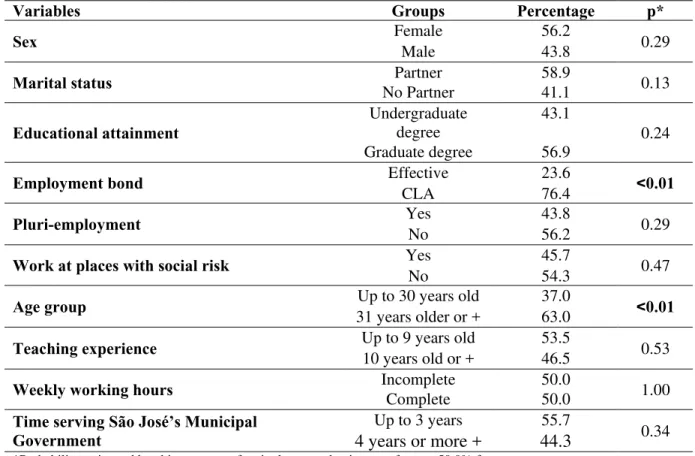
Results of sociodemographic variables of the investigated group (Table 1) revealed homogeneity in the distribution of Physical Education teachers’ characteristics as to sex, marital status, educational attainment, pluri-employment, work at places with social risk, teaching experience, weekly working hours and time serving São José’s Municipal Government. On the other hand, the employment bond (p<0.01) and age group (p<0.01) variables evidenced the sample’s trend, which consisted of a majority of teachers with temporary employment bond (76.4%) and with 31 years of age or over (63.0%).
Table 1. Sociodemographic data on Physical Education teachers.
Variables Groups Percentage p*
Sex Female 56.2 0.29
Male 43.8
Marital status No Partner Partner 58.9 41.1 0.13
Educational attainment
Undergraduate degree
43.1
0.24
Graduate degree 56.9
Employment bond Effective 23.6 <0.01
CLA 76.4
Pluri-employment Yes No 43.8 56.2 0.29
Work at places with social risk Yes 45.7 0.47
No 54.3
Age group 31 years older or + Up to 30 years old 37.0 63.0 <0.01
Teaching experience Up to 9 years old 10 years old or + 53.5 46.5 0.53
Weekly working hours Incomplete Complete 50.0 50.0 1.00
Time serving São José’s Municipal Government
Up to 3 years 55.7
0.34 4 years or more + 44.3
*Probability estimated by chi-square test for single group, having as reference 50.0% for groups. Source: The authors.
Table 2. Percentage of Physical Education teachers satisfied with their job
Job satisfaction Job satisfaction p*
Dissatisfied (%) Satisfied (%)
Overall Assessment 28.8 71.2 <0.01
Remuneration 71.2 28.8 <0.01
Job conditions 52.1 47.9 0.73
Autonomy at work 19.2 80.8 <0.01
Career development 24.7 75.3 <0.01
Social relations 43.8 56.2 0.29
Job laws and norms 20.5 79.5 <0.01
Job and life total space 56.2 43.8 0.29
Job’s social relevance 16.4 83.6 <0.01
*Probability estimated by chi-square test for single group, having as reference 50.0% for groups. Source: The authors.
Concerning a possible association between job satisfaction and employment bond of teachers from the municipal education network, it was possible to observe in the overall assessment and in the eight dimensions that there were no significant statistical differences between effective and temporary teachers, as displayed in Table 3.
Table 3. Job satisfaction of Physical Education teachers by employment bond.
Job satisfaction Employment bond
p* Effective
Md (Q1;Q3)
Temporary Md (Q1;Q3)
Overall assessment 62.50 (18.75 ; 75.00) 62.50 (25.00 ; 87.50) 0.40
Remuneration -16.67 (-54.17 ; 16.67) 0.00 (-16.67 ; 33.33) 0.10
Job conditions 38.89 (-27.78 ; 55.56) 16.67 (-16.67 ; 38.89) 0.33
Autonomy at work 55.56 (30.56 ; 66.67) 61.11 (22.22 ; 77.78) 0.72
Career development 50.00 (25.00 ; 66.67) 41.67 (8.33 ; 66.67) 0.26
Social integration at work 20.00 (6.67 ; 60.00) 33.33 (6.67 ; 46.67) 0.97
Job laws and norms 58.33 (29.17 ; 75.00) 50.00 (25.00 ; 75.00) 0.80
Job and life total space 0.00 (-33.33 ; 41.67) 16.67 (-16.67 ; 50.00) 0.20
Job’s social relevance 66.67 (38.89 ; 88.89) 66.67 (44.44 ; 88.89) 0.91
*Probability estimated by Mann-Whitney U Test Source: The authors.
Table 4. Job satisfaction among Physical Education teachers by time serving São José’s
Municipal Government
Job satisfaction Time serving SJMG
p* Up to 3 Years
Md (Q1;Q3)
4 Years or + Md (Q1;Q3)
Overall assessment 62.50 (12.50 ; 75.00) 75.00 (25.00 ; 87.50) 0.04
Remuneration 0.00 (-25.00 ; 33.33) 0.00 (-25.00 ; 25.00) 0.94
Job conditions 11.11 (-16.67 ; 38.89) 27.78 (-16.67 ; 55.56) 0.32
Autonomy at work 50.00 (22.22 ; 72.22) 66.67 (22.22 ; 83.33) 0.21
Career development 41.67 (16.67 ; 58.33) 58.33 (25.00 ; 75.00) 0.08
Social integration at work 20.00 (0.00 ; 40.00) 33.33 (13.33 ; 60.00) 0.09
Job laws and norms 50.00 (25.00 ; 66.67) 58.33 (33.33 ; 91.67) 0.07
Job and life total space 0.00 (-16.67 ; 66.67) 33.33 (-16.67 ; 50.00) 0.72
Job’s social relevance 55.56 (33.33 ; 77.78) 77.78 (55.56 ; 100.00) 0.02
*Probability estimated by Mann-Whitney U Test Source: The authors.
Assessing job satisfaction by teaching time (Table 5), it was possible to observe that teachers with up to nine years found themselves less satisfied with the dimensions: autonomy at work (p<0.01); career development (p<0.01); social integration at work (p=0.02); and job’s social relevance (p<0.01).
Table 5. Job satisfaction among Physical Education teachers by teaching time.
Job satisfaction
Teaching time
p* Up to 9 Years
Md (Q1;Q3)
10 Years or + Md (Q1;Q3)
Overall assessment 62.50 (21.88 ; 75.00) 75.00 (25.00 ; 87.50) 0.10
Remuneration 0.00 (-25.00 ; 16.67) 16.67 (-50.00 ; 33.33) 0.49
Job conditions 11.11 (-16.67 ; 38.89) 33.33 (-11.11 ; 50.00) 0.20
Autonomy at work 50.00 (20.83 ; 66.67) 72.22 (47.22 ; 83.33) <0.01
Career development 29.17 (6.25 ; 50.00) 58.33 (41.67 ; 75.00) <0.01
Social integration at work 23.34 (-10.00 ; 40.00) 33.33 (13.33 ; 60.00) 0.02
Job laws and norms 50.00 (20.83 ; 75.00) 50.00 (33.33 ; 83.34) 0.16
Job and life total space 8.34 (-16.67 ; 50.00) 16.67 (-25.00 ; 50.00) 0.98
Job’s social relevance 50.00 (30.55 ; 77.78) 77.78 (55.56 ; 88.89) <0.01
*Probability estimated by Mann-Whitney U Test Source: The authors.
Discussion
The overall assessment of job satisfaction among Physical Education teachers from São José’s Municipal network revealed that they are satisfied with their job. Such information corroborates results of studies conducted with Physical Education teachers from the state education networks of Rio Grande do Sul14,17,18, Santa Catarina15,16 and Paraná20,21, as well as from Porto Alegre’s municipal education network19,23. On the other hand, it is worth stressing that a study carried out with professors from a private institution in the state of Goiás found higher satisfaction percentages and expressly lower job dissatisfaction values29 compared to the Physical Education teachers participating in this study and mentioned researches.
conditions, as well as the worker’s personal evaluation. In this way, it can be highlighted among the dimensions established in this research that assesses the job satisfaction construct, that the Physical Education teachers were satisfied with the following components: job’s social relevance; autonomy at work; job laws and norms; and career development. However, they claimed to be dissatisfied with remuneration.
In line with these results, we can find in the literature publications by Both, Nascimento and Borgatto15, Farias et al.17, Folle et al.18, Moreira et al.19,20, Both et al.22,31, in which the authors found the same job satisfaction factors, as well as strong dissatisfaction with remuneration. Likewise, Kleinfeld, McDiarmid and Williamson32, Jabnoun and Fook33
and Zembylas and Papanastasiou34 revealed that teachers from schools in Alaska, Malaysia and Cyprus, respectively, find themselves dissatisfied with social relations established at the institution and with the social relevance of their job. On the other hand, teachers from Cyprus34 proved dissatisfied with the impact of social problems on their everyday activity, with students’ lack of interest and bad behavior, as well as with lack of professional autonomy in schools and possibilities of professional promotion, whereas teachers from Alaska found themselves dissatisfied with the school’s location and administrative matters32. Additionally, Jabnoun and Fook33, Koustelios1 and Haisan e Bresfelean35 also identified that teachers from schools in Malaysia, Greece and Romania were dissatisfied with their wage conditions. From this perspective, it is made evident that results revealed in studies from different countries corroborate Nilan’s36 statement that teachers, for being mostly public servers, have a relatively low income for the job they perform and the social responsibility they carry.
Public teaching, whether federal, state or municipal, enables teachers to conquer a permanent job, stability and chances of career development after being approved in public tenders, which oftentimes means a social status and protection as they become part of the public administration’s permanent staff37. From this perspective, it is worthy of attention the fact that 76.4% of the Physical Education teachers from the researched education network are CLAs.
This information surveyed in the present study is characterized as a matter of concern within Education public policies, since teacher turnover can influence the quality of teaching, the continuity of pedagogical practice developed within school sphere and the teacher’s professional development. However, it is worth highlighting that although CLA teachers do not have stability in the investigated education network, they find themselves satisfied in the overall evaluation with their quality of life at work and with the dimension called career development; then, it is possible to infer that they consider that this institution enables constant updating (ongoing training) and application of knowledge acquired during courses, in addition to ensuring monthly salary payment27. Such results are similar to those published by Folle et al.38 in a study conducted with Physical Education teachers from three municipal education networks in the state of Santa Catarina, in which it was found that the percentage of CLA teachers satisfied with their profession was higher than that of effective ones. Valle37 corroborates that professional stability takes on diverse aspects throughout one’s career. Thus, substitute teachers increasingly long for the status of their permanent peers and, consequently, engage themselves intensely in achieving it.
On the other hand, Florianópolis’ permanent teachers also found themselves satisfied with opportunities of career development and the overall job evaluation. Similarly, in a study with teachers from three municipal secretariats of Education in Santa Catarina, Folle et al.38 found that substitute teachers were more satisfied with their jobs than their permanent peers, just as observed in the present investigation.
Concerning the association between job satisfaction and time of service in the municipal network, the information found revealed that teachers with four years or more serving São José’s Municipal Government were more satisfied in the overall assessment and in the job’s social relevance dimension. Such data differ from those presented by Farias et al.23 in a study with teachers from Porto Alegre’s Municipal Government, RS, which found greater satisfaction only in the job’s social relevance dimension among teachers with longer time serving the specific education network.
As to association between job satisfaction and teaching time, the findings evidenced that the longer the time working in Education, the greater the satisfaction in the overall evaluation with the job. These results are similar to data presented by Lemos, Nascimento e Borgatto14, Farias et al.17 and Catapan et al.39. Contrarily, investigations by Gomes, Borges e Nascimento13, Both, Nascimento e Borgatto15 and de Moreira et al.20 found that teachers starting their career were more satisfied with their jobs than their peers going through the last stages of their professional journey.
When it comes to the relationship between job satisfaction dimensions and the teachers’ teaching time, it was found that those teachers with less than nine years of professional intervention were less satisfied with autonomy at work, career development, social integration at work and job’s social relevance. It is thus inferred that greater satisfaction with career development is possibly linked to benefits arising from a perspective of becoming a permanent teacher, which usually happens after few years teaching. In this context, Valle37 reinforces that teaching instability, mainly experienced during the first teaching years, has been referenced as a big reason for dissatisfaction with this profession among new teachers.
Despite the limitation found in the development of the study as to reaching all teachers working within the investigated context, due to the extension of the questionnaire used in the research, relevant information was identified in the investigation, allowing for the verification of practical implications that enable reflections around a political reformulation towards favorable labor conditions, quality and satisfaction in the teaching field. This study thus suggests the conduction of further investigations that expand the theoretical and empirical foundation about the theme in question. The publishing of such knowledge aims at promoting actions that contribute to a better performance of professionals responsible for the formation of future generations, which, consequently, will result in the qualification of teaching systems.
Conclusions
Physical Education teachers from São José’s municipal education network, SC, are mostly satisfied with their quality of life at work, especially with dimensions referring to social relevance, autonomy, laws and norms, and career development, being dissatisfied with the dimension called remuneration.
No significant statistical differences have been found concerning the relationship between job satisfaction and employment bond, whereas significant associations were evidenced between overall evaluation of quality of life at work, time of service in the network and teaching time.
1. Koustelios AD. Personal characteristics and job satisfaction of greek teachers. International J Manag Educ 2001;15(7):354-358. Doi: 10.1108/EUM0000000005931.
2. Locke EA. The nature and causes of job satisfaction. In: Dunnette MD, editor. Handbook of industrial and organizational psychology. Chicago: Rand McNally; 1976, p. 1297-349. 3. Locke EA. Job satisfaction. In: Gruneberg M, Wall T, editores. Social Psychology and
organizational behaviour. New York: John Wiley and Sons; 1984, p. 93-117.
4. Martinez MC, Paraguay AIBB, Latorre MRDO. Relação entre satisfação com aspectos psicossociais e saúde dos trabalhadores. Rev Saúde Pública 2004;38(1):55-61. Doi: 10.1590/S0034-89102004000100008.
5. Tamayo A. Valores organizacionais. In: Tamayo A, Borges JE, Codo AW, editores. Trabalho, organização e cultura. São Paulo: Cooperativa de Autores Associados; 1996, p. 175-193.
6. Ferreira ACM. Satisfação no trabalho de docentes de uma instituição pública de ensino superior:reflexos na qualidade de vida. [Dissertação de Mestrado em Enfermagem]. Goiânia: Universidade Federal de Goiás. Programa de Pós-Graduação em Enfermagem; 2011.
7. Ramos S. (In)Satisfação e stress na profissão docente. Interacções 2004;6:87-130.
8. Lapo FR, Bueno BO. Professores, desencanto com a profissão e abandono do magistério. Cad Pesqui 2003;118:65-88. Doi: 10.1590/S0100-15742003000100004.
9. Seco GB. A satisfação na actividade docente. [Tese de Doutorado em Ciências da
Educação]. Coimbra: Universidade de Coimbra. Pós-Graduação em Ciências da Educação; 2000.
10. Bogler R. Two profiles of schoolteachers:a discriminant analysis of job satisfaction. Teach Teach Educ 2002;18(6):665-673.
11. Okpara JO, Squillace M, Erondu EA. Gender differences and job satisfaction: a study of university teachers in the United States. Women Manag Rev 2005;20(3-4):177-190. Doi: 10.1108/09649420510591852.
12. Proni MW. Universidade, profissão Educação Física e o mercado de trabalho. Motriz Rev Edu Fis 2010;16(3):788-798. Doi:10.5016/1980-6574.2010v16n3p788.
13. Gomes MA, Borges LJ, Nascimento JV. Ciclos de desenvolvimento profissional e a qualidade de vida dos professores de Educação Física da região Sudoeste da Bahia. REFELD 2007;2(4):104-114.
14. Lemos CAF, Nascimento JV, Borgatto AF. Parâmetros individuais e sócio-ambientais da qualidade de vida percebida na carreira docente em educação física. Rev Bras Educ Fís Esporte 2007;21(2):81-93.
15. Both J, Nascimento JV, Borgatto AF. Percepção da qualidade de vida no trabalho ao longo da carreira docente em Educação Física. Rev bras cineantropom desempenho hum 2008;10(4):372-378.
16. Both J, Nascimento JV, Borgatto AF. Percepção da qualidade de vida no trabalho e perfil do estilo de vida dos docentes de Educação Física do estado de Santa Catarina. Rev Educ Fís UEM 2008;19(3): 377-389. Doi: 10.4025/reveducfis.v19i3.5993.
18. Folle A, Lemos CAF, Nascimento JV, Both J, Farias GO. Carreira no magistério público e nível de qualidade de vida no trabalho docente em Educação Física. Motriz Rev Edu Fis 2008;14(3):210-221. Doi: http://dx.doi.org/10.5016/1396.
19. Moreira HR, Farias GO, Both J, Nascimento JV. Qualidade de vida no trabalho e Síndrome de Burnout em professores de Educação Física do estado do Rio Grande do Sul, Brasil. Rev Bras Ativ Fís Saúde 2009;14(2):155-122.
Doi:10.12820/rbafs.v.14n2p115-122.
20. Moreira HR, Nascimento JV, Sonoo CN, Both J. Qualidade de vida do trabalhador docente em Educação Física do estado do Paraná, Brasil. Rev bras cineantropom desempenho hum 2010;12(6):435-442. Doi: 10.5007/1980-0037.2010v12n6p435.
21. Moreira HR, Nascimento JV, Sonoo CN, Both J. Qualidade de vida no trabalho e perfil do estilo de vida individual de professores de Educação Física ao longo da carreira docente. Motriz Rev Edu Fis 2010;16(4):900-912. Doi: 10.5016/1980-6574.2010v16n4p900. 22. Both J, Nascimento JV, Sonoo CN, Lemos CAF, Borgatto AF. Bem estar do trabalhador
docente de Educação Física da região sul do Brasil de acordo com os ciclos vitais. Rev Bras Educ Fís Esporte 2014;28(1):77-93. Doi: 10.1590/S1807-55092014000100077.
23. Farias GO, Both J, Folle A, Pinto MG, Nascimento JV. Satisfação no trabalho de professores de Educação Física do magistério público municipal de Porto Alegre. Rev Bras Cien Mov 2015;23(3):5-13. Doi: 10.18511/0103-1716/rbcm.v23n3p5-13.
24. Both J, Nascimento JV. Condições de vida do trabalhador docente em Educação Física do magistério público municipal de Florianópolis. Cad Educ Fís 2010;9(1):11-28.
25. Triviños ANS. Introdução à pesquisa em ciências sociais: a pesquisa qualitativa em educação. São Paulo: Atlas; 1987.
26. IBGE. [internet] Cidades:Santa Catarina, São José, Informações Completas.2016. [acesso em 17 jun 2016]. Disponível em:
<http://www.cidades.ibge.gov.br/xtras/perfil.php?lang=&codmun=421660&search=||info gr%E1ficos:-informa%E7%F5es-completas>.
27. Both J, Nascimento JV, Lemos CAF, Donegá AL, Ramos MHKP, Petroski EC. et al. Qualidade de vida no trabalho percebida por professores de Educação Física. Rev Bras Cineantropom Desempenho Hum 2006;8(2):45-52.
28. Lemos CAF. Qualidade de vida na carreira profissional de professores de educação física do magistério público estadual/RS. [Dissertação em Educação Física]. Florianópolis: Universidade Federal de Santa Catarina. Programa de Pós-Graduação em Educação Física; 2007.
29. Silva IO. Qualidade de vida no trabalho em professores universitários. Colec Pesqui Educ Fís2011;10(2):133-140.
30. Martinez MC. As relações entre a satisfação com aspectos psicossociais no trabalho e a saúde do trabalhador. [Dissertação de Mestrado em Saúde Ambiental]. São Paulo: Universidade de São Paulo. Programa de Pós-Graduação em Saúde Pública; 2002. 31. Both J, Nascimento JV, Sonoo CN, Lemos CAF, Borgatto AF. Bem-estar do trabalhador
docente em Educação Física ao longo da carreira. Rev Educ Fís UEM 2013;24(2): 233-246. Doi: 10.4025/reveducfis.v24i2.16114.
33. Jabnoun N, Fook CY. Job satisfaction of secondary school teachers
in Selangor, Malaysia. Int J economics commerce manag. 2001;11(3-4):72-90. Doi:10.1108/eb047428.
34. Zembylas M, Papanastasiou E. Sources of teacher job satisfaction and dissatisfaction in Cyprus. J Comp Edu 2006;36(2):229-247.
35. Hăisan AA, Bresfelean VP. A data mining examination on the Romanian Educational
System – teachers’ viewpoint. Int J Mathematical Models Methods Appl Sci 2013;7(3):277-285.
36. Nilan P. Teachers’ work and schooling in Bali. Int Rev Educ 2003;49(6):563-584.
37. Valle IR. A era da profissionalização: formação e socialização do corpo docente de 1ª a 4ª série.Florianópolis: Cidade Futura; 2003.
38. Folle A, Borges LJ, Coqueiro RS, Nascimento JV. Nível de (in)satisfação profissional de professores de Educação Física da Educação Infantil. Motriz Rev Edu Fis
2008b;14(2):124-134. Doi:10.5016/1198.
39. Catapan A, Bonfim BLS, Panucci Filho L, Oliveira EG, Vila EW, Reis EB. Qualidade de vida no trabalho (QVT): uma análise em professores do Ensino Médio e Superior do Brasil. R Bras Quali Vida2014;6(2):130-138.
Recebido em 20/12/15. Revisado em 15/06/16. Aceito em 28/06/16.