Mental health promotion in school context –
Validation of the ES’COOL scale for teachers
Received: Mar 14, 2018 Accepted: Jun 19, 2018 Published Online: Jun 22, 2018
Journal: Journal of Psychiatry and Behavioral Sciences Publisher: MedDocs Publishers LLC
Online edition: http://meddocsonline.org/
Copyright: ©Tomé G (2018). This Article is distributed
under the terms of Creative Commons Attribution 4.0 International License
*Corresponding Author(s): Gina Tomé FMH & ISAMB, University of Lisbon, Portugal Email: [email protected]
Journal of Psychiatry and Behavioral Sciences
Open Access | Research Article
Cite this article: Tomé G, de Matos MG, Camacho I. Mental Health Promotion in School Context –Validation of the es’cool scale for teachers. J Psychiatry Behav Sci. 2018; 2: 1009.
Gina Tomé*; Margarida Gaspar de Matos; Inês Camacho; Paulo Gomes; Marta Reis; Cátia Branquinho
FMH/University of Lisbon, Portugal
Introduction
In general, a large proportion of young people report them-selves as healthy, happy and satisfied with their circumstances. However, it was estimated that about 20%of youths experience significant stress at times, which raised concerns about the long-term impact of this distress on future adjustment. How-ever, there is evidence that only a small proportion of young people with disorders receive treatment, and that their person-al distress is steadily linked to negative outcomes at school and to overall maladjustment [1].
It is necessary to prevent these problems among young peo-ple and the school reveals itself as the ideal place to carry out this work. In schools, youths make contact with different pro-fessionals on a daily basis. These daily contacts give the trained school staff a chance to interact with children, at which point they can make assessments, counsel, intervene, consult with other trained professionals, and make referrals and follow-up with the youth as needed [2].
There are many reasons why effective mental health inter-ventions for children and adolescents should be developed. 1) Specific mental disorders occur at specific stages of a child and adolescent’s development, screening programs and interven-tions for such disorders can be targeted to the stage at which they are most likely to appear; 2) there is a high degree of continuity between child and adolescent disorders into adult-hood, early intervention could prevent or reduce the likelihood of long-term impairment; 3) effective interventions can reduce the burden of mental health disorders on the individual and the family; 4) the majority of children and adolescents who do not receive treatment may experience significant negative out-comes [3].
The promotion of emotional health and well-being is a core feature of the WHO’s Health Promoting Schools initiative. There is good evidence that mental health promotion programmes in schools, especially those adopting a whole school approach, lead to positive mental health, social and educational outcomes [4]. The school-based programs can reach a large number of
2 children and adolescents from different family backgrounds. Furthermore, the school context represents a natural and an interactive scenario comprising both direct (e.g., family, peers, class, school) and more distal (e.g., cultural, political) settings [5].
In Portugal, mental health used to be until very recently, an extremely deprived area of intervention in school-based health promotion interventions. After a recent national economic re-cession, with severe impact on young people well-being, a new approach to health promotion in Portuguese Schools highlight-ed the importance of having schools embrace mental health as a major focus, together with sexual and reproductive health, substance use, nutrition, active leisure and interpersonal vio-lence. However, except when focusing at very specific social risk contexts, mental health promotion seems to remain the health promotion “taboo”. This fact has pervasive effects on children and adolescent’s wellbeing, once internalizing and externalizing problems in childhood and adolescence are particularly com-mon and particularly relevant, exactly due to their impact on psychosocial development [6].
Research shows that when student’s mental health needs are properly addressed, the likelihood of school success increases. High quality, effective school mental health promotion has been linked to increases in academic achievement and competence; decreases in incidence of problem behaviours; improvements in the relationships that surround each child; and substantive, positive changes in school and classroom climates [7]. Carvalho, Matos & Social Adventure Project Team [6] found in their study that girls reported more emotional symptoms, and boys report-ed more substances’ use. Emotional symptoms and substances’ use increased with age, in contrast school commitment and perception of safe neighbourhood decreased with age [6].
Three decades of research show that prevention programs for adolescents can build resilience, improve academic perfor-mance, facilitate healthy choices and, in turn, minimize risks for violence, substance abuse, and risky sexual behaviour. Preven-tion programs can achieve positive outcomes whether deliv-ered during or after school [8]. The majority of youth preven-tion programming has been designed for schools. However, time for training teachers or implementing ‘‘bulky’’ programs is limited, reflecting a decade of increasing demands on teachers in order to raise standardized test scores and defining priorities that emphasize basic and academic skills and minimize social-emotional goals.
Reports indicate that well-designed school-based programs that are well-implemented can have positive impacts on stu-dents’ mental health (Askell-Williams &Cefai, 2014). For ex-ample, a review by Wells, Barlow, and Stewart-Brown (2003) identified evidenceof effectiveness for programs that adopted a whole-school approach, were implemented continuously for more than a year, and were aimed at the promotion of mental health as opposed to the prevention of mental illness [9]. Still, Durlak, Weissberg, Dymnicki, Taylor, and Schellinger’s (2011) conducted a meta-analysis of 213 social and emotional learning programs (a component of mental health promotion programs) in schools which illustrated that, compared to controls, par-ticipants demonstrated significantly improved, social and emo-tional skills (22% improvement), attitudes (9% improvement), positive social behaviour (9% improvement), conduct problems (9% improvement), emotional distress (9% improvement), and academic attainment (11% improvement) [10].
One essential aspect of integrating mental health under-standing into the classroom is ensuring the classroom teach-ers have an appropriate knowledge base from which to gener-ally identify and support children with mental health concerns. Without a solid understanding of both typical and atypical child development, new or inexperienced teachers may lack the abil-ity to identify children who may be at-risk for mental health is-sues or to provide necessary classroom-based intervention at even a basic level. As such, the importance of incorporating mental health awareness into teacher preparation programs is paramount. Beginning with the incorporation of mental health understanding in teacher training programs and moving into prevention and intervention programs in schools, teachers may become more aware and responsive to the social-emotional needs of their students [11].
Ensuring that teachers, administrators, and other school based staff are aware of mental health issues and have some basic understanding of how to identify suspected mental health concerns is a key first step. Teachers are often the first indi-viduals in a child’s life to flag areas of concern. However, many teachers may not know what symptoms or warning signs to look for in these children or where to refer them if they have concerns. Teachers should have basic training or background in understanding, identifying, and referring children with sus-pected mental health difficulties so that these children may be formally assessed and appropriate treatment or supports put in place [12]. There is a significant reliance on teachers and school staff to have the training and/or expertise to (a) identify chil-dren with possible mental health issues, (b) know what to do when they suspect emotional disabilities in these children (e.g., make appropriate referral to school counsellors or psycholo-gists), and (c) take action to support these students within the school environment [12].
A major challenge to developing a measure that assesses knowledge of factors promoting mental health is that individu-als’ conceptions of what is needed to obtain and maintain men-tal health are highly individualized [13].
However, there is a paucity of evaluations of the tools to measure mental health knowledge. For example, many men-tal health knowledge evaluation tools used in menmen-tal health literacy studies are varied in content, purpose, and quality, which may lead to non-comparable study results and increase risk of biased conclusions. Although sometimes the content of a mental health knowledge tool may be specifically designed to be somewhat different from another depending on the lo-cal community in which it is deployed, tools used must be of acceptable quality as the use of tools with poor quality may re-sult in non-evidenced and unreliable rere-sults when evaluating the effectiveness of mental health interventions or investigat-ing mental health literacy levels in order to develop appropriate interventions in the community [14]. The assessment of mental health literacy is a key aspect in the design and implementation of mental health education and awareness programmes, spe-cifically in school settings, given the high prevalence of mental disorders in adolescents and young people and the need for in-terventions adjusted to specific settings and target groups [15]. In Portugal there are few intervention programs aimed at promoting the mental health of young people through teacher training. There are no tools to assess the impact of training on young people or teachers validated for this specific purpose. Thus, this study aims to validate the “Scale of Mental Health Knowledge and Attitudes in a School Context– ES´COOL” [16,17]
3 for teachers, used in the intervention program ESCOOL, aimed at promoting the mental health of adolescents through teacher training.
ES´COOL Project
The ES’COOL Project arises from the gap in the promotion of mental health in a school context, especially in the training of teachers. The main goal of ES´COOL is to promote adoles-cents’ mental health through capacity building of school teach-ers and school staff. The program aims the development of per-sonal and social skills, and includes the prevention of anxiety and depression symptoms and the promotion of resiliency, and self-regulation in adolescents. Teachers training will allow early-detection of problems that affect adolescents’ mental health and early intervention, improving care effectiveness.
Through the ES´COOL training, it is intended to reduce the existing gap in mental health promotion in the school context, giving the teachers of skills that make them able to transform schools in environments promoters of well-being and conse-quently reduce the problems of mental health among children and adolescents.
It is intended that with the skills obtained during the 40 hours of training and exchange of experiences between partici-pants, the school environment improve, with the development of mental health promoting projects, greater participation of adolescents and parents in the activities proposed by the school, increase communication between students and teach-ers and the involvement of the educational community in the developed projects [16,17].
Methods Participants
The sample was constituted by the teachers who completed the initial evaluation of the ESCOOL training, consisting ofteach-ers of which12.3% are males and 87.7% females with an aver-age aver-age of 47 (SD = 7.3; Min -27; Max- 65) and an averaver-age of 20.2 years (SD = 8.2; Min- 0; Max- 41) of service.
Of the teachers who did the ES´COOL initial evaluation, 70.9% were graduates, 22% had a master’s degree, 2.2% a PhD and 1.9% a bachelor degree.
About 17.9% of teacher’s report that they already have men-tal health training while 82.1% say they do not (Table 1).
Materials
The Questionnaire “ES’COOL - SURVEY MENTAL HEALTH IN SCHOOL CONTEXT (Teacher Version)” consists of demographic issues, the “Scale of Mental Health Knowledge and Attitudes in a School Context – ES´COOL” which was adapted from the “Self-Perception Scale of Risk Behaviours” (Cruz, 2016) and from questions adapted from the Health Behaviour in School Aged Children Questionnaire - HBSC / OMS (2015). Scales were also used to evaluate: life satisfaction, professional satisfaction, problems solving, leadership ability, social environment and in-terpersonal relations in school and skills and knowledge in men-tal health.
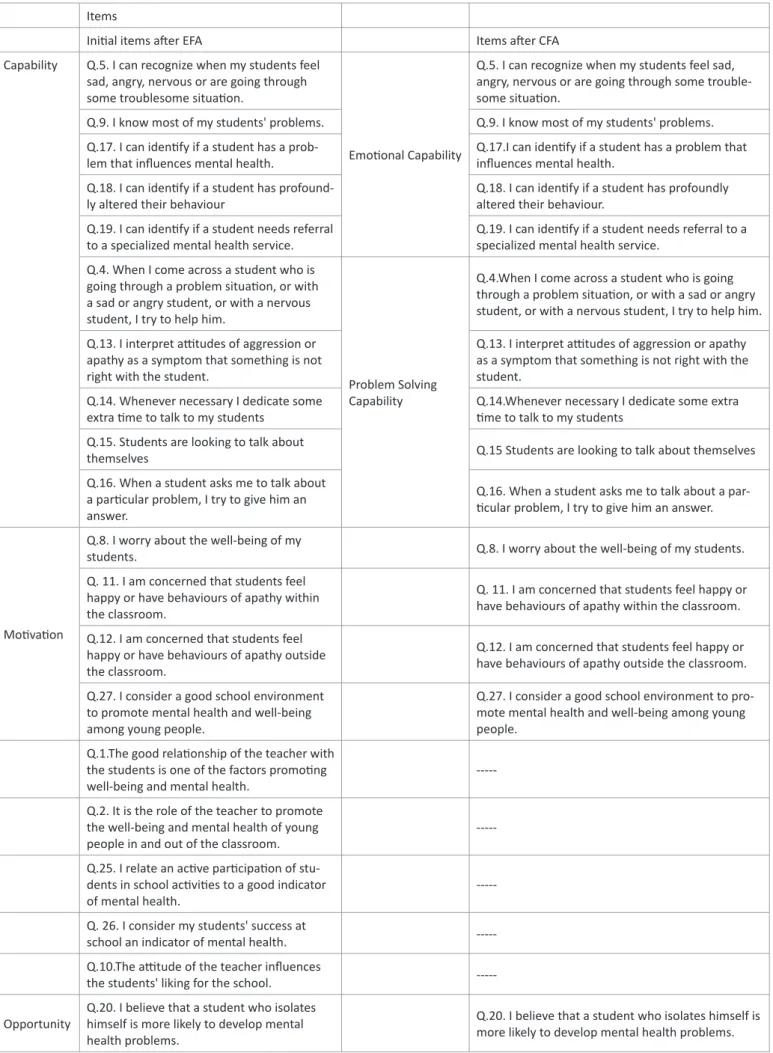
The ES’COOL-“Scale of Mental Health Knowledge and Atti-tudes in a School Context” is a questionnaire consisting of 29 items (Table 2) , whose answers are given according to a 5-point Likert intensity scale in which, the subject should indicate the degree of agreement or disagreement in which 1 = “strongly
disagree “, 3 =” I do not disagree or agree “and 5 =” Strongly agree “.
The analysis of the “Scale of Mental Health Knowledge and Attitudes in a School Context – ES´COOL” was carried out tak-ing into account the Behaviour Change Wheel Model (BCW). The BCW model was developed based on theoretical and evi-denced-based instruments that allow the design and selection of interventions and policies, in agreement with 1) the analysis of behaviour nature; 2) the mechanisms for behaviour change; 3) the interventions and policies needed to change those mech-anisms. In addition, this model grew from the need to identify effective interventions. This system is the COM-B system. The COM-B system suggests that for behavioural change to happen, at least three components are needed:
1. Capacity, i.e., physical and psychologic skills for behaviour change, mainly knowledge and competence;
2. Motivation, i.e., the intention to act, which includes emo-tional and impulsive processes, as well as a reflexive process of decision making;
3. Opportunity, i.e., that no external factors interfere with the behaviour action. In this system, there is a dual interaction between the three factors and the behaviour and a specific in-tervention can change one or more components of the system itself. The BCW model reinforces the context (corresponding to the component Opportunity) as a key factor for the design and implementation of effective interventions. Therefore, be-haviour can only be understood in relationship with the context and both are the starting point for planning interventions [18]. The ES’COOL training tries to reinforce among the teachers the three components described in the model, to reinforce the be-havioural changes and maintain the result of the formation over time.
In the article by Tomé, Matos, Camacho & Gomes (2018), an exploratory factor analysis was performed and the ES’COOL-”Scale of Mental Health Knowledge and Attitudes in a School Context” was reduced to 26 items and three subscales [16], meeting the BCW model [18]. This article aims to validate this instrument, through the accomplishment of a confirmatory fac-torial analysis.
Procedures
The ES’COOL training was implemented with teachers from primary and secondary schools (from 1st to 12th grade), kin-dergarten teachers and special education teachers covering schools from all the regions of Portugal. We had training groups all over Portugal, namely in the North, Center, Lisbon, and Al-garve regions.
The first assessment of the study was conducted one week before the start of the formation, while the second one was car-ried until two weeks after the ES´COOL training. Data collection was performedthrough an online survey, using the Lime survey platform.
This way, we intend to verify the real impact of the training among the participants, namely the level of their knowledge about mental health and their ability to develop promoting well-being and healthy lifestyles projects in their schools.
The training program consists of 40 hours, distributed for 20hours theoretical, formal, in person and 20 “non-face-to-face” hours, practical sessions. The theoretical part addressed
4 several topics, such as: promoting skills, promoting mental health, self-regulation, resilience, active listening, leadership, and entrepreneurship. In the practical part, the participants de-veloped and implemented projects with the technical supervi-sion and evaluation from the ES´COOL technicians. The distance learning modules were carried out through the New Communi-cation Technologies, especially via Skype with sessions between the trainees and trainers. Another method used to conduct the supervision of the work and projects was the use of a forum created on the project site, where all teachers involved in the ES’COOL project can share experiences, doubts, solutions, proj-ects or ideas between themselves and with the supervisors.
The training plan of the formation was the following: Module 1 – Mental Health in School; Module 2 – Project Methodology; Module 3 – Project Design; Module 4 – Project Presentation; Module 5 – Techniques and Strategies for Project Development; Module 6 – Project Implementation in School
Informed consent was obtained from all individual partici-pants included in the study, and ES’COOLfollowed all the rules for research outlined in the Declaration of Helsinki (WMA, 2008) and was approved by the Ethics Committee of the Medi-cal Center of Lisbon. Confidentiality was ensured and data ac-cess restricted to the research team members.
Results
Data was analysed with the statistics program SPSS 24. De-scriptive analysis followed by bivariate analysis was carried out.
With the aims to validate a tool to evaluate attitudes and mental health knowledge, and the impact of the ESCOOL train-ing a Confirmatory Factor Analysis (CFA) was conducted with the EQS 6.2 for windows. Multiple fit indexes were used to eval-uate goodness of fit of models tested in the study: chi-square statistics (χ2),
Comparative Fit Index (CFI), Non-Normed Fit Index (NNFI), Root Mean Square Error of Approximation (RMSEA), and Stan-dardized Root Mean Squared Residual (SRMR).
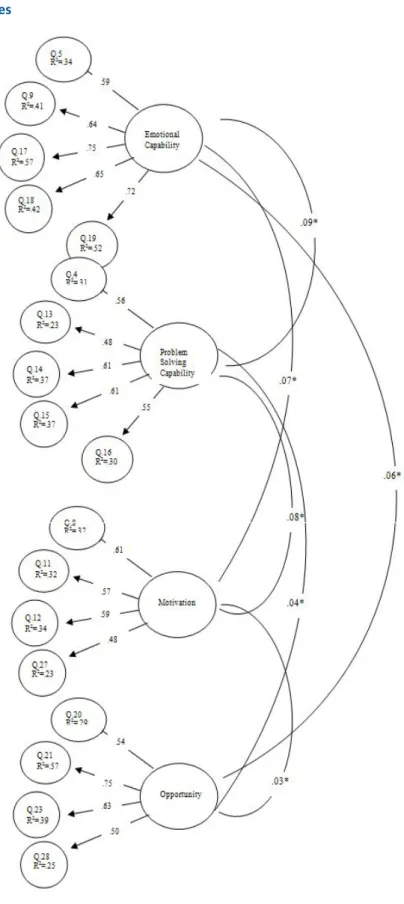
In a previous study [16], an exploratory factor analysis was performed and the “ES’COOL - Scale of Mental Health Knowl-edge and Attitudes in a School Context” was reduced to 26 items and three subscales [16]. In the confirmatory factor anal-ysis, there were not three but four factors on the same scale: Emotional Capability and Problem Solving Capability, Motiva-tion and Opportunity. The Capability factor was split into two factors: Emotional Capability and Problem Solving Capabilityin order to increase the model fit.
The internal consistency of each of the four subscales was also good: Emotional Capabilities α = 0.80, Problem Solving Capabilityα = 0.69, Motivation α = 0.72 and Opportunity α = 0.70 (Table 3). The goodness of-fit estimates reported corre-spond to the robust solution (except for SRMR). In addition, the Satorra-Bentler Chi-square and fit indexes that control non-nor-mality results were used. Alternative fit indexes such as the Comparative Fit Index (CFI), Non-Normed Fitindex (NNFI), Root Mean Square Error of Approximation (RMSEA), Standardized Root Mean Squared Residual (SRMR) are presented. The pro-cedures used to determine factorial invariance included: verifi-cation of configure invariance, in which the equivalence of the specified structure of factor loading is tested (unconstrained model); Simulation studies show that the difference in CFI
be-tween the model with and without restrictions is among the most adequate measures to assume factorial invariance [19].
Table 4 (step 1) shows that the adjustment index of the CFA was acceptable and the model shows a good adequacy. However, the analysis of the results obtained in the Langrange Multiplier test (LM test), a test that assesses the need to add new parameters to the model, showed that the introduction of some connections between factors would decrease significantly the value of the qui-square. A decision was made to add them and to re-evaluate the model (Table 4, step 2). After the intro-duction of these parameters, the results show better levels of the model’s adequacy. Finally, the results obtained in the Wald test, which show the non-significant model parameters, were analyzed. These showed the existence of some non-significant relations, which were eliminated. The results obtained after the elimination of these parameters are shown in Table 4, step 3, and Figure 1.
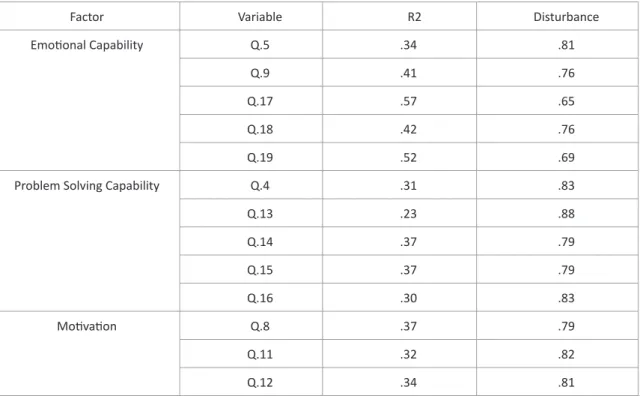
The internal consistency is shown in Table 3, and the ex-plained variance, as well as the residual, for the confirmatory factor analysis model is presented in Table 5. As shown, these values are also appropriate and range from R2 = 0.23 e R2 = 0.57.
In order to analyse the differences between the factors found and some variables was used the Correlation and ANOVA test. Regarding the results observed in the correlations among the factors it can observed that there is a strong positive and significant correlation, between Emotional Capability and Prob-lem Solving Capability (r=.75*); Moderate positive correlation can also be observed between Motivation and between Emo-tional Capability (r=.57*) andbetween Motivation and Problem Solving Capabilitya strong positive correlation can be observed (r=.85*). thus, all factors are strongly associated and when one of them increases the remaining also increases. The associa-tion of factors suggests that the promoassocia-tion of each of the skills worked will increase several other skills for wellbeing. It can be observed moderate positive correlations between Opportunity and Emotional Capability (r=.39*), and Problem Solving Capa-bility (r=.33*) and a weak positive correlation between Oppor-tunity and Motivation (r=.27*) (Table 6).
Regarding the results observed in the ANOVA Test, it can be observed, when comparing the genders, and taking into ac-count the 4 factors of the scale (Emotional Capability; Problem Solving Capability; Motivation; Opportunity), the female are the ones with the highest values in Emotional Capability (M = 18.7, SD = 2.6), and Problem Solving Capability(M = 21.3, SD = 2.1). It was also observed that teachers whose refer that they will put into practice the knowledge and strategies of the ES’ COOL training are the ones with the highest scores in Emotional Capa-bility (M = 18.9, SD = 2.6), Problem Solving CapaCapa-bility(M = 21.6, SD = 2.1) and Motivation (M = 18.0, SD = 1.7) when compared to teachers who say they will not put knowledge into practice acquired in training.
When teachers with the highest professional satisfaction indexes and those with the worst professional satisfaction are compared, the teachers with the highest professional satisfac-tion indexes are those with the highest values in the subscales Emotional Capability (M = 19.1, SD = 2.9), Problem Solving Ca-pability (M = 21.9, SD = 2.1) and Motivation (M = 18.1, SD = 1.7). These results suggest that teachers who start training with greater motivation and interest are also the ones that develop the most competences along the same.The results need to be
5 confirmed with the continuity of the training and with the pre and post evaluation (Table 7).
Discussion
Poor mental health in childhood and adolescence is asso-ciated with health and social problems such as school failure, delinquency and substance misuse, and increases the risk of poverty and other adverse outcomes in adulthood. Interven-tions that promote positive mental health should equip young people with the necessary life skills, supports and resources to fulfil their potential and overcome adversity [4].
In Portugal mental health it is a poorer area of intervention in school-based health promotion interventions [6]. Portugal still needs to deal with several difficulties in the mental health area. Those that deserve special reference are: reduced participation of users and their families; scarce scientific production in the psychiatric and mental health sector; limited response to the needs of vulnerable groups; the lack of promotion/ prevention programs (Caldas, 2009).
The ES’COOL Project arises because of the gap in the pro-motion of mental health in a school context, especially in the training of teachers. The main goal of “ES´COOL” is to promote adolescents’ mental health through capacity building of school teachers and school staff. The program aims the development of personal and social skills and includes the prevention of anxiety and depression symptoms and the promotion of resiliency, and self-regulation in adolescents. Teachers training will allow early-detection of problems that affect adolescents’ mental health and early intervention, improving care effectiveness. One es-sential aspect of integrating mental health understanding into the classroom is ensuring the classroom teachers have an ap-propriate knowledge base from which to generally identify and support children with mental health concerns [11]. However, there is a paucity of evaluations of the tools to measure mental health knowledge. In Portugal there are few intervention pro-grams aimed at promoting the mental health of young people through teacher training. There are no tools to assess the im-pact of training on young people or teachers validated for this specific purpose.
This study aims was validate the ES’COOL - “Scale of Mental Health Knowledge and Attitudes in a School Context” [16,17] for teachers, used in the intervention program ESCOOL. In Tomé and collaborators (2018), was conducted an exploratory factor analysis of the ES’COOL -”Scale of Mental Health Knowledge and Attitudes in a School Context”, used to evaluate the impact of training and also the teachers’ knowledge and attitudes towards mental health. Three factors were found: Capability, Motivation and Opportunity. In this study, was performed a confirmatory factor analysis, in order to validate that scale. The results indi-cated the need to divide the Capability subscale in two different subscales: Emotional Capability and Problem Solving Capability. The model with the four subscales analyzed revealed a good fit, allowing its use in future works.
In addition to the objectives described above, the ESCOOL training is intended to change behaviour in order to allow the promotion of mental health in a school context. Thus, for the construction of “Scale of Mental Health Knowledge and Atti-tudes in a School Context – ES´COOL” is based on the Behaviour Change Wheel Model (BCW). The BCW model was developed based on theoretical and evidenced-based instruments that allow the design and selection of interventions and policies,
in agreement with 1) the analysis of behaviour nature; 2) the mechanisms for behaviour change; 3) the interventions and policies needed to change those mechanisms.
Throughout the training, it was found that the greatest prob-lem for teachers was the lack knowledge of young people men-tal health, which creates an obstacle in early interventions and behaviour change. For Climie&Altomare [11], one essential as-pect of integrating mental health understanding into the class-room is ensuring the classclass-room teachers have an appropriate knowledge base from which to generally identify and support children with mental health concerns. Without a solid under-standing of both typical and atypical child development, new or inexperienced teachers may lack the ability to identify children who may be at-risk for mental health issues or to provide neces-sary classroom-based intervention at even a basic level.
The ESCOOL training works with teachers and other educa-tion professionals to develop their knowledge and strategies, needed to enable early referral of problem situations and devel-opment projects that promote mental health in schools [16,17]. The results indicate that female professionals reveal greater Emotional Capability and Problem Solving Capability than male professional. However, it seems important to work as well on their motivations and their opportunities in order to develop effective projects that deliver positive results, making schools environment promoters of mental health and well- being. The opportunity subscale, which indicates the external factors that may influence the change in behaviour, was the subscale that was not significant in any analysis presented. The difficulty in recognizing signs of unwell and mental health problems can influence and block the active work of education profession-als in the promotion of mental health in a school context. It is clear that those who seek training with intent to put it into practice are more motivated and reveal greater skills, but they also reveal some difficulties in seizing the existing opportuni-ties to promote the well-being of their students, without the necessary knowledge. Also a professional satisfaction of the education professionals seems to influence a motivation and competences in the area of mental health. A good working en-vironment is essential for professionals to feel good and moti-vated to promote the well-being of young people.
Developing a collaborative work among the school commu-nity, families, teachers and all education professionals seems to be the best indicator for the promotion of mental health among young people and among education professionals, preventing various mental health problems. Contemporary social-ecologi-cal perspectives conceive that protective factors for developing positive mental health, (and avoiding mental health difficulties), reside in each person’s psychological world, family contexts (e.g., effective parenting), and environments (e.g., communities and schools) (Askell-Williams &Cefai, 2014).
Transforming the ES’COOL -”Scale of Mental Health Knowl-edge and Attitudes in a School Context” according to the BCW model [18], and verifying the existence of the four factors re-ferred to as essential for behavioural change is a strength of the ESCOOL could make a difference in existing mental health pro-motion programs in the school context and the results obtained in the training show an trend towards change in the teachers whose have been covered by the training. It is also important to check whether teacher training has an impact on the men-tal health of young people, since this is the aim of the project. Changing teachers’ behaviours, by promoting their knowledge, skills, motivations and attitudes, are expected to have a positive
impact on the well-being and mental health of young people. The results suggest the need to continue to work the knowl-edge and attitudes of teachers and other education profession-als, developing skills in the area of mental health in school con-text. The development of projects that involve the entire school community is essential for behaviour change. It is vital that mental health becomes a priority and that it integrates strat-egies for the promotion of young people’s health, as mental health and well-being is an integral and essential part of healthy young people.
Figures
6
7 Tables N % M SD Range. Sample Teachers (1st to 12th grade) 209 77.8 Kindergarten teachers 14 5.2
Special education teachers 34 12.7 Psychologists and other specialists 11 4.1 Gender Male 33 12.3 Female 235 87.7 Age 257 95.9 47 7.3 27-65 Educational Level Bachelor Degree 5 1.9 Graduate 190 70.9 Master 59 22 PhD 6 2.2 Other 8 3 Professional Situation Permanent 172 64.2 Temporary 74 27.6 Other 22 8.2 Years of Service 268 100 20.2 8.2 0-41
Years of service in the current school 268 100 8.1 8.5 0-35 Mental Health Training 268 100 8.1 8.5 0-35
Yes 48 17.9
No 220 82.1
“Consider ESCOOL training important for your work”
Neither a lot nor a little important 3 1.1
Important enough 86 32.1
Very Important 179 66.8
“Have skills to identify and refer young people with mental illness”
None 19 7.1
Few 91 34
Some 110 41
Enough 42 15.7
Many 6 2.2
“Put into practice knowledge and strategies of ESCOOL training”(1-unlikely -5-very likely)
268 100 3.9 .8 2-5
Professional Satisfaction (10- better
satisfaction-0- worse satisfaction) 266 99.3 6.4 1.9 0-10
8
Table 2: ES’COOL - Scale of Mental Health Knowledge and Attitudes in a School Context (results of the exploratory factorial
analy-sis (EFA) and the confirmatory factorial analyanaly-sis (CFA) carried out) Items
Initial items after EFA Items after CFA Capability Q.5. I can recognize when my students feel
sad, angry, nervous or are going through some troublesome situation.
Emotional Capability
Q.5. I can recognize when my students feel sad, angry, nervous or are going through some trouble-some situation.
Q.9. I know most of my students' problems. Q.9. I know most of my students' problems. Q.17. I can identify if a student has a
prob-lem that influences mental health. Q.17.I can identify if a student has a problem that influences mental health. Q.18. I can identify if a student has
profound-ly altered their behaviour Q.18. I can identify if a student has profoundly altered their behaviour. Q.19. I can identify if a student needs referral
to a specialized mental health service. Q.19. I can identify if a student needs referral to a specialized mental health service. Q.4. When I come across a student who is
going through a problem situation, or with a sad or angry student, or with a nervous student, I try to help him.
Problem Solving Capability
Q.4.When I come across a student who is going through a problem situation, or with a sad or angry student, or with a nervous student, I try to help him. Q.13. I interpret attitudes of aggression or
apathy as a symptom that something is not right with the student.
Q.13. I interpret attitudes of aggression or apathy as a symptom that something is not right with the student.
Q.14. Whenever necessary I dedicate some
extra time to talk to my students Q.14.Whenever necessary I dedicate some extra time to talk to my students Q.15. Students are looking to talk about
themselves Q.15 Students are looking to talk about themselves Q.16. When a student asks me to talk about
a particular problem, I try to give him an answer.
Q.16. When a student asks me to talk about a par-ticular problem, I try to give him an answer.
Motivation
Q.8. I worry about the well-being of my
students. Q.8. I worry about the well-being of my students. Q. 11. I am concerned that students feel
happy or have behaviours of apathy within the classroom.
Q. 11. I am concerned that students feel happy or have behaviours of apathy within the classroom. Q.12. I am concerned that students feel
happy or have behaviours of apathy outside the classroom.
Q.12. I am concerned that students feel happy or have behaviours of apathy outside the classroom. Q.27. I consider a good school environment
to promote mental health and well-being among young people.
Q.27. I consider a good school environment to pro-mote mental health and well-being among young people.
Q.1.The good relationship of the teacher with the students is one of the factors promoting
well-being and mental health. ---Q.2. It is the role of the teacher to promote
the well-being and mental health of young
people in and out of the classroom. ---Q.25. I relate an active participation of
stu-dents in school activities to a good indicator
of mental health.
---Q. 26. I consider my students' success at
school an indicator of mental health. ---Q.10.The attitude of the teacher influences
the students' liking for the school. ---Opportunity Q.20. I believe that a student who isolates himself is more likely to develop mental
health problems.
Q.20. I believe that a student who isolates himself is more likely to develop mental health problems.
Q. 21. I believe that students who have par-ents with mental health problems are more likely to develop mental health problems.
Q. 21. I believe that students who have parents with mental health problems are more likely to develop mental health problems.
Q. 23. I consider that students from prob-lematic families are more likely to develop mental health problems.
Q. 23. I consider that students from problematic families are more likely to develop mental health problems.
Q.28. I consider that students identified as having some mental health problem are more likely to have failed school.
Q.28. I consider that students identified as having some mental health problem are more likely to have failed school.
Q.7. I believe that a student who is irrespon-sible in class is more likely to have a mental
illness.
---Q. 22. I consider that students from disad-vantaged families are more likely to develop
mental health problems. ---Q.24. I consider mental illness a clinical
con-dition, like other diseases.
---9
Table 3: ES’COOL - Scale of Mental Health Knowledge and Attitudes in a School Context - Internal consistency of the
scales
Factors Items N M SD Cronbach
Emotional Capability 5 268 18.5 2.8 .80 Problem Solving Capability 5 268 21.1 2.2 .69
Motivation 4 268 17.6 1.9 .72
Opportunity 4 268 14.1 2.3 .70
Table 4: ES’COOL - Scale of Mental Health Knowledge and Attitudes in a School Context - Adjustment indexes
χ2 (g.l.) CFI NNFI RMSEA (90% I.C.)2 SRMR
Step 1 464.76 (224) .83 .81 .063 (.055-.071) .082
Step 2 316.30 (146) .86 .84 .066 (.056-.076) .090
Step 3 222.73(127) .92 .90 .053 (.041-.064) .070
Table 5: ES’COOL - Scale of Mental Health Knowledge and Attitudes in a School Context - Explained Variance
Factor Variable R2 Disturbance
Emotional Capability Q.5 .34 .81
Q.9 .41 .76
Q.17 .57 .65
Q.18 .42 .76
Q.19 .52 .69
Problem Solving Capability Q.4 .31 .83
Q.13 .23 .88 Q.14 .37 .79 Q.15 .37 .79 Q.16 .30 .83 Motivation Q.8 .37 .79 Q.11 .32 .82 Q.12 .34 .81
10 Q.27 .23 .88 Opportunity Q.20 .29 .84 Q.21 .57 .65 Q.23 .39 .78 Q.28 .25 .87
Table 6: ES’COOL - Scale of Mental Health Knowledge and Attitudes in a School Context - Correlation among the
scales (Fig 2 - 4 factors)
Capability 1 Capability 2 Motivation Opportunity Emotional Capability - .75* .57* .39* Problem Solving Capability - - .85* .33*
Motivation - - - .27*
*p<.001
Table 7: ES’COOL - Scale of Mental Health Knowledge and Attitudes in a School Context - Comparisons among mental health subscales
by gender, expectations and satisfaction (ANOVA)
Gender Male Female
N M SD N M SD F p
Emotional Capability 33 16.9 3.4 235 18.7 2.6 12.483 .000
Problem Solving Capability 33 19.9 2.6 235 21.3 2.1 10.688 .001
Motivation 33 17.3 2.3 235 17.7 1.8 1.299 .255 Opportunity 33 14.3 2.4 235 14.1 2.3 .310 .578
Will use ESCOOL training Unlikely Very likely
N M SD N M SD F p
Emotional Capability 70 17.2 2.7 198 18.9 2.6 21.653 .000
Problem Solving Capability 70 19.9 2.1 198 21.6 2.1 31.771 .000
Motivation 70 16.6 2.1 198 18 1.7 32.625 .000
Opportunity 70 13.8 2.3 198 14.2 2.3 2.026 .156
Professional Satisfaction worse satisfaction better satisfaction
N M SD N M SD F p
Emotional Capability 180 18.2 2.7 86 19.1 2.9 7.116 .008
Problem Solving Capability 180 20.7 2.2 86 21.9 2.1 17.566 .000
Motivation 180 17.5 1.9 86 18.1 1.7 5.829 .016
References
1. Allen KA, McKenzie VL. Adolescent mental health in an Austra-lian context and future interventions. 2015; 44: 80-93.
2. Blackman KF, Powers JD, Edwards JD, Wegmann KM, Lechner E, Swick DC. Closing the Gap: Principal Perspectives on an Innova-tive School-Based Mental Health Intervention. 2016; 48: 245. 3. Cho SM, Shin YM. The promotion of mental health and the
pre-vention of mental health problems in child and adolescent. Ko-rean J Pediatr. 2013; 56: 459-464.
4. Barry MM, Clarke AM, Jenkins R, Patel V. A systematic review of the effectiveness of mental health promotion interventions for young people in low and middle income countries. BMC Public Health. 2013; 13: 835.
5. Bjorklund K, Liski A, Samposalo H, Lindblom J, Hella J, Huhtin-en H, et al. “Together at school”--a school-based intervHuhtin-ention program to promote socio-emotional skills and mental health in children: study protocol for a cluster randomized controlled trial. BMC Public Health. 2014; 14: 1042.
6. Carvalho M, Matos MG, Team SAP. Psychosocial determinants of mental health and risk behaviours in adolescents. Glob J Health Sci. 2014; 6: 22-35.
7. Baskaran M, Sekar U, Kokilavani N. Pilot Study of Mental Health Programme on Promoting Mental Health Characteristics among Adolescents in PSG Schools, Coimbatore. International Journal of Nursing Education. 2016; 8: 161-166.
8. Boustani MM, Frazier SL, Bechor M, Hedemann ER, Ogle RR, Becker KD, et al. Common Elements of Adolescent Prevention Programs: Minimizing Burden While Maximizing Reach. Admin-istration and Policy in Mental Health and Mental Health Services Research. 2015; 42: 209-219.
9. Jane W, Jane B, Sarah SB. A systematic review of universal ap-proaches to mental health promotion in schools. Health Educa-tion. 2003; 103: 197-220.
10. Durlak JA, Weissberg RP, Dymnicki AB, Taylor RD, Schellinger KB. The impact of enhancing students’ social and emotional learn-ing: a meta-analysis of school-based universal interventions. Child Dev. 2011; 82: 405-432.
11
11. Climie E, Altomare AA. Supporting Children with Mental Health Concerns in Classrooms. 2013; 1.
12. Climie EA. Canadian Children’s Mental Health: Building Capacity in School-Based Intervention. 2015; 51: 122-125.
13. Bjornsen HN, Eilertsen MEB, Ringdal R, Espnes GA, Moksnes UK. Positive mental health literacy: development and validation of a measure among Norwegian adolescents. BMC Public Health. 2017; 17.
14. Yifeng W, McGrath PJ, Hayden J, Kutcher S. Measurement prop-erties of tools measuring mental health knowledge: a systematic review. BMC Psychiatry. 2016; 16: 1.
15. Loureiro LM. Questionário de Avaliação da Literacia em Saúde Mental - QuALiSMental: estudo das propriedades psicométricas / Questionnaire for Assessment of Mental Health Literacy - QuALiSMental: study of psychometric properties / Cuestionario de Evaluación de la Alfabetización en la Salud Mental - QuAL-iSMental: estudio de las propiedades psicométricas. Revista de Enfermagem Referência. 2015; 79.
16. Tomé G, Matos MG, Camacho I, Gomes P. ES´COOL- Mental Health Promotion in School Psychology in the Schools, In press. 2018.
17. Tomé G, Matos MG, Gomes P, Camacho I, Gaspar T. Promoção da Saúde Mental nas Escolas – Projeto ES´COOL. Journal of Child and Adolescent Psychology. 2017; 8: 173-184.
18. Michie S, van Stralen MM, West R. The behaviour change wheel: A new method for characterising and designing behaviour change interventions. Implementation Science. 2011; 6: 42. 19. Cheung GW, Rensvold RB. Assessing Extreme and Acquiescence
Response Sets in Cross-Cultural Research Using Structural Equa-tions Modeling. Journal of Cross-Cultural Psychology. 2000; 31: 187-212.