(Annals of the Brazilian Academy of Sciences) ISSN 0001-3765
www.scielo.br/aabc
Bromophenol concentrations in fish from Salvador, BA, Brazil
ALINE S. OLIVEIRA3, VILMA M. SILVA1, MÁRCIA C.C. VELOSO2, GISLAINE V. SANTOS3 and JAILSON B. DE ANDRADE1
1Instituto de Química, Universidade Federal da Bahia, UFBA, Rua Barão de Geremoabo s/n
Campus Universitário de Ondina, 40170-290 Salvador, BA, Brasil
2Centro Federal de Educação Tecnológica da Bahia, CEFET-BA, Rua Emídio dos Santos s/n
Barbalho, 40625-650 Salvador, BA, Brasil
3Instituto de Biologia, Universidade Federal da Bahia, UFBA, Rua Barão de Geremoabo s/n
Campus Universitário de Ondina, 40170-290 Salvador, BA, Brasil
Manuscript received on July 14, 2008; accepted for publication on October 7, 2008; contributed byJAILSONB.DEANDRADE∗
ABSTRACT
The main objective of this work is to evaluate the occurrence of bromophenols (2-bromophenol, 4-bromophenol, 2,4-dibromophenol, 2,6-dibromophenol and 2,4,6-tribromophenol), in the flesh and guts in two species of the Lutjanidae Family:Lutjanus synagrisandOcyurus chrysurus. The bromophenols were extracted by steam distillation with pentane-ether (7:3 v/v), identified by reverse phase High Performance Liquid Chromatography (HPLC-UV), and quantified by the external-standard method. Total bromophenol concentrations were similar in the muscle of both species, ranging from 36 ng g–1to 349 ng g–1. The total bromophenol concentrations in stomach (ranging from 12 ng g–1to 586 ng g–1) were slightly higher than in muscle. The presence of bromophenol in the muscles of the species under study may occur as a result of their diet. The results of this work are therefore expected to contribute toward a better understanding of the path of bromophenol absorption from the fish’s stomach to the rest of its body.
Key words:bromophenols, flavor, marine fishes,Lutjanus,Ocyurus.
INTRODUCTION
Flavor, or the consumer’s perception thereof, is an im-portant attribute of the quality of marine fishes and other seafoods (Lindsay 1990, Stansby 1962), and is the first and principal discriminative factor in his evaluation, ac-ceptance, rejection or preference for the product (Boyle et al. 1992a). This fact has led to extensive research in several areas, including agriculture and the food and beverage industry, aimed at putting on the market prod-ucts of excellent nutritional quality and especially of pleasant flavor (Lindsay 1990).
The success of aquaculture products has been ham-pered by problems relating to the quality of their flavor,
*Member Academia Brasileira de Ciências Correspondence to: Jailson B. de Andrade E-mail: [email protected]
since many consumers can clearly distinguish the differ-ence between the flavor of cultivated and wild harvest seafoods (Boyle et al. 1992a). Knowledge of the factors and chemical substances that determine flavor can con-tribute significantly to the improvement and expansion of aquaculture and to the preservation, storage, control and improved quality of seafoods.
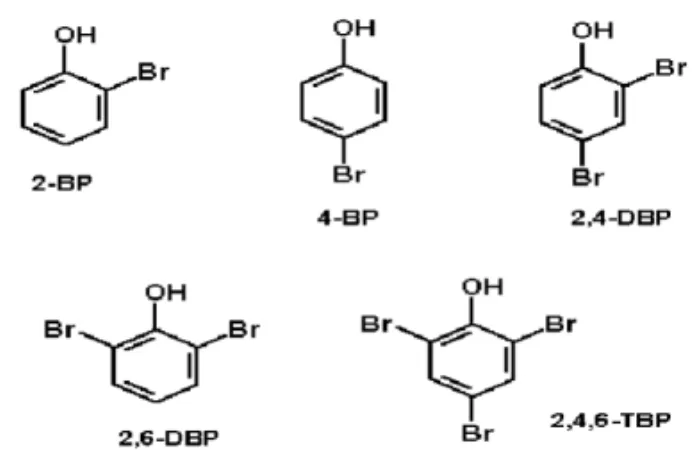
4-bromo-phenol (4-BP), 2,4-dibromo4-bromo-phenol (2,4-DBP), 2,6-dibromophenol (2,6-DBP) and 2,4,6-tribromophenol (2,4,6-TBP), (Fig. 1) in water, have very low sensory threshold concentrations in the ng g–1 range (Whitfield 1988).
Fig. 1 – Simple bromophenols: 2-bromophenol (2-BP); 4-bromo-phenol (4-BP); 2,4-dibromo4-bromo-phenol (2,4-DP); 2,6-dibromo4-bromo-phenol (2,6-DP) and 2,4,6-tribromophenol (2,4,6-TBP).
Bromophenols, which have been found in marine fishes (Boyle et al. 1992a, Whitfield et al. 1998), crus-taceans (Chung et al. 2003a, Whitfield et al. 1997, 2002) and mollusks (Boyle et al. 1992a), are strongly associ-ated with pleasant (marine- or ocean-like) or unpleasant (plastic-, medicinal-, disinfectant-, iodoform or iodine-like) flavors, alone or in different combinations and con-centrations. Marine food gourmets describe the flavor of some fish species as mildly candy-like and others as marine or oceanic-like, which is characteristic of the presence of bromophenols in different concentrations (Whitfield et al. 1998). Boyle et al. (1992a), who com-pared four Pacific salmon species (Oncorhynchus spp) from marine and freshwater environments, found that the marine species contained 6.1 to 34.8 ng.g–1 of to-tal bromophenols while the freshwater species not only contained none of the five bromophenols investigated but also had none of the characteristic oceanic-like fla-vor. Although 2,4-DBP and especially 2,4,6-TBP have been considered important anthropic pollutants (playing an important role as industrially produced flame retardant and pesticides) (Polo et al. 2006), the presence of bro-mophenols in these marine organisms has been attributed to their natural diets; in other words, these compounds may come from other species in the food chain. De-spite of their importance does not exists limit value to the bromophenol content in marine species.
According to previous studies, bromophenols have been detected in a variety of other marine organ-isms such as macroalgae (Chung et al. 2003b, Lee et al. 2007, Pedersén et al. 1974, Phillips and Towers 1981, Whitfield et al. 1992b, 1999a, Xu et al. 2003), poly-chaetes (Goerke and Weber 1990, 1991, Steward and Lovell 1997, Whitfield et al. 1999b), sponges (Hattori et al. 2001, Unson et al. 1994, Vetter and Janussen 2005) and bryozoans (Whitfield et al. 1999b), which are a major dietary source for many marine organisms including fish (Whitfield et al. 1997, 1998, 1999a, 1999b, Ma et al. 2005).
The flavor of marine fishes varies depending on the location and time of year when they were caught (Whitfield et al. 1995), and the diet of certain fish species can vary considerably according to the availability of alimentary components, which depends on seasonal variations (Whitfield et al. 1998). It is believed that the bromophenols in marine fish come from their natural diet (Whitfield et al. 1998). This hypothesis is strongly supported by the fact that bromophenols have been de-tected in the stomach content and the flesh, with higher concentrations in the former (Chung et al. 2003a, Whit-field et al. 1995), allied to the fact that benthic carnivo-rous fishes feeding on polychaetes and herbivocarnivo-rous fishes feeding on macroalgae have a strong flavor while piscivo-rous fishes feeding primarily on other fish do not contain these bromophenols (Whitfield et al. 1994, 1995, 1996). However, the identification of specific organisms that may introduce bromophenols into the diet of ma-rine fish requires a broader investigation (Whitfield et al. 1996, 1998). Some reports suggest that fish do not accumulate bromophenols, but gradually metabolize or excrete them (Whitfield et al. 1992b, Anthoni et al. 1990). Therefore, studies are needed to establish the route whereby bromophenols are transferred to different fish species.
species their particular flavor (Santos et al. 2001, Veloso et al. 2001). The purpose of this work was therefore to evaluate the occurrence of bromophenols in the flesh and guts (stomach content and pyloric ceca or appendices) of two species of the Lutjanidae family,Lutjanus synagris andOcyurus chrysurus, and to identify the probable ali-mentary source of these bromophenols in these species.
MATERIALS AND METHODS
SOLVENTS, REAGENTS ANDSTANDARDS
The bromophenols standards were obtained from Aldrich (Milwaukee, WI), in purities ranging from 97 to 99%. Purified water was obtained by distillation and filtra-tion through an E-pure Alltech system (Deerfield, IL). Acetonitrile (HPLC grade) was obtained from Aldrich and filtered through a 0.45µm membrane. The other
reagents (pentane, diethyl ether, sodium chloride and sulfuric acid) were of analytical grade produced by Merck (Darmstadt, Germany).
COLLECTION ANDPREPARATION OFSAMPLES
Two fish species of the Lutjanidae family were studied: Lutjanus synagrisand Ocyurus chrysurus. Fresh fish caught in the coastal waters of Bahia, Brazil (13◦01′S and
38◦31′W), were purchased from commercial fishermen.
Three specimens of each species were purchased, with an average weight of 1.0 kg and 30 cm length. In the laboratory, the fish were washed in distilled water, gutted, and the flesh was separated from the heads, tails, and backbone.
The flesh was washed in a saturated NaCl solution and then blended into a smooth purée in a food processor (Triton-Arno). Samples of puréed flesh (in portions of 250 g) were stored in sealed polyethylene bags at−15◦C prior to their analysis.
The guts (full stomach contents and pyloric ceca) were dissected, weighed and stored in a refrigerator (0◦C). Subsequently, an incision was made in each
stom-ach to check the types of food items and classify them according to the highest taxon. This material and the pyloric ceca were then blended together into a purée. Stomachs that were empty, everted, or contained bait-like contents were rejected. The samples consisting of three blended stomachs, each weighing about 30 g, were
stored in sealed polyethylene bags at −15◦C until re-quired for analysis.
PREPARATION OFBROMOPHENOLSTANDARDS ANDCALIBRATIONSOLUTIONS
Stock solutions (100 mg mL–1) were prepared by first weighing each bromophenol and then dissolving it in acetonitrile. The standard calibration solutions were pre-pared by diluting the bromophenol stock solutions in acetonitrile, in concentrations of 200 to 1000 ng mL–1. The resulting solutions were stored at 4◦C in dark glass
flasks. The standard solutions were prepared at least once a week. More detailed information is available elsewhere (Silva et al. 2005).
EXTRACTION OFBROMOPHENOLS
Representative samples of flesh (250 g) or guts (30 g) were homogenized separately in purified wa-ter (1000 mL) and the homogenates, acidified to pH 1 with 10 mol L–1 sulfuric acid, were left to stand at ambient temperature (26±3◦C) for about 12 h. The volatile components were isolated by combined contin-uous hydrodistillation-solvent extraction with 2 mL of pentane/diethyl ether (6:4) using a modified Clevenger apparatus (Vidrosel Ltda, Brazil) adapted for this study (Silva et al. 2005). The hydrodistillation process was completed after 4 hours, and the pH of the residues was measured. The collected extract was concentrated un-der a gentle stream of ultrahigh purity (99.999%) ni-trogen. The concentrated extract was then dissolved in acetonitrile(500µL)and stored in 2 mL dark glass vials
at−15◦C until it was analyzed.
SEPARATION OFCOMPOUNDS
A PerkinElmer series 200 liquid chromatograph equip-ped with a Rheodyne (Cotati, California, USA) injec-tor valve with a 20µL sample loop and a PerkinElmer
UV-visible detector were used. Chromatographic sepa-ration of bromophenols was performed in a LiChrospher 100 Rp-18 (244 mm×4.4 mm I.D., 5µm; Merck)
tem-perature. The detection was performed at 286nm, where the 2-BP, 4-BP, 2,4- and 2,6-DBP show significant ab-sorptive values and at 297nm for 2,4,6-TBP.
TABLE I
RP-HPLC solvent gradient varying the mobile phase water-acetonitrile composition used in the
bromophenols separation.
Time (min) Solution with % CH3CN 45% CH3CN : 55% H2O
0 100 0
10 100 0
20 45 55
22 45 55
27 100 0
ANALYTICALCALIBRATIONCURVE ANDQUANTIFICATION
Analytical calibration curves were built by plotting the observed peak height against the amount of injected bro-mophenol (200 to 1000 ng mL–1). Quantification of the bromophenols was performed using an external standard (n=5), by measuring the peak height at each retention time calculated from the calibration curve. Spikes of each bromophenol were produced in the samples to as-certain the exact retention times. The total bromophenol content (TBC), used in the literature to reflect the impact of flavor produced by all the bromophenols contained in a food (Whitfield et al. 1995, 1996, 1998), was calcu-lated by incrementing the concentration (ng g–1) of all the simple bromophenols detected in a sample.
RESULTS AND DISCUSSION
The items found in the stomach contents of the speci-mens indicated that the main taxonomic categories were Crustacea (Decapoda) and Teleostei, with a smaller pro-portion of representatives of the taxon Mollusca. When full, the pyloric appendices or pyloric ceca presented a stomach fluid, probably due to a previous digestion. The five simple bromophenols were found to occur in the muscle and stomach of the species under study. Ta-bles II and III list the concentration of each of the five bromophenols and the total bromophenol content (TBC) found, respectively, in the muscle and stomach of each species.
The highest bromophenol concentrations in the two fish species involved 2,4-DBP and 2,4,6-TBP, which were present in concentrations exceeding 110 ng g–1 in muscle and stomach (Tables II and III). 2-BF and 4-BF showed the lowest concentrations.
Total bromophenol concentrations showed a simi-lar predominance in the muscle of both species, ranging from 36 ng g–1 to 349 ng g–1 (Table II). The total con-centrations in the stomach (ranging from 12 ng g–1 to 586 ng g–1) (Table III ) were slightly higher than in the muscle.
The results presented in Table II are consistent with those found by Whitfield (1998, 1999), Chung et al. (2003a) and Silva et al. (2005) in marine fish. Those authors reported high total bromophenol concentrations (2.72 to 462 ng g–1), especially for 2,4,6-TBP, which was the most frequent and abundant bromophenol (Chung et al. 2003a, Silva et al. 2005). The concentrations of 2,6-DBP, 2,4-DBP and 2,4,6-TBP determined in seven fish species (Branchiostegus wardi,Girella tricuspidata, Nemadactylus douglassi,Rhabdosargus sarba, Acantho-pagrus australis,Meuschenia trachylepis, and Pseudo-rhombus jenynsii) (Parejo et al. 2004) fell within the range of 0.4-18 ng g–1, 112-150 ng g–1 and 5.7-170 ng g–1, respectively. The concentrations reported here (Table II) show a similar predominance of these three bromophenols in the two fish species studied.
TABLE II
Range of bromophenol concentrations (ng g–1) found in muscle. Fish (N=15) 2-BF 4-BF 2,4-DBF 2,6-DBF 2,4,6-TBF TBC
Lutjanus synagris 1–35 nd–20 11–110 3–29 15–171 41–349
Ocyurus chrysurus 0.20–19 nd–14 7–158 nd–28 6–119 36–299
2-BF: 2-bromophenol, 4-BF: 4-bromophenol, 2,4-DBF: 2,4-dibromophenol, 2,6-DBF: 2,6-dibromo-pheno; 2,4,6-TBF: 2,4,6-tribromophenol; TBC = Total Bromophenol Concentration; nd = not detected.
TABLE III
Range of bromophenol concentrations (ng g–1) in stomach.
Fish (N=9) 2-BF 4-BF 2,4-DBF 2,6-DBF 2,4,6-TBF TBC
Lutjanus synagris nd–6 nd–11 7–247 nd–27 3–104 12–396
Ocyurus chrysurus nd–14 nd–8 98–372 nd–214 nd–55 179–586
2-BF: 2-bromophenol, 4-BF: 4-bromophenol, 2,4-DBF: 2,4-dibromophenol, 2,6-DBF: 2,6-dibromo-phenol; 2,4,6-TBF: 2,4,6-tribromo2,6-dibromo-phenol; TBC = Total Bromophenol Concentration; nd = not detected.
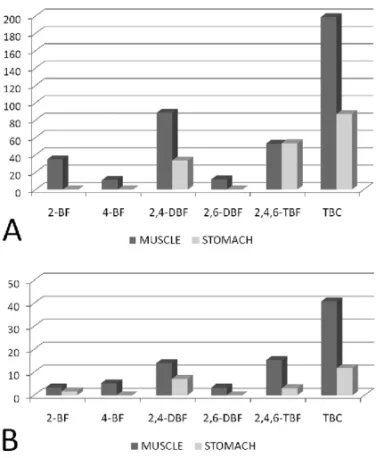
Fig. 2 – Bromophenol concentrations and TBCs in the muscle and stomach ofL. synagriscollected in winter (A) and summer time (B).
Figures 3 and 4 indicate, respectively, the varia-tion in average bromophenol concentravaria-tions and TBCs in the muscle (15 samples) and stomach (9 samples) of the speciesL. synagrisandO. chrysurusduring the pe-riod of this study. With the exception of 2,4-BF, the bromophenol pattern found forLutjanus synagris was
similar in the muscle and stomach (Fig. 3). In contrast, O. chrysurusshowed substantial differences, especially in 2,4-BF, 2,6-BF and TBF (Fig. 4), which were found predominantly in the stomach.
Fig. 3 – Average bromophenol concentrations and TBCs in the muscle and stomach ofL. synagris.
The predominant items in the diet of L. synagris and O. chrysurus are crustaceans (mainly Decapoda) and fish, and a smaller proportion of mollusks and poly-chaetes (Costa et al. 2002, Druzhinin 1970, Szpilman 1991, Filho 1994, La Morinière et al. 2003). With the exception of polychaetes, the stomach contents of the specimens collected were compatible with those re-ported in the literature. Thus, the bromophenol found in the muscle of the species under study may come from their diets.
The route of bromophenol absorption from the fish’s stomach to the rest of its body, as well as its phys-iological roles, is still unknown (Boyle et al. 1992b, Chung et al. 2003b). Additional research is therefore necessary to clarify such questions, whose answers are of paramount importance for aquaculturists.
ACKNOWLEDGMENTS
The present work was supported by the Conselho Na-cional de Desenvolvimento Científico e Tecnológico (CNPq), Fundação de Apoio a Pesquisa do Estado da Bahia (FAPESB)-PRONEX/FAPESB/CNPq, Coordena-ção de FormaCoordena-ção de Pessoal de Nível Superior (CAPES) and Financiadora de Estudos e Projetos (FINEP).
RESUMO
O principal objetivo do presente trabalho foi o estudo de bro-mofenóis (2-bromofenol, 4-bromofenol, 2,4-dibromofenol, 2,6-dibromofenol and 2,4,6-tribromofenol), no músculo e estô-mago de duas espécies de peixes da Familia Lutjanidae: Lut-janus synagriseOcyurus chrysurus. Os bromofenóis foram extraídos através de destilação por arraste a vapor com pentano-éter (7:3 v/v), analisados por Cromatografia Líquida de Alta Eficiência e quantificados por padronização externa. As con-centrações totais de bromofenóis no músculo de ambas as es-pécies foram similares e estiveram na faixa de 36 ng g–1 a 349 ng g–1. As concentrações totais de bromofenóis no estô-mago (na faixa de 12 ng g–1a 586 ng g–1) foram mais altas que no músculo. A presença de bromofenóis no músculo das es-pécies estudadas pode ter origem na dieta. Os resultados deste trabalho contribuirão para o melhor entendimento das rotas de absorção de bromofenóis nos peixes.
Palavras-chave: bromofenóis, flavor, peixes marinhos, Lut-janus,Ocyurus.
REFERENCES
ANTHONI U, LARSEN C, NIELSEN PH AND CHRISTO -PHERSEN C. 1990. Off-flavor from commercial crus-taceans from North Atlantic zone. Biochem Syst Ecol 18: 377–379.
BOYLEJL, LINDSAYRCANDSTUIBERDA. 1992a. Bro-mophenol distribution in salmon and selected seafoods of fresh and saltwater origin. J Food Sci 57: 918–922. BOYLEJL, LINDSAYRCANDSTUIBERDA. 1992b.
Contri-butions of bromophenols to marine-associated flavors of fish and seafood. J Aquat Food Prod Technol 1: 43–63. BOYLEJL, LINDSAYRCANDSTUIBERDA. 1993.
Ocur-rence and properties of flavor-related bromophenols found in the marine environment: a review. J Aquat Food Prod Technol 2: 75–112.
CHUNGHY, MAWCJ, ANGPOANDKIMJS. 2003a. Sea-sonal distribution of bromophenols in selected Hong Kong seafood. J Agric Food Chem 51: 6752–6760.
CHUNGHY, MAWCJ, ANGPO, KIM JS ANDCHEN F. 2003b. Seasonal variations of bromophenols in brown algae (Padina arborescens,Sargassum siliquastrum, and Lobophora variegata) collected in Hong Kong. J Agric Food Chem 51: 2619–2624.
COSTAPAS, BRAGA ACAND ROCHA LOF. 2002. Reef fisheries in Porto Seguro, eastern Brazilian coast. Fish-eries Res 1449: 1–7.
DRUZHININAD. 1970. The range and biology of snappers (Family Lutjanidae). J Ichthyology 10: 717–736. FILHOAC. 1994. Peixes da Costa Brasileira. Terceira Edição.
São Paulo: Editora Marca d’Água, 304 p.
GOERKE H AND WEBER K. 1990. Locality-dependent concentrations of bromophenols in Lanice conchilega (Polychaeta: Terebellidae). Comp Biochem Physiol 97B: 741–744.
GOERKEHANDWEBERK. 1991. Bromophenols inLanice conchilega(Polychaeta: Terebellidae) – The influence of sex, weight and season. Bull Mar Sci 44: 70–74. HATTORI T, KONNO A, ADACHI K AND SHIURI Y.
LEEH, LEET, LEEJ, CHAEC, CHUNGS, SHIND, SHIN J ANDOHK. 2007. Inhibition of the Pathogenicity of Magnaporthe grisea by Bromophenols, Isocitrate Lyase Inhibitors, from the Red Alga Odonthalia corymbifera. J Agric Food Chem 55: 6923–6928.
LINDSAYRC. 1990. Fish flavors. Food Rev Int 6: 437–455. MAJW, CHUNGHY, ANGPOANDKIMJ. 2005. Enhan-cement of Bromophenol Levels in Aquacultured Silver Seabream (Sparus sarba).J Agric Food Chem 53: 2133– 2139.
PAREJO I, VILADOMAT F, BASTIDA J AND CODINE C. 2004. Development and validation of a high-performance liquid chromatographic method for the analysis of anti-oxidative phenolic compounds in fennel using a narrow bore reversed phase C18 column. Anal Chim Acta 512: 271.
PEDERSÉN M, SAENGER P AND FRIES L. 1974. Simple brominated phenols in red algae. Phytochemistry 13: 2273–2279.
PHILLIPSDW ANDTOWERS GHN. 1981. Bromophenols ofRhodomela larix: Chemotaxonomy of morphological forms. Biochem Syst Ecol 9: 1–3.
POLOM, LLOMPARTM, GARCIA-JANESC, GOMEZ-NOYA G, BOLLAIN MANDCELA R. 2006. Development of a solid-phase microextraction method for the analysis of phenolic flame retardants in water samples. J Chromatogr A 1124: 11–21.
SANTOS GV, VELOSO MCC, PEREIRA PAP AND DE ANDRADEJB. 2001. Fish off-flavor analysis by head-space and off-line purge and trap by high resolution gas chromatography coupled with mass spectrometry detector. Am Lab 24: 28–30.
SILVAVM, VELOSO MCC, OLIVEIRA AS, SANTOS GV, PEREIRA PAP AND DE ANDRADE JB. 2005. Deter-mination of simple bromophenols in marine fishes by reverse-phase high performance liquid chromatography (RP-HPLC). Talanta 68: 323–328.
SILVAVM, LOPESWA,DEANDRADEJB, VELOSOMCC, SANTOSGV ANDOLIVEIRAAS. 2007. Bromofenóis Simples relacionados ao “Flavor” de Organismos Mari-nhos. Quim Nova 30: 629–635.
STANSBY ME. 1962. Speculations on Fish Odors and Flavors. Food Technol Feature 4: 28–32.
STEWARD CCANDLOVELL C R. 1997. Respiration and assimilation of 4-bromophenol by estuarine sediment bacteria. Microb Ecol 33: 198–205.
SZPILMANM. 1991. Guia Aqualung de Peixes – Guia Prático de Identificação dos Peixes do Litoral Brasileiro, 220 p. UNSON MD, HOLLAND ND AND FAULKNER DJ. 1994.
A brominated secondary metabolite synthesized by the cyanobacterial symbiont of a marine sponge and accumu-lation of the crystalline metabolite in the sponge tissue. Mar Biol 119: 1–11.
VELOSOMCC, SILVAVM, SANTOSGVAND DEANDRA -DEJB. 2001. Determination of aldehydes in fish by high-perfomance liquid chromatography. J Chromatogr Sci 39: 173–176.
VETTERWANDJANUSSEND. 2005. Halogenated natural products in five species of antartic sponges: compounds with POP-like properties? Environ Sci Technol 39: 3889– 3895.
WHITFIELDFB. 1988. Chemistry of off-flavours in marine organisms. Water Sci Technol 20: 63–74.
WHITFIELDFB, SHAWKJANDWALKER DI. 1992a. The source of 2,6-dibromophenol: Cause of an iodoform taint in Australian prawns. Water Sci Technol 25: 131–138. WHITFIELDFB, SHAWKJANDSVORONOSD. 1992b. The
volatile aroma components of Australian marine algae. In: 12thINTERNATIONALCONGRESS OFFLAVOURS, FRA -GRANCES AND ESSENTIAL OILS, Vienna. Abstracts, Vienna, 365–372.
WHITFIELDFB, SHAWKANDSVORONOSD. 1994. Effect of the natural environment on the flavour of seafoods: the flavour ofGirella tricuspidata. In: TRENDS INFLAVOUR RESEARCH, p. 417–420.
WHITFIELDFB, HELIDONIOTISF, SHAWKJ, SVORONOS DANDFORDGL. 1995. The source of bromophenols in some species of Australian ocean fish. Water Sci Technol 31: 113–120.
WHITFIELD FB, HELIDONIOTIS F AND DREW M. 1996. The role of diet and environment in the natural flavours of seafoods. In Flavour Science: Recents Developments. TAYLORAJ, MOTRAMDS (Eds), Cambridge, U.K.: The Royal Society of Chemistry: Cambridge, U.K. p 3–12. WHITFIELD FB, HELIDONIOTIS F, SHAW KJ ANDSVO
-RONOSD. 1997. Distribution of bromophenols in Aus-tralian wild-harvested and cultivated prawns (shrimp). J Agric Food Chem 45: 4398–4405.
WHITFIELD FB, HELIDONIOTISF, SHAW KJ AND SVO -RONOS D. 1999a. Distribution of bromophenols in species of marine algae from eastern Australia. J Agric Food Chem 47: 2367–2373.
WHITFIELD FB, DREW M, HELIDONIOTIS F AND SVO -RONOS D. 1999b. Distribution of bromophenols in species of marine polychaetes and bryozoans from east-ern Australia and the role of such animals in the flavor of edible ocean fish and praws (shrimp). J Agric Food Chem 47: 4756–4762.
WHITFIELDFB, HELIDONIOTISF ANDSHIMTH D. 2002. Role of feed ingredients in the bromophenols content of cultured prawn. Food Chem 79: 355–365.