http://dx.doi.org/10.1590/S1678-9946201860058
1Universidade de São Paulo, Faculdade de
Medicina, Hospital das Clínicas, São Paulo, São Paulo, Brazil
2Universidade de São Paulo, Instituto de
Medicina Tropical de São Paulo, São Paulo, São Paulo, Brazil
3Universidade de São Paulo, Faculdade de
Medicina, Hospital das Clínicas, Grupo De Controle de Infecções Hospitalares, São Paulo, São Paulo, Brazil
4Universidade de São Paulo, Faculdade
de Medicina Veterinária e Zootecnia, São Paulo, São Paulo, Brazil
5Universidade de São Paulo, Faculdade de
Medicina, Hospital Universitário, São Paulo, São Paulo, Brazil
6Universidade de São Paulo, Faculdade de
Medicina, Hospital das Clínicas, Instituto de Medicina Física e de Reabilitação, São Paulo, São Paulo, Brazil
Correspondence to: Taniela Marli Bes Universidade de São Paulo, Instituto de Medicina Tropical de São Paulo, Rua Dr Enéas Carvalho de Aguiar, 470, CEP 05403-000, São Paulo, SP, Brazil
E-mail: [email protected]
Received: 2 July 2018
Accepted: 13 September 2018
Prevalence of methicillin-resistant Staphylococcus aureus
colonization in individuals from the community in the city of Sao Paulo, Brazil
Taniela Marli Bes1,2, Roberta Ruedas Martins2, Lauro Perdigão1,3, Diego
Mongelos2, Luisa Moreno4, Andrea Moreno4, Gerson Salvador de Oliveira5,6,
Silvia Figueiredo Costa1,2, Anna Sara Levin1,2,3
ABSTRACT
Staphylococcus aureus (SA) is a commensal habitant of nasal cavities and skin. Colonization by community-acquired methicillin-resistant SA (CA-MRSA) is associated with infections in patients who have not been recently hospitalized. The aim of this study is to determine the prevalence of MRSA colonization in an outpatient population, currently unknown in Brazil. Three-hundred patients or caregivers from two teaching hospitals were included. A questionnaire was applied and nasal swabs were obtained from patients. Swabs were inoculated in brain heart infusion (BHI) with 2.5% NaCl and seeded in mannitol. Suspicious colonies were subjected to MALDI-TOF MS Microflex™ identification. Antimicrobial susceptibility test for oxacillin was performed for SA-positive samples by microdilution. Polymerase chain-reactions for detection of mecA and coA genes were performed for resistant samples. Data about MRSA carriers were compared with non-carriers. There were 127 S. aureus isolates, confirmed by MALDI-TOF. Only seven (2.3%) were MRSA and positive for mecA and coA genes. Factors associated with MRSA carriage were African ethnicity, skin diseases or antibiotic use. The majority of them were from Dermatology clinics. Prevalence of MRSA colonization in individuals from the community was low in our study (2.3%). This finding raises the hypothesis of inter-household transmission of SA, although we did not find any association between MRSA-colonization and the shared use of personal objects. Given the low prevalence of MRSA carriers observed, empirical antimicrobial coverage for MRSA in community-acquired infections should be not necessary.
KEYWORDS:Staphylococcus aureus. MRSA. Skin colonization.
INTRODUCTION
Staphylococcus aureus (SA) is a human commensal and inhabits nasal cavities and skin. It is estimated that 30-60% of the population are transiently colonized and 20% carry SA persistently1,2.
Although originally a nosocomial pathogen, methicillin-resistant SA (MRSA) has caused community-acquired infections since the 2000s3. The first community-acquired MRSA (CA-MRSA) report was in Australia in 1993, in local indigenous people, and since then outbreaks have been described in different contexts. In Brazil CA-MRSA was reported sporadically4-7.
include: living in agglomerations, children, antibiotic use for less than one year, chronic skin disease, HIV infection, and low socioeconomic level1,9,10.
Currently the prevalence of MRSA colonization in the community is unknown in Brazil.
The objective of this study was to determine the prevalence of MRSA-colonized individuals in a population from an outpatient healthcare facility.
MATERIALS AND METHODS
Outpatients and persons who accompany them at two hospitals were included in the study during the period from January to April 2017.Hospital das Clinicas (HC) is a tertiary-care facility and Hospital Universitario (HU) is a community hospital. Both are teaching facilities affiliated with the University of Sao Paulo, Brazil. The research was conducted after the approval of the Research Ethics Committees of both hospitals (Nº 1.887.780 and 1.930.074). Data were consolidated and analyzed, and patients’ identities were confidential.
Inclusion criteria: Individuals with at least 18 years of age who passed the entrance doors of the outpatient Infectious Diseases and Dermatology Clinics at HC, emergency room, at both hospitals and the immunization center.
Exclusion criteria: history of use of long-term catheters, undergoing surgery or hospitalization within the last year. Individuals included in the study, after signing the consent form, answered a questionnaire on personal data; demographics; daily habits; sports; personal hygiene; the presence of pets at home; illicit drug use; family members living in the same household; public transport (bus, subway or train); trips in the last year; frequency at motels, gyms, swimming pools or other crowded places; history of diseases such as Aids, cutaneous conditions, sexually transmitted diseases and use of antibiotics in the last year.
The number of subjects to be included in the study was calculated taking into account a population of 10 million inhabitants, a prevalence of MRSA colonization of 2% in this population, a 95% confidence interval with a 5% variation. The sample was composed of 300 subjects, divided equally between the five sectors, with 60 each.
For sample collection, swabs (COPAN Venturi Transystem®, COPAN Diagnostics Inc., Murrieta,
California, USA) were used. Samples were collected from the anterior nares by gently rotating the swab in each nare. One sample was obtained from each subject. Swabs were initially inoculated in Brain Heart Infusion medium (BHI) with 2.5% NaCl to stimulate the growth of cutaneous agents, incubated for 24 h and then seeded on regular mannitol
agar. Samples that converted mannitol agar to yellow staining were subjected to MALDI-TOF MS Microflex™
identification (Bruker Daltonics, Billerica, Massachusetts, USA). The criteria for interpreting the results were: scores = 2.0 were accepted for species assignment and scores = 1.7 and <2.0 were used for genera identification.
SA isolates were submitted to antimicrobial susceptibility testing by microdilution for oxacillin11. Samples were tested in duplicate. Isolates identified as resistant to oxacillin were submitted to Polymerase Chain Reaction for mecA and coA genes for confirmation.
Analysis of data: individuals colonized with MRSA strains from the community and without hospitalization within the past year were compared with non-colonized individuals. For the analysis of the dichotomous variables, non-parametric chi-square test and Fisher’s exact test were used. Numerical variables were analyzed using the Student T test. Also, means and standard deviations were presented. Statistical analysis was performed with the Epi Info v3.1.3 (StatCalc Statistical Calculators).
RESULTS
Three hundred samples were collected from patients and accompanying persons: 61% were female and 95% were heterosexual. None were military in the last year; two had been incarcerated at some point during their lives but had been free for more than one year. None were intravenous drug users or lived in the same household as a drug user. Eight reported sharing a home with marijuana users, three with inhaled cocaine users andone with volatile product inhalers. Two were tobacco smokers.
Of the 300 samples collected, 127 were positive for S. aureus of which seven had a MIC = 4 µg/mL (4-128) and were positive for coA and mecA genes.
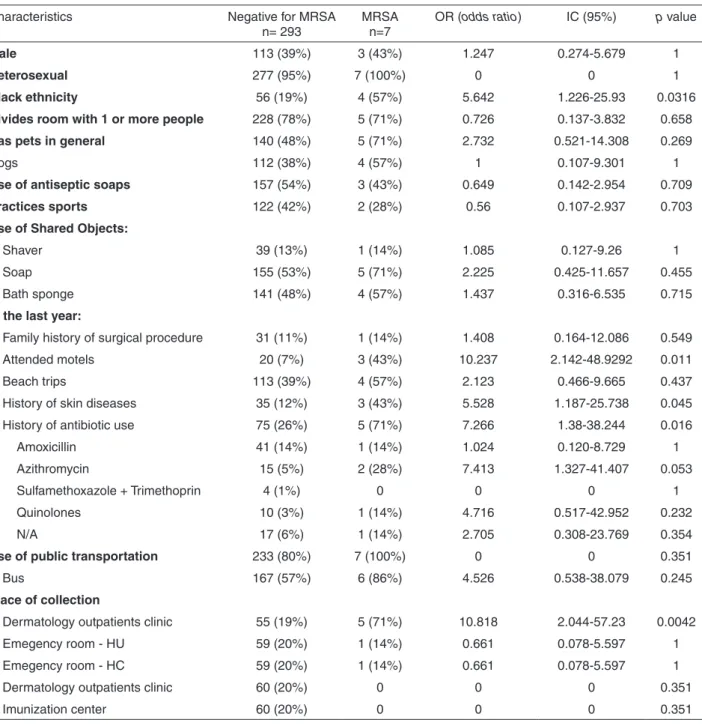
Five of the seven MRSA isolates were collected from patients or persons that accompanied patients at the Dermatology outpatient clinic. When comparing MRSA carriers with non-carriers, the Dermatology unit was associated with MRSA colonization (OR: 10.81; 95% CI: 2.04 - 57.23 p: 0.0042). Other factors associated with MRSA carriage were: history of skin disease; skin color; use of motels. The use of antibiotics in the last year was a protective factor for colonization (Table 1).
DISCUSSION
The prevalence of MRSA causing cutaneous infections in patients seeking emergency services in the US varied widely from 15% to 74% in New York and Kansas City, respectively12. Over the years, the incidence of CA-MRSA infections in the United States has increased from 2.5% to 39%, with clonal heterogeneity in different regions13-15.
A published European study involving England, France, Germany, Italy, Greece, Romania and Spain included 205 cases of skin and soft tissue infections16. The mean
prevalence of MRSA was 15.1%, with no cases in Northern countries and 29% in Southern countries.
In Brazil, community-acquired MRSA cases have been reported in the cities of Porto Alegre, Rio de Janeiro, Botucatu and Bahia. All cases have in common cutaneous involvement and the presence of PVL toxin6,17,18. A study evaluated nasal carriage of MRSA19 among 250 first and second year students from University of Londrina, in the South of the country, with a prevalence of 2.5%, a similar result to our study. Among 148 children in a daycare center Table 1 - Univariate analysis of characteristics associated with methicillin-resistant Staphylococcus aureus colonization among persons visiting outpatient clinics or emergency rooms or vaccination clinics
Characteristics Negative for MRSA
n= 293
MRSA n=7
OR (odds ratio) IC (95%) p value
Male 113 (39%) 3 (43%) 1.247 0.274-5.679 1
Heterosexual 277 (95%) 7 (100%) 0 0 1
Black ethnicity 56 (19%) 4 (57%) 5.642 1.226-25.93 0.0316
Divides room with 1 or more people 228 (78%) 5 (71%) 0.726 0.137-3.832 0.658
Has pets in general 140 (48%) 5 (71%) 2.732 0.521-14.308 0.269
Dogs 112 (38%) 4 (57%) 1 0.107-9.301 1
Use of antiseptic soaps 157 (54%) 3 (43%) 0.649 0.142-2.954 0.709
Practices sports 122 (42%) 2 (28%) 0.56 0.107-2.937 0.703
Use of Shared Objects:
Shaver 39 (13%) 1 (14%) 1.085 0.127-9.26 1
Soap 155 (53%) 5 (71%) 2.225 0.425-11.657 0.455
Bath sponge 141 (48%) 4 (57%) 1.437 0.316-6.535 0.715
In the last year:
Family history of surgical procedure 31 (11%) 1 (14%) 1.408 0.164-12.086 0.549
Attended motels 20 (7%) 3 (43%) 10.237 2.142-48.9292 0.011
Beach trips 113 (39%) 4 (57%) 2.123 0.466-9.665 0.437
History of skin diseases 35 (12%) 3 (43%) 5.528 1.187-25.738 0.045
History of antibiotic use 75 (26%) 5 (71%) 7.266 1.38-38.244 0.016
Amoxicillin 41 (14%) 1 (14%) 1.024 0.120-8.729 1
Azithromycin 15 (5%) 2 (28%) 7.413 1.327-41.407 0.053
Sulfamethoxazole + Trimethoprin 4 (1%) 0 0 0 1
Quinolones 10 (3%) 1 (14%) 4.716 0.517-42.952 0.232
N/A 17 (6%) 1 (14%) 2.705 0.308-23.769 0.354
Use of public transportation 233 (80%) 7 (100%) 0 0 0.351
Bus 167 (57%) 6 (86%) 4.526 0.538-38.079 0.245
Place of collection
Dermatology outpatients clinic 55 (19%) 5 (71%) 10.818 2.044-57.23 0.0042
Emegency room - HU 59 (20%) 1 (14%) 0.661 0.078-5.597 1
Emegency room - HC 59 (20%) 1 (14%) 0.661 0.078-5.597 1
Dermatology outpatients clinic 60 (20%) 0 0 0 0.351
in Northeastern Brazil, MRSA nasal carriage was 7.4%20. A previous study from our group showed that among hospitalized patients in the Dermatology Unit MRSA carriage was 45%, of which a quarter were community-acquired21. Among chronic dermatologic patients, MRSA carriage is frequent, and there may be household transmission explaining the colonization of the people who accompanied patients to the Dermatology outpatient clinic in our study, although we did not find a relationship with statistical significance between colonization by MRSA and the shared use of personal objects.
Other findings in our study such as black ethnicity have been previously described by Tosas Auguet et al.22, but we do not know how to explain it. History of antibiotic has been previously described by Gustave et al.23, who suggested that previous antibiotics use contributed to the increase of MRSA lineages in the community. The association between attending motels and MRSA colonization has not yet been described and is difficult to explain. It may be due to the collective environment and objects shared by multiple individuals.
Due to the low prevalence of colonization found in our sample, we suppose that empirical coverage against MRSA, with drugs such as clindamycin and sulfamethoxazole-trimethoprim (SMX-TMP) or even nasal decolonization with mupirocin, as recommended by the IDSA24 guideline can be used in patients from the community without risk factors, in our setting.
The IDSA guideline made the US recommends the use of MRSA coverage for patients with severe purulent or non-purulent infection (patients with abscesses, signs of sepsis or impaired immune status), skin and soft tissue infection from the community. However, this recommendation is based on studies performed in settings different from ours, with high MRSA prevalence in the community.
Our study has limitations. Our sample was obtained in hospitals and may not represent the community. However, if so, the prevalence of MRSA may be even lower than the one we observed. The study was carried out in two hospitals in the city of Sao Paulo, not allowing extrapolation of data to the entire State or even to other regions of the country. Furthermore, due to the study design, we may have included temporary nasal carriers. On the other hand, our sample was very heterogeneous, which may allow us to generalize our results and suggest empirical therapy for infections in which S. aureus is suspected.
CONCLUSION
Given the low prevalence of MRSA nasal carriage found in our study (2.3%), we believe that empirical coverage
for MRSA is not necessary for patients with community-acquired infections caused by Staphylococcus aureus.
REFERENCES
1. Kluytmans J, van Belkum A, Verbrugh H. Nasal carriage of Staphylococcus aureus: epidemiology, underlying mechanisms, and associated risks. Clin Microbiol Rev. 1997;10:505-20.
2. Liu GY. Molecular pathogenesis of Staphylococcus aureus infection. Pediatr Res. 2009;65:71R-7R.
3. Seal JB, Moreira B, Bethel CD, Daum RS. Antimicrobial resistance in Staphylococcus aureus at the University of Chicago Hospitals: a 15-year longitudinal assessment in a large university-based hospital. Infect Control Hosp Epidemiol.
2003;24:403-8.
4. Udo EE, Pearman JW, Grubb WB. Genetic analysis of community isolates of methicillin-resistant Staphylococcus aureus in Western Australia. J Hosp Infect. 1993;25:97-108.
5. Ribeiro A, Dias C, Silva-Carvalho MC, Berquó L, Ferreira FA, Santos RN, et al. First report of infection with community-acquired methicillin-resistant Staphylococcus aureus in South America. J Clin Microbiol. 2005;43:1985-8.
6. Ribeiro A, Coronado AZ, Silva-Carvalho MC, Ferreira-Carvalho BT, Dias C, Rozenbaum R, et al. Detection and characterization of international community-acquired infections by methicillin-resistant Staphylococcus aureus clone in Rio de Janeiro and Porto Alegre cities causing both community and hospital associated diseases. Diagn Microbiol Infect Dis. 2007;59:339-45.
7. Camargo CH, Cunha ML, Bonesso MF, Cunha FP, Barbosa AN, Fortaleza CM. Systemic CA-MRSA infection following trauma during soccer match in inner Brazil: clinical and molecular characterization. Diagn Microbiol Infect Dis. 2013;76:372-4.
8. Tarai B, Das P, Kumar D. Recurrent challenges for clinicians: emergence of methicillin-resistant Staphylococcus aureus, vancomycin resistance, and current treatment options. J Lab Physicians. 2013;5:71-8.
9. Hansra NK, Shinkai K. Cutaneous community-acquired and hospital-acquired methicillin-resistant Staphylococcus aureus. Dermatol Ther. 2011;24:263-72.
10. Eady EA, Cove JH. Staphylococcal resistance revisited: community-acquired methicillin resistant Staphylococcus aureus - an emerging problem for the management of skin and soft tissue infections. Curr Opin Infect Dis. 2003;16:103-24.
11. Clinical Laboratory Standards Institute. M100: performance standards for antimicrobial susceptibility testing: 28th
informational supplement. Wayne: CLSI; 2018.
13. DeLeo FR, Otto M, Kreiswirth BN, Chambers HF. Community-associated meticillin-resistant Staphylococcus aureus. Lancet. 2010;375:1557-68.
14. Chen CJ, Unger C, Hoffmann W, Lindsay JA, Huang YC, Götz F. Characterization and comparison of 2 distinct epidemic community-associated methicillin-resistant Staphylococcus aureus clones of ST59 lineage. PLoS One. 2013;8:e63210.
15. Chuang YY, Huang YC. Molecular epidemiology of community-associated meticillin-resistant Staphylococcus aureus in Asia. Lancet Infect Dis. 2013;13:698-708.
16. Bouchiat C, Curtis S, Spiliopoulou I, Bes M, Cocuzza C, Codita I, et al. MRSA infections among patients in the emergency department: a European multicentre study. J Antimicrob Chemother. 2017;72:372-5.
17. Razera F, De Stefani S, Bonamigo RR, Olm GS, Dias CA, Narvaez GA. CA MRSA in furunculosis: case report of southern Brazil. An Bras Dermatol. 2009;84:515-8.
18. Rozenbaum R, Sampaio MG, Batista GS, Garibaldi AM, Terra GM, Souza MJ, et al. The first report in Brazil of severe infection caused by community-acquired methicillin-resistant Staphylococcus aureus (CA-MRSA). Braz J Med Biol Res. 2009;42;756-60.
19. Prates KA, Torres AM, Garcia LB, Ogatta SF, Cardoso CL, Tognim MC. Nasal carriage of methicillin-resistant Staphylococcus aureus in university students. Braz J Infect Dis. 2010;14:316-8.
20. Carvalho SP, Almeida JB, Andrade YM, Silva LS, Oliveira AC, Nascimento FS, et al. Community-acquired methicillin-resistant Staphylococcus aureus carrying SCCmec type IV and V isolated from healthy children attending public daycares in northeastern Brazil. Braz J Infect Dis. 2017;21:464-7.
21. Pacheco RL, Lobo RD, Oliveira MS, Farina EF, Santos CR, Costa SF, et al. Methicillin-resistant Staphylococcus aureus (MRSA) carriage in a dermatology unit. Clinics (Sao Paulo). 2011;66:2071-7.
22. Tosas Auguet O, Betley JR, Stabler RA, Patel A, Ioannou A, Marbach H, et al. Evidence for community transmission of community-associated but not health-care-associated methicillin-resistant Staphylococcus aureus strains linked to social and material deprivation: spatial analysis of cross-sectional data. PLoS Med. 2016;13:e1001944.
23. Gustave CA, Tristan A, Martins-Simões P, Stegger M, Benito Y, Andersen PS, et al. Demographic fluctuation of community-acquired antibiotic-resistant Staphylococcus aureus lineages: potential role of flimsy antibiotic exposure. ISME J. 2018;12:1879-94.