Determinants of Emerging Technology Commercialization:
Evidence from MEMS Technology
WANG Chunbo
Thesis submitted as partial requirement for the conferral of the degree of
Doctor of Management
Supervisor:
Professor Paulo Bento, Assistant Professor, ISCTE University Institute of Lisbon
Co-supervisor:
Professor Lu Yin, Professor, University of Electronic Science and Technology of China, School of Management and Economics
- Spine –
De ter mi na nts of Eme rging Te chnology C omm erc ia li za ti on: Evi de nc e f rom MEMS T ec hnology W AN G Chun boDeterminants of Emerging Technology Commercialization:
Evidence from MEMS Technology
WANG Chunbo
Thesis submitted as partial requirement for the conferral of
Doctor of Management
Jury:
Professor Ana Simaens, Assistant Professor, ISCTE-IUL Professor Xiao Wen, Associate Professor, UESTC, China
Professor Teng Ying, Full Professor, UESTC, China
Professor Álvaro Lopes Dias, Full Professor, Instituto Superior de Gestão Professor Paulo Bento, Assistant Professor, ISCTE-IUL
Statement of honor
Submission of master's dissertation or project work or doctoral thesis
I the undersigned state on my honor that:
- The work submitted herewith is original and of my exclusive authorship and that I have indicated all the sources used.
- I give my permission for my work to be put through Safe Assign plagiarism detection tool.
- I am familiar with the ISCTE-IUL Student Disciplinary Regulations and the ISCTE-IUL Code of Academic Conduct.
- I am aware that plagiarism, self-plagiarism or copying constitutes an academic violation.
Full name WANG Chunbo Course Doctor of management Student number Email address [email protected] Personal email address Building 30,No.58,Xiuxi Road,Wuxi Jiangsu China Telephone number +8613906188021 ISCTE-IUL, 14/5/2018 Signed
The term “emerging technology” refers to new technologies that create substantial changes to industry evolution and enterprise management. Nowadays, such technologies are mainly based on the development of information technology, internet technology, biotechnology and other interdisciplinary areas with potential industrial applications. Although emerging technologies have created opportunities for technological and economic innovation, their “creative destruction” characteristics also result in a very high failure rate in their commercialization processes.
Most of the recent studies on the commercialization of emerging technology have focused on developed areas such as the United States, Japan, and the European Union, with few studies on developing countries like China. The present thesis seeks to fill this gap. Taking 112 Chinese MEMS enterprises as a sample, this thesis empirically investigated the determinants of emerging technology in China. Furthermore, a case study (Wuxi BEWIS Sensing Technology, Ltd.) was employed to analyze how these determinants affect the real commercializing process in the Chinese economy. Through multiple regression analysis, the empirical results show that technology property, market conditions, regional innovation network, and enterprise capability are determinants of MEMS commercialization, whereas social environment and policy and regulation do not have significant impacts on the performance of MEMS commercialization.
This chapter is comprised of seven chapters. Chapter 1 mainly introduces the background, the content of the research, and the contributions of the research. Chapter 2 presents a literature review on emerging technologies, including definitions, characteristics, management, and commercialization. Chapter 3 analyzes the status and developing trends of MEMS technology. Chapter 4 describes an empirical study on the determinants of commercialization of MEMS technology, before Chapter 5 reports the results of the empirical survey in Chapter 4. Chapter 6 uses Wuxi BEWIS Sensing Technology Ltd. as a case to analyze how the above-mentioned determinants affect the four stages in the commercialization process. Finally, Chapter 7 presents the main conclusions and recommendations, as well as limitations and suggestions for further research.
in China, providing some practical guides to Chinese enterprises and helping increase their commercialization success rate. The thesis offers value to emerging technology literature, industrial development, and government policy makers.
Keywords: MEMS; emerging technology; commercialization; determinant JEL: O33; M11
O termo “tecnologia emergente” diz respeito a novas tecnologias que estão a gerar mudanças substanciais na evolução da indústria e na gestão das empresas. Atualmente essas tecnologias baseiam-se sobretudo no desenvolvimento da tecnologia de informação, da tecnologia de internet, da biotecnologia e de outras áreas interdisciplinares com potencial de aplicação industrial. Embora as tecnologias emergentes tenham criado oportunidades para a inovação, tecnológica e económica, as suas características de “destruição criativa” também resultaram numa elevada taxa de insucesso nos processos de comercialização.
A maioria dos estudos recentes relativos à comercialização de tecnologia emergente têm-se focado em regiões desenvolvidas tais como os Estados Unidos, o Japão, e a União Europeia, existindo poucos estudos em países em vias de desenvolvimento como é o caso da China. Esta tese procura contribuir para o preenchimento dessa lacuna. Partindo de uma amostra de 112 empresas chinesas de sistemas microeletromecânicos (MEMS), procurou-se investigar empiricamente os determinantes de tecnologia emergente na China. Além disso, foi efetuado um estudo de caso (Wuxi BEWIS Sensing Technology, Ltd.) para analisar como esses determinantes afetam o processo real de comercialização na economia chinesa. Os resultados empíricos, obtidos através de análises de regressão múltipla, mostram que a propriedade tecnológica, as condições de mercado, a rede regional de inovação e a capacidade empresarial são determinantes para a comercialização de MEMS. Por outro lado, constata-se que o ambiente social, a política e a regulamentação não têm impactos significativos no desempenho da comercialização de MEMS.
Esta tese é composta por sete capítulos. Primeiramente são apresentados os antecedentes, o âmbito da investigação e as contribuições da mesma. Depois, é efetuada uma revisão de literatura sobre tecnologias emergentes, incluindo definições, características, gestão e comercialização, seguindo-se uma analise à situação atual e às tendências de desenvolvimento da tecnologia de MEMS. De seguida, efetuou-se uma descrição de um estudo empírico sobre os determinantes da comercialização da tecnologia de MEMS, antes de serem relatados os resultados dessa mesma investigação. Posteriormente, utilizou-se a Wuxi BEWIS Sensing Technology Ltd. para analisar como os determinantes mencionados acima afetam as quatro
e recomendações, bem como as limitações e sugestões para futuras investigações.
Esta tese explora os métodos de sucesso da comercialização de tecnologia emergente na China, fornecendo alguns guias práticos para empresas chinesas aumentarem a taxa de sucesso de comercialização. A tese oferece contributos à literatura sobre tecnologia emergente, ao desenvolvimento industrial e aos responsáveis pelas políticas públicas.
Palavras-chave: MEMS; tecnologia emergente; comercialização; determinantes. JEL: O33; M11
新兴技术特指可以创造或有潜力改变一个行业管理方式的一种新型的技术,今天, 主要是指信息技术、互联网技术、生物技术以及它们在其它领域的潜在应用,虽然新兴 技术已经为技术和经济创新创造了机会,但是,它们创造性毁灭的特征也为商业化成功 带来了高的失败率,而发展新兴技术是一项风险极高的活动。 目前大多关于新兴技术的研究集中在发达国家,如美国、日本及欧洲,很少有研究 者关注像中国这样的发展中国家,为了弥补空白,本文调研了 112 个中国 MEMS(微机械 机电系统)方面的新兴技术企业,然后以无锡北微传感科技有限公司为案例分析了在中 国经济背景下新兴技术商业化过程中的影响因素,通过多重回归分析和实证分析得到技 术属性、市场条件、区域创新网络和企业家能力是影响新兴技术商业化成功的主要影响 因素,而社会环境和政策法规因素对 MEMS 技术商业化成功没有显著影响的结论。 本文总共有七章。第一张主要介绍了研究的背景和主要贡献;第二章是文献综述, 描述了新兴技术的定义、特征、管理方法和商业化相关研究;第三章分析了 MEMS 技术 的发展状态和趋势;第四章为 MEMS 技术商业化影响因素的实证研究;第五章对实证研 究结果进行了阐述;此外,第六章以无锡北微传感科技有限公司为例分析了各个因素在 商业化的四个阶段影响作用;最后,第七章对全文进行了总结,同时也提出了本研究的 局限性和将来进一步研究方向。 本文的目的是探索新兴技术在中国商业化成功之路,也希望能为中国的企业提供一 些实践上的指导,帮助他们技术商业化道路上提高成功率和避免不必要的失败,本文以 崭新的视角研究新兴技术商业化,期望对新兴技术理论研究和业界实践、包括政府政策 的制定提供有价值的帮助。 关键词:MEMS;新兴技术;商业化;影响因素 JEL:O33;M11
We are extremely grateful to all those who helped and encouraged me during the period of writing this thesis.
We are particularly appreciative of my supervisor Paulo Bento and my co-supervisor Lu Yin, who gave me the freedom to choose the subject of my thesis and offered me a lot of help. Their sincere advice and instructive suggestions on this thesis benefited me greatly. Paulo pointed out my mistakes and shortcomings and we are deeply thankful for his help in the accomplishment of this thesis.
Moreover, We would like to show my special thanks to all the people who were involved in the questionnaire design, including three specialists on MEMS: Mr. Jin Yufeng, Mr. Ma Shenglin, and Mr. Huang Qiang; two professors on management: Mr. Yin Lu and Ms. Wang Min; and three doctoral candidates: Mr. Xu Feng, Mr. Han Jiulin, and Mr. Lu Zhouying.
We would also like to show my sincere gratitude to the other professors – XiaoWen, SunPing and Virgínia Trigo – from whose lectures and help, we have benefited greatly. They have improved my language, writing and research method, and have provided guidance.
We also want to express my sincere gratitude to my family and friends, who gave me valuable suggestions and comforted and encouraged me during the course of writing this thesis.
我十分感谢在我写论文的时候给予帮助和鼓励的人们。 首先,要向我的导师银路教授和 Paulo Bento 表达我诚挚的谢意。他们给了我选题 的自由和空间。同时在写作阶段给予我很大的帮助。他们真诚的指导和建议让我受益匪 浅。银教授指出了我论文中的不足及需要改进之处。我很感激他对我的论文完成起到了 很大的帮助作用。 同时,我也要向我的任课老师 Virgínia Trigo 教授和项目负责人肖文教授表达我 的谢意。他们的演讲及课堂帮助让我更好地完成论文写作。他们在语言,写作和研究方 法上都为我提供了指导和帮助。 我还想要感谢项目组孙平教授、马绍壮教授以及我的家人和朋友,还有在写在上给 与我协助的许许多多的人。他们为我论文的写作提供了很多支持。 最后,再一次向以上所有人表达我诚挚的谢意。在他们的帮助下,我更好的完成了 论文写作。
Contents
Chapter 1: Introduction ... 1
1.1 Background and significance ... 1
1.2 Research objective, problem and questions ... 4
1.3 Structure of the thesis ... 4
1.4 Research method ... 6
1.5 Contributions of this study ... 7
Chapter 2: Literature Review ... 11
2.1 Definition of emerging technologies ... 11
2.1.1 Technology, high technology and new technology ... 11
2.1.2 Emerging technologies ... 12
2.1.3 Relationships among emerging technology, high technology and new technology ... 13
2.2 Characteristics of emerging technology ... 15
2.2.1 High uncertainty ... 15
2.2.2 Creative destruction ... 16
2.3 Emerging technology management ... 17
2.3.1 Importance of emerging technology management ... 17
2.3.2 Main topics on emerging technology management ... 19
2.4 Commercialization of emerging technology ... 22
2.4.1 Definition of emerging technological commercialization ... 22
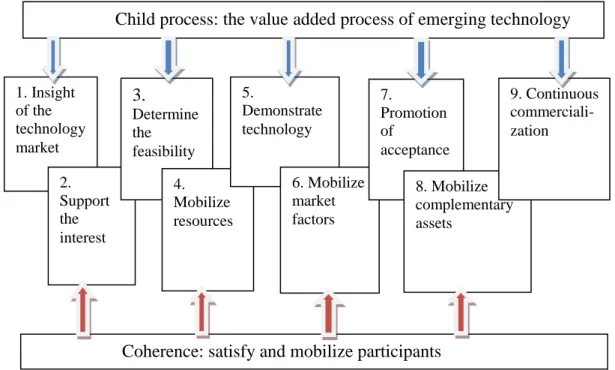
2.4.2 Process of emerging technological commercialization ... 23
2.4.3 Factors affecting the commercialization of emerging technologies ... 25
2.5 Summary ... 29
Chapter 3: MEMS Technology and its Commercialization ... 31
3.1 Overview of MEMS technology ... 31
3.1.1 MEMS technology ... 31
3.1.2 History of MEMS technology ... 33
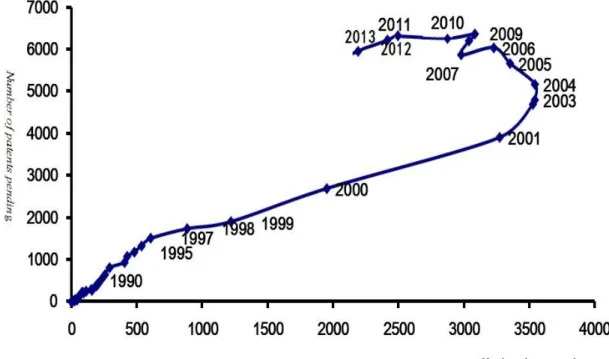
3.2 Development of MEMS technology: patent data analysis ... 38
3.2.1 Global patents related to MEMS technology ... 38
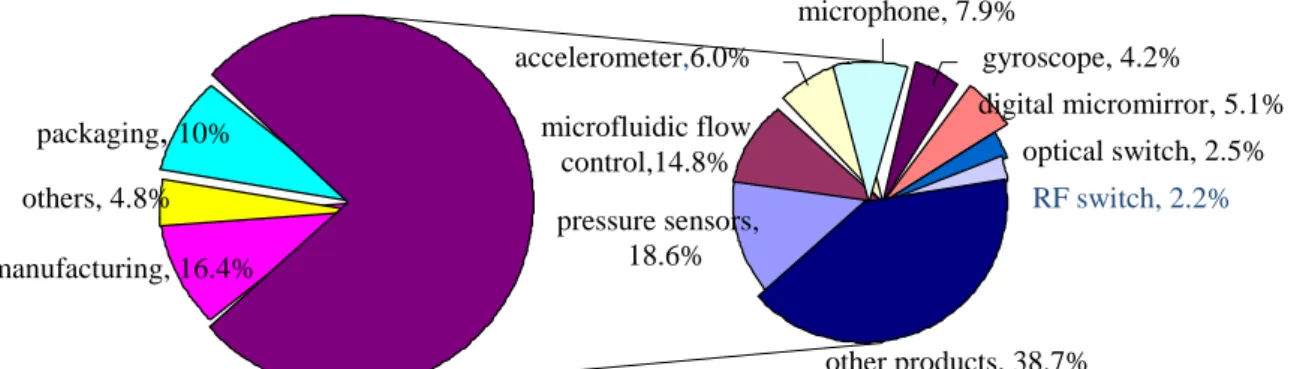
3.2.3 Patents distributions in products ... 42 3.3 Developing trends of MEMS technology ... 44 3.4 Commercialization of MEMS technology ... 47 3.4.1 Characteristics of developing MEMS products ... 47 3.4.2 MEMS market capacity ... 49 3.4.3 Formation of MEMS industry ... 51 3.4.4 Ways of MEMS technology commercialization ... 52 3.5 Summary ... 57 Chapter 4: Empirical Study: Hypotheses and Research Design ... 58 4.1 Hypotheses ... 59 4.1.1 Technology properties ... 59 4.1.2 Enterprise capability ... 60 4.1.3 Regional innovation network ... 61 4.1.4 Market conditions ... 62 4.1.5 Policy and regulation ... 62 4.1.6 Social environment ... 63 4.2 Questionnaire design ... 63 4.3 Variable measurement ... 66 4.3.1 Dependent variables and measurement ... 66 4.3.2 Independent variables and measurement ... 67 4.4 Sample selection and data collection ... 75 4.4.1 Sample selection ... 75 4.4.2 Data collection ... 76 4.5 Reliability and validity test ... 76 4.6 Summary ... 78 Chapter 5: Results and Discussions ... 79 5.1 Descriptive statistics ... 79 5.1.1 Profile of sampled enterprises ... 79 5.1.2 Descriptive statistics of variables ... 80 5.2 Correlation analysis ... 80 5.3 Confirmatory factor analysis ... 83 5.4 Multiple regression analysis ... 88 5.4.1 Multicollinearity examination ... 88 5.4.2 Multiple regression analysis ... 90 5.5 Discussion of empirical results ... 92
5.6 Summary ... 94 Chapter 6: Case Study of MEMS Commercialization: Wuxi BEWIS Sensing Technology Company ... 97
6.1 Objective and method of case study ... 97 6.1.1 Objective of the case study ... 97 6.1.2 Research method ... 98 6.2 Case selection and background ... 99 6.2.1 Case selection ... 99 6.2.2 Data collection and analysis ... 100 6.3 Background of Wuxi BEWIS Sensing Technology Ltd. (BEWIS) ... 102 6.4 Stages of MEMS commercialization in BEWIS ... 103 6.4.1 Technology (product) selection stage (2010–2011) ... 104 6.4.2 R&D stage (2011–2013) ... 105 6.4.3 Pilot test stage (2012–2015) ... 106 6.4.4 Mass production stage (2015–present) ... 106 6.5 Determinants of MEMS commercialization in BEWIS ... 107 6.5.1 Technology property and market conditions ... 107 6.5.2 Regional innovation network ... 108 6.5.3 Enterprise capability ... 109 6.6 Implication of the case study ... 111 6.7 Summary ... 114 Chapter 7: Conclusions and Recommendation ... 115 7.1 Conclusions ... 115 7.2 Recommendations ... 116 7.2.1 Recommendation to governments ... 116 7.2.2 Recommendation to enterprise ... 117 7.3 Limitation and further research ... 119 Bibliography ... 121 Appendix 1: Questionnaire ... 128 Appendix 2: MEMS Patent Data from 1982 to 2013...135 Appendix 3: List of Sampled MEMS Companies (112)...136
List of Tables
Table 2-1 Comparison of Emerging Technologies and Established Technologies………..15 Table 2-2 Differences between Technical Product and Technology Commercialization ... ...…...22 Table 3-1 Milestones of the MEMS Technology……….…..….34 Table 3-2 Three Modes for Technology Commercialization…..………54 Table 4-1 Enterprises Involved in the Questionnaire Design………..………..63 Table 4-2 Dependent Variable: Risk Reduction and Its Indicators………..65 Table 4-3 Dependent Variable: Financial Performance and Its Indicators………...66 Table 4-4 Technology Property and Its Indicators………..67 Table 4-5 Enterprise Capability and Its Indicators……….………68 Table 4-6 Regional Innovation Network and Its Measurement……….70 Table 4-7 Market Conditions and Its Measurement……..…….………....71 Table 4-8 Indicators for Policy and Regulation Variable…………..……….73 Table 4-9 Social Environment and Its Measurement……….………74 Table 4-10 Reliability Test Results………..………...…..76 Table 4-11 Validity of the Questionnaire……….…77 Table 5-1 Profiles of Sampled Enterprises………….………....79 Table 5-2 Descriptive Statistics for Each Measurement Variable ………..….80 Table 5-3 Pearson Correlation Coefficients among the Variables……….81 Table 5-4 Risk Reduction and Company Performance-factor Matrix after Rotation………84 Table 5-5 Technology Property-factor Matrix after Rotation……….………84 Table 5-6 Enterprise Capability-factor Matrix after Rotation………..85 Table 5-7 Regional Innovation Network Factor-factor Matrix after Rotation………..86 Table 5-8 Market Condition-factor Matrix after Rotation………....….86 Table 5-9 Policy, Regulations and Social Environment-factor Matrix after Rotation………87 Table 5-10 Final Items – the Rotation Factor Matrix…….………..87 Table 5-11 Multicollinearity Diagnosis……….………89 Table 5-12 Regression Analysis Results (Dependent Variable: Risk Reduction)……....……90 Table 5-13 Regression Analysis Results (Dependent Variable: Financial Performance) …..90 Table 5-14 Test Results of the Hypotheses………..…..93 Table 6-1 Comparison of Three Types of Case Study Methods……….…….…..98 Table 6-2 Main Roles of Determinants on MEMS Commercialization in BEWIS….……..112
List of Figures
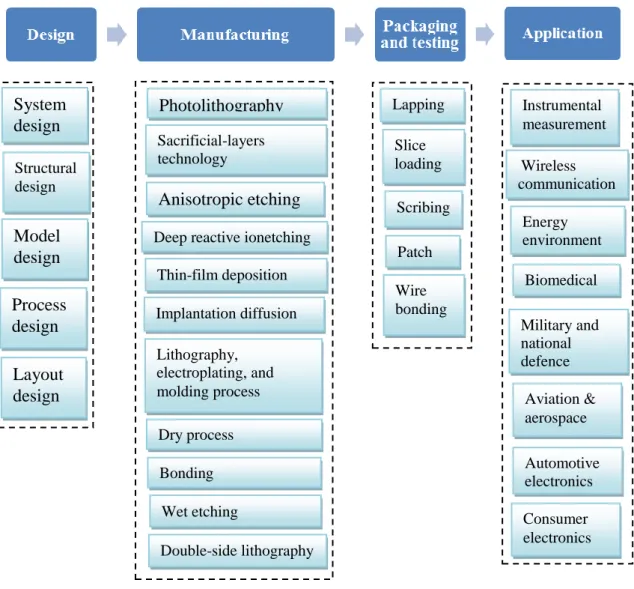
Figure 1-1 Structure of the Thesis ……….………..5 Figure 2-1 Relationships among Emerging, New and High Technologies…..…..…………14 Figure 2-2 The Process of Emerging Technology Commercialization…..……….…..25 Figure 3-1 Diagram of Information links of a Micro-electromechanical System…....……….31 Figure 3-2 MEMS Technology Components………..……….……….32 Figure 3-3 Global Patent Applications and Pending Related to MEMS technology…..…...39 Figure 3-4 MEMS Patent Application in Different Countries or Regions………...40 Figure 3-5 Distribution of Enterprises with MEMS Patents in the World………..……….….42 Figure 3-6 Distribution of MEMS Products in Global Market…….……..………….……...42 Figure 3-7 Distribution of MEMS Products in China………..……….…….43 Figure 3-8 MEMS Industry Chain……….……….48 Figure 3-9 Modes for MEMS Technology Commercialization………...54 Figure 3-10 Two Types of Cooperation during MEMS Commercialization……..………...56 Figure 6-1 Stage of MEMS Commercialization in BEWIS………..…….….….104
List of Abbreviations
PDA Personal Digital Assistant R&D research and development
MEMS Micro-Electro-Mechanical Systems NBSC National Bureau of Statistics of China
TWB The World Bank
SEM Structure Equation Model
BEWIS Wuxi BEWI Sensing Technology Ltd. WIPO World Intellectual Property Organization
ROA Return on Assets
ROE Return on Equity
SPC Statistical Process Control
IOT Internet of Things
Chapter 1: Introduction
1.1 Background and significance
Throughout the long history of societal evolution, new technologies have gradually become the most important engine of economic growth. It is widely believed that, to date, there have been three main technological revolutions (Yin & Wang, 2010). The first one happened in the 1760s with the invention of the steam engine by British engineer James Watt; the second one was brought on by the application of electricity in the 1870s, and the third one began in the 1940s with the wide application of information and communication technology around the world. Emerging technology, as a type of new technology, refers to technologies that are emerging and creating substantial changes to industry evolution and enterprises management. Nowadays, such technologies are mainly based on the development of information technology, internet technology, biotechnology, and other interdisciplinary areas with potential industrial applications. Recently, intelligent sensors, 3D printing, nanotechnology, grapheme material, and biological information technology have all shown the potential to reshape the entire industries or create a new sector, significantly updating established business models (Masters & Thiel, 2014).
Although emerging technologies have created opportunities for technological and economic innovation (Yin &Wang, 2005), their “creative destruction” characteristics (Day & Schoemaker, 2000) also bring about a very high failure rate in their commercialization process. Compared to the incremental technological innovation, emerging technology has a significant impact on the business model, posing new challenges to traditional managerial skills in an enterprise (Day & Schoemaker, 2000). For example, in 1998, Apple Computer launched the Newton “personal digital assistant” (PDA) product to the market after spending $500 million on research and development (R&D), but experienced poor sales. However, a tiny startup called Palm Computing, Inc. also used PDA technology to develop the PalmPilot, one of the best-selling consumer electronics products in history, and sold more than 1 million units in its first year and a half (Dillon, 1998). This case highlights the high risk of emerging technological commercialization. One of main reasons why Palm Computing succeeded while Apple failed lies in the completely new requirements for the enterprise management,
including the innovations of organization structure, business model, and marketing strategy (Huang & Zhang, 2015).
For emerging technology, the failures of incumbents are so widely recognized that some traditionally managerial approaches may turn out to be a disadvantage when facing outside entrants with new ideas and vision (Huang & Zhang, 2015). Therefore, in order to increase the successful rates for both startups and incumbents, it is necessary to study the determinants of emerging technology commercialization. In the present study, we consider a typical emerging technology called Micro-Electro-Mechanical Systems (MEMS) to explore the determinants of its commercialization process.
MEMS is a micro intelligent machine or system that consists of miniature intelligent sensors, information processing and control circuits, micro-power, micro-machines, peripheral package entities, various types of data interfaces, and communication units. The origins of what we now know as MEMS technology can be traced back to April 1954, when a paper by Charles Smith was published in Physical Review (Smith, 1954). Pustan, M., Dudescu, C., and Birleanu, C. (2016) predicted that, by 2018, the annual global market for MEMS products will reach more than $9.96 billion. The commercialization of MEMS technology started at the end of the 20th century, with a very small market, when wireless communication technology went into the matured stage. At the beginning of the 21st century,
with the rapid development of ultraprecise machining technology as well as integrated circuit micro-fabrication technology, the application MEMS began to burst out, showing a typical market feature for emerging technology. MEMS has since become one of the fastest developing high technologies in the field of information technology, maintaining at least double-digit growth every year (Mounier, 2014). Meanwhile, new markets such as consumer electronics, industrial control, and military industry have been explored quickly, showing a wide application prospect. As a type of emerging technology, MEMS has the potential either to create new industries or to subvert the competition of existing industries.
On the way to becoming the world’s second-largest economy, China has experienced high growth during the past 30 years (The World Bank [TWB], 2016). However, it has become increasingly difficult to maintain this speed by relying solely on natural resource consumption and high investment at the cost of the environment. Chinese economic structure has had to upgrade, transferring from extensive growth to intensive one (Hu, 2012). According to the National Bureau of Statistics Data, China’s GDP growth rate was 6.9 percent in 2015, the lowest in 25 years (National Bureau of Statistics of China [NBSC], 2017).
China’s economy has reached the end of 30 years of rapid growth, and the central government has announced that China’s economy has entered a “new normal”; that is, a state of medium low growth. Over the past few decades, China’s growth has primarily depended on low wages, high-polluting industries, and real-estate construction. To avoid falling into the “middle-income trap”, China must rely on new technology to upgrade industry (Hu, 2012). However, the lack of experience and knowledge for emerging technology commercialization has led to a very high failure rate for emerging technology companies in China. The distinct differences between traditional and emerging technologies make it difficult to copy the commercializing experiences in tradition technology (Li & Chen, 2015). While innovation-oriented strategy has become the national strategy of China, developing new technologies – especially emerging technologies – is a high-risk activity, which means that China must urgently improve its success rate of emerging technologies commercialization (Yin & Wang, 2010;Huang & Yang, 2014).
While some scholars have discussed the commercialization of emerging technology (Zhu J., 2015), there is still no literature focusing on MEMS technology. Different emerging technologies have their own trajectory and evolution rules, making them unique to business model design, managerial skills, or even government supporting policies (Kostoff, 2004). China’s history, policies, and political institutions have meant that Chinese companies mainly concentrate on learning and imitating the enterprises of developed countries. Previous Chinese literature on emerging technology has focused on basic characteristics and general management principles, but has seldom focused on specific technology to explore its developing trajectory and commercialization (Li, 2005; Li & Chen, 2015). Thus, current academic research cannot effectively guide the management of specific emerging technologies like MEMS. Meanwhile, since most researchers and institutes in China are greatly affected by developed countries, especially the classic theory from the Wharton School, and directly borrow research method and theory from Western countries, few studies have been conducted regarding the Chinese economic context and enterprise capabilities (Jin, 2005; Huang & Wang, 2011).
To fill this gap, this thesis will combine empirical analysis and case study methods to systematically investigate the determinants for MEMS commercialization. The results are valuable for academic research and also for enterprises, whether they are startups or incumbents in the MEMS industry. In addition, this study can provide theoretical support for
government industry policies to help lower the cost and shorten the commercialization process.
1.2 Research objective, problem, and questions
The objective of this thesis is to explore the successful methods of emerging technological commercialization in China, providing a practical guide to Chinese MEMS enterprises, helping increase their success rate and avoid unnecessary losses during their technology commercialization process. The main challenge in this study is to investigate the determinants of the commercialization of MEMS technology in China. Accordingly, the main research questions are as follows:
(1) How many stages are there in the MEMS commercialization process? (2) How can these stages of MEMS technology commercialization be identified? (3)What are the determinants of successful commercialization of MEMS technology? (4) To what extent do these factors affect MEMS commercialization?
(5) How do these determinants influence the commercialization of MEMS technology?
1.3 Structure of the thesis
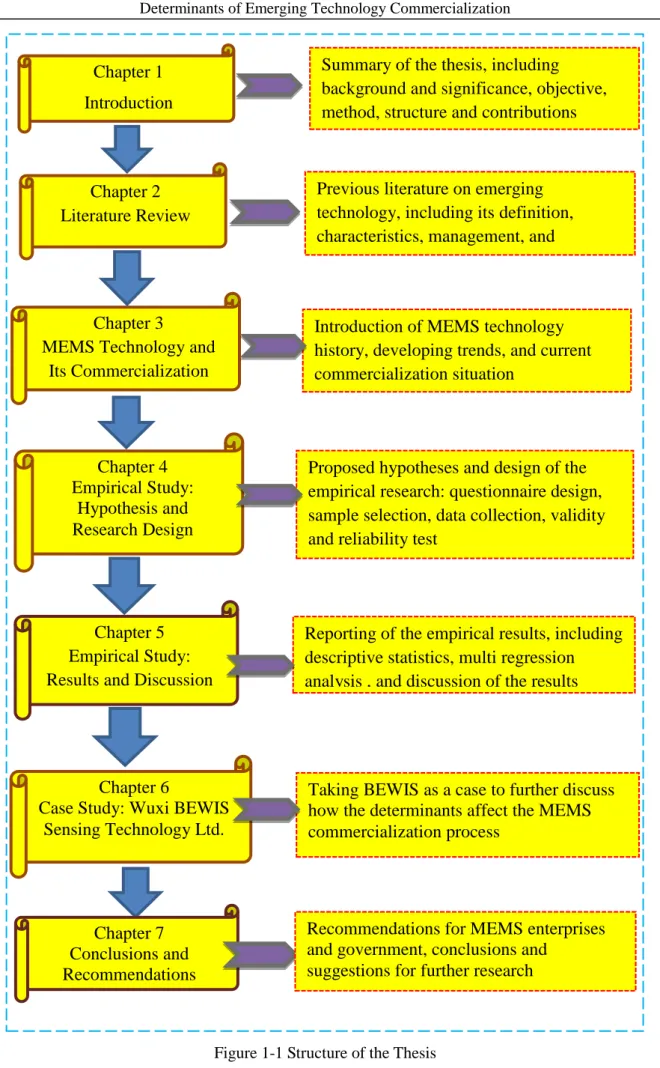
Taking MEMS technology as an example, this thesis investigates the key factors that determine the successful commercialization of MEMS technology. Figure 1-1 illustrates the structure of this thesis.
Chapter 1 introduces the background, significance, and purpose of the thesis, along with the content of the research and its structure. The contributions of the research are also described in this chapter. Chapter 2 is the review of the literature on emerging technologies, including its definition, characteristics, management, and commercialization. Chapter 3 analyzes the status and developing trends of MEMS technology. It overviews the MEMS technology and systematically presents the characteristics of MEMS technology. In addition, the patent data are analyzed and, based on this information, common forms of MEMS technology and are identified, thus illustrating the domestic and overseas development status of MEMS technology. Finally, the prospects for the main applications and the future of MEMS technology are identified.
Figure 1-1 Structure of the Thesis Chapter 1 Introduction Chapter 2 Literature Review Chapter 3
MEMS Technology and Its Commercialization Chapter 4 Empirical Study: Hypothesis and Research Design Chapter 5 Empirical Study: Results and Discussion
Chapter 6
Case Study: Wuxi BEWIS Sensing Technology Ltd.
Summary of the thesis, including background and significance, objective, method, structure and contributions
Previous literature on emerging technology, including its definition, characteristics, management, and commercialization
Introduction of MEMS technology history, developing trends, and current commercialization situation
Proposed hypotheses and design of the empirical research: questionnaire design, sample selection, data collection, validity and reliability test
Reporting of the empirical results, including descriptive statistics, multi regression analysis , and discussion of the results
Taking BEWIS as a case to further discuss how the determinants affect the MEMS commercialization process
Chapter 7 Conclusions and Recommendations
Recommendations for MEMS enterprises and government, conclusions and
Based on a review of previous research on emerging technology and analysis of MEMS technology, Chapter 4 presents an empirical study on determinants of commercialization of MEMS technology. Related hypotheses were proposed and a questionnaire was designed to investigate the impact of various factors on MEMS commercialization. We then introduce the sample selection and data collection in Chapter 4, and also conduct the validity and reliability test for empirical data. Chapter 5 reports the results of the empirical survey in Chapter 4. Multiple regression was employed to analyze the statistical data, examining the extent of key factors on the performance of commercialization including technology property, regional cluster innovation network, enterprise capacity, market conditions, policy and regulations, and social environment. Related discussions are also provided in Chapter 5.
Since the empirical survey only investigated the determinants of MEMS commercialization, Chapter 6 uses Wuxi BEWIS Sensing Technology Ltd. (BEWIS) as a case to analyze how these factors affect the four stages in the commercialization process. Thus, this case study is a complementary to the empirical analysis in Chapters 4 and 5.
Finally, Chapter 7 provides conclusions and recommendations, as well as limitations and suggestions for further research.
1.4 Research method
The purpose of this study is to investigate the determinants of MEMS technology commercialization in China. To achieve this goal, multiple methods can be used to collect necessary information. In this study, qualitative and quantitative analyses were conducted to analyze the key factors that determine the success of MEMS commercialization.
1.4.1 Empirical study
This study employed empirical survey approaches like questionnaire and in-depth interview to collect the necessary data and information. The questionnaire includes basic information of enterprises and the influences of different factors on MEMS product development, which are measured by a five-point Likert scale. Structure equation model (SEM) was then used to analyze the statistical data. This empirical study will examine the extent to which the proposed factors affect the success of MEMS technology commercialization. In this empirical study, the sample covers 112 MEMS enterprises in China.
1.4.2 Case study
To further explore how these factors influence the MEMS product development, we also employed a case study to do qualitative analysis. Case analysis is a suitable means of conducting exploratory research work, especially for complex procedures (Yin, 1994). Emerging technique management is complicated. It is also novel research work that has not been sufficiently developed. Since Wuxi BEWIS Sensing Technology Ltd. (BEWIS) has passed the emerging stage and the fast-growth stage and is now at the mature stage, it is a suitable case to observe the commercialization of MEMS technology. This case study may provide some novel insights into MEMS product development, particularly the role of various factors on the commercialization, which is valuable to other MEMS enterprises.
1.4.3 Theoretical analysis
This study conducts a comprehensive literature review on emerging technology, which reveals the current theories. In addition, related analyses for MEMS technology characteristics, as well as developing trends, are also summarized in the thesis. All of these theoretical analyses provide a foundation for the following empirical study. Furthermore, recommendation to the other MEMS enterprise is discussed based on the results of the empirical examination and case study.
1.5 Contributions of this study
By combining empirical analysis and case study, this study explores the determinants for the successful commercialization of MEMS technology, especially under China’s transition economies. The contributions of this thesis are from theoretical and practical perspectives.
1.5.1 Theoretical contributions
Currently, most studies on the commercialization of emerging technology have considered the context in developed countries and regions like the United States, Japan, and the European Union, with few studies on developing countries like China. To fill this gap, this thesis takes MEMS technology as a typical example to systematically analyze the characteristics of emerging technology commercialization, especially the four stages identified during the entire commercializing process.
Taking 112 Chinese MEMS enterprises as a sample, this study empirically investigated the determinants of emerging technology in China. Furthermore, a case study was employed to analyze how these determinants affect the real commercializing process under the Chinese economic background. Through multi-regression analysis, the empirical results show that technology property, market conditions, regional innovation network, and enterprise capability are the main determinants of MEMS commercialization, whereas social environment and policy and regulation do not have a significant impact on the performance of MEMS commercialization. These findings enrich the emerging technology literature, especially for the commercialization of emerging technology under developing countries.
1.5.2 Practical contributions
This thesis empirically investigates the determinants of MEMS commercialization and discusses how they influence the MEMS product development, which is valuable for government policy making as well as the related enterprises’ product development providing some guidance to the commercialization of other emerging technologies.
(1) For government. Through empirical study, this study finds that, during the MEMS commercialization process, regional innovation networks are among the determinants of commercialization performance. Therefore, to provide more favorable context to the MEMS enterprises, local governments should carefully make related policies to help cultivate regional innovation network. This open innovation system requires extensive cooperation among various agents such as universities, industry associations, intermediate agencies, and governments in the region. Apart from the innovation network, the case study also show the importance of various financial programs in supporting the survival of startups. How to identify prospective startups is a big challenge for local governments. To address this problem, the specific features of an emerging technology should be considered carefully since different emerging technology may exhibit quite different commercialization paths and requirements, meaning that the same policy and regulation may not be suitable for all technologies. Thus, the local government should also enhance the academic research and field survey on emerging technology before the related policy is proposed.
(2) For enterprises. To develop a successful product, an MEMS enterprise needs to consider four determinants including technology property, market conditions, regional innovation network, and enterprise capability simultaneously. This study also divides the commercialization into four stages and discussed the different roles of the determinants on
product developing process so as to provide necessary reference to the enterprise practice. At the early product selection stage, it is critical to make a large-scale survey and collect comprehensive information to evaluate the market conditions, finding a niche market to develop. Later in the R&D and pilot test stages, enterprise may make full use of all external supporting resources, such as various public platforms, to control the cost. During these process, how to design a product to satisfy the customer’s demand, rather than a product with the most advanced technology is a key to successful commercialization. Since the emerging technologies are changing continuously, an enterprise looking to maintain its advantage over its competitors must continue innovating in order to keep up with technological change.
(3) For emerging technology industries. MEMS technology is a new form of technology that has attracted global attention in recent years. Using the global MEMS patent data, this thesis discusses the MEMS product distribution as well as its geographic distribution around the world, which provides some hints with which to predict the trends of MEMS technology. This study provides six trends to MEMS industry-3D-structural, high-performance monolithic, highly integrated module, low power consumption, intelligence, and networking which may create new sectors or change existing industries dramatically. In addition, due to the common property of emerging technology, the characteristics of MEMS commercialization may be applied to other technologies to some extent, guiding their commercialization processes.
Chapter 2:Literature Review
This chapter summarizes the existing literature on emerging technologies, including the definition, characteristics, management, and commercialization of emerging technology.
2.1 Definition of emerging technologies
2.1.1 Technology, high technology and new technology
2.1.1.1 Technologies
In daily work and life, the terms “science” and “technology” are often combined to form the term “scientific technology”. Science is a knowledge system that reflects the essence and laws of objective things. Science is based on practice, precisely argued logic, the rational knowledge of essential features, necessary connections, or the laws of the movement of things in the objective world (World Intellectual Property Organization [WIPO], 1977).
Technology is the set of knowledge, skills, methods, and types of planning that adjust, control, and transform nature and society according to objective laws, making it possible to engage in practical activities to increase the chances of survival. It is a resource that controls the factors of production and products as well as a system of knowledge that serves as a basis for products or services. Technology may be a product or technological invention, a type of design, a practical method or a professional type of design and managerial skills (Fu & Tong, 1996).
2.1.1.2 High technologies
The term “high technology” was coined in the classic High-Grade Technology in the 1960s (Bi, 2015). In 1983, the phrase “high technology” was formally included in the Merriam-Webster Third New International Dictionary. There are several definitions of high technology. According to Chen (1997), high technology is the latest knowledge-intensive scientific achievements, which dominate the development of socially productive forces. Gu and Zhao (1998) also suggested that high technology is based on modern scientific theory and can bring great economic and social benefits to society. High technology has also been viewed as a combination of cutting-edge scientific knowledge and technologies that play a
revolutionary role in modern social production. Yin and Wang (2010) summarized that high technology has the following features: (1) it is based on the latest scientific theory; (2) it belongs in the class of knowledge-intensive technology; and (3) it has a profound influence on both economic development and social progress. Thus, high technology is based on scientific invention and discovery. From social economic perspectives, each high-technology product has its own features. Compared to either general or traditional technology, high technology represents not only the accumulation of human experience, but also scientific inputs and knowledge based on contemporary technological achievements.
2.1.1.3 New technologies
A new technology is a concept related to time. New technology and high technology differ in that a new technology is classified from the time of occurrence and does not have a direct relationship to the latest scientific development and the degree of knowledge intensiveness, whereas high technologies are directly and closely connected to these two factors (Chen, 1997). For example, some newly practical technologies are new technology, but not high technology. On the other hand, new technologies and high technologies overlap with each other (Day & Schoemaker, 2000) like Through Silicon Via techniques and nanometer material technology, which are the high and new technologies at well.
2.1.2 Emerging technologies
The term emerging technologies has appeared in recent years. Day and Schoemaker (2000) noted that emerging technologies are innovations and applications that have a scientific foundation and the potential to both change existing industries and create new ones. They made three key points in this regard. Firstly, knowledge for emerging technologies is spreading continuously. Secondly, applications of emerging technologies in the market are undergoing innovation. The market keeps its original status but products are in the process of upgrading. Thirdly, emerging markets are developing and taking shape. The technologies involved are pre-existing technologies that are leading to new markets.
Based on Day and Schoemaker’s (2000) definition, Li (2012) further analyzed emerging technology from the perspectives of time, content, function, and development. He suggested that emerging technologies are established based on the disciplinary development of information technology and biological technology with potential industrial prospects and high levels of uncertainty regarding development, requirements, and management. These technologies might lead to changes in industry, enterprise, the competitive environment and
management thought, business flow, organizational structure, and managing modes. Meanwhile, Yin and Wang (2010) argued that emerging technology should exhibit the following three characteristics simultaneously:
(1) It is being formed or developed. Most such technologies are beginning to appear. For example, microfluidic chips, nanometer robots, and LEDs are emerging technologies that are in the process of formation. Although some technologies have been in existence for some time, they are always engaged in the developing process; an example of this phenomenon is Internet technology. Thus, researchers classify these technologies as emerging technologies.
(2) It belongs to high technology, not traditional technology. As a typical type of high technology, emerging technologies contain a very high level of technological property. If an emerging technology cannot be classified as high technology, it is only regarded as a new technology, although it is in the process of being formed or developed.
(3) It can have a great influence on economic structures or industrial development. If a recently appeared high-technology product does have an essential influence on the economic structure or on industrial development, it can be classified as general high technology or cutting-edge technology, or even as early-mature technology. Whether a technology can exert an essential influence on the economic structure or industrial development is an important standard to identify emerging technology.
2.1.3 Relationships among emerging technology, high technology and new technology
The widely accepted definition of emerging technologies in China is that it refers to recent or developing high technologies that have a substantial influence on the structure of the economy and industrial development (Li, S.M., Xiao, L. & Xiao, Y.G., 2007). Until now, most emerging technologies have focused on information technology and biological technology. However, not all recently developed high technologies are emerging technologies. Only high and new technologies that have a substantial influence on economic structures or industrial development are emerging technologies (Zhao, Z.Y., Yin, L. & Cheng, 2004; Yin & Shi, 2005). Yin and Wang (2010) asserted the following similarities and differences among emerging technologies, high technology and new technology.
(1) Similarities and differences between emerging technology and high technology Only a few high technologies are emerging technologies. Emerging and high technologies both use the latest scientific theories, discoveries, and inventions. There are a few differences between emerging and high technologies. First, according to the present
theory, high technology is a relatively stable technological group, such as information technology and biological technology. Emerging technologies refers to a specific technology such as MEMS technology, transgenic technology, or 3D printing technology. Second, high technology is usually related to a certain industry. For instance, biological technology has a corresponding biological industry. Any technology developed from this technological group would be added to the list of biological technological industries upon its commercialization. Also, high technologies are not always technologies that have appeared recently. For instance, many examples of information technology are still listed as high technology in the prevalent classifications despite the fact that they are not new. The same is true in the field of aerospace engineering and other forms of high technology. Finally, high and emerging technologies have different effects on economic development. Emerging technologies in high technology have a great influence on economic development, which is an essential feature of emerging technologies.
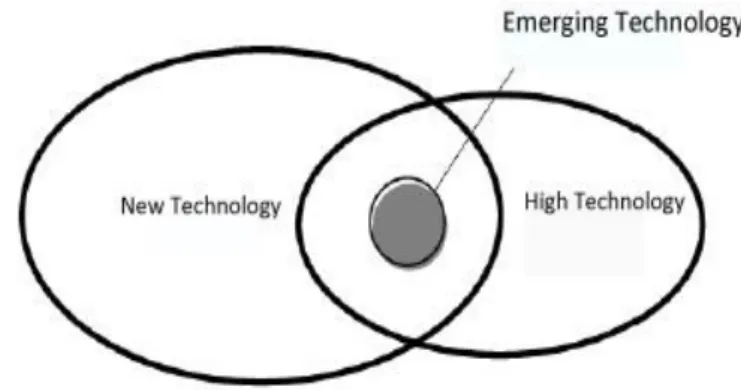
(2) Similarities and differences between emerging technology and new technology Similar to high technology, only a few new technologies can be classed as emerging technologies. As mentioned above, some overlaps may exist between new and high technologies. Indeed, all emerging technologies are new technologies. The scope of emerging technologies is narrower than that of new technologies. Only a very small portion of new technologies belong to emerging technologies. Therefore, emerging technologies are a subset of the intersection of high technologies and new technologies. Figure 2-1 illustrates the relationships among the three types of technologies.
Figure 2-1 Relationships Among Merging, New, and High Technologies
2.2 Characteristics of emerging technology
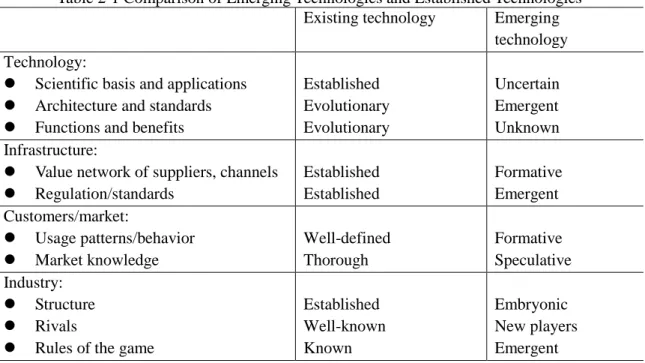
Table 2-1 Comparison of Emerging Technologies and Established Technologies Existing technology Emerging
technology Technology:
Scientific basis and applications Architecture and standards Functions and benefits
Established Evolutionary Evolutionary Uncertain Emergent Unknown Infrastructure:
Value network of suppliers, channels Regulation/standards Established Established Formative Emergent Customers/market: Usage patterns/behavior Market knowledge Well-defined Thorough Formative Speculative Industry: Structure Rivals
Rules of the game
Established Well-known Known Embryonic New players Emergent
Source: Day and Schoemaker (2000)
As shown in Table 2-1, Day and Schoemaker (2000) compared emerging and existing technologies. They argued that for an existing technology, the skills, foundational structure, customers, and industries related to current existing technology are definitely known whereas emerging technologies are not clear and their networks of suppliers and channel values are beginning to grow. Market knowledge of emerging technology is insufficient. During the growing process, competitors are complex and show great uncertainty.
2.2.1 High uncertainty
Zhao et al. (2004) proposed that, unlike traditional and high technologies, emerging technologies have shown quite different features, in which high uncertainty may come from the various aspects.
(1) Market uncertainty. Since the emerging technology itself is immature and changing rapidly, especially in the early commercial stages, there is considerable uncertainty as to whether it can be accepted by the market. The demand for the emerging technology is difficult to predict, making it hard to guarantee a profit for the pioneer enterprises.
(2) Technological uncertainty. Generally speaking, an emerging technology depends heavily on many stages, which means it faces high risks of scientific uncertainty,
technological application uncertainty, R&D uncertainty (related to both time and success), and commercial uncertainty.
(3) Environmental uncertainty. The development of emerging technologies is influenced by market demand, and enterprise capacity, and other factors, but also supported by the external environment; for example, the guidance and support of the government policy environment, along with the industrial upstream and downstream enterprises. Therefore, environmental uncertainty has become an important factor that influences emerging development.
(4) Management uncertainty. The management of emerging technologies requires different processes, skills, and methods compared to the traditional one. More specifically, the investment commitment, strategy, market exploration, organizational structure, as well as learning methods related to emerging technologies, may all be different from the other technologies. Many theories and methods of traditional technological management are not adaptable to emerging technologies.
Furthermore, Liu and Li (2005) suggested that the technological uncertainty for an emerging technology is also characterized by the dynamics of a technology itself, other multidimensional factors and even unknown aspects. In the preliminary phase of an emerging technology, its nature and characteristics are uncertain. Gradually, the development of related science means that there will be fewer technological uncertainties. Meanwhile, uncertainties also come from many aspects, including technical uncertainty, scientific foundations, technical applications, standard systems, and functional interests. Moreover, technical uncertainty is uncertainty about the future, which is different from risk in that it cannot be calculated and estimated. Uncertainty is the “unknown” aspect of future events, including “partially unknown” and “completely unknown” aspects, which always inform the development path of emerging technologies.
2.2.2 Creative destruction
Schumpeter (1911) proposed the concept of creative destruction, arguing that it would substitute old and outdated methods and products with better ones. The destruction of old ways and products results in the embrace of the creativity of new ways and products. The emerging technology either creates a new industry or changes an existing industry dramatically (Li, 2012). Emerging technologies usually use a new and different scientific foundation to alter the original track of technological development. This not only creates new
technological forms, but also destructively creates new competitive rules, methods of organizing, markets, management theories, and even industrial forms. Enterprises using current resources and strategies may not be able to adapt to the demand of emerging technologies, and may therefore require new capacity (Li et al., 2005). When emerging technologies creatively influence or destroy related industries, technological innovations such as mobile internet technologies can potentially influence all industries (Li, 2012). For example, internet technology has restructured the traditional media: Alipay has influenced the financial industry; Wechat has had a profound impact on mobile operators, substantially improving the convenience and quality of communication; and digital technology has changed photography, music, TV, and film. Therefore emerging technologies are also featured by creative destruction.
2.3 Emerging technology management
2.3.1 Importance of emerging technology management
The essence of emerging technologies is changing quickly, which brings forth uncertainty and creative destruction. These essential features imply that the management of emerging technology will involve the challenges presented by various aspects of these technologies. In terms of discipline classification, emerging technology management is both a branch and an important component of technology management, which can be classified into the three types (Wu & Xie, 1999).
The first type of technical management was presented in a report entitled “Technology Management: Hidden Advantages”, which was issued by the United States National Research Council in 1987. The report states that technology management is related to engineering, science, and management and is used to plan, develop, and realize technology to influence and complete an organization’s strategy and operating objectives. The second type of technical management primarily focuses on technological invention and creation. As Dreje and Kofoed (2000) argued, technological management refers to the timely creation and improvement of the company product and producing capacity. The third type of technical management considers it to be a part of strategic management. Zehner (2000) stated that technology management includes the practice of integrating the commercial strategy and technological strategy of the companies. It is an integrated process that requires refined coordination of research, production, and the market.
Emerging technologies management and technological innovation management are closely related. Emerging technologies cannot have an independent existence without technological innovation. Emerging technologies arise from technological innovation. Only enterprises with a strong technological capacity and innovation ability can continuously create new technology. Schumpeter (1911) first proposed the innovation concept and theory, but he did not explicitly provide the precise definition of technological innovation. According to Wu (2000), technological innovation refers to the entire activities that begin with new technological concepts, R&D, or technological combinations and then actual applications, economic commercialization, and social benefits.
Although the theories of emerging technological management are also mainly based on technological management and technological innovation management, traditional strategic planning, financial analyses, marketing strategies, and organization structure design, a set of new management frameworks and tools are needed in order to adapt to the creative features of emerging technological destruction (Li & Chen, 2015). The challenges of emerging technology management call for the reform of many fields, including management thought, developing strategy, marketing strategy, and value assessment. Thus, the theories and methods from related disciplines in management are insufficient.
Since the 1990s, drastic and rapid technological reforms have changed not only industrial forms of technology development, but also people’s conceptual opinions, the competitive rules of industries and the operating modes of enterprises, resulting in new research subjects for theoretical researchers. The essence of emerging technologies is technical change, which is a source of creative destruction accompanied by uncertainty. Therefore, the management of emerging technology represents a different form of managerial skills and has gradually become one of the key factors for industry success. In addition to characteristics such as uncertainty and creativity, emerging technologies are also known for their explosive growth and discontinuous changes in performance due to technical improvement as well as the structure and characteristics of network-marketing businesses (Wang, J., Ling, F. & Tang, J., 2015). This performance could help less-advanced companies reach the levels of more-advanced companies while prompting an unusual emerging-technologies race. Additionally, the discontinuous change of emerging technologies requires specific management strategies that are quite different from conventional strategies (Geels, 2002).
2.3.2 Main topics on emerging technology management
2.3.2.1 Evolution of emerging technologies
The evolution of emerging technologies has attracted the attention of scholars worldwide. There are different levels of understanding regarding the content of emerging technologies, but the following seven perspectives have been the most widely studied: a combination of biological and sociological perspectives (Geels, 2002; 2006); a quantitative perspective based on literature; patents and other objective data or indexes; influential factors evaluated from a multi-stage, multi-level perspective; the perspective of the co-evolution of technologies and associated factors (Pelikan, 2003; Mao & Liu, 2010); the perspective of the framework-element relationship; and the philosophy of the technology perspective (Cao, 2012). Some of the abovementioned perspectives share basic ideas and are therefore not completely isolated from each other. For example, Adomavicius et al. (2007) proposed the concept of a technology ecosystem, which is actually a metaphor borrowed from the field of biology that incorporates the idea of coevolution. To some extent, this term reflects the technical view of the framework-element relationship.
The findings of Huang and Yang (2014) suggest that the evolutionary powers of emerging technologies and emerging industries are mutually stimulated and constrained by (1) knowledge learning and diffusion; (2) space demands and structural changes; (3) the redistribution of values along technology supply chains; (4) technology tracks and technical standards conversion; (5) the coevolution process between the two (which includes four major stages: initial coordination, reinforced coordination, in-depth coordination, and differentiation collaboration). Meanwhile, the level of overlap between emerging technologies and emerging industries varies according to the stage.
Like many technologies, emerging technologies might have arisen out of the process of breakthrough innovation and incremental innovation. Alternatively, they might have resulted from changes in the field of innovative applications, with new technical pathways generated through the process of breakthrough innovation (Koberg et al., 2003). Incremental innovation places a stronger emphasis on the trajectories of technological evolution, along with the process of separating, grafting, and integrating related technologies; that is, the synthesis of a new system as a result of two unrelated technologies being applied in the same field (Yoffie, 1996). In addition, emerging technologies involve characteristics of disruptive technology and discontinuous innovation (Kostoff, 2004). From the point of biological evolution, emerging
technologies are more like the discontinuous equilibrium process that occurs when new species are formed (Gould & Eldredge, 1977). Here, it should be mentioned that disruptive technology emphasizes enterprise and business factors, as in Bower and Christensen (1995), whereas discontinuous innovation is more concerned with customer and market factors (Glynn & Paulson, 1996).
2.3.2.2 Assessment of emerging technologies
Because emerging technologies are characterized by a high level of uncertainty, conventional static analysis techniques, such as the net present value method, are no longer applicable. Instead, dynamic assessment methods are urgently needed. Doering (2000) proposed four steps, namely, scope, research, evaluation and practice. The technology roadmap is a method that is commonly used to assess, select, and predict available technologies, searching the development trajectories of new technologies or products according to time variation when factors such as related technologies, market, and organizational links are all explicitly considered (Rinne, 2004). Because of the existence of high levels of complexity and uncertainty during the investment and decision-making process of emerging technologies, the investment process can be carried out in stages. Additionally, such investment behavior can be considered as a series of options. Only when investment uncertainty is reduced to the minimum level and the market looks promising is it possible to decide to make a large-scale investment (Zhang, 2005). The option-pricing model, real options, positioning options, and search options consider the second characteristic of emerging technologies; in other words, past decisions can affect future technology choices and development opportunities in the future with internal uncertainty (Zhang, 2005). Therefore, they are commonly used during the process of technology selection and assessment.
2.3.2.3 Managerial capability of enterprises
As Day and Schoemaker (2000) noted, because traditional management practices such as strategic planning, financial analysis, marketing strategy, and organizational design are based on sustainability, they emphasize equilibrium, rationality, and optimization. However, such assumptions are often challenged by emerging technologies that have features of non-equilibrium and extreme vagueness. Additionally, such technologies are difficult to analyze using standard analytical methods. Therefore, the establishment of new management theories and methods is required. For the management of emerging technologies, managers have to reconsider their managerial pattern due to the more flexible environment, more
dynamic and adaptive strategic decision-making processes, and a discontinuous resource allocation process. Thus, experimental and exploratory approaches should be adopted for market surveys, and more attention should be paid to the development of adaptive technology. When companies confront a continuously changing and unpredictable market environment, traditional modes of strategic thinking are out of date. Therefore, researchers begin to focus on the internal resources (Barney, 1991)and dynamic capabilities (Teece et al., 1997) of companies.
Yin and Wang (2010) found that a multilayer pyramid structure is unsuitable for the development of emerging technologies. The natural choice for the vast majority of emerging technologies is a flat, matrix-like, separated organizational structure. It is also necessary to establish strategic alliances and new types of organizations. Based on an in-depth analysis of the organizational characteristics of emerging technologies, Jin (2005) discussed the abilities that are necessary for emerging technologies and organizational strategies and established a theory-based cognitive model of emerging technologies management. Meanwhile, Zhang (2005) noted that corporate governance structure can have a significant influence on technology innovation and a well-established governance structure can help promote business innovation activities. Chen (2005) and He and Raymman-Bacchus (2010) analyzed the diffusion characteristics and dynamic process of technology innovation in an industry cluster, finding that because an industry cluster represents a cluster of associated regional companies, industry clusters and technology innovation diffusion can facilitate and promote each other.
2.3.2.4 Identification of emerging technologies
Considering that the development of science and technology at the beginning of the 21st
century has been rapid, it is important to identify emerging technologies characterized by creative destruction property among the large number of technologies. Currently, most studies are based on the complexity and uncertainty of emerging technologies, with a focus on qualitative analysis. Jin et al. (2006) analyzed the selection and cognition process of emerging technologies from the perspective of business organizations. They studied the critical capabilities of organizational strategies and established a theory-based cognitive model for emerging technologies, testing the validity of the model by using the case studies from IBM Corporation and Seagate Technology, Inc. Based on the uncertainties and risks associated with emerging technologies, Tan and Huang (2007) suggested a recognition and selection framework model that combines a technology roadmap and a real-option approach. Wei (2006) tested the recognition accuracy of emerging technologies based on experts’ marking methods.