Artig
os de pesquisa
Resumo
A pesquisa teve o objetivo de conhecer a opinião dos idosos sobre o exercício da autonomia, a utilização de medidas obstinadas e a escolha do local de morte para idosos na presença de doença grave e terminal. Foram entrevistados 112 (77%) participantes de programa da Universidade Federal do Amazonas orientado para o envelhecimento. O resultado mostrou que 67% foram desfavoráveis a que a vida do paciente fosse mantida “de qualquer jeito”, ou seja, seria necessário que as condutas a serem tomadas nessas ocasiões fossem ava- liadas levando em consideração a dignidade da pessoa humana em evitar o prolongamento do sofrimento de morrer. A lucidez foi o indicador de qualidade de vida mais apreciado (79%), seguido pela autonomia em poder respirar sem o uso de aparelhos (17%) e alimentar-se sem o uso de sonda (4%). A casa do paciente (63%) foi considerada o local de morte mais apropriado.
Palavras-chave: Bioética. Autonomia pessoal. Saúde do idoso.
Resumen
Autonomía del anciano y la distanasia
La investigación tuvo como objetivo conocer la opinión de los ancianos sobre su autonomía , la utilización de medidas perseverantes y la selección del lugar de muerte para los ancianos ante la presencia de una enfer- medad grave y terminal. Se entrevistó a 112 (77%) participantes de un programa orientado para el envejeci- miento en la Universidad Federal del Amazonas. El resultado mostró que un 67% no fueron favorables a que mantuveira la vida “de todos modos” o sea, es necesario que las conductas a ser tomadas en estos momentos sean evaluadas llevándose en consideración la dignidad de la persona humana en evitar la prolongación del sufrimiento al morir. La lucidez (79%) fue el indicador de la calidad de vida más apreciado, seguido por la autonomía del poder respirar sin el uso de aparatos (17%) y alimentarse sin el uso de sonda (4%). La casa del paciente (63%) fue considerada el local de muerte más apropiado.
Palabras-clave: Bioética. Autonomía Personal. Salud del anciano.
Abstract
The elderly autonomy and dysthanasia
The purpose of the survey was to know the opinion of the elderly about the exercise of autonomy, the use of obstinate measures and the choosing process of the place of death for the elderly with terminal illness. The interview had 112 (77%) participants of the program for aging at the Federal University of Amazonas. The result showed that 67% did not agree that the life of patient should be maintained at any circumstance, meaning that measures are needed to be taken into account to consider the dignity of the person avoiding the extension of death suffering. The presence of awareness (79%) was the most appreciated indicator of life quality, followed by autonomy of being able to breathe without any apparatus (17%) and eating without a tube (4%). Patient’s house (63%) was considered the most appropriate place to die.
Key words: Bioethics. Personal autonomy. Elderly health.
ApprovalCEP/UFAMnumber383.0.115.000-10
1. PhD under course [email protected] – University of Porto, Portugal/ Federal Medicine Council, Brazil 2. PhD barbas35@ aeiou.pt –Autonomy University of Lisboan and University of Porto, Portugal.
Correspondence
Maria Zeneida Puga Barbosa Oliveira – Rua A, Casa 44, Condomínio Aristocrático, Bairro Chapada ZIP CODE 69.050-130. Manaus/AM, Brazil.
Artig
os de pesquisa
This research discusses the exercise of auton-omy of elderly people in relation to dysthanasia, in other words, medical conducts with the use of tech-nology that in the rush to save lives may prolong the suffering of death when applied to cases in which the studies show that will not really benefit patients in the long term, but only bring more hours or days of life. The truth is that the conducts that promote dysthanasia have been created to save lives in cas-es when the patient, at determined time, prcas-esents dysfunction and needs to use machines to perform basic physiological functions such as breathing. It is hoped, however, that the evolution of the situation over the time promotes their recovery, bringing back the full use of their vital functions or the closest to normal. Thus, the application of these maneuvers as cardiopulmonary resuscitation, the use of respira-tors and enthrall nutrition in elderly with severe and terminal conditions must be analyzed, considering the extent to which presents benefit to the patient or just to prolong their suffering.
Based on interviews, the study surveyed the opinions of elderly people relative to dysthanasia and the more suitable place for the death to the dy-ing elderly patients, and also which aspects of life quality they have interests in maintaining.
The autonomy bioethical principle
The word autonomy comes from two Greek terms – auto (self) and nomos (law, rule, norm) – that, together, mean self-determination to take decisions that affect their life, health, physical and psycho integrity, as well as their social relations. The autonomy principle, therefore, refers to the human capacity to choose on what is good and what is their
well being. The person is autonomous when their
thoughts are free, from internal or external con-straints to choose between the proposals presented. For this, it is also necessary that alternatives of action exist or that their creation is possible. There is no real exercise of autonomy when there is just one way¹. When there is no freedom of thought or of choices, when you have only one option, or when there is no freedom to act according to the alter-native desired, the action taken may not be judged as autonomous². Autonomy expresses the princi-ple of moral freedom, in which every human being is an autonomous and as such, must be respected by everybody who have different moral options. No moral can be imposed upon the humans against the dictates of his conscience3.
The complete autonomy is an ideal. In prac-tice, the human being is always constrained by the rules of society, the religious influences and other behavioral conditionals. Man is not born autono-mous, becomes autonomous with the contribution of biological, psychological and socio-cultural struc-tural variables. However, the autonomous person can act as non autonomous in certain situations. In the case of the elderly in medical treatment, al-though he may have enough lucidity to exercise his autonomy, he may not do so for various reasons such as: it depends on who takes him to the doctor, technological resources of the city where he lives, the purchasing power to buy special food or med-icine, among others.In addition, physical changes, emotional and mental disorders may compromise the enjoyment and rationality of decisions to be tak-en. When the autonomy situation is reduced, it lies to third parties, family members or health profes-sionals to decide for the non autonomous person1.
The concept of autonomy is closely linked to the competency. The competence-incompetence judgment of a person should be considered in each particular decision and not extend to all the deci-sions of their life. It is not common to question the competence of the patient’s decision when the de-cision is in accordance with the doctor´s. However, all patients must be judged competent until there is proof of his incompetence, a situation in which his autonomy is reduced 4. In the legal ambit, it is as-sumed that an adult is competent until the Judicia-ry considers him incompetent and restricts his civil rights; however, for ethics, there is no incompetent person in all areas of his life5.
Socioeconomically vulnerable groups, because of their lack of resources, have fewer alternatives to choose in their lives, what contributes to not fully develop the autonomy potential. Still, they should be seen and respected as autonomous people. In the treatment, doctors shall not decide for them un-der the allegation that they do not have the capacity or resources to decide 1. Finally, autonomy does not mean following the individualism, since man lives in society and ethic is the form to regulate the rela-tions between people, harmonizing individual and collective interests.
Dysthanasia or the use of obstinate measures
Dysthanasia is a neologism that combines the Greek prefix dys, that means defective act, and the complement thanatos, understood as death. Thus, the literal translation “defective death”, would be referring to difficult or painful death due to
exces-Artig
os de pesquisa
sive and disproportionate prolongation of the act of dying by a treatment that prolongs the biological life of the patient. This attitude, which comes from the medical effort to save lives, results in the end, in a slow and often painful death, result of the obsti-nate prolonging of the patient’s life when there is no hope of cure and any treatment has become futile, without benefits.
The cure of the disease and the relief of suffer-ing, are accepted as the goals of medicine. The dis-ease destroys the integrity of the body, and the pain and suffering destroys the overall integrity of the person. However, as much as it tries, medicine may not avoid death indefinitely. When medical therapy can no longer achieve the goal of healing, to insist on treatment only for keeping the person alive is fu-tile. This dilemma indicates the need to stop what is being useless and intensify the efforts to reduce the discomfort of dying6.
Historically, Hippocrates concebied three ob-jectives for medicine: to relieve the suffering of the patient, to decrease the aggressiveness of the disease and to refuse to do the treatment in which medicine recognizes that it can no longer contribute. In the an-tiquity, if a doctor tried to prolong the life of a person, he would be considered unethical – this thought re-mained until the Middle Ages7. The Hippocratic writ-ings inform that the physician should know the limits of his art and to avoid arrogance. At the end of the sixteenth century, Francis Bacon, the father of
mod-ern science, has considered three purposes for
medi-cine: preservation of the health, cure of diseases and life prolonging. He insisted that it was necessary to find ways to make death less unpleasant8.
The most common causes for dysthanasia are: the conviction that the biological life is a good, for which the maximum effort must be invested to ex-tend it, regardless of the life quality presented; the lack of knowledge on this subject by the patients and family members, who could use their rights in order to avoid prolonging the agony of the dying pa-tient; the physician’s anxiety with the failure of the treatment and the difficulty of death acceptance.
The patients with more risks to be exposed to dysthanasia are the ones in the intensive care units (ICU), the born children with low birth weight (<650g) and lifetime under 26 weeks, chronic pa-tients with a history of aggravation and remission, and terminal patients9.
In situations when death is imminent and in-evitable, treatments that would only extend life precariously and piously may be renounced
(thera-peutic obstinacy or medical futility), without, how-ever, interrupting the normal care due to the sick in similar cases10. This was the case of Pope John Paul II, who in a state of advanced disease and after two hospitalizations in the Gemelli Clinic, has asked to remain in his quarters in the Apostolic Palace, in Rome, in order to conclude his mission11. This is a case of “orthotanasia,” in other words, death at the right time, without abbreviation or unreasonable prolongation of the dying process6.
Technological advances and success in the treatment of many diseases caused medicine to become increasingly directed towards healing. This way, the technical question is now to eliminate the death. Thus, the technical issue became to prolong vital signs; the quality of this life, a concept of diffi-cult mediation to science and technology, was put as second plan12. Although it is the duty of the physi-cian to cure while possible, in the case of a terminal patient he can reduce suffering by suspending the treatment with curative intent, since this objective is no longer achievable, and by providing the necessary medications to reduce the discomforts caused by the disease, with the consent of the patient or family 13.
In circumstances when death is inexorable, the most sensible way is to suspend the artificial means, expendable and superfluous. So, death can occur in its time. This way, if the individual is alive, he should be treated. If he is dead, there is no reason to keep him connected to devices. There is neither half life, nor half death14.
In Europe, the dysthanasia is known as obsti-nate therapy and in the United States of America (USA), as medical futility. The term used in Europe was introduced by Jean Robert Debray, is under-stood as the behavior in which the therapeutic pro-cess brings more harmful effects than the disease effects to cure, because the cure is impossible and the expected benefit, smaller than the disadvantag-es. The cure of disease and the relief of suffering are acceptable as objectives of medicine. The disease destroys the integrity of the body, and the pain and the suffering, the overall integrity of the person14.
The concept of futile treatment or therapeutic obstinacy should meet three criteria: effectiveness, benefit and burden. It is a guide of prudence that must involve physicians, patients and their repre-sentatives, because decisions will be taken in terms of therapeutic investments at the end of life. The first criterion, effectiveness, focuses on physicians, in measurable data of prognostic and therapeutic. It seeks to verify the capacity of the treatment to change the natural history of the disease, and make
Artig
os de pesquisa
a difference, in relation to the morbidity and the mortality known. The second criterion is the ben-efit, or, what contribution it brings to the patient under the optic of the patient himself or his repre-sentative. The third criterion is the burden, or, the emotional, economic and social costs to the physi-cian and the patient. Every determination of futile treatment must be analyzed in the context of values and commitments of the person’s dignity15. It does not mean abandonment of care, but a direction for the overall care in which the patient is comforted in his human aspect 16.
It is inconvenient to present the patient or his representative a treatment that does not change his continued vegetative state, does not change the de-ficiencies that are incompatible with survival, that leave permanently compromised capacities neuro-cardiopulmonary and for social life, and that does not help the patient to get rid of the devices used in intensive care. Thus, when patients are not bene-fited, in the sense of medical treatment, the doctor can use the principles of beneficence and non-mal-feasance to avoid them. This assessment should not be influenced by the socioeconomic status of the patient17. According to the Code of Medical Ethics (CEM)18, the doctor will accept the choices of their patients about the diagnostics and therapeutics conducts expressed by them, since they are fitted to the case and recognized by science.
Method
It was conducted a descriptive study, with cross-sectional cut. The research was conducted with the elderly inscribed in the program Happy El-derly Always Participates – University of the Third Adult Age, of Faculty of Physical Education and Phys-iotherapy, Federal University of Amazonas (Ufam), in Manaus. The data collection took place in Novem-ber and DecemNovem-ber 2010. Of the 145 elderly regis-tered for the annual activities, 112 (77%) participat-ed of the survey.
Oriented to aging, this program of physi-cal activities exists for 20 years and integrates the university extension programs. It takes place from Monday to Thursday afternoons, in our own facili-ties, campus Ufam. Among many physical activities that elderly perform, it can be cited: water aerobics, swimming, dancing, choreography and walk.
The questionnaire was tested by previous ap-plication of 10 elderly for adjustments. The data col-lection was done using standardized questionnaire
(Appendix 1). The elderlies who participated of the pre-test were interviewed again in order to com-pose the sample.
Results and discussion
Sample characterization
There were interviewed 112 elderlies, 96 (85.7%) women and 16 (14.3%) men. As to age, 72 were 60-69 years old (64.3%); 32, 70-79 years old (28.6%) and eight aged 80 or over (7.1%). The per-centage by gender confirms national data that indi-cated the feminization of aging in Brazil.
The higher proportion of women than men may be explained by the longer life average of wom-en, lower mortality from external causes and less exposure to adverse conditions throughout the life cycle19. If it is considered the expectancy at birth, it is observed that women live on average five to sev-en years longer than msev-en. Risk factors, such as work and traffic accidents, domestic accidents, homicides and suicides are more frequent in men. Further-more, the difference in attitude towards the disease is demonstrated by the fact that women participate more of the health service, what enables them to receive diagnosis and earlier treatment 20.
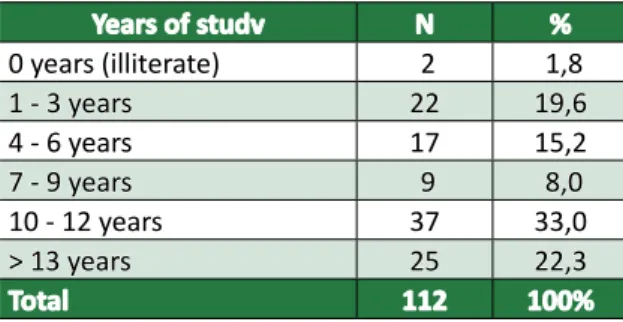
Regarding to education, the distribution has showed that below 10 years of study there were 60 elderlies (44.6%) and with 10 or more years, 62 (55.3%). The highest percentage of education found was from 10 to 12 years of study, with 37 cas-es (33%), referent to the elderly who exceeded the Fundamental education without completing high school (Table 1). There were identified two cases of literacy (1.8%), confirming that this situation is in-creasingly less frequent. Although, generally, people in this age group have not had easy access to school in their childhood or youth, many of the illiterate overcame from that condition through popular edu-cation projects for youth and adults.
According to the Demographic Census of the Brazilian Institute of Geography and Statistics (IBGE) 21 the elderly population (above 65 years old) has shown good indicators on the evolution of liter-acy. In 1960, the percentage of literate males was 51.4% of women, 34.7%. In 2000, these percent-ages passed respectively to 64.9% and 59.7%. The increase in the literacy rate among the elderly popu-lation is beneficial because it allows the individual to be more active and participative. It is possible that this also works as a protective factor against the cog-nitive dysfunctions that affect the elderly19.
Artig
os de pesquisa
Regarding marital status, respondents 11 were single (9.8%), 46 married (41%), 16 divorced (14.3%) and 39 widowers (34.5%). Joining unmar-ried, divorced and widowed is possible to infer that the majority of respondents (59%) live without part-ner. Live for a long time without company is a factor that contributes to the isolation22. The probability of been a widower, increases with age. So, loneliness is more common among women, who represent 72% of the cases of elderly people living alone23.
Table 1. Distribution according to education
Years of studv N % 0 years (illiterate) 2 1,8 1 - 3 years 22 19,6 4 - 6 years 17 15,2 7 - 9 years 9 8,0 10 - 12 years 37 33,0 > 13 years 25 22,3 Total 112 100%
Use of obstinate measures
When asked about the use of obstinate mea-sures for the stubborn maintenance of life “anyway” in the case of the elderly terminal patient, the re-sult showed that 33% are favorable and 67% are not favorable (Table 2). In the interview, the elderly favorable “to do everything to keep life anyway” cit-ed some important phrases to be recordcit-ed: “While
there is life there is hope”, “Only God can take some-one’s life” and “The devices [technological
resourc-es] exist to be used.”
The dysthanasia, also known as obstinate ther-apy, damages the patient’s right to die in peace and with dignity24. The patient in terminal stage can be considered a patient who presents a clinical state in expectation of death in short term.
In accordance with Article 51 of the CEM, in
cases of incurable and terminal disease, the doctor should not practice diagnostic and / or therapeutic actions useless or obstinate, should create oppor-tunities all palliative care that the case indicate, always considering the wishes of the patient or his representative 18.
The patient has the right to decide about the techniques or procedures that eventually it will be applied. This idea leads to the principle of autonomy, very accepted in the United States. The patient has the right to decide about all the possibilities of treat-ment and should be informed of the consequences of non-adherence to any treatment. In Europe, with a different culture, patients are not fully informed
about their health status, especially in cases of se-vere disease leading to death in the short term. The clinical practice is still paternalistic and hinders the autonomy of the patient 26.
Table 2. Use of obstinate measures in the presence
of severe and terminal disease
Use No %
Yes 37 33
No 75 67
Total 112 100%
The 75 elderly not favorable “to do everything to keep life anyway” (67%) responded that they would need some “indicator of life quality” to in-sist on it such as lucid (79%), breathing without the use of devices (17%) and to eat without the aid of the probe (4%) (Table 3). The term “indicator of life quality” was understood by them and proposed by the researcher, as something that showed clearly that the years of life to gain with the use of the ob-stinate measures in elderly with severe and terminal allows the patient some performance or participa-tion autonomously.
According to the CEM18, in clinically irrevers-ible and terminal situations, the doctor should not perform unnecessary procedures, diagnoses or treatments, but provide all palliative care indicated to the case, as predicted in article XXI in Chapter I.
Table 3. Indicator os life quality cited by elderly
favorable to obstinate measures
Indicator N %
Lucidity 59 78,7
Breathing without the use os
devices 13 17,3
Eat without the aid of the probe 3 4
Other 0 0
Total 75 100%
Part of the interviewees stated clearly the fear of “not recognizing the children”, “need to eat thought the hands of others”, “bed rest” and “live like a vegetable”. Many reported their experience with friends or family in a vegetative state and rec-ognized the suffering that the situation imposed ev-eryone: patient and family. About the place of death for serious and terminal elderly patients, 63.4% con-sidered the home as the best place. Other 36.6% found that the ICU would be the appropriate envi-ronment (Table 4).
Artig
os de pesquisa
Table 4. Place of death for serious and terminal
elderly patiens
Local N %
UTI 41 36,6
Hom 71 63,4
Total 112 100%
Humans can not live without the help of others in all vital circumstances and, mainly in key moments like death27. The awareness of this fact, made in a time, that the passage from life to death was a part of life. The society and community sheltered helplessness, especially because the convivial with death was almost every day.
If the needs of the patients did not change over time, there is the inability to satisfy the emotional is-sues of patients facing death. When death at home was accompanied by the satisfaction of the desires of the patient, thought the spiritual company and the presence of the family, today remains the technical care with the body and the loneliness of the profes-sional environment24. Death changed from the house to the hospital, being absent from the familiar world of everyday life. Because he does not see it, modern man believes he can forget about it 28.
When analyzed the relation between the use of obstinate measures and the choice of the place of de-ath, it was found that there was an association, among the 75 seniors who decided on the “no use of obstina-te measures”, most (72%) found that the right place of death was home. From the 37 interviewees “favorable to the use of obstinate measures”, 54% considered the ICU as the most convenient place of death (Table 5).
Table 5. Estudy of the association between the use
of obstinate measures and the place os death
Local de morte
Use of obstinate
measures UCI Home Total
No 21 (28%) 54 (72%) 75 Yes 20 (54%) 17 (46%) 37
Total 41 (36,6%) 71 (63,4%) 112
Association test , chi-square p value=0,007.
In the interview, some elderly commented that “to die at home among theirs” would be “something natural.” They would receive the affection of family, ask and give forgiveness to people, bless the children, say goodbye to friends, decide about the patrimonies, prepare according to the rituals of their religion. Oth-ers mentioned that by taking the patient home, they can use home measures to help them, as the use of
tea, broth, compresses, and baths, among others. Therefore, it is essential to highlight the importance of respect for the individual patient. Even (or especially) at the end of life anyone can be enforced on behalf of paternalistic beneficence of nature, something they do not want. Their self determination and autonomy must be respected. The person has the right to choose to die with life quality in the environment they consid-er the best29.
Respondents who considered the ICU the most suitable place to die alleged that there are human, technological and materials resources in it, that can meet the needs of patients, such as physicians, nurses, respiratory pain, medicines etc. They consider that at home there is no money to buy medicine or way to transport the patient at the time that his state is worse, there is nobody who knows how to accompany and as-sist them, besides the fact that family members need to work or there is no one to take care of the sick.
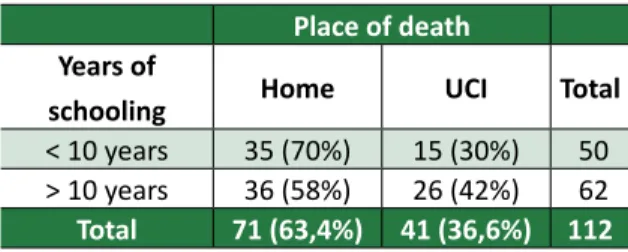
When studied the association between years of schooling and place of death, there was no association. Both, the least educated (less than 10 years of study) as the most educated (more than 10 years of study) considered home as the most suitable location. The percentages were 70% and 58%, respectively (Table 6).
Table 6. Estudy of the association between education
and place os death for terminally ill patiens
Place of death
Years of
schooling Home UCI Total
< 10 years 35 (70%) 15 (30%) 50 > 10 years 36 (58%) 26 (42%) 62
Total 71 (63,4%) 41 (36,6%) 112
Association test, chi-square p value=0,192.
The association between gender and place of death also showed there is no association, both women (64.6%) and males (56.2) consider that the best place is the home (Table 7).
Table 7. Association between gender and place os
death for terminally ill patients
Place of death
Gender Home UCI Total
Female 62 (64,6%) 34 (35,4%) 96 Male 9 (56,2%) 7 (43,8%) 16
Total 71 (63,4%) 41 (36,6%) 112
Artig
os de pesquisa
Likewise, when studied the association be-tween gender and the use of obstinate measures, no association was found, women (67.7%) and men (62.5%) are not in favor of using measures to keep life “anyway” for the elderly in serious condition with terminal illness (Table 8).
Table 8. Estudy of the association beween gender
and the of obstinate measures
Use of obstinate measures
Gender Yes No Total
Female 31 (32,3%) 65 (67,7%) 96 Male 6 (37,5%) 10 (62,5%) 16
Total 37 (33%) 75 (67%) 112
Association test, chi-square p value = 0,682.
Final considerations
This research showed that 67% of elderly re-spondents said they were not favorable to the life of the elderly patient in the presence of terminal ill-ness be maintained “by any means”, in other words, find it is necessary that the conducts to taken in these occasions be evaluated taking into account the dignity of the human person on help to avoid the prolonging of the suffering of dying. More than technical solutions are necessary attitudes that can contribute to life quality for the time remaining. In parallel, 33% considered that life should be pre-served at any cost and under any condition. Some have argued that life was “given by God and only He can take it.”
These findings contribute to the guidance that is important to realize the aspirations of the elderly in the type of document “anticipated policy”. With the will of the elderly patient expressly documented it is easier for the family and the doctor to take deci-sions without disrespecting their autonomy.
Lucidity was the indicator of life quality most enjoyed, indicated by 79% of the elderly as what should be considered to insist with obstinate mea-sures. The fact that the patient can breathe with-out the use of breathing apparatus (17%) and feed in a natural way without the use of the probe (4%), were the other indicators mentioned by seniors as important to be favorably taken into consideration by physicians when investing in obstinate measures.
In the case of elderly patients, in the pres-ence of serious and terminal illness, respondents answered that the best place of death would be
their own home (63%). In association studies, it was found association between the choice of place of death and the use of obstinate measures, most people who considered correct to insist on the use of obstinate measures for elderly with the serious and terminal disease, preferred they died in the ICU. Meanwhile, respondents who considered better the death of the patient at home were those who were not favorable to insist with obstinate measures.
In interview with elderly it was possible to talk about why to choose to die at home or in the ICU. Summarizing the answers, the ones who found it is better to die in the ICU claimed that there, they would be continued attended by specialists and ap-paratus, the family would have less work and suffer-ing to follow. The focus was to prioritize the require-ments of the disease.
The elderly who considered most suitable to die at home emphasized the care (teas, massages, special food etc and the care and attention of the family (ask and give forgiveness, bless children and grandchildren, perform religious practices, decide on goods, among others) would be determinant for the solace of that hour. They would feel death in a natural form, not so lonely as in the ICU, but sur-rounded by family.
Some were very explicit about wanting to “die at home”, but left the option in the ICU checked.
They claimed that at home there was no struc-ture (required drugs, appropriate devices and peo-ple available).
Therefore, it should be clear that the measures that may lead to dysthanasia, such as cardiopulmo-nary resuscitation, use of re-breathed and enthrall nutrition, among others, are of large value for the Emergency Medicine to save lives. However, if mis-applied, or used in cases where studies show there is no to bring benefit the patient in the long term, this will only extend the agony of death.
The findings of this research serve to prove that the orientations proposed by the new Medical Ethics Code from 2009 will meet the expectations of the society when they propose the complete attend to patients, respecting the dignity of human and ra-tional use of technology. In the case of terminal pa-tients, advising against unnecessary procedures and with dubious efficacy, to recommend palliative care that propose falling the person that suffers, not the disease in an advanced stage.
In conclusion, it is necessary that the evolution of the studies and that Brazilian law promotes the use of appropriate medical procedures at the right
Artig
os de pesquisa
moment of treatment, avoiding the maintenance of false hope to the dying patient and their family members, overspending, when life can no more be
rescued, suffering where death has been announced and lawsuits against doctors who favor human dig-nity and make rational use of technology.
Paper presented at the PhD program in Bioethics, Faculty of Medicine, University of Porto, ingreement with the Federal Council of Medicine.
References
1. Muñoz DR, Forte PAC. O princípio da autonomia e o consentimento livre e esclarecido. In: Costa SIF, Oselka G, Garrafa V, coordenadores. Iniciação à bioética. Brasília: Conselho Federal de Medicina; 1998.
2. Pessini L, Barchifontaine CP. Problemas atuais de bioética. 4a ed. São Paulo: Loyola; 1997.
3. Gracia D. La bioetica medica. In: Bioetica temas y perspectivas. Washington: Opas; 1990. p. 3-7. 4. Culver CM. Competência do paciente. In: Segre M, Cohen C, coordenadores. Bioethics. São Paulo:
Edusp; 1995.
5. Harris J. The value of life: an introduction to medical ethics. London: Routledge and Kegan Paul; 1985. p. 197-8.
6. Cinà G, Locci E, Rocchetta C. Dicionário interdisciplinar da pastoral da saúde. São Paulo: Paulus; 1999.
7. Amundsen DW. The physician’s obligation to prolong life: a medical duty without classical roots. Hastings Cent Rep. 1978;8(4):23-30.
8. Jecker NS. Medical futility: the duty not to treat. Medical futility: demands, duties and dilemmas. Camb Q Healthc Ethics. 1993; 2:151-9.
9. Leone S, Privitera S, Cunha JT. Dicionário de bioética. São Paulo: Editora Santuário Aparecida; 2001. Distanásia.
10. João Paulo II. Evangelium Vitae: carta encíclica sobre o valor e a inviolabilidade da vida humana. São Paulo: Paulinas; 1984.
11. Pessini L. Bioética: um grito pela dignidade de viver. 3a ed. rev. São Paulo: Paulinas; 2008.
12. Martin L. Eutanásia e distanásia. In: Costa SIF, Oselka G, Garrafa V, coordenadores. Op. cit. p. 171-92.
13. Associação Médica Mundial. Declaração de Veneza sobre o paciente terminal. Aprovada na 35a
Assembleia Geral AMM; out. 1983; Veneza. In: França GV. Medicina Legal. 8a ed.reimp. Rio de
Janeiro: Guanabara Koogan; 2008. p. 522.
14. França GV. Medicina legal. 8a ed.reimp. Rio de Janeiro: Guanabara Koogan; 2008.
15. Conferência Nacional dos Bispos do Brasil. Questões de bioética. Brasília: Edições CNBB; 2010. 16. Pellegrino E. Decision at the end of life: the use and abuse of the concept of futility. In: Corrêa
JDV, Sgreccia E, editores. The dignity of the dying person: proceedings of the Fifth Assembly the Pontifical Academy for Life; 24-27 feb. 1999; Vatican City. Vaticano: Libreria Editrice Vaticana; 2000. p 219-41.
17. Drane J. El cuidado del enfermo terminal: ética clínica y recomendaciones practicas para instituciones de salud y servicios de cuidados domiciliarios. Washington: Opas; 1999.
18. Conselho Federal de Medicina. Código de Ética Médica: resolução CFM no 1.931, de 17 de
setembro de 2009 (versão de bolso). Brasília: Conselho Federal de Medicina; 2010.
19. Telarolli Jr R, Machado JCMS, Carvalho F. Perfil demográfico e condições sanitárias dos idosos em área urbana do sudeste do Brasil. Rev Saúde Pública. 1996;30(5):485-98.
20. Papaléo Netto M, Yuaso D, Kitadai F. Longevidade: desafio no terceiro milênio. In: Pessini L, Barchifontaine CP, organizadores. Bioética e longevidade humana. São Paulo: Loyola; 2006. p. 259-88.
21. Instituto Brasileiro de Geografia e Estatística. Censo Demográfico 2000. [Internet]. [acesso 12 jul. 2011]. Disponível: http://www.ibge.gov.br/home/estatistica/populacao/default_censo_2000. shtm
22. Veras RP. Atenção preventiva ao idoso: uma abordagem de saúde coletiva. In: Papaléo Netto M, editor. Gerontologia. São Paulo: Atheneu; 1996.
23. Berquó ES, Cavenaghi SM. Oportunidades e fatalidades: um estudo demográfico das pessoas que moram sozinhas. Anais do 6o Encontro Nacional de Estudos Populacionais; out. 1988; Olinda.
Olinda, PE: Associação Brasileira de Estudos Populacionais; 1988. v. 1, p. 155-81. 24. Kluber Ross E. Sobre a morte e o morrer. São Paulo: Martins Fontes; 1996. 25. Jonsen A. A short history of medical ethics. New York: Oxford University Press; 2000.
26. Serrão D. Ética das atitudes médicas em relação com o processo de morrer. In: Serrão D, Nunes R, organizadores. Ética em cuidados de saúde. Porto: Porto Editora; 1988.
27. Cassorla RMS, coordenador. Da morte: estudos brasileiros. Campinas: Papirus; 1992.
28. Ariés P. Sobre a história da morte no ocidente desde a idade média. 2a ed. Lisboa: Teorema; 1989.
Artig
os de pesquisa
The authors thank the teacher PhD. Rita Maria dos Santos Puga Barbosa (Faculty of Physical Education and Physiotherapy /Ufam), the teacher PhD. José Cardoso Neto (Department of Statistic/Ufam) and the PhD. Cláudia Marina Puga Barbosa Oliveira (Ufam).
Participation of the authors
Maria Zeneida Puga Barbosa Oliveira performed all the stages of the research and the article elaboration under the coordination of the orienteer teacher PhD. Stela Barbas.
Received: 15.10.2011 Reviewed: 22. 4.2013 Approved: 11. 6.2013
Artig
os de pesquisa
Appendix 1
Questionary for data collection
1. Identification data:
Name: __________________________________________________________________________________ Address: ________________________________________________________________________________ Telephone: ______________________________________________________________________________ Gender: 1. M____ 2. F____
Age:____1. 60-64 years____2. 65-69 years____3. 70-74____4. 75-79 years____5. 80 years and over____ Schooling years:
1. Illiterate____2. 1-3 years____3. 4-6 years____4. 7-9 years____5. 10-12 years____6. 13 years and over____ Marital status:____1. Single____2. Married____3. Widower____4. Divorced____
2. Use of obstinate meajures
In case of sever and/or terminal disease, you wish:
2.1. That everything to keep you alive is done (cardiopulmonary resuscitation, use of re-breathed and enthrall nutrition) ___________________________________________________________________________ 2.2. That everything to keep you alive would not be done, only if there is some life quality such as:
2.2.1. Breathe without the use of devices __________________________________________________ 2.2.2. Eat without the aid of the probe _____________________________________________________ 2.2.3. Lucidity ________________________________________________________________________ 2.2.4. Others (specify): _________________________________________________________________
_________________________________________________________________ _________________________________________________________________ _________________________________________________________________ 3. Place of death for terminal patients
In case the elderly has a terminal disease such as cancer and with imminent death (patient with no more chances to live), you consider it is better to:
3.1. Keep the elderly in the intensive care unit until the end _______________________________________ 3.2. Take the elderly to die at home __________________________________________________________