Development and quality of gladiolus stems with the use of vermicompost and
Trichoderma
sp. in substrate
(1)LETÍCIA RUTZ DEWANTIER DA CRUZ(2), FERNANDA LUDWIG(2)*,
GERUSA PAULI KIST STEFFEN(3), JOSEILA MALDANER(3)
ABSTRACT
The gladiolus is an important cut flower that is cultivated in all parts of the world, and it is very appreciated to be used in floral arrangements. The growing concern with the environmental contamination and the look for production with higher quality have resulted in increasing the number of studies on the use of organic inputs and microorganisms in floriculture, in particular, the vermicompost and the Trichoderma sp. This work was conducted with the objective to evaluate the development and the quality
of gladiolus floral stems in function of the use of vermicompost and Trichoderma sp. applied to the substrate. The experiment
was conducted in a greenhouse during the period of August to December of 2015. It was done by utilizing four treatments: T1 = control substrate (50% soil and 50% commercial substrate Carolina Soil); T2 = vermicompost (40%) and control substrate (60%); T3 = Trichoderma sp. added to the control substrate; T4 = Trichoderma sp. added to the vermicompost (40%) and
control substrate (60%). The gladiolus variety used was the Peter’s Pears. The variables analyzed were main plant height, Falker chlorophyll index, length and diameter of the main stem, tassel length, quantity of main stem florets, proportionality between tassel and stem, and time until the start of flowering. It was concluded that the development and the quality of the gladiolus floral stem were favored by the use of vermicompost in the concentration of 40% added to the substrate.
Keywords: Gladiolus sp.; Peter’s Pear variety; floriculture; benefic soil microorganisms.
RESUMO
Desenvolvimento e qualidade de hastes de gladíolo com o uso de vermicomposto e Trichoderma sp. em substrato
O gladíolo é uma importante flor de corte cultivada em todo o mundo, muito apreciada para uso em arranjos florais. A crescente preocupação com a contaminação ambiental e a busca pela produção com maior qualidade, tem resultado no aumento dos estudos com o uso de insumos orgânicos e microrganismos na floricultura, destacando-se o vermicomposto e o Trichoderma sp. O
presente trabalho foi conduzido com o objetivo avaliar o desenvolvimento e a qualidade de hastes florais de gladíolo em função do uso de vermicomposto e de Trichoderma sp. aplicados ao substrato. O experimento foi conduzido em casa de vegetação, de
agosto a dezembro de 2015. Foram utilizados quatro tratamentos: T1 = substrato controle (50% solo e 50% substrato comercial Carolina Soil®, T2 = vermicomposto (40%) e substrato controle (60%); T3 = Trichoderma sp. adicionado ao substrato controle;
T4 = Trichoderma sp. adicionado ao vermicomposto (40%) e substrato controle (60%). A variedade de gladíolo utilizada foi a
Peter’s Pears. As variáveis analisadas foram: altura da planta principal, índice de clorofila Falcker, comprimento e diâmetro da haste principal, comprimento do pendão, número de floretes da haste principal, proporcionalidade entre pendão e haste e tempo até o início da floração. Concluiu-se que o desenvolvimento e a qualidade das hastes florais de gladíolo foram favorecidos pelo uso do vermicomposto na concentração de 40%, adicionado ao substrato.
Palavras-chave: Gladiolus sp.; variedade Peter’s Pears; floricultura; microrganismos benéficos do solo.
DOI: http://dx.doi.org/10.14295/oh.v24i1.1131
(1) Received in 08/11/2017 and accepted in 23/04/2018
(2) Universidade Estadual do Rio Grande do Sul (UERGS), Unidade em Cachoeira Sul. Cachoeira do Sul-RS, Brazil. *Corresponding author:
1. INTRODUCTION
Gladiolus (Gladiolus x grandiflorus), which belongs
to the Iridaceae family, is cultivated in all world and has a great importance in the international market of flowers (MEMON et al., 2009; MAHASEN et al., 2015). It is a cut flower propagated by corms (SCHWAB et al., 2015a), which is a propagative material in high demand in the foreign market. This is contributing to the investment in
its cultivation (TOMBOLATO et al., 2005; FERREIRA et al., 2009).
for ornamentation of ceremonies and general decorations, where All Souls’ Day is its peak in sales (SCHWAB et al., 2014). New varieties are produced through hybridization, in which show a high variability in the days of flowering (POON et al., 2009), variety of shapes, colors, and size of inflorescence (TOMBOLATO et al., 2005).
It presents a low cost of implantation, and it has a quick economic return due to the short cycle and ease of cultivation. Among the management factors, the fertilizing and nutrition have an important role in the general growth performance (RUPPENTHAL and CASTRO, 2005; VERMA et al., 2015). Due to the nutritional importance for the gladiolus quality and the concern on environmental protection, research studies have been developed to evaluate the use of organic fertilizers in its production (SÖNMEZ et al., 2013).
Vermicompost is an organic fertilizer that is a result of a bio-oxidative process of organic waste, which is done by earthworms and microorganisms, with significant effects in the improvement of the soil fertility, in the crop yield, and in the contribution to the agro-ecological sustainability (BROZ et al., 2016; XU and MOU, 2016). A significant number of works have shown the efficiency of vermicompost as a substrate or associated with other materials for the production of seedlings of lettuce and tomatoes (STEFFEN, 2010a), snapdragon (STEFFEN, 2010b), and watermelon (PELIZZA, 2013). In petunia, the addition of vermicompost to the substrate reflected in the increase of the number of leaves and flowers, in the fresh phytomass, and in the reduction of the days for flowering. These effects were due to the higher availability of nutrients (CHAMANI et al., 2008), and they are related to the increase of humic acids present in animal manures by the process of vermicomposting (PATHMA and SAKTHIVEL, 2012; BALDOTTO and BALDOTO, 2013; BROZ et al., 2016). The humic acids dissolve and make available insoluble minerals that act similarly to phytohormones, stimulating the growth of plants (PATHMA and SAKTHIVEL, 2012).
In nature, multiple symbiotic relations occur between plants and microorganisms, such as the fungus
Trichoderma, and these relations may be manipulated
to increase the plants’ productivity (NIETO-JACOBO
et al., 2017). Some varieties of Trichoderma are used in
the control of phytopathogens due to its action versatility, such as parasitism, antibiosis, and competition, and by acting as inductors of plants’ resistance against diseases (MACHADO et al., 2012). The filamentous fungus has the ability to reduce the plants diseases, and to promote the growth and the productivity through the action mode that includes the increase of efficiency of nutrients and production of metabolites with antifungal and antibacterial functions, improving the resistance of the plant to pathogenic agents (LEE et al., 2016). Many species of Trichoderma can produce auxins, suggesting
the promotion of the root growth (NIETO-JACOBO et al., 2017).
Facing the growing demand for the sustainable agricultural production, this work was conducted with the objective to evaluate the development and the quality of gladiolus floral stems with vermicompost and Trichoderma
sp. applied to the substrate.
2. MATERIALS AND METHODS
The experiment was conducted in a greenhouse during the period of August to December of 2015. The experimental design was completely randomized, having four treatments and eight repetitions, composing of 32 experimental unities. The treatment used were: T1 = control substrate (50% soil and 50% commercial substrate Carolina Soil®);
T2 = vermicompost (40%) and control substrate (60%); T3 = Trichoderma sp. added to the control substrate; T4
= Trichoderma sp. added to the vermicompost (40%) and
control substrate (60%). It used the isolated T02 of species
Trichoderma asperellum, coming from the antagonist
fungus collection of Center of Research in Forests. The preparation of the Trichoderma followed the methodology
described by Steffen and Maldaner (2017). The vermicompost was produced with the use of earthworms of the species Eisenia andrei Bouché (1972), using tanned
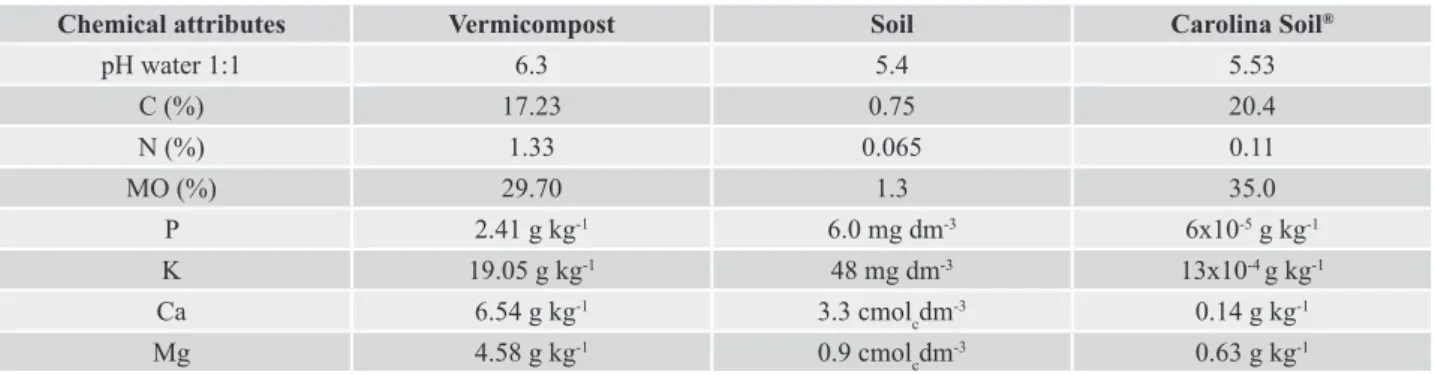
bovine manure. After the complete transformation of the organic wastes, it was sifted in a 2 mm mesh. The chemical analysis characterization of vermicompost, soil and commercial substrate are shown in Table 1.
Table 1. Chemical characterization of vermicompost, soil and commercial substrate used in the substrates composition.
Chemical attributes Vermicompost Soil Carolina Soil®
pH water 1:1 6.3 5.4 5.53
C (%) 17.23 0.75 20.4
N (%) 1.33 0.065 0.11
MO (%) 29.70 1.3 35.0
P 2.41 g kg-1 6.0 mg dm-3 6x10⁻⁵ g kg-1
K 19.05 g kg-1 48 mg dm-3 13x10-4 g kg-1
Ca 6.54 g kg-1 3.3 cmol
cdm
-3 0.14 g kg-1
Mg 4.58 g kg-1 0.9 cmol
cdm
Pots with 2.8 liters were filled with the substrates, receiving after, a bulb of gladiolus of the Peter’s Pear variety. These pots were arranged on the workbench of the dimensions of 1.10m of width, 0.50 m of length and 0.50 m of height.
The plants were manually irrigated every two days. The staking was done when the plants had a minimum height of 0.30 m, which occurred at 76 days after the planting (DAP). Pine stakes with 1 m of height were utilized, fixed in the substrate aside the plants and tied with a cotton cord.
The main plant height and the Falker chlorophyll index (FCI) were analyzed at 76, 101 and 117 DAP. The dates of evaluation were determined in function of the staking (76 DAP), start of the flowering (101 DAP) and harvest point (117 DAP). The harvest point was adopted when the inferior floral buds showed the color of cultivar (COSTA et al., 2017). The length and the diameter of the main stem, the floral tassel length, and the quantity of florets of the main stem were determined at 117 DAP. The interval until start of flowering was also determined.
The plant height was measured starting at the base of the substrate to the apex to the taller leaf. The FCI was measured in two leaves per plant, with a digital chlorophyll meter ClorofiLOG CFL1030 model from Falker®. The
diameter of the main stem was measured with the use of a digital pachymeter of the brand Messen®, in the node where
the penultimate leaf was emitted. The length of the stem was determined by the distance of the base of the plant in the soil to the tip of the spike. The length of the tassel was
determined by the distance from the insertion of the first button to the tip of the spike. Moreover, the spike florets of the main plant were counted.
From the measures of the stem length and the floral tassel, the diameter of the stem and quantity of florets, the floral tassels were classified according to the quality, following the patterns utilized by Veilling Holambra (CRITÉRIOS, 2013).
The results were submitted to the analysis of variance. The effects of the vermicompost and of Trichoderma
had their averages compared by the Tukey test at 5% of probability, when significantly, using the statistical software Sisvar (FERREIRA, 2011).
3. RESULTS AND DISCUSSION
The plant height varied significantly in function of the treatments at 76 and 117 DAP (Table 2). At 76 DAP the plants that were conducted in T1 presented higher height as compared to the other treatments. At 101 DAP, when the majority of the plants were in the phase of emission of spikes and the start of flowering, did not present statistical difference. However, at 117 DAP, T2 presented higher average height (151.45c m), being significantly different of T3 (129.38 cm). The heights that were obtained are higher than the ones from the literature. Pereira et al. (2009), working with different water tensions in the soil for the gladiolus production, obtained heights between 73.1 to 116.4cm.
Table 2. Plant height and Falker chlorophyll index (FCI) in gladiolus plants at 76, 101 and 117 days after planting (DAP).
Treatment
Plant height FCI
76 DAP 101 DAP 117 DAP 76 DAP 101 DAP 117 DAP
---cm---1 100.81 a 114.94 a 135.41 ab 66.98 ab 54.00 a 56.91 a 2 86.68 b 109.15 a 151.45 a 69.94 a 61.25 a 67.47 a 3 90.17 b 105.41 a 129.38 b 62.28 b 54.74 a 54.59 a 4 82.39 b 96.36 a 135.57 ab 60.60 b 59.90 a 66.70 a
T * NS * * NS NS
CV (%) 8.11 13.91 11.58 7.61 10.35 16.12
The period with greater height growth happened from 101 to 117 DAP, and the plants that had better results were conducted in the treatments 2 and 4, which were in the period of emission of the floral stem. These two treatments presented vermicompost in their composition, confirming the relation between this organic fertilizer and the growth of the plants, which was already cited by several authors (CHAMANI et al., 2008; STEFFEN, 2010a; STEFFEN, 2010b; BROZ et al., 2016; PELIZZA, 2013; XU and MOU, 2016). Probably, these results are related to the presence of phytohormones in the vermicompost, which presents a direct effect in the vegetative growth (ARANCON et al., 2006; RAVINDRAN et al., 2016; MAJI et al. 2017). According to Lee et al. (2016), the Trichoderma fungus has
the possibility of promoting plants growth, however, in this study, this effect was not observed.
It is likely that biotic or abiotic factors have interfered with the expected beneficial effects of Trichoderma on
the development of the gladiolus because it has already demonstrated beneficial effects on forest species (AMARAL et al., 2017). In general, the benefits of Trichoderma
inoculation on plant growth have been observed in plants originated from seeds or cuttings, where the gladiolus was the first bulb-emitting specie tested with this Trichoderma
isolate. This fact justifies the need for specific evaluations of the integration between beneficial fungi and plants at the level of fungal isolate and vegetable species. Another consideration in relation to the fact that there was no positive effect of Trichoderma on the development of the
gladiolus is related to the general conditions of the crop, which in this case was almost ideal. Moreover, the culture presents a bulb, which guarantees an energy supply in the initial establishment of the plant. Therefore, it is probable that the action of Trichoderma as a growth promoter was
not necessary, which can be evidenced by the fact that the control treatment has already presented plants with commercial standard (Tables 2 and 3).
The plants Falker chlorophyll index (FCI) varied significantly between the treatments only at 76 DAP (Table 2), when T2 presented higher value, being different from T3 and T4. The FCI can be an alternative to estimate the nitrogen concentration on the plant, due to its relation between the chlorophyll content and nitrogen content in the leaf tissue (BACKES et al., 2010). Kramer and Kozlowski (1979) assert that chlorophylls are directly linked to the conversion of the light radiation into chemical energy, and they are related to the photosynthetic efficiency of the plants, and, consequently with its growth and adaptability to different environments. In the beginning of the cycle, the plants conducted in T2 presented a higher Falker chlorophyll index and lower height, where this last increased considerably over the cycle. It can be supposed that the higher initial nitrogen contribution, provided by the vermicompost, was the responsible for the higher height of the plants in this treatment, when in marketing stage.
Plants conducted in T2 presented a higher stem length, but without significant difference from T1 and T4 (Table 3), where the contribution of the vermicompost can be again highlighted. Considering this variable, all the treatments were classified in class 110, presenting stems with 110 cm in length (CRITERIOS, 2013). Pereira et al. (2009) and Schwab et al. (2015b) obtained values between 87.8 to 116.4 cm and 75.8 to 123.8 cm, respectively. A long stem is desirable because it can be realized systemic cuts with the objective to eliminate the tissues that do not present capacity of water absorption, prolonging the durability after harvesting and keeping the stem with a marketable size (SCWHAB et al., 2015b).
Table 3. Gladiolus floral stems, according to the Veiling Holambra standard, at 117 days after planting (DAP).
Treatment
117 DAP
Stem length Stem diameter Tassel length Number of florets Proportion tassel
x stem --- cm --- %
1 135.41 ab 0.9 a 45.07 b 13.00 a 45.07 b
2 151.45 a 1.0 a 51.64 a 13.38 a 51.64 a
3 129.38 b 0.7 a 43.00 b 10.50 a 43.00 b
4 135.57 ab 0.7 a 44.15 b 12.00 a 44.15 b
T * NS * NS *
CV (%) 11.58 14.44 9.43 18.03 9.43
There was no significant difference between the plants for the stem diameter, with the values varying between 0.7 to 1.0 cm (Table 3). For achieving the standards of Veiling Holambra (CRITÉRIOS, 2013), the gladiolus stem must present the diameters proportional to the length. In the case of class 110, the minimum diameter should be 1.0 cm, which was only achieved in T2. Moreover, the proportionality between the diameter and the height give the stem a higher resistance to mechanical damage that may happen in the tillage, which may be caused by the wind or in the moment of the transportation of the harvested stems.
The tassel length where the florets are distributed was longer for the plants conducted in T2 (Table 3). However, independently of treatment, they exceeded the minimum required by Veiling Holambra, which was 40% in relation to the total stem length (CRITÉRIOS, 2013). Stem with harmonic proportion between the portions without flowers and the tassel are aesthetically more pleasant (SCHWAB et al., 2015b). These authors achieved tassel length between 30.9 and 62.9 cm for this variety.
There was no significant difference between the treatments for the number of florets. However, only the inflorescences produced in T1, T2 and T4 were classified in Class I, with 100-120 cm of height stem and 12-16 number of florets, following the quality standard of Veiling Holambra (CRITÉRIOS, 2013). Pereira et al. (2009) obtained an average of 11 florets for the variety Peter’s Pears, which are smaller than the ones obtained in this work.
The treatment that presented the best results was the T2, which is composed of 60% of control substrate and 40% of vermicompost. According Edwards (2004), the vermicompost works as a bio-stimulator of plant growth, acting in a beneficial way in the development of plants. Observing Table 1, it can be verified that the pH, the nutrient levels, and the organic material of vermicompost were superior to those of the soil; besides, they do not present aluminum, which favors the plant development. Acording to Antunes et al. (2016), the addition of vermicompost to soil increase the availability of nutrients to plants, especially the phosphorus, potassium and magnesium. In addition to the changes exerted on the chemical properties, the organic composts have a clear impact on soil biological properties, positively interferes in the edaphic population that lives on the surface and inside the soil (LAZCANOA and DOMÍNGUEZ, 2011).
There are several research studies that show the efficiency of the vermicompost utilization as part of the substrate on several crops. The vermicompost utilization in horticultural substrates, up to 50% of the volume, is a viable practice for the formation of seedlings of lettuce, tomato, snapdragon, helicon and melon (STEFFEN et al., 2010 a, b; SANTOS et al., 2006; PELIZZA et al., 2013).
The treatment T3, control substrate with Trichoderma
sp., and the treatment T4, control substrate and vermicompost (40%) and Trichoderma sp., even with
statistically inferior results to T2, also produced stem with better standards than the cited by other authors for
al., 2015b). Research showed that different Trichoderma
isolates have led to significant increases in plant growth and in the productivity of crops inoculated with this bio-agent. The most impacted crops are tomato, maize, bean, chickpea and cucumber (YEDIDIA et al., 2001; HARMAN et al., 2004; RESENDE et al., 2004; GRAVEL et al., 2007; JYOTSNA et al., 2008; HOYOS-CARVAJAL et al., 2009). The control substrate was used as the base in all treatments, with a composition of 50% of soil with 50% of the commercial substrate Carolina Soil®. The use of the
commercial substrate for the composition of the control treatment made it suitable for gladiolus growth, due to the characteristics such as macronutrients values (N, P, K, Ca and Mg) (Table 1), electrical conductivity (1.5 mS cm-1),
density (114 kg m-³) and water retention capacity (54%).
This combination (50% soil + 50% Carolina Soil®) also
produced stem with similar height and number of florets to those described by Pereira et al. (2009) and Schwab et al. (2015b).
CONCLUSIONS
The development and quality of gladiolus flower stems were favored by the use of vermicompost in the proportion of 40%, providing stems with greater length and increasing the stems/stalk ratio. Under the conditions of this experiment, no growth promoting effect was observed by the Trichoderma isolate evaluated.
AUTHORS CONTRIBUTIONS
L.R.D.C.: conception and design of the research,
conducting of the research, obtaining data, analyze and interpretation of data, statistical analysis, write of manuscript; F.L.: conception and design of the research,
analyze and interpretation of data, write and critically analyses of manuscript; G.P.K.S.: conception and design
of the research, conducting of the research, obtaining data analyze, write and critically analyses of manuscript;
J.M.: conception and design of the research, conducting
of the research, obtaining data analyze, write and critically analyses of manuscript.
REFERENCES
AMARAL, P.P.; STEFFEN, G.P.K.; MALDANER, J.; MISSIO, E.L.; SALDANHA, C.W. Promotores de crescimento na propagação de caroba. Pesquisa Florestal Brasileira, v.37, p.149-157, 2017. DOI: <10.4336/2017.
pfb.37.90.1402>
ANTUNES, R.M.; CASTILHOS, R.M.V.; CASTILHO, D.D.; LEAL, O.A.; ANDREAZZA, R. Crescimento inicial de acácia-negra com vermicompostos de diferentes resíduos agroindustriais initial growth of Acacia
mearnsii with vermicompost of different agroindustrial
wastes. Ciência Florestal, v.26, p.1-9, 2016. DOI:
ARANCON, N.Q.; EDWARDS, C.A.; LEE, S.; BYRNE, R. Effects of humic acids from vermicomposts on plant growth. European Journal of Soil Biology, v.42, p.65-69,
2006. DOI: <10.1016/j.ejsobi.2006.06.004>
BACKES, C.; VILLAS BÔAS, R.L.; LIMA, C.P.; GODOY, L.J.G.; BÜLL, L.T.; SANTOS, A.J.M. Estado nutricional em nitrogênio da grama esmeralda avaliado por meio do teor foliar, clorofilômetro e imagem digital, em área adubada com lodo de esgoto.Bragantia, v.69,
p.661-668, 2010. DOI: <10.1590/S0006-87052010000300018>
BALDOTTO, M.A.; BALDOTTO, L.E.B. Gladiolus development in response to bulb treatment with different concentrations of humic acids. Revista Ceres, v.60,
p.138-142, 2013. DOI: <10.1590/S0034-737X2013000100020>
BROZ, A.P.; PRIYA, O.V.; APPEL, C. Nitrogen dynamics of vermicompost use in sustainable agriculture. Journal of Soil Science and Environmental Management, v.7,
p.173-183, 2016. DOI: <10.5897/JSSEM2016.0587>
CHAMANI, E.; JOYCE, D.C.; REIHANYTABAR, A. Vermicompost effects on the growth and flowering of
Petunia hybrida ‘Dream Neon Rose’. American-Eurasian
Journal Agricultural and Environmental Science, v.3,
p.506-512, 2008.
COSTA, L.C. da; ARAÚJO, F.F.; SANTOS, M.N. de; LIMA, P.C.L.; PEREIRA, A.M.; FINGER, F.L. Vase life and rehydration capacity of dry-stored gladiolus flowers at low temperature. Ciência Rural, v.47, p.1-6, 2017. DOI:
<10.1590/0103-8478cr20160139>
CRITÉRIOS de classificação: gladíolo corte. Santo Antônio, de Posse: Veiling Holambra, Departamento de Qualidade
e Pós-Colheita, [2013?]. 5p. Available at: <http://www. ibraflor.com/publicacoes/vw.php?cod=78>. Accessed in: Oct. 2015.
EDWARDS, C.A. The use of earthworms in the breakdown and management of organic wastes. In: EDWARDS, C.A. (Org.). Earthworm Ecology. Boca Raton: St. Lucie Press,
2004. p.327-354.
FERREIRA, C.A.; VON PINHO, E.V.R.; SALGADO, K.C.P.; PEREIRA, G.S.; FERREIRA, I.A. Identificação de cultivares de Gladiolus sp. por meio de marcadores
genético bioquímicos e de RAPD. Revista Brasileira de Horticultura Ornamental, v.15, n.2, 115-126, 2009. DOI:
<10.14295/rbho.v15i2.492>
FERREIRA, D.F. Sisvar: A computer statistical analysis system. Ciência e Agrotecnologia, v.35, p.1039-1042,
2011. DOI: <10.1590/S1413-70542011000600001>
GRAVEL, V.; ANTOUN, H.; TWEDDELL, R.J. Growth stimulation and fruit yield improvement of greenhouse tomato plants by inoculation with Pseudomonas putida or
Trichoderma atroviride: possible role of indole acetic acid
(IAA). Soil Biology and Biochemistry, v.39, p.1968-1977,
2007. DOI: < HYPERLINK “https://doi.org/10.1016/j. soilbio.2007.02.015” \t “_blank” \o “Persistent link using digital object identifier” 10.1016/j.soilbio.2007.02.015>
HARMAN, G.E.; PETZOLDT, R.; COMIS, A.; CHEN, J. Interactions between Trichoderma harzianum Strain
T22 and maize inbred line Mo17 and effects of these interactions on diseases caused by Pythium ultimum and
Colletotrichum graminicola. Plant Physiology, v.94,
p.146-153, 2004. DOI: < HYPERLINK “https://doi. org/10.1094/PHYTO.2004.94.2.147” \t “_blank” 10.1094/ PHYTO.2004.94.2.147>
HOYOS-CARVAJAL, L.; ORDUZ, S.; BISSETT, J. Growth stimulation in bean (Phaseolus vulgaris L.)
by Trichoderma. Biological Control, v.51, p.409-416,
2009. DOI: < HYPERLINK “https://doi.org/10.1016/j. biocontrol.2009.07.018” \t “_blank” \o “Persistent link using digital object identifier” 10.1016/j.biocontrol.2009.07.018>
ISLAM, S. Anthocyanin compositions in different colored gladiolus species: a source of natural food colorants.
American Journal of Food Science and Technology, v.4,
p.109-114, 2016. DOI: <10.12691/ajfst-4-4-4>
JYOTSNA; SRIVASTAVA, A.; SINGH, R.P.; SRIVASTAVA, A.K.; SAXENA, A.K.; ARORA, D.K. Growth promotion and charcoal rot management in chickpea by Trichoderma harzianum. Journal of Plant Protection Research, v.48, p.81-92, 2008. DOI: <
HYPERLINK “https://doi.org/10.2478/v10045-008-0009-6” 10.2478/v10045-008-0009-6>
KRAMER, T.; KOZLOWSKI, T. Physiology of woody plants. New York: Academic Press, 1979. 811p.
LAZCANOA, C.; DOMÍNGUEZ, J. The use of vermicompost in sustainable agriculture: impact on plant growth and fertility. In: MIRANSARI, M. Soil Nutrients.
New York: Nova Science Publishers, 2011. p.1-23.
LEE, S.; YAP, M.; BEHRINGER, G.; HUNG, R.; W. BENNETT, J. W. Volatile organic compounds emitted
by Trichoderma species mediate plant growth. Fungal
Biological Biotechnology, v.3, p.1-7, 2016. DOI: <
HYPERLINK “https://doi.org/10.1186/s40694-016-0025-7” \t “_blank” 10.1186/s40694-016-0025-7>
MACHADO, D.F.M.; PARZIANELLO, F.R.; SILVA, A.C.F.; ANTONIOLLI, Z.I. Trichoderma no Brasil: o
fungo e o bioagente. Revista de CiênciasAgrárias, v.35,
MAHASEN, M.; ONAA, A.F.; TAUFIQUEA, T.; MEHRAJB, H.; JAMAL UDDINA, A.F.M. Suitability of cut corm as planting materials on flowering and corm-cormel production of gladiolus cultivars. Journal of Bioscience and Agriculture Research, v.4, p.10-19, 2015.
MAJI, D.; MISRA, P.; SINGH, S.; KALRA, A. Humic acid rich vermicompost promotes plant growth by improving microbial community structure of soil as well as root nodulation and mycorrhizal colonization in the roots of
Pisum sativum. Applied Soil Ecology, v.110, p.97-108,
2017. DOI: <10.1016/j.apsoil.2016.10.008>
MEMON, M.; QASIM, M.J.; AHMAD, R. AHMAD, I. Corm and cormel production in gladiolus. New Zealand Journal of Crop and Horticultural Science, v.37, p.319–
325, 2009.
NIETO-JACOBO, M.F.; STEYAERT, J.M.; SALAZAR-BADILLO, F.B.; NGUYEN, D.V.; ROSTÁS, M.; BRAITHWAITE, DE SOUZA, J.T.; JIMENEZ-BREMONT, J.F.; OHKURA, M.; STEWART, A.; MENDOZA-MENDOZA, A. Environmental Growth Conditions ofTrichodermaspp. affects indole acetic acid
derivatives, volatile organic compounds, and plant growth
promotion. Frontiers Plant Science, v.8, p.1-18, 2017. DOI: <10.3389/fpls.2017.00102>
PATHMA, J.; SAKTHIVEL, N. Microbial diversity of vermicompost bacteria that exhibit useful agricultural traits and waste management potential. Springerplus,
p.1-19, 2012. DOI: < HYPERLINK “https://dx.doi. org/10.1186%2F2193-1801-1-26” \t “pmc_ext” 10.1186/2193-1801-1-26>
PELIZZA, T.R.; SILVEIRA, F.N.; MUNIZ. J.; ECHER,
A.H.B.; MORSELI, T.B.G.A. Produção de mudas de
meloeiro amarelo, sob cultivo protegido, em diferentes substratos. Revista Ceres, v.60, p.257-21, 2013. DOI:
<10.1590/S0034-737X2013000200015>
PEREIRA, J.R.D.; CARVALHO, J.A.; PAIVA, P.D.O.; SILVA, D.J.; SOUZA, A.M.G. de; SOUZA, K.J. Crescimento e produção de hastes florais de gladíolo cultivado sob diferentes tensões de água no solo. Ciência e Agrotecnologia, v.33, p.965-970, 2009. DOI: <10.1590/
S1413-70542009000400004>
POON, T.B.; RAO, T.M.; KUMAR, D.P.;
VENUGOPALAN, R.; DHANANJAYA, M.V. Study on
floral biology of Gladiolus genotypes. Nepal Journal of Science and Technology, n.10, p.37-43, 2009. DOI:
<10.3126/njst.v10i0.2821>
RAVINDRAN, B.; DINESH, S.L.; KENNEDY, L.J.; SEKARAN, G. Vermicomposting of solid waste generated from leather industries using epigeic earthworm Eisenia
foetida. Applied Biochemistry and Biotechnology, v.151,
p.480-488, 2008. DOI: <10.1007/s12010-008-8222-3>
RESENDE, M.L.; OLIVEIRA, J.A.; RENATO MENDES GUIMARÃES, R.M.; VON PINHO, R.G.; VIEIRA, A.R. Inoculações de sementes de milho utilizando o Trichoderma
harzianum como promotor de crescimento. Ciência e
Agrotecnologia, v.28, p.793-798, 2004. DOI: <10.1590/
S1413-70542004000400010>
ROSA, Y.B.C.J.; WOLLEMBERG, S.; SILVA, E.F. da; ROSA JUNIOR, E.J.; NUNES, M.F.; SORGATO, J.C.; ROSA, D.B.C.J.; SOARES, J.S.; ROSA, C.S.L. Desenvolvimento de gladíolos em função da adubação
nitrogenada e diâmetro do cormo. Revista Brasileira de Horticultura Ornamental, v.20, n.1, p.87-92, 2014. DOI:
< HYPERLINK “https://doi.org/10.14295/rbho.v20i1.521” 10.14295/rbho.v20i1.521>
RUPPENTHAL, V.; CASTRO, A.M.C. Efeito do composto de lixo urbano na nutrição e produção de gladíolo. Revista Brasileira de Ciência do Solo, v.29, p.145-150, 2005.
DOI: <10.1590/S0100-06832005000100016>
HYPERLINK “http://www.scielo.br/cgi-bin/wxis.exe/ iah/?IsisScript=iah/iah.xis&base=article%5Edlibrary&fo rmat=iso.pft&lang=i&nextAction=lnk&indexSearch=AU &exprSearch=SANTOS,+MAURICIO+R+A” SANTOS, M.R.A.; HYPERLINK “http://www.scielo.br/cgi-bin/ wxis.exe/iah/?IsisScript=iah/iah.xis&base=article%5Edli brary&format=iso.pft&lang=i&nextAction=lnk&indexS earch=AU&exprSearch=TIMBO,+ANA+L+O” TIMBO, A.L.O.; HYPERLINK “http://www.scielo.br/cgi-bin/ wxis.exe/iah/?IsisScript=iah/iah.xis&base=article%5E dlibrary&format=iso.pft&lang=i&nextAction=lnk&ind exSearch=AU&exprSearch=CARVALHO,+ANA+C+P +P” CARVALHO, A.C.P.P.; HYPERLINK “http://www. scielo.br/cgi-bin/wxis.exe/iah/?IsisScript=iah/iah.xis&ba se=article%5Edlibrary&format=iso.pft&lang=i&nextActi on=lnk&indexSearch=AU&exprSearch=MORAIS,+JOA O+P+S” MORAIS, J.P.S. Estudo de adubos e substratos orgânicos no desenvolvimento de mudas micropropagadas de helicônia. Horticultura Brasileira, v.24, p.273-278,
2006. DOI: <10.1590/S0102-05362006000300001>
SCHWAB, N.T.; STRECK, N.A.; BECKER, C.C.; LANGNER, J.A.; ULHMANN, L.O.; RIBEIRO, B.S.M.R. A phenological scale for the development of Gladiolus. Annals of Applied Biology, v.166, p.496–507, 2015a.
SCHWAB, N.T.; STRECK, N.A.; REHBEIN, A.; RIBEIRO, B.S.M.R.; ULHMANN, L.O.; LANGNER, J.A.; BECKER, C.C. Dimensões lineares da folha e seu uso na determinação do perfil vertical foliar de gladíolo. Bragantia, v.73,
p.97-105, 2014. DOI: <10.1590/brag.2014.014>
SCHWAB, N.T.; STRECK, N.A.; RIBEIRO, B.S.M.R.; BECKER, C.C.; LANGNER, J.A.; UHLMANN, L.O.; RIBAS, G.G. Parâmetros quantitativos de hastes florais de gladíolo conforme a data de plantio em ambiente subtropical.
Pesquisa Agropecuária Brasileira, v.50, p.902-911,
2015b. DOI: <10.1590/S0100-204X2015001000006>
SINGH, J.P.; KUMAR, K.; KATIYAR, P. Effect of zinc, iron and copper on
Yield parameters of gladiolus.
HortFlora Research Spectrum, v.1, p.64-68, 2012.
SÖNMEZ, F.; ÇIG, A.; GÜLSER, F.; BASDOGAN, G. The effects of some organic fertilizers on nutrient contents in hybrid Gladiolus. Eurasian Journal of Soil Science,
v.2, p.140-144, 2013.
STEFFEN, G.P.K.; ANTONIOLLI, Z.I.; STEFFEN, R.B.; MACHADO, R.G. Casca de arroz e esterco bovino como substratos para a multiplicação de minhocas e produção de mudas de tomate e alface. Acta Zoologica Mexicana,
v.26, p.333-343, 2010a.
STEFFEN, G.P.K.; ANTONIOLLI, Z.I.; STEFFEN, R.B.; MACHADO, R.G. Húmus de esterco bovino e casca de arroz carbonizada como substrato para a produção de mudas de boca-de-leão. Acta Zoologica Mexicana, v.26,
p.345-357, 2010b.
STEFFEN, G.P.K.; MALDANER, J. Methodology for
Trichoderma sp. multiplication in organic substrates.
International Journal of Current Research, v.9,
p.44564-44567, 2017.
TOMBOLATO, A.F.C.; CASTRO, J.L. de; MATTHES, L.A.F.; LEME, J.M. Melhoramento genético do gladíolo no IAC: novos cultivares ‘IAC Carmim’ e ‘IAC Paranapanema’. Científica, v.33, p.142-147, 2005. DOI: < HYPERLINK “http://dx.doi. org/10.15361/1984-5529.2005v33n2p142+-+147” 10.15361/1984-5529.2005v33n2p142+-+147>
VERMA R.P.; KUMAR, A.; VERMA, S.K.; VERMA, A.; VERMA, P.K. Influence of nitrogen, planting geometry and corm size on vegetative growth and corm and cormel production of gladiolus cv Nova Lux. Environment & Ecology, v. 32, p.199-201, 2015.
XU, C.; MOU, B. Vermicompost affects soil properties and spinach growth, physiology, and nutritional value.
Hortscience, v.51, p.847-855, 2016.
YEDIDIA, I.; SRIVASTVA, A.K.; KAPULNIK, Y.E.; CHET, I. Effect of Trichoderma harzianum on microelement
concentrations and increased growth of cucumber plants.