J. res.: fundam. care. online 2015. abr./jun. 7(2):2440-2452
2440
INTEGRATIVE REVIEW OF THE LITERATURE
Ações de enfermagem frente às reações a quimioterápicos em pacientes oncológicos
Nursing actions facing reactions to chemotherapy in oncological patients
Acciones de enfermería delante las reacciones a quimioterapéuticos en pacientes con câncer
Rita de Cássia Ribeiro Guimarães1 , Renata Patrícia Fonseca Gonçalves2 , Cássio de Almeida Lima3 , Marcelo Rocha Torres4 , Carla Silvana de Oliveira e Silva5
Objective: Describing the action of nursing facing the chemotherapy reactions in oncological patients. Method: Integrated review of literature of 14 scientific articles published in the last 10 years. Results: The
adverse reactions inherent to the chemotherapy treatment manifested by the patients are frequent. Nausea and vomit were the main reactions described in chemotherapy. The nursing job is developed through the orientation before and during the treatment and has as an primordial objective the improvement of the psychological state of the patient, ensuring security in the proposed treatment.
Conclusion: The orientation leads to a better acceptance of chemotherapy, favoring the continuation of
the treatment. The need of an improvement of the registers of nursing was evidenced, as well as the implementation of the evaluation process in the construction of to evaluate the procedure and or specific interventions. Descriptors: Chemotherapy, Adverse effects, Care in nursing.
Objetivo: Descrever as ações de enfermagem frente às reações a quimioterápicos em pacientes
oncológicos. Método: Revisão integrativa da literatura de 14 artigos científicos publicados nos últimos 10 anos. Resultados: As reações adversas inerentes ao tratamento quimioterápico manifestadas pelos pacientes são frequentes. A náusea e o vômito foram as principais reações da quimioterapia descritas. O trabalho da enfermagem é desenvolvido através da orientação antes e durante o tratamento, e tem como objetivo primordial melhorar o estado psicológico do paciente, fornecendo segurança no tratamento proposto. Conclusão: As orientações levam a uma melhor aceitação da quimioterapia, favorecendo a continuação do tratamento. Constatou-se a necessidade de melhoria dos registros de enfermagem, bem como a implantação do processo avaliativo na construção de indicadores para avaliar condutas e/ou intervenções específicas. Descritores: Quimioterapia, Efeitos adversos, Cuidados de enfermagem.
Objetivo: Describir las acciones de enfermare en las reacciones al quimioterapéutico en pacientes con
cáncer. Método: Revisión integradora de literatura de 14 artículos científicos publicados en los últimos 10 años. Resultados: Las reacciones adversas inherente a la quimioterapia manifestado por los pacientes son frecuentes. La náusea y el vómito fueron las principales reacciones de la quimioterapia descritos. El trabajo de enfermare es desarrollado por medio de la orientación antes y durante el tratamiento y tiene como objetivo primordial mejorar la condición psicológica de los pacientes, proporcionando seguridad para el tratamiento. Conclusión: Las orientaciones llevan a un mejor aceptación de la quimioterapia, favoreciendo la continuación del tratamiento. Se encontró la necesidad de mejora de los archivos de enfermare, así como la implantación del proceso evaluativo en la construcción de indicadores para evaluar conductos y/o intervenciones específicos. Descriptores: Quimioterapia, Efectos adversos, Cuidados de enfermare.
1 Nurse, a Specialist in Oncology, University Hospital Clemente de Faria (HUCF), Montes Claros (MG), Brazil. Email: [email protected] 2 Nurse, Mastership in nursing, Professor of the Nursing Department of the State University of Montes Claros (UNIMONTES), Montes Claros (MG), Brazil. Email: [email protected] 3 Academic Degree Course in Nursing, UNIMONTES, Montes Claros (MG), Brazil. Email: [email protected] 4 Nurse, Specialist in Emergency Trauma and Intensive Care, HUCF, Montes Claros (MG), Brazil. Email: [email protected] Nurse, Doctorate in Sciences, Professor of the Department of Nursing of UNIMONTES, Montes Claros (MG), Brazil. Email: [email protected]
ABSTRACT
RESUMEN RESUMO
J. res.: fundam. care. online 2015. abr./jun. 7(2):2440-2452
2441
C
METHOD
ancer is a chronic-degenerative pathology considered, currently, a public health problem. Sure of the diagnosis as well as treatment, interferes directly on patients' quality of life. In this way, nursing plays an important role in the follow-up of cancer patients, in control of adverse reactions, having influence on improvement of quality of life the same.1 front of a cancer diagnosis, any individual has their quality of life shaken for several reasons, among them, the uncertainty of life expectancy, the body's responses to possible treatmentsIn addition to the change in his concept of health/disease. Thus, it is considered that the quality of life is directly related to the State of health of the person.
Chemotherapy is an important therapeutic modality for cancer, represented by the use of chemical substances, isolated or in combination, to interfere in the process of growth and cell division, destroying the tumor cells and also attack normal cells that have similar characteristics. Currently, chemotherapy is among the methods of treatment, which has a higher incidence of cure in several tumors, and that more increases the survival rate of cancer. One can classify it in neo-adjuvante chemotherapy, when administered before a surgical procedure, with the objectives to assess the response and reduce antineoplasic tumor, and in adjuvant chemotherapy, administered after surgical treatment, in order to eradicate possible micrometástases.2
On professional experience, watching cancer patients undergoing chemotherapy treatment, a great frequency of adverse reactions in these patients.3 Nursing plays an extremely important role in monitoring and minimization of adverse effects. Acts positively on the physical and global adjustment of patients in chemotherapy treatment through a systematic nursing care, especially as regards implementation of accurate and effective interventions against the side effects resulting from the administration of chemotherapeutic drugs.4-5
Faced with the need to provide the oncological patient a better quality of life during and after treatment of chemotherapy, this study aimed to identify and analyze the Brazilian scientific production on the nursing care in the face of reactions to chemotherapy in cancer patients, seeking to highlight gaps and dimensions addressed regarding the theme.
It is an integrative literature review study on nursing actions facing the oncology patient reactions to chemotherapy. For the operationalization of the integrative review, the
INTRODUCTION
J. res.: fundam. care. online 2015. abr./jun. 7(2):2440-2452
2442
following steps were followed: the selection of thematic issues, establishment of criteria forinclusion and exclusion for selection of articles (sample selection), selection of research, analysis and interpretation of results, dissemination.6
The bibliographic survey of publications indexed and catalogued was conducted during the months of June and July 2013 using descriptors chemotherapy, adverse effects and nursing care, in the following databases: Latin American literature of the Caribbean in Health Sciences (LILACS), database in nursing (BDENF) and Scientific Electronic Library Online (SCIELO). Were also used, as a source of research, databases of theses and dissertations of the Universidade Federal de Minas Gerais (UFMG) and the University of São Paulo (USP).
After searching in the databases, the following criteria were adopted for the inclusion of articles: articles that cover a specific topic; studies involving adults, restricted the period 2002 to 2012, in the Portuguese language, which were available in full. Various strategies were used in the search electronics, in an attempt to find the maximum of publications.
Table 1 describes in detail the route to raising articles. The sample was composed by publications concerning adverse reactions of cancer patients to chemotherapy. The results from each study were discussed in the light of the specific literature.
Table 1 - Electronic search strategy. Montes Claros, MG, 2012.
Database accessed Obtained publications Excluded publications Selected publications n % n % n % LILACS 31 33,3 23 29,1 08 57,1 SCIELO 02 2,1 02 2,5 00 00 BDENF 50 53,8 46 58,2 04 28,6
Basis of theses and dissertations from USP and UFMG
10 10,8 08 10,2 02 14,3
J. res.: fundam. care. online 2015. abr./jun. 7(2):2440-2452
2443
RESULTS AND DISCUSSION
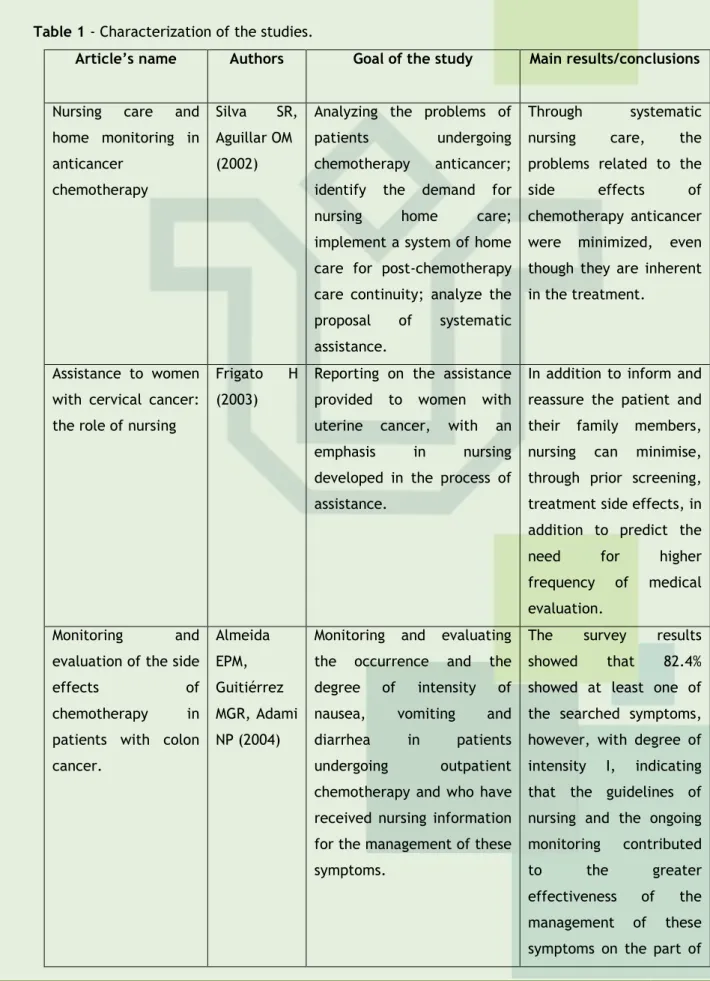
After thorough reading, 14 were selected articles that met the criteria for inclusion. Below, are analyzed with greater detail specific nursing publications identified in the 2002 to 2012.
Table 1 - Characterization of the studies.
Article’s name Authors Goal of the study Main results/conclusions
Nursing care and home monitoring in anticancer chemotherapy Silva SR, Aguillar OM (2002)
Analyzing the problems of patients undergoing chemotherapy anticancer; identify the demand for nursing home care; implement a system of home care for post-chemotherapy care continuity; analyze the proposal of systematic assistance.
Through systematic nursing care, the problems related to the side effects of chemotherapy anticancer were minimized, even though they are inherent in the treatment.
Assistance to women with cervical cancer: the role of nursing
Frigato H (2003)
Reporting on the assistance provided to women with uterine cancer, with an emphasis in nursing developed in the process of assistance.
In addition to inform and reassure the patient and their family members, nursing can minimise, through prior screening, treatment side effects, in addition to predict the need for higher frequency of medical evaluation.
Monitoring and evaluation of the side effects of chemotherapy in patients with colon cancer. Almeida EPM, Guitiérrez MGR, Adami NP (2004)
Monitoring and evaluating the occurrence and the degree of intensity of nausea, vomiting and diarrhea in patients undergoing outpatient chemotherapy and who have received nursing information for the management of these symptoms.
The survey results showed that 82.4% showed at least one of the searched symptoms, however, with degree of intensity I, indicating that the guidelines of nursing and the ongoing monitoring contributed to the greater effectiveness of the management of these symptoms on the part of
J. res.: fundam. care. online 2015. abr./jun. 7(2):2440-2452
2444
patients. Adverse effects of chemotherapy in treatment of lung cancer Boery EN, Gutiérrez R, Boery RNSO (2005)Reporting adverse effects of chemotherapy in the treatment of patients with lung cancer with the goal of contributing to a better understanding of the impact of this treatment on the life of these patients.
The knowledge of health professionals, especially nurses, on adverse events of chemotherapy treatment, as well as the incorporation of responsibility in minimizing these effects, either in monitoring or guidance, can help patients face the disease
with more
determination, and minimize the side effects, influence on the outcome of treatment and to improve the quality of life during the course of treatment. Adverse reactions to treatment with 5-Fluouracil in patients with colorectal cancer Santo EARE, Vanzeler MLA (2006)
Identifying and quantifying the adverse reactions to chemotherapy for 5-Fluouracil (5-FU) 425mg/m2 and Leucovorin (LV) 20 mg/m2 (RA-5FU) with the schema Mayo (5 days of treatment, with intervals of 3 to 4 weeks for a total of 6 cycles).
Adverse reactions submitted by patients treated with 5-FU and Leucovorin were found with primarily in TGI, being the most frequent nausea. Late reactions were more frequent than the immediate, and, although all patients have used antiemetics associated to chemotherapy, the nausea, the vomiting and the hiporexia were present in all cycles of chemotherapy. Chemotherapy Administration: a nursing protocol proposal Silva SR, Andrade MA (2007)
Reviewing the literature looking for updated information regarding the protocols of nursing care in the administration of
The authors identified the importance of the oncological assistance and planning, based on up-to-date information,
J. res.: fundam. care. online 2015. abr./jun. 7(2):2440-2452
2445
chemotherapy. presented the Protocol ofnursing care in the administration of chemotherapy.
Nursing care of patients with nausea and vomiting under quimiostático
treatment
Zampiere D (2007)
Study with the purpose of analyzing people with cancer in chemotherapy treatment with nausea and vomiting, and to plan an appropriate assistance to these patients.
The nurse-patient relationship-family is essential importance. Establish a profile for each customer is the basis to identify problems and plan for nursing care.
Nursing guidance to the patient in chemotherapy treatment: a review of the literature Penido ISO, Lima EDRP (2007)
Reviewing the literature on nursing guidelines to cancer patients in chemotherapy treatment.
The literature indicates that it is the responsibility of the nurse to ensure that the information provided to patients are quite clear and accurate. Patients with good understanding of your condition and its treatment, probably, present greater adherence to treatment. Leakage prevention for chemotherapy anticancer: integrative review Ferreira MT, Reis PED, Gomes IP (2008)
Identifying evidence in the scientific literature related to prevention of extravasation in patients undergoing intravenous infusion chemotherapy peripheral vesicant.
The authors conclude that it is of utmost importance that new studies, testing effective ways of prevention, to be carried out by the nurses, so they are best provided evidence for decision making and clinical support for prevention of extravasation in patients undergoing peripheral intravenous chemotherapy. Adverse effects identified in place of peripheral intravenous infusion for chemotherapy drugs Reis PED, Rodrigues CC, Vasques CI, Carvalho EC (2008)
Verifying the occurrence of
local changes
(thrombophlebitis, pain, Erythema, Vasospasm, vesicles, and tissue necrosis) in peripheral venous network of adults undergoing
Patients undergoing cancer treatment often exhibit poor venous network, making it difficult to puncture. The data show that 40% of the subjects presented
J. res.: fundam. care. online 2015. abr./jun. 7(2):2440-2452
2446
intravenous chemotherapy. complaints referred to(pain, burning, or stinging) or damage observed (local Erythema, edema or extravasation). Non-pharmacological interventions for nausea and vomiting induced by chemotherapy: integrative review Silva DRF, Reis PED, Gomes IPG, Funghetto SS, Ponce de Leon CGRM (2009)
Identifying evidence in the scientific literature related to non-pharmacological interventions (acupressure, acupuncture,
eletroacunpuntura,
relaxation and yoga) for nausea and vomiting induced by chemotherapy.
The authors conclude that the results suggest that the use of non-pharmacological
interventions for nausea and vomiting induced by chemotherapy should be considered in patients with cancer, especially in those who experience recurrence of êmese in subsequent cycles. Dermatologic toxicity
in women with breast cancer undergoing chemotherapy Gozzo TO, Panobianco MS, Clapis MJ, Almeida AM (2010)
Analyzing the occurrence of dermatologic toxicity caused by drugs used in the adjuvant and neoadjuvant chemotherapy protocol between women with breast cancer.
The record of complications by the nursing staff is essential for the monitoring of venous puncture sites used during the chemotherapy
treatment, as well as the measurement and photographic record of the site. Observed in neoadjuvant therapy and adjuvant, records on the charts of hardened injury on-site, fibrosis, pain, hyperemia and overflows. Prevention and treatment of oral mucositis Gondim FM, Gomes IP, Firmino F (2010) Identifying evidence on prevention and treatment for oral mucositis induced by chemotherapy and/or radiation they subsidize nursing care.
The mucositis requires active participation of the nurse, acting in the pre-therapeutic
assistance, preventing and preparing the patient through individualized evidence-based approach. It was found that the maintenance of good oral hygiene (39.4%) is
J. res.: fundam. care. online 2015. abr./jun. 7(2):2440-2452
2447
the most effective formof prevention. The treatment that most stands out is currently the low power laser (21.0 percent), followed by the chlorhexidine gluconate 0.12% (18.4%) Hand-foot syndrome induced by chemotherapy: report of a case Simão DAS, Lima EDRP, Souza RS, Faria TV, Azevedo GF (2012)
Reporting a case of a patient who presented hand-foot syndrome of degree 3 arising out of the use of Capecitabine chemotherapy, and for which it was used partial massage with moisturizing cream Aloe Vera based aqueous.
The topical treatment with Aloe Vera was successful, with significant improvement of Tissue Integrity, providing complete relief of symptoms and essential to improving the quality of life, in addition to allow rapid return of the patient to chemotherapy
treatment, thereby reducing the risk of progression of oncological disease.
Regarding the authorship of articles selected, 100% is authored by nurses; two have, among their authors, other occupational categories, such as doctors and pharmacists.
Articles assessed, 11 were developed in educational institutions, including hospitals, schools and clinics linked to universities, and three were developed in hospitals specialising in Oncology.
By analyzing the design of the research, it was noted, in the sample: five descriptive prospective studies, eight studies of literature review, an account of experience and a cross-sectional study.
In relation to the type of where magazine were published articles included in the review, six were published in nursing journals; three, in Oncology journals; and five, in magazines from other areas, such as education and health.
Adverse reactions inherent to the chemotherapy treatment expressed by patients are frequent. The authors of the studies are unanimous in describing the major side effects of chemotherapy, as well as the performance of nursing against the same.
Nausea, diarrhoea and vomiting were, respectively, the main reactions caused by chemotherapy in relation to gastrointestinal toxicity presented by patients, and may affect the nutritional condition, water-electrolyte balance and quality of life of these patients.7-11
J. res.: fundam. care. online 2015. abr./jun. 7(2):2440-2452
2448
Nursing actions are directed predominantly to nutritional support and education ofthe patient and the family.
On occurrence of nausea and vomiting, patients were encouraged to eat small portions of food with greater frequency, cold or at room temperature. Were also encouraged to make use of the medication prescribed antiemética and avoid fatty or candies, foods with strong odor.8-9,11-2
Non-pharmacological interventions, such as acupressure, acupuncture, eletroacunpuntura, relaxation and yoga, are also cited in the literature for the management of nausea and vomiting in patients undergoing chemotherapy. The authors recommend that sort of treatment to cancer patients who experience recurrence of êmese in subsequent cycles.10
It is believed that the discomfort brought to the patient by nausea and vomiting contribute greatly to the reduction in quality of life as patients become debilitated and unwilling to conduct their daily affairs properly.13-4 In addition, the patient starts eating less than usual, leading to loss of appetite, anorexia and weakness, and may contribute to worsen his condition general practitionerand even with the abandonment of the treatment.8-9,11
The diarrhea was described mainly when chemotherapy is applied in the pelvic region.8,11-2 For this issue, and the fact the antidiarrheals are not prescribed prophylactically as antiemetics, orientation and evaluation of nursing on adequate hydration and the type of diet they become paramount to minimize this side effect. Patients are advised to ingest foods low in fiber and high in protein and potassium, as well as water intake of at least two litres of liquid per day.8,11 Skin care were also shown more rarely, as the washing of the anal area after each evacuation, preventing infections and skin lesions in the perianal region.11
Anorexia, accompanied by weakness and fatigue, is also found in patients under chemotherapy treatment, and nursing occupies a privileged position to recognize patients who are at increased risk of presenting these signals, enabling the implementation of strategies, both preventive and curative.7,9,11
Is a function of nurse Oncology expert guide to the importance of food intake even during the clarify and inappetance physical activities that can increase appetite, as well as serve as an intermediary with professional nutritionists. In the most serious cases, the nurse, along with the nutritionist, must evaluate alternative measures, such as the use of food supplements, parenteral and enteral nutrition.7,9,11,15
A very feared complication, described by some authors, is the drug extravasation was urged antineoplasmic/irritants or adverse effects on the venous infusion site.16-7 study on hospital multidisciplinary care with the philanthropic individuals with malignant neoplasms, showed that 40% of the subjects presented complaints referred to (pain, burning, or stinging) and observable damage (erythema, edema and extravasation) during chemotherapy. Although these occurrences are not very common, can cause stress, interfering in the quality of life of the cancer patient, as well as causing pain and necrosis at the site affected.17
The pain in damaged tissue can range from moderate to severe, and the extent of necrosis can reach the periosteum. In many cases, there is a need for even the intervention
J. res.: fundam. care. online 2015. abr./jun. 7(2):2440-2452
2449
of plastic surgery.16 The prevention of extravasation is critical to ensure good nursing careto the patient with cancer. It is the responsibility of the nurse specialist to observe the risk factors and act on them, including educational activities aiming at the better performance of the nursing staff administering these drugs.16-7
In this sense, the use of long catheter permanence can be useful for the patient, reducing pain and discomfort, as well as for the nursing staff. This is due to the fact that auxiliary device on installation of chemotherapy by facilitating and expanding patient safety as it offers larger caliber for intravenous access. Among the recommendations related to nursing after extravasation detection, there is a recommendation for immediate suspension of infusion; aspiration (when possible) from the rest of the drug that remains on access road; applying cold compresses and/or hot, depending on antineoplasic drug extravasada; and application of antidotes, according to the drug infused.16-7
Alopecia is, the adverse effects of treatment, that it causes a big social impact, because, generally, the patient that presents demonstrates, significantly, their dissatisfaction, since the same interferes in their physical appearance, lowering their self-esteem and, sometimes, leading him to confinement and removal of social conviviality.3,8,11
Nursing care aimed at psychosocial needs of the patient must be included during and after chemotherapy sessions, since the effects can act in negative way on self-esteem, mainly on sexuality and well-being.14 For some authors, the nursing intervention for psychosocial needs and psychospiritual must be directed toward a more comprehensive care of the patientThus, breaking with a type of action centered only on the psychopathological aspects.14-5
The oral mucositis, a term used to distinguish Oral lesions generally denominated, stomatitis is an injury that occurs on the surface of the oral mucosa, caused by chemotherapy and/or radiation. It is also a reaction commonly observed in patients undergoing cancer treatment, mainly on the involvement of oral neoplasia. It was found that the nursing orientation about the maintenance of oral hygiene is the most effective form of prevention. The treatment that most stands out is currently the low-power laser, following the chlorhexidine gluconate%.8,11,18 The knowledge about oral mucositis and on methods of prevention and treatment are essential to the daily practice of oncology nursing, due to the high incidence of injury and to compromise on the quality of life of the patient.18
Other side effects of lower incidence are also cited by some authors, like: constipation, amenorrhea, tingling, tremors and cutaneous toxicity.3,8,11,19 Hand-foot syndrome (SMP), or eritrodisestesia inch-palmar is a toxic skin reaction that occurs less frequently, however, constitutes an important clinical problem and can lead to stopping treatment or reducing the dose of chemotherapy.20
Regardless of the frequency of involvement of the reactions to chemotherapy, these can severely affect quality of life of the cancer patient, causing chronic discomfort, as well as the limitation of daily activities. Thereby, the skilled nursing care is a determining factor for the recovery biopsicosocioespiritual the patient with cancer. The provision of patient care requires nurses multiplicity of cancer knowledge and versatility in acting; When
J. res.: fundam. care. online 2015. abr./jun. 7(2):2440-2452
2450
CONCLUSION
combined with a systematic assistance plan and well implemented, nursing interventions by the patient are determining factors for quality management.
The analysis of the articles comprising this integrative review showed that, although the chemotherapy treatment can trigger the onset of common side effects, these manifestations are not present with the same intensity in all patients. This reinforces the view that each patient's response to treatment is unique and should therefore be considered in your individuality.
Nursing guidelines constitute one of the strategies that can encourage and develop the potential of patients and their families, as well as instrumentalizá them to assume, as subjects, the actions directed to tackling the problems caused by this treatment.
It might be noted that the work of nursing is developed primarily through the guidance, before and during treatment and aims to improve the primary psychological state of the patient, providing security in the proposed treatment. These walkthroughs induce a better acceptance of chemotherapy, despite side effects, favoring the continuation of the treatment.
Studies have shown that patients and their families expressed a positive opinion in relation to nursing interventions and regarding your follow-up, punctuating that through this treatment was facilitated. It was reported that the information of the nurses had an impact of a greater safety and emotional support for the fight against the disease.
It stresses the importance of the preparation of the nurse in offering specific guidance and care to patients with cancer. This professional needs to have updated knowledge of the latest advances in treatment, prevention of the side effects, regardless of the structure of the institution in which it is inserted.
Another aspect to be highlighted concerns the importance of nursing interventions are systematized based on protocols and properly recorded. It was noted the need for improvement of nursing records, as well as the implementation of the evaluation process in the construction of indicators to evaluate pipes and/or specific interventions.
J. res.: fundam. care. online 2015. abr./jun. 7(2):2440-2452
2451
REFERENCES
1. Machado SM, Sawada NO. Avaliação da qualidade de vida de pacientes oncológicos em tratamento quimioterápico adjuvante. Texto Contexto Enferm. 2008;17(4):750-7.
2. Bonassa EMA. Enfermagem em terapêutica oncológica. 2 ed. São Paulo: Atheneu; 2000. 3. Boery EN, Gutiérrez R, Boery RNSO. Efeitos adversos da quimioterapia em tratamento de câncer de pulmão. Rev Soc Bras Cancerol. 2005;29:37-42.
4. Maccloskey JC, Bulechek GM. Classificação das Intervenções de Enfermagem. 4 ed. Porto Alegre: Artmed; 2008.
5. Silva SR, Aguillar OM. Assistência de enfermagem e acompanhamento domiciliar em quimioterapia antineoplásica. Rev Bras Enferm. 2002;55(2):123-27.
6. Whittemore R, Knafl K. Uma revisão integrativa: uma metodologia atualizada. J Adv Nurs. 2005;52(5):546-53.
7. Almeida EPM, Guitiérrez MGR, Adami NP. Monitoramento e avaliação dos efeitos colaterais da quimioterapia em pacientes com câncer de cólon. Rev Latino-am Enferm. 2004;12(5):760-6.
8. Santo EARE, Vanzeler MLA. Reações adversas ao tratamento com 5-fluouracil em pacientes portadores de câncer colorretal. Cogitare Enferm. 2006;11(2):176-7.
9. Zampieri D. A. Assistência de enfermagem a pacientes com náuseas e vômito em tratamento quimiostático. Revista Actualidades em Cancerologia. 2008;19:9-11.
10. Silva DRF, Reis PED, Gomes IPG, Funghetto SS, Ponce de Leon CGRM. Intervenções não farmacológicas para náuseas e vômitos induzidos por quimioterapia: revisão integrativa. Online braz j nurs. 2009;8(1).
11. Silva SR, Andrade MA. Administração de quimioterápicos: uma proposta de protocolo de enfermagem. Rev Bras Enferm. 2007;60(3):331-5.
12. Frigato S, Hoga LAK. Assistência à mulher com câncer de colo uterino: o papel da enfermagem. Rev Bras Cancerol. 2003;49(4):209-14.
13. Alquiéri VT. Assistência de enfermagem na quimioterapia. Revista Enfoque. 2005;9(4):14-17.
14. Penido ISO, Lima EDRP. Orientação de enfermagem ao paciente em tratamento quimioterápico: uma revisão da literatura. Revista Nursing. 2007;10(111):372-76.
15. Ferreira MT, Reis PED, Gomes IP. Prevenção de extravasamento por quimioterapia antineoplásica: revisão integrativa. Online braz j nurs. 20087(3).
16. Reis PED, Rodrigues CC, Vasques CI, Carvalho EC. Efeitos adversos identificados em local de infusão intravenosa periférica por drogas quimioterápicas. Cienc enferm. 2008;14(2). 17. Gondim FM, Gomes IP, Firmino F. Prevenção e tratamento da mucosite oral. Rev enferm UERJ. 2010;18(1):67-74.
J. res.: fundam. care. online 2015. abr./jun. 7(2):2440-2452
2452
18. Gozzo TO, Panobianco MS, Clapis MJ, Almeida AM. Toxicidade dermatológica em mulheres com câncer de mama submetidas à quimioterapia. Rev Latino-Am Enferm. 2010;18(4).19. Simão DAS, Lima EDRP, Souza RS, Vitervo FT, Fernandes AG. Síndrome mão-pé induzida por quimioterapia: relato de um caso. Rev Bras Enferm. 2012;65(2):374-8.
Received on: 25/02/2014 Required for review: No Approved on: 29/10/2014 Published on: 01/04/2015
Contact of the corresponding author: Cássio de Almeida Lima Avenida Rui Braga, sem número, Vila Mauricéia, CEP 39401-089, Montes Claros (MG), Brasil. E-mail: [email protected]