2010 Sept-Oct;18(5):849-55 www.eerp.usp.br/rlae
Corresponding Author: Sueli Riul da Silva
Universidade Federal do Triângulo Mineiro. Centro de Graduação em Enfer-magem. Departamento de Enfermagem na Área Hospitalar.
Rua: Praça Manoel Terra, 330 Centro
CEP: 38015-050 Uberaba, MG, Brasil E-mail: [email protected]
Evaluation of the Quality of Life of Gynecological Cancer Patients
Submitted to Antineoplastic Chemotherapy
Lívia Loamí Ruyz Jorge
1Sueli Riul da Silva
2This study aimed to evaluate the quality of life of female gynecological cancer patients
submitted to antineoplastic chemotherapy Between August 2007 and April 2009, 50 patients
who were undergoing chemotherapy at an outpatient chemotherapy unit in Uberaba – MG
were interviewed, by applying the instrument of evaluation of Quality of Life of the World
Health Organization, WHOQOL-BREF. The results showed that the domain most affected
was the Physical and the more preserved, the Social, with the mean of the general quality
of life above the means obtained in other studies. All domains correlated significantly with
the general quality of life. It was evident then that the quality of life of these women is
satisfactory, however it is suggested that the domains with lower scores be the targets of
more accurate observations during multi-professional interventions in order to provide a
better quality of life during the chemotherapy treatment.
Descriptors: Oncologic Nursing; Quality of Life; Drug Therapy; Neoplasms.
Universidade Federal do Triângulo Mineiro, Brazil:
Avaliação da qualidade de vida de portadoras de câncer ginecológico, submetidas à quimioterapia antineoplásica
Este estudo teve como objetivo avaliar a qualidade de vida de mulheres portadoras de
câncer ginecológico, submetidas à quimioterapia antineoplásica. Foram entrevistadas 50
pacientes, no período de agosto de 2007 a abril de 2009, que estavam em tratamento
quimioterápico em um ambulatório de quimioterapia de Uberaba, MG, mediante aplicação
do instrumento de avaliação de Qualidade de Vida da Organização Mundial da
Saúde-WHOQOL-bref. Os resultados apontaram que o domínio mais comprometido foi o físico
e o mais preservado, o social, sendo que a qualidade de vida geral obteve média acima
da obtida em outros estudos. Todos os domínios correlacionaram-se signiicativamente
com a qualidade de vida geral. Pode-se evidenciar, então, que a qualidade de vida dessas
mulheres é satisfatória; entretanto, sugere-se que os domínios com escores mais baixos
sejam alvo de observações mais acuradas, durante as intervenções multiproissionais, a im de se proporcionar melhor qualidade de vida durante o tratamento quimioterápico.
Descritores: Enfermagem Oncológica; Qualidade de Vida; Quimioterapia; Neoplasias.
Evaluación de la calidad de vida de portadoras de cáncer ginecológico, sometidas a quimioterapia antineoplásica
Este estudio tuvo como objetivo evaluar la calidad de vida de mujeres portadoras de
cáncer ginecológico sometidas a quimioterapia antineoplásica. Fueron entrevistadas 50
pacientes en el período de agosto de 2007 a abril de 2009 que estaban en tratamiento
quimioterapéutico en un ambulatorio de quimioterapia de Uberaba–MG, mediante la
aplicación del instrumento de evaluación de Calidad de Vida de la Organización Mundial
de la Salud-WHOQOL-bref. Los resultados apuntaron que el dominio más comprometido
fue el físico y el más preservado, el social, siendo que la calidad de vida general obtuvo un
promedio superior al obtenido en otros estudios. Todos los dominios se correlacionaron
signiicativamente con la calidad de vida general. Se puede evidenciar, entonces, que
la calidad de vida de esas mujeres fue satisfactoria; sin embargo se sugiere que los
dominios con puntajes más bajos sean examinados con observaciones más exactas
durante las intervenciones multiprofesionales, a in de proporcionar una mejor calidad
de vida durante el tratamiento quimioterapéutico.
Descriptores: Enfermería Oncológica; Calidad de Vida; Quimioterapia; Neoplasias.
Introduction
Cancer is incident in the population in an
overwhelming way, due to the demographic transition we
are experiencing today, as well as the growing exposure
of the population to carcinogens in the environment.
Gynecologic cancer, especially breast and cervical
cancer remain the most common among women, with
estimates, for Brazil, of more than 70,000 new cases for
the year 2010(1).
The use of antineoplastic chemotherapy as a
systemic therapeutic resource against cancer, is proving
to be ever more promising, given the puriication of drugs,
and the development of administration protocols that
allow the concurrent use of more than one compound, as
well as the reversing of side effects by applying rescue,
symptomatic and protective therapy(1-3).
In this context, nursing has been participating
in cancer control initiatives and has been consistently
assuming care actions in the administration of various
treatments for disease, particularly antineoplastic
chemotherapy(3). There is an increasing emphasis
on evaluating the quality of life of people treated for
and treatment of the disease, more optimistic social
attitudes, the increase in the number of survivors, the
concern with the autonomy and rights of patients, the role of psychosocial factors, the extent of survival,
among others(4-5).
The World Health Organization (WHO) deines
quality of life as “an individual’s perception of his/her position in life in the context of the culture and value
systems in which he/she lives, and in relation to his/her
goals, expectations, standards and concerns”(4). However,
to assess or measure quality of life is a complex task,
given the subjective nature of the subject. Therefore,
the proposed use of an instrument for assessing quality of life, valid for all human groups, by the WHO, aims
to homogenize the concept and to provide professionals
with a technical-scientiic, standardized and consistent
tool(6). The instrument proposed by the WHO evaluates
quality of life in domains denominated as Physical,
Psychological, Social relationships and Environment
that interpret the perception that the individuals have of themselves and their surroundings, as favorable or
not(6).
In our professional pathway we have been keen to develop studies and practices related to immediate
and delayed side effects of antineoplastic chemotherapy,
and to assess the impact of this treatment in the lives
of patients with gynecologic cancer. There is a need, however, for a thorough and systematic study, based on
a consistent and consolidated instrument for evaluating
the quality of life of patients during treatment, in order
to respond ever more effectively and eficiently to their
needs, considering, the integral aspect of the individual,
aiming for a holistic therapeutic proposal.
Our proposal is justiied because it contributes to the
construction of knowledge of oncology nursing related
to the quality of life of those who undergo aggressive
treatment for cancer, and has sought to understand the life situations of people with cancer(7).
This study therefore aims to evaluate the quality
of life of patients with gynecologic cancer undergoing
antineoplastic chemotherapy, by applying the instrument
proposed by the WHO, the WHOQOL-BREF.
Methods
This descriptive and cross-sectional study was
developed in the Chemotherapy Centre of the Clinical
Hospital of the Federal University of Triangulo Mineiro
(UFTM), which aims for care, teaching and research.
The study population consisted of all patients with
gynecological cancer over 18 years of age, undergoing
antineoplastic chemotherapy, who agreed to participate
in the study by understanding and signing the Terms of
Clariication and Consent respectively, from August 2007
to April 2009. An opportune moment for the interview
was understood to be 10-14 days after administration of
the third cycle of chemotherapy. This moment was chosen
for the application of the data collection instrument
because this is a moment for which all patients would
pass, as some treatments are composed of three, four,
six or more cycles, being a minimum of three.
Data collection was performed in two stages: irstly,
all patients undergoing chemotherapy and residents of
Uberaba were interviewed, with the interviews conducted
during pre-scheduled home visit (August 2007 to July
2008); secondly, patients that were non-residents of
Uberaba were included in the study, and data collection
began to be performed at Chemotherapy Central during
their treatment (from July 2008 to April 2009). This
extension to the study was justiied by the observation
that data collection could be performed during treatment
and that with this a larger number of patients could be
addressed.
In the period described, there were 71 patients
undergoing chemotherapy at the research site, two
refused to participate in the study, one had no cognitive
conditions to answer the questionnaire and 18 were
excluded, in the irst stage of data collection, due to not
residing in Uberaba, totaling, therefore, a population of
50 individuals.
Data were collected in private, the interviews being
carried out in the room where the patients received
chemotherapy. Due to the infusion often lasting several
hours and, according to the experience of the researchers
in the service and the staff of the site, this being the
best place for the interview. Although most of the time,
a family member was present at the venue, they were
asked not to intervene. Before starting the interviews,
all were once again informed of the research objectives,
the conidentiality of information obtained, as well as
the mode of application and the destination of the data,
being asked to sign a terms of consent form.
To collect the data, the WHOQOL-BREF was used,
a shortened version in Portuguese of the Quality of Life
Assessment Instrument of the WHO, validated for the
Brazilian culture(6). This instrument consists of two parts,
the irst being an information form about the Respondent,
which is designed to collect socio-demographic and health
data of the subjects. The second part, about quality of life
itself, is composed of 26 questions, two on general quality
Rev. Latino-Am. Enfermagem 2010 Sep-Oct;18(5):849-55.
and their facets that make up the original instrument,
of Physical, Psychological, Social relationships and
Environment domains.
The answers to all questions of the
WHOQOL-BREF are obtained through a Likert type scale of ive
points, in which scores can range from 1 to 5. Both the
domains and the general quality of life are measured in
the positive direction, i.e. higher scores denote higher
quality of life. To calculate the domain scores, we used
the syntax provided by the WHOQOL Group for use in
the software program SPSS (Statistical Package for
Social Science). With it, the program can check, recode
and establish domain and questions of general quality
of life scores.
For data analysis, descriptive statistics (frequency,
proportion, means of position and dispersion) and
the Pearson’s coeficient were used to evaluate the
correlation of each domain with the general quality of life. The value of p<0.05 (α= 5.0%) was adopted as the critical level.
To develop the study, advice and consent was
sought and obtained from the Human Research Ethics
Committee of the Institution (protocol No. 709/2006).
Results
Fifty patients were interviewed, 12 of whom
(24.0%) were between 20 and 39 years of age, 24
(48.0%) between 40 and 59 years, and 14 (28.0%)
aged 60 years or over, with a mean age of 48.4 (±
12.0) years. Regarding educational level, three (6.0%)
were illiterate, 31 (62.0%) had incomplete primary
education, four (8.0%) complete primary education,
one (2.0%) incomplete high school, nine (18.0%)
completed high school, one (2.0%) incomplete higher
education and one (2.0%) complete higher education.
In relation to marital status, 11 (22.0%) were single,
26 (52.0%) married, four (8.0%) were cohabiting,
two (4.0%) separated, two (4, 0%) divorced and ive
(10.0%) widowed.
Regarding the type of cancer, 29 (58.0%) were
suffering from breast cancer, 11 (22.0%) from cervical
cancer, eight (16.0%) from ovarian cancer, one (2, 0%)
from endometrial cancer and one (2.0%) from vaginal
cancer. Questioned regarding self-rated health, 20
patients (40.0%) classiied it as “very good” or “good”,
16 (32.0%) as “neither good nor bad” and 14 (28.0 %)
as “very bad” or “weak”. In relation to satisfaction with
health, 27 (54.0%) were “satisied”, 14 (28.0%) “neither satisied nor dissatisied” and nine (18%) “dissatisied” or “very dissatisied”.
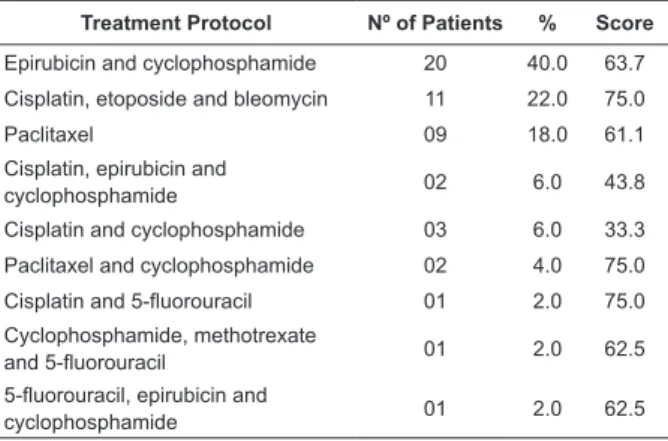
Regarding treatment protocols, 20 patients
(40.0%) were using epirubicin and cyclophosphamide
(EC), 11 (22.0%) used cisplatin, etoposide and
bleomycin (PEB), nine (18%) paclitaxel and ten (20%)
were using other protocols. Frequency distributions of
the protocols used with the scores obtained for each of
these are described in Table 1.
Treatment Protocol Nº of Patients % Score
Epirubicin and cyclophosphamide 20 40.0 63.7
Cisplatin, etoposide and bleomycin 11 22.0 75.0
Paclitaxel 09 18.0 61.1
Cisplatin, epirubicin and
cyclophosphamide 02 6.0 43.8
Cisplatin and cyclophosphamide 03 6.0 33.3
Paclitaxel and cyclophosphamide 02 4.0 75.0
Cisplatin and 5-fluorouracil 01 2.0 75.0
Cyclophosphamide, methotrexate
and 5-fluorouracil 01 2.0 62.5
5-fluorouracil, epirubicin and
cyclophosphamide 01 2.0 62.5 Table 1 - Frequency of treatment protocols and scores
obtained using the WHOQOL-BREF for patients in
outpatient chemotherapy (n = 50). Uberaba, 2009
The results obtained in the evaluation of quality
of life with the WHOQOL-BREF are shown in Table 2. It
was observed that the most compromised domains were
the Physical and Environment domains, and the most
preserved, the Social domain.
Table 2 - Scores obtained using the WHOQOL-BREF of patients in outpatient chemotherapy (n = 50). Uberaba,
2009
Domains Mean Standard deviation Median Minimum Maximum
Physical 56.0 13.5 57.1 21.4 85.7
Psychological 62.6 12.3 62.5 16.7 83.3
Social 71.0 15.6 75.0 16.7 100.0
Environment 58.1 12.6 56.2 31.2 93.7
All domains correlated positively and signiicantly
with the general quality of life, the Psychological domain
with a strong magnitude, and the other with moderate
magnitude, as can be observed in Table 3.
Domains and General quality of life
Domains
Physical Psychological Social Environment
General quality of life 0.55* 0.67* 0.40* 0.41*
Table 3 - Correlation between the domains of WHOQOL-BREF and of these with the Quality of Life of patients in
outpatient chemotherapy (n = 50). Uberaba, 2009
*p<0.05
Discussion
The data analysis allows the comprehension that
the age group of highest incidence of gynecological
cancers is over 40 years of age, which is consistent
with information provided by the INCA - National
Cancer Institute. This highlights the importance of
screening this population with preventive examinations
and guidance regarding lifestyle, prevention and early
detection of cancer in the age group 20-49 years(8).
Breast cancer stood out as the most common
neoplasia among women, followed by cervical cancer,
supporting the literature. According to the INCA, breast
cancer stands out as the most frequent in the female
population of the Southeast of Brazil, with an estimate
for 2010 of 65 new cases for every 100,000 women.
Without considering non-melanoma skin tumors, this
type of cancer is also the most frequent among women
from the South (64/100,000), Midwest (38/100,000)
and Northeast (30/100,000), whereas in the North it
is the second most prevalent (17 per 100,000)(1-2,4).
However, cervical cancer is the second most frequent
among the Brazilian female population and represents
one of the most frequent causes of death in the female
population in Latin America, where incidence rates are
among the highest in the world(9).
Regarding self-rated health, most of the
interviewees rated it as very good or good and
considered that they are satisied with it. This result
indicates that, in view of the prospect of progress of
a chronic disease, they are satisied with the moment
they are experiencing.
With regard to quality of life, it was observed
that the Physical domain was the most compromised
(score 56.0). This fact can be explained by the toxicity
of chemotherapy drugs administered, in relation to
cellular non-speciicity, which can generate effects such
as pain, fatigue, nausea and vomiting, and additionally
anorexia, hampering clients in their daily activities
and thus reducing their quality of life(3,10). Thus, this
should be investigated and actions proposed to more
effectively control these effects.
The second most compromised domain was
the Environment (score 58.1), indicating that these
clients consider themselves to have some dificulties
related to the conditions of where they live, security,
transportation, economic conditions and opportunities for recreation and leisure. Studies show that leisure is
altered after breast cancer, especially in patients with lymphedema, because they feel social discomfort due to the increase in size of the limb and there is also
decrease in the intensity, quantity and time devoted to activities previously practiced such as sunbathing,
gardening and physical activities. Moreover, many women leave or diminish their professional work, which
ultimately affects their family inancial condition(11-12).
To help women ind alternative leisure opportunities,
and inform them as to their rights as women with
cancer are ways to minimize the environmental impact in their quality of life.
Due to the diverse changes occurring in the family
routine, and the impact caused by the diagnosis of cancer and chemotherapy, the Psychological domain was also
affected, although to a lesser extent, in the quality of life of these women. The occurrence of treatment in their life is experienced in a particular way for each woman.
Furthermore, the affected woman’s age also inluences
their adaptation and the biopsychosocial sequelae caused
by cancer. Depending on the life cycle of the women, their activities and plans, such as in relation to family and work, are fully affected, especially the femininity and
self-esteem in young women. However, anxieties, fears, worries and apprehension are feelings that accompany
Rev. Latino-Am. Enfermagem 2010 Sep-Oct;18(5):849-55.
support offered by the whole multidisciplinary team and
for therapeutics with psychologists, in addition to support
from the family and partner, which has an important role
in the adaptation of these patients(10-11,13).
Although studies show that gynecological cancer
and antineoplastic chemotherapy may obstruct personal
relationships, given the greater reliance on others to
perform various tasks and/or the possible changes in
physical appearance or body self-image, the Social
domain was the least compromised in this study(9-10),
followed by the Psychological domain. In a similar study,
with ostomy patients suffering from colorectal cancer, it
was also found that the most compromised domain was
the Physical, and the Social the least compromised(14).
It was observed that even with the changes imposed by
the disease and treatment, these women are satisied
with their personal relationships, their sexual activities
and, especially, with the support they receive from
relatives and friends, thus contributing signiicantly to
coping well with this process.
Regarding the general quality of life, it was found
that the score obtained in this study, in addition to
corresponding to a good quality of life was also superior
to those obtained in other studies(13-15).
In relation to the inluence of the domains on the
general quality of life, it was found that the Psychological
domain had the highest correlation, followed by the
Physical domain, in this population. The Environment
and Social domains were those with lower correlations,
although signiicant. These indings contribute in part
to understanding the high values found for the general quality of life in our study group, since the Psychological domain had the second highest score and Environment the lowest.
This study contributes to others related to the evaluation of quality of life of patients with degenerative-chronic diseases(16) in general, more speciically in
oncology, which have shown to be effective tools for
oncology nursing(17), for contributing to the construction
of scientiic knowledge and the development of skills in
the area of oncology.
Conclusions
Based on data collected and analyzed, it can be said that the perception of quality of life of the women monitored in the development of this study is satisfactory since, due to the recognition of the seriousness of the
prognosis, they consider it positive that their physical and psychological capacities, their social relationships and their environment were not affected as they believed they would be, thus enabling the performance of their practical activities in daily life.
This study also concluded that the domains with lower scores should be the subjects of more
accurate observation and more eficient and effective
intervention in order to provide a better quality of life
during chemotherapy.
References
1. Ministério da Saúde (BR). Instituto Nacional do Câncer. Estimativa 2010: Incidência do câncer no Brasil. Rio de Janeiro (RJ): INCA; 2009.
2. Ministério da Saúde (BR). Instituto Nacional do Câncer. Ações de enfermagem para o controle do câncer: uma proposta de integração ensino-serviço. 2 ed. Rio de Janeiro (RJ): INCA; 2002. 3. Bonassa EMA, Santana TR. Enfermagem em terapêutica oncológica. 3. ed. São Paulo (SP): Atheneu; 2005.
4. Riul da Silva S, Aguillar OM. Assistência de enfermagem em quimioterapia antineoplásica. Rio de Janeiro (RJ): EPUB; 2002. 5. Silva CHD, Derchain SFM. Qualidade de vida de mulheres com câncer ginecológico: uma revisão de literatura. Rev Bras Cancerol. 2006; 52(1):33-47.
6. Fleck MPA, Leal OF, Louzada S, Xavier M, Chachamovich E, Vieira G, et al. Desenvolvimento da versão em português do instrumento de avaliação de qualidade de vida da OMS (WHOQOL-100). Rev Bras Psiquiatr. 1999; 21(1):19-28. 7. Siqueira KM, Barbosa MA, Boemer MR. O vivenciar a situação de ser com câncer: alguns dês-velamentos. Rev. Latino-Am. Enfermagem. 2007; 15(4):605-11.
8. Ministério da Saúde (BR). Secretaria de Assistência à Saúde. Instituto Nacional do Câncer. Viva Mulher. Programa nacional de controle do câncer do colo do útero e de mama: informações técnico-gerenciais e ações desenvolvidas. Rio de Janeiro (RJ): INCA; 2008.
9. Ferreira MLM, Oliveira C. Conhecimento e significado para funcionárias de indústrias têxteis sobre prevenção do câncer do colo-uterino e detecção precoce do câncer da mama. Rev Bras Cancerol. 2006; 52(1):5-15.
10. Sales CACC, Paiva L, Scandiuzzi D, Anjos ACY. Qualidade de vida de mulheres tratadas de câncer de mama: funcionamento social. Rev Bras Cancerol. 2001; 47(3):263-72.
11. Alegrance FC. Qualidade de vida e estratégias de enfrentamento de mulheres com e sem linfedema após câncer de mama.[dissertação]. São Bernardo do Campo (SP): Faculdade de Psicologia e Fonoaudiologia/Universidade Metodista de São Paulo; 2007.
13. Rabin EG. Avaliação da qualidade de vida das mulheres com câncer de mama e a percepção de seus parceiros.[dissertação]. Porto Alegre (RS): Faculdade de Ciências Médicas/Universidade Federal do Rio Grande do Sul; 2006.
14. Michelone APC, Santos VLCG. Qualidade de vida de adultos com câncer colorretal com e sem ostomia. Rev. Latino-Am. Enfermagem. 2004 novembro-dezembro; 12(6):875-83. 15. Mansano TC. Qualidade de vida de pacientes com câncer no período de quimioterapia.[Trabalho de Conclusão de Curso]. Campinas (SP): Faculdade de Ciências Médicas (FCM)/ Universidade Estadual de Campinas; 2008.
16. Guimarães FA, Santos MA, Oliveira EA. Qualidade de vida de pacientes com doenças auto-imunes submetidos ao transplante de medula óssea: um estudo longitudinal. Rev. Latino-Am. Enfermagem. 2008 setembro-outubro; 16(5):856-63.
17. Pires AMT, Segreto RA, Segreto HRC. Avaliação das reações agudas da pele e seus fatores de risco em pacientes com câncer de mama submetidas à radioterapia. Rev. Latino-Am. Enfermagem. 2008 setembro-outubro; 16(5):844-9.
Received: Jun. 10th 2009