RESUMO.- [Efeito da suplementação de arginina na dieta de frangos na performance produtiva e na mor-fologia do intestino delgado.] O efeito na dieta inicial (1-21 dias) da suplementação de arginina (Arg) foi estudada
Effects of starter diet supplementation with arginine on broiler
production performance and on small intestine morphometry
1Alice E. Murakami2*, Jovanir I. M. Fernandes3, Luzmarina Hernandes2
and Tatiana C. Santos2
ABSTRACT.- Murakami A.E., Fernandes J.I.M.,Hernandes L. & Santos T.C. 2012. Effects of starter diet supplementation with arginine on broiler production performance and on small intestine morphometry. Pesquisa Veterinária Brasileira 32(3):259-266. Depar-tamento de Zootecnia, Universidade Estadual de Maringá, Av. Colombo 5790, Maringá, PR 87020-900, Brazil. E-mail: [email protected]
The effects of starter diet (days 1 to 21) supplemented with arginine (Arg) on the production performance and duodenum and jejunum mucosa morphometry of broilers were studied. Male Cobb broiler chickens (990) were randomly assigned to one of ive treatments in a complete random design. Measurements of 33 chicks per treatment were made in six repetitions. The treatments consisted of a basal diet with 1.390% digesti-ble Arg (no supplementation) and four dietary levels (1.490%, 1.590%, 1.690%, and 1.790%), providing a relationship with lysine of 1.103; 1.183; 1.262; 1.341 and 1.421%, respectively. From the age of 22 days on, all birds received conventional grower diet. The data were submitted to regression analysis by polynomial decomposition of the degrees of freedom in relation to the levels of Arg. The Arg supplementation increased (P<0.05) the live weight and the feed conversion ratio without increasing the feed intake of the birds. However, no effect was observed (P>0.05) in the growth phase (days 22 to 42) in the absence of the Arg supplementation. The supplementation of Arg over of NRC recom-mendation during the starter phase may be necessary for the expression of the maximal weight gain potential in birds. No effect (P<0.05) of Arg dietary supplementation was observed either on small intestine weight and length at any age. However, the duodenum villus:crypt ratio increased and the crypt depth decreased in the irst week in response to increasing dietary Arg. It is concluded that broiler Arg dietary supplementation in the starter diet improved production performance and small intestine morphometry, espe-cially in the irst week.
INDEX TERMS: Starter diet supplementation, amino acids, polyamines, arginine, duodenum, villus: crypt ratio, broilers.
1 Received on September 9, 2011.
Accepted for publication on February 1, 2012. Part of the M.Sc. Dissertation of the second author.
2 Departamento de Zootecnia, Universidade Estadual de Maringá, Avenida
Colombo 5790, Jardim Universitário, Maringá, PR 87020-900, Brazil. *Corres-ponding author: [email protected]. Other e-mails: [email protected], [email protected]
3 Departamento de Medicina Veterinária, Universidade Federal do
Para-ná (UFPR), Campus Palotina, Rua Pioneiro 2153, Palotina PR 85950-000, Brazil . E-mail: [email protected]
efeito (P>0,05) na fase de crescimento (22 a 42 dias) na au-sência de suplementação de Arg. A suplementação acima do recomendado pelo NRC na fase inicial pode ser necessá-ria para a expressão máxima do potencial de ganho de peso em aves. Não houve efeito da suplementação de Arg na dieta no peso e comprimento do intestino delgado em ne-nhuma idade. No entanto, a relação vilo:cripta no duodeno aumentou e a profundidade da cripta diminuiu na primeira semana em resposta ao incremento de Arg na dieta. Con-cluiu-se que em frangos de corte a suplementação de Arg na dieta inicial melhorou o desempenho e a morfometria do intestino delgado, especialmente na primeira semana. TERMOS DE INDEXAÇÃO: Suplementação, aminoácidos, poliami-nas, arginina, duodeno, relação vilo:cripta, frangos de corte.
INTRODUCTION
Nutrition and health during this irst week of life prepares the broiler chicks for rapid growth and excellent livability throughout rearing. The nutritional investigations of the broiler starter phase has been intensiied and dissemina-ted due to its great signiicance for the growth of modern broiler lineages in relation to its total growth period.
Arginine (Arg) is essential amino acids for birds, espe-cially in the starter phase, since the urea cycle is not functio-nal in birds (Austic & Nesheim 1971). Birds cannot synthe-size Arg, de novo, and thus are dependent of dietary supply of this AA. Additionally, corn and soy meal-based diets, Arg is the ifth limiting amino acid, after methionine, lysine, threo-nine, and valine (Vieira & Berres 2007), may be particularly important in what concerns Arg availability to broilers. Birds have the highest requirement of Arg among the studied ani-mals (Ball et al. 2007). This high Arg requirement is explai-ned by the lack of endogenous Arg synthesis, the high pro-tein deposition rate due to the fast growth of current broiler lineages, and the antagonistic metabolic interaction betwe-en lysine (Lys) and Arg (Edmonds & Baker 1987).
Besides their role as building blocks of proteins and polypeptides, some aminoacids regulate key metabolic pa-thways that are necessary for maintenance, growth, repro-duction, and immunity. They are called functional AA, whi-ch include arginine, cysteine, glutamine, leucine, proline, and tryptophan (Wu 2009). These amino acids may maxi-mize the feeding eficiency and protein aggregation, reduce adiposity, and improve the health of humans and animals.
Wu & Morris (1998) described Arg as one of the most ver-satile amino acids in animal cells. It is required for the syn-thesis of several compounds, such as ornithine, polyamines (spermidine, spermine, and putrescine), proline, creatine, protein, nitric oxide (NO), and citrulline, besides glutamate and agmatine in mammals. Arg is also a powerful secretago-gue, increasing the release of insulin, the growth hormone, and IGF-I in the blood stream (Newsholme et al. 2005).
The tissue polyamine concentrations in birds are par-ticularly responsive to dietary manipulations of Arg levels. Due to the lack of a functional urea cycle, birds depend on an exogenous Arg source to form ornithine, which, in mammals, is derived from glutamic acid (Austic & Nesheim 1971). Putrescine is formed by the decarboxylation of or-nithine, and spermine and spermidine are obtained from
putrescine in the presence of decarboxylated S-adenosyl-methionine, which is derived from methionine; thus both arginine and methionine are involved in their synthesis. These biogenic amines are also considered nutritionally important local factors for growth and the development of small intestinal and colonic mucosa (Löser et al. 1999). Ruemmele et al. (1999) had already reported that the lack of polyamines inhibits the proliferation, migration, and apoptosis of intestine cells. As a precursor of polyamines, Arg may be considered a trophic agent in the stimulation of the development of the intestine mucosa, accelerating the mitotic process in the villus-crypt region with a resulting increase in the number and size of villus cells.
According to Wu (2009), amino acids induce gene trans-cription mechanisms by activating important enzymes of the intestine mitotic process, such as glutamine in the in-duction of ornithine-decarboxylase, the enzyme responsi-ble for the decarboxylation of ornithine in the synthesis of polyamines. They also regulate gene expression in highly speciic processes that involve the transfer of coded infor-mation from a gene to its product (RNA and/or protein). In mammals, research has shown that dietary supplementa-tion with Arg and glycine (Gln) can increase the expression of antioxidant genes and reduce the expression of proin-lammatory genes in the small intestine and adipose tissue (Fu et al. 2005, Wang et al. 2008, Jobgen et al. 2009).
Despite the large growth of the small intestine in the irst week post-hatching, it is not fully mature for the di-gestion and absorption processes (Noy & Sklan 1995). As a result, broiler chicks exhibit a negative correlation be-tween feed intake and nutrient digestibility in the irst week of life. However, after the second week of life, this correlation becomes positive due to the optimization of intestinal growth and enzyme activity (Nir 1998, Muraka-mi et al. 2007).
This work aimed to evaluate the effects of starter diet supplementation with Arg on production performance and duodenum mucosa morphometry in broilers.
MATERIALS AND METHODS
The experiment was conducted in the poultry sector of the Igua-temi Experimental Farm with the approval of the Animal Experi-mentation Ethics Committee of the State University of Maringa. (Protocol 004/2006).
Male Cobb 500 chicks (n=990) produced by 39-week old broi-ler breeders were assigned in a complete randomized design to groups of 33 chicks per pen in a total of 30 experimental units submitted to ive levels of Arg and six experimental repetitions. The open-sided house had thermostatically controlled heating and ventilation and each pen (0.173m2/bird) had rice husk liter
and was placed one feeder and one drinker. Birds had free access to feed and water during the experimental period. Continual arti-icial illumination was applied.
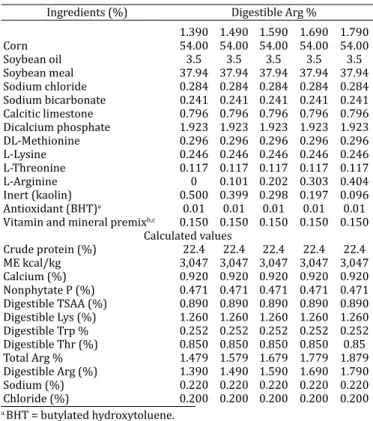
digestible Arg dietary levels were 1.390, 1.490, 1.590, 1.690, and 1.790% (Table 1) with Arg:Lys ratios of 1.103, 1.183, 1.262, 1.341, and 1.421, respectively. From the age of 22 days on, all birds re-ceived conventional grower diet with 19.7% CP, 3,150 ME kcal/kg, 1.099% Lys and 1.249% Arg as advocated by Rostagno et al. (2005).
The chemical compositions of the experimental diets were cal-culated in accordance with AOAC Oficial Method 994.12 (AOAC
1995) by performic acid oxidation with acid hydrolysis-sodium metabisulite method.
At the ages of 7, 14, 21, and 42 days, all the birds and the feed remains were weighed in order to determine body weight gain, feed intake and feed conversion ratio. Each period, two birds per pen (12 birds/treatment) were randomly selected and euthanized by cervical dislocation and weighed individually. The carcasses were dissected in order to remove the small intestine, which was weighed and measured. Fragments of approximately 5cm length from the duodenum (from the pylorus until distal duodenal por-tion) and jejunum (from the distal duodenal portion until Meckel diverticulum) were obtained. Fragments were opened, washed with saline solution and ixed in Bouin’s solution for 24 h for histological analysis. Each fragment was submitted to 5μm-thick semi-serials cuts and stained by Hematoxylin and eosin. To his-tological morphometric study the slides were analyzed by light microscopy, and digital images were captured (IMAGE PROPLUS 5.2 from Media Cybertechnics, São Paulo, Brazil). The height of villi and depth of crypts were measured in twenty different points in duodenum and jejunum in each bird.
The data were submitted to regression analysis by polynomial decomposition of the degrees of freedom in relation to the levels of Arg. The data were analyzed with software SAEG(1997) using the statistical model:
Yij = b0 + b1Ai + b2Ai + b3Ai + eij where:
Yij: observation of the dependent variable in the experimental unit j submitted to level i of Arg, i: 1, 2, 3, 4, 5 (1= 1.390%, 2= 1.490%, 3= 1.590%, 4= 1.690% and 5= 1.790%);
b0: constant;
b1, b2, and b3: linear, quadratic, and cubic regression coefi-cients of the dependent variable as a function of the levels of Arg;
eij: random error associated with each Yij observation.
The determination coeficients were calculated as percenta-ges of the sum of the squares of the model in relation to the total sum of squares.
RESULTS
The analysis of the amino acid proile of the experimental feeds resulted in a total Arg content 10% over the calcu-Table 1. Composition of experimental diets of broilers in the
starter phase (1-21 days of age)
Ingredients (%) Digestible Arg %
1.390 1.490 1.590 1.690 1.790
Corn 54.00 54.00 54.00 54.00 54.00
Soybean oil 3.5 3.5 3.5 3.5 3.5
Soybean meal 37.94 37.94 37.94 37.94 37.94 Sodium chloride 0.284 0.284 0.284 0.284 0.284 Sodium bicarbonate 0.241 0.241 0.241 0.241 0.241 Calcitic limestone 0.796 0.796 0.796 0.796 0.796 Dicalcium phosphate 1.923 1.923 1.923 1.923 1.923 DL-Methionine 0.296 0.296 0.296 0.296 0.296 L-Lysine 0.246 0.246 0.246 0.246 0.246 L-Threonine 0.117 0.117 0.117 0.117 0.117
L-Arginine 0 0.101 0.202 0.303 0.404
Inert (kaolin) 0.500 0.399 0.298 0.197 0.096 Antioxidant (BHT)a 0.01 0.01 0.01 0.01 0.01
Vitamin and mineral premixb,c 0.150 0.150 0.150 0.150 0.150
Calculated values
Crude protein (%) 22.4 22.4 22.4 22.4 22.4 ME kcal/kg 3,047 3,047 3,047 3,047 3,047 Calcium (%) 0.920 0.920 0.920 0.920 0.920 Nonphytate P (%) 0.471 0.471 0.471 0.471 0.471 Digestible TSAA (%) 0.890 0.890 0.890 0.890 0.890 Digestible Lys (%) 1.260 1.260 1.260 1.260 1.260 Digestible Trp % 0.252 0.252 0.252 0.252 0.252 Digestible Thr (%) 0.850 0.850 0.850 0.850 0.85 Total Arg % 1.479 1.579 1.679 1.779 1.879 Digestible Arg (%) 1.390 1.490 1.590 1.690 1.790 Sodium (%) 0.220 0.220 0.220 0.220 0.220 Chloride (%) 0.200 0.200 0.200 0.200 0.200
a BHT = butylated hydroxytoluene.
b Premix provided per kg of diet: retinyl acetate 3.5mg, cholecalciferol
82.5mg, dl-alfa-tocoferol 16.50mg, menadione 2.4mg, thiamin 3.00mg, ribolavin 7.50mg, vitamin B-12 18.00mg, niacin 52.50mg, pantothenic acid 19.50mg, folic acid 1.20mg.
c Mineral mix provided per kg of diet: Fe 15mg, Cu 24mg, iodine 3.60mg,
Zn 150mg, Mn 210mg, Se 0.60mg.
Table 2. Performance parameter means and estimates of broilers fed different amounts of Arg in diet in the 1 to 21 days of age
Digestible Arg % CV (%) Effect 1.390 1.490 1.590 1.690 1.790
1 to 7-day age period
Weight gain g 118.55 125.72 129.67 130.38 127.86 5.42 Quadratic Feed intake, g 131.20 137.14 135.39 134.50 132.65 5.43 NS Feed conversion,g/g 1.103 1.083 1.063 1.043 1.023 4.18 Linear
1 to 14-day age period
Weight gain g 390.44 396.5 396.67 406.42 398.99 2.47 NS Feed intake, g 473.71 480.50 474.18 483.26 473.14 2.51 NS Feed conversion, g/g 1.215 1.207 1.199 1.192 1.184 2.47 Linear
1 to 21-day age period
Weight gain g 820.17 824.80 829.43 834.06 838.69 2.19 Linear Feed intake, g 1086.12 1093.46 1077.62 1099.76 1079.49 2.08 NS Feed conversion, g/g 1.328 1.319 1.311 1.303 1.295 1.09 Linear
1 to 42-day age period
lated values. The production performance results of broi-lers in periods 1 to 7, 1 to 14, 1 to 21, and 1 to 42 days of age are given in Table 2. The mortality ratio recorded during the whole experimental period was about 1.5% and it was not inluenced (P>0.05) by the experimental treatments.
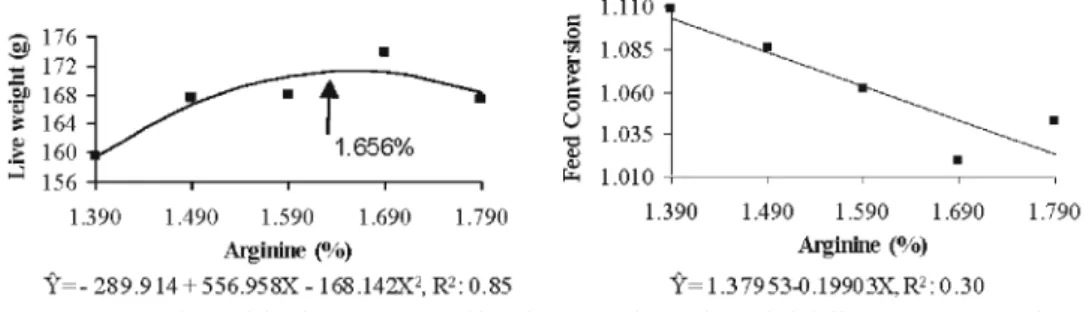
The live weight of the birds in the irst week presen-ted quadratic effect (P<0.05) for Arg supplementation, peaking at 1.560% Arg. The Arg supplementation incre-ased (P<0.05) feed conversion linearly, but did not affect (P>0.05) feed intake (Fig.1).
jejunum of broilers fed diets supplemented with different levels of Arg at 7, 14, 21, and 42 days of age are given in Tables 3 and 4.
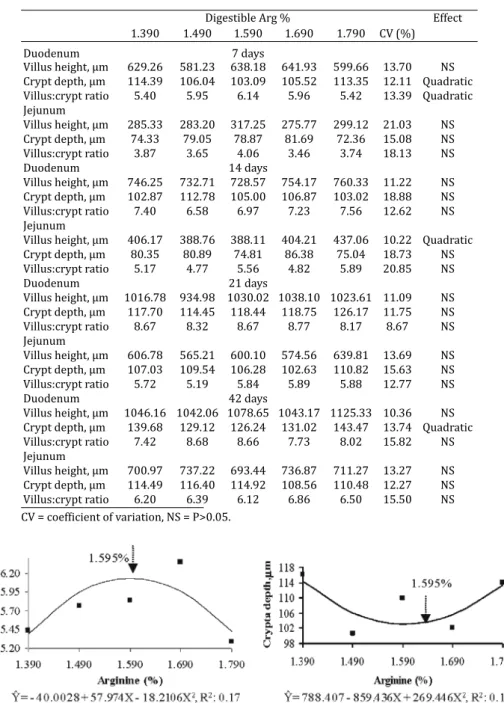
No effect (P>0.05) was observed for Arg supplementa-tion on the small intestine weight and length at any of the ages evaluated. The morphometry of the duodenum muco-sa of broilers aged 7 days was affected (P<0.05) by the die-tary Arg levels. The duodenum crypt depth and the villus: crypt ratio there was quadratic effect (P<0.05), according to the itted equations, and 1.595% Arg resulted in a higher villus:crypt ratio and shallower crypts in the duodenum (Fig.4).
At 14 days of age, was observed only a quadratic res-ponse (P<0.05) to dietary arginine levels in the height of the jejunal villi (Fig.5). In contrast, at 21 days of age, no di-fference was observed in the mucosa morphometry of any segment of the small intestine studied.
Although the birds did not receive Arg-supplemented diets after 21 days of age, a quadratic variation was obser-ved (P<0.05) for the duodenum mucosa crypt depth at 42 days of age, similar to that observed at 7 days of age. Fig.2. Feed conversion of broilers at 14 days of age fed different
levels of Arg in diet in the 1 to 21-day age period.
Fig.3. Live weight and feed conversion of broilers at 21 days of age fed different amounts of Arg in diet from 1 to 21 days of age.
Table 3. Mean small intestine weight and length of broilers fed different amounts of Arg in diet in the 1 to 21 days of age
Small Digestible Arg, % CV
(%) Effect intestine 1.390 1.490 1.590 1.690 1.790
7 days
Weight, g 16.43 16.48 16.37 16.95 16.80 8.74 NS Length, cm 92.83 96.00 96.50 93.83 93.42 7.31 NS
14 days
Weight, g 35.07 31.54 32.87 33.79 30.65 14.34 NS Length, cm 121.42 121.83 121.00 122.58 121.92 5.56 NS
21 days
Weight, g 53.75 50.92 55.06 56.62 49.19 18.17 NS Length, cm 140.75 145.83 135.50 143.00 141.00 11.63 NS
42 days
Weight, g 118.17 122.85 122.31 137.95 122.03 20.42 NS Length, cm 191.17 189.25 187.33 198.08 187.00 8.23 NS CV = coeficient of variation, NS = P>0.05.
Fig.1. Live weight and feed conversion of broilers at 7 days of age fed different amounts of Arg in diet from 1 to 21 days of age.
At 1 to 14 day period, the feed conversion increased li-nearly (P < 0.05) with the Arg level in diet an effect was observed an effect (P<0.05) on feed conversion, which im-proved with the increase in Arg levels (Fig.2). From days 1-21, live weight and feed conversion improved linearly (P<0.05) with Arg supplementation, whereas feed intake did not vary (P>0.05) among the treatments (Fig.3).
In the total period, including the period of days 22-42, when the birds were not given Arg-supplemented feed, no effect (P>0.05) was observed on any production parame-ter despite the positive effect observed in the 1 to 21-day period.
Table 4. Means and estimated valued of morphometric measurements of the small intestine mucosa (duodenum and jejunum) of broilers fed
different levels of Arg in diet in the 1 to 21 days of age
Digestible Arg % Effect
1.390 1.490 1.590 1.690 1.790 CV (%)
Duodenum 7 days
Villus height, μm 629.26 581.23 638.18 641.93 599.66 13.70 NS Crypt depth, μm 114.39 106.04 103.09 105.52 113.35 12.11 Quadratic Villus:crypt ratio 5.40 5.95 6.14 5.96 5.42 13.39 Quadratic Jejunum
Villus height, μm 285.33 283.20 317.25 275.77 299.12 21.03 NS Crypt depth, μm 74.33 79.05 78.87 81.69 72.36 15.08 NS Villus:crypt ratio 3.87 3.65 4.06 3.46 3.74 18.13 NS
Duodenum 14 days
Villus height, μm 746.25 732.71 728.57 754.17 760.33 11.22 NS Crypt depth, μm 102.87 112.78 105.00 106.87 103.02 18.88 NS Villus:crypt ratio 7.40 6.58 6.97 7.23 7.56 12.62 NS Jejunum
Villus height, μm 406.17 388.76 388.11 404.21 437.06 10.22 Quadratic Crypt depth, μm 80.35 80.89 74.81 86.38 75.04 18.73 NS Villus:crypt ratio 5.17 4.77 5.56 4.82 5.89 20.85 NS
Duodenum 21 days
Villus height, μm 1016.78 934.98 1030.02 1038.10 1023.61 11.09 NS Crypt depth, μm 117.70 114.45 118.44 118.75 126.17 11.75 NS Villus:crypt ratio 8.67 8.32 8.67 8.77 8.17 8.67 NS Jejunum
Villus height, μm 606.78 565.21 600.10 574.56 639.81 13.69 NS Crypt depth, μm 107.03 109.54 106.28 102.63 110.82 15.63 NS Villus:crypt ratio 5.72 5.19 5.84 5.89 5.88 12.77 NS
Duodenum 42 days
Villus height, μm 1046.16 1042.06 1078.65 1043.17 1125.33 10.36 NS Crypt depth, μm 139.68 129.12 126.24 131.02 143.47 13.74 Quadratic Villus:crypt ratio 7.42 8.68 8.66 7.73 8.02 15.82 NS Jejunum
Villus height, μm 700.97 737.22 693.44 736.87 711.27 13.27 NS Crypt depth, μm 114.49 116.40 114.92 108.56 110.48 12.27 NS Villus:crypt ratio 6.20 6.39 6.12 6.86 6.50 15.50 NS CV = coeficient of variation, NS = P>0.05.
Fig. 4. Villus:crypt ratio and duodenum crypt depth of 7-day-old broilers fed different amounts of Arg in diet from 1 to 21 days of age.
periment was conducted between October and November and during this season the ambient temperature is high. Despite the facilities where the experiment was developed possess systems for temperature control it was not possi-ble to maintain it constantly within the range of thermal comfort. The rearing temperature was maintained within the chicks comfort zone and the average temperature was 25±2°C, and relative humidity was 61 ± 10% throughout experimentation.. However, there were records of tempera-ture above 32°C during the growth phase. Balnave & Brake (2002) reported that under this condition, besides reduced absorption of Arg in the intestine, it was more degraded, which demonstrated its higher demand. Furthermore, lar-ger amounts of Arg are required for the synthesis of nitric oxide (NO), which is a powerful vasodilator, thus affecting the synthesis of other Arg-dependent metabolites negati-vely.
This proposition may be reinforced by Chamruspollert et al. (2004), who reported decreased creatine and creati-nine levels in excreta of birds under heat stress, without concomitant increase in the concentrations of these sub-stances in muscle, which implies that birds submitted to high temperatures had lower creatine biosynthesis. Ar-ginine transfers a guanidino group to glycine for the for-mation of glycocyamine, and the synthesis of creatine is completed by methylation of glycocyamine by S-adeno-sylmethionine (Bloch & Schoenheimer 1941). Balnave & Brake (1999) also observed that heat stress reduces the synthesis of ornithine, and consequently of polyamines, due the lower activity of kidney arginase. Under those con-ditions, dietary manipulation of amino acids may alter the metabolism of polyamines in birds.
The results obtained on intestine villus analysis de-monstrates that the addition Arg in higher amounts than the current commercial feed formulation levels is required to maintain the intestine epithelium development. Accor-ding to Maiorka et al.(2003), animals with a higher intes-tine mucosa cell turnover have deeper crypts as a result of high mitotic activity and hyperplasia. Considering that the intestine mucosa grows continually due to cell desquama-tion to the intestine lumen, cell turnover occurs at the ex-penses of the consumption of nutrients derived from the bird organism energy reserves and the feed intake. McBri-de & Kelly (1990) estimated that the maintenance of the intestine epithelium and its supporting structures corres-ponds to 20% of the total energy consumed by the animal. Therefore, the more extensive the intestine mucosa repairs, the smaller the net energy availability.
A positive effect similar to that with Arg supplementa-tion on morphometry of the duodenum mucosa was obser-ved on the live weight of 7-day-old birds, demonstration that Arg supplementation is involved in the maintenance of the duodenum mucosa and that this effect may be associa-ted to the better performance observed at this age.
The villus height may be positively related to the body weight gain and feed intake (Kelly et al. 1991); neverthe-less, such an effect has not been observed. Yet, the weight gain and feed conversion were optimized under Arg sup-plementation, which may be attributed to a lower mitotic
DISCUSSION
The increase in the Arg:Lys ratio in the starter phase affor-ded a increased production performance.. At 1,25% diges-tible dietary lysine as is now common for young broiler chicks and if a lysine:arginine ratio 1.00:1.05 is to be main-tained, as suggested by ideal protein (Dean & Scott 1965, Baker 1994, Rostagno et al. 2005) then the Arg level ne-eds to be 1.31%. However, according to Marumatsu et al. (1991), the Arg use eficiency of birds falls linearly with the increase in the Lys level. The Arg requirement for modern broiler may be slightly below due of annual broiler genetic gains.
The present work conirmed this supposition. The Lys level in the starter diet was kept at 1.260% and the Arg level that maximized the live weight of birds was around 1.650%; however, higher levels were required to improve the feed conversion ratio.
Mendes, Watkins & England (1997) and Brake et al. (1998) also observe improved feed conversion with the addition of Arg to broiler diet. However, Labadan Jr et al. (2001) suggested that higher Arg amounts are needed for feed conversion than for live weight gain. Live weight was optimized at 1.24% Arg, whereas feed conversion was op-timized at 1.31%. In contrast, the levels tested by these and other authors were lower than the ones used in this experi-ment, leading to some differences in the results obtained.
Burton & Waldroup (1997) reported a total Arg require-ment of 1.40% in 1-28-day old broilers fed a 21% raw pro-tein diet, and Costa et al. (2001) studied male Ross broilers aged 22-42 days submitted to seven Arg:Lys ratios ranging from 95 to 132.5% and did not observed an effect of Arg level on performance characteristics.
Chamruspollert et al. (2002) reported a total Arg requi-rement of 1.26% for weight gain and 1.27% for feed con-version. Corzo & Kidd (2003) recommended even lower levels, 1.15% for live weight gain and 1.28% for feed con-version at the 1 to 18-day age; however, the live weight gain of the birds was very low, around 50% the value obtained in the present result.
Atencio et al. (2004) did not observe any effect on feed intake; nevertheless, the live weight gain and feed conver-sion varied quadratically with digestible Arg levels betwe-en 1.10 and 1.39% in the 1 to 21-day period.
In the present experiment, the feed intake was not affec-ted in any of the evaluaaffec-ted ages either, indicating that the di-fferences in weight gain may be attributed to the eficient use of feeds by the birds and the balance between essential and non-essential amino acids. Growth consists, in part, of pro-tein synthesis whereas eficiency of utilization is dependent not only on the protein synthesis but also on the amount of AA being catabolized (Sklan & Noy 2004). Different interre-lationships between the dietary AA affect the amount of ca-tabolism and these processes interact with an accompanying energy cost. Arg may be a limiting amino acid for the expres-sion of maximal live weight gain in birds; therefore, its adjust-ment to optimal levels is fundaadjust-mental. (Sklan & Noy 2004).
ex-activity of the duodenum mucosa crypt cells and the resul-ting lower maintenance energy expenditure of the birds.
Moreover, the mechanism involved in the intestine cell turnover by nutrients is little understood yet. There is evi-dence for the participation of adjustment mechanisms be-tween intrinsic and primary extrinsic afferent neurons and the central nervous system in addition to enzyme gene trans-cription mechanisms, and even gene expression, as specii-cally reported for some amino acids, such as Arg & Gln (Fu et al. 2005, Wang et al. 2008, Jobgen et al. 2009, Wu 2009).
Arg is involved in the synthesis of polyamines, which in turn are associated with cell division, protein synthesis, and tissue growth (Pegg & McCann 1982) besides its nu-tritional importance for the growth and intestine develop-ment (Löser et al. 1999). However, for Arg to be used in the synthesis of polyamines, it needs to be hydrolyzed into urea and ornithine by kidney arginase (Meijer et al. 1990, Wu & Morris 1998), since ureotelic species do not synthesize ornithine. Unlike mammals, the arginase activity of the kid-ney (high rate of Arg degradation) is 30 times higher than that in the liver (Tamir & Ratner 1963). Consequences of arginase induction can include impaired NO synthesis as a result of reduced arginine bioavailability.. Furthermore, Ruiz-Feria et al. (2001) questioned if there may be a diffe-rence between broiler lineages or even within lineages in relation to kidney arginase activity. If so, birds with high kidney arginase activity may beneit from supplemental Arg that might result in a trophic effect on the intestine mu-cosa. On the other hand, birds with a low kidney arginase activity may not respond to increased levels of Arg.
Given the increasing commercial availability of food- and feed-grade amino acids for dietary supplementation, they will widely become cost-effective functional nutrients, exerting a regulatory action on the growth and develop-ment of tissues, thus optimizing production performance and meat production in broilers.
CONCLUSIONS
Arg supplementation of broiler starter diets over the recommended levels improved production performance and intestine mucosa development only during the starter phase (1-21 days).
Dietary supplementation with Arg at levels above the ones recommended for the growth phase may be necessa-ry for improved performance productive in lines with fast growth broilers.
Acknowledgements.- This study received inancial support from
Natio-nal Counsel of Technological and Scientiic Development of Brazil (CNPq). We gratefully acknowledge Ajinomoto Biolatina, which provided the L-Arg for this study.
REFERENCES
AOAC 1995. Oficial Methods of Analysis of the Association of Oficial Analytical Chemists. 16th ed. Association of Oficial Analytical Chemists,
Washington, DC.
Atencio A., Albino L.F.T., Rostagno H.S., Oliveira D.C., Vieites F.M. & Pupa J.M.R. 2004. Exigência de arginina digestível para frangos de corte ma-chos em diferentes fases. Revta Bras. Zootec. 33:1456-1466.
Austic R.E. & Nesheim M.C. 1971. Arginine, ornithine and proline meta-bolism of chicks: Inluence of diet and heredity. J. Nutr. 101:1403-1413.
Baker D.H. 1994. Ideal protein and amino acid requirement of broiler chi-cks. Proc. California Nutrition Conference, Fresno, p.21-24.
Ball R.O., Urschel K.L. & Pencharz P.B. 2007. Nutritional consequences of interspecies differences in arginine and lysine metabolism. J. Nutr. 137:1626-1641.
Balnave D. & Brake J. 1999. Responses of broilers to sodium bicarbona-te supplementation of diets containing varying arginine: Lysine ratios. Aust. J. Agric. Res. 50:425-430.
Balnave D. & Brake J. 2002. Re-evaluation of the classical dietary arginine:lysine interaction for modern poultry diets: A review. World’s Poult. Sci. J. 58:275-289.
Bloch K. & Schoenheimer R. 1941. The biological precursors of creatine. J. Biol. Chem. 138:167-169.
Brake J., Balnave D. & Dibner J.J. 1998. Optimum dietary arginine:lysine ra-tio for broiler chickens is altered during heat stress in associara-tion with changes in intestinal uptake and dietary sodium chloride. Brit. Poult. Sci. 39:639-647.
Burton E.M. & Waldroup P. 1997. Arginine and lysine needs of young broi-ler chicks. Nutr. Int. 19:607-614.
Chamruspollert M., Pesti G.M. & Bakalli R.I. 2002. Dietary interrela-tionships among arginine, methionine, and lysine in young broiler chi-cks. Brit. J. Nutr. 88:655-660.
Chamruspollert M., Pesti G.M. & Bakalli R.I. 2004. Chick responses to die-tary Arg and met levels at different environmental temperatures. Brit. Poult. Sci. 45:93-100.
Corzo A. & Kidd M.T. 2003. Arginine needs for chick and growing broiler. Int. J. Poultry Sci. 2:379-382.
Costa F.G.P., Rostagno H.S., Toledo R.S. & Albino L.F.T. 2001. Efeito da rela-ção arginina:lisina sobre o desempenho e qualidade de carcaça de fran-gos de corte de 3 a 6 semanas de idade, em condições de alta tempera-tura. Revta Bras. Zootec. 30:2021-2025.
Dean W.F. & Scott, H.M. 1965. The development of an amino acid reference diet for the early growth of chicks. Poult. Sci. 44:803-808.
Edmonds M.S. & Baker D.H. 1987. Comparative effects of individual amino acid excesses when added to a corn-soybean meal diet: effects on gro-wth and dietary choice in the chick. J. Anim. Sci. 65:699-705.
Fu W.J., Haynes T.E., Kohli R., Hu J., Shi W., Spencer T.E., Carroll R.J., Meinin-ger C.J. & Wu G. 2005. Dietary L-arginine supplementation reduces fat mass in Zucker diabetic fatty rats. J. Nutr. 135:714-721.
Jobgen W., Fu J., Gao H., Li P., Stephen B.S., Spencer T.E. & Wu G. 2009. High fat feeding and dietary L arginine supplementation differentially regulate gene expression in rat white adipose tissue. Amino Acids 37:187-198.
Kelly D., Smith J.A. & McCracken K.J. 1991. Digestive development of the early-weaned pig. 1. Effect of continuous nutrient supply on the develo-pment of the digestive tract and on changes in digestive enzyme activity during the irst week post-weaning. Brit. J. Nutr. 65:169-180.
Labadan Jr M.C., Hsu K.N. & Austic R.E. 2001. Lysine and arginine require-ments of broiler chickens at two to three weeks intervals to eight weeks of age. Poult. Sci. 80:599-606.
Löser C., Eisel A., Harms D. & Foëlsch U.R. 1999. Dietary polyamines are es-sential luminal growth factors for small intestinal and colonic mucosal growth and development. Gut 44:12-16.
Maiorka A., Santin E., Dahlke F., Boleli I.C. Furlan R.L. & Macari M. 2003. Post hatching water and feed deprivation affect the gastrointestinal tract and intestinal mucosa development of broiler chicks. J. Appl. Poult. Res. 12:483-492.
Marumatsu T.H., Ohshima H., Goto M., Mori S. & Okumura J. 1991. Growth prediction of young chicks. Do equal deiciencies of different essential amino acids produce equal responses? Brit. Poult. Sci. 32:139-149. Mcbride B.W. & Kelly J.M. 1990. Energy cost of absorption and
metabo-lism in the ruminant gastrointestinal tract and liver: a review. J. Ani. Sci. 68:2997-3010.
Mendes A.A., Watkins S.E. & England J.A. 1997. Inluence of dietary lysine levels and arginine:lysine ratios on performance of broilers exposed to heat or cold stress during the period of three to six weeks of age. Poult. Sci. 76:472-481.
Murakami A.E., Sakamoto M.I., Natali M.R.M., Souza L.M.G. & Franco J.R.G. 2007. Supplementation of glutamine and vitamin E on the morpho-metry of the intestinal mucosa in broiler chickens. Poult. Sci. 86:488-495.
Newsholme P., Brennnan L., Rubi B. & Maechler P. 2005. New insights into amino acid metabolism, beta-cell function and diabetes. Clin. Sci. 108:185-194.
Nir I. 1998. Mecanismos de digestão e absorção de nutrientes durante a primeira semana. Annais da Conferencia APINCO Ciencia e Tecnologia Avícolas. FACTA, Campinas, p.81-91.
Noy Y. & Sklan D. 1995. Digestion and absorption in the young chick. Poult. Sci. 74:366-373.
Pegg A.E. & Mccann P.P. 1982. Polyamine metabolism and function. Am. J. Physiol., Cell Physiol. 243:212-221.
Rostagno H.S., Albino L.F.T., Donzele J.L., Gomes P.C., Oliveira R.F., Lopes D.C., Ferreira A.S. & Barreto S.L.T. 2005. Tabelas Brasileiras para Aves e Suínos: composição de alimentos e exigências nutricionais. 2ª ed. Uni-versidade Federal de Viçosa, Viçosa. 185p.
Ruemmele F.M., Ruemmele C., Levy E. & Seidman E. 1999. Les mécanismes moléculaires de la régulation du renouvellement de cellules épithéliales intestinales par des nutriments. Gastroenterol. Clin. Biol. 23:47-55. Ruiz-Feria C.A., Kidd M.T. & Wideman R.F. 2001. Plasma levels of arginine,
ornithine, and urea and growth performance of broilers fed supplemen-tal L-Arginine during cool temperature exposure. Poult. Sci. 80:358-369. SAEG 1997. Sistema de Análises Estatísticas e Genéticas: manual do
usuá-rio. Universidade Federal de Viçosa, Viçosa. Versão 7.1.
Sklan D. & Noy Y. 2004. Catabolism and deposition of amino acids in gro-wing chicks: effect of dietary supply. Poult. Sci. 83:952-961.
Tamir H. & Ratner S. 1963. Enzymes of arginine metabolism in chicks. Arch. Biochem. Biophys. 102:249-58.
Vieira S.L. & Berres J. 2007. El cuarto aminoácido limitante para pollos de engorde. Anais XX Congreso Latinoamericano de Avicultura, Porto Alegre, p.143-152.
Wang J.J., Chen L.X., Li P., Li X.L., Zhou H.J., Wang F.L., Li D.F., Yin Y.L. & Wu G. 2008. Gene expression is altered in piglet small intestine by weaning and dietary glutamine supplementation. J. Nutr. 138:1025-1032.
Wu G. 2009. Amino acids: metabolism, functions, and nutrition. Amino Acids 37:1-17.