Heterozygosity level and its relationship with genetic variability
mechanisms in beans
1Níveis de heterozigose e sua relação com mecanismos de variabilidade genética em feijão
Rita Carolina de Melo2*, Nicole Trevisani2, Thayse Cristine Vieira Pereira2, Altamir Frederico Guidolin2
and Jefferson Luís Meirelles Coimbra2
ABSTRACT - Heterozygosity is an extremely important resource in early breeding programs using autogamous plants because
it is usually associated with the presence of genetic variability. Induced mutation and artificial hybridization can increase distinctly the proportion of loci in heterozygosis. This study aimed to compare segregating and mutant populations and relate the mechanisms used to generate variability with their respective heterozygosity levels tested. The treatments mutant populations (M2, M3, M4, M5, M6 and M7), segregating populations (F4, F5 and F6) and lines (BRS Pérola and IPR Uirapuru) were evaluated by multivariate analysis and compared by orthogonal contrasts. The canonical discriminant analysis revealed which response variables contributed to differentiate the treatments assessed. All orthogonal contrasts involving the mutant populations showed significant differences, except the contrast between M2vs. M3, M4, M5, M6, M7. The orthogonal contrast between the mutant and
segregating populations denotes a significant variation in the interest in genetic breeding. The traits stem diameter (1.41) and number of legumes per plant (2.72) showed the highest canonical weight in this contrast. Conversely, number of grains per plant (-3.58) approached the mutant and segregating populations. No significant difference was observed in the linear comparison of means F5vs. F6. The traits are fixed early in the segregant populations, unlike the mutant populations. Comparatively, induced
mutation provides more loci in heterozygosis than artificial hybridization. Selection pressure should vary according to the variability creation mechanism used at the beginning of the breeding program.
Key words:Phaseolus vulgaris.Multivariate analysis. Orthogonal contrasts. Multiple allelism. Selection intensity.
RESUMO - Em plantas autógamas, a heterozigose é um recurso extremamente importante no início do programa de melhoramento, pois geralmente está associada a presença de variabilidade genética. A mutação induzida e a hibridação artificial podem aumentar a proporção de locos em heterozigose distintamente. O objetivo do trabalho foi comparar populações segregantes e mutantes relacionando os mecanismos utilizados para geração de variabilidade com os respectivos níveis de heterozigose testados. Os tratamentos populações mutantes (M2, M3, M4, M5, M6 e M7), populações segregantes (F4, F5 e F6) e linhagens (BRS Pérola e IPR Uirapuru) foram avaliados por meio de uma análise multivariada e comparados por contrastes ortogonais. A análise discriminante canônica apontou quais variáveis-respostas contribuíram para diferenciação dos tratamentos avaliados. Todos os contrastes ortogonais envolvendo as populações mutantes apresentaram diferença significativa, exceto o contraste entre M2vs. M3, M4, M5, M6, M7. O contraste ortogonal entre as populações mutantesvs.segregantes denota uma variação significativa de interesse ao melhoramento genético. Os caracteres de maior peso canônico neste contraste foram: diâmetro do caule (1,41) e número de legumes por planta (2,72). De modo contrário, o número de grãos por planta (-3,58) aproximou as populações mutantes e segregantes. Na comparação linear de médias F5vs. F6não ocorreu diferença significativa. Os caracteres são fixados precocemente nas populações segregantes, diferente do que ocorreu com as populações mutantes. Comparativamente, a mutação induzida proporciona mais locos em heterozigose do que a hibridação artificial. A pressão de seleção deve ser praticada diferentemente conforme o mecanismo de criação de variabilidade empregado no início do programa de melhoramento.
Palavras-chave:Phaseolus vulgaris. Análise multivariada. Contrastes ortogonais. Alelismo múltiplo. Intensidade de seleção.
DOI: 10.5935/1806-6690.20170056 *Autor para correspondência
Recebido para publicação em 20/05/2016; aprovado em 13/09/2016
1Pesquisas do Instituto de Melhoramento e Genética Molecular (IMEGEM), com participação de professores e alunos de Graduação e Pós Graduação 2Programa de Pós-Graduação em Ciências Agrárias, Departamento de Agronomia, Instituto de Melhoramento e Genética Molecular, Universidade do
INTRODUCTION
Successful selection of genetically superior plants is directly associated with the occurrence of genetic variability (ALLARD, 1960). Genetic variability is generated in plant breeding by the presence of contrasting loci in the genetic constitution under study (FUet al., 2014). The loci may primarily be homozygous or heterozygous (FEHR, 1987). Heterozygous loci are important for breeding programs due to the heterosis phenomenon, which was first discovered some decades ago in alogamous species (RAMALHOet al., 2012), but has been used in autogamous species as well.
Heterosis depends on the performance of heterozygous genotypes in relation to the homozygous. Theories that explain the heterosis phenomenon analyze the fact of heterozygosity is a necessary condition for its manifestation or not, being: i) dominance: or hybrid vigor is the result of the action and interaction of favorable dominant alleles, situated in various locos genic; ii) overdominance: it assumes that the combination of heterozygous alleles of a locus is greater than any one of combinations homozygous. In diploid species, after some selfing generations, heterosis will be reduced by half due to endogamy (WRIGHT, 1950). Several mechanisms can be used to create and expand the loci in heterozygosis, such as induced mutations and artificial hybridizations.
The occurrence of spontaneous mutations in nature is relatively rare and difficult to identify, since most of them are deleterious (ALLARD, 1960; KEIGHTLEY; HALLIGAN, 2009). However, mutation frequency can be increased with the use of chemical or physical mutagenic agent (PORCHet al., 2009). Induced mutations are defined as heritable changes in DNA qualitative and quantitative order that do not derive from genetic segregation or recombination. The main strategy for the use of mutation in breeding is achieving gain for one or two characters of greater interest, without changing important agronomic characteristics (AHLOOWALIA; MALUSZYNSKI, 2001).
Unlike mutations that mainly cause changes in gene structure, which result in genetic variability, artificial hybridization implies favorable allele combinations from different hybridized parents (AHLOOWALIA; MALUSZYNSKI, 2001). That is why this method has been widely used in plant breeding
programs (DOROSHKOV et al., 2016; MELO et al.,
2016). However, this method is time consuming when applied to bean crops. Numerous individuals must be hybridized to achieve the number seeds necessary to conduct the segregating populations and select superior recombinants (RAMALHOet al., 2012).
The heterozygous loci provided by these two mechanisms can result in different genotypic combinations. The effects of loci in homozygosis and heterozygosis on plants are well known. Knowledge of the causes and consequences of these loci on plants and their genetic bases help understanding the genetic breeding methods and determining the best plant selection strategy (ALLARD, 1960). Therefore, the present work aimed to compare segregating and mutant populations, by relating the mechanisms used to generate variability with their respective heterozygosity levels tested.
MATERIAL AND METHODS
Genetic constitutions assessed
In 2006, the bean cultivars BRS Pérola and IPR Uirapuru were irradiated by the physical mutagenic agent gamma rays (from 60Co) at doses of 100 and
200 grays (Gy). The irradiation originated four mutant populations in the M1generation, namely, BRS Pérola, at the dose of 100 and 200 (PMP.100-M1 and PMP.200-M1) and IPR Uirapuru, at the dose of 100 and 200 (PMU.100-M1 and PMU.200-M1). In the same year, the mutant populations were taken to a field trial conducted inBulk for the advance of generations (M1 -M2). In the subsequent agricultural years, other selfing generations were conducted (also in bulk), giving rise to mutant populations in different generations (M3, M4, M5, M6, M7).
At the same time, in 2009, artificial crosses were performed in a complete diallel, between four parents: BAF_07, BAF_09 and BAF_50 (accessions belonging to the Germplasm Bank of the Universidade do Estado de Santa Catarina - UDESC) and cultivar IPR Uirapuru, giving rise to 12 segregating populations (F1). In each year, these populations were taken to a field test conducted by theBulk population method, giving rise to the F2, F3, F4, F5 and F6progenies.
In short, the trial is formed by eight genotypes and 10 generations. The following treatments were tested:
i) Four mutant populations, PMP.100 and 200; and PMU.100 and 200 in the generations M2, M3, M4, M5, M6 and M7;
ii) Two progenies, BAF_50 vs. Uira and Uira vs. BAF_50 in the generations F4, F5and F6;
Traits assessed
The eight following traits of agronomic interest were evaluated: plant height (PH) in centimeters; insertion of first legume (IFL) in centimeters; stem diameter (SD) in millimeters; number of legumes per plant (NLP); number of grains per plant (NGP); mass of one hundred grains (MHG) in grams and grain yield (GY) kg ha-1. The traits
PH, IFL, SD, NLP and NGP were measured in five plants within the useful area. At harvest, the plants found in the plot were also counted and named plant stand (PS).
Experimental design and statistical analysis
The work was conducted in the experimental area of the Instituto de Melhoramento e Genética Molecular (Breeding and Molecular Genetics Institute) of the Universidade do Estado de Santa Catarina (UDESC) - Lages (27º 48’ S and 50º 19’ O, altitude 930 m). The experiment was arranged in randomized block design with two replications per treatment. Each experimental unit consisted of four rows, with four meters of length, 0.45 m spacing and density of 15 plants per linear meter.
The data were subjected to multivariate inference (HAIRet al., 2007). The analysis was performed by using the GLM procedure of the SAS 9.2 statistical program (SAS INSTITUTE, 2009). This analysis considers the dependence between the response variables (covariance). The hypotheses were tested by multivariate analysis of variance (MANOVA), at 5% error probability. It was used the following multivariate statistical model:
Yijkl = µ + blocki + gereration(population)jk + eijkl
Yijkl - the values observed for mean vectors in the l - th experimental unit in the j - th generation in the k - th population in the i - th block; μ - effect of general average;blocki - effect of the i-th level of block factor; generation(population)jk - effect of k-th level of the generation factor nestled to the j-th level of the population factor, andeijkl - effect of the residue.
Contrasts of orthogonal and multivariate means were performed to compare groups of treatment means to verify differences between the levels of heterozygosity tested, namely: C1: Homozygous lineages x segregant and mutant populations; C2: M2 vs. M3, M4, M5, M6, M7; C3: M3 vs. M4, M5, M6, M7; C4: M4 vs. M5, M6, M7; C5: M5 vs. M6, M7; C6: M6 vs. M7; C7: segregant populations x mutant populations C8: F4 vs. F5, F6; C9: F5 vs. F6.
The canonical discriminant analysis (CCP) was used to detect the response variables with greater canonical weight for the differentiation of heterozygosity levels. CCPs are interpreted as follows:i) positive values indicate the effect of separation between heterozygosity levels. Characters with higher CCP values show greater weight in the differentiation between the levels of heterozygosity; ii) negative values can be interpreted similarly, but with opposite direction of the effect, so that the negative values reduce the response of the variable under study (HAIRet al., 2007).
RESULTS AND DISCUSSION
The multivariate analysis of variance showed significant difference for the vectors of the average generation factor nested to the population (Table 1). This fact shows that the mechanisms associated with genetic variability (artificial hybridization and induced mutation) caused genetic changes in populations over the segregating generations, which allowed the optimization of genetic gain in beans.
The analysis of variance is the first step of the tests that discriminate genotypes. It provides important information about the existence of different genotypic constitutions. The information obtained from the tests can be enriched by multivariate analysis (YEATER; DUKE; RIEDELL, 2015). Variables are often equally important or inter relate, thus establishing a structure of interest for research. The multivariate variance analysis identifies
Table 1 - Summary of the multivariate variance analysis, by means of four statistical tests for the agronomic traits: plant height (PH), stem diameter (SD), insertion of the first legume (IFL), number of legumes per plant (NLP), number of grains per plant (NGP), mass of one hundred grains (MHG), grain yield (GY) and plant stand (PS). Analysis for the generation (population) effect. UDESC-IMEGEM, Lages-SC, Brazil
H0: µ1 = µ2 = ...µk, HA: µ1 ≠ µ2 ≠...≠ µk;NGL: Numerator degrees of freedom; DGL: Denominator degrees of freedom
Effect Statistical Test Value P-value NGL DGL
Generation (population)
Lambda de Wilks 0.01 0.001 248 203
Pillai’s Trace 4.96 0.001 248 248
Hotelling-Lawley 26.66 0.001 248 106
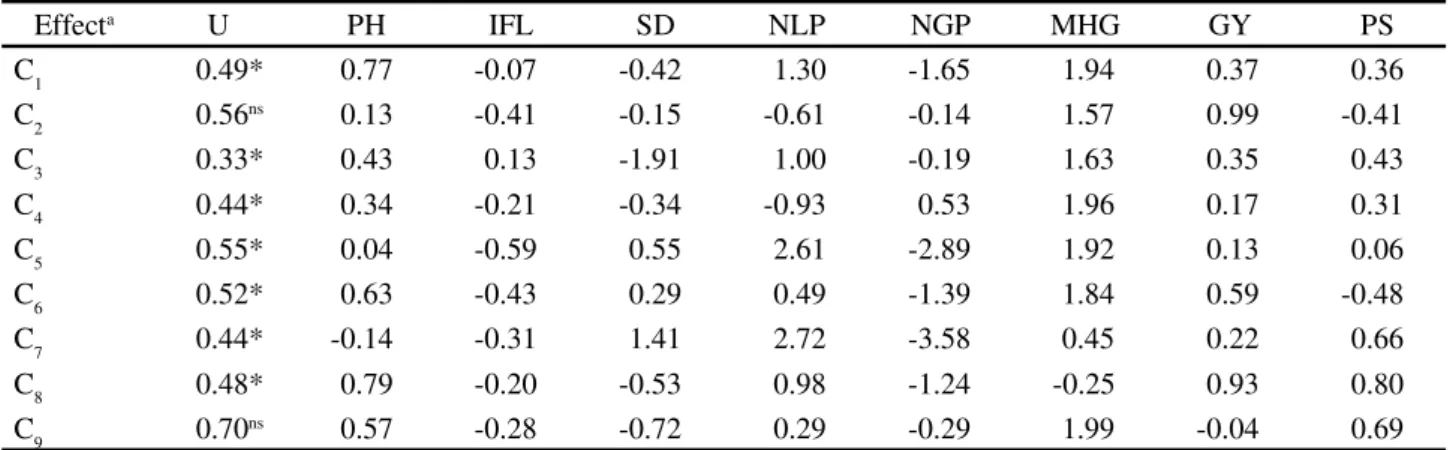
On the other hand, the linear comparison C2inherent to the early mutant generations showed no significant difference (Table 2). The first mutant generation presented changes in the mean populations. These changes remained in subsequent mutant generations without causing significant differences between the mean vectors. In general, it is observed a strong prevalence of macromutation compared to micromutation. Macromutations led to changes in population averages, even in the first mutant generations. Gregory (1967) considered that the change in the average mutant populations indicates the occurrence of modifications in a small number of great expression genes in the trait, which is called macromutation; however, the effect on a large number of low expression genes on the phenotype results in changes in variance, which was originally called micromutations.
Significant difference was observed in the comparison C3(Table 2). The physical mutagenic agent was efficient to cause consistent changes in both allele and genotypic frequencies of the traits (COIMBRAet al., 2005). All characters contributed to this difference, except the variables NGP and SD. These traits show narrow genetic variability in the populations studied. Rochaet al. (2009) found the same result while evaluating bean mutant populations for the trait stem diameter, and did not achieve significant variations.
There was significant difference in the linear comparison involved between the mutant population M4 and other mutant populations (C4). Such difference can be explained by the positive and significant contribution of the traits PH, NGP, MHG, GY and PS. Significant the (co)variation existing between the response variables
(HAIR et al., 2007). Therefore, understanding both the relationship and the effect of each variable under study can be fundamental for the biological sciences (BERTINI et al., 2010; HUANG; CHEN; CHEN, 2015). Multivariate analysis can, for example, facilitate the classification and identification of superior genotypes (COIMBRAet al., 2007) in genetic breeding. The identification of these genotypes based on one character alone often leads to the failure of a plant variety in the market, especially when characters such as color, shape and size of the grains are not considered. Thus, this is one of the most challenging tasks in a breeding program (BERTINIet al., 2010).
In Table 2 it was observed significant difference between homozygous lineages, mutant populations and other segregating (contrast C1). The use of mutagenic agent and artificial hybridization increased the occurrence of heterozygous loci, which led to genetic variability in populations. All measured traits contribute to differentiate the treatments, except IFL, SD and NGP, which presented negative canonical weights.
A breeding program seeks balance between the traits studied so that the plant may have an ideotype that maximizes grain yield, taking into account the other traits
associated (BAENZIGER et al., 2006; CECCARELLI,
2015). It is extremely important to bring together the trait pursued and the other associated traits. For example, there must be genetic variability for the trait SD, since a significant increase in the number of vegetables may not be supported by a plant that does not present increased stem diameter as well (ROCHAet al., 2009).
Table 2 - Multivariate test for the orthogonal contrasts between the different levels of heterozigosis and standardized canonical coefficients (CCP) for the response variables: Plant height (PH), Insertion of first legume (IFL), Stem diameter (SD), Number of legumes per plant (NLP), Number of grains per plant (NGP), Mass of one hundred grains (MHG), grain yield (GY) plant stand (PS). UDESC-IMEGEM, Lages-SC, Brazil
aC
1: Homozygous Lineages vs. Segregant and mutant populations; C2: M2 vs. M3, M4, M5, M6, M7; C3: M3 vs. M4, M5, M6, M7; C4: M4 vs. M5, M6,
M7; C5: M5 vs. M6, M7; C6: M6 vs. M7; C7: Segregant populations vs. Mutant populations; C8: F4 vs. F5, F6; C9: F5 vs. F6; * Significant at 0.05 error probability by the Wilk’s Lambda test; ,E = sum of squares and products matrix of error;H = sum of squares and products matrix of hypothesis
Effecta U PH IFL SD NLP NGP MHG GY PS
C1 0.49* 0.77 -0.07 -0.42 1.30 -1.65 1.94 0.37 0.36
C2 0.56ns 0.13 -0.41 -0.15 -0.61 -0.14 1.57 0.99 -0.41
C3 0.33* 0.43 0.13 -1.91 1.00 -0.19 1.63 0.35 0.43
C4 0.44* 0.34 -0.21 -0.34 -0.93 0.53 1.96 0.17 0.31
C5 0.55* 0.04 -0.59 0.55 2.61 -2.89 1.92 0.13 0.06
C6 0.52* 0.63 -0.43 0.29 0.49 -1.39 1.84 0.59 -0.48
C7 0.44* -0.14 -0.31 1.41 2.72 -3.58 0.45 0.22 0.66
C8 0.48* 0.79 -0.20 -0.53 0.98 -1.24 -0.25 0.93 0.80
differences can also be found in contrast C5 (between M5 vs. M6 and M7), although in advanced generations the degree of heterozygosity is expressed in these populations. In this orthogonal contrast, all traits assessed contributed to differentiate these treatments, except IFL and NGP.
In fact, the mutation-inducing mechanism may contribute to the improvement of the main components of grain yield, such as NGP and MHG. This is promising, since it meets market demands for more productive
genotypes (BEAVER; OSORNO, 2009; MIKLASet al.,
2006). However, such traits may be lost due to genetic segregation over selfing generations. A mutant gene can be lost mainly during the first generations, if it does not result in any selective advantage. The monitoring of the genotypic performance of these genetic constitutions is fundamental in advanced generations.
The orthogonal contrasts showed that, regardless of the method employed to generate variability, 67% of mean linear comparisons are not able to change the multiplicative components of grain yield, including number of grains per plant. There is no wide genetic variability for this trait in the populations under study, possibly due to the existence of genic blocks associated with the expression of this trait. One of the strategies recommended to advance this level is the use of recurrent selection. This breeding method increases the frequency of favorable alleles in a population through selection and intercross cycles, exploring the genetic variability and thus increasing the probability of obtaining genetic gains (ALVESet al., 2015; MENEZES JÚNIORet al., 2013; SILVAet al., 2010). One of the most important aspects of an interbreeding population is genetic variability gain associated with broken linking blocks (CANCI; BARBOSA NETO; CARVALHO, 1997).
Significant differences are still found in comparisons between populations in advanced generations (contrast C6) (Table 2). Mutation induction excessively increases the level of heterozygosity and seems to maintain this condition even in advanced generations, as compared to artificial hybridization. Character fixation in mutants may require more selfing generations in beans to achieve the level of homozygosity. All characters contribute to this divergence, except IFL, NGP and PS. Unlike orthogonal contrasts involving the initial generations (M3, M4 and M5), the plant stand does not contribute to differentiate comparison C6. Regardless of the genetic variability mechanism employed, there is not genetic diversity in this character in the original populations.
The presence of genetic variability in mutant populations allows the selection of superior genetic constitutions (contrasts C3, C4 and C5). The mutant populations clearly present genetic variability even
in advanced generations, due to higher proportion of heterozygous loci to the detriment of homozygous loci. Different genes have different mutation rates and a single gene may undergo more than one type of mutation, thus originating a series of multiple alleles that affect the same trait in different degrees (MOORE, 1986). As an original source of variability, induced mutation allowed the creation of new alleles in the populations studied. It explains the occurrence of significant differences between the mutant populations in all levels of heterozygosis tested, which demonstrates that selection pressure should vary according on the mechanism associated with the genetic variability used at the beginning of the bean breeding program. The mutant populations have a high proportion of heterozygous locos that result in genetic variability even in advanced selfing generations. In this situation, the beginning of the breeding program of these populations the selection intensity should be reduced (FEHR, 1987).
As for linear comparison between averages of treatment C7, there is significant variation in the interest in genetic breeding (Table 2). The difference between induced mutation and artificial hybridization provides different opportunities for conducting segregating populations, according to the agronomic interest. SD and NLP were traits that presented higher canonical weight. Conversely, NGP (-3.58) reduced the effect on the differentiation between mutant and hybrid populations, which demonstrates that the number of grains per plant has little genetic variability. Coimbra et al. (2004) used gamma-rays to induce mutation and performed artificial crosses in oat for the trait vegetative cycle and found that both in artificial cross and induced mutation, the magnitude of genetic variability was changed in all directions.
High genetic variability can be observed for the segregating populations in early generations (contrast C8). Recombination and gene segregation allowed identifying genotypes with high level of heterozygosis, mainly the characters related to NLP (0.98) and GY (0.93). In these generations, breeders must not exert high selection pressure, due to the risk of discarding prominent genetic constitutions.
which results in genetic variability even in advanced selfing generations, which results in decreased selection pressure at the start of the breeding program, while the segregating populations fix their characters early.
Although the methods present different results and efficiencies, these mechanisms can and should be used in associatively. A particular genetic constitution may have its genotype changed by induced mutation and present a different plant height prominent for the breeding
program (ROCHA et al., 2009). The application of
induced mutation can also provide genotypes of interest for the trait vegetative cycle (COIMBRAet al., 2004). But plant height or vegetative cycle alone do not define a genotype that meets the interest of plant breeders. The insertion of this genetic constitution in crossing blocks with adjusted genotypes may provide significant gains to the final inbred line.
CONCLUSIONS
1. Mutant populations require more selfing generations to achieve the same level of homozygosis when compared with the segregating populations;
2. Strategies to define the selection pressure exerted at the beginning of the breeding program should also consider the mechanisms used to generate genetic variability.
ACKNOWLEDGEMENS
To the Universidade do Estado de Santa Catarina (UDESC), Conselho Nacional de Desenvolvimento Científico e Tecnológico (CNPq), Coordenação de Aperfeiçoamento de Pessoal de Nível Superior (CAPES) and Fundação de Apoio à Pesquisa Científica e Tecnológica do Estado de Santa Catarina (FAPESC) for the scholarship granting and financial support for the development of the present work.
REFERENCES
AHLOOWALIA, B. S.; MALUSZYNSKI, M. Induced mutation: a new paradigm plant breeding.Euphytica, v. 118,
p. 167-173, 2001.
ALLARD, R. W. Principles of plant breeding. 3. ed. Nova
York: J. Wiley, 1960. 485p.
ALVES, A. F.et al.Genetic progress and potential of common
bean families obtained by recurrent selection. Crop Breeding and Applied Biotechnology, v. 15, p. 218-226, 2015.
BAENZIGER, P. S.et al. Improving lives: 50 years of crop breeding, genetics, and cytology (C-1).Crop Science, v. 46, p. 2230-2244, 2006.
BEAVER, J. S.; OSORNO, J.M. Achievements and limitations of contemporary common bean breeding using conventional and molecular approaches. Euphytica, v. 168, p.145-175,
2009.
BERTINI, C. H. C. M. et al. Análise multivariada e índice de
seleção na identificação de genótipos superiores de feijão-caupi.
Acta Scientiarum. Agronomy, v. 32, n. 4, p.613-619, 2010.
CANCI, P. C.; BARBOSA NETO, J. F.; CARVALHO, F. I. F. de. Implementação da seleção recorrente no melhoramento de plantas autógamas através da macho-esterilidade. Ciência Rural, v. 27, n. 3, p.505-512, 1997.
CECCARELLI, S. Efficiency of plant breeding.Crop Science,
v. 55, p. 87-97, 2015.
COIMBRA, J. L. M.et al. Criação de variabilidade genética
no caráter ciclo vegetativo em aveia: hibridação artificial x mutação induzida.Revista Brasileira de Agrociência, v. 10, n. 2, p. 159-166, 2004.
COIMBRA, J. L. M.et al. Doses de raio gama na cultura da
aveia: estatura de planta.Revista Brasileira de Agrociência, v. 11, n. 3, p. 305-308, 2005.
COIMBRA, J. L. M. et al. Técnicas multivariadas aplicadas
ao estudo da fauna do solo: contrastes multivariados e análise canônica discriminante. Revista Ceres, v. 54, n. 313, p. 271-277, 2007.
DOROSHKOV, A. V. et al. Interactions between leaf pubescence genes in bread wheat as assessed by high throughput phenotyping.Euphytica, v. 207, p. 491-500, 2016.
FEHR, W. R.Principles of cultivars development. New York: Macmillan, 1987.
FU, D.et al. Utilization of crop heterosis: a review.Euphytica, v. 197, p. 161-173, 2014.
GREGORY, W. C. Mutation breeding. In: FREY, K. J. Plant breeding. Ame, USA: Iowa State University, 1967. p.189-217.
HAIR, J. F.et al.Análise Multivariada de dados. São Paulo:
Bookmam, 2007. 593 p.
HUANG, M.; CHEN, L-y.; CHEN, Z-q. Diallel analysis of combining ability and heterosis for yield and yield components in rice by using positive loci.Euphytica, v. 205, p.37-50, 2015. KEIGHTLEY, P.D.; HALLIGAN, D. L. Analysis and implications of mutational variation.Genetica, v. 136, p.
359-369, 2009.
MELO, R. C. et al. Genetic variation in the trait root
distribution over segregating generations of common bean.
Euphytica, v. 207, p. 665-674, 2016.
MENEZES JÚNIOR, J. A. N. et al. Two cycles of recurrent
MIKLAS, P. N. et al. Common bean breeding for resistance against biotic and abiotic stresses: from classical to MAS breeding.Euphytica, v. 147, p. 105-131, 2006.
MOORE, J. A. Science as a way of knowing: genetics.American Zoologist, v. 26, p. 583-747, 1986.
PORCH, T. G.et al. Generation of a mutant population for tilling
common bean genotype BAT 93. J. Journal of the American Society for Horticultural Science, v. 134, n. 3, p. 348-355, 2009. RAMALHO, M. A. P.et al.Genética na agropecuária. 5. ed.
Lavras: UFLA, 2012. 566 p.
ROCHA, F. et al. Análise dialélica como ferramenta na
seleção de genitores em feijão.Revista Ciência Agronômica,
v. 45, n. 1, p. 74-81, 2014.
ROCHA, F. et al. Seleção em populações mutantes de feijão (Phaseolus vulgaris L.) para caracteres adaptativos.
Biotemas, v. 22, n. 2, p. 19-27, 2009.
SAS INSTITUTE. SAS/STAT: user’sguideversion 9.2. Cary: SAS Institute, 2009.
SILVA, G. S. et al. Estimation of genetic progress after eight
cycles of recurrent selection for common bean grain yield.Crop Breeding and Applied Biotechnology, v. 10, p. 351-356, 2010. WRIGHT, S. The genetical structure of populations.Annals of Eugenics, v. 15, p. 323-354, 1950.