GROWTH AND
NUTRIENT
CONCENTRATION IN
COFFEE
ROOT
SYSTEM
UNDER
WEED
SPECIES
COMPETITION
1Crescimento e Concentração de Nutrientes no Sistema Radicular do Cafeeiro sob Competição de
Plantas Daninhas
RONCHI, C.P.2, TERRA, A.A.3e SILVA. A.A.4
ABSTRACT - The effects of competition of six weed species on growth, nutrient concentration and nutrient content of coff ee plant root system under greenhouse conditions were evaluated. Thirty days after coff ee seedling transplantation into 12 L pots with soil level area of 6.5 dm2. Weeds were transplanted or sowed in these pots, at densities of 0, 1, 2, 3, 4 and 5 plants per pot. The duration of competition (or weedy periods) from weed transplantation or emergence until plant harvesting, at the weed preflowering stage, were (in days): 77 (Bidens pilosa), 180 (Commelina diffusa), 82 (Leonurus sibiricus), 68 (Nicandra physaloides), 148 (Richardia brasiliensis) and 133 (Sida rhombifolia). Dry matter of coff ee plants was linearly reduced with increasing
B. pilosa andS. rhombifoliadensity, with pronounced eff ect of B. pilosa. C. diffusa was the only weed species whose increasing density in the pots did not diminish crop root dry matter.
L. sibiricus,N. physaloides andR. brasiliensisreduced root dry matter of coffee plants by 75, 52 and 47%, respectively, as compared to the weed-free treatment, regardless of weed density. Under competition, even though weed species showed lower macronutrient concentration in the roots (except for P), they accumulated 4.2 (N), 12.3 (P), 4.3 (K), 5.5 (Ca), 7.6 (Mg) and 4.4 (S) times more nutrients in the roots than the coff ee plants. Crop and weed nutrient concentration, as well as competition degrees greatly varied depending on both weed species and densities.
Keywords: Coffea arabica, weed density, interference, mineral nutrition, root.
RESUMO - Este trabalho teve como objetivo avaliar os efeitos da competição de seis espécies de plantas daninhas sobre o crescimento, a concentração e o conteúdo de nutrientes no sistema radicular de plantas de café, cultivadas em casa de vegetação. Aos 30 dias após o transplantio das mudas de café, em vasos contendo 12 L de substrato e com área de 6,5 dm2
na superfície do solo, fez-se o transplantio e, ou, a semeadura das espécies daninha s nesse s vasos, em seis densidad es (0, 1, 2, 3, 4 e 5 plan tas por vaso). Os períodos de convivência, desde o transplantio ou emergência das plantas daninhas até a colheita das plantas, quando do florescimento das plantas daninhas, foram (em dias): 77 (Bidens pilosa), 180 (Commelina diffusa), 82 (Leonurus sibiricus), 68 (Nicandra physaloides), 148 (Richardia brasiliensis) e 133 (Sida rhombifolia). A massa seca do sistema radicular das plantas de café reduziu-se linearmente com o aumento da densidade de B. pilosae de S. rhombifolia, com efeito mais pronunciado em B. pilosa. C. diff usa foi a única espécie que não reduziu o acúmulo de matéria seca no sistema radicular das plantas de café.L. sibiricus,N. physaloides
eR. brasiliensisreduziram a massa seca da raiz do café em 75, 52 e 47%, respectivamente, comparado ao tratamento livre de interferência, independentemente da densidade de plantas daninhas. Sob competição, apesar de apresentarem, no seu sistema radicular, concentrações
1 Recebido para publicação em 15.1.2007 2007 e na forma revisada em 25.10.2007.
2 Professor, Universidade Federal de Viçosa – Campus de Rio Paranaíba – Rod. BR 354, km 310, 38810-000, Rio Paranaíba-MG,
<[email protected]>;3Técnico de Nível Superior – Engo-Agro, EPAMIG-Fazenda Experimental de Pitangui, zona rural s/n,
35650-000, Pitangui-MG, <[email protected]>;4Professor, Universidade Federal de Viçosa, Dep. de Fitotecnia, Av. PH
de macro nu tri en tes (exce to para P) inf eri ore s àquelas do café, as plantas danin has acumularam 4,2 (N), 12,3 (P), 4,3 (K), 5,5 (Ca), 7,6 (Mg) e 4,4 (S) vezes mais nutrientes nas raízes que as plantas de café. A concentração de nutrientes no café e nas plantas daninhas, assim como o grau de interferência dessas plantas, variaram fortemente com a espécie e densidade de planta daninha.
Palavras-chave: Coffea arabica, densidade de plantas daninhas, interferência, nutrição mineral, raiz.
(Conab, 2006). Coffee is a perennial crop grown in rows and may be in production up to 30 years. As a result of weed competition, coffee yield and qua lit y are ser iou sly dec rea sed and wee d control is one of the major cultural operations entailing high cost. Crop yield losses due to weed competition varied from 24% (Moraima, et al., 2000) to 77% (Blanco et al., 1982). In addition to yield losses, several other harmful effects of weed competition on this crop are discussed elsewhere (Ronchi et al., 2001; Silva & Ronchi, 2003; 2004) including weeds as an alternative host to the coffee strain of Xilella fastidiosa, that causes coffee leaf scorch (Leite Júnior & Nunes, 2003; Lopes et al., 2003) and has a greater nutrient competitive potential tha n the cof fee plants (Gallo et al., 1958 ; Ronchi et al., 2003).
The critical period of weed competition in coff ee plan tations has been dete rmin ed in different condi tions and locations of coffee produc tion (Pere ira & Jones, 1954; Blanco et al., 1982; Friessleben et al., 1991; Moraima et al., 2000). Despite information available on the critical period of weed competition for this crop (at the reproductive stage), little is known about weed density , which is an important fact or also affecti ng comp etit ion degr ee or intensity. Besides, just after transplanting in the field, young coffee plants seem to be highly sen sit ive to weed com pet ition since wee d control in the coffee rows is an agronomical practice usually applied by growers (Ronchi et al. , 2001; Silva & Ronc hi, 2003, 2004). Nevertheless, the effects of weed competition on young cof fee plants has bee n sca rce ly studied (Dias et al., 2004).
Several methods have been developed to study competition among different species of pl an ts , an d ea ch of th em co ns ti tu te s a bioassay in that the response of a species is used to describe the interference of the other. INTRODUCTION
Competition (which represents the negative effect of the interaction) is the most studied types of interference among plants (Radosevich et al ., 19 96). Co mpet it ion is a biologic al inte raction occur ring betw een at least two plants for limiting resources (mainly light, water and nutrients) (McNaughton & Wolf, 1973). Re so ur ce li mi ta ti on s ca n be ca us ed by unavailability, poor supply, or proximi ty to neig hbour ing plan ts, which ulti mately can aggravate an already insufficient resource or creat e a deficiency where there was ample resource for a single individual (Radosevich et al., 1996). Actu ally , comp etit ion amon g weeds and crop affects both kinds of plants but weeds almost always have a deleterious effect on crops (Pitelli, 1985).
Am on g th e se ver al fa ct or s af fe ct in g competition degree, weedy period or the critical period of competition, and weed density are very important. The former addresses the period of time in the crop life cycle in which weed competition occurs and during which weeds should be controlled to prevent yield losses (Blanco & Oliveira, 1978; Pitelli, 1985). The latter, representing the number of plants per unit of area, is also important in competition studies because of the relationship among crop yield, number of individuals, and resources in a given area (Blanco, 1972; Radosevich, 1987; Radosevich et al., 1996).
Co ff ee pl an ta ti on s, es pe ci al ly Co f f ea
arabica L., are the most important crops in
The add iti ve met hod is per hap s the mos t common approach used to study weed-crop relationships (Radosevich, 1987; Radosevich et al., 1996). In this method, two (or more) plant species are grown together, the crop and the weed. The density of one species, such as the cr op, is usu ally kep t con st ant , whi le th e densi ty of the othe r is var ied. The species wh ose den si ty is no t chan ged, acts as a comparative indicator for the aggressiveness and competitiveness of the other species.
The objective of this study was to determine the competition effects of several weed species on th e gr ow th an d bo th ma cr on ut ri en t concentration and content of coffee plant root sy st em s, us in g th e ad di ti ve me th od. We hy po th es ize d th at th e de gr ee of w ee d competition with young coffee plants depends on weed species and densities. It also should be stressed that such study concerning growth and mineral nutrition aspects of coffee and we ed ro ot sy st em un de r co mp et it io n is unknown. The effects of these weed species on growth and nutrient contents, particularly in coffee plants shoots, has been published elsewhere (Ronchi et al. 2003; Ronchi e Silva, 2006).
MATERIALS AND METHODS
Th e ex pe ri me nt wa s co nd uc te d in a gr eenh ou se in Vi ço sa (20 º4 5’S , 42 º5 5’ W; 650 asl), southeastern Brazil. Plants ofCoff ea arabicaL. cv. Red Catuaí, with five leaf pairs were transplanted into 12 L pots filled with a mixture of soil and organic matter (3.5:1, v/v). The soil was a Yellowish Red Podzolic, 51% clay, pH 4.9, with an orga nic matt er cont ent of 2.95%, and fertilized with 1.0 kg m-3of P
2O5and
3.6 kg m-3 of dolomitic limestone. Fifteen and
60 days aft er trans pla nti ng, 3.0 g N wer e applied to each pot. Plants were irrigated daily with an automatic sprinkle system to maintain pot capacity and to prevent competition for water.
Six weed species (Table 1) commonly found in Brazilian coffee plantation s (particularly
Bid ens pil osa, Com mel ina dec umb ens and
Leonurus sibiricus; Ronchi et al., 2001) were grown separately in each pot (each weed species constituted an experi ment), containing one coffee plant. Each weed species was established
at six densities (0, 1, 2, 3, 4 and 5 plants per pot), with four replicates. Pots were distributed in the exp eri ment al area in a com ple tely randomized design. Each plot was constituted by one pot, with a soil surface area of 0.065 m2.
Thus, the range of weed density established in the pots relates to the density occurring in the fields approximately from zero up to 75 plants per square meter. Thirty days after coffee plants were transpl ante d, seed weeds (except the seedlings of Commelina diff usa, which were obtained from stem segment) were sown in the pot and the densities mentioned above were established by thinning them out after weed species emergence. The weedy periods (Table 1) for each species were considered as being the pe r io ds be tw ee n we ed em er ge nc e (o r tr an sp la nt in g fo r C. di f f us a) an d th ei r pre flowe rin g or flowe rin g sta ge, whe n the exper imen ts were disco ntin ued. This stag e was chosen because when the plants are about to initiate their reproductive phase, absorption and accu mula tio n of nut rie nts (he nce the com pet it ion ) re ach th ei r maxim um le ve ls (Singh & Singh, 1938; Pedrinho Júnior et al., 2004). At that time, both weed and coffee plant roo t sys tem s wer e col lec ted sep ara tel y by washi ng using a fine mesh sieve until soil residues were removed. After that, they were washed with distilled water and oven-dried for 72 h, at 70 ºC to determine root dry matter.
Dried root of both weeds and coffee plants were ground to a fine powder, homogenized and analyzed for quantification of N, P, K, Ca, Mg and S (Ronchi and Silva , 2006). Total root nutrient content was estimated as a product of nutrient concentration by total root dry matter per pot. Since it is quite difficult to eliminate micro nutr ient conta minat ion from sampl es when soil was used as growth medium (Gallo et al., 1958), only macronutrients were analyzed.
ana lys es wer e per for med usi ng the SAE G System version 8.0 (SAEG, 1999).
RESULTS AND DISCUSSION
Root system dry matter of bothB. pilosa
and S. rhombif olia line arly incr ease d wit h in cr ea si ng de ns it y; ho we ve r, th e li ne ar reduct ion in the root system dry matter of coffee plants induced byB. pilosa was much higher than that induced by S. rhombif olia
(Table 2). For example, from one to five plants of B. pilosaper pot a decrease of 20% in coffee root system dry matter was observed to each weed individual added to the pot (Table 2). Si-milar results were also observed in coffee plant shoot dry matter (Ronchi et al. 2003; Ronchi e Silva, 2006).
Com mel ina dif fu sa was the onl y wee d species whose increasing density in the pots did not decrease coffee root system dry matter (Table 2), although such effect on coffee shoot dry matter was dramatic (Ronchi and Silva, 2006). In any case,C. diff usaroot system dry matter did not rise as its density increased (Table 2). It must be emphasized that weeds such asCommelinaspp.(C. Benghalensisand
C. diffusa) andB. pilosaare widely dispersed in Brazilia n coffee fields (Blan co et al., 1982; Ronchi et al., 2001).
Similar negative effects on coffee dry matter accumulation was observed due to competition of di ff er ent de ns it ie s of L. si bi ri cu s,
N. physaloidesandR. brasiliensis: coffee dry matter decreases quickly due to the presence of onl y one typ e of wee d per pot , but no additional (or only slight) reduction in coffee
dry matter was observed as weed densiti es incre ased (acco rding to a Rsquared model; Table 2). Regardless of the presence of one or five plants ofL. sibiricus,N. physaloides and
R. brasiliensis, coffee dry matter reduced by 75, 52 and 47%, respectively, compared to weed-free treatm ent (Table 2). In any case, since
C. diffusa,R. brasiliensisandL. sibiricusdid no t in cr ea se wi th in cr ea si ng dens it y, no significative effect of these weed densities on root dry matter accumulation was observed (Table 2).
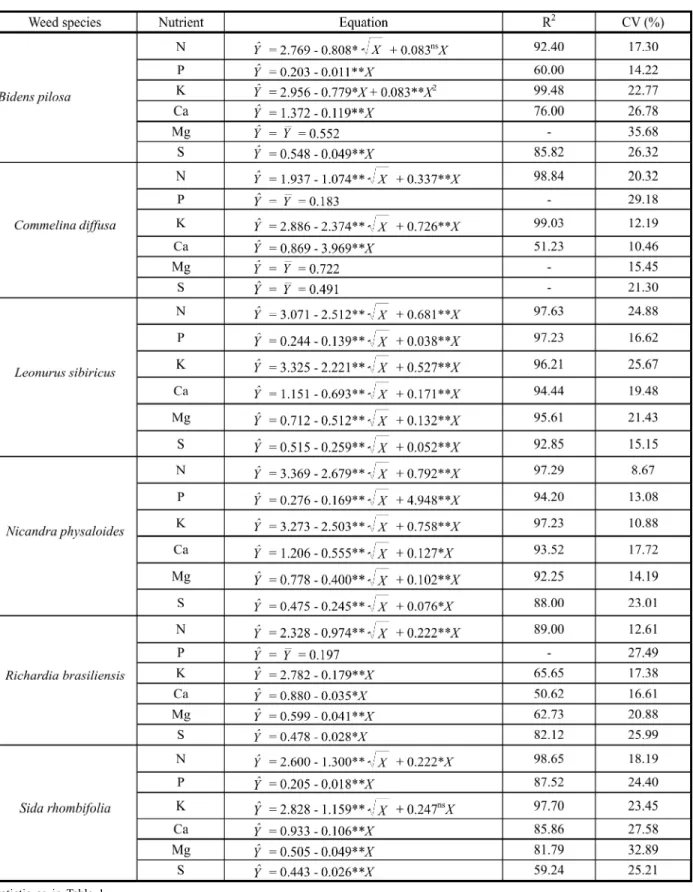
Th ere wa s a sign if ican t and nega ti ve ef fe ct of we ed de ns it y on ma cr on ut ri en t concentration in the root system of the coffee plants, except for P and Mg forB. pilosa, P, Mg and S forC. diff usa and P for R. brasiliensis
(Table 3). Such a negative effect was linear (Yˆ= a - bX) or Rsquared (Yˆ= a - bX1/2 + cX)
depending on both nutrient and weed considered (Table 3). According to the former regression model, nutrient concent ration in the coffee pl an t re du ce d li ne ar ly as we ed de ns it y
increased (e.g.,B. pilosa; P;Yˆ= 0.203 - 0.011X; Table 3); in the latter, a marked reduction on nutrient concentration was expected to occur mainly at low weed density, with a slight effect under high densit ies (e.g. B. pilosa; N; Yˆ= 2.769 - 0.808X1/2+ 0.083X; Table 3).
Using of Table 3 regression equations and considering weed density of one plant per pot,
B. pi los a, C. di f f us a, L. si bi ri cu s,
N. ph ys al oi de s, R. br as il ie ns is a nd
S. rhombif olia redu ced N conc entr ation in ro ot s by 26, 38, 60, 56, 32 an d 41%; K concentration by 24, 57, 51, 53, 6 and 32%, and Ca concentration by 9, 4, 45, 35, 4 and
Table 1- Weed species and weedy periods among them and the coffee plants
1/ Source: Lorenzi (20 00) ; 2/Weedy periods were consid ered as being the periods between weed emergence (or transp lantin g for C.
11%, respectively, as compared to weed-free treatment. In general, N and K concentrations we re mo re af fe cte d by we ed s th an Ca con cen tration . N con cen trati on was mor e affected byL. sibiricus, K byC. diffusaand Ca by N. phys aloides. All togh eter thes e data indicate that nutrient concentrations in the roots of coffee plants are differently affected depending on weed species and nutrient.
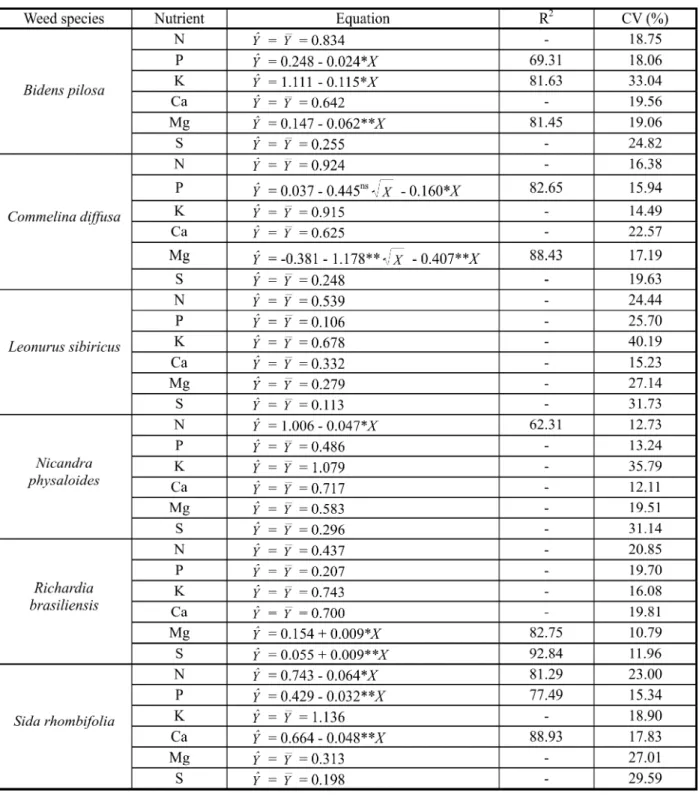
For almost all the weeds and nutrients, there was no effect of increasing weed species den sit y on its roo t sys tem mac ron utr ien t concentration. Table 4 shows the mean values
(
Y
ˆ
=Y
) for each weed and nutrient, regardless of weed density. However, root concentration of P, K and Mg for B. pilosa, P and Mg forC. diff usa, N forN. physaloidesand N, P and Ca for S. rho mbi fo lia mar ked ly dec rea sed (according to a linear or Rsquare models) with incre asing weed densi ty (Table 4). Only for
R. bra sil ien sis, Mg and S co ncentr at ion s li ne ar ly in cr ea se d wi th in cr ea si ng we ed density (Table 4).
Con sid eri ng eac h nut rient sep ara tel y, th er e wa s a gr ea t di ff er en ce in nu tr ie nt
con centra tion amon g weed species, whi ch al low ed t o ar ra ng ed th em int o th re e reco gniz able cate gor ies, the dist ingu ishi ng fe at ur e of ea ch of th e cl as se s be in g th e presence of higher (H), medium (M) or lower (L) concentration of a particular nutrient in the root system dry matter: N: (H - 0.87%)
B. pilosa, C. dif fus a, N. physaloides; (M -0.59%) L. sibiricus and S. rhombif olia; (L -0. 43 %) R. br as il ie ns is; P (H - 0. 48 % )
N. ph ys al oi de s; (M - 0. 32 % ) B. pi los a,
C. dif fusa and S. rhomb ifolia; (L - 0.15 %)
L. sibiricusandR. brasiliensis; K (H - 1.10%)
N. physaloidesandS. rhombifolia; (M - 0.91%)
C. diffusa(L - 0.76%)B. pilosa, L. sibiricusand
R. bras iliensis; Ca (H - 0.6 7%) B. pil osa,
C. diffusa,N. physaloidesandR. brasiliensis; (M - 0. 51 %) S. rh om bi f ol ia; (L - 0. 32 %)
L. sibiricus; Mg (H - 0.58%)N. physaloides; (M - 0.32%)B. pilosa, C. diffusa, L. sibiricusand
S. rhombifolia; (L - 0.18%)R. brasiliensis; S (H - 0. 26 %) B. pi los a, C. di f f us a a nd
N. physaloides; (M - 0.19%)S. rhombifolia; (L -0.11%) L. sibiricus andR. brasiliensis (Data not shown). All together, these data showed that macronutrient concentration in the root sy st em dr y ma tt er wa s hi gh er in
Table 2- Dry matter accumulation (g pot-1) in both coffee and weed root system related to weed species density (plants per pot)
Table 3- Macronutrient concentration (%) in coffee root system dry matter related to weed species density (plants per pot)
Table 4- Macronutrient concentration (%) in weed root system dry matter related to weed species density (plants per pot)
N. physaloides, lower in bothL. sibiricusand
R. brasiliensis and with intermediate values for other species herein investigated.
Weeds have been reported to contain a much higher percentage of nutrients than the com mon cro p pla nts or as bei ng a bet ter nutrient accumulators than crops (Singh & Singh, 1938; Gallo et al., 1958; Qasem, 1992; Ronchi et al., 2003), thus highlighting a good indicator of their greater competitive abilities. Howeve r, such genera l conclusion must be int erpreted wit h caut ion beca use it is not cons iste nt for all crop , weed, and mine ral int eractio ns (Qas em, 1992). More over, the apparent higher nutrient conc entr ation in weeds than in crops was exclusively based on shoot dry matter data, and a different pattern may occur when root systems are considered. Contrary to their content in shoots, N, K, Ca and Mg percen tage in root s of most wee d species was lower than that of bean crop and the percentage of N, Ca and Mg of many weed species was lower that in tomato roots (Qasem, 1992). Other works have also reported lower root concen tr ations of nu tr ie nts in we ed species than in crop plants (Kolar et al., 1980). Corroborating such information, comparisons of the results shown in Tables 3 and 4 revealed that under competition, the concentrations of N, K, Ca, Mg and S were 40%, 40%, 22%, 24% an d 44 %, res pe ct iv el y, lo we r in we ed s (considering all weeds together) than in the coffee root system (data not shown). Nutrient content rather than nutrient concentration, is a bet ter indic ator of weed com pet ition (Pitelli, 1985), since the former considers dry mat ter pro duc tion for wee d com mun ities . Thus, ev en showing low er macronutrient concentration in roots (except for P), weeds herein investigated extracted (accumulated) a total average of 4.2 (N), 12.3 (P), 4.3 (K), 5.5 (Ca), 7.6 (Mg) and 4.4 (S) times more nutrients than the coffee plant root system (data not shown), at the and of a specific weedy period. These are total mean values and obviously large varia tions were detect ed among weed species, weed densities and mineral elements.
Tak ing into acc oun t that int erf ere nce amon g neig hbou ring plan ts occu rs aft er a sp ec if ic we ed de ns it y ha d be en re ac he d (Al drich, 198 7), in add ition to crop- weed competition, intraspecific competition among
individuals of the same weed species certainly had also occurred, mainly at higher densities. Moreover, the effect of weed competition could have been overestimated due to reduced pot size. However, it is usually observed in young field coffee plantations that weed densities are much higher than those studied here, and could reach a high degree of competition as that reported here. Hence, on the grounds of the pre sen t experi men tal condit ion s, it is highly recommended that weeds be controlled within crop rows to prevent weed competition for nutrients. This would decrease initial crop growth, delayi ng its establishme nt and the ti me ta ke n by th em to re ac h ma tu ri ty , probably reducing also their bearing capacity. Further research on weed competition against young coffee plants under field conditions may be of major importance to improve management of coffee crops.
LITERATURE CITED
ALDRICH, R. J. Predicting crop yield reduction s from weeds.Weed Technol., v. 1,p. 199-206, 1987.
BLANCO, H. G. A importância dos estudos ecológicos nos programas de controle das plantas daninhas.Biológico, v. 38, n. 10, p. 343-350, 1972.
BLANCO, H. G.; OLIVEIRA, D. A. Estudos dos efeitos da época de controle do mato sobre a produção de citros e a composição da flora daninha.Biológico, v. 45, n. 1, p. 25-36, 1978.
BLANCO, H. G.; OLIVEIRA, D. A.; PUPO, E. I. H. Período de competição de uma comunidade natural de mato em uma cultura de café em formação.Biológico, v. 48, n. 1, p. 9-20, 1982.
COMPANHIA NACIONAL DE ABASTECIMENTO -CONAB. Segundo levantamento safra 2006/2007: café beneficiado.Disponível em: (http://www.conab.gov.br/ download/Safra/Safracafe.pdf). Acesso em: 26 de julio de 2006.
DIAS, G. F. S.; ALVES, P. L. C. A.; DIAS, T. C. S.
Brachiaria decumbenssuppresses the initial growth of
Coffea arabica.Sci. Agric., v. 61, n. 6, p. 579-583, 2004.
EMPRESA BRASILEIRA DE PESQUISA AGROPECUÁRIA - EMBRAPA.Café: histórico. Disponível em: (http://www.embrapa.br/cafe/historico.htm). Acesso em: 29 de fevereiro 2004.
GALLO. J. R. et al. Absorção de nutrientes pelas ervas daninhas e sua competição com o cafeeiro.B. Inst. Agron., v. 104, p. 1-13, 1958.
KOLAR, J. S.; BAINS, D. S.; GILL, G. S. Studies of competitive ability of wheat andChenopodium albumL. Indian J. Ecol., v. 7, p. 308-310, 1980.
LEITE Jr., R. P.; NUNES, L. M. Avanços nas pesquisas sobreXylella fastidiosado café no Brasil. In: ZAMBOLIM, L. (Ed.)Produção integrada de café. Viçosa, MG: Universidade Federal de Viçosa, 2003. p. 87-101.
LOPES, S. A. et al. Weeds as alternative hosts of the citrus, coffee, and plum strains ofXylella fastidiosain Brazil.Plant Disease, v. 87, p. 544-549, 2003.
LORENZI, H.Manual de identificação e controle de plantas daninhas: plantio direto e convencional. 5. ed. Nova Odessa: Plantarum, 2000. 384 p.
McNAUGHTON, S. J.; WOLF, L. L.General ecology. New York: Holt, Rinchart & Winston, 1973. 710 p.
MORAIMA, G. S. et al. A contribution to determine critical levels of weed interference in coffee crops of Monagas state, Venezuela.Bioagro, v. 12, n. 3, p. 63-70, 2000.
NETER. J.; WASSERMAN, V.; KUTNER, M. H.Applied linear statistical models: regression, analysis of variance and experimental designs. Homewood: Richard A. Irwin, 1990. 842 p.
PEDRINHO Jr., A. F. F.; BIANCO, S.; PITELLI, R. A. Acúmulo de massa seca e macronutrientes por plantas de
Glycine maxeRichardia brasiliensis.Planta Daninha, v. 22, n. 1, p. 53-61, 2004.
PEREIRA, H. C.; JONES, P. A. A tillage study in Kenya Coffee. Part I: The effects of tillage practices on coffee yields.Emp. J. Exp. Agric., v. 22, n. 87, p. 231-240, 1954.
PITELLI, R. A. Interferência de plantas daninhas em culturas agrícolas.Informe Agropec., v. 120, n. 11, p. 16-27, 1985.
QASEM, J. R. Nutrient accumulation by weeds and their associated vegetable crops.J. Hortic. Sci., v. 67, n. 2, p. 189-195, 1992.
RADOSEVICH, S. R. Methods to study interactions among crops and weeds.Weed Technol., v.1, p. 190-198 , 1987.
RADOSEVICH, S. R.; HOLT, J.; GHERSA, C.Weed ecology:implication for managements. New York: John Wiley & Sons, Inc., 1996. 589 p.
RONCHI, C. P. et al. Acúmulo de nutrientes pelo cafeeiro sob interferência de plantas daninhas.Planta Daninha, v. 21, n. 2, p. 219-227, 2003.
RONCHI, C. P.; SILVA, A. A. Effects of weed species competition on the growth of young coffee plants.Planta Daninha, v. 24, n. 2, p. 415-423, 2006.
RONCHI, C. P.; SILVA, A. A.; FERREIRA, L. R.Manejo de plantas daninhas em lavouras de café. Viçosa, MG: Suprema Gráfica & Editora, Viçosa, 2001. 94 p.
SILVA, A. A.; RONCHI, C. P. Avanços nas pesquisas sobre o controle de plantas daninhas na cultura do café. In: ZAMBOLIM, L. (Ed.)Produção integrada de café. Viçosa, MG: Universidade Federal de Viçosa, 2003. p. 103-132.
SILVA, A. A.; RONCHI, C. P. Manejo e controle de plantas daninhas em café. In: VARGAS, L.; ROMAN, E. S. (Orgs.). Manual de manejo e controle de plantas daninhas. Bento Gonçalves: Embrapa Uva/Vinho, 2004. p. 337-396.
SINGH, B. N.; SINGH, L. B. Relative absorption of nutrients by weeds of arable land.Soil Sci., v. 47, p. 227-235, 1938.