Bukholderia
strains promote
Mimosa
spp. growth but not
Macroptilium
atropurpureum
1Estirpes de
Burkholderia
promovem o crescimento de
Mimosa
spp. mas não o de
Macroptilium atropurpureum
Kaliane Sírio Araújo2, Fernanda de Carvalho3 and Fatima Maria de Souza Moreira4*
ABSTRACT -The aim of this study was to evaluate the relationship and symbiotic efficiency of 14 strains ofBurkholderia
isolated from rupestrian grasslands, using M. atropurpureum and Mimosa tenuiflora as trap plants, with the speciesM. atropurpureum,Mimosa bimucronataandM. foliolosa. For the nodulation and symbiotic efficiency test inM. atropurpureum,
long-neck bottles containing nutrient solution were used. The experiments with Mimosa spp. were carried out in tubes containing vermiculite (160 cm3) and sand (80 cm3) (2:1). The parameters under evaluation were number of nodules, nodules
dry matter production, shoots dry matter, roots dry matter, and total dry matter production for all the species analyzed; and plant height, diameter, and the Dickson quality index forMimosaspecies. Of the 14 tested strains, two nodulatedM. atropurpureum; however, they were ineffective in promoting plant growth. All the tested strains established symbiosis withM. bimucronata, and 12 strains nodulatedM. foliolosa. Of these, six promoted growth inM. bimucronata, and seven presented symbiotic efficiency inM. foliolosa. The strains UFLA 01-739, UFLA 01-748 and UFLA 01-751, isolated from
M. tenuiflora, and UFLA 04-260 and UFLA 04-405, isolated fromM. atropurpureum, stood out as potential inoculants for theMimosa species evaluated in this study.
Key words:Rupestrian grasslands. Nitrogen-fixing bacteria. Symbiosis.Mimosa bimucronata.Mimosa foliolosa.
RESUMO -O objetivo deste trabalho foi avaliar a relação e a eficiência simbiótica de 14 estirpes deBurkholderia isoladas de
campos rupestres, utilizandoM. atropurpureumeMimosa tenuiflora como plantas iscas, com as espécies:M. atropurpureum, Mimosa bimucronata eM. foliolosa. Para o teste de nodulação e eficiência simbiótica emM. atropurpureumforam utilizadas
garrafas do tipo long neck, contendo solução nutritiva. Os experimentos com asMimosa spp. foram realizados em tubetes
contendo vermiculita (160 cm3) e areia (80 cm3) (2:1). Os parâmetros avaliados foram número de nódulos, produções de
massa de matéria seca de nódulos, da parte aérea, da raiz e total para todas as espécies vegetais analisadas, e altura da planta, diâmetro, e o índice de qualidade de Dickson para as espécies deMimosa. Das 14 estirpes avaliadas, duas foram capazes de
nodularM. atropurpureum. Entretanto, estas foram ineficientes na promoção de crescimento vegetal. Todas as estirpes testadas
estabeleceram simbiose comM. bimucronata e 12 estirpes nodularamM. foliolosa. Destas, seis promoveram o crescimento de M. bimucronatae sete apresentaram eficiência simbiótica emM. foliolosa. Destacam-se as estirpes UFLA 739, UFLA
01-748, UFLA 01-751 isoladas deM. tenuiflora e UFLA 04-260 e UFLA 04-405 isoladas deM. atropurpureum como potenciais
inoculantes para as espécies deMimosa avaliadas.
Palavras-chave: Campos rupestres. Bactérias fixadoras de nitrogênio. Simbioses.Mimosa bimucronata.Mimosa foliolosa.
DOI: 10.5935/1806-6690.20170005 *Autor para correspondência
1Recebido para publicação em 25/11/2015; aprovado em 20/05/2016
Dados extraídos parcialmente da Dissertação de Mestrado da primeira autora
2Departamento de Biologia, Universidade Federal de Lavras/UFLA, Av. Central, s/n - Campus Universitário, Lavras-MG, 37.200-000, kalianesirio@
hotmail.com
3Bolsista de Pós Doutorado, Universidade Federal de Lavras/UFLA, [email protected]
INTRODUCTION
Bacteria of the Burkholderia genus occupy a
variety of ecological niches, and are exploited for several purposes, such as biological control, bioremediation, and plant growth promotion (COENYE; VANDAMME,
2003). The first Burkholderia strains with nodulation
capacity were proven in Macroptilium atropurpureum
(DC), which were isolated from nodules of Aspalathus
carnosa Bergius andMachaerium lunatum (L. f.) Ducke
(MOULINet al., 2001).
Since then, it has been proven the ability of
Burkholderia species to nodulate M. atropurpureum
(ANGUS et al., 2013; ELLIOT et al., 2007; LIMA et
al., 2009), Cyclopia spp. (ELLIOTet al., 2007), Vigna unguiculata (L.) Walp (SOARESet al., 2014),Phaseolus vulgaris L. (FERREIRA et al., 2012; TALBI et al.,
2010), and Mimosa spp. (BARRET; PARKER, 2005;
BONTEMPSet al., 2010; CHENet al., 2003, 2005, 2006;
REIS JÚNIORet al., 2010).
Although it has been proven the nodulation of
M. atropurpureum and Mimosa spp. by Burkholderia
strains, the symbiotic effectiveness of these relationships is still unknown. The efficiency of these strains has been mainly reported by means of observations by the nodules internal color, and it was verified the presence or absence
of leghemoglobin. Moulin et al. (2001) and Barrett
and Parker (2005) verified that nodules formed in M.
atropurpureum were ineffective due to the whitish color,
and did not observe the presence of leghemoglobin. Chen
et al. (2005) suggested that the strains of Burkholderia
Br3407, Br 3454, Br 3461, Br3469 and MAP3-5 were efficient inMimosa pudica L., M. diplotricha C. Wright
ex Sauvalle, M. pigra L. and M. acutispula Benth. due
to the internal reddish color of the nodule. In addition to nodules internal color, some authors report the
efficiency and/or inefficiency of Burkholderia strains
by means of the evaluation of nitrogenase activity in
Mimosa spp. nodules. (CHENet al., 2005; ELLIOTTet
al., 2007; REIS JÚNIOR et al., 2010), and few studies
have evaluated the development of the plants inoculated withBurkholderia strains. It was observed the efficiency
of Burkholderia phymatum (STM815T) to promote the
growth ofMimosa pudica (ELLIOTTet al., 2007), but the
same was not observed when this species was inoculated withBurkholderia Hpud10.4(C) (BARRETT; PARKER,
2006). On the other hand, inM. atropurpureum, it was
verified greater dry matter production and shoot length
of plant when it was inoculated with Burkholderia
tuberum (STM678T). However, this increase was
attributed to other processes rather than biological nitrogen fixation, since the observed nodules were
ineffective (ANGUSet al., 2013).
Considering the economic and ecological
importance of M. atropurpureum and Mimosa spp., as
well as the biotechnological potential of Burkholderia
strains, this study aimed to verify the relationship and symbiotic efficiency ofBurkholderiastrains isolated from
nodules of M. atropurpureum and Mimosa tenuiflora
(Willd.) Poir. cultivated in rupestrian grasslands soils in
M. atropurpureum, Mimosa bimucronata (DC.) Kuntze
andMimosa foliolosaBenth. subsp. pachycarpa(Benth.)
Barneby var. pachycarpa.
MATERIAL AND METHODS
The 14 Burkholderia sp. strains evaluated
regarding their relationship and symbiotic efficiency in
Macropitilium atropurpureum, Mimosa bimucronata
and M. foliolosa were isolated from nodules of M. atropurpureum andM. tenuiflora grown in distinct soils
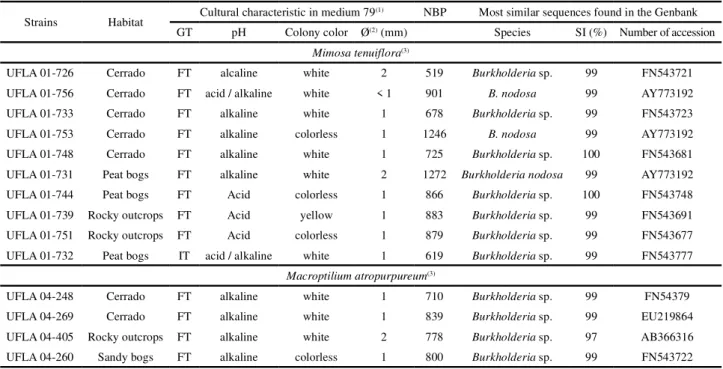
of rupestrian grasslands, located in Serra do Cipó, Minas Gerais, Brazil (CARVALHO, 2010). Table 1 shows the cultural characteristics and origin of these strains. The 14 strains were deposited in the GenBank under the accession number KT957898 to KT957912.
Three experiments were carried out in a greenhouse. Each experiment consisted of 17 treatments: 14 treatments corresponded to the inoculation of each
Burkholderia strain in nutrient solution (HOAGLAND;
ARNON, 1950), containing low mineral N concentration (5.25 mg L-1); two uninoculated negative controls, one
with low mineral N concentration (5.25 mg L-1), and
another with high mineral N concentration (52.5 mg L-1);
and one positive control in nutrient solution with low mineral N concentration (5.25 mg L-1), inoculated with
a nodulating strain, according to the host plant species
UFLA 04-212 -Bradyrhizobium sp, forM. atropurpureum
(FLORENTINO et al., 2009), BR3460 - Burkholderia
gladioli for M. bimucronata (FARIAet al., 1997) and
UFLA 01-750 - Burkholderia sp. for M. foliolosa. The
mineral N sources used were Ca(NO3)2.4H2O; KNO3 and NH4H2PO4.
Each treatment in the experiment with M.
atropurpureum consisted of three replications. For the
experiment withM. bimucronata and M. foliolosa, each
treatment consisted of eight replications.
The experiment with M. atropurpureum was
carried out from September 17th 2013 to October 28th
2013, and temperature ranged between 16 to 27 °C. Long neck bottles containing nutrient solution (HOAGLAND; ARNON, 1950) were used in the experiment. The bottles were autoclaved for one hour, at 1.5 kg cm-2 pressure and
Table 1 - Identification and origin of the 14 Burkholderia strains used in authentication trials, and symbiotic efficiency in M. atropurpureum,M. bimucronata andM. foliolosa, (CARVALHO, 2010)
(1)GT - Growth time; FT - fast; IT - Intermediate.(2)Colony diameter (mm). NBP - Number of Base Pairs; SI (%) - Percentage of Similatiry in
the GeneBank;(3)Host Plant
Strains Habitat Cultural characteristic in medium 79
(1) NBP Most similar sequences found in the Genbank
GT pH Colony color Ø(2) (mm) Species SI (%) Number of accession
Mimosa tenuiflora(3)
UFLA 01-726 Cerrado FT alcaline white 2 519 Burkholderia sp. 99 FN543721
UFLA 01-756 Cerrado FT acid / alkaline white < 1 901 B. nodosa 99 AY773192 UFLA 01-733 Cerrado FT alkaline white 1 678 Burkholderia sp. 99 FN543723 UFLA 01-753 Cerrado FT alkaline colorless 1 1246 B. nodosa 99 AY773192
UFLA 01-748 Cerrado FT alkaline white 1 725 Burkholderia sp. 100 FN543681 UFLA 01-731 Peat bogs FT alkaline white 2 1272 Burkholderia nodosa 99 AY773192
UFLA 01-744 Peat bogs FT Acid colorless 1 866 Burkholderia sp. 100 FN543748
UFLA 01-739 Rocky outcrops FT Acid yellow 1 883 Burkholderia sp. 99 FN543691 UFLA 01-751 Rocky outcrops FT Acid colorless 1 879 Burkholderia sp. 99 FN543677 UFLA 01-732 Peat bogs IT acid / alkaline white 1 619 Burkholderia sp. 99 FN543777
Macroptilium atropurpureum(3)
UFLA 04-248 Cerrado FT alkaline white 1 710 Burkholderia sp. 99 FN54379
UFLA 04-269 Cerrado FT alkaline white 1 839 Burkholderia sp. 99 EU219864
UFLA 04-405 Rocky outcrops FT alkaline white 2 778 Burkholderia sp. 97 AB366316 UFLA 04-260 Sandy bogs FT alkaline colorless 1 800 Burkholderia sp. 99 FN543722
using 98% ethyl alcohol (30 seconds), 2% sodium hypochlorite (2 minutes), and then scarified with pure sulfuric acid (20 minutes). After this period, seeds were subjected to successive washes in sterile distilled water. Afterwards, seeds were placed in petri dishes containing sterilized filter paper and moistened cotton, where they remained for 48 hours in a growth chamber, at 28 °C, for the pre-sprouting seed. One plantlet per bottle was used. The 17 strains were grown in liquid culture medium “79”
(FRED; WAKSMAN, 1928) for 3 days forBurkholderia
strains, and for 5 days for UFLA 04-212 (Bradyrhizobium
sp.), due to differences in the growth time of the strains under shaking (110 rpm), at 28 °C. In each inoculated treatment, plantlets were microbiolyzed with 2 ml
inoculum in minimum concentration of 1x10⁸ bacterial
cells mL-1. At 40 days, plants were collected to determine
number of nodules (NN), shoot dry matter production (SDM), root dry matter (RDM), and total dry matter (TDM), and the result was obtained by the sum of SDM and RDM. Data were subjected to analysis of variance, by using the statistical analysis program SISVAR, version 5.3 (FERREIRA, 2011). The effects of the treatments were compared by the Scott-Knott test at 5% probability.
Experiments inM. bimucronataandM. foliolosa
were carried out, respectively, from July 22nd to October
2nd, 2013, and from September 16th to November 25th,
2013. The temperatures ranged from 13 to 26 °C and from 16 to 27 °C, respectively. Plants were cultivated
in 240 cm3polypropylene tubes, containing vermiculite
(160 cm3) and sand (80 cm3) (2:1), and irrigated with
nutrient solution (HOAGLAND; ARNON, 1950),
according to the plants need. M. bimucronata and
M. foliolosa seeds were disinfected using the same
procedure applied inM. atropurpureum seeds, and went
through breaking dormancy process for 10 minutes in pure sulfuric acid. Afterwards, they were subjected to successive washings in sterile distilled water. After pre-sprouting seed in growth chamber (28 °C for 48 hours), one plantlet was transferred to each tube. Plants were harvested after 70 days to determine plant height and diameter, number of nodules (NN), nodules dry matter production (NDM), shoot dry matter (SDM), root dry matter (RDM), and total dry matter (TDM), which was obtained by the sum of SDM and RDM. Dickson quality index (DQI) was obtained by the following equation (1):
DQI = [total dry matter/(HDR + SRR)] (1)
In which: SRR is the ratio between shoot dry matter and root dry matter, and HDR is the ratio between shoot height
and stem diameter(DICKSON; LEAF; HOSNER, 1960).
by using the statistical analysis program SISVAR version 5.3 (FERREIRA, 2011). The effects of the treatments were compared by the Scott-Knott test at 5% probability. NN data and NDM were transformed into square root of Y + 0.5. Graphs were obtained by the R software.
RESULTS AND DISCUSSION
UFLA 04-212 (Bradyrhizobium sp.) was able
to nodulate and promote growth of M. atropurpureum
(Figura 1), which indicates that the experimental conditions were suitable for nodulation. However, of
the 14 Burkholderiastrains (Table 1), only UFLA 01-726
and UFLA 04-248 (14%) nodulatedM. atropurpureum,
but inefficiently, i.e., growth was similar to that
of the control without inoculation. The species M.
atropurpureum has been used as trap plant in studies
Figure 1 - Shoot dry matter, root dry matter and total dry matter (g), with coefficient of variation (CV) of 45.3, 23.3 and 31.4%, respectively,
ofMacroptilium atropurpureum, with the different treatments: treatments with individual inoculation with strains (Table 1 indicates the
identification of strains); and two treatments without inoculation: one containing high mineral N concentration - 52.5 mg L-1 (With N), and
another containing low mineral N concentration- 5.25 mg L-1 (Minimum N) concentration. All inoculated treatments received low mineral
N concentration- 5.25 mg L-1. Columns followed by the same letter do not statistically differ by the Scott-Knott test at 5% probability
on diversity since they capture bacteria of the alphaproteobacteria and betaproteobacteria classes
(LIMAet al., 2009). Although the interaction between
Burkholderia and M. atropurpureum enable the
formation of nodules (ANGUS et al., 2013; ELLIOT
et al., 2007; LIMAet al., 2009; MISHRAet al., 2012),
this interaction is not always considered effective
(ANGUS et al., 2013; BARRET; PARKER, 2005;
MOULIN et al., 2001). Angus et al. (2013) reported
thatB. tuberum (STM 678T) favored the growth ofM.
atropurpureum. However, this effect was attributed
to other processes that promote plant growth, since nodules were ineffective. Furthermore, there was no comparison with a positive control for nodulation and efficiency, but with an uninoculated control and with CIAT 899 (Rhizobium tropici) strain, which was inefficient.
Of the four strains isolated fromM. atropurpureum
also observed by other authors, when Burkholderia fungorum strains isolated fromM. atropurpureum did not
nodulate after re-inoculation in the same species (SILVA
et al., 2012). However,Burkholderia was able to nodulate
common bean (FERREIRAet al., 2012).
Burkholderia strains presented higher capacity
of establishing symbiosis with the plants of the genus
Mimosa, since 100% of the tested strains nodulatedM. bimucronata species, and 86% nodulated M. foliolosa
species (Tables 2 and 3). The four strains isolated from
M. atropurpureum nodulatedM. bimucronata,and three
nodulated M. foliolosa (Tables 2 and 3). The present
study corroborates other researches, which show higher
affinity of Burkholderia strains with Mimosa genus.
This affinity was indicated by the high frequency of
Burkholderia strains isolated fromMimosa spp. located
in different ecosystems (BARRET; PARKER, 2005;
BONTEMPSet al., 2010; CHENet al., 2003, 2005, 2006,
2007, 2008; MISHRAet al., 2012; REIS JÚNIORet al.,
2010). However, Elliotet al. (2007) found that the strain Burkholderia tuberumSTM678T isolated from nodules
of Aspalathus carnosa (MOULIN et al., 2001) failed
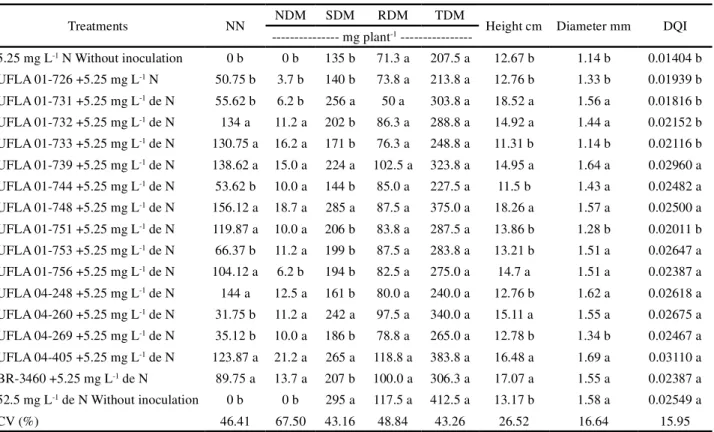
Table 2 - Number of nodules (NN), nodules dry matter (NDM), shoot dry matter (SDM), root dry matter (RDM), and total dry matter
(TDM), plant height and diameter inMimosa bimucronata and Dickson quality index (DQI) in different treatments
Table 1 shows the identification of strains that compose treatments with inoculation, and BR 3460 is the positive control. The two treatments without inoculation: one containing high mineral N concentration (52.5 mg L-1) and another containing low mineral N concentration (5.25 mg L-1) are the
negative controls. Columns followed by the same letter do not present statistical differences by the Scott-Knott test, at 5% probability
Treatments NN NDM SDM RDM TDM Height cm Diameter mm DQI
--- mg plant-1
---5.25 mg L-1 N Without inoculation 0 b 0 b 135 b 71.3 a 207.5 a 12.67 b 1.14 b 0.01404 b
UFLA 01-726 +5.25 mg L-1 N 50.75 b 3.7 b 140 b 73.8 a 213.8 a 12.76 b 1.33 b 0.01939 b
UFLA 01-731 +5.25 mg L-1 de N 55.62 b 6.2 b 256 a 50 a 303.8 a 18.52 a 1.56 a 0.01816 b
UFLA 01-732 +5.25 mg L-1 de N 134 a 11.2 a 202 b 86.3 a 288.8 a 14.92 a 1.44 a 0.02152 b
UFLA 01-733 +5.25 mg L-1 de N 130.75 a 16.2 a 171 b 76.3 a 248.8 a 11.31 b 1.14 b 0.02116 b
UFLA 01-739 +5.25 mg L-1 de N 138.62 a 15.0 a 224 a 102.5 a 323.8 a 14.95 a 1.64 a 0.02960 a
UFLA 01-744 +5.25 mg L-1 de N 53.62 b 10.0 a 144 b 85.0 a 227.5 a 11.5 b 1.43 a 0.02482 a
UFLA 01-748 +5.25 mg L-1 de N 156.12 a 18.7 a 285 a 87.5 a 375.0 a 18.26 a 1.57 a 0.02500 a
UFLA 01-751 +5.25 mg L-1 de N 119.87 a 10.0 a 206 b 83.8 a 287.5 a 13.86 b 1.28 b 0.02011 b
UFLA 01-753 +5.25 mg L-1 de N 66.37 b 11.2 a 199 b 87.5 a 283.8 a 13.21 b 1.51 a 0.02647 a
UFLA 01-756 +5.25 mg L-1 de N 104.12 a 6.2 b 194 b 82.5 a 275.0 a 14.7 a 1.51 a 0.02387 a
UFLA 04-248 +5.25 mg L-1 de N 144 a 12.5 a 161 b 80.0 a 240.0 a 12.76 b 1.62 a 0.02618 a
UFLA 04-260 +5.25 mg L-1 de N 31.75 b 11.2 a 242 a 97.5 a 340.0 a 15.11 a 1.55 a 0.02675 a
UFLA 04-269 +5.25 mg L-1 de N 35.12 b 10.0 a 186 b 78.8 a 265.0 a 12.78 b 1.34 b 0.02467 a
UFLA 04-405 +5.25 mg L-1 de N 123.87 a 21.2 a 265 a 118.8 a 383.8 a 16.48 a 1.69 a 0.03110 a
BR-3460 +5.25 mg L-1 de N 89.75 a 13.7 a 207 b 100.0 a 306.3 a 17.07 a 1.55 a 0.02387 a
52.5 mg L-1 de N Without inoculation 0 b 0 b 295 a 117.5 a 412.5 a 13.17 b 1.58 a 0.02549 a
CV (%) 46.41 67.50 43.16 48.84 43.26 26.52 16.64 15.95
to nodulate three species of Mimosa (Mimosa pigra,
M. diplotricha andM. pudica), probably for presenting
nodulation gene sequences different from those of
nodulating Burkholderia species described, and which
establish symbiosis withMimosaspp. (GYANESHWAR
et al., 2011).
In the experiment carried out with the speciesM.
bimucronata, there was significant effects of treatments for
most variables NN, NDM, SDM, plant height, diameter, and DQI (Table 2). The strains UFLA 732, UFLA 01-733, UFLA 01-739, UFLA 01-748, UFLA 01- 751, UFLA 01-756, UFLA 04-248 and UFLA 04-405 presented higher number of nodules, and were grouped with the inoculant strain for this culture (BR 3460) (Table 2).
04-Treatments NN NDM SDM RDM TDM Height cm Diameter mm DQI --- mg plant-1
---5.25 mg L-1 de N Without inoculation 0 d 0 c 207.2 b 37.70 b 245.0 b 10.15 b 1.4317 b 0.01952 b
UFLA 01-726 +5.25 mg L-1 de N 24.75 a 26.7 a 245.1 b 48.70 b 293.9 b 10.99 b 1.5462 b 0.02593 a
UFLA 01-731 +5.25 mg L-1 de N 0 d 0 c 164.4 c 31.37 a 195.7 c 10.14 b 1.0762 c 0.01260 b
UFLA 01-732 +5.25 mg L-1 de N 16.37 b 10.2 c 132.2 c 30.50 b 161.6 c 7.74 c 1.1987 c 0.01586 b
UFLA 01-733 +5.25 mg L-1 de N 28.00 a 14.7 b 137.7 c 29.62 a 167.4 c 7.20 c 1.1925 c 0.01500 b
UFLA 01-739 +5.25 mg L-1 de N 12.12 c 19.2 b 197.9 b 45.50 b 243.4 b 9.43 b 1.4637 b 0.01723 a
UFLA 01-744 +5.25 mg L-1 de N 3.62 d 4.4 c 166.2 c 30.37 b 196.6 c 9.25 b 1.1825 c 0.01330 b
UFLA 01-748 +5.25 mg L-1 de N 26.50 a 30.4 a 276.1 b 55.62 b 331.7 b 11.65 b 1.6037 b 0.02823 a
UFLA 01-751 +5.25 mg L-1 de N 6.38 c 7.7 c 209.5 b 40.50 a 253.0 b 10.00 b 1.6012 b 0.02249 a
UFLA 01-753 +5.25 mg L-1 de N 1.43 d 5.2 c 166.0 c 27.75 b 193.7 c 8.77 c 1.2857 c 0.01561 b
UFLA 01-756 +5.25 mg L-1 de N 6.00 c 5.1 c 201.1 b 35.75 b 236.9 b 9.69 b 1.4986 b 0.01723 b
UFLA 04-248 +5.25 mg L-1 de N 29.00 a 28.0 a 196.6 b 46.25 b 242.9 b 9.73 b 1.2342 c 0.02164 a
UFLA 04-260 +5.25 mg L-1 de N 3.12 c 9.1 c 166.2 c 36.87 a 255.9 b 8.51 c 1.4662 b 0.02365 a
UFLA 04-269 +5.25 mg L-1 de N 0 d 0 c 140.9 c 32.25 a 173.1 c 9.00 c 1.0400 c 0.01195 b
UFLA 04-405 +5.25 mg L-1 de N 12.87 c 11.1 c 184.0 b 38.12 b 250.7 b 9.46 b 1.3450 c 0.01913 a
UFLA 01-750 +5.25 mg L-1 de N 21.12 b 21.9 b 194.9 b 52.50 b 247.4 b 9.24 b 1.4937 b 0.02668 a
52.5 mg L-1 de N Without inoculation 0 d 0 c 429.1 a 68.62 a 497.7 a 16.55 a 2.0650 a 0.03462 a
CV (%) 62.36 71.64 35.03 46.57 33.97 21.27 27.44 23.25
405 were superior to the inoculant strain, and equivalent to the control with high mineral N concentration (Table 2). There were no differences between treatments in relation to root dry matter and total dry matter (Table 2).
In relation to the height of M. bimucronata, the
strains UFLA 01-731, UFLA 01-732, UFLA 01-739, UFLA 01-748, UFLA 01-756, UFLA 260, UFLA 04-40 were similar to the strain BR 3460, which were superior to the control with high nitrogen concentration (Table 2). All these strains plus UFLA 01-744, UFLA 01-753, and UFLA 04-248 also promoted higher diameter growth, and were equivalent to the control with high mineral N concentration.
For the Dickson quality index (DQI), the strains UFLA 01-739, UFLA 01-744, UFLA 01-748, UFLA 01-753, UFLA 01-756, UFLA 04-248, UFLA 04-260, UFLA 04-269 and UFLA 04-405 were equivalent to the inoculant strain (BR 3460) and to the control with high N concentration (Table 2). However, the strains UFLA 01-739, UFLA 01-748 and UFLA 04-405 should be highlighted. Of the 14 tested strains, in the experiment carried out withM. foliolosa, only two did not nodulate
Table 3 - Number of nodules (NN), nodules dry matter (NDM), shoot dry matter (SDM), root dry matter (RDM), and total dry matter(TDM), height and diameter ofMimosa foliolosa and Dickson quality index (DQI), in different treatments
Table 1 shows the identification of strains that compose the inoculation treatments, and UFLA 01-750 is the positive control. The two treatments without inoculation: one containing high mineral N concentration (52.5 mg L-1), and another containing low mineral N concentration (5.25 mg L-1) are the
negative controls. Columns followed by the same letter do not present statistical differences by the Scott-Knott test, at 5% probability
this species, UFLA 01-731 and UFLA 04-269, which
were isolated fromMimosa tenuiflora andMacroptilium
atropurpureum, respectively (Table 3). M. folilosa is
an endemic species of rupestrian grassland of Serra do Cipo, MG, and this is the first study that evaluates the nodulation and efficiency of nitrogen-fixing strains in its development; therefore, no strains have been approved by MAPA as inoculant yet.
The strains that presented higher number of nodules production were UFLA 01-726, UFLA 01-733, UFLA 01-748 and UFLA 04-248. With the exception of UFLA 01-733, these strains also promoted greater nodules dry matter production (Table 3).
All parameters showed significant effects; however, no strain was able to surpass, nor was equivalent to the results obtained with the control with high nitrogen concentration for shoot dry matter, total dry matter, height and diameter (Table 3). Root dry matter production by the strains UFLA 01-731, UFLA 01-733, UFLA 01-751, UFLA 04-260 and UFLA 04-269 was equivalent to that of the control with high mineral N concentration.
by the strains UFLA 726, UFLA 739, UFLA 01-748, UFLA 01-750, UFLA 01-751, UFLA 04-248, UFLA 04-260, and UFLA 04-405 were equivalent to that of the control with high N concentration (Table 3).
The Mimosa species evaluated this study are
promising to be used in the recovery of degraded areas. The use of native legumes species that establish symbosis with nitrogen-fixing bacteria is of great interest for degraded areas restoration, since they established themselves in the field more quickly, and promote greater biomass accumulation and contribute to the improvement of soil fertility, favoring other species that are not able to establish this type of
symbiosis (CHAERet al., 2011).
This study is the first to evaluate the potential of bacteria strains from nodules of legume species cultivated in rupestrian grasslands soils. The soils of this region are
oligotrophic and acid (CARVALHOet al., 2012; 2014;
NEGREIROS; MORAIS; FERNANDES, 2008), and the selection of strains adapted to these conditions may be used to obtain seedlings for the recovery of areas which have soils with these characteristics.
AlthoughMimosa foliolosa is an endemic species
of the same region where the Burkholderia strains
were obtained, they were more efficient in Mimosa
bimucronata.
It can be considered that the strains UFLA 01-739, 01-748, 01-751, 04-260, 04-405 were in general the most
effective in promoting the growth of Mimosa species.
UFLA 01-739, 01-748, and 04-405 were considered
potential inculants forM. bimucronata;and UFLA 01-751
and UFLA 04-260 were considered potential inoculants forM. foliolosa.
CONCLUSIONS
1.Burkholderia strains establish symbiosis with the species Macroptilium atropurpureum, Mimosa bimucronata
and Mimosa foliolosa, and present greater specificity
for species of the genusMimosa;
2.Macroptilium atropurpureum nodulation byBurkholderia
strains occurred only with two of the 14 strains, and was inefficient;
3. Burkholderia strains isolated from Macroptilium atropurpureum and Mimosa tenuiflora cultivated
in rupestrian grasslands soils promote plant growth
of the species Mimosa bimucronata and Mimosa
foliolosa, with potential to be used as inoculants for
these species.
4.Burkholderia strains promoteMimosa spp. growth, but
notMacroptilium atropurpureum.
ACKNOWLEDGEMENTS
To the National Council for Scientific and Technological Development
(CNPq) and to the Coordination for the
Improvement of Higher Education Personnel (CAPES)
for the finantial support to this research project, and for the study and research scholarships.
REFERENCES
ANGUS, A. A.et al. Nodulation and effective nitrogen fixation of
Macroptilium atropurpureum (siratro) byBurkholderia tuberum,
a nodulating and plant growth promoting beta-proteobacterium, are influenced by environmental factors.Plant and Soil, v. 369, n. 1, p. 543-562, 2013.
BARRET, C. F.; PARKER, M. A. Coexixtence ofBurkholderia, Cupriavidus andRhizobium sp. nodule bacteria on twoMinosa
spp. in Costa Rica.Applied and Environmental Microbiology, v. 72, n. 2, p. 1198-12016, 2006.
BARRET, C. F.; PARKER, M. A. Prevalence ofBurkholderiasp.
nodule symbionts on four mimosoid legumes from Barro Colorado Island, Panama.Systematic and Applied Microbiology, v. 28, n. 1, p. 57-65, 2005.
BONTEMPS, C. et al. Burkholderia species are ancient
symbionts of legumes.Molecular Ecology, v. 19, n. 1, p. 44-52,
2010.
CARVALHO, F. Abundância de espécies de plantas e diversidade de simbiontes radiculares em campos rupestres da serra do cipó, MG. Tese (Doutorado em Ecologia, Conservação e Manejo da Vida Silvestre) - Instituto de Ciências Biológicas, Universidade Federal de Minas Gerais, Belo Horizonte, 2010.
CARVALHO, F. et al. Relationship between physical and
chemical soil attributes and plant species diversity in tropical mountain ecosystems from Brazil. Journal of Mountain Science, v. 11, n. 4, p. 875-883, 2014.
CARVALHO, F.et al.The mosaico f habitats in the high-altitude
brazilian rupestrian fields is a hotspot for arbuscular mycorrhizal fungi.Applied Soil Ecology, v. 52, n. 1, p. 9-19, 2012. CHAER, G. M.et al. Nitrogen-fixing legume tree species for
the reclamation of severely degraded lands in Brasil. Tree Physiology, v. 31, p. 139-149, 2011.
CHEN, W. M. et al. Burkholderia nodosasp. nov., isolated
CHEN, W. M.et al. Burkholderia sabiaesp. nov., isolated from root nodules ofMimosa caesalpiniifolia.International Journal of Systematic and Evolutionary Microbiology, v. 58, n. 9, p. 2174-2179, 2008.
CHEN, W. M.et al. Legume symbiotic nitrogen fixation by
beta-proteobacteria is widespread in nature.Journal of Bacteriology, v. 185, n. 24, p. 7266-7272, 2003.
CHEN, W. M.et al. Proof that Burkholderia forms effective symbioses with legumes: a study of novel Mimosa-nodulating strains from South America. Applied and Environmental Microbiology, v. 71, n. 11, p. 7461-7471, 2005.
CHEN, W.-M. et al. Burkholderia mimosarum sp. nov.,
isolated from root nodules of Mimosa spp. From Taiwan and South America. International Journal of Systematic and Evolutionary Microbiology, v. 56, n. 8, p. 1847-1851, 2006.
COENYE, T.; VANDAMME, P. Diversity and significance of Burkholderia species occupying diverse ecological niches.
Environmental Microbiology, v. 5, n. 9, p. 719-729, 2003.
DICKSON, A.; LEAF, A. L.; HOSNER, J. F. Quality appraisal of white spruce and white pine seedling stock in nurseries.
Forest Chronicle, v. 36, n. 1, p. 10-13, 1960.
ELLIOTT, G. N. et al. Nodulation of Cyclopia spp.
(Leguminosae, Papilionoideae) by Burkholderia tuberum. Annals of Botany, v. 100, n. 7, p. 1403-1411, 2007. FARIA, S. M. et al. Obtenção de estirpes de rizóbio eficientes na fixação biológica de nitrogênio para espécies florestais. Seropédica: Embrapa Agrobiologia, 1997. p. 1-4. (Recomendação Técnica, 3).
FERREIRA, D. F. Sisvar: a computer statistical analysis system.
Ciência e Agrotecnologia, v. 35, n. 6, p. 1039-1042, 2011. FERREIRA, P. A. A.et al. Efficient nitrogen-fixingRhizobium
strains isolated from amazonian soils are highly tolerant to acidity and aluminium.World Journal of Microbiology and Biotechnology, v. 28, n. 5, p. 1947-1959, 2012.
FLORENTINO, L. A. et al. Sesbania virgata stimulates the
occurrence of its microsymbiont in soils but does not innibit microsymbiont of other species.Scentia Agricola, v. 66, n. 5,
p. 667-676, 2009.
FRED, E. B.; WAKSMAN, S. A. Laboratory manual of general microbiology. New York: McGraw-Hill Book, 1928.
143 p.
GYANESHWAR, P.et al.Legume-nodulating betaproteobacteria:
diversity, host range, and future prospects. The American Phytopathological Society, v. 24, n. 11, p. 1276-1288, 2011. HOAGLAND, D. A.; ARNON, D. D.The water-culture method for growing plants without soil. Berkeley: California Agricultural of Experiment Station, 1950. 32 p. (Circular 347).
REIS JÚNIOR, F. B. dos et al. Nodulation and nitrogen
fixation byMimosa spp in the Cerrado and Caatinga biomes
of Brazil.New Phytologist, v. 186, n. 4, p. 934-946, 2010. LIMA, A. S. et al. Nitrogen-fixing bacteria communities
occurring in soils under different uses in the Western Amazon Region as indicated by nodulation of siratro (Macroptilium atropurpureum).Plant and Soil, v. 319, n. 1, p. 127-145, 2009. MISHRA, R. P. N. et al.Genetic diversity ofMimosa pudica
rhizobial symbionts in soils of French Guiana: investigating the origin and diversity of Burkholderia phymatum and other beta-rhizobia.Microbiology Ecology, v. 79, n. 2, p. 487–503, 2012. MOULIN, L.et al.Nodulation of legumes by members of the
b-subclass of Proteobacteria.Nature, v. 411, n. 6840, p. 948-950,
2001.
NEGREIROS, D.; MORAIS, M. L. B.; FERNANDES, G. W. Caracterização da fertilidade dos solos de quatro leguminosas de campos rupestres, serra do cipó, MG, Brasil.Revista de la Ciência del Suelo y Nutrición Vegetal, v. 8, n. 3, p. 30-39, 2008. SILVA, K.et al. DiazotrophicBurkholdria species isolated from the Amazon region exhibit phenotypical, functional andd genetic diversity.Systematic and Apllied Microbiology,
v. 35, n. 4, p. 253-262, 2012
SOARES, B. L. et al. Cowpea symbiotic efficiency, pH and
aluminum tolereance in nitrogen-fixing bactéria.Scientia Agricola, v. 71, n. 3, p. 171-180, 2014.
TALBI, C. et al. Burkholderia phymatum strains capable of
nodulating Phaseolus vulgaris are present in Moroccan soils. Applied and Environmental Microbiology, v. 76, n. 13, p.