A Work Project, presented as part of the requirements for the Award of a Masters Degree in Management from the NOVA – School of Business and Economics.
Decision-making process of Nova Executivos’ students
Marta Filipa Dias Santos Bica, 1565
A Project carried on the Educational Organization – Consumer Insights Field Lab, under the supervision of: José Rosário
1
Abstract
The Executive Education sector has been experiencing significant changes throughout the years, with the growing necessity for companies to develop their talent. The present project analyzes the decision-making process of individuals when selecting an executive education program. This research was based on a quantitative analysis conducted through an online survey. Results show that organizations were behind the financing of the majority of the respondents’ programs, even if they had the initiative themselves. It also uncovered the main strengths of Nova SBE, its reputation, program content and faculty members. The overall feedback was favorable considering its impact on the professional careers.
Keywords: Decision-making process; Buying Process; Executive Education; Nova Executivos
2
Table of contents
1. Introduction ………3
2. Literature Review ………...4
3. Methodology of the Analysis ……….7
4. Limitations of the Research ………...9
5. Discussion of the Results ……….10
6. Recommendations ………19
7. Conclusions ………..21
3
1. Introduction
Faculdade de Economia da Universidade Nova de Lisboa, recently known as Nova School of Business and Economics, founded Nova Executivos in 1975, as an institute focused on developing executives through several education programs aiming to provide individuals with valuable expertise that can assist on their career development and help lead companies towards success. Currently, Nova Executivos has a selective range of programs in its offerings, such as open enrollment programs for individuals with managerial or non-managerial backgrounds. These programs are divided into three categories: career track programs, skill or function specific programs and sector specific programs. In addition, it offers customized programs oriented to corporate clients.
Nova Executivos recognizes the growing demand for executive education services aligned to the globalization of markets and competition pressures that have been forcing companies and executives to invest in continuous development and training. The investment on executive education provides individuals and companies with a set of new tools, perspectives and skills that can enhance the organizations’ abilities to better approach and serve their markets. By acknowledging this context, this work project was proposed with the intent of conducting a market research study focused on understanding individuals that previously participated in open enrolment programs at Nova Executivos and their decision making process before enrolling in the program. Afterwards, an analysis was conducted to understand how and for how long the process takes place and the main factors that influence their decision. The main objective is to provide Nova Executivos with extended knowledge on the matter, enabling the organization to improve, adapt and manage their current and future
4 strategies accordingly. Furthermore, the successful implementation of strategies focused on the actual consumer insights of former participants is expected to reach and attract a wider net of potential students.
2. Literature Review
This section is based on the existing literature and empirical research on Executive Education. Several recent studies underline the emerging trends faced by the executive education. Research highlights the impact of competitive challenges and continuously changing markets and business environment faced by organizations nowadays, which strengths the demand for executive development and leadership talent while creating a competitive advantage (Topping, 2005; Lloyd & Perryman, 2006). In 2007, Buchel and Antunes stated that companies and executives are increasingly aware of growing necessity of relying on executive education to drive strategic change that can positively contribute to the success of a company. In order to achieve that, educational organizations are expected to provide executives with opportunities to expand knowledge and gain new business perspectives while at the same time developing competencies and capabilities (Rogers & Prince, 2012; Buchel & Antunes, 2007; Olson & Stotz, 2013). In 2003, Hura also argued the importance of executive development as a component of executive retention. Besides, Topping (2005) stated that one of the critical purposes of executive development is to prepare executives for future roles inside the business. Furthermore, quite a few authors emphasize that the intensification of the demand for high-quality executive education services requires business schools to have a deeper understanding of the different industries and businesses (Buchel & Antunes, 2007; Lloyd & Newkirk, 2011), as well as to provide programs that can be
5 translated into performance and business strategies improvement and deliver tangible business results (Lloyd & Perryman, 2006; Buchel & Antunes, 2007; Olson & Stotz; Rogers & Prince, 2012; Lloyd and Newkirk, 2011). In 2007, Buchel and Antunes also stressed that by doing so, educational providers will be able to strengthening its reputation and create business retention. Additionally, in 2012, Rogers and Prince argued that educational organizations to be successful should devote efforts to be aware of what their participants are seeking. Following a similar reasoning Spearly (2006), argued the importance of a better understanding of the main selection criteria and the entire decision process undertaken by students of executive education programs.
Nevertheless, there are few articles and publications that discuss the main reasons and decision criteria considered during the search for an executive education program. Some factors entail a certain degree of risk like in the case of the financial costs associated, such as the tuition fees (Roger & Prince, 2012; Buchel & Antunes, 2007). However, other researchers found that the price of the executive education programs has not that much significance meaning that it is not a determinant selection criterion (Day & Barksdale, 1992; Schrader, 1985). Primarily the important selection criterion behind the decision of choosing an executive education program include, the reputation of the institution (Schrader, 1985, Vicere, 1988, Spearly, 2006; Lloyd & Perryman, 2006; Lloyd & Newkirk, 2011), the curriculum offered, faculty members (Buchel & Antunes, 2007) and the possibility of achieving greater personal, professional and financial rewards, (Roger & Prince, 2012), program content (Schrader 1985; Spearly, 2006; Lloyd & Perryman, 2006) and perceived quality (Vicere, 1988). Still, in 2006, Jeffrey acknowledged the growing concern with the direct applicability and the return on investment on executive education initiatives.
6 Moreover, in 1985, in a research study Schrader found that the great majority of the respondents were selected to participate in an executive education program by its supervisors contrasting with a considerably smaller percentage of the respondents that had the initiative by themselves. Supporting that finding, in 2000, Conger and Xin, claimed that the main drivers of executive education initiatives inside organizations were not the operations superiors but instead corporate executives including CEO or Human resources executives.
Regarding the marketing of executive educational organizations, the exponential growth of Internet in the last few years and its global use, has led numerous authors to highlight the need to shift the marketing approach towards more effective channels, like websites, social media, given the ease of data access (Deighton & Kornfeld, 2012; Cataldo, 2012). Additionally, the website was found to be the most important source of information in several research studies (Deighton & Kornfeld, 2012; Cataldo, 2012; Havaldar & Dash, 2009). Other common marketing channels used by educational organizations are direct mail, e-mail marketing, print and media advertising, paid search engines, publications, and personal selling activities (Deighton & Kornfeld, 2012; Cataldo, 2012). In 2009, Havaldar and Dash argued that word-of-mouth, the process of transmitting information to others based on the recall of perceptions or experiences, is a crucial component of marketing strategies due to the high degree of credibility associated. Besides, according to other research studies, this influential information channel is recognized to have a positive impact on the purchase intentions (Park, Lee & Han, 2007) and the actual purchase behavior (Havaldar & Dash, 2009) as well as in reducing the perceived risks of the decision both in a business-to-business context and business-to-consumer setting (File, Judd & Prince, 1992).
7 On the matter of decision-making, researchers have suggested several models on the subject. According to Hoyer and MacInnis (2010), the decision-making process begins when consumers face a problem or situation that requires a decision to reach an ideal state. In 2011, Kotler and Armstrong argued the buying process starts way before the actual purchase decision and continues long after. The authors also established a model comprising the different phases of the process, beginning with the need recognition, where the problem or need is identified, followed by information search where individuals may recur to different sources, the next stage is the evaluation of alternatives where the consumer uses the information acquired and assess the brands in the choice set, after this phase the consumer takes the purchase decision, and finally, the last stage of the buying process is the post purchase behavior, in which the consumer will evaluate the perceived performance of the product/service.
3. Methodology of the analysis
The research on the process of decision-making at Nova Executivos intended to follow an exploratory approach (Malhotra & Birks, 2006), aiming to explore the entire process in order to provide a stronger understanding and insights of how and for how long individuals and companies make decisions about executive education and the key influential factors considered to be more valuable. To support this research a quantitative analysis was performed based on the data collected through an online survey that included several variables directly related to the stages of the buying process defined by Kotler and Armstrong in 2011. The survey was conducted through online sources considering the reduced costs associated, the easiness and practicality of
8 accessing the survey by the respondents as well as the easiness of collecting data and further analysis (Malhotra & Birks, 2006).
The design of the questionnaire was based on the literature and research articles available on the matter (Malhotra & Birks, 2006; Lindon, Lendrevie, Lévy, Dionísio and Rodrigues, 2009; Evans & Mathur, 2005; Rowley, 2014). The questions were organized in a functional order to assure a structured data collection based on the sequence of steps undertook by each participant before and during the decision-making process so as to be coherent with the entire cognitive process. For the programming of the survey, an online survey software known as Qualtrics was used, considering its features that not only enable a structured flow for the different answers of the respondents but also allow the creation of individual emails. Given that, each sample member received an individual and personalized e-mail explaining the purpose of the questionnaire. Instructions were provided throughout the filling of the questionnaire.
As a request from Nova Executivos, the research was centered specifically on open enrollment programs including Curso Geral de Gestão, Intensive Management Program, Advanced Negotiation Program, Effective Leadership Program and the one for Managing the Law Firm. The sample included former executive students from the five programs under analysis, belonging to the selected courses from 2010 until 2014. The sample focused on participants from 2010 until 2014 aiming to avoid inaccurate results by including individuals that completed the programs more than four years ago given that this research is based on the recall of the entire experience of applying to an executive education program. The final sample included 497 former participants.
9 In order to improve the questionnaire an initial beta testing was conducted. The survey was distributed to several Nova Executivos’ employees that gave their input on how to improve the design of the survey.
Furthermore, to identify potential challenges with the questionnaire design, the questionnaire was pre-tested on a small sample with the objective of avoiding errors or misunderstandings. The pre-test was sent to around 10% of the total sample. After two days, there was no negative feedback so the rest of the sample was deployed. During two weeks the participants were able to participate in the research. Furthermore, a week after the questionnaire was sent there were 126 responses. In order, to increase the response rate after the initial 7 days a reminder was sent. Finally, from the original sample, 176 respondents completed the questionnaire.
Later on, for the purpose of data analysis statistical tools were used enabling to reach important conclusions. Moreover, the results obtained are expected to have a positive impact on the services of the educational organization through extended insights of the different perspectives of the users about the process of selecting an executive development program and hence, to enabling them to understand the main areas that could use some improvement.
4. Limitations of the research
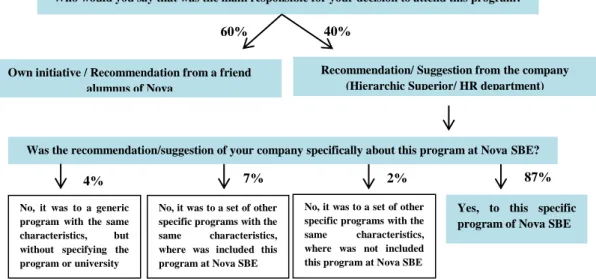
First of all, before analyzing the main findings of this research, is important to be aware of some of the limitations faced. One concerns the limited sample of 497 former executive education students from which 176 responded creating a response rate for the questionnaire of 35%. Although the response rate is very good, the design of the questionnaire as required by Nova Executivos conducted the respondents through 4
10 distinct paths depending on how the decision-making process began. By doing so, the sample was subdivided into 4 small samples from which 2 were found to be not statistically significant to analyze, as mentioned further on this report (Figure 1). Nevertheless, the limitation of the total sample comes as a consequence of the request of Nova Executivos to focus on the five programs mentioned above and on programs that took place less than five years ago, since as explained before it would not be accurate to have respondents recalling an experience of five or more years ago.
5. Discussion of the results
From a sample of 497 former participants selected to participate in this research study, 176 completed the questionnaire. Given the collected data, a detailed analysis of the actual results and its further relation with the theoretical model studied by Kotler and Armstrong (2011) was conducted. Due to the purpose of this research and considering the limitations faced, this analysis ended up to be mainly descriptive aiming to primarily identify and describe the main findings.
Overview
The first question of the survey, intended to establish who was behind the funding of the executive development program. From the 176 respondents, 76% claimed that the employer company was behind the funding of the executive development program, however, 11% of those split the tuition fees with the company where they work or used to work. Furthermore, to understand how the decision-making process began it was important to distinguish how the first initiative arose. If it arise by the individuals’ own initiative or if there was a recommendation from the employer organization or even if
11 the initiative appear after the suggestion from a friend alumnus of Nova SBE. It was crucial to make this distinction since this first initiative has consequently a direct influence on the entire flow of the decision-making process. The results obtained show that 54% of the respondents were the ones responsible for the first initiative and 6% state that the initiative took place after the recommendation from a friend alumnus of Nova SBE, while 26% claim that their participation was suggested/recommended by an immediate superior from the employer organization and 14% stated that their participation was suggested/recommended by the Human Resources Department inside the company. Most of the individuals that completed the survey had the initiative themselves to attend an executive education program, contrasting with the findings in the research study conducted by Schrader in 1985, where the majority of the participants were selected to participate in a program by its supervisors.
From the final sample, 65% respondents had the opportunity to choose the institution and executive development program, either because the search for the program began by their own initiative or even in the sequence of the companies’ intervention in the process. When questioned about the academic institutions considered during the search for an executive education program the results were, Católica Lisbon School of Business and Economics, considered by 74% of the respondents, followed by 21% for when Nova SBE was the only one considered and 18% considered ISCTE as a viable alternative as well. These results show that when selecting an academic institution to enroll in an executive education program besides Nova SBE, Católica Lisbon School of Business and Economics and ISCTE are also two strong possibilities. However, with these results it is possible to infer that Católica Lisbon School of Business and Economics is one of the biggest competitors in the market. Regarding the
12 three main factors that made Nova SBE the best fit for their needs, the majority of the these respondents selected, the reputation of Nova SBE (70%), the programs content (65%) and its faculty members (45%). In addition, the results obtained are in line with what other authors previously considered as an important selection criterion, such as the reputation of the university (Schrader, 1985, Vicere, 1988, Spearly, 2006; Lloyd & Perryman, 2006; Lloyd & Newkirk, 2011), program content (Schrader 1985; Spearly, 2006; Lloyd & Perryman, 2006) and faculty members (Buchel & Antunes, 2007).
As for the three key methods that individuals normally use to search for more information about executive education programs, this question intended to provide sustained knowledge to Nova Executivos to redirect the marketing strategies accordingly. The results show that the great majority of the 176 respondents selected the website of the institutions as one of the most preferred choices, 69%, the second method that was found to be more used can be considered word of mouth from family members, friends, colleagues (34%), method that is also associated with contacts with Nova SBE’s alumni (17%) and finally, the third method preferred is the Newsletter sent by the institution (26%). These findings are once again in line with the literature review, where it was stated that the website was considered as the most important source of information (Deighton & Kornfeld, 2012; Cataldo, 2012; Havaldar & Dash, 2009) and word of mouth as a key element of marketing strategies (Havaldar & Dash, 2009).
Theoretical model – The Buyer Decision Process by Kotler and Armstrong (2011)
This report will now focus in describing two distinct cases of the decision-making process of former participants who enroll by their own initiative or upon a suggestion from a friend alumnus of Nova SBE and for those who were subject to their companies’
13 recommendation for a specific the program. As the below graphical representation shows (Figure 1), the results obtained for those participants that enroll in the course as a consequence of the recommendation of the Human Resources department from their company or from a hierarchical superior and had the possibility to select the academic program to attend, cannot be taken under consideration since the sample is too small. Only nine individuals were subject to those conditions, that is, only 13% of the total sample. Therefore, those results are not statistically significant to support an analysis.
Figure 1. Brief representation of the results obtained with the questionnaire
As mentioned before the theoretical framework of Kotler and Armstrong (2011), intends to define the decision making process of buyers by establishing five stages, the first it is the need recognition, followed by information search, evaluation of alternatives, purchase decision and finally, the post-purchase behavior. Since, the main objective of this report is to study how individuals conduct their decision on executive development programs and the main influential factors during the process, it makes sense to rely on this theoretical framework to draw conclusions.
Who would you say that was the main responsible for your decision to attend this program?
Recommendation/ Suggestion from the company (Hierarchic Superior/ HR department) Own initiative / Recommendation from a friend
alumnus of Nova
60% 40%
Was the recommendation/suggestion of your company specifically about this program at Nova SBE?
No, it was to a generic program with the same characteristics, but without specifying the program or university
No, it was to a set of other specific programs with the same characteristics, where was included this program at Nova SBE
No, it was to a set of other specific programs with the same characteristics, where was not included this program at Nova SBE
Yes, to this specific program of Nova SBE
87% 2%
14
Case 1
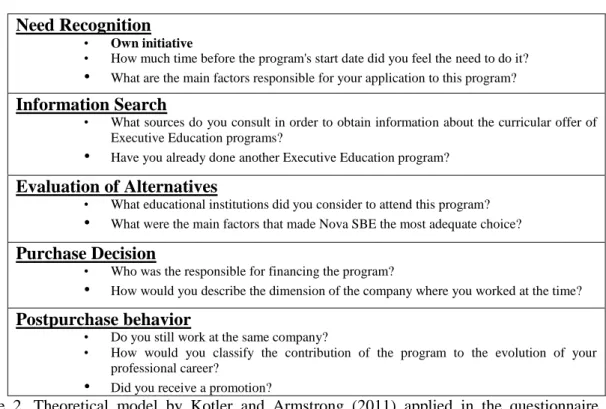
First of all, case 1 will consider merely the respondents that enrolled in the executive education program by their own initiative.
Need Recognition
• Own initiative
• How much time before the program's start date did you feel the need to do it? • What are the main factors responsible for your application to this program?
Information Search
• What sources do you consult in order to obtain information about the curricular offer of Executive Education programs?
• Have you already done another Executive Education program?
Evaluation of Alternatives
• What educational institutions did you consider to attend this program? • What were the main factors that made Nova SBE the most adequate choice?
Purchase Decision
• Who was the responsible for financing the program?
• How would you describe the dimension of the company where you worked at the time?
Postpurchase behavior
• Do you still work at the same company?
• How would you classify the contribution of the program to the evolution of your professional career?
• Did you receive a promotion?
Figure 2. Theoretical model by Kotler and Armstrong (2011) applied in the questionnaire distributed for case 1
The first stage of the framework is the Need Recognition, which concerns the identification of the need or problem that requires a decision. In that sense, the participants were asked about the two main factors behind the initiative to attend the program, for which the great majority responded acquisition and/or development of new competencies and knowledge (87%). Other reasons included with the intent to prepare a new position in the company or project (27%) or just for personal fulfillment (24%). In addition, 50% of the respondents claimed that they felt the need to attend the program for more than 6 months before. It is clear that the main common need that individuals sought to fulfill was the acquisition and/or development of new competencies and
15 knowledge. Besides, we can infer that it was not a temporary necessity since many of the respondents claim that they had felt the need for more than 6 months before.
Afterwards, the second stage comprises the information search, the phase when the consumer gathers information. It was crucial to understand if the respondents had already practical experience with other executive development programs, nevertheless, 60% claimed that it was their first executive education program. Besides, during this stage the main methods used to collect information were also assessed, and the findings clearly pointed out to the website of the institutions (77%) as the key source for information when searching for this kind of courses, followed by the feedback obtained from friends, family and colleagues (40%), advertising and media sources (25%) and directly around the academic institutions (25%). Results show that once again the website was found to be the main source of information, which can be associated to its easy to access and practicality in searching for information.
As for the stage concerning the evaluation of alternatives, when asked about other academic institutions that were considered, the one with the highest percentage ended up being Católica Lisbon School of Business and Economics (72%), ISCTE (17%), while 22% claimed that Nova SBE was their only alternative. Católica Lisbon School of Business and Economics was found for a second time to be a key competitor in the market of executive education. Regardless, of the consideration set of individuals, the three core factors valued at Nova SBE by former participants of the selected programs can be considered to be, reputation of the institution accounting for 70%, curriculum content for 68% and finally, faculty members with 44%.
16 For the purchase decision phase, one of the questions asked concerned who was behind the funding of the participation in the program, to which 46% answered that it was handled by the company, 39% handled by themselves and 15% split the costs. Therefore, when the individuals had the initiative by themselves, only 46% of the participants had the academic program financed by the company. Yet, when we look at the overall results obtained from the participants who attended the program following the company’s recommendation, 94% had their program’s costs totally covered by the company and as it would be expected none of those participants financed the course themselves. These findings suggest that when companies recommend this kind of development programs they are normally the ones who handle the expenses associated.
Finally, the stage of the postpurchase behavior, when the customer usually evaluates the service, the respondents that are still working in the same company as when they attended the program, claimed that the program had a favorable impact in their professional careers (62%) and 21% considered that it had a very favorable impact. However, when asked if they received a promotion after the program 79% answered negatively. The feedback was mostly positive and satisfactory in what concerns the impact of the course on the professional careers of the individuals. It is possible to infer that participants found that the programs have real applicability in their professional lives.
Case 2
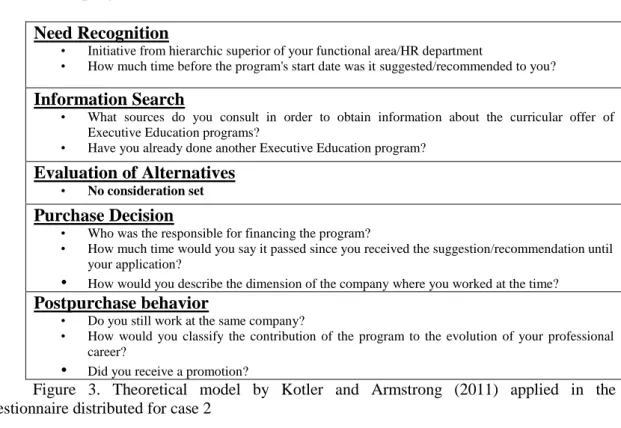
This case approaches the results obtained from those respondents who attended the course in the sequence of a recommendation/suggestion either from a hierarchical superior or by the Human Resources department to enroll in a specific executive
17 education program. Meaning that, to this partial sample was not given the choice to choose which program to attend.
Need Recognition
• Initiative from hierarchic superior of your functional area/HR department
• How much time before the program's start date was it suggested/recommended to you?
Information Search
• What sources do you consult in order to obtain information about the curricular offer of Executive Education programs?
• Have you already done another Executive Education program?
Evaluation of Alternatives
• No consideration set
Purchase Decision
• Who was the responsible for financing the program?
• How much time would you say it passed since you received the suggestion/recommendation until your application?
• How would you describe the dimension of the company where you worked at the time?
Postpurchase behavior
• Do you still work at the same company?
• How would you classify the contribution of the program to the evolution of your professional career?
• Did you receive a promotion?
Figure 3. Theoretical model by Kotler and Armstrong (2011) applied in the questionnaire distributed for case 2
In the first stage of Need Recognition, the employer company was behind the initiative to send the participants to an executive education program, 63% claim that the initiative came from an immediate superior while 37% claim that it came from the Human Resources Department. Besides, the suggestion to attend this program was given for most of the respondents between 2 weeks and 6 months before the beginning of the course (82%). Unlike in the case where the need was identify by the individual itself, the results are widely dispersed when looking for how long before the course they received the recommendation to enroll in an executive education program.
The next stage of the decision making process is the information search, for which the respondents were questioned if they had already completed another executive education program before and 60% responded negatively, similarly at the results obtain for case 1. As for the main sources used to obtain further information about the courses,
18 the results show once again that the website is the preferred choice accounting for 56%, newsletters also came out as an important source with 39% and finally, the other source that is also preferred by the respondents is the Human Resources Department of the employer company 23%, for which the participants rely to gather information. Contrasting with case 1, when the suggestion comes from inside the company, participants also search for information about the programs around the Human Resources Department in the company.
Afterwards, usually follows the stage of evaluation of alternatives, however in this case the respondents were not able to select the program to attend because as mentioned before the organization suggested from the program and institution. So, there is no consideration set for these participants.
For the purchase decision stage, the main findings clearly shows that when it was the employer company to suggest/ recommend the program attended, the great majority of the respondents 97% claim that it was the company to support the financial costs associated to the participation in the specific course. Nevertheless, 45% of these respondents suggested that the companies where they work or worked at that time, are large companies with more than 1000 employees. Therefore, one can infer that they have naturally more incentives to invest in the development of their workforce and are probably more able to financially support the expenses associated to this investment. When asked how long does it took since the suggestion to actually enroll in the course, 48% claimed that it took less than two weeks.
Lastly, the final stage of the decision-making process, the postpurchase
behavior, from those who continued to work in the same company around 59% stated
19 that it was very favorable. However, when asked if they received a promotion after the program, 80% answered negatively. Once again the feedback was positive in what concerns the impact of the executive development program in the professional careers of the individuals.
6. Recommendations
Following the discussion of the results, some general recommendations were drawn based on key findings. These recommendations can then be used by Nova Executivos as guidelines to adjust and improve their current and future business strategies.
One important recommendation is to adopt an ongoing strategy. Currently, Nova Executivos’ go to market strategy starts on average 3 months before the beginning of the programs. However, the findings show that there is no precise time when some individuals or companies feel the need to attend or recommend an executive education program, because for instance in case 1, they felt the need for more than 6 months before while in case 2, most of the respondents claimed that the recommendation from the company came between 2 weeks and 6 months before the beginning of the program. So, it is crucial to adopt an ongoing strategy to reach executives and companies as soon as the needs emerge or even before. Additionally, the globalization of the markets and the increasingly competitive industries created a demand to develop not only knowledge but also skills and competencies inside the organizations. Hence, organizations are more willing to invest in the training and development of their workforce, increasing the demand for development programs. These trends create an opportunity for universities to attract more potential participants, so the key is to have a continuous market strategy
20 to raise awareness about this necessity and to place Nova Executivos’ programs as a strategic tool that can translate into positive business impacts.
In addition, the main sources for marketing strategies should be, the website of the organization, that should be appealing and be continuously updated with news and detailed information about the university and its offerings. Nevertheless, since the website was found to be the preferred source of information for the great majority of the respondents, Nova Executivos should create a sort of survey that can be place on the home page of the website, where the visitants of the page could provide feedback on what they would like to see on the website and what features should be improve. By doing so, Nova Executivos would be able to adjust the design and content of the website accordingly with what the potential clients wish to see when they search for information about executive education programs. Advertising and media sources as well as newsletters, should be also the focus of the marketing strategies. For instance, Nova Executivos’ website allows individuals to enroll on Nova Executivos’ contact list to receive the newsletters, however, this feature is not very visible and one way to increase the number of registrations to send the newsletters would be to place this tool on the home page of the website. This way the organization would be able to enlarge its contact list and possibly attract more potential participants.
Meanwhile, the organization should continue to establish direct contact with the different companies to let them know about its offerings. This is also important, since the results from the questionnaire showed that when individuals enroll following the recommendation from the company they would also be more prone to search for information around their Human Resources Department. On the other hand, Nova Executivos should also establish more agreements with companies to provide training
21 and development programs for specific industries from times to times. For instance, by offering special prices to large groups of participants defined upon the realization of the agreement. Aligning with larger companies Nova Executivos would be able to attract more clients and would also be able to strengthen their reputation and standing out in the market.
With this research study it is also possible to conclude on the importance to be aware of the different industries and its characteristics and to establish a point of differentiation between Nova Executivos and its main competitors. As the results show, the competition is very stiff in the executive education market, and is crucial for Nova Executivos to stand out in the market. Therefore, it is important to constantly adapt their programs to the changing markets. Following this reasoning, the focal strategic recommendation in this report, is for Nova Executivos to focus on the consumer, the organizations and individuals that are potential participants. They should redirect their strategies towards what are the main necessities of its clients and find the most innovate ways to offer high quality programs that can have a real applicability in the market.
Nevertheless, letting participants and companies satisfied can create positive word of mouth if individuals end up recommending Nova Executivos to others. This strategy can end up to be a very effective one, since as mentioned before people are more willing to believe by hearing past experiences and opinions from others.
7. Conclusions
This research study was conducted with the objective of exploring the decision-making process of former participants on executive education programs at Nova Executivos, in order to identify how the decision was taken and the main factors that
22 can influence the final decision. Furthermore, the results of this research are expected to provide Nova Executivos with extended knowledge about its strengths, weaknesses and highlight potential opportunities to stand out on the competitive market of executive education.
As requested by Nova Executivos, this report focused on the following programs Curso Geral de Gestão, Intensive Management Program, Advanced Negotiation Program, Effective Leadership Program and the one for Managing the Law Firm. Moreover, to avoid inaccurate results it was also recommended by Nova Executivos that this research focused only on the more recent 4 years of the programs.
Regarding the main methodology adopted, a quantitative analysis was conducted through an online questionnaire. Considering the above limitations, the final sample included 497 individuals, to which the questionnaire was sent. Finally, 176 individuals of the total sample completed the questionnaire accounting for a response rate of 35%.
Afterwards, an analysis of the results based on the theoretical framework of Kotler and Armstrong (2011), the buyer decision process, was conducted. The main findings were, the majority of the respondents enroll in the program by their own initiative and had their program financed by the company. In addition, Católica Lisbon School of Business and Economics was found to be a key competitor in the market. As for the main factors valued at Nova SBE, the respondents selected the reputation, programs content and faculty members as their preferred choices. Yet, the website was also considered the most important source of information. Finally, the overall feedback of the programs was positive in what concerns the applicability of the program on the professional lives of the individuals.
23 Concluding, the constantly changing and competitive global markets are the main reason behind the growing necessity of organizations to develop their talent and new perspectives. Therefore, this creates an opportunity for Nova Executivos to attract more potential clients. Nevertheless, with the data collected from this research Nova Executivos has now further insights on the experiences from former participants, which can be important tools to adapt their business strategy and to focus on providing high quality programs oriented to the final individual and companies’ needs.
8. References
Buchel, Bettina and Don Antunes. 2007. “Reflections on Executive Education: The
User and Provider’s Perspectives”. Academy of Management Learning & Education, 6(3), 401-411.
Cataldo, Pat. 2012. “Best Practices in Marketing Executive Education”.
http://uniconexed.org/2012/research
Conger, Jay A., and KatherineXin. 2000. “Executive education in the 21st century”.
Journal of Management Education, 24(1), 73–101.
Day, Ellen and Hiram C. Jr Barksdale. 1992. “How firms select professional
services”. Industrial Marketing Management, 21(2), 85–91
Deighton, John and Leora Kornfeld. 2012. “Harvard Business School Executive
Education: Balancing Online and Offline Marketing”. Harvard Business School Case 510-091, February 2010. (Revised March 2012.)
Evans, Joel R. and Anil Mathur. 2005. “The value of online surveys”, Internet
Research, 15(2), 195-219
File, Karen M., Ben B. Judd and Russ A. Prince. 1992. “Interactive Marketing: The
Influence of Participation on Positive Word-of-Mouth and Referrals,” The Journal of
ServicesMarketing, 51, 5-14.
Havaldar, Krishna K. and Mihir Dash. 2009. “A Study on the Importance of
24
Hoyer, Wayne D., and Deborah J. MacInnis. 2010. Consumer Behavior. 5th ed.
Mason: South-Western Cengage Learning.
Hura, Gerry. 2003. A New Model for Executive Education. Journal of Executive
Education, Fall 2003.
Kotler, Philip, and Gary Armstrong. 2011 Principles of Marketing. 14th ed. New
Jersey: Pearson Prentice Hall.
Lindon, D., Lendrevie, J., Lévy, J., Dionísio, P. and Rodrigues, J. V. 2009. Mercator
XXI: Teoria e Prática do Marketing. Paris: Dom Quixote.
Lloyd, Frank R. and David Newkirk. 2011. “University-Based Executive Education
Markets and Trends”. https://uniconexed.org/2011/research/
Lloyd, Frank R. and David Perryman. 2006. “The Case for University-Based
Executive Education”. www.smuexed.net/Newsletter/April_07/White_Paper.doc
Malhotra, Naresh K., and David F. Birks. 2006. Marketing Research: An Applied
Approach. Updated Second European ed. Harlow: Pearson Education Limited.
Olson, Steven D. and Daniel L. Stotz. 2013. “The Future of Executive Education”.
http://execed.robinson.gsu.edu
Prince, Russ A. and Bruce Rogers. 2012. “How Executive Education Organizations
Can Gain a Competitive Advantage”. Forbes. September 21. http://www.forbes.com/sites/russprince
Rowley, Jenny. 2014. “Designing and using research questionnaires”, Management
Research Review, 37(3), 308-330.
Schrader, Albert. W. 1985. “How companies use university-based executive
development programs”. Business Horizons, 28(2): 53-62
Spearly, Jeffrey L. 2006. “An Investigation into the Major Factors that Influence the
Selection of a Custom Executive Education Provider”. PhD diss. The Pennsylvania State University.
Topping, Peter A. 2005. “Measuring Return on Investment (ROI) of an Executive
Development Activity”. https://uniconexed.org/2005
Vicere, Albert A. 1998. “Changes in practices, changes in perspectives: The 1997
international study of executive development trends”. Journal of Management