Repositório ISCTE-IUL
Deposited in Repositório ISCTE-IUL:
2019-03-08
Deposited version:
Post-print
Peer-review status of attached file:
Peer-reviewed
Citation for published item:
Grubler, A., Wilson, C., Bento, N., Boza-Kiss, B., Krey, V., McCollum, D. L....Valin, H. (2018). A low energy demand scenario for meeting the 1.5 degrees C target and sustainable development goals without negative emission technologies. Nature Energy. 3, 515-527
Further information on publisher's website:
10.1038/s41560-018-0172-6
Publisher's copyright statement:
This is the peer reviewed version of the following article: Grubler, A., Wilson, C., Bento, N., Boza-Kiss, B., Krey, V., McCollum, D. L....Valin, H. (2018). A low energy demand scenario for meeting the 1.5 degrees C target and sustainable development goals without negative emission technologies. Nature Energy. 3, 515-527, which has been published in final form at
https://dx.doi.org/10.1038/s41560-018-0172-6. This article may be used for non-commercial purposes in accordance with the Publisher's Terms and Conditions for self-archiving.
Use policy
Creative Commons CC BY 4.0
The full-text may be used and/or reproduced, and given to third parties in any format or medium, without prior permission or charge, for personal research or study, educational, or not-for-profit purposes provided that:
• a full bibliographic reference is made to the original source • a link is made to the metadata record in the Repository • the full-text is not changed in any way
The full-text must not be sold in any format or medium without the formal permission of the copyright holders. Serviços de Informação e Documentação, Instituto Universitário de Lisboa (ISCTE-IUL)
Av. das Forças Armadas, Edifício II, 1649-026 Lisboa Portugal Phone: +(351) 217 903 024 | e-mail: [email protected]
Title page
Authors
Arnulf Grubler* 1, Charlie Wilson1,2, Nuno Bento1, 3, Benigna Boza-Kiss1, Volker Krey1,David McCollum1, NarasimhaD. Rao1, Keywan Riahi1,6, Joeri Rogelj1, Simon De Stercke1, 4, Jonathan Cullen5, Stefan Frank1,Oliver Fricko1, Fei Guo1, Matt Gidden1, Petr Havlík1, Daniel Huppmann1, Gregor Kiesewetter1, Peter Rafaj1, Wolfgang Schoepp1, Hugo Valin1
* Correspondence and requests for materials should be addressed to AG ([email protected])
Affiliations and contact information
1 International Institute for Applied Systems Analysis (IIASA), Schlossplatz 1, A-2361 Laxenburg, Austria
2 Tyndall Centre for Climate Change Research, University of East Anglia (UEA), Norwich NR4 7TJ, UK
3 Instituto Universitário de Lisboa (ISCTE-IUL), DINÂMIA’CET
4 Department of Civil and Environmental Engineering, Imperial College-London
5 University of Cambridge Department of Engineering, Trumpington Street Room: BE2-09 Cambridge CB2 1PZ
A Low Energy Demand Scenario for Meeting the 1.5°C Target and Sustainable Development Goals without Negative Emission Technologies
Abstract
Scenarios limiting global warming to 1.5°C describe major transformations in energy supply and ever-rising energy demand. Here we provide a contrasting perspective by developing a narrative of future change based on observable trends that results in low energy demand. We describe and quantify changes in activity levels and energy intensity in the Global North and South for all major energy services. We project that global final energy demand by 2050 reduces to 245 EJ, around 40% lower than today despite rising population, income and activity. Using an integrated assessment modelling framework, we show how changes in the quantity and type of energy services drive structural change in intermediate and upstream supply sectors (energy and land use). Down-sizing the global energy system dramatically improves the feasibility of low-carbon supply-side transformation. Our scenario meets the 1.5°C climate target as well as many Sustainable Development Goals, without relying on negative emission technologies.
Introduction
The purpose of the global energy system is to provide useful services to end users. End-use demand determines the size of the energy system and so the challenges of mitigating climate change1. Rising energy demand pushes an ever larger burden of emission reduction onto supply-side decarbonisation. Global mitigation scenarios tend to focus on supply-side solutions2. Available emission budgets for 1.5°C warming create a need for large-scale negative emission technologies that have been critically assessed in terms of limitations and uncertainty3,4.
Energy end-use is the least efficient part of the global energy system5 and has the largest improvement potential. Improving end-use efficiency also leverages proportionally greater reductions in the energy
resources needed to provide for human needs6 (also see Supplementary Note 1). In this study we describe an energy end-use and efficiency focused future scenario based on major trends observable today. Consistent with our scenario narrative, we provide bottom-up quantifications of changing activity levels, energy intensities, and final energy demand to 2050 for all major energy end-use services and corresponding upstream sectors. Using the global integrated assessment modelling framework MESSAGE-GLOBIOM7, we show how appropriately scaling down the size of the global energy system creates the necessary space for feasible supply-side decarbonisation within a 1.5°C emission budget without the need for negative emissions technologies and with significant sustainable development co-benefits.
Scenario Narrative of Low Energy Demand
Our global scenario is called Low Energy Demand or 'LED'. The LED scenario narrative has five main drivers of long-term change in energy end-use: quality of life, which is the continued push for higher living standards, clean local environments, and widely accessible services and end-use technologies8; urbanisation, referring to the continued rapid urbanisation particularly in mid-size cities in developing countries9; novel energy services, which sees a continued historical trend of end users demanding novel, more accessible, more convenient, cleaner, and higher quality energy services10; end-user roles, meaning the continued diversification of roles played by end-users in the energy system from consumer, to producer, trader, citizen, designer and community member11; and information innovation, which involves continued rapid improvements in cost and performance of information and communication technologies (ICTs) supporting their widespread application12. Each of these drivers is clearly evidenced as currently shaping energy-related developments (see Supplementary Note 2).
These five drivers of change interact to generate five additional elements of the LED scenario narrative: granularity, referring to the proliferation of small scale, low unit cost technologies enabling experimentation, rapid learning and equitable access13; decentralised service provision of energy generation, distribution and end-use, with piecewise expansion or adaptation of centralised
infrastructure14; use value from services, meaning a move away from ownership of single purpose goods to 'usership' with flexible, multi-purpose services delivered through digital platforms or sharing economies15; digitalisation of daily life, describing the integration of sensors, processors, wireless communication, and control functionality into energy-using technologies and daily routines16; and rapid transformation, which is the accelerated improvement demanded by end users in the changing form and quality of energy-service provision as incomes and aspirations rise.
We emphasise four important points of difference between LED and the large body of climate change mitigation scenarios17. First, the LED scenario narrative describes rapid social and institutional changes in how energy services are provided and consumed, in addition to technological innovation (see Supplementary Note 2). Second, this narrative is significantly less reliant on stringent climate policy than comparable low-emission scenarios (see Supplementary Notes 2, 10, & 11). Third, LED is strongly focused on energy end-use and energy services (see Sections below and Supplementary Notes 3 to 6). Fourth, downstream changes in LED in turn drive structural change in intermediate and upstream sectors (see Sections below and Supplementary Notes 7 to 9).
Final Energy Demand by End-Use Service
We map the LED scenario narrative onto changes from 2020 to 2050 in the activity levels and intensities of the four main end-use services. LED has been designed to match, and, in most cases, to far exceed the activity levels or amount of energy services provided in comparable scenarios, but with drastically reduced energy inputs.
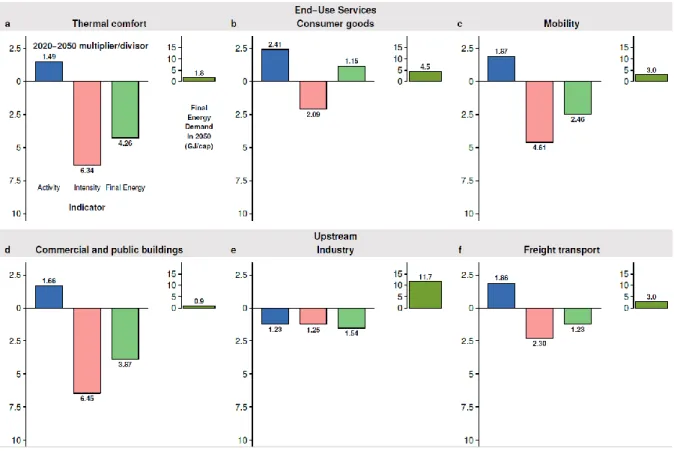
Highlights of LED for energy-end use are summarised below and in Table 1 which also provides links to extensive further documentation in the Supplementary Information. Fig. 1 summarises the decomposition analysis and resulting changes in final energy demand (see Methods for explanation).
Thermal comfort is characterised by conditioned and adequate residential floor space that converges globally to 30 m2/capita (the current average in the Global North). This is a factor of 3 higher than the minimum acceptable for a decent standard of living18. Energy use per m2 floor space improves dramatically towards current best practice designs for new construction (in the Global South), and for building retrofits (Global North) in line with recent scenario literature (see Supplementary Note 3).
Consumer goods continue to proliferate in line with rising living standards. The number of devices increases by 80% in the Global North and almost by a factor of 3 in the Global South. Energy efficiency improves significantly per device. The integration of multiple service functions in single devices (particularly smartphones) yields up to 100-fold potential power savings while in use (Fig. 2). Devices increasingly become 'smart' and interconnected, opening up potential for controllability, system integration including load management, and demand response (see Supplementary Note 4).
Mobility services (passenger-kilometres) delivered in the Global South increase by more than 100% by 2050 with rising populations, aspirations and living standards. Mobility also grows in the Global North, but more modestly, constrained by urbanisation and some virtual substitution of physical travel. Energy intensity improves drastically due to the combined effects of electric vehicles and new organisational models of service provision including shared mobility (see Supplementary Note 5).
Food supply expands by one third globally to feed a 20% larger population and to eradicate undernourishment and malnutrition. Food supply increases to 3130 kcal/capita/day and diets converge globally towards being healthier and more varied (see Supplementary Note 6).
Energy Used in Intermediate and Upstream Sectors
Changes in the type and quantity of energy services consumed by end users have knock-on effects on energy use upstream in commercial buildings, industry (including manufacturing and construction), and freight transportation.
Commercial and public buildings expand by two thirds in terms of floor area globally to 23 m2/capita in the Global North and 9 m2/capita in the Global South, where space constraints in dense cities stimulate new construction of flexible use, multi-purpose buildings. Energy efficiency improves dramatically in line with thermal comfort trends in residential buildings (see Supplementary Note 7).
Industry sees changes both downstream in the quantity and type of material goods, and upstream in the energy and material requirements of production processes (see Supplementary Note 8). Industrial process energy efficiency improves by one fifth. Aggregate total material output decreases by close to 20% from today, one third due to dematerialisation, and two thirds due to improvements in material efficiency. 'Dematerialisation' describes lower absolute material use due to increases in asset utilisation, e.g. shared car fleets requiring fewer cars. 'Material efficiency' includes light-weighting, e.g. less material input per car.
Freight transport expands in activity levels (tonne-kilometres) in both the Global North and the Global South particularly by rail. Further growth is moderated by dematerialisation and reduced transport distances in growing urban agglomerations. Modal split changes and vehicle efficiency improvements combine to yield significant reductions in energy use per tonne-km transported (see Supplementary Note 9). (Note that international shipping and aviation are reported separately in LED as international bunker fuels to ensure consistency with energy statistics).
Summary of Global Energy Demand in LED
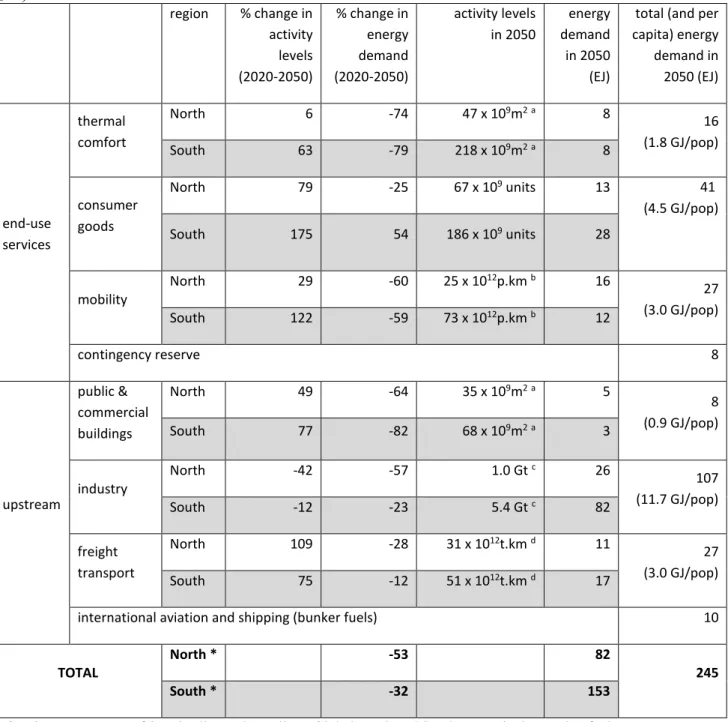
Table 2 summarises the constituents of the 245 EJ total global final energy demand in 2050, relative to reference levels in 2020 (see Methods). This total includes 8 EJ of additional final energy demand as a contingency reserve for the emergence of new energy services and 10 EJ for international bunker fuels used in aviation and shipping. Food calories are excluded from the energy demand estimates but energy needs of their production are included in the upstream sectors. Supplementary Note 10 provides extensive documentation per sector, comparisons to the literature, and 2020 base year values.
Supply-Side Transformation
LED describes a major transformation in the quantity and quality of energy services provided. Higher levels of energy services in absolute terms are provided with improved service efficiencies (e.g. higher asset utilisation), improved physical capital stock (e.g. efficient building designs and retrofits), and granular end-use technologies with diverse applications or economies of scope (e.g. batteries or fuel cells in vehicles, homes and grids). This demand-side transformation requires energy carriers with high versatility or exergy (ability to do work). As a result, LED sees strong electrification of energy end-use, consistent with the narrative of pervasive digitalisation and more versatile end-use technologies that are also non-polluting at the point of use. Over the longer term, hydrogen also increases its share of final energy demand (in addition to its role for energy storage).
Changes in energy end-use therefore drive supply-side transformation, as has been the case historically10. Consistent with the LED scenario narrative, granular energy-supply technologies like heat pumps, fuel cells, and solar PV proliferate. Granularity, decentralisation and variable renewables pose significant challenges for system management and balancing addressed via 'smart' transformation of physical networks and control systems and scaled-up storage and load management options.
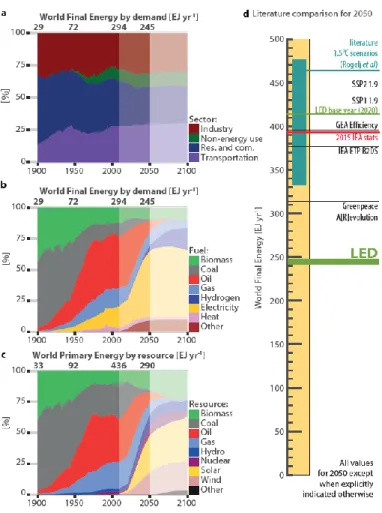
Fig. 3 shows global final energy demand by end-use sector and by energy carrier, and the implications this has for primary energy supply (see Supplementary Note 11 for regional disaggregation). Results are shown to 2100 although LED is primarily concerned with the period to 2050. Historical context is also provided19. Energy demand is shown in absolute terms for key years on top of each panel and compared to other modelling projections for 2050 on the ruler (Fig. 3d).
LED’shistorical energy shares by sector remain broadly consistent into the future (Fig. 3a). In contrast, LED shows significant structural change in end-use technologies and fuels (Fig. 3b) and resulting upstream conversion (Fig. 3c). By 2050, close to 60 per cent of global final energy is delivered by electricity and hydrogen. Remaining final energy is provided by a diverse portfolio of energy carriers including gases, liquids, and some district heat. Solids (coal, traditional biomass) are practically phased
out. This structure of final energy demand allows greater flexibility in the portfolio of supply options (Fig. 3c). Single purpose fuel-supply chains (e.g., crude oil, refineries, gasoline, cars) are substituted by 'general purpose' electricity and hydrogen supplied by a variety of low-carbon resources: solar PV, wind, biomass, hydro, and nuclear (in decreasing order of final energy supplied in 2050). Fossil fuels are increasingly phased out. Carbon capture and storage (CCS) for fossil or bioenergy was explicitly excluded in LED (see Supplementary Note 11).
Final energy demand of 245 EJ by 2050 in LED is significantly below current values and also below comparable scenarios in the mitigation literature (Fig. 3d), including the lowest scenario of all those reviewed in the IPCC Fifth Assessment Report (274 EJ in 2050; see Figure 6.18 on p44417).
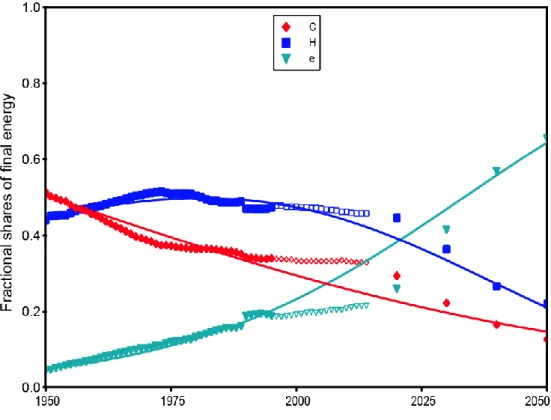
However, from a historical perspective the structural change observed in LED is 'dynamics as usual'. Fig. 4 shows the consistent dynamic of substitution from carbon to hydrogen to electrons in final energy, as energy resources and carriers shifted from fuelwood to coal, to oil, to gas, to electricity over the past 70 or so years. This dynamic has stalled over the past two decades; LED sees it restarted and continued out to 2050.
Rapid supply-side transformation in LED is enabled by low final energy demand (Fig. 5). Lowered demand (Fig. 5a) via efficiency gains and changing end-use technologies and services lead to pervasive electrification (Fig. 5b) and the diffusion of granular, decentralised energy-supply technologies including solar PV. This results in a strong expansion of low-carbon energy resources in general (Fig. 5c & 5d), and of non-biomass renewables specifically (Fig. 5e & f). Annual growth rates by 2050 are about 3% and 5% respectively. These are at or below comparable growth rates in other 1.5°C scenarios. However, as LED scales down the whole energy system, these growth rates lead to much higher market shares: 80% and 55% of primary energy from low-carbon resources and non-biomass renewables, respectively (Fig. 5d & 5f).
Low energy demand also implies less need for biofuels, reducing adverse impacts on food security (Fig. 6g). Combined with continued agricultural yield increases and changing diets (see Supplementary Note 6) cropland areas remain roughly constant, whereas forest cover expands from 4,000 to 4,300 million
hectares (Fig. 6h). These changes in both energy and land-use systems have diverse benefits for biodiversity, health, poverty alleviation, and climate (including a cumulative 168 Gt CO2 absorbed by forest sinks between 2020 and 2100).
Implications of LED for Sustainable Development Goals
LED outcomes translate into important benefits for many of the 17 UN Sustainable Development Goals (SDGs) especially when compared to other mitigation scenarios. Fig. 6 demonstrates important positive outcomes of LED for SDG2 (Hunger, Fig. 6a), SDG3 (Health, Fig. 6b & 6c), SDG7 (Energy, Fig.6d), SDG13 (Climate, Fig.6e & 6f), SDG14 (Oceans, Fig.6f) and SDG15 (Land, Fig. 6g & 6h). However, it is important to note that SDG indicators are complex and have important distributional aspects not analysed here (see Supplementary Note 12 for a fuller discussion).
Discussion and Conclusions
Scenarios are possible futures, based on a coherent and internally consistent set of assumptions about the driving forces of change20. The LED scenario is one such possible future. It comprises a detailed narrative of future social, institutional and technological change based on observable trends; bottom-up estimates of activity, intensity and final energy demand in 2050 for four end-use services and five upstream sectors, consistent with the narrative; and, quantitative energy and land-use transformation pathways to 2050, with resulting impacts on emissions and sustainable development.
LED is the lowest global energy demand scenario ever published (to the best of our knowledge). Its main findings are in stark contrast to much of the growing literature on energy and climate mitigation.
LED shows that improving energy-service efficiency is the key to achieving a range of climate and development goals synergistically. Lower demand results in greater flexibility and speed of both
end-use and supply side decarbonization, lowers pollution and reduces systems costs, as also found in earlier scenario studies21 that focused on lowering energy demand, although not to the extent of LED (Fig 3d). LED also goes significantly further in showing that the 1.5°C mitigation target can be achieved without relying on controversial and uncertain negative emission technologies.
Energy-service efficiency is the product of energy-conversion efficiency and 'use efficiency'. Enormous scope remains to improve conversion efficiencies through technological change and public policy, particularly envelope-pushing standards for buildings and appliances. Use efficiency is a more complex outcome of the organisational, institutional and infrastructural forms of energy-service provision. These effects are not commonly resolved in global scenario and modelling analysis. LED shows how an energy-services lens opens up new vistas for progressive action on global challenges.
This in turn opens many new avenues for further research. We highlight three in particular: economic implications; modelling; and implementation and policy.
The aim of LED was to examine how changing forms of energy-service provision could potentially transform both demand and supply-sides of the global energy system. Clearly this will have implications for commodity prices, economic growth, patterns of trade in energy technologies and resources, and other economic factors. We have not explored these in any detail, with the exception of supply-side investment costs and carbon shadow prices. In both cases, LED compares favourably with other mitigation scenarios (see Supplementary Note 11). For example, energy-supply investments in LED are 2-3 times lower than in other 1.5°C scenarios. But this is a one-sided story without analogous quantifications of demand-side investments and costs for which current data are mostly unavailable (see Supplementary Note 11 for discussion).
However, the big economic elephant in the room is the rebound effect. Historically, cheaper and more efficient energy services have led inexorably to demand growth and welfare gains from higher consumption22. Could this be different in a LED future? First, compared to the past, there is increasing evidence of demand saturation in activity levels (along the well-established Engel-curve for food demand)23,24. Examples include ever fewer drivers' licences held by successive younger generations25,
indications of ‘peak travel’ or ‘peak car travel’26, and the decline observed in aggregate energy use indicators like per capita electricity consumption in economies like California27. Second, rebound is not inevitable and can be managed by policy, for example, by adjusting taxation levels to offset efficiency improvements and so hold energy-service prices roughly constant (although this might be difficult to implement).
Model sensitivity analyses performed for LED show that its main conclusions (staying below 1.5°C global warming and without negative emissions technologies) remain robust even if demand increases by up to +50% (see Supplementary Note 11). This leaves a sufficient buffer to absorb potential rebound effects. Ultimately, LED's low energy demand outcomes depend on social and institutional changes that reverse the historical trajectory of ever-rising demand. How these can be endogenously represented in modelling studies remains a critical, multi-disciplinary research agenda28.
Policy also plays a critical role in driving and enabling the change depicted by LED. First, strict and tightening efficiency standards are needed for building retrofits in the Global North, for new buildings in the Global South, and for appliances and equipment globally. Forward-looking standardisation is also needed to reduce the transaction costs of technology and network integration. Second, rapid innovation, cost reductions and performance improvements from widespread diffusion of granular end-use and low-carbon supply technologies requires sustained innovation policies aligned to credible efforts to stimulate market demand29. Third, regulators need to ensure that space is opened up for new business models, digital integration, and distributed service provision to overcome incumbents' vested interests in slowing structural change30. These are important but not insuperable challenges towards a cleaner, cooler, healthier world in which high-quality living standards are enjoyed by all.
Methods
Scenario Demand Development Methodology
We carried out a bottom-up assessment of activity, intensity, and energy demand for four end-use services (thermal comfort, consumer goods, mobility, food) and five intermediate and upstream sectors (public and commercial buildings, industry, freight transport, energy supply, agriculture and land-use) using the Global Energy Assessment (GEA) Efficiency scenario1 as a starting reference point (see Supplementary Note 2).
We mapped our LED scenario narrative down onto each end-use service and upstream sector by varying GEA Efficiency assumptions about activity levels and energy intensities from 2020 to 2050 (see Table 1). This included upwards revisions to the amount of energy services provided in the Global South to ensure rising living standards in line with the LED scenario narrative. We then examined how these high levels of energy services could be provided with lower energy (and material) inputs than in GEA Efficiency, which focused more narrowly on technical improvements in energy-conversion efficiencies.
We used 2020 as a base year to ensure consistency with decadal output reported by the integrated assessment model used to assess supply-side transformation. We adjusted 2020 data from GEA Efficiency where necessary if it deviated from either recently available observations or near-term projections (e.g., activity levels for mobility in the Global South based on ITF31 and IEA32, and thermal comfort provision in buildings based on Güneralp et al.33). We provide detailed comparisons between our 2020 estimates and recent data for each end-use sector in Supplementary Note 10. We also enriched GEA Efficiency data with further detail and analysis where necessary (e.g., dematerialisation impacts on industrial production processes based on Allwood et al.34).
Changes to activity and energy intensity from 2020 to 2050 relative to GEA Efficiency combine to provide estimates of final energy demand in 2050 (Table 1). We focused on a 2050 timeframe over which the major end-use and supply transformations of the LED scenario need to take place in order to meet the SDGs. To assess longer-term climate change implications, we extended the LED scenario
to 2100 based on simplified assumptions (stationary energy demand), but we emphasise that the LED’s analytical focus is on the period to 2050.
Bottom-Up Assessments of Energy Demand
Table 1 summarizes the headline changes to activity levels and energy intensities in the Global North and South over the period 2020 to 2050. Here we explain the main underlying assumptions derived from relevant elements of the LED scenario narrative (further detail is provided in the relevant Supplementary Notes, with all relevant links shown in Table 1).
Thermal comfort improves through strong end-user demand for higher living standards and rising quality of life. Activity levels in the Global South (approximated by floor space) rise to around 30 m2/capita, particularly in multi-family dwellings given pervasive urbanisation and densification. In line with recent scenario studies33,35, floor space in the Global North converges downwards to a similar level as trends towards suburban single-family dwellings revert back to urban living in cleaner, less congested, more amenable cities.
In the Global North, retrofit rates double to around 3% of the housing stock per year stimulated by low-cost, low-hassle techniques for installing pre-fabricated building shells combining external wall insulation with solar PV and air-source heat pump units (e.g. by Energiesprong Foundation36). Offsite manufacture reduces costs for high-performance retrofits through standardisation, economies of scale, and controlled manufacturing. In the Global South, rising cooling demands in new build homes lead to a ratcheting up of efficiency and indoor air quality standards improving building quality through best practice design (e.g., Passivhaus standards with forced ventilation and advanced regenerative room conditioning systems).
Diversifying end-user roles within an increasingly decentralised energy system stimulates the diffusion of granular end-use technologies including heat pumps and fuel cells. Economies of scope (heating, cooling, hot water) create energy-service efficiency gains relative to traditional single-purpose systems (gas boilers, air-conditioning units).
Consumer goods are not an end-use service per se but provide for cooking, lighting, hygiene, entertainment, communication and other useful services principally within the home. In energy-demand analysis, consumer goods tend to be bundled into 'specific electricity consumption' within the buildings end-use sector. As they are an important determinant of material wellbeing and living standards, we separate them out.
In the LED scenario, activity levels approximated by numbers of devices see factor 2 increases in the Global North and factor 3 increases in the Global South pulled by rising incomes and living standards (cooking, lighting). Information and communication technologies (ICTs) continue to diffuse and diversify to provide new and improved energy services. In the Global North, activity growth is more constrained by increasing economies of scope as multiple functions converge into single devices (e.g. smartphones).
The digitalisation of devices and appliances accelerates. Low-cost distributed sensors, processors, and wireless communication become ubiquitous. Connected, responsive, 'smart' devices improve controllability and help reduce passive losses (e.g., lighting unoccupied rooms). Cloud-based services disseminate operating improvements (as software patches) and allow for rapid energy-performance optimisation. Online platforms also enable peer-to-peer and commercial exchange of surplus capacity increasing utilisation rates of physical goods. Coupled with increased uptake of shared mobility, 'usership' starts to weaken cultural norms of 'must-have' ownership. Consumers demand service quality, variety, flexibility, convenience, low lifecycle costs.
Mobility-related activity levels (passenger-kilometres) in the Global South double as populations, incomes, work and leisure opportunities rise. Further activity growth is constrained by dense cities, shared modes, and some substitution of physical mobility by telepresence as improving quality of life demands stringent action on air pollution and congestion. The same constraints reduce activity in the Global North and stimulate vehicle and mode shifting away from private cars. Rapid market diffusion of electric vehicles with factor 3 improvements in power-train efficiency is enabled by the short useful life of vehicles, especially when compared to infrastructures. Real-time information via mobile
devices support shared vehicle fleets (including autonomous vehicles) and flexible transit systems, which rationalise vehicle usage and reduce congestion31,37. Increasing vehicle occupancy by 25% and vehicle usage per day by 75% delivers the same intra-urban mobility with 50% of the vehicle fleet. By 2050 total vehicle numbers have halved to around 850m light duty vehicles.
Fewer vehicles allows existing road infrastructure to be repurposed for walking, cycling and recreation. New forms of mobility-as-a-service are characterised by ease of use, flexibility, and variety of choice. High-frequency, high-capacity public transport routes emphasise use of existing infrastructure (e.g., rapid transit buses) rather than lumpy new infrastructure with high sunk costs (e.g., trams, trains). Electrified rail remains the mode of choice for long-distance inter-urban mobility.
Food is an important determinant of human health and capabilities, but is not an energy end-use per se. We include it here because dietary preferences affect land use change and greenhouse gas emissions from agricultural production. In the LED scenario, global food production increases sharply to provide a growing population with adequate calorific intake (including for the 800 million people currently undernourished38) and with adequate micronutrients (including for the 2 billion people current at risk of one or more mineral, vitamin or other deficiency39). Growing concerns for healthy living also induce dietary shifts away from excessive calorific intake and red meat consumption. In the Global North daily intake does not exceed 3,500 kcal in 2050, and meat consumption stays relatively constant despite increasing prosperity.
Sustainable intensification dominates agricultural production, but diversifying end-user roles combined with rapid urbanisation also lead to proliferating decentralised food production. Small-scale (granular) non-meat production systems become more common including urban farms, vertical farms, hydroponic and aquaponic systems, and roof-top greenhouses using building waste heat. These trends are consistent with end users playing more active and heterogeneous roles in final service provision, but make little impact on aggregate global food production.
Commercial and public buildings range from offices and shopping centres to hospitals and schools. Drivers of change in the LED scenario are similar to those in residential buildings for thermal comfort
(heating and cooling) and consumer goods (electricity-using devices and appliances). Activity levels increase in the Global South. Space constraints in dense cities stimulate new construction of flexible use, multi-purpose buildings. Economies of scope combine with digital exchange platforms to reduce surplus unused capacity. Thermal performance improves markedly through retrofit (Global North) and standards and best-practice designs (Global South). Conversion efficiency of end-use devices similarly improves through standards, digitalisation, economies of scope, and reduction of passive losses.
Industry includes consumer goods manufacturing, raw materials processing, and buildings and infrastructure construction. Energy use in industry is determined by downstream changes in the quantity and type of material goods required ('dematerialisation'40), and the energy and material requirements of industrial production processes ('material efficiency'34).
Activity levels (approximated by the weight of industrial output) grow significantly in the Global South with rising living standards and development aspirations for improved material well-being. Physical capital stocks and material standards of living in the Global North are closer to saturation. Emphasis shifts to repurposing and optimising use of existing goods and infrastructure, and the quality of useful services provided. Consumer shifts away from ownership (with preferences for low upfront costs) towards 'usership' (with preferences for high quality services) are supported by service-based and sharing-economy business models, enabled by pervasive digitalisation. Service provision benefits from lower maintenance, longer-lived, higher quality products, leading both to light-weighting (lower materials use for same functional performance) and lifetime extensions (reduction in materials needed for replacements). One-off material inputs increase relative to low quality 'throw away' designs, reducing resource use overall as turnover rates fall and reuse rates increase. Multiple drivers of change in the LED scenario thus interact to dematerialise end-use services. Halving the private vehicle stock (see above) by 2050, reduces global demand for steel by 14Mt and saves around 3 EJ of industrial energy use. Consumer preferences for service quality in clean urban environments reduce chemical substances in once-through use plastics, reducing global demand for petrochemical and feedstock
materials by 600Mt and saving around 17 EJ of industrial energy use. Extending building lifetimes by 25% reduces cement use by around 20%34 and energy use by up to 2 EJ.
Freight transport in the LED scenario is strongly influenced by changing end-use demand for goods, and upstream changes in manufacturing and construction. As with passenger mobility, rising populations and incomes see total activity, measured in tonne-kilometres, rise strongly (+140%) in the Global South. However, a combination of dematerialisation, product life extension, and urban space constraints slow further demand growth for the movement of goods. Energy intensity of freight transport is shaped by similar drivers to those affecting passenger mobility, including electrification and increased vehicle and transit utilisation.
International statistics report energy and emissions data from international aviation and shipping separately. Following the same drivers of change in passenger mobility and freight transportation, we include an additional 10 EJ of energy use by international aviation and shipping (bunker fuels), which is roughly a 25% increase from current values. Limited potentials for electrification in shipping and aviation result in no significant intensity changes.
System Modelling of Supply-Side Transformations in Energy and Land Use
The detailed bottom-up assessment of the quantity and type of end-use services (with corresponding changes in upstream sectors) provides us with disaggregated final energy demand over the period 2020 to 2050. We assess how this impacts energy supply and land use with the MESSAGE-GLOBIOM integrated assessment modelling framework7. This framework couples MESSAGE, an energy-supply model41, with GLOBIOM, a land-use model including agriculture and forestry42.
The energy supply impacts of the LED scenario were calculated using MESSAGE (Model for Energy Supply Strategy Alternatives and their General Environmental Impact), which is a linear programming (LP) energy engineering model43. With its inter-temporal optimisation solution framework, MESSAGE minimizes total discounted energy systems costs for a range of scenario-specific parameters (including energy demands, resource availability, technology costs) subject to technical constraints (e.g. demand-supply balancing) as well as scenario-specific constraints (e.g. carbon emission budgets). For the LED scenario, target final energy demands from the bottom-up assessments were formulated at the level of final energy disaggregated to 2 regions (Global North and South) and then downscaled to the 11 MESSAGE regions in proportion to their respective regional shares in the SSP2 scenario (see below)44.
We ran MESSAGE by imposing three types of constraints: First, bottom-up assessments of final energy demand per sector had to be met (see Table 1). Second, the portfolio of available technology options had to exclude carbon capture and storage (CCS) and all negative emission technologies like bioenergy with CCS (BECCS) and direct air capture of CO2 (noting that afforestation calculated by the GLOBIOM model is not affected by this technology constraint). Third, cumulative carbon emissions had to fall within the budget of 390 Gt CO2 between 2020 and 2100 in order to limit global warming to 1.5°C target by the end of 21st century.
The Shared Socioeconomic Pathway 2 (SSP2) scenario44 set-up provided the base parameterisations of our MESSAGE model runs in terms of resource availability, technology costs, and efficiencies, assuming a 3% discount rate. The SSPs are part of a new scenario framework established by the
climate change research community to facilitate the integrated analysis of future climate impacts, vulnerabilities, adaptation, and mitigation.
Within the SSPs, SSP2 depicts a central, middle-of-the road pathway describing a development consistent with intermediate challenges for both adaptation and mitigation7. The SSP2 storyline is described in O’Neill et al.45. It has also been interpreted with the MESSAGE-GLOBIOM modelling framework. The quantitative results and the underlying modelling assumptions are summarized in detail in Fricko et al.7. In addition to the SSP2 baseline (with no climate constraints), alternative climate change mitigation scenarios with a target of 6.0 to 1.9 W/m2 by 2100 have been developed7,46. SSP2-1.9 (denoting SSP2 with SSP2-1.9W/m2 radiative forcing) is comparable to the LED scenario in its climate outcomes consistent with limiting global warming to 1.5°C.
In SSP2, global population growth is moderate and levels off in the second half of the century47. Gross Domestic Product (GDP) follows historical trends48. The availability of fossil-energy resources (based on various sources1,49) reflects the intermediate characteristics of the SSP2 storyline7. Renewable energy resource potentials for solar and wind follow a central path and are classified according to resource quality (annual capacity factor) based on Pietzcker et al.50 and Eurek et al.51. The resource quality curves are implemented in the MESSAGE-GLOBIOM model7 with regionally-specific capacity factors for solar PV, concentrating solar power (CSP), onshore and offshore wind as described in Johnson et al.52. To account for the variability of solar and wind energy, MESSAGE incorporates renewable integration constraints53. Technological costs vary regionally; costs start out lower in the developing world, and are assumed to converge to those of present-day industrialized countries as the former becomes richer. Estimates for present-day and mature technology costs are from the Global Energy Assessment1 and World Energy Outlook54. Assumptions for granular technologies, including solar PV, small-scale hydrogen production, fuel cells, heat pumps, and distributed energy storage such as batteries, or fuel cells were updated from SSP2 to reflect the more dynamic storyline of the LED scenario (see Supplementary Table 28). For all other technology assumptions the original SSP2 specifications were retained.
The agricultural and land-use impacts of the LED scenario were assessed by feeding carbon prices and biomass demand for energy use from MESSAGE into GLOBIOM. GLOBIOM, the Global Biosphere Management Model, is a partial equilibrium model of the global agricultural and forestry sectors42. GLOBIOM represents major GHG emissions from agricultural production, forestry, and other land use. Changes in socioeconomic and technological conditions, such as economic growth, population changes, and technological progress, lead to adjustments in the production mix and the use of land and other productive resources. By solving the model in a recursive dynamic manner for 10 year time steps, decadal trajectories are generated for variables related to supply, demand, prices, emissions, and land use.
For the LED scenario, a food security constraint was imposed in GLOBIOM to avoid trade-offs with food security. The constraint ensures that rising populations in the Global South are not worse off in terms of animal and vegetal calorie intake as a result of land-use based climate mitigation efforts (e.g., expansion of bioenergy crops). In the Global North, a minimum calorie intake threshold was imposed up to which countries could reduce their consumption levels.
Evaluating Impacts of LED Scenario Outcomes on a Range of SDGs.
The quantitative outcomes of the LED scenario from MESSAGE-GLOBIOM were evaluated against relevant SDGs (see Supplementary Note 12). Poverty eradication impacts were assessed through consistency checks with quantitative literature on minimum acceptable thresholds for activity levels and energy demand per capita to ensure 'decent living standards'18. Air quality and health impacts were quantified by linking MESSAGE-GLOBIOM with the Greenhouse Gas and Air Pollution Interactions and Synergies (GAINS) model. GAINS projects emissions of air pollutants while considering air pollution policies and standards, and computes the ambient concentrations of fine particles and associated premature mortality rates55. GAINS calculates emissions globally, whereas ambient concentration calculations focus on specific geographical areas covering two thirds of the
world population.Climate change implications were assessed used the MAGICC reduced complexity carbon-cycle and climate model7,56 in a probabilistic setup constrained by historical observations of hemispheric temperatures and ocean heat uptake57. The model setup is consistent with the latest assessment by the Intergovernmental Panel on Climate Change (IPCC) with regard to equilibrium climate sensitivity and transient climate response58. A similar setup was used for the most recent climate assessment of emissions scenarios by IPCC Working Group III17.
Data availability
Extensive documentation of LED scenario data, assumptions, and bottom-up assessments are provided in Supplementary Information (see Table 1 for links)
.
Data describing the LED scenario from integrated assessment model output are publicly available in the “LED Database” at:https://db1.ene.iiasa.ac.at/LEDDB/. Analogous data for the SSP scenarios are publicly available in the “SSP Database (Shared Socioeconomic Pathways)” at https://tntcat.iiasa.ac.at/SspDb/.
Tables and Figures
Table 1. Main assumptions & findings, key references, and links to Supplementary Notes, Figures, and Tables.
LED scenario Main Assumptions Key References Links to Supplementary
Information
Notes Figures Tables Rationale Underlying justification for LED scenario's emphasis on energy services and final energy demand. Gilli et al. 19965,
Nakicenovic et al. 199359,
Cullen & Allwood 20106
1 1 1
Narrative Overview and discussion of five scenario drivers and how these generate five additional elements of scenario narrative.
Fouquet 201010, UN DESA
20159, ITF 201732,
Urge-Vorsatz et al. 201860, 61Rao
& Min 201718
2 2-7 2
Activity Levels Energy Intensity
En d -u se S er v ice s thermal comfort
Roughly constant in Global North and 35% increase in Global South converging on a global average of
30m2/capita.
High service-efficiency thermal end-use technologies combined with doubling of retrofit rate (Global North) and new build standards (Global South) reduces energy intensity by 75% in Global North to
around 160-170 MJ/m2 and by 86% in Global South to 40 MJ/m2. Guneralp et al. 201733; Urge-Vorsatz et al. 201235 3 3 consumer goods
Factor 2 increase in Global North to 42 devices per capita; factor 3 increase in Global South to 24 devices per capita.
Fall in global average electricity intensity, weighted by share of total devices, from 93 to 82 kWh/device, with strongest reductions in lighting and appliances.
IEA 201732; von
Weizsäcker et al. 201461
4 8 4-11
mobility Factor 2 increase across all modes (particularly flexible route shared vehicles) in the Global South; 20% fall in the Global North with larger reductions in road-based modes offsetting increases in rail and air.
70% fall in global average energy intensity weighted by modal share, with strongest reductions in road-based modes, resulting from electrification, shared fleets, flexible public transit, and active modes.
ITF 201731; Kahn-Ribeiro et
al. 201262
5 9-10 12-16
food Increase of food demand by 70-100% globally, combined with the continuation of dietary transition. Food availability is solved in Global South, reaching appropriate calorie intake.
Energy intensity impacts are not quantified in LED.
Smith et al. 201463, Valin et
al. 201464, Havlik et al
201442, Bajzelj et al 201465
Inter m ed ia te a n d Upstr ea m S ec to rs commercial & public buildings
43% increase to 23m2/capita in Global North and 50%
increase to 9m2/capita in Global South.
Falls 76% to an average of 139 MJ/m2 in
Global North and falls 90% to an average
of 44 MJ/m2 in Global South.
Guneralp et al. 201733;
Urge-Vorsatz et al. 201235
7 18
industry Demand for global commodities (steel, aluminium, cement, paper, petrochemicals, and feedstocks) falls by around 15% to 6.4 Gt as a result of dematerialisation (1/3) and improvements in material efficiency (2/3).
Global average energy intensity, weighted by activity shares of specific manufacturing and construction processes, falls by a fifth to 16.7 GJ/t.
Allwood et al. 201234; IEA
201732; Banerjee et al.
201266
8 19-20
freight transport
Rises by around 20% in the Global North to 64 trillion t-km, and by around 70% in the Global South to 58 trillion t-km, with stronger increases in rail (and shipping) and some reduction in truck activity.
Global average intensity (MJ/t-km) falls by 50% to 0.5 - 0.7 MJ/t-km for trucks and by 10% to 0.2 MJ/t-km for rail. Limited potentials for electrification in shipping and aviation, so no significant intensity changes.
Kahn-Ribeiro et al. 201262 9 21-22
Main Findings Total Final Energy
Demand
Compared to similarly ambitious climate-target and low-demand scenarios at both global and regional levels (Global North & South), LED is identified as the lowest final energy demand scenario ever published in the literature.
ITF 201732, De Stercke
201419, GEA 201267, Tecke
et al. 201568, Clarke et al.
201417
10 11-12 23-27
Supply-Side Transformation
Changes in levels and structure of end use drive supply-side transformation and decarbonisation. Trends towards electrification, and increasing shares of renewables drastically reduce dependence on fossil fuels in end-use and supply. Continued productivity increases in agriculture and lessened demand for biofuels allows for reforestation. Scenario quantifications in the MESSAGE-GLOBIOM Integrated Assessment Modelling framework are based on a SSP2 scenario setup, but adjusted with assumptions derived from the LED scenario narrative.
Nakicenovic et al. 199359, Rogelj et al. 201846 11 13-22 28-32 Implications for Sustainable Development Goals
Implications of LED on SDG 1 (Poverty), SDG 2 (Hunger), SDG 3 (Health), SDG 7 (Energy), SDG 12 (Responsible Consumption and Production), SDG 13 (Climate) and SDG 14 (Ocean) are assessed qualitatively and quantitively. SDG1 is assessed through the Decent Standards of Living framework. SDG3 analysis is assessed using the GAINS Model.
Rao & Min18, Smith et al.
201269, Rogelj et al. 20153,
Smith et al. 20164
Table 2. Impact of LED Scenario on Final Energy Demand in 2050.
Notes: All sub-totals and totals are rounded (lower integer at numerical values <.5, to upper integer ≥0.5). region % change in activity levels (2020-2050) % change in energy demand (2020-2050) activity levels in 2050 energy demand in 2050 (EJ)
total (and per capita) energy demand in 2050 (EJ) end-use services thermal comfort North 6 -74 47 x 109m2a 8 16 (1.8 GJ/pop) South 63 -79 218 x 109m2a 8 consumer goods North 79 -25 67 x 109 units 13 41 (4.5 GJ/pop) South 175 54 186 x 109 units 28 mobility North 29 -60 25 x 1012p.km b 16 27 (3.0 GJ/pop) South 122 -59 73 x 1012p.km b 12 contingency reserve 8 upstream public & commercial buildings North 49 -64 35 x 109m2a 5 8 (0.9 GJ/pop) South 77 -82 68 x 109m2a 3 industry North -42 -57 1.0 Gt c 26 107 (11.7 GJ/pop) South -12 -23 5.4 Gt c 82 freight transport North 109 -28 31 x 1012t.km d 11 27 (3.0 GJ/pop) South 75 -12 51 x 1012t.km d 17
international aviation and shipping (bunker fuels) 10
TOTAL
North * -53 82
245
South * -32 153
* Contingency reserve of 8 EJ is allocated equally to Global North and South respectively. Bunker fuels are reported at the global level only, consistent with current energy balances and emission accounting frameworks. Activity level units vary per end-use service and upstream sector: a billion m2 of floor space; b trillion
Figure 1. Decomposition analysis of determinants of LED final global energy demand for end-use services and upstream sectors.
Changes 2020-2050 in total global activity, energy intensity and final energy demand (left chart in each panel; variable multiplier above x-axis, divisor below) and resulting per capita final energy demand (GJ/capita, right chart in each panel). Note that decomposition is represented by variable multipliers or divisors with direction of change also shown. These are multiplicative and not additive with the final energy change being the product of the activity and intensity changes between 2020 and 2050. Panels a-c show end-use services: (a) thermal comfort, (b) consumer goods, and (c) mobility. Panels d-f show upstream sectors: (d) commercial and public buildings, (e) industry, and (f) freight transport. For regionally disaggregated results see Supplementary Note 10.
Figure 2. Example of Reduced Energy Demand through Digitalisation and Device Convergence. A smartphone with 5 W power and 2.5 W standby energy use provides a single, integrated digital platform, which potentially substitutes for over 15 different end-use devices. Resulting reductions in power (load, blue) are close to a factor 100, and reductions in standby energy use (orange) are close to a factor 30. Source: Supplementary Table 4. For a pictorial representation see Tupy70.
Figure 3. LED scenario in historical context and in comparison to the literature.
Structural changes in: (a) final energy shares by sector, (b) final energy shares by fuel, and (c) primary energy shares by resource, historical data (to 2014, no shading), LED scenario to 2050 (light shading) and simplified scenario extension post 2050 (lightest shading) used for calculating climate change outcomes. Absolute levels of historical final and primary energy are indicated for key years on top of panels (a), (b), and (c). Panel (d): Final energy demand (EJ) for LED compared to 2015 statistics, LED 2020 base year, and comparable scenarios with stringent climate mitigation for the year 2050, including the Shared Socioeconomic Pathways SSP1 and SSP2 1.9 W/m2 scenarios7,71; other literature on 1.5˚C scenarios3, the IEA ETP Beyond 2 Degree (B2DS) scenario32; the
Greenpeace A[R]evolution scenario68. The GEA Efficiency scenario that provided the starting point for LED is also shown. Note: primary energy of non-combustible energy carriers is counted as the direct equivalent of secondary energy output.
Figure 4. Dynamics of change in global final energy structure historically and in the LED scenario.
Fractional shares of final energy provided by (oxidation of) carbon (C, red diamonds), hydrogen (H, blue squares), and electrons (e, electricity, also including direct uses of heat, turquoise inverted triangles) analysed with a model of competing technologies or products. Hydrocarbon fuels are allocated to the respective carbon and hydrogen fractions of fuels based on their specific stoichiometric hydrogen-carbon ratios (e.g. 1:4 in case of methane, CH4) applied to fuel energy contents using lower heating values (LHV). Symbols represent historical (1950 to 2015) and LED data (2020, 2030, 2040, 2050). Lines represent logistic substitution curves fitted to the combined historical data and 2020-2050 LED scenario data (filled symbols) omitting the 1995-2015 stagnation in observable structural change (unfilled symbols).
Figure 5. Projected global final energy, low-carbon supply and non-biomass renewables in the LED scenario.
Global energy system in terms of: (a) final energy in 2050 (in EJ), (b) share of electricity and hydrogen in final energy, (c) annual deployment rate (EJ/year) of all low-carbon resources in 2050, (d) resulting share (%) of all low-carbon resources in global primary energy in 2050. Low carbon resources comprise solar, wind, hydro, geothermal, biomass, and nuclear. Panels (e) and (f) show the same data for non-biomass renewables only. All panels compare the LED scenario (green circles) with scenarios developed under the Shared Socioeconomic Pathways (SSP) framework including 3 SSP baseline scenarios with no climate constraints44 (red, SSP1: diamonds, SSP2: squares, SSP3: stars) and two SSP 1.9 W/m2 (orange, SSP1: diamonds, SSP2: squares, SSP3: no 1.9 W/m2 scenario available) scenarios46 interpreted by the MESSAGE-GLOBIOM model in separate studies. Dashed lines show 2020 values for comparison.
Figure 6. Global Sustainable Development Goals benefits of the LED scenario.
Panels show how LED scenario results in multiple benefits across different Sustainable Development Goals (SDGs): (a) SDG2 (increased food availability reduces the risk of Hunger); (b) and (c) SDG3 (reduced air pollution from black carbon and sulphur improves Health); (d) SDG7 (less traditional biomass use indicates improved Energy access to modern energy forms); (e) SDG13 (reduced temperature change positively impacts Climate); (f) SDG14 (Ocean, reduced CO2 concentration reduces ocean acidification); (g) and (h), SDG15 (Land, less biomass use for energy and larger forest areas benefits biodiversity). All panels compare LED scenario (green circles) with Shared
Socioeconomic Pathways (SSP) scenarios including 3 SSP baselines with no climate constraints44 (red, SSP1: diamonds, SSP2: squares, SSP3: stars) and two SSP 1.9 W/m2 scenarios (orange, SSP1: diamonds, SSP2: squares, SSP3: no 1.9 W/m2 scenario available). Progress towards SDG goals achievement is denoted by circled arrow symbols (increase or decrease of indicator). Arrows in circles denote direction of change to achieve positive SDG benefits, which in some cases can be achieved only within bounds (capped arrows, e.g. maximizing forest cover would jeopardize cropland
availability for food production and hence SDG1). Dashed lines show 2020 values or other target levels for comparison.