BORYANA KRASIMIROVA TSENKOVA
SYNTHESIS AND CHARACTERIZATION OF IONIC
CO-CRYSTALS OF ENANTIOPURE AND RACEMIC PROLINE
UNIVERSIDADE DO ALGARVE FACULDADE DE CIÊNCIAS E TECNOLOGIA
BORYANA KRASIMIROVA TSENKOVA
SYNTHESIS AND CHARACTERIZATION OF IONIC
CO-CRYSTALS OF ENANTIOPURE AND RACEMIC PROLINE
Erasmus Mundus MSc in Chemical Innovation and Regulation Mestrado Erasmus Mundus em Inovação Química e Regulamentação
Trabalho efetuado sob a orientação de: Work supervised by:
Prof. Fabrizia Grepioni (University of Bologna) Prof. Teresa Duarte (Centro de Química Estrutural)
UNIVERSIDADE DO ALGARVE FACULDADE DE CIÊNCIAS E TECNOLOGIA
1 SYNTHESIS AND CHARACTERIZATION OF IONIC CO-CRYSTALS OF
ENANTIOPURE AND RACEMIC PROLINE
Declaration of Authorship
I declare that I am the author of this work, which is original. The work cites other authors and works, which are adequately referred in the text and are listed in the bibliography.
Boryana Krasimirova Tsenkova
Copyright: Boryana Krasimirova Tsenkova. The University of Algarve have the right to keep
and publicize this work through printed copies in paper of digital form, or any other means of reproduction, to disseminate it in scientific repositories and to allow its copy and distribution with educational and/or research objectives, as long as they are non-commercial and give credit to the author and editor.
2
ACKNOWLEDGEMENTS
I am grateful to the European Commission for the scholarship funded within the Erasmus+ KA1 Programme ref.2013-0241-Erasmus Master Joint Master Degree in Chemical Innovation and Regulation.
I would like to express my gratitude for the wonderful collaboration between UAlg, CQE and UniBo, which allowed me to perform all the experimental work under the supervision of
Prof. Fabrizia Grepioni (UniBo) and Prof. Teresa Duarte (CQE). I would like to express my heartfelt gratitude to both of them for their support, expert guidance, understanding and continuous encouragement throughout this project.
This thesis would not have been possible without the support of the members of the Crystal Engineering groups at University of Bologna and CQE. I would like to express my gratitude for their kind guidance and assistance to Lorenzo degli Esposti, Oleksii Shemchuk, Dr. Vânia Andre, Prof. Lucia Maini and Dr. Katia Rubini. It has been a great honor to work in the research group of Prof. Dario Braga.
I would like to express my deepest appreciation to – Prof. Isabel Cavaco and Prof. Emilio Tagliavini for creating and coordinating this programme.
Finally, I would like to thank my parents, my sister, and my partner, for providing me with unconditional love and emotional support through this challenging project. I would like to thank my ChIR family for creating a supportive and academically stimulating environment.
3
ABSTRACT
An ionic co-crystal (ICC) is a multicomponent solid formed by at least an organic molecule and an inorganic salt in a defined stoichiometric ratio. ICCs have the potential to alter physicochemical properties (such as solubility and thermal stability) of a pure organic material of interest, and recent research has also highlighted the possibility of chiral resolution through ICC formation.
The purpose of the current work was to synthesize and characterize novel ionic co-crystals of racemic proline with lithium halides using mechanochemical and solution techniques, and to investigate the solid-state chiral resolution ability of lithium. The synthesis of molecular and ionic co-crystals of enantiopure and racemic proline with different inorganic salts and organic co-formers was attempted in order to obtain novel compounds with modified properties. Powder and Single Crystal X-ray diffraction, TGA and DSC were the main techniques used for the characterization of the novel compounds.
The results obtained confirm the potential for chiral resolution through ICC formation as conglomerate and racemate ICCs were obtained. In the racemate ICCs, at least in the 1:1 stoichiometry amino acid to lithium halide, a very consistent pattern was observed - the homochiral preference of Lithium resulted in the formation of homochiral columns. Previously described in the literature ICC of (DL-Proline)2•ZnCl2 with homochiral columns spiked our
interest and a different synthesis procedure was followed, resulting in the formation of a (DL-Proline)2•ZnCl2 polymorph without the homochiral columns. These results encourage further
studying the factors that promote homochiral column formation in the crystal packing - a possible precursor to conglomerate formation. Narrowing down these factors could allow us in the future to fine-tune the co-crystallization of chiral compounds as a conglomerate or a racemate ICC and pave the road towards novel methods for chiral resolution.
4
RESUMO
Co-cristal iónico (CCI) é um sólido multicomponente formado por pelo menos uma molécula orgânica e um sal inorgânico numa razão estequiométrica definida. Os CCIs têm o potencial de alterar propriedades físico-químicas (tais como solubilidade e estabilidade térmica) de um material orgânico puro. Dados recentes mostraram ainda a possibilidade de serem utilizados em resolução quiral.
O objetivo do trabalho apresentado foi o de sintetizar e caracterizar novos CCIs de DL-prolina com halogenetos de lítio, usando técnicas de mecanoquímica e de solução, com o intuito de investigar a capacidade de resolução quiral do lítio. Foi tentada a síntese de diversos co-cristais moleculares e iónicos tanto da L- como da DL- prolina com diferentes sais inorgânicos e moléculas orgânicas, para a obtenção de novos compostos com propriedades modificadas. A difração de raios-X de pó e cristal único, TGA e DSC foram as principais técnicas utilizadas na caracterização dos novos compostos.
Os resultados obtidos confirmam o potencial de resolução quiral do Li através da formação de CCIs, à medida que foram obtidos conglomerados e racematos. Nos CCIs de racematos, pelo menos na estequiometria 1: 1 (prolina: haleto de lítio), observou-se um padrão muito consistente - a preferência homoquiral do lítio resultou na formação de colunas homoquirais nos diferentes CCIs. Já anteriormente descrito na literatura, o CCI da (DL-Prolina)2 • ZnCl2 mostrava colunas
homoquirais, o nosso interesse aumentou, quando utilizando o nosso procedimento experimental obtivemos um polimorfo, mas sem as colunas homoquirais. Estes resultados estimularam o interesse pelo estudo dos fatores que promovem a formação de colunas homoquirais no empacotamento cristalino - um possível precursor da formação de conglomerados. O estudo e controle dos diferentes factores de cristalização, permitirão no futuro, afinar a co-cristalização de compostos quirais em conglomerados ou em racematos e pavimentar o caminho para novos métodos de resolução quiral, recorrendo a CCIs.
5
TABLE INDEX
Table 1.1 Unit cell parameters of anhydrous and hydrated forms of enantiopure and racemic proline. .... 19
Table 1.2 Unit cell parameters for previously reported ICCs of Proline of relevance to this work. ... 21
Table 2.1 Summary of successful experiments using mechanochemistry. ... 25
Table 2.2 Summary of successful experiments using solution methods. ... 26
Table 2.3 Crystallographic data for novel Hydrated Ionic Co-crystals. ... 29
Table 2.4 Crystallographic data for the Anhydrous Ionic Co-Crystals (1:1 stoichiometry). ... 30
Table 2.5 Crystallographic data for Ionic Co-Crystals (Different Stoichiometry) ... 31
Table 3.1 Summary of DSC results for all ICCs. ... 50
Table 3.2 Comparison of the packing efficiency (%) of all enantiopure, racemate and conglomerate-forming ICCs. ... 52
Table 3.3 Synthesis of ICCs: Cases of unsuccessful reactions. ... 64
6
FIGURE INDEX
Figure 1.1 Example of the most common homo- and hetero synthons: I is carboxylic acid homosynthon; II an amide dimer homosynthon; III is an acid-amide dimer heterosynthon; IV is a head-to-tale chain formed from carboxylic acids; V is a six-membered intramolecular hydrogen; VI N-H…O and O-H…N synthon; VII C-H…O synthon; VIII is a synthon often observed in diols. [3]
... 10 Figure 1.2 Solid State Crystal forms[5] ... 11 Figure 1.3 Possible solid state phases of racemic mixtures.[19] ... 15 Figure 1.4: Diastereomeric Co-Crystal formation (top) vs. Diastereomeric salt formation (bottom).
Diastereomeric co-crystal formation refers to the possibility of co-crystallizing a racemic molecule (S/R) with an enantiopure co-former to obtain co-crystals (no proton transfer) with different physicochemical properties, while with diastereomeric salt formation the idea is to form a salt (proton transfer complete) between the racemate (S/R) and the enantiopure resolving agent to obtain products with different physicochemical properties. ... 16 Figure 1.5 Proline in its neutral (a) and zwitterionic (b) forms. ... 18 Figure 2.1 Thermogravimetric analysis of a) L-Proline and b) DL-Proline. L-Proline and DL-Proline are
thermally stable up to ~ 225°C ... 23 Figure 3.1 Comparison between the experimental powder pattern of DL-Pro•LiCl•H2O (top), calculated
from single crystal, rac-Pro•LiCl•H2O (middle) and the conglomerate of L-Pro•LiCl•H2O and
D-Pro•LiCl•H2O (bottom) one calculated by single crystal data (bottom). Differences between the
XRD patterns are highlighted in the green boxes. ... 35 Figure 3.2 Kinetics of DL-Pro•LiCl•H2O formation. Powder sample was ground with a drop of water for
5 min and XRD pattern. The characteristic racemate doublet peak at 17.6-18.1 2θ range is present already after 5 min of grinding. The calculated XRD pattern corresponds to the racemate
DL-Pro•LiCl•H2O ICC. ... 36
Figure 3.3 TGA trace of DL-Proline•LiCl•H2O. Analysis shows the loss of 10% sample weight starting at
90°C. As each of the starting reagents has a higher melting point than 90°C and with the knowledge from single-crystal analysis that the ICC is hydrated, this weight loss is assigned to loss of
crystallization water. ... 37 Figure 3.4 DSC (closed pan) Analysis of DL-Proline•LiCl•H2O. ... 37
Figure 3.5 a) Packing of L-Pro•LiCl•H2O (CCDC YOXBET), b) Racemate DL-Pro•LiCl•H2O and c)
Conglomerate of L-Pro•LiCl•H2O and D-Pro•LiCl•H2O. The packing arrangement is very similar
between the three compounds
7 Figure 3.6 Comparison between the experimental powder pattern of conglomerate DL-Proline•LiBr•H2O
(top) and the one calculated by single crystal data (bottom)... 39 Figure 3.7 TGA trace of DL-Proline•LiBr•H2O. Analysis shows the loss of 8% sample weight starting at
110°C. As each of the starting reagents has a higher melting point than 100°C and with the
knowledge from single-crystal analysis that the ICC is hydrated, this weight loss is assigned to loss of crystallization water. ... 40 Figure 3.8 DSC (closed pan) Analysis of DL-Proline•LiBr•H2O. ... 41
Figure 3.9 Packing of a)L-Pro•LiBr•H2O(CCDC: NOCXIO, and b)Conglomerate of L-Pro•LiBr•H2O and
D-Pro•LiBr•H2O. ... 41
Figure 3.10 Comparison between the experimental powder pattern of L-Proline•LiI•H2O (top) and the
one calculated by single crystal data (bottom). ... 42 Figure 3.11 TGA trace of L-Proline•LiI•H2O. Analysis shows the loss of 7% sample weight starting at
50°C. As each of the starting reagents has a higher melting point than 50°C and with the knowledge from single-crystal analysis that the ICC is hydrated, this weight loss is assigned to loss of
crystallization water. ... 43 Figure 3.12 DSC (closed pan) Analysis of L-Proline•LiI•H2O. ... 43
Figure 3.13 Comparison between the experimental powder pattern of DL-Pro•LiI•H2O (top) and the one
calculated by single crystal data (bottom). ... 44 Figure 3.14 TGA trace of DL-Proline•LiI•H2O. Analysis shows the loss of 6% sample weight starting at
100°C. As each of the starting reagents has a higher melting point than 100°C and with the
knowledge from single-crystal analysis that the ICC is hydrated, this weight loss is assigned to loss of crystallization water. ... 44 Figure 3.15 DSC (closed pan) Analysis of DL-Proline•LiI•H2O. ... 45
Figure 3.16 a) Packing of L-Pro•LiI•H2O, and b) Racemate DL-Pro•LiI•H2O. ... 45
Figure 3.17 Variable Temperature analysis of enantiopure and racemic ICC shows the change in the powder pattern associated with dehydration. All ICCs remain crystalline upon dehydration. ... 47 Figure 3.18 Comparison of the Packing arrangement of anhydrous a) Pro•LiCl along the c-axis, b)
L-Pro•LiBr along the c-axis and c) L-Pro•LiI along a-axis d) Pro•LiCl e) L-Pro•LiBr f) DL-Pro•LiI. ... 51 Figure 3.19 DSC (closed pan) Analysis of (L-Proline)2•LiI The ICC has a higher MP than the pure
L-Proline reagent. ... 53 Figure 3.20 The experimental powder pattern of (L-Proline)2•LiI (top) matched the one calculated by
8 Figure 3.21 Comparison of the Packing arrangement of anhydrous a)(L-Pro)2•LiCl (CCDC: EVUVUN),
b) (L-Pro)2•LiBr(CCDC: EVUVIB) and c) (L-Pro)2•LiI. The structures with LiCl and LiBr are
isomorphous while the structure with LiI follows a completely different packing arrangement. ... 54 Figure 3.22 TGA Analysis of (DL-Proline)2•LiI. Analysis shows the loss of 5% sample weight starting
at 40°C. As each of the starting reagents has a higher melting point than 40°C and with the
knowledge from single-crystal analysis that the ICC is hydrated, this weight loss is assigned to loss of crystallization water. ... 55 Figure 3.23 DSC (closed pan) Analysis of (DL-Proline)2•LiI. This ICC has a lower MP than the pure
DL-Proline. ... 55 Figure 3.24 The experimental powder pattern of (DL-Proline)2•LiI (top) matched the one calculated by
single crystal data (bottom). ... 56 Figure 3.25 a) Tetrahedral coordination around the lithium cation in the (DL-Proline)2•LiI, b) Packing
arrangement along the b-axis. ... 57 Figure 3.26 Powder Pattern of (DL-Proline)2•ZnCl2 calculated from single crystal XRD. ... 59
Figure 3.27 a) Zinc cation tetrahedral coordination in the polyrmorph (DL-Proline)2•ZnCl2 ICC. b) Zinc
cation tetrahedral coordination in the CCDC LUPTEV (DL-Proline)2•ZnCl2 ICC, c) Chain projection
along the a-axis polymorph, d) Chain projection along the a-axis LUPTEV, e) Projection of crystal packing along the b-axis polymorph, f) Projection of crystal packing along the b-axis LUPTEV. .... 60 Figure 3.28 Powder Pattern of DL-Proline•SrCl2•4H2O calculated from single crystal XRD. ... 61
Figure 3.29 Packing DL-Proline•SrCl2•4H2O along the b-axis. ... 61
Figure 3.30 TGA trace of DL-Proline•SrCl2•4H2O. Analysis shows the loss of 20% sample weight
starting at 40°C. As each of the starting reagents has a higher melting point than 40°C and with the knowledge from single-crystal analysis that the ICC is hydrated, this weight loss is assigned to loss of crystallization water. ... 62 Figure 3.31 DSC (closed pan) Analysis of DL-Proline•SrCl2•4H2O. ... 62
9
LIST OF ABBREVIATIONS AND ACRONYMS
API(s) – active pharmaceutical ingredient(s)CSD – Cambridge Structural Database
CQE, IST – Centro de Química Estrutural, Instituto Superior Técnico DSC – Differential scanning calorimetry
EM – Erasmus Mundus
EMMC-ChIR or ChIR – Erasmus Mundus Master Course in Chemical Innovation and Regulation
PXRD or XRPD – Powder X-ray Diffraction
VT-PXRD-Variable Temperature Powder X-ray Diffraction TGA – Thermal gravimetric analysis
L-Pro-L-Proline DL-Pro-DL-Proline SE-Solvent Evaporation MP-Melting Point LT-Low Temperature RT-Room Temperature
LAG-Liquid Assisted Grinding UniBo – University of Bologna
10
1 Introduction
1.1 Crystal Engineering
The first use of the term “Crystal Engineering” is attributed to R. Pepepinsky in 1955 and subsequently G. Schmid in 1971, but it was Desiraju who defined it as “the understanding of intermolecular interactions in the context of crystal packing and the utilization of such understanding in design of new solids with desired physical and chemical properties”.[1] The rapid advance of crystal engineering as a discipline starting in the 1990s was facilitated by technological progress - small molecule crystallography became more accessible, improved computers and point-detectors allowed for a faster and easier manipulation of molecular images, and finally, a more user friendly Cambridge Structural Database (CSD) became the platform for extensive data mining and recognition of repeating interaction motifs in co-crystals. [2] These motifs, later termed “supramolecular synthons” by Desiraju, are “structural units within the supramolecules which can be formed by known and conceivable synthon operations involving intermolecular interactions”.[1] Based on the components inside them, synthons fall in two main categories: homosynthons in which the interaction is among the same functional groups and heterosynthons-where the two functional groups are different. [1] There is a hierarchy in the evaluation of synthons with the most robust ones being the ones formed from strong and directional interactions, hydrogen and halogen bonds, and only after these synthons have been formed, new weaker and less directional synthons can form.[1] Refer to Figure 1.1.
Figure 1.1 Example of the most common homo- and hetero synthons: I is carboxylic acid homosynthon; II an amide dimer homosynthon; III is an acid-amide dimer heterosynthon; IV is a head-to-tale chain formed from carboxylic acids; V is a six-membered intramolecular hydrogen; VI N-H…O and O-H…N synthon; VII C-H…O synthon; VIII is a synthon often observed in diols. [3]
11 Etter et al.’s extensive study on H-bonds was also a great force towards the advance of crystal engineering as it established the H-bond as both strong and directional. Etters’s general rules on hydrogen bonds state that:
1. All good proton donors and acceptors will be used in H-bonding.
2. Six-membered ring intermolecular bonds form in preference to intermolecular H-bonds.
3. The best proton donor and acceptors remaining after intermolecular H-bond formation will form intermolecular H-bonds to one-another but not all acceptors will necessarily interact with donors. [4]
1.1.1 Solid State Crystal Forms
Figure 1.2 Solid State Crystal forms[5]
In fact, it is Etter who is credited for obtaining the first molecular co-crystal by design, using the empirical H-bond rules discussed in the previous section.[6] Before starting our main discussion on co-crystals, it is worth reflecting on the multiple crystal forms that exist in the solid state and have relevance in the pharmaceutical industry and to recognize the differences between them. Starting with the Active Pharmaceutical Ingredient (API), in the solid state we can obtain a salt, various solvates/hydrates and co-crystals. Hydrates and solvates have water or solvent molecules inside the crystal and their physicochemical properties are very different from the ones of the anhydrous molecule.[7] There is still a debate ongoing in industry and academia as to what exactly a co-crystal is, a universal definition still lacking, with the broadest definition being “a crystalline solid containing multiple components” and a more specific definition as ”solids that are crystalline single phase materials of two or more different molecular/ionic compounds generally in a stoichiometric ratio which are neither solvates not simple salts”. [8, 9]
12 Most arguments about the definition challenge what is the nature of the component.[8] Finally, the difference between a salt and a co-crystal, both of them multicomponent crystals, is usually resolved by the question of the proton transfer. If the proton transfer has occurred, the compound is classified as a salt, while if the proton transfer has not occurred- the compound is regarded as a co-crystal.[8] Depending on the nature of the components and the intermolecular interactions, co-crystals fall in two categories- molecular and ionic co-co-crystals. It should further be noted, that any of these crystal forms can have multiple polymorphs.
1.2 Molecular Co-crystals
The interest of molecular co-crystals is especially high in the pharmaceutical industry where co-crystallizing an API with a molecular co-former can result in the synthesis of a pharmaceutical crystal. Since the requirements for salt formation are very different from co-crystallization (it is not necessary that the API is ionizable), co-co-crystallization can often be achieved even if the API is not ionizable. [9] The new co-crystal forms are an often sought alternative for practical and intellectual property considerations. Co-crystallization can be used to modify the physicochemical properties of the API of interest (e.g., melting point, hygroscopicity/hydration stability and solubility).[10] It can also play an important role in the processing of the drug product final formulations as tablets to achieve suitable hardness/softness, elasticity/plasticity, photo stability and half-life. [6] Finally, it is possible to obtain co-crystals with different stoichiometry between the active and the API- which, on one hand, increases the chance of obtaining a crystal form that more closely matches the physicochemical or pharmacological properties desired for product development, and on the other hand the increased number of API forms increases the patent space around it. [10] The interest is also reflected by the issue of the recent Draft Guidance to Pharmaceutical co-crystals by the United States Food and Drug Administration in August 2016. [11]
13
1.3 Ionic Co-crystals
An ionic co-crystal (ICC) is a multicomponent crystal system between an inorganic salt and an organic molecule in a defined stoichiometric ratio.[12] The inorganic salts are usually alkaline or alkaline earth salts.[13] Since ICCs combine the properties of molecular crystals with those of salts, they show the potential to provide a route to modified physicochemical properties of the organic material of interest such as solubility, thermal stability, and hygroscopicity with respect to the corresponding neutral molecular crystal.[13, 14]
The formation and stability of the ICC is mainly reliant, on top of ion···ion forces, on (i) dipole···ions interactions between the organic molecule and the cations from the inorganic salt, as oxygen or nitrogen atoms present in the organic molecule are involved in dipole···ion interactions via their lone pairs, and on (ii) hydrogen bonds involving hydrogen atoms attached to nitrogen and oxygen and the anions from the inorganic salt.[13]
The prospect of improved product performance, new drug product and formulation development and superior material properties through ionic co-crystal formation make ICCs an area of growing interest in the pharmaceutical and chemical industry.
Most recently, the palette of potential benefits through ionic co-crystal formation has expanded with the addition of chiral resolution. A fascinating discovery was made while exploring ionic co-crystal formation between racemic histidine and lithium halides: the lithium cation exhibited a clear-cut homochiral preference - even though in the unit cell both D-Histidine and L-Histidine are present, the lithium cation is able to separate the enantiomers from each other, choosing to be coordinated by only molecules of single handedness and resulting in infinite “enantiopure” L-His•Li / D-His•Li chains in the racemic ICCs with LiCl and LiBr. Furthermore, even more strikingly the reaction between DL-Histidine and LiI produced a conglomerate of D-Histidine•LiI•H2O and L-Histidine•LiI•H2O.[15] Contrastingly, racemate ICCs
of DL-Histidine were also obtained with CaCl2 (study to be published separately) but the
homochiral preference was not observed - each Ca2+ interacts with a molecule of D-Histidine and a molecule of L-Histidine, therefore hinting to the fact that the tetrahedral coordination around the lithium cation has a role in the chiral separation of enantiomers. [16]
14
1.4 Chirality Importance
Living systems are inherently chiral, and how they interact with chiral molecules whose enantiomers may possess different properties has overreaching implications for the use, safety and regulation of the marketed chiral molecules. Nowadays, although certain advances have been made in asymmetric synthesis, a majority of drugs and agrochemical products is still developed as racemates. Since enantiomers possess identical physicochemical properties but differ in their behavior in biological systems, the enantioseparation of racemates is often challenging yet compulsory. For instance, to obtain approval for their drugs the pharmaceutical companies must obey the strict regulations that guide the authorizations of chiral pharmaceutical compounds and take multiple considerations during drug development. Since opposite enantiomers may possess different pharmacokinetic properties - absorption, distribution, biotransformation and excretion to mention a few - there must be suitable methods to separate the enantiomers, identify and characterize the chiral composition in any material used for pharmacologic / toxicologic and clinical studies to establish the safety of the final product. [17] In the agrochemical industry 25% of all agrochemical products commercialized are chiral, but only 7% are marketed as the single isomer. This highlights the fact that a substantial amount of product is wastefully released to the environment without useful benefit but could potentially cause damaging side effects to non-target organisms. For both industries, single stereoisomer products are favored from the regulatory bodies, intellectual properties (prolonged patent protection for products that underwent a racemic switch) and marketing considerations (greener image for companies, more efficient product use, optimized packaging and transport), but the practical and economical challenges in introducing a single enantiomer product remain. [18] Innovative methods for chiral synthesis and resolution would be needed to address these challenges.
1.4.1 Racemic Mixtures in the Solid State and Chiral Resolution
To better understand the implications of the unexpected finding with Histidine ICC, one should briefly revise how racemic mixtures exist in the solid state and what are the most used methods for chiral separation.
15 In the solid state racemic mixtures can pack: a) as a racemate, i.e. a racemic compound in which there is an even ratio of both enantiomers in a regularly structured array, b) as a conglomerate, which is a physical mixture of pure enantiomeric crystals, or c) as a pseudoracemate (also called a solid solution) in which both enantiomers compete for the same position within the crystal. [19] While a racemic mixture can be found to exist in all three forms, only one of these is thermodynamically stable at given conditions.[20] Spontaneous resolution (conglomerate formation) is a rare phenomenon. It is estimated that only 5-10% of all racemates exist as conglomerates, and that understanding the underlying causes of spontaneous resolution and predicting its occurrence remains “one of the great challenges in stereochemistry” in the 21st
century.[20, 21] Investigating conglomerate forming systems is notably advantageous, due to the potential for recovery of the whole enantiomeric excess (ee), recovery of the whole amount of each enantiomer, preferential primary nucleation, and de-racemization in the solid state.[22]
Figure 1.3 Possible solid state phases of racemic mixtures.[19]
From a crystallographic point of view, conglomerates are limited in the number and nature of the space groups they can crystallize in. The presence of conglomerates is compatible only with space groups that lack both reflection and inversion symmetry and thus the number of space groups is decreased to 65 (non-centrosymmetric space groups). The space groups most preferred by enantiomers are monoclinic P21 and orthorhombic P212121.[22]
One of the main techniques used for chiral separation is diastereomeric salt formation with a chiral resolving agent, and due to its conceptual similarity with salt formation, co-crystal formation has also been investigated as a novel route towards chiral resolution (refer to Figure
16 ΔpKa = pKa (Acid) - pKa (Base) is greater than 2 or 3, while a co-crystal will generally form if ΔpKa < 0.[8]
The strong directionality of the hydrogen bond responsible for co-crystal formation, in combination with the high potential of co-crystallizing compounds that do not easily form salts, promote the chiral separation via co-crystallization as an even more tempting approach.[8] Furthermore, in the particular case of the pharmaceutical industry, co-crystallization of an API with a Generally Regarded as Safe (GRAS) co-former is more advantageous, since there are more GRAS compounds that can be used as co-crystal formers than pharmaceutically acceptable salts. [24] Leyssen et. al have previously demonstrated the enantioselectivity of the co-crystal formation in the case of 2-(2-oxopyrrodin-1-yl)butanamide. S-2-(2-oxopyrrodin-1-yl)butanamide successfully crystallized with S-mandelic or S-tartaric acid, but surprisingly did not co-crystallize with neither R-mandelic nor R-tartaric acid. [25] Furthermore, a CSD bibliographic study followed by targeted laboratory crystallization experiments estimated that 85% of co-crystal systems behave enantiospecifically.[23] To the best of the author’s knowledge, only two studies have previously reported conglomerate formation through molecular co-crystallization.
[26, 27]
However, none of these studies was performed on ionic co-crystal systems, and conglomerate formation had not previously been reported with a simple Lithium Halide salt as a resolving agent.
Figure 1.4: Diastereomeric Co-Crystal formation (top) vs. Diastereomeric salt formation (bottom). Diastereomeric co-crystal formation refers to the possibility of co-crystallizing a racemic molecule (S/R) with an enantiopure co-former to obtain co-crystals (no proton transfer) with different physicochemical properties, while with diastereomeric salt formation the idea is to form a salt (proton transfer complete) between the racemate (S/R) and the enantiopure resolving agent to obtain products with different physicochemical properties.
S-DH R-DH :A-R´ :A-R´ S-DH R-DH :A-R´ :A-R´ (S-D)- (S-D)- (HA- R`)+ (HA -R`)+ --H-- -A-R` --H-- -A-R` S-D--- R-D-
17
1.5 Synthesis Methods
Several methods have proven useful for the synthesis of co-crystals. In this master thesis, the mechanochemical and solution synthesis have been primarily used.
1.5.1 Mechanochemical synthesis
Mechanochemical synthesis refers to reactions between solids performed via mechanical methods and is suitable for both organic and inorganic compounds. Although it is an ancient method, it has recently been growing in importance both in research and industrial settings as a practical and sustainable method of synthesis.[24] Mechanochemistry can be performed manually, using mortar and pestle, or by a ball mill apparatus. [28] It can be performed in dry (without the addition of solvent) or wet conditions with a catalytic amount of solvent (also known as kneading/liquid assisted grinding or LAG). The addition of a tiny quantity of solvent has been shown to be especially beneficial to enable and increase the rate of product formation.[28] In addition, LAG generally produces materials of higher crystallinity with respect to dry grinding and the choice of solvent can be beneficial to control polymorphism of the starting reagents.[24] The advantages of this technique are that it can be applied on a wide range of chemicals, and it is both economically and environmentally friendly due to the absence or minimal use of solvents; only a small sample quantity is required, and that the final product is obtained in a short time with a high yield.[29] In addition, it has been shown to yield products otherwise not obtainable through solution methods, either due to solubility issues (in cases when the solubility of the reactants is very different with the less soluble reactant crystallizing first) or because of the solvent used disrupting the H-bonds essential for co-crystal formation.[24, 28] The disadvantages are that the reproducibility of experimental conditions such as exact grinding time, temperature and pressure exerted by the operator could be a challenge especially using manual mortar and pestle on a lab scale.[30] The biggest drawback of this technique, however, is the impossibility to obtain single crystals required for structure determination of the novel compound, so that a subsequent crystallization step, helped by seeding, is often required; however, recent advances have made significant improvements to structure solution from powder XRD data. [24, 28]
18 1.5.2 Solution Synthesis
Co-crystallization in solution is a well-applied method for synthesis. It is generally beneficial in cases when the solubility of the crystal co-formers is similar such as in our work with proline and inorganic salts-both components being very soluble in water. Nevertheless, similar solubility does not necessarily translate to co-crystallization success and besides solubility the polymorphism of the starting reagents should also be considered since using a conformationally flexible co-former can improve the chances of obtaining a novel co-crystal. [3]
1.6 Proline
Proline is a non-essential amino acid abundant in collagen and it is unique among the other amino acids because the amino group is part of a pyrrolidine ring;[31] because of the presence of a secondary amino group it is also called an imino acid. The CSD contains the structures for L-Proline, L-Proline monohydrate, DL-Proline and DL-Proline monohydrate. The polymorph of DL-Proline thermodynamically stable at room temperature has also been found by lyophilization.[32] All the structures mentioned above are in their zwitterionic form.
Figure 1.5 Proline in its neutral (a) and zwitterionic (b) forms.
19 Table 1.1 Unit cell parameters of anhydrous and hydrated forms of enantiopure and racemic proline.
Compound L-Proline L-proline
Monohydrate
DL-Proline DL-Proline DL-Proline Monohydrate
DL-Proline
Monohydrate
CSD Refcode PROLIN RUWGEV QANRUT QANRUT01 DLPROM01 DLPROM02
T (K) 293 K 100 K 120 K 100 K 283-303 K 100 K
Crystal
system
Orthorombic Monoclinic Monoclinic Monoclinic Orthorombic Orthorombic
Space group P212121 C2 P21/c P21/c Pbca Pbca
a (Å) 11.550 20.431 8.991 8.795 5.274 5.253 b (Å) 9.020 6.192 5.299 5.293 12.087 11.987 c (Å) 5.200 5.136 11.479 11.340 20.053 19.864 α (º) 90.00 90.00 90.00 90.00 90.00 90.00 β (º) 90.00 95.79 97.04 96.61 90.00 90.00 γ (º) 90.00 90.00 90.00 90.00 90.00 90.00 Volume (Å3) 541.741 646.434 542.699 524.397 1278.315 1250.791
Due to its high solubility, constrained and rigid ring structure and its zwitterionic nature, proline has been investigated as a molecular co-crystal former for pharmaceutical products with fumaric acid, naproxen, celecoxib, C-glycoside derivatives and SGLT inhibitors, among others.
[33]
Within the framework of crystal engineering, the pairing of organic and inorganic molecules utilizing ion-ion/ion-dipole and hydrogen bonds to build ICC provides numerous opportunities to enhance the properties of the individual components and is exemplified in the previous studies of proline ionic co-crystal formation. The very first ICC reported between L-Proline and Lithium Salicylate was also evaluated in vivo and showed a better safety profile than the currently marketed Lithium Carbonate API by itself, potentiating the interest of bringing ICCs to the pharmaceutical industry.[34] In addition, ICCs (often referred as “semi-organic” compounds in this branch of chemistry research) have found a place in the growing field of non-linear optics (NLO) as combining organic materials with excellent non-linear optical responses and inorganic molecules with excellent mechanical and chemical properties produces NLO materials with superior properties. [35] As a result hydrated ionic co-crystals between L-proline and LiCl, LiBr, SrCl2, CaCl2 (1:1 stoichiometry amino acid: salt) have been synthesized in solution,
20 characterized and almost all of them investigated as second order non-linear optical materials.
[35-37]
Anhydrous ionic co-crystals between L-Proline and LiCl, LiBr (stoichiometry 2:1 amino acid: salt) have been reported as metal-organic materials and ZnCl2, ZnBr2 (stoichiometry 2:1 amino
acid: salt) have been investigated for NLO properties. [37-40] Previous studies of ionic co-crystals between racemic proline are limited to two structures - one with ZnCl2 and one with CaCl2
(stoichiometry 1:1 and 2:1 amino acid: CaCl2). To the best of the authors´ knowledge, no ionic
co-crystals have been synthesized from enantiopure and racemate proline and LiI. [41] Refer to Table 1.2 for crystallographic information on previously reported structures.
21 Table 1.2 Unit cell parameters for previously reported ICCs of Proline of relevance to this work.
Compound L-Pro•LiCl•H2O L-Pro•LiBr•H2O L-Pro•LiBr•H2O L-Pro•SrCl2•H2O
CSD Reference YOXBET NOCXIO NOCXIO01 Not in database,
R=0.148
Note 193 K 296(2) K 293 (2)K 293 K
Crystal System Monoclinic,
P 21 Monoclinic, P 21 Monoclinic, P 21 Orthorombic, P212121 a (Å) 7.68 (10) 8.04(7) 8.00(3) 6.70(3) b (Å) 5.07(5) 5.15(4) 5.14(2) 12.45(5) c (Å) 10.34(15) 10.62(9) 10.60(4) 15.24(5) α (º) 90.00 90.00 90.00 90.00 β (º) 105.86(16) 104.25(2) 104.27(2) 90 γ (º) 90.00 90.00 90.00 90 Volume (Å3) 387.47(9) 425.74(6) 422.12(3) 1271.99
Compound (L-Pro)2•ZnCl2 (DL-Pro)2•ZnCl2 (L-Pro)2•LiCl (L-Pro)2•LiBr
CSD Reference DIKVOI LUPTEV EVUVUN EVUVIB
Note 283-303 K 150 (2) K 100 (2) K 100 (2) K Crystal System Space group Orthorombic P212121 Monoclinic, C2/c Tetragonal, P41212 Tetragonal, P41212 a (Å) 13.53(3) 18.67(8) 9.08(1) 9.17 (3) b (Å) 16.26 (3) 5.94 (2) 9.08(1) 9.17(3) c (Å) 6.60 (1) 13.40 (4) 15.41(2) 15.57 (14) α (º) 90 104.64(4) 90 90 β (º) 90 90 90 90 γ (º) 90 90 90 90 Volume (Å3) 1451.491 1438.10 (9) 1270.28(3) 1309.30 (14)
1.7 Objective of the Master Thesis Project
The main objective of this master thesis research project was to synthesize and characterize novel ionic co-crystals of racemic proline with lithium halides using mechanochemistry and solution methods, and to investigate the solid-state chiral resolution power of lithium. This was part of the more general research theme on synthesizing molecular and ionic co-crystals of chiral
22 and racemic proline with other inorganic salts and organic co-formers to obtain novel compounds with modified properties.
2 Experimental part
All reagents were purchased from Sigma-Aldrich or Alfa Aesar and used without further purification. Milli-Q water was used.
Due to the high hygroscopocity of the salts used, excess amount of salt was used in some of the preparations. Again, due to the high hygroscopicity of the obtained ICCs, some of the powders were dried for several minutes at 70 °C in the oven before PXRD analysis. This is not believed to have influenced the final product.
As some of the compounds already published in the literature were synthesized using solutions methods, the experiments were repeated using mechanochemistry to confirm that the same product could be obtained.
Some of the compounds were synthesized several times to ensure reproducibility and to produce enough material for the experiments. The same compounds were obtained every time, with the exception of a scale up study using LiCl and LiBr, where a mixture of two phases in stoichiometry 1:1 and 2:1 (L-Proline:lithium halide) was obtained. The results from this synthesis are not reported in the tables as the two phases were not separated, and will be discussed in the Unsuccessful Experiments Chapter. Since the solvent used for LAG can determine the product obtained even if it is not present in the final product,[24] some experiments were performed using LAG with methanol, but the same products were obtained as with water, therefore these results will not be reported/discussed.
Finally, it should be noted that the salt LiI is not only hygroscopic, but also very unstable to light, and in open air degrades to lithium and inorganic iodine, also forming multiple hydrated forms. Therefore, using freshly opened anhydrous LiI was found to be crucial to obtain pure ICC phases.
Both L-Proline and DL-Proline are thermally stable until approximately 225°C Figure 2.1 below reports the thermogravimetric analysis performed in our laboratory.
23 a)
b)
Figure 2.1 Thermogravimetric analysis of a) L-Proline and b) Proline. L-Proline and DL-Proline are thermally stable up to ~ 225°C
24
2.1 Synthesis using grinding methods
The ICCs were obtained by manually kneading proline (1 mmol) with the inorganic salt (1 mmol) in an agate mortar for 20 min with a drop of water. Since most of the inorganic salts utilized in the project are hygroscopic, limited attempts were made to perform dry grinding, and kneading with a drop of water was preferred. To investigate the kinetic versus the thermodynamic factors in the formation of a racemate ICC versus a conglomerate, for one preparation with LiCl kneading was performed at 5 min intervals, followed by XRD pattern measurement.
The mechanochemically obtained product was then used to grow single crystals for analysis in water or ethanol solution. The preparations in ethanol were stirred and heated to aid the dissolution.
25 Table 2.1 Summary of successful experiments using mechanochemistry.
Stoichiometry Organic Molecule Inorganic Salt
Solvent Synthesis Method
1:1 114.0 mg L-Pro 44.0 mg LiCl Water LAG
1:1 58.5 mg L-Pro 46.4 mg LiBr Water LAG
1:1 115.1 mg L-Pro 132.2 mg LiI Water LAG 1:1 115.3 mg DL-Pro 47.9 mg LiCl Water LAG 1:1 115.0 mg DL-Pro 89.5 mg LiBr Water LAG 1:1 114.6 mg DL-Pro 133.7 mg LiI Water LAG
1:1 118.3 mg L-Pro 48.2 mg LiCl Methanol LAG
1:1 116.0 mg
L-Pro
93.3 mg LiBr Methanol LAG
1:1 115.0 mg L-Pro 142.5 mg LiI Methanol LAG 1:1 114.9 mg DL-Pro 49.5 mg LiCl Methanol LAG 1:1 116.3 mg DL-Pro 91.7 mg LiBr Methanol LAG 1:1 58.1 mg L-Pro 135.0 mg SrCl2 ·H2O Water LAG
2:1 231.6 mg DL-Pro 136.4 mg LiI Water LAG
26
2.2 Synthesis using solution methods
Proline (1 mmol) and the inorganic salts were dissolved in several milliliters of water or ethanol and left to evaporate at room temperature as reported in the table below. For both ZnCl2
and SrCl2 the synthesis was first attempted using mechanochemistry, however, a very sticky gel
was obtained in the case of ZnCl2 and a film in the case of SrCl2 and it was not possible to
further analyze. In water solution, the reaction with ZnCl2 produced a gel, into which crystals
suitable for single crystal XRD analysis were identified after more than 6 months. None of the solutions had its pH adjusted.
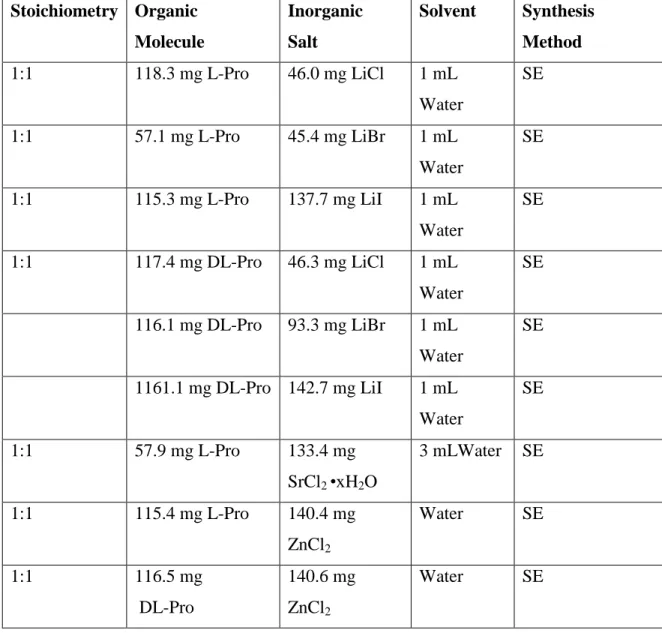
Table 2.2 Summary of successful experiments using solution methods. Stoichiometry Organic Molecule Inorganic Salt Solvent Synthesis Method 1:1 118.3 mg L-Pro 46.0 mg LiCl 1 mL Water SE 1:1 57.1 mg L-Pro 45.4 mg LiBr 1 mL Water SE 1:1 115.3 mg L-Pro 137.7 mg LiI 1 mL Water SE 1:1 117.4 mg DL-Pro 46.3 mg LiCl 1 mL Water SE 116.1 mg DL-Pro 93.3 mg LiBr 1 mL Water SE 1161.1 mg DL-Pro 142.7 mg LiI 1 mL Water SE 1:1 57.9 mg L-Pro 133.4 mg SrCl2 •xH2O 3 mLWater SE 1:1 115.4 mg L-Pro 140.4 mg ZnCl2 Water SE 1:1 116.5 mg DL-Pro 140.6 mg ZnCl2 Water SE
27
2.3 Powder X-Ray Diffraction (PXRD)
X-Ray Diffraction from Powder – University of Bologna. For phase identification purposes, X-Ray diffraction patterns were collected on a PANalytical X´Pert Pro Automated diffractometer equipped with an X´celerator detector in Bragg-Bentano geometry, using Cu-Kα radiation (γ=1.5418 Å) without monochromator in 2θ range between 3º and 50º (step size 0.033º; time/step: 20 s; Soller slit 0,04 rad, antiscatter slit: ½, divergence slit: ¼ ; 40 mA*40kV).
X-Ray diffraction from Powder – Centro de Quimica Estrutual-Lisbon. For phase identification purposes, data were collected using a Brag-Brentano geometry on a Bruker D8Advance powder diffractometer with a copper anode (Cu Kα1, λ=1.5406 Å) and equipped a LYNXEYE-XE detector.
2.4 Variable Temperature Powder X-Ray Diffraction (VT-PXRD)
X-Ray powder diffractograms in the 2θ range between 3º and 50º were collected on a PANalytical X´Pert PRO automated diffractometer equipped with an X´Celerator detector and an Anton Paar TTK 450 system for measures at controlled temperature. The data were collected in open air in Bragg-Brentano geometry using Cu Kα radiation without a monochromator. Thermal programs were selected on the basis of thermogravimetric measurement results.
2.5 Single Crystal X-Ray Diffraction
Single crystals for the hydrated co-crystals and the 2:1 stoichiometry co-crystals were grown by solution evaporation in water or ethanol. Two different Single Crystal Diffractometers were used. Single crystals of the anhydrous co-crystals (1:1 stoichiometry) were grown from powder by dehydrating the powders in a capillary at a temperature below their melting point.
University of Bologna. Single Crystal X-ray diffraction data were collected at room temperature with an Oxford Diffraction X´Calibur equipped with a graphite monochromator and a CCD detector. Mo-Kα radiation (γ=0.71073 Å) was used. Single Crystal data were collected for all compounds. SHELX97 was used for structure solution using direct methods and refinement based on F2.[42] Non-hydrogen atoms were refined anisotropically. Hydrogen atoms bound to nitrogen and oxygen atoms were either located from a Fourier map or added in calculated positions, and their position was refined riding on their C/N/O atoms. The DL-Pro•LiCl•H2O and DL-Pro•LiBr•H2O conglomerate crystals were refined as twinned crystals.
28 crystal packing, and also (Mercury 3.8) to simulate the powder patterns based on single crystal data.
Centro de Quimica Estrutual. Data were collected on a Bruker D8QUEST single crystal diffractometer with Mo sealed tube (Mo Kα, λ=0.71073 Å). The X-ray generator was operated at 50 kV and 30 mA and the X-ray data collection was monitored by the APEX3 program. All data were corrected for Lorentzian, polarization, and absorption effects with SAINT[45] and SADABS[45] programs.
Unit cell parameters for all compounds discussed herein are reported in Table 2.3, Table 2.4, Table 2.5
29 Table 2.3 Crystallographic data for novel Hydrated Ionic Co-crystals.
L-Pro•LiCl•H2O + D-Pro•LiCl•H2O (conglomerate) DL-Pro•LiCl•H2O (racemate) L-Pro•LiBr•H2O + D-Pro•LiBr•H2O (conglomerate) L-Pro•LiI•H2O DL-Pro•LiI•H2O (racemate) DL-Pro•SrCl2•4H2O (racemate) Formula C5 H11 Cl Li N O3 C5 H11 Cl Li N O3 C5 H11 Br Li N O3 C5 H11 I Li N O3 C5 H11 I Li N O3 C5 H17 N O5 Sr Cl2 MW 175.54 175.54 219.99 266.9 266.9 345.72 Crystal System
Monoclinic Monoclinic Monoclinic Monoclinic Monoclinic Orthorombic
Space Group P 21 P21/n P 21 P 21 P 21/c P bca a (Å) 7.7854(6) 7.7798(7) 8.0080(8) 11.8562(4) 10.9413(10) 14.135(13) b (Å) 5.1011(3) 5.1002(4) 5.1407(5) 5.2224(2) 5.1757(5) 7.111(11) c (Å) 10.373(1) 20.1000(14) 10.6122(10) 15.4190(5) 16.988(2) 26.401(2) α (°) 90 90 90 90 90 90 β (°) 105.436(9) 96.335 104.321(10) 105.337(4) 102.411(10) 90 γ (°) 90 90 90 90 90 90 V(Å3) 397.10(6) 792.67(11) 423.29(7) 920.71(6) 939.53(17) 2654(5) Dc( mg m -3 ) 1.468 1.471 1.726 1.926 1.888 1.731 2θ range 3.80-29.15 2.718-25.415 3.66-28.86 3.46-29.42 3.42-29.23 3.299-29.223 Ncollected./Nunique 1707/1438 6601/1459 1838/1403 4374/2934 3861-2166 3106/3106 Rint. 0.0154 0.0489 0.0295 0.0263 0.0485 0.0322 T (K) 293 (2) K 293(2) K 293 (2) K 293 (2) K 293 (2) K 293 (2) K R1 (I>2sigma(I)) 0.0837 0.0849 0.0624 0.0342 0.0537 0.0449 wR2 0.2163 0.2193 0.1396 0.0703 0.0989 0.0712 GOF 1.158 1.080 1.011 0.984 1.002 1.100
30 Table 2.4 Crystallographic data for the Anhydrous Ionic Co-Crystals (1:1 stoichiometry).
L-Pro•LiCl DL-Pro•LiCl L-Pro•LiBr DL-Pro•LiBr L-Pro•LiI DL-Pro•LiI
Formula C5 H9 Cl Li N O2 C5 H9 Cl Li N O2 C5 H9 Br Li N O2 C5 H9 Br Li N O2 C5 H9 I Li N O2 C5 H9 I Li N O2
MW 157.52 157.52 201.97 201.97 248.97 248.97
Crystal System Orthorhombic Orthorhombic Orthorhombic Orthorhombic Orthorhombic Orthorhombic
Space Group P 21 21 21 P 21 21 21 P 21 21 21 P n a 21 P 21 21 21 P n a 21 a (Å) 13.0755(3) 13.0596(6) 9.69850(8) 9.70822(15) 5.0904(3) 9.9521(13) b (Å) 11.3993(3) 11.3501(6) 15.62005(12) 15.6198(2) 9.9978(8) 16.1957(14) c (Å) 5.03559(12) 5.0431(2) 5.02495(4) 5.02705(8) 16.222(1) 5.0668(5) α (°) 90 90 90 90 90 90 β (°) 90 90 90 90 90 90 γ (°) 90 90 90 90 90 90 V(Å3) 750.562(3) 747.53(6) 761.235(11) 762.30(2) 825.58(10) 816.67(15)
Dc( mg m-3) N/A-Structures Solved from Powder data 2.003 2.025
2θ range 28.770 3.24-29.44 Nref./Npara 2138/91 2170/1343 Rint 0.0677 0.0639 T (K) 293 K 293 K R1 (I>2sigma(I)) 0.1468 0.0723 wR2 0.1855 0.1359 GOF 1.016 1.026
31 Table 2.5 Crystallographic data for Anhydrous Ionic Co-Crystals (Different Stoichiometry)
(L-Pro)2•LiI (DL-Pro)2•LiI (DL-Pro)2•ZnCl2
Formula C10 H18 Li N2 O4 I C10 H20 I Li N2 O4 C10 H18 C12 N2 O4 Zn MW 364.19 370.12 366.55
Crystal System Orthorhombic Monoclinic Monoclinic Space Group P 21 21 21 P 21/n P21/c a (Å) 5.1897(2) 11.499 8.7133(3) b (Å) 11.5839(5) 5.138 6.6937(3) c (Å) 24.1467(11) 25.589 25.1323(9) α (°) 90 90 90 β (°) 90 97.30 94.159(3) γ (°) 90 90 90 V(Å3) 1451.63(11) 1499.6 1461.96(10) Dc( mg m-3) 1.666 1.639 1.665 2θ Range 2.437-28.226 2.809-25.415 3.251-29.532 Nref./Npara 73152/3559 13243/2745 6952/3369 T (K) 273 K 293 (2) K 293 K Rint 0.0616 0.1065 0.0397 R1 (I>2sigma(I)) 0.0295 0.0963 0.0452 wR2 0.0665 0.1971 0.0926 GOF 1.102 1.298 1.082
32
2.6 Thermal Gravimetric Analysis (TGA)
TGA measurements were performed with a PerkinElmer TGA7 in the temperature range 40-500 ºC, under N2 gas flow and at a heating rate of 5.00 ºC min-1.
2.7 Differential Scanning Calorimetry (DSC)
DSC thermograms were recorded using a Perkin-Elmer Diamond. The samples (1-3 mg range) obtained through kneading were placed in open or closed Al-pans. All measurements were conducted at a heating rate of 10ºC min-1. The initial measurements were performed in an open pan to follow the dehydration processes, and were then repeated in a closed pan to allow the accurate determination of the melting point of the hydrated co-crystals.
Special Thanks to Dr. Katia Rubini for her support with the thermal measurements.
2.8 Structure Determination from PXRD
X-ray diffraction patterns for structure solution for L-Pro•LiCl, L-Pro•LiBr, DL-Pro•LiCl and DL-Pro•LiBr were collected on a PANalytical X’Pert Pro automated diffractometer with transmission geometry equipped with Focusing mirror and Pixcel detector in the 2θ range 3–70° (step size 0.0130°, time/step 170.595 s, Soller slit: 0,04 rad; anti-scatter slit: ½; divergence slit: ½; 40kV x 40mA). The data were analyzed with the software PANalytical X’Pert HighScore Plus and unit cell parameters were found using DICVOL4 or DICVOL algorithms. [46] Simulated and annealing runs with structure fragments were performed with EXPO2014[47]; all options were left as default if not specifically stated and the best solutions were chosen for Rietveld refinements. The structures were refined by the Rietveld method with the software TOPAS5[48], treating the single molecules as rigid bodies and using a spherical harmonics model to describe preferred orientation. Refer to Table 2.4 for results.
Many Thanks to Oleksii Shemchuk for helping with solving the structures of all anhydrous compounds.
33
3 Results and Discussion
The work is organized in several sub-chapters. Each chapter individually describes in detail the structures of the synthesized ICC, reports the results of the performed analysis and is followed by an overall discussion on the chiral resolution obtained through ICC formation and the considerations made during the study to evaluate it.
3.1 Ionic Co-Crystals in 1:1 Stoichiometry Proline: Lithium Salt
3.1.1 DL-Proline•LiCl•H2O
Kneading DL-Pro with LiCl produced an XRD pattern comparable to the one of the previously reported enantiopure co-crystal with LiCl (CCDC: YOXBET) indicating the formation of a conglomerate. Single crystals suitable for analysis and structure determination were grown through solution evaporation in ethanol. Single crystal results for the analysis of DL-Pro•LiCl•H2O are reported in Table 2.3. The ICC crystallizes in the non-centrosymmetric space
group P21 and has identical unit cell parameters as the previously reported enantiopure ICC,
confirming the formation of a conglomerate of L-Pro•LiCl•H2O and D-Pro•LiCl•H2O ICCs.
Minor differences in volume, angles and lengths could be explained by the experimental setup: conglomerate ICCs were analyzed at room temperature while the enantiopure ICC was analyzed at low temperature. The analysis confirms that a conglomerate was formed, as it shows that the unit cell parameters are identical to the ones previously reported in the literature and because there is only one enantiomer in the unit cell. In the conglomerate crystal, the lithium cation is tetra-coordinated, interacting with three oxygen atoms from three different molecules of proline and one oxygen from a water molecule. Each of the three proline molecules interacts in turn with three lithium cations with the resulting stoichiometry being 1:1. In addition, the relevant hydrogen bonds in this crystalline structure are the amino group forming hydrogen bonds with two chlorine/bromine ions (N-H...Cl-/Br-). Each water molecule forms hydrogen bonds with two anions (O-H...Cl-).
34 Although conglomerate formation was confirmed by single-crystal analysis, the experimental powder pattern of the DL-Pro•LiCl•H2O was not completely superimposable with the one
calculated from the single crystal, which suggested the possibility of a second solid phase. Upon further single crystal screen of crystals grown in water or ethanol, it was confirmed that a racemate ICC was also obtained. The rac-Pro•LiCl•H2O ICC crystallizes in the centrosymmetric
space group P21/n. The powder pattern calculated from single crystal analysis of the rac-ICC is
superimposable to the experimental powder pattern of the kneaded powder. The interactions between the molecules in the unit cell are the same for both ICCs, and although they adopt different space groups, their packings are strikingly similar. The XRD patterns are almost identical for the two ICCs with the exception of several extra “shoulder” peaks in the racemate pattern Refer to Figure 3.1.
35 Figure 3.1 Comparison between the experimental powder pattern of DL-Pro•LiCl•H2O (top),
calculated from single crystal, rac-Pro•LiCl•H2O (middle) and the conglomerate of
L-Pro•LiCl•H2O and D-Pro•LiCl•H2O (bottom) one calculated by single crystal data (bottom).
Differences between the XRD patterns are highlighted in the green boxes.
It is worth noting that while powder X-ray diffraction has a limitation in detecting a mixture of solid phases when the extra phase is below 2% of the total mixture, as illustrated in Figure 3.1 there are no extra peaks of conglomerate with respect to the racemate ICC which makes it impossible to determine if the conglomerate and racemate form upon grinding, or the two phases emerge in solution as crystals of conglomerate and racemate ICCs were identified in the same crystallization vial. To investigate the kinetic factor in the solid state, one liquid assisted grinding experiment was performed in which the powders were ground for 5 min and the XRD pattern measured, for a total of 25 min. The results reveal that the racemate ICC forms immediately upon grinding. Refer to Figure 3.2.
36 Figure 3.2 Kinetics of DL-Pro•LiCl•H2O formation. Powder sample was ground with a drop of
water for 5 min and XRD pattern. The characteristic racemate doublet peak at 17.6-18.1 2θ range is present already after 5 min of grinding. The calculated XRD pattern corresponds to the racemate DL-Pro•LiCl•H2O ICC.
The crystallization kinetics of a racemic compound versus a conglomerate in solution should also be considered. As Leyssens et al. discuss, the rate of formation of chiral compounds is reduced as for the growth of a conglomerate crystal the “right” enantiomer must come in contact with a chiral cluster of the same handedness. For any of the two enantiomers it would be easier to come in contact with a racemic cluster in which they will find a matching site.[26] Furthermore, the crystal size is also related to the compound solubility with small crystals (such as the conglomerate ICC) dissolving more readily than large crystals (such as the racemate ICC). [22] If two solid phases are present after grinding, the one that will crystallize first in solution and could potentially serve as a seed for the other crystals is the one with lower solubility (bigger crystal size) which in this case is the racemate ICC. Finally, if we consider crystal growth as an Aufbau
37 process (one-few-many-nucleus-crystal)[1], and extend it to our conglomerate / racemate system, it is possible to obtain a mid-size enantiopure cluster which is unable to grow further, dissolves and finds an alternative pathway (such as the more efficiently packed racemic crystal).
Figure 3.3 TGA trace of DL-Proline•LiCl•H2O. Analysis shows the loss of 10% sample weight
starting at 90°C. As each of the starting reagents has a higher melting point than 90°C and with the knowledge from single-crystal analysis that the ICC is hydrated, this weight loss is assigned to loss of crystallization water.
38
a) b)
c)
Figure 3.5 a) Packing of L-Pro•LiCl•H2O (CCDC YOXBET), b) Racemate DL-Pro•LiCl•H2O and c) Conglomerate of
39 3.1.2 DL-Proline•LiBr•H2O Conglomerate ICC
Kneading DL-Pro with LiBr produced XRD patterns comparable to those of the previously reported enantiopure co-crystal with LiBr (CCDC: NOCXIO) indicating the formation of a conglomerate. Single crystals suitable for analysis and structure determination were grown through solution evaporation in ethanol. Single crystal results for the analysis of DL-Pro•LiBr•H2O are reported in Table 2.3. The ICC is isomorphous to the conglomerate obtained
with LiCl, and crystallizes in non-centrosymmetric space group P21 and has identical unit cell
parameters as the previously reported enantiopure ICC. The analysis confirms that a conglomerate of L-Pro•LiBr•H2O and D-Pro•LiBr•H2O was formed, as it shows that the unit cell
parameters are identical to the ones previously reported in literature and because there is only one enantiomer in the unit cell. In the conglomerate crystal, the lithium cation assumes a tetrahedral coordination, interacting with three oxygen atoms from three different molecules of proline and one oxygen from a water molecule, each of the three proline molecules interacts in turn with three lithium with the resulting stoichiometry being 1:1. In addition, the relevant hydrogen bonds in this crystalline structure are the amino group hydrogen bonding two chlorine/bromine ions (N-H...Br-), which also interact with the two water molecules.
Figure 3.6 Comparison between the experimental powder pattern of conglomerate DL-Proline•LiBr•H2O (top) and the one calculated by single crystal data (bottom).
40 Figure 3.7 TGA trace of DL-Proline•LiBr•H2O. Analysis shows the loss of 8% sample weight
starting at 110°C. As each of the starting reagents has a higher melting point than 100°C and with the knowledge from single-crystal analysis that the ICC is hydrated, this weight loss is assigned to loss of crystallization water.
41 Figure 3.8 DSC (closed pan) Analysis of DL-Proline•LiBr•H2O.
a) b)
Figure 3.9 Packing of a)L-Pro•LiBr•H2O(CCDC: NOCXIO, and b)Conglomerate of
L-Pro•LiBr•H2O and D-Pro•LiBr•H2O.
3.1.3 L-Proline•LiI•H2O
In the case of LiI, no previous ICC had been reported in the literature with enantiopure L-Proline so we tried to synthesize ICC between both enantiopure and racemic proline and further
42 investigate whether a conglomerate of ICCs would be formed. L-Pro•LiI•H2O crystallizes in the
non-centrosymmetric space group P212121 (refer to Table 2.3 for details). As in the previously
discussed ICCs, the lithium cation assumes a tetrahedral coordination, interacting with three oxygen atoms from three different molecules of proline and one oxygen from a water molecule, each of the three proline molecules interacts in turn with three lithium with the resulting stoichiometry being 1:1. In addition, the relevant hydrogen bonds in this crystalline structure are the amino group forming N-H...I- and the water molecules forming O-H...I- hydrogen bonds.
Figure 3.10 Comparison between the experimental powder pattern of L-Proline•LiI•H2O (top)
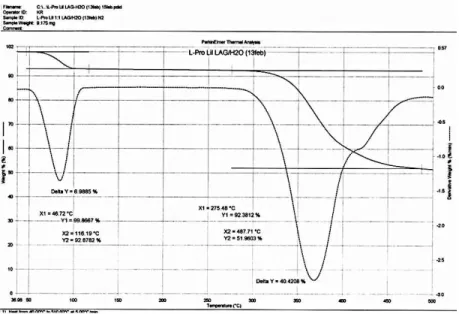
43 Figure 3.11 TGA trace of L-Proline•LiI•H2O. Analysis shows the loss of 7% sample weight
starting at 50°C. As each of the starting reagents has a higher melting point than 50°C and with the knowledge from single-crystal analysis that the ICC is hydrated, this weight loss is assigned to loss of crystallization water.
Figure 3.12 DSC (closed pan) Analysis of L-Proline•LiI•H2O.
3.1.4 DL-Proline•LiI•H2O-racemic ICC
The powder patterns between the co-crystals with L-Pro•LiI•H2O and DL-Pro•LiI•H2O were
44 racemate ICC had been obtained, which was confirmed by single crystal analysis. The racemate ICC crystallized in an orthorhombic crystal system, in the centrosymmetric space group Pna21
confirming the presence of both enantiomers in the unit cell (refer to Table 2.3).
Figure 3.13 Comparison between the experimental powder pattern of DL-Pro•LiI•H2O (top) and
the one calculated by single crystal data (bottom).
Figure 3.14 TGA trace of DL-Proline•LiI•H2O. Analysis shows the loss of 6% sample weight
starting at 100°C. As each of the starting reagents has a higher melting point than 100°C and with the knowledge from single-crystal analysis that the ICC is hydrated, this weight loss is assigned to loss of crystallization water.
45 Figure 3.15 DSC (closed pan) Analysis of DL-Proline•LiI•H2O.
a) b)
Figure 3.16 a) Packing of L-Pro•LiI•H2O, and b) Racemate DL-Pro•LiI•H2O.
3.2 Chiral Resolution in the Solid State
In this research project, the ICC formation between racemic proline and lithium halides has been studied. One of the aims of this work was also that of verifying on a different amino acid the intriguing behavior of L and DL Histidine in the formation of ICCs with LiX (X = Cl, Br, I).
In the true spirit of crystal engineering, a series of ICCs were synthesized and characterized to study the racemate / conglomerate systems and in order to try to understand the role of coordination to the lithium cations and of the other intermolecular interactions in chiral resolution. In the previous work with Histidine, in all structures with lithium halides, Li+
![Figure 1.3 Possible solid state phases of racemic mixtures. [19]](https://thumb-eu.123doks.com/thumbv2/123dok_br/18921057.937454/18.918.247.682.482.744/figure-possible-solid-state-phases-of-racemic-mixtures.webp)