Universidade do Minho Escola de Engenharia Departamento de Informática
Paulo Ricardo Cunha Correia Araújo
Data Analytics in IoT
FaaS with DataFlasks
Universidade do Minho Escola de Engenharia Departamento de Informática
Paulo Ricardo Cunha Correia Araújo
Data Analytics in IoT
FaaS with DataFlasks
Master dissertation
Master Degree in Computer Science
Dissertation supervised by
Prof. Dr. José Orlando Roque Nascimento Pereira Dr. João Tiago Medeiros Paulo
A C K N O W L E D G E M E N T S
Terminada mais uma etapa da minha vida, resta apenas agradecer a todas as pessoas que fizeram isto possível.
Aos meus pais Manuel e Rosa, a quem eu devo tudo. Obrigado por sempre estarem ao meu lado e acreditarem em mim, apesar dos incontáveis erros.
À minha namorada Rebeca. Obrigado por todo o apoio dado durante o último ano e por mostrar-me o que a vida tem de mostrar-melhor para oferecer.
Aos meus amigos João Rodrigues, Fernando Mendes, Francisco Sousa, Tiago Dinis e Orlando Costa. Pelos momentos passados que fizeram da universidade uma aventura incrível. Um agradec-imento especial ao João e ao Fernando, por sempre me ajudarem a melhorar para estar ao nível deles.
Aos meus amigos Nuno Francisco, Bruno Oliveira e Hélio Costa. Obrigado pela amizade e pelas histórias que levo de Braga, das quais nunca me vou esquecer.
Ao resto da minha família e amigos. Obrigado por toda a felicidade que me dão cada dia. A todo o HASLab e em particular ao GSD pelo bom ambiente de trabalho e entreajuda.
A todo o Departamento de Sistemas Distribuídos da TU Wien, por acolher-me como se fosse da casa.
Aos professores José Pereira e Hong-Linh Truong, pelo conhecimento e experiência que sempre se disponibilizaram a passar.
Aos doutores João Paulo e Francisco Maia, pelos valiosos conselhos que fizeram esta tese pos-sível. Em particular, um obrigado especial ao doutor João Paulo, pela incansável ajuda e paciência, assim como pela motivação para alcançar esta meta.
Finalmente, algumas instituições apoiaram o trabalho apresentado nesta dissertação. A Fun-dação para a Ciência e Tecnologia (FCT) apoiou este trabalho através da bolsa de mestrado. O De-partamento de Informática da Universidade do Minho, o HASLab - High Assurance Software Lab e a TU Wien, ofereceram-me as condições necessárias para o desenvolvimento deste trabalho.
A B S T R A C T
The current exponential growth of data demands new strategies for processing and analyzing in-formation. Increased Internet usage, as well as the everyday appearance of new sources of data, is generating data volumes to be processed by Cloud applications that are growing much faster than available Cloud computing power.
These issues, combined with the appearance of new devices with relatively low computational power (such as smartphones), have pushed for the development of new applications able to make use of this power as a complement to the Cloud, pushing the frontier of computing applications, data storage and services to the edge of the network.
However, the environment in Edge computing is very unstable. It requires leveraging resources that may not be continuously connected to a network and device failure is a certainty. The system has to be aware of the processing capabilities of each node to achieve proper task distribution as it may exist a high level of heterogeneity between the system devices.
A recent approach for developing applications in the Cloud, named Function as a Service (FaaS), proposes a way to enable data processing in these environments. FaaS services adhere to the prin-ciples of serverless architectures, providing stateless computing containers that allow users to run code without provisioning or managing servers.
In this dissertation we present OpenFlasks, a new approach to the management and processing of data in a decentralized manner across Cloud and Edge. We build upon these types of architec-tures and other data storage tools and combine them in a novel way to create a flexible system capable of balancing data storage and data analytics needs in both environments. In addition, we call for a new approach to provide task execution both in Edge and Cloud environments that is able to handle high churn and heterogeneity of the system.
Our evaluation shows an increase in the percentage of task execution success under high churn environments of up to 18% with OpenFlasks relatively to other FaaS systems. In addition, it denotes improvements in load balancing and average resource usage in the system for the execution of simple analytics at the Edge.
R E S U M O
O atual crescimento exponencial de dados exige novas estratégias para processar e analisar in-formação. O aumento do uso da Internet, assim como o aparecimento diário de novas fontes de dados, produz volumes de dados a ser processados por aplicações Cloud que crescem a uma maior velocidade do que o poder de computação aí disponível.
Este problema, combinado com o surgir de novos dispositivos com poder computacional rela-tivamente baixo (como smartphones), tem motivado o desenvolvimento de novas aplicações ca-pazes de usar esse poder como complemento a Cloud computing, expandindo a fronteira dos serviços de processamento e armazenamento de dados atuais para o limite da rede (Edge).
No entanto, o ambiente de Edge computing é muito instável. Requer a gestão de recursos que podem não estar continuamente conectados à rede e a falha de dispositivos é uma certeza. O sistema deve estar ciente das capacidades de processamento de cada dispositivo para obter uma distribuição de tarefas adequada, dado que pode existir um alto nível de heterogeneidade entre os dispositivos do sistema.
Uma abordagem recente para o desenvolvimento de aplicações de Cloud computing, denomi-nada Function as a Service (FaaS), propõe uma forma de permitir o processamento de dados neste tipo de ambientes. Os serviços FaaS aderem aos princípios de arquiteturas serverless, fornecendo containers de computação que não mantêm estado e que permitem aos utilizadores executar código sem a necessidade de instanciar e gerir servidores.
Nesta dissertação apresentamos OpenFlasks, uma nova abordagem para a gestão e processa-mento de dados de forma descentralizada em ambientes Cloud e Edge. Baseamo-nos neste tipo de arquiteturas, assim como outros serviços atuais de armazenamento de dados e combinamo-los de forma a criar um sistema flexível, capaz de equilibrar o armazenamento e as necessidades de análise de dados em ambos ambientes. Além disso, propomos uma nova abordagem para possi-bilitar a execução de tarefas tanto em ambientes de Edge como de Cloud, capaz de lidar com o elevado dinamismo e heterogeneidade do sistema.
A nossa avaliação mostra um aumento na percentagem de sucesso da execução de tarefas sob ambientes de elevado dinamismo de até 18% relativamente a outros sistemas FaaS. Além disso, denota melhorias na distribuição de carga e no uso médio de recursos do sistema para a execução de data analytics simples em ambientes Edge.
C O N T E N T S 1 I N T R O D U C T I O N 2 1.1 Motivation 3 1.2 Problem Statement 4 1.3 Objectives 5 1.4 Contributions 6 1.5 Document layout 7 2 R E L AT E D W O R K 8
2.1 Decentralized data storage 8
2.1.1 Dynamo 9
2.1.2 BigTable 10
2.1.3 Dataflasks 10
2.2 Distributed data processing 11
2.2.1 Apache Spark 11 2.2.2 AWS Lambda 12 2.2.3 Openwhisk 13 2.3 Discussion 14 3 A R C H I T E C T U R E 16 3.1 System overview 16 3.2 Request handling 17
3.3 Scaling and Handling Churn 18
3.4 Device discovery 19 3.5 Task distribution 20 3.6 Operation execution 22 3.7 Data management 23 3.7.1 Statefulness 23 3.7.2 Data Locality 23
3.7.3 Data Replication Across Environments 24
4 I M P L E M E N TAT I O N 26
4.1 Frameworks 26
4.1.1 Data storage - DataFlasks 27
4.1.2 Data processing - Openwhisk 29
4.1.3 Integration 33
4.2 Connecting Cloud and Edge 35
Contents v
4.2.1 Dataflask’s group construction protocol 35 4.2.2 Cloud and edge group construction protocol 38
4.3 API 41
4.3.1 Operations 41
4.3.2 Creating an operation 42
4.3.3 Defining operation limits 43
4.3.4 Requesting an operation execution 44
4.4 Data pipeline 46 4.4.1 Consuming data 46 4.4.2 Tagging data 47 4.4.3 Storing data 47 4.4.4 Assumptions 48 4.5 Operation pipeline 49
4.5.1 Entering the system 50
4.5.2 Handling the request 50
4.5.3 Finding available nodes 51
4.5.4 Assigning the task 52
4.5.5 Executing the code 53
4.5.6 Storing the results 54
5 E V A L U AT I O N 55
5.1 Testing environment 56
5.2 Workload and Assumptions 57
5.3 Experiments 58
5.3.1 Group construction across environments 59 5.3.2 Operation distribution across environments 60
5.3.3 Churn handling 64
6 C O N C L U S I O N S 69
6.1 Discussion 69
7 A P P E N D I C E S 75
L I S T O F F I G U R E S
Figure 1 Cloud and edge software for infrastructure maintenance. 3
Figure 2 Core Architecture. 17
Figure 3 Translating a user request into an executable operation. 18 Figure 4 Dissemination of peer information through the system. 19
Figure 5 Processing an operation request. 20
Figure 6 Operation Hub’s high level flow. 21
Figure 7 Executing an operation. 22
Figure 8 Data is replicated across both environments. 24 Figure 9 Overlay network formed by nodes and their views of the system. 28 Figure 10 Openwhisk’s high level architecture. 29 Figure 11 Openwhisk events, actions and triggers. 30 Figure 12 Openwhisk’s Controller flow upon request. 31 Figure 13 Issues when dispatching an action with Kafka. 32
Figure 14 Dataflasks within the architecture. 33
Figure 15 Openwhisk within the architecture. 34
Figure 16 Data to group mapping. 37
Figure 17 Dissemination of peer information through the system. 40 Figure 18 Data is produced at the edge, where it is tagged, stored and replicated. 48
Figure 19 Overview of the implementation. 49
Figure 20 Request translation with the given parameters. 50 Figure 21 Computing device needs to abide by the given restrictions. 51 Figure 22 Assining an operation execution request. 52
Figure 23 Processing a request on the Edge. 53
Figure 24 Overview of the testing environment. 58 Figure 25 Convergence of 1024 nodes running the cross environment version of the
group construction algorithm. 60
Figure 26 Convergence for the cross environment group construction algorithm
un-der churn. 61
Figure 27 Average RAM usage during operation execution by environment 62 Figure 28 Average CPU usage during operation execution by environment 62
Figure 29 Operation latency by environment 62
Figure 30 RAM usage during operation execution by host 63 Figure 31 Average latency of the system during operation execution by environment. 64
List of Figures vii
Figure 32 Memory usage for each node over time by environment 64 Figure 33 Operation failure after each churn stage. 65 Figure 34 Average latency of the system during operation execution by environment. 66 Figure 35 Memory usage for each node over time by environment 67 Figure 36 Operation failure after each churn stage. 68
L I S T O F TA B L E S
Table 2 Survey of the existing solutions and our proposal. 14
Table 3 Request parameters/annotations. 44
Table 4 Parameter configuration for example operation. 49 Table 5 Virtual node configuration for evaluation. 56
L I S T O F L I S T I N G S
4.1 Example of log entries. . . 42
4.2 Wsk: Create an operation. . . 42
4.3 Wsk: Response for operation creation. . . 43
4.4 Wsk: Listing created operations. . . 43
4.5 Wsk: List of created operations. . . 43
4.6 Wsk: Update an existing operation. . . 44
4.7 Wsk: Execute an operation. . . 45
4.8 Wsk: Operation execution response. . . 45
4.9 Wsk: Get operation result. . . 45
7.1 Example code for operation. . . 75
A C R O N Y M S
API Application Programming Interface AWS Amazon Web Services
BTS Base Transceiver Stations CEU Computing Environment Unit DHT Distributed Hash Table DI Departamento de Informática FaaS Function as a Service
GFS Google File System
HVAC Heating, ventilation, and air conditioning IoT Internet of Things
MEI Mestrado em Engenharia Informática MQTT Message Queuing Telemetry Transport PMS Peer Management System
PSS Peer Sampling Service
RDBMS Relational Database Management System RDD Resilient Distributed Dataset
UM Universidade do Minho VM Virtual Machine
1
I N T R O D U C T I O N
The Big Data explosion that has been occurring over the last 15 to 20 years is a result not only of the exponential increase in Internet usage by people around the world, but also the everyday appearance of new devices able to produce a large amount of data that can prove itself valuable, provided it’s properly processed [1].
In example, geosensor networks [2] consist of large sets of sensor nodes distributed across a geo-graphic space. Each node consists of a computational unit and one or more configurable sensing devices, programmed to retrieve and upload data according to the user’s analysis needs. These net-works produce large numbers of real-time sensor data, which are streamed directly to the cloud for analysis.
Such increase of data, not only in volume but also in velocity and variety, will in the near future surpass the capacities of current IT architectures and infrastructure of enterprises and prevent them from being able to act upon trend changes and making proper decisions [3].
Typically, since it is not economically sustainable for many organizations to perform large in-vestments in hardware for in-house computing solutions, they resort to the power available in the cloud to perform complex analytics on their data [4].
However, as data volumes to be processed by cloud applications grow, so does the cost of trans-mitting the data to be stored and processed in the cloud [4].
Since the data usually has to be ingested by the servers composing the cloud before it can give useful information, its real-time requirement will further stress the available computing capacity. However, what if the data streamed to the cloud could already provide useful information after being processed locally at the data producers?
These issues have pushed for the development of a new data processing approach. Namely, with the appearance of new devices with relatively low computational power (when compared to the power available in the cloud), such as smartphones, single-board computers, laptops, TV con-nected boxes and smart-speakers, applications are starting to adapt so they can make use of this power as a complement to the cloud, pushing the frontier of computing applications, data storage and services to the edge of the network [5].
Edge computing presents an opportunity for data processing to occur near the source of the data. These devices allow for data to be processed closer to the source, while significantly decreasing the
1.1. Motivation 3
data volume moved to the cloud and consequently improving latency and quality of service for data analytics tools [6].
1.1 M O T I V AT I O N
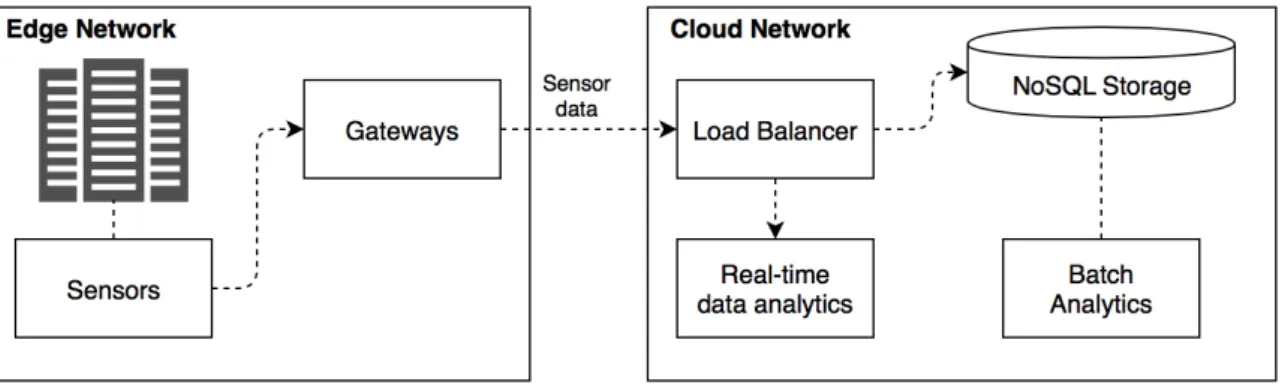
Let us examine a real-world scenario. A Telco company maintains an IoT infrastructure (Figure 1) with thousands of Base Transceiver Stations (BTSs) that help monitor the equipment (HVAC, backup electricity systems, electricity generators).
Figure 1: Cloud and edge software for infrastructure maintenance.
Each BTS includes an IoT gateway running on a Raspberry PI that connects to sensors interfac-ing to the equipment, and is responsible for readinterfac-ing data from hardware sensors and sendinterfac-ing the data to the cloud through a MQTT (Message Queuing Telemetry Transport) broker. Management services are thus able to control the equipment from the cloud by sending commands to the Rasp-berry PI through the broker. The cloud is managed by a third-party company that is responsible for scaling and provisioning of the servers.
There exist two scenarios for the way the Telco company handles their data.
In the first scenario, the company pushes critical data to the cloud as soon as it is produced. Man-agement services continuously perform processing tasks on the cloud with a streaming platform such as Apache Spark Streaming [7], adjusting equipment settings or deploying software patches by issuing commands to the broker that are automatically executed at the specified BTSs.
Since all the data is processed in the cloud, a system like MongoDB [8] already fulfills the com-pany’s requirements for data storage.
In the second scenario, the company doesn’t require data to be processed in real-time. The data is not considered critical so it doesn’t have to be immediately pushed to the cloud. Therefore, it can instead be temporarily stored closer to the source, at the Raspberry PIs which are able to provide a simpler kind of analytics.
Even so, data must still be pushed to the cloud so it can also provide information through a different kind of analytics, such as batch processing [9]. Since the data is represented by log files
1.2. Problem Statement 4
from the sensors, composed by entries of a variety of metrics over time, the cloud can provide historic information about the equipment by analyzing the data at variable intervals of time (i.e. 10 in 10 minutes).
Such a scenario would require an infrastructure capable of combining several capabilities: • Seamlessly handle and store data in both cloud and edge environments.
• Process data locally at the edge devices in a distributed manner, according to their capabili-ties.
• Execute complex data analytics in the cloud.
A similar type of data management system such as MongoDB is needed to provide typical dis-tributed storage properties (replication, fault tolerance, scalability). These kind of systems are however too demanding in terms of computational resources to able to operate in edge environ-ments, and rely on Distributed Hash Tables which have proven to be unsuited for highly dynamic environments [10].
1.2 P R O B L E M S TAT E M E N T
Edge computing allows for data to be processed (or pre-processed) in the edge of the network, only requiring its transfer to higher performance environments (such as the cloud) when in need for a more resource demanding type of analytics.
By extending data analytics to edge devices and gateways, we’re able to act upon IoT events closer to the physical source [11]. Their event driven nature works well in IoT scenarios, and applications that execute code in response to sensor data, scheduled tasks or cognitive trends should benefit from edge analytics capabilities.
However, the environment in edge computing is very unstable. It requires leveraging resources that may not be continuously connected to a network and device failure is a certainty. The system has to be both aware of the processing capabilities of each node to achieve proper task distribution as it may exist a high level of heterogeneity between the system devices. These devices may have different computing power and available storage, as well as different network connectivity, which can impair their ability to communicate with the rest of the system.
Current data analytics applications do not support execution of tasks both at the edge and in the cloud without global knowledge of the system. Task allocation is heavily reliant on system knowledge and device monitorization [12,13], even for the the execution of simple analytical tasks that do not perform operations on data, being unsuited for dynamic environments. In addition, distributed data processing requires high expenditure of the available bandwidth, as applications usually have to transfer data to the processing hosts before they are able to act on it, causing an increase on processing tasks latency.
1.3. Objectives 5
Since current systems require global knowledge in order to support data processing applications, they must operate in a stable computing environment, where devices are connected most of the time and failure is expected but manageable.
Although current efforts seemingly converge to the goal of enabling seamless data processing both on the edge and the cloud, applications currently running on IoT devices and gateways are still lagging behind the modern methods and tools available in cloud computing.
A recent approach for developing applications in the cloud proposes a way to enable data pro-cessing in these environments. Unlike traditional architectures, FaaS services [12] (such as AWS Lambda) adhere to the principles of serverless architectures, providing stateless computing con-tainers (usually ephemeral and managed by a 3rd party) that allow users to run code without pro-visioning or managing servers, requiring only for the user to upload code.
As FaaS systems do not currently support complex data processing (such as map-reduce), they do not rely on node availability and communication between computing nodes, therefore not re-quiring high system stability. Furthermore, these systems do not provide a service for managing data, as their current architecture design is aimed at being stateless. However, as each container aims to act as a lightweight independent unit of data processing, they can be suitable for both cloud and edge environments.
We argue that by combining several currently existing techniques and tools in a novel way, we are able to design a flexible system capable of balancing data storage and data analytics needs in both cloud and edge and provide a solution to our use case.
We look into how FaaS systems behave when supported by an underlying data management platform that enables them to access local state, replicated both across the edge and cloud envi-ronments. In addition, we provide these systems with an algorithm for decentralized node organi-zation so they can execute tasks and replicate data in a reliable manner. Finally, we provide a task distribution algorithm for better mapping of tasks to nodes according to their current resources and state, in order to maximize usage of system resources across the network.
1.3 O B J E C T I V E S
We propose an architecture for the execution of function based analytics in a decentralized manner across cloud and edge devices, such that users can adequately execute data processing tasks in highly dynamic environments. By combining different protocols of proven solutions for similar situations, we extract the best of different worlds. Our goal is thus to design a distributed analytics architecture capable of operating in IoT environments, employing the following principles:
• Usage of peer-to-peer protocols to provide a framework for decentralization of system knowl-edge. These serve as the basis for a flexible and lightweight distributed storage system for IoT data, and are able to progress on highly dynamic environments. Moreover, these protocols provide an alternative for current distributed storage systems [14] that is able to function
1.4. Contributions 6
both on commodity hardware as well as high-end servers, enabling different data process-ing solutions dependprocess-ing on the device’s computprocess-ing power and stored data.
• Design that accounts for heterogeneity of the devices and task distribution, taking into ac-count device load and capabilities. Moreover, task distribution is to be based on the same peer-to-peer [15] protocols that support data storage and management, thus not requiring global system knowledge.
• Integrate the versatility of FaaS systems for remote function execution in lightweight con-tainerized environments with a node churn resistant data management application, provid-ing a way for data to be processed locally where the data is and accordprovid-ing to the environment capabilities.
Taking back from our motivation use-case, a system that implements this architecture enables companies like the previous one to retrieve recent information about their equipment by period-ically executing functions closer to the source of the data. Since data is stored as log files at the Raspberry PIs located near each BTS, management services would need only to define file process-ing code able to read the file structure and act on the obtained results.
This means that critical data would be pushed to the cloud for real-time processing, whilst non-critical data would be available on the edge for information extraction through simple user-defined functions. The cloud would adopt a different role in the management of the equipment, being re-sponsible for executing more complex analytics on the data as well as store earlier sensor readings for big data knowledge extraction.
We consider the various issues associated with the design of a system capable of operating in such dynamic and heterogenic contexts, advocating the applicability of FaaS systems in provid-ing simple analytics at the edge and the need for a decentralized data management protocol that makes available system data in both cloud and edge environments. Namely, we call for a new ap-proach to provide task execution both in edge and cloud environments that is able to handle high churn and heterogeneity of the system.
1.4 C O N T R I B U T I O N S
We propose an architecture for the execution of function based analytics in a decentralized manner across cloud and edge devices, such that users can adequately execute data processing tasks in highly dynamic environments.
By supporting the execution of user defined functions in lightweight software containers, sys-tems following our architecture are able to run data processing code upon files stored on low pow-ered devices, as well as more complex analytics on cloud computing environments.
1.5. Document layout 7
• An abstract architecture for function based analytics in a decentralized manner across cloud and edge devices.
• A gossip-based algorithm for scalable and decentralized organization of system nodes (cloud and edge) into replication groups that doesn’t demand global knowledge of the system and is able to progress even under massive node failure.
• A novel task distribution algorithm capable of mapping tasks to nodes according to their current load and overall computing power.
• An extension to current FaaS approach that allows for data to be accessed locally on comput-ing nodes.
• A functioning prototype of our architecture, named OpenFlasks, and its experimental evalu-ation.
1.5 D O C U M E N T L AY O U T
The document is structured as follows.
Chapter 2 explores the state of the art in data analytics across IoT environments, divided by fields of study. First section displays a background on large scale distributed storage as well as current solutions. The section that follows describes related work on data processing techniques and frameworks currently being used on large scale distributed systems, with preference for FaaS architectures.
Chapter 3 presents our main contribution to the problems presented. It details an architecture for data processing across edge and cloud environments, agnostic to the tools used to instantiate it, that attempts to fulfill the requirements of the presented use-case.
Chapter 4 goes further into the architecture, describing the implementation of OpenFlasks, an usable prototype using the tools we’ve deemed most suitable when exploring the state of the art.
OpenFlasks is then tested and benchmarked in chapter 5. We simulate our use-case environ-ment and perform a stack of tests similar to the work our solution would undergo in the presented use-case scenario.
Finally, chapter 6 discusses the results of our work and draws some conclusions about possible improvements and problems.
2
R E L AT E D W O R K
The problem of efficiently managing and processing massive sensor-network data generated by sensor networks has received significant attention during the last 15 years [16].
In addition, decentralized systems, more specifically data storage and data processing for IoT and Cloud environments, have been widely explored in literature. Several approaches [17,18,3,6] have been developed in order to mitigate current needs of the majority of businesses. However, we believe most of these approaches do not take advantage of the potential of edge computing.
Although during the last decade we have witnessed a surge of proposals for new cloud com-puting systems, each one suitable for a significant number of these tasks, they are still unable to provide a solution that is capable of fully taking advantage of the power of IoT. To the best of our knowledge, current systems are still not capable of adequately process unstructured data under high churn heterogeneous environments, failing to connect both cloud and edge seamlessly.
Our use-case presents the need for a more elastic system and in order to meet the requirements for data processing and availability, the system must be able to store sensor-data in a distributed and available manner and operate under highly dynamic environments. In addition, it must be able to distribute the data processing tasks between heterogeneous system nodes and maintain data locality to reduce latency and bandwidth usage, whilst maintaining the prospect of high scal-ability.
Our problem thus meddles between multiple fields of study. Therefore, we choose to sub-divide our research into two widely studied subjects in the field of cloud computing so we can evoke a clearer vision of the different components presented in our solution.
2.1 D E C E N T R A L I Z E D D AT A S T O R A G E
Traditional replicated relational database systems focus on the problem of guaranteeing strong consistency to replicated data. These systems are however limited [19] in scalability and availabil-ity, not being capable of handling network partitions due to strong consistency guarantees.
On account of those limitations, in the recent decade a new kind of databases referred to as NoSQL [20] have become popular. They’re able to store and replicate data in distributed systems, even across data-centers, achieving scalability and high availability at the expense of consistency.
2.1. Decentralized data storage 9
Such work is intrinsically related with ours as we look for data storage solutions able to offer relaxed consistency models that suit very dynamic environments.
In addition, these highly scalable systems can adjust themselves to the changing data volume by simply adding or removing nodes. This requires a mechanism to dynamically partition data over the nodes in the system. Here we present three systems that do it in very different ways and compare their applicability to our use case.
2.1.1 Dynamo
Dynamo is Amazon’s [21] highly available and scalable distributed storage system. It consists of a fully managed NoSQL key-value store and aims to provide underlying storage system inside their platform, where it currently being used by the internal services as an ’always available’ data store.
Dynamo as proved to able to scale to deployments of hundreds of nodes and it is characterized by its symmetry and decentralization, where every node has the same set of responsibilities as its peers, ensuring no single point of failure.
Moreover, it can be suitable to support data processing tasks by integrating with other Amazon services like Kinesis or EMR. It is also able to account for heterogeneity by applying the concept of virtual nodes, where each node is accountable for a number of virtual nodes proportional to its capacity. Furthermore, Dynamo employs gossip-based [22] protocols to manage membership and failure detection. Each node contacts a peer chosen at random every second and the two nodes exchange their membership data.
However, this scalable system’s applicability is still limited when applied to edge computing sce-narios. Dynamo uses a technique called consistent hashing to organize nodes and distribute data among them. Every node in the system is assigned to one or more points on a fixed circular space called “ring” and data items are assigned to nodes based on the hash value of its key. Dynamo replicates each data object at N nodes, where N is a user-defined parameter.
Multiple systems employ this technique for data replication and partitioning, such as Facebook’s Cassandra [23] and Chord [24]. The main advantage of this technique is that addition or removal of a node only affects its immediate neighbors and other nodes remain unaffected, which is effective for moderately stable systems but greatly impacts the performance and availability of systems with high node churn [25].
Finally, even though it is lightweight enough to operate on edge nodes and low resource ma-chines, its inability to identify the environment to which it belongs prevents data processing frame-works from taking full advantage of its local resources.
2.1. Decentralized data storage 10
2.1.2 BigTable
Just like Amazon built Dynamo for their internal use, Google developed BigTable [26]. BigTable consists of a distributed storage system for managing structured data and it is designed to scale to very large table sizes.
Relatively to Dynamo, BigTable implements a more flexible data model - multidimensional sorted map. The map is indexed by a row key, column key, and a timestamp, and ordered by a row key, allowing Google’s applications to access data either by row key or by range of row keys.
BigTable works with Google File System (GFS) [27] as a storage platform, which is able to handle huge files by dividing them into chunks and replicating each chunk across multiple machines.
Although both Dynamo and BigTable achieve high availability, reliability and durability by repli-cating data on multiple hosts, the techniques they use for replication and partitioning are very different. In contrast with Dynamo’s DHT method, BigTable has a master node responsible of split-ing ranges of rows into multiple servers when the tables grow big enough, storsplit-ing the meta-data in a special table.
Moreover, in contrast with Dynamo’s gossip-based protocol for failure detection, where each node contacts a peer chosen at random every second and the two nodes exchange their mem-bership data, BigTable identifies failed servers with regular handshakes between the master and remaining nodes.
Although Big table has been shown to be able to efficiently managing massive sensor-network data generated by large-in-size sensor networks [28], it is clearly very limited to stable environ-ments due to its centralized nature where a single master node maintains all system meta-data.
2.1.3 Dataflasks
DataFlasks [29] is a key-value store developed at INESC TEC that is able to scale to several thou-sands of nodes while, at the same time, cope with very high levels of node churn in highly unstable environments. It shares the focus on peer-to-peer protocols as Dynamo and Cassandra and main-tains their principles of symmetry and eventual consistency, while using an unstructured approach to avoid the pitfalls caused by DHTs.
Contrary to these systems, DataFlasks implements a decentralized peer-to-peer solution to at-tain scalability, where each node relies on its local knowledge of the system, making progress with-out any kind of global knowledge. Dataflasks uses solely epidemic [30] (gossip-based) protocols to provide data persistence guarantees even in highly dynamic, massive scale systems. There is no distinction between nodes and every node runs the same set of algorithms, without any hier-archy or structure of any kind, as opposed to the more structured approach executed by Dynamo, Cassandra and BigTable.
2.2. Distributed data processing 11
DataFlasks provides a custom group construction algorithm [29] responsible for dividing nodes into groups in order to distribute and replicate data. Each node is able to understand which kind of data it should hold and to where it should replicate it, solely based on its partial view of the system. It presents a very promising solution to data management on edge environments, although it still lacks integration with other data processing tools and needs further validation with real-world applications. However, since it is built in a modular way, integrating with other systems is easily achievable.
2.2 D I S T R I B U T E D D AT A P R O C E S S I N G
Data storage and data analytics come closely related. Data analytics are essential in order to plan and create decision support systems able to optimize business infrastructures. However, the amount of data produced by businesses provides several challenges [3], not only relative to the size of the data, but also their structure, velocity and real-time needs.
In order to provide better service, not only in terms of availability but latency as well, data pro-cessing systems often replicate data across multiple servers (even in different geographical loca-tions).
Taking advantage of the system resources has an increased complexity on dynamic environ-ments, as node availability and computing power can fluctuate greatly. In addition, other com-putational challenges arise when optimizing for performance, such as adequately provision the platform according to incoming request rate (elasticity). Data processing systems often maintain their computing nodes up the entire time even when very few tasks are being triggered, when they could allocate resources on-the-fly to handle requests according to current demand.
Multiple vendors [31] are delivering services for data processing with the intent of providing a scalable way to process all this data, presenting a collection of tools for on-line data collection, cloud hosted databases and map reduce processing.
We present different architectures for on-line and batch data processing of massive volumes of sensor data, and study their applicability to edge environments and our use-case. A system capable of properly utilizing the processing capabilities of the edge has to be able to not only adapt itself to the dynamism experienced in the overall edge environment, but also to its heterogeneity. It has to be aware of the processing capabilities of each device and make the most of what resources each one has to offer.
2.2.1 Apache Spark
Apache’s Spark [32] is a high performance parallel computing framework designed to efficiently deal with iterative computational procedures that recursively perform operations over the same
2.2. Distributed data processing 12
data. It is an open source project by the Apache Software Foundation and a flagship product in big data analytics.
Resilient distributed datasets (RDD) [33] are the main abstraction that Spark provides in order to parallelize data processing in a fault tolerant manner. These are a distributed, immutable and fault-tolerant memory abstractions that collect a set of elements in which operations can be applied.
Yet, the main advantage to RDDs is that they can be rebuilt if a partition is lost. A handle to an RDD contains enough information to compute the RDD starting from data in reliable storage. If a node crashes in the middle of an operations, the cluster manager is able to detect the malfunc-tioning node, and tries to assign another node to continue processing. This node will be told to operate on the particular partition of the RDD and the series of operations that the crashed node was executing.
Spark also uses this mechanism to guarantee exactly-once processing, as operations on RDDs can create other RDDs or give a result value, meaning that RDDs originated from operations are also recoverable.
Although Spark is able to avoid repeated processing of datasets and losing data on node fail-ure, the framework is not well suited for highly unstable environments, acting very similarly to Hadoop’s Map-reduce [4] in terms of data processing.
Both Hadoop and Spark are data analytics frameworks, the key difference between them being in the way they approach processing. Spark can do it in-memory, while Hadoop MapReduce has to read from and write to a disk. As a result, the speed of processing differs significantly – Spark may be up to 100 times faster. However, the volume of data processed also differs: Hadoop MapReduce is able to work with far larger data sets than Spark.
Both these frameworks have a master-slave based architecture, which goes away from our ideal of decentralization as they typically require structure and hierarchies between nodes. These types of architectures split devices between a small subset of master nodes (one or many) and a larger subset of slave nodes responsible for executing tasks which the master nodes coordinate.
Even though data locality can theoretically be achieved on Apache Spark by implementing RDDs with a data store that provides such features, node heterogeneity and system dynamism are still an issue with both frameworks, as node failure severely affects data processing performance and they are designed to work on high resource machines.
2.2.2 AWS Lambda
Lambda [34] is a serverless compute service, in this case known as Function as a Service [35], from Amazon Web Services that runs code in response to events and automatically manages the under-lying compute resources. It enables customers to execute code on demand without any dedicated infrastructure by adhering to the serverless architecture paradigm and it aims at being the next evolution in cloud computing.
2.2. Distributed data processing 13
With Lambda, users do not have to pay for server use when the server is not executing any func-tion. Users upload code snippets packaged as a function that executes a specific task and the code only runs when triggered by an event. Users are then billed on a pay-per-use basis, determined by the number of requests served and the compute time needed to run the code.
This programming model constitutes a good match for micro-services and IoT as users get inher-ent auto-scaling and load balancing out of the box without having to manually configure clusters and load balancers, and with the benefit of almost zero administration, meaning that all of the hardware, networking and software is maintained by Amazon.
Lambda allows the addition of custom logic to other resources (such as DynamoDB [36]), making it easy to apply computations to data as it is enters or moves through the cloud.
However, since serverless architectures are stateless [35] in nature, data locality primitives are not achievable with Lambda. The system doesn’t provide the user with any kind of data locality awareness when executing tasks, meaning that data oriented processing requests are not available unless the data is passed to each Lambda instance upon each request, which is not ideal for net-works with limited bandwidth.
It has built-in fault tolerance and is designed to provide high availability for both the service itself and for the functions it operates, enabling predictable and reliable operational performance. In addition, Lambda invokes code only when needed and automatically scales to support the rate of incoming requests without requiring extra configuration.
Although the positives of AWS Lambda far surpass its downsides, its applicability to edge com-puting can still be improved. Highly dynamic environments still pose a threat to the system, as it is designed to run on stable servers hosted by Amazon, heterogeneous in nature. Due to that, it is unable to link cloud and edge seamlessly and provide a solution for our use-case.
2.2.3 Openwhisk
OpenWhisk [37] is a distributed and event-driven compute service, currently being developed as an Apache Incubator Project by IBM. Similarly to AWS Lambda, which is a more mature project, Openwhisk belongs to the category of FaaS platforms and allows users to run application logic in response to events or direct invocations from web or mobile applications over HTTP.
The main differences to Lambda is that it is open-sourced and can be triggered by any external API-driven event, such as new items that appear in an RSS feed, meaning that organizations can set up their own serverless platform.
It is common practice to deploy multiple VMs or containers to be resilient against outages. How-ever, OpenWhisk offers a model with no resiliency-related cost overhead, where tasks are executed only at one node, but more nodes are automatically provisioned according to the tasks trigger rate. The on-demand execution of tasks provides inherent scalability and optimal utilization.
2.3. Discussion 14
Similarly to Lambda, Openwhisk is stateless in nature and lacks from the same data locality prim-itives. Fault tolerance is not as developed as in Lambda, providing message queues and automatic scaling but lacking proper handling of execution failures.
2.3 D I S C U S S I O N
As previously mentioned, we base our work upon existing systems that allow us to satisfy the re-quirements of our use-case. Table 1 presents an overview of some of the tools we’ve studied and compares them according to our architecture needs.
Comparison Dynamo BigTable D.Flasks A.Spark A.Lambda O.Whisk O.Flasks
Decentralized 3 7 3 7 3 3 3
Data processing 7 3-- 7 3 3 3 3
--Handles churn 7 7 3 3-- 7 3-- 3
Data locality 7 7 7 3-- 7 7 3
Heterogeneity 3 3-- 3 3-- 3 3 3
Cloud and edge 7 7 7 7 7 7 3
Open Source 7 7 3 3 7 3 3
Table 2: Survey of the existing solutions and our proposal.
Most of these systems only provide a design that supports either the distribution or the process-ing of data across different nodes.
Our use-case depends primarily on the ability of these systems to adapt to different environ-ments whilst providing data locality primitives in order to optimize the processing of data over a limited network bandwidth.
We value decentralized systems where every node has the same responsibilities over the master-slave architectures applied by systems such as BigTable and Apache Spark, as they’ve been shown not to scale well in highly dynamic environments. Similarly, decentralized systems that depend on consistent hashing for replication and partitioning such as Dynamo or Cassandra are not suited for these kind of environments.
These applications only consider analytics either on the cloud or at the edge of the network, failing to differentiate the analytics that can be performed on the cloud and on the edge. Some applications are able to process data on the edge but fail to consider the power available in each device, as well as the power available in the cloud for more complex computations.
In order to process data on the edge we thus assert that FaaS platforms are the best alternative to current cloud computing solutions, as they provide support for operating in heterogenic devices and basically reverse the way we think about processing data, taking the computation to where the data is and not the other way around.
2.3. Discussion 15
Dataflasks presents a very promising solution to data management on edge environments, al-though it still lacks integration with data processing tools. However, since it is built in a modular way, integrating with other systems is easily achievable.
Its peer-to-peer basis presents possibilities for both data locality and heterogeneity support, as it enables the exchange of system and data information between servers in an epidemic way. Com-pared to Dynamo, Cassandra and BigTable, we believe it is the most suited data store to seamlessly connect both edge and cloud environments whilst supporting the management of unstructured data and heterogenic nodes.
On the data processing side, AWS Lambda and Openwhisk can be fitting to provide a resource aware data processing platform, since they make no assumptions of the kind of hardware it will be provisioned in, being open and adaptable to different environments or on premise.
Even so, the applicability of these systems to edge environments is yet to prove. We build upon these systems and provide solutions for the missing capabilities that deprive them of successfully operating between environments.
In the next sections, we present a new combination of well known solutions that seeks to fulfill the current gap in data management and processing solutions. We show how our solution tackles all these challenges and show how our architecture can be adapted to integrate with other existing systems that are also missing certain capabilities.
3
A R C H I T E C T U R E
In this section we present the basic architecture for our function based data analytics system. A system capable of operating in such dynamic environments has to comprise several functional-ities (handle node churn, handle heterogeneity, be able to scale) in order to adequately retrieve knowledge from the data.
Our architecture intends to follow the design of current FaaS host-side platforms, providing fast allocation of resources for function execution, while remaining completely decentralized in terms of device management and task distribution.
3.1 S Y S T E M O V E R V I E W
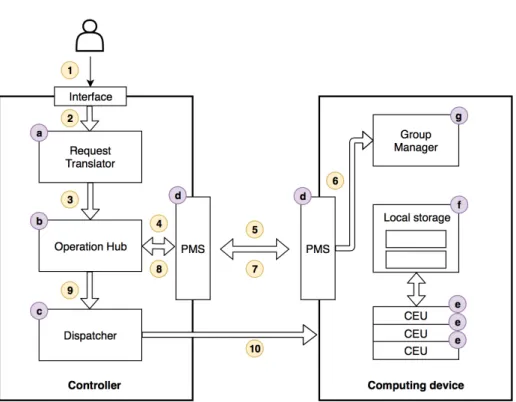
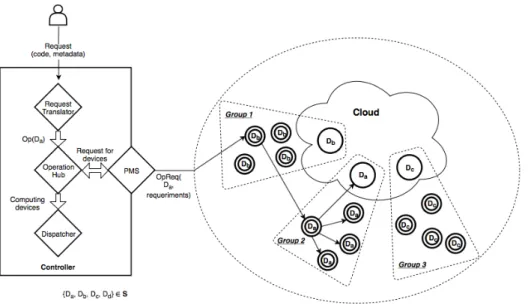
Figure 2 shows an high-level overview of the system, which is divided into 2 main modules: the controller module and the computing device module.
The controller is responsible for receiving user requests, allocating computing tasks and return-ing the results to the users. The computreturn-ing device module must run in every device that intends to execute computing tasks and it is responsible for replying to execution requests made by the controller and executing tasks assigned by it.
Both of these modules can be deployed independently in different machines or in the same one. Since the controller modules manage user requests, they should run on devices capable of han-dling the expected request load (i.e. cloud or in-premises devices with considerable computing power). The computing device modules can however be instantiated at the cloud or edge.
Each module possesses several components that play a precise role in the overall architecture. Upon receiving a request (2) in the controller from an user (1), a Request Translator (a) processes the request and translates it (3) into an executable operation that can be carried out by computing devices. The translated operations are managed by an Operation Hub (b) responsible for choosing the nodes best suited for their execution and send them the operation (9) through a Dispatcher (c) component.
The controller module is able to find and manage available nodes by communicating (4, 8) with a Peer Management System (d) component that is also available in every computing device
3.2. Request handling 17
Figure 2: Core Architecture.
ule. This component manages (5, 7) system information and disseminates knowledge about the devices in a decentralized manner.
Devices are able to organize themselves into replication groups in both edge and cloud envi-ronments by using the information managed by the Peer Management System and feeding (6) it to a Group Manager (g) component that provides the device with knowledge about which data it should hold, which in turn also allows for it to be processed locally.
Finally, upon receiving instructions to execute a task (10), computing devices create Computing Environment Units (CEUs)(e). These units can execute tasks upon files stored in the local storage component (f ) and store the results locally.
3.2 R E Q U E S T H A N D L I N G
Regarding our use-case, management services would submit a function (code) through a user-interface (that we consider as implicit in the Controller), usually a HTTP reverse proxy server. The Request Translator (Figure 3) is responsible for translating user requests to code that can be exe-cuted at the computing devices, in the form of a function F that takes (or not) a given data tag Da, which refers to the identifier of the data associated with the request (i.e. the name of a file that holds the data).
The code is translated into an executable task Op (named operation) that, along with the code itself, contains all the necessary parameters to be computed. In order for the system to be able to
3.3. Scaling and Handling Churn 18
translate requests into operations, management services must provide execution meta-data along with the code to be executed, related to the required resources needed to execute the requested operation, such as minimum available memory, minimum available CPU, as well as related data to the request, in case the request needs data locally available in the device’s storage in order to be successfully executed.
Figure 3: Translating a user request into an executable operation.
Operations are deployed as FaaS units (or functions), containing all their dependencies for proper execution, on dedicated FaaS runtimes. This versatility allows the management services to submit their own modular application code, therefore enabling them to process data as needed, not only by usual data analytics standards. After translating the operation, the Request Translator passes the operation information to the Operation Hub, along with the operation meta-data.
3.3 S C A L I N G A N D H A N D L I N G C H U R N
Our architecture is able to perform under highly dynamic environments and reach high scalability by using the Peer Management Service (PMS) to manage system knowledge. This service is respon-sible for managing the connections between the devices in the system and the information they share with each other.
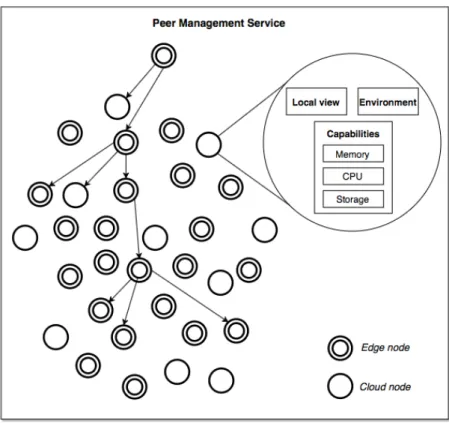
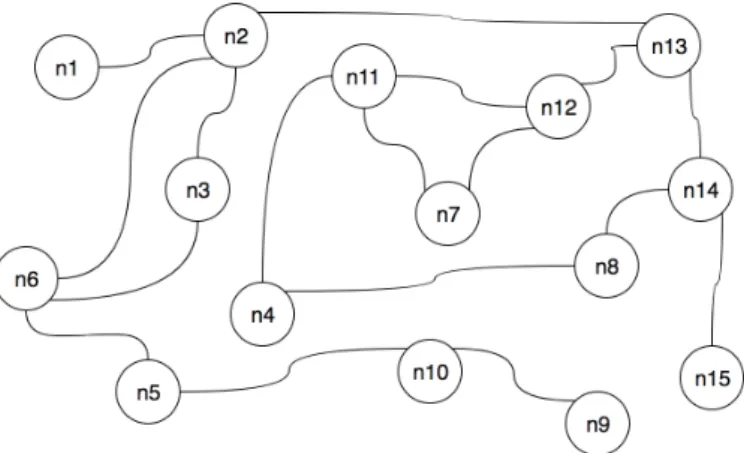
Since it is impossible to attain global knowledge in highly dynamic systems, this knowledge must be decentralized. Edge devices usually offer the possibility of peer-to-peer communication, creat-ing an opportunity to use peer-to-peer and gossip-protocols [38] to spread information through the system. These protocols work by making each node spread their knowledge about the sys-tem to a random subset of its known neighbors in short intervals of time, meaning that each node maintains an up to date view of a subset of the nodes available. Figure 4 details what information is transfered through the network. Each device holds information about the environment on which it operates, its local view of the system and its computing and storage capabilities, propagating it to the nodes in its localview, which is composed of cloud and edge nodes.
A decentralized peer management service is obtainable employing these kind of protocols, such that each peer is able to advance without depending on a central information repository or a plete view of the system. Furthermore, these protocols do not assume the existence of reliable com-munication channels and are fault tolerant, enabling the system to support high levels of churn
3.4. Device discovery 19
Figure 4: Dissemination of peer information through the system.
and still be able to operate. The system is able to quickly adapt to changes in the network after each node stabilizes its localview of the system.
The PMS is instantiated in each device and maintains information about a subset of the system, such that each device on the system is able to find any other device. In addition, the PMS is in-stanced in the controller as well and provides a connection between the Operation Hub and the rest of the system. This allows for the dissemination of operation request messages in order to find available devices that are capable of computing a given operation.
3.4 D E V I C E D I S C O V E R Y
The Operation Hub is responsible for managing the ongoing operations in the system, from the mo-ment they are translated until they are assigned to the computing devices. It stores the operation information along with the related meta-data, and cooperates with a Peer Management System component in order to find the devices best suited to execute it.
Upon receiving an operation, the Operation Hub builds an Operation Request message that en-capsulates the requirements a device must fulfill in order to execute the associated operation and disseminates it through every node in the system by passing it to its local PMS. These requirements are obtained from the meta-data given by the management services, and are composed of both
3.5. Task distribution 20
pure system metrics a device must possess, such as available memory/storage/CPU, and dynamic device traits that each device relates to, such as the environment it belongs to (edge or cloud) and the data it currently holds.
Figure 5: Processing an operation request.
When receiving an operation request message from its local PMS, each computing device evalu-ates its own capabilities against the requirements included in the message (Figure 5). We assume each device is able to gather the knowledge of himself relative to each requirement, i.e. a device knows if it operates in the cloud or in the edge. The device interacts with its local Group Manager in order to find if it holds the required file (or files) to be used in the operation. Moreover, it checks its current available computing power regarding the aforementioned metrics.
Hence, if the operation requires the local presence of a certain file in the device, and to be ex-ecuted in a more powerful device (i.e. cloud), only cloud devices that store that file will respond to the controller’s message. Devices that meet the requirements to execute the operation related to the request are able to respond directly to the Controller’s PMS, which is reachable since the operation request message contains its network profile (i.e. the IP address), indicating their ability to compute the operation and providing further information about their current status, such as system metrics and current load.
3.5 T A S K D I S T R I B U T I O N
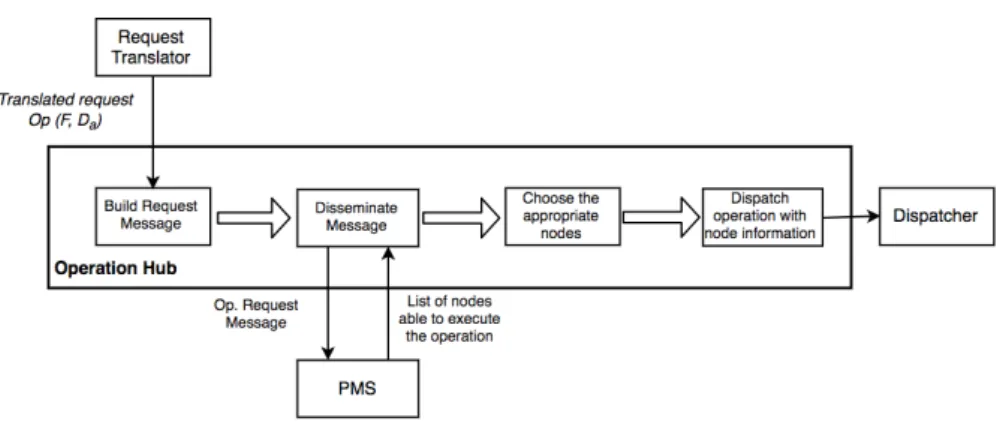
After N responses to the PMS (N being defined by the management services per request) or within a given time limit, the PMS gives back this information to the Operation Hub, which selects the devices that are going to execute the computing task based on their current status (Figure 6).
This approach means that when asked to execute a given request there will be two main steps in doing so: finding devices able to execute the request and dispatch said request to those devices.
3.5. Task distribution 21
Figure 6: Operation Hub’s high level flow.
When compared to the alternative of flooding the network with the entire payload of the request, we believe our proposed protocol brings several advantages over its alternative when performing in dynamic environments.
The more obvious one would be bandwidth saving, since the prior dissemination of Operation Request messages can be considerably lighter than disseminating the entire packaged code pay-load through the system, considering the paypay-load ’weight’ that data processing code can have. The more complex the task, the bigger it is the code package.
Moreover, we argue that by allowing the Operation Hub to select the most appropriate devices to execute a given task, better task placement can be achieved, which will in turn warrant the system to achieve higher performance, better load balancing between the devices and cheaper data locality (since we are sure the nodes that receive the code are the ones able to compute it).
For instance, the Operation Hub may give preference to a device with only 3GB of memory and no ongoing tasks rather than one with 10GB and 50% load for a task which requires 2GB of mem-ory to perform. The device selection protocol to be employed depends however on the preferred implementation for it, since different systems can have different requirements for task placement. By decentralizing system knowledge and making configurable the amount of nodes that must respond to each request, we make a trade-off between better request response time and the ability to operate in a highly scalable manner across both edge and cloud environments (availability).
This means that the PMS’s response to the Operation Hub is not immediate, and an operation request must first be disseminated through the system, avoiding the maintenance of a central peer information repository at the controller. By letting the user configure the minimum ’level of avail-ability’ he desires, we’re opening the possibility for users to pay for more resources in order to achieve better availability primitives for the execution of more important tasks.
3.6. Operation execution 22
3.6 O P E R AT I O N E X E C U T I O N
The Operation Hub selects the most appropriate devices from the set of responses obtained af-ter issuing the Operation Request Message, and uses the Dispatcher component to forward the operation to the selected devices. Since each device responds to the Operation Hub with the nec-essary information for the Dispatcher to access it directly (such as their IP address), bandwidth usage overhead is reduced and there is no need for extra message dissemination throughout the network.
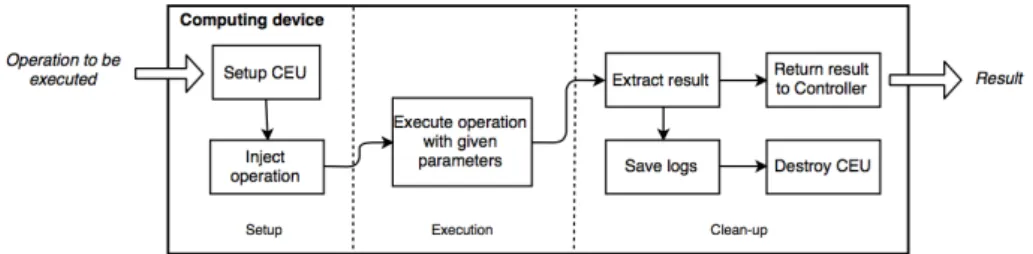
Operations are executed in encapsulated task processing environments, such as containers, named Computing Environment Units (CEU). CEUs allow for the operations to be executed safely and in an isolated manner, whilst having access to their data locally (typically the device’s filesystem).
Each device can host multiple CEU’s, according to its ability to do so. For each received opera-tion, a new CEU is spawned and the operation code is injected and executed with the associated parameters. As a result, each device is able to process different operations simultaneously in a con-trolled way and is aware of the power each CEU shall be authorized to use in order to execute a given operation.
Figure 7: Executing an operation.
Figure 7 briefly details the actions taken by a Computing device when receiving an operation execution task. After processing the request payload, the device provisions a CEU able to compute the request, which means that the CEU will have access to the resources required by the operation, such as the minimum memory needed to complete it, as well as access to the local storage.
In addition, since the request code can be written in different languages, the CEU is also provi-sioned with the required installment of that language, so the code can be ran. The request payload is then injected into the CEU, which will process it and return the result, which in turn will be sent to the controller.
After function execution, the CEU is destroyed. CEU are suitable for use in the IoT environment, since the execution of tasks under it usually require minimal initialization overhead and low re-sponse times.
3.7. Data management 23
3.7 D ATA M A N A G E M E N T
Our architecture intends to follow the design of current FaaS host-side platforms. However, we employ a different set of data management techniques in order to allow data storage locally at the devices. We use a protocol that allows for data to be stored across environments and processed locally within the storing devices, lowering latency and improving general system usage.
3.7.1 Statefulness
Typical FaaS systems employ the principles of stateless computing, where calls are usually indepen-dent from each other and the input data to be used is sent along with the request, which means they have no need for an underlying storage layer. However, we allow for file storage with the goal of processing data locally on computing devices.
Each file is stored in the device’s storage layer and it is identifiable by its name/description and source/owner. Operations code is able to access these files just as it would if executed on the user’s computer.
Introducing statefulness in a previously stateless paradigm offers different use-cases for this new capability, each with a different level of complexity. Statefulness is not only about allowing opera-tions to be able to access the result of previous operaopera-tions.
In example, a read-only approach to statefulness can consist in allowing nodes to hold data in local storage so operations can perform data analysis tasks on it without the need for data transfer upon each invocation, saving bandwidth and improving the average latency of those operations. However, in this approach two consecutive operations that make changes on the same data are not guaranteed to operate on the most updated version of that data, since that would require the distributed system to have data replication capabilities that would enable it.
Adjacent to this is the read-write approach to statefulness. This approach enables consecutive operations to access the most update version of a given data item, allowing data processing opera-tions to save results locally that can be later accessed in replicas of the executing node. Operaopera-tions executed after state-changing operations should be able to operate and access that new state.
Maintaining state across invocations has however considerable architectural implications. This characteristic must be provided by the underlying data storage solution / filesystem / application. Applications that employ weak data consistency primitives may fail to provide such consistency guarantees.
3.7.2 Data Locality
In addition to meta-data related to the computing requirements for operation execution, man-agement systems can also specify information related to data their code pretends to access. As
3.7. Data management 24
previously mentioned, files are labeled by their source before entering the system. Upon submit-ting a request, management systems can specify the file(s) their operation code intends to access by specifying the file(s) label on the operation request.
Therefore, to avoid unnecessary data transfer, operations with associated data to be processed can only be executed by devices that store this data. This means that during request dissemination across the system, request messages carry information about related data to be processed, and only nodes that currently store that data will respond positively to those requests.
3.7.3 Data Replication Across Environments
Besides nodes communicating using peer-to-peer and gossip protocols, they should be able to organize themselves in a way that ensures data is replicated through the cloud and edge environ-ments. For instance, a data item Da should be stored both in edge devices and cloud devices, so that it is available for processing under both environments. Since usually data will enter the system through edge nodes, the first requirement is fulfilled.
However, for the second requirement to be obtained, edge nodes should transfer incoming data to the cloud, such that data is available for the execution of more complex analytics. In the same way, results of functions that are executed in edge devices and stored in those same devices must be propagated to cloud devices as well.
Figure 8: Data is replicated across both environments.
By making each device identify itself as operating in a cloud or edge environment, and commu-nicating that information through the network, we enable nodes to maintain a view of the system composed of both edge and cloud nodes. State changes should be notified to the peers on this view so they can update their state in case they currently replicate this data.
3.7. Data management 25
Data is thus replicated to both environments, enabling nodes to organize themselves in an het-erogeneous manner. Edge nodes communicate directly with cloud nodes for data replication and data is constantly available at both environments.
Figure 8 briefly illustrates the process of inter-environment operation execution. Nodes are or-ganized in groups that hold the same data and are composed by edge and cloud nodes. Upon receiving an operation request that perfoms changes on the local data, the nodes propagate that change to every node in its group, which in turn will do the same. The change is propagated to every replica until all nodes hold again a subset of the same data.
4
I M P L E M E N TAT I O N
Having described the core components of our architecture, it remains to show how we prototype and test it. We detail the implementation of OpenFlasks and the tools we use, highlighting the most important aspects that enable our solution to manage and process data. The end result is open-source and available onGithub.
Since our work is based upon existing frameworks for data management and processing, we first detail how they work and what keeps them from achieving our architectural goals. After establish-ing the basis for our prototype development, we denote the most important changes we’ve made to these frameworks so they conform to our architecture and describe how the solution matches our use-case, describing step-by-step how data is handled and how tasks are performed across the platform.
4.1 F R A M E W O R K S
Our analysis of the existing data processing and management tools helped us come to the under-standing that our use-case currently lacks an appropriate solution. However, even though current solutions are not completely able to fulfill our requirements, they do provide a set of solid solutions for other problems from where we can build upon. This section details the current state of these tools, so that we can understand why they currently do not conform to our architecture and what they lack in order to do so.
In order to implement OpenFlasks, we apply our architecture over an existing cloud-first dis-tributed event-based programming service (Openwhisk), and expand its node management com-ponent in order to be able to operate under high churn environments. In addition, we enable this system to maintain state and read local data by connecting it to a data management layer built upon Dataflasks, which is able to operate under highly dynamic environments and account for node heterogeneity.
4.1. Frameworks 27
4.1.1 Data storage - DataFlasks
DataFlasks [29] is a key-value store that is able to scale to several thousands of nodes while, at the same time, cope with very high levels of node churn in highly unstable environments. It shares the same focus on peer-to-peer protocols as Dynamo and Cassandra and maintains their principles of symmetry and eventual consistency, using an unstructured approach to avoid the pitfalls caused by DHTs.
Contrary to these systems, DataFlasks implements a decentralized peer-to-peer solution to at-tain scalability, where each node relies on its local knowledge of the system, making progress with-out any kind of global knowledge. DataFlasks uses solely epidemic (gossip-based) protocols [15] to provide data persistence guarantees even in highly dynamic, massive scale systems. There is no distinction between nodes and every node runs the same set of algorithms, without any hierarchy or structure of any kind.
Data Partitioning
DataFlasks implements a novel group construction protocol that facilitates data partitioning and replication, and is able to organize thousands of nodes into groups in a robust and scalable way. The protocol provides eventual consistency properties to DataFlasks by updating replicas asyn-chronously.
Data is divided by group, and nodes in the same group have the same set of data. Every node is able to learn to which group it belongs, solely based on its partial view of the system and the size of the groups to construct. The protocol provides for each node an estimation of the number of groups needed to satisfy the configured group size and, from those groups, the group the node belongs to.
The protocol is specially relevant to our architecture, as it forms the basis for the Group Manager we designed to fit our requirements. Although the protocol fits our needs for supporting data par-titioning on highly dynamic environments, it is yet unable to link cloud and edge seamlessly as it doesn’t provide the operating nodes with any awareness of their environment.
Membership
Another important feature we take advantage of is Dataflask’s Peer Management Service (PMS) algorithm, named Cyclon [30]. For the group construction protocol to work, every node needs to know a set of other nodes in the network (the local view).
Cyclon’s peer-to-peer/gossip nature perfectly matches our problem as it allows each node to advance without global knowledge of the system. Not only that, it supports our Group Manager component with information about the system, meta-data related to the surrounding nodes and easy integration of new nodes in the system.