UNIVERSIDADE DE LISBOA
Faculdade de Ciências
Departamento de Informática
MS IPTV AUDIT COLLECTION SERVICES
Nuno Filipe Fernandes Antunes
MESTRADO EM SEGURANÇA INFORMÁTICA
UNIVERSIDADE DE LISBOA
Faculdade de Ciências
Departamento de Informática
MS IPTV AUDIT COLLECTION SERVICES
Nuno Filipe Fernandes Antunes
DISSERTAÇÃO
Tese orientada pelo Professor Doutor António Casimiro
MESTRADO EM SEGURANÇA INFORMÁTICA
I
Resumo
Microsoft Mediaroom Internet Protocol Television (MS IPTV), uma plataforma de televisão digital, levou o conceito de televisão a uma dimensão totalmente nova. MS IPTV é um sistema onde o serviço de televisão digital é entregue aos clientes usando Internet Protocol (IP), através de uma conexão de banda larga. Com o advento do IPTV começaram a aparecer novas situações relacionadas com a segurança da televisão, uma vez que, a infra-estrutura começou a ganhar complexidade e exposição a uma série de novos riscos. Por esta razão, a segurança numa infra-estrutura de MS IPTV não é apenas mais uma funcionalidade, mas sim uma necessidade. Podemos mesmo dizer que hoje em dia é obrigatório aguçar o engenho para estar um passo à frente dos atacantes, uma vez que estes estão sempre à espera de uma brecha, para comprometer os sistemas. Uma infra-estrutura como o MS IPTV armazena por omissão dados relativos ao comportamento dos utilizadores ao nível dos logs, no entanto esta informação só se torna relevante se puder ser consultada e analisada com o objetivo de proporcionar uma compreensão a alto nível sobre os diferentes padrões que estão a ocorrer nos servidores ou no comportamento dos utilizadores, uma tarefa que envolve poderosas técnicas de data parsing.
A tese apresenta uma abordagem que combina técnicas de data parsing, a fim de analisar os logs relevantes da infra-estrutura de MS IPTV, com o objetivo principal de aumentar a segurança através da investigação dos tipos de informações adicionais que pode ser extraída.
Tentámos assim entender se é possível determinar que tipos de ataques estão a ser perpetrados contra a infra-estrutura MS IPTV, com base na análise dos logs. Como o foco central desta tese está no diagnóstico, propomos uma abordagem para descobrir ataques, onde os logs são verificados para identificar grupos coerentes de ocorrências susceptíveis de constituir ataques que apelidámos de padrões. Nos testes, verificámos que a nossa abordagem consegue bons resultados na descoberta de ataques. Os resultados obtidos têm a vantagem adicional de poderem ser integrados na ferramenta de monitorização utilizada pelas equipas de operação dos sistemas da Portugal Telecom, o System Center Operations Manager (SCOM).
Palavras-Chave: Microsoft Internet Protocol Television, Padrões de ataque; Expressões
III
Abstract
Microsoft Mediaroom Internet Protocol TeleVision (MS IPTV), one of the platforms for digital TV, took television to an all new dimension level. MS IPTV is described as a system where a digital television service is delivered to consumers using the Internet Protocol over a broadband connection. Since the infrastructure started to gain complexity and exposure to a number of new risks, never envisaged situations related to television security started to appear. For this reason, MS IPTV security is not only a great asset, but also a necessity. Nowadays it is mandatory to sharpen the wit to get ahead of attackers, who are always waiting for a breach to compromise our systems.
MS IPTV log servers collect information about user and system behavior. However, this information only becomes relevant if it can be queried and analyzed with the purpose of providing high-level understanding about the different patterns. This task must comprise powerful data parsing techniques, since MS IPTV is able to generate close to one terabyte of logs per day.
This thesis presents an approach that combines data parsing techniques in order to analyze relevant MS IPTV logs, with the main objective to increase security through the investigation of what type of additional information can be extracted from the server log files of a MS IPTV platform. The thesis focus is on diagnosis, trying to understand if it is possible to determine what type of attacks are being perpetrated against the MS IPTV infrastructure.
We propose an approach for discovering attacks, where the application logs are scanned to identify coherent groups of occurrences that we call patterns, which are likely to constitute attacks. Our results showed that our approach achieves good results in discovering potential attacks. Our output results can be integrated into the MS IPTV monitoring system tool SCOM (System Center Operations Manager), which is an additional advantage over the other monitoring and log management systems.
V
Acknowledgments
I would like to thank CMU (Carnegie Mellon University), FCUL (Faculdade de Ciências da Universidade de Lisboa) and PT (Portugal Telecom) the sponsor of this program, for their support during the past semesters.
I would like to thank all the professors, for their support and guidance that helped me to take this endeavor to a successful conclusion, in particular my advisor Prof. António Casimiro who never failed to provide me the right advice and review, which I needed to develop my work.
This was the fulfillment of a long awaited dream since I have the notion how important it is to accomplish an international educational program, and Master of Science in Information Technology – Information Security surpassed my expectations.
However, it is my family, which always gave me strength to never give up, the ones that I have to thank for all the affection and support.
VII
IX
Contents
Resumo ... I Abstract ... III Acknowledgments ... V Contents ... IXList of Figures ... XIII
List of Tables ... XV Abbreviations ... XVII 1 Introduction ... 1 1.1 Motivation ... 4 1.2 Contributions ... 5 1.3 Document structure ... 5 2 Background... 7 2.1 Security concepts ... 8 2.1.1 Terminology ... 8
2.1.2 Attacks and vulnerabilities ... 9
2.1.3 OWASP Top ten ... 12
2.2 MicroSoft Internet Protocol Television (MS IPTV) ... 12
2.2.1 MS IPTV architecture ... 13
2.2.2 MS IPTV identified threats ... 15
2.3 Monitoring and Log management systems ... 16
2.3.1 OSSIM - AlienVault Unified SIEM ... 16
2.3.2 SALSA ... 19
2.3.3 Feedzai ... 20
X
2.3.5 Pulso ... 23
2.3.6 ArcSight SIEM ... 24
2.3.7 Summary and comparison of tools ... 26
2.4 Event diagnosis at Portugal Telecom ... 27
3 Data Set Characterization... 29
3.1 Internet Information Services data set ... 29
3.1.1 IIS logging ... 30
3.1.2 IIS workflow ... 32
3.1.3 IIS HTTP codes ... 34
3.2 Common mistakes regarding log policies... 34
4 Methodology and Test Cases ... 37
4.1 Methodology ... 37
4.1.1 Attack patterns ... 37
4.1.2 Regular expressions ... 39
4.2 Test cases ... 39
4.2.1 The simulated log ... 40
4.2.2 Real world logs – Scan31 ... 41
4.2.3 MS IPTV logs ... 41
5 SCOM MEO Collector Security ... 43
5.1 Problem statement ... 43
5.2 SMCS Architecture ... 44
5.2.1 On-line vs. Off-line approach ... 45
5.2.2 Implementation design ... 45
5.3 Definition of SMCS regular expressions ... 47
5.3.1 A1-Injection attacks ... 49
5.3.2 A2-Cross-Site Scripting attacks ... 51
XI
5.3.4 A4-Insecure Direct Object References ... 54
5.3.5 A5-Cross-Site Request Forgery (CSRF) ... 55
5.3.6 A10-Unvalidated Redirects and Forwards ... 56
5.3.7 Detecting other relevant attacks ... 56
5.4 Complementing SMCS with Log Parser ... 57
5.4.1 Script Abuse ... 59
5.4.2 Trojan attacks ... 59
5.4.3 DoS and DDoS attacks ... 60
5.4.4 Aggregating Log Parser outputs ... 62
5.5 Reducing false positives ... 62
6 Results ... 63
6.1 Detecting attacks in a simulated test case ... 63
6.2 Detecting real world attacks ... 67
6.3 Detecting MS IPTV attacks ... 70
6.4 SMCS execution overhead ... 72
6.4.1 Parsing times – simulated log ... 72
6.4.2 Parsing Times - scan31 log ... 73
6.4.3 Parsing Times – MS IPTV log... 73
6.5 SMCS integrating with SCOM ... 75
7 Conclusions ... 77
8 Future Directions ... 81
8.1 Promote SMCS and SCOM integration ... 81
8.2 Reducing false positive rate ... 81
8.3 Automatically trigger response actions... 81
8.4 Green monitor attacks prevention ... 82
8.4.1 Baseline correlation... 83
XIII
List of Figures
Figure 1 - Number of vulnerabilities in Networks, OS and applications ... 2
Figure 2 – OWASP top ten list ... 12
Figure 3 - MS IPTV Microsoft Mediaroom blocks ... 13
Figure 4 – AlienVault architecture ... 17
Figure 5– HLD Feedzai Pulse ... 21
Figure 6 - FeedZai architecture ... 21
Figure 7 – ArcSight architecture ... 25
Figure 8 – Analyzing non-served web request ... 28
Figure 9 – IIS web log example ... 32
Figure 10 - IIS workflow ... 33
Figure 11 – List of attack patterns ... 38
Figure 12 – Simulated log with attack signatures ... 40
Figure 13 – Number of lines simulated.log ... 40
Figure 14 – Number of lines access_log ... 41
Figure 15 – Number of MS IPTV log lines ... 42
Figure 16 – SCMS implementation design ... 46
Figure 17 – Log Parser ... 58
Figure 18 – Number of hits per file name ... 61
Figure 19 – Log Parser browsers chart ... 61
Figure 20 – Log Parser outputs... 62
Figure 21 – Simulated scenario output (bar chart) ... 63
Figure 22 - Simulated scenario output (pie chart) ... 64
Figure 23 – Simulated log 1LevelReport output... 64
Figure 24 – Simulated log 2LevelReport output... 65
XIV
Figure 26 – SMCS output chart for the real world scenario ... 67
Figure 27 – SMCS attacks detected in the scan31 (pie) ... 67
Figure 28 – MS IPTV attacks detected ... 70
Figure 29 – SMCS output for MS IPTV logs (pie) ... 70
Figure 30 – MS IPTV Log Parser output console ... 71
Figure 31 – SCOM and SMCS integration ... 75
Figure 32 – SCOM and SMCS Log Parser integration ... 76
Figure 33 – “Green” alerts attack – before the attack ... 82
Figure 34 -“Green” alerts attack – after the attack... 82
XV
List of Tables
Table 1 – Current worldwide cyberattacks ... 10
Table 2 – Computer worms that exploit one or more vulnerability ... 11
Table 3 – Tools evaluation ... 26
Table 4 – IIS logging fields ... 31
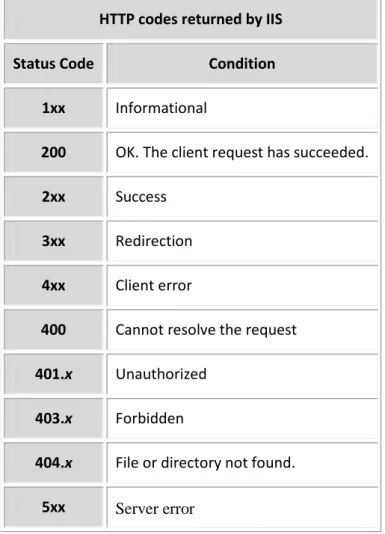
Table 5 – HTTP codes returned by IIS ... 34
Table 6 – OWASP top ten list 2010 ... 49
Table 7 – SMCS results and simulated log inputted attacks ... 66
Table 8 - SMCS results and Honeynet solutions ... 68
Table 9 – Attacks detected comparison (Honeynet vs. SMCS) ... 69
Table 10 – Simulated log analysis time ... 72
Table 11 – Scan31 log analysis time ... 73
Table 12 – MS IPTV log analysis time ... 73
XVII
Abbreviations
A1 – Injection attacks, according to the OWASP Top 10
A2 – Cross-Site Scripting (XSS) attacks, according to the OWASP Top 10
A3 – Broken Authentication and Session Management, according to the OWASP Top 10
A4 – Insecure Direct Object References, according to the OWASP Top 10
A5 – Cross-Site Request Forgery (CSRF), according to the OWASP Top 10
A10 – Unvalidated Redirects and Forwards, according to the OWASP Top 10
CSRF – Cross-Site Request Forgery
DDoS – Distributed denial of service attack
DoS – Denial of service attack
IIS – Internet Information Services
IPTV – Internet Protocol TeleVision
MEO – Portugal Telecom MS IPTV production environment
MS IPTV or Mediaroom – Microsoft Internet Protocol TeleVision
OWASP – The Open Web Application Security Project
ReDoS – Regular expressions Denial of Service
REGEX – Regular expression
SCOM – System Center Operations Manager
SMCS – SCOM MEO Collector Security
VOD – Video on demand
XVIII Logs are just data,
processed and analyzed, they become information Marcus J. Ranum
1
1
Introduction
Television has become a so significant part of today’s life, that something that was earlier just a token of luxury is nowadays a need. We should ask ourselves if we could live without TV (classic TV, computer TV or programs and shows). According to a recent study, the average american television viewer is watching more than 151 hours of television per month [4] (considering that in average a month has 700 hours, we work 140 hours and we spend 1/3 of it sleeping), this number is impressive and it has been increasing year by year. Based on these numbers, it is easy to realize that people daily routines will be affected if something happens to the TV services, since the traffic, weather or stock news became more than commodities, but basic goods.
Satellite, terrestrial and cable TV made people used to a service that is “always on” with reliable quality levels. There is no paying subscriber that will accept frequent interruptions or bad quality images, which leaves the new TV concept - Internet Protocol TeleVision (IPTV) with no space for errors.
This thesis addresses the problem of auditing a specific IPTV service, the Microsoft Internet Protocol TeleVision (Mediaroom or MS IPTV) environment in terms of security. We developed a new set of log parsing techniques, using Microsoft PowerShell scripting language, which can be used by the IT teams to monitor the MS IPTV system proactively. Since no security analysis is performed in a regular basis for the internal MS IPTV systems, we realized how important it is to develop methods that identify and even prevent attacks. This is important, since under certain circumstances, attackers could take control of a significant number of set-top boxes and use them to perform attacks against middleware servers1 (e.g. denial of service attacks).
We named our project SMCS (SCOM MEO Collector Security), because it uses the best of two worlds. The System Center Operation Manager (SCOM) infrastructure, developed by Microsoft to monitor explicitly their products, and the open source development tools that can be
2
adapted to fit Microsoft Internet Protocol TeleVision (MS IPTV) needs (e.g. PowerShell, Log Parser, Google charts, Html pages, and others). We will develop SCOM MEO Collector Security to deal with the lack of high-qualified vulnerability researching tools, for a fair price. While this scarcity persists, the defenders will be in disadvantage in terms of protecting their systems against attacks. SMCS provides relevant advances, since these attacks will not only affect the operators’ revenue but also its reputation.
This thesis also addresses the fact that the number of attacks is currently so high, that companies do not distinguish which they should deal first, since they are not aware of those that represent the higher risk of causing substantial damages. The data logs that we use cover the MS IPTV 2011 web logs, from different services and applications, what give a reliable picture of what are the current attacks against the MS IPTV infrastructure. Our goal is to document the immediate threats and those that are emerging and could compromise the data, operations and process of MS IPTV.
We also present some descriptions of the most recent attacks and some of the most important discoveries made in the last year (OWASP 2010) [14], on the field of cybernetic security.
Figure 1 - Number of vulnerabilities in Networks, OS and applications
Recent studies (year 2010), show that the number of vulnerabilities discovered in applications are much higher than those discovered on operating systems, as illustrated in Figure 1.Web applications are one of the preferred attacker targets [5]. For this reason we will concentrate our efforts on this direction.
3
Our ultimate goal will be to realize how these attacks are performed because only then we can become and train people to be effective MS IPTV defenders.
The thesis relies on MEO, a Portugal Telecom MS IPTV production environment and the core business of the operator, which is suffering a migration to a new Microsoft Internet Protocol Television version. These circumstances allied to the fact that production data requires special permission to be retrieved from the platform, restrict the scope of this project to the design and implementation of a security collector that actively audits exposed services, using whatever information is available.
Nevertheless, all the information used in this project is similar to the one used in the MS IPTV systems of any other operator, and its application to any production environment requires few conversions.
Note: We will use boldface characters, when a term is defined, and italic characters to focus
4
1.1
Motivation
IPTV is considered by many [6], one of the emerging technologies that will play an important role in the near future (next decade). Like all new technologies, it brings a large spectrum of paradigms. It is based on a new network solution, through which Internet television services are delivered. It includes live television, time-shift programing and video on demand. All these new services are supported in information systems and all the data generated is saved in logs that are used latter to generate all kinds of alarms and operational data. The Microsoft Internet Protocol TeleVision (MS IPTV) service became the new banner for Portugal Telecom and all its reputation is in stake. The growth has been auspicious, as well as the amount of data and events that need to be correlated to know what is happening in the MS IPTV platform.
Security in this new IPTV architecture is also a major concern for the operator that used to work with other architectures and suddenly is forced to adapt to the market impositions. System administrators also have less experience with this new architectural model and due to this, problems are prone to happen. The novelty of this architectural system is also one of the causes of the security faults, owed to all the data parsing and other detection mechanisms that are still poorly tuned to the new IPTV reality. A lot of tuning and manual analysis is still necessary.
Firewalls are an integrant component of the major networks projects and MS IPTV is no exception, nevertheless our experience tell us that, while external systems are closely monitored in terms of security, internal systems tend to be neglected. In the end, what really matters is to find out if attacks are passing beyond the firewalls layer and reaching the application layer (this task is facilitated if we are talking about the web application layer), this is the main issue that we want to help to solve.
Microsoft has learned a lot with past mistakes, and they are coming out with patches faster, this has made MS IPTV architecture more robust and secure. Nevertheless, ports 80 and 443 are usually allowed through firewalls and taking into consideration that a MS IPTV web applications work its way into many components, the only defense is the early detection and patching, since malicious scripts used in attacks are typically heavily obfuscated and evidences carefully deleted in order to evade detection and delay analysis. Web application attacks using brute force password guessing, and web application attacks making use of SQL injection, Cross-Site Scripting and PHP file includes, continue to be popular techniques used for compromising web sites. Traditional protection mechanisms like firewalls are not designed to protect MS IPTV web applications and consequently do not provide adequate defense. The use of firewall
5
rules is not always. In summary, when we realized the importance of the web services in the MS IPTV platform, we were lead to think that any breakthrough done in terms of security countermeasures will be of utmost importance.
1.2
Contributions
The main contribution of our work is to create a collector to audit exposed MS IPTV services. It will help to parse log information around a common objective the detection of attacks that aim to prevent the correct operation of the MS IPTV infrastructure. We called the collector SMCS (SCOM MEO Collector Security), and as far as we know, it is the first log analysis technique that aims to obtain security information from MS IPTV log files.
The main guidelines of SMCS2 analysis are data logs analysis, data parsing and event diagnosis.
Data logs analysis because large and complex systems like MS IPTV generate a huge quantity of logs. The first of our contributions is to find the ones that contain valuable information about system security. Data parsing since logs must be parsed in search for evidences for attacks. We addressed the most recent and prevalent vulnerabilities and their immediately recognizable attacks. Others can be added, something that is a valuable add-on. Event diagnosis, since SMCS present the results in a clear an aggregated form to help the operator diagnose in a more accurate and precise way the attack that happened in the system.
1.3
Document structure
The rest of the thesis is organized as follows. We start in Chapter 2 by providing an overview over the context and background of this thesis, where we revise the main concepts associated to security, and then we present an overview of the important blocks of a MS IPTV infrastructure and the already identified threats that can affect their normal operation. The chapter proceeds describing the monitoring and log management systems that we considered relevant to our study, namely OSSIM, SALSA, Feedzai, SCOM, Pulso and ArcSight. Finally, the tools were compared taking into account several parameters that we considered relevant to the analysis. In Chapter 3, we present the reasons that lead us to work with certain logs data sets. We then present an overview over the common errors regarding log policies. Chapter 4 establishes the conceptual model of our approach explaining how we expect to implement our
6
methodology, using our attack pattern and regular expression strategy. Chapter 5 is dedicated to the solution’s architecture and to the implementation of the SCOM MEO Collector Security (SMCS). The solution is implemented accordingly to a workflow presented in section 5.2.2. The chapter proceeds with the description of the regular expressions that will enable a powerful, flexible, and efficient form of text processing for detecting potential attacks. We then present how the integration of the Microsoft Log Parser tool was able to complement SMCS results. The remaining part of the chapter is dedicated to the reducing of false positives rate. In Chapter 6, we present the test cases (simulated, real word and MS IPTV) used to verify if SMCS is able to detect potential attacks. Finally, Chapter 7 is dedicated to the conclusions and Chapter 8 to future work.
7
2
Background
This chapter provides the context and background in which this thesis is inserted. Since our focus is auditing the Microsoft Internet Protocol TeleVision (MS IPTV) environment in terms of security, this chapter starts with an introduction to the commonly used terms and concepts in the security context. The next section presents an overview of MS IPTV architecture blocks and identified threats and their related problems. The final section presents an overview on the monitoring and log management systems, that we consider relevant for our research project.
Internet Protocol TeleVision (IPTV) services are the fastest growing television services in the world today. They are divided into two main flows: the high-definition Linux Android, and MS IPTV. Over 685 companies worldwide are deploying MS IPTV services that will reach over 81 million clients worldwide in 2013 and many more companies are deploying other IPTV solutions [4].
Since the thesis was a suggestion of Portugal Telecom, we will focus on their currently deployed MS IPTV solution service, MEO. This service requires a great number of servers and databases, when compared with the standard cable networks or free air broadcasts. Portugal Telecom choice resided on the fact that MS IPTV represents the future of TV, since it is one of the world most deployed IPTV platforms [5]. Their services are being offered by more than three dozen of the world’s leading operators, delivering services to more than seven million consumer households, which corresponds to more than fourteen million set-top boxes deployed throughout the world.
In terms of security, MS IPTV goes to great trouble to ensure it for live TV and VOD3 services. It
employs multiple security measures to ensure that only those subscribers that should have access, can actually access the program.
We will now present some of the mechanisms used to secure the main MS IPTV services. MS IPTV system provides full DRM4, it encrypts live TV content and VOD with strong encryption
8
algorithms. In terms of authentication, MS IPTV uses both client and server authentication via X.509 certificates and server authentication assures that only real MS IPTV servers serve clients. Anyway, the constant technological advances can carry severe threats to the existing security mechanisms and there is where our thesis steps in.
2.1
Security concepts
We will now make an introduction to the commonly used terms and concepts, regarding security. Then we will present a brief introduction to the attacks and vulnerabilities and finally the OWASP top ten list.
2.1.1 Terminology
Before we continue, it is important to define some of the terminology that is going to be used in the thesis, and in this way mitigate some issues that may arise due to misinterpretation. The following definitions come mainly from [11].
An attack is the act of carrying out an exploit. It is also known as a “cyberattack,” if it disrupts the integrity or authenticity of data, usually through malicious code that alters program logic that controls data, leading to errors in output. An attack is the action of causing harm to an information system, for example by unauthorized access or denial of service.
An attacker is the person that actually executes an attack. Attackers may range from unskilled individuals leveraging automated attacks developed by others (“script kiddies”), to well-funded government agencies or even large international organized crime syndicates with highly skilled software experts.
An exploit is a technique or software code (often in the form of scripts) that takes advantage of a vulnerability or security weakness in a piece of target software.
Vulnerability is defined as a weakness of an asset or group of assets that can be exploited by one or more threats, where an asset is anything that can have value to the organization, its business operations and their continuity, including information resources that support the organization's mission. Vulnerabilities might have different causes, including badly written web
4 DRM - Digital Rights Management is any of the several technologies used to enforce pre-defined policies for controlling access to digital data (such as software, music, movies) and hardware.
9
applications made by programmers, including the ones considered “expert”. Attackers explore what we call vulnerabilities, a computer or system weakness that allowed them make use of that flaw to reduce the information assurance, in others words reduce the confidentiality, integrity, and availability of computers and systems through an attack.
A threat is an actor or an agent that is a source of danger to the system under consideration, or the assets to which it has access. The threat can be a person that abuses the software, a program running on a compromised system, or even a non-sentient event such as a hardware failure. A threat exploits a vulnerability in software to attack it.
An intrusion is a malicious activity that triggers a policy violation, making use of a previously discovered vulnerability.
Honeypots are traps that appeared as a reaction to the prevalence of security attacks on the Internet. Honeypots initiatives set up information system traps on the Internet, to attract, solicit and monitor malicious attacks. The honeypot data can then be analyzed and mined for valuable information on the patterns behind these attacks, which help in developing defenses against them [12].
An attack pattern is a general framework for carrying out a particular type of attack, such as a method for exploiting a buffer overflow or an interposition attack that leverages certain kinds of architectural weaknesses. In these articles, an attack pattern describes the approach used by attackers to generate an exploit against software.
Risks capture the probability that a vulnerability will be exploited, as well as the potential damage (impact) that will occur if it is. It is important to note that risks, threats, and exploits are all separate things. Risks may be present in the target software, on the target host, or in the broader operational environment of the software.
2.1.2 Attacks and vulnerabilities
We can say that “Kevin Mitnick, Kevin Poulsen, Robert Tappan Morris” are some of the first cyber attackers, since they were responsible for breaching the security barriers of major companies and for the creation of computer worms (e.g. the first computer worm, the “Morris Worm”). Nowadays, the most frequent “family” of attacks, according to OWASP[14], are the “SQL injection” attacks, where a query string parameter that is not filtered or validated, exposes the database contents to the attacker.
Attacks against worldwide systems happen in an almost continuous way. Some examples are presented in Table 1:
10
Date Attacks against worldwide systems
Jul 04 2011
Microsoft IIS FTP Globing Functionality causes a remote denial of service
vulnerability; Microsoft IIS is prone to a denial-of-service vulnerability affecting the application's FTP server. The following example command: ls "-R p*/../", causing a DoS attack terminates the affected application, denying service to legitimate users [21].
Jun 18 2011
Sega Japanese video game developer Sega Corp, said on Sunday that information
belonging to 1.3 million customers has been stolen from its database, the latest in a rash of global cyberattacks against video game companies. [18]
Jun 06 2011
Sony Pictures confirms hacking group website attack (Security Bytes blog), a
hacking activist group which claimed responsibility for attacks against the websites of PBS and Nintendo has breached Sony Pictures [18].
Sept 14 2011
Microsoft IIS Request Header Buffer Overflow Vulnerability, Microsoft IIS is prone
to remote buffer-overflow vulnerability. An attacker can exploit this issue to execute arbitrary code within the context of the affected application. Failed exploit attempts will result in a denial-of-service condition. Repeated Parameter Request Denial of Service Vulnerability, Microsoft IIS is prone to a remote denial-of-service vulnerability. An attacker can exploit this issue to force the affected application to become unresponsive, denying service to legitimate users. [23].
Oct 12 2011
Sony Under Attack…Again, Sony Network has detected a large amount of
unauthorized sign-in attempts on PlayStation Network (PSN), Sony Entertainment Network (SEN) and Sony Online Entertainment (SOE) services. They discovered these attempts and have taken steps to mitigate the activity. This time less than one tenth of one percent of our PSN, SEN and SOE consumers may have been affected [18].
Table 1 – Current worldwide cyberattacks
From our personal experience, we can say that system administrators have a natural tendency to think in terms of features and functions and neglect security, which leaves attackers with the advantage of having to find only an exploitable vulnerability to achieve the objective of entering the “castle”. Another challenge is the pressure imposed by the market (also called TTM or time to market), that force companies to rush the deployment of their products before
11
their competitors, at risk of failing their objectives. Time to market led companies to believe that security by obscurity would keep the attackers away. However, looking at an actual list of the current attacks, as presented in Table 1, is enough to realize that this was a very poor assumption.
After looking at the present situation in terms of attacks, we considered important to go back in time, and look into some of major attacks in the history, that caused incalculable damages to companies’ computer systems. Some examples are presented on Table 2.
Attacks Damage caused
Nimda
Was one of the more complex virus/worm released. It infects all versions of Windows (...) as well as Microsoft's IIS. Webworm Nimda scans the Internet for Microsoft IIS Web servers and when a server is found that has open security holes, Nimda enters and modifies random web pages on the server. Nimda is credited with several "firsts" in its infection techniques. It was the first to infect .EXE files, by embedding them into itself as a resource. It also infects Web pages, so unsecured browsers will be infected upon viewing the Web page. Finally, Nimda is the first worm to use any user's computer to scan a network for vulnerable machines behind a firewall to attack (in the past only infected servers did that). [20].
Code Red worm
A computer worm observed on the Internet on July 13, 2001. It attacked computers running Microsoft's IIS web server. It was released on July 13 and the largest group of infected computers was seen on July 19. On this day, the number of infected hosts reached 359,000 [19].
Stuxnet
Microsoft Windows computer worm discovered in July 2010 that targeted industrial software and equipment. While it is not the first time that crackers have targeted industrial systems, it is the first discovered malware that spies on and subverts industrial systems, and the first to include a programmable logic controller (PLC) rootkit [19].
Table 2 – Computer worms that exploit one or more vulnerability
Looking at the devastating effects of these worms, leads us to think what will be the next major computer security threat and, meanwhile, how can we prepare for it. First it is important to understand if some attacks could be identified a priori or, only a posteriori.
12
Second, in our opinion, log files already allow performing a detailed analysis of attacker’s actions, and the only question is how to retrieve that information. We hope with the method employed in the thesis, to be able to retrieve that information. We believe that this is possible since logs showed à posteriori that worms, virus and attackers left fingerprints behind.
2.1.3 OWASP Top ten
When we made ourselves the question of what type of attacks should we start looking for, we became overwhelmed with the multitude of answers. To help us with this task, we took as starting point the OWASP (Open Web Application Security Project) top ten document, that lists the most actual and critical web application security flaws [14]. The goal of this document, from this non-profit global organization, is to educate companies and government agencies and help them create more secure web application environments, so it will fit as a glove in our objectives. It is also important to notice that this is not a static attacks list. Figure 2 present side by side the differences between the 2007 list and the updated list (year 2010). For the thesis purposes, we will use the newer one.
In summary, we direct our efforts in a certain direction, based on the OWASP list, showed in Figure 2, but it is important to notice that we are not limiting our scope to it, as we will demonstrate in section 5.3.7 and 5.4.
Figure 2 – OWASP top ten list
2.2
MicroSoft Internet Protocol Television (MS IPTV)
In this section, we will present an overview of the important blocks of a MS IPTV infrastructure and the already identified threats that can affect their normal operation.
13
2.2.1 MS IPTV architecture
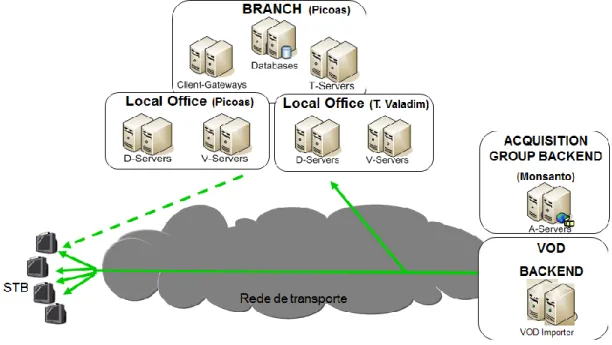
MS IPTV has the advantage of using a bundle or services and applications, where Microsoft has a solid reputation. The actual architecture of the MS IPTV system implemented by Portugal Telecom is illustrated in Figure 3.
Figure 3 - MS IPTV Microsoft Mediaroom blocks
We will describe the architecture solution that combined all those services and a brief description of the main blocks presented, based on the Microsoft windows ”family”, with the purpose of providing a television infrastructure.
Acquisition block is a group of servers responsible for the television contents, for applying
DRM, repacking in RTP5, generate PIP6, and deliver the contents. They are also responsible for
performing streaming multicast for the live TV channels to the entire network and to encode the channels according to a boundary key that arrives from the acquisition controllers. In summary, the acquisition subsystem is an installation of hardware and software modules that take live MPEG7 transport streams as TV data feeds and converts them into RTP streams.
5 Real-time Transport Protocol (RTP) defines a standardized packet format for delivering audio and video over IP networks 6 Picture-in-picture (Pip) is a lower-resolution, lower-bit-rate, video-only version of a live TV or VOD service that can be used to preview a channel other than the one that the subscriber is currently viewing.
7 MPEG is a standard method for video compression and audio data compression which permit storage and transmission of movies using currently available storage media and transmission bandwidth
14
Branch is a block of servers composed by a group of servers where the most important for our
study are the Client Facing, Server Facing Application, Client Gateways and the Terminal Server servers.
Client Facing servers (CFAs) contain the public Web Services from the infrastructure. This
group of servers is responsible for sending notifications, authenticating customers, triggering software upgrades of the set-top boxes and the live TV service maps.
Server Facing Application (SFAs) contain the internal Web Services platform from the
infrastructure. This group of machines is responsible for the management of the Terminal-Servers and interacts with the OSS and BSS layer. It is also responsible, along with the Client Gateways, for the notifications.
Client Gateways (CGWs) servers work like a router between the clients and servers from MS
IPTV platform. They forward the requests of clients to servers and send notifications such as new versions of EPG8 and updates for the costumers channel maps.
Terminal Server (TSRV) performs RDP9 functions for applications that customers can access,
for example, the “buy channels” menu.
Local office block is a block of servers composed by a group of servers where the most
important for our study are the Distribution and Video on demand servers.
Distribution Servers (D servers) have the function to support the functionality of Instant
Channel Change (ICC) and Reliable UDP (RUDP) to services of live TV. Distribution servers also buffer channels (about 10 seconds) and make unicast streaming (RTP / UDP) to customers.
Video on demand (VOD) servers have the function to support the functionality of
Video-On-Demand. These servers store the content ROV (movies, trailer and posters) and they perform streaming unicast (TCP / HTTP / RTP) directly to the client.
Monitoring systems block is a group of servers, responsible for analyzing the alarms received
from the different MS IPTV systems. It uses a Microsoft SQL Server engine and network agents that retrieve all the relevant information from the servers.
8 EPG - Electronic program guides 9 RDP - Remote Desktop Protocol
15
2.2.2 MS IPTV identified threats
Security for the MS IPTV service will rely on the security of the underlying infrastructure. Users and content providers are now exposed to the same security problems faced by any computer user and any Internet service. If a computer worm infects a home PC, then this self-replicating program will try to infect the STB and any other equipment connected, including the head-end equipment. In a sense, there is a logical path between the Internet and the head end. In the past, there was few ways an attacker could disrupt standard TV services. With MS IPTV, that situation is a distant possibility, but a possibility nevertheless. Previously industry practices with the telecom industry show that home-end equipment tends to be configured with minimum-security levels including using a standard password for all equipment or leaving the default values set by the hardware vendor. While this facilitates installation and maintenance, it also creates several security problems, for example the unauthorized access to elements.
We will present some of the general MS IPTV infrastructure security threats identified in [2]:
Denial of service (DoS) - Attackers could exploit known security problems with the applications
or stack implementations, to crash a particular system. Another known approach for DoS is bandwidth consumption or resource exhaustion. Attackers will send a very large number of requests, causing either the networking equipment or the application to stop working due to excessive load.
Operating system vulnerabilities - All operating systems have security vulnerabilities that can
be used one way or the other to affect the operation of the service, especially in an infrastructure where all the updates have to be tested in Alcatel-Lucent labs, before released.
Application attacks - MS IPTV market has several applications currently used by content
providers, attackers might discover security problems with the applications and cause problems with the availability of the service.
Theft or abuse of MS IPTV assets10 - something that is possible due to the packet capture and analysis on the home network and IP subnet that will enable the attackers to circumvent the CAS (conditional access systems) to enable access to all contents.
16
2.3
Monitoring and Log management systems
It´s getting harder to sit back and relax relying on passive alerting mechanisms, mainly when dealing with something like the television services, where clients expect providers to actively defend their assets using counter threat operations, better known as CTO, to provide a service that is “always on” with reliable quality levels. Typically, log management systems, or LM, are the default solution implemented to perform these complex event-processing tasks, or CEP [24], but other specific tools can be used.
We will present some of these tools, that process or filter many of the events that are happening across the relevant systems, identifying, aggregating and correlating the most important ones, so real-time actions can be triggered. The default solution, log management, focus on the collection and storage of log files, audit records, audit trails, event-logs, and others, from different types of systems and normally is not concerned with the analysis or content of the data. SIEM11 solutions normally are. What we discovered in practice is that, many log management solutions provide some tools for analysis but rarely reach the level of completeness achieved by SIEM. Log management deals with large volumes of log messages, collecting, aggregating and performing long-term retention tasks, but they neglect security analysis. Currently, companies’ infrastructures depend more and more on the security information event managers (SIEMs), because these tools provide a solution to centralize the storage and interpretation of logs and events with the intention to provide real-time analysis of security alerts generated by other software performing security event manager or SEM, in conjunction with the security information managers or SIM. The tools that include hardware/software capable of presenting information from multiple sources of security-relevant data, allow companies to react faster, improve efficiency and achieve the ultimate goal of automate compliance. Many are the solutions that a company can choose; open source SIEMs that work individually or others that integrate open source tools, research or academic solutions and proprietary solutions. In the next section, we will present an overview of those that we consider relevant for our thesis.
2.3.1 OSSIM - AlienVault Unified SIEM
OSSIM, Open Source Security Information Management is designated one of the world’s most widely used SIEM [1]. The open source features, and the compilation of different tools
17
associated to the fact that it uses a strong correlation engine, greatly contributed to this fact. As already mentioned the main goal of this software is correlation12, thereby providing the
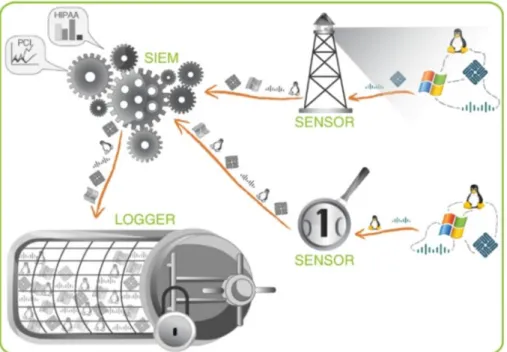
opportunity to monitor processes, prioritize events according to their occurrence, detect any threat to the system and finally monitor any security events within the network. AlienVault Unified SIEM is based on OSSIM tool that includes a wide range of security measures, combined together to work as part of a fully functional system. This is accomplished with the distributed architecture shown in Figure 4.
Figure 4 – AlienVault architecture
We will present a brief description of the three AlienVault architecture components observed in Figure 4 (Sensor, SIEM and Logger).
Sensors perform the agents role and are responsible for managing the security, in other words
to detect and collect information about security incidents. These agents or “sensors” must be distributed throughout the infra-structure depending on the type and volume of information that we intend to collect and analyse.
SIEM component provides the tool with the security intelligence and data mining capacities,
what enables it to perform risk assessment, correlation, risk metrics, vulnerability scanning, data mining for events and real-time monitoring.
18
AlienVault SIEM uses a SQL database to store normalized information, what allows strong analysis and data mining capacities.
Logger is the component used to address security. It stores events in raw format in the file
system that is later used for forensic purposes.
In summary this tool was optimized for high performance and scalability allowing the correlation of millions of events per day. It uses digital signatures to ensure data integrity and, the ten to one compression saves valuable space, because it interoperates with Storage Area Networks (SANs) and Network Attached Storage (NAS). AlienVault Unified SIEM includes a powerful reporting system which may include both historical and real-time information. Built in report examples are (Availability, Security, Vulnerability Analysis). The dashboard functionality is also present, allowing the customizations that are of interest to the user. The real-time policy manager capabilities allow the creation of exceptions, and easily tunes the system behaviour and it is one of the advantages over the tools that only perform historical analysis. Since it includes Nagios13availability-monitor, it is capable of checking, displaying and
reporting hosts and network availability status (e.g. host availability, service availability, service level, system resource utilization; CPU, memory, network interfaces, disk, services running, operating system metrics, and others). In terms of intrusion detection and prevention (IDS and IPS) AlienVault includes Snort [28] the most widely used intrusion detection system and, it can be implemented as a sensor or inline as an IPS14, a configuration that will allow stopping in real-time the selected attacks. Another ability is the anomaly detectors, or NBA15 feature, that will enable the tool to learn by itself and alert when the statistical behaviour deviates enough from what it has learnt as a normal behaviour. It also installs in each system a host IDS16 that will enable the analysis of logs (e.g. windows event logs) and deploy policies and detection rules (e.g. for detecting Malware).
Since AlienVault unified SIEM is an aggregation of other open source tools it has a broad spectrum of activity, it provides immediate protection to critical assets, including detection, prevention and awareness capabilities needed to deal with the security challenges that companies have to deal with nowadays. Since it integrates more than thirty open source tools,
13 Nagios is a powerful monitoring system that enables organizations to identify and resolve IT infrastructure problems before they affect critical business processes.
14 IPS is an intrusion prevention system 15 NBA is a network behavior analysis solution 16 IDS is an intrusion detection system
19
AlienVault can be installed trough an installer package and runs over Debian GNU/Linux operating system, 32-bit and 64-bit editions.
In MS IPTV particular case, a solution like OSSIM will be hard to implement since it relies in sensors that need to be installed in the servers that it will monitored. MS IPTV is a closed platform where no type of software or agents can be deployed, so a non-intrusive security analysis will be our best option. This is why SMCS that was specifically developed to work under these circumstances is better tailored to fit the MS IPTV security analysis needs. OSSIM is not able to perform attack pattern & regular expressions analysis, by default, hard configuration and scripting has to be performed.
In the end of this chapter we will provide a subsection with the comparison of the tools and also a summary of the parameters used for perform the comparison.
2.3.2 SALSA
SALSA is an approach from the Parallel data Laboratory from Carnegie Mellon University. It is an automated system-log analysis tool, that involves examining the logs to trace control-flow and data-flow execution in a distributed system, and the retrieval of state-machine-like views of the system’s execution on each node (19). In others words, SALSA picks up log data as-is and works towards building state-machine views and control and data-flow models of the target system´s with the purpose of analyzing problems.
Salsa performs an event-based analysis not looking to logs as a purely sources of events, but imposing additional semantics on the events of interest, to identify durations in which the system is performing a specific activity. To demonstrate the Salsa’s approach, logs generated by Google’s Hadoop17 were used. One of the major advantages of the SALSA method is that it
can uniquely delineate the start and end of key activities in the logs. SALSA also works at the failure diagnosis level and is able to compute the histogram of the durations of its different states in the derived state-machine view. After the study of the behavior of the durations of failure-free hosts and failure-injected hosts SALSA developers hypothesize that failures could be diagnosed by comparing the probability distributions of the durations, for a given state across hosts, assuming that a failure affects fewer than n/2 hosts in a cluster of n slave hosts.
SALSA it is not a perfect failure-diagnosis algorithm (something that reaches the true-positive rate of 1.0 at a false-positive rate of 0.0), but presents interesting performance results. It
20
presents different views of log data, which can be useful for a variety of purposes, such as visualization and failure diagnosis and also present some ways to diagnose correlated failures by superimposing the derived data-flow models on the control-flow models.
In short, SALSA examines system logs to derive state-machine views of the system’s execution, along with control-flow, data-flow models and related statistics.
In MS IPTV particular case, a solution like SALSA will be hard to implement as a single solution for security analysis, nevertheless, SALSA algorithm after some adaptation to the MS IPTV reality, might be valuable to attest SMCS findings. SALSA will not be able to take SMCS place since it is not able to perform attack pattern & regular expressions analysis.
2.3.3 Feedzai
When talking about real-time analysis applications we must talk about FeedZai “Pulse”. Feedzai was the first company that was born as a startup of Carnegie Mellon-Portugal program and they already won the European Prize for Intelligent Companies on the Smart Entrepreneurship Competition of 2010.
They are the developers of “Pulse”, a real‐time Business Intelligence18 product created to deal
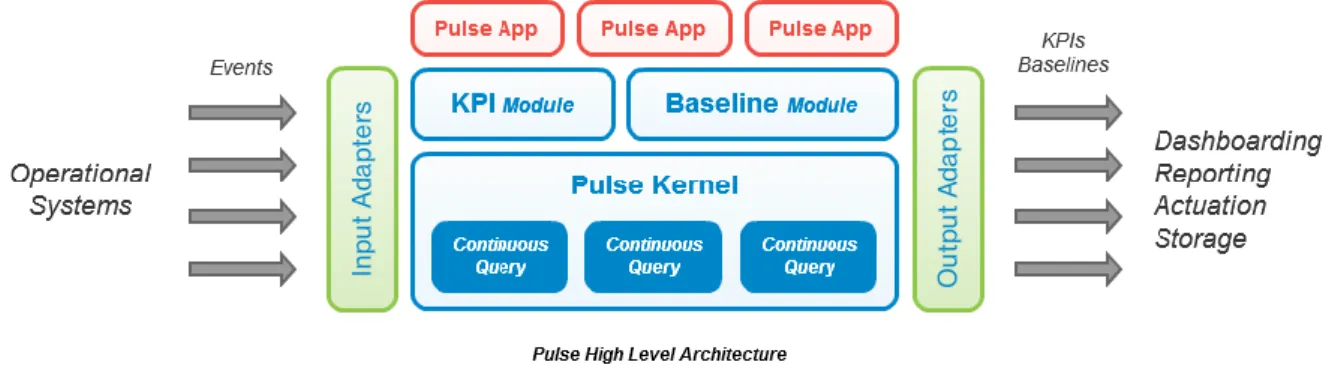
with huge data volumes that are generated by the modern companies and help them to make quick decisions based on real-time information. Feedzai Pulse mission is to provide a clever and high performance way to automatically discover when critical business indicators have unexpected values when compared with historical baselines. This tool can also be applied to single customers that can use it for example to save energy in their houses. Pulse is able to show the home electric, gas and water consumption in real-time and since it is equipped with prediction algorithms it will not only show home consumption as they happen, but also give some estimations and comparisons with other homes with the same profile. For this reason Feedzai Pulse high-level architecture (HLD), presented in Figure 5, shows why it can be considered a real-time event-driven data analytics system. In the HLD we can observe that the interaction with external operational systems is realized through the input and output adapters. Pulse Kernel also designated from PKernel is the core and it is running the event-processing engine, upon it, two modules appear the KPI and the Baseline module. The first allows defining Key Performance Indicators, transparently providing the ability to store them in
18 Business intelligence (BI) mainly refers to computer-based techniques used in identifying, extracting,[clarification needed] and analyzing business data
21
any database, and the second allows defining reference values to which real-time KPIs are compared.
Figure 5– HLD Feedzai Pulse
Architecture
Feedzai pulse architecture is composed by different modules that operate in the workflow presented in Figure 6. To better, understand the architecture the modules will be explained using the numbers one to five.
Figure 6 - FeedZai architecture
The KPI (Key Performance Indicator) module, based on KPI definitions, is responsible for submitting the continuous queries into the PKernel engine (data processing kernel).
1) KPI module is notified every time new results are produced, 2) KPI module validates the results and stores them on the database,
22
3) The baseline engine, given its baseline definitions, will be responsible for scheduling queries
over the KPIs stored in the database,
4) and 5) The baseline engine will validate the query results and not only store them in the
database, something that happens for historical purposes, but it will forward them into the PKernel.
Security analysis
Feedzai “Pulse” is a product that can be integrated in the SIEMs group since it allows companies to continuously monitor their businesses, reacting to new information proactively and in real-time. It is able to perform a security real-time analysis, because when an event arrives at the Event Processing engine, it is analyzed by a series of procedures that generate a result. In summary Pulse from Feedzai, is a tool that performs complex event processing analysis and integrates real-time data with historical information from huge data volumes.
In MS IPTV particular case, a solution like Pulse will be possible to implement. Nevertheless, the results that Pulse provides are out of the SMCS security analysis scope and, in the other hand, FeedZai Pulse is not able to perform attack pattern and regular expressions analysis.
2.3.4 SCOM
Microsoft chose System Center Operations Manager (SCOM) as the monitoring system to aggregate all the events generated in the different application components of MS IPTV, and issue alarms based on the pre-defined management pack rules19. Nevertheless, all the
configuration and fine-tuning depend on the client infrastructure, which means that a lot of the customization and authoring, must be done before SCOM is fully operational.
Since MS IPTV is a new technology based on old technology, (e.g. Microsoft SQL20 Server is
used for the databases and Internet Information Services for the web services). They were all bundled in a new concept called Mediaroom or MS IPTV, with the purpose of providing smart TV services. The question here is: can these services be monitored like independent services? On the other hand, does it make sense to analyze the entire infrastructure, knowing à priory that some single services can jeopardize the entire system?
19 Management pack is a set of filtering rules specific to some monitored application.
20 SQL - commonly expanded to Structured Query Language is a popular computer language used to create, modify, retrieve and manipulate data from relational database management systems
23
SCOM provides a specific management pack for MS IPTV, but in what concerns security it is not enough. The SCOM module that is more likely to be used in a security analysis is the Microsoft Audit Collection Services (ACS). This module can identify security threats (e.g. hacking and viral activity), auditors and security officers can look for the misuse for regulatory compliance and administrators can track users’ activity (e.g. account lockouts).
Nevertheless, SCOM has no built in methodology that enables it to detect attacks, something that, most likely, has to be developed by third party vendors.
2.3.5 Pulso
Pulso is a Portugal Telecom in-house monitoring solution, started to be developed in 2003, which allows the different groups within the company to have the same monitoring tools and indexes.
The Pulso platform was initially developed to address the lack of information about the QoS21
of the internal and critical servers of Portugal Telecom. At that time there was the IBM Tivoli solution, because IBM was the company OMG22 outsourcer, so having a proprietary view, a
second vision over the servers QoS, was essential. Pulso was then developed based on some open source components and philosophy. Its architecture is made by a central repository and a network of distributed agents, developed in Perl, that gather and forward informational data to the processing and correlation engine. At the present moment Pulso has no built-in process to track security breaches, systems OMG quality or the QoM23. It can only assure the QOP24 if
some tests on demand were performed against the systems. It is a custom made monitoring application, very difficult to extend, but its graphics are very important to allow the visualization of the status of the overall infrastructure and to drill down and verify the status of each server. In case of any problem affecting the QoS index of the application, the drill down permits to identify which server and component is affecting the index. Pulso reports are also very important because they are used in more high-level meetings, with administrators and directors, providing aggregated information about the systems health. In the actual monitoring system scenario, Pulso can be categorized in the real-time, predictive and reactive categories, since QoS system metrics are collected every minute and database metrics every five minutes.
21 QoS - Quality of Service
22 - OMG – Operations and management 23 QoM - Quality of Maintenance 24 QoP - Quality of Protection
24
Pulso has some predictive algorithms, for instance to predict when a system partition will become full, and reactive because based on the correlation engine rules it opens alarms via email, SMS and HP OpenView console for the technical teams.
About the programing languages used in Pulso we can say that system agents are developed in Perl; oracle agents are developed in PL/SQL; internal core components are developed in Java; web applications are developed in Ruby On Rails; glue code between the different components with no need for performance, are developed in Ruby.
A commercial version of this product is in the forge, Pulso V5,the first commercial and customer ready product, and very easy to extend with new functionalities. One of the major advantages over the other monitoring products is the price, since Pulso is mostly open source. The company aims to make profit selling consulting services. This latest version of the Pulso project creates a model of the target infrastructure, based on a Ruby DSL, defining everything about the operating system, application processes, log files, web servers, databases, and others, from the different vendors (UNIX families and Windows). Agents are automatically generated based on that DSL configuration files.
Pulso was not developed to perform attack pattern & regular expressions analysis, so SMCS action is of utmost importance to detect place since it is not able to perform.
2.3.6 ArcSight SIEM
ArcSight is a product that is now part of HP Company, and it was positioned by Gartner, Inc. in the Leaders Quadrant of the 2011 Magic Quadrant for SIEM [30]. It was developed with the objective of providing greater security, better access governance, and faster forensic investigations.
This tool was adopted by the operator, Portugal Telecom, with the purpose of performing real-time monitoring, but they soon realized that they were misinterpreting the ArcSight concept. This product is a powerful correlation engine and a data collection database that runs smoothly even when large amounts of information is analyzed. This happens provided that the built in categorizations of ArcSight are used, something that was not happening when PT was using it to act has an IDS system. In a second phase, when ArcSight started to be correctly used to gather multiplatform data, PT was capable of unifying logs into one common format (e.g. Cisco Checkpoint, Linux, Microsoft, and other custom-built applications). It is now possible to perform a plain language analysis that eliminates the need for separate reports for every device type, and the powerful reporting capabilities help in great deal the forensic analysis.
25
ArcSight presents impressive performance numbers, processing up to hundred thousand events per second, compressing and storing up to thirty-five terabytes of logs, and browsing through tree million records in one second. But most of all, the big win is the increase in the response time, since all these centralizing capabilities enable the really fast discovery of the underling events, something that in the end will supply a better security accuracy.
As we can see in Figure 7, a series of agents are part of the product bundle, but if a connector for a certain proprietary solution does not exist, it can be developed and easily integrated in the operations since ArcSight operates in conformity with the syslog25 standard. The core
engine operates over Java and the database uses Oracle. The new version is planned to use a proprietary database system that will influence the performance (up to three times faster) and the price, since the Oracle licenses are currently one of the reasons for the high price of ArcSight [27].
Figure 7 – ArcSight architecture
The ArcSight architecture in Figure 7, presents the Enterprise Security Management (ESM) that is the “brain” of the ArcSight SIEM platform, where the analysis and data correlation is performed. The other components, the smart agents, bring already some built in rules and specifications for certain providers, while the database keeps the results, that are later presented on the consoles.
In terms of requirements, it is a heavy application, which requires a robust server in terms of memory and processor to house the ESM component. Additionally, database server should take into consideration the large amount of disk size necessary to deal with the terabytes of information that ArcSight stores.