ScienceDirect
Available online at www.sciencedirect.com
Procedia Computer Science 121 (2017) 998–1005
1877-0509 © 2017 The Authors. Published by Elsevier B.V.
Peer-review under responsibility of the scientific committee of the CENTERIS - International Conference on ENTERprise Information Systems / ProjMAN - International Conference on Project MANagement / HCist - International Conference on Health and Social Care Information Systems and Technologies.
10.1016/j.procs.2017.11.129
1877-0509 © 2017 The Authors. Published by Elsevier B.V.
Peer-review under responsibility of the scientific committee of the CENTERIS - International Conference on ENTERprise Information Systems / ProjMAN - International Conference on Project MANagement / HCist - International Conference on Health and Social Care Information Systems and Technologies.
10.1016/j.procs.2017.11.129
10.1016/j.procs.2017.11.129
© 2017 The Authors. Published by Elsevier B.V.
Peer-review under responsibility of the scientific committee of the CENTERIS - International Conference on ENTERprise Information Systems / ProjMAN - International Conference on Project MANagement / HCist - International Conference on Health and Social Care Information Systems and Technologies.
1877-0509 Available online at www.sciencedirect.com
ScienceDirect
Procedia Computer Science 00 (2017) 000–000www.elsevier.com/locate/procedia
1877-0509 © 2017 The Authors. Published by Elsevier B.V.
Peer-review under responsibility of the scientific committee of the CENTERIS - International Conference on ENTERprise Information Systems / ProjMAN - International Conference on Project MANagement / HCist - International Conference on Health and Social Care Information Systems and Technologies.
CENTERIS - International Conference on ENTERprise Information Systems / ProjMAN -
International Conference on Project MANagement / HCist - International Conference on Health
and Social Care Information Systems and Technologies, CENTERIS / ProjMAN / HCist 2017, 8-10
November 2017, Barcelona, Spain
Knowledge sharing at the construction sector – facilitators and
inhibitors
Carmem Leal
a, Sandra Cunha
b,c*, Iolanda Couto
baCentro de Estudos Transdisciplinares para o Desenvolvimento (CETRAD), University of Trás-os-Montes e Alto Douro, Vila Real, Portugal bUniversity of Trás-os-Montes e Alto Douro, Vila Real, Portugal
c C-MADE - Centre of Materials and Building Technologies, University of Beira Interior, Covilhã, Portugal
Abstract
In modern economic society, organizations’ competitiveness relies heavily on their ability to leverage and manage knowledge rather than in physical assets, some authors refer even though the concepts of knowledge management (KM) are being well implemented in the industrial sector, the construction segment, however, appears to have some difficulties in adopting the practices and strategies offered by KM. It is known that the construction sector (CS) is experiencing a time of instability and recession, and one of the causes of this may involve the lack of adaptation to knowledge era. Therefore, this paper, based on literature review, gives an overview of inhibitor and the facilitator factors of knowledge sharing (KS) with the objective to answer two questions: which of the KS inhibitors and facilitators characterize the CS? has the CS its specifics KS inhibitors and facilitators? It’s presented a framework in order to verify the existence of exclusive factors of the sector. At this point it is possible to suggest that CS has mainly organizational factors as inhibitors and the facilitator’s factors are almost individual. The facilitating factors might be the consequence of an effective and successful KS strategy and can be seen as guidelines to improve the construction industry organizational performance.
© 2017 The Authors. Published by Elsevier B.V.
Peer-review under responsibility of the scientific committee of the CENTERIS - International Conference on ENTERprise Information Systems / ProjMAN - International Conference on Project MANagement / HCist - International Conference on Health and Social Care Information Systems and Technologies.
Keywords: Knowledge Sharing; Inhibitor Factors; Facilitator Factors; Organizational Performance; Construction Industry.
* Corresponding author.
E-mail address: [email protected]
Available online at www.sciencedirect.com
ScienceDirect
Procedia Computer Science 00 (2017) 000–000
www.elsevier.com/locate/procedia
1877-0509 © 2017 The Authors. Published by Elsevier B.V.
Peer-review under responsibility of the scientific committee of the CENTERIS - International Conference on ENTERprise Information Systems / ProjMAN - International Conference on Project MANagement / HCist - International Conference on Health and Social Care Information Systems and Technologies.
CENTERIS - International Conference on ENTERprise Information Systems / ProjMAN -
International Conference on Project MANagement / HCist - International Conference on Health
and Social Care Information Systems and Technologies, CENTERIS / ProjMAN / HCist 2017, 8-10
November 2017, Barcelona, Spain
Knowledge sharing at the construction sector – facilitators and
inhibitors
Carmem Leal
a, Sandra Cunha
b,c*, Iolanda Couto
baCentro de Estudos Transdisciplinares para o Desenvolvimento (CETRAD), University of Trás-os-Montes e Alto Douro, Vila Real, Portugal bUniversity of Trás-os-Montes e Alto Douro, Vila Real, Portugal
c C-MADE - Centre of Materials and Building Technologies, University of Beira Interior, Covilhã, Portugal
Abstract
In modern economic society, organizations’ competitiveness relies heavily on their ability to leverage and manage knowledge rather than in physical assets, some authors refer even though the concepts of knowledge management (KM) are being well implemented in the industrial sector, the construction segment, however, appears to have some difficulties in adopting the practices and strategies offered by KM. It is known that the construction sector (CS) is experiencing a time of instability and recession, and one of the causes of this may involve the lack of adaptation to knowledge era. Therefore, this paper, based on literature review, gives an overview of inhibitor and the facilitator factors of knowledge sharing (KS) with the objective to answer two questions: which of the KS inhibitors and facilitators characterize the CS? has the CS its specifics KS inhibitors and facilitators? It’s presented a framework in order to verify the existence of exclusive factors of the sector. At this point it is possible to suggest that CS has mainly organizational factors as inhibitors and the facilitator’s factors are almost individual. The facilitating factors might be the consequence of an effective and successful KS strategy and can be seen as guidelines to improve the construction industry organizational performance.
© 2017 The Authors. Published by Elsevier B.V.
Peer-review under responsibility of the scientific committee of the CENTERIS - International Conference on ENTERprise Information Systems / ProjMAN - International Conference on Project MANagement / HCist - International Conference on Health and Social Care Information Systems and Technologies.
Keywords: Knowledge Sharing; Inhibitor Factors; Facilitator Factors; Organizational Performance; Construction Industry.
* Corresponding author.
E-mail address: [email protected]
2 Carmem Leal et al. / Procedia Computer Science 00 (2017) 000–000
Introduction
Knowledge is a term with different meanings in different contexts. For example, according to Webster’s dictionary, knowledge is the fact or condition of knowing something with familiarity, something that has been acquired through
experience or association, as referred by Serna1. Others authors, like Davenport and Prusak2 define knowledge as a
mixture of experiences, values, contextual and specialized information, originating from and applied in each individual in the knowledge, and which provides a framework for evaluating and incorporating new experiences and information. There are numerous definitions of knowledge in literature that confirm that knowledge originates and resides in
people1. As suggested by Nonaka and Takeuchi3, knowledge can be classified as tacit/informal and explicit/formal.
Nonaka4 define knowledge as showed in Table 1.
Table 1 – Explicit and Tacit Knowledge definition.
Explicit Knowledge Tacit Knowledge
This is the type of knowledge that can be expressed in a formal and systematic language, and be shared as data, specific formulas, details, manuals or specialists.
A more subjective knowledge, based on experience, it is invisible and hardly expressed, communicated, perceived or measured.
Knowledge organisations perform knowledge processes, using their primary resources of intellectual capital, their key input of information and their effectiveness in performing these processes depends on their knowledge
capabilities5. Egbu6 believes that, for leaders of construction projects and organisations, the processes by which
knowledge is created or acquired, communicated, applied and utilised must be effectively managed.
Alavi and Leidner7 remind that according to Davenport and Prusak2, most KM projects have one of three aims: (1)
to make knowledge visible and show the role of knowledge in an organization, mainly through maps, yellow pages, and hypertext tools, (2) to develop a knowledge-intensive culture by encouraging and aggregating behaviours such as KS and proactively seeking and offering knowledge; (3) to build a knowledge infrastructure-not only a technical system, but a web of connections among people given space, time, tools, and encouragement to interact and collaborate. This paper will focus on the KM second aim: the KS, because understanding the effectiveness of formal and informal approaches to KS may assist organisations in taking full advantage of this practices and achieve better
performance levels8.
According to Robinson12 the CS represents one of the biggest resistant in terms of implementing KM strategies.
These authors defend that construction firms (CFs) are often reluctant to invest in new initiatives or innovative approaches, citing low profit margins often militating against investment in research and development. Mohd Zin and
Egbu8 follow the same line of reasoning, highlighting a variety of factors, most notably the cultural practices.
Regarding this, the main purpose of this paper is to emphasize the facilitating and inhibiting factors of KS at the construction industry firms and its impact on their performance.
To achieve more specific results, it will be separated individual KS from organizational KS factors, since it’s intended with this paper the classification and improvement at the organizational level of the sector under analysis.
In this way, based on former literature, it will be developed a representative framework of a set of facilitators and inhibitors to KS practices, distinguishing between individual and organisational factors. Throughout this literature review it will be presented an overview of those who are specific connected to CFs.
Methodology
As previously stated this paper is based on literature review and according to Brereton15, a literature review has
three primary phases:
(1) Planning of the review; (2) Conducting the review; and (3) Documenting the results.
In this way, the paper will summarize all of these phases to answer the two research questions that were formulated for this investigation:
(RSQ1) Which of the KS inhibitors and facilitators characterize the construction industry?
To get an overview of different types of KS challenges reported in literature and identify the challenges that are most frequently reported in the context of this specific sector.
Carmem Leal et al. / Procedia Computer Science 121 (2017) 998–1005 999
ScienceDirect
Procedia Computer Science 00 (2017) 000–000
www.elsevier.com/locate/procedia
1877-0509 © 2017 The Authors. Published by Elsevier B.V.
Peer-review under responsibility of the scientific committee of the CENTERIS - International Conference on ENTERprise Information Systems / ProjMAN - International Conference on Project MANagement / HCist - International Conference on Health and Social Care Information Systems and Technologies.
CENTERIS - International Conference on ENTERprise Information Systems / ProjMAN -
International Conference on Project MANagement / HCist - International Conference on Health
and Social Care Information Systems and Technologies, CENTERIS / ProjMAN / HCist 2017, 8-10
November 2017, Barcelona, Spain
Knowledge sharing at the construction sector – facilitators and
inhibitors
Carmem Leal
a, Sandra Cunha
b,c*, Iolanda Couto
baCentro de Estudos Transdisciplinares para o Desenvolvimento (CETRAD), University of Trás-os-Montes e Alto Douro, Vila Real, Portugal bUniversity of Trás-os-Montes e Alto Douro, Vila Real, Portugal
c C-MADE - Centre of Materials and Building Technologies, University of Beira Interior, Covilhã, Portugal
Abstract
In modern economic society, organizations’ competitiveness relies heavily on their ability to leverage and manage knowledge rather than in physical assets, some authors refer even though the concepts of knowledge management (KM) are being well implemented in the industrial sector, the construction segment, however, appears to have some difficulties in adopting the practices and strategies offered by KM. It is known that the construction sector (CS) is experiencing a time of instability and recession, and one of the causes of this may involve the lack of adaptation to knowledge era. Therefore, this paper, based on literature review, gives an overview of inhibitor and the facilitator factors of knowledge sharing (KS) with the objective to answer two questions: which of the KS inhibitors and facilitators characterize the CS? has the CS its specifics KS inhibitors and facilitators? It’s presented a framework in order to verify the existence of exclusive factors of the sector. At this point it is possible to suggest that CS has mainly organizational factors as inhibitors and the facilitator’s factors are almost individual. The facilitating factors might be the consequence of an effective and successful KS strategy and can be seen as guidelines to improve the construction industry organizational performance.
© 2017 The Authors. Published by Elsevier B.V.
Peer-review under responsibility of the scientific committee of the CENTERIS - International Conference on ENTERprise Information Systems / ProjMAN - International Conference on Project MANagement / HCist - International Conference on Health and Social Care Information Systems and Technologies.
Keywords: Knowledge Sharing; Inhibitor Factors; Facilitator Factors; Organizational Performance; Construction Industry.
* Corresponding author.
E-mail address: [email protected]
Available online at www.sciencedirect.com
ScienceDirect
Procedia Computer Science 00 (2017) 000–000
www.elsevier.com/locate/procedia
1877-0509 © 2017 The Authors. Published by Elsevier B.V.
Peer-review under responsibility of the scientific committee of the CENTERIS - International Conference on ENTERprise Information Systems / ProjMAN - International Conference on Project MANagement / HCist - International Conference on Health and Social Care Information Systems and Technologies.
CENTERIS - International Conference on ENTERprise Information Systems / ProjMAN -
International Conference on Project MANagement / HCist - International Conference on Health
and Social Care Information Systems and Technologies, CENTERIS / ProjMAN / HCist 2017, 8-10
November 2017, Barcelona, Spain
Knowledge sharing at the construction sector – facilitators and
inhibitors
Carmem Leal
a, Sandra Cunha
b,c*, Iolanda Couto
baCentro de Estudos Transdisciplinares para o Desenvolvimento (CETRAD), University of Trás-os-Montes e Alto Douro, Vila Real, Portugal bUniversity of Trás-os-Montes e Alto Douro, Vila Real, Portugal
c C-MADE - Centre of Materials and Building Technologies, University of Beira Interior, Covilhã, Portugal
Abstract
In modern economic society, organizations’ competitiveness relies heavily on their ability to leverage and manage knowledge rather than in physical assets, some authors refer even though the concepts of knowledge management (KM) are being well implemented in the industrial sector, the construction segment, however, appears to have some difficulties in adopting the practices and strategies offered by KM. It is known that the construction sector (CS) is experiencing a time of instability and recession, and one of the causes of this may involve the lack of adaptation to knowledge era. Therefore, this paper, based on literature review, gives an overview of inhibitor and the facilitator factors of knowledge sharing (KS) with the objective to answer two questions: which of the KS inhibitors and facilitators characterize the CS? has the CS its specifics KS inhibitors and facilitators? It’s presented a framework in order to verify the existence of exclusive factors of the sector. At this point it is possible to suggest that CS has mainly organizational factors as inhibitors and the facilitator’s factors are almost individual. The facilitating factors might be the consequence of an effective and successful KS strategy and can be seen as guidelines to improve the construction industry organizational performance.
© 2017 The Authors. Published by Elsevier B.V.
Peer-review under responsibility of the scientific committee of the CENTERIS - International Conference on ENTERprise Information Systems / ProjMAN - International Conference on Project MANagement / HCist - International Conference on Health and Social Care Information Systems and Technologies.
Keywords: Knowledge Sharing; Inhibitor Factors; Facilitator Factors; Organizational Performance; Construction Industry.
* Corresponding author.
E-mail address: [email protected]
2 Carmem Leal et al. / Procedia Computer Science 00 (2017) 000–000
Introduction
Knowledge is a term with different meanings in different contexts. For example, according to Webster’s dictionary, knowledge is the fact or condition of knowing something with familiarity, something that has been acquired through
experience or association, as referred by Serna1. Others authors, like Davenport and Prusak2 define knowledge as a
mixture of experiences, values, contextual and specialized information, originating from and applied in each individual in the knowledge, and which provides a framework for evaluating and incorporating new experiences and information. There are numerous definitions of knowledge in literature that confirm that knowledge originates and resides in
people1. As suggested by Nonaka and Takeuchi3, knowledge can be classified as tacit/informal and explicit/formal.
Nonaka4 define knowledge as showed in Table 1.
Table 1 – Explicit and Tacit Knowledge definition.
Explicit Knowledge Tacit Knowledge
This is the type of knowledge that can be expressed in a formal and systematic language, and be shared as data, specific formulas, details, manuals or specialists.
A more subjective knowledge, based on experience, it is invisible and hardly expressed, communicated, perceived or measured.
Knowledge organisations perform knowledge processes, using their primary resources of intellectual capital, their key input of information and their effectiveness in performing these processes depends on their knowledge
capabilities5. Egbu6 believes that, for leaders of construction projects and organisations, the processes by which
knowledge is created or acquired, communicated, applied and utilised must be effectively managed.
Alavi and Leidner7 remind that according to Davenport and Prusak2, most KM projects have one of three aims: (1)
to make knowledge visible and show the role of knowledge in an organization, mainly through maps, yellow pages, and hypertext tools, (2) to develop a knowledge-intensive culture by encouraging and aggregating behaviours such as KS and proactively seeking and offering knowledge; (3) to build a knowledge infrastructure-not only a technical system, but a web of connections among people given space, time, tools, and encouragement to interact and collaborate. This paper will focus on the KM second aim: the KS, because understanding the effectiveness of formal and informal approaches to KS may assist organisations in taking full advantage of this practices and achieve better
performance levels8.
According to Robinson12 the CS represents one of the biggest resistant in terms of implementing KM strategies.
These authors defend that construction firms (CFs) are often reluctant to invest in new initiatives or innovative approaches, citing low profit margins often militating against investment in research and development. Mohd Zin and
Egbu8 follow the same line of reasoning, highlighting a variety of factors, most notably the cultural practices.
Regarding this, the main purpose of this paper is to emphasize the facilitating and inhibiting factors of KS at the construction industry firms and its impact on their performance.
To achieve more specific results, it will be separated individual KS from organizational KS factors, since it’s intended with this paper the classification and improvement at the organizational level of the sector under analysis.
In this way, based on former literature, it will be developed a representative framework of a set of facilitators and inhibitors to KS practices, distinguishing between individual and organisational factors. Throughout this literature review it will be presented an overview of those who are specific connected to CFs.
Methodology
As previously stated this paper is based on literature review and according to Brereton15, a literature review has
three primary phases:
(1) Planning of the review; (2) Conducting the review; and (3) Documenting the results.
In this way, the paper will summarize all of these phases to answer the two research questions that were formulated for this investigation:
(RSQ1) Which of the KS inhibitors and facilitators characterize the construction industry?
To get an overview of different types of KS challenges reported in literature and identify the challenges that are most frequently reported in the context of this specific sector.
1000 Carmem Leal et al. / Procedia Computer Science 121 (2017) 998–1005
Carmem Leal et al. / Procedia Computer Science 00 (2017) 000–000 3 To gain an understanding of the KS practices already implemented in CS.
All the investigation will be based on literature review itself, the verification of the data obtained through it and the conclusions inherent to it.
Literature Review
According to Singh and Kant17, the implementation of KM in the organizations, especially the implementation of
KS strategies, represents one of the biggest attractions for researchers and specialists, simply due to the essential part that KS plays for any organization that wish to compete with success.
KM is largely regarded as a process involving various activities. Slight discrepancies in the delineation of the processes appear in the literature, namely in terms of the number and labeling of processes, rather than the underlying
concepts. Alavi and Leidner7 considered the four basic processes of KM that can be listed as: creating,
storing/retrieving, transferring, and applying knowledge. Knowledge Sharing in Construction Sector
Although there are many KS facilitators identified in the literature such as organizational culture, information technology support, resources, intrinsic motivations, extrinsic incentives, social factors, reciprocity, conformity or social proof, commitment, consistency, experts, authority (that should emphasize the importance of KS thus creating
an environment where people feel that they are treated fairly in exchange for their knowledge16), fondness and
scarcity17, there are persistent barriers to workplace learning, which will prevent the communication and sharing of
tacit knowledge between management and workers in teams18, including knowledge tacitly19, limited absorptive
capacity of knowledge receivers20, perceptions of competition by knowledge providers21,22, and lack of trust between
providers and receivers23.
The KS process and the consequent sharing knowledge strategy depends on each firm sector. A particular KS strategy or specific managerial actions will not suit all firms. The implementation of KS goals and strategies into a
firm’s strategic planning will vary greatly24.
Construction projects are unique and temporary, which means that construction project teams are also temporary and consist in multidisciplinary teams. During these projects it is valuable to collect information about events,
consequences and the steps taken together with their effectiveness25. It is important to collect all available information
and use it in subsequent projects. This use of available information is only possible when KS exists. Given that CFs work on projects with different characteristics and normally many at the same time, it is important to realize that such projects are managed differently. These management characteristics must be shared so that other teams can use this shared knowledge in particular conditions of similar projects, in this way it is possible to use resources (time, people and materials) more efficiently. However, some CFs take some unsuccessful efforts concerning the implementation of KS strategies.
For Javernick–Will17 the majority of prior work on KS strategies examines constructs and relationships at the macro
level, generally at the firm-level, leaving little work rooted in micro-foundations at the individual level28.That is why
it is necessary to separate the individual factors from the organizational ones, since the difference between them is very sharp.
Table 2. Inhibiting and Facilitating Factors of KS in the Construction Industry.
Inhibiting Factors Facilitating factors
Resources – Mainly time Mainly a male sector High turnover
Low level of training, intellectual capital Culture12,17,26,29,34,35,36,37,38,39,40,41
Financial/social motivations Conformity to corporate culture Reciprocity
Perceived value and uniqueness of knowledge Peer recognition
Honouring KS commitments Mimicking the behaviour of leaders Culture12,39,17,40,2,8,41,42
Table 2 highlights the inhibiting and facilitating factors of KS in the CS found in the literature. Now they can be separate according to their specificity.
4 Carmem Leal et al. / Procedia Computer Science 00 (2017) 000–000
In this way, in Table 3 can be verified that the facilitating factors appear to have an individual nature almost in their totality, allowing some conclusions about the lack of success in the application of organizational strategies of KS in the sector. These conclusions also point to the fact that the inhibiting factors of the sector being totally linked to organizational factors.
Table 3- Individual, Organisational, Inhibiting and Facilitating Factors of KS in CS.
Fac
ili
tat
or
s
Individual factors Organisational factors
Conformity to corporate culture Reciprocity
Perceived value and uniqueness of knowledge Peer recognition
Honouring KS commitments Mimicking the behaviour of leaders
Financial/social motivations Culture
Inh
ib
ito
rs Resources – Mainly time Mainly male sector
High turnover
Low level of training/ intellectual capital Culture
Carrillo28 found that the main drivers for KM in construction are the need to encourage continuous improvement,
to share valuable tacit knowledge, to disseminate best practices, to respond to customers quickly, to reduce rework and to develop new products and services. An effective KS process is therefore highly vital for CFs in order to prevent
the loss of knowledge gained in the construction projects26. In this regard, organizations should consider the most
suitable KS approach to their firm and select the right tools, techniques and practices in developing a KM strategy26.
The facilitating factors, could, in this way, work as guidelines to achieve a successful KS strategy.
Therefore, aiming to answer research question 1, Tables 2 and 3 present the inhibiting and facilitating factors which characterize the CS as well as others economic sectors.
Then, Table 4 presents the facilitator factors mentioned above with characteristics found in the literature. Although only organizational factors are considered in this study, it will also be presented the importance of the individual factors so that CFs can adopt them, not in the individuality, but as a whole, according to its organizational culture. Because the way of effectively managing knowledge is to translate individual and group knowledge to organizational
knowledge29.
Table 4: Facilitators framework
Fa cil ita to rs Financial/social motivations
KS barriers need to be overcome and KM strategies appropriately supported by a reward and incentive structure for a successful implementation in construction organisations14.
It is important to develop an incentive and reward structure since according to Lawton42 “goodwill
knowledge philanthropy” is hard to achieve12.
Conformity to corporate culture
One complimentary factor for ensuring optimal information flow in global business processes such as KM is a supportive and harmonized culture shared by all organizational constituents42.
Establishing a culture with the norm of KS is critical to sustain KM initiatives within the organization, as stated in 2012 by Javernick-Will17.
Honouring KS commitments
According to Javernick-Will17, people want to appear consistent to others and having made their
intentions to share their knowledge explicit, people will want to live up to these intentions and honour their commitment.
Peer recognition It is in the interests of people to be viewed as experts. If people have a reputation for expertise this is a source of power. They need to be certain that their colleagues will acknowledge the source of this knowledge and will not claim credit for it2.
Perceived value and uniqueness of knowledge
People find some subjects particularly fascinating, and Davenport and Prusak2 sustain that they
may be eager to talk about them as much from self-gratification as wanting to communicate knowledge.
To gain an understanding of the KS practices already implemented in CS.
All the investigation will be based on literature review itself, the verification of the data obtained through it and the conclusions inherent to it.
Literature Review
According to Singh and Kant17, the implementation of KM in the organizations, especially the implementation of
KS strategies, represents one of the biggest attractions for researchers and specialists, simply due to the essential part that KS plays for any organization that wish to compete with success.
KM is largely regarded as a process involving various activities. Slight discrepancies in the delineation of the processes appear in the literature, namely in terms of the number and labeling of processes, rather than the underlying
concepts. Alavi and Leidner7 considered the four basic processes of KM that can be listed as: creating,
storing/retrieving, transferring, and applying knowledge. Knowledge Sharing in Construction Sector
Although there are many KS facilitators identified in the literature such as organizational culture, information technology support, resources, intrinsic motivations, extrinsic incentives, social factors, reciprocity, conformity or social proof, commitment, consistency, experts, authority (that should emphasize the importance of KS thus creating
an environment where people feel that they are treated fairly in exchange for their knowledge16), fondness and
scarcity17, there are persistent barriers to workplace learning, which will prevent the communication and sharing of
tacit knowledge between management and workers in teams18, including knowledge tacitly19, limited absorptive
capacity of knowledge receivers20, perceptions of competition by knowledge providers21,22, and lack of trust between
providers and receivers23.
The KS process and the consequent sharing knowledge strategy depends on each firm sector. A particular KS strategy or specific managerial actions will not suit all firms. The implementation of KS goals and strategies into a
firm’s strategic planning will vary greatly24.
Construction projects are unique and temporary, which means that construction project teams are also temporary and consist in multidisciplinary teams. During these projects it is valuable to collect information about events,
consequences and the steps taken together with their effectiveness25. It is important to collect all available information
and use it in subsequent projects. This use of available information is only possible when KS exists. Given that CFs work on projects with different characteristics and normally many at the same time, it is important to realize that such projects are managed differently. These management characteristics must be shared so that other teams can use this shared knowledge in particular conditions of similar projects, in this way it is possible to use resources (time, people and materials) more efficiently. However, some CFs take some unsuccessful efforts concerning the implementation of KS strategies.
For Javernick–Will17 the majority of prior work on KS strategies examines constructs and relationships at the macro
level, generally at the firm-level, leaving little work rooted in micro-foundations at the individual level28.That is why
it is necessary to separate the individual factors from the organizational ones, since the difference between them is very sharp.
Table 2. Inhibiting and Facilitating Factors of KS in the Construction Industry.
Inhibiting Factors Facilitating factors
Resources – Mainly time Mainly a male sector High turnover
Low level of training, intellectual capital Culture12,17,26,29,34,35,36,37,38,39,40,41
Financial/social motivations Conformity to corporate culture Reciprocity
Perceived value and uniqueness of knowledge Peer recognition
Honouring KS commitments Mimicking the behaviour of leaders Culture12,39,17,40,2,8,41,42
Table 2 highlights the inhibiting and facilitating factors of KS in the CS found in the literature. Now they can be separate according to their specificity.
In this way, in Table 3 can be verified that the facilitating factors appear to have an individual nature almost in their totality, allowing some conclusions about the lack of success in the application of organizational strategies of KS in the sector. These conclusions also point to the fact that the inhibiting factors of the sector being totally linked to organizational factors.
Table 3- Individual, Organisational, Inhibiting and Facilitating Factors of KS in CS.
Fac
ili
tat
or
s
Individual factors Organisational factors
Conformity to corporate culture Reciprocity
Perceived value and uniqueness of knowledge Peer recognition
Honouring KS commitments Mimicking the behaviour of leaders
Financial/social motivations Culture
Inh
ib
ito
rs Resources – Mainly time Mainly male sector
High turnover
Low level of training/ intellectual capital Culture
Carrillo28 found that the main drivers for KM in construction are the need to encourage continuous improvement,
to share valuable tacit knowledge, to disseminate best practices, to respond to customers quickly, to reduce rework and to develop new products and services. An effective KS process is therefore highly vital for CFs in order to prevent
the loss of knowledge gained in the construction projects26. In this regard, organizations should consider the most
suitable KS approach to their firm and select the right tools, techniques and practices in developing a KM strategy26.
The facilitating factors, could, in this way, work as guidelines to achieve a successful KS strategy.
Therefore, aiming to answer research question 1, Tables 2 and 3 present the inhibiting and facilitating factors which characterize the CS as well as others economic sectors.
Then, Table 4 presents the facilitator factors mentioned above with characteristics found in the literature. Although only organizational factors are considered in this study, it will also be presented the importance of the individual factors so that CFs can adopt them, not in the individuality, but as a whole, according to its organizational culture. Because the way of effectively managing knowledge is to translate individual and group knowledge to organizational
knowledge29.
Table 4: Facilitators framework
Fa cil ita to rs Financial/social motivations
KS barriers need to be overcome and KM strategies appropriately supported by a reward and incentive structure for a successful implementation in construction organisations14.
It is important to develop an incentive and reward structure since according to Lawton42 “goodwill
knowledge philanthropy” is hard to achieve12.
Conformity to corporate culture
One complimentary factor for ensuring optimal information flow in global business processes such as KM is a supportive and harmonized culture shared by all organizational constituents42.
Establishing a culture with the norm of KS is critical to sustain KM initiatives within the organization, as stated in 2012 by Javernick-Will17.
Honouring KS commitments
According to Javernick-Will17, people want to appear consistent to others and having made their
intentions to share their knowledge explicit, people will want to live up to these intentions and honour their commitment.
Peer recognition It is in the interests of people to be viewed as experts. If people have a reputation for expertise this is a source of power. They need to be certain that their colleagues will acknowledge the source of this knowledge and will not claim credit for it2.
Perceived value and uniqueness of knowledge
People find some subjects particularly fascinating, and Davenport and Prusak2 sustain that they
may be eager to talk about them as much from self-gratification as wanting to communicate knowledge.
1002 Carmem Leal et al. / Procedia Computer Science 121 (2017) 998–1005
Carmem Leal et al. / Procedia Computer Science 00 (2017) 000–000 5
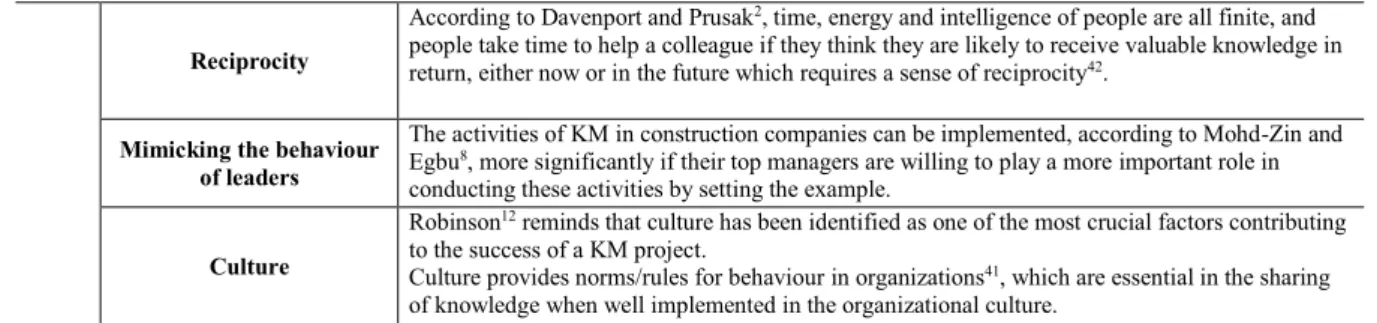
Reciprocity
According to Davenport and Prusak2, time, energy and intelligence of people are all finite, and
people take time to help a colleague if they think they are likely to receive valuable knowledge in return, either now or in the future which requires a sense of reciprocity42.
Mimicking the behaviour of leaders
The activities of KM in construction companies can be implemented, according to Mohd-Zin and Egbu8, more significantly if their top managers are willing to play a more important role in
conducting these activities by setting the example.
Culture
Robinson12 reminds that culture has been identified as one of the most crucial factors contributing
to the success of a KM project.
Culture provides norms/rules for behaviour in organizations41, which are essential in the sharing
of knowledge when well implemented in the organizational culture.
Serna1 emphasizes that in the KS process, in this particular sector, some inconveniences appear mostly because the
KS needs are not correctly identified and/or recollected. Besides, the actors implicated do not easily share their
knowledge about the problem30,31. Generally, much knowledge acquired is lost and the lessons learned are dispersed
at the end of the projects if not recorded or shared properly32.
Table 5 shows the main inhibitors factors collected from the literature that can explain the major problems of the CFs in terms of a KS strategy implementation.
Table 5: Inhibitors framework
Inh ib ito rs Resources – Mainly time
Time constraint is a key barrier in construction organisations given that projects are characterised by fixed time scales12.
Employees frequently cite a lack of time to share knowledge17.
Low level of training/ intellectual capital
Covey37 suggests that the loss of intellectual capital due to the lack of means for knowledge is one of the several
reasons why sharing knowledge projects fail at the sector38.
The lack of standard work processes highlighted by Carrillo29 as a barrier to KS is partly connected with the low
level of training of the employees.
High turnover Staff leaving the organisation was point out as being one of the main barriers of the KS processHigh staff defection is also seen as of the main obstacle in the implementation of KM36. 37.
Mainly a male sector
Lin34 noticed through previous literature that females are likely to experience high-quality instrumental
exchanges about individualized information and personalized knowledge, suggesting that females are more sensitive than males to the influence of instrumental ties on KS35.
Culture Culture has been a recurrent theme in the KM literature as it can enable or inhibit an organisation’s KM strategy12.
Several studies outlined cross-cultural sharing barriers based on organisational culture24,39,40,41.
The high turnover assumes an important role in terms of KS since is considered by the literature as the main obstacle in the implementation of KM, more precisely a KS strategy, in CS. Given the way CFs work, with defined timelines projects, the actors of each project have also a timeline schedule to find, gather and share knowledge. This cycle will only be possible if a successful KS strategy is carried out by the construction firm that manages these same projects to make sure that the found and gathered information leaves its individual field and becomes part of the organizational field once shared. Although we can perceive, the influence that the inhibiting factors found in the literature have in the construction industry KS process, it is inevitable, and considering the technological era in which we are living, to mention an inhibiting factor not yet very developed in the literature that is the lack of willingness to share knowledge by the appealing way in which this process has been defined in the construction. Ignoring the informal, non-canonical nature of KS, including people’s motivation, ability and opportunity to share knowledge, is one of the key
causes of resistance to use knowledge-sharing information technology tools33 although there are already numerous
construction KS platforms such as Knowledge Platform for Contractors (KPfC) developed by a group of researchers
in Turkey to promote KS in a more interactive and dynamic way and more recently HASIFR, mentioned by Gajzler25,
which works as a knowledge based tool to support technical management in the selection of building materials and technological solutions in the CS. The transformation of the CFs and their adaptation to the current market goes, considering the technological advances, through the innovation of the KS strategies and the consequent adhesion of the intervenient actors in the KS process.
6 Carmem Leal et al. / Procedia Computer Science 00 (2017) 000–000
So, in sum, and responding to second research question, based on Tables 4 and 5, it is possible to suggest that CS has its own enablers and obstacles in process of sharing of knowledge. These factors are linked mainly to organizational issues, but the individual’s perceptions are also very important in order to obtain better performances. Conclusions, limitations and future research
Organizations are becoming more knowledge intensive. They are hiring “minds” more than “hands”, and the need for leveraging the value of knowledge is increasing. A broad range of factors can influence the success of KM implementation, has being mentioned in the literature. That same literature has also been studying the problematic range of factors that inhibit KS at the CS.
Although these factors are all well known, the CFs seem to have stopped in time and does not demonstrate innovation capabilities to establish a successful KM strategy that should always be aligned with the firm’s overall strategy and objectives.
It was verified that the facilitating factors of KS in the CS are characterized as individual factors almost in their totality, which indicates the lacking of success in the implementation of organizational KS strategies, despite of the benefits that are well known.
On the contrary, the inhibiting factors present themselves as just organizational factors, reinforcing the conclusion that the initiative of sharing knowledge it is very much the responsibility of the CFs organizational culture and its capacity to implement a successful KS strategy.
Throughout the literature review, it was perceived that construction projects are unique and temporary which means that construction project teams are also temporary and consist of multidisciplinary teams. The high turnover seems to be one of the most characteristic inhibitor at the CS, if not the most characteristic one. The actors involved on the KS strategy normally move to another project, resign or retire conditioning the KS process.
It was found that the facilitating factors might be the consequence of an effective and successful KS strategy and can be seen as guidelines to improve the construction industry organizational performance and it will only be possible if this industry is able to translate individual and group knowledge to organizational knowledge.
In present characterized by high technology, and most important, by our high dependence on it, which makes clear that what may be considered a very visible barrier these days may not have been seen a few years ago. When we refer to knowledge capturing and KS in construction projects, we refer to it as a tedious task and in this way, very difficult to pass on to others (referring to administrative and documentary techniques). Nowadays, it is inevitable to consider as a barrier to KS, the lack of will to do so, not only because of the lack of time, but also because of the boring nature it seems to present. This inhibitor one can easily become a facilitator one if we adjust the CS to the incredibly easy world that technology has created. There are online platforms for KS in the CS, known as Knowledge-based systems, such as KPfC and more recently the advisory system HASIFR, which must be under constant updates. A simply platform registration is no longer an eye-catching for the actors who can and should develop the process of KS.
In this way it is believed that the development of more interesting techniques could bring better benefits in this matter. A partnership with researchers in the field of technology may be further established so that it can be developed a knowledge-gathering and knowledge-sharing software that really encourages the construction industry to not only know that there is a duty to share its knowledge but also to want and to desire to share its knowledge.
Regarding to limitations, this work do not have empirical data to prove any statement however, and talking about future investigation, the framework presented will be useful to design questionnaires according to the specific characteristics of this sector and to produce more investigation addressed to an economic sector as important as construction is.
References
1. Serna EM, Bachiller OS, Serna AA. Knowledge meaning and management in requirements engineering. International Journal of Information Management 2017; 37: 155-161.
2. Davenport TH, Prusak L. Working Knowledge. Boston: Harvard Business School Press; 1998. 3. Nonaka I, H. The Knowledge Creating Company. New York: Oxford University Press 1995.
Reciprocity
According to Davenport and Prusak2, time, energy and intelligence of people are all finite, and
people take time to help a colleague if they think they are likely to receive valuable knowledge in return, either now or in the future which requires a sense of reciprocity42.
Mimicking the behaviour of leaders
The activities of KM in construction companies can be implemented, according to Mohd-Zin and Egbu8, more significantly if their top managers are willing to play a more important role in
conducting these activities by setting the example.
Culture
Robinson12 reminds that culture has been identified as one of the most crucial factors contributing
to the success of a KM project.
Culture provides norms/rules for behaviour in organizations41, which are essential in the sharing
of knowledge when well implemented in the organizational culture.
Serna1 emphasizes that in the KS process, in this particular sector, some inconveniences appear mostly because the
KS needs are not correctly identified and/or recollected. Besides, the actors implicated do not easily share their
knowledge about the problem30,31. Generally, much knowledge acquired is lost and the lessons learned are dispersed
at the end of the projects if not recorded or shared properly32.
Table 5 shows the main inhibitors factors collected from the literature that can explain the major problems of the CFs in terms of a KS strategy implementation.
Table 5: Inhibitors framework
Inh ib ito rs Resources – Mainly time
Time constraint is a key barrier in construction organisations given that projects are characterised by fixed time scales12.
Employees frequently cite a lack of time to share knowledge17.
Low level of training/ intellectual capital
Covey37 suggests that the loss of intellectual capital due to the lack of means for knowledge is one of the several
reasons why sharing knowledge projects fail at the sector38.
The lack of standard work processes highlighted by Carrillo29 as a barrier to KS is partly connected with the low
level of training of the employees.
High turnover Staff leaving the organisation was point out as being one of the main barriers of the KS processHigh staff defection is also seen as of the main obstacle in the implementation of KM36. 37.
Mainly a male sector
Lin34 noticed through previous literature that females are likely to experience high-quality instrumental
exchanges about individualized information and personalized knowledge, suggesting that females are more sensitive than males to the influence of instrumental ties on KS35.
Culture Culture has been a recurrent theme in the KM literature as it can enable or inhibit an organisation’s KM strategy12.
Several studies outlined cross-cultural sharing barriers based on organisational culture24,39,40,41.
The high turnover assumes an important role in terms of KS since is considered by the literature as the main obstacle in the implementation of KM, more precisely a KS strategy, in CS. Given the way CFs work, with defined timelines projects, the actors of each project have also a timeline schedule to find, gather and share knowledge. This cycle will only be possible if a successful KS strategy is carried out by the construction firm that manages these same projects to make sure that the found and gathered information leaves its individual field and becomes part of the organizational field once shared. Although we can perceive, the influence that the inhibiting factors found in the literature have in the construction industry KS process, it is inevitable, and considering the technological era in which we are living, to mention an inhibiting factor not yet very developed in the literature that is the lack of willingness to share knowledge by the appealing way in which this process has been defined in the construction. Ignoring the informal, non-canonical nature of KS, including people’s motivation, ability and opportunity to share knowledge, is one of the key
causes of resistance to use knowledge-sharing information technology tools33 although there are already numerous
construction KS platforms such as Knowledge Platform for Contractors (KPfC) developed by a group of researchers
in Turkey to promote KS in a more interactive and dynamic way and more recently HASIFR, mentioned by Gajzler25,
which works as a knowledge based tool to support technical management in the selection of building materials and technological solutions in the CS. The transformation of the CFs and their adaptation to the current market goes, considering the technological advances, through the innovation of the KS strategies and the consequent adhesion of the intervenient actors in the KS process.
So, in sum, and responding to second research question, based on Tables 4 and 5, it is possible to suggest that CS has its own enablers and obstacles in process of sharing of knowledge. These factors are linked mainly to organizational issues, but the individual’s perceptions are also very important in order to obtain better performances. Conclusions, limitations and future research
Organizations are becoming more knowledge intensive. They are hiring “minds” more than “hands”, and the need for leveraging the value of knowledge is increasing. A broad range of factors can influence the success of KM implementation, has being mentioned in the literature. That same literature has also been studying the problematic range of factors that inhibit KS at the CS.
Although these factors are all well known, the CFs seem to have stopped in time and does not demonstrate innovation capabilities to establish a successful KM strategy that should always be aligned with the firm’s overall strategy and objectives.
It was verified that the facilitating factors of KS in the CS are characterized as individual factors almost in their totality, which indicates the lacking of success in the implementation of organizational KS strategies, despite of the benefits that are well known.
On the contrary, the inhibiting factors present themselves as just organizational factors, reinforcing the conclusion that the initiative of sharing knowledge it is very much the responsibility of the CFs organizational culture and its capacity to implement a successful KS strategy.
Throughout the literature review, it was perceived that construction projects are unique and temporary which means that construction project teams are also temporary and consist of multidisciplinary teams. The high turnover seems to be one of the most characteristic inhibitor at the CS, if not the most characteristic one. The actors involved on the KS strategy normally move to another project, resign or retire conditioning the KS process.
It was found that the facilitating factors might be the consequence of an effective and successful KS strategy and can be seen as guidelines to improve the construction industry organizational performance and it will only be possible if this industry is able to translate individual and group knowledge to organizational knowledge.
In present characterized by high technology, and most important, by our high dependence on it, which makes clear that what may be considered a very visible barrier these days may not have been seen a few years ago. When we refer to knowledge capturing and KS in construction projects, we refer to it as a tedious task and in this way, very difficult to pass on to others (referring to administrative and documentary techniques). Nowadays, it is inevitable to consider as a barrier to KS, the lack of will to do so, not only because of the lack of time, but also because of the boring nature it seems to present. This inhibitor one can easily become a facilitator one if we adjust the CS to the incredibly easy world that technology has created. There are online platforms for KS in the CS, known as Knowledge-based systems, such as KPfC and more recently the advisory system HASIFR, which must be under constant updates. A simply platform registration is no longer an eye-catching for the actors who can and should develop the process of KS.
In this way it is believed that the development of more interesting techniques could bring better benefits in this matter. A partnership with researchers in the field of technology may be further established so that it can be developed a knowledge-gathering and knowledge-sharing software that really encourages the construction industry to not only know that there is a duty to share its knowledge but also to want and to desire to share its knowledge.
Regarding to limitations, this work do not have empirical data to prove any statement however, and talking about future investigation, the framework presented will be useful to design questionnaires according to the specific characteristics of this sector and to produce more investigation addressed to an economic sector as important as construction is.
References
1. Serna EM, Bachiller OS, Serna AA. Knowledge meaning and management in requirements engineering. International Journal of Information Management 2017; 37: 155-161.
2. Davenport TH, Prusak L. Working Knowledge. Boston: Harvard Business School Press; 1998. 3. Nonaka I, H. The Knowledge Creating Company. New York: Oxford University Press 1995.
1004 Carmem Leal et al. / Procedia Computer Science 121 (2017) 998–1005
Carmem Leal et al. / Procedia Computer Science 00 (2017) 000–000 7 4. Nonaka I, Totama R, Nakata A. A Firm as A Knowledge – Creation Entity: A New Perspective on the Theory of The Firm. Industrial and Corporate Change 2000; 9(1):1-20.
5. Dawson R. Knowledge capabilities as the focus of organizational development and strategy. Journal of Knowledge Management 2000; 4(4): 320-327.
6. Egbu CO. Managing Knowledge and Intellectual Capital for Improved Organizational Innovations in the Construction Industry: an Examination of Critical Success Factor. Journal of Engineering, Construction and Architectural Management 2004; 11(5): 301-315.
7. Alavi M, Leidner DE. Knowledge management and knowledge management systems: conceptual foundations and research issues. MIS Quarterly 2001; 25(1): 107-136.
8. Mohd Zin IN, Egbu CO. A Review of Knowledge Management Strategies – Issues, Contexts and Benefits for the Construction Industry. The University of Salford: School of Built Environment 2010.
9. Ipe M. Knowledge sharing on organizations: a conceptual framework. Human Resource Development Review 2003; 2(4): 337-359.
10. Choi SY, Kang YS, Lee H. The effects of socio-technical enablers on knowledge sharing: an exploratory examination. Journal of Information Science 2008; 34(5):742-754.
11. Hansen S, Avital M. Share and share alike: the social and technological influences on knowledge sharing behavior. Sprouts: Working Papers on Information Systems 2005; 5(13):5-13.
12. Robinson HS, Carrillo PM, Anumba CJ, Al-Ghassani AM. Perceptions and barriers in implementing knowledge management strategies in large construction organisations. Department of Civil and Building Engineering, Loughborough: Loughborough University 2001.
13. Brereton P, Kitchenham B, Budgen D, Turner M, Khalil M. Lessonsfrom applying the systematic literature review process within the software engineering domain. Journal of Systems and Software 2007; 80(4): 571–583.
14. Lytras MD, Pouloudi A. Project Management as Knowledge Management primer: the learning infrastructure in knowledge-intensive organizations: projects as knowledge transformations and beyond. The Learning Organisation 2003; 4:237-250.
15. Singh MD, Kant R. Knowledge management barriers: An interpretive structural modeling approach. International Journal of Management Science and Engineering Management 2008; 3(2):141-150.
16. MacNeil CM. Line Managers: facilitators of knowledge sharing in teams. The Business School, Oxford Brookes University 2003; 25(3): 294-307.
17. Javernick-Will A. Motivating Knowledge Sharing in Engineering and Construction Organizations: Power of Social Motivations. Journal of Management in Engineering 2012; 2:193-202.
18. Argris C, Schon DA. Organisational Learning a Theory of Action Perspective, Addison-Wesley, Reading, MA, 1978.
19. Teece D. Profiting from technological innovation: implications for integration, collaboration, licensing and public policy. Research Policy 1986; 15(6): 285-305.
20. Szulanski G. Exploring internal stickiness: impediments to the transfer of best practice within the firm. Strategic Management Journal, Winter Special Issue 1996; 17: 27-43.
21. Hansen MT, Mors ML, Lovas B. Knowledge sharing in organizations: multiple networks, multiple phases. Academy of Management Journal 2005; 48(5): 776-793.
22. Tsai W. Social structure of “coopetition” within a multiunit organization: coordination, competition, and intraorganizational knowledge sharing. Organization Science 2002; 13(2): 179-190.
23. Levin, D., Cross, R. Z. The Strength of Weak Ties You Can Trust: The Mediating Role of Trust in Effective Knowledge Transfer. 2004, Management Science, 50(11), 1477-1490.
24. Riege A. Three – dozen knowledge – sharing barriers managers must consider. Journal of Knowledge Management 2005; 9(3):1367-3270. 25. Gajzler M. Usefulness of mining methods in knowledge source analysis in the construction industry. Archives of Civil Engineering 2016; LXII(1): 127-142.
26. Serkan K, Gokhan A, Irem D, Birgonul MT. Capturing knowledge in construction projects: knowledge platform for contractors. Journal of Management in Engineering 2008; 24: 87-95.
27. Foss NJ, Husted K, Michailova S. Governing knowledge sharing in organizations: levels of analysis, governance mechanisms, and research directions. Journal of Management Studies 2010; 47(3): 455-482.
28. Carrillo PM, Robinson HS, Al-Ghassani, AM, Anumba, CJ. Knowledge management in UK construction: strategies, resources and barriers. Project Management Journal 2004; 35(1):46-56.
29. Van den Hooff B, De Ridder JA. Knowledge sharing in context: the influence of organizational commitment communication climate and CMC use on knowledge sharing. Journal of Knowledge Management 2004; 8(6): 117-130.
30. Burnay C, Jureta I, Faulkner S. What stakeholders will or will not say: A theoretical and empirical study of topic importance in requirements engineering elicitation interviews. Information Systems 2014; 46:61–81.
31. Vásquez D, Sánchez M, Medina F, Amescua A. Knowledge Management acquisition improvement by using software engineering elicitation techniques. Computers in Human Behavior 2014; 30: 721–730.
32. Kazi A, Koivuniemi A. Sharing through social interaction: The case study of YIT Construction Ltd. Real-Life KM. Lessons from the field 2006; 72(4): 63–81.
8 Carmem Leal et al. / Procedia Computer Science 00 (2017) 000–000
33. Huysman M, Wulf V. IT to support knowledge sharing in communities, towards a social capital analysis. Journal of Information Technology 2006; 21: 40-51.
34. Lin C. Gender differs: modelling knowledge sharing from a perspective of social network ties. Asian Journal of Social Psychology 2006; 9: 236-241.
35. Elsass PM, Graves LM. Demographic diversity in decision-making groups: The experience of women and people of color. Academy of Management Review 1997; 22:946-973.
36. Singh MD, Shankar R. Survey of knowledge management practices in Indian manufacturing industries. Journal of Knowledge Management 2006; 10 (6):110-128.
37. Covey SR. The five pillars of organizational excellence. Quality Congress. ASQ Annual Quality Congress Proceedings 2004; 58: 191-202. 38. Ly E, Anumba CJ, Carrillo PM. Knowledge management practices of construction project managers. In Khosrowshahi, F. (Ed). Simpósio conduzido na 21st Annual ARCOM Conference, Londres, Reino Unido 2005.
39. Ives W, Torrey B, Gordon C. Knowledge sharing is a human hehavior. In Morey, D. et al. (Eds), Knowledge Management, MIT Press: Cambridge 2000.
40. Chow C, Deng JF, Ho J. The openness of knowledge sharing within organizations: a comparative study in the United Dtates and the PRC. Journal of Management Accounting Research 2000; 12: 65-95.
41. McDermott R, O’Dell C. Overcoming culture barriers to sharing knowledge. Journal of Knowledge Management 2001; 5(1):76-85.
42. Balthazard PA, Cooke RA. Organisational culture and knowledge management success: Assessing the behavior – performance continuum. Proceedings of the 37th Hawaii International Conference on System Sciences 2004.
43. Clark T, Rollo C. Corporate initiatives in knowledge management. MBC University Press 2001; 43(4/5):206-214.
44. Yang J. Knowledge sharing: Investigating appropriate leadership roles and collaborative culture. Tourism Management 2007; 28:530-543. 45. Lawton P. Moving knowledge management beyond technology. PricewaterhouseCoopers, http://www.pwcglobal.com, accessed 02/05/00.