CENTERIS 2016 - Conference on ENTERprise Information Systems / PRojMAN 2016 -
International Conference on Project MANagement / HCIST 2016 - International Conference on
Health and Social Care Information Systems and Technologies
Internal Banking Auditing: From Conceptual Proposal to
Technological Aids Development
Gudilak Constantino
a, Claudio Sapateiro
b*
aPolytechnic Institute of Setúbal, Estefanilha, Setúbal 2910-761, Portugal bPolytechnic Institute of Setúbal, Estefanilha, Setúbal 2910-761, PortugalAbstract
Audit activities are the way to determinate and guarantee the efficiency of operational and financial quality of organizations in general, and bank institutions in particular, which are the primary target of this work. So, empowering audit teams with systematic methodology, measures and metrics, which together allows to plan, carry out and guide auditing within an improvement continuity perspective, is the overall objective of this work. Adopting a set of case studies as research approach allowed to elicit the requirements that inform the presented proposal. So, the principal contributions of this work are: 1) Conceptualization of a framework to guide a systematization for tracking the life cycle of auditing endeavors, 2) Quantitative criteria to operationalize framework’s underlying processes’ workflows 3) Instruments that allow its integration with the multidimensional data modeling paradigm. For validation purposes, a questionnaire was submitted to expert/auditing technicians, allowing to assess the created model. The results of the conducted assessment revealed a satisfactory perspective of experts toward the present work contribution.
Keywords: Bank Audit; Audit Life-Cycle; Business Intelligence; Multidimensional Data Modeling.
1. Introduction
In today competitive environments, stakeholders require guarantees of proper organizational performance, making auditing processes powerful instruments to determine operational and financial quality (1,2). The scope
* Corresponding author. Tel.: +351 265 790 000; fax: +351 265 790 043+0-000-000-0000 . E-mail address: [email protected].
of this work relies on bank institutions auditing (particularly on the Angolan market), (3) emphasize auditing endeavors in bank institutions, as very own banks’ life´s assurance. For an effectiveness and efficient audit function, bank´s audit teams should consider on their approach an audit methodology and the data analytics-enabled auditing perspective (4). Data analytics-enable auditing is a way to automat audit process, enabling audits
that are more focused on data gathering and a more efficient analysis over larger datasets (5). Despite the
benefits of data analytics-enabled auditing, audit teams should, simultaneously, focus on an audit methodology, in other words, auditors must adopt and/or develop the methodology to provide guidance for auditing processes, that is, define criteria on planning, execution, and reporting on a continuous and integrative basis (4).
This research consist in the proposition of a framework for methodological guidance of auditing tasks within a full spectrum: from underlying conceptual proposal to a Computer Audit Assisted Tool aids Development (CAATD). Thus, from conceptual point of view, is defined criteria to systematize an audit process, that is, define specific criteria (concept, metric and indicator) that allow track/monitor different phases of an auditing process (audit life cycle), and principles that allow integrated track of different kinds of audits, which in the present proposition is formulated as the audit route concept. The present proposal is further furnished with its integration within the multi-dimensional data modeling orientation, underlying Data Warehouses (DW) development, which are a hardly neglected data source to feed audit analytics-enabled endeavors. Such combination: conceptual framework for audit processes and systematic integration with DW, yields the specification for CAATD through the definition of principles and instruments to coupling the conceptual model with the multi-dimensional data modeling concepts. Although a proof of concept prototype is briefly presented in the paper conclusion, fine grained data modeling process, full system specification and implementation issues are not object of this paper.
Initially, it was conducted a study that characterizes the Angolan financial market and respective bank institutions. This characterization, allowed to establish and select 3 “cases” considered informative for current research purposes on auditing practices and instruments. Interviews, qualitative questionnaires and documental analysis constituted the instruments to collect data, for each “case”. The information was analyzed accordingly the following dimensions: characterization of institution that is, regarding it by major operational nature, dimension and market share; audit direction structure - focusing on organic structure of the audit direction, describing its constitution areas, activities and skills; audit types and objects - namely, its scope, goal, and driven activities; and audits plans and respective management - exposes the way of how audits are planned, executed, implemented, and managed.
This paper is organized in six sections: First section introduce the paper; second section brings up the existing related work; section three, shows the proposed framework concepts; section four, succinctly describe concepts and instrument to integrate the proposed model with multidimensional data modelling concepts; section five synthesizes the validation process and its results. In the last section we draw the conclusions and point future work directions.
2. Related Work
As a response to the current organization environment companies are rapidly moving toward more automated environments/systems regarding auditing assistance/support (6,7). A classic approach is presented by (8), that suggest a shift of paradigm adopting Continuous Audit (CA) and Continuous Monitoring (CM) concepts to efficiently and effectively conduct and evaluate auditing endeavors. On one-hand, CA is defined as an auditing methodology for report simultaneously, or shortly after, a relevant event occurrences (9,10). On other-hand, CM is “a process implemented by management to ensure that business is operating effectively” (9). The study conduct by (7) reinforce the idea of integrating CA/CM on a systematic auditing methodology. This study affirm that the adoption of CA/CM methodology enhance audit process assurance and reduce external auditing cost. In the same way, (11) emanate that the CA/CM methodology improve the organizational oversight status and enhance the reliance of external auditors. The CA/CM methodology is also contemplated in the present work, that is, based
on this methodology the proposed framework enable auditor team to track and/or keep up with audit life-cycle and audit route evolution.
Although CA/CM methodology enhance the audit process, one can acknowledge the value of a step forward considering the suggestion to integrate the audit process with a Computer Assisted Audit Tool (CAAT†) (12). Another acknowledgement is given by (13), that consider the use of CAAT as optimized level in the auditing information system maturity level. Accordingly (14,15), point out two reasons for using CAAT: identify correct data to be audited and ensure the data analysis is relevant and complete. Identify, polish and structure the correct data is a fundamental to auditing reliability. Therefore (16,17), for example, suggest the build of a Data Warehouse (DW) to aids this purpose. Another objective of a CAAT is to provide relevant information to the auditor and other decision makers in a customizable/suited manner. Such approach is touched in (17), where the authors suggests a CAAT architecture based on tree tier, namely: DW, OLAP Sever, and Visualization. A similar idea is suggested in (4). The author fall back on multidimensional data modeling to provides an illustration on how to implement sustainable data analytics-enabled auditing. The idea of use CAAT tree tier architecture and multidimensional data modeling was also adopted in this research for illustration propose. The positive impact in audit activities of the coupling between CAAT and CA/CM has been reported in (6). This context become the work foundation for the framework proposed in this paper.
3. Proposed Framework
An audit process life-cycle, is characterized by the activities of the different auditing phases: planning, execution, and corrective actions evaluation. The audit route concept, consists in the successive transitions (sequential and/or parallel) between three types of audits, namely: traditional audit (type I), ethic and rigor audit (type II), and directed audit (type III). The current framework consider a sequential route, as an audit route that encloses all audit types sequentially executed. Regarding parallel routes, the framework, consider an audit route which registers at least one auditing type repetition (given its poor result). The proposed framework allows to track and evaluate audits requirements and results between life-cycle phases (intra-type) and iterations (parallel routes), both within the overall route that bound the auditing endeavor. The proposal is not bounded by the cases that contributed, along with existing best practices, to its formulation; the framework, is highly adjustable through a set of parameters in all of its propositions to provide considering different financial institutions environments. The remaining of this section presents an overview of the framework.
3.1. Audit life cycle
One paramount construct is the Analytical Question (QA, the Portuguese acronym). QA is a cast list of questions, defined by the auditing team, targeting what auditors are looking for to inform auditing goals. Auditing life cycle delves with two kind of QA’s: preview/planning support analytical question (QAp) and execution Analytical Question (QAe). On one hand QAp consist in a set of QA defined to inform the auditing planning at a macro level, in contrast QAe consist in a set of QA derived from the QAp designed to ensure proper auditing fine grain execution. Figure 1 shows the envisioned interaction between the phases of audits. QA´s over the initial data set that constitutes the Information Base (IB) will drive the focus toward product, services and/or Organic Unit (OU) of the auditing scope.
The proposed framework provides the mechanism that allow simultaneously: the conversion of the aggregate of unconformities (obtained through QAp) into Key Performance Indicators (KPIX)‡, and the contrast of these
indicators (KPIX) with the Key Goal Indicators (KGIX)§. Products, services and/or OU which KPIX does not
comply with KGIX become target to the detailed analysis – Execution phase.
It is interesting to note that, for conversion purposes, in the planning phase, is adopted the total items of the product/services as the Base Measure of Product (MBP, being the value of this 100%). Subsequently, the framework provide auditors team with performance indicators (𝐾𝑃𝐼𝑀𝑖) referent to the aggregate of
unconformities of each product or service, as well as performance indicators referent to the aggregate of unconformities of each OU (e.g. a regional balcony) based on the following mathematical expression.
(1) (2)
While 𝐾𝑃𝐼𝑀𝑖 is obtained between the ratio of the total unconformities of the product (TIP, from Portuguese
acronym), that is the measure of aggregate of unconformities of a particular product or service, over the MBP; 𝐾𝑃𝐼𝑀𝑗∗ result from the weighted average of the 𝐾𝑃𝐼𝑀𝑖 to a given OU. For such, the 𝐾𝑃𝐼𝑀𝑖 is weighted by the
%@pp parameter, which is defined by the audit team. Another construct was introduced, is the audit life-cycle key performance indicator (𝐾𝑃𝐼𝐶∗), that is obtained from the algebraic sum of 𝐾𝑃𝐼𝑀𝑗∗ , as showed in the next
expression.
(3)
The execution phase offers a fine grain perspective, of specific unconformities of each products, services and/or OU, elicited on the planning phase. For each QAp, are defined subset of QAe. As so, in this perspective, for each aggregate of nonconformities defined in the planning phase, the QAe define criteria to quantify and evaluate specific unconformities inherent to the aggregates of “macro” unconformities (e.g. QAp 1 generate QAe 1.1, QAe 1.2). QAe identifies different natures of unconformities in each product/service (INP**). Therefore, in
‡ The “KPIx” is used to generically to refer to 𝐾𝑃𝐼
𝑀 (KPI relative to a product or service) and 𝐾𝑃𝐼𝑀∗ (KPI relative to OU) originally
foreseen in the framework, but here aggregated for simplicity and space reasons.
§ The “KGIx” is used to generically refer to 𝐾𝐺𝐼
𝑀 (KGI relative to a product or service) and 𝐾𝐺𝐼𝑀∗ (KGI relative to OU) originally foreseen
in the framework, but here aggregated for simplicity and space reasons.
**In this project the concept of unconformities of the same nature, refer to set of similar unconformities related to a given product or
service.
detailed analysis, execution phase scope, for each product and service, the proposed framework identify and provide auditors with overall unconformities of the same nature (TINP). For performance evaluation, each TINPK
should be converted and delivered to auditors as a performance indicator of the respective TINPK (PITINPK), that
is, indicators that defines, accounting for the weight for the given nature of unconformities, over the aggregate of unconformities of the respective product or service. This indicator is provided by the following (4). Where %@in reflect the weight (assigned by audit team) that the aggregate of unconformities of given nature represent over the respective TIP.
(4)
The corrective actions evaluation phase provide instruments to support the evaluation and tracking of successive iterations of the audit. This phase has associated two indicators; one for continuous monitoring support (MC) and other (IT – Transition Indicator) for iteration/phase transitions threshold definition. The MC indicator records and provide to auditors, the evolution the performance indicators, during and after successive iteration of the audit life-cycle and the audit route. MC is given through the following expression (5). Where 𝐾𝑃𝐼𝑋+1 refer
to the 𝐾𝑃𝐼𝑋 of the actual audit life-cycle iteration. The ITx indicator provide variation between 𝐾𝑃𝐼𝑋 and 𝐾𝐺𝐼𝑋,
informing the impact of the performances indicators over the goals indicators. Mathematically ITx is provides by the expression (6).
(5) (6)
As a goals deviation/variation indicator, ITx is used for performance evaluation and as decision criteria of transaction between auditing phase’s and/or audit (new) cycle (whereas for the same or consequent audit type).
3.2. Audit route
The audit route concepts, are related with systematization of evaluation and interaction of the audits types (and their iterations) proposed by the framework. The proposed framework recommends that an audit route begins with multiple audits process and during the execution will result in the culmination of the last process with need of repetition, as shown in table 1.
Table 1. Relation between audit process and audit life cycle.
Audit Type Planning Phase Execution Phase Corrective Action Phase Traditional All/Multiples Process Multiples Process Multiples /some/one Ethics and Rigor Some Processes Some Processes Some/One Process
Directed One Process One Process One Process
The audit route indicators can be partial (PPP) and/or global (PTP, total route evaluation). PPP, report the impact that performance indicators, of each cycle of auditing, represent over the route. Therefore, partial indicator of audit route is given by global evaluation of auditing life cycle, that is, the weight of a PPP over the audit route is given by the ITx relative to KPIC*. Mathematically PPP is elicited by the following (7). Where %@ap (a
parameter - again defined by the audit team) reflects the weight that specific auditing has on the route. It is important to note that for auditing directed to a specific OU, product/service and/or unconformities of given nature the PPP will be given by ITx relative to KPIM*, KPIM and/or PITINPK, respectively. The PTP provide
information for overall evaluation, as such it is obtained from the PPP arithmetic average, as shown in the following (8).
(7) (8)
NTA represent the overall cycle of auditing in auditing route. For cases which the audit route is not linear (with parallel courses ramifications), is calculated partial score (𝑆𝑃𝐼𝑚) for each iteration, and then PTP will be
the weighted (assigned/established by the stakeholders) average of
𝑆𝑃𝐼
𝑚.The audit route performance evaluation criteria and logic are similar with the previous depicted for the audit life-cycle in the previous section. Nevertheless, it worth to briefly refer that in the audit route are defined indicators that allow auditors team to track and follow up routes of auditing.
4. Integrating the Framework with Multidimensional Data Modeling
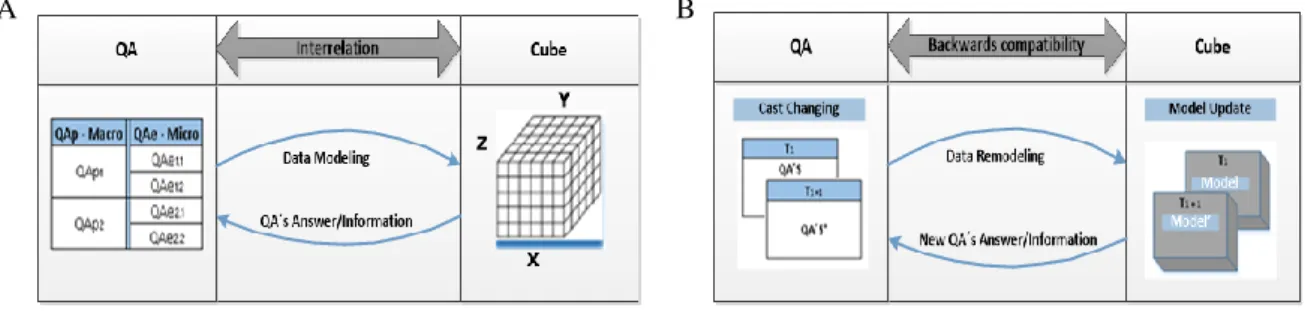
The principles of dimensional data modeling organize the data that allows to answer QA according to the cube metaphor, which is consubstantiated by fact and dimension tables hosted in a DW (18). Considering that the auditors team decision making are based on a set of pre-defined QA’s, proves to be necessary create a coupling between such QA’s and the multidimensional data model, that can inform them. This constitutes pertinent requirement if one is supposed to continuously monitor evolution. Figure 2 show the relation between QA’s and the cube of data, and the retro compatibility requirement.
A B
Fig. 2. (a) Interrelation between QA´s and cube; (b) Retro compatibility between data model and cast list of QA’s.
Figure 2 (b) shows that a change occurred in cast list of QA’s will implicitly require an updated of cube’s constitution. To deal with retro compatibility consistence and coherence we had supported upon two instruments, namely: two-way table and bus matrix. Both were tailored for this particular application but there description is beyond the scope of this article.
5. Evaluation and Discussion
The proposed framework and also its integration into the multidimensional data modeling paradigm sets out the guiding for CAAT development, which altogether were evaluated through a structured questionnaire administrated to auditing experts/professionals. The questionnaire was divided in four sections: First section, concerns to evaluate the utility of the proposed key concepts; the second section intended to validate concepts related to the criteria proposed to support decision making; the third section aims to elicit the pertinence of the coupling between proposed framework and multidimensional data modeling approach; and the main objective of the fourth section was to obtain comments, suggestion, and constructive critics. Altogether the result was satisfactorily positive, on a scale that ranges from 1 to 5 and considering 8 respondents. Answers position the proposed framework above the average of every section, which suggests that the concepts proposed are useful and applicable.
6. Conclusions
A selection of three bank institutions was rooted on an analysis of Angolan bank system. On such, representative, cases, it was identified the relevance of adopting tracking and continuous monitoring of consecutive audits toward bank activities. In such cases (good) auditing practices were identified, but however low levels of systematization and methodology that improve the efficacy of tracking the overall audit life-cycle and consequently the audit route, concepts that we develop on the proposed framework. Therefore, it was defined the criteria which promotes systematic measures to plan, execute and to monitor audit actions. As result a framework was conceptualized to support the process of tracking audit life-cycle (and audits routes). Though, the proposed framework emerge from illations taken from case study, it is adjustable to bank institutions in and out of case study scope, that is, model provide a set of parameters which are editable by the audit team. The concepts underlying the framework had further inform the development of a prototype that demonstrate the implementation of a technological tool (a CAAT, which details of implementation are beyond the scope of this paper). The CAAT provide support for the proposed indicators and in did has allowed to explore 3 years of data considering the proposed metrics and framework workflows.
For a preliminary evaluation a structured questioner was administrated to auditing experts The results seems to provide evidence that the proposed framework may constitute an useful instrument to support auditing’s activities, and its adoption enable auditors with systematic measures that optimize audit action and support decision making. Further work remains to be done on model maturity and effective adoption related issues.
References
1. Morck RK, Steier L. A History of Corporate Governance around the World : Family Business Groups to Professional Managers [Internet].
Morck RK, editor. Chicago: University of Chicago Press; 2005. Available from: http://www.nber.org/chapters/c10266
2. Cohen J, Krishnamoorthy G, Wright AM. Corporate governance and the audit process. Contemp Account Res [Internet]. 2002;19(4):573–
94. Available from: http://doi.wiley.com/10.1506/983M-EPXG-4Y0R-J9YK
3. Committee B. Basel Committee on Banking Supervision Consultative Document Principles for enhancing corporate governance. 2010.
4. KPMG International. Transforming Internal Audit: A Maturity Model from Data Analytics to Continuous Assurance. Available from: http://www.kpmg.com/BE/en/IssuesAndInsights/ArticlesPublications/Documents/Transforming-Internal-Audit.pdf
5. KPMG International. Data Analytics Enabled Internal Audit Survey [Internet]. 2015. Available from:
http://www.kpmg.com/za/en/issuesandinsights/articlespublications/risk-compliance/pages/2015-data-analytics-enabled-internal-audit-survey.aspx
6. Tumi A. An Investigative Study into the Perceived Factors Precluding Auditors Form Using CAATS and CA. Int Conf Adv Res Bus Dubai.
2013;1(December):1–87.
7. Malaescu I, Sutton SG. The Reliance of External Auditors on Internal Audit’s Use of Continuous Audit. J Inf Syst [Internet]. 2015;29(1):95–
114. Available from: http://aaajournals.org/doi/10.2308/isys-50899
8. ISACA. Adopting Continuous Auditing/Continuous Monitoring in Internal Audit (Digital) [Internet]. Available from:
http://www.isacajournal-digital.org/isacajournal/2012vol3?pg=33#pg33
9. Vasarhelyi MA, Romero S, Kuenkaikaew S, Littley J. Adopting Continuous Auditing / Continuous Monitoring in Internal Audit. ISACA
J. 2012;3:1–5.
10. Brennan G. Implementation of a Continuous Auditing System at SIEMENS. 2005;
11. Abbott LJ, Parker S, Peters GF. Audit Fee Reductions from Internal Audit-Provided Assistance: The Incremental Impact of Internal Audit
Characteristics. Contemp Account Res [Internet]. 2012;29(1):94–118. Available from:
http://eds.b.ebscohost.com/eds/pdfviewer/pdfviewer?vid=2&sid=e60cde94-9e35-4b5d-ab48-0400430e2b9c@sessionmgr120&hid=120
12. Computer Assisted Audit Group. A Guide to Computer Assisted Audit Techniques. :9. Available from:
www.mtc.gov/uploadedFiles/Multistate_Tax_Commission/Audit_Program/Resource/caat.pdf
13. Goyal H. Internal Audit Process. 2012;
14. Pedrosa I, Costa CJ. Computer Assisted Audit Tools and Techniques in Real World: CAATT’s Applications and Approaches in Context.
Int J Comput Inf Syst Ind Manag Appl. 2012;4:161–8.
15. ICAI. Introduction to CAAT. ITT FDP; 2015.
16. Dewald, Baya; Hughes, Steve; Turley P. SQL Server analysis services 2012 cube development cookbook. 1a Edição. Birmingham: Packt
Publishing; 2013. 323-350 p.
17. Mei J, Wu WC, Gan XD, Liu LB. The decision support system of auditing social insurance funds on-line based on data warehouse. Proc -
2010 2nd IEEE Int Conf Inf Financ Eng ICIFE 2010. 2010;348–50.
18. Kimball R, Ross M. The data warehouse toolkit: the definitive guide to dimensional modeling [Internet]. 3a Edição. Vasa. Indianapolis: