WOOD RESEARCH
64 (1): 2019105-116
ADHESIVES FROM LIQUEFIED EUCALYPT BARK
AND BRANCHES
Bruno Miguel De Morais Lemos Esteves, Luisa Paula Valente Cruz-Lopes Center on Studies in Education Technology and Health (Ci&Dets) and
Centre for Studies in Natural Resources Environment and Society (Cernas)
Viseu, Portugal Ana Paula Fernandes. Politechnic Institute of Viseu
Viseu, Portugal Jorge Manuel Martins Polytechnic Institute of Viseu
Universidade do Porto, Faculdade de Engenharia, Lepae Laboratory for Process Environmental And Energy Engineerin
Viseu, Portugal
Idalina De Jesus Domingos, José Vicente Ferreira Polytechnic Instituteof Viseu
Center on Studies in Education Technology and Health (Ci&Dets) and Centre For Studies in Natural Resources Environment and Society (Cernas)
Viseu, Portugal
Silvia Helena Fuentes Da Silva, Jalel Labidi
Biorp, Chemical and Environmental Engineering Department University of The Basque Coutry (Upv/Ehu)
San Sebastián, Spain (Received June 2018)
ABSTRACT
Adhesives made from lignin are one of the most promising alternatives to common urea-formaldehyde adhesives. One of the possible sources is from wood or bark liquefaction at low temperatures and pressure. The possibility of using forest wastes for the production of adhesives was the objective of this work. Eucalypt bark and branches are wastes produced in the company Pedrosa & Irmãos, which is a forest management company based in Portugal (Leiria). The
wastes were liquefied with polyalcohols catalyzed by sulfuric acid. The water insoluble fraction of the liquefied material was used for the production of the bio-adhesive. Both fractions were characterized and the bonding performance of the bio-adhesive was tested by ABES. The bio-adhesives obtained from bark or branches were similar, exhibiting a bonding strength approximately half of the conventional UF resin.
KEYWORDS: ABES, bark, bio-adhesives, branches, Eucalyptus globulus, liquefaction.
INTRODUCTION
The phenomenon of gluing or adhesion is widely used in the wood and furniture industry. The most used adhesives are urea-formaldehyde (UF), melanin-urea-formaldehyde (MUF), melanin-formaldehyde (MF) and phenol-formaldehyde (PF). Wood-based panels (WBP-Wood Based Panels) that include particle board, fibreboard, oriented strand boards (OSB) or plywood use mainly UF and MUF resins, while high pressure laminates (HPL-High pressure laminates) commonly use MF and PF resins (Martins et al. 2013). The fact that these resins have petroleum origin, allied to the fact that they are based on formaldehyde that is classified as a toxic substance and carcinogen by the Environmental Protection Agency (EPA) since 2008, prompted the investigation in bio-based adhesives (Ferdosian et al. 2017).
In recent years the search forbio-based adhesives has been intensified in order to replace the formaldehyde-based resins. According to a recent review about bio-adhesives for wood and composites, these adhesives are based on three main types of biopolymers: lignin, starch and vegetable proteins (Ferdosian et al. 2017). Another review classified them into five groups: adhesives based on proteins (gluten, soya and casein); carbohydrates (corn starch, wheat flour); vegetable oils (coconut, corn, cotton, peanut, olive, flax seed, soybeans, sunflower seed), but also tannins and lignin (Cardoso et al. 2015). The growing interest in this type of adhesives for wood lies also in the fact that value-added products can be produced from materials that were once called waste. Tannin-based adhesives can be obtained from forest residues or agricultural wastes, adhesives based on cereals can be prepared from food industry residues or lignin based adhesives from pulp and paper industry (Cardoso et al. 2015). Studies pointed out that lignin and extractives from trees bark, as for example tannins, can replace between 30 to 50% phenol of petroleum origin in the production PF resins (Zhao et al. 2010). Tannins are polyphenolic compounds that exist in high concentration in the bark of some trees, nevertheless the performance of tannin-based adhesives depends on the species and also on the parameters in which the extraction is made (Feng et al. 2013). There are many barkst hat have been used for the synthesis of tannin-based adhesives for wood gluing, namely acacia (Acacia dealbata), hemlock (Tsuga spp.), red quebracho (Schinopsis lorentzii) and Pinus radiata (Bertaud et al. 2012l, Cardoso et al. 2015). Moreover, chemical modified tannins by sulphitation from the bark of three eucalyptus (Eucalyptus citriodora, Eucalyptus grandis x Eucalyptus urophylla and Eucalyptus pellita) were used in the production of wood adhesives. These adhesives showed a similar performance to conventional phenolic adhesives (Silva 2001).
There has been a lot of work on lignin based adhesives, nevertheless in accordance to Cardoso et al. (2015), adhesives based solely on lignin are difficult to produce because of the complexity of the procedure. In a recent study (Lee et al. 2015) lignin based adhesives were produced from waste generated by the enzymatic hydrolysis of oak wood in bioethanol production.
The objective of this study was to successfully liquefy bark and branches from Eucalyptus globulus and obtain an adhesive for wood bonding. This work was done in the framework of the VALRESF project (PROJ/CI &DETS/CGD/0014).
MATERIAL AND METHODS
Liquefaction
The samples used in the test are wastes produced in the company Pedrosa &I rmãos, which is a forest management company based in Portugal (Leiria). Both bark and branches were air dried milled in a knives mill, followed by sieving in several fractions: > 40 mesh (> 0.425 mm); 40-60 mesh (0.425 - 0.250 mm); 60-80 mesh (0.250 - 0.180 mm) and < 80 mesh (< 0.180 mm). Then these fractions were dried at 100°C over night.
Liquefaction was done in a double shirt Parr 4571 reactor (600 mL) heated with oil. The dried sample (3g) was introduced in the reactor (fraction < 80 mesh) with a mixture of glycerol and ethylene glycol 1:1, catalyzed with 3% sulfuric acid. The liquefaction reaction was conducted at 160°C for 60 min. The reactor was closed down and the time started to count when the temperature of the oil reached the working temperature. After the reaction the reactor was cooled in an ice bath. After cooling 200 mL of methanol were added to the reactor and after stirring the liquefied material was filtered using a paper filter in a Buckner funnel. Afterwards approximately 200 mL of water were used to remove the remaining glycerol from the residue. Liquefaction yield was determined in accordance to Eq. 1.
(1) After filtration, the liquefied material was placed in a rotary evaporator to remove the solvents, water and methanol and placed in an oven at 105°C overnight to remove any water still remaining after evaporation.
Polyol characterization
The initial dried material, the liquefied material and the resulting solid residue were analysed by FTIR-ATR. The samples were dried in an oven at 100ºC for one week in order to assure that water was completely removed. FTIR-ATR spectra were taken in a Perkin Elmer UATR Spectrum Two with 72 scans.min-1 with a resolution of 4.0 cm-1 over the 4000 to 400 cm-1 range.
After performing the background, the sample was placed over the crystal. Solid samples were pressed against the crystal. The average of three spectra was used.ATR and baseline corrections were made for all spectra.
The determination of molar mass distribution of the polyols resulting from liquefaction was done by gel permeation chromatography (GPC). About 25 mg of liquefied material were dissolved in 5 ml of N,N-dimethylformamide (DMF) and injected in the equipment. N,N-Dimethylformamide eluent was used as GPC mobile phase, at a flow rate of 0.7 mL.min-1
and 35°C, using a Jasco Inc. chromatograph provided with an LC-NetII/ACD interface, a column oven CO-2065Plus and a RI-2031Plus intelligent refractive indexed. A guard column and two columns PolarGel-M (Varian Inc.) were employed. Calibration was made using polystyrene standards provided by Fluka, ranging from 250 to 70.000 g.mol-1.
Bio-adhesive production and characterization
Polyols obtained from the liquefaction of bark and branches of Eucalyptus globulus were used. In order to obtain two different fractions, one soluble (WSF) and another insoluble (WIF) in water, 200 mL of distilled water were added to 100 mg of the polyol and mixed, followed by filtration with G4 crucibles. The undissolved fraction remaining in the cruciblewas used for the production of the bio-adhesive.
Bio-adhesive testing
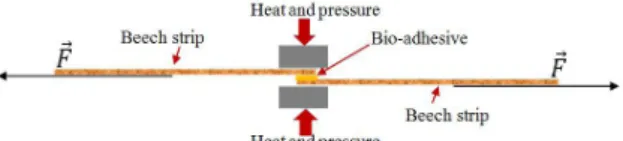
Bonding Performance of the produced bio-adhesive was evaluated using ABES (Automated Bonding Evaluation System). This device, developed by Philip Humphrey (1993), is a practical and precise system to evaluate the resistance of adhesives bonds. The test consists in gluing two strips of veneer beech (Fagus sylvatica) with dimensions of 117 x 20 mm and thickness of 0.5 mm in accordance to Fig. 1. In one of the strips about 10 mg of bio-adhesive are applied in order to cover an area of 20 x 5 mm. The two beech strips were positioned in ABES apparatus (Fig. 1) and pressed together using heat and pressure. The heat is to promote the curing of adhesive, and the pressure has the function to increase the contact area between the adhesive and the beech strips, maximizing thus the formation of the adhesive bond. This phenomenon is quite complex, since it involves mass transfer and heat transfer, chemical reactions, such as adhesive curing and rheological behavior (Jorge Martins et al. 2013).
Fig. 1: ABES testing.
At fixed pressing time (one for sample), the two beech strips were drawn apart by forces of equal intensity, but that act in opposite directions, thus assessing the maximum shear strength, developed by the adhesive, that is, the bonding strength. It should be noted that beech strips must not have glue load exceeding 100 g.m-2 since higher values cause a negative effect on shear
(Costa et al. 2014).
RESULTS AND DISCUSSION
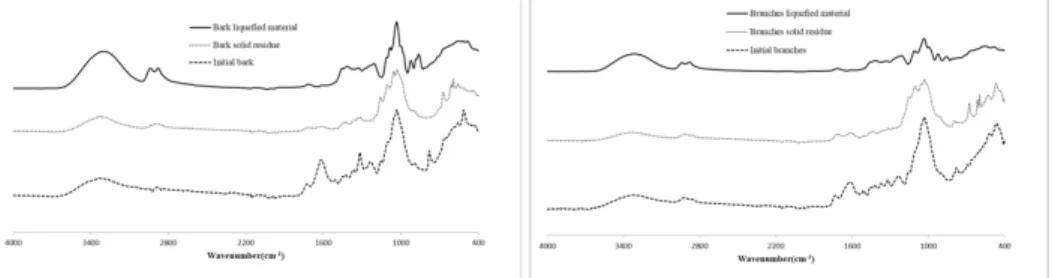
The liquefaction yield of the polyols obtained in the liquefaction of bark and branches was 62% and 48%, respectively. Fig. 2 presents the FTIR spectra of the original material, the liquefied material and the solid residue for both bark and branches. The spectrum of the solid residue from bark liquefaction presents lower absorption at 1600 cm-1 which can be attributed to benzene ring
stretching vibrations, the same happening for 1515 cm-1 and 1240 cm-1 (S and G lignin) which
combined indicates that the solid residue has lower amounts of lignin than the original material. Similar results were presented before for the residue of liquefied bagasse in ethylene glycol (Zhang et al., 2007) and for wheat straw liquefaction with a mixture of glycerol and PEG (Chen and Lu, 2009). Nevertheless these last authors also determined Klason lignin in the residue and obtained a high percentage of this compound (59%) much more than in the original material (17%) which is not consistent with FTIR results. These authors suggested that some other samples were accounted as lignin in Klason determination. Another reason might be the contamination of the
residue with some of the polyalcohol (glycerol and ethyleneglycol) used in the liquefaction that would lead to a comparative decrease in benzene ring absorption bands. The residue spectrum presents higher absorptions at around 1100 cm-1 usually attributed to C–OH single bond
stretching and at 1115 cm-1 due to C–O–C stretching vibration. The peak at around 775 cm-1
in the spectrum of the original material, completely disappears in the solid residue. The same was reported before (Chen and Lu, 2009). These authors stated that this peak may be attributed to angular deformation of adjacent 3H in meta-substituted rings which might imply that lignin monomers present in the residue are dimethoxylated. In the residue spectrum the absorption is higher at 1030 cm-1 than at 1060 cm-1, contrary to the original material.
The spectrum of the liquefied bark shows strong absorptions at around 3300 cm-1,
corresponding to OH stretching vibrations as well as at around 2930 cm-1 and 2850 cm-1,
CH stretching vibrations. This was to be expected since most of the polyalcohol used in the liquefaction is present in the liquefied phase. The peak corresponding to benzene ring stretching vibrations (1600 cm-1) almost disappeared in the liquefied material spectrum, the same
happening for 1515 cm-1, which seems to indicate that lignin amount is much lower than in the
original material. Since lignin or lignin derived compounds have to be either in the residue or in the liquefied material the lower amount of these compounds in both fractions compared to the original material is probably due to the liquefying agent which has no benzene rings, as stated before. When comparing the residue to the liquefied material, the residue has higher absorptions at 1600 cm-1, 1720 cm-1 but much lower absorption at 3300 cm-1, 2930 cm-1 and 2850 cm-1.
The spectra for branches presents similar variations has observed for bark. In the spectrum of the original material the main differences are a higher absorption on lignin related peaks for bark and a lower absorption for cellulose bands. This shows that bark has higher amounts of lignin and less amount of cellulose in relation to branches. The spectrum of the liquefaction residue, overall, presents higher absorptions at 1030 cm-1, 1060 cm-1, 1100 cm-1 and lower absorptions at
1600 cm-1, 1515 cm-1 and 1220 cm-1. Similarly for the liquefied branches the spectrum has
higher absorptions at 3300 cm-1, corresponding to OH stretching vibrations as well as at around
2930 cm-1 and 2850 cm-1, CH stretching vibrations and lower absorptions at 1720 cm-1,
1600 cm-1, 1515 cm-1 and 1030 cm-1 (Fig. 2).
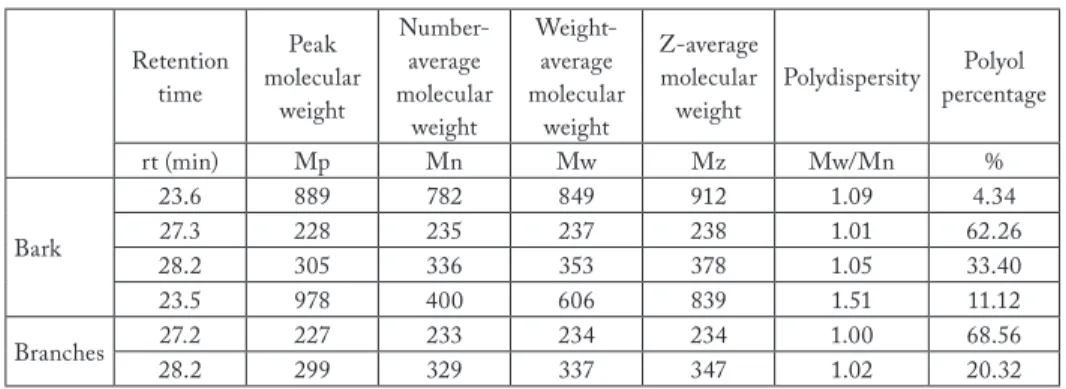
Fig. 2: FTIR spectra of original material, solid residue and liquefied bark(left) and branches (rigth). Tab. 1 presents the molecular mass distribution of the polyols obtained from bark and branches obtained by GPC. The polyols presented a first peak near 23.6 min, another close to 27.3 min and a third by 28.2 min. The first peak at 23.6 min presents average molecular weight of 782 and 400 g.mol-1, corresponding to 4% and 11% of polyols from bark, and branches
respectively. The most representative peak is however, the peak at around 27.3 minutes which corresponds to an average molecular weight of about 235 g.mol-1 and 233 g.mol-1 and represents
Tab. 1: GPC testing of liquefied bark and branches. Retention time Peak molecular weight Number-average molecular weight Weight-average molecular weight Z-average molecular weight Polydispersity Polyol percentage rt (min) Mp Mn Mw Mz Mw/Mn % Bark 23.6 889 782 849 912 1.09 4.34 27.3 228 235 237 238 1.01 62.26 28.2 305 336 353 378 1.05 33.40 23.5 978 400 606 839 1.51 11.12 Branches 28.2 27.2 227 299 233 329 234 337 234 347 1.00 1.02 68.56 20.32 The last peak at about 28.2 min has a molecular weight of about 336 g.mol-1 and 329 g.mol-1
representing about 33% and 20% for bark and branches. In accordance to Chen and Lu (2009) with liquefied wheat straw, only two peaks were achieved in GPC testing. Both peaks presented molecular weights higher than in this work with the first one ranging from 1340-1450 g.mol-1
and the second from 1040-1070 g.mol-1. The average molecular weight (Mw) of the first peak
of liquefied bamboo using ethylene glycol liquefaction was 1815 g.mol-1 (Yip et al. 2009) which
was not much different from the values presented by Chen and Lu (2009). Kurimoto et al. (2001) studied the species effect on the characteristics of liquefied wood and obtained two very different peaks in GPC. The first one with molecular weight ranges from 14600-18600 g.mol-1 and
another one from 380-413 g.mol-1. The total Mn ranged from 583 to g.mol-1, since the second
peak represented around 60% of the polyol. In terms of polydispersity the peak at 23.5 min in the polyol of eucalyptus branches was 1.51, quite higher than the other peaks with polydispersity around 1. The polydispersity of liquefied wheat straw, presented before (Chen and Lu 2009) was around 1.2 for both peaks, a little higher than the obtained here, except for the peak at around 23.5 min for branches.
Bio-adhesive production and characterization
The polyols produced at 160ºC and 60 min were used in the production of the bio-adhesive. From the liquefied biomass a water soluble fraction (WSF) and another insoluble in water (WIF) were obtained. Fig. 4 presents the FTIR spectra for both fractions. The water soluble fraction has mainly a higher absorption at around 3400 cm-1 corresponding to stretching vibration of hydroxyl
and 1030 cm-1 (C-O) stretching vibration while the WIF has higher absorptions at 1515 cm-1,
1600 cm-1 (benzene ring) and 1720 cm-1 (stretching vibration of carbonyl groups). This means
that the fraction that is insoluble in water presents more lignin derivatives than the WSF that has more sugar related compounds. Similar results were reported before. For instance in accordance to Galhano dos Santos et al (2017) the peak at 1734 cm-1 is slightly higher in the aqueous phase
indicating that the carboxylic acids have traveled to the aqueous extract while Zhang et al. (2007) reported that the bands of benzene rings and carbonyl were very strong in the acetone soluble fraction of liquefied bagasse (Fig. 3).
Fig. 3: FTIR spectra of the water soluble fraction (WSF) and of the water insoluble fraction (WIF) for liquefied bark(left) and branches(rigth).
Bio-adhesive testing
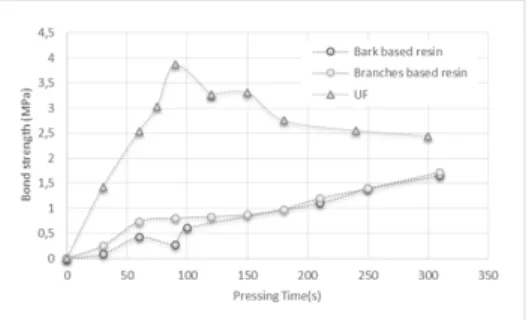
The first tests with the original liquefied material and with the WSF showed that these materials were not able to bond the two beech slices at 100ºC. Therefore only the WIF was tested and compared with a common UF resin. These results are presented in Fig. 4 that shows the variation of the bonding strength for several pressing times for a UF resin and for bark and branches bio-based resins determined in ABES with a pressing temperature of 100ºC.
Fig. 4: Bonding strength vs pressing time for UF and bio-based resins determined in ABES at 100ºC pressing temperature.
As reported by several researchers (Esteves et al. 2015, Ferra et al. 2011) the typical resin curve has mainly three different zones, corresponding to different stages in the bonding process:
in the first zone there is an initial delay in the beginning of the bonding strength development, related to both the temperature unsteady state (temperature rise) and water evaporation. This zone is not observed in Fig. 4, probably due to the relative large interval between sample measurements. The second zone is almost linear and corresponds to the curing reaction of adhesive by both chain extension and cross-linking processes. The evolution of the bonding strength, on the third stage, is heavily dependent on the adhesive behavior regarding temperature and moisture, some adhesives suffer a small increase while others, such as UF based adhesives, suffers a small and gradual decrease on the bonding strength.
The maximum bonding strength registered was 1.65 MPa and 1.72 MPa for the bio-adhesive produced from liquefied Eucalyptus globulus bark and branches, respectively using a pressing temperature of 100°C. The bonding strength of the bio-based adhesives achieved almost 50% of the maximum bonding strength for the conventional UF resin tested (4 MPa). It should be noted that both bio-adhesive could have reached higher values of bonding strength if the pressing time could be increased (they are still in the second stage of the bonding development process), but that was not possible in our ABES equipment and it is not recommended due to the impact of temperature on the wood veneer strips. Therefore, the use of liquefied forest residues like branches or bark of eucalyptus, presents very promising results to partial replace UF resin in some applications and total replacement in less demanding applications, contributing to the reduction of the use of formaldehyde in adhesives and its subsequent release to the environment. An exact comparison with different studies is difficult since the wood species used for the strips are usually not the same as well as the pressing temperature used, which leads to different bonding strengths recorded by ABES as proven before (Frihart et al. 2009). Nevertheless, comparable results were presented before for other bio-based adhesives, as for instance, Norström et al. (2014), who tested several gums as adhesives in a similar ABES apparatus using beech wood strips but at a higher pressing temperature (120°C). These authors concluded that Locust bean gum had the highest bonding strength (3.5 MPa), followed by Guar gum (3 MPa), Tamarind gum (>2 MPa) and Xanthan gum (2 MPa). In accordance to Norström et al. (2015) the tensile shear strength measurements of veneers, bonded with xylan dispersed in glyoxal and/or PVA at 120°C, was 2 MPa which is similar to the values obtained here. Also tannins have been tested as adhesives by ABES and results showed that the bonding strength was around 2MPa without hexamine (Niro et al. 2016). In accordance to Bandara et al. (2013), the adhesion strength of DDGSaa proteins extracted with acetic acid from triticale distillers was 2.6 MPa and 3.9 MPa, without and with glutaraldehyde modification, respectively. Spen then proteins modified by sodiumdodecyl-sulfateorurea were used to produce an adhesive by Wang and Wu (2012). These authors stated that bonding wet strength was around 7.99 MPa.
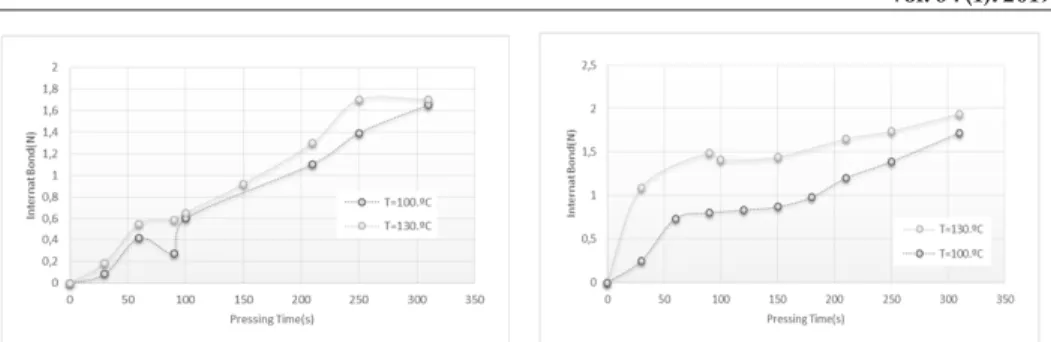
Fig. 5 shows the results obtained for two different temperatures (100°C, 130°C). Results show that for the bio-adhesive produced from Eucalyptus globulus bark the differences are very small with an increase from 1.65 MPa to 1.70 MPa from 100ºC to 130ºC.
Fig. 5: Bonding strength vs pressing time for the bio-based resins determined in ABES at several pressing temperatures for bark (left) and branches (right).
However, for branches the difference is higher with an increase from 1.72 MPa to about 1.94 MPa at 130°C. This shows that a higher temperature is needed to cure these bio-adhesives in order to achieve a better adhesion (Fig. 5).
CONCLUSIONS
The liquefied material from bark and branches of eucalyptus globulus is similar, showing that Liquefied Eucalyptus globulus bark and branches can be successfully converted into adhesives for wood industry which may constitute a step forward for the development of environmentally friendly resins. The bio-adhesive obtained from bark and branches of Eucalyptus globulus presented bonding strengths of 1.65 MPa and 1.72 MPa, respectively. These values are acceptable when compared with a conventional (UF resin 4.00 MPa).
ACKNOWLEDGEMENTS
This work is financed by national funds through FCT - Fundação para a Ciência e Tecnologia, I.P., under the project UID/Multi/04016/2016. Furthermore we would like to thank the Instituto Politécnico de Viseu and CI&DETS for their support.
REFERENCES
1. Bandara, N., Chen, L., Wu, J. 2013: Adhesive properties of modified triticale distillers grain proteins. International Journal of Adhesion and Adhesives 44: 122–129.
2. Bertaud, F., Tapin-Lingua, S., Pizzi, A., Navarrete, P., Petit-Conil, M. 2012: Development of green adhesives for fibreboard manufacturing, using tannins and lignin from pulp mill residues, Cell. Chem. Technol. 46(7–8): 449–455.
3. Cardoso, S., Nunes, L., Faria, P. 2015: Utilização de colas naturais para placas de derivados de madeira–uma síntese. CiênciaTecnologia Dos Materiais 27(2): 143–151.
4. Chen, F., Lu, Z. 2009: Liquefaction of wheat straw and preparation of rigid polyurethane foam from the liquefaction products. Journal of Applied Polymer Science 111(1 ): 508–516.
5. Costa, N. A., Pereira, J., Ferra, J., Cruz, P., Martins, J., Magalhães, F. D., Mendes, A., Carvalho, L. H. 2014: Evaluation of bonding performance of amino polymers using ABES. The Journal of Adhesion 90(1): 80-88.
6. Esteves, B., Martins, J., Martins, J., Cruz-Lopes, L., Vicente, J., Domingos, I. 2015: Liquefied wood as a partial substitute of melamine-2 formaldehyde and urea-formaldehyde resins 3, Maderas-Cienc Tecnol 17, 3.
7. Feng, S., Cheng, S., Yuan, Z., Leitch, M., Xu, C. 2013: Valorization of bark for chemicals and materials: A review. Renewable and Sustainable Energy Reviews 26: 560–578. 8. Ferdosian, F., Pan, Z., Gao, G., Zhao, B. 2017: Bio-based adhesives and evaluation for wood
composites application. Polymers 9(2): 70.
9. Ferra, J. M. M., Ohlmeyer, M., Mendes, A. M., Costa, M. R. N., Carvalho, L. H., Magalhães, F. D. 2011: Evaluation of urea-formaldehyde adhesives performance by recently developed mechanical tests. International Journal of Adhesion and Adhesives 31: 127–134. 10. Frihart, C. R., Dally, B. N., Wescott, J. M., Birkeland, M. J. 2009: Bio-based adhesives
and reproducible rapid small-scale bond strength testing. In Proceedings of International Symposium on Advanced Biomass Science and Technology for Bio-based Products, Beijing, China, Pp 364–370.
11. Galhano dos Santos, R., Acero, N. F., Matos, S., Carvalho, R., Vale, M., Marques, A. C., Bordado, J.,Mateus, M. M. 2017: One-component spray polyurethane foam from liquefied pine wood polyols: Pursuing Eco-Friendly Materials. Journal of Polymers and the Environment 1–10.
12. Humphrey, P. E. 1993. A device to test adhesive bonds. US Patent, (5,176,028).
13. Kurimoto, Y., Koizumi, A., Doi, S., Tamura, Y., Ono, H. 2001. Wood species effects on the characteristics of liquefied wood and the properties of polyurethane films prepared from the liquefied wood. Biomass and Bioenergy 21(5): 381–390.
14. Lee, S. J., Kim, H. J., Cho, E. J., Song, Y., Bae, H.-J. 2015: Isolation and characterization of lignin from the oak wood bioethanol production residue for adhesives. International Journal of Biological Macromolecules 72: 1056–1062.
15. Martins, J., Lopes, L. C., Esteves, B. 2013: Otimização da Liquefação da Madeira de Pinuspinaster com Poliálcoois. Silva Lusitana 21(ESPECIAL ): 177–183.
16. Martins, Jorge, Pereira, J., Coelho, C., Ferra, J., Mena, P., Magalhães, F., Carvalho, L. 2013: Adhesive bond strength development evaluation using ABES in different lignocellulosic materials. International Journal ofAdhesion and Adhesives 47: 105–109.
17. Niro, J., Kyriazopoulos, M., Bianchi, S., Mayer, I., Eusebio, D. A., Arboleda, J. R., Lanzo. M. M.,Pichelin, F. 2016: Development of medium- and low-density fibreboards made of coconut husk and bound with tannin-based adhesives. International Wood Products Journal 7(4): 208–214.
18. Norström, E., Fogelström, L., Nordqvist, P., Khabbaz, F., Malmström, E. 2014: Gum dispersions as environmentally friendly wood adhesives. Industrial Crops and Products 52: 736–744.
19. Norström, E., Fogelström, L., Nordqvist, P., Khabbaz, F., Malmström, E. 2015: Xylan – A green binder for wood adhesives. European Polymer Journal 67: 483–493.
20. Silva, R. V. 2001: Uso de taninos da casca de três espécies de eucalipto na produção de adesivos para madeira (PhD Thesis). Universidade Federal de Viçosa.
21. Wang, C., Wu, J. 2012: Preparation and characterization of adhesive from spent hen proteins. International Journal of Adhesion and Adhesives 36: 8-14.
22. Yip, J., Chen, M., Szeto, Y. S., Yan, S. 2009: Comparative study of liquefaction process and liquefied products from bamboo using different organic solvents. Bioresource Technology 100(24): 6674–6678.
23. Zhang, T., Zhou, Y., Liu, D., Petrus, L. 2007: Qualitative analysis of products formed during the acid catalyzed liquefaction of bagasse in ethylene glycol. Bioresource Technology 98(7): 1454–1459.
24. Zhao, Y., Yan, N., Feng, M. 2010: Characterization of phenol–formaldehyde resins derived from liquefied lodgepole pine barks. International Journal of Adhesion and Adhesives 30(8): 689–695.
*Bruno Miguel De Morais Lemos Esteves
Center on Studies in Education Technology and Health (Ci&Dets) and Centre For Studies in Natural Resources Environment
and Society (Cernas) Viseu Portugal
*Corresponding author: [email protected] Ana Paula Fernandes. Politechnic Institute of Viseu
Viseu Portugal Jorge Manuel Martins Polytechnic Institute of Viseu
Universidade do Porto Faculdade de Engenharia Lepae Laboratory for Process Environmental and Energy Engineerin
Viseu Portugal
Idalina De Jesus Domingos, José Vicente Ferreira Polytechnic Institute of Viseu
Center on Studies in Education Technology and Health (Ci&Dets) and Centre For Studies in Natural Resources Environment And Society (Cernas)
Viseu Portugal
Silvia Helena Fuentes Da Silva, Jalel Labidi
Biorp, Chemical and Environmental Engineering Department University of The Basque Coutry (Upv/Ehu)
Plaza Europa 1 20018 San Sebastián
Luisa Paula Valente Cruz-Lopes Polytechnic Institute of Viseu
Portugal Center on Studies In Education Technology and Health (Ci&Dets) and Centre for Studies in Natural Resources Environment and Society (Cernas)
Viseu Portugal