Research Paper
The Brand Management: a perspective applied in the context of sports
media
A Gestão da Marca: uma perspetiva aplicada em contextos de imprensa
desportiva
Bruno Sousa* Joaquim Silva **
ABSTRACT
The main objective of this study is to analyze the brand management approach applied to sports media context. Thus, in particular, the research proposed aims to present a contribution to the study and management of the brand in a perspective applied to the sports daily press environment in Portugal, in particular on physical and psychological brand identity. So he proceeded to lifting elements and publication of the subproducts, with a view to analyzing and understanding of key aspects of brand management (case study: O Jogo).
The brand management is unquestionably one of the aspects on which many researchers have dedicated attention, as this was something that in addition to facilitate recognition, improving the loyalty and increasing notoriety. It is of course an asset for the company, which will allow products that identify and differentiate them from the competition. Besides the undeniable connection with the component product (marketing mix), the study of the brand requires attention to various kinds of concepts, no less important (e.g. image, notoriety or identity). Recently have been new approaches and new contributions in this regard. This paper presents and systematizes some of these contributions, an application of the optical particular case of sports media in which the communication elements are particularly important (e.g. logo, signature, colors, slogans, values and symbols). Thus, the scope of a theme as brand management allows to study fundamental aspects of the brand (i.e. to establish the relationship with marketing mix strategy).
Keywords: brand management, marketing, physical identity, psychological identity, sports media.
* Polytechnic Institute of Cávado and Ave, Portugal and ISAG – European Business School, Portugal. E-mail: [email protected]
** University of Minho, School of Economics and Management, Portugal. E-mail: [email protected]
RESUMO
O principal objetivo do presente trabalho é analisar a gestão da marca numa abordagem aplicada aos denominados sport media, em concreto o caso do jornal diário desportivo “O Jogo”. Nesse sentido, e em específico, o trabalho aqui proposto visa apresentar um contributo para o estudo e gestão da marca numa perspetiva aplicada ao contexto de imprensa diária desportiva em Portugal, nomeadamente no que concerne à identidade física e psicológica de uma marca. Para tal procedeu-se ao levantamento de elementos e subprodutos da publicação, tendo em vista a análise e compreensão dos principais aspetos inerentes à gestão da marca, numa ótica de estudo de caso. A marca é, inquestionavelmente, um dos aspetos sobre os quais vários investigadores se têm dedicado nos últimos anos, visto tratar-se de algo que, além de facilitar o reconhecimento, favorece a fidelização e o aumento da notoriedade. É, naturalmente, um ativo para a empresa, que vai permitir identificar bens daquela e diferenciá-los dos da demais concorrência. Além da inegável ligação com a componente produto (composto de marketing), o estudo da marca requer a atenção para conceitos de natureza diversa, não menos importantes, como são os casos da imagem, notoriedade ou identidade. A evidenciá-los, têm recentemente surgido novos e importantes modelos de diagnóstico da marca. O presente trabalho apresenta e sistematiza alguns desses contributos, numa ótica de aplicação ao caso em concreto dos sports media, na qual os elementos da comunicação ganham especial importância (e.g. logo, assinatura, cores, slogan). Assim, a abrangência de um tema como a gestão da marca permite estudar os aspetos fundamentais da marca e, consequentemente, procurar estabelecer a relação com os elementos do composto, não descurando a ligação com o pilar do objeto do triângulo da marca.
Palavras-chave: gestão da marca , identidade física, identidade psicológica, marketing, sports media.
Received on: 2015.04.30 Approved on: 2015.06.25
Evaluated by a double blind review system
1. INTRODUCTION
Despite of branding being one of the main topics in marketing literature and practice, in particular since mid 1950’s (Gardner & Levy, 1955, Levy, 1959, Martineau, 1959), its discussion was not considered fundamental in the literature of marketing until the end of the 1980’s. It was only from last decades onwards that it really became a central concept (Aaker, 1991; Low & Fullerton, 1994; Rubinstein, 1996; De Lencastre & Côrte-Real,
2010). In a global economy with changing market dynamics and growing competition, the role of brands has never been as important as now. The brand management is unquestionably one of the aspects on which many researchers have dedicated attention in recent years, as this was something that in addition to facilitate recognition, improving the loyalty and increasing notoriety. Brand equity and trust are the most important antecedents of behavioral and attitudinal loyalty (Taylor, Celuch & Goodwin, 2004). Therefore, it is an asset for the company, which will allow identifying and differentiating products, services, places and people from the competition. Besides the undeniable connection with the product mix, the study of the brand management requires attention to various kinds of concepts, no less important, such as image, awareness or identity. To better understand brand management, several models of brand diagnosis have emerged recently. This paper presents and systematizes some of these contributions, making an application to a particular case of a sports media company.
2. LITERATURE REVIEW 2.1 Brand Management
Levitt (1980) uses the term “marketing myopia” to explain the limited vision of marketing, when it fails to consider that a marketing product is not merely a technology, but a benefit. From the customer’s viewpoint, the benefit, not the technology, is the essential part of a product and the reason why s/he buys it and appreciates it. So, we can also consider “branding myopia” as a limited vision of branding that forgets that the brand and its meanings, more than a distinguishing label, is what gives value to the offer, and gives the building block of a relationship with the publics. A brand “is a
distinguishing name and/or symbol (such as logo, trademark, or package design) intended to identify the products or services of either one seller or a group of sellers, and to differentiate those products or services from those of competitors” (Ghodeswar, 2008, p.4). According to Weilbacher (1995), a brand provides the basis upon which consumers can identify and bond with a product or service or a group of products or services. Brands serve as a guiding map to purchasing behavior and, when managed correctly, often result in significant value for their holders (Brymer, 2004; Anholt, 2005). The brand is the most is the most valuable asset of a company (Aaker, 1992), but beyond the financial value of brands, there is an important social value beyond brand
value. Brands are “regarded as links between products/companies and their customers” (Brito, 2010, p.49). According to Pires (2002), the brand is an identifier of a product that distinguishes from others. Apart from being an aid in the purchase decision process, responsible who produces or sells the product (improving confidence). The main source of the value for a brand is its reputation, the loyalty, the perceived quality and the legal ownership. According to Bennet (1995), brand is a company asset, a name, a term, a sign, symbol or combination of these that serves to identify company’s assets, but also to distinguish them from the other competition, creating value for consumers and companies. In spite of being repeatedly mentioned in books, journals and articles, the integration of branding in the conceptual structure of marketing is still not consolidated (Stern, 2006; De Lencastre & Côrte-Real, 2010).
Another aspect, equally important, concerns the development of new products, which ensures the survival and growth of the company. Sometimes they are required to replace products that have reached the final stage of its life cycle, however it is not easy to define what is a new product. It may be similar to existing products, but with a different brand or a new package to existing products or to an existing product in a new market. Strong brands “enjoy customer loyalty, the potential to charge premium prices, and
considerable brand power to support new product and service launches. Companies need to have thorough understanding of customer beliefs, behaviors, product or service attributes, and competitors” (Ghodeswar, 2008, p.4). The task of developing new products is the responsibility of marketing, but must do so in collaboration with other functional areas of business. Helping the client in the process of purchase decision, the brand is inscribed within a logic of differentiation of the offer. The company has the ambition to better meet the expectations of a particular clientele and focuses to give him steadily and repeated the combination of tangible and intangible, functional and hedonistic, visible and invisible attributes (Kapferer, 2001). When the brand is the focus of study, there is a need and interest to understand and distinguish some concepts, which sometimes can be mistaken. Are mentioned, particularly, brand identity, as a concept of the issuer, which seeks to answer the question "what the brand is”, deriving from a physical aspect, but also the character and values of the brand. Brand image, in contrast, results from the receiver perspective, or more precisely, how the brand is identified and perceived. Finally, the position is related to the "as intended that the
brand is known" and is a concept of a strategic nature, defined by the company (in this
case being connected to the brand positioning). It has identity (emitter), image and reputation (receiver) and positioning (strategy) as the three roles that structure political brand (Lindon, Lendrevie, Lévy, Dionysus & Rodrigues, 2004).
2.2 The functions of a brand and its benefits
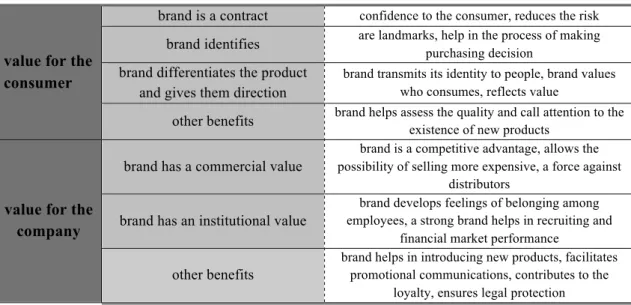
A brand is not limited to creating value for the consumer, but also for the company, becoming an active, having a social value and a financial value (table 1). Overall, much of the financial value of a company is based on its intangible assets. The brand is a special intangible asset. In many companies is the most important asset (Keller, 1998; Kotler & Gertner, 2002; Cunha, Duarte, O’Shaughnessy & Marcelino, 2004; Lindon et al., 2004; Clifton & Simmons, 2005; Kapferer, 2012). Building a brand driven culture is a lifelong commitment to a mindset and a way of life that takes time, planning and perseverance. it produces intangible outputs, which include greater customer satisfaction and loyalty (repetition), reduced price sensitivity, fewer customer defections, a greater share of customers’ wallets and more referrals (Knapp, 2000, Ghodeswar, 2008; Baumgarth & Schmidt, 2010).
Table 1 - The benefits of a brand
value for the consumer
brand is a contract confidence to the consumer, reduces the risk
brand identifies are landmarks, help in the process of making purchasing decision brand differentiates the product
and gives them direction
brand transmits its identity to people, brand values who consumes, reflects value
other benefits brand helps assess the quality and call attention to the existence of new products
value for the company
brand has a commercial value
brand is a competitive advantage, allows the possibility of selling more expensive, a force against
distributors
brand has an institutional value
brand develops feelings of belonging among employees, a strong brand helps in recruiting and
financial market performance
other benefits
brand helps in introducing new products, facilitates promotional communications, contributes to the
loyalty, ensures legal protection
Source: based on the authors (Aaker, 1991; Cunha et al., 2004; Lindon et al., 2004)
According to Aaker (1991), a brand thus signals to the client the source of the product, and protects both the customer and the producer from other competitors who would attempt to provide products that appear to be identical or similar. However, the brand is also important for society (globally), because it contributes to better quality products,
fosters innovation and provides information about the product, but also for distributors (is a relevant aspect to ensure loyal consumers).
2.3 The brand identity
Since 1990’s, brand equity has been the subject of increased academic studies and progresses (e.g. Aaker, 1991, 1996; Kapferer, 2001, 2004; De Chernatony, 1999; Gladden & Funk, 2004; Madhavaram, Badrinarayanan & McDonald, 2005; Baumgarth & Schmidt, 2010; Coleman, de Chernatony & Christodoulides, 2011, Vásquez, 2011, Aaker & Joachimsthaler, 2012). Despite the multiple perspectives on brand identity, there is a consensus around its importance and the need to be the company to define it. The analysis of the elements of the brand shows that despite the specific nature of each element, the brand's success is closely linked to its careful selection and harmonious integration and interaction. One should not forget that the positioning seems to be the expression of the combination of the elements of the brand in its market adaptation (Biel, 1997; Duarte, 2005).
According to Ghodeswar (2008, p.5) brand identity ”is a unique set of brand
associations implying a promise to customers and includes a core and extended identity”. Core identity is the central, everlasting essence of the brand that remains
constant as the brand moves to new markets and new products or services. Extended identity is woven around brand identity elements, organized into adherent and meaningful groups that provide brand texture and completeness, and focuses on brand personality, relationship, and strong symbol association.
Brand identity is a key brand management aspect, looking to answer the questions "Who am I?" and "What are my particular signs?", compared with an identity card. The concept of identity suggests the multiplicity of signals, messages, products that are designed from a single sender (company) (Kapferer, 2001, 2004). Through its identity, brand specifies its meaning, its project.
Brand identity is based on a thorough understanding of the firm’s customers, competitors, and business environment (macro, specific and micro environment). The brand identity needs to reflect the company strategy and the willingness to invest in the programs needed for the brand to live up to its promise to customers. To be effective, a brand identity needs to resonate with customers, differentiate the brand from
competitors and represent what the organization can and will do over time (Ghodeswar, 2008, Aaker & Joachimsthaler, 2012).
According to De Chernatony (1999), there are several helpful models that enable managers better appreciate their corporate identity (e.g. van Riel 1995; Balmer and Stotvig 1997; Creedon, 1998, McDaniel, 1999). Kapferer (2001) presents a particularly insightful brand-based view of identity. His Hexagonal Identity Prism Model (Figure 1)
“is a powerful tool to understand the essential difference between a brand and its competitors and is based on six central components: physique, personality, culture, relationship, reflection and self-image” (De Chernatony, 1999, p.165).
Figure 1: Brand Identity Prism
Source: adapted from Kapferer (1997)
Hexagonal Identity Prism model conceptualizes brand identity via six different, but complementary facets. The brand identity is inherent to the size of messages issued by the brand, where the aim is to specify the direction (Kapferer, 2000). So the dimensions of brand identity, represented in brand identity prism, are developed from the set of elements. The ideogram is the diagnosis of the identity of a brand, as proposed by Kapferer, is composed of a physical element and the personality (emission). At the
reception, the ideogram consists of a reflection and the self-image, and relationship with the brand culture to ensure the connection between the elements of the emission and reception (Duarte, 2005).
3. METHODOLOGY
This study aims to analyze and understand the key issues associated with the brand in the context of sports media (e.g. subproducts “O Jogo”, with a view to analysis and understanding of key issues related to the brand management, case study, in a qualitative approach, before last rebranding).
The collected data relates to the previous brand strategy to the new strategic orientation of the company in recent months. We consider being the best procedure, through a content analysis of the various elements that communicate with the audience in this very specific market.
4. RESULTS
4.1 O Jogo: brand management and brand identity
“O Jogo”, a recognized brand in the sports daily press sector (in Portugal), dates from 1985. Currently, “O Jogo” is positioned as a dynamic brand, endowed with creativity, appealing to the emotions associated with sports information, such as it is, favoring the exemption and simplicity in words. This is the strategic choice for the way you want the game to be known and understood. The brand identity, positioning an image has grown around two building blocks: psychological and physical brand elements.
4.1.1 Psychological elements of the brand
A brand has a psychological identity, highlighting, among others, relevant psychological traits as a person. This is a brand component that is in the organizational control, since it is created and nurtured by the company’s managers. The elements that constitute the psychological identity of a brand are its character (the personality), its territory (in the case of a person, its social class) and its core values (culture) (Aaker, 1991, 1997; Lindon et al., 2004).
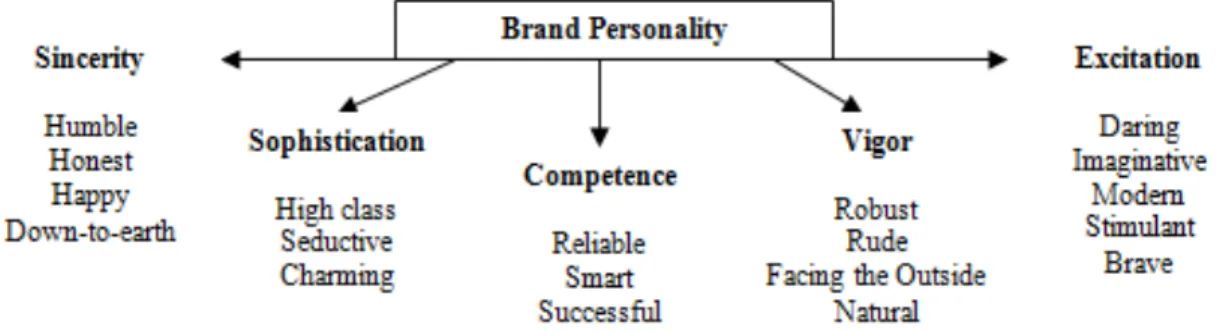
with a brand, and may include demographics, such as gender (e.g. masculinity) and age (e.g. brand with traces of youth) (Aaker, 1991). The personality of a brand should not be too complex, making it useless to give a large number of psychological dimensions, because consumers will always make a triage. Aaker (1997) developed a composite of five factors with the capacity to capture the key dimensions of the brand personality scale. Figure 2 summarizes this idea.
Figure 2: The five dimensions of brand personality
Source: adapted from Aaker (1997) and Duarte (2005)
The “O Jogo” brand possesses a set of human characteristics as it is conceived as “young, male, emotional, imaginative, attractive and active, looking to associate with
personalities and sports or cultural events that follow the sport and Timeless” (O Jogo,
2006). The territory of a brand is related with the space that the brand occupies in the market. A brand has a certain space where is accepted and makes sense to the market, and this is particularly important in brand extension.
The market space where “O Jogo” is legitimate is located in the sports daily press (a restricted form, in respect of the newspaper), as all sports are in a broad sense a game (“jogo”). Inside this market space it can naturally develop a set (diverse) of subproducts which, one way or another, end up being related to sport, broadly, often with football. The cultural aspects of a brand are related with the fundamental values that support the existence and actions related with the brand. According to Duarte (2005), it is necessary to choose values with which the brand is connoted, meeting the defined mission. The consumer is sensitive to anything that seems somewhat authentic. The cultural aspects are essential in institutional umbrella brands. The main values observed are: Dedication,
Commitment, Simplicity, Accuracy, Disclaimer and journalistic Truth, Creativity, Passion and emotionality.
According De Chernatony (1999), monitoring a brand's reputation and comparing this against the brand's identity provides insights about the urgency and direction for change. This types of changes needed can be appreciated when the differences between identity and reputation are shown for each stakeholder category (e.g. suppliers) separately and when they are also benchmarked against key competitors' reputations (Whitson, 1998; Raney & Bryant, 2009).
4.1.2 Physical elements of the brand
However, once described psychological aspects of “O Jogo” as brand, it matters to understand how these aspects are made visible, physical, precisely with the study of the physical identity of the brand. Basically, is to understand how the psychological is materialized in physical terms. The physical facets of a brand are a set of consistent signs, shapes, colors and even sounds (Aaker, 1991, 1997; Lindon et al., 2004), serving all the physical senses of consumers to focus attention on the brand and facilitate its identification.
The name is the most important identifier of a brand. There are several types of names: patronymic (the brand with the name of its founder), acronym, evocative (the brand name reminds product category that identifies), fantasy brand, family brand or junction names (e.g. merging companies). A good name should be short and easy to pronounce, recognize and remember; it should not have undesirable connotations, be easy to translate into other languages and maintain positive meaning; it should be available and legally defensible and capable of registration, adaptable to the needs of packaging and label, non-restrictive.
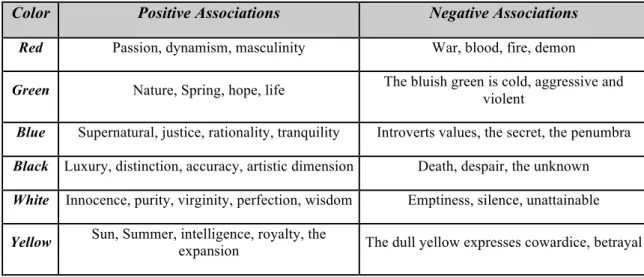
The design and packaging are very important because it is advisable to deliver an attractive product to customers (functionality, ergonomics, efficiency, adaptation to social use and attractiveness). Bothe elements are important to attract the eye of the customer, be recognized or identified by them and arouse the desire of purchase, assuming the role of "silent salesman". Table 2 gives an indication of the significance of color code in Western countries, according to Lindon et al. (2004).
Table 2: Code indicating the significance of color in Western countries
Color Positive Associations Negative Associations
Red Passion, dynamism, masculinity War, blood, fire, demon
Green Nature, Spring, hope, life The bluish green is cold, aggressive and
violent
Blue Supernatural, justice, rationality, tranquility Introverts values, the secret, the penumbra
Black Luxury, distinction, accuracy, artistic dimension Death, despair, the unknown
White Innocence, purity, virginity, perfection, wisdom Emptiness, silence, unattainable
Yellow Sun, Summer, intelligence, royalty, the
expansion The dull yellow expresses cowardice, betrayal
Source: adapted from Lindon et al. (2004, p.211)
In analogy to a person, and beyond the physical, a brand also has a psychological or cultural identity (Lindon et al., 2004). The brand name “O Jogo” is a kind of evocative name, in that it refers to the sport idea to the category that identifies as a trademark. This brand name has important qualities: is short and easy to pronounce, recognize and remember, and it has no undesirable connotations. Moreover, it seems to be easy to translate into other languages and maintain its positive meaning, without any distortion. The name is complemented with other brand elements that contribute the brand identity, positioning and image. Throughout the history “O Jogo”, several signatures have been used, but all have in common the fact that, in one way or another, they are "linked" to the product, while a sports newspaper. Firstly “O Jogo” was a weekly newspaper, but later (as competition), it went out five days a week, signing "The week's newspaper
work”. Later, when the new passage daily, “O Jogo” was "Your sports daily". Above all,
the emphasis was given to the journal basis, as a means of competitive advantage. The current signature, created in 2005 is "Emotion from first to last page". This statement incorporates emotion: sports generate passion, emotion, uncertainty in the winner (emotion present in the world of sport), but simultaneously emotion can be experienced internally, within the organization, as a symbol of dedication, impartiality with coverage, but with passion. At the same time, the emotion is also linked experience, relationship and loyalty.
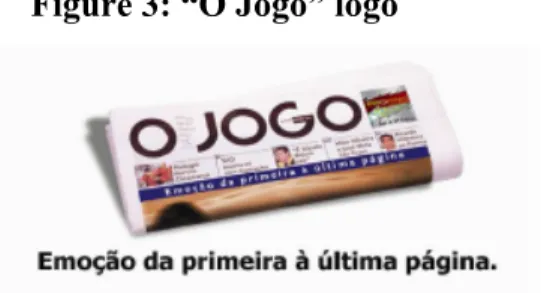
The logo (Figure 3) is well connected to “O Jogo” as a publication (i.e. design). The symbol shape denotes some lightness and simplicity. A newspaper design and shape are particularly important since, in principle, it will focus the reader not only in the functionality (utility) but also ergonomics (newspaper handling facility). The logo, stand predominantly white and black. The white as a symbol of truth (journalistic in case), wisdom and purity; Black, in turn, evoking the mystery, the distinction and accuracy. Arise, to supplement, a combination of various colors suggesting the emotion and joy, life.
Figure 3: “O Jogo” logo
The logo has three different application forms. The logo displayed above, with the signature, appears frequently in advertising (e.g. products). However, it has two more different applications: the words "O Jogo" as an integral and application of the logo (with the website statement, used in large formats (e.g. advertising in football stadiums) and the words "O Jogo" as integral and application of the logo for small formats (e.g. business cards, internal documents, sponsorships, hats, pens, subproducts packaging. The expression (simple, easy viewing, identification and reading) usually comes in black or white then, as the background and the situation, again suggesting the distinction and wisdom, respectively.
5. CONCLUSION
In an increasingly global world, dominated by competitiveness and change, the difference is, so often, the ability to create discontinuities in the external environment. In this study, we presented some of the main aspects related to a careful brand management, a competitive market, and in particular reporting some examples applied in the context of sports media (i.e. daily press – “O Jogo”). The brand is a company value, a name, a term, a sign, symbol or combination of these that serves to identify company assets but also to distinguish them from the other competition, creating value
not only for consumers but also for the company. Our purpose was based on the idea that its practice analysis will hardly be dissociated from the study of brand management, becoming important to develop future research.
5.1 Limitations and next steps
This paper presents some scientific limitations. Besides not being possible to generalize these results, this paper includes an earlier version of marketing elements, which have already been changed by the company. Currently we consider that perhaps the marketing strategy is different, so this could be an important vector for developing other findings in future steps, constituting a limitation but also a development point. However, in the future it would be interesting to make a comparison between the two approaches. Hereafter, it will be relevant to measure the extent to which various strategies in this area influence the reader and consumer satisfaction and in which direction (positive or negative) and to analyze which determinants that, in different contexts facilities, may affect the brand management and their specificities. Future research would be relevant to identify other examples of brand management with applicability to products, services or ideas. It will be our intention to study the impact of satisfaction on a possible brand loyalty in the sports daily press sector, by comparing the last years. Finally, and this work is primarily theoretical and reflection, is expected to arise in the future some work of a practical nature that bring greater robustness to support and perspectives presented here.
REFERENCES
Aaker, D. A. (1991). Managing Brand Equity – Capitalizing on the value of a brand name, New York: The Free Press.
Aaker, D. A. (1992). Managing the most important assets: Brand equity. Planning Review, 20 (5), 56 - 58.
Aaker, D. A. & Joachimsthaler, E. (2012). Brand leadership. Simon and Schuster.
Anholt, S. (2005). Branding de locais e países. Clifton, R. e Simmons, J.(Eds). O Mundo das
Marcas. Lisboa, Lisboa: Actual Editora.
Balmer, J. & Stotvig, S. (1997). Corporate Identity and Private Banking: A Review and Case Study. lntemational ]oumal of Bank Marketing, 15 (5), 169-184
Baumgarth, C. & Schmidt, M. (2010). How strong is the business-to-business brand in the workforce? An empirically-tested model of ‘internal brand equity’in a business-to-business setting. Industrial Marketing Management, 39 (8), 1250-1260.
Bennet, P. (1995), Dictionary of Marketing Terms, 2nd Edition, American Marketing Association, New York.
Biel, A. (1997). Discovering brand magic: the hardness of the softer side of branding,
International Journal of Advertising. (16), 199-210.
Brito, C (2010). Uma abordagem relacional ao valor da marca. Revista Portuguesa e Brasileira
de Gestão [online], 9 (1-2), 49-63.
Brymer, C. (2004). 4 What makes brands great. Brands and Branding.
Coleman, D., de Chernatony, L. & Christodoulides, G. (2011). B2B service brand identity: Scale development and validation. Industrial Marketing Management, 40 (7), 1063-1071.
Creedon, P. J. (1998). Women, sport, and media institutions: Issues in sports journalism and marketing. MediaSport, 88-99.
Cunha, M., Duarte, M., O’Shaughnessy, N. & Marcelino, A, (2004). Marketing – Conceitos e
Casos Portugueses, Escolar Editora, Lisboa.
De Chernatony, L. (1999). Brand management through narrowing the gap between brand identity and brand reputation. Journal of Marketing Management,15 (1-3), 157-179.
De Lencastre, P. & Côrte-Real, A. (2010). One, two, three: A practical brand anatomy. Journal
of Brand Management, 17 (6), 399-412.
Duarte, P. (2005). A Preferência pela Marca – Estudo dos factores que contribuem para a
formação da preferência, Tese de Doutoramento em Gestão, Departamento de Gestão e
Economia, Universidade da Beira Interior, Covilhã.
Elliott, R. & Percy, L. (2007). Strategic Brand Management. Oxford University Press, Oxford. Gardner, B. B. & Levy, S. J. (1955). The product and the brand. Harvard Business Review, 33 (March-April): 33-39.
Ghodeswar, B. M. (2008). Building brand identity in competitive markets: a conceptual model.
Journal of Product & Brand Management, 17 (1), 4-12.
Gladden, J. M. & Funk, D. C. (2004). Understanding brand loyalty in professional sport: Examining the link between brand associations and brand loyalty. The business of sports, 194-198.
Kapferer, J. N. (2001). Strategic Brand Management, 2nd Edition, Kogan Page, London.
Kapferer, J. N. (2004). The new strategic brand management: Creating and sustaining brand
equity long term. Kogan Page, London.
Kapferer, J. N. (2012). The new strategic brand management: Advanced insights and strategic
thinking. Kogan page publishers.
Keller, K. (1998). Strategic Brand Management: Building, Measuring and Managing Brand
Equity; Prentice-Hall, New Jersey.
Kotler, P. & Gertner, D. (2002). Country as brand, product, and beyond: A place marketing and brand management perspective. The Journal of Brand Management, 9 (4), 249-261.
Levy, S. J. (1955). Symbols for sale. Harvard Business Review, 37 (March-April), 117-124. Lindon, D. Lendrevie, J., Lévy, J., Dionísio, P., & Rodrigues, J. (2004). Mercator XXI. Teoria e
prática do Marketing. Dom Quixote: Lisboa.
Low, G. S. & Fullerton, R. A. (1994). Brands, brand management, and the brand manager system: A critical-historical evaluation. Journal of Marketing Research, 173-190.
Madhavaram, S., Badrinarayanan, V. & McDonald, R. E. (2005). Integrated marketing communication (IMC) and brand identity as critical components of brand equity strategy: A conceptual framework and research propositions, Journal of Advertising, 34 (4), 69-80.
Martineau, P. (1959). Sharper focus for the corporate image. Harvard Business Review, 36 (1), 49-58.
McDaniel, S. R. (1999). An investigation of match-‐up effects in sport sponsorship advertising: The implications of consumer advertising schemas.Psychology & Marketing, 16 (2), 163-184. Pires, A. (2002). Marketing – conceitos, técnicas e problemas de Gestão, 3ª edição, Editorial Verbo, Lisboa.
Raney, A. A. & Bryant, J. (Eds.). (2009). Handbook of sports and media. Routledge. Rubinstein. H. (1996). “Brand first management”, Journal of Marketing Mangement, (12) 4, 269-280. Stern, B. (2006). What does brand mean? Historical-analysis method construct definition.
Journal of Academy of Marketing Science, 43 (2), 216 – 223 .
Taylor, S. A.; Celuch K. & Goodwin, S. (2004). The importance of brand equity to customer loyalty, Journal of Product & Brand Management, 13(4), 217-227.
Van Riel, C. (1995). Principles of Corporate Communication, Hemel Hempstead, Prentice-Hall Weilbacher, W.M. (1995). Brand Marketing, NTC Business Books, Chicago, IL, p. 4.
Whitson, D. (1998). Circuits off Promotion: Media, Marketing and the Globalization of Sport. MediaSport, 57.
How to cite this article:
Sousa, B & Silva, J. (2015). The Brand Management: a perspective applied in the context of sports media.
International Journal of Marketing, Communication and New Media. 4 (3), 118-133. Available at