Flow Injection Systems for Elemental Soil
Analysis Determinations
Alexandra M. R. Ferreira,
aAntónio O. S. S. Rangel,
a,1and
José L. F. C. Lima
ba
Escola Superior de Biotecnologia, Universidade Católica Portuguesa, Rua Dr. António Bernardino de Almeida, 4200 Porto, Portugal
b
CEQUP/Departamento de Química-Física, Faculdade de Farmácia, Rua Aníbal Cunha 164, 4050 Porto, Portugal
ABSTRACT
Flow injection analysis (FIA) is becoming an important automated procedure for the elemental analysis of agricultural and environmental samples. This paper reviews the application of the FIA technique for soil elemental analysis determinations, giving short descriptions of the required flow manifolds by highlighting some of their most important features.
INTRODUCTION
The control of the chemical composition of soil is of vital importance to both the agricultural and environmental sectors. It is, therefore, necessary to determine many analytical parameters for a large number of samples which is a demand that is becoming increasingly incompatible with the use of time consuming classical
1
Corresponding author.
327 Copyright © 1998 by Marcel Dekker, Inc.
328 FERREIRA, RANGEL, AND LIMA methods of analysis. Additionally, the legal limits concerning permissible levels of various elements are becoming even narrower, thus requiring the use of methodologies capable of determinations that can be made at very low concentration levels and with high precision. From these requirements, efficient automated analytical techniques that have high sensitivity and sample throughput characteristics have been developed.
The analysis of a soil involves five main procedural stages: sampling, preparation (drying, grinding, and conditioning), extraction or digestion procedure, preparation of the extracts/digests for measurement (involving dilution, concentration, separation, and the addition of reagents), and measurement of the analytical signal. The first three stages are difficult to automate mainly due to the need to handle solid samples. However, there would be a considerable economy of time, reagents, and technical personnel if the last two stages could be performed automatically. Two continuous flow methods, segmented flow analysis (SFA) and flow injection analysis (FIA), have been the developed to meet this need and they are commonly used for the analysis of soil extracts and digests for their elemental content.
Segmented flow analysis, proposed by Skeggs (1957), has been applied in different areas of analytical chemistry, such as food, clinical, and environmental sectors. It is based on the segmentation of the liquid flow with an air bubble, either air or nitrogen (N2) gas, or even oil. These systems preserve the concept
inherent to classical analysis by keeping the identity of the samples and performing measurements under conditions of equilibrium and homogenization. They are composed of sampling, propulsion, and bubble introduction devices, with intermediate devices capable of operations, such as dialysis, liquid-liquid extractions, and heating, followed by a bubble release system, and then a detection and data treatment device. These analyzers, commonly known as "AutoAnalyzers" which were first adapted to soil analysis in 1964 by Flannery and Steckel (Markus et al., 1985) for the determination of calcium (Ca) potassium (K), magnesium (Mg), and phosphorus (P) in soil electrodialysates. However, other SFA systems for soil analysis have been reported since then for the determination of nitrogen (N) in its different forms (Keay and Menage, 1969; Selmer-Olsen, 1971; Li and Smith, 1984; Markus et al., 1985; Willis and Gentry, 1987,1988;TelandHeseltine, 1990a; Carlson et al., 1990; McLeod, 1992a, 1992b), sulphur (S) and sulphate (SO4) (Lea and Wells, 1980), and chloride (Cl) (Tel and Heseltine, 1990b). There
are many other examples that could be presented. The main disadvantages of these SFA systems are their high cost and complex nature mainly due to the technical difficulties inherent in the segmentation as well as the need to perform the measurements under equilibrium and homogenization conditions. Normally, the useful analyte concentration range is two to three decades at best.
As an alternative to the SFA systems, FIA emerged in the 1970s (Ruzicka and Hansen, 1975), a methodology based on a non-segmented flow, which dramatically changed the existing automated concept method not requiring equilibrium
FLOW INJECTION SYSTEMS 329 conditions to be reached before detection. Its success is basically due to its simplicity, relatively low cost, versatility, high sampling rate, and low sample and reagent consumption. In addition, the analyte concentration range can be three to four orders of magnitude depending on the analyte concentration range. In the FIA system, the liquid analyte sample is injected into a moving, non-segmented continuous carrier stream of a suitable liquid. The injected sample forms a zone which is then transported towards a detector that continuously records either the absorbance, electrode potential, or other physical parameter with the passage of the analyte sample through the detector (Ruzicka and Hansen, 1975, 1988). Flow injection analysis combines three operational principles: sample injection, controlled dispersion of the injected sample zone, and reproducible timing of its movement from the injection point to the detector.
The interest that the FIA technique has generated in different fields of analytical chemistry is clearly seen by the large number of papers published in various international journals as well as the Journal of Flow Injection Analysis which is totally devoted to this methodology. Several books (Valcárcel and Luque de Castro, 1987; Ruzicka and Hansen, 1988; Burguera, 1989; Karlberg and Pacey, 1989;Fang, 1993) have also been published on the FIA technique. The simplicity and versatility of the manifolds and their ease of coupling to the detection devices make this analytical procedure suitable for its application for many different matrices in several areas of analytical chemistry, including agricultural (Appelqvist et al., 1986; Catalayud, 1985) and the environmental (Luque de Castro and Valcárcel, 1990). In fact, most of the early routine FIA systems, such as those proposed in Brazil and later in China, were employed for determining chemical species in water, and plant and soil sample extracts and/or digests (Karlberg and Pacey, 1989).
The relatively large number of papers reporting on FIA methods developed for soil analysis justifies the compilation of all this work, reviewing the important features of each analytical technique.
FIA APPLICATIONS FOR SOIL ANALYSIS
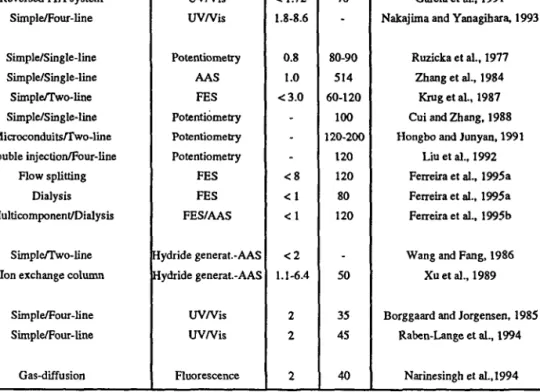
Flow injection manifolds which have been developed for the analysis of soil extracts and digests can be divided into five groups of chemical species, cationic, anionic, N compounds and P compounds, and elemental and molecular species. Within each group, we will present the analyte species in alphabetical order and then chronologically. Some of the characteristics of these systems are also given in a generalized form in Table 1 where all the species are listed alphabetically.
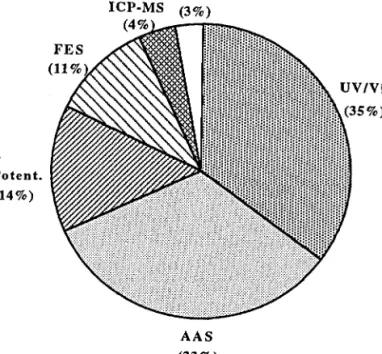
Ultraviolet/visible (UV/Vis) and atomic absorption spectrophotometry (AAS) are the most widely used detection systems (Figure 1), thereby employing existing analytical methodology and detection techniques already in use in manual analytical procedures. For easy adaptation of these detectors to the flow systems,
o
TABLE 1. Flow injection system application to soil analysis.
Analyte Aluminium Antimony Arsenic Bismuth Boron Bromide Cadmium Matrix KC1 soil extracts KC1 soil extracts Soil extracts Soil extracts Soil extracts Soil extracts Soil extracts H2O soil extracts HjO soil extracts CaCbsoil extracts Synthetic soils extracts
Soil digests FIA mode Merging zones Simple/Three-line Simple/Three-line Simple/Two-line Simple/Two-Iine Simple/Two-line Simple/Three-line Simple/Single-line Reversed FIA system Time-based injection/Four-line
Simple/Two-line On-line sorbent extraclion
Method/Detection UV/Vis Amperometry UV/Vis Hydride general-AAS Hydride generat.-AAS Hydride generat.-AAS UV/Vis UV/Vis UV/Vis UV/Vis Potentiometry AAS RSD(a> (%) <1 4.3 0.4-0.9 0.4-0.9 0.4-0.9 1.0 0.9 1.1 <1.2 1.6 -S R * ) 120 60 -60 70 50 200 80 -References Reis et al., 1979 Downard et al., 1992 Hawke and Powell, 1994
Wang and Wang, 1992 Wang and Wang, 1992 Wang and Wang, 1992
Sun et al., 1983 López-Garcia et al., 1988 López-Garcia et al., 1988 Carrero et al., 1993 Van Staden, 1987 Ma et al., 1994
l
o
Calcium Ca/Li/K/Na Ca/K/Cl/Nitrate Ca/K Ca/Mg Ca/Mg Chromium Chloride Copper Iron KC1 soil extracts Soil extracts Soil extracts H2O soil extracts NH4AC soil extracts NH4AC soil extracts NaAc soil extracts NH4AC soil extracts NH4AC soil extracts KC1 soil extracts
Soil extracts H2O soil extracts H2O soil extracts Soil extracts
Soil digests HC1 soil extracts
Zone sampling/Merging zones Merging zones Simple/Two-line Flow splitting Dialysis Multicomponent/Two-line Multicomponent/Single-line Multi component/Dialysis Multicomponent/Dialysis Multicomponent/Multi-site detection Simple/Two-line Microconduits/Two-line Pseudo-titration Simple/S ingle-line On-line sorbent extraction
Simple/Single-line UV/Vis AAS AAS AAS AAS Grad, scan./ FS Potentipmetry AAS/FES AAS/AAS UV/Vis UV/Vis Potentiometry Potentiometry AAS AAS UV/Vis <1.0 1.0 <3.0 < 2 <4 2.5-4.6 0.3-3.2 < 3 < 3 <2.0 1.3 . <4.8 1.0 -180 540 60-120 120 60 -80 100 160 70 120-200 60-160 514 -200 Jacintho et al., 1981 Zhang et al., 1984 Krug et al., 1987 Ferreira et al., 1995a Ferreira et al., 1995a Fang et al., 1985 Cardwell et al., 1988 Ferreira et al., 1995b Ferreira et al., 1995b Nogueira et al., 1996 Jorgensen and Regitano, 1980
Hongbo and Junyan, 1991 Ferreira et al., 1996a
Zhang et al., 1984 Maetal., 1994 Cui and Fang, 1984
O
a
q
I
1/3i
C/3 (continued)TABLE 1. Continued. Iron Lead Magnesium Mg/Na Manganese Mercury Molybdenum Nitrogen Ammonia-N Soil extracts Soil extracts Soil extracts Soil digests Soil extracts Soil extracts H2O soil extracts NH4AC soil extracts NH4AC soil extracts
Soil extracts Soil extracts Soil extracts Soil digests Soil extracts Soil digests Simple/Single-line Simple/Three-Iine Simple/One-line
On-line sorbent extraction
Merging zones Simple/Two-line Flow splitting Dialysis Multicomponent/Dialysis Simple/Single-line Simple/Two-line Gas-diffusion Gas-diffusion
Ion exchange column
Simple/Tbree-line AAS UV/Vis AAs AAS AAS AAS AAS AAS AAS/FES AAS UV/Vis Cold vapour-AAS Fluorescence ICP-AES Turbidimetry-UV/Vis 1.0 <1.7 <4.8 -1.0 <3.0 < 2 < 3 < 3 1.0 <1 1 2 5.3 1.5 514 60 300 -514 60-120 150 60 100 514 60 200 40 12 120 Zhang et al., 1984 Ferreira et al., 1996b Ferreira et al., 1996d Ma et al., 1994 Zhang et al., 1984 Krug et al., 1987 Feneira et al., 1995a Ferreira et al., 1995a Feneiia et al., 1995b
Zhang et al., 1984 Mesquita et al., 1989
Zhang et al., 1987 Narinesingh et al., I994
Guoetal., 1993
Krug et al., 1979
I
>
Ammonium-N Nitrate-N Nitrite-N Total-N Urea-N Nitrate/Nitrite Nitrate/Nitrite pH Phosphorous Soil extracts KC1 soil extracts KC1 soil extracts Soil extracts Saturated soil extracts
Soil extracts Soil extracts KC1 soil extracts Soil extracts Soil digests Soil digests Soil digests Soil digests KC1 soil extracts Soil extracts Soil extracts
CaCl2 soil extracts CaCl2 soil extracts
Soil extracts Soil digests
Gas-diffusion Reversed FIA system
Simple/Four-line Simple/Two-line Simple/Single-line Cu-Cd reduction column Double injection/Four-line Cd-reduction column Sandwich technique Simple/Four-line Gas-diffusion Gas-diffusion Gas-diffusion Simple/Four-line
Multicomponent/Cd reduction column Multicomponent/Cd reduction column
Simple/Single-line Simple/Single-line Simple/Four-line Simple/Two-line UV/Vis UV/Vis UV/Vis Potentiometry Potentiometry UV/Vis Potentiometry UV/Vis UV/Vis UV/Vis UV/Vis UV/Vis Potentiometry UV/Vis UV/Vis UV/Vis Potentiometry Potentiometry UV/Vis UV/Vis 0.3-0.5 <1.34 -0.8 -0.3-03 -<0.55 0.3-0.5 3.5 1.1 2.1-5.4 <5 -0.7-1.0 -0.4-0.9 -0.4-1.8 0.97 6 40 60 120 20 6 180 40 6 120 -80 60 120 45 90 110 120 120 Shirato et ai, 1989 Raigón et a., 1992 Alves et al., 1993 Ruzicka et al., 1977 Schalscha et al., 1981 Shirato et al., 1989 Liu et al, 1992 Raigón et al, 1992 Shirato et al, 1989 Sun et al, 1981 Sun et al, 1986 Nakajima and Yanagihara, 1993
Ferreira et al, 1996c Sullivan and Havlin, 1991
Xu and Fang, 1983 KarUceketal, 1988
Edmonds and Coutts, 1983 Hongbo et al, 1985
Sun et al, 1981 Fang et al, 1982
(continued)
TABLE 1. Continued. Phosphorous Potassium K/Na Selenium Silicon Silver
NaHCO3 soil extracts Soil digests Soil extracts Soil extracts Soil extracts Soil extracts H2O soil extracts
Soil extracts H2O soil extracts NH4AC soil extracts NH4AC soil extracts
Soil extracts Soil extracts Soil extracts H2O soil extracts
Soil extracts
Reversed FIA system Simple/Four-line Simple/Single-line Simple/Single-line Simple/Two-line Simple/Single-line Microconduits/Two-line Double injection/Four-line Flow splitting Dialysis Multi component/Dialysis Simple/Two-line Ion exchange column
Simple/Four-line Simple/Four-line Gas-diffusion UV/Vis UV/Vis Potentiometry AAS FES Potentiometry Potentiometry Potentiometry FES FES FES/AAS Hydride generat.-AAS Hydride generat.-AAS UV/Vis UV/Vis Fluorescence <1.72 1.8-8.6 0.8 1.0 <3.0 -< 8 < 1 <1 < 2 1.1-6.4 2 2 2 70 -80-90 514 60-120 100 120-200 120 120 80 120 -50 35 45 40 Garcia et al., 1991 Nakajima and Yanagibara, 1993
Ruzicka et al., 1977 Zhang et al., 1984
Krug et al., 1987 Cui and Zhang, 1988 Hongbo and Junyan, 1991
Liu et al., 1992 Ferreira et al., 1995a Ferreira et al., 1995a Ferreira et al., 1995b Wang and Fang, 1986
Xu et al., 1989 Borggaard and Jorgensen, 1985
Raben-Lange et al., 1994 Narinesingh et al.,1994
i
Sodium Sulphate Technetium-99 Thallium Thorium-230 Uranium-234 Zinc Soil extracts Soil extracts H2O soil extracts H2O soil extracts NH4AC soil extracts
H2O soil extracts Soil digests Soil digests Soil digests Soil digests Soil extracts Soil extracts Simple/Single-line Simple/Two-line Microconduits/Two-line How splitting Flow splitting On-line filtration/Merging zones
Ion exchange column Simple/Single-line Ion exchange column Ion exchange column Simple/Single-line Simple/Two-line AAS FES Potentiometry FES FES Turbidimetiy-UV/Vis ICP-MS Amperometry ICP-MS ICP-MS AAS UV/Vis 1.0 <3.0 -< 3 < 2 <10 -7.2-14.3 -1.0 1.4 514 60-120 120-200 120 100 120 -514 60 Zhang et al., 1984 Kiugetal., 1987 Hongbo and Junyan, 1991
FetTeira et al., 1995a Ferreira et al., 1995a
Zhietal., 1994 Hollenbach et al., 1994 Lukaszewski and Zembizuski, 1992
Hollenbach et al., 1994 Hollenbach et al., 1994 Zhang et al., 1984 Sun et al., 1985
3
o
H M O'"'Relative standard deviations. '"'Sampling rate.
336 FERREIRA, RANGEL, AND LIMA Others ICP-MS ( 3 % ) Potent. (14%) UV/Vis (35%)
FIGURE 1. Distribution of the detection systems used in FIA systems developed for soil analysis. UV/Vis: UV/Vis Spectrophotometry; AAS: Atomic Absorption Spectro-photometry; Potent: Potentiometry; FES: Flame Emission Spectrometry; Others: Include Amperometry and Fluorescence.
either a simple coupling of the flow cell on a UV/Vis spectrophotometer or flow tube to the entrance device of an AA spectrophotometer, is made. Fourteen percent of the systems reported, however, use a potentiometric detector. Mechanical difficulties in robustly incorporating these detectors in their conventional configuration into the flow system may be the most important factor that determines their usefulness. Tubular configurations for these detectors minimize these problems as has been reported in some of the procedures developed for soil extract analysis (Ferreira and Lima, 1993).
Flame emission spectrometry is the detection system used in 11% of the reported papers. Despite benefiting from the same advantages associated to its connection to a FIA system, and as with the FIA-AAS combination, this low percentage is probably due to the fact that this detection system is basically only used in the determination of three alkali elements, sodium (Na), potassium (K), and lithium (Li).
FLOW INJECTION SYSTEMS 337 Amperometry and fluorescence detection systems can also be coupled to the FIA system but with fewer number of applications. They are included in the group identified as "others" in Figure 1.
Cationic Species
Reis et al. (1979) developed a FIA system with a merging zones approach and sequential addition of pulsed reagents for the spectrophotometric determination of aluminum (Al) in soil potassium chloride (KCL) extracts and plant tissue digests. The manifold consisted of a four channel arrangement where samples and reagents are introduced into the system by a multiple proportional injector. The sample is injected in a water carrier stream and simultaneously with two reagents. After addition of the first reagent for neutralization, the sample plug meets a stream of color reagent (eriochrome cyanine) with the reaction taking place in a mixing coil before merging into a stream carrying the masking agent which is added in a synchronized manner. Detection finally takes place in the flow cell at 535 nm. The pH of each stream was carefully studied due to the dependence of the reactions on pH. Iron (Fe) interference is minimized with the addition of ascorbic acid, and SO4 interference is not significant due to the high dispersion level in the manifold.
This system is able to assay Al in a range of concentrations between 0 and 20 mg I/1 with a relative standard deviation (RSD) less than 1% for an Al concentration
of 5.0 mg L"1 and with recoveries between 98-101%.
The determination of Al in KCL soil extracts was also reported by Downard et al. (1992) who described a FIA procedure involving the formation of an Al(III)-l,2-dihydroxianthraquinone-3-sulphonic acid (DASA) complex at pH 9.0 with ampero-metric measurement of the excess of DASA at +0.50 V on a gold electrode. Electrode fouling by the adsorption of DASA oxidation products was minimized by the use of a double pumping system to provide both a reagent cycle and a wash cycle. They described both the advantages and also some drawbacks of this detection system when compared with determinations made spectrophotometrically. The detection limit when using 2x10⁵M DASA was
2.5xlO"7M Al(III) and the RSD for 9xlO"6M A1(III) was 4.3%.
Hawke and Powell (1994) applied a simple three-line flow injection system with short reaction times for the determination of kinetically-labile A1(III) with spectrophotometric detection. A comparison of the chrome azurol S (CAS), eriochrome cyanine R (ECR), and pyrocatechol violet (PCV) techniques was made in a series of complexes with model ligands. A 250-uL aliquot of standards and samples was injected in a water carrier stream. A buffer stream of 0.05M KCL (pH 5.5) was merged with the chromophore stream and this mixture subsequently merged with the carrier stream for absorbance reading after flowing through a 28-cm mixing coil. Aluminum(III) was determined with a detection limit of 60 nM and the system showed linear response up to 30 uM.
338 FERREIRA, RANGEL, AND LIMA Cadmium (Cd) determination has only been reported by Ma et al. ( 1994). These authors suggested a flow injection on-line sorbent extraction system with flame atomic absorption spectrometry to determine not only Cd, but also copper (Cu) and lead (Pb) in digests from solid environmental samples. In the extraction stage, the sample was loaded for 20 seconds at 8.7 mL min1 mixed with a
complexing reagent DDPA (ammonium diethyldithiophosphate) at 2.2 mL muv1
passing through a (C18) bounded silica gel column. Then at the elution stage, the column was eluted with methanol pumped by a second peristaltic pump at an elution rate of 4.0 mL min'1 against an uptake rate of the nebulizer of 2.0 mL
min"1. The linear detection ranges obtained were of 0.8 to 50,1.4 to 300, and 10
to 1,000 mg I/1 of Cd, Cu, and Pb, respectively. Enhancement factors compared
with conventional flame AAS were of 35 for Cd and Cu and 26 for Pb.
Several FIA systems have been developed for the determination of Cd in soil. Jacintho et al. (1981) proposed a FIA system with spectrophotometric detection for the determination of Ca in KCL soil extracts, employing glyoxal bis(2-hydroxyanil) as the color-forming agent. The zone-sampling technique was used for adequate dilution of the sample before its injection allowing a dispersion factor of 0.009. This dispersion factor was evaluated as the ratio between absorbances corresponding to the maximum peak height and to an undispersed dye solution (Reis et al., 1981). After selecting a well defined small zone of the sample, it was injected in a second carrier and a merging zones technique was used for reagent addition. After the confluence of sample and reagent streams, mixing took place in a mixing chamber and the red complex was formed just before its concentration was made at 555 nm.
Another system for the determination of Ca in soil extracts, but with AAS detection, was suggested by Zhang et al. (1984). The simple FIA system makes use of the merging zones technique for the addition of a lanthanum (La) solution for saving of this reagent [consumption of La(III) was about 1% ofthat of the manual method]. After the merging of the sample and reagent streams, the mixture was directed into the detector through a 40-cm flow tube. This same system was not only applied for the determination of Ca, but also for the determination of Mg in concentration ranges of 0-30 mg L"1 and 0-10 mg I/1, respectively, for the two
cations.
Also using AAS detection, Krug et al. (1987) suggested a FLA system based on the injection of a 5 uL of sample into a water carrier stream which merged with another stream for the addition of either a La or strontium (Sr) reagent for minimizing interferences, and then further mixed with water before reaching the detector. This same system was also applied for the determination of Mg, but as the dispersion level was not sufficient for this cation, the authors rotated the AAS spectrophotometer burner head 30° which, however, resulted in a loss of sensitivity. This FIA-AAS system could determine Ca in a range from 0 to 1,000 mg L-1 and
Mg in arange of 0 to 500 mg L"1 in the analyte without requiring previous treatment
of the samples.
FLOW INJECTION SYSTEMS 339 The same detection system (AAS) was used by Ferreira et al. (1995a) in two different manifolds for the determination of Ca in soils in both the water soluble and available forms. Both systems were developed in order to allow for in-line dilution of the extracts to adjust the Ca concentration of any soil sample to the working linear concentration range of the detection system as well as provide for the addition of reagents for the minimization of interferences. For water-soluble Ca, a very simple three-line manifold was used. Part of the injected extract was discarded at a splitting point while the remaining portion, after merging with a La solution in a confluence point, was passed through the detector, the determinable range being 3 to 200 mg Ca L'1. The system for the determination of available Ca
(ammonium acetate extracted) had a much higher dilution factor which was achieved by using a dialysis unit. The remaining plug in the donor stream was discarded while the acceptor stream carrying the small part of the plug that diffused through the membrane was led to the detector after merging with a confluent stream of La. This system could determine available Ca between 57 and 2,250 mgL-1.
The first publication reporting on the development of a FIA system for the multicomponent analysis of several species present in soil extracts was by Fang et al. (1985). A gradient scanning standard addition flow injection technique was applied for the simultaneous flame spectrophotometric determination of Ca, Li, Na, and K in an ammonium acetate soil extract as well as in tap water. A fast scanning mono-chromator and a storage oscilloscope were employed to obtain the spectra in the 350-800 nm range in different sections of the injected sample zone which optimized the intensity ranges for all analytes. Standard solutions without an internal reference were used as the carrier solution and were directed to waste during the sampling stage, while distilled water was aspirated into the burner. When the valve was turned, the sample was propelled by the standard carrier stream with water preceding the sample zone with the standard solution being gradually dispersed into the sample zone. Sampling rates were limited by the data storage of the oscilloscope and the speed of the recorder which was slow. However, the method described showed the feasibility of such an approach, with the possibility that the sampling frequency could be much increased by storing and processing the collected analytical data by computer.
Cardwell et al. (1988) applied a single-line manifold connected to a potentiometric sensor cell and a data acquisition system which was constructed for the simultaneous determination of Ca, K, Cl, and nitrate (NO3). The sensor
membranes were of valinomycin for K, neutral carrier ETH 1001 for Ca, tetradodecylammonium nitrate for NO}, and Cl determined with an Ag/AgCl
electrode. Sodium acetate (NaC2H3O2) soil extracts (30 uL) were injected in a
solution of NaC2H302-containing potassium nitrate (KN03) and calcium chloride
(CaCl2). Calibration graphs showed linearity down to near lxlO^M of each ion.
A FIA system for the simultaneous determination of Ca and Mg was proposed by Ferreira et al. (1995b) using two AA spectrophotometers placed in parallel.
340 FERREIRA, RANGEL, AND LIMA The major manifold characteristic was a dialysis unit for division of the injected soil extract into two streams. The extract (240 uL) was injected into a carrier stream and led to the dialysis unit. The analyte that diffused to the acceptor channel which was then directed to a confluence for the addition of La, flowing towards the detector for Mg determination. The plug remaining in the donor stream was diluted by withdrawing part of it at a splitting point while the rest was led to the detector after a confluence of La. The sensitivity of this determination was decreased by rotating the burner head about 30°. This system could make 100 determinations per hour for these pair of ions in the range of 40 to 2,500 mg of Ca per kg of dry soil and 10 to 350 mg of Mg per kg of dry soil, thus covering the full range of concentrations usually found in soils.
The same paper reported on the optimization of the previous FIA system for the determination of both Ca and K by AA and flame emission spectrometry, respectively. In this case, the different dilution levels demanded by each cation led to the determination of K from the donor stream and Ca from the acceptor stream. The values for the flow rates and tube lengths were adjusted for this particular pair of ions in order to adjust the concentration of these ions to that expected to be found in soil to the linear concentration intervals of the detectors. The optimized manifold could perform 80 determinations per hour for both ions in the range of 0.5 to 500 mg of K per kg dry soil and 100 to 2,500 mg of Ca per kg dry soil.
Another FIA set-up for the determination of both Ca and Mg in KCL soil extracts was proposed by Nogueira et al. (1996) by resorting to a relocatable detector. In this type of configuration, a multielement determination is attained based on the possibility of moving one detector to a different manifold site by making it relocate from one monitoring site to another (Zagatto et al., 1992). The color reagent was o-cresolphtalein complexion (CPC), ammonium/ammonia was the buffer system, and EGTA or 8-hydroxyquinoline was the masking agents for Ca and Mg, respectively. By switching the injector-commutator, 100 uL aliquot of sample was introduced into the carrier stream (KCL for matrix matching purposes) which received the buffer/masking solution and the CPC reagent before flowing through a 100-cm mixing coil where the color was developed. The resulting transient signal was proportional to the Mg content in the sample which was monitored at 575 nm. After reaching the maximum signal, the injector-commutator was switched again, receiving a second plug (35 uL) of the same sample into another KCL carrier stream. The aliquot was similarly treated but with the addition of a modified reagent and a different masking agent. The treated sample was monitored at the same wavelength, yielding a transient signal proportional to the Ca concentration. Recoveries between 97.5 and 104.1% were obtained after adding
100 mL of Ca at 15 mg L-1 or Mg at 5.0 mg L1 to 50-mL sample solutions.
Only one reference concerning the determination of chromium (Cr) was found. Jorgensen and Regitano (1980) proposed a manifold where the mixing of the
FLOW INJECTION SYSTEMS 341 color development reagent (1,5-diphenylcarbazide) and sulphuric acid (H2SO4)
(for pH adjustment) took place before injection of 30 uL of the soil extract. A 50-cm tube separated the injection point from the spectrophotometric detector set to 540 nm, which was sufficient for proper color development. The authors presented different combinations for flow rates of the two channels as a way of obtaining different dispersion levels, thus different sensitivities. The system can determine Cr(VI) in a concentration range of 0.1 to 20 mg L'1.
Copper determination in soil samples by FIA was reported in two articles, the first by Zhang et al. ( 1984), who presented a simple single-line flow system where the water carrier stream was aspirated into the nebulizer of an AA spectrophotometer (aspiration rate of 6.0 mL min1). Only a 5-cm tube separated
the injection point from the nebulizer entrance. With this system it was possible to determine Cu in a range from 0 to 6 mg I/1. The same system was applied for
the determination of iron (Fe), manganese (Mn), and K in a concentration range of 0 to 10 mg L'1 and also zinc (Zn) and Na in a range of 0 to 2 mg L ' .
The other system is described by Ma et al. (1994) for the determination of Cu, Cd, and Pb in soil digests which has already been described earlier for the determination of Cd.
The determination of Fe in soils was first presented by Cui and Fang (1984) using UV/Vis spectrophotometry as detection system. Hydrochloric acid (HCl)-soluble Fe was determined as the complex of Fe(II) with 2,2'-bipyridyl(I). A 30 uL aliquot of extract was injected in a previously de-aerated carrier stream of potassium hydrogenphtalate (pH 4) containing iodine (I) and ascorbic acid and flowing towards the flow cell for detection at 540 nm. The system could make Fe determinations in a range of 0.02 to 7 mg L'1 in the injected soil extracts.
Ferreira et al. (1996b) more recently described another FIA system using colorimetric detection for the determination of Fe in soil extracts based on the formation of the colored complex produced from the reaction of Fe(II) with 1,10-phenanthroline. Samples and standards were injected in a water carrier stream that merged towards a stream of ascorbic acid in HC1 for the reduction of Fe(III) to Fe(II). This stream was mixed with the color development reagent at a confluence point before detection at 508 nm. The authors discussed problems due to the influence of the refraction index (Schlieren signal) observed from the injection of the soil extracts which was solved by using a large injection volume (540 uL) that allowed the formation of three distinct areas: two refractive index peaks at the extremes of a well defined plateau whose height was taken as the analytical signal. The system covered the Fe concentration range of 1 to 10 mg The same authors (Ferreira et al., 1998) proposed an alternative single-line system for Fe determination with AAS detection. The use of FIA as a way of introducing the extracts into the AA spectrophotometer worked as a way of overcoming the blockage of the burner head which was observed with the
342 FERREIRA, RANGEL, AND LIMA conventional introduction. The system allowed the determination of Fe within the range of 0.36 and 5 mg I/1 without requiring any pretreatment of the extracts.
The sample throughput rate was 300 samples hour1.
Only one work reported the determination of Pb in soils by FIA. Ma et al. (1994) developed a FIA on-line sorbent extraction with flame AAS for the determination of Pb, Cd, and Cu. This system was already described for the determination of Cd.
Resorting to AAS detection, Zhang et al. ( 1984) and Krug et al. ( 1987) suggested a FIA technique for the determination of Mg which were also previously described for the determination of Ca.
Ferreira et al. (1995a) suggested another FIA-AAS system for the determination of water-soluble Mg, but instead of resorting to the injection of an extremely small volume as done by Krug et al. (1987), the authors manipulated the flow rates of a splitting and a confluence stream to achieve the necessary dilution of the samples. The splitting, to discard part of the injected volume (240 uL), and the confluence to contribute for dispersion and also for the addition of the La(III) solution. This joint effect allowed a dispersion level of 12-fold and the determination of Mg in a concentration range between 0.2 and 20 mg I/1.
In the same work, the authors reported on another system for the determination of Mg in the both available or extractable forms. Since the amount of available Mg was about 300 times higher than the linear response limit of the AAS for this element, the system had to provide for a very high dilution capability. The authors developed a FIA system with a dialysis unit, in which the donor stream was discarded and the acceptor stream delivered to the detector after merging with a stream of La(III) solution. In this flow system, determination of Mg is within the range of 15 to 4Ö0 mg I/1.
This approach was reported later by the same authors (Ferreira et al., 1995b) with another procedure where the FIA system was developed for the simultaneous determination of both Mg and Na using AAS and a flame emission spectrometer as detectors, respectively. The donor stream merged to a confluence of water not only to increase the dilution level, but also to adjust the final flow rate to the normal uptake rate of the flame photometer for the detection of Na. As much higher dilution levels were necessary for the Mg determination, this one was drawn from the acceptor stream after converging with a stream of La(III) for interference treatment. In this system, determinations of Na is in a range of 0.02 to 350 mg kg-l and between 19 and 400 mg kg" for Mg in dry soil.
Two papers reported FIA systems for the determination of manganese (Mn) in soils, one using AAS and the other using UV/Vis spectrophotometry as the detection devices. Zhang et al. (1984) presented the system already described for Cu consisting of a single-line manifold in which samples and standards were injected in a water carrier stream aspirated into the nebulizer of an AA spectrophotometer.
FLOW INJECTION SYSTEMS 343 The system described by Mesquita et al. (1989) is based on permanganate formation for detection at 548 nm, applied for determination of Mn in soils, plants, and rocks. The soil extracts were injected in a HCl-carrier stream merging with a stream containing the oxidant/catalyst reagent. The oxidation reaction by periodate took place along a 400-cm length coil immersed in a boiling water bath to keep the temperature of the coil at 95°C. The stream then passed by a debubbler and cooled along another coil before reaching the detector. The rate of this reaction was accelerated by exploiting the autocatalytic effect which is enhanced with the addition of permanganate in the confluent stream. The detection limit of this system was about 0.3 mg Mn L"1.
Two papers reported on the FIA determination of pH in soils. The first by Edmonds and Coutts (1983) described a FIA system for the determination of pH in filtered CaCl2 extracts. Samples (500 uL) were injected in a carrier (a buffer at
pH 5.54) flowing at 0.9 mL min1. A 5-cm flow tube separated the injection point
from the detector (a pH electrode), finally flowing to a beaker where the reference electrode was placed. System dispersion was minimal and the carrier role was as a transporter of the extracts and also as a stabilizer of the electrode.
Hongbo et al. (1985) described another FIA manifold for pH measurement in soil extracts and critically evaluated the parameters affecting this type of determination. They incorporated a tubular PVC-based pH-sensitive membrane electrode in a single-line flow system with a minimum dispersion coefficient. In order to obtain reliable results, the authors stated that it is necessary to have a dispersion coefficient D ^ ^ l . 0 0 8 at peak maximum and to adjust the buffering capacity of the carrier to be less than that of the sample solution. This is achieved by injecting 350 uL samples into a carrier with pH=4.9 and with a buffering capacity of 2.9xlO5 flowing at 2.0 mL min1 which allowed for sampling rates of
110 determinations per hour and with high reproducibility. This membrane was also applied in FIA microconduits allowing a throughput of 200 samples per hour. A large number of papers describing different FIA systems for the determination of K in soils have been reported. The first one published was by Ruzicka et al. (1977). This in fact was the first work where a potentiometric detector was applied in FIA methodology. The authors described a one-line flow system with potentiometric detection using a commercially available valinomycine K-selective electrode. The NaC2H3O2 soil extracts (200 uL) were injected in a NaC2H3O2
stream and carried along a 65-cm tube. After passing by the electrode membrane, the stream flowed to a reservoir where the reference electrode was placed and the level of this reservoir was maintained constant by differential pumping. The same flow system has been applied for the determination of K in blood serum.
Krug et al. (1987) developed a FIA manifold with AAS detection for the determination of K in soil extracts. This same system was also applied for the determination of Na in the same matrix. It consisted of a two-line manifold where the extracts (250 uL for K and 50 uL for Na) were injected in a water carrier stream. To this stream was added a 250 mg L'1 sodium chloride (NaCl) or a 250
344 FERREIRA, RANGEL, AND LIMA mg L"1 KCL buffer in a confluence for masking interferences. Concentrations
between 0 and 10 mg L'1 were determined for either of the two cations.
Cui and Zhang (1988) proposed a FIA system with potentiometric detection for the determination of K in hydrochloric acid (HC1) soil extracts. The selective electrode was a PVC tubular flow-through valinomycin membrane. The samples and extracts (350 uL) were injected in a HCl-triethanolamine carrier (pH 8.5) containing 0.1 mg K L1 for stabilization of the baseline. The detection limit of
this system was 0.05 mg K I/'.
Another flow system with potentiometric detection was presented by Hongbo and Junyan (1991) consisting of a K, Na, and Cl integrated microconduits device, where these ions were determined separately. The operational conditions were of 100 uL for the sampling volume, 2.0 mL min1 for the flow rate at the indicator
tubular electrode and 0.24 mL min1 for the flow rate at the reference electrode.
This system was applied for the determination of these ions in water soil extracts, water, and serum.
Liu et al. (1992) described a flow injection system which had two ion-selective electrodes arranged in parallel to serve as detectors for both K and NO3. These
two ions could be detected by using a double sample loop and an asynchronous sample injection technique. The carrier stream channels of the electrodes alternated between the sampling and the sample injection modes. The potential of the electrodes of the sample in the sampling stage was kept constant which served as the reference electrode. The selective electrodes potential between injections was stabilized by adding a small concentration of each analyte to be determined in the carrier solution, thus allowing the electrode membrane to be always in contact with the respective ion. Determinations of K and NO3 were performed in
a range of 0.8 to 6,000 mg I/1 and 0.3 to 3,500 mg L"1, respectively.
Ferreira et al. (1995a) reported two FIA systems using flame emission spectrometry as the detection technique, one for the determination of water-soluble K and the other for the ammonium acetate-soluble form. In the first system, the dispersion level necessary to adjust the concentration of any soil extract to the linear range of the flame photometer was achieved simply by disposing part of the injected sample in a splitting point and leading the remaining towards the detector. This approach allowed determinations in a range between 2.5 and 300 mg K L1. The second system was developed had a much higher dilution level
which was achieved by providing the FIA system with a dialysis unit, an approach already described for the determination of Ca and Mg. Potassium was determined in the range of 0.5 to 1,100 mg L1. Both systems were optimized in order to
allow for the injection of any soil sample without requiring previous treatment or dilution of the extracts.
The same authors (Ferreira et al, 1995b) also proposed a system with a dialysis unit for the simultaneous determination of both K and Na by flame emission spectrometry. Sodium was determined in the stream flowing from the donor channel and K from the acceptor channel as the necessary dispersion level was
FLOW INJECTION SYSTEMS 345 much higher for K (dispersion levels of 13 for Na and of 86 for K were achieved). The stream flowing from the donor channel converged with a stream of water before reaching the nebulizer and the flow rate was set in order to impose an overpressure over the nebulizer as a final adjustment of the sensitivity. The stream flowing from the acceptor stream also merged with a stream of water, but in this case only to set the input rate close to the photometer aspiration rate. Potassium was then determined between 1.7 and 1,000 mg kg1 and Na between 0.95 and
500 mg kg1 in dry soil.
Wang and Fang (1986) reported a FIA system for the determination of trace levels of selenium (Se) with hydride-generation atomic absorption spectro-photometric detection. The system was applied to soil, plants, and waste waters. An aliquot of the sample was injected into a HC1 carrier solution. Following passage through a mixing coil, Se was reduced by a NaBH4 solution added at a
confluence point. The H2Se formed in the reaction coil was mixed with argon
and was then swept into a gas-liquid separator as H2Se to be determined by AAS
at 700°C. The detection limit of this system was of 0.07 ng Se ml/1.
A similar system for the determination of ultra-trace levels of Se(IV) in water-soluble soil extracts as well as in natural waters was described by Xu et al. (1989) using an on-line preconcentration column. Selenium was adsorbed on two parallel miniature basic ion-exchange columns fixed on a 8-channel rotary multi-functional valve to achieve the concentration of two samples simultaneously. Sample solutions merged with a flowing acetate buffer solution (pH 5.0) before passing through the ion-exchange columns. The Se adsorbed on the columns was eluted sequentially through a two-way valve into the flow injection hydride generation system with 1 mol HC1L1 and merged with a reductant (0.5% NaBH4
in 0.1% NaOH). The detection limit of this system was of 0.002 ug Se L1.
Sodium is another cation of great interest in routine soil analyses and several procedures describing the development of FIA systems for this determination have been reported. Several of these systems have already been described reporting on the determination of other ions (Zhang et al., 1984; Krug et al., 1987; Hongbo and Junyan, 1991). Multicomponent analysis of this ion combined with others have also been described in this text (Fang et al., 1985; Ferreira et al., 1995b).
Two FIA systems have been reported by Ferreira et al. (1995a) for the determination of water-soluble and ammonium acetate-soluble Na, both with flame emission spectrometry detection. For water extracts, a 240 \iL aliquot is injected into a water carrier stream flowing at 12.4 mL min1. Part of the dispersed plug is
removed in a splitting point at a rate of 7.4 mL min1 which results in a flow rate
at the nebulizer entrance close to the normal uptake rate for the flame photometer. This simple system allows for determinations of soluble Na between 0.3 and 300 mg L"1. The other system provides for a higher dilution which is achieved by
increasing the level of splitting (thus discarding more of the sample plug) and also by adding to the previous system a confluent stream of water after the splitting point. Available Na can be determined between 2.5 and 300 mg L"1.
346 FERREIRA, RANGEL, AND LIMA Two systems for the determination of Zn have been reported, the first by Zhang et al. (1984) with AAS detection which has already been described for the determination of Ca. The other by Sun et al. (1985) consists of a two-line arrangement where a 240 uL aliquot of sample is injected into a carrier stream followed by the addition of a dithizone solvent for Zn extraction with color development occurring in a 200-cm mixing coil before detection at 535 nm. The system can make Zn determinations in a range between 0.015 and 5 mg L1.
Anionic Species
A FIA system with potentiometric detection was suggested by Van Staden (1987) for the determination of inorganic bromide (Br) in synthetic soil extracts. Samples were taken from the turntable of an automatic sampler, and 30 uL were injected in a carrier stream [IM potassium nitrate (KNO3)]. The injected samples were
mixed with the carrier stream in a 105-cm mixing coil and suffered the addition of another stream of IM KNOr After flowing through a second mixing coil of
160 cm, the potential was measured in a laboratory-made coated tubular Br electrode with the reference electrode dipped in a waste beaker at the end of the flow system. Chloride interferences were overcome by fixing the interference in the baseline which was achieved by adding 100 mg L"1 of Cl in both KNO3
solutions. The method was suitable for the determination ofBr in the range 1-5,000 mgl/1.
Two papers reporting the development of FIA systems for the determination of water-soluble Cl in soils with potentiometric detection have been presented. The first by Hongbo and Junyan (1991) consisting of an integrated microconduit potentiometric analytical system with a tubular coated ion-selective electrode, applied not only for soil, but also for water and serum analysis. A sample aliquot of 100 uL was injected in a carrier stream (105M Cl) flowing towards the
flow-through cell for potential reading. The indicator and the reference electrodes were connected with a micro three-way tube. This system allowed sampling rates between 120 and 200 determinations per hour.
The other system was suggested by Ferreira et al. (1996a), describing a single channel FIA manifold for the potentiometric pseudo-titration of water-soluble Cl using a tubular silver (Ag) ion-selective electrode with a homogeneous crystalline membrane of silver sulfide (Ag2S) as the potentiometric detector. Standards and
soil extracts (180 uL) were injected in a carrier stream [5.0xl05M silver nitrate
(AgNO3), 103M nitric acid (HNO3), and 0.2M KNO3] where the dispersion of the
plug and the precipitation of Ag cation occurred. An Ag concentration gradient was generated in a mixing chamber with a volume of 300 uL and this gradient was monitored at the tubular electrode. A relation between the peak width versus the logarithm of Cl concentration was established and Cl was determined in a range between 1 and 100 mg L1 which includes the whole range of Cl concentration
expected to be found in this matrix.
FLOW INJECTION SYSTEMS 347 A flow method for the turbidimetric determination of soluble SO4 has been
described by Zhi et al. ( 1994). The FIA system was coupled to a on-line filtration probe designed in order to simplify the sample pretreatment. To avoid interferences of organic matter with the developed method, the samples were mixed with activated charcoal before extraction of the SO4. The soil suspension was aspirated
to pass through the filtration probe, followed by a debubbler unit for removal of air bubbles before feeding the injection loop of the flow system. A volume of 200 uL of filtrate and of 36 uL of supplementary SO4 solution was introduced in a
merging zones mode and was then mixed with the reagent (barium-arabic gum-HCl solution) added in a confluence. The reaction of precipitation of barium sulphate (BaSO4) took place in a mixing coil before spectrophotometric detection at 400
nm. This system allowed the determination of this anion between 2 and 180 mg L'1 with little pretreatment of the samples.
Nitrogen Compounds
In most soils the bulk of N is in organic forms and usually near the surface. The inorganic forms of N include nitrate (NO3) which is soluble and easily leached
or taken up; nitrite (NO2) which is usually a transitional stage between NO, and
ammonium (NH4); NH4 which occurs as the easily removed exchangeable ion
and also in more unavailable fixed forms as well as traces of gaseous forms such as N2, nitrogen monoxides, and elemental N.
Several works describing FIA systems for the determination of N in its different forms in soils were reported. The first by Ruzicka et al. ( 1977) for the determination of NO3 in soil extracts with potentiometric detection. The electrode consisted of
a membrane based on tetraoctylammonium bromide dissolved in dibutyl phthalate and incorporated in PVC. The inner reference solution was composed of 1 x 10²M
sodium nitrate (NaNO3) and lxl02M sodium chloride (NaCl). The FIA system
was a confluent stream arrangement where 300 uL of sample was injected in a phosphate buffer carrier solution that then merged with another stream of the same composition for a better mixing and hence a better stabilization of the pH. The mixture took place in a 1.4-m mixing coil and after passing by the membrane of the NO3-selective electrode, and the stream flowed to a reservoir where the
reference electrode was dipped. The lowest NO, detection limit obtained was approximately lxlO'M.
Krug et al. ( 1979) described a turbidimetric procedure for the determination of ammonia (NH,) in low concentrations with the use of Nessler's reagent. An aliquot of 30 uL of soil digest was injected in a carrier stream of 2M sodium hydroxide (NaOH) solution which then met another stream of a mixture of Nessler's reagent and 2M NaOH. This mixture took place in a reaction coil before reaching the detector set at 420 nm. The advantage of this system was the possibility of injecting acid samples (provided by the procedures for digestion of the soils) without affecting the colored turbidity formed. This system allowed the determination of
348 FERREIRA, RANGEL, AND LIMA ammonia (NH3) in soil digests and in water samples in a range of 0.5-6.0 mg L"1
of NH4-N, but this method could not be applied if a significant amount of colloidal
material was present in the solutions to be analyzed.
Schalscha et al. (1981) evaluated the potentiometric FIA system described by Ruzicka et al. (1977) for the determination of NO3 in saturated soil extracts and
compared this methodology with the Bremner reduction-distillation method and the Cd-reduction method, respectively. Several advantages of the FIA method were reported specifically concerning the lower volume of sample, the short analysis time, and the low investment in equipment involved in the application of this method in laboratories of soil routine analysis.
The first FIA system for the determination of total N in soils was suggested by Sun et al. (1981a). The digests (230 uL) were injected in a carrier of alkaline phenol solution where it was neutralized. An alkaline sodium hypochlorate solution flowing at the same rate was then added in a confluence and the color development reaction took place before detection at 625 nm. The authors described some problems associated with the variety of acidities in the different soil digests, for what they recommended a controlled possible loss of H2SO4 during the digestion
process. They also recommended that the quantity of Cu catalyst added for the digestion process should be kept as constant as possible since the Cu color can affect the detection. The detection limit of this system was of 0.5 mg N L1.
A gas-diffusion FIA system with colorimetric detection was proposed by Sun et al. (1986) also for the determination of total N. Samples and soil digests (100 uL) were injected in a water carrier that converged with a NaOH stream for conversion of NH4 into NH3 gas. This gas passed across a gas-permeable membrane
to an acceptor stream where it reacted with an indicator prepared in a buffer solution, to result in NH4 and a change in the color of the indicator. Absorbance
was then read at 590 nm. Different working ranges were obtained depending on the concentration of the buffer solution. Several problems of interferences reported in previous works were overcome by the use of the gas-diffusion unit that permitted the disposal of some interfering species that could not cross the hydrophobic membrane.
Shirato et al. (1989) described different FIA systems with UV/Vis spectrophotometric detection for determination of N in several forms. For the determination of NO2, 40 uL of N-(l-naphthyl) ethylenediamine reagent was
injected into a water carrier solution on either end of the sample solution by using a 16-port valve. This stream then passed along a reaction coil towards the detector and absorbance was measured at 520 nm. Nitrate was determined similarly after reduction to NO2 on a 30-cm Cu-Cd-glass column. For NH4 determination, NH3
was liberated by 200 uL of a 1M NaOH solution injected in both sides of the sample solution, separated with a dialysis membrane and determined by the indophenol method in the acceptor stream. Absorbance was measured at 630 nm. These systems allowed the determination of NO2, NO3, and NH4 in the range of
0.1 to 7 mg I/1, 1 to 20 mg I/1, and 1 to 150 mg L1, respectively.
FLOW INJECTION SYSTEMS 349 Sullivan and Havlin (1991) described a FIA system developed for the determination of urea-N in KC1 soil extracts, based on the diacetyl monoxime thiosemicarbazide colorimetric method with a modified acid reagent that increased the rate of color formation. The reagents were all mixed along the flow system before merging with the carrier stream (2M KC1 solution) which carried the 310
\iL of injected extract. The streams were mixed in a mixing coil immersed in a
95°C water bath and detection of the formed colored complex took place at 520 nm. The reagents of this method were modified for this FIA system and optimized to allow the determination of urea-N up to 8 mg L-1 with a detection limit of 0.01
mgL"1.
Raigón et al. (1992) described two FIA manifolds with spectrophotometric detection for the determination of available N in the nitric and ammoniacal forms. For the NH4-N, a reversed FIA system was used. A stream of ammonium chloride
(NH4C1) solution merged with a stream of soil extract and this mixture acted as
carrier. The Nessler's reagent (110 uL) was injected into this carrier stream and the colored product formed was monitored at 415 nm. Ammonium-N was determined in the range of 0.02 to 4 mg L'1. The system for determination of
NO3-N was a normal FIA system in which 10 uL of the soil extract was injected
into a carrier of ammonium chloride (NH4C1) with the NO3 being reduced to NO2
on-line during the passage of the sample plug in a Cd-reductor column. Nitrites then reacted with acidic sulphanilamide and N-(l-naphtyl)-ethylenediamine dihydrochloride added in a confluence, and the color development reaction took place in a 75-cm tube before the purple product was detected at 540 nm. Nitrate-N was detected in a range between 0.10 and 8 mg L1.
Liu et al. (1992) proposed an ion-selective electrode flow system with two electrodes arranged in parallel in the manifold for the determination of NO3 and
K. This system was already described in this text for the determination of K. Another system resorting to UV/Vis spectrophotometry was described by Alves et al. (1993) for determination of NH4 in KC1 extracts based on the
salicylate-hypochlorite colorimetric reaction. Samples and standards were injected in a water carrier stream and reagents were added in confluences along the flow system. The reaction took place in a 200-cm mixing coil immersed in a 70°C water bath and the colored product flowed towards the flow cell of the spectrophotometer for absorbance reading at 647 nm. Important care was given to control the water bath temperature which should not vary more than ±0.1 °C for stable and reproducible results. This technique is capable of quantifying NH4 to
concentrations as low as 0.05 mg NH4-N L'1 (equivalent to 0.25 mg NH4-N g1 dry
soil).
Nakajima and Yanagihara (1993) reported a FIA system for the colorimetric determination of N using a gas-diffusion unit. The digests (30 to 200 uL) were injected in a H2SO4 carrier stream that merged with a confluence for the addition
of a NaOH for conversion of NH4 into NH3. This conversion takes place in a
100-cm mixing coil heated at 30°C. The gas crossed a gas-permeable membrane to an acceptor stream of an indicator for detection at 590 nm.
350 FERREIRA, RANGEL, AND LIMA Another FIA system incorporating a gas-diffusion unit but with a potentiometric detector was recently developed by Ferreira et al. (1996c) for the determination of total N in soil digests and was presented as an alternative to the distillation/ titration step in the Kjeldahl method. The solutions, obtained from the Kjeldahl digestion of the soil samples, were injected (180 uL) in a water carrier stream which directed the plug to a confluence where a NaOH solution which was added for conversion of NH4 into NH3. While passing along the gas-permeable
membrane, the NH3 gas diffused to an acceptor buffer stream of Tris HC1 (pH
7.5) responsible for the reconversion of the NH3 gas which was finally led towards
the NH4 ion-selective electrode. The selectivity of the electrode sensor system
provided the final selection between the NH, gas already converted into NH, and the other gaseous species that might have passed through the membrane. The potentiometric detector was a PVC tubular selective electrode without inner reference solution and with the sensor system composed of nonactin/monactin in tris (2-ethylexyl) phosphate. The construction of this electrode was also described. This system allowed direct introduction of any soil Kjeldahl digest and determinations in a concentration range between 0.05 and 0.6% of N in dry soil. A multicomponent system for the determination of NO2-NO3 was suggested by
Xu and Fang (1983) by resorting to the simultaneous injection of the extract in two different channels. The system was based on the reaction of NO2 with
alfa-naphthylamine-7-sulphonic acid and sulphanilamide with spectrophotometric detection at 520 nm. A Cd-coated Zn reductor column was included in one of the channels of the flow system for a previous in-line reduction of NO3 to NO2. The
detection limits achieved were of 10 ug L1 for NO3-N and of 1 ug L1 for NO2-N.
Another system for this multicomponent determination was described by Karlicek et al. (1988) based on the same reaction of the NO2 with
alfa-naphthylamine-7-sulphonic acid and sulphanilamide with absorbance reading of the red dye. Nitrates were determined the same way after in-line reduction by metallic Cd. Concentration ranges of 0.02-2 mg L1 for NO2 and of 0.5-20 mg I/1
for NO3 were determined.
Phosphorus Compounds
Four papers report the development of FIA systems for the determination of P in soils. In all of them, the authors resorted to the same color development reaction based of the formation of the molybdate blue, but different approaches for the flow injection manifold were described.
In the manifold described by Sun et al. (1981 b) for determining available P, the extracts (560 uL) were injected in a reductor carrier [stannous chloride (SnCl2)]
that flowed towards a confluence for addition of the color development reagent (molybdate). The reaction took place in a mixing coil before detection at 650 nm. Relative standard deviations of 1.8% and 0.4% were obtained for 25 injections of extracts with P2O5 concentrations of 0.46 and of 0.8 mg L1, respectively.
FLOW INJECTION SYSTEMS 351 Fang et al. (1982) described a very similar flow system for determination of total P, where only 25 uL of sample was injected. The absorbance of the color complex was monitored at 700 nm. The main purpose of this work was to achieve a better detection limit for this determination and they obtained a detection limit o f 0 . 0 5 m g P L ' .
Garcia et al. (1991) developed a reversed flow injection system for the determination of assimilable P in 0.5M sodium bicarbonate (NaHCO3) soil extracts.
The selection of a reversed FIA approach in which the extract runs in the system as the carrier solution with the reagents (molybdate in acidic solution and tin chloride) being added in confluences, had the main objective of overcoming problems of unstable baseline reported by other authors. The authors described additional advantages such as the increase in sensitivity and the lower reagents consumption. The extracts (with a previous 1:10 dilution) flowing in the flow tube were added 119.5 uL of the reagents mixture injected in this stream. The color development reaction took place in a flow tube before detection at 660 nm. Linearity was obtained up to 0.8 mg P L"1 and the detection limit was of 0.025 mg
P L1.
Nakajima and Yanagihara (1993) described a FIA system for total P in which the soil digests (30-200 uL) were injected into a H2SO4 carrier to mix successively
with ammonium molybdate solution, water, and finally ascorbic acid before detection at 660 nm. All these streams were added in confluences followed by reaction coils for appropriate mixture and reactions. The authors reported the possibility of determining 100 samples in three days from the weighing operation till the end of the analysis.
Other Species
Wang and Wang (1992) reported a system for the determination of antimony (Sb) and also arsenic (As) and bismuth (Bi) by FIA hydride generation graphite furnace AAS. The samples were injected in a stream consisting of a mixture of HC1, HNOj, and H2SO4 which merged with a stream of NaBH, in NaOH. The
mixture passed to a gas-liquid separator where the generated hydrides were carried to the graphite-furnace by a stream of argon flowing at 250 mL min1 for AAS
determination of As, Sb, and Bi. Recoveries were of 94 to 99% and detection limits of 6.29,9.21, and 3.77 pg for As, Sb, and Bi, respectively.
Three papers describe systems for the determination of boron (B). The first by Sun et al. (1983) based on the reaction of B with azomethine-H with colorimetric detection. The system consisted of a three channel configurations where reagents were added in confluences and allowed to mix in long mixing coils before detection at 415 nm. This system throughput was of 60 samples per hour in a concentration range of 0.02 to 5 mg B L1.
López-Garcia et al. (1988) described two FIA manifolds, one normal and one a reversed system, both based on the formation of a blue ternary complex between the anionic complex of boric acid (H3BO3) with 2,6-dihydroxybenzoic acid
352 FERREIRA, RANGEL, AND LIMA (DHBA) and crystal violet. As the formation of the B-DHBA complex is slow (10 min at pH 1.0), they needed to be mixed before injection into the manifold. In the normal FIA system, 35 uL of this mixture were injected into a water carrier stream. This stream merged with a stream of reagent solution [crystal violet, poly(vinyl alcohol) and a pH 2.6 buffer solution], following to the detector set at 490 nm. This system could determine B in a range between 0.02 and 0.5 mg I/1.
In the reversed FIA system, 135 uL of the reagent solution were injected into a carrier (B-DHBA-complex), and the product detected at 590 nm. With this system, linearity was obtained between 0.05 and 0.5 mg B L1.
Carrero et al. (1993) described a time-based injector for B determination applied to soil and plant analyses. The extract solution plus azomethine-H and phosphate buffer (pH 6.9) containing EDTA were mixed in a ratio of 3:1:1 in a mixing coil and passed to a 47-cm holding coil using a suction device. The time-based injector delivered electronic pulses to a two-way solenoid valve which closed the tube from the suction device injecting 150 uL of the mixture into a water carrier stream flowing towards the detector were absorbance was measured at 420 nm. When the analysis of each sample was completed, the system was cleaned by circulating 0. IM HC1 solution through the sample line for at least 30 seconds. As the sample and reagents were not consumed during the stoppage of the sample zone, there was a considerable saving. This set-up allowed determinations in a concentration range between 0.5 and 6 mg B I/1.
Zhang et al. (1987) modified a flow system for the determination of mercury (Hg) in aqueous solutions developed by Andrade et al. (1984) in order to apply it to the determination in soil and improve the detection limit, sampling frequency as well as to increase the lifetime of the PTFE membrane. The method involved permeation of Hg vapor through the PTFE membrane which separated the flow cell from the optical path of the spectrophotometer. Absorption was read at 253.7 nm. The detection limit achieved was 0.06 ug Hg L"1 with a sampling rate of 200
samples per hour. The coefficient of variation was of 1% for a concentration of Hgof4ugL-'.
Narinesingh et al. (1994) described another FIA system for trace Hg and Ag determinations but based on the inhibitory effect that these ions have on the enzymatic reaction of urease which converts urea to carbon dioxide (CO2) and
NH3. The liberated NH3 was monitored fluorimetrically. An aliquot of 90 uL of
sample was injected into a phosphate-buffered urease (pH 7.0) carrier stream and mixed successively with the urea and NaOH reagent streams. The reaction mixture passed through a gas-separation unit where the enzymatically-generated NH3
diffused through a PTFE membrane and was collected in a stream of o-phthaldehyde(I) and mercaptoethanol in borate buffer solution (pH 10.2). The resulting fluorophore-NH3 adduct was then determined at 455 nm (excitation at
340 nm). Soil extracts were analyzed within a concentration range from 2 to 22 ug L1 and from 0.1 to 1.0 ug L"1 of Hg and Ag, respectively, with a coefficient of
variation of 2%.
FLOW INJECTION SYSTEMS 353 Trace molybdenum (Mo) determination in soil extracts and water samples was reported in one work from Guo et al. (1993) by a FIA inductively coupled plasma spectrometry (ICP-AES). The concentration step took place in-line, in a micro-ion-exchange column where samples were injected with ammonium chloride/ ammonium citrate as the eluent flowing at 0.5 mL min"1 and at 60°C over 5 min.
The eluate was then carried to the spectrophotometer with argon as carrier gas for ICP-AES detection. Recoveries between 90 and 110% were obtained for 12 ng MoL-1.
A FIA procedure for the determination of silicon (Si) based on the molybdenum blue formation by reduction of ß-molybdosilicate by ascorbic acid was described byBorggaardand Jorgensen(1985). Different extractors [NaOH, dithionite-EDTA solution, and hydrogen fluoride (HF)] were used and tested especially to evaluate the capacity to minimize interferences. The extracts (300 uL) were injected in a water carrier stream that converged into three consecutive confluences for addition of ammonium molybdate, oxalic acid, and ascorbic acid solution. Between each addition long mixing coils (5,2, and 5 m, respectively) immersed in a 80°C water bath assured the development of reactions before detection at 816 nm. The authors reported the formation of air bubbles in the FIA system due to the high temperature and suggested a de-aeration of the solutions before use as a way to reduce their effect. All extracts had to be diluted before injection. Arateof35 determinations per hour was obtained with a detection limit of 30 ng Si mL'1 and a linear limit of
1.0 mg Si I A
A similar system, based on the same colorimetric reaction was optimized by Raben-Lange et al. (1994) for the determination of water-soluble Si, but with reduction of PO4 interference. Detection took place at 790 nm. The reactions
developed at room temperature, thus avoiding problems due to the formation of bubbles observed in previous method without compromising the sensitivity of the system as determinations in a concentration range between 0.04 and 20 mg Si L"1 were obtained. However, the authors recommended de-gassing of solutions
and samples before use. At the same time, interferences from PO4 were reduced
up to 15-fold excess of this anion and the sampling rate was improve to 45 determinations per hour.
A FIA mini-column was used for pre-concentration of technetium-99, thorium-230, and uranium-234 added to soil samples followed by detection by ICP-AES (Hollenbach et al., 1994). Advantage was taken from the FIA technique for reproducible concentration of the samples and introduction in the detection system, allowing detection limits of 11 mBq g1 (0.02 ng g1), 3.7 mBq g1 (0.005
ng g1), and 0.74 mBq g1 (0.003 ng g1) for 99Tc, 230Th, and 234U, respectively.
Lukaszewski and Zembrzuski (1992) resorted to a FIA system for the determination of thallium (Th) in soils with differential pulse anodic stripping voltammetry as detection process in a method that did not require any separation prior to determination. The interferences of Fe, Al, and Mn were removed by media exchange performed in the FIA system and the other interferences were