Patrícia Ferreira Ponciano Ferraz , Tadayuki Yanagi Junior , Renato Ribeiro de Lima(2), Gabriel Araújo e Silva Ferraz(1) and Hongwei Xin(3)
(1)Universidade Federal de Lavras (Ufla), Departamento de Engenharia, Caixa Postal 3037, CEP 37200‑000 Lavras, MG, Brazil.
E‑mail: [email protected], [email protected], [email protected] (2)Ufla, Departamento de Ciências Exatas, Caixa
Postal 3037, CEP 37200‑000 Lavras, MG, Brazil. E‑mail: [email protected] (3)Iowa State University, Department of Agricultural and
Biosystems Engineering, 1340 Elings Hall, 605 Bissel Road, 50011‑3310 Ames, Iowa, United States. E‑mail: [email protected]
Abstract – The objective of this work was to evaluate the effect of thermal challenge at different intensities and durations on the production responses of 3 to 21-day-old broiler chickens. Two hundred and ten Cobb chicks were subjected to dry-bulb temperatures (tdb) of 27, 30, 33, or 36°C for the duration of 0, 1, 2, 3, or 4 days from the second day of life onwards. The experiment was carried out in four identical environmentally-controlled wind tunnels. Data on body mass (BM), feed intake (FI), and water intake (WI), all in grams, were monitored daily; and body weight gain (BWG), in grams, and feed conversion (FC) were also calculated. The effect of duration was not statistically significant. Empirical models were adjusted to relate BM, FI, and WI with tdb and bird age. The performance of chicks at 21 days of age was analyzed using the BM, FI, WI, BWG, and FC values. Overall, the development of chicks at 33 and 36°C was better than that of those subjected to the lower tdb of 30 and 27°C. The exposure of chicks to cold thermal challenge in early life can have a carry-over negative effect on their production performance up to 21 days of age.
Index terms: air temperature, broiler, carry-over effect, production responses, thermal stress.
Desempenho de pintinhos submetidos a estresse térmico
Resumo – O objetivo deste trabalho foi avaliar o efeito do estresse térmico em diferentes intensidades e durações sobre as respostas produtivas de frangos de corte de 3 a 21 dias de idade. Duzentos e dez pintinhos Cobb foram submetidos às temperaturas do bulbo seco (tbs) de 27, 30, 33 ou 36°C durante 0, 1, 2, 3 ou 4 dias, a partir do segundo dia de vida. O experimento foi conduzido em quatro túneis de vento climatizados idênticos. Dados de massa corporal (MC), consumo de ração (CR) e consumo de água (CAg), todos em gramas, foram coletados diariamente; e ganho de massa corporal (GMC), em gramas, e conversão alimentar (CA) também foram calculados. O efeito da duração não foi estatisticamente significativo. Modelos empíricos foram ajustados para estimar MC, CR e CAg em função da tbs e da idade das aves. O desempenho dos pintinhos aos
21 dias de idade foi analisado a partir dos valores de MC, CR, CAg, GMC e CA. Em geral, o desenvolvimento de pintinhos a 33 e 36°C foi melhor que o dos submetidos às menores tbs, de 30 e 27°C. A exposição de pintos de corte ao frio nos primeiros dias de vida pode causar efeito residual em suas respostas produtivas até 21 dias de idade.
Termos para indexação: temperatura do ar, frango, efeito residual, respostas produtivas, estresse térmico.
Introduction
Commercial broiler production in Brazil is prominent worldwide, with an annual output of 13.5 million tons of broiler meat (AviSite, 2016). In this
context, an efficient production requires adequate
indoor thermal conditions throughout the broiler’s growth phases (Mostafa et al., 2012).
Suitable environmental conditions are essential
during the first week of life of chicks, which tend to
have high mortality in this period (Lee et al., 2009).
This is attributed to the fact that newborn chicks are poikilothermic, due to their not yet developed thermoregulatory mechanisms (Mujahid, 2010). As a result, chicks are particularly sensitive to thermal environments outside their comfort range (Moura et al., 2008; Mujahid & Furuse, 2009; Chowdhury et al., 2012).
Broilers achieve the best performance when reared in thermoneutral conditions. Thermoneutral dry-bulb air temperatures (tdb) for chicks should range from: 32
2004; Oliveira et al., 2006; Pauli et al., 2008); 30 to 32°C during the second week; and 26 to 28°C during
the third week (Cony & Zocche, 2004). Air velocity
should be maintained less than 0.3 m s-1 until the birds
are fully feathered, in order to avoid chilling by drafts.
When the tdb are below the thermoneutral zone
(TNZ), part of the animal’s feed energy intake that
could be used for growth or production is diverted to thermoregulation to maintain homeostasis. Under
severe low tdb, chicks can experience hypothermia,
decreased alertness, and behavioral and physiological disorders (Mujahid & Furuse, 2009; Mujahid, 2010). Similarly, tdb above the TNZ can also have a number of
adverse impacts on the animal, such as reduced energy intake and metabolic rate, altered cardiovascular system, and impaired immune function. Furthermore,
high tdb, in most cases, are accompanied by reduced
performance, such as reduced growth rate and elevated mortality (Renaudeau et al., 2012).
Therefore, it is important to quantify the production performance responses of broiler chickens to the thermal environment, in order to better understand this relationship, leading to the enhancement of both
animal welfare and production efficiency.
The objective of this work was to evaluate the effect of thermal challenge at different intensities and durations on the production responses of 3 to 21-day-old broiler chickens.
Materials and Methods
All procedures used in the experiment were approved by the committee on animal research and
ethics of Universidade Federal de Lavras (Ufla)
(protocol number 001/12).
The experiment was carried out using four identical, thermal environmentally-controlled wind tunnels
located at the environmental laboratory of Ufla, in the
state of Minas Gerais, Brazil. The wind tunnels were constructed with steel frames, sheets, and polyvinyl chloride (PVC) pipes. The target tdb, relative humidity,
and air velocity throughout the 21-day test period were well maintained in the wind tunnels, with a standard deviation of 0.3°C, 0.5%, and 0.10 m s-1, respectively.
Data on the thermal environment variables in the wind tunnels were controlled, measured, and stored at 1-min intervals using the CR1000 datalogger, which consists
of a programmable control and a measurement module
(Campbell Scientific, Inc., Logan, UT, USA).
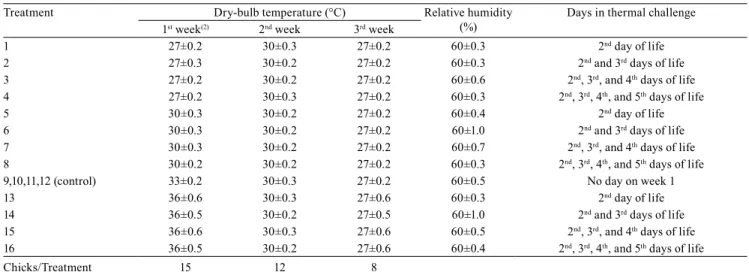
A total of 16 experimental treatments were
performed, combining four tdb (27, 30, 33, and 36°C)
with four durations of thermal challenge (1 to 4 days) (Table 1). All treatments were carried out in four phases, with four treatments evaluated in each one. Performing the experiment in four sequential phases was not expected to affect the experimental results because the environmental conditions within the tunnels were fully controlled and the used chicks were homogenous. The tested chicks had similar initial body mass, came from the same hatchery, and received the same vaccines for Marek’s disease, Gumboro disease, and Fowl pox.
The chicks were placed inside the environmentally-controlled wind tunnels on the day of hatch and remained there until 22 days of age. They were housed in 1×1-cm wire-mesh steel frame cages of 0.40-m
width × 0.60-m length × 0.50-m height. Each cage was
divided into three equal parts of 0.08 m2 floor area, and
the cages were oriented parallel to the direction of the
air flow. Therefore, all the birds were subjected to the
same thermal conditions.
Due to the amount of space available in the cages, 210 mixed-sex chicks of the Cobb breed were used for the entire experiment. The chicks were randomly
distributed among the treatments. Each trial, with four
treatments, began with 60 birds, 15 per treatment, distributed in three replicates of 5 birds each. On the eighth day of each 21-day trial, 12 birds were removed
from the trial (1 per replicate). Then, on the fifteenth
day, another 12 birds were removed from the trial. Therefore, by the end of the trial, 3 birds remained in each replicate. The removed birds were those with the largest deviations in body mass, when compared with the average of the same replicate group. This procedure was used to maintain an appropriate bird stocking density throughout the entire trial and to
reflect the housing conditions in commercial broiler production. At the third, eighth, fifteenth, and
twenty-second day of age, the average bird stocking densities
were of 2.7, 7.4, 12.3, and 20 kg m-2, respectively.
These stocking density values are in alignment with the recommendations of Manning et al. (2007) and Broiler… (2008).
Different numbers of replicates (unbalanced) were
and eleventh treatments had one five-bird replicate with five birds per treatment, whereas the tenth and twelfth treatments each had two five-bird replicates (Table 1).
This is the reason why the total number of birds for all the treatments was 210 instead of the expected 240.
Water and commercial feed, with the same formulation, were provided to the birds ad libitum throughout the experimental period.
The chicks were placed in the wind tunnels on the
first day of life, upon arrival from the hatchery, with tdb
maintained at 33°C (Menegali et al., 2013). Each group
of 15 birds housed in the same tunnel was subjected to one of the 16 treatments from the second day of life onwards. Once the thermal challenge was over, air temperature was returned to the thermoneutral level
recommended for the first week of life, i.e., 33°C.
During the second and third weeks of life, the birds were subjected to thermoneutral temperatures of 30 and 27°C, respectively (Menegali et al., 2013). Relative humidity in the wind tunnels was set at 60% during the entire experimental period (Lin et al., 2005), whereas bird-level air velocity was kept at 0.2 m s-1, which was
considered comfortable for the age range of the studied birds (Nascimento et al., 2013).
The production performance of the chicks was assessed daily using the following parameters: body mass (BM), feed intake (FI), water intake (WI), body weight gain (BWG), and feed conversion (FC). Data on
BM, FI, WI, BWG, and FC were collected daily from
all animals in each treatment. Each replicate had 5, 4,
and 3 birds at 1, 2, and 3 weeks of age, respectively. The experimental design was completely randomized and unbalanced, with two replicates for the thermoneutral temperature of 33°C and three replicates for the remaining treatments (Table 1). The model considered in the analysis was the following one:
yijkl = m + ti + dj + tdij + eijk + gl + tgil + dgjl + tdgijl + eijkl
in which yijklis the value found at age l of replicate k
subjected to tdb i for j days of thermal challenge; m is
a constant inherent to each observation; ti is the tdb i
effect, with i = 1, 2, 3, 4; djis the effect of duration
j, with j = 1, 2, 3, 4; tdijis the interaction between tdb
and duration; eijk is the random error associated with
each bird; gl is the effect of age l, with l = 1, 2, …,
20; tgil is the interaction between tdb and age; dgjl is
the interaction between duration and age; tdgijl is the
interaction between tdb, duration, and age; and eijkl is
the random error associated with the subplot.
Regression models were fitted when the effects were found to be statistically significant because the studied factors were quantitative. These fitted or empirical
models were used to estimate the BM, FI, and WI
of the birds during the first three weeks of life under
different intensities and durations of thermal challenge.
Table 1. The experimental treatments in environmentally-controlled wind tunnels, combining four dry-bulb temperatures and four durations of thermal challenge(1).
Treatment Dry-bulb temperature (°C) Relative humidity (%)
Days in thermal challenge 1st week(2) 2nd week 3rd week
1 27±0.2 30±0.3 27±0.2 60±0.3 2nd day of life
2 27±0.3 30±0.2 27±0.2 60±0.3 2nd and 3rd days of life
3 27±0.2 30±0.2 27±0.2 60±0.6 2nd, 3rd, and 4th days of life
4 27±0.2 30±0.3 27±0.2 60±0.3 2nd, 3rd, 4th, and 5th days of life
5 30±0.3 30±0.2 27±0.2 60±0.4 2nd day of life
6 30±0.3 30±0.2 27±0.2 60±1.0 2nd and 3rd days of life
7 30±0.3 30±0.2 27±0.2 60±0.7 2nd, 3rd, and 4th days of life
8 30±0.2 30±0.2 27±0.2 60±0.3 2nd, 3rd, 4th, and 5th days of life
9,10,11,12 (control) 33±0.2 30±0.3 27±0.2 60±0.5 No day on week 1
13 36±0.6 30±0.3 27±0.6 60±0.3 2nd day of life
14 36±0.5 30±0.2 27±0.5 60±1.0 2nd and 3rd days of life
15 36±0.6 30±0.3 27±0.6 60±0.5 2nd, 3rd, and 4th days of life
16 36±0.5 30±0.2 27±0.6 60±0.4 2nd, 3rd, 4th, and 5th days of life
Chicks/Treatment 15 12 8
The models were selected considering performance and biological explanation. Therefore, BM, FI, and WI may be estimated based on: the tdb to which the animals
were subjected, which ranged from 27 to 36°C; the duration of the thermal challenge from the second day of life onwards, which was of 1, 2, 3, or 4 days; and the age of the birds, from 3 to 21 days of life. It should
be noted that data from the first and second day of life
were excluded in the regression analysis because these days were considered as the acclimation period.
The accumulative means of bird productive responses were used to evaluate the treatment effect on BM, FI, WI, BWG, and FC. Data were subjected to the analysis of variance, and means were compared by Tukey’s test, at 5% probability.
Statistical analyses were performed using the Proc
REG and Proc Mixed procedures of the SAS software,
version 9.3 (SAS Institute Inc., Cary, NC, USA).
Results and Discussion
BM, FI, and WI showed a two-way interaction between tdb and age (p<0.01). Multivariable regression
models were fitted to relate the production performance
responses to these two factors. BWG showed a three-way interaction between tdb, duration, and age (p<0.01),
and the multivariable regression models were fitted
accordingly. However, in this last case, the resultant
models were not statistically significant (p>0.05) and,
therefore, were not used to estimate the variable.
The regression models fitted for the BM, FI, and WI
equations below, respectively, were the most adequate in delineating functional relationships (p<0.01). These models are valid for birds from 3 to 21 days of age
and subjected to tdb from 27 to 36°C. The standard
errors (between brackets) of the estimated parameters of the model indicate the degree of uncertainty in the estimation:
BM = 5.0748 (0.3305) × tdb + 25.0786 (0.2132) × Age -
220.1379 (10.7145);
FI = 0.68984 (0.0883) × tdb + 5.03152 (0.0570) × Age -
23.11542 (2.8643);
WI = 1.09 × tdb (0.1730) + 10.2354 × Age (0.1116) -
24.7531 (5.6102).
The correlation coefficients (R2) of the regression
models were 0.934, 0.933, and 0.935 for BM, FI, and WI, respectively. This means that only 6.6% of the
variability in BM, 6.7% in FI, and 6.5% in WI was
not explained by the fitted models. These relatively
small deviations between the observed and estimated values could have resulted from random errors that were not necessarily attributable to the model factors (Kelkinnama & Taheri, 2012).
Araujo et al. (2011) developed response surface
models to estimate BWG and FI as a function of tdb,
metabolizable energy of feed, and age of animals
at slaughter, yielding R2 values of 0.88 and 0.87,
respectively. In the present study, the models obtained showed reasonable accuracy for predicting BM, FI, and WI of chicks from 3 to 21 days of life subjected to the thermal condition treatments, when compared with models of similar nature reported in the literature.
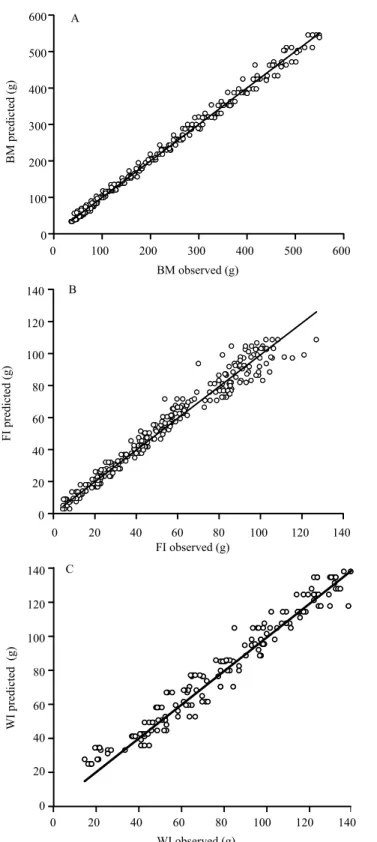
A graph of model-predicted values versus observed values allows visualizing the model’s bias. Such a graph should appear as a straight line in the case of an unbiased model (Faria Filho et al., 2008). This shows that the adjusted models provided good approximation of the actual values for BM, FI, and WI (Figure 1).
The response surface graphs to predict BM, FI, and WI are merely regression models as a function of two explanatory variables or factors; in this case, of tdb and
bird age. The response surfaces provided a more vivid
depiction of BM, FI, and WI as affected by age and tdb
(Figure 2).
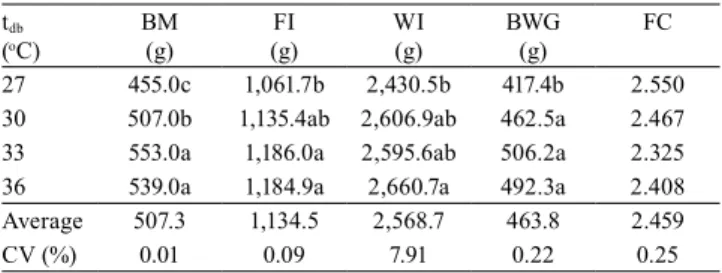
The results obtained by Tukey’s test revealed that
BM, FI, WI, BWG, and FC were not significantly
affected by the duration of the thermal challenge. The corresponding p-values were 0.2638 for BM, 0.8366 for FI, 0.8920 for WI, 0.2905 for BWG, and 0.6344 for FC (Table 2).
At 21 days of age, the chicks subjected to low tdb, especially of 27°C, showed a significantly lower
BWG than those subjected to the other tdb (p<0.05)
(Figure 2 A and Table 2). This result indicates that
27°C is unconducive for chicks in the first week of life, confirming the findings of Carvalho et al. (2011).
These authors reported that thermal challenge affects animal productivity since heat exchange with the environment alters BWG and, consequently, nutrient metabolism.
The lowest BM was also observed for chicks subjected to 27oC (p<0.05) (Figure 2 A and Table 2).
Moura et al. (2008) pointed out that low tdb in the first
Figure 1. Functional relationship between the predicted and observed values of: A, body mass (BM); B, feed intake (FI); and C, water intake (WI) of broiler chickens under the experimental conditions: dry-bulb temperature from 27 to 36oC, bird age from 3 to 21 days, and thermal challenge duration of 1 to 4 days.
them less effective in conserving body heat. Indeed, the thermoregulatory system of chicks is not fully
developed in the first week of life, indicating the need
for higher environmental temperatures for young birds to maintain normal core temperature (Cordeiro et al., 2010; Nazareno et al., 2015). Therefore, air temperatures below the thermal requirements will inevitably cause
financial losses because a higher portion of the feed
energy is diverted to thermoregulation or the survival of the animal as opposed to production (Schiassi et al., 2015).
The largest BM was obtained for chicks subjected
to 33°C – the recommended comfortable tdb for this
age (Cony & Zocche, 2004) – and to 36°C (p<0.05).
Therefore, the results show that 36°C does not pose heat stress to the chicks as their performance was very similar to that of the those subjected to 33°C (p=0.8711).
The chicks subjected to low tdb had a lower FI than
the ones under the comfortable tdb, of 33 and 36oC
(Figure 2 B and Table 2), which, in turn, led to a lower BWG. According to Mujahid & Furuse (2009), cold stress adversely affects the FI of chicks because of its impact on the digestive system and body development.
In a commercial broiler facility where lower tdb may
exist in parts of the house, BWG differences will cause
increased nonuniformity of the flock and, consequently, financial losses (Khan et al., 2011, 2012).
WI increased with increasing tdb during the 21 days
of life of the chicks (p<0.05) (Figure 2 C and Table 2). Nielsen (2012) stated that heat dissipation has an important effect on bird WI and growth. Under warm/ hot environments, the WI by birds is greater because it is essential to the cooling mechanisms (increased latent
heat loss) involved in thermoregulation (Cordeiro et al., 2010).
Although better results for BM, FI, WI, and BWG were found at tdb of 33 and 36°C, no significant
differences were observed for FC among the
tdb evaluated (p=0.1794) (Table 2). Overall, the
performance of chicks at 33 and 36°C was better
than that under 30 and 27°C during the first week
of life. This shows that the development of birds
subjected to cold challenge in the first few days
of life may be delayed and may not be recovered adequately, as reported by Cordeiro et al. (2010). According to Abreu et al. (2012), young birds have a higher resistance to heat and a greater susceptibility to cold stress. This result was supported by those of the present study, in which birds initially subjected
to 36°C performed better than those at the cooler tdb
of 27 or 30ºC.
Although the scale of the current study is far from that of commercial farms, the obtained results can still be used as reference values for decision-making regarding the proper environmental conditions to give chicks a good start in the brooding period. It should be highlighted that a relative short exposure of thermal stress may be as detrimental to the birds as a long one.
Conclusions
1. The exposure of broiler chickens to cold thermal challenge early in life shows a carry-over effect on body mass, feed intake, water intake, and body weight gain until 21 days of age.
2. The production performance of broiler chickens subjected to a draft-free environment at 33 and 36ºC dry-bulb temperatures, under 60% relative humidity, is similar.
3. The empirical models perform well in estimating body mass, feed intake, and water intake of broiler chickens as a function of dry-bulb temperature and bird age.
Acknowledgments
To Conselho Nacional de Desenvolvimento
Científico e Tecnológico (CNPq), to Fundação de Amparo à Pesquisa do Estado de Minas Gerais
(Fapemig), and to Coordenação de Aperfeiçoamento
de Pessoal de Nível Superior (Capes), for financial
support.
Table 2. Cumulative body mass (BM), feed intake (FI), water intake (WI), body weight gain (BWG), and feed conversion (FC) of 21-day-old broiler chickens under each evaluated dry-bulb temperature (tdb)(1).
tdb (oC)
BM (g)
FI (g)
WI (g)
BWG (g)
FC
27 455.0c 1,061.7b 2,430.5b 417.4b 2.550 30 507.0b 1,135.4ab 2,606.9ab 462.5a 2.467 33 553.0a 1,186.0a 2,595.6ab 506.2a 2.325 36 539.0a 1,184.9a 2,660.7a 492.3a 2.408 Average 507.3 1,134.5 2,568.7 463.8 2.459
CV (%) 0.01 0.09 7.91 0.22 0.25
(1)Means followed by equal letters, in the columns, do not differ
References
ABREU, P.G. de; ABREU, V.M.N.; COLDEBELLA, A.; HASSEMER, M.J.; TOMAZELLI, I.L. Medidas morfológicas em
função do peso e da idade da ave, por meio de imagens. Revista
Brasileira de Engenharia Agrícola e Ambiental, v.16,
p.795-801, 2012. DOI: 10.1590/S1415-43662012000700014.
ARAUJO, R.B.; FARIA FILHO, D.E. de; FARIA FILHO, D.E. de; LIMA, C.G. de; TREVISAN, R.B.; SOUZA, K.M.R. de; SAKAMOTO, M.I.; SOUZA, V.N. de. Modelos de superfície de
resposta para predição do desempenho de frangos e elaboração de análise econômica. Revista Brasileira de Saúde e Produção
Animal, v.12, p.770-783, 2011.
AVISITE: estatísticas e preços: produção de carne de frango em mil ton. 2016. Available at: <http://www.avisite.com.br/economia/
index.php?acao=carnefrango>. Accessed on: Aug. 8 2016. BROILER management guide. Siloam Springs: Cobb-Vantress, 2008. 70p.
CARVALHO, F.B.; SARTORI, J.R.; STRINGHINI, J.H.; FASCINA, V.B.; PEREIRA, L.A.; PELÍCIA, V.C. Efeito
da temperatura ambiente e da idade do frango sobre o valor energético do farelo de soja. Arquivo Brasileiro de Medicina
Veterinária e Zootecnia, v.63, p.1437-1445, 2011. DOI: 10.1590/
S0102-09352011000600022.
CHOWDHURY, V.S.; TOMONAGA, S.; NISHIMURA, S.;
TABATA, S.; FURUSE, M. Physiological and behavioral
responses of young chicks to high ambient temperature. The
Journal of Poultry Science, v.49, p.212-218, 2012. DOI: 10.2141/
jpsa.011071.
CONY, A.V.; ZOCCHE, A.T. Equipamentos para fornecimento de ração e água. In: MENDES, A.A.; NÄÄS, I. de A.; MACARI, M. (Ed.). Produção de frangos de corte. Campinas: Fundação Apinco de Ciência e Tecnologia Avícolas, 2004. p.97-106.
CORDEIRO, M.B.; TINÔCO, I. de F.F.; SILVA, J.N. da; VIGODERIS, R.B.; PINTO, F. de A. de C.; CECON, P.R. Thermal
comfort and performance of chicks submitted to different heating systems during winter. Revista Brasileira de Zootecnia, v.39, p.217-224, 2010. DOI: 10.1590/S1516-35982010000100029.
FARIA FILHO, D.E.; ROSA, P.S.; TORRES, K.A.A.; MACARI,
M.; FURLAN, R.L. Response surface models to predict broiler performance and applications for economic analysis. Revista
Brasileira de Ciência Avícola, v.10, p.131-138, 2008. DOI:
10.1590/S1516-635X2008000200009.
KELKINNAMA, M.; TAHERI, S.M. Fuzzy least-absolutes
regression using shape preserving operations. Information
Sciences, v.214, p.105-120, 2012. DOI: 10.1016/j.ins.2012.04.017.
KHAN, R.U.; NAZ, S.; NIKOUSEFAT, Z.; SELVAGGI, M.; LAUDADIO, V.; TUFARELLI, V. Effect of ascorbic acid in
heat-stressed poultry. World’s Poultry Science Journal, v.68, p.477-489, 2012. DOI: 10.1017/S004393391200058X.
KHAN, R.U.; NAZ, S.; NIKOUSEFAT, Z.; TUFARELLI, V.; JAVDANI, M.; RANA, N.; LAUDADIO, V. Effect of vitamin E
in heat-stressed poultry. World’s Poultry Science Journal, v.67, p.469-478, 2011. DOI: 10.1017/S0043933911000511.
LEE, I.-B.; SASE, S.; HAN, H.-T.; HONG, H.-K.; SUNG, S.-H.; HWANG, H.-S.; HONG, S.-W.; SEO, I.-S.-H.; KWON, S.-H. Ventilation design for a chick incubator using computational fluid
dynamics. Japan Agricultural ResearchQuarterly, v.43, p.227-237, 2009. DOI: 10.6090/jarq.43.227.
LIN, H.; ZHANG, H.F.; JIAO, H.C.; ZHAO, T.; SUI, S.J.; GU, X.H.; ZHANG, Z.Y.; BUYSE, J.; DECUYPERE, E. Thermoregulation
responses of broiler chickens to humidity at different ambient temperatures. I. One week of age. Poultry Science,v.84, p.1166-1172, 2005. DOI: 10.1093/ps/84.8.1166.
MANNING, L.; CHADD, S.A.; BAINES, R.N. Key health and
welfare indicators for broiler production. World’s Poultry Science
Journal, v.63, p.46-62, 2007. DOI: 10.1017/s0043933907001262.
MENEGALI, I.; TINOCO, I.F.F.; CARVALHO, C. da C.S.; SOUZA, C. de F.; MARTINS, J.H. Comportamento de variáveis
climáticas em sistemas de ventilação mínima para produção de pintos de corte. Revista Brasileira de Engenharia Agrícola
e Ambiental, v.17, p.106-113, 2013. DOI:
10.1590/S1415-43662013000100015.
MOSTAFA, E.; LEE, I.-B.; SONG, S.-H.; KWON, K.-S.; SEO, I.-H.; HONG, S.-W.; HWANG, H.-S.; BITOG, J.P.; HAN, H.-T. Computational fluid dynamics simulation of air temperature distribution inside broiler building fitted with duct ventilation
system. Biosystems Engineering, v.12, p.293-303, 2012. DOI: 10.1016/j.biosystemseng.2012.05.001.
MOURA, D.J. de; NÄÄS, I. de A.; ALVES, E.C. de S.; CARVALHO, T.M.R. de; VALE, M.M. do; LIMA, K.A.O. de. Noise analysis to
evaluate chick thermal comfort. Scientia Agricola,v.65, p.438-443, 2008. DOI: 10.1590/S0103-90162008000400018.
MUJAHID, A. Acute cold-induced thermogenesis in neonatal
chicks (Gallus gallus). Comparative Biochemistry and
Physiology Part A: Molecular and Integrative Physiology, v.156,
p.34-41, 2010. DOI: 10.1016/j.cbpa.2009.12.004.
MUJAHID, A.; FURUSE, M. Behavioral responses of neonatal
chicks exposed to low environmental temperature. Poultry
Science,v.88, p.917-922, 2009. DOI: 10.3382/ps.2008-00472.
NASCIMENTO, S.T.; SILVA, I.J.O. da; MAIA, A.S.C.; CASTRO, A.C. de; VIEIRA, F.M.C. Mean surface temperature prediction models for broiler chickens – a study of sensible heat flow.
International Journal of Biometeorology, v.57, p.1-6, 2013. DOI
10.1007/s00484-013-0702-7.
NAZARENO, A.C.; SILVA, I.J.O. da; VIEIRA, F.M.C.; SANTOS,
R.F.S. Temperature mapping of trucks transporting fertile eggs
and day-old chicks: efficiency and/or acclimatization? Revista
Brasileira de Engenharia Agrícola e Ambiental, v.19,
p.134-139, 2015. DOI: 10.1590/1807-1929/agriambi.v19n2p134-139.
NIELSEN, B.L. Effects of ambient temperature and early open-field response on the behaviour, feed intake and growth of fast-
and slow-growing broiler strains. Animal, v.6, p.1460-1468, 2012. DOI: 10.1017/S1751731112000353.
OLIVEIRA, R.F.M. de; DONZELE, J.L.; ABREU, M.L.T. de; FERREIRA, R.A.; VAZ, R.G.M.V.; CELLA, P.S. Efeitos
idade. Revista Brasileira de Zootecnia,v.35, p.797-803, 2006. DOI: 10.1590/S1516-35982006000300023.
PAULI, D.G. de; SILVA, J.N. da; VIGODERIS, R.B.; TINOCO,
I. de F.F.; IORIO, V.O. de; GALVARRO, S.F.S. Desenvolvimento de um software para dimensionamento de sistemas de ventilação e resfriamento evaporativo em instalações avícolas climatizadas.
Engenharia na Agricultura, v.16, p.167-179, 2008. DOI:
10.13083/1414-3984.v16n02a04.
RENAUDEAU, D.; COLLIN, A.; YAHAV, S.; BASILIO, V. de; GOURDINE, J.L.; COLLIER, R.J. Adaptation to hot climate and
strategies to alleviate heat stress in livestock production. Animal, v.6, p.707-728, 2012. DOI: 10.1017/S1751731111002448.
SCHIASSI, L.; YANAGI JUNIOR, T.; FERRAZ, P.F.P.; CAMPOS, A.T.; SILVA, G.R. e; ABREU, L.H.P. Comportamento
de frangos de corte submetidos a diferentes ambientes térmicos.
Engenharia Agrícola, v.35, p.390-396, 2015. DOI:
10.1590/1809-4430-Eng.Agric.v35n3p390-396/2015.