International Journal of Engineering Business Management
Outsourcing in Healthcare Through
Process Modularization - A Lean
Perspective
Regular Paper
Cristina Machado Guimarães
1,*and José Crespo de Carvalho
11 Lisbon University Institute, Lisbon, Portugal
* Corresponding author E-mail: [email protected]
Received 30 April 2012; Accepted 30 June 2012 DOI: 10.5772/51886
© 2012 Guimarães and de Carvalho; licensee InTech. This is an open access article distributed under the terms of the Creative Commons Attribution License (http://creativecommons.org/licenses/by/3.0), which permits unrestricted use,
distribution, and reproduction in any medium, provided the original work is properly cited.
Abstract Looking for efficiency, quality and profitability gains, healthcare organizations are adopting outsourcing solutions in the attempt of “doing more with less”. Seeking for cost reduction, risk mitigation, adapting to quick changes without compromising internal resources, these organizations also take big risks in control and flexibility variables. In order to understand how healthcare organizations find the best value equation combining internal and external resources in a modular service conception, a case study on a start‐up Long‐term Care unit with innovative format, great levels of customization and following an outsourcing strategy, was carried out.
The main conclusion, among others, is that in ambitious start‐ups, having speed of entrance as the conditioning factor, a process orientation and management approach may offer a clear view of the gains related with trade‐off decisions regarding time and cost (agility) and cost and quality (Leanness) ie, decisions under the “leagile” paradigm.
This study contributes for a wider understanding of the “leagile” concept associated to an outsourcing
operational strategy. Additionally, it also provides new insights to the concept of modularity in services settings in a complex service as healthcare.
Keywords Process Orientation, Process Modularization, Lean Thinking, Agility, Outsourcing, Healthcare Services
1. Introduction
Competition is not between companies but between supply chains [1]. Thus, organizations core capabilities lie in their ability to design and manage their supply chains in order to have maximum advantage in a continuous changing market [2]. In the supply chain management (SCM1) of healthcare organizations, outsourcing decisions
have been globally increased. In spite of the differences between healthcare systems, they all are converging into a network governance model where loosely coupled [3]
1 Vitasek (2005) definition, consensual among Council of Supply
Chain Management Professionals, can be consulted at http://www.cscmp.org/Website/AboutCSCMP/Definitions/Defini tions.asp
organizations with ever‐changing partners are linked by all sorts of outsourcing contracts, not by ownership, in a cooperation atmosphere [4]. In loosely coupled systems modular product/service designs allow a range of variations that can be carried out concurrently by multiple, loosely coupled modular organization structures [5]. In such structures, multiple governances of external and internal providers call for strong relational management skills. Being supplier relationship management one of the eight key SCM processes [6], the process‐oriented (PO) approach frames outsourcing decisions in a value chain optimization scenario.
According to some authors [7, 8], when taking a broader view, “Leanness” can be conceptualized in terms of a quest for structural flexibility involving restructuring and outsourcing. The extension (scope), motives (drivers), decision process, contracts, risks and benefits can vary according to each one of the three outsourcing paradigms – transactional, strategic and transformational. In fact this paradigm shift is mostly due to the “Westernisation of the Japanese keiretsu model” that emphasises flexibility of “Lean and mean” structures focused on “core competencies” leading to “do more with less” [9]. Do all outsourcing relationships serve Lean principles, agile ones, or both?
A decade after Naylor et al. [10] working paper coining the term “leagility”, deeper empirical research in different settings from the usual manufacturing as services, namely in healthcare sector, is still required [11]. Naim and Gosling [11] literature review shows that the extent to which one paradigm fits into another is in discussion. The scope of each (Lean or agile) paradigm and the extent to which Leanness is a prerequisite for agility and vice‐ versa are still contested. Delivering the best value equation to end‐customer implies a suitable combination of efficiency, effectiveness and relevancy to face market challenges. In the attempt of eliminate redundant work or find knowledge specialization, outsourcing presents several benefits and continues to drive organizations from vertical to virtual integration [12].
The two main questions this research intends to give an answer are:
‐ How modularity contributes to find the best value equation combining internal and external resources in order to offer innovative and highly customized services?
‐ How PO enables standardization of activities and outputs in services settings, in order to achieve flexibility and “leagility”?
The vertical disaggregation of the firm through modularization of the structure is not new in healthcare services [13]. However the modularization concept goes
beyond physical structure, addressing service configuration issues. In this paper we explore the full concept associated with the “make or buy” question in the period of an organization life cycle when it should be firstly posed, the start‐up.
In order to contribute for a wider understanding of the “leagile” concept associated to an outsourcing strategy a case study on a Long‐term Care (LTC) unit was carried out. This paper is organized in the following way: section 2 outlines the process modularization concept; section 3 gives a theoretical background of Lean, agile and “leagile” paradigms and their identification in healthcare setting and section 4 presents a theoretical explanation of outsourcing evolution and relation with the “leagile” concept. The following two sections are dedicated to the case method and case study and the last one presents the conclusions.
2. Process Modularization
Processes are “structured sets of work activity that lead to specified outcomes for customers” [14] consuming resources/ inputs and delivering outputs in stream alignment throughout the value chain.
A process‐oriented (PO) organization focuses on end‐to‐ end business processes instead of placing emphasis on functional and hierarchical structures looking at the organization as a group of silos. PO most cited direct effects are: (i) improvements in cost, quality, speed, profitability; (ii) internal and external customer satisfaction; (iii) added value increasing by sourcing out non‐competitive activities and concentrate on core competences and (iv) improvement of operational effectiveness [15]. The author also considers other important benefits as the elimination of ownership ambiguity, the clarification of boundaries description and interfaces, the communication facilitation, the visibility of potential improvement areas and a proactive management through process performance measurement. PO can be classified into three applications: process view, process mapping and process management [16].
According to the literature’s theoretical perspective, modularity represents “the conceptual tool that allowed to capture the benefits and costs of interdependence, degrees of coupling, redesigning and imitation in the design of technological and organizational systems” [17]. Every system has a degree of modularity (subsystems and/or components) that will be higher in a modular structure comparing to an integral one. These authors’ review addresses also the practical perspective in which modularity plays a important role in: (i) new product development processes, (ii) the design and management of vertical and horizontal inter‐organizational relationships, (iii) the adoption of formal and informal
standards; (iv) the design of flexible and scalable production systems based on cells, (v) sub‐assembly and (vi) pre‐testing.
In a modular system, each module communicates and interacts with the others via standardized interfaces that allow modules’ decoupling. And through modularity, firms can redesign their internal organizational structure to gain strategic flexibility, and inter‐organizational connectivity and Leanness to enter new markets or quickly exploit changing technologies [18‐20]. Both theoretical and practical perspectives can be clustered into three kinds of modularity: product design modularity, production system modularity and organizational design modularity. The linkage of these three kinds is made by “process modularization”. Lessons from automotive sector present modularisation through three main elements: product/service architecture, modular production and inter‐firm systems, showing the importance of outsourcing as an enabler [21]. The authors distinguish the western path to modularization that only considers two aspects: modular production and inter‐firm systems, from the Japanese path that also includes the product/service architecture enhancing the importance of innovation and product development in modularisation, and not only production and purchasing.
Some defend that product modularity have direct positive impacts in competitive performance by improving quality, flexibility, cost and supplier integration [22]. On the other hand, modularity (namely through outsourcing) may facilitate imitation with negative consequences for modular performance advantages [23].
Others posit that, to some extent, modular products lead to modular organizations [19], but organizational modularity has multiple facets to explore, including outsourcing options [24]. But what if the outsourcing decision is collateral to service design in start‐up phase? A frequent question leads to different opinions concerning the relationship between product modularity and outsourcing strategies: ‐ does product modularity determine outsourcing of modules’ production? Or vice versa, does outsourcing affect product modularity? In fact, some authors [17, 25] defend that the effect of modularity in outsourcing is in fact a two‐way effect, whatever the life cycle stage the organization might be in. Moreover, with outsourcing, modularization can be used for strategic changes in organizational structure [26].
A recent stream of research, taking into consideration a life‐cycle perspective and the peculiarities of the activities moved out of the firm boundaries, posits that the firm defines a modular product architecture before outsourcing one or more modules (in the phase of
growth) [17]. On the other hand, a second path posits the firm starts to outsource some product components before moving towards a modular design. In the third path the firm simultaneously implements product modularity and outsourcing. However, this authors’ review leave unanswered the question: ‐ “Does the adoption of a process perspective facilitates the definition of modules, interfaces and standards at organizational design level?” and stresses the need of deeper research on the drivers of modularization and architecture classification especially in services setting [25]. Attempting to operate and measure the degree of service architecture modularity, the author “borrows” from manufacturing settings five dimensions associated with the study of modularity: (i) interfaces; (ii) degree of coupling; (iii) components and systems; (iv) commonality sharing; and (v) platform (back office, among others). The interfaces (people, information, rules governing information flow) play the role of allowing mix and match of components enabling mass customization. The degree of coupling indicates how loose/tight the system constituents are. Commonality sharing refers to the possibility of using the same version of a component across multiple services/products, allowing economies of scale, economies of scope, rapid product development, shorter lead times and time to market. Outsourcing can only be realized when a system can be decomposed in a way that components’ interfaces are well specified and standardized requiring a clear knowledge of both the process architecture (nodes and linkages) and the interfaces [25]. Defending modularity, in both loosely and tightly coupled systems, as key driver of mass customization in services (as long as the interfaces between components were standardized) the authors conclude that, in services, customization can either be combinatorial (various service processes and products combined to create a unique service) or menu driven (personnel or the customers select from among existing services/products to meet customers’ needs).
In manufacturing several cases are reported, from the automotive industry (Chrysler Jeep [26], and others), providing insights that link the product architecture designs with strategic decisions in supply chain management as outsourcing. Less examples of modularity in services are known, despite of a recent literature stream on modularity, but more in the context of product‐related services [27]. However the literature presents contributions from cases in services multisite organizations (banking, retail), in third‐party logistics (3PL) and also in healthcare services as elderly care [28] and hospital patient care [29].
3. Leagile paradigm in healthcare
Lean is about doing more with less [30] or, in a summarized statement, “Leanness means developing a value stream to eliminate all waste, including time, and to
ensure a level schedule”, whilst “agility means using market knowledge and a virtual corporation to exploit profitable opportunities in a volatile market place” [10].
Presented as an antidote to muda (waste), converting
muda into value, “Lean thinking” was coined by Womack,
Jones and Ross [31] as a five principle improvement philosophy: (i) specify value, (ii) identify the value stream, (iii) make the value‐creating steps for specific products flow continuously, (iv) let the customers pull value from the enterprise, and (v) pursue perfection. These authors streamlined the core Lean concepts based in Taiichi Ohno and Shingeo Shingo’s Toyota Production System (TPS), describing Lean production in five elements: (i) Lean manufacturing, (ii) Lean product development, (iii) supply chain coordination, (iv) customer distribution, and (v) Lean enterprise management. Research has been evolving from Lean manufacturing including the concept’s relation to Six Sigma and Total Quality Management (TQM) [32]. In the evolution of Lean concept, the shifting of focus from quality in early 1990s to customer value was visible in appliance to services sector, from 2000s onwards [33, 34, 35, 36]. In 2003 revision, Womack and Jones [31] introduced the application of Lean thinking in the medical services. Some authors advocate Lean practices in healthcare services to eliminate delays, reduce length of stay, repeated encounters, errors and inappropriate procedures [37‐39]. Brandao de Souza [40] updates the Lean principles application evolution to healthcare and leaves taxonomy to understand differences of Lean deployment.
The original concept of agility was brought by academics (Lehigh University) and practitioners (in 1991) referring to a new manufacturing paradigm (high quality and highly customized products, high information and value added products/services, mobilization of core competences, responsiveness, response to change and uncertainty and intra/inter‐enterprise integration). Based on the first research context – manufacturing – several definitions of Agile Manufacturing were translated into agility for business [41‐44] enhancing the organizations’ adaptive capability in re‐organizing and even in reconfiguring themselves responding to a market opportunity.
“Agility is the successful exploration of competitive bases (speed, flexibility, innovation proactively, quality and profitability) through the integration of reconfigurable resources and best practices in a knowledge‐rich environment to provide customer‐driven products and services in a fast changing market environment” [45]. This definition suggests three levels of agility: individual, enterprise and inter‐enterprise, supported by four pillars of agile competition: core competence management, virtual enterprise formation, re‐configuration capability and knowledge‐driven enterprise.
However, it is pertinent to underline here that the definition of flexibility as the “ability of companies to respond to a variety of customer requirements which exist within defined constraints” cannot be confounded with agility [43].
Modularity is one of the ways of show re‐configuration capability and flexibility (“the use of interchangeable units to create product variants” [46]), necessary to mass customization, defined as provision of individually customized products (or services) through the use of flexible and highly responsive systems [47, 48]. Agility characteristics are presented by Sherehiy [49] review: flexibility, responsiveness, speed, culture of change, integration and low complexity, high quality and customized products and mobilization of core competences, as characteristics of agility. In consonance, Jain et al. [50] indicate four elements required to an agile supply chain: (i) responsiveness (the ability to identify changes and respond to them quickly, reactively or proactively, and also to recover from them); (ii) competency (the ability to efficiently and effectively realize enterprise objectives); (iii) flexibility/adaptability (the ability to implement different processes and apply different facilities to achieve the same goals) and (iv) quickness/speed (the ability to complete an activity as quickly as possible). Some authors address agility as precondition for 21 st century related with the following issues: (i) rapidly changing markets; (ii) globalization; (iii) decreasing new product time‐to‐market; (iv) increasing inter‐enterprise co‐operation; (v) interactive value‐chain relationships; and (vi) increasing value of information/service [41]. Agility is the issue also in service quality in healthcare providers [51].
It is consensual in literature that agile and Lean are not synonymous. However, for some, agility is mutual compatible with Leanness [10, 45, 52‐55], as Lean is needed to build agility [2]. Containing “little fat”, Leanness may be an element of agility, but by itself does not warrantee satisfying the customer more rapidly compared to a “nimble” organization [30]. Both Lean and agile systems emphasize supply integration, waste reduction, and lead time compression, but they differ mostly in their emphasis on flexibility for market responsiveness [10]. Some authors posit that Lean is more related with production focused while agile is with customer focused strategies [56]. Others stated that when the primary goal is to be Lean, responsiveness is compromised over cost‐efficiencies whilst agility places cost and responsiveness as equally important [57]. In a short statement, Lean does not imply agile, but agile does imply that many of the principles and techniques of Lean are in place [58]. The Total Cycle Time Compression Paradigm [59] is, though, sufficient to achieve Lean, but represents only one necessary condition, not sufficient, to
achieve agile [60]. Therefore, agile is a post‐Lean paradigm leaving to Lean a ʺfoundational” role.
Some authors [61, 62] find the agile paradigm suitable to innovative products, in low volume, highly volatile supply chains, where customer requirements are often unpredictable and supplier capabilities and innovations are difficult to control as in healthcare services. Others [54] compare both paradigms distinguishing attributes, but in the end of the day, the essence of the difference lies, in terms of value to the customer, in the fact that in agility, the market winner is “service level”, whilst “cost” is the Lean critical factor [44].
“Leagility” [10, 54, 63] is the combination of both paradigms (Lean and agile) within a total supply chain strategy marked by a decoupling point (DP). Downstream of the DP, an agile strategy responds to a volatile, unpredictable demand, and upstream providing level scheduling and eliminating waist, non added‐value activities and bottlenecks pursuing a Lean strategy. This strategic point separates the supply chain part that is pulled directly by the end customer and where variability asks for agility and effectiveness, from the upstream supply chain part lead by efficiency purposes and forecast driven. Leagility is, thus, also called hybrid strategy [30]. Both paradigms can coexist separated: (i) by space (matching agile supply chain with innovative products and functional products); (ii) within a whole and its parts (by settling a decoupling point); (iii) in time (having short lead times for “fashion” or “emergency” and longer ones for “basics” or “elective” healthcare events); and (iv) upon condition (using order winner criteria in market segmentation or in product design modularization) [64]. “Having the best of both worlds” [65] is also possible in healthcare setting through a “pipeline differentiation”, coexisting Lean and agile pipelines, or by using three approaches: (i) the Pareto curve approach; (ii) the decoupling point; and (iii) the “base and surge” demands.
Moreover, it is also possible for a corporation to simultaneously pursue both Lean and agile strategies by adopting a leagile infrastructure [56]. Some stress the need for adapting the implementation of Lean, agile and leagile systems to product´s life cycle and innovation level [11]. Standard/functional products or commodities [66] call for Lean systems and hybrid products call for leagile systems, no matter the cycle life phase they’re in. Conversely, innovative products first two cycle life phases (infancy and growth) ask for agile systems, while in maturity and decline phases they can have either Lean or leagile systems.
Also, leagility enables “mass customization” strategies by stabilizing variety and flow responsiveness [63]. Mass customization is defined as “Customer co‐design process
of products and services, which meet the needs of each individual customer with regard to certain product features” [47]. All operations are performed within a fixed solution space, characterized by stable but still flexible and responsive processes. Kumar [67] contribution led to a better understanding of modularity as mass customization strategy enabler.
The shifting from craft industry to a process industry in healthcare sector [68], where guidelines don’t jeopardize individual different care, introduces a mass customization paradox that lead to combine Lean with agile paradigm [56].
4 “Leagility” through Outsourcing
Outsourcing or transferring internal activities to third parties [69] can assume several forms in a wide spectrum of relationships [70‐72]. A theoretical evolution from Transaction‐cost Analysis (TCA) [73, 74] and Agency Theory (AT) [75], to Resource‐Based View (RBV) [76], and, more recently, the Transformational View [77] placing outsourcing as a SCM strategic tool allows the redesign of the organization value creation process and, sometimes, its mission [78]. In a RBV perspective, Eisenhardt and Martin [79], argue that the value for competitive advantage lies, not in the capabilities, but in the resource configurations that they create. Thus, the capability for strategically deciding what to perform internally or to leave to an effective external alliance is itself a distinctive competence.
Healthcare organizations adopt outsourcing solutions for the same reasons as in other sectors [80], looking for efficiency, quality and profitability gains. In healthcare units, outsourcing appears often as part of volume flexible strategies trying to respond to a non predictable demand’s flotation, care increasing complexity, and to the linkage between clinical performance and act volume [81]. Guimarães and Carvalho’s literature review [4], point as main drivers to outsource in healthcare unit: (i) cost reduction; (ii) risk mitigation; (iii) flexibility to adapt to quick changes without jeopardize internal resources; and (iv) value stream redefining. Outsourcing decisions in healthcare also depend on: (i) the kind of activity (modular versus integral more or less contractible); (ii) the type of contract (classical versus relational); (iii) contract duration (depending on contract type and supplier selection process); (iv) specification of performance requirements (process and outcomes indicators) and, finally (v) payment mechanisms.
However, adopting outsourcing as panacea doesn’t always lead to cost reduction. Apart from non successful outsourcing experiences, where hidden costs (monitoring, contract management, low productivity and high turnover [82]) erase the initial cost advantage, in
successful transformational outsourcing, when comparing internal with external costs, in the four phases of organizations life cycle, only in the last two phases outsourcing leads to cost reduction [83]. In start‐up phase, external costs are, according to this author, higher than internal and in the “Pathway to Grow” phase, the costs of outsourced services are equal to internal cots, not showing advantages of cost reduction.
Still, “make or buy” decisions are taken according to a core competencies evaluation. Core competencies can be used to reduce time to market [41]. The meaning of core activities in health care organizations is often the ones of “direct contact with patient” [84, 85]. The integration of core competences distributed among a number of real and carefully selected organizations, can be used as loose coupling mechanism of integration promoting agility. In this “sub‐strategy”, temporary alliances and partnerships based on core competencies are formed to improve flexibility and responsiveness [42] and core activities are also outsourced [86]. Based on this view success lies on focusing in the value added activities with a differential advantage over competitors. Escaping to RBV limitations considering a dynamic capability concept (the firm’s ability to integrate, build, and reconfigure internal and external competences to address rapidly changing market [87]), outsourcing the remaining activities leads to creation of “network organization”[30]. This author stresses the need of a responsive organization facing the continuous and rapid changes, a “new organizational paradigm” that combines innovation and flexibility with co‐operation in competition (co‐opetition). This virtual integration requires monitoring supplier performance skills, common vision of value creation among all supply chain partners in a risk/reward sharing atmosphere, and also extending Lean management views beyond suppliers achieving up‐stream alignment [12].
The legitimacy of Lean discourse is rooted in 30‐year trends of corporate restructuring, de‐layering and outsourcing [8]. In the attempt of “doing more with less”, outsourcing presents several benefits such as cost reduction, risk mitigation, adapting to quick changes without compromising internal resources (value mapping and value chain reconstruction) [88, 89], but also big risks as loss of control and flexibility [90, 91]. In dynamic outsourcing framework the key component is organizational modularization where the value chain can be restructured and decomposed in a multiple‐tier structure enabling better performance monitoring and achievements and assessment of what underperforming modules should be eliminated [87]. Therefore, outsourcing seams to follow not only Lean paradigm, with a strong focus on reducing waist (sometimes mainly costs) but also agile (with strong time reductions),
pursuing flexibility and quick response – but when can we call it a leagile outsourcing?
Lean supply chain impacts flexibility and time‐based technology leadership objectives rather than cost and quality. Conversely, the agile supply chain influenced cost rather than flexibility and time‐based technology leadership [92]. In terms of performance outcomes, there is no clear evidence (in manufacturing setting) of the dominance of one supply model on the other [93].
Combining both paradigms leads to focus on time and quality pursuing responsiveness goals. That is the focus of a modular start‐up outsourcing strategy.
5. Methodology
The case study method is appropriate to “How” and “Why” questions and to investigate a contemporary phenomenon in its real‐life context when the boundaries between phenomenon and context are not evident recurring to several data collection techniques and different evidence sources [94]. This qualitative method, allowing a deeper understanding of phenomena [95], has been frequently used in management studies, namely in operational management [96] and logistics [97, 98]. Being more a idiosyncratic than a generalizing method, was chosen by its descriptive and exploratory character, not to produce causality statements but to achieve a logical sequence of connection between empirical data, problem/research questions and findings/conclusions. Though, the unit of analysis chosen was a start‐up geriatric Long‐term Care unit with recognizable innovative format (great customization levels and distinctive service offer compared to other players). The choice of a LTC was due to the possibility of a longer evaluation by the end customer of the value equation offered. High innovation and customization levels were also including criteria in order to find evidence of the agile paradigm. The choice of an ambitious start‐up aiming fast market share achievements had the purpose of taking conclusions regarding the conflict between cost‐ efficiency, time‐to‐market and flexibility.
In data collection and analysis, a study protocol was followed as well as multiple sources data triangulation [94]. For data collection (from April to October 2008) we’ve recurred to semi‐structured interviews (to the CEO, COO, Marketing Director, one external consultant and three department managers), document analysis (company profile, interim regulation, outsourcing proposals, contracts, sector regulations, internal memos, structural charts, press releases) and direct, non participant observation (procedures of outsourced activities) [99]. Data analysis followed Miles and Huberman [100] recommendations on data codification, reduction and categorization techniques. Data gathered
from different informants and sources was reduced to precise categories in common tables [100] and then systematically interrogated [94] comparing and noting patterns [100]. The results were compared with an ongoing review of the concepts’ attributes of each paradigm and their linkage to the option of outsourcing in a start‐up phase.
In spite of being supported by a single case study, the paths followed in the structure of this study enables replication in other units of analysis with similar inclusion criteria.
6. A Long‐term Care Start‐up
CL (Carlton Life) is the first unit (two other are in project phase) of an organization that aims to be a national reference in providing high quality and differentiated Long‐term care for the elderly. Having a market share penetration ambitious goal of 15% to 20% in 7 – 9 years, CL aims to be the first, the better and the bigger player among others on The Long‐term care scene. In a moment marked by the announced entrance of several players in this fast growing sub‐sector, this unit is the only one presenting a floor building segmentation by independency levels. In the building conception, the modularization is present allowing different configurations of services and the mobility of care teams along the different dependency levels allocated in specific areas.
CL presents as the first Long‐term Care (LTC) unit to develop an individual and totally customized plan of care from the customer geriatric evaluation, instead of offering packages for the customers to fit in.
Recurring to Hines’s [101] integrated value chain model to better illustrate the “pull” model according to which the customer triggers the activities’ chain (by contrast to “push” model of Porter’s value chain), all activities in pink shade ground are outsourced (Fig.1). The only support activity kept in house was the customers’ personal laundry for the great error risk probability associated.
Figure 1. CL Integrated Value Chain
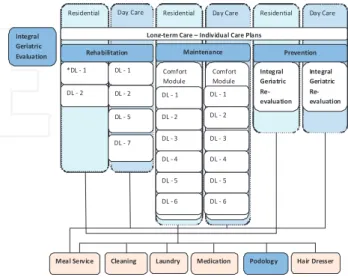
An interdisciplinary care plan for each client and a specific place in the residence is given as result from a complete geriatric assessment, by a multi‐professional team, at check‐ in time and during follow‐up to match the particular needs of each person. Therapies, equipment, medication, leisure actions and even meals are customized in a four star hotel environment. Though, in client’s value equation four major issues are addressed: (i) clients expectations (cleanness, safety, comfort and health solutions); (ii) modular solutions (rehabilitation, maintenance, prevention‐ Fig.2); (iii) service delivery (specialized, customized); and (iv) service segmentation (price, range).
*DL‐ Dependence Level
Figure 2. CL Services Decomposition
According to the interviewees, outsourcing was consider, first of all, due to strategic need for flexibility, time scarcity, speed to enter in the market and focus in core business. The main concern was to focus on LTC and use the distinctive competences of the founders, hospitality associated with healthcare, leveraging the LTC concept to a four star care environment. Therefore, all that was directly delivered to end customer should be internal and all the rest leave to third parties, with short length contracts, in an initial phase, and admitting other relationship developments with the growth of business. Looking for external expertise, specific know‐how to deal with complexity of some non core activities was needed, leaving financial worries to a second plan.
However, we found some restrains of outsourcing decision: (i) an adversity to take risks from the top management that takes outsourcing as a risk mitigation way; (ii) an ambition of market leadership; (iii) a best‐in‐ class seeking position in the Long‐term care business; (iv) an innovative combined health‐hotel service; (v) all service components are modular “same ingredients are used for different recipes”; (v) the rule of service delivery to final client only by in‐house staff; and (vi) incipient degree of knowledge formalization with no reporting culture and few written procedures. Day Care Residential Day Care Residential Day Care Residential Integral Geriatric Evaluation Long‐term Care – Individual Care Plans
Rehabilitation Maintenance Prevention
*DL ‐ 1 DL ‐ 2 DL ‐ 1 DL ‐ 2 Comfort Module Comfort Module DL ‐ 5 DL ‐ 7 DL ‐ 1 DL ‐ 2 DL ‐ 3 DL ‐ 4 DL ‐ 5 DL ‐ 6 DL ‐ 1 Integral Geriatric Re‐ evaluation Integral Geriatric Re‐ evaluation DL ‐ 2 DL ‐ 3 DL ‐ 4 DL ‐ 5 DL ‐ 6
All primary activities, being a direct service to final client, are kept internal. Were chosen to outsource activities considered : (i) less specific for having similar competitors in the market; (ii) less complex, simplifying the Requests For Proposals (RFP); (iii) with broader scopes and, though, with no punctual periodicity; and (iv) with medium level of criticality (even non core activities as meals and laundry services are very “visible” or close to final client). Thus, it was always followed the rule of outsourcing activities not direct delivered to final client. All contracts are for one year period, with a classical structure with no mention to contingence measures for failures or penalties and monitoring system.
The daily based outsourced activities (geriatric care, pharmacy service, meals service, laundry and cleaning services) were analysed following the tree paradigm (Lean, Agile and Leagile) theoretical perspective and found each decoupling point separating the “pull” system from the “push” as presented in Fig. 4.
Figure 4. Activities decoupling points
For having missed some steps on outsourcing process and lacking risk assessment and monitoring settling before the final outsourcing agreement, CL and vendors went on a spiral of continuous revisions and processes redesigning leading to service discontinuity and loss of quality. Also, the adjustment process resulted in higher costs (external consultancy, internal and external training programs), extra‐time spent (designing and testing new
processes, new contracts and negotiation), quality problems revealed in clients surveys, and lack of flexibility to follow occupation rates changes.
7. Conclusions
This paper illustrates how trough a process approach, a service value chain can be disaggregated into pieces favoring the Lean principle of pulling value by the customer. Moreover, the PO approach allows standardization of activities and outputs enabling activity’ mapping, costing and service design. Also brings visibility to bottle‐necks, improvement opportunities and identifies outsourcing options. Outsourcing presents, though, as a Lean solution for all activities that, if performed inside, would not be value added. This paper does not focus on outsourcing in the usual context of change, but a less crossed path, i.e. at the beginning of all service conception by considering modularization, as a result of process view.
The case showed as the main driver of speed of market entrance led to look at the value chain through a PO lenses and design services in a modular structure, combining internal and external resources to serve each process and even adopt a building modular conception and service lay‐out. Outsourcing in all non‐direct delivery services (considered non‐core), presented a solution to trade‐offs between cost and quality gains (Leanness) and between cost and time gains (agility) can be combined through outsourcing strategies in a so called “leagile” paradigm. The CL case is consonant with some authors [61, 62] that find the agile paradigm suitable to innovative products, as the innovation component calls for rapid market entrance before losing momentum and the novelty of the service model. At the same time, other “steady” components, upstream, can benefit of Lean paradigm.
This case’s business model lies in the combination of the same ingredients‐ modules to multiple customer needs. In this cascade service architecture the separation of the supply chain part that is pulled directly by the end customer where variability asks for agility and effectiveness, from the upstream supply chain part lead by efficiency purposes, was not always easy to identify due to the concomitancy of customer need and service delivery.
In spite of being the Lean philosophy that leads a start‐up healthcare organization to outsource “non‐value” added activities in order to gain speed to market and flexibility in entrance momentum, innovative products first two cycle life phases (infancy and growth) ask for agile systems. It is, therefore, suitable to combine both characteristics, agile and Lean, in order to be able to achieve the required degree of responsiveness that places
Geriatric daily care package
Decoupling point: Integral Geriatric
Evaluation
New geriatric daily care package
Daily cleaning routine occupation-based Emergency picket Inspection/cleaning routine Check-in cleaning Decoupling point: New Admission Decoupling point: Floor call Cleaning emergency solved Daily “heavy” laundry
collection/delivery
Decoupling point: Extra bed/table needs
Extra laundry collection/delivery Medication individualized
stock management, medication plan monitoring
Decoupling point: new prescriptions
Extra fulfillment
Meal weekly menu
(4 choices per meal) nutrition plan Individualized Decoupling point:
the organization as one of major players in a strong competitive sector. The modularization of services (and spaces) and the stream dual philosophies allowed the existence of decoupling points, boundaries between Lean and agile systems. This paper provides an example of “leagile” concept associated to an outsourcing strategy in healthcare setting showing the decoupling points in primary and support activities
However, an organization can be fat and nimble…but not all the time. Sustainability issues were not taken into consideration in all outsourcing processes in CL case.
To this result might concur the inefficient process management that places this case only in a “process mapping” type narrowing the PO possible applications [16].
This case also stresses the difficulty to control outsourced processes and addresses the performance monitoring problem as a risk management issue.
Nevertheless, through this case evidence it was possible to conclude that PO approach allows activity stabilization and standardization of outcomes. It was though possible to evaluate activity costs, time allocation and service bottlenecks and base the outsourcing decisions. The customization complexity was softened by modularity. 8. References
[1] Christopher M (1997) Marketing Logistics. Butterworth‐Heinemann, Oxford.
[2] Marcus I (2010) Agile supply chain: strategy for competitive advantage. Journal of Global Strategic Management.7: 5‐17.
[3] Orton JD, Weick KE (1990) Loosely Coupled Systems:
A Reconceptualization. The Academy of
Management Review. 15 (2): 203‐223.
[4] Guimarães CM, Carvalho JC (2011) Outsourcing in Health Care Sector – A State of the Art Review. Supply Chain Forum‐ An International Journal.12(2): 140‐148.
[5] Sanchez R (1995) Strategic Flexibility in Product Competition. Strategic Management Journal.16: 135‐ 159.
[6] Lambert DM, Cooper MC, Pagh JD (1998) Supply chain management: implementation issues and research opportunities. International Journal of Logistics Management. 9(2): 1‐19.
[7] Womack JP, Jones DT (1996)(2003) Lean Thinking, Banish Waste and Create Wealth in Your Corporation. London: Simon&Schuster
[8] Green SD, May SC (2005) Lean construction: arenas of enactment, models of diffusion and the meaning of ‘Leanness’. Building Research & Information. 33(6): 498‐511.
[9] Kakabadse N, Kakabadse A (2000) Critical review‐ outsourcing: A paradigm shift. The Journal of Management Development. 19 (8):670‐727.
[10] Naylor JB, Naim MM, Berry D (1999) Leagility: integrating the Lean and agile manufacturing paradigms in the total supply chain. International Journal of Production Economics. 62: 107‐18.
[11] Naim MM, Gosling J (2010) On Leanness, agility and leagile supply chains. International Journal of Production Economics. DOI: 10.1016/j,ijpe.2010.04.045. [12] Bowersox DJ, Closs DJ, Stank TP (2000) Ten mega‐
trends that will revolutionize supply chain logistics. Journal of Business Logistics.21 (2): 1‐16.
[13] Kuntz L, Vera A (2007) Modular organization and hospital Performance. Health Services Management Research . 20: 48–58.
[14] Davenport, T. H. and M. C. Beers (1995), Managing information about processes, Journal of Management Information Systems, Vol. 12 (1) pp. 57‐80.
[15] Kohlbacher M (2010) The effects of process orientation: a literature review. Business Process Management Journal. 16(1): 135‐152.
[16] Hellström A, Eriksson H (2008) Are you viewing, mapping or managing your processes?. The TQM Journal. 20 (2): 166‐174.
[17] Campagnolo D, Camuffo A (2010) The Concept of
Modularity in Management Studies: A Literature Review. International Journal of Management Reviews. 12 (3): 259‐283.
[18] Baldwin CY, Clark KB (1997) Managing in an age of modularity. Harvard Business Review. 75: 84‐93. [19] Sanchez R, Mahoney J T (1996) Modularity,
Flexibility, and Knowledge Mangement in Product and Organization Design. Strategic Management Journal. 17: 63‐76.
[20] Wang F, Chen G, Li D (2008) The formation and operation of modular organization: A case study on Haier’s “market chain” reform. Frontiers of Business Research in China. 2(4): 621–654.
[21] Takaeishi A, Fujimoto T (2001) Modularisation in the Auto Industry: Interlinked Muktiple Hierarchies of Product. Production and Supplier Systems discussion paper. CIRJE‐F‐197 Univrsity of Tokyo.
[22] Jacobs M, Vickery SK, Droge C (2007) The effects of product modularity on competitive performance‐Do integration strategies mediate the relationship? International Journal of Operations & Production Management. 27 (10): 1046‐1068.
[23] Pil FK, Cohen SK (2006) Modularity: Implications for Imitation, Innovation, and Sustained Advantage. Academy of Management Review. 31 (4): 995–1011. [24] Hoetker G (2006) Do Modular Products Lead to
Modular Organizations? Strategic Management Journal. 27: 501‐518.
[25] Voss C, Hsuan J (2009) Service Architecture and Modularity. Decision Sciences. 40(3): 541‐569.
[26] Karim S (2006) Modularity in Organizational Structure: The Reconfiguration of Internally Developed and Acquired Business Units. Strategic Management Journal. 27: 799‐823.
[26] Mikkola JH (2000) Modularity, outsourcing, and inter‐firm learning. Proceedings from DRUID Summer Conference 2000, June 15‐17, Rebild, Denmark.
[27] Bask A, Lipponen M, Rajahonka M, Tinnilä M (2010) The concept of modularity: diffusion from manufacturing to service production‐ Journal of Manufacturing Technology Management. 21(3): 355‐ 375.
[28] De Blok C, Luijkx K, Meijboom B, Schols J (2010) Improving long‐term care provision: towards demand‐based care by means of modularity, BMC
Health Services Research. 10:278
http://www.biomedcentral.com/1472‐6963/10/278 Assessed 2011 March 21.
[29] Meyer M H, Jekowsky E, Crane F G (2007) Applying platform design to improve the integration of patient services across the continuum of care. Managing Service Quality, 17(1): 23–40.
[30] Christopher M (2011) Logistics and supply chain management: creating value‐adding networks. 4th
Edition, Prentice Hall, Pearson Education Limited, UK.
[31] Womack JP, Jones DT, Ross D (1990) The Machine That Changed the World. Rawson Associates New York.
[32] Liker JK (2004) The Toyota Way‐14 management principles from the world’s greatest manufacturer.
McGraw Hill, New York.
[33] Hines P, Mathias H, Rich N (2004) Learning to evolve – A review of contemporary Lean thinking. International Journal of Operations & Production Management. 24(10): 994‐1011.
[34] Allway M, Corbett S (2002) Shifting to Lean Service: Stealing a Page from Manufacturers Playbooks. Journal of Organizational Excellence. 21: 44‐54. [35] Emiliani ML (2004) Improving Business School
Courses by Applying Lean Principles and Practices. Quality Assurance in Education: An International Perspective.12 (4):175‐187.
[36] Piercy N, Rich N (2009) “Lean transformation in the pure service environment: the case of the call service centre”. International Journal of Operations & Production Management. 29(1): 54‐76.
[37] Fillingham D (2007) Can Lean save lives? Leadership in Health Services. 20 (4): 231‐241.
[38] Kollberg B, Dahlgaard JJ, Brehmer PO (2007) Measuring Lean initiatives in health care service: issues and findings. International Journal of Productivity and Performance Management. 56 (1): 2‐24.
[39] Manos A, Sattler M, Alukal G (2006) Make Healthcare Lean. Quality Progress.39, (7): 24‐30. [40] Brandão de Souza L (2009) Trends and approaches
in Lean healthcare. Leadership in Health Services. 22 (2): 121‐139.
[41] Gunasekaran A (1998) Agile manufacturing: enablers and implementation framework. International Journal of Production Research. 36 (5): 1223‐1247. [42] Gunasekaran, A (1999) Agile manufacturing: A
framework for research and development. International Journal of Production Economics. 62: 87‐105.
[43] Backhouse CJ, Burns ND (1999) Agile value chains for manufacturing – implications for performance measures. International Journal of Agile Management Systems. 1 (2): 76‐82.
[44] Christopher M, Towill D (2000) Suply chain migration from Lean and functional to agile and customised. Supply Chain Management: An International Journal. 5 (4): 206‐213.
[45] Yusuf YY, Sarhadi M, Gunasekaran A (1999) Agile manufacturing: The drivers, concepts and attributes. International Journal Production Economics. 62: 33‐ 43.
[46] Ulrich K, Tung K (1991) Fundamentals of product
modularity. Issues in Design
Manufacture/Integration. 39: 73–79.
[47] Piller F T (2003) What is Mass Customization? A Focused View on the Term. Mass Customization News. 6 (1): 2–4.
[48] Stump B, Badurdeen F (2009) Integrating Lean and
other strategies for mass customization
manufacturing: a case study, Journal of Intelligent
Manufacturing. DOI: 10.1007/s10845‐009‐0289‐3. [49] Sherehiy B, Karwowski W, Layer JK (2007) A review
of enterprise agility: Concepts, frameworks, and attributes. International Journal of Industrial Ergonomics. 37: 445‐460.
[50] Jain, V, Benyoucef L Deshmukh SG (2008) What’s the buzz about moving from “Lean” to “agile” integrated supply chains? A fuzzy intelligent agent‐ based approach. International Journal of Production Research. 46(23): 6649‐6677.
[51] Davies BM, Drake PR (2007) “Strategies for achieving best value in commissioned home care”. International Journal of Public Sector Management. 20 (3): 206‐25.
[52] Jones C, Medlen N, Merlo C, Robertson M, Shepherdson J (1999) The Lean enterprise. BT Technology Journal.17(4):15‐22.
[53] Katayama H, Bennett D (1999) Agility, adaptability, Leanness: a comparison of concepts and a study of practice. International Journal of Production Economics. 60/61: 43‐51.
[54] Mason‐Jones R, Naylor B, Towill DR (2000) Engineering the leagile supply chain. International Journal of Agile Management Systems. 2 (1): 54‐61. [55] Hormozi A M (2001) Agile manufacturing: The next
logical step, Benchmarking: An International Journa,l. 8 (2): 132‐143.
[56] Krishnamurthy R, Yauch C A (2007) Leagile manufacturing: a proposed corporate infrastructure. International Journal of Operations & Production Management. 27 (6): 588‐604.
[57] Gunasekaran A, Yusuf Y (2002) Agile manufacturing: a taxonomy of strategic and technological imperatives. International Journal of Production Research. 40 (6): 1357‐1385.
[58] Narasimhan R, Swink M, Kim SW(2006) Disentangling Leanness and agility: An empirical investigation. Journal of Operations Management. 24: 440‐457.
[59] Towill DR (1996) Time compression and supply chain management a guided tour. Supply Chain Management. 1 (1): 15‐27.
[60] Christopher M (2002) Viewpoint: You are Lean but are you agile? PPI, May. 44 (5): 3.
[61] Cox A, Chicksand D (2005) The Limits of Lean Management Thinking: Multiple Retailers and Food Farming Supply Chains. European Management Journal. 23 (6): 648‐662.
[62] Herer YT, Tzur M, Yucesan E (2002) Transshipments: An emerging inventory recourse to achieve supply chain leagility. International Journal of Production Economics. 80: 202‐212.
[63] van Hoek R I (2000) The thesis of leagility revisited. International Journal of Agile Management Systems. 2 (3): 196‐201.
[64] Stratton R, Warburton RD H (2003) The strategic integration of agile and Lean supply. International Journal o Production Economics. 85: 183‐198.
[65] Towill DR, Christopher M (2005) An evolutionary approach to the architecture of effective healthcare delivery systems. 19 (2): 130‐147.
[66] Fisher M (1997) What is the right supply chain for
your product? Harvard Business Review.
March/April:105‐116.
[67] Kumar A (2004) Mass Customization: Metrics and Modularity. The International Journal of Flexible Manufacturing Systems.16: 287–311.
[68] Bliss D (2009) Lean in Healthcare‐Wow. Frontiers of Health Services Management.26 (1): 39‐42.
[69] Greaver MF (1999) Strategic Outsourcing. AMACOM, AMA Publications, NY.
[70] Ballou R H (2003) Business Logistics/Supply Chain Management. Fifth Edition Pearson – Prentice Hall – International Edition.
[71] Franceschini F, Galetto M (2003) Outsourcing: guidelines for a structured approach, Benchmarking. 10: 246‐260.
[72] Sanders N R, Locke A, Moore CB, Autry CW (2007) A Multidimensional Framework for Understanding Outsourcing Arrangements. The Journal of Supply Chain Management. 43: 3‐15.
[73] Coase R H (1988) The Firm, the Market and the Law. The University of Chicago Press Chicago.
[74] Williamson, O. (1979), Transaction‐Cost Economics: The Governance of Contractual Relations. Journal of Law and Economics, Vol. 22, pp. 233‐261.
[75] Eisenhardt KM (1989) Agency theory: an assessment and review. Academy of Management Review. 14: 57‐74.
[76] Prahalad CK, Hamel G (1990) The Core Competence of the Corporation. Harvard Business Review. May‐ June: 79‐91.
[77] Linder JC (2004) Transformational Outsourcing. Supply Chain Management Review.8(4): 54‐61. [78] Schneller E S, Smeltzer L R (2006) Strategic
Management of the Health Care Supply Chain. Jossey‐Bass San Francisco.
[79] Eisenhardt KM, Martin J A (2000) Dynamic capabilities: what are they? Strategic Management Journal. 21: 1105‐1121.
[80] Quinn JB, Hilmer FG (1994) Strategic Outsourcing. Sloan Management Review. 35 (4): 43‐55.
[81] Jack EP, Powers TL (2006) Managerial perceptions on volume flexible strategies and performance in health care services. Management Research News. 29: 228‐ 241.
[82] Kremic TO, Tuckel I, Rom WO (2006) Outsourcing decision support: a survey of benefits, risks, and decision factors. Supply Chain Management: An International Journal. 11 (6): 467‐482.
[83] Linder J C (2004b) Outsourcing for Radical Change: A Bold Approach to Enterprise Transformation. AMACOM, American Management Association, International, New York.
[84] Young S (2007) Outsourcing: two case studies from the Victorian public hospital sector. Australian Health Review. 31(1): 140‐149.
[85] Young S (2007a) Outsourcing: uncovering the complexity of the decision. International Public Management Journal. 10 (3): 307‐25.
[86] Gottfredson M, Puryear R, Phillips S (2005) Strategic sourcing: from periphery to the core. Harvard Business Review. February: 132‐139.
[87] Wu L, Park D (2009) Dynamic outsourcing through
process modularization. Business Process
Management Journal.15 (2): 225‐244.
[88] Roberts V (2001) Managing Strategic Outsourcing in the Healthcare Industry. Journal of Healthcare Management. 46 (4): 239‐249.
[89] Hazelwood S E, Hazelwood AC, Cook ED (2005) Possibilities and Pitfalls of Outsourcing. Healthcare Financial Management. 59 (10): 44‐48.
[90] Lonsdale C, Cox A (1997) Outsourcing: Risks and Rewards. Supply Management. 3: 32‐34.
[91] Chasin B, Elliot S, Klotz S (2007) Medical Errors Arising from Outsourcing Laboratory and Radiology Services. The American Journal of Medicine. 120 (9):819.e9‐819.e11.
[92] Yusuf YY, Gunasekaran A, Adeleye EO, Sivayoganathan K (2004) Agile supply chain capabilities: Determinants of competitive objectives. European Journal of Operation Research. 159: 379‐392. [93] Cagliano R, Caniato F, Spina G (2004) Lean, Agile
and traditional supply: how do they impact manufacturing performance? Journal of Purchasing & Supply Management. 10: 151‐164.
[94] Yin RK (2009) Case Study Research: Design and Methods. 4th Edition, Sage Publications.
[95] Flyvbjerg B (2006) Five Misunderstandings About Case Study Research. Qualitative Inquiry. 12 (2): 219‐ 245.
[96] Voss C, Tsikriktsis N, Frohlich M (2002) Case research in operations management. International Journal of Operations & Production Management. 22 (2): 195‐219.
[97] Ellram L M (1996) The use of case study method in logistics research. Journal of Business Logistics. 17: 93‐138.
[98] Renner C, Palmer E (1999) Outsourcing to increase service capacity in a New Zealand Hospital. Journal of Management in Medicine. 13: 325 – 338.
[99] Saunders M, Lewis P, Thornhill A (2007) Research Methods for Business Students. 4rd ed. Prentice Hall. [100]Miles MB, Huberman AM (1994) Qualitative Data
Analysis. Thousand Oaks, Sage Publications, Inc [101]Hines P (1993) “Integrated materials management:
the value chain redefined”. International Journal of Logistics Management. 4: 13‐22.