I
ETHICS IN HUMAN RESOURCE MANAGEMENT
A study on Ethical Perceptions of HRM Practices
Margarida Pimenta
Dissertation submitted as partial requirement for the conferral of Master in Human Resources Management
Supervisor:
Eduardo Simões, PhD, Assistant Professor, ISCTE Business School, Department of Human Resources and Organizational Behavior
II
E
T
H
ICS
IN
H
U
MA
N
RE
SO
U
RCE
M
A
N
A
G
E
ME
N
T
A
st
u
d
y
o
n
E
th
ic
a
l P
er
ce
p
ti
o
n
s o
f HRM
P
ra
ct
ice
s
M
a
rg
a
ri
d
a
P
im
ent
a
III
Acknowledgements
I would like to thank a few people that made this work possible.
Firstly , to my parents who gave me a great education, good references and showed me the importance of good values and principles. I owe them my idealistic character and my will to fight for more ethical organizations.
To professor Eduardo, for all the promptness and suggestions you gave me during this period and for the patience at the times when I was most bothersome! Thank you also for insisting on me to be more rigorous and formal.
Finally to all my good friends who supported me by cheering me up, pushing me to work, giving me different perspectives to look at, asking for regular updates, making cliché speeches about the “finish line” and the “bigger picture” and by contributing with my coffee expenses. Happiness is only real when shared.
IV
Abstract
The present research attempts to explore the way ethical challenges in Human Resources Management are perceived by HR professionals, to understand how ethical infrastructures and their relevance are associated with the individual ethical judgment and, lastly, to create a measurement tool for the ethical acceptability of dubious HRM practices.
A newly-created questionnaire was filled by employees from several Portuguese companies (N=146), who had to assess their organizations’ ethical infrastructures and rate a list of ethically-dubious HRM practice examples.
The results of this exploratory study support the hypothesis that the higher the relevance of ethical infrastructures, the less prone employees are to accept ethically questionable practices of Favoring of Power and practices of Discrimination. Results also suggest that the mere existence of ethical infrastructures is not a predictor of less acceptance of ethically dubious practices. These results suggest that the existence of solid ethical infrastructures that are complemented with proper informal systems to assure their relevance may be considered a contextual determinant of the organizational members’ ethics.
Keywords: Ethics, Human Resource Management (HRM), individual ethics, ethical
infrastructures (EIS).
M 100 Business Administration
M 140 Corporate Culture; Diversity; Social Responsibility
V
Resumo
O presente estudo pretende analisar a maneira como os desafios éticos na Gestão de Recursos Humanos são percecionados pelos profissionais de RH, de que forma as infraestruturas éticas e a sua relevância estão associados ao julgamento ético individual e, finalmente, criar um instrumento de análise para a aceitabilidade de práticas de Gestão de Recursos Humanos eticamente dúbias.
Um questionário criado para este estudo foi distribuído e preenchido por trabalhadores de várias empresas portuguesas (N=146), que tinham de avaliar as infraestruturas éticas das suas organizações e classificar uma lista de exemplos de práticas de GRH eticamente dúbias.
Os resultados deste estudo exploratório suportam a hipótese de que quanto mais elevada é a relevância das infraestruturas éticas, menor a probabilidade dos trabalhadores aceitarem práticas eticamente questionáveis de Favorecimento do Poder e práticas de Discriminação. Os resultados apontam também para o facto de que a mera existência de infraestruturas éticas não prevê a menor aceitabilidade de práticas eticamente dúbias. Estes resultados sugerem que a existência de infraestruturas éticas sólidas, complementadas com sistemas informais que assegurem a sua relevância pode ser considerado como uma determinante contextual da ética dos colaboradores.
Palavras-chave: Ética, Gestão de Recursos Humanos (GRH), ética individual,
infraestruturas éticas (IEE).
M 100 Business Administration
VI
Table of Contents
Index of Figures and Tables ... VIII Sumário Executivo ... IX Chapter I - Ethics in Human Resource Management ... XI
1. Introduction ... - 8 -
1.1 Ethics ... - 10 -
1.2 Business Ethics ... - 11 -
1.3 Ethical Judgment and Decision Making ... - 12 -
2. What is behind the Ethical actions/decisions ? ... - 14 -
2.1 Contextual Factors ... - 15 -
2.2 Individual Factors ... - 20 -
3. Ethics and Human Resource Management ... - 24 -
4. What are the ethical challenges in HRM? ... - 25 -
4.1 Recruitment and Selection ... - 25 -
4.1.1 EEO – Equal Employment Opportunity... - 27 -
4.2 Performance Management ... - 27 -
4.3 Reward Management ... - 29 -
4.3.1 Fairness VS consistency ... - 29 -
4.4 Training and Development ... - 30 -
4.5 Discipline ... - 31 -
4.6 Terminations ... - 31 -
4.7 Diversity ... - 32 -
4.8 Harassment ... - 33 -
4.9 Family and Personal Issues ... - 34 -
4.10.1 Informed Consent ... - 34 -
4.10.2 Privacy and confidentiality... - 35 -
4.10.3 Voluntariness, self-mastery and choosing freely ... - 35 -
Chapter II - A Study on Ethical Perceptions of HRM Practices ... - 37 -
5. Objectives and Hypothesis ... - 38 -
6. Method ... - 39 -
VII
6.2 Procedure ... - 39 -
6.3 Variables and Measures ... - 40 -
6.3.1 Ethical Infra-structures ... - 40 -
6.3.2 Relevance of Ethical Infra-structures ... - 40 -
6.3.4 Ethical acceptability of dubious HRM Practices... - 41 -
7. Results ... - 43 -
7.1 Preliminary analysis of the Main Variables ... - 43 -
7.2 Discussion ... - 46 - 8. Conclusion ... - 48 - References ... - 51 - Annexes ... - 57 - Index of Figures ... - 58 -
VIII
Index of Figures and Tables
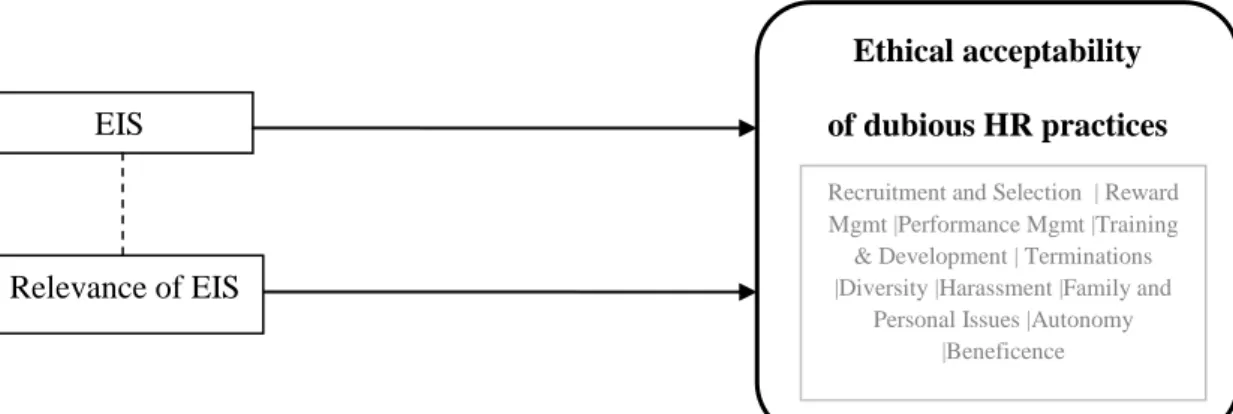
Figure 1. Synthesis of the variables studied and their predicted relations with each other ... - 38 -
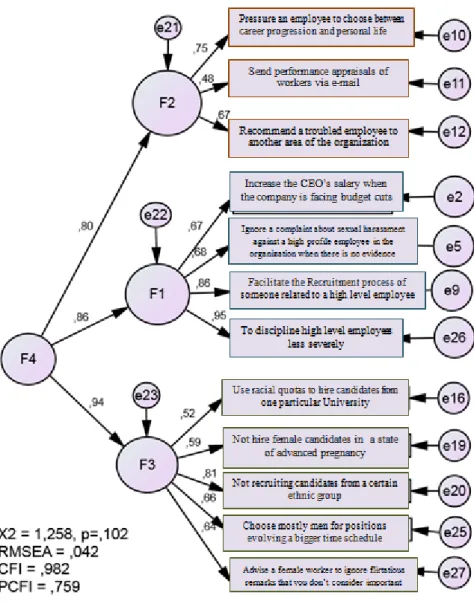
Figure 2. Model of the 3 factors of Ethical acceptability of dubious HR practices. ... - 42 -
Figure 3. Representation of main hypothesis. ... - 45 -
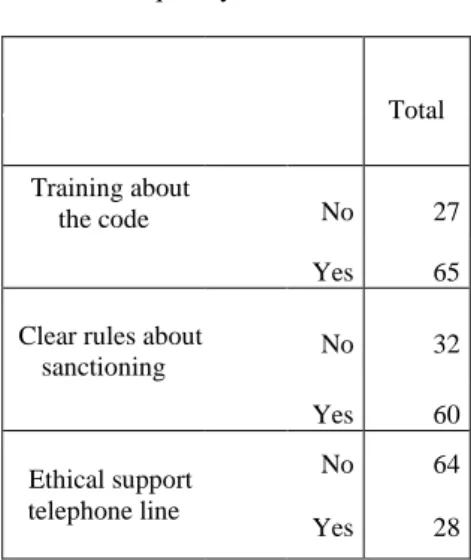
Table 1-Frequency of existence of Ethical code (or similar) ... - 43 -
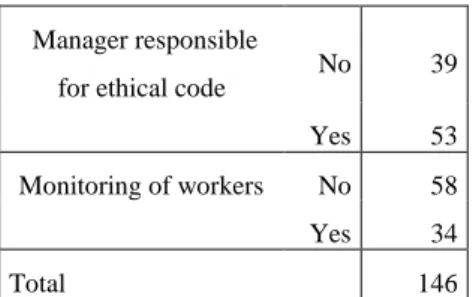
Table 2-Frequency of EIS. ... - 43 -
Table 3- Frequency of Relevance of EIS ... - 44 -
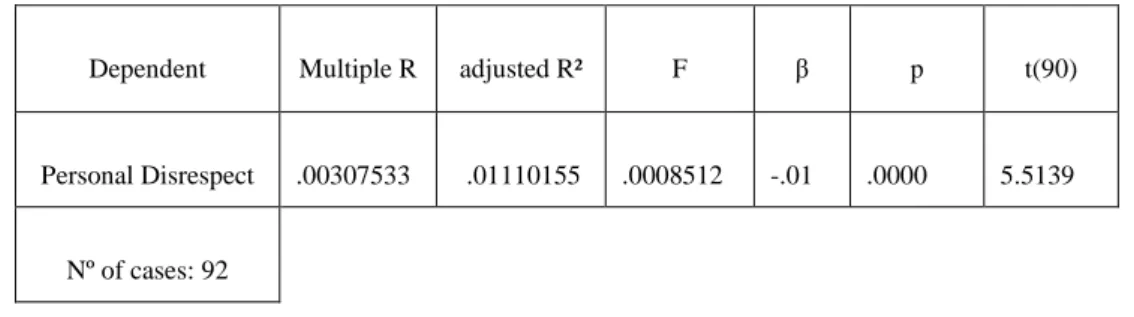
Table 4- Effects of Relevance of EIS (IV) on Personal Disrespect (as DV). ... - 45 -
Table 5- Effects of Relevance of EIS (IV) on Favoring of Power (as DV). ... - 46 -
IX
Sumário Executivo
O presente estudo optou por explorar os efeitos das infraestruturas éticas sobre a auto-percepção de práticas de Recursos Humanos em profissionais de GRH.
Na primeira parte é feita uma breve descrição da pesquisa teórica e empírica sobre Ética individual e organizacional destacando alguns dos principais fatores contextuais e individuais que influenciam a tomada de decisão ética, tais como a identidade Moral, clima organizacional e infraestruturas éticas.
Os capítulos seguintes focam-se na Ética na Gestão de Recursos Humanos. Em primeiro lugar em destacar a natureza eticamente complexa inerente à profissão e da quantidade de oportunidades para a ocorrência de desafios éticos, e, em seguida, explorar quais são os desafios éticos na Gestão de Recursos Humanos. A pesquisa não incidiu apenas sobre o tipo de desafios, tais como a equidade VS Consistência, Disciplina, Diversidade, Assédio, Informação e Consentimento ou Família e questões pessoais, mas também sobre a identificação das principais áreas onde eles ocorrem: Recrutamento e Seleção, Gestão de Desempenho , Processamento Salarial, Formação e Desenvolvimento ou Despedimentos.
No capítulo II, encontra-se o estudo empírico da relação entre a existência e a relevância das infraestruturas éticas para a aceitabilidade ética individual de práticas de RH duvidosas. Em outras palavras, o nosso objetivo foi testar se o facto de existirem estruturas mais formais, tais como códigos de ética e regras processuais e que lhes seja dada relevância afeta o raciocínio ético individual.
Um questionário foi elaborado utilizando os dados recém-adquiridos das diversas áreas de atuação na gestão de Recursos Humanos onde ocorrem situações eticamente duvidosas. O questionário foi preenchido por funcionários de diversas empresas portuguesas que tiveram de avaliar as infraestruturas éticas das suas organizações e avaliar uma lista de exemplos de práticas de GRH eticamente duvidosas.
Após a análise dos resultados, três dimensões da aceitação de praticas de GRH eticamente dúbias emergiram: Desrespeito pessoal, favorecimento do poder e Discriminação.
Os resultados do estudo sugerem que a mera existência de infraestruturas éticas não é um preditor de menor aceitação de práticas eticamente duvidosas, no entanto, eles suportam a hipótese de que quanto maior a relevância das infraestruturas éticas, menor a
X aceitação de práticas eticamente questionáveis de Favorecimento de Poder e práticas de Discriminação.
Estes resultados sugerem que o desenvolvimento de estruturas formais é extremamente importante, mas, a fim de evitar que sejam percebidos como "algo para inglês ver" é mais importante garantir que lhes é dada relevância, que fazem parte das rotinas organizacionais e que as pessoas desempenham um papel ativo nesse processo.
A recomendação apresentada por este trabalho é que de modo a possibilitar que os profissionais de GRH exercerem o seu papel como agentes das questões éticas nas organizações, é necessário construir infraestruturas éticas sólidas e é necessário comunicar e reforçar os princípios éticos desejados pelas organizações.
XI
Chapter I
- 8 -
is its compassion, not its speed or ability to consume, condemns itself to death.
Chris Hedges
1. Introduction
Behaviors such as cheating, lying, corruption and deception are becoming banal and are helping to perpetuate a cynical vision towards ethics and business. Many people even argue that associating the two is overlooking a contradiction. Freidson (2001) feared that many, if not most professional workers were fated to become “merely technical experts in the service of the political and cultural economy”. Despite the contemporary pessimistic pathos over the “professional society”, it is now widely accepted that one of the main causes of political and economic decline was a corporate drive for massive deregulation. It sold the illusion that the free market was the natural outgrowth of democracy and a force of nature, until the “house of cards” collapsed and these corporations needed the taxpayers money to survive. Consequently, societies are now demanding a higher attention to the way these corporate mechanisms operate and more attention to social questions, in particular, questions of corporate social responsibility and ethicality. There is pressure for more openness, transparency and meritocracy. However, if on one hand society has become more conscious and demanding for ethical concerns, on the other, the business market is also increasing competitiveness and adopting more questionable measures. Everyone has heard of Enron, WorldCom, Gap, among many others, whose charges range from financial fraud to human rights violations. These corporate scandals and the attention they received in the media apart from damaging reputation can have a devastating effect on the environment affecting the workers. On the Brightside, we are now benefiting from society’s increased awareness due to these scandals and we have increased our sensibility to ethical concerns. Many companies started assuming a compromise towards their organizational members and towards corporate social responsibility, for example, it is becoming common to hear about organizations being proactive about social and environmental issues.
- 9 - Human Resources managers were often thought as the control apparatus of the employing organizations and their sole purpose was to keep the “organizational show on the road”, but, as organizations evolve and gain awareness of ethical issues, they realize the importance of these professionals as “ethical agents”. (Ewing & Tharp, 2003) We choose to focus on these professionals for two main reasons: Firstly, conventional wisdom suggests that “HR related jobs are a laboratory of ethical scenarios, particularly due to the high degree of role-multiplicity” (Wooten, 2001) thus it becomes important to examine the scenarios in which HR professionals are often involved in and gather valuable observations to help them ponder and enhance their ability to deal effectively with ethical problems. Their competence in resolving ethical dilemmas is becoming more and more critical for business success. Secondly, since they play such an important role in dealing with ethical issues it is important for organizations to have a better understanding of the conflicts they experience and to be able to “ see their viewpoint”. The important role often played by HR managers as “union workers representatives” becomes less jeopardized if organizations gain more awareness of the issues at stake. HR managers will then be able to find ‘spaces’ within the business-dominated decision-making in which they can expose ethical considerations that are personally important to them. Unless HR managers can act without fear of retaliation , CEO’s may well find that issues will escalate and create further problems and costs (Treviño et al., 1999)
The current study chose to explore the effects of ethical infrastructures on the self-perceptions of HR practices in Portuguese HR professionals.
In the next sections we give a brief account of the state of theoretical and empirical research on Organizational and Individual Ethics and Ethics in Human Resources Management, highlighting some breakthroughs made by some authors. Afterwards we state our objectives of the study which include: 1) to gain a better understanding of the way ethical challenges and dilemmas in the HR profession are perceived by their protagonists; 2) The empirical study of the relation between existence and relevance of ethical infrastructures to the individual ethical acceptability of dubious HR practices; 3) to create a measurement tool constructed using the most common HR ethical issues as basis.
- 10 -
1.1 Ethics
Nowadays, it is widely accepted that corporations are encouraged to behave in an ethically responsible way but many discussions of ethics and ethical issues differ about definitions and there is still some uncertainty on how to define the concept.
Australian moral philosopher Peter Singer (1985) defined ethics as: “ the field of study, or branch of inquiry that has morality as its subject matter.” From the enormous variety of definitions on ethics (Mercier,2003; Vickers,2005; Banks e Nohr,2008; Angeles,1981; Lacey,1990) it is possible to distinguish three main different approaches on ethical theory: Deontological, Virtue and Consequentialist.
The deontological approach is one where the individual is using a pre-existing rule and following a duty. The ethical choice will be clear if the rule is explicit and formal, as it is visible, for example, in a professional code of ethics. The Ethics of Virtues approach is based on character and integrity and considers morally correct actions as those undertaken by actors with virtuous characters. The formation of a virtuous character is the first step towards morally correct behavior and as such, more than the action, it’s the nature of the subject that is at stake. Thirdly, the consequentialist approach, where the consequences of the action are considered as a measure of ethicality. Utilitarianism is the most common variant among this approach. According to the utilitarian theory by John Stuart Mill, one has a duty to calculate how much happiness various courses of action will generate and to choose the course of action that generates the most happiness. Some alternative approaches to ethics have also gained popularity, for example, Feminist ethics and Postmodern business ethics. Feminist ethics have an approach based on relationships and responsibility that starts from the assumption that men and women have fairly different attitudes towards organizing social life, with significant impact on the way ethical conflicts are handled. Feminist ethics is an approach that prioritizes empathy, harmonious and healthy social relationships, care for one another, and avoidance of harm above abstract principles. It focuses on Relationships, Responsibility and Experience. Postmodern business ethics are approaches based on empathy and moral impulse: these approaches locate morality beyond the sphere of rationality in an emotional ‘moral impulse’ towards others. It encourages individual actors to question everyday practices and rules, and to listen to and follow their emotions, inner
- 11 - convictions, and ‘gut feelings’ about what they think is right and wrong in a particular situation. (Crane & Matten,2010)
The task of finding a single ethical perspective for all organizations is futile. Despite the different perspectives, when it comes to organizations it is hard to find a better alternative for the utilitarian perspective, however, interpreting ethics as a simple matter of calculating the consequences can be very dangerous. There needs to be room for other perspectives such as virtue ethics or feministic ethics that consider other dimensions and consider recent psychological and sociological research. For example, it is possible to support an ethics of virtue designed to support values associated with work aspirations. A study underlined six dimensions of organizational virtue (Integrity, empathy, warmth, courage, consciousness and zeal) that seem to be associated to financial and qualitative aspects such as employee satisfaction, loyalty and client retention. (De Cremer, D.,2009).
1.2 Business Ethics
While philosophers became active in researching business ethics in the 1960s and 1970s, business ethics has been a staple of Catholic thinking on business for most of the last century (Bowie, 2000). Since then, the field of business ethics went through a time of definition to an emerging research field in the 1970’s, followed by specific research streams in the 1980’s (De George,1987). From the 1990’s on there have been significant academic contributions including many quantitative and qualitative research. The concept can be broadly defined as the study of Business situations, activities and decisions where issues of right and wrong are addressed (Crane & Matten ,2010)
Two central concepts that have a clear relationship with Business Ethics linking an individual to its working context are morality and law. Morality is concerned with norms, values and beliefs embedded in social processes which define right and wrong for an individual or a community (Crane & Matten, 2010); Law can be broadly defined as the minimum acceptable standards of behavior (Crane & Matten,2010);
Ethics is about how people ought to behave and so it focuses on duty, the boundaries of right and wrong and on the concept of accountability. “The perceived need to defend or
- 12 - justify behaviors to an audience with sanction authority and the standards used are based on shared value systems” (Buckley et al. ,2001) “People generally expect to be held accountable, and in response, try to identify their sources of accountability, and then tailor behavior to accommodate those accountabilities” (Frink & Ferris, 1998; Frink & Klimoski, 1998; Tetlock, 1992; Tetlock, Skitka, & Boettger, 1989). Ethics, then, become operationalized, in part, in the formal and normative accountabilities that occur in organizations (ex: disciplinary systems, performance evaluations, merit compensation, and other reward systems, performance monitoring, employee handbooks, formal hierarchies)
1.3 Ethical Judgment and Decision Making
Once people are aware of a situation with ethical dimensions they engage in ethical judgment processes that will result in an ethical or unethical conduct. Ethical judgment is meant by a decision about what is the right thing to do (Treviño & Nelson 2011). The term judgment refers to the cognitive aspects of our decision- making process. To fully understand judgment, it is necessary to identify the components of decision-making process : 1- Define the problem, 2- Identify the criteria, 3-Weight the criteria, 4- Generate alternatives, 5-Rate each alternative on each criterion, 6- Compute the optimal decision (Bazerman & Moore, 2013) The problem with this model is that it assumes that people follow these six steps optimally and most scholars agree that we very rarely do so. In order for this type of orientation to be valid it should be associated with procedures that alert us towards our egotistical tendencies and distortions caused by individual and contextual factors.
In the past, ethics researchers had defined ethical judgments as being both singular (for example, Rest 1986) and comparative (for example, Hunt & Vitell, 1986) in nature and suggestive of both heuristic and systematic information processing. Previously, in the field of psychology, there were two dominant different perspectives on the origin and formation of our moral values the internal and external one (Straughan, 1983). Based on the internal perspective, values would derive from the individual’s rational thinking, being mostly determined by each one’s unique personality. One example of this perspective would be Kohlberg’s (1981) theory of moral cognitive development. On the
- 13 - other hand, according to the external perspective, individuals would assimilate values from their social context through a process Bandura (1977) called social learning. More recent research on psychological and sociological domains, particularly social psychology and moral psychology shows that in ethically dubious situations decisions are often out of our conscious control and may even conflict with our moral standards, in other words, “good” people can do “bad” things and still see themselves as morally impollute. (De Cremer D. ,2009) Multiple psychological processes occur that cause us to distort our decisions in ethical questions without even realizing it, a phenomenon that has been called “limited ethicality”. (Banaji, Bazerman & Chugh, 2003) We are not aware of many ethically dubious behavior we engage in and consequently we may act against our own declared moral orientations and beliefs.
In the field of Neuroscience, the neural network underlying moral decisions was found to overlap with the network related with representing others’ intentions (i.e., theory of mind) and the network related to representing others’ emotional states (i.e. empathy). This supports the notion that moral reasoning is related to both seeing things from other persons’ points of view and to grasping others’ feelings and these results provide evidence that there might be no such things as “a moral module” in the human brain and that the neural network underlying moral decisions is probably domain-global.
Research shows that people tend to consider themselves more ethical than average. (Tenbrunsel, 1998). And frequently use unconscious cognitive maneuvers in order to mitigate the individual notion of ethical obligation when it conflicts with their motivations and interests. In other words, they often act as “intuitive lawyers” (Kramer, & Messick, 1996) that engage in self-persuasion to satisfy individual interests and personal motivations, processing information in a selective way and framing situations in the way that is most favorable for them. Empirical research by Milkmann and colleagues suggests that the common conflict between the “ego of wanting” and the “ego of duty” occur in ethical judgments. (Milkman,Rogers & Bazerman,2008). People tend to wrongly predict their behavior, believing they will act in a more ethical way than what will actually happen. There is also empirical evidence that people consider ethically ambiguous behavior as unethical and subject of punishment more often when there are known victims of the action but not when these are unknown or not mentioned. (Gino,Shu, & Bazerman, 2010).
- 14 - Authors Linda Treviño and Katherine Nelson (2011) have considered these individual processes including less rational aspects and proposed a model to aid decision making. It consists on the following stages: 1- Gather facts, 2- Define Ethical Questions, 3-Identify involved subjects, 4-3-Identify consequences, 5-3-Identify Obligations, 6-Consider Personal Integrity, 7- Think creatively about courses of action and 8- look into intuition. Ethical decision making is determined by a complex interaction between some individual characteristics of the decision maker and multiple social and/or organizational factors. As such, the cognitive processes involved, the individual differences and contextual factors interfere in the ethical decision making and it might not be possible to follow all steps of such a model. The important thing will be to increment a systematic and reflexive process to balance the intuitive, emotional and automatic tendencies or, in simpler words, think before act.
2. What is behind the Ethical actions/decisions ?
Various empirical studies support the evidence that there’s a distinct difference between what is stated in organizational codes of ethics and what really happens in organizations. (Wiley, 1998; Savevska 2011, Foote, 2001, Duarte & Neves, 2011; Leal,Rego & Coelho, 2011).
While studying ethical behavior it’s important to ask the question: Can we separate Business Ethics from Individual Ethics? Many approaches to the subject convey the idea that business ethics and ethics in organizations correspond to specific domains i.e. it only concerns organizational activities. In some cases, for example, in the case of investing companies, ethics is central and inherent to the functioning of the organization. (Oberlechner ,2007) On the other hand, many researchers consider that it is not possible to separate a person’s identity in and out of work. If they act ethically or not it’s an individual question and independent of context. This perspective assumes that “business ethics” do not exist. (Maxwell, 2003 )
In alternative to the previous perspectives, it is possible to assume a more interactive position. Many contextual factors affect ethical conduct, and as such, any prescriptive orientation about ethical decisions in an organization must consider the organizational context as well as the individual characteristics that are relevant to ethical judgment.
- 15 -
2.1 Contextual Factors
2.1.1 Ethical Infrastructures
Organizational internal regulation success depends on the competence, responsibility and high ethical standards of its managers. Regulation that must normally be translated into ethical codes or codes of conduct. Allison (1996, cit in Nunes, 2004) and many organizations have started to develop and implement measures aimed to target this new ethical requirement. (Weaver, Trevino & Cochran, 1999). These “ethical infrastructures” (Tenbrunsel, 2003) will then act as regulators of employees’ ethical conduct. Most organizations have either established such structures or are in the process of doing so. Companies are spending millions of dollars on ethics and compliance management with almost 100% of them addressing ethics-related issues in formal documents and programs (Trevino, Weaver, Gibson, & Toffler, 1999).
Authors Tenbrunsel, Smith-Crowe & Umphress identify three important elements of an EIS: formal systems, informal systems, and the organizational climates that support the infrastructure. With regard to the first two elements, they argue for a distinction between the formality of a system and the mechanisms: communication, surveillance, and sanctioning by which ethical principles can be conveyed.
It is also very important to mention the nature and form of the relationship between these elements and ethical behavior in organizations. The authors propose a theory of embeddedness to describe these interrelations. Formal systems are embedded within their informal counterparts, which in turn are embedded within the organizational climates that support the infrastructure. The strength and ultimate success of each layer depends on the strength of the layer in which it is embedded. (Tenbrunsel, Smith-Crowe & Umphress, 2003)
Formal systems can be defined as those that are documented and standardized (Pugh, Hickson, Hinings, & Turner, 1968) and visible to anyone inside or outside the organization. Conversely, informal systems are defined as those indirect signals regarding appropriate ethical conduct that are received by the organizational members. Noticeable primarily to people inside of the organization, such signals cannot be
- 16 - verified through formal documents. Rather, they are “felt” by organizational members through personal relationships (Lawler and Rhode, 1976; Selznick, 1943).
Corporate codes of conduct, value-based mission statements, ethical ombudsmen, ethical training are just a few of the strategies undertaken by organizations. Unfortunately, the results of such efforts are decidedly mixed. Formal codes of conduct, for example, have been argued by some to produce positive outcomes, namely a reduction in unethical behavior (McCabe, Trevino, & Butterfield, 1996), but by others to produce no discernible difference in behavior (Badaracco & Webb, 1995) and (Kish-Gephart et al., 2010). The previous authors even found a negative effect of code enforcement (i.e., employees’ perception that the existing code is enforced) on unethical behavior. The analysis also found that when code is perceived as enforced and other organizational variables are taking into account simultaneously ( e.g., ethical culture and ethical climate) code existence has a small positive effect on unethical behavior. This suggests that in the presence of these other factors, employees can view the mere existence of a code as a negative sign that the code represents window dressing only, thus producing a cynical response that leads to more unethical behavior. (Treviño et al., 2014)
2.1.2 Organizational Culture, Ethical Climate and Ethical leadership
Speculators in the seventeenth century were hanged. Today they receive billions in taxpayer money and huge bonuses. (Hedges, 2009)
In SHRM ‘s 2007 report Organizational culture was pointed out as one of the most important factors for ethical behavior of employees and of Human Resource Managers. Research identifies the importance of ethical climate and ethical leadership as mediators in the ethical actions and decisions .
Organizational Ethical culture gathers what it’s considered to be morally acceptable and/or desirable and inserts it into a group of assumptions, shared values, beliefs, explicit and implicit that are translated into the daily behavior inside the organization and in symbolic vehicles such as, the codes of rules and social rituals. People tend to recognize more easily the ethical questions if these have more social and symbolic
- 17 - protrusion, which is what happens in an organization with ethical concerns. On the contrary, it is not a surprise that individuals tend to ignore ethical problems of certain procedures if “everybody is doing it”. If, for example, omitting expenses to the accountability department of a company is a common procedure, it is not even likely that reflexion upon its ethical implication exists. (Simões, 2014). This distinction between strong and weak ethical cultures is especially important for ethical behavior. In a strong culture, values, norms and guidance’s are shared by most people in the organization who tend to behave in the prescribed manner.
Ethical climate can be defined as : “the shared perceptions and values, beliefs, prescriptions, explicit and implicit that can be translated in the everyday behavior inside the organization and in symbolic vehicles”, in other words, the shared perception of what is right and how ethical situations should be dealt with in an organization. (Victor & Cullen, 1987).It is different from Organizational Culture because it is linked with individual perception rather than with cultural, physical, symbolic or discursive structures. On their investigation of the dimensions of ethical climate, Victor and Cullen identified 5 types of ethical climate: Benevolent, Instrumental, Independent, Rule Based and Law & Codes.
Considering that people have a basic need to be accepted by the social groups to which they belong (Baumeister & Leary, 1995) , the ethical climate affects ethical behavior of individuals in the organization, influencing a larger or smaller tendency for them to get involved in unethical behavior. For example, a clear ethical and positive climate diminishes the probability of falsifying reports. (Martin & Cullen, 2006).
Ethical leadership has also a central role of influence for ethical individual behaviors . Doing what the leader does is always more likely than doing what he says.
Despite the share of ethical responsibility by all actors in the organizational life, on the basis of the most important processes and decisions are leaders and as such, ethical leadership gains a central role of influence for ethical individual behaviors. Leaders values and interests affect not only the way decisions are made but also the importance given to ethical considerations within those decision by other members. Organizational members anticipate expected behavior and know which ones are rewarded or punished through a process of social learning. (Bandura, 1977). Much like parenting, doing what the leader does is always more likely than doing what he says.
- 18 - The first empirical studies about the leadership ethical dimension indicated with no surprise that the moral reputation of a manager is constructed around the perception that he is honest, truthful and has a concern for the wellbeing of others. (Treviño, Hartman, & Brown, 2000). This notion is also supported by empirical evidence of a study on German SME by Hammann, Habish & Pechlaner (2009). Most of the time, SMEs have only limited (financial) resources and few formal internal systems and processes (Keasey & Watson, 1993). They reflect to a greater extent the personality, values, character, attitudes, education or background of the entrepreneur or the owner– manager than large corporations do with regard to their executives. This close connection shows how strongly the behavior of the entrepreneur or the manager can impact the behavior of the company.
2.1.3 Organizational Commitment
Researchers Meyer & Allen (1991) also considered the impact of Organizational commitment. “the psychological state that a) characterizes the employee relationship with the organization, and b) has implications for the decision to continue or discontinue membership” . They distinguished three distinct forms: 1- Affective commitment identification with, involvement in, emotional attachment, 2- Normative commitment- sense of obligation to the organization and 3- Continuance commitment- recognition of the costs associated with leaving. Leal, Rego & Coelho (2012) empirically verified this association and noted that Employees develop higher psychological capital and affective commitment when they perceive that companies behave ethically and consequently adapt more Organizational Citizenship Behavior (OCB).
2.1.4 Accountability
Accountability is also suggested as a factor of impact on Ethical Decision making. Kruglanski & Webster ( 1996) point out that when confronted with the possibility of seeing their decisions reviewed by others, individuals may feel the need to engage in a more systematic and analytical decision process. This tendency to an epistemic
- 19 - motivation is verified with the empirical study of Silva & Simões (2012) as well as the notion that Individuals who are accountable to an unknown audience tend to produce judgments less biased by the nature of the outcomes of the decision made. Authors Anne Tenbrunsel and Max Bazerman suggest that by making an ethical intention public, by committing publicly to a decision people tend to stick and act according to it. This type of self-persuasion is linked with the need for congruence between our actions and our publicly assumed intentions. (Bazerman & Tenbrunsel, 2011).
2.1.5 Other factors
Crane & Matten (2010) linked six other context related factors as mediators behind actions/decisions of managers: Reward Systems: as people tend to do what they are rewarded for, thus when ethical behavior is not rewarded, it will often not be conducted; Authority: people do what they are told to do, or what they think they are being told to do; Bureaucracy: it causes negative effects on action/decision making such as suppression of moral autonomy, instrumental morality, distancing and denial of moral status; Work roles: adopting the roles that are assigned to them, and acting in correspondence with these roles( e.g. The Stanford Experiment (Zimbardo, 1971); Organizational Culture: some norms are determined by shared values, beliefs and behaviors within the organization, which can act both as barriers as well as enhancers of ethical behavior and finally National Context: different cultures maintain different views of what is right and wrong .
The influence of contextual factors can be complex and dependent upon individual characteristics and processes, however, some other specific contextual factors that have recently started to be analyzed reveal some easy-to-identify effects. For example, the presence of visible wealth abundance can increase the probability for unethical conduct as it is empirically tested in a study by Gino and Pierce. Participants were found to cheat more frequently when they held the perception of a wealthy climate. It seems that signs of visible wealth stimulate feelings of envy that lead to unethical behavior. (Gino & Pierce, 2009).
Another factor affecting the ethicality of choices is the perception of the social context of the individual decision. For example, when dishonesty can benefit others besides themselves, people tend to be more flexible and feel less guilty. (Gino, Ayal & Ariely,
- 20 - 2012) Another good example is the notion of white collar crime. A phrase coined by Edwin Sutherland (1940). “White collar crime is generally seen as less morally severe than street crime”. “While most street crimes look nothing like acceptable citizen behaviors, white-collar crimes can resemble sharp but accepted business practices” (Messner & Rosenfeld, 2007).
2.2 Individual Factors
Research has uncovered a number of individual differences that influence the way people think and behave in response to ethical dilemma situations. Authors Treviño and Nelson identify 4 differences: Ethical decision making style, Cognitive moral development, Locus of Control, Machiavellianism and Moral disengagement.
2.2.1 Ethical Decision making style
Research suggests that individuals have preferences for particular prescriptive ethical theories. Forsyth (1992) proposed that we think about these preferences in terms of two factors: 1- Idealism or the persons concern for the welfare of others and 2-relativism or the person’s emphasis on ethical principles being dependent on the situation rather than being applicable to all of them.
A study by Hastings & Finegan (2011) tests these different notions empirically and found that high idealists were less likely than low idealists to engage in either form of deviance, regardless of injustice and people who score high on relativism, on the other hand, were expected to engage in deviance only when justice perceptions were low, as relativists are guided by contextual information and that for distributive justice situations, all groups except high relativists/low idealists behaved more constructively as justice increased. They would not necessarily care if everyone was treated fairly, but would care if they in particular were treated fairly.
- 21 -
2.2.2 Moral Identity
The concept of moral identity refers to the way an individual sees himself ethically, in other words, a self-concept organized around a set of moral traits. (Aquino & Reed, 2002). It is also linked with the assimilation of a set of moral values and the tendency for automatic sequences of certain behaviors. This notion can be also linked with the notion of congruence. People need to see themselves as congruent, therefore, the more salient a person’s moral identity the more he will feel an impulse to be congruent. The more important ethical questions are to a way an individual sees himself, the more he/she will want to act in conformity.
2.2.3 Locus of Control
An individual with a high internal locus of control believes that outcomes are primarily the result of his or her own efforts whereas an individual with a high external locus of control believes that life events are determined primarily by fate, luck or powerful others. Research by Treviño and Nelson suggests that individuals with a higher internal locus of control will weigh the consequences of their actions more. For example, an employee with an internal locus of control who has a controlling boss will be uncomfortable with the boss’s request to do something inappropriate and is more likely to resist his influence. (Treviño & Nelson 2011)
2.2.4 Machiavellianism
This personality trait was named after Niccoló Machiavelli, a sixteen century philosopher, statesman and a political theorist who is associated with promoting a pragmatic style of leadership that included amoral and unethical behavior with the aim of achieving certain outcomes, in other words, the ends justify the means. Research using a survey that assesses Machiavellianism (Gephart et al., Hegarty & Sims, Flynn, Reichard & Slane, Jones & Kavanagh) has found that individuals scoring high on Machiavellianism are significantly more likely to have unethical intentions and to engage in clearly unethical action such as lying, cheating or taking bribes.
- 22 -
2.2.5 Moral Disengagement
According to Bandura (1986) the idea behind moral disengagement is that most people behave ethically because we’ve internalized standards of good conduct and judge our behaviors against these standards. But research has found that individuals have a higher or lower propensity to deactivate that self control system through moral disengagement mechanisms, such as moral justification, advantageous comparison, displacement of responsibility or attribution of blame. (Treviño & Nelson 2011). According to Rest (1994, cit in Rego et al., 2006) an individual’s capacity to empathize is fundamental in a professional activity. Individuals with a high propensity to morally disengage have been found to have reduced empathy for other people, to be more cynical, to see their behavior as resulting from chance or fate and to have a reduced moral identity- a weaker sense of themselves as ethical beings and consequently more likely to behave unethically. (Detert, Treviño & Sweitzer 2008)
2.2.6 Other Factors
2.2.6.1 Moral Intuition
It is also argued that most ethical judgments occur without a conscious reflection, and rather as an automatic judgment triggered by an emotional reaction that antecedes ethical judgment, a moral intuition. This apprehension of the moral quality of a judgment seems to be triggered by an emotional reaction prior to ethical judgment. It is what happens when people immediately reject something even without being able to explain why, for example, using a national flag as a cleaning towel or using a dog’s corpse for culinary purposes.( Haidt, Koller & Dias, 1993). This challenges the knowledge that ethical apprehension is something sequential, carefully thought and conscious. It is better described as a “sudden revelation in consciousness of a moral judgment, including an affective label ( good, bad, like, dislike), without any consciousness of being involved in steps of search, weighting options or inferencing a conclusion. (Haidt, 2001). In simpler words, this intuitionist perspective bears the notion that first comes intuition and then strategic reasoning. People will judge
- 23 - automatically( for example, to like or dislike) and then justify their choices rationally in a way that it is justifiable and guarantees protection of personal reputation in the eyes of others within the social groups in which they belong.
2.2.6.2 Work Roles
A survey from Mio and Favotto (2012) found significant differences of perception across groups and subgroups among middle managers. Senior managers are likely to express significantly more positive perceptions of the organization when compared with non-managerial positions, they have “a rosier perspective” whereas a more cynical perspective is held by middle and lower managers who tend to recognize more discrepancy between espoused values and day to day activities also referred to as “ window dressing”.
2.2.6.3 Gender
It was simply assumed for many years in our male-dominated society that the way that men thought and acted was clearly superior. The women’s movement rightly challenged this assumption. It also led to an exploration of the “feminine” and “masculine” and a recognition of the gender similarities and differences and their unique value. In 1982, author Gilligan published a book about women’s cognitive moral development. The author claimed that Kohlberg’s theory had only studied male subjects. She argued that females were more likely to use a “morality of care” that emphasized relationships- raising issues related to caring for others, responsibility to others and the continuity of interdependent relationships. Kohlberg's scheme is often called an ethics of justice. Like the representation of Justice wearing a blindfold, the person at Stage 6 refuses to see anything that could sway his or her decision. There are no extenuating circumstances, no special cases, no emotions. Everything must be rational, objective, and impartial. Gilligan's subsequent research suggests that Kohlberg missed an alternate way of thinking about right and wrong, an approach used by both men and women, but used far more frequently by women. In this outlook, care and responsibility to others, rather than justice and individual rights become the fundamental ethical principles.
- 24 - Empirical study by Chan, Jamilah & Rusinah (2012) supports this theory of gender difference. Significant differences between male and female respondents in their ethical decision making were found. Female were able to react significantly more ethically than male respondents. Furthermore, female respondents tended to judged, more sensitive, have higher motivation and tended to react more ethically compare with their male counterparts. No style is better than the other but their differences need to be taken into account. They may seem opposed at times because they differ so much on the surface but they should be looked at as complementary.
2.2.6.4 Creativity
There is another individual predisposition that seem to increase the probability of less ethical behavior. Even if it is generally linked with socially desirable traits. When investigating the “dark-side of creativity” it was found that highly creative individuals are likely to engage in unethical behavior. This was empirically verified in a field study on a publicity agency by Francesca Gino and Dan Ariely that confirmed the association of unethical behavior and creative functions in the organization. (Gino & Ariely, 2012). Apparently, Creative people have more capacities to justify their behaviors.
3. Ethics and Human Resource Management
It is important to understand that Human Resource Management by the nature of its role inside organizations is at the front line of ethics problems on what concerns employees and employers. This is why many companies give HR professionals the role of leadership in establishing and maintaining ethical programs. (Wiley, 2000). Although some activities are outsourced, most HR Managers follow the main stages of an employee’s path in the companies/Organizations: Recruitment and Selection, Reward Management, Performance Appraisal, Career Management and Firing/Separation. (Mercier, 2003)
HRM practitioners engage in a high degree of role multiplicity which influences the opportunity for ethical dilemmas to occur. (Wooten, 2001) Confronted with this multiplicity, Almeida (2011) defends that Human Resource Management should reflect
- 25 - epistemologically and ethically about itself in order to avoid becoming a mere instrument of the interests and dominant speeches and Wiley (2000), argues that it is the professional duty of HR managers to promote ethical business practices and to contribute to the ‘ethical success of organizations. Bearing this in mind, the next chapter will reflect upon ethical dilemmas that Human Resource managers are often confronted with while exerting their role in organizations.
4. What are the ethical challenges in HRM?
Wooten (2001) defined ethical challenges in HRM as: “the multifaceted demands placed on HRM professionals in which personal, professional and organizational beliefs, expectations, values, and needs conflict as a result of environmental influences upon HRM functions, duties, roles, services and activities.” The 1992 "Ethical Issues in
Human Resource Management" survey sought to discover employment managers'
perceptions of ethical issues. This survey basically replicated the 1991 SHRM/ CCH
survey using members of the Employment Management Association. Based on their
means, the five most serious ethical situations reported by them are : 1) staffing based on favoritism, 2) sexual harassment, 3) using discipline for managerial and non-managerial personnel inconsistently, 4) non-performance factors used in appraisals, and 5) allowing differences in pay, discipline, promotion, etc. due to friendships with top management. According to Wiley (1998, cit in Gramberg & Menzies, 2006) the situations where HR managers have less ethical conduct are related with Recruitment and Selection, Conflict Management, Health and Safety, Reward Management and Labor relations. Another study by Macklin (2007) noted that HR managers tended to identify three broad areas for ethical problems 1) Clashes between justice and care, 2) morality (including justice) and 3) organizational performance, confidentiality and honesty or openness.
4.1 Recruitment and Selection
The causes of discrimination in the recruitment and selection process are often contingent on the specific circumstances and the type of job (e.g. demographic
- 26 - characteristics of the recruiter, perceived fit between job type and demographic characteristics of the applicant). One common denominator, however, is that when discrimination in recruitment and selection occurs, it generally has to do with stereotypes being held by the recruiter. (Dijk , Engen & Paauwe, 2012) For example, if an HR manager is selecting a candidate for a sales manager position and the most qualified candidate has a very unattractive appearance, the situation is ambiguous. Unattractiveness is not included in protectionist handicapped legislation, so the law isn’t helpful but the larger issues are what qualities should determine whether or not an individual should be hired and is it ethical to consider a potential employee’s attractiveness? (Treviño & Nelson 2011) Another example that has been substantially demonstrated is the female gender stereotype which is often at odds with stereotypes we have of the ‘typical’, and particularly the ‘ideal’ worker (Burgess & Borgida 1999; Eagly & Karau 2002; Heilman, 2001). Consequently, gender stereotypes have been shown to bias, among others, hiring and promotion decisions (Heilman et al., 2004; Rudman & Glick, 2001; Vinkenburg et al., 2011).
A study by Costea, Amiridis & Crump (2012) that focuses on university campuses as a major site of the recruitment process, and particularly as a new domain in which HRM’s ethical claims are configured because it sets and answers a range of ethical questions as it outlines the ‘ethos’ of the ideal future worker. At the heart of this ethos lies the ‘principle of potentiality’ and HRM’s attempt to shape the character of future workers. The principle of potentiality is, in essence, the exhortation that every individual ought to see itself as always capable of ‘more’: through the idiom of potentiality, HRM produces a cultural object (the ideal ethos of the future worker) that becomes so rigid and overwhelming that it endangers precisely the cultural subject of which it seeks to speak so positively. This goes along with the notion of “corporate profile” that is held in mind by many employers when they hire, especially when they are trying to fill positions with “extensive public contact”. They look for healthy young people with regular features, moderate height, medium build and no discernible accent (Treviño & Nelson, 2011) Prejudice is hard and everyone has biases: some prefer taller or smaller, fatter or skinnier, older or younger and even candidates that come from a certain type of school but the real issue is: do these qualities have anything to do with the person’s ability to do their job? When HR managers use anything other than talent and ability as evaluators for hiring they are helping perpetuating stereotypes instead of building a
- 27 - workforce that actually reflects real life. It is also very important to hire candidates that will fit the company culture but companies need to be open to people who fit, but may be different. HR managers have a central role in countering this tendency to hire a “profile”.
4.1.1 EEO – Equal Employment Opportunity
Equal employment opportunity is both a legal and ethical issue. Considered as a basic human right and argued to be one of the most serious issues in HRM today (Cascio 1998; CCH, 2003; Lutz 2001). Equal employment opportunity is employment practice where employers do not engage in employment activities that are prohibited by law. It is illegal for employers to discriminate against an applicant or employee on the basis of race, age, color, sex, religion, or national origin and as Ewing, and Tharp (2003) point out : HR has a fiduciary responsibility to ensure legal compliance, and that as research indicates that HR managers are more likely to act on legal and ethical issues than other employees, it follows that if HR managers do not adopt the role of agent of the state in EEO matters, then possibly no one will. HR managers suffer pressures not to enforce EEO obligations and when they refuse, insufficient protections exist. unless HR managers can act without fear of retaliation, CEOs may well find that issues will escalate and create even further problems and costs (Trevino et al., 1999).
4.2 Performance Management
Performance management refers to the measurement and management of employee performance and includes the creation of performance standards, methods to measure and evaluate performance based on those standards and providing feedback through, e.g. (formal) performance reviews (Armstrong & Baron, 2005; Den Hartog et al., 2004). Unfortunately, issues of discrimination, prejudice and stereotyping do not stop once people are employed by the organization. There is ample evidence that minority group members face discrimination in the different phases of the performance management process. Because majority members tend to have more voice in creating performance
- 28 - standards, it is likely that the performance standards will be more considerate towards majority members than towards minority members (e.g. not taking maternity leave into account when compiling a list of best performing employees based on, e.g. number of media appearances or amount of sales). (Dijk, Engen & Paauwe, 2012)
Another practical problem with performance evaluation is that most managers don’t like to deliver negative feedback. It is such a difficult issue that in a survey of 4,000 Fortune 500 executives, five out of seven executives said that they would rather lie to employees about performance than confronting them (Halper, 1988) and there’s even reports of managers conducting appraisals via e-mail (Treviño & Nelson, 2011). This is a serious problem considering it is the managers responsibility to accurately and continually appraise performance. Only when employees receive feedback reflecting the complete range of their behavior will they be able to improve their performance. There are also important implications with written performance appraisals. They usually have some influence on salary adjustments and become part of the employee’s permanent file. For example, a manager that has an employee who is a nice guy but hasn’t been able to match the performance of others in the department at all and he tells the manager that he is interviewing for another job in the company. Looking at his file, the manager sees that his predecessor rated him quite highly ( which leads him to assume that he has been inaccurately and perhaps dishonestly evaluated in the past). Since most employers require a high rating to be able to transfer to another job the manager is confronted with the decision: give the good recommendation and pass the employee on to someone else or to be honest with him, deny the recommendation and clarify all the issues of his performance? Many organizations suffer with similar situations, having employees who are never confronted with their poor performance. In some organizations this process of passing poor performers around even has its own term: “turkey farming” – due to previous dishonest performance appraisals – future managers get “buffaloed” into thinking the employees performance is adequate. This is a vicious circle and a real disservice to everyone involved. (Treviño & Nelson, 2011).
- 29 -
4.3 Reward Management
According to Lawler (1995) the reward strategy consists of three components: the organization’s core reward values, structural issues and process features. The organization’s core reward values are what the organization stands for, which informs the principles on which the reward strategy is founded. Structural issues include the strategy features (e.g. performance-related or profit-related pay) and the administrative policies surrounding these features. Process features include principally how the strategy is communicated and implemented and the extent to which employees are involved in the design and implementation of the strategy. Important structures to promote the reward values are: making a clear division between base pay and variable pay; individual performance-related pay; team based pay; broad banding; profit-related pay; gain sharing; performance appraisal and job design. Strategic reward management poses a threat to the wellbeing of employees. New pay advocates suggest reducing the proportion of pay that is fixed, thus putting a proportion of the pay packet ‘at risk’ through techniques such as performance-related pay or profit related pay. Wellbeing is threatened by an increased amount of insecurity and unpredictability that is potentially harmful both economically and psychologically. (Lewis, 2001)
4.3.1 Fairness VS consistency
Fairness depends on something external, such as circumstances, situations, performance or contribution. Consistency depends on conformity to an existing standard. Consistency requires good records. Fairness requires the application of good judgment. (Catllete & Hadden, 2007) We’ve all heard the workplace mantra, “Whatever you do, ensure that employees are treated fairly and consistently.” The manager’s dilemma emerges, however, when “fair” seems to collide with “consistent,” and someone has to figure out which way to swerve. Joe Kraus, founder of Web portal Excite.com once said: “Nothing demotivates people like the equal treatment of un-equals. “When you hire a bozo and treat him the same as a rock star, it deflates the rock star.”
- 30 - There are two ways in which employees may feel their pay is inequitable. First, there is the issue of external equity and internal equity. Armstrong (1993) points out that in many organizations there is a tension between the two. The desire to be competitive in the labor market for some jobs, thus ensuring external equity, may lead to feelings of lack of internal inequity among those employees whose external labor market appeal does not afford them similar power. What is implied here is the necessity for the employer to take a clear policy decision on the value it places in equity and the way in which this value is expressed. The second way in which employees may feel their pay is inequitable is less about the amount of pay than the way in which it is determined. One of the most potent symbols of perceived inequity which has gained considerable publicity in recent years is that of directors’ pay. The image of directors gaining huge pay increases at a time when their organizations have been declaring redundancies and trimming general pay costs is one that has created significant employee and trade union discontent. Employee acceptance of reward strategy change is unlikely if the general impression is that ‘fat cats’ are getting an unfair share of organizational rewards. (Lewis, 2001) But it is not just directors’ pay that fed the impression of inequity. Inequality between the pay of men and women has also a major role. Despite the three decades of equal pay legislation, the gross hourly earnings of women in 1998 was significantly lower than men’s.(Labor Market Trends, 1998).
4.4 Training and Development
Armstrong (2001) defines training as the formal and systematic modification of behavior through learning which occurs as a result of education, instruction, development and planned experience. The author also views management development as being concerned with improving managers‟ performance in their present roles and preparing them for greater responsibilities in the future. Thus, from the above we can see an association between training and non managerial personnel and development and managerial personnel. Authors Chidi et al. point out the following common unethical training and development practices: training for training’s sake without a demonstrated need, improper evaluation of training and development, paying lip service to training and development, negative training and development philosophy, training employees
- 31 - who curry favor or embark on boss massaging or kissing up, training program viewed by trainees as a form of holiday from work as well as training based on discrimination on the grounds of sex, age, ethnicity or closeness to ones boss.
4.5 Discipline
Many people in work environments ignore worker’s shortcomings and hope the situation will improve. Discipline, however, is important to ensure productivity and also to set the standards of behavior expected from all employees. The principle of fairness is also violated when people in different job classifications are treated differently and discipline should be appropriately harsh and consistent with what other employees have received for similar offences. (Ball, Treo & Sims Jr., 1994) For example, when a person receives a warning and the other is suspended or fired for the same action. One of the most telling characteristics of an organization’s ethical culture is the way they manage “star” employees. If an organization treats stars in a way that is consistent with the organizational values, the culture will be strengthened but on the other hand, if it permits star behavior to deviate from the organizations stated values, the entire culture will be undermined. For example, if a “star” sales employee with an amazing track record is constantly late for every meeting, paperwork delivery, sales reports, etc. HR managers have a decision to either view his disciplining as just nitpicking, because after all he is the star and shouldn’t be bothered with small issues , however unless managers are willing to be consistent and accept tardiness from all employees, his behavior needs to be addressed. The whole concept of “star” also brings an important question regarding who gets to be considered one in the first place. Does only quantitative performance matter or does performance based upon ethical values such as respect for people and dignity also count? (Treviño & Nelson, 2011).
4.6 Terminations
Terminations are by nature an unpleasant process. Terminations for cause mean that an individual has committed an offense that can result in instant dismissal. The concept of
- 32 - “cause” can have different meanings for different companies, but usually theft, assault, cheating on expense reports, forgery, fraud and insubordination are considered causes in most organizations and are present in company handbooks. Poor performances are also a cause for termination thus the importance of the previous chapter concerning performance appraisal. Finally there is also downsizings and layoffs. It is very important to consider the implications of layoff not only to the persons losing the job but also the coworkers since they display reactions such as low morale and distrust. (Rice & Dreillinger, 1991) and if management provides a clear and adequate explanation of the reasons for layoff, “survivors” are more likely to view them as being fair (Brockner,1992)
Some very difficult situations can occur in terminations, for example a loan officer that has been working in the bank for 20 years with impeccable record forged an approval signature on a costumer loan and when confronted with the situation he apologizes profusely and explains that his child is very ill and on the day he forged the signature his child was going into surgery and he didn’t have time. This is a very sad situation and is easy to feel empathy for the employee, however, he will most likely be fired considering his offense is very likely unpardonable in a financial institution.
4.7 Diversity
According to a 2002 diversity article on the University of Florida website, the increasing globalization of business has increased the need for diversity in the workplace, from religion and sex to ethnicity and background. HR Managers must be able to deal with individuals of both sexes and all ages, religions, races, different health conditions and ethnic groups as well as being able to encourage other employees to do the same. Dress codes, for example, tend to raise some concerns. The intention of most dress codes is not to restrict individuality, but to ensure a professional appearance in the workplace. For example, imagining a situation where an African employee of a consultancy firm dresses in vibrant colors and wears a kufi – an African clothing. The employee is highly qualified and talented and his dress is not an issue to the company, however, a very important client is very conservative and surely wouldn’t react well to the kufi. In this case, the manager has to make a choice. Either to assign other more