ISSN 1517-7076 artigo e-12171, 2018
Autor Responsável: Fernanda Pacheco Data de envio: 28/06/2017 Data de aceite: 11/09/2017
10.1590/S1517-707620180003.0505
Efeito da adição de fibras híbridas na durabilidade
de compósitos cimentícios avançados em
ambientes úmidos e agressivos
Effects of fiber hybridization in advanced cementitious
composites durability in humid and aggressive
environments
Fernanda Pacheco 1, Roberto Christ1 Uziel Quinino2, Bernardo Fonseca Tutikian 1
1 Programa de Pós-Graduação em Engenharia Civil - Universidade do Vale do Rio dos Sinos (UNISINOS), São Leopoldo, RS, Brasil.
e-mail: [email protected], [email protected], [email protected] 2
Engenharia Civil - Instituto Tecnológico em Desempenho e Construção Civil (UNISINOS), São Leopoldo, RS, Brasil. e-mail: [email protected]
ABSTRACT
Reactive powder concrete (RPC) is one type of advanced cementitious composite that has been increasingly used. Its high mechanical strength enables the application of the composite in bolder structures. Considering its recent history of use, there is a lack of knowledge about this materials durability. Therefore, this paper aimed to evaluate the behavior of hybrid fiber reinforced RPC under accelerated testing, evaluating different hybrid fiber combinations. Composites contained metallic microfibers and polypropylene fibers in the fol-lowing proportions: 100/0%, 75/25%, 50/50%, and 0/0% (metallic/polypropylene). Accelerated tests were performed (salt spray, carbonation and acid immersion), as well as 3D microtomography analyses, in order to visualize the distribution of fibers throughout the matrix. Results indicated high durability under some ag-gressive wet environments, with no signs of carbonation, nor damage caused by salt spray, and small damage related to sulfuric acid attack. In addition, it was possible to observe in the 3D microtomography images that fibers are well distributed in the matrix volume, and that there is no transition zone in the material due to the reduced volume void.
Keywords: Reactive powder concrete; Chemical attack; Durability; Deterioration; Fibers hybridization.
1. INTRODUCTION
As investments are made in the development of new technologies and products, such as high and ultra-high performance concrete, careful analysis and determination of the parameters that affect its durability is essen-tial. The goal is to implement improvements to increase the material’s ability to resist attack of aggressive agents. The impact caused by chemical reactions in water as well as the weather can affect the original quali-ty of concrete or even reduce its intended service life, hence the need for research into material’s durability and construction systems [1,2]. The huge use of conventional concrete stimulates the research for understand-ing its physical, chemical and mechanical properties throughout its life cycle. Concrete undergoes degrada-tion resulting from environmental effects as well as from the use of the structure. In this scenario, several studies have investigated how the carbonation or chloride ion penetration deteriorate the concrete matrix or accelerate rebar’s corrosion process [3].
Callister Jr. and Rethwisch (2014) [4] define composite materials as a combination of two or more materials that can belong to three classes of basic materials: metals, ceramics and polymers. This material aims to achieve properties not provided by a single material joining the best characteristics of each item of the composition.
These materials consist of advanced compositions, considering that conventional concrete has evolved since its basic composition given the use of superplasticizing additives, reduction of water / cement ratio, pozzolanic additions such as active silica or fly ash, among others. This development aims to reach specific properties of the materials, not achieved with the conventional concretes [5,6,7].
One of those composites is the RPC - reactive powder concrete -, a high performance concrete, widely used with high cement content and ultrathin materials such as silica, quartz powder and sand with particles smaller than 300 µm. Microfibers with approximately 1,2mm of length and 0,2mm of diameter are also in-cluded. [8]. This composite doesn´t use coarse aggregate. This material presents higher mechanical properties, with compressive strength around 200 MPa, being able to obtain 800 MPa, with elasticity modulus of 45 GPa [9].
Juanhong; Shaomin; Lin [10] define this special composition as a modern material, considering the possibility to replace concrete with pozzolans to reduce its environmental impact. According to Tutikian et al. (2011) [11], it is used in applications where conventional concrete does not meet design specifications, as in the case of structural elements with large spans, intensive aggressive agent action, need for waterproof structures, and others. RPC has a homogeneous matrix where powders are combined with optimum compac-tion and reduced voids, being able to withstand more stress and deformacompac-tion [5,12,13]. In the use of fine short fibers with high deformation modulus the RPC can be able to absorb energy, achieving values similar to the ductility and other isotropic properties of some metal composites.
Additionally, fibers are an important and fundamental constituent as their main function is to strength-en the predominantly fragile cemstrength-entitious matrix. In addition, confining pressure in the fresh state and high temperature curing can be applied [10], considering that this procedure reduces porosity, enhancing materi-al’s properties.
According to Banyhussan et al (2016) [14], the material properties are well known, being the current stage of reduction its microcracks by the use of microfibers. Furthermore, a microstructure with optimal compactness and reduced voids makes the element more resistant to different aggressive agents to which structures are commonly exposed [15]. The RPC without fibers is a material with high mechanical properties but brittle. Thus, as noted by Dawood and Ramli (2011) [16], the introduction of microfibers makes the RPC more resistant and able to withstand stress and deformation. Souza (2014) [17] highlights the expansion of the material, considering the use of microfibers provides greater spans and architectural possibilities.
Wu et al (2016) [18] show the incorporation of metal fibers as favorable to the mixture, increasing its tensile strength and reducing crack formation. According to the authors, the parameters of the fibers that in-terfere in their performance are: format, distribution, way of launching the microfibers in the mixture, shape indices (dimension x height), among others.
In this context, Christ and Tutikian (2013) [19] state the use of fibers increases the tensile strength, reduces initiation and propagation of cracks from shrinkage and increases the impact and fire resistance of mixtures. Using two types of microfibers can contribute to these aspects as hybridization maximizes the effects of each type of fiber. The combination of steel fibers (0,5%) and polypropylene fibers (<0,2%) is possible to reach a synergy. The hybridization culminates in greater compressive strength [20], benefit the composite’s tensile strength, cracks control and ductility increase [21]. Steel fiber are less flexible, which contributes to improving tensile strength. Furthermore, polypropylene fibers, which are more flexible, adds the stress gen-erated immediately after the first openings [22].
Yu; Spiesz; Brouwers [23] found out that, basing on the optimized particle packing and hybrid macro and microfibers, it is possible to produce RPC with low binder amount (about 620 kg/m3) and low fiber con-tent (volume of 2%). According to the authors, with hybrid fibers composition is possible to improve materi-als flowability and its mechanical properties. However, the behavior of RPC concerning durability is not well known, though the expectations are positive because of its reduced porosity [24].
Pacheco et al (2016) [25] verified, through SEM, the interface between fibers and the cementitious matrix is not characterized as a fragile zone or accumulation of voids, and no affects the compactness of the material. Stamatina et al (2017) [26] affirm that one of the reasons of hybridity is the improvement of the mechanical and early age properties. It is possible also to use fibers with different functions.
assessing durability parameters with accelerated tests of carbonation, salt spray and chemical attack by acid (hydrochloric, nitric and sulfuric). Different percentages of two types of fibers were evaluated.
2. EXPERIMENT
The experiment started by materials characterization. For samples’ preparation, early age high strength c e-ment was used. The determination of particle size distribution occurred by laser particle size analysis, follow-ing the prescriptions set in ISO 13320: 2009 [27], which results are presented in Figure 01. The test showed that the average particle diameter (D50) was 95.76 nm and the average size was 50 μm. Table 01 shows the cement mechanical properties.
Table 1: Cement characterization and mechanical properties
PROPERTIES VALUE
Specific density (g/cm3) 3,09 Specific surface (cm2/g) 4190 Hardening begin (h:min) 3:05
Hardening end (h:min) 4:25
Compressive strength (MPa)
1 day 14,6 3 days 34,6 7 days 40,7 28 days 46,6
The laser particle size analysis made for silica fume was performed following the same procedures employed for cement, yielding the results shown in Figure 01. Table 02 shows chemical composition and physical properties of the silica fume.
Table 2: Silica fume chemical and physical characteristics
CHEMICAL COMPOSITION CONTENT (%) PHYSICAL CHARACTERISTICS CONTENT (%)
Silicon (Si) 88,43 Humidity (%) 2
Sodium (Na) 2,786 Specific density (g/cm3) 2,35
Potassium (K) 0,658 Bulk density 0,375
Aluminum (Al) 0,316 pH 10
Calcium (Ca) 0,286 Specific area (m2/kg) 20.000
Magnesium(Mg) 0,122 State Solid
Titanium (Ti) 0,091 Medium diameter (µm) 0,004
Iron (Fe) 0,015 Loss on ignition (%) 6
Table 3: Quartz powder physical and chemical characteristics.
Physical Characteristics Results Chemical Composition Content (%)
Humidity (%) 1 Silicon dioxide (SiO2) 99
Specific density (g/cm3) 2,8 Aluminum oxide (Al2O3) 0,25
Bulk density 1,35 Iron Oxide (Fe2O3) 0,05
pH 11 Titanium Dioxide (TiO2) 0,03
State Solid
Loss on ignition (%) 0,6
Fly ash is not a common component of RPC, but it is already proven that it can be used and improve composite’s mechanical properties [28], creating an Environmentally-friendly class of RPC [29]. The fly ash used in this research comes from a steam generating unit of a paper manufacturer. Its main components ob-tained by X-ray fluorescence testing, is shown in Table 04. Figure 01 shows the ash particle size distribution. The average particle diameter obtained was 63,92nm.
Figure 1: Cement, silica fume, fly ash and quartz powder particle size distribution – laser granulometry.
Table 4: Fly ash main components
CHEMICAL COMPOSITION CONTENT (%)
Silicon (Si) 69,3
Aluminum (Al) 26,1
Iron (Fe) 1,8
Potassium (K) 1,4
Calcium (Ca) 0,9
Sodium (Na) 0,3
Magnesium(Mg) 0,05
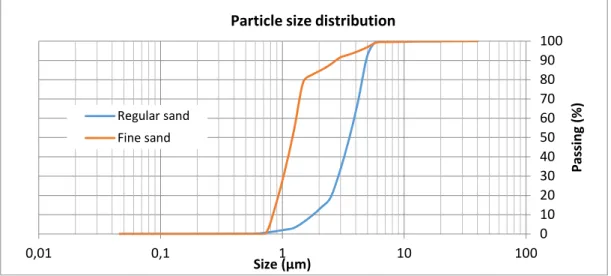
Two types of sand were used throughout the preparation of the RPC mixes studied: fine sand, usually used for mortar coating finish, and regular sand. The particle size distribution of both types of sand was de-termined according to procedure by AASHTO T 27: 2015 [30]. The results obtained are shown in Figure 02. The fineness modulus for fine sand and regular sand was 1.64 and 2.83, respectively. Table 05 shows the properties of the superplasticizer and the viscosity modifier as informed by their manufacturers.
0 10 20 30 40 50 60 70 80 90 100
0,0001 0,001 0,01 0,1 1 10 100
Pas
si
n
g
(%
)
Size (µm)
Cement Silica fume Fly ash Quartz powder
Figure 2: Sand particle size distribution
Table 5: Chemical additives characteristics
PROPRIETIES SUPERPLASTICIZER ADDITIVE VISCOSITY MODIFIER ADDITIVE
Physical state Liquid Liquid
Color and odor Turbid yellow and characteristic
odor Transparent and characteristic odor Specific density
(g/cm³) 1,10 +/- 0,02g/cm³ 1 +/- 0,02g/cm³
pH (pure product) 5,5 +/- 1,0 9,0 a 10,5
Fire reaction - Not inflamed and non-explosive
Volatiles (% by
weigth) 51% -
Water solubility Completely soluble in water -
Microfibers were characterized for their geometric properties. The metal microfiber had 13 mm in width, 0.11 mm diameter and form factor of 0.01. For the polypropylene microfibers these values were 6 mm, 0.0012 mm and 0.0002, respectively.
The composition of mixtures was determined using the modified Andreassen’s packing model [31]. For the durability tests, samples were prepared by applying 20 MPa pressure in the fresh state and heat curing in the first 24 hours, at 90 °C. This pressure was applied through a universal testing machine, with load in-crease velocity of 0,45MPa/sec.
After this stage, the samples were kept in an environment with controlled temperature of 23±2 °C, submerged in water until the date of testing. Table 06 shows the mix used, as well as the variations of use of both microfibers, metal and polypropylene. A volume content of 3% of microfibers was adopted for the mix-ture, corresponding to 235 kg/m3 of fiber. Thus, it was possible to analyze the RPC durability with a hybrid fiber mixture.
The nomenclature used in this study refers to WF for non-fiber samples; 100 (SF) for samples using only metal microfibers; 75/25 for samples with 75% use of metal microfibers and 25% polypropylene micro-fiber; and 50/50 for samples using 50% of each type of microfiber.
The samples used for accelerated carbonation testing were prismatic with dimensions 4x4x16 cm. In this procedure, the carbonation depth was determined by spraying a phenolphthalein indicator on 28 and 56 days. The carbonation chamber was adjusted to a CO2 concentration of 5%. As for the reaction of the chemi-cal indicator on the concrete, the color pink or fuchsia indicates high pH; if it remains colorless, it means that the pH decreased due to carbonation [32]. As the pH decreases (from approximately 13 to 9,5) the alkalinity of concrete also drops, resulting in reduced protection for the structure, making it more prone to attack by external agents.
0 10 20 30 40 50 60 70 80 90 100
0,01 0,1 1 10 100
Pas
si
n
g
(%
)
Size (µm)
Regular sand Fine sand
Table 6: Concrete mixcomposition and fibers use percentages
Materials WF 100/0 75/25 50/50
Cement
1
0,44 1
0,44 1
0,44 1
0,44
Silica fume 0,37 0,37 0,37 0,37
Fly ash 0,19 0,19 0,19 0,19
Fine sand
2,39 1,02
2,39 1,02
2,39 1,02
2,39
1,02
Regular sand 0,86 0,86 0,86 0,86
Quartz 0,51 0,51 0,51 0,51
Water/binder relation 0,22
Superplasticizer additive 0,03
Viscosity modifier additive 0,01
Steel fiber 0 100 75 50
Polypropylene fiber 0 0 25 50
The conditions of a marine environment were simulated, considering that its aggressiveness is due to the presence of salts, which act as electrolytes resulting in electrochemical corrosion. The test was carried out according to the specifications of ASTM B-117:2011 [33], with cubic samples of 50 mm side suspended in-side the chamber. For the system operation, a cycle with moisture saturation was defined with sodium chlo-ride (NaCl) concentration of 5% for 500 hours. Visual checking and mass determination of samples were performed every 100 hours.
Sulfuric acid (H2SO4), nitric acid (HNO3) and hydrochloric acid (HCl) were used to perform the chemical attack tests on concrete. Twelve prismatic specimens (4x4x16 cm) were molded for each mixture. Nine of these specimens were exposed to acid attack, three for each acid, and three were used as reference. Testing was performed according to ASTM C452:2010; ASTM C1012:2013 standards [34, 35]. Monteiro et al (2000) [36] highlight the importance of checking the flexural and compressive strength of samples in order to identify potential mechanical damages caused by immersion in acid, which was done in this study. The attack cycles lasted 14 days, including immersion, drying and mass and dimension verification. Each solution had three times the volume of samples and 5% concentration of acid. This experimental program had five cycles of immersion and drying. After the last cycle, samples were subjected to flexural tensile strength and compressive strength tests.
The 3D microtomography test was performed in one of the materials prepared with the main purpose of identifying the different constituent components and observe their arrangement along the generated geom-etry. A small 22 mm diameter and 30 mm length cylindrical sample was extracted from the original prismatic specimens.
3. RESULTS AND DISCUSSION
Figure 3: Depth of carbonation analysis at 28 and 56 days.
Similarly, Juanhong; Shaomin; Lin (2009) [9] proposed to perform this same analysis in samples of RPC, one of which contained only cement as a binder, and in the other fly ash was used. Due to the exposure to the accelerated carbonation chamber, for both compositions, the authors verified that the depth of damage was zero, that is, the test did not present any damage to the specimens analyzed.
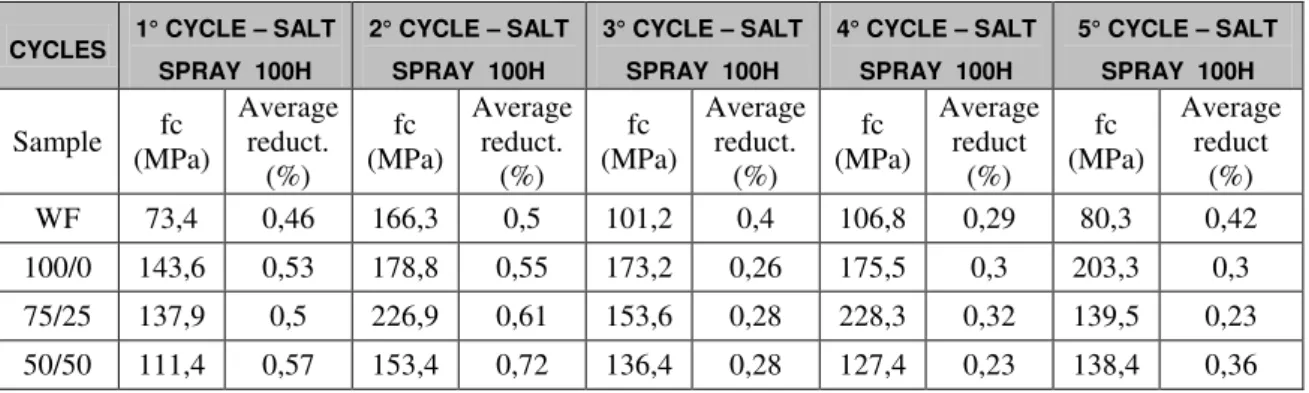
After periods of exposure to salt spray, samples were subjected to compressive strength test. It was possible to check the effects of fiber hybridization in mixture’s performance. Results are shown in Table 07.
Table 7: Compressive strength values and percentage loses
CYCLES 1° CYCLE – SALT SPRAY 100H
2° CYCLE – SALT
SPRAY 100H
3° CYCLE – SALT
SPRAY 100H
4° CYCLE – SALT
SPRAY 100H
5° CYCLE – SALT
SPRAY 100H
Sample fc (MPa)
Average reduct.
(%)
fc (MPa)
Average reduct.
(%)
fc (MPa)
Average reduct.
(%)
fc (MPa)
Average reduct
(%)
fc (MPa)
Average reduct
(%)
WF 73,4 0,46 166,3 0,5 101,2 0,4 106,8 0,29 80,3 0,42
100/0 143,6 0,53 178,8 0,55 173,2 0,26 175,5 0,3 203,3 0,3 75/25 137,9 0,5 226,9 0,61 153,6 0,28 228,3 0,32 139,5 0,23 50/50 111,4 0,57 153,4 0,72 136,4 0,28 127,4 0,23 138,4 0,36
No linear relationship was observed between compressive strength and the progression of exposure cycles to salt spray. As for mass reduction of samples, it was more intense in the first stages of exposure, and final mass reductions were less than 1%.
It was also noted that the specimens were affected along the direction of the cut, in dry condition. Metal microfibers were exposed to corrosion because of the effects of the chamber, explaining why it was possible to notice that the most affected samples were those with 100% of microfiber use. Fibers were affect-ed only in the unprotectaffect-ed area (cut) as internal fibers did not show signs of corrosion. Internal fiber protec-tion is explained by the material impermeability, preventing the ingress of external deterioraprotec-tion agents. Shaheen; Shrive (2006) [37] verified the action of ice and melt cycles in RPC mixture with the addi-tion of carbon fibers, realizing that the use of microfibers in the composite provided greater resistance to cracking and durability, as showed in this study for salt spray cycles. Carbon fibers, however, presents high cost.
By the verification of the diffusion coefficient of chloride ions by calculation, Juanhong; Shaomin; Lin (2009) [9] found reduced diffusion, expected by the reduced presence of voids in the RPC compositions, in agreement with the results obtained in this study. Chuang; Huang (2013) [38] evaluated, through accelerated tests, the use of pozzolans could be a way to increase the resistance to diffusion of chlorides, agreeing with this study, since fly ash was used in the composition of the concrete.
values along the five cycles for samples subjected to the action hydrochloride acid. Mass reduction was ob-served for all samples in every cycle, though small and visually imperceptible. The samples with the lowest mass reduction values were those with a 50/50 mix, indicating that fiber hybridization is feasible and positive. The specimen with no fiber showed the highest mass reduction, proving indicating that fibers contribute to durability by hydrochloric acid attack. Figure 05 shows the results for nitric acid attack.
Figure 4: Mass reduction after chloride acid exposure
Figure 5: Mass reduction after nitric acid exposure
Similarly to what occurred with hydrochloric acid, all samples subjected to nitric acid showed mass loss and the 100% metal microfiber mixture had the best behavior. The sample with no fibers had mass loss similar to the 50/50 sample and lower than the 75/75 sample. Figure 06 shows mass loss by sulfuric acid at-tack.
0 1 2 3 4 5 6 7 8 9 10
1 2 3 4 5
M
a
ss
r
ed
u
ctio
n
p
er
ce
n
ta
g
e
Cycles
Mass reduction- chlorid acid
WF 100/ 0 75/25 50/50
0 1 2 3 4 5 6 7 8 9 10
1 2 3 4 5
M
a
ss
r
ed
u
ctio
n
p
er
ce
n
ta
g
e
Cycles
Mass reduction- nitric acid
WF
100/0
75/25
Figure 6: Mass reduction after sulfuric acid exposure.
In this stage, samples showed higher mass reduction than in the other acid attack tests, as shown in Figures 4, 5 and 6. It was similar for all mixes, but the 100% steel microfiber mix had the lowest mass loss. It was also possible to check, through visual inspection, that only after sulfuric attack the samples suffered ex-pansion.
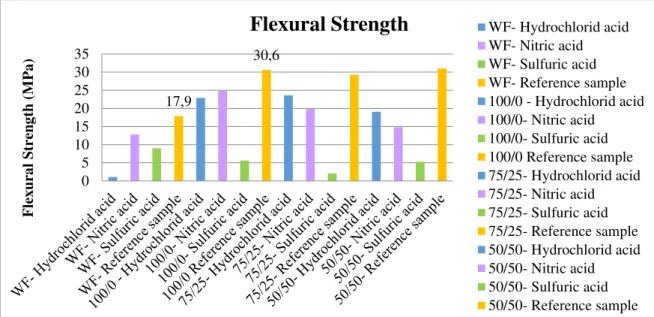
Following the chemical attack tests, tests for compressive strength and tensile strength in flexure were performed. Figure 07 shows the values for compressive strength. It's worth to highlight that samples indicat-ed as reference samples are relatindicat-ed to those which were not exposindicat-ed to acid attack
Figure 7: Compressive strength after samples exposition to acids.
The compressive strength test showed that samples suffered the most damage by sulfuric acid, where-as the nitric acid samples with no fibers and with 100% metal fibers had increwhere-ased strength values where-as com-pared with the reference mixtures. Caggiano et al (2017) [39] found out that the use of microfibers slightly influences the compressive strength of composites, opposing to the results obtained and showed at Figure 7. Observing the values obtained by reference samples, the use of hybrid fibers (75/25) more than doubled the compressive strength. The values for tensile strength in flexure are shown in Figure 08.
0 50 100 150 200 250 300
Co
m
press
iv
e
Str
eng
th (
M
P
a
)
Compressive Strength
WF- Hydrochlorid acid
WF- Nitric acid
WF- Sulfuric acid
WF- Reference sample
100- Hydrochlorid acid
100- Nitric acid
100- Sulfuric acid
100- Reference sample
75/25- Hydrochlorid acid
75/25- Nitric acid
75/25- Sulfuric acid
75/25 -Reference sample
50/50- Hydrochlorid acid
50/50- Nitric acid
50/50- Sulfuric acid
50/50Reference sample 0
20 40 60 80
1 2 3 4 5
M
a
ss
re
du
ct
io
n per
ce
nta
g
e
Cycles
Mass reduction- Sulfuric acid
WF
100/0
75/25
Figure 8: Flexural strength after samples exposition to acids.
The results showed that the damage caused to conventional concrete were very similar for the three acids. Also, sulfuric acid was the acid that showed the greatest potential for concrete degradation. The con-crete samples not reinforced with fibers (NF) were more severely damaged by hydrochloric acid and, when compared with the sample not exposed to chemical attack, the average value is 57% lower. It is also possible to identify that the 100% steel fiber samples were more damaged by sulfuric acid attack. These tests showed increased specimens volume and surface deterioration, resulting in the formation of voids and affecting mate-rial’s strength. In this mix, the damage caused by hydrochloric and nitric acids did not have a significant im-pact on the strength values of the samples. As for the samples above, the 75/25 and 50/50 mixes were more severely damaged by sulfuric acid, not showing extreme losses when attacked by the other acids.
When analyzing only the reference sample, to verify the effect of the fibers on the mechanical proper-ties, it is highlighted that the interaction between the two types of microfibers was favorable. The greatest compressive strength occurred in the 75/25 proportion, and the higher tensile strength in the 100/0 and 50/50 samples. In a study with similar analysis, the authors Yu, Spiesz and Brouwers (2015) [23] realized that the best mechanical behavior occurred with hybrid mixture containing two sizes of steel fibers.
Figure 09 shows the sample with material differentiation obtained by microtomography analysis. The materials differ in density.
Figure 9: Microtomography 3D images of hybrid fibers samples.
The mostly green area represents the RPC cementitious matrix and the steel fibers can be seen by the reddish particles distributed along the sample. Because of their low density value, polymeric fibers (polypro-pylene) could not be identified by the equipment. In order to determine metal fibers distribution, imaging highlighting only the filaments was used. Figure 10 shows the high fiber concentration in the mixture for the small specimen removed.
17,9
30,6
0 5 10 15 20 25 30 35
F
lex
ura
l
Str
eng
th (
M
P
a
)
An important finding concerns the distribution, concentration and orientation of fibers. The image on the right of Figure 10 refers to a single section of the sample. The generation of a fiber mesh, preferably ho-mogeneous and random, with no flaws or inadequate fiber agglomeration, enhances the overall ductility of the composite and helps define the properties with isotropic tendencies. An interesting finding refers to the presence of fibers in that the polymeric filaments did not cause segregation of the mixture nor affected the distribution of metal fibers.
Figure 10: Metal fibers distribution
4. CONCLUSION
The accelerated carbonation test results were very similar for all different samples, where the phenomenon did not occur as verified on days 28 and 56 due to the low number of voids and high compactness. The rein-forced RPC with metallic microfibers and polypropylene fibers samples showed high resistance against chemical attacks;
The results obtained with the salt spray test indicates RPC’s resistance against attacks in the salt envi-ronment to which it was subjected, with reduced loss of mass values and variation of volume. No linear rela-tionships with the values obtained for compressive strength or mechanical losses caused by the accelerated tests was identified. Fibers were damaged only in their cut area as there was no ingress of degrading agents in the areas protected by coating;
The results for chemical attack by acid immersion were considerably different, showing that hybrid fibers reinforced RPC samples were more resistant (except the 75/25 mix immersed in sulfuric acid). As ob-served, the immersion acid with the highest degradation potential was sulfuric acid. Therefore The reinforced RPC with metallic microfibers and polypropylene fibers samples satisfactorily met the durability expectation showing small signs of damage in the accelerated tests, suggesting reduced penetration of degrading agents. The reinforced RPC with metallic microfibers and polypropylene fibers has a large potential to resist to some common chemical deterioration agents. This material seems able to be applied even in several condi-tions. The fiber hybridization improved the mechanical properties. It is possible to use those composites with greater performance than conventional concretes. The exposure to high temperatures was not assessed in this study
5. AKNOWLEDGMENTS
We thank itt Performance / Unisinos for the study carried out
6. BIBLIOGRAPHY
[1] TANG, S.W., YAO, C., ANDRADE, Z.J. “Recent durability studies on concrete structure”, Cement and Concrete Research, n.78, pp.143-154, 2015.
[2] MEHTA, P. K., MONTEIRO, P. J., Concreto: microestrutura, propriedades e materiais, 1. ed., São Paulo, Pini, 2014.
[3] DESMETTRE, C., CHARRON, J.P. “Water permeability of reinforced concrete subjected to cyclic te n-sileloading”, ACI Mater, n.110, pp.67-78, 2013.
[4] CALLISTER JR., W. D., RETHWISCH, D. G. Materials Science and Engineering: An Introduction. University of Utah, 2014.
[6] HASSOUN, M. Nadim; AL-MANASEER, Akthem. Structural Concrete: Theory and Design. 6. ed. Ho-boken: Wiley, 2015
[7] RICHARD, P., CHEYREZY, M. “Compostion of Reactive Powder Concrete. Scientific division” BOUYGYES, St Quentin- Yvelines, v. 25, p. 1501 – 1511, 1995.
[8] VANDERLEI, R. D. Análise experimental do concreto de pós reativos: Dosagem e propriedades mecâ-nicas, Tese de D.Sc. Escola de Engenharia de São Carlos, São Paulo, Brasil, 2004.
[9] JUANHONG, L., SHAOMIN, S., LIN, W. “Durability and micro-structure of reactive powder concrete”, Journal of Wuhan University of Technolotgy-Mater. Sci. Ed., pp.506-509, June 2009.
[10] TUTIKIAN, B. F., ISAIA, G. C., HELENE, P. “Concreto de Auto e Ultra-Alto Desempenho”, In: Con-creto: Ciência e Tecnologia. Editor: Isaia, G.C.São Paulo, IBRACON,. 2v, pp.1283-1326, 2011
[11] MAROLIYA, M.K. “Sustainability of Ultra High strength Reactive Powder Concrete”, International Journal of Engineering Research and Development, v. 4, pp. 54-57, 2012.
[12] YIGITER, H., AYDUN, S., YAZICI, H., et al., “Mechanical performance of low cement reactive po w-der concrete (LCRPC)”,Composites Part B: Engineering, v. 43, n. 8, pp. 2907–2914, 2012.
[13] VANDERLEI, R.D. GIONGO, J.S. “Análise Experimental do Concreto de pós reativos: dosagem e pro-priedades mecânicas”, In: Cadernos de Engenharia de estruturas, São Carlos, pp.115-148, 2006
[14] BANYHUSSAN, Q.S., YILDIRIM, G., BAYRAJTAR, E., et al., “Deflection- hardenind hybrid fiber reinforced concrete: the effect of aggregatecontent”,Construction and building materials, v.125, pp. 41-52, 2016.
[15] NOUMOWE, A. N., SIDDIQUE, R., DEBICKI, G. “Permeability of high-performance concrete sub-jected to elevated temperature (600°C)”,Construction and Building Materials, v. 23, n. 5, pp. 1855–1861, 2009.
[16] DAWOOD, E. T., RAMLI, M. “Contribution of Hybrid Fibers on the Properties of High Strength Con-crete Having High Workability”,Procedia Engineering, v. 14, pp. 814–820, 2011.
[17] SOUZA, P.L.A.S. Caracterização da distribuição e orientação das fibras em betões de elevado desem-penho reforçados com fibras, Dissertação de M.Sc., Especialização em Estruturas, Faculdade de Engenharia, Universidade do Porto, Portugal, 95p, 2014.
[18] WU, Z., SHI, C., HE, W., et al., “Effects of steel fiber content and shape on mechanical properties of ultra high performance concrete”, Construction and building materials, v.103, pp. 8-14, 2016.
[19] CHRIST, R., TUTIKIAN, B.F. “Study of pressure and curing temperature in Reactive Powder Concretes (RPC) with different amounts of Metallic Microfibers”,Revista de la Construcción, v.12, pp 46-64, 2013. [20] ZHENG, W., LI, H., WANG, Y. “Compressive behavior of hybrid fiber-reinforced powder concrete after high temperature”, Materials & Design,v. 41, pp 403-409, 2012.
[21] PIZZOL, V.D., MENDES, L.M., FREZATTI, L., et al., “Effect of accelerated carbonation on the micro-structure and physical properties of hybrid fiber-cement composites”,Minerals Engineering, v.59, , pp. 101– 106, 2014.
[22] BANTHIA, N., GUPTA, R, “Hybrid fiber reinforced concrete (HyFRC): fiber synergy in high strength matrices”, Materials and Structures, v. 37, n. 10, pp. 707–716, 2004.
[23] YU, R., SPIEZ, P., BROUWERS, H.J.H. “Development of ultr-high performance fiber reinforced con-crete (UHPFRC): towards an efficient utilization of binders and fibers”,Construction and building materials, v.79, pp. 273- 282, 2015.
[24] MATTE, V., MORANVILLE, M. “Durability of Reactive Powder Composites: influence of silica fume on the leaching properties of very low water/binder pastes”, Cement and concrete composites, pp. 1-9, 1999. [25] PACHECO, F., CHRIST, R., GIL, A.M., et al., “SEM and 3D microtomography application to investi-gate the distribution of fibers in advanced cementititous composites”,RIEM- Revista Ibracon de Estruturas e Materiais, v.9, n. 6, pp-824-841, 2016.
[26] STAMANTINA, G., VECCHIO, G., VECCHIO, F.J. “Shear behavior and crack control characteristics of hybrid steel fiber- reinforced concrete panels”, ACI Structural Journal. Technical paper, v.114, n.1, pp.209-220, 2017.
[28] KUMAR, A., RAO, A., SABHAHIT, N. “Reactive powder concrete properties with replacement using waste material”, International Journal of Scientific & Engineering Research, v. 4, n.5, pp. 203-206, 2013 [29] ZHU, P; MAO, X; LI, Z; MA, Z., “Investigation of using recycled powder from waste of clay bricks and cement solids in reactive powder concrete”, Construction and building materials, v.113, pp. 246-254, 2016 [30] AMERICAN ASSOCIATION OF STATE HIGHWAY AND TRANSPORTATION OFFICIALS. ASHTO T 27: Standard Method of Test for Sieve Analysis of Fine and Coarse Aggregates. Washington, D.C, 2015.
[31] FIDJESTOL, P., THORSTEINSEN, R.T., SVENNEVIG, P. “Making UHPC with local materials- The way forward”, In: Ultra-high performance concrete and nanotechnology in construction , v. 19, pp. 207-214, 2012.
[32] PAULETTI, Cristiane. Análise comparativa de procedimentos para ensaios acelerados de carbonata-ção. Tese de D.Sc., Porto Alegre, Universidade Federal do Rio Grande do Sul, RS, Brasil, 2004
[33] AMERICAN SOCIETY FOR TESTING MATERIALS. ASTM B-117: Standard Practice for Operating Salt Spray (Fog) Apparatus. 2011.
[34] ASTM C452: Standard Test Method for Potential Expansion of Portland-Cement Mortars Exposed to Sulfate, 2010.
[35] ASTM C1012: Standard Test Method for Length Change of Hydraulic-Cement Mortars Exposed to a Sulfate Solution. 2013.
[36] MONTEIRO, P.J.M, ROESLER, J. KURTID, K.E, et al., “Accelerated Test for Measuring Sulfate R e-sistance of Hydraulic Cements for Caltrans LLPRS Program”, In: Report California department of transporta-tion. Pavement research center- Institute of Transportation Studies- University of California, Berkeley, pp 1 – 46, 2000.
[37] SHAHEEN, E., SHRIVE, N.G. “Optimization of mechanical properties and durability of reactive pow-der concrete”, ACI Materials Journal, v. 103, n. 6, pp-444-451, 2006.
[38] CHUANG, M., HUANG, W. “Durability analysis testing on reactive powder concrete”,Advanced mate-rials research, v. 811, pp244-248, 2013.
[39] CAGGIANO, A., FOLINO, P., LIMA, C., et al., “On the mechanical response of hybrid fiber reinforced concrete with recycled and industrial steel fibers”,Construction and bulding materials, v.147, pp. 286-295, 2017.