2017;25:e2996
DOI: 10.1590/1518-8345.2277.2996 www.eerp.usp.br/rlae
Efficacy of an educational manual for childbirth companions: pilot study
of a randomized clinical trial
Liana Mara Rocha Teles
1Camila Félix Américo
2Mônica Oliveira Batista Oriá
3Camila Teixeira Moreira Vasconcelos
4Odaléa Maria Brüggemann
5Ana Kelve de Castro Damasceno
6Objective: to evaluate the effectiveness of an educational manual in the instrumentalization of
companions to provide support to the parturients and check its influence on the satisfaction of
companions and women during vaginal delivery. Method: pilot study of a randomized controlled
clinical trial with 65 companions and puerperal women (intervention = 21 and control = 44).
The previous knowledge of the companions was evaluated at baseline. The Evaluation Form for
Companions in the Delivery Room was used to measure the actions provided and the satisfaction
with the experience, and the Questionnaire for Evaluation of the Experience and Satisfaction of
Puerperal Women with Labor and Delivery was used to evaluate the satisfaction of women with
childbirth. The Student’s t-test or Wilcoxon, chi-square or Fisher’s exact test, risk ratios and 95%
confidence intervals were used. Results: the companions in the intervention group performed a
greater number of support actions (7.2 vs 4.6, p: 0.001) and had higher satisfaction scores (72.4 vs
64.2; p = 0.00). Puerperal women in the intervention group had higher satisfaction with childbirth
(119.6 vs 107.9; p: 0.000). Conclusion: the manual was effective for the instrumentalization
of companions, contributed to support actions to the parturients and had repercussions on the
satisfaction of companions and women with the birthing process. RBR-776d9s
Descriptors: Social Support; Parturition; Clinical Trial; Nursing; Health Education; Health
Promotion.
1 PhD, Nursing. Adjunct Professor. Nursing Department, Universidade Federal do Ceará, Fortaleza, CE, Brazil. 2 PhD, Nursing. Adjunct Professor. Nursing Department, Universidade Federal do Ceará, Fortaleza, CE, Brazil.
3 PhD, Nursing. Associated Professor. Nursing Department, Universidade Federal do Ceará, Fortaleza, CE, Brazil. Research Productivity Scolarship CNPq.
4 PhD, Nursing. Adjunct Professor. Nursing Department, Universidade Federal do Ceará, Fortaleza, CE, Brazil.
5 PhD, in Tocogynecology. Associated Professor. Nursing Department, Universidade Federal do Ceará, Fortaleza, CE, Brazil. Research Productivity Scolarship CNPq.
6 PhD, Nursing. Associated Professor. Nursing Department, Universidade Federal do Ceará, Fortaleza, CE, Brazil. Research Productivity Scolarship CNPq.
How to cite this article
Teles LMR, Américo CF, Oriá MOB, Vasconcelos CTM, Brüggemann OM, Damasceno AKC. Efficacy of an educational manual
for childbirth companions: pilot study of a randomized clinical trial. Rev. Latino-Am. Enfermagem. 2017;25:e2996.
[Access ___ __ ____]; Available in: ____________________. DOI: http://dx.doi.org/10.1590/1518-8345.2277.2996
URL day
Introduction
Childbirth is one of the most remarkable experiences
in a woman’s life. It involves a mixture of sensations,
feelings, desires, overcomings, and challenges that
make it a complex, multidimensional process involving
physiological and cognitive aspects. In this sense it is
important that companions be prepared and well trained
to participate in this moment, supporting and comforting
the parturients and bringing greater satisfaction to
the process of delivery and birth. Stimulating the
participation of companions in delivery and birth is part
of the qualification of humanized childbirth care(1). Evidence shows that the continuous support from
a companion who does not belong to the hospital’s
professional team during the delivery provides
several benefits for the woman and the newborn(2-4). It is necessary, therefore, to develop and evaluate
educational technologies for those who intend to
participate in childbirth as companions, with the purpose
of disseminating and expanding the knowledge about
the physiology and care involved in the process of
childbirth and techniques to support parturients. The
lack of preparation of companions has been highlighted
as one of the reasons for health institutions to prevent
their presence(5).
Based on the assumption that the development
of educational technologies can contribute to the
empowerment and better performance of companions
in the delivery room, the manual entitled “Preparing to
be a companion during vaginal birth: what is important
to know?”(6). This educational technology seeks to
encourage the development of skills in those who intend
to participate in childbirth as companions. It is also
an important tool to dynamize the methodology used
by nurses in the systematization of their educational
actions in the prenatal context.
It is presumed that companions with access to the
educational manual will be better prepared to provide
support to parturients, bringing a positive effect on the
satisfaction of companions and puerperal women with
the birthing process. From that point on, the following
question arose: will companions who have access to
the educational manual during prenatal care provide
more support to the parturients, leading to a greater
satisfaction of companions and puerperal women
with the process of childbirth? Thus, the objective of
the present study was to evaluate the effectiveness
of an educational manual in the instrumentalization
of companions to provide support to the parturient
women and to check its influence on the satisfaction
of companions and women with the process of vaginal
delivery.
Method
This is a parallel, open, two-arm pilot Randomized
Clinical Trial (RCT). Pilot studies are conducted to guide
decisions on how to outline recruitment, gauging and
intervention approaches and are particularly useful in
studies on new forms of intervention(7). In this sense,
with the aim to evaluate a new educational technology
and in view of the paucity of experimental studies
assessing the impact of educational interventions on
the performance of companions in the delivery room, a
Pilot Study became necessary before the realization of a
larger RCT. The methodology used was the Consolidated
Standards of Reporting Trials (CONSORT) for
Non-Pharmacological Interventions(8).
The study was developed in two primary care
insititutions in Fortaleza (CE). These Health Units were
chosen because they are a reference to vaginal delivery
of habitual risk and accept the presence of companions
during the process of delivery.
The subjects of the study were the companions
of women who underwent prenatal consultation in the
Centro de Parto Normal Ligia Barros Costa (CPN-LBC)
and the Centro Integrado de Educação e Saúde Casimiro
José de Lima Filho (CIESCJLF) and the puerperal women
who had the presence of a companion who participated in
the prenatal care. The inclusion criteria for companions
were: having been chosen by the pregnant woman to
participate in delivery as a companion; having completed
at least the fourth year of elementary school (level of
schooling compatible with the readability index of the
manual); and being companions of pregnant women
with indication of vaginal delivery (type of delivery for
which the manual is directed). The criterion of exclusion
for companions was: prior experience as a companion
during childbirth. The criterion of inclusion for puerperal
women was: having had vaginal delivery; having had
as a companion in the delivery room the same person
approached in the first phase of this study. The criteria
for discontinuing the participation of companions
and puerperal women were: companions of pregnant
women who progressed to cesarean section (elective/
emergency); withdrawal from the study after the start
of the collection; withdrawal or impossibility to be
present at labor/delivery; choice of another companion
at the moment of childbirth; change of address and/
after birth. Thus, the pairs (companion and puerperal
woman) were selected and analyzed.
Since this is a pioneering Pilot Clinical Trial to
evaluate the impact of an educational technology on
the support provided by companions in the delivery
room, the sample size was not calculated. Thus, the
sample corresponded to all the companions (and the
respective puerperae) recruited in the period, who met
the inclusion criteria and who completed the follow-up,
that is, went through all phases of the study. At the end,
65 companions, 21 in the Intervention Group (IG) and
44 in the Control Group (CG) were selected.
The participants were recruited by the field team
and randomized into the IG or CG using sequence of
random numbers generated at www.randomizer.org.
The study was blinded to the field team responsible for evaluation phases III and IV, specified below. The
IG was represented by the group of companions to
whom the educational manual was made available. The
CG corresponded to the group of companions eligible
to participate in the survey who received the routine
guidelines, characterized by individual guidelines during
prenatal care and the course for pregnant women (and
companions) promoted by the institutions.
Data collection tools
Three instruments were used for data collection
(two for companions and one for the women). The
instrument 1 addressed the characterization of the
companions and items for assessment of their prior
knowledge about support techniques during childbirth.
This instrument was applied to all eligible companions
who agreed to participate in the survey. It is a baseline
diagnostic tool (Phase 1).
The instrument 2, the Evaluation Form for
Companions in the Delivery Room, consisted of 22
questions and was applied to the companions during
the Phase 3 to evaluate the support provided and the
satisfaction with the experience in the delivery room.
The instrument was composed of the following topics:
support actions carried out; satisfaction in being a
companion (labor and delivery); satisfaction with the
support provided (labor and delivery); satisfaction with
the way the birth process occurred; satisfaction with the
delay (labor and delivery); satisfaction with the care
provided by health professionals (labor and delivery);
evaluation of the usefulness of the support provided and
of the cooperation with health professionals. The score
was distributed as follows: one point for each support
action performed by the companion (questions 1 to 3)
and a Likert-type response varying from one (none)
to four (very much) points for the questions 4 to 22.
These questions assessed the level of satisfaction of the
companion with his or her experience. The final score of
the instrument consisted of the sum of the number of
support actions performed and the sum of the scores in
the Likert-type questions. This instrument was prepared
based on a previous study(6) and evaluated by three
researchers in the field of obstetrics.
The instrument 3 was a questionnaire entitled
Evaluation of the Experience and Satisfaction of Puerperal
Women with Labor and Delivery(9). This questionnaire is
divided into two parts: I. characterization of the puerperal
women (items 1 to 13); and II. The short version of
the Questionnaire of Experience and Satisfaction with
Childbirth (QESC) (items 14 to 51). This instrument was
applied to women during the Phase 4.
The QESC has already been used and validated in
a Brazilian study(10) and is divided into 8 subscales, of
which the following were selected for the present study:
- Subscale 2 - Positive Experience, consisting of 22 items
related to the confirmation of expectations, self-control, self-confidence, knowledge, pleasure and satisfaction
with the experience of childbirth; - Subscale 3 -
Negative experience, consisting of 12 items that refer
to fear, malaise and pain during labor and delivery; -
Subscale 4 - Relaxation, consisting of 6 items related to
the experience of relaxation during labor and delivery; -
Subscale 6 - Companion’s support, consisting of 8 items
specifically related to the support of the companion.
Items with negative topics such as pain, fear, malaise
and worry have a reverse score.
The QESC has a good internal consistency
(Cronbach’s alpha = 0.9087) and test-retest fidelity
index of 0.586(9), allowing the consistent and reliable
evaluation of the different dimensions that are relevant
to the experience of childbirth.
Data colletion
Data collection was performed in four phases,
with three different teams of collaborators: one
team responsible for Phase I, another responsible for
Phase II and one responsible for Phases III and IV. The
collaborators were previously trained and followed the
guidelines of the Standard Operational Protocol developed
for each phase of the study. The operationalization of
the data collection took place as follows:
Phase I (Baseline): interviews with companions to identify
their sociodemographic profile and prior knowledge
about support techniques. The form (Instrument 1) and
and numbered envelopes, which were randomized to
either IG or CG;
Phase II (Intervention): after the randomization of
the participants, the names and respective contacts
of companions were given by the researcher to the
team responsible for the intervention group. The
companions selected for this group were invited to
attend the institution, at a date and time previously
scheduled. During the intervention, the educational
manual was introduced and read, openig the
possibility of interruption for expressing doubts or for
making comments. A printed version of the manual
was delivered to the participants and they were
requested to keep the manual confidential, not lending
or replicating this material in order to prevent the
companions of the control group from having access to
it, since this material is not yet a publication of public
domain. Each intervention had an average duration of
20 minutes.
The manual in question consists of 38 illustrations
and 11 topics that deal sequentially from the preparation
to go to the Maternity until the puerperal period. The
topics covered in the handbook are: Few days before
delivery (changes in the woman’s body that indicate
the approach of delivery); Knowing the woman’s body
(anatomy of the reproductive organs); Signs and
symptoms of labor (events that indicate the onset of
labor); Arriving at the maternity hospital (documents
that should be brougth and professionals who can act
in the delivery room, presenting the duties of each one
of them); Techniques of pain relief at childbirth (benefit
of each of the methods and how the companion can
offer them to the woman); How does normal delivery
happen? (the physiological mechanism of vaginal
delivery); Rights and duties of the woman and the
companion; and Notions of Citizenship (birth certificate
and maternity and parental leave). The manual has
already been evaluated by representatives of the target
public and validated as to its appearance and content
by specialists in the area of women’s health and/or
obstetrics(6).
Phase III (Evaluation of the support provided by the
companion in the delivery room): a telephone contact
was made to the companion had already participated
in labor and delivery (if the pregnant woman had not
yet given birth, another call was made after one week).
If the pregnant woman had progressed to a cesarean
section or if her companion had not participated in the
birth process, the reason that impeded the participation
of the companion was recorded. If the participant had
been at the delivery, the team applied the Instrument 2
(described above).
Phase IV (Satisfaction of the woman with the childbirth
experience): the Instrument 3 was used in this phase,
also performed through a telephone contact. To evaluate
the satisfaction of the woman with the process of
childbirth, the following variables were considered: 1. to
which extent the form of the labor process and the felt
pain met her expectations; 2. to which extent was the
woman able to relax and how useful was the relaxation
provided; 3. how confident she felt and the situation
under control; 4. to which extent she counted on the
help of the companion and how useful that help was; 5.
how much knowledge she had about the relative events
during the birthing process; 6. level of fear, malaise,
pleasure/satisfaction during the labor process; 7. how
much she cooperated with health professionals; and 8.
how much she remembers how painful the process of
childbirth was; and the satisfaction with the form, time
and intensity of pain during labor and delivery, variables
corresponding to QESC Subsections 2, 3, 4 and 6.
Evaluated outcomes
The primary outcome was the support provided
by the companion who used the educational manual,
measured by the number of support actions (emotional,
physical, informational and intermediation) provided by
the companion to the parturient. The secondary outcomes
were the satisfaction of the companion and the woman
with the process of childbirth, as measured through the
Instruments II and III. These indicators were used to
evaluate the effectiveness of the educational manual.
The control variables were: sociodemographic data
of the companion: sex, age, marital status, schooling
and family income; participation of the companion in
educational strategies during prenatal care; degree of
kinship of the companion; sociodemographic variables
of the puerperal woman: age, marital status, schooling,
family income; obstetric variables: number of gestations,
births, abortions, stillbirths, living children; numbers
of prenatal consultations performed by the puerperal
woman; and participation of the puerperal woman in
educational activities carried out during the prenatal
period. Before analyzing the outcomes of the study,
the similarity between the groups and the existence of
confounding factors were verified.
The data were analyzed using the Statistical
The Kolmogorov-Smirnov (KS) was used to verify
the normality of continuous data. The groups were
compared at the baseline and after the intervention, in
separate analyses. The chi-square and Fisher exact tests
(categorical variables) and the Student t-test or
Mann-Whitney test (continuous variables) were used in these
comparisons. The correlations were evaluated by means
of the Spearman correlation index. The Relative Risk
(RR) and the 95% confidence intervals were calculated
for the main dependent variables, with a critical alpha of
0.05 to determine the level of significance.
The study was approved by the Research
Ethics Committee of the Federal University of Ceará
(nº 576.174/14) and registered in the database of
the Brazilian Clinical Trials Registry (ReBEC)
(RBR-776d9s). The study participants signed an ICF, and
their anonymity was assured, according to the norms of
Resolution nº 466/12 of the National Health Council of
the Ministry of Health.
Results
A total of 65 companions and puerperae
participated in the study, 21 in IG and 44 in CG. Among
the 21 IG companions, 15 (71.4%) were from the
CPN-LBC and 6 (28.6%) from the CIESCJLF. Among the 44
companions of the CG, 36 (81.8%) were from the
CPN-LBC and 8 (18.2%) from the CIESCJLF. There was no
difference between Unit of Origin and allocation group
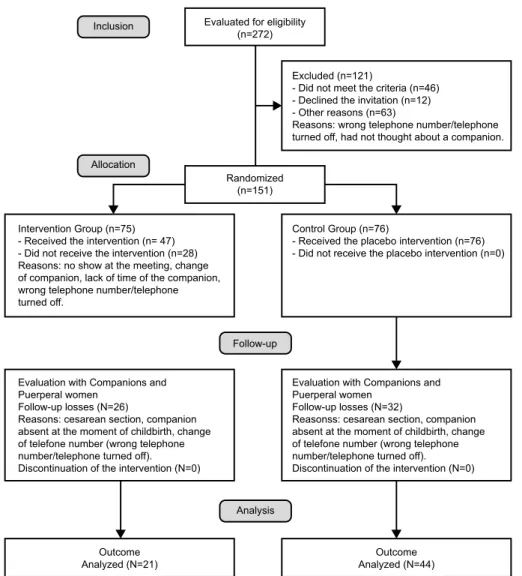
(intervention/control) (Fisher: 0.353). Figure 1 shows
the follow-up of participants in each phase of the study.
Baseline sociodemographic and obstetric data and
prior knowledge of the companions on support actions to
the parturient and their access to educational activities
during the pre-natal care were investigated (Table 1). The
companions had, on average, 39.3 (± 14.6) years of age
and 8.4 (± 2.5) years of schooling. Among companions,
38 (58.4%) were males, mostly husbands/partners (36;
55.4%), mothers (15; 23.1%) and sisters (8; 12.3%), in
this order. There were no differences in these variables
between the intervention and control groups.
Evaluated for eligibility (n=272) Inclusion
Allocation
Randomized (n=151)
Excluded (n=121)
- Did not meet the criteria (n=46) - Declined the invitation (n=12) - Other reasons (n=63)
Reasons: wrong telephone number/telephone turned off, had not thought about a companion.
Control Group (n=76)
- Received the placebo intervention (n=76) - Did not receive the placebo intervention (n=0) Intervention Group (n=75)
- Received the intervention (n= 47) - Did not receive the intervention (n=28) Reasons: no show at the meeting, change of companion, lack of time of the companion, wrong telephone number/telephone turned off.
Evaluation with Companions and Puerperal women
Follow-up losses (N=26)
Reasons: cesarean section, companion absent at the moment of childbirth, change of telefone number (wrong telephone number/telephone turned off). Discontinuation of the intervention (N=0)
Evaluation with Companions and Puerperal women
Follow-up losses (N=32)
Reasonss: cesarean section, companion absent at the moment of childbirth, change of telefone number (wrong telephone number/telephone turned off). Discontinuation of the intervention (N=0) Follow-up
Analysis
Outcome Analyzed (N=21)
Outcome Analyzed (N=44)
Figure 1. Representative flow chart of participants in each phase of the study as set forth by the CONSORT for
Table 1. Distribution of data of companions according to sociodemographic and obstetrics characteristics and
evaluation of prior knowledge about support methods to parturient women. Fortaleza, CE, Brazil, 2015.
Variable
TOTAL (n = 65)
IG (n = 21)
CG
(n = 44) p
Md (± SD) Md (± SD) Md (± SD)
Age (years) 39.3 (±14.6) 41.6 (±12.8) 38.1 (±15.6) 0.5621
Schooling (years) 8.4 (±2.5) 7.5 (±2.6) 8.8 (±2.4) 0.2201
Income (Brazilian reais) 1.037.85 (±810.49) 950.22 (±804.47) 1.081.67 (±833.07) 0.6991
Obstetric data
Number of pregnancies 2.1 (±1.5) 2.9 (±1.5) 1.8 (±1.4) 0.0852
Nº of deliveries 1.7 (±1.3) 2.3 (±1.3) 1.4 (±1.2) 0.0762
Nº of abortions 0.2 (±0.5) 0.4 (±0.7) 0.1 (±0.5) 0.3752
N (%) N (%) p
Sex
Male 38 (58.5%) 12 (57.1%) 26 (59.1%) 0.8823
Female 27 (41.5%) 9 (42.9%) 18 (40.9%)
Marital status
With partner 49 (75.4%) 15 (71.4%) 34 (77.3%) 0.6093
Without partner 16 (24.6%) 6 (28.6%) 10 (22.7%)
Degree of kinship with the pregnant woman
Husband/Partner 36 (55.4%) 12 (57.1%) 24 (54.5%) 0.2133
Mother 15 (23.1%) 7 (33.3%)) 8 (18.2%)
Sister 8 (12.3%) 2 (9.5%) 6 (13.6%)
Others 6 (9.2%) 0 (4.2%) 6 (13.6%)
Questions related to previous knowledge on support actions
TOTAL (n=65)
GI (n=21)
GC
(n=44) p
N % N % N %
Participated in preparatory educational activity for childbirth 13 20.0 3 14.3 10 22.7 0.5224
Knows support actions to parturient women 44 67.7 16 76.2 28 63.3 0.3115
Knows physical support actions 18 27.7 4 19.0 14 31.8 0.2825
Knows emotional support actions 22 33.8 16 76.2 27 61.4 0.2375
Knows informational support actions 2 3.1 - - 2 4.5 1.0004
Knows negociation/mediation actions 4 6.2 1 4.8 3 6.8 1.0004
p1 = Student’s t-test; p2= Wilcoxon test; p3 = Chi-square test; p4= Fisher’s exact test; p5= Chi-square test
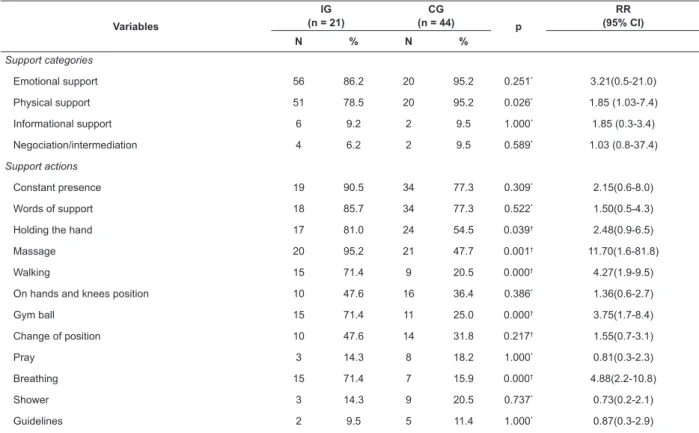
After participating in the delivery process, the
companions were re-evaluated. Table 2 shows the
support actions performed by the companions, according
to the allocation group.
Companions who used the educational manual
performed a greater number of support actions for
parturients (7.2 ± 1.8 in the IG vs 4.6 ± 2.5 in the
CG, p: 0.001), being more likely to perform support
techniques such as hand holding, massage, walking,
gymnastic ball and breathing exercises.
The experience of accompanying the childbirth was
better conceptualized by the participants of the GI, as
pointed out by the sum of the items of the Instrument
2. However, the companions of the GI were less satisfied
with the way the childbirth took place and with the care
provided by health professionals during this moment, as
shown in Table 3.
After the evaluation of the companions, the
satisfaction of the puerperal women with the process
of childbirth was evaluated. The mothers had a mean
age of 24.1 (± 6.4) years (24.2 ± 6.2 in the IG vs
23.9 ± 6.6 in the CG, p: 0.796), 8.9 (± 2.3) and 8.9
years of schooling (9.5 ± 2.5 in the IG vs 8.6 ± 2.2 in
the CG, p:0.137), and performed on average 7.7 (± 1.6)
prenatal consultations (7.4 ± 1.8 in the IG vs 7.8 ± 1.5
in the CG, p: 0.323). There was no difference between
the groups for the variables number of gestations (p:
0.278), deliveries (p: 0.060) and abortions (p: 0.428).
As to participation in educational activities during
prenatal care, 38 (60.3%) responded positively (76.2%
in the IG vs 52.4% in the CG, p: 0.069).
Women whose companions were part of the IG
had higher means in all the QESC subscales evaluated
(Table 4).
Women whose companions participated in the GI
Table 2. Distribution of data of companions according to the types of support provided during labor and delivery.
Fortaleza, CE, Brazil, 2015.
Variables
IG (n = 21)
CG
(n = 44) p
RR (95% CI)
N % N %
Support categories
Emotional support 56 86.2 20 95.2 0.251* 3.21(0.5-21.0)
Physical support 51 78.5 20 95.2 0.026* 1.85 (1.03-7.4)
Informational support 6 9.2 2 9.5 1.000* 1.85 (0.3-3.4)
Negociation/intermediation 4 6.2 2 9.5 0.589* 1.03 (0.8-37.4)
Support actions
Constant presence 19 90.5 34 77.3 0.309* 2.15(0.6-8.0)
Words of support 18 85.7 34 77.3 0.522* 1.50(0.5-4.3)
Holding the hand 17 81.0 24 54.5 0.039† 2.48(0.9-6.5)
Massage 20 95.2 21 47.7 0.001† 11.70(1.6-81.8)
Walking 15 71.4 9 20.5 0.000† 4.27(1.9-9.5)
On hands and knees position 10 47.6 16 36.4 0.386* 1.36(0.6-2.7)
Gym ball 15 71.4 11 25.0 0.000† 3.75(1.7-8.4)
Change of position 10 47.6 14 31.8 0.217† 1.55(0.7-3.1)
Pray 3 14.3 8 18.2 1.000* 0.81(0.3-2.3)
Breathing 15 71.4 7 15.9 0.000† 4.88(2.2-10.8)
Shower 3 14.3 9 20.5 0.737* 0.73(0.2-2.1)
Guidelines 2 9.5 5 11.4 1.000* 0.87(0.3-2.9)
* Fisher’s exact test; † Chi-square test
Table 3. Satisfaction of companions according to the evaluation of the experience during labor and delivery. Fortaleza,
CE, Brazil, 2015.
Variables
IG (n = 21)
CG
(n = 44) p
RR (95% CI)
N % N %
Birthing labor
Satisfaction of being a companion 19 90.5 38 86.4 1.000* 1.33 (0.4-4.6)
Satisfaction with the support provided 20 95.2 36 81.8 0.251* 3.21 (0.5-21.0)
Satisfaction with the way it took place 16 76.2 42 95.5 0.031* 0.38 (0.2-0.7)
Satisfaction with the delay 19 90.5 36 81.8 0.479* 1.72 (0.5-6.2)
Satisfaction with the care provided by health professionals 16 76.2 42 95.5 0.031* 0.38 (0.2-0.7)
Usefulness of the support provided 21 100.0 39 88.6 0.166*
-Cooperation with health professionals 19 90.5 36 81.8 0.479* 1.72 (0.5-6.2)
Parturition
Satisfaction of being a companion 20 95.2 40 90.9 1.000* 1.66 (0.3-9.9)
Satisfaction with the support provided 20 95.2 40 90.9 1.000* 1.66 (0.3-9.9)
Satisfaction with the way it took place 16 76.2 41 93.2 0.100* 0.45 (0.2-0.8)
Satisfaction with the delay 19 90.5 37 84.1 0.706* 1.52 (0.4-5.4)
Satisfaction with the care provided by health professionals 18 85.7 42 95.5 0.318* 0.50 (0.2-1.1)
Usefulness of the support provided 20 95.2 40 90.9 0.148* 3.63 (0.5-24.1)
Cooperation with health professionals 19 90.5 36 81.8 0.479* 1.72 (0.5-6.2)
Evaluation Form for Companions in the Delivery Room Md
(±DP)
Md (±DP)
Total score 72.43
(±8.18)
64.23 (±7.38)
0.000†
self-confidence, knowledge, pleasure and satisfaction
with the experience of childbirth (Subscale 2), reported
lower levels of fear, malaise and pain (subscale 3), felt
more relaxed (Subscale 4) and had a better evaluation
of the support provided by the companion (Subscale 5)
(Table 4).
Discussion
The results of this study show that the educational
manual is an effective technology to instrumentalize
companions to carry out support actions to parturient
women, especially actions of physical support. This
has a positive influence on the satisfaction of the
companions and puerperal women with the experience
of accompanying and experience the birth, respectively.
The companions that participated in the study have
characteristics similar to those of other studies regarding
age, years of schooling, sex, and degree of kinship with
the women(11-13). This shows that the sample studied
represents well the Brazilian reality.
The groups did not differ as to the previous
knowledge about the support techniques for the
parturient women, with emphasis on the reports of
supportive actions more present in common sense
and those of emotional support. This underscores the
importance of health services to offer and encourage the
participation of pregnant women and their companions
in educational strategies for childbirth preparation,
providing counseling, education, trust and support(14).
As shown in the flowchart of the study participants,
most of the baseline sample was not a companion to
the parturient. The main reasons were a change of
companion, restrictions of the health service (not
acceptance of male companion) and cesarean section
without the presence of a companion. Several Brazilian
maternity hospitals still do not accept the presence
of companions, or accept it partially (during labor
only). Among the factors that prevent the inclusion of
companions are the non-acceptance by the professionals
and the inadequate organizational structure of the
services. Specifically in caesarean sections, lack of
material resources (dressing and aprons) and increased
risk of infection are the main limiting factors(13).
The findings here show that almost all the
companions used some technique to support the
parturient, more frequently the techniques of
emotional and physical support, in this order. Lack of
knowledge is still one of the main barriers to the use
of non-pharmacological methods of pain relief among
companions(15). In the comparison of the groups, it was
observed that the companions in the GI performed a
greater variety of support actions, and were more likely
to perform physical support techniques. This indicates
the effectiveness of the educational manual for the
empowerment of companions and, consequently, for
their role in providing support to the parturient. It is
worth emphasizing that the educational manual must
back the knowledge of the companion regarding the
various support actions available, but these actions must
be carried out according to the needs of the parturient.
Participants who used the educational manual
evaluated more positively the experience of accompanying
childbirth. Among the possible justifications for this finding are: greater satisfaction and feeling of being
useful when seing that the support provided increases
the well-being of the mothers; less fear and anxiety due
to the greater knowledge on the physiology of childbirth,
the role of health professionals, and the procedures to
be performed (subjects covered in the manual).
O study brought an unexpected and extremely
important finding, going beyond its initial goal. The
companions who had access to the educational manual,
besides providing more support actions and better
evaluation of their experience as companions, also made
a more critical analysis of the quality of care provided
by the health team. The educational intervention seems
to have favored the empowerment of the companions,
making them more demanding and questioning, a fact Table 4. Distribution of means of evaluation of the puerperal women regarding the experience and satisfaction with
the process of childbirth. Fortaleza, CE, Brazil, 2015.
Variables
TOTAL IG CG
p Md
(± SD)
Md (± SD)
Md (± SD)
Subscale 2: Positive Experience 53.4
(±6.2)
55.9 (±6.2)
52.1 (±5.8)
0.034*
Subscale 3: Negative Experience‡ 23.7
(±3.1)
24.8 (±3.4)
23.1 (±2.7)
0.001†
Subscale 4: Relaxation 14.9
(±3.4)
17.0 (±3.0)
13.9 (±3.2)
0.002†
Subscale 6: Companion’s Support 19.7
(±4.1)
21.8 (±2.3)
18.7 (±4.4)
0.000†
Final QESC Score 11.7
(±12.8)
119.6 (±10.4)
107.9 (±12.2)
0.034*
that may justify the greater dissatisfaction of the IG
with the health professionals and with the way the labor
process occurred.
Research that investigated the involvement of
fathers during pregnancy and childbirth found that those
who did not have qualification during prenatal care felt
unprepared because they did not know how to help their
wives, and impotent because they were mere spectators,
they did not understand the work nor their role in this
process(16). In another study, fathers who had access to
an educational intervention of preparation for childbirth
had a lower risk of experiencing the childbirth event in
a frightening way and feeling unprepared for birth(17).
The educational manual, besides positively
influencing the quality of the support provided by the
companions in the delivery room, also contributed to
the better evaluation of the women with respect to the
experience of childbirth. A similar finding was obtained
in a study that investigated the interference of the
support provided by companions in the assessment of
women regarding the experience of giving birth. The
study found that the amount of support provided had
a significant association with a positive evaluation of
the women(18). It is worth mentioning that the positive
experience of the childbirth process also depends on
factors such as availability and accessibility to health
services, information and support networks, as well as
the model of care provided by health professionals and
the adoption of evidence-based practices(19).
The present study allowed the delimitation of
parameters for sample calculation in the definitive study,
considering the mean difference in the outcome (number
of support actions provided by companions). It was also
possible to detect the need for adjustments in the data
collection process, in order to minimize the interruption
of the losses in the follow-up. It is recommended to ask
the participants for a telephone contact of their close
relatives in order to help when the attempts to contact
the companion/postpartum woman are not successful.
It is also necessary to do home visits to the addresses
provided in the identification section and/or by Community
Health Agents, to interview the participants that could not
be contacted by telephone. As a limitation of the study,
it is worth mentioning the absence of psychometrically
validated Brazilian instruments geared at the evaluation
of the support provided by the companion. Another
limitation is the disparity in the numbers of participants
in the IG and CG.
Conclusion
The educational manual allowed the companion
to provide a greater number and variety of actions
to support the parturient. In addition, the use of the
manual by the companions had a positive effect on the
satisfaction of companions and women with the birthing
process. In this sense, the manual is an effective
educational technology to be used with this target
audience.
We suggest the realization of further studies
to evaluate the effectiveness of other educational
interventions that potentiate the abilities of companions
as providers of support to the women during the labor
process and to evaluate the influence of this support on
maternal and neonatal outcomes.
Referências
1. Werner A, Uldbjerg N, Zachariae R, Wu CS, Nohr EA.
Antenatal hypnosis training and childbirth experience: a
randomized controlled trial. Birth. 2013; 40(4):272-80.
doi: 10.1111/birt.12071
2. Hodnett ED, Gates S, Hofmeyr GJ, Sakala C, Weston J.
Continuous support for women during childbirth.
Cochrane Database Syst Rev. 2013; (4):CD003766.
doi: 10.1002/14651858.CD003766.pub3
3. Yuenyong S, O’Brien B, Jirapeet V. Effects of labor
support from close female relative on labor and
maternal satisfaction in a Thai Setting. J Obstet Gynecol
Neonat Nurs. 2012; 41(1): 45-56. doi:
10.1111/j.1552-6909.2011.01311.x.
4. Bruggemann OM, Osis MJD, Parpinelli, MA. Support
during childbirth: perception of health care providers
and companions chosen by women. Rev Saúde Pública.
2007; 41(1):44-52. doi: http://dx.doi.org/10.1590/
S0034-89102006005000015
5. Brüggemann OM, Ebsen ES, Oliveira ME, Gorayeb
MK, Ebele RR. Reasons which lead the health services
not to allow the presence of the birth companion:
nurses’ discourses. Texto Contexto Enferm. 2014;
23(2):270-7. doi:
http://dx.doi.org/10.1590/0104-07072014002860013
6. Teles LMR, Oliveira AS, Campos FC, Lima TM, Costa
CC, Gomes LFS, et al. Development and validating an
educational booklet for childbirth companions. Rev Esc
Enferm USP. 2014; 48(6):977-84. doi: http://dx.doi.
org/10.1590/S0080-623420140000700003
7. Hulley SB, Cummings SR, Browner WS, Grady
DG. Delineando a pesquisa clínica: uma abordagem
epidemiológica. 4th.ed. Porto Alegre: Artmed; 2015.
8. Boutron I, Moher D, Altman D, Schulz K, Ravaud
P. Extending the CONSORT Statement to randomized
trials of non pharmacologic treatment: explanation and
elaboration. Ann Intern Med. [Internet]. 2008 [cited
Nov 10, 2015]; 148(4):295-309. Available from: http://
Received: May 24th 2017 Accepted: Nov 29th 2017
Copyright © 2018 Revista Latino-Americana de Enfermagem
This is an Open Access article distributed under the terms of the Creative Commons (CC BY).
This license lets others distribute, remix, tweak, and build upon your work, even commercially, as long as they credit you for the original creation. This is the most accommodating of licenses offered. Recommended for maximum dissemination and use of licensed materials.
Corresponding Author: Liana Mara Rocha Teles Universidade Federal do Ceará
Faculdade de Farmácia, Odontologia e Enfermagem Rua Alexandre Baraúna, 1115
Bairro: Rodolfo Teófilo
CEP: 60416-000, Fortaleza, Ceará, Brasil E-mail: [email protected]
9. Costa R, Figueiredo B, Pacheco A, Pais A. Experience
and satisfaction with childbirth questionnaire. Psicol
Saúde Doenças. [Internet]. 2004 [cited Nov 10, 2015];
5(2):159-87. Available from: http://www.scielo.mec.pt/
pdf/psd/v5n2/v5n2a03.pdf
10. Cicuto AG, Belisário CRL, Tavares BB. Puerperal
women’s satisfaction with their delivery. Invest Educ
Enferm. [Internet]. 2012 [cited Nov 20, 2015];
30(2):208-14. Available from: http://www.scielo.org.
co/pdf/iee/v30n2/v30n2a05.pdf
11. Oliveira AS, Damasceno AKC, Moraes JL, Moreira
K.A.P, Teles LMR, Gomes, LFS. Technology used by
companions in labor and childbirth: a descriptive
study. Online Braz J Nurs. [Internet]. 2014 [cited Nov
20, 2015]; 12(1):36-45. Available from: http://www.
objnursing.uff.br/index.php/nursing/article/view/4254/
pdf_91
12. Diniz CS, D’Orsi E, Domingues RMSM, Torres JA,
Dias MAB, Schneck CA, et al. Implementation of the
presence of companions during hospital admission for
childbirth: data from the Birth in Brazil national survey.
Cad Saúde Pública. 2014; 30:140-53. doi: http://dx.doi.
org/10.1590/0102-311X00127013
13. Batista DB, Bruggemann OM, Junges CF, Velho MB,
Costa R. Factors associated with the birth companion’s
satisfaction with the care provided to the parturient
woman. Cogitare Enferm. [Internet]. 2017 [cited Set
25, 2017]; 22(3):
e51355. Available from: http://www.saude.ufpr.
b r / p o r t a l / r e v i s t a c o g i t a r e / w p - c o n t e n t / u p l o a d s /
sites/28/2017/07/51355-209444-1-PB.pdf
14. Ai-ateeq MA, Ai-rusaiess AA. Health education during
antenatal care: the need for more. Int J Womens Health.
[Internet]. 2015 [cited May 20, 2016]; 7(1):239-42.
Available from: https://www.ncbi.nlm.nih.gov/pmc/
articles/PMC4340373/pdf/ijwh-7-239.pdf
15. Almushait M, Ghani RA. Perception toward
non-pharmacological strategies in relieving labor pain: an
analytical descriptive study. J Nat Sci Res. [Internet].
2014 [cited May 20, 2015]; 4(2):1-12. Available from:
http://www.iiste.org/Journals/index.php/JNSR/article/
view/10598/10785
16. Daye DK, Kakaire O, Nakimuli A, Osinde MO,
Mbalinda SN, Ka-Kande N. Male involvement during
pregnancy and childbirth: men’s perceptions, practices
and experiences during the care for women who
developed childbirth complications in Mulago Hospital,
Uganda. BMC Pregnancy Childbirth. 2014; 14(54):2-8.
doi: 10.1186/1471-2393-14-54
17. Bergström M, Rudman A, Waldenström U, Kieler H.
Fear of childbirth in expectant fathers, subsequent
childbirth experience and impact of antenatal education:
subanalysis of results from a randomized controlled
trial. Acta Obstet Gynecol Scand. 2013; 92(8):967-73.
doi: 10.1111/aogs.12147
18. Simon RM, Johnson KM, Liddell J. Amount, source,
and quality of support as predictors of women’s birth
evaluations. Birth. 2016; 43(3):226-32. doi: 10.1111/
birt.12227
19. Mattar LD, Diniz CSG. Reproductive hierarchies:
motherhood and inequalities in women’s exercising of
human rights. Interface Comun Saúde Educ. 2012;
16(40):107-20. doi: