Differential expression of genes identified from
Poncirus trifoliata
tissue
inoculated with CTV through EST analysis and
in silico
hybridization
Mariângela Cristofani-Yaly
1, Irving J. Berger
1, Maria Luisa P.N. Targon
1, Marco A. Takita
1,
Sílvia de O. Dorta
1, Juliana Freitas-Astúa
1,2, Alessandra A. de Souza
1,
Raquel L. Boscariol-Camargo
1, Marcelo S. Reis
1and Marcos A. Machado
11
Laboratório de Biotecnologia, Centro APTA Citros Sylvio Moreira, Instituto Agronômico de Campinas,
Cordeirópolis, SP, Brazil.
2
Embrapa Milho e Sorgo, Sete Lagoas, MG, Brazil.
Abstract
Citrus is the most important fruit crop in Brazil andCitrus tristeza virus (CTV) is considered one of the most important pathogens of citrus. Most citrus species and varieties are susceptible to CTV infection. However,Poncirus trifoliata, a close relative of citrus, is resistant to the virus. In order to better understand the responses of citrus plants to the infec-tion of CTV, we constructed expressed sequence tag (EST) libraries with tissues collected fromPoncirus trifoliata plants, inoculated or not withCitrus tristeza virus at 90 days after inoculation, grafted on Rangpur lime rootstocks. We generated 17,867 sequence tags fromPoncirus trifoliata inoculated (8,926 reads) and not (8,941 reads) with a se-vere CTV isolate. A total of 2,782 TCs (Tentative Consensi sequences) were obtained using both cDNA libraries in a single clusterization procedure. By thein silico hybridization approach, 289 TCs were identified as differentially ex-pressed in the two libraries. A total of 121 TCs were found to be overexex-pressed in plants infected with CTV and were grouped in 12 primary functional categories. The majority of them were associated with metabolism and defense re-sponse. Some others were related to lignin, ethylene biosynthesis and PR proteins. In general, the differentially ex-pressed transcripts seem to be somehow involved in secondary plant response to CTV infection.
Key words:citrus, disease resistance,Citrus tristeza virus, biotic stress.
Received: November 7, 2006; Accepted: May 14, 2007.
Introduction
Citrus is the most important fruit crop in Brazil. Among all its pathogens,Citrus tristeza virus(CTV) is con-sidered one of the most important ones. This virus is an aphid-transmitted, positive sense, single-stranded RNA member of the Closteroviridae. Most citrus species and va-rieties are susceptible to CTV infection. However,
Poncirus trifoliata, a close relative of citrus, is resistant to CTV. There are other citrus relatives like Severinia buxifolia(Poir) Ten andSwinglea glutinosa(Blanco) Merr that are also resistant to infection by most CTV strains (Albiach-Martiet al., 2004).
CTV resistance seems to be a single gene dominant trait (Ctv, Gmitteret al., 1996), but according to Albiach-Martiet al.(2004) this resistance is modified by a second gene (Ctm) (Mestreet al., 1997). Moreover, plants which are heterozygous forCtvare resistant to most CTV isolates,
but may allow local movement in the absence of Ctm
(Mestreet al., 1997). It has been suggested thatCtv resis-tance is constitutive, preventing some early step in the in-fection process (Albiach-Martiet al., 2004).
To complete its cycle, the virus undergoes a multi-step process that includes entry into plant cells, uncoating of nucleic acid, translation of viral proteins, replication of viral nucleic acid, assembly of progeny virion, cell-to-cell movement, systemic movement and plant-to-plant trans-mission (Kanget al., 2005).
Albiach-Martiet al.(2004) showed that a range of bi-ologically and genetically distinct CTV isolates were able to replicate and form infectious viral particles in protoplasts obtained fromP. trifoliata andCitrusx Poncirushybrid plants (which contained the Ctv resistance gene) and in protoplasts fromS. buxifoliaandS. glutinosaplants. Ac-cording to the authors, this suggests that thePoncirus resis-tance affects a viral step subsequent to replication and assembly of viral particles. Nevertheless, it should be noted that these data do not eliminate the possibility that resis-tance is due to a hypersensitive response (HR) since it could Send correspondence to Mariângela Cristofani-Yaly. Centro APTA
Citros Sylvio Moreira, Instituto Agronômico de Campinas, Caixa Postal 4, 13490-970 Cordeirópolis, SP, Brazil. E-mail: [email protected].
happen without visible necrosis and also, replication in protoplasts is possible in incompatible interactions (Albiach-Martiet al., 2004).
In order to better understand the responses ofP. tri-foliataplants to the infection of CTV, we constructed ex-pressed sequence tag (EST) libraries from Poncirus trifoliata plants inoculated or not with a severe Citrus tristeza virus(CTV) grafted on Rangpur lime rootstocks. The reads were analyzed using bioinformatics tools to gen-erate a picture of the defense response ofPoncirus trifoliata
to CTV infection.
Material and Methods
Plant material and construction of libraries
Buds of Pêra sweet orange (Citrus sinensisOsbeck) infected with a severe isolate of CTV and free of virus were grafted on Poncirus trifoliata cv. Rubidoux previously grafted on Rangpur lime (Citrus limonia Osbeck) root-stocks. The infected and non-infected buds of sweet orange were left as a continuous source of inoculum and control, respectively. Approximately 1-3g of the leaf tissue from
Poncirus trifoliatawere collected from each treatment, 90 days after inoculation. Plants were kept under greenhouse conditions.
The libraries were prepared from mRNA isolated from leaves collected from both non-inoculated and CTV inoculated specimens at the same developmental stage. RNA extraction, cDNA and sequencing were done accord-ing to Targonet al.(in this issue).
EST sequencing and data analysis
Sequencing was carried out using the Big Dye Ter-minator v.3 Kit as described by the manufacturer (Perkin-Elmer). Products were separated by capillary electrophoresis using an ABI 3700 sequencer (Applied Biosystems).
In silicohibridization and functional annotation
For comparison of the libraries, we performed anin silico hybridization analysis. The in silico hybridization methodology included a clusterization of all transcripts from both libraries, using the CAP3 tool (Huang and Ma-dan, 1999), with the default parameters. Furthermore, for each tentative consensus (TC) sequence, the relative abun-dance of transcripts was calculated, using a correction fac-tor of 10,000 for normalization. The differentialin silico
expression was then evaluated using statistic verification (Audic and Claverie, 1997). We considered differential ex-pression as the possibility of a random transcript abundance distribution, for a given TC, to be equal to or lower than 5% (P-value≤0.05). Automatic categorization over the tenta-tive consensi (TC) was performed as well, using the Mu-nich Center for Proteins and Sequences Functional Categories (MIPS) v. 1.3 (http://mips.gsf.de). Comparative
genomics was carried out through TC comparison against the GenBank protein database, using the Blastall imple-mentation of the BLAST algorithm (Altschulet al., 1997). More details on the bioinformatics analyses can be found at Reiset al.(in this issue).
Results and Discussion
Differential expression and functional annotation
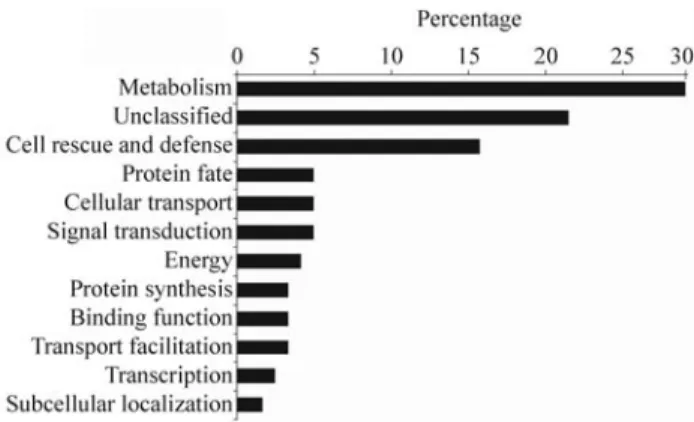
We generated a total of 17,867 ESTs fromPoncirus trifoliata,with 8,926 reads coming from CTV inoculated and 8,941 reads from the control source. A total of 2,782 TCs (Tentative Consensi sequences) were obtained using both cDNA libraries in a single clusterization procedure. Through thein silicohybridization approach, 289 TCs were identified as differentially expressed in the two libraries. A total of 121 TCs out of these were found to be putatively overexpressed in plants infected with CTV (Table 1), while 168 TCs were potentially underexpressed. The 121 overexpressed TCs were grouped in 12 primary functional categories and the 168 underexpressed TCs were grouped in 16 categories (data not shown). An overview of the functional categorization of the putative overexpressed TCs with known or predicted functions is presented in Figure 1.
The largest set of genes (29.75%) was assigned to the metabolism category, while genes involved in transcription constituted the smallest group, comprising less than 2.47% of the genes. Genes involved in signal transduction and pro-tein destination/storage were 4.95%. Genes implicated in stress/defense response constituted 15.70% of the infected cDNA collection. Proteins with unknown functions corre-sponded to 21.48%. They were similar to already se-quenced plant genes of unknown function and might be an additional source of genes participating in the expression of citrus in response to biotic stresses.
General responses to theCitrus tristeza virus
Synthesis of phenylpropanoids
We identified several genes involved in the biosyn-thesis of defense-related secondary metabolites (phenyl-propanoids and phytoalexins). Together, these metabolites function in a variety of defense-related processes, including the induction of wound response, antimicrobial and anti-fungal defense, and antioxidant defense (Verica et al., 2004).
hydro-Table 1- Functional categories of genes detected as overexpressed inPoncirus trifoliatainfected withCitrus tristeza virusat 90 days after inoculation.
Functional category Best blast match Organism Accession number % identity e-value
01. Metabolism
Alanine-glyoxylate aminotransferase Arabidopsis thaliana AT2G13360 86 0.0
Enolase Ricinus communis CAA82232.1 92 e-179
S-adenosylmethionine (adoMetDC2) Arabidopsis thaliana AT5G15950 67 e-125
Neutral invertase Arabidopsis thaliana AT1G56560 74 0.0
4-Coumarate -CoA ligase Arabidopsis thaliana AT1G65060 63 3e-78
Phosphoribulokinase Arabidopsis thaliana AAN15338 92 e-108
Proline iminopeptidase Arabidopsis thaliana AT2G14260 83 1e-71
Phosphoribosylglycinamide Formyltransferase 2 Bordetella parapertussis NP886172.1 85 3e-13
Thiazole biosynthetic enzyme precursor Citrus sinensis cab05370.1 95 e-118
Thiazole biosynthetic enzyme precursor Citrus sinensis cab05370.1 84 e-156
ACC Synthase Arabidopsis thaliana AT5G51690 67 e-129
ACC Oxidase Arabidopsis thaliana AT1G05010 75 e-148
Ethylene forming enzyme (ACO) Arabidopsis thaliana AAM613662.1 67 e-85
Anthranilate N-Benzoyltransferase Arabidopsis thaliana AT5G01210 65 2e-82
Flavonol synthase Oryza sativa XP-482984.1 45 2e-68
Cinnamoyl CoA reductase Arabidopsis thaliana AT2G02400 67 e-129
Caffeic acid O-Methyltransferase Arabidopsis thaliana AT3G53140 74 e-155
Xyloglucan endo-transglycosylase Arabidopsis thaliana AT1G14720 69 e-135
Fructose-biphosphate aldolase Arabidopsis thaliana AT4G26530 75 1e-22
Anthocyanin5-aromatic acyltransferase Arabidopsis thaliana AT3G29590 39 3e-72
UMP synthase Arabidopsis thaliana AT3G54470 85 e-111
Putative glyoxysomal malate dehydrogenase Arabidopsis thaliana AT2G36790 50 4e-61
Cobalamin Synthase Arabidopsis thaliana NP-173974 77 6e-82
Methylthioadenosine/S-adenosyl homocysteine nucleosidase
Oryza sativa NP-910292.1 71 4e-84
Phosphate/phosphoenolpyruvate Arabidopsis thaliana AT5G33320 47 2e-35
Phosphoenolpyruvate carboxylase Glycine max AAS67005.1 86 0.0
Putative Prolyl endopeptidase Arabidopsis thaliana AAL86330.1 72 0.0
Sucrose synthase Citrus unshiu BAA88904.1 98 e-117
Sedoheptulose-Biphosphatase Arabidopsis thaliana AT3G55800 82 0.0
3-ketoacyl-CoA thiolase Arabidopsis thaliana AT2G33150 89 e-174
Inositol 1,3,4-Triphosphate Arabidopsis thaliana AT4G08170 90 1e-75
Flavonol synthase Oryza sativa XP-482984.1 45 2e-68
Sucrose synthase Citrus unshiu BAA88904.1 98 e-117
UDP-Glucoyl transferase Arabidopsis thaliana AT2G36790 50 4e-61
UDP-Glucose Glucosyltransferase Rhodiola sachalinensis AAS55083.1 56 e-110
Glycosyltransferase NTGT5a Nicotiana tabacum BAD93689.1 65 1e-87
02. Energy
Chlorophyll A/B-binding protein Arabidopsis thaliana AT4G10340 83 5e-96
Photosystem II Polypeptide Arabidopsis thaliana AAM20194.1 82 2e-57
Ribulose 1,5-Biphosphate Carboxylase Manihot esculenta AAF06101.1 81 1e-42
NADP-Dependent Glyceraldehyde-3-phosphate Dehydrogenase
Arabidopsis thaliana AT2G24270 90 0.0
Protein I Photosystem II oxygen-evolving Arabidopsis thaliana AT3G50820 79 e-155
04. Transcription
Ein3-like Cucumis melo BAB64345.1 55 5e-78
RNA polymerase Sigma 70 Arabidopsis thaliana AT2G36990 58 1e-44
Table 1 (cont.)
Functional category Best blast match Organism Accession number % identity e-value
05. Protein synthesis
Translation initiation factor eIF-2 Beta chain Arabidopsis thaliana AT5G20920 76 e-113
30 Ribosomal protein S5 Arabidopsis thaliana AT2G33800 69 e-109
60S Ribosomal protein L1 Arabidopsis thaliana AT3G09630 87 e-104
50S Ribosomal protein L13 Arabidopsis thaliana AAD30573.1 66 3e-90
06. Protein fate (folding, modification, destination)
Hydroxypyruvate reductase (HPR) Arabidopsis thaliana AT1G68010 90 0.0
FtsH chloroplast protease Arabidopsis thaliana AT2G30950 86 0.0
Expressed protein Arabidopsis thaliana NP 178048.1 33 3e-21
Ketoacyl-CoA Arabidopsis thaliana AT2G33150 89 e-174
ATP-dependent Clp protease Arabidopsis thaliana AT5G50920 92 0.0
Transformer-SR ribonucleoprotein putative Arabidopsis thaliana AT1G07350 51 1e-40
08. Cellular transport and transport mechanism
ABC transporter Arabidopsis thaliana NP-188762.2 78 0.0
ABC Transporter protein 1-Like Arabidopsis thaliana AT5G64840 86 e-132
Peroximal membrane related protein Arabidopsis thaliana NP564615.1 87 7e-84
Rieske iron-sulfur protein Nicotiana tabacum AAA20832.1 73 1e-94
Sulfate transporter 2 Lycopersicon esculentum AAK27688.1 80 0.0
ADP-rybosylation factor-like protein Arabidopsis thaliana AT3G62290 97 e-100
10. Cellular communication/Signal transduction mechanism
BIS (5-Adenosyl triphosphatase; histidine triad) Arabidopsis thaliana AT5G58240 67 3e-55
Rab-type small GTP-binding Arabidopsis thaliana AT5G45750 100 7e-12
Ras-related GTP-binding Arabidopsis thaliana AT5G45130 56 8e-99
CONSTAINS- like- B Box Zinc Finger Arabidopsis thaliana AT5G57660 54 e-103
Zinc Finger Arabidopsis thaliana NP-197938.2 72 e-133
14-3-3 Protein GF14 Arabidopsis thaliana AT5G65430 86 e-117
11. Cell rescue, defense and virulence
NADPH Oxydase Arabidopsis thaliana AT5G49730 59 3e-59
Germin-like protein Arabidopsis thaliana AT1G72610 68 6e-76
Papain-like Cysteine proteinase Gossypium hirsuntum CAE54306.1 75 e-113
Chitinase Citrus sinensis CAA938471 89 e-107
Ankyrin Vitis aestivalis AAQ96339.1 66 4e-85
NADPH-Ferrihemoprotein reductase (ATR2) Arabidopsis thaliana AT4G30210 81 0.0
N-Rich protein Glycine max CAI44933.1 60 e-110
SRG1 Arabidopsis thaliana AT1G17020 56 e-116
Miraculin-like protein 2 Citrus paradisi AAG38518.1 44 7e-42
Miraculin-like protein 3 Citrus paradisi AAG38519.1 39 4e-31
DNAJ Arabidopsis thaliana AT3G44110 84 0.0
High molecular weight heat shock protein Malus x domestica AAF34134 93 e-147
TCP1-chaperonin cofactor A Arabidopsis thaliana AAM63030.1 82 6e-46
Cytochrome P450 Arabidopsis thaliana AT3G52970 40 4e-50
Peroxidase prxr1 Arabidopsis thaliana AT4G21960 83 e-159
Type I proteinase inhibitor-like protein Citrus paradisi AAN76363.1 97 4e-65
Resistance protein Arabidopsis thaliana AT5G52780 45 3e-29
Putative auxin-induced protein Arabidopsis thaliana AT1G23740 73 e-125
xycinnamoyl-CoA:shikimate /quinate hydroxycinnamoyl transferase seems to control the biosynthesis and turnover of major plant phenolic compounds such as lignin and chlorogenic acid. Benzoyl-CoA:anthranilate N-benzoyl-transferase catalyzes the first committed reaction of phyto-alexin biosynthesis in carnation (Dianthus caryophyllusL.) (Reinhard and Matern, 1989).
Only a few studies have demonstrated the antiviral activity of phenylpropanoids against plant viruses (Chong
et al., 2002). However, a range of flavonoids inhibit the infectivity ofTobacco mosaic virus(TMV) (Frenchet al., 1991). Up-regulation of the flavonol synthase encoding gene reported here may be involved in such a resistance mechanism inP. trifoliataagainst CTV.
Table 1 (cont.)
Functional category Best blast match Organism Accession number % identity e-value
40. Subcellular localization
CP12 protein Arabidopsis thaliana AT3G62410 56 3e-31
Coatomer complex subunit Arabidopsis thaliana AT1G52360 78 e-156
63. Protein with binding function or cofactor requirement
NADP/NADP binding Arabidopsis thaliana AT1G42970 85 0.0
DNA binding protein Arabidopsis thaliana AAN13013.1 60 e-156
Arabidopsisdynamin like protein ADL2 Arabidopsis thaliana AT4G33650 59 3e-34
RNA binding protein Arabidopsis thaliana AT1G09340 78 e-143
67. Transport facilitation
Aquaporin Arabidopsis thaliana AT3G01280 73 e-115
Aquaporin Arabidopsis thaliana AT2G45960 89 e-150
Aquaporin Arabidopsis thaliana AT2G36830 80 e-115
Aldo/Keto reductase Fragaria x ananassa AAV28174.1 61 e-115
99. Unclassified protein
Arabidopsis thaliana AAM63493.1 59 1e-39
Arabidopsis thaliana AT3G09050 63 1e-86
Arabidopsis thaliana AT1G44920 69 5e-80
Arabidopsis thaliana AT2G46820 64 2e-57
Arabidopsis thaliana AT2G39570 59 1e-11
Arabidopsis thaliana AT3G58900 52 3e-07
Arabidopsis thaliana AT2G16350 38 7e-22
Arabidopsis thaliana AT4G11570 77 3e-16
Arabidopsis thaliana AT3G52740 52 2e-25
Arabidopsis thaliana AT1G48090 74 e-119
Arabidopsis thaliana AT1G63610 72 e-129
Arabidopsis thaliana AT3G57890 71 0.0
Arabidopsis thaliana AT2G03440 50 4e-26
Arabidopsis thaliana AT1G74640 81 e-130
Arabidopsis thaliana AT4G32020 41 7e-25
Arabidopsis thaliana AT2G44310 80 5e-61
Arabidopsis thaliana AT3G07760 91 6e-64
Arabidopsis thaliana AT1G15340 47 9e-54
Arabidopsis thaliana AT2G35330 69 1e-64
Arabidopsis thaliana AT3G56360 42 1e-40
Arabidopsis thaliana AT3G22850 75 e-110
Arabidopsis thaliana AT1G09930 58 e-112
Arabidopsis thaliana AT5G53450 66 0.0
Arabidopsis thaliana AT3G21360 74 e-146
Arabidopsis thaliana AT5G23950 43 1e-49
Cell wall changes
Cell wall reinforcement and thickening are associated with plant defense during resistance responses. In this study, we found two TCs (cinnamoyl-CoA reductase and caffeic acid-O-methyltransferase) whose expression is as-sociated with lignification in several dicot species (Ye, 1997; Yeet al., 2001). Lignin is a complex phenolic poly-mer that reinforces the walls of certain cells in higher plants. Such reinforcement is an effective defense response against infection by pathogens (Kawasakiet al., 2006). In addition, many antimicrobial substances such as phytoa-lexins are known to be produced by the monolignol syn-thetic pathways. It is therefore likely that lignin and lignin-related compounds with antimicrobial activities co-operatively play important roles in disease resistance of various plant species. Lignin synthesis was induced in soy-bean leaves inoculated withSoybean mosaic virus(SMV) (Hajimorad and Hill, 2001).
According to Jaecket al.(1992) the regulation of an enzyme involved in lignin biosynthesis, an O-methyltrans-ferase occurred during the hypersensitive reaction of to-bacco in interactions with TMV.
Phytohormones
In the present work we also identified four TCs (S-adenosylmethionine adoMetDC2) (SAM), ACC syntha-se, ACC oxidase and ethylene forming enzyme (ACO) whose expression is putatively overexpressed under condi-tions inducing ethylene biosynthesis (Gomez-Gomez and Carrasco, 1998). SAM serves as a precursor of the plant hormone ethylene, implicated in the control of numerous developmental processes (Kende, 1993). In a cDNA li-brary, prepared from leaves of TMV-infected tobacco after TMV infection and subsequent recognition of the pathogen by the host, ethylene is produced by the conversion of S-adenosyl-L-methionine (SAM) into ACC. ACC is then converted into ethylene, carbon dioxide and cyanide. Eth-ylene production generates a molecular and genetic cascade of responses that lead to the induction of host
defense-related genes (Knoesteret al., 1995). In the present work, the up-regulation of ACC enzymes suggests a possible TMV-like interaction and, thus, indicates that ethylene par-ticipates in the response to CTV infection.
Additionally, a TC coding for a putative EIN3-like protein (an important component in ethylene signal trans-duction pathway) was identified, corroborating the possible participation of ethylene in the plant response to CTV in-fection.
Defense-related genes
The third largest functional category (accounting for 15.70% of the differentially expressed genes) was cell res-cue, defense, cell death and ageing. This group includes putative homologs of ankyrin, NADPH oxydase, germin, papain-like cysteine proteinase, chitinase, NADPH-ferri-hemoprotein reductase (ATR2), N-rich protein, SRG1, miraculin-like protein 2, miraculin-like protein 3, DNAJ, TCP1-chaperonin cofactor A, cytochrome P450, peroxi-dase prxr1 PR9, type I proteinase inhibitor-like protein, re-sistance protein, putative auxin-induced protein and LLS1-like protein.
A N-rich protein was found overexpressed in CTV in-oculated plants in the present work. According to Ludwig and Tenhaken (2001), the NRP gene appears to be a new marker in early responses in plant disease resistance. The protein is located in the cell wall, with a very high content of asparagines and was, therefore, termed N-rich protein (NRP). The NRP-gene is not directly induced by salicylic acid or hydrogen peroxide, indicating a distinct and specific signal transduction pathway which is only activated during programmed cell death.
One of the putative TCs related to cell defense showed similarity to LLS1 (Lethal leaf spot-1) that has a role in cell death-suppression. LLS1 may act to prevent reactive oxida-tive species formation or serve to remove a cell death media-tor to maintain chloroplast integrity and cell survival. Yang
et al.(2004) demonstrated that the LLS1 protein is present constitutively in all photosynthetic plant tissues and that a transient increase in Lls1 gene expression by about 50-fold upon physical wounding of maize leaves indicates that the function of Lls1 is regulated in response to stress.
We also found genes encoding miraculin-like protein 2 and miraculin-like protein 3 ofCitrus paradise in the CTV infected libraries. In Citrus jambhiri, two distinct transcripts of miraculin-like proteins accumulated to higher levels in leaves after wounding, inoculation with conidia of
Alternaria alternata, or treatment with methyl jasmonate vapors (Tsukudaet al., 2006). Stress-inducible genes such as pathogenesis-related class Chitinase (PR3), PR10 (SGR1), Peroxidase prxpr1 (PR9) and a germin-like pro-tein (PR16) were also observed as potentially over-expressed transcripts in CTV inoculated plants.
An important common feature of most PRs is their antifungal effect. Some PR also exhibit antibacterial, insec-Figure 1- Functional classification following MIPS categories (Munich
ticidal, nematicidal and, as recently shown, anti-viral action. PR-10 induced in hot pepper by incompatible inter-actions with TMV pathotype (TMV-Po) andXanthomonas campestriswas shown to function as a ribonuclease. A hot pepper (Capsicum annuum) cDNA clone encoding pathogenesis-related protein 10 (CaPR-10) was isolated by differential screening of a cDNA library prepared from pepper leaves inoculated with TMV-Po (Parket al., 2004). The inoculation and subsequent phosphorylation of CaPR-10 increased its ribonucleolytic activity to cleave invading viral RNAs, and this activity should be important to its anti-viral pathway during anti-viral attack in vivo. In the present work, one TC wasSRG1, a gene of unknown function that is a member of the PR-10 family (Truesdell and Dickman, 1997) that was also represented in ESTs libraries from ca-cao leaves treated with inducers of defense response like methyl jasmonate/ethylene (Vericaet al., 2004). Xuet al.
(2003) showed for the first time that multiple defense re-sponses are specifically induced inCucumber mosaic virus
(CMV) and D satRNA (CMV/D satRNA)-infected tomato plants, but not in mock-inoculated or CMV-infected plants. These responses include callus deposition and hydrogen peroxide accumulation in infected plants. Furthermore, the transcription of several tomato defense-related genes (e.g., PR-1a1, PR-1b1, PR-2, and PR-10) was activated, and the expression of tomato PR-5 and some abiotic and biotic stress-responsive genes are enhanced.
The germin-like protein (PR16) was also observed as overexpressed in CTV inoculated plants. The multifaceted functionality of PR-15 and PR-16, including a cell wall re-modeling ability, can be directed against pathogens and may have protective role (Parket al., 2004). Germins and germin-like proteins (GLPs) have been classified as PR-15 and PR-16. PR-16 has been isolated from hot pepper during the resistance response to bacterial and viral infection (Edreva, 2005). Another overexpressed gene in the pres-ence of the CTV was the peroxidase encoding prxr1. Pero-xidase prxr1 is considered a PR9 peroPero-xidase that probably strengthens plant cell walls by catalyzing lignin deposition in reaction to microbial attacks (Schereret al., 2005).
InP. trifoliataplants,PR-2,PR-3,PR-15andPR-16
gene families were highly expressed within leaves after in-fection by CTV, whereas no expression was found for other
PRgene families (Camposet al., in this issue). According to these authors, the differentialPRgene expression pro-files vary between infected and healthy tissues, as well as between different pathogen infections. For instance, the high expression of thePR-3,PR-15andPR-16gene fami-lies withinP. trifoliataleaves upon CTV inoculation was found to be suppressed in steam bark afterP. parasitica in-fection. This indicates that it is also possible thatPRgene expression profiles may vary among tissues.
BAC clones of Ctv
Citrus tristeza virus(CTV) is an important pathogen of Citrus. A single dominant geneCtv, present inPoncirus
trifoliata,confers broad spectrum resistance against CTV (Gmitteret al., 1996). BAC clones and their use as anchors localizedCtvto a 282,699 bp region, comprising 22 pre-dicted genes (Ctv.1 toCtv.22) (Yanget al., 2003). Refine-ment of genetic maps delimited this gene to a 121 kb region, comprising ten candidateCtvresistance genes. The ten candidate genes were individually cloned in an
Agrobacteriumbased binary vector and transformed into three CTV susceptible grapefruit varieties (Rai, 2006). The authors found that two of the candidate R-genes, R-2 and R-3 were exclusively expressed in transgenic plants and in
Poncirus trifoliata, while five other genes are also ex-pressed in non-transformed Citrus controls.
In the present work, no significant differences could be observed in the expression profiles of theCtvregions (Ctv.1 toCtv.22) ofPoncirus trifoliata,challenged or not with CTV. Homologs of Ctv.2, Ctv.3, Ctv.10, Ctv.12, Ctv.15, Ctv.20,and Ctv.22 were identified in inoculated and non-inoculatedPoncirus leaf libraries, as well as in other libraries constructed fromPoncirus bark and seeds (data not shown). Moreover,Ctvhomologs were also pres-ent in libraries constructed from all tissues (leaf, bark, fruit, flower, root, and seed) and allCitrusspecies analyzed in the CitEST database (C. aurantifolia, C. aurantium, C. latifolia, C. limettioides, C. limonia, C. reticulata, C. sinensis,andC. sunki). It is possible that theCtvBAC clone regions may be involved in resistance to CTV inP. trifoli-ata, as suggested by Yang et al.(2003) and Rai (2006). Nevertheless, the observation thatCtvhomologs seem to be expressed in the related genusCitrus, including in highly susceptible species such as C. aurantium, indicates that they are not a major component in resistance, or that they behave in a very unexpected fashion. TheCtvBAC clone regions may not exhibit the characteristics of a typical re-sistance gene, and it has not been unequivocally shown that they confer resistance to CTV. Hence, further experiments will need to address whether or not theCtvregions play an important role in CTV resistance, and which of them are re-sponsible for the major component of such resistance.
Concluding Remarks
CTV resistance inP. trifoliataprevents viral prolifer-ation in plants by an undetermined mechanism, essentially resulting in immunity. Lack of a visual hypersensitive re-sponse in inoculated plants or in rootstocks with infected susceptible scions suggests that resistance is associated with the interruption of some step in viral multiplication.
would have to assume an atypical mechanism of resistance that would have to be investigated in further experiments.
References
Albiach-Marti MR, Grosser JW, Gowda S, Mawassi M, Satya-narayana T, Garnsey S and Dawson WO (2004) Citrus tristeza virusreplicates and forms infectious virions in pro-toplasts of resistant citrus relatives. Mol Breed 14:117-128. Altschul SF, Madden TL, Schäffer AA, Zhang J, Zhang Z, Miller W and Lipman DJ (1997) Gapped BLAST and PSI-BLAST: A new generation of protein database search programs. Nu-cleic Acids Res 25:3389-3402.
Audic S and Claverie JM (1997) The significance of digital gene expression profiles. Genome Res 7:986-995.
Chong J, Baltz R, Schmitt C, Beffa R, Fritig B and Saindrenan P (2002) Downregulation of a pathogen-responsive tobacco UDP-Glc:phenylpropanoid glucosyltransferase reduces scopoletin glucoside accumulation, enhances oxidative stress, and weakens virus resistance. Plant Cell 14:1093-1107.
Edreva A (2005) Pathogenesis-related proteins: Research prog-ress in the last 15 years. Gen Appl Plant Physiology 31:105-124.
French CJ, Elder M, Leggett F, Ibrahim RK and Towers GHN (1991). Flavonoids inhibit infectivity of tobacco mosaic vi-rus. Can J Plant Pathol 13:1-6.
Gomez-Gomez L and Carrasco P (1998) Differential expression of the S-adenosyl-L-methionine synthetase genes during pea development. Plant Physiol 117:397-405.
Gmitter FG, Xiao SY, Huang S, Hu XL, Garnsey SM and Deng Z (1996) A localized linkage map of citrus tristeza virus resis-tance gene region. Theor Appl Genet 92:688-695.
Hajimorad MR and Hill JH (2001) Rsv1-mediated resistance against Soybean mosaic virus- N is hypersensitive re-sponse-independent at inoculation site but has the potential to initiate a hypersensitive response-like mechanism. Mol Plant-Microbe Interact 14:587-598.
Huang X and Madan A (1999) CAP3: A DNA sequence assembly program. Genome Res 9:868-877.
Jaeck E, Dumas B, Geoffroy P, Favet N, Inze D, van Montagu M, Fritig B and Legrand M (1992) Regulation of enzymes in-volved in lignin biosynthesis: Induction of O-methyltrans-ferase rnRNAs during the hypersensitive reaction of tobacco to tobacco mosaic virus. Mol Plant-Microbe Interact 5:294-300.
Kang BC, Yeam I and Jahn MM (2005) Genetics of plant virus re-sistance. Annu Rev Phytopathol 43:581-621.
Kawasaki T, Koita H, Nakatsubo T, Hasegawa K, Wakabayashi K, Takahashi H, Umemura K, Umezawa T and Shimamoto K (2006) Cinnamoyl-CoA reductase, a key enzyme in lignin biosynthesis, is an effector of small GTPase Rac in defense signaling in rice. Proc Natl Acad Sci USA 103:230-235. Kende H (1993) Ethylene biosynthesis. Annu Rev Plant Physiol
Plant Mol Biol 44:283-534.
Knoester M, Bol JF, van Loon LC and Linthorst HJ (1995) Vi-rus-induced gene expression for enzymes of ethylene
bio-synthesis in hypersensitively reacting tobacco. Mol Plant-Microbe Interact 8:177-180.
Ludwig AA and Tenhaken RA (2001) New cell wall located N-rich protein is strongly induced during the hypersensitive response inGlycine maxL. Eur J Plant Pathol 107:323-336. Mestre PF, Asíns MJ, Carbonell EA and Navarro L (1997) New
gene(s) involved in the resistance ofPoncirus trifoliata(L.) Raf. toCitrus tristeza virus. Theor Appl Genet 95:691-695. Park CJ, Kim KJ, Shin R, Park JM, Shin YC and Paek KH (2004)
Pathogenesis-related protein 10 isolated from hot pepper functions as a ribonuclease in an antiviral pathway. Plant J 37:186-98.
Rai M (2006) Refinement of theCitrus tristeza virusresistance gene (Ctv) positional map inPoncirus trifoliataand genera-tion of transgenic grapefruit (Citrus paradise) plant lines with candidate resistance genes in this region. Plant Mol Biol 61:399-414.
Reinhard K and Matern U (1989) The biosynthesis of phytoa-lexins inDianthus caryophyllusL. cell cultures: Induction of benzoyl-CoA: Anthranilate N-benzoyltransferases activ-ity. Arch Biochem Biophys 275:295-301.
Scherer NM, Thompson CE, Freitas LF, Bonatto SL and Salzano FM (2005) Patterns of molecular evolution in pathogenesis-related proteins. Genet Mol Biol 28:645-653.
Truesdell GM and Dickman MB (1997) Isolation of patho-gen/stress-inducible cDNAs from alfalfa by mRNA differ-ential display. Plant Mol Biol 33:737-743.
Tsukuda S, Gomi K, Yamamoto H and Akimitsu K (2006) Char-acterization of cDNAs encoding two distinct miraculin-like proteins and stress-related modulation of the corresponding mRNAs inCitrus jambhirilush. Plant Mol Biol 60:125-136. Verica JA, Maximova SN, Strem MD, Carlson JE, Bailey BA and
Guiltinan MJ (2004) Isolation of ESTs from cacao (Theobroma cacaoL.) leaves treated with inducers of the defense response. Plant Cell Rep 23:404-413.
Xu P, Blancaflor EB and Roossinck MJ (2003) In spite of induced multiple defense responses, tomato plants infected with Cu-cumber mosaic virusand D satellite RNA succumb to sys-temic necrosis. Mol Plant-Microbe Interact 16:467-476. Yang M, Wardzala E, Johal GS and Gray J (2004) The
wound-inducible Lls1 gene from maize is an orthologue of the
Arabidopsis Acd1gene, and the LLS1 protein is present in non-photosynthetic tissues. Plant Mol Biol 54:175-91. Yang ZN, Ye XR, Molina J, Roose ML and Mirkov TE (2003)
Se-quence analysis of a 282-kilobase region surrounding the
Citrus tristeza virusresistance gene (Ctv) locus inPoncirus trifoliataL. Raf. Plant Physiol 131:482-492.
Ye ZH (1997) Association of caffeoyl CoA 3-O-methyltrans-ferase expression with lignifying tissues in several dicot plants. Plant Physiol 115:1341-1350.
Ye ZH, Zhonga R, Morrison WH 3rd and Himmelsbach DS (2001) Caffeoyl coenzyme A O-methyltransferase and lig-nin biosynthesis. Phytochemistry 57:1177-1185.
Internet Resources
MIPS Functional Categories (FunCat), http://mips.gsf.de/projects/ funcat (August 15, 2006).