Dispersion of transposable elements and multigene families: Microstructural
variation in
Characidium
(Characiformes: Crenuchidae) genomes
Marcela Baer Pucci
1, Viviane Nogaroto
2, Orlando Moreira-Filho
1and Marcelo Ricardo Vicari
21
Departamento de Genética e Evolução, Universidade Federal de São Carlos, São Carlos, SP, Brazil.
2Departamento de Biologia Estrutural, Molecular e Genética, Universidade Estadual de Ponta Grossa
Ponta Grossa, PR, Brazil.
Abstract
Eukaryotic genomes consist of several repetitive DNAs, including dispersed DNA sequences that move between chromosome sites, tandem repeats of DNA sequences, and multigene families. In this study, repeated sequences isolated from the genome ofCharacidium gomesi were analyzed and mapped to chromosomes in Characidium ze-bra and specimens from two populations of C. gomesi. The sequences were transposable elements (TEs) named retroelement ofXiphophorus (Rex); multigene families of U2 small nuclear RNA (U2 snRNA); and histones H1, H3, and H4. Sequence analyses revealed thatU2 snRNA contains a major portion corresponding to the Tx1-type non-LTR retrotransposonKeno, the preferential insertion sites of which are U2 snRNA sequences. All histone se-quences were found to be associated with TEs.In situ localization revealed that these DNA sequences are dispersed throughout the autosomes of the species, but they are not involved in differentiation of the specific region of the W sex chromosome in C. gomesi. We discuss mechanisms of TE invasion into multigene families that lead to microstructural variation inCharacidium genomes.
Keywords: Mobile DNA, histones, karyotype evolution, snRNA, WZ/ZZ. Received: April 25, 2017; Accepted: November 29, 2017.
Introduction
The genomes of all studied eukaryotic species pri-marily consist of repetitive sequences that are dispersed or found in tandem (Sumner, 2003). Repetitive sequences were identified in fragile sites and evolutionary break point regions, promoting non-B DNA conformations and dou-ble-strand breaks, which are involved in chromosomal rear-rangements (Eichler and Sankoff, 2003; Szamalek, 2005; Wells, 2007; Barroset al., 2017). Repetitive sequences are also responsible for a significant portion of the karyotype variations observed in many groups of organisms (Kidwell, 2002).
Dispersed DNA sequences can move between chro-mosome sites, with this movement occurring in the pres-ence or abspres-ence of RNA as a transposition intermediate (Tollis and Boissinot, 2012). These mobile segments are called transposable elements (TEs) and are classified as retrotransposons (class I elements, RNA intermediates of the transposition process) or transposons (class II elements, DNA intermediates of the transposition process) (Wickeret al., 2007). These mobile elements can drive genetic and
genomic evolution and influence eukaryotic gene regula-tory systems (Feschotte, 2008). In addition to consisting of dispersed DNA sequences, eukaryotic genomes are also en-riched in tandem repeats of DNA sequences (Hardman, 1986) and groups of repeated and linked genes located at the same chromosomal region, shaping clustered but not tandemly repeated genes such as multigene families (Hentschel and Birnstiel, 1981; Heintzet al., 1991).
A multigene family is described as a group of genes with similar functions and sequences that originate from a common ancestral gene (Nei and Rooney, 2005). TheU2 small nuclear RNA (U2 snRNA) sequence represents a multigene family of snRNA that control premessenger RNA intron splicing (Nei and Rooney, 2005). Histone genes do not have introns, and they comprise a multigene family in which the five genes are in the same order but sep-arated by spacer DNA (Hentschel and Birnstiel, 1981). In the rainbow trout (Salmo gairdneri), the histones are pres-ent in the order ofH4-H2B-H1-H2A-H3, and they are tran-scribed from the same strand (Connoret al., 1984).
Concerning genome diversification, fish represent an important group for studies of genetic variability. The ge-nusCharacidium(Characiformes: Crenuchidae) presents a diversified karyotype microstructure despite its conserved karyotype macrostructure and prevalent diploid number
DOI: http://dx.doi.org/10.1590/1678-4685-GMB-2017-0121
Send correspondence to Marcelo Ricardo Vicari. Departamento de Biologia Estrutural, Molecular e Genética, Universidade Estadual de Ponta Grossa, Av. Carlos Cavalcanti, 4748, 84030-900 Ponta Grossa, PR, Brazil. E-mail: [email protected]
(2n) of 50 (Centofante et al., 2001, 2003; Vicari et al., 2008; Pazianet al., 2013; Scacchettiet al., 2015a; Pucciet al., 2016; Serranoet al., 2017). TheCharacidiumspecies studied to date exhibited differences mainly in the number of ribosomal DNA sites and sex chromosomes (Panso-nato-Alves et al., 2010, 2011, 2014; Pucci et al., 2014; Scacchettiet al., 2015a, Utsunomiaet al., 2017), as well as an interesting dynamic of repetitive DNAs (Scacchettiet al., 2015b; Pucciet al., 2016).
The primary goal of this study was to perform se-quence analyses and chromosome mapping of some re-peated sequences isolated from the genome ofC. gomesi. Retroelement ofXiphophorus(Rex) TEs were mapped to chromosomes to elucidate their possible involvement in Characidiumkaryotype evolution and diversification. The multigene families ofU2 snRNAand histonesH1,H3, and H4were also investigated through chromosome mapping and sequence analyses. Our study revealed associations be-tween TEs and the multigene families. The obtained results will improve our understanding of the evolution and diver-sification ofCharacidiumgenomes.
Materials and Methods
Sampling and chromosome preparation
Individuals of the following species were collected at the indicated locations: C. zebra (15 specimens; Paiol Grande Stream, São Bento do Sapucaí, SP) andC. gomesi (nine specimens; Paiol Grande Stream, São Bento do Sapu-caí, SP/five specimens; São João River, Carambeí, PR). Chromosomes for analyses were obtained using the ‘air-drying’ procedure (Bertollo et al., 1978). The analyzed specimens were then deposited in the following ichthyol-ogy museums: Núcleo de Pesquisas em Limnologia, Ictio-logia e Aquicultura (Nupelia), Universidade Estadual de Maringá, and Museu Nacional, Rio de Janeiro, Brazil, voucher numbers (NUP 14577–14580; MNRJ 29183). The processing was performed in accordance with the Ethical Committee on Animal Use (CEUA 29/2016) of the Uni-versidade Estadual de Ponta Grossa and current Brazilian legislation. Chromosome preparations were subjected to conventional Giemsa staining to determine 2n and the chro-mosome formula.
Sequence isolation
The analyzed sequences were synthesized by poly-merase chain reaction (PCR) using genomic DNA fromC. gomesi(São João River population), and the reaction mix-tures consisted of 100–200 ng of genomic DNA, 0.04–0.2
mM primers, 0.04–0.16 mM dNTPs, 1 U ofTaqDNA Poly-merase (Invitrogen, Waltham, MA, USA), and 1.5 mM MgCl2in a 1 reaction buffer (200 mM Tris, pH 8.4, 500
mM KCl). The specific PCR mixtures and primers se-quences are summarized in Table S1. The PCR conditions were as follows: (i)Rex1andRex3probes: 95 °C for 5 min,
35 cycles of 95 °C for 1 min, 55 °C for 40 s and 72 °C for 2 min, and a final extension at 72 °C for 5 min; (ii)U2 snRNA probe: 95 °C for 45 s, 30 cycles of 95 °C for 45 s, 52 °C for 45 s and 72 °C for 80 s, and a final extension at 72 °C for 7 min; and (iii) histones H1, H3, and H4: 95 °C for 5 min, 30 cycles of 95 °C for 30 s, 52 °C for 45 s and 72 °C for 80 s, and a final extension at 72 °C for 7 min.
TEs and multigene family sequences: Sequencing and analyses
After the amplification reactions, the PCR products were purified using the GenElute PCR Clean-Up Kit (Sigma Aldrich, St Louis, MO, USA).Rex1andRex3 se-quences were cloned using pGEM®-T Easy Vector Sys-tems (Promega, Madison, WI, USA). The obtained clones were sequenced using an ABI-PRISM Genetic Analyzer (Applied Biosystems, Carlsbad, CA, USA). The sequences were edited and analyzed using Geneious 7.1.3 software (Kearseet al., 2012), and their identities were confirmed using the CENSOR tool for repeated sequences (Girinst) (Kohanyet al., 2006) and BLASTn(NCBI). Finally, the se-quences were deposited in GenBank (Table S2).
Probe preparation
The sequences ofRex3,U2 snRNA, and histones H1 and H4 were labeled with digoxigenin via nick translation using DIG-Nick Translation Mix (Roche Applied Science, Penzberg, Germany), and those ofRex1and H3 were bio-tinylated using Biotin-Nick Translation Mix (Roche Ap-plied Science). AC. gomesiW-specific chromosome probe was constructed as described by Machadoet al.(2011), la-beled with digoxigenin 11-dUTP (Roche Applied Science), and used in fluorescence in situ hybridization (FISH) to identify sex chromosomes in the karyotypes.
FISH
Chromosome spreads were subjected to FISH using the constructed probes. FISH was performed under a high stringency of approximately 76% (2.5 ng/mL of each probe, 50% formamide, 2 SSC, 10% dextran sulfate, pH 7.0–7.2, 37 °C overnight) following the general procedure described by Pinkelet al.(1986). Signal detection was performed us-ing an anti-streptavidin antibody conjugated to Alexa Fluor 488 (Molecular Probes, Eugene, OR, USA) and an anti-digoxigenin antibody conjugated to rhodamine (Roche Ap-plied Science). Chromosomes were counterstained with 4'6-diamidino-2-phenylindole (0.2mg/mL) in Vectashield mounting medium (Vector Laboratories, Burlingame, CA, USA) and observed under an epifluorescence microscope.
Karyotype analysis
according to the arm ratio (Levanet al., 1964) and arranged by decreasing size in the karyotypes.
Results
Analyses of partial sequences of TEs and multigene families
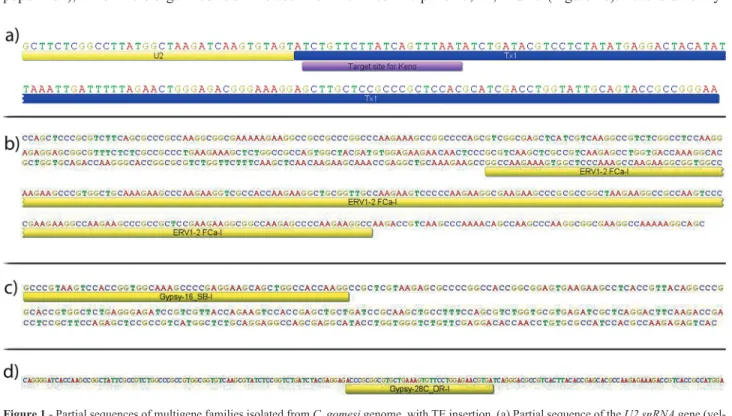
The partial sequences ofRex1,Rex3,U2 snRNA, and the H1, H3, and H4 genes were isolated from the genomes ofC. gomesiandC. zebra, and consensus sequence of each gene was constructed (Table S2). When analyzed using the CENSOR tool, the multigene family sequences displayed high proportions of retrotransposon sequences as follows: U2 snRNA contained the Tx1-type element called Keno-1_SSa(Figure 1a); H1 contained an internal portion (217 bp) of anERV1-type endogenous retrovirus sequence (Figure 1b); H3 displayed an internal portion (52 bp) of the LTR retrotransposonGypsy(Figure 1c), although chromo-some mapping of this sequence only revealed the main H3 histone clusters with no evidence of dispersed clusters; and H4 contained an internal portion (37 bp) of the LTR retro-transposonGypsy(Figure 1d).
Cytogenetics ofCharacidium
The studied species presented a 2n of 50, and these chromosomes have been cytogenetically described by Ma-chadoet al.(2011) and Pucciet al.(2014). Karyotype for-mulae were organized as 32 metacentric + 18 submeta-centric, excluding females ofC. gomesi(São João River population), which were organized as 31 metacentric + 18
submetacentric + 1 subtelocentric. The fundamental num-ber of chromosome arms was 100 in all studied species/populations. No differentiated sex chromosomes were found in the C. zebra population. The C. gomesi W-specific probe revealed sex chromosomes as metacentric pair 2 in C. gomesi from the Paiol Grande Stream population and metacentric Z position 2 and subtelocentric W inC. gomesifrom the São João River pop-ulation (Figure 2, Z and W chromosomes are highlighted in the box).
Chromosome mapping of Rex1 and Rex3 on Characidiumchromosomes
The non-LTR retrotransposonsRex1andRex3inC. zebraandC. gomesiwere observed in a few chromosomes (Figure 2a–e). InC. zebra,Rex1displayed more prominent hybridization signals in metacentric pair 3 and submeta-centric pairs 18 and 19 (Figure 2a). InC. gomesifrom the Paiol Grande Stream population,Rex1exhibited strong sig-nals in metacentric pairs 8 and 13 (Figure 2b). InC. gomesi from the São João River population,Rex1exhibited clear marks in metacentric pairs 4, 5, and 8 and submetacentric pair 19 (Figure 2c). However,Rex1did not display clear marks in the Z and W chromosomes eitherC. gomesi popu-lation (Figure 2b–c). InC. zebra,Rex3exhibited convinc-ing hybridization signals in metacentric pairs 1, 3, and 8 and submetacentric pair 17 (Figure 2d). InC. gomesifrom the São João River population,Rex3displayed signals in metacentric pairs 1, 3, 4, 6, 7, 8, 14, and 16 and submeta-centric pairs 17, 22, and 25 (Figure 2e).Rex3did not
hy-Figure 1- Partial sequences of multigene families isolated fromC. gomesigenome, with TE insertion. (a) Partial sequence of theU2 snRNAgene (yel-low), associated with its specific U2-targetKenoTE (blue); histone partial sequences, with the internal portion of TEs; (b) H1 with retrotransposonERV1
bridize with the Z and W chromosomes ofC. gomesifrom the São João River population (Figure 2e), nor did it exhibit hybridization signals in any chromosome of C. gomesi from the Paiol Grande Stream population (data not shown).
Chromosome mapping of multigene families U2 snRNA and the H1, H3, and H4 genes on Characidiumchromosomes
TheU2 snRNAprobe displayed a single cluster of hy-bridization signals in the pericentromeric region of meta-centric pair 1 in all analyzed species, with no additional dispersed sites detected (Figure 3a–c).
The H1 histone gene probe displayed primary clusters of hybridization signals in the pericentromeric region and short arm of one chromosome of metacentric pair 10, whereas only one cluster was found in the pericentromeric region of the other chromosome in pair 10 ofC. zebra (Fig-ure 3d) and metacentric pair 10 ofC. gomesi(Paiol Grande Stream population). An additional cluster was noted in pair 7 ofC. gomesifrom the Paiol Grande Stream population (Figure 3e) and metacentric pair 5 ofC. gomesifrom the São João River population (Figure 3f). In addition, each species exhibited weak additional signals in several other autosomes (Figure 3d–f).
The H3 gene probe displayed primary clusters of hy-bridization signals in the pericentromeric region and short arm of one chromosome of metacentric pair 10 and one cluster in the pericentromeric region of the other chromo-some in pair 10 ofC. zebra(Figure 3g), the short arm of metacentric pair 10 ofC. gomesi from the Paiol Grande Stream population (Figure 3h). One cluster was also found
in the short arm of metacentric pair 5 ofC. gomesifrom the São João River population (Figure 3i).
The H4 gene probe revealed primary clusters of hy-bridization signals in the pericentromeric region and short arm of one chromosome in metacentric pair 10 and one cluster in the pericentromeric region of the other chromo-some in pair 10 ofC. zebra, as well as additional marks in metacentric pair 9 (Figure 3j) and the short arm of meta-centric pair 10 ofC. gomesifrom the Paiol Grande Stream population (Figure 3k) and a weak signal in metacentric pair 5 ofC. gomesifrom the São João River population (Figure 3l). Marks were also noted in some autosomes of both populations ofC. gomesi(Figure 3k–l).
Discussion
Distribution of Rex1 and Rex3 onCharacidium chromosomes
Rexelements are non-LTR retrotransposons (Wicker et al., 2007) that are extensively distributed through fish genomes (Ozouf-Costazet al., 2004; Ferreiraet al., 2010; Borbaet al., 2013; Schneideret al., 2013; Yanoet al., 2014; Seneet al., 2015; Pinheiroet al., 2016), in addition to those of other species.Rex1andRex3are significant sequences in the organization and evolution of the genomes in most of the aforementioned species, as indicated by evident hybrid-ization signals and prominent amounts of these sequences. In this analysis,Rex1andRex3elements were dispersed in small clusters throughout the chromosomes, and they did not display significant chromosome reorganization be-tweenCharacidiumspecies.
Figure 2- Karyotypes ofCharacidiumfemales subjected to fluorescencein situhybridization (FISH) with TE probes. (a)C. zebra, (b)C. gomesi(PG), (c)C. gomesi(SJ); (d)C. zebra, (e)C. gomesi(SJ). TheRex3probe did not show any hybridization signals inC. gomesi(PG) chromosomes (not shown). The W and Z sex chromosomes ofC. gomesifemales are highlighted in the box. PG, Paiol Grande Stream population; SJ, São João River population.
Concerning the distribution ofRex1andRex3in the sex chromosomes, no hybridization sites were identified in the Z and W sex chromosomes ofCharacidium, whereas these elements are involved in sex chromosome evolution in other species. In particular,Rex3was detected in the Y chromosome of Chionodraco hamatus (Ozouf-Costaz et al., 2004) and X chromosome ofEigenmannia(Seneet al., 2015);Rex1andRex3were found in the W chromosome of Leporinus(Borbaet al., 2013); andRex1,Rex3, andRex6 were identified in the Z and W chromosomes of Triportheus(Yanoet al., 2014). TheRex1andRex3 ele-ments analyzed in theCharacidiumgenome emerged in the ancestral speciesC. zebra. However, these elements did not
exhibit high transposition rates, presenting only small clus-ters in some autosomes in all analyzed species. Moreover, theRex3element was not identified in the genome of C. gomesifrom the Paiol Grande Stream population. Natural selection may minimize the transposition rate, promoting vertical inactivation (Lohe et al., 1995), which could be true forRexelements inCharacidium. Another possible ex-planation for the low transposition rate could be stochastic loss, in which the element is gradually removed from the genome, as observed for mariner-like elements in the Drosophila melanogaster species complex (Lohe et al., 1995) and probably forRex3 inC. gomesifrom the São João River population.
Multigene families and TE insertions
Chromosome mapping ofU2 snRNArevealed local-ized clusters in the first metacentric pair in all studied spe-cies. In fact, the distribution pattern ofU2 snRNAis highly conserved forCharacidium, as described by Scacchettiet al. (2015a), with only some exceptions such as Characidium sp. aff. C. vidali, Characidium sp. 1 (Scacchettiet al., 2015a), and C. alipioi (Serrano et al., 2017). U2 snRNA sequences appear to be conserved in other species, and co-localization and linkage between U2 genes and ribosomal sites has been reported (Cross and Rebordinos, 2005; Manchado et al., 2006; Úbeda-Man-zanaroet al., 2010; Scacchettiet al., 2015a). Despite the presence of conserved clusters, sequence analyses ofU2 snRNAusing the CENSOR tool revealed a major portion corresponding to the Tx1-type non-LTR retrotransposon Keno-1_SSa(Kohany et al., 2006). There are several se-quence-specific families in the Tx element group, andKeno is specific forU2 snRNA(Kojima and Fujiwara, 2004). In-sertion of theKenoelement occurs at a specific site 37 nu-cleotides downstream of U2 snRNA, and its insertion destroys the target (Kojima and Fujiwara, 2004). The Keno-1_SSa(Kohanyet al., 2006) element found in theU2 snRNAsequence ofCharacidiumis classified asKenoDr1 because the specific 3’ target sequence (TCTGTTCTTATCAGTTTAAT) localized 37 nucleo-tides downstream of U2 snRNA (Kojima and Fujiwara, 2004; Kojima and Jurka, 2015). Despite the TE insertion, theU2 snRNAsequence did not exhibit additional clusters.
In situlocalization for the H1, H3, and H4 sequences revealed primary clusters in metacentric pair 10 ofC. zebra andC. gomesifrom the Paiol Grande Stream population as well as metacentric pair 5 ofC. gomesifrom the São João River population. Additional hybridization signals for H1 and H4 were dispersed through the autosomes of the three populations, although not in the sex chromosomes. Chro-mosomal rearrangement and the absence of gene flow re-sulted in the differentiated karyotype ofC. gomesifrom the São João River population, which exhibited primary clus-ters of H1, H3, and H4 in metacentric pair 5 (translocation) and subtelocentric sex chromosome W (inversion). The sites of H3 were also localized to metacentric pair 10 inC. alipioi(Serranoet al., 2017), albeit in the long arms, point-ing to the occurrence of rearrangements involvpoint-ing these chromosomes. Our analyses of the histone sequences also revealed LTR retrotransposon (Wickeret al., 2007) inser-tions of ERV1 (H1) and Gypsy (H3 and H4). The LTR retrotransposonGypsyinserted in the H3 sequence was not involved in the spread of this sequence throughout the ge-nome. Additional clusters of H1 and H4 are probably due to the involvement of TEs. Hence, the major force leading to chromosomal spread of the H1 and H4 sequences in the Characidiumkaryotypes were probably a consequence of hitchhiking by H1 and H4 with the mobile elements-mediated transposition events. However, these additional
H1 and H4 chromosomal marks could represent theGypsy andERV1TE sequences alone without the histone genes adjacent to them.
Insertion of a TE inside or around a gene can alter its expression considerably, increasing or decreasing its ex-pression when the insertion occurs in promoter regions, (Finnegan, 1989), or block gene expression by disrupting normal gene function (Chuonget al., 2016). However, it is difficult at present to determine the consequences of retro-transposon insertions in U2 snRNA and the H3 gene of Characidium, as they are essential for cellular function.
Our results illustrated that theCharacidiumgenome is dynamic concerning TEs. However, these TEs did not promote deep chromosomal reorganization of the Characidiumkaryotypes, nor were they involved in differ-entiation of the specific W sex chromosome region inC. gomesi. It is therefore desirable to identify and map other TEs in the Characidium genome to improve our under-standing of karyotype and sex chromosome evolution in this fish genus. However, the results presented in this study will enable the detection of innumerous TE inser-tions/transpositions generating microstructural variation in Characidium genomes, including some TE invasions in gene families.
Acknowledgments
This study was supported by Fundação Araucária (Fundação Araucária de Apoio ao Desenvolvimento Cien-tífico e Tecnológico do Estado do Paraná), CNPq (Conselho Nacional de Desenvolvimento Científico e Tec-nológico), CAPES (Coordenação de Aperfeiçoamento de Pessoal de Nível Superior) and SETI-PR (Secretaria de Estado da Ciência, Tecnologia e Ensino Superior do Estado do Paraná).
References
Barros AV, Wolski MAV, Nogaroto V, Almeida MC, Moreira-Filho O and Vicari MR (2017) Fragile sites, dysfunctional telomere and chromosome fusions: What is 5S rDNA role? Gene 608:20-27.
Bertollo LAC, Takahashi CS and Moreira-Filho O (1978) Cyto-taxonomic considerations on Hoplias lacerdae (Pisces, Erythrinidae). Braz J Genet 1:103-120.
Borba RS, Silva EL and Parise-Maltempi PP (2013) Chromosome mapping of retrotransposable elementsRex1 and Rex3in
Leporinus Spix, 1829 species (Characiformes:
Anostomidae) and its relationships among heterochromatic segments and W sex chromosome. Mob Genet Elements 3:e27460.
Centofante L, Bertollo LAC and Moreira-Filho O (2001) Compar-ative cytogenetics among sympatric species ofCharacidium (Pisces, Characiformes). Diversity analysis with the descrip-tion of a ZW sex chromosome system and natural triploidy. Caryologia 54:253-260.
sympatric Characidium fish species (Crenuchidae, Characidiinae). Hereditas 138:213–218.
Chuong EB, Elde NC and Feschotte C (2016) Regulatory activi-ties of transposable elements: From conflicts to benefits. Nat Rev Genet 18:71-86.
Connor W, Mezquita J, Winkfein RJ, States JC and Dixon GH (1984) Organization of the histone genes in the rainbow trout (Salmo gairdnerii). J Mol Evol 20:227-235.
Cross I and Rebordinos L (2005) 5S rDNA and U2 snRNA are linked in the genome of Crassostrea angulata and Crassostrea gigas oysters: does the (CT)n(GA)n microsa-tellite stabilize this novel linkage of large tandem arrays? Genome 48:1116-1119.
Eichler EE and Sankoff D (2003) Structural dynamics of eukaryotic chromosome evolution. Science 301:793-797. Ferreira DC, Oliveira C and Foresti F (2010) Chromosome
map-ping of retrotransposable elementsRex1andRex3in three fish species in the subfamily Hypoptopomatinae (Teleostei, Siluriformes, Loricariidae). Cytogenet Genome Res 132:64-70.
Feschotte C (2008) Transposable elements and the evolution of regulatory networks. Nat Rev Genet 9:397-405.
Finnegan DJ (1989) Eukaryotic transposable elements and ge-nome evolution. Trends Genet 5:103-107.
Hardman N (1986) Structure and function of repetitive DNA in eukaryotes. Biochem J 234:1-11.
Heintz N, Zernik M and Roeder RG (1991) The structure of the human histone genes: Clustered but not tandemly repeated. Cell 24:661-668.
Hentschel CC and Birnstiel ML (1981) The organization and ex-pression of histone gene families. Cell 25:301-313. Kearse M, Moir R, Wilson A, Stones-Havas S, Cheung M,
Stur-rock S, Buxton S, Cooper A, Markowitz S, Duran Cet al. (2012) Geneious Basic: An integrated and extendable desk-top software platform for the organization and analysis of sequence data. Bioinformatics 28:1647-1649.
Kidwell MG (2002) Transposable elements and the evolution of genome size in eukaryotes. Genetica 115:49-63.
Kohany O, Gentles AJ, Hankus L and Jurka J (2006) Annotation, submission and screening of repetitive elements in Repbase: Repbase Submitter and Censor. BMC Bioinformatics 25:474.
Kojima KK and Fujiwara H (2004) Cross-genome screening of novel sequence-specific non-LTR retrotransposons: Vari-ous multicopy RNA genes and microsatellites are selected as targets. Mol Biol Evol 21:207-217.
Kojima KK and Jurka J (2015) Ancient origin of the U2 small nu-clear RNA gene- targeting non-LTR retrotransposons Uto-pia. PLoS One 10:e0140084.
Levan A, Fredga K and Sandberg AA (1964) Nomenclature for centromeric position on chromosomes. Hereditas 52:201-220.
Lohe AR, Moriyama EN, Lidholm DA and Hart DL (1995) Hori-zontal transmission, vertical inactivation, and stochastic loss of mariner-like transposable elements. Mol Biol Evol 12:62-72.
Machado TC, Pansonato-Alves JC, Pucci MB, Nogaroto V, Al-meida MC, Oliveira C, Foresti F, Bertollo LA, Moreira-Filho O, Artoni RFet al.(2011) Chromosomal painting and ZW sex chromosomes differentiation in Characidium (Characiformes, Crenuchidae). BMC Genetics 12:65.
Manchado M, Zuasti E, Cross I, Merlo A, Infante C and Rebor-dinos L (2006) Molecular characterization and chromo-somal mapping of the 5S rRNA gene inSolea senegalensis: A new linkage to the U1, U2, and U5 small nuclear RNA genes. Genome 49:79-86.
Nei M and Rooney AP (2005) Concerted and birth-and-death evo-lution of multigene families. Annu Rev Genet 39:121-152. Ozouf-Costaz C, Brandt J, Körting C, Pisano E, Bonillo C,
Cou-tanceau J-P and Volff J-N (2004) Genome dynamics and chromosomal localization of the non-LTR retrotransposons Rex1andRex3in Antarctic fish. Antarct Sci 16:51-57. Pansonato-Alves JC, Paiva LRS, Oliveira C and Foresti F (2010)
Interespecific chromosomal divergences in the genus Characidium (Teleostei: Characiformes: Crenuchidae). Neotrop Ichythyol 8:77-86.
Pansonato-Alves JC, Vicari MR, Oliveira C and Foresti F (2011) Chromosomal diversification in populations of Characidium cf.gomesi (Teleostei, Crenuchidae). J Fish Biol 78:183-194.
Pansonato-Alves JC, Serrano EA, Utsunomia R, Camacho JPM, Silva GJC, Vicari MR, Artoni RF, Oliveira C and Foresti F (2014) Single origin of sex chromosomes and multiple ori-gins of B chromosomes in fish genusCharacidium. PLoS One 9:e107169.
Pazian MF, Shimabukuro-Dias CK, Pansonato-Alves JC, Oliveira C and Foresti F (2013) Chromosome painting of Z and W sex chromosomes inCharacidium(Characiformes, Crenu-chidae). Genetica 141:1-9.
Pinheiro VSS, Carvalho NDM, Carmo EJ, Schneider CH, Feldberg E and Gross MC (2016) Karyoevolution in Potamorhina (Cope, 1878) (Ostariophysi, Curimatidae): Using repetitive DNA for the elucidation of genome organi-zation. Zebrafish 13:118-131.
Pinkel D, Straume T and Gray JW (1986) Cytogenetic analysis us-ing quantitative, high-sensitivity, fluorescence hybridiza-tion. Proc Natl Acad Sci USA 83:2934-2938.
Pucci MB, Barbosa P, Nogaroto V, Almeida MC, Artoni RF, Pansonato-Alves JC, Foresti F, Moreira-Filho O and Vicari MR (2014) Population differentiation and speciation in the genusCharacidium(Characiformes: Crenuchidae): Effects of reproductive and chromosomal barriers. Biol J Linnean Soc 111:541-553.
Pucci MB, Barbosa P, Nogaroto V, Almeida MC, Artoni RF, Scacchetti PC, Pansonato-Alves JC, Foresti F, Moreira-Filho O and Vicari MR (2016) Chromosomal spreading of microsatellites and (TTAGGG)n sequences in the
Characidium zebra and C. gomesi genomes
(Characiformes: Crenuchidae). Cytogenet Genome Res 149:182-190.
Scacchetti PC, Utsunomia R, Pansonato-Alves JC, Silva GJC, Vicari MR, Artoni RF, Oliveira C and Foresti F (2015a) Re-petitive DNA sequences and evolution of ZZ/ZW sex chro-mosomes inCharacidium(Teleostei: Characiformes). PLoS One 10:e0137231.
Schneider CH, Gross MC, Terencio ML, Carmo EJ, Martins C and Feldberg E (2013) Evolutionary dynamics of retro-transposable elementsRex1,Rex3andRex6in Neotropical cichlid genomes. BMC Evol Biol 13:152.
Sene VF, Pansonato-Alves JC, Ferreira DC, Utsunomia R, Oli-veira C and Foresti F (2015) Mapping of the retrotrans-posable elements Rex1 and Rex3 in chromosomes of Eigenmannia (Teleostei, Gymnotiformes, Sternopygidae). Cytogenet Genome Res 146:319-324.
Serrano EA, Utsunomia R, Scudeller PS, Oliveira C and Foresti F (2017) Origin of B chromosomes in Characidium alipioi (Characiformes, Crenuchidae) and its relationship with su-pernumerary chromosomes in other Characidiumspecies. Comp Cytogenet 11:81-95.
Sumner AT (2003) Chromosomes: Organization and Function. Blackwell Publishing Company, London, 287 pp.
Szamalek JM, Goidts V, Chuzhanova N, Hameister H, Cooper DN and Kehrer-Sawatzki H (2005) Molecular characterisa-tion of the pericentric inversion that distinguishes human chromosome 5 from the homologous chimpanzee chromo-some. Hum Genet 117:168-176.
Tollis M and Boissinot S (2012) The evolutionary dynamics of transposable elements in eukaryote genomes. Genome Dyn 7:68-91.
Úbeda-Manzanaro M, Merlo MA, Palazón JL, Cross I, Sarasquete C and Rebordinos L (2010) Chromosomal mapping of the major and minor ribosomal genes, (GATA)nand U2 snRNA gene by double-colour FISH in species of the Batrachoididae family. Genetica 138:787-794.
Utsunomia R, Scacchetti PC, Hermida M, Fernández-Cebrián R, Taboada X, Fernández C, Bekaert M, Mendes NJ, Robledo D, Mank JE et al. (2017) Evolution and conservation of Characidiumsex chromosomes. Heredity 119:237-244.
Vicari MR, Artoni RF, Moreira-Filho O and Bertollo LAC (2008) Diversification of a ZZ/ZW sex chromosome system in Characidiumfish (Crenuchidae, Characiformes). Genetica 134:311-317.
Wells RD (2007) Non-B DNA conformations, mutagenesis and disease. Trends Biochem Sci 32:271-278.
Wicker T, Sabot F, Hua-Van A, Bennetzen JL, Capy P, Chalhoub B, Flavell A, Leroy P, Morgante M, Panaud Oet al.(2007) A unified classification system for eukaryotic transposable elements. Nat Rev Genet 8:973-982.
Yano CF, Poltronieri J, Bertollo LAC, Artoni RF, Liehr T and de Bello Cioffi M (2014) Chromosomal mapping of repetitive
DNAs in Triportheus trifurcatus (Characidae,
Characiformes): insights into the differentiation of the Z and W chromosomes. PLoS One 9:e90946.
Internet Resources
Girinst, www.girinst.org (October 4, 2016)
NCBI, http://www.ncbi.nlm.nih.gov/blast (October 7, 2016)
Supplementary material
The following online material is available for this article: Table S1 - PCR reaction mixture for the synthesis of probes used in this work.
Table S2 - Partial sequences isolated from theCharacidium species/population genome.
Associate Editor: Yatio Yonenaga-Yassuda