http://dx.doi.org/10.1590/S1678-9946201860044
1Universidad Autonoma de Yucatan, Centro de Investigaciones Regionales “Dr. Hideyo Noguchi”, Laboratorio de Arbovirologia, Merida, Yucatan, Mexico
2Instituto Nacional de Salud Publica, Centro Regional de Investigación en Salud Publica, Tapachula, Chiapas, Mexico
3Instituto Nacional de Medicina Tropical, Puerto Iguazú, Misiones, Argentina
4Universidad Juarez Autonoma de Tabasco, Laboratorio de Enfermedades Tropicales y Transmitidas por Vector, Tabasco, Mexico
5Universidad Internacional SEK, Facultad de Ciencias Naturales y Ambientales, Laboratorio de Biodiversidad y Salud Ambiental, Quito, Ecuador
Correspondence to: Carlos Marcial Baak-Baak
Universidad Autonoma de Yucatan, Centro de Investigaciones Regionales “Dr. Hideyo Noguchi”, Laboratorio de Arbovirologia, Calle 96 s/n x Av. Jacinto Canek y 47 Fraccionamiento Paseo de las Fuentes, 97225, Mérida, Yucatán, México
E-mail:[email protected]
Received: 26 April 2018
Accepted: 28 June 2018
Study of Aedes aegypti population with emphasis on the gonotrophic cycle length and identification of arboviruses:
implications for vector management in cemeteries
Julian E. Garcia-Rejon1, Armando Ulloa-Garcia2, Nohemi Cigarroa-Toledo1,
Angelica Pech-May3, Carlos Machain-Williams1, Rosa Carmina Cetina-Trejo1,
Lourdes Gabriela Talavera-Aguilar1, Oswaldo Margarito Torres-Chable4, Juan
Carlos Navarro5, Carlos Marcial Baak-Baak1
ABSTRACT
Aedes aegypti is the vector of the arboviruses causing dengue, chikungunya and zika infections in Mexico. However, its presence in public places has not been fully evaluated. In a cemetery from Merida, Yucatan, Mexico, the productivity of Ae. aegypti, the gonotrophic cycle, and the presence of Ae. aegypti females infected with arboviruses were evaluated. Immature and adult mosquitoes were inspected every two months between April 2016 to June 2017. For the gonotrophic cycle length, the daily pattern of total and parous female ratio was registered and was analyzed using time series analysis. Ae. aegypti females were sorted into pools and assayed for flavivirus RNA by RT-PCR and Sanger sequencing. Aedes aegypti
immatures represented 82.86% (8,627/10,411) of the collection. In total, 1,648 Ae. aegypti
females were sorted into 166 pools. Two pools were positive; one for dengue virus (DENV-1) and the other for zika virus (ZIKV). The phylogenetic analysis revealed that the DENV-1 is more closely related to isolates from Brazil. While ZIKV is more closely related to the Asian lineage, which were isolates from Guatemala and Mexico. We report some evidence of vertical transmission of DENV-1 in nulliparous females of Ae. aegypti. The gonotrophic cycle was four and three days in the rainy and dry season, respectively. The cemetery of Merida is an important focus of Ae. aegypti proliferation, and these environments may play a role in arboviruses transmission; probably limiting the efficacy of attempts to suppress the presence of mosquitoes in domestic environments.
KEYWORDS: Arbovirus. Dengue. Mexico. Daily survival. Zika virus.
INTRODUCTION
Cemeteries are obligatory components of human settlements. In Latin American cultures, cemeteries are important places to honor the deads, and it is common to have a large influx of visitors to cemeteries throughout the year1. Previous studies revealed that cemeteries are suitable habitats for mosquitoes due to the great availability of resources such as sugar containing substances, shelter and water-filled vases2,3. Immature stages
of Aedes aegypti are common in cemeteries, where larvae and pupae are often found
In home environments, survivorship and gonotrophic cycle of Ae. aegypti are well-documented6. A short time of the gonotrophic cycle of Ae. aegypti increases the contact vector-human and thus the risk for arbovirus transmission7. Previous studies carried out in houses estimated between 3 to 7 days the gonotrophic cycle of Ae. aegypti; the region, season, and temperature affected significantly the cycle6,8,9. It has also been observed that mosquitoes can disperse beyond the houses. Previous studies reported engorged Ae.
aegypti in schools and churches10,11. Therefore, the vectorial
capacity of mosquitoes must be evaluated in cemeteries because they have breeding sites and are near the houses.
Cemeteries have been used to study the mosquito ecology (i.e., productivity, species interaction, competition, composition and temporality), and also in field assays to evaluate biological and chemical mosquito control1,12,13. Cemeteries have also been used for the early detection and monitoring of invasive mosquitoes such as Aedes albopictus (Skuse)14. There is a growing recognition that cemeteries can also be effective sites for monitoring virus transmitted by mosquitoes4,5. In Yucatan State of Southeastern Mexico, dengue, chikungunya and zika viruses co-occur15,16. Despite this, studies have not been performed to quantify the
Ae. aegypti population in cemeteries of Merida city and
whether they are potential sites for arboviruses transmission. The goals of the study were to determine by season 1) the infestation of breeding sites; 2) abundance of immatures and adults of Ae. aegypti; 3) the length of the gonotrophic cycle and the survival rate of Ae. aegypti; and 4) the presence of
Ae. aegypti females infected with arbovirus.
MATERIALS AND METHODS
Study area
The study was carried out in the “General Cemetery” of
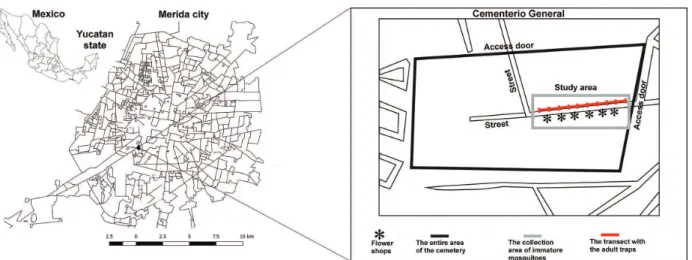
Merida city in the Yucatan State of Southeastern Mexico. This cemetery is the oldest and largest (15 hectares), is immersed within a densely populated city. Based on data of the town hall, the cemetery has 25,700 vaults registered as tombs, ossuaries, niches, crypts and mausoleums (http:// www.merida.gob.mx/). The area selected for the study is located approximately 300 m from the nearest houses (Figure 1). The cemetery is open to public between 07:00 to 18:00 h.
In Yucatan State, the rainy season extends from May to October and the dry season from November to April. During the rainy season, the mean rainfall is 1,000 mm and the mean temperature of 27.5 °C. During the dry season, the mean rainfall is 300 mm and the mean temperature is 25.1 °C10.
Adult mosquitoes collection
Adult mosquitoes were collected for three consecutive days in April, June, August, October and December 2016
and in February, April and June 2017. Aedes aegypti
females were collected using BG-Sentinel traps (Biogents GmbH, Regensburg, Germany) coupled to the attractant BG-Lure (Biogents GmbH, Regensburg, Germany). Inside the cemetery, we chose a transect of 170 m, in which ten traps were placed. The transect was located near the flower shop due to the influx of visitors and presence of cemetery workers (Figure 1). BG-Sentinel traps were placed at every 17 m and were activated between 07:00 and 10:00 h. Female
Ae. aegypti were sorted into pools of up to 15 and stored at
-80 °C until required.
Sampling of immature mosquitoes
Mosquitoes were collected into a quadrant of approximately 100 m, where the BG-Sentinel traps were placed. Mosquitoes were removed from vases using nets,
turkey basters and pipettes and placed inside plastic transportation containers labeled according to date, study site and sample identification number. Immature and adult mosquitoes were transported alive to the Laboratory of Arbovirology at Universidad Autonoma of Yucatan and were identified using published identification keys17,18.
Gonotrophic cycle and survival dynamics
Female Ae. aegypti were collected using BG-Sentinel traps during 19 consecutive days in the dry (April 20 to May 08) and rainy (September 06 to 24) season in 2016. The blood feeding status (Sella’s stages) was determined by external examination of the abdomen. Insects were then grouped as unfed (the collapsed abdomen and the ovaries occupy one-third of the abdomen), fed (freshly fed, bright red blood and the ovaries occupy two to three segments ventrally; the sub-gravid with dark blood and with great space reduced and ovaries occupy most of abdomen) and gravid (blood completely digested or present only as a black trace or line)10.
To estimate the gonotrophic cycle, all the females were dissected in microscope slides using a drop of 65% saline solution. They were classified as nulliparous, parous or gravid according to the appearance of the tracheolar system and/or the presence of eggs in the abdomen19. Aedes aegypti
females dissected were stored at -80 °C and assayed for
flavivirus RNA.
RNA extraction and RT-PCR
Pools of female adult Ae. aegypti were placed into
eppendorf microtubes containing 300 µL of Liebovitz’s L15 medium (Invitrogen, Carlsbad, CA, USA) and mechanically homogenized using sterile pestles. Homogenates were centrifuged at 10,000 × g for 10 min and supernatants were collected. Total RNA was extracted from an aliquot (100 µL) of each supernatant using the RNeasy kit (QIAGEN, Valencia, CA, USA) and tested for flavivirus RNA by reverse transcription-polymerase chain reaction (RT-PCR) using flavivirus-specific primers (cFD2 and FS778) which amplify a 250 nucleotide region of the
NS5 gene20. RT-PCRs were performed in 25 µL reaction
volumes containing 2.5 µL of total RNA, 2 µL MgCL2 at a concentration of 25 mM, 2.5 µL of 5 x reaction buffer, 0.2 µL of dNTPs, 0.15 µL Taq polymerase (Invitrogen®), 0.5 µL of each primer at a concentration of 10 mM. and 16.65 µl ddH2O was added to reach the final volume. Amplification conditions are as follows: an initial denaturation of 95 °C for 1 minute, followed by 35 cycles each consisting of 1 min at 95 °C, 1.5 min at 75 °C, and 1 min at 72 °C and one cycle
of extension for 7 min at 72 °C. Amplicons were visualized on 2% agarose gels with 0.5 µg/mL of ethidium bromide using a Doc™ XR+ Gel Documentation System. RT-PCR products were purified using the Zymoclean DNA recovery kit Cat (Zymo Research, Irvine, CA, USA) and sequenced using a 3500xL DNA sequencer (Applied Biosystems, Foster City, CA, USA).
Data analysis
Entomological indices were estimated: 1) the percentage
of water-filled containers with immature Ae. aegypti
presence (larvae, pupae, or both); and 2) a pupal index representing the percentage of containers with Ae. aegypti
pupae present out of all containers with Ae. aegypti
immatures presence.
To compare the number of immature and adult of Ae.
aegypti by season, data were submitted to a normality
test. A Mann–Whitney U test was used to compare the
number of immature and Ae. aegypti females by season,
because data did not meet the assumptions of normality and homogeneity of variances. The minimum infection rate (MIR) was calculated: (number of positive pools/ total specimens tested) x 1,000. Statistical analysis was performed using the IBM SPSS Statistics version 22 software for Windows (IBM Corporation, Armonk, NY, USA), and results were considered significant when P ≤ 0.05.
The length of the gonotrophic cycle was estimated using a cross-correlation analysis7 with the formula M
t = Pu T(t-u),
where M = the number of parous individuals captured
on day t; T(t-u) = the total number of females (nulliparous and parous) captured on day t-u; u = the length of the gonotrophic cycle; and P = the survival rate per gonotrophic cycle, calculated from the slope in a regression model. The correlation coefficient (r) for day 0 represented the correlation between P and Tt data pairs from mosquitoes captured on the same day (15 data pairs). The r for day was obtained by pairing daily P data with the corresponding T data of 1 day before. Likewise, r for each day 1 was obtained by pairing daily Pt data with the corresponding Ttdata of 1 day before. The r for day 2 was calculated by pairing daily Pt data with corresponding Tt data of 2 days before, and so on. It was assumed that a significant r between the same series expressed a time delay (u) equivalent to the gonotrophic cycle. The highest correlation coefficient and significance obtained after day 0 (u = 0) indicated the number of days per gonotrophic cycle, with descending peaks occurring at multiples of this interval.
1 day, with the formula Zt= X – β(Xt-1), where Zt = is the filtered time series, Xt = the time series to be filtered, and
β = the estimated auto-regressive parameter21. A significant
correlation between 2 filtered time series (Mt and X(t-u) was assumed), and r corresponded to a lag u equivalent to the gonotrophic cycle, with regular peaks at the start of each cycle.
Daily survival rates (p) were calculated from the parity rates using the formula p = (PR)1/CG, where PR = the parity rate and CG = the duration of the gonotrophic cycle22.
Sequence analysis
Sequences were manually aligned and edited using the Bioedit v.7.0.923 and the Mega v.724 softwares. The
nucleotide sequences were translated into the corresponding amino acid counterparts using the translation tool of the ExPASy bioinformatic resource portal (http://web.expasy. org/ translate/) and compared to other sequences from the GenBank database using the Basic Local Alignment Search Tool (https://blast.ncbi.nlm.nih.gov/Blast.cgi). The alignment of the NS5 fragment and amino acid sequences was performed with Mega v.724. The DnaSP
v.5.10 software25 was also used to analyze genetic variants.
The similarity and identity were calculated using the MatGat software26. Genetic distances among variants
were calculated using the Mega v.7 software24 with 10,000
random permutations.
RESULTS
Immature mosquitoes collection
The total number of container observations for the entire study was 4,867 (Table 1). Water was detected during 16.29% (793/4,867) of the container observations and 22.95% (182/793) yielded immatures. In a quadrant of 100 m, the density of positive vases was 112 and 70 during the dry and rainy season, respectively. A total of 10,411 immatures of four species were collected. The most abundant species was
Ae. aegypti (n = 8,627), followed by Culex quinquefasciatus
Say (n = 1,663), Culex nigripalpus Theobald (n = 69), and
Culex coronator Dyar and Knab (n = 52).
Immature Ae. aegypti represented 82.86% of the collection. Analysis of data at the species level revealed that there was no significant statistical difference between the number of immature Ae. aegypti per season (Z = - 0.142,
P ≥ 0.05); although two-fold more immatures were collected in the rainy season. A total of 3,014 vases observations were made during the rainy season. Water was detected in 14.56% (439/3,014) of the container observations and 25.51% (112/439) yielded immatures (Table 1). The pupal index was calculated as 47.32% (53/112). During the dry season, 1,853 vases observations were made. Of these, 19.10% (354/1,853) revealed water and 19.77% (70/354) yielded immatures. The pupal index was calculated as 32.85% (23/70).
Adult mosquitoes collection
In total, 3,957 adult mosquitoes (2,198 males and 1,759 females) of four species were collected (Table 2). Of the females collected, the most abundant species was
Ae. aegypti (n = 1,648), followed by Aedes taeniorhynchus
(Wiedemann) (n = 77), Aedes trivittatus (Coquillet) (n = 17), and Cx. quinquefasciatus (n = 17).
A significant statistical difference was observed in the median number of Ae. aegypti females per season (Z = -8.099, P ≤ 0.05). Approximately eight-fold more females were collected during the rainy season (n = 1,471) compared to the dry season (n = 177) (Table 2). Of the 1,471 Ae. aegypti females collected during the rainy season, 1,210 were identified as unfed, 121 as fed and 140 as gravid (Table 2). In the dry season, 177 Ae. aegypti females were collected with 117 identified as unfed, 14 as fed and 46 as gravid.
Length of Ae. aegypti gonotrophic cycle
There was no significant correlation (P≥ 0.05) observed between raw and filtered data in daily changes of parity rates over 19 days in females collected during the dry and rainy season. Following the criteria of Bockarie et al.27,
the highest r-values are considered for the duration of the
Table 1 - Abundance of Ae. aegypti immatures by season in a cemetery from Merida city, Yucatan from April 2016 to June 2017
Season
Containers Total number Ae. aegypti collected Entomological index Total number
examined
Number (%)
with water Larvae Pupae Total
% water-filled containers with
Ae. aegypti immatures present
Pupal index (%)
Dry 1,853 354 (19.10) 3,084 193 3,277 19.77 32.85
Rainy 3,014 439 (14.56) 4,968 382 5,350 25.51 47.32
gonotrophic cycle. During dry season, a high correlation on days 2, 5 and 8 was found, suggesting a gonotrophic cycle of 3 days (Table 3). A daily survival rate of 0.83 and parity rate of 0.58 (Table 4) in a mean temperature of 29.43±2.41°C, 57.16±5.56% HR and 2.03 mm of precipitation were estimated. During the rainy season, a high correlation on days 5, 9 and 13 was found suggesting a gonotrophic cycle of 4 days (Table 3). A daily survival rate of 0.89 and parity rate of 0.61 (Table 4) in a mean temperature of 26.7±1.22 °C, 79.44±5.64% HR and 59.68 mm of precipitation were estimated. The daily survival rate was similar in dry (0.83) and rainy (0.89) seasons, and as a consequence, there was no significant difference between parity rate by season (t = -1.596, d.f. = 36, P ≥ 0.05).
Detection of DENV and ZIKV RNA in Ae. aegypti
Females were sorted into 166 pools and were analyzed
for flavivirus RNA by RT-PCR and Sanger sequencing. Two pools were positive. The minimal infection rate (MIR) for
female Ae. aegypti was 1.2. One pool contained DENV-1
RNA and the other contained ZIKV RNA. Both pools comprised of mosquitoes collected on day 13 and 17 during the gonotrophic cycle in the rainy season (September 2016). We report some evidence of vertical transmission of DENV-1 in nulliparous females of Ae. aegypti; these females (n = 11) were collected on day 13 in the gonotrophic cycle.
Sequences analyses of DENV-1
The phylogenetic analysis was performed using 94 DENV-1 sequences (Supplemental Table 1). The sequences correspond to a 204 nucleotides region of the NS5 gene. Many sequences were identical to others and therefore
considered to represent the same “variant”. There were eleven variants of DENV-1 (designated DENV-1, V1 to V11). The DENV-1 sequence obtained in this study (V11-DENV-1; Mex 2016) has a close phylogenetic relationship with V1-DENV-1 isolates from Brazil in 2015 with 98.5% nucleotide identity and similarity. Alignment of Table 2 - Species composition and abundance of adult mosquitoes collected in a cemetery of Merida Yucatan, from April 2016 to June 2017
Species Total number adults collected Blood feeding status
Males Females Unfed Fed Gravid
Rainy season
Ae. aegypti 1,969 1,471 1,210 121 140
Ae. taeniorhynchus 77 57 4 16
Ae. trivittatus 1 17 10 4 3
Cx. quinquefasciatus 1 3 1 1 1
Subtotal 1,971 1,568 1278 130 160
Dry season
Ae. aegypti 220 177 117 14 46
Cx. quinquefasciatus 7 14 3 5 6
Subtotal 227 191 120 19 52
Total 2,198 1,759 1,398 149 212
Table 3 - Correlation indices of the parity rates of Ae. aegypti
captured in a cemetery from Merida, Yucatan, during the rainy and dry seasons in 2016, by cross-correlation analysis of a time series
Day Filtered dates of the dry season
Crudes dates of the rainy season
0 0.69 0,02
1 0.03 0,60
2 *0.02 0,56
3 0.00 0,01
4 0.02 0,00
5 *0.38 **0,73
6 0.31 0,11
7 0.14 0,43
8 *0.54 0,22
9 0.20 **0,73
10 0.21 0,55
11 _ 0,29
12 _ 0,14
13 _ **0,64
14 _ 0,07
15 _ 0,69
the deduced amino acid sequences revealed that they have 100% identity and similarity. Likewise, the V11 obtained in this study has a close phylogenetic relationship with V2-DENV-1 identified in Merida, Mexico in 2016 with 99.0% nucleotide identity and similarity (Supplemental
Table 1). Alignment of the deduced amino acid sequences
revealed that they have 98.5% identity and 100% similarity. The genetic distance Kimura-2 parameter between the V1 and V2 was 0.015, while V11 and V2 was 0.01
(Supplemental Table 2). The most common DENV was V8
(n=46), which was isolated in Mexico, USA, and Nicaragua (Supplemental Table 1).
Sequence analysis of ZIKV
The phylogenetic analysis was performed using 100 ZIKV sequences (Supplemental Table 1). The sequences correspond to a 172 nucleotides region of the NS5 gene. There were six variants of ZIKV (designated V1 to V6). The ZIKV sequence obtained in this study (V1-ZIKV; Mex 2016) has a close phylogenetic relationship with V2-ZIKV (Asian genotype) isolates from Guatemala (2015), Mexico (2015-2016), China (2016), Honduras (2016), Nicaragua
(2016), Russia (2016-2017) and USA (2016-2017) with 98.3% nucleotide identity. Alignment of the deduced amino acid sequences revealed that they have 100% identity and similarity. The genetic distance Kimura-2 parameter between the V1 and V2 was 0.018 (Supplemental Table 3). The most common ZIKV was V2 (n=80), followed by V3 (n=17), which was isolated in El Salvador, China, Mexico, Ecuador, Taiwan and Colombia (Supplemental Table 1).
DISCUSSION
The findings of the present study suggest that the Merida city general cemetery is an important focus of
Ae. aegypti proliferation. Vases infestation was high in
the present study. An average of 15 infested vases was reported in a quadrant of 100 m, while in Venezuela it was 39 per hectare28. Another notable result is that the
number of larvae and pupae of Ae. aegypti was high in both seasons. The most likely explanation for the high abundance of mosquitoes and frequency of infested vases during the dry season is in part due to the water supplied by human action as occur in houses29. In contrast with
this result, in cemeteries from Philippines and Venezuela,
Table 4 - Parity rate of female Ae. aegypti captured in cemetery from Merida, Yucatan, during the rainy and dry seasons in 2016
Day Dry season Rainy season
Dissected Nulliparous Parous Parity rate Dissected Nulliparous Parous Parity rate
1 9 3 6 0,67 8 1 7 0,88
2 3 2 1 0,33 13 6 7 0,54
3 8 1 7 0,88 7 2 5 0,71
4 4 1 3 0,75 16 5 11 0,69
5 4 3 1 0,25 27 4 23 0,85
6 6 3 3 0,50 8 2 6 0,75
7 2 0 2 1,00 18 2 16 0,89
8 6 0 6 1,00 6 0 6 1,00
9 4 2 2 0,50 12 3 9 0,75
10 7 3 4 0,57 27 2 25 0,93
11 3 3 0 0,00 27 7 20 0,74
12 4 3 1 0,25 24 10 14 0,58
13 5 1 4 0,80 55 38 17 0,31
14 3 2 1 0,33 36 32 4 0,11
15 4 3 1 0,25 32 13 19 0,59
16 4 2 2 0,50 51 23 28 0,55
17 4 2 2 0,50 66 18 48 0,73
18 3 1 2 0,67 68 25 43 0,63
19 3 1 2 0,67 40 16 24 0,60
most vases had water and yielded immature mosquitoes during the rainy season2,28. The results of this study suggest
that the heterogeneous urban environment supports a high population of mosquitoes. In addition to the general cemetery, previous studies in Merida have also shown that breeding sites on houses, streets/sidewalks and vacant lots yield high number of immature Ae. aegypti29-31.
Immature Ae. aegypti was found to be the dominant species in the vases. Ninety-two percent of the vases containing larvae and pupae had only Ae. aegypti. Nevertheless,
Cx. quinquefasciatus, Cx. coronator and Cx. nigripalpus were
also found. In cemeteries from Philippines and Argentina,
Ae. aegypti was found co-inhabiting with Ae. albopictus
and Cx. pipiens, respectively2,3. The adaptive features of
Ae. aegypti eggs to enter diapause allowed their reproductive
success. The diapause may extend for six months or more, until the eggs get in contact with water in the container again, and then hatching occurs32. In the cemeteries, it is not
possible to control the rain factor, therefore, it is important to have a method to control the presence of larvae and pupae in the vases. In a cemetery of Buenos Aires, Argentina, temephos was effective in reducing Ae. aegypti populations12.
Meanwhile, Toxorhynchites splendens (Wiedemann) was effective in controlling the larvae of Ae. albopictus in Malaysia13.
In the present study, 80% (1,327/ 1,648) of the
Ae. aegypti females were classified as unfed. It is possible
that the emerged adults fly towards the nearby houses in search of a blood meal. It is necessary to perform studies on the dispersion of Ae. aegypti from cemeteries to houses, as this will probably limit the efficacy of attempts to suppress the mosquitoes in domestic environments. In contrast to the cemeteries, it is common to find engorged
Ae. aegypti in indoor environments. This may be the result
of a closer relationship with human15. It should be noted that Ae. aegypti display a strong anthropophilia. In houses and schools of Merida city, 57% of the Ae. aegypti females were collected as fed, 29% as unfed and 14% as gravid females11,15. In churches, 47% of the Ae. aegypti females were collected as fed, 34% as unfed and 19% as gravid females10.
Previous studies on the gonotrophic cycle of Ae. aegypti was estimated with human bait and mark-release-recapture experiment6,33. Currently, human bait is not used due to ethical issues, while the second method requires more effort and sometimes has poorer results. We use BG-Sentinel traps and they turned out to be an effective method for surveillance of Ae. aegypti. In our study, estimated intervals between two consecutive blood meals were three days during dry season and four days during rainy season. The gonotrophic cycle of three days
was affected by high temperatures (29.43 °C) during dry season. Under laboratory conditions, high temperatures are significantly more favorable for shorter gonotrophic cycles
of Ae. aegypti8. Our results agree with previous findings in
studies conducted in Thailand33, East Africa34 and Peru9. Additionally, in Thailand, Pant and Yasuno35 estimated the gonotrophic cycle of three days during the rainy season, with two days of delay during the dry season. During the rainy season, we estimated a four-day cycle. This result is comparable with the ones from studies performed using the mark-release-recapture method in Thailand35, Tanzania36 and Kenya37. In Merida city, two studies have estimated the gonotrophic cycle of Ae. aegypti. In houses, Rebollar-Tellez
et al.6 estimated a seven-day cycle, while in churches, the
duration of the gonotrophic cycle was similar to the one found in the present study of three and four days during the dry and rainy season, respectively10.
High values of survival rate increase the potential risk for transmission of pathogens day to day20. Under laboratory
conditions, the highest survival rate for Ae. aegypti
femaleswas 84% at 27 °C, reaching 25 days of age8. In Mexico, the survivorship for Ae. aegypti was estimated by Rebollar-Tellez et al.6 as 0.86. In the cemetery of Merida city, we found a high survival rate (0.83) for Ae. aegypti. Previous studies conducted in cemeteries identified arbovirus-infected mosquitoes. For example, La Crosse encephalitis virus-infected Aedes triseriatus were collected in cemeteries in Tennessee, USA4. In the State of San Luis Potosi, Mexico, ZIKV-infected Ae. aegypti were detected
in cemeteries5. In the present study, DENV-1 RNA and
ZIKV RNA were identified in Ae. aegypti. It is also the first report of Ae. aegypti infected with ZIKV RNA in Yucatan State. Notably, the sequence obtained in this study revealed that the viruses are more closely related phylogenetically to DENV and ZIKV from Central and South America (Supplemental Table 1).The MIR in this study was 1.2 which is considerably lower than the 4.6 reported in schools in Merida11. However, our results are similar to the ones from earlier studies performed inside the houses of dengue patients15,38. On the other hand, the first report of
ZIKV-infected Ae. aegypti was from Chiapas, Mexico and the
MIR was estimated at 52.49-172.6639.
We also found evidence of vertical transmission of
DENV-1 in nulliparous Ae. aegypti females during the
gonotrophic cycle. In Mexico, vertical transmission of dengue virus by Ae. aegypti and Ae. albopictus was reviewed
by Ferreira-de-Lima and Lima-Camara40, who mentioned
CONFLICT OF INTERESTS
None.
FUNDING
The study was supported by the Consejo Nacional de Ciencia y Tecnologia de Mexico, Grant Problemas Nacionales PDCPN 2014-247005.
ACKNOWLEDGMENTS
We thank the laboratory staff at Arbovirologia of Universidad Autonoma de Yucatan for assistance with mosquitoes collection.
AUTHORS’ CONTRIBUTIONS
J. Garcia-Rejon and C. M Baak-Baak conceived and designed the study; N. Cigarroa-Toledo and A. Pech-May carried out the phylogenetic analysis; R. C. Cetina-Trejo, L. G. Talavera-Aguilar, and O. M. Torres-Chable carried out the fieldwork and the labwork; A. Ulloa-Garcia, C. Machain-Williams, and J. C. Navarro analyzed the data. All authors contributed for drafted the manuscript, provided critical input regarding the findings and approved the final manuscript.
REFERENCES
1. Vezzani D. Review: artificial container-breeding mosquitoes and cemeteries: a perfect match. Trop Med Int Health. 2007;12:299-313.
2. Schultz GW. Cemetery vase breeding of dengue vectors in Manila, Republic of the Philippines. J Am Mosq Control Assoc. 1989;5:508-13.
3. Vezzani D, Albicócco AP. The effect of shade on the container index and pupal productivity of the mosquitoes Aedes aegypti and Culex pipiens breeding in artificial containers. Med Vet Entomol. 2009;23:8-84.
4. Trout Fryxell RT, Freyman K, Ulloa A, Hendricks B, Paulsen D, Odoi A, et al. Cemeteries are effective sites for monitoring la crosse virus (LACv) and these environments may play a role in LACv infection. PLoS One. 2015;10:e0122895.
5. Huerta H, González-Roldán JF, Sánchez-Tejeda G, Correa-Morales F, Romero-Contreras FE, Cárdenas-Flores R, et al. Detection of Zika virus in Aedes mosquitoes from Mexico. Trans R Soc Trop Med Hyg. 2017;111:328-31.
6. Rebollar-Téllez EA, Loroño-Pino MA, Rodríguez-Angulo EM, Farfán-Ale JA. Blood-feeding frequency and life expectancy of Aëdes aegypti (Diptera: Culicidae) in an urban area of Merida city, state of Yucatan, Mexico. Rev Biomed. 1995;6:135-41.
7. Birley MH, Rajagopalan PK. Estimation of the survival and biting rates of Culex quinquefasciatus (Diptera: Culicidae). J Med Entomol. 1981;18:181-6.
8. Goindin D, Delannay C, Ramdini C, Gustave J, Fouque F. Parity and longevity of Aedes aegypti according to temperatures in controlled conditions and consequences on dengue transmission risks. PLoS One. 2015;10:e0135489.
9. Wong J, Astete H, Morrison AC, Scott TW. Sampling considerations for designing Aedes aegypti (Diptera:Culicidae) oviposition studies in Iquitos, Peru: substrate preference, diurnal periodicity, and gonotrophic cycle length. J Med Entomolol. 2011;48:45-52.
10. Baak-Baak CM, Ulloa-Garcia A, Cigarroa-Toledo N, Tzuc Dzul
JC, Machain-Williams C, Torres-Chable OM, et al. Blood feeding status, gonotrophic cycle and survivorship of Aedes (Stegomyia) aegypti (L.) (Diptera: Culicidae) caught in churches from Merida, Yucatan, Mexico. Neotrop Entomol. 2017;46:622–30.
11. García-Rejón JE, Loroño-Pino MA, Farfán-Ale JA, Flores-Flores
LF, López-Uribe MP, Najera-Vazquez MR, et al. Mosquito infestation and dengue virus infection in Aedes aegypti females in schools in Merida, Mexico. Am J Trop Med Hyg. 2011;84:489-96.
12. Vezzani D, Velázquez SM, Schweigmann N. Control of Aedes
aegypti with temephos in a Buenos Aires cemetery, Argentina. Rev Saude Publica. 2004;38:738-40.
13. Nyamah MA, Sulaiman S, Omar B. Field observation on the
efficacy of Toxorhynchites splendens (Wiedemann) as a biocontrol agent against Aedes albopictus (Skuse) larvae in a cemetery. Trop Biomed. 2011;28:312-9.
14. Salomón-Grajales J, Lugo-Moguel GV, Tinal-Gordillo VR, de La
Cruz-Velázquez J, Beaty BJ, Eisen L, et al. Aedes albopictus Mosquitoes, Yucatan Peninsula, Mexico. Emerg Infect Dis. 2012;18:525-7.
15. Garcia-Rejon J, Loroño-Pino MA, Farfan-Ale JA, Flores-Flores L,
Del Pilar Rosado-Paredes E, Rivero-Cardenas N, et al. Dengue virus-infected Aedes aegypti in the home environment. Am J Trop Med Hyg. 2008;79:940-50.
16. Cigarroa-Toledo N, Blitvich BJ, Cetina-Trejo RC,
Talavera-Aguilar LG, Baak-Baak CM, Torres-Chablé OM, et al. Chikungunya virus in febrile humans and Aedes aegypti mosquitoes, Yucatan, Mexico. Emerg Infect Dis. 2016;22:1804-7.
17. Carpenter SJ, LaCasse WJ. Mosquitoes of North America (North
of Mexico). Berkeley: University of California Press; 1955.
18. Darsie RF, Ward RA. Identification and geographical distribution
of the mosquitoes of North America, North of Mexico. Gainesville: University Press of Florida; 2005.
19. Detinova TS. Age-grouping methods in Diptera of medical
20. Scaramozzino N, Crance JM, Jouan A, DeBriel DA, Stoll F, Garin D. Comparison of flavivirus universal primer pairs and development of a rapid, highly sensitive heminested reverse transcription-PCR assay for detection of flaviviruses targeted to a conserved region of the NS5 gene sequences. J Clin Microbiol. 2001; 39:1922-7.
21. Holmes PR, Birley MH. An improved method for survival rate analysis from time series of haematophagous dipteran populations. J Animal Ecol. 1987;56:427-40.
22. Davidson G. Estimation of the survival-rate of anopheline mosquitoes in nature. Nature. 1954;174:792-3.
23. Hall T. BioEdit: an important software for molecular biology. GERF Bull Biosci. 2011;2:60-1.
24. Kumar S, Stecher G, Tamura K. MEGA7: Molecular Evolutionary Genetics Analysis version 7.0 for bigger datasets. Mol Biol Evol. 2016;33:1870-4.
25. Librado P, Rozas J. DnaSP v5: a software for comprehensive analysis of DNA polymorphism data. Bioinformatics. 2009;25:1451-2.
26. Campanella JJ, Bitincka L, Smalley J. MatGAT: an application that generates similarity/identity matrices using protein or DNA sequences. BMC Bioinformatics. 2003;4:29.
27. Bockarie MJ, Service MW, Barnish G, Touré YT. Vectorial capacity and entomological inoculation rates of Anopheles gambiae in a high rainfall forested area of southern Sierra Leone. Trop Med Parasitol. 1995;46:164-71.
28. Abe M, McCall PJ, Lenhart A, Villegas E, Kroeger A. The Buen Pastor cemetery in Trujillo, Venezuela: measuring dengue vector output from a public area. Trop Med Int Health. 2005;10:597-603.
29. García-Rejón JE, López-Uribe MP, Loroño-Pino MA, Farfán-Ale JA, Del Najera-Vazquez MR, Lozano-Fuentes S, et al. Productive container types for Aedes aegypti immatures in Merida, Mexico. J Med Entomol. 2011;48:644-50.
30. Baak-Baak CM, Arana-Guardia R, Cigarroa-Toledo N, Loroño-Pino MA, Reyes-Solis G, Machain-Williams C, et al. Vacant lots: productive sites for Aedes (Stegomyia) aegypti (Diptera: Culicidae) in Merida City, Mexico. J Med Entomol. 2014;51:475-83.
31. Arana-Guardia R, Baak-Baak CM, Loroño-Pino MA, Machain-Williams C, Beaty BJ, Eisen L, et al. Stormwater drains and catch basins as sources for production of Aedes aegypti and Culex quinquefasciatus. Acta Trop. 2014;134:33-42.
32. Soares-Pinheiro VC, Dasso-Pinheiro W, Trindade-Bezerra JM, Tadei WP. Eggs viability of Aedes aegypti Linnaeus (Diptera, Culicidae) under different environmental and storage conditions in Manaus, Amazonas, Brazil. Braz J Biol. 2017;77:396-401.
33. Sheppard PM, Macdonald WW, Tonn RJ, Grab B. The dynamics of an adult population of Aedes aegypti in relation to dengue haemorrhagic fever in Bangkok. J Animal Ecol. 1969;38:661-702.
34. McClelland GA, Conway GR. Frequency of blood feeding in the mosquito Aedes aegypti. Nature. 1971;232:485-6.
35. Pant CP, Yasuno M. Field studies on the gonotrophic cycle of Aedes aegypti in Bangkok, Thailand. J Med Entomol. 1973;10:219-23.
36. Conway GR, Trpis M, McClelland GA. Population parameters of the mosquito Aedes aegypti (L.) estimated by mark-release-recapture in a suburban habitat in Tanzania. J Animal Ecol. 1974;43:289-304.
37. Trpis M, Hausermann W. Dispersal and other population parameters of Aedes aegypti in an African village and their possible significance in epidemiology of vector-borne diseases. Am J Trop Med Hyg. 1986;35:1263-79.
38. Eisen L, Garcia-Rejón JE, Gómez-Carro S, Nájera Vázquez MR, Keefe TJ, Beaty BJ, et al. Temporal correlations between mosquito-based dengue virus surveillance measures or indoor mosquito abundance and dengue case numbers in Merida City, Mexico. Mexico. J Med Entomol. 2014;51:885-90.
39. Guerbois M, Fernandez-Salas I, Azar SR, Danis-Lozano R, Alpuche-Aranda CM, Leal G, et al. Outbreak of Zika virus infection, Chiapas State, Mexico, 2015, and first confirmed transmission by Aedes aegypti mosquitoes in the Americas. J Infect Dis. 2016; 214:1349-56.
Supplemental Table 1 - Database with GenBank accession numbers
GenBank accession number
Clave in
the study Virus Genotype Collection date State Country
KU232287 V1 Dengue 1 2015 Pernambuco Brazil
KU232286 V1 Dengue 1 2015 Pernambuco Brazil
Merida, Mex-2016 V2 Dengue 2016 Yucatan Mexico
KF973475 V3 Dengue 2012 No data Nicaragua
KF973472 V3 Dengue 2012 No data Nicaragua
KF973467 V3 Dengue 2012 No data Nicaragua
KF973466 V3 Dengue 2012 No data Nicaragua
KF973463 V3 Dengue 2012 No data Nicaragua
KF973460 V3 Dengue 2012 No data Nicaragua
KF973458 V3 Dengue 2012 No data Nicaragua
KF973456 V3 Dengue 2012 No data Nicaragua
KF973455 V3 Dengue 2012 No data Nicaragua
KF973454 V3 Dengue 2012 No data Nicaragua
KJ189349 V3 Dengue 2011 Yucatan Mexico
KJ189348 V3 Dengue 2011 Yucatan Mexico
GQ199859 V3 Dengue 2008 Managua Nicaragua
KJ189342 V4 Dengue 2009 Yucatan Mexico
KJ189341 V4 Dengue 2009 Yucatan Mexico
KF973474 V5 Dengue 2012 No data Nicaragua
KF973473 V6 Dengue 2012 No data Nicaragua
KJ189359 V7 Dengue 2012 No data Puerto Rico
KJ189345 V8 Dengue 2009 Yucatan Mexico
KJ189343 V8 Dengue 2009 Yucatan Mexico
KJ189339 V8 Dengue 2008 Yucatan Mexico
KJ189337 V8 Dengue 2008 Yucatan Mexico
KJ189333 V8 Dengue 2008 Yucatan Mexico
KJ189332 V8 Dengue 2008 Yucatan Mexico
KJ189331 V8 Dengue 2008 Yucatan Mexico
KJ189321 V8 Dengue 2007 Yucatan Mexico
KJ189320 V8 Dengue 2007 Yucatan Mexico
KJ189319 V8 Dengue 2007 Yucatan Mexico
KJ189318 V8 Dengue 2007 Yucatan Mexico
KJ189313 V8 Dengue 2008 Yucatan Mexico
KF955443 V8 Dengue 2007 Yucatan Mexico
KF955442 V8 Dengue 2007 Yucatan Mexico
KF955433 V8 Dengue 2008 Yucatan Mexico
KF955422 V8 Dengue 2007 Yucatan Mexico
JQ675358 V8 Dengue 2010 Florida USA
JQ287666 V8 Dengue 2009 Managua Nicaragua
JN819403 V8 Dengue 2006 Managua Nicaragua
JN819402 V8 Dengue 2005 Managua Nicaragua
JF937644 V8 Dengue 2009 Managua Nicaragua
JF937645 V8 Dengue 2009 Managua Nicaragua
HM631855 V8 Dengue 2007 Yucatan Mexico
GU131976 V8 Dengue 2007 Yucatan Mexico
GU131968 V8 Dengue 2007 Yucatan Mexico
GU131966 V8 Dengue 2007 Yucatan Mexico
GU131964 V8 Dengue 2007 Yucatan Mexico
GU131961 V8 Dengue 2007 Yucatan Mexico
GenBank accession number
Clave in
the study Virus Genotype Collection date State Country
GU131958 V8 Dengue 2006 Yucatan Mexico
GQ868539 V8 Dengue 2008 Yucatan Mexico
GQ868536 V8 Dengue 2008 Yucatan Mexico
GQ868527 V8 Dengue 2007 Yucatan Mexico
GQ868509 V8 Dengue 2007 Yucatan Mexico
GQ868503 V8 Dengue 2007 Yucatan Mexico
GQ868501 V8 Dengue 2007 Yucatan Mexico
GQ868499 V8 Dengue 2006 Quintana Roo Mexico
GQ868498 V8 Dengue 2006 Yucatan Mexico
GQ199875. V8 Dengue 2004 Managua Nicaragua
GQ199873 V8 Dengue 2004 Managua Nicaragua
GQ199872 V8 Dengue 2004 Managua Nicaragua
GQ199867 V8 Dengue 2004 Managua Nicaragua
FJ898433 V8 Dengue 2007 Managua Nicaragua
FJ873814 V8 Dengue 2005 Managua Nicaragua
FJ850114 V8 Dengue 2005 Managua Nicaragua
FJ850113 V8 Dengue 2005 Managua Nicaragua
KF955408 V9 Dengue 2007 No data Venezuela
KF955407 V9 Dengue 2005 No data Venezuela
JN819415 V9 Dengue 2006 Aragua Venezuela
JN819413 V9 Dengue 2006 Aragua Venezuela
JN819412 V9 Dengue 2006 Aragua Venezuela
JN819411 V9 Dengue 2005 Aragua Venezuela
JN819405 V9 Dengue 2006 Merida Venezuela
GU131842 V9 Dengue 2007 Aragua Venezuela
GQ868570 V9 Dengue 2008 Santander Colombia
GQ868562 V9 Dengue 2005 Santander Colombia
FJ882579 V9 Dengue 2007 Aragua Venezuela
FJ873809 V9 Dengue 2007 Aragua Venezuela
FJ850101 V9 Dengue 2007 Aragua Venezuela
FJ850100 V9 Dengue 2007 Aragua Venezuela
FJ850099 V9 Dengue 2007 Aragua Venezuela
FJ850093 V9 Dengue 2008 No data Brazil
FJ639824 V9 Dengue 2006 Aragua Venezuela
FJ639823 V9 Dengue 2006 Aragua Venezuela
FJ639820 V9 Dengue 2006 Aragua Venezuela
FJ639818 V9 Dengue 2006 Aragua Venezuela
FJ639813 V9 Dengue 2005 Aragua Venezuela
FJ639812 V9 Dengue 2005 Aragua Venezuela
FJ639802 V9 Dengue 2005 Aragua Venezuela
FJ639796 V9 Dengue 2005 Aragua Venezuela
GU056032 V10 Dengue 1998 Aragua Venezuela
FJ898437 V10 Dengue 2004 Managua Nicaragua
At present study V11 Dengue 2016 Yucatan Mexico
At present study V1 Zika Asian 2016 Yucatan Mexico
MF801426 V2 Zika 2016 No data Nicaragua
MF801424 V2 Zika 2016 Yucatan Mexico
MF801423 V2 Zika 2016 Guerrero Mexico
MF801422 V2 Zika 2016 Guerrero Mexico
MF801420 V2 Zika 2016 Chiapas Mexico
GenBank accession number
Clave in
the study Virus Genotype Collection date State Country
MF801418 V2 Zika 2016 Chiapas Mexico
MF801417 V2 Zika 2016 Chiapas Mexico
MF801414 V2 Zika 2016 Guerrero Mexico
MF801413 V2 Zika 2016 Guerrero Mexico
MF801412 V2 Zika 2016 Guerrero Mexico
MF801411 V2 Zika 2016 Guerrero Mexico
MF801410 V2 Zika 2016 Guerrero Mexico
MF801408 V2 Zika 2016 Chiapas Mexico
MF801406 V2 Zika 2016 Oaxaca Mexico
MF801405 V2 Zika 2016 Guerrero Mexico
MF801403 V2 Zika 2016 Chiapas Mexico
MF801402 V2 Zika 2016 Chiapas Mexico
MF801401 V2 Zika 2016 Chiapas Mexico
MF801400 V2 Zika 2016 Chiapas Mexico
MF801399 V2 Zika 2016 Chiapas Mexico
MF801398 V2 Zika 2016 Chiapas Mexico
MF801396 V2 Zika 2016 Chiapas Mexico
MF801395 V2 Zika 2016 Chiapas Mexico
MF801391 V2 Zika 2016 Oaxaca Mexico
MF801389 V2 Zika 2016 Roatan Honduras
MF801387 V2 Zika 2016 Roatan Honduras
MF801386 V2 Zika 2016 Roatan Honduras
MF801385 V2 Zika 2016 Roatan Honduras
MF801384 V2 Zika 2016 Roatan Honduras
MF801383 V2 Zika 2016 No data Honduras
MF801377 V3 Zika 2016 No data El Salvador
KX906952 V2 Zika 2016 No data Honduras
MF593625 V2 Zika Asian 2016 No data China
MF434522 V2 Zika Asian 2016 Managua Nicaragua
MF434521 V2 Zika Asian 2016 Managua Nicaragua
MF434517 V2 Zika Asian 2016 Managua Nicaragua
MF434516 V2 Zika Asian 2016 Managua Nicaragua
MF159531 V2 Zika 2017 Miami USA
MF098771 V2 Zika 2017 No data Russia
MF098770 V2 Zika 2016 No data Russia
KY927808 V2 Zika 2016 Henan China
KY765327 V2 Zika 2016 Managua Nicaragua
KY765326 V2 Zika 2016 Managua Nicaragua
KY765325 V2 Zika 2016 Managua Nicaragua
KY765324 V2 Zika 2016 Managua Nicaragua
KY765323 V2 Zika 2016 Managua Nicaragua
KY765320 V2 Zika 2016 Managua Nicaragua
KY785461 V2 Zika 2016 Francisco Morazan Honduras
KY785457 V2 Zika 2016 Florida USA
KY785452 V2 Zika 2016 Francisco Morazan Honduras
KY785442 V2 Zika 2016 Francisco Morazan Honduras
KY785431 V2 Zika 2016 Francisco Morazan Honduras
KY785418 V2 Zika 2016 Francisco Morazan Honduras
KY785414 V2 Zika 2016 Francisco Morazan Honduras
KY693677 V2 Zika 2016 No data Honduras
GenBank accession number
Clave in
the study Virus Genotype Collection date State Country
KY693676 V2 Zika 2016 No data Honduras
KY631494 V2 Zika 2015 Tapachula, Chiapas Mexico
KY631493 V2 Zika 2015 Tapachula, Chiapas Mexico
KY648934 V2 Zika 2016 Chiapas Mexico
KY014327 V2 Zika 2016 Francisco Morazan Honduras
KY014319 V2 Zika 2016 Francisco Morazan Honduras
KY014315 V2 Zika 2016 Francisco Morazan Honduras
KY014312 V2 Zika 2016 Francisco Morazan Honduras
KY014310 V2 Zika 2016 Francisco Morazan Honduras
KY014306 V2 Zika 2016 Francisco Morazan Honduras
KY606274 V2 Zika 2016 Guerrero Mexico
KY606273 V2 Zika 2016 Guerrero Mexico
KY606272 V2 Zika 2016 Oaxaca Mexico
KY606271 V2 Zika 2016 Chiapas Mexico
KX421195 V2 Zika 2016 No data Nicaragua
KX421194 V2 Zika 2016 No data Nicaragua
KY325479 V2 Zika 2016 Florida USA
KY325465 V2 Zika 2016 Florida USA
KY328289 V2 Zika 2016 No data Honduras
KX694534 V2 Zika 2016 No data Honduras
KX856011 V2 Zika Asian 2016 Chiapas Mexico
KX262887 V2 Zika 2016 No data Honduras
KU870645 V2 Zika 2016 No data USA
KU501217 V2 Zika 2015 No data Guatemala
KU501216 V2 Zika 2015 No data Guatemala
MF099651 V3 Zika 2016 Guizhou China
MF801421 V3 Zika 2016 Chiapas Mexico
MF801419 V4 Zika 2016 Chiapas Mexico
MF801397 V5 Zika 2016 Campeche Mexico
MF801381 V6 Zika 2016 No data Honduras
MF794971 V3 Zika 2016 No data Ecuador
MF692778 V3 Zika 2016 No data Taiwan
MF574588 V3 Zika 2016 Barranquilla Colombia
MF574587 V3 Zika 2016 Barranquilla Colombia
MF574586 V3 Zika 2016 Barranquilla Colombia
MF574585 V3 Zika Asian 2016 Barranquilla Colombia
MF574584 V3 Zika 2016 Barranquilla Colombia
MF574583 V3 Zika Asian 2016 Barranquilla Colombia
MF574582 V3 Zika 2016 Barranquilla Colombia
MF574581 V3 Zika 2016 Barranquilla Colombia
MF574580 V3 Zika 2016 Barranquilla Colombia
MF574577 V3 Zika 2016 Barranquilla Colombia
MF574576 V3 Zika 2016 Barranquilla Colombia
MF574575 V3 Zika Asian 2015 Barranquilla Colombia
MF574574 V3 Zika 2015 Barranquilla Colombia
Supplemental Table 3- Genetic distance (Kimura 2 parameter model) among the different variants of zika virus (below the diagonal) and the standard error among variants (above the diagonal)
V1 V2 V3 V4 V5 V6
V1 0.01 0.012 0.012 0.012 0.011
V2 0.018 0.006 0.006 0.006 0.006
V3 0.024 0.006 0.008 0.008 0.008
V4 0.024 0.006 0.012 0.008 0.008
V5 0.024 0.006 0.012 0.012 0.008
V6 0.024 0.006 0.012 0.012 0.012
V1: V1ZIKV; Mexico (2016 - at present study); V2: ZIKV; Guatemala (2015), Mexico (2015-2016), China (2016), Honduras (2016), Nicaragua (2016), Russia (2016-2017) and USA (2016-2017)
Supplemental Table 2 - Genetic distance (Kimura 2 parameter model) among the different variants of DENV1 (below the diagonal) and the standard error among variants (above the diagonal)
V1 V2 V3 V4 V5 V6 V7 V8 V9 V10 V11
V1 0.008 0.012 0.01 0.013 0.013 0.008 0.011 0.011 0.011 0.011
V2 0.015 0.011 0.011 0.012 0.012 0.012 0.012 0.012 0.012 0.007
V3 0.03 0.025 0.007 0.005 0.005 0.008 0.007 0.005 0.005 0.013
V4 0.02 0.025 0.01 0.008 0.008 0.008 0.005 0.008 0.005 0.013
V5 0.035 0.03 0.005 0.015 0.007 0.01 0.008 0.007 0.007 0.014
V6 0.035 0.03 0.005 0.015 0.01 0.01 0.008 0.007 0.007 0.014
V7 0.015 0.03 0.015 0.015 0.02 0.02 0.008 0.007 0.007 0.014
V8 0.025 0.03 0.01 0.005 0.015 0.015 0.015 0.008 0.005 0.014
V9 0.025 0.03 0.005 0.015 0.01 0.01 0.01 0.015 0.007 0.014
V10 0.025 0.03 0.005 0.005 0.01 0.01 0.01 0.005 0.01 0.014
V11 0.025 0.01 0.035 0.035 0.04 0.04 0.04 0.04 0.04 0.04