
CONFIDENTIAL
Faculdade de Engenharia da Universidade do Porto Mestrado Integrado em Engenharia Informática e Computação
Analysis of an Oracle RPAS Planning Solution
MIEIC 2007/08 Project ReportSílvia Cristina dos Anjos Seabra Monteiro
FEUP Supervisor: Alcibíades Paulo Guedes Enabler Informática S.A. Supervisor: Sandra Oliveira
To safeguard the company’s interest, one requests for this document to remain confidential for a period of 2 years.
De forma a garantir a salvaguarda dos interesses da empresa, requisita-se a confidencialidade deste documento pelo período de 2 anos.
Abstract
This report documents the final project for the conclusion of the Mestrado Integrado em Engenheria Informática e Computação, a 5 year master degree in Computer and Software Engineering from the Faculdade de Engenharia da Universidade do Porto. This project was hosted by Wipro Retail (former Enabler Informática S.A.), a specialized company in software solutions for retailers.
The project consisted in the analysis of a development version of an Oracle Retail Planning Solution, which supported an Assortment process at fashion retail. The goal was to be able to underline its main functionalities and provide an in-depth description of the utility of this version to Wipro Retail.
This work performs a the state-of-the-art overview of the assortment process at fashion retail, considering current challenges and approaches as well as best practises. An outlined of Oracle’s merchandise footprint is also presented to better understand how the solution integrates in it and to highlight which gap does it intent to fill in Oracle’s offer. The main concepts of the RPAS tool are also included to capture the complexity of this kind of application. This in-depth knowledge helped to better uncover and map the functionalities available in the template; it also provided a more solid awareness to perform a broader analysis of the template’s utility to Wipro Retail.
This report highlights the evolution of the available information during the course of this project and the reorientation of the approach to the problem according to it. The analysis output includes detailed functionalities’ analysis as well as an assembly of the different conclusions and recommendations based on the stakeholders of this solution.
Acknowledgments
I would like to take this opportunity to thank all of those who directly or indirectly helped me during this project.
From Wipro Retail, I would like to thank the Planning pool-leader, Sofia Amorim, for her time and contribution. Dirk Hansel for his restless support, patience and shared experience. My supervisor Sandra Oliveira, for her patience, availability, assistance and knowledge shared; I couldn’t have had a better supervisor.
From FEUP, I would like to thank my supervisor Alcibíades Guedes for granting me the opportunity to be supervised by him, for his valuable time spent, experience shared and support.
To my parents, thank you for giving me this opportunity; thank you for the underlying patience, support and love.
Agradecimentos
Gostaria de agradecer a todos os que directa ou indirectamente me ajudaram neste projecto.
Da Wipro Retail, gostaria de agradecer à pool-leader da área de Planning, Sofia Amorim, pelo seu tempo e contribuição. Ao Dirk Hansel pelo seu incansável suporte, paciência e experiência partilhada. À minha supervisora Sandra Oliveira, pela sua paciência, disponibilidade, assistência e conhecimento partilhado; não poderia ter tido uma melhor supervisora.
Da FEUP, gostaria de agradecer ao meu supervisor Alcibíades Guedes por me ter dado a oportunidade de ser supervisionada por ele, pelo se valioso tempo dispendido, experiência partilhada e suporte.
Aos meus pais, por me terem dado esta oportunidade; obrigada pela vossa incansável paciência, suporte e amor.
Table of Contents
1. Introduction ... 1
1.1. The Internship institution... 1
1.1.1. Services Offer... 1 1.1.2. Internal Organization ... 2 1.2. The Project... 3 1.2.1. Project’s Description... 3 1.2.2. Project Plan... 3 1.3. Report Structure ... 4
2. Assortment in Fashion Retail... 7
2.1. Introduction to Retail ... 7
2.1.1. What is Retail ... 7
2.1.2. Types of Retailers ... 8
2.2. Fashion Retail Business ...10
2.2.1. Fashion Retail Overview...10
2.2.2. Fashion Retail Business Process...14
2.2.3. Fashion Retail Supply Chain overview ...16
2.2.4. Merchandise Management at Fashion Retail ...19
2.3. Business Challenges and Opportunities ...23
2.3.1. Consumer behaviour ...23
2.3.2. Evolution of the Merchandise Planning Process ...24
2.3.3. Opportunities and challenges ...25
2.4. Consumer-Centric Merchandising...25
2.4.1. Overview...25
2.4.2. Integrated Planning & Execution Process ...26
2.4.3. Challenges, Organizational Barriers and Technology Enablers...27
2.5. Assortment in Fashion Retail ...28
2.5.1. Assortment Management – the CCM approach to Assortment...28
2.5.2. Assortment Planning Process...31
2.5.3. Store Grading and Clustering Process...35
2.5.4. Integration of processes ...38
3. Assortment Management Solutions...41
3.1. Vendor Analysis ...41
3.1.1. Vendor Approaches to Assortment Management ...41
3.1.2. Oracle’s position in Assortment Management...42
3.1.3. Enabler’s position...43
3.2. Oracle Retail Solutions...44
3.2.1. Oracle Retail Background...44
3.2.2. Oracle Retail Merchandise Solutions...45
3.3. Oracle Retail Predictive Application Server - ORPAS...46
3.3.1. Introduction ...46 3.3.2. ORPAS Components ...47 3.3.3. ORPAS Concepts ...48 3.4. Configuration Tool...49 3.5. Client Tool...56 3.5.1. ORPAS Applications...57
4. Analysis of Oracle's Assortment template for fashion...59
4.1. Method of analysis ...59
4.1.1. Available information...59
4.1.2. Approach to the problem ...59
4.1.3. 3rd Step – Analyse Solution ...61
4.1.4. New available information...63
4.2. Detailed Functionality’s Analysis ...64
4.2.1. Store Clustering Workbook...64
4.2.2. Business Administration Workbook ...67
4.3. Analysis’ Coverage ...68
4.3.1. Enabler’s perspective...68
4.3.2. Enabler’s Customer perspective...72
4.3.3. Shared perspective...73
4.4. Enabler’s opportunities ...76
4.4.2. Space Constraints and Geographical differences ...77
5. Conclusions and future work...79
5.1. Summary of the work done...79
5.2. Future work...80
5.3. Internship evaluation...80
Glossary...83
References...87
APPENDIX A – Workflow ...93
Table of Figures
Figure 1 - Services provided in Business Process and Analytics. Source: [Wip’08c]... 2
Figure 2 – Organizational Structure. Source: [Ena’07]. ... 2
Figure 3 – Project’s Gantt Chart ... 4
Figure 4 – Typical Retailer position at trading... 8
Figure 5 – US Personal Consumption Expenditures. Source: [SP’04]. ... 8
Figure 6 - Types of Retailers: Retailers may be classified by amount of service provided, product lines, price policy and organizational approach. [Kot’83]... 9
Figure 7 – Typical Products Lifecycle at Fashion Retail. Source: Adapted from [CU’06]...11
Figure 8 – Typical Lifecycle phases of a Limited-Time Offer. Source: Adapted from [GD’03]. ...12
Figure 9 – Example of a Merchandise Hierarchy at Fashion Retail...13
Figure 10 – Example of a Location Hierarchy...13
Figure 11 – Example of a retailer’s calendar of seasons...14
Figure 12 – Example of a Fashion Retailer business process. Source: Adapted from [Koe’06]. .14 Figure 13 - An example of an Early Spring Season Planning and Execution Processes. As one can observe, the design stage ends in June year 1, but the selling time window starts 8 months later and lasts only 2 months. Source of the image’s text: [Mar’08]...16
Figure 14 – A Vision of the complexity of the fashion retail business process and the need for its supply chain integration and collaboration. Source: Adapted from [TXT’07]. ...17
Figure 15 – Supply Chain example of price of item increase. Source: Adapted from [GD’03]....18
Figure 16 – Example of a Merchandise Management Business Process. Source: Adapted from [Kell’08]...20
Figure 17 – Consumer polarization – A shift in consumer behaviour is forcing a change in fundamental product strategy. Source: Adapted from [IBM’04]...23
Figure 18 – Consumer-centric merchandising components. Source: Adapted from [SG’08]. ...26
Figure 19 –Integration between Merchandising and Supply Chain: the need for a single view of demand. Source: [NRF’08]. ...27
Figure 20 – “What are the challenges to effectively executing plans based on granular insights at customer specific store clusters?” Source: Adapted from [FCR’06]...28
Figure 21 – “How Granular is your product assortment today?”. Source: Adapted from [FCR’06]. ...29
Figure 22 – An overview of how the Merchandise Planning is integrated with the Strategic and Execution phases, providing a complete Assortment Management integrated solution...30
Figure 23 – The traditional approach to assortment planning, based on store volume grade. Source: Adapted from [Mar’08]...32
Figure 24 – Demand forecast accuracy. Forecast is more accurate the closer you plan with recent historical demand. Source: [FRM‘00]. ...33
Figure 25 – Example of a Cluster Mix Percentage Grid. Source: [CG’08]...37
Figure 26 – Example of Regression Analysis. Source: [CG’08]. ...37
Figure 27 – “Percent unit sales by cluster: Each line represents the size demand of an item for a cluster of similar stores. The green line represents the average for all stores. If the retailer allocates sizes based on the average, stores would be either under or overstocked on some sizes at some point.” Source: [SAS’06]. ...38
Figure 28 – Assortment Management Applications functional footprint evaluation. Source: [SG’08]. ...43
Figure 29 – Forrester Wave™: Oracle Implementation Providers, Q1’08 – Wipro in Leader Category. Source: [Hel’07]. ...44
Figure 30 – Oracle is one of the few vendors that offer an End-to-End Merchandise solution. Source: [NG’07]...45
Figure 31 –Planning Integrated within Oracle Retail Footprint. Source: [OC'08b]. ...46
Figure 32 – RPAS as a foundation layer for other applications. Source: Adapted from [OR’07b]. ...47
Figure 33 – RPAS integration with other Oracle Retail platforms. Source: Adapted from [OR’07b]...47
Figure 34 – RPAS’ Architecture. Source: Adapted from [OR’07b]. ...48
Figure 35 – Three-dimensional database visual view; on the right, the small red cube represents the all the data at the combination SKU/Store/Week levels...49
Figure 36 – Configuration Tool’s elements and their description. Source: [Ena’05]...50 Figure 37 – Steps needed to perform at the Configuration Tool to build a domain in RPAS. Source: [Ena’05]...50 Figure 38 – Example of three typical hierarchies. The dimension Holyday of the Calendar Hierarchy is an alternate rollup. ...51 Figure 39 – Interface of the Rule’s definition. Source: [Ena’05]...54 Figure 40 – Interface of the definition of workbooks, tabs and worksheets. ...56 Figure 41 – An example of a RPAS Workbook, visualized in the Client Tool; the dimensions, tabs, worksheets, hierarchies and measures are highlighted. ...57 Figure 42 – Example of setup of a maximum of 4 role/intents, each one consisting on a
combination of one or more of the 5 measures available, weighted between them. ...67 Figure 43 – Example of setup of role/intent by product’s department. ...68 Figure 44 – Example of a Visual Merchandise Solution from the Visual Retailing company. Source: [VR’08]. ...75 Figure 45 – Prototype. Integration of the display image functionality present in RPAS version 13 in the template’s worksheet “Store Count and Eligibility” (from the workbook “Pre-Season Buy Plan”, tab “Pre-Season – Assortment Mix” at the development version template). ...75 Figure 46 – Perceived Value of Systems Integrators Varies Wildly by Region. Source: [Abe’05]. ...76 Figure 47 – Width/ Breadth (Wide/Narrow) and Depth (Deep/Shallow) of a retailer’s
assortment/range. Source: [Mar’08]. ...83 Figure 48 – Bullwhip effect. Source: [Kha’08]. ...83 Figure 49 – The relationship between range and assortment at a retailer [Mar’08] ...85
Table of Tables
Table 1 – Spreading methods. Source: [OR’07b]. ...52 Table 2 – Aggregation methods. Source: [OR’07b]. ...53
List of Acronyms
SKU - Stock Keeping Unit PLC – Product Lifecycle
PLM – Product Lifecycle Management CRM – Customer Relationship Management SCM - Supply Chain Management
KPI – Key Performance Indicators; also know as KPM KPM - Key Performance Metrics
GMROI – Gross Margin Return On Investment ROI - Return On Investment
OTB – Open To Buy
OLAP - On Line Analytical Processing POS – Point Of Sale
RDF - Oracle Retail Demand Forecasting (or ORDF) RDW - Oracle Retail Data Warehouse (or ORDW) RMS - Oracle Retail Merchandise System (or (ORMS)
RPAS - Oracle Retail Predictive Application Server or (ORPAS) AUR - Average Unit Price
TIS – Technology Infrastructure Services BPO – Business Process Outsourcing IS – Information Systems
1. Introduction
1.1. The Internship institution
This internship took place within Wipro Retail Portuguese unit (former Enabler Informática S.A.), here forth Enabler.
Enabler was established through the spin-off of the IS/IT department of Portugal’s leading retailer Modelo Continente Hipermercados (a division of Sonae Group) having formed a separate legal entity in 1997. Driven by the six year knowledge and experience acquired at the conception and implementation of applications for the different areas of retail, Enabler quickly became an independent, specialised and international IS Services Company.
In July 2006, Enabler was acquired by Wipro Technologies1, the world's first PCMM2 Level 5, SEI CMM3 Level 5 certified IT Services Company and the first company outside USA to receive the IEEE Software Process Award [Wip’08a]. With over 25 years of IT Consulting, Systems Integration and Engineering Services experience, Wipro Technologies - the global IT Services arm of Wipro Limited - acquired Enabler to “strengthen Wipro’s worldwide retail solutions portfolio as well as global delivery footprint” [Wip’08b].
Since 1st of July, Enabler has become known as Wipro Retail (a division of Wipro Technologies), aiming to be acknowledged as a global retail consultancy company able to operate at a highest level with larger customers, offering a broader range of complementary services.
1.1.1. Services Offer
By combining the already available assets of Enabler and now incorporating the Wipro Technologies capabilities, Wipro Retail value proposition is based on a broad range of services:
• Enterprise Application Services including Retail Package implementation • Consulting and outsourcing
• Change Management
• Technology Infrastructure Services • Testing Services
Wipro Retail aims to deliver high-value in an end-to-end delivery service, offering a complete set of services supporting business process and analytics, as one can see in Figure 1.
1
NYSE: WIT
2
PCMM stands for People Capability Maturity Model
Figure 1 - Services provided in Business Process and Analytics. Source: [Wip’08c].
1.1.2. Internal Organization
By the beginning of the internship, Enabler was organized as presented in Figure 2. It was composed of seven business units: Operations, Delivery, Competency Centres, Innovation, Business Development, Human Resources, Quality, Admin and Finance. Each of these units was further divided into functional areas.
Figure 2 – Organizational Structure. Source: [Ena’07].
o Merchandise Management o Store & Inventory Management o Back Office Operations
o Data Warehouse (DW) o Business Intelligence (BI)
o Enterprise Application Integration (EAI) o Supply Chain (SC)
o Planning o Tests
o Technical Consulting o Management and Consulting
The internship took place within the Planning competency centre. This area comprehends the different planning processes at retail, such as merchandise planning, financial planning, category management, assortment planning, item planning, store planning, space planning and more. This internship was focused on the assortment planning business process for a specific type of retailer.
1.2. The Project
1.2.1. Project’s Description
The Oracle Retail Predictive Application Server (RPAS) it’s the basis of a set of applications that are used to generate forecasts and develop financial, merchandise and assortment plans, based on consumer behaviour. These applications employ best-of-breed forecast technology that analyse historical data in order to predict demand.
The main goal of this project was to analyse a development version of an application (also known as and further named template) that supported an Assortment process at fashion retail; it was asked to evaluate if this version was functional to present it at a CRP4. Identifying gaps between functionalities available and fashion retailers’ processes was also considered in the project’s scope, as well as analysing the template’s utility to Enabler as a starting point for development of new functionalities. The integration of this template with other applications (namely, the Item Planning) was also considered important. Finally, the internee would need to deliver documentation that could support an assortment oriented CRP. At the end of the internship, it was expected that the internee would have gained specific knowledge of the RPAS tool, as well as business concepts in the planning area, becoming an autonomous resource in this area.
1.2.2. Project Plan
Prior to the beginning of the project, there was an induction at Enabler, which was anticipated to provide intensive training in the general skills that the intern would need to carry out at the company. At the beginning of the project, the internee did a more detailed training on the areas that the project spanned and prepared the working environment. A redefinition of the project’s plan was done at mid May due to new available information. This new information consisted in a video presentation of the latest version of the template that was being explored. This new information provided the internee with a privileged update of how the template was evolving in terms of strategic development and functionalities; because of this, the internee decided to shift the approach and consider this new information to provide a better, more accurate and updated analysis to address Enabler’s needs.
Since the project was based on deep analysis of both business process and technical details about the template, the activity that weighted more on the project’s plan was the analysis task. The analysis of the business process and retail industry were done concurrently with the report building; this approach provided the internee with a ground base for knowledge consolidation.
During the internship, the internee tried to capitalize the training opportunities available at the company that could help in its project and integration within the company.
Figure 3 shows a Gantt Chart with a summary of activities that were done during the internship project. For a more detailed plan, please refer to APPENDIX B – Detailed Project Gantt Chart.
Figure 3 – Project’s Gantt Chart
1.3. Report Structure
This introductory chapter aims to present the background of the project, introducing the institution environment, the project’s scope, its goals and schedule.
Chapter 2 introduces the concepts needed to fully understand the theme of this project: the assortment process at fashion retail. An overview of the fashion retail business is provided, along with the several processes that integrate and influence the assortment process. Current challenges and approaches to assortment are also introduced, along with best practises.
Chapter 3 intends to provide the reader with an overview of Oracle’s position in the market, in order to understand its strategy in the conception of this solution. Oracle’s merchandise footprint is presented to better comprehend how the tool integrates in it and to identify which hole does it intent to fill in Oracle’s offer. An overview of the tool is also included so that one can follow the next chapter.
presented from the different stakeholders’ perspectives. Detailed functionalities’ analysis is also included as well as a brief assembly of Enabler’s opportunities.
Chapter 5 offers the conclusions of the project as a whole, presenting a summary of the work and overall appreciation. It also includes directions for future work.
2. Assortment in Fashion Retail
Assortment planning is a retail process conducted by a retailer that aims to determine the number and types of products in a product line. This process includes decisions about inventory depth and breadth variety and at apparel retail industry, the mix between basic and fashion merchandise needs also to be determined. The goal of assortment is to translate the company’s goals into an executable plan to maximize the expected profits. [Raj’01]
This chapter aims to introduce the assortment planning process at a fashion retailer. In order to better understand how assortment is evolving and why it is such a hot issue in fashion area, one must understand the complexity around fashion retailing.
This chapter begins with the introduction of core concepts of the retail industry that are needed to understand how fashion industry fits within it. The fashion business process is then introduced, going through an overview of its specificities, explaining the business processes around it and the importance of its supply chain. Merchandise management is a specific business process of fashion retailing that considerably impacts its supply chain management. This process is described, going through its characteristics and detailing its importance in the general fashion industry.
Next, business challenges and opportunities are outlined, so that one can understand the history, evolution and current trends in the merchandise process. Consumer-centric merchandising is a current trend that addresses the current issues that retailing is suffering. This approach is described, as well as its importance, benefits and challenges in adoption.
Finally, one is introduced to the assortment process at fashion retail. With an overview of its surrounding done at the beginning of this chapter, it is easier to understand the importance of this process, its evolution, its integration within fashion retailing, so as the challenges in its application. The Consumer-Centric merchandising approach to assortment is outlined, so as current best practises to assortment planning. An essential step that must be done prior to assortment is the store clustering. This process is outlined, so as its utility to other processes.
By the end of this chapter, one should be familiar with the fashion retail process, outline the current approach to assortment process and understand its challenges.
2.1. Introduction to Retail 2.1.1. What is Retail
Retail, in short, can be defined as the sale of goods and services directly to the consumer and for personal use. If a company is also a manufacturer or also does wholesale, it is still considered a retailer if it interacts with the final consumer of the product or service and if its sales come primarily from retailing. This will be explored later.
Most industries that produce goods with individual consumers in mind cannot sell their products directly to them. Consequently these companies need retailers to get their products to consumers. So, the Retail business is important to the industry as it serves as a link between consumers and manufacturers, making it easy for the product to be sourced, easily distributed and accessed by the consumer. Possibly more important, it
also enables the possibility to offer a better buying experience to the consumer, providing services and special attention to their needs.
Figure 4 – Typical Retailer position at trading
2.1.2. Types of Retailers
For statistical and market analysis purposes, retailers are usually categorized by what they sell. There are entities which provide a standard classification model to classify retailers, such as the United Nations’ ISIC (International Standard Industrial Classification) or the United States’ NAICS (North American Industry Classification System) and SIC (Standard Industrial Classification). Their classifications are usually grouped by the retailer’s main merchandise line, as it’s the line that accounts for the largest share of store sales. The most general categories for statistical data in retailing are durable and non-durable goods. Conventionally, durable goods are expected to last longer (one year or more) and include items like electronics, furniture or motor vehicles whereas non-durable items are expected to last less then a year, like food, pharmaceuticals or toiletries. Non-durable goods sales tend to represent a larger percentage of sales than durables, although services represent the double of non-durable sales, as we can see in Figure 5. This is relevant to understand how a retailer’s product fits in the global market.
Figure 5 – US Personal Consumption Expenditures. Source: [SP’04].
Apart from this categorization that is mainly used for statistical and financial purposes, retailers are usually classified by four major characteristics: the amount of service provided, product lines, price policy and organizational approach. [Kot’83]
Figure 6 - Types of Retailers: Retailers may be classified by amount of service provided, product lines, price policy and organizational approach. [Kot’83]
• Amount of Service Provided
Retailers can be classified by the amount of service that they provide; usually there are three types: self-service retailers, limited-service retailers and full-service retailers [Wal’06]. Self-service retailers focus on customers that are willing to self-serve to save money and are usually used by sellers of convenience goods or fast-moving shopping goods. Limited-service retailers are mostly department stores such as El Corte Ingles: they offer sales assistance to a limited set of goods about which customers need information. Full-service retailers carry more slower-moving items and have sales people that assist customers in every aspect of their shopping experience; they are usually specialty stores like a car selling retailer.
• Product Lines
A classification by product lines requires an analysis of the depth and breadth of the retailer’s product assortments. Depth of an assortment is the variety of styles or brands within a product line - depth can be narrow or wide. Breadth is the number of products available of a particular style or brand of a product line - breadth can be shallow or deep.
Different product lines are implemented at speciality stores, department stores, supermarkets, convenient stores, superstores and category killers [Wal’06]. Speciality stores usually have narrow product lines with deep assortments. Department stores, on the other hand, have a wide variety of product lines. Convenience stores have limited lines of products and are often located alongside busy roads or at petrol stations. Superstores offer food and non-food products as well as services. A supermarket is a self-service store offering a wide variety of food and non-food products; it’s organized by departments and it’s smaller than a hypermarket or superstore, but is larger in size and has a wider assortment than a traditional grocery store. A Category Killer is a giant retailer that has a sustainable competitive advantage that doesn’t allow its competitors to operate profitably in the same industry; IKEA is considered to be a category killer in Europe’s furniture industry.
• Relative Prices
Price strategy is also considered when classifying retailers; by analysing their relative prices they can be considered discount stores or price retailers [Wal’06]. The off-price retailers can also be further subdivided into independent off-off-price retailers, factory outlets and warehouse clubs. Discount stores have a high-volume low-profit strategy aiming to attract price-conscious consumers; these stores emerged mainly after World
War II and an example is German Lidl. Off-price retailers sell major-label products at a significant discount; these retailers take advantage of overruns, cancelled orders, and forecasting mistakes and sell the excess inventory at a 20%-60% discount. Independent off-price retailers buy this excess inventory with discounts from their suppliers and pass these savings to the consumers. Factory outlets are owned and operated by the manufacturer and sell not only the excess inventory, but also the discontinued or irregular goods. Warehouse Clubs sell a limited selection of items at deep discounts to members who pay annual membership fees.
• Organizational Approach
Finally, retailers can also be classified by their organizational approach: Corporate Chain Stores, Franchise Organizations, Voluntary Chains, Retailers’ Cooperative and Merchandise Conglomerates [Wal’06]. Corporate Chain Stores are several companies owned and controlled by the same company, sharing a brand and central management, usually with standardized business methods and practices. Franchise Organizations are very special organizations; “the nature of the business format franchising focuses on the franchisor’s ownership of the trade name and the proprietary method of doing business, which are leased to the franchisee in return for the payment of fees and royalties, and the submission to rather complete control for a limited time, with a very limited ability to sell or pass the franchise on to others” [GM’05]. Voluntary Chains are similar to franchising; they “are established when a wholesaler enters into a buyer-seller relationship with independent retailers, joining together for purchasing economies and to coordinate marketing efforts, but remaining distinct with separate profit motives.” [GM’05]. A Retailers’ Cooperative is a type of cooperative which takes advantage from economies of scale on behalf of its retailer members. Merchandising conglomerates or multi-channel retailers are combined diversified retailing lines, formed under central ownership, that have an integrated distribution and management of functions; they usually are retailers who own the manufacturer, production and distribution lines along with the retailing business to take the benefits of controlling the whole chain.
2.2. Fashion Retail Business
Fashion retail is usually referred to the apparel, footwear, textiles and home furnishings but its principals can also be applied to toys, computer games, books, computers, music, pharmaceuticals [MIT’05] or any other product type that is likely to suffer from trends and therefore has also short-lifecycle products with unpredictive demand. In this report, fashion retail is intended to be the apparel, footwear and textile industries, since they all share similar product attributes (style, size and colour). In this chapter it will be introduced the fashion retail merchandise concepts and the highly seasonability of it. These concepts are needed to better follow the succeeding descriptions of the specific fashion retail business process, its supply chain constraints, challenges and opportunities.
2.2.1. Fashion Retail Overview
At this overview, the basic concepts of fashion retail are going to be presented. To better understand the industry, the merchandise types and their lifecycle are described. A description of the internal hierarchical organization of the fashion industry is also introduced, so as the concept of seasons.
• Merchandise Types
General classifications of merchandise apply also to fashion. The typical types are basic, seasonal, event, thematic, kaleidoscopic and big ticket items [Mar’08].
Basic items have a long life-cycle and are easy to forecast demand and manage inventory; they are available in all seasons and can be repeatable each year. Fashion items on the other hand have a short life-cycle and are highly unpredictable; usually they last for a season, but can last more or less then that, depending on the trends. You may also classify items as Seasonal, Event or Thematic; examples of it are swimwear, Valentines items and sports accordingly. Kaleidoscope items are products that don’t have continuity, generally limited editions. Big ticket items are like VIP’s but for products: they need special care or have specific space needs; usually the stock is only at the display (have a limited stock or are only available from order). Usually Big Ticket items at fashion retail are those exclusive, rare and unique items, like a 1million dollar purse or a unique piece of jewellery.
• Merchandise / Product Lifecycle
Product Lifecycle represents the stages that a product is believed to go through from the beginning it is introduced until it is take out of circulation: introduction, growth, maturity and decline [CU’06].
At fashion, a product is adopted and discarded within a short period of time, that’s why these products have the so called short lifecycle. As was said before, basic products such as t-shirts or blue jeans have a longer lifecycle then the other fashion products, as they are sold every year. Fashion goods, on the other hand, are more unstable and last shorter time then basic products. When consumers adopt a fashion style at a particular time, the product starts its growth, but when it is no longer adopted by many, its lifecycle ends drastically as it becomes to be “out of fashion”; this is why fashion products have a steep decline once they reach their highest sales.
There are also the “fad products”, those who have the shortest lifecycle; these products are usually a style that is adopted by a particular set of customers (like a sub-culture or a younger demographic group) for a short period of time. To these products, the time to market and quick response to demand becomes critical to the success of sales.
Figure 7 – Typical Products Lifecycle at Fashion Retail. Source: Adapted from [CU’06].
Further in this report, when refereeing to fashion products, it is meant to be these short-period lifecycle products - the fads and fashion products - as they represent best the products that can be found at a fashion retailer and also represent the most difficult items to work with.
Fashion products are sold within a particular season (the basic seasons are for instance the spring-summer and the autumn-winter seasons). The typical lifecycle of a limited-time offer is presented at Figure 8. Usually the retailer can start to sell an item a little bit before the season starts to test the products - to see how the customers react. Then for a typical period of 5 weeks, he takes advantage of the growth of the product sales, until it reaches its maturity. Right then, is when the retailer should start making markdowns, as the product starts to decline.
Figure 8 – Typical Lifecycle phases of a Limited-Time Offer. Source: Adapted from [GD’03].
• Merchandise Hierarchy
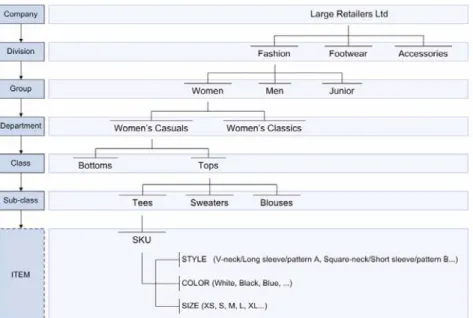
In order to plan the products lifecycle, a retailer must be able to fully identify a particular product within the company. Stock Keeping Unit (SKU) is a term used by retailers to identify the lowest level of product detail. When a customer goes to a store and says “I want blue jeans, size 27, low waste style, for women” he is referring to a SKU. At fashion retail there isn’t a standard hierarchy due to the various types of classifications that a fashion item can have. An example of a possible merchandise hierarchy at fashion is presented in Figure 9.
Figure 9 – Example of a Merchandise Hierarchy at Fashion Retail
o Location Hierarchy
A Location Hierarchy is also necessary in order to identify specifically which items should go to which location within the retailer’s company. An example of a location hierarchy is presented at Figure 10.
Figure 10 – Example of a Location Hierarchy
• Fashion Retail Seasons
Each fashion retailer, depending on its strategy, considers many seasons within a year. A season represents the need of the retailer to offer specific products, pricing and promotions to maximise revenue and profit, allowing him to take advantage of flows of retail spending that occur throughout somewhat predictive periods. Figure 11 represents an example of a seasons’ calendar at a retailer.
Figure 11 – Example of a retailer’s calendar of seasons
Seasonality varies according to product, geography and other factors. For example, if a company sells products at both northern and southern hemispheres, he may need to consider separate seasons for the two hemispheres. Still in the example, he may create a “Summer 2009 Apparel U.S.” season and a “Summer 2009 Apparel Australia”, where these seasons would span different months. Seasons are particularly useful for the Assortment Process, as each assortment is created for a specific season.
2.2.2. Fashion Retail Business Process
As it was explained before, retailers can buy directly the goods or can manufacturer their own merchandise. But to fully understand how the manufacturer and retailer process are intertwined, it is necessary to understand how the fashion business process begins from the manufacture until the goods reach the client.
The fashion business doesn’t have a standard process, as the internal organization and specificities of each retailer can vary a lot across the market. Typically, it is composed of six steps: Design, Planning, Sourcing, Trading, Distributing and Selling. [Wa’06], [Koe’06] and [Txt’07].
Figure 12 – Example of a Fashion Retailer business process. Source: Adapted from [Koe’06].
• Steps Design
The process begins with the design stage, that is, the development of the collection from basics to more fashion items. The designers try to develop styles and colours based on several sources of information like grand couturiers trends, haute-couture and prêt-a-porter fashion, fashion shows, magazines, idols and VIP’s styles, etc. This task is very important; innovation, creativity and sensitivity to perceive current trends are a must have for the job.
Planning
In the planning phase, a choice is made about which number of options will be available from the set made at the design stage. In this stage, is done the merchandise and
will seed the assortment plan, which aims to choose which options should be kept and which options should be dropped (based on historical data and forecasting the demand at your particular set of stores). This stage should also output an assortment that indicates which stores should get which options; this is necessary as your stores have different characteristics that go from physical constraints, different climates and clients that influence sales, different needs of transportation of the goods to the stores, etc. Sourcing
Sourcing is a term used in supply chain management which describes the improvement and re-evaluation of purchasing activities. This step includes sourcing the planned options from your vendors, bidding and getting the best price/quality (arrangement) at the best delivery time.
Trade
After the sourcing, the trade stage begins and the initial stock allocation is done. The retailer needs to chose which options at what quantity should go first to be able to respond to demand more quickly. This is called the in-season stock management, where you closely manage your stock quantity at each store, monitoring and receive constant feedback about what goods are selling more then others, so that you can make an effective replenishment.
Distribute
The replenishment stage is done after the beginning of the season and is based on the in-season stock management monitoring.
Sell
In the final stage, you only focus on selling the goods in order to obtain the maximum profit and end with no items at stock. This is where you manage the display of items at stores, marketing campaigns, markdowns, and others.
• Fashion business process applied
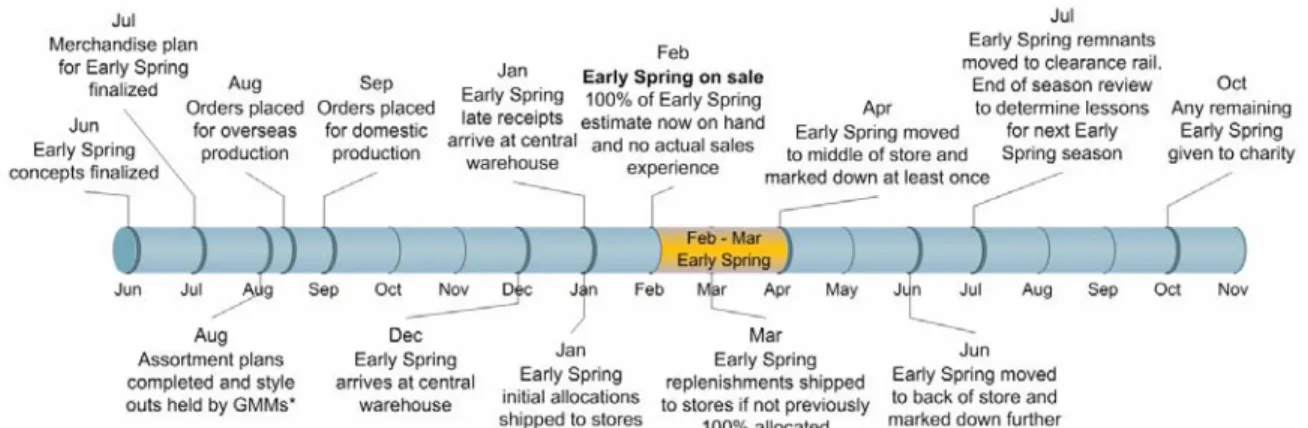
At Figure 13, it is possible to view how this whole process is applied to a specific season. Notice that the retailer ends the design stage at June (year 1) but only starts selling in February (year 2); in an industry so highly unpredictable, it is obvious that the planning stage becomes crucial. The only way to get a better performance and being able to respond quickly to the unpredictable demand is to shrink these stages. Inditex is a great model to this approach: getting to plan more closer to the beginning of the sales, being able to send “testing demand” items and respond quickly from close production sites with a product more adapted to demand, is proving to be more efficient. But this requires: high collaboration between each part of the stage business with almost no space to delays or errors; good planning tools with good input data from historical, CRM, climate, on-sight data; and highly supply chain optimization. This is not an easy task, it takes years to develop this kind of optimization and external factors can ruin a business - like in 2005 when the European Commission blocked 75 million items [BBC’05] of Chinese textile goods due to the exceeded annual quotas of China’s imports.
Figure 13 - An example of an Early Spring Season Planning and Execution Processes. As one can observe, the design stage ends in June year 1, but the selling time window starts 8 months later and lasts only 2 months. Source of the image’s text: [Mar’08].
2.2.3. Fashion Retail Supply Chain overview
Supply Chain Management is the “integration of key business processes from end user to original suppliers that provides products, services, and information that add value for customers and other stakeholders” [LCP’98]. Supply Chain Management is critical to retail business, and in a fast moving unpredictable business like fashion, this area becomes even more critical. The need to have updated information that’s integrated across the chain, with little space for delays or errors, with ever lessening lead times and managing the differences and needs of each part of the chain, it is really a challenge. That’s why some retailers, in order to cut on the costs and gain control on the critical areas, are abandoning the manufacturers and outsourcing and start owning part or even the whole supply chain.
As said before, the process of taking a product to a store begins on the design, the planning of quantities, time to deliverer and locations for it to be sold, the bidding for price/quality/delivery time with suppliers and the actual products request and manufacturing, the transportation to the retailers warehouse, the allocation from the warehouse to the stores and presentation of the product at each store, the actual sales and the feedback of them in order to improve and forecast future demand to support this loop process.
Figure 14 illustrates perfectly how the various stages of the fashion retail business relate with each other and form a looping process.
Figure 14 – A Vision of the complexity of the fashion retail business process and the need for its supply chain integration and collaboration. Source: Adapted from [TXT’07].
Various types of supply chains strategies can be followed by the retailers. Following is a brief description of how the retailers’ business chain can be organized. [Das’08].
• Apparel supply chain and variants
o Push Supply Chains
Push Supply Chains are usual when the demand of homogenised products is stable. In this type of supply chain, production and distribution decisions are based on long-term forecasts. This type of supply chain was characteristic of the mass-market trend between 50s and 70s; these retailers had vertical organization structures and focused on optimizing their activities. This enabled a better response to the back-then predictive and stable demand since they had a buffer-stock; although in the current demand trend, this doesn’t apply. The bull-whip effect was very visible in this type of supply chain.
o Pull Supply Chains
Between 70s and 90s, retailers were both vertically and horizontally aligned. As competition increased and market-demand became volatile, apparel retailers were trying to integrate their production and distribution towards customer-demand in a pull oriented supply chain. This enabled reduction of the unnecessary buffer stock and a more close fit into what the consumer wants and not what company makes. Although, the highly long lead-time to market was unable to quickly respond to customer-demand. As the consumer behaviour changed and become more heterogeneous, the necessity to have a bigger product mixed increased; this lead to significant operational difficulties since it reduced the responsiveness of the supply chain.
o Push-Pull Supply Chains
From the 90s, retailers were trying to shift their supply chains to take advantage of the best of the push and pull strategies. This resulted into a hybrid of the two systems, the Push-Pull supply chain system. In this synchronised strategy, the initial stages of the supply chain are operated based on a Push system, and the final stages are operated on a Pull strategy. The Push strategy is applied to the steps in the supply chain that don’t have much error forecast variability; the Pull strategy on the other hand, is applied to the steps in the supply chain where uncertainty and variability are high, making the decisions as closer as possible to the real demand.
All of these types co-exist in the apparel industry, although it is evolving towards a push-pull synchronous strategy, where retailers start to also own a part of the supply chain to better integrate and react to the actual demand – the increasing bet in private labels are an example of this effort.
• Owning the supply chain
In order to cut costs and take more control on time, design and margins, a retailer can have its own part of the supply chain or outsource it; usually the globalization enabled the possibility to cut costs on acquiring the production and finishing of products at far more inexpensive locations (like China), with the benefit of having more control over the chain. As said before, in fashion industry, the process of negotiating with suppliers, the fabric production times, the cutting and sewing and application of garments, the finishing and the actual transportation to the stores are all processes that take time and money and these two assets are critical at fast-cheap fashion actual trend.
Figure 15 shows how a product is conceived and sold at a classic supply chain where each member of the chain has just one business and buys from the other members.
Figure 15 – Supply Chain example of price of item increase. Source: Adapted from [GD’03]
If the retailer can cut on the profit margin at each member on the supply chain, and gain control of strategy and times, it can achieve competitive advantage.
- manufacturing their own products: the clothing is produced at factories owned by the retailers themselves;
- sub-contracting: the retailer does the design process and then forwards the design and cuts of the clothing to contracted manufacturers who will produce on the retailer’s behalf;
- purchase the finished product: buying the finished product from wholesalers, buying syndicates or at the manufacturer themselves; the design and production is the responsibility of the manufacturer, the retailer has no say on it.
Depending on the method implemented, the supply chain and the planning process becomes more or less flexible to the retailer.
2.2.4. Merchandise Management at Fashion Retail
Merchandise Management can be defined as the retailer’s product planning, development, buying, management, pricing and supporting sales, along through the retail business cycle that was presented before [UV’08]. Basically is the process that manages the merchandise from its conception to sale.
The main objective of the Merchandise Management is to ensure that the product is available to the customer at the right time, place, quantity and price. So this process needs to assure the best set of products that correspond to the companies global image, specify the order quantities, source them (selecting the suppliers) and distribute the products through the stores each with specific attributes (style, colour, size) and setting the optimal price of each product at that store.
As was said before, this process varies from industry and from the type of retailer. On the specific case of fashion merchandise, it goes usually from the design process, to the buying of the raw materials, manufacture, finishing and distribution.
So a typical fashion retailer can be either of three types: Brand/Collection buyer, Private Label owner or a combination of these two [AM’06, Fas’05 and Ric’96].
A Brand/Collection buyer buys already-made merchandise from vendors. Usually this is a less risky approach and requires a minor investment from the retailer. The cons of this approach is that the retailer has little or no control in the design process and manufacturing times, which means he has little or no flexibility on the supply chain. A Private Label owner outsourcers the production of goods or manufactures its own goods, but usually he owns the design process. With this approach the retailer is able to control the design process, having more flexibility over decisions and margin gain. On the other hand, it requires more investment and the risk at predicting demand and trends are higher (because the products have to start being manufactured long before).
A combination of the above two approaches is also possible, in fact, many retailers are starting to take advantage of each solution to leverage the risks and taka advantage of both approaches, as was explained before – Push-Pull strategy. This way, retailers can reach for instance the demanding customers by providing them branded assortments while also meeting the other side of the spectrum behaviour, the customers that want a fast-cheap fashion that don’t mind to buy a private label. However, this approach as also cons; managing the company’s global image while managing different kinds of merchandise it’s not easy and a good strategy must be well placed and managed.
Following, an overview of the Merchandise Management process at the fashion retail industry is going to be made. A brief explanation of the differences between Merchandise Management and Category Management is going to be made, since it is a frequently asked question among retailers. Also, an overview of the Merchandise Planning Process is also presented, going over key-concepts like types of plans and roles involved in it.
• Merchandise Management Process
Figure 16 represents the Merchandise Management Process that basically consists on the management of the whole retail merchandise business process. In this figure it is possible to view the tasks and roles involved in each process; some roles and tasks are not going to be presented in detail, the report will only focus on the roles involved in the Assortment process.
Figure 16 – Example of a Merchandise Management Business Process. Source: Adapted from [Kell’08].
• Merchandise Management versus Category Management
Category Management (CM) can be defined as “a process that involves managing product categories as business units and customising them [on a store by store basis] to satisfy customer needs” [Nie’93]. This approach was until recently the best of breed standard methodology to retailers. But since the changing in consumer behaviour started to appear and as fast-fashion started to become more competitive, there was a need to shift the processes.
The difference between CM and Merchandise Management (MM) it’s mainly in the focus. While CM is driven by customer segmented targets and focuses on space optimization and optimal display of items, MM focuses more on meeting customer demand and expectations, planning markdowns and controlling the items’ flow. Although each one has processes like assortment planning, vendor selection, sales forecasting, space and promotion planning, the processes are still a little different because basically, these are two different ways of managing a business.
At CM, the purpose of the category is what actually drives its content selection; while at MM, it is the content that tends to define a merchandise category. CM is more associated with the grocery and drugs industry, as it is more suited to long lifecycle items or basic items that have a relatively predictive demand. It often incorporates suppliers in the strategic and planning processes. On the other hand, MM is more suited to fashion items or short lifecycle items which have a highly unpredictive demand and need for rapid reaction to demand fluctuations. At MM, assortments are selected based on demand forecasting and market trends, leaving the vendors out of financial planning and strategic decisions.
• Merchandise Planning at Fashion Retail
Merchandise Planning (MP) process can be defined as the process used to match supply with demand. The objective of this process is to develop a plan that will support the sales execution process in order to meet company’s targets [Raj’98]. MP is composed of several planning process, including Financial Planning, Location Planning, Product Planning, Space Planning, and others. There is no standard approach to MP [CFA’05], neither there is a consensus on processes’ names and roles involved in the Planning process. Each retailer has its own MP process which means that the steps, level of detail and roles involved in each step vary from retailer.
o Retail Plan
A retail plan it’s a financial model of a retail business process which expresses how it is expected to perform. It is typically composed by Key Performance Indicators (KPI), or measures, that should be translated into predefined rules of calculation. It should be focused on a specific time period in the future, usually at month level or week level if it’s an operational plan or at season or year level if it’s a strategic plan [OR’07a].
It’s very common to have several different versions of the plan during the planning process, which reflects revisions and approvals by different people or roles in the organization. These versions are reconciled and linked after the management’s review and should output a global and balanced approved plan.
The plan will be compared to the actual results throughout the in-season and updated accordingly in order to meet the initial goals set. We will go through this in more detail later at the merchandise planning process.
o Roles
There are no standard organizational roles at retail. Every retailer has its own hierarchical organization, role’s names and responsibilities; even if two retailers have the same name role in the organization, the responsibilities may not be the same.
However, we can enumerate three typical levels of roles involved in the planning process: the executives, the managers and the planners [OR’07a].
The executives plan at a more high-level view of the organization, setting strategic and long-date financial goals. The executive role plans at the highest division level from a product hierarchy perspective, and at total company level in a location hierarchy perspective; it focus on key elements of the business like sales or gross margin and perform a top-down approach.
The managers work at a middle-level view, serving as an interface between the executives and the planners. They have the responsibility to communicate company goals to the planners at the highest level, through middle-out targets specified by a broader range of metrics then at the executive level.
The planners have the responsibility to build and track plans at the lowest level of the organization. Depending on the organization’s structure and size, the planner may be responsible for building a detailed financial plan, category planning, item planning and assortment planning or be involved in location or channel planning.
o Versions of plans
To be able to reconcile the various perspectives of the different roles involved, there are plan versions. Different plan types are needed in order to carry out the different steps along the planning process. The typical plan versions can be classified as provisional, published or revised [OR’07a]. A provisional plan has a wider range of time; usually it has the next season and the following on sight. It should provide detailed sales and stocks targets, with the planned quantity information and the according times, with the best merchandise mix. A published plan is used to manage stock ordering and it’s the base for the initial distribution; it is used also for performance monitoring of the current season or the nearest season. A revised plan is the current season’s updated plan; usually it is updated each week and it’s the rolling basis for forecasting, replenishment and decision making for the current season.
o Types of planning processes
There are three typical types of planning processes: top-down, bottom-up and middle-out. The roles involved at the planning process vary according to the industry as said before, but typically we have the executive, manager and planner roles that represent the top, middle and bottom levels accordingly [OR’07a].
- Top-Down Planning
A top-down approach is essentially breaking down the overall organization goals into smaller goals in order to spread them to the sub-levels and ending up with an implementation plan. It corresponds to the planning process at the executive level, where major targets and information must be passed to the manager and planner levels bellow it. This approach ensures a more consistent global strategy, but lacks the vision of the lowest levels and does not take account the differences within them and the resources available at the bottom level.
- Bottom-Up Planning
A bottom-up approach is the opposite of the top-down. It starts to specify the goals based on the vision of the lowest level and spreads up to the top level by aggregation. This approach enables a more accurate implementation plan that better matches the differences and available resources of the lowest levels, but may result in a non-consistent global strategy.
- Middle-out Planning
Middle-out planning is basically a distributed planning approach and usually produces the best results as it is a combination of the top-down and bottom-up approaches. It consists on a flexible framework in which the strengths of both the other two approaches are combined in order to have both visions: the up level and bottom level visions. This ensures a more consistent global strategy across the levels, and a match between the main goals of the upper levels and the specificities of the lowest levels.
o Types of plans
retailer company which will differ only in their focus, not in their results: Merchandise Plans, Range Plans and Store Plans.
Each of these types of plans are built by different teams with differing points of view, providing the retailer a shared, strong and more comprehensive big picture plan. This is done by collaboration, having periodic meetings between the three groups in order to share viewpoints, refine trends and roll-up to total plans.
Merchandise Plans are just summary level views of each hierarchy level. Store Plans on the other hand are the summary level view of each store. Range Plans are an aggregation of assortment & style level plans; it can also be called a macro-assortment plan.
2.3. Business Challenges and Opportunities
2.3.1. Consumer behaviour
Consumer behaviour is radically changing and retailers need to understand how this change affects the retail industry. The consumer diversification has increased in the last years making the traditional tracking of consumer purchase irrelevant; dramatic demographic and lifestyle changes and an increase on the accessibility of information are just a few examples. A retailer cannot keep up with a “one-size-fits-all” approach and has to increase its range of products in order to remain competitive. The mass market era is gone and an era of niches has arisen.
This shift in consumer behaviour [presented in Figure 17] is being translated into consumers becoming more critical, expecting more and better service and shopping experiences [IBM’04]. On the other hand, consumer’s behaviour is becoming so unpredictive that they actually trade-off the guaranteed quality and exclusivity principles to benefit from hot fashion goods “here and now”; they are actually putting their fickle personal matrixes of value on their money.
Figure 17 – Consumer polarization – A shift in consumer behaviour is forcing a change in fundamental product strategy. Source: Adapted from [IBM’04].
Retailer’s spectrum is changing to keep up with this shift in consumer behaviour. Mega-retailers, like Wal-Mart had the capacity to reach more of these niches just by broadening their range of offer, while the remaining retailers were forced to move to the high-end of the spectrum or just stay in the middle. To survive, retailers must let consumers drive the direction of their brand and products.
Choosing the value position that a retailer wants to have has impact on the business; the characteristics of the planning, supply chain and execution are completely different depending on which side of the customer’s spectrum behaviour a retail wants to be. Industry leaders realized that in order to meet the fickle consumer demand, they needed to invest also on building consumer-driven supply chains so that they could respond to it almost in real-time. Synchronizing planning, manufacturing, distribution and replenishment is essential to maximize flexibility and responsiveness.
Also the investment on tools that could predict demand arisen as the usual data analysis and pattern finding became irrelevant. Predictive planning, real-time customer demand and customer behaviour feedback is now the key.
2.3.2. Evolution of the Merchandise Planning Process
• Traditional Approach
Although it may be surprising, not all retailers have a structured planning process in place [McW’08]. An example of a basic merchandise planning process that we may find consists in the following scenario:
- planning process is focused on the product (doesn’t consider store level information);
- goes only at class or sub-class of product hierarchy; although, some key items can be planned more in depth;
- usually is done at month level (although in Europe is often at week level);
- basic set of KPIs (sales, inventory, markdowns, GMROI, turns, receipts – planned manually rather then optimized);
- frequently contained in an excel spreadsheet with links to other spreadsheets, typically with a format that can be easily changed;
- relies only at one person, who spends almost of their time keeping the spreadsheet alive (rather then analyzing business performance or doing efficient planning) Keeping this process alive is hard enough by its own, so it’s no wonder that most retailers struggle to go further. But why are retailers so reluctant to change? According to Nikki Baird5, merchandising is the “heart of retail” - the closest process to the core of the business – representing 80% of right product, right store, and right price; that’s why retailers are reluctant to adopt standard processes and applications. They tend to develop custom applications that “fossilize arcane working practices and increase costs because they are hard to replace and difficult to support, upgrade, and integrate” [NG’07]. • Current approach
With the change in consumer-behaviour, the days where retailers were able to merchandise all stores with the same assortment are history. For many retailers, the solution to grow sales can no longer be about adding new stores but by “cracking the
code” and understanding and deliver more precisely what customers at each store really need and want.
We’ve seen that changes in the consumer behaviour and lifestyles diversity has increased over the years and retailers are challenged to respond quickly and tailored to the local consumer demand, while still differentiating their offer and pressuring on margins as the competition increases. To keep up the pace, retailers need a way to maximize profitability of the merchandise process while still exceeding customer expectations.
By applying a merchandise mix that sells best for each store, retailers can order and allocate inventory more effectively as well as setting optimal prices to improve profitability. More cost and time reductions can be made by optimised pre-packs and straight collaboration with vendors [RKS’07]. This is a change in mindset, this is moving from a Category-Centric Approach to a Consumer-Centric Approach. A buyer must no longer think about “which products should I buy for my “women’s casuals” category” but rather “which “women’s casuals” products should I buy for my customer segment B“ - or even if it makes sense to have that category of products.
2.3.3. Opportunities and challenges
A Forrester study on collaboration between manufacturers and retailers [Nik’06] shows an increasing interest in this merchandise optimization approach from the market industry, stating that 64% of retailers and 58% of manufacturers were planning to increase the granularity of their assortments in 2007.
However, it is important to keep in mind that these are big projects and that not all retailers have the conditions and maturity to fully adopt these process; these are large retail chains with hundreds of stores and ten thousands of SKU’s to plan, with a lot of historical information data, matured processes and structured IT enabling shared data across the supply chain. Wal-Mart for instance, by 2007 had a chain with more than 6,000 stores, with some of them having almost a half-million SKUs; their database tables had something like 100 billion rows; by that time, their POS systems was dealing with approximately 276 million items a day; we’re talking about a data warehouse larger than 4 Petabytes [Eva’07]. The IT area is a major challenge and critical to the business, as it cannot stop or fail, running the risk of jeopardising the entire business. The cost of implementation of these processes is heavy and needs to be balanced with the return on investment. Adding another application to the system simply will not work as it did in the past because this time, to get the most of this kind of approach, it needs to be fully integrated within the whole supply chain processes as well as with the front-end lines of the business.
2.4. Consumer-Centric Merchandising 2.4.1. Overview
Consumer-Centric Merchandising (CCM) it’s a recent approach that goes one step closer to the customer, leaving behind the traditional merchandising. The traditional merchandising approach was based on history and customer segmentation in order to reach “targeted” customers, whether CCM is more based on advanced forecasts and aims to meet customer’s needs and expectations [Dem’07]. CCM aims to have a common view of demand to all steps, having a bottom-up approach to forecast and focusing on item and store level decisions; the usual approach was more top-down
controlled and had disparate forecasts along the steps [DJ’07]. But possibly more importantly is that the focus in CCM is on the consumer and not on the merchandise. As said before, the traditional merchandise management aimed to meet local needs instead of justifying a buy quantity like in category management. A more efficient assortment and a critical component of CCM can be accomplished by having an Assortment Management Process, connecting the planning and execution steps and determining the right merchandise mix based on a granular level of store-specific demand intelligence [SG’08]. Figure 18 shows the integrated components of the Consumer-Centric Merchandising approach.
Figure 18 – Consumer-centric merchandising components. Source: Adapted from [SG’08].
2.4.2. Integrated Planning & Execution Process
Retailers are now facing a competitive market with increasing choices and options. As a result, customers are increasingly more selective on what they buy, where they shop and how much time are they willing to wait. This pressures retailers on time and budget: as inventory increases, so is the risk.
Consumer Behaviour and Market Trends affect forecast, strategy, planning and execution levels; on the other hand, having the 5 R’s (Right Product, Right Price, Right Store, Right Time and Right Quantity) influences Consumer Behaviour. So this is a two-way street. If merchandising and supply chain aren’t fully integrated, the further upstream you go in the supply chain, the greater fluctuation in demand appears – the so called Bullwhip effect. So there’s a need to keep a single view of demand in order to leverage the risk and keep the Supply Chain and Merchandising processes focusing in the same data, becoming an integrated planning & execution process.
Figure 19 –Integration between Merchandising and Supply Chain: the need for a single view of demand. Source: [NRF’08].
2.4.3. Challenges, Organizational Barriers and Technology Enablers
With the retail industry changing with global sourcing, product variety, reduced life-cycles (fast-fashion), aggressive competition, ever less predictable demand, the pressure on retailers keeps increasing.
With the recent enhancements in technology, this consumer-centric merchandise management optimization may help to reduce the large markdowns due to excessive inventory and the lost sales opportunity due to the stock-outs so usual at the modern fashion industry.
A survey on collaboration [FCR’06] showed that retailers were already trying to manage their merchandising/category management activities on customer specific store clusters (49 percent) and demographically aligned store clusters (26 percent). Surveyed retailers stated that the biggest challenge they faced on effectively executing plans based on granular insights and customer specific clusters was by far the effective retail execution (53 percent) as you can see in Figure 20.
![Figure 1 - Services provided in Business Process and Analytics. Source: [Wip’08c].](https://thumb-eu.123doks.com/thumbv2/123dok_br/19177196.943716/22.918.120.761.102.471/figure-services-provided-business-process-analytics-source-wip.webp)

![Figure 7 – Typical Products Lifecycle at Fashion Retail. Source: Adapted from [CU’06]](https://thumb-eu.123doks.com/thumbv2/123dok_br/19177196.943716/31.918.161.596.744.935/figure-typical-products-lifecycle-fashion-retail-source-adapted.webp)
![Figure 8 – Typical Lifecycle phases of a Limited-Time Offer. Source: Adapted from [GD’03]](https://thumb-eu.123doks.com/thumbv2/123dok_br/19177196.943716/32.918.163.600.259.532/figure-typical-lifecycle-phases-limited-offer-source-adapted.webp)



![Figure 18 – Consumer-centric merchandising components. Source: Adapted from [SG’08].](https://thumb-eu.123doks.com/thumbv2/123dok_br/19177196.943716/46.918.170.752.302.758/figure-consumer-centric-merchandising-components-source-adapted-sg.webp)
