Health- and skill-related physical fitness profile of
Brazilian children and adolescents: a systematic review
Perfil da aptidão física relacionada à saúde e ao desempenho motor de crianças e
adolescentes brasileiros: uma revisão sistemática
AUTHOR’S Augusto Pedretti1,2 Júlio Brugnara Mello1,3 Anelise Reis Gaya1 Alessandro Pedretti4 Adroaldo Gaya1
1 Projeto Esporte Brasil. Programa de Pós-graduação em Ciências do Movimento Humano. Universidade Federal do Rio Grande do Sul, Faculdade de Educação Física, Fisioterapia e Dança, Porto Alegre, Rio Grande do Sul, Brasil.
2 Universidade Regional do Cariri, Departamento de Educação Física, Crato, Ceará, Brasil. 3 Faculdade Sogipa, Departamento de Educação Física, Porto Alegre, Rio Grande do Sul, Brasil. 4 Escola Municipal Newton Tavares, Boa Vista, Roraima, Brasil.
CORRESPONDING Adroaldo Gaya
Projeto Esporte Brasil. Escola de Educação Física, Fisioterapia e Dança da UFRGS. Rua Felizardo nº 750 - sala 205 do LAPEX. Bairro Jardim Botânico, Porto Alegre, Rio Grande do Sul, Brasil.
CEP: 90690-200. DOI
10.12820/rbafs.25e0131
ABSTRACT
Since 1994, the Projeto Esporte Brasil (PROESP-Br) battery tests has been used to evaluate health- and skill-related physical fitness among aged 6-17 Brazilian schoolchildren. The aim of this study was to delineate the Brazilian children and youth’s physical fitness profile from a systematic review over studies that used the PROESP-Br proposal. The search was carried at PubMed, ScienceDirect, Lilacs, SciELO and Google Scholar. Original studies published between 1994 and 2017 about phys-ical fitness (health and/or motor performance) with schoolchildren (children and/or adolescents) that used the PROESP-Br battery test were included. A total of 13.582 participants were evaluated to health-related fitness and 276 to skill-related fitness from 18 included studies. The methodolog-ical quality was evaluated using the Newcastle-Ottawa quality assessment scale adapted version. The results show that 27-30% of youngsters are at health “risk zone” for Body Mass Index (BMI), 70% for cardiorespiratory fitness (CRF), 50% and 65% for flexibility (FLEX) and muscular strength (MST), respectively. The data concerning skill-related fitness were inconsistent. In summary, the results suggest that Brazilian children and adolescents have low cardiovascular health level (BMI/ CRF), mainly regarding CRF, and low muscle health level (FLEX/MST). We emphasize that the lack of studies regarding skill-related fitness, make it impossible to describe the profile of the com-ponents of this construct.
Keywords: Physical education; School; Physical fitness; Children; Adolescents.
RESUMO
O Projeto Esporte Brasil (PROESP-Br) propõe, desde 1994, uma bateria de medidas e testes para avaliação de escolares entre seis e 17 anos com o objetivo de delinear o perfil de crianças e jovens brasileiros no que se refere a aptidão física relacionada à saúde e ao desempenho motor. O objetivo deste estudo foi delinear o perfil da aptidão física de crianças e jovens brasileiros a partir de uma revisão sistemática da literatura sobre artigos que utilizaram da proposta do PROESP-Br. A busca foi realizada na PubMed, ScienceDirect, Lilacs, SciELO e Google Acadêmico. Estudos originais publicados entre 1994 e 2017 acerca da aptidão física (saúde e/ou desempenho motor) de escolares (crianças e/ou adolescentes) que utilizaram a bateria de testes do PROESP-Br foram incluídos. Um total de 13.582 sujeitos foram avaliados quanto a saúde e 276 quanto ao desempenho motor nos 18 estudos incluídos. A qualidade metodológica foi avaliada uma versão adaptada da Newcastle-Ottawa quality assessment scale. Os resultados evidenciam que 27-30% dos jovens estão na “zona de risco” à saúde para o Índice de Massa Corporal (IMC), 70% para a aptidão cardiorrespiratória (ApC) e 50 e 65% para flexibilidade e força muscular localizada (FML), respectivamente. Os dados sobre o desempenho motor são inconsistentes nesta revisão de literatura. Em síntese, os resultados indicam baixos ní-veis de saúde cardiovascular (IMC/ApC), principalmente quanto à ApC, assim como baixos níní-veis de saúde musculoesquelética (flexibilidade/FML) dos jovens. Ressalta-se a escassez de estudos quanto ao desempenho motor impossibilitando delinear o perfil dos componentes deste construto.
Palavras-chave: Educação física; Escola; Aptidão física; Criança; Adolescente.
Introduction
Twenty-four years ago, the professor Adroaldo Gaya1
asked himself: “But after all, what is Physical Educa-tion (PE)?”. Many years passed and we do not know if actual PE programs has been contributed to the de-velopment physical fitness of Brazilian children and adolescents. There are few Brazilian states (from the
26 and the Federal District) that have PE as a manda-tory subject at the school program in Brazil. In primary school (3-5 years old), basic school (6-14 years old) and high school (15-17 years old) it is necessary to recogni-ze the PE teacher’s relevance for the growth and body development of children and adolescents.
Meanwhile, we observed at the Student Health
This work is licensed under a Creative Commons Attribution 4.0 International License.
National Research2, that on average 34% of adolescents
were physically active, 61% insufficiently active and 5% physically inactive. Likewise, the Brazil Human
De-velopment National Report3 shows that only 0.55% of
the Brazilian public and private schools have a culture and infrastructure which values and promote physical activities and sports. That is, nearly 88% of the schools present very poor conditions to promote physical activ-ities and sports, being 12% at intermediate levels.
We believe that PE classes should be directed to influence positively the students’ health- and skill-re-lated fitness levels and motor development linked to PE specific contents (gymnastic components, rhythmic activities, motor abilities and sporting games). This per-spective of school transformation, in the scope of health promotion, may help children to become more active, as
well as to affect positively all the school community4.
Another relevant question is should we be
interest-ed only in developing elite young athletes?5. It would
seem intuitively naive to ignore the potential benefits of long-term athletic development as a way to improve physical fitness and health of children and
adoles-cents6. Some researchers argue that, for global benefits,
the long-term athletic development programs are not
only appropriate but also essential to all adolescents7. A
proper motor development at younger ages, gives in the future equal opportunity of choice to everyone, within the multiple values and meanings of physical activity, related to health, skills, competition, socialization and
leisure, among others3.
Research systematically shows the positive effects of many school-programs, promoting the students’ interest for physical activity and sport along with
health-related8 and skill-related physical fitness9.
Jans-sen and LeBlanc8 showed that physical activity is
pos-itively associated with health indicators in school-age children and youth, like better profiles in blood cho-lesterol, blood pressure, metabolic syndrome, obesity
prevention and bone density. García-Hermoso et al.9
observed a negative association between muscular fit-ness during childhood/adolescence and adiposity and cardiometabolic parameters in adulthood, together with a positive association for bone health.
The Projeto Esporte Brasil (PROESP-Br) is a health- and skills-related physical fitness evaluation system of children and adolescents. With the ambition to be a PE teacher’s tool, the PROESP-Br developed a battery test easy to access, at a very low cost, with a min-imal requirement of sophisticated materials and easy to
use, evidently maintaining the rigor of validity, reliabil-ity and objectivreliabil-ity. It must be pointed out that the ref-erenced-criteria for health and skill-related fitness were
established from the Brazilian population data10.
Periodic evaluation of the physical fitness is an essential activity to guide the quality of PE teachers’ interventions, considering their pedagogical inherent commitments to promote children and adolescents’ health, stimulate the establishment of active lifestyle behaviors through sports practices, popular games, gymnastics, martial arts and dance. A physical fitness evaluation allows the teacher to draw a students’ diag-nostic profile and observe the benefits of his/her ped-agogical interventions. The development follow-up of different levels of physical fitness, in the field of health and skills, allows teachers and coaches to obtain indi-cators that can support quality and adequate planning to their classes and training sessions, according to the students or athlete’s needs.
Therefore, the present study adds to the field by delineating a profile of health-related fitness and skills-related fitness through a systematic review on articles that included the battery of tests and measures proposed by the PROESP-Br.
Methods
This systematic review was conducted according to the Preferred Reporting Items for Systematic
Revie-ws and Meta-Analyses (The PRISMA Statement)11
and registered at the International Prospective Re-gister of Systematic Reviews (PROSPERO – nº CRD42017063848). We used the Health Sciences Descriptors (DeCs) and the Medical Subject Hea-dings (MeSH), and the following descriptors were used: PROESP; physical fitness; children and adoles-cents. In addition, the searches were performed using Boolean operators “AND” and “OR”, using the stra-tegy in English ((PROESP) AND (“physical fitness”) AND (children OR adolescent)), Spanish ((PROESP) AND (“aptitud física”) AND (niño OR adolescente)) and Portuguese ((PROESP) AND (“aptidão física”) AND (crianças OR adolescentes)) in each website da-tabases. Moreover, additional research was done on the references of selected articles.
The inclusion criteria used for the study were: (i) original articles published between 1994 and 2018 wherein (ii) evaluations were conducted with PROESP-Br battery, (iii) physical fitness were eval-uated (health-related or skill-related physical fitness)
(iv) including children and/or adolescents (aged 6-17 years). Only original articles were considered for eli-gibility and there were no restrictions about study de-signs for inclusion. The exclusion criteria applied were did not use the full battery of measurements and tests for health- or skill-related physical fitness.
The search was carried in peer-reviewed journals indexed in the website databases PubMed, ScienceDi-rect, Lilacs, SciELO and Google Scholar. The time interval comprised the period from 1994 to 2018 (1994 represents the date that PROESP-Br started). Two researchers carried out the search in the databas-es and the selection of titldatabas-es, abstracts and articldatabas-es in-dependently, considering the inclusion and exclusion criteria. In cases of disagreement among researchers, a third researcher was consult at consensus meetings.
The Newcastle-Ottawa quality assessment scale12
evaluate the methodological quality in cross-sectional studies for systematic reviews. The extracted compo-nents were defined by all the authors, and the scale was scored by the first two authors and checked by a third author. For this study, the authors adapted the scale re-moving the comparability evaluation, once it does not apply to the selected studies design. A ‘star system’ was developed in which a study was judged on three broad perspectives: 1) the selection of the study groups; 2) the comparability of the groups; and 3) the ascertain-ment of either the exposure or outcome of interest for case-control or cohort studies respectively. The compa-rability perspective was exclude since it does not apply to the included studies design. The adapted scale can be seen in the supplement.
The information evaluated were: the selection of the sample (describes the method and/or the procedure or not); the sample size (describes the criteria adopted for the sample calculation or not); description of the data collection procedure (describes the evaluation proce-dures for each study variable or not); valid cases (de-scribes the valid and/or missing cases of the variables evaluated or not); coherence was analysed (the data analysis was consistent with the objective of the study or not); description of the data analysis procedure (the statistical procedure for data analysis was clearly de-scribed and appropriate or no; in the case of a descrip-tive study with a representadescrip-tive sample, the confidence interval or standard deviation was included or not).
For each positive identified criteria, the study earned one star, with the possibility of earning two stars in the description of the procedures, totalling seven stars.
Studies that scored five stars or more were considered to be of good methodological quality.
After the different phases of the systematic review, the extraction of the data contained in Tables 1, 2, 3 and 4 was performed by the first two authors, after de-fining the components to be extracted by all authors together and checked by a third author. When possi-ble, the absolut frequency values for each study vari-able were stratified by sex. Then, summed up for each variable evaluated for the participants. After absolute value identifications, the relative frequencies (percent-ages) were calculated for health-related fitness (“health risk zone” and “healthy zone”) and skill-related fitness (“regular”, “good”, “very good”, “excellence”) on each variable, always considering the total of participants at the variable and the way the result was described (strat-ified by sex when possible).
Results
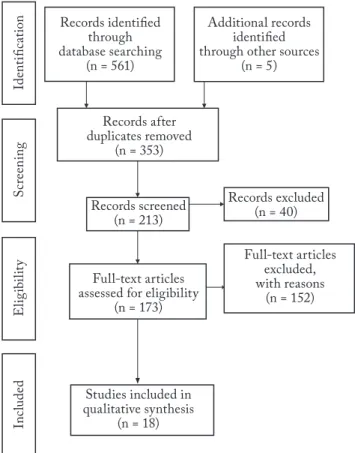
Electronic search identified 561 potentially relevant studies and 5 additional records identified through the references of eligibility articles (PubMed = 0; Science-Direct = 6; Lilacs = 41; SciELO = 11; Google Scholar = 503). Then, 353 records were deleted after checking duplicates, abstracts, dissertations and theses. Title and abstract were read and the inclusion criteria applied. A total of 213 original articles were fully analysed and 40 records excluded for not having included the PROES-P-Br battery. Thus, 173 met the eligibility criteria and 152 of full-text articles were excluded for not using the full battery for health- or skill-related fitness. From the-se, 18 met all the inclusion criteria. Sixteen evaluated the health-related fitness and three the skills-related to fitness. Figure 1 shows the PRISMA Flow Diagram.
A total of 13.582 participants with aged 6-17 years were submitted to the health-related fitness tests and 276 participants with aged 6-16 years were submitted to the skills-related fitness tests. Some studies did not report sample stratified by sex making it difficult to evaluate the results.
The main methodological characteristics were sum-marized in Table 1. Except one study (quasi-experi-mental), all others have an observational design. From 18 included studies, 14 of them were published from 2014-2018 and the others were published in 2013, 2012, 2011 e 2008. Concerning the Brazilian geo-graphical regions, studies that evaluated the health-re-lated fitness were conducted at the South (12), North (1), Northeast (1), Southeast (1) Brazilian regions and
a national sample (1). The studies that evaluated the skills-related fitness were conducted at the South (1), North (1) and Southeast (1) Brazilian regions.
Information on the physical fitness of children and adolescents were described as presented in their re-spective studies. To describe the cardiorespiratory fit-ness (CRF), flexibility (FLEX) and muscular strength (MST), 12 studies described the classification criteria suggested by PROESP-Br: “health risk zone” (RZ) and “healthy zone” (HZ). Four studies described the test results with their mean and standard deviation val-ues. Regarding body mass index (BMI), seven studies used the criteria suggested by PROESP-Br, four stud-ies used different criteria to classify overweight/obesity and five studies presented the mean and standard de-viation values.
On a seven-star scale (five stars denoting good methodological quality), two studies were observed as having seven stars, three studies as having six stars and six studies as having five-star. Eleven out of 18 includ-ed studies showinclud-ed a good methodological quality; sev-en scored four stars.
From the total sample, 1372 children and ado-lescents had their BMI evaluated and classified by
PROESP-Br criteria. The percentage of participants classified at the RZ was 30.8% (242 from 868). The studies that used a normal weight, overweight and obe-sity criteria evaluated 3442 participants, with 27.6% (950 from 3442) classified as overweight and obese. When stratified by sex, we observed that there was a similarity between boys and girls about overweight/ obesity and BMI at the RZ, regardless of the classifi-cation criteria.
A total of 12.196 participants were evaluated for CRF. In general, approximately 72% (8.781 from 12.196) of the participants were classified at the RZ. When stratified by sex, similarities, approximately 76% (6.964 from 9.155), of boys and girls were classified at the RZ for CRF.
For FLEX, 12.282 participants were evaluated. In general, classifications were balanced, with 50% (6.141 from 12.282) of the classifications in the RZ. The sex-stratified analysis showed that 50% (2.672 from 4.915) of boys and 53% (2.105 from 4.277) of girls were at the RZ for FLEX.
The MST was evaluated in 10.689 children and ad-olescents. From this total, 64.9% (6.948 from 10.689) of participants were at the RZ. The stratified analysis by sex showed a clear difference, with 48.8% (2,086 from 4.274) of girls against 74.8% (3.714 from 4.960) of boys at the RZ.
The results described in mean values (Table 3) for the four variables made the sum of the values inappro-priate for the presentation of an overall mean, due to the high variability of the subject ages at the studies and the inappropriate classification about the RZ or the HZ.
Regarding the variables composing the skills-relat-ed fitness, each one of the authors presentskills-relat-ed their
re-sults distinctly. Moreira et al.13 was the only study that
followed the PROESP-Br suggested criteria, high-lighting that for upper limbs explosive strength (UES) and agility approximately 63% of the participants were at the “WEAK” category. For lower limbs explosive strength (LLES) and speed, approximately 50% were classified as “good” and “very good”. For speed, just five boys were classified as “excellence” category and for CRF 86% of the boys were classified at the “ex-cellence” and 13% at the “very good” categories. Those boys participated in a Sports Project with organized and planned activities.
Considering that it is inappropriate to compare the results described in mean values for five variables, due
to the high variability of the participants, Souza
Bez-erra et al.14 describe and compare the physical fitness
of children who attended an indoor soccer school with children’s who attended structured physical education
classes. The study of Silva et al.15 was the only one that
described all variables stratified by sex.
Discussion
In summary, the results highlighted an elevated pro-portion of Brazilian children and adolescents with low cardiovascular fitness, which has been associated with the occurrence of high cholesterol levels, hypertension
and insulin resistance16-18. The same scenario was
ob-served for the musculoskeletal parameters (FLEX and MST), which have been associated with the
occurren-ce of low back pain and hyperlordosis19. The few
stu-dies evaluating motor performance made the synthesis of the results inconsistent.
According to some research, the evaluation of the nutritional status allows the identification of the main
risks for cardiometabolic diseases17,20,21. Our results
re-lated to cardiovascular health (BMI and CRF) showed that approximately 27-30% of the adolescents, boys and girls, were classified in the overweight/obesity cat-egories or the health risk zone for the BMI.
Those results are similar to other studies conducted in the USA and Europe, which identified 30% of the
adolescents with overweight/obesity22,23. In a recent
study, Gaya et al.24, highlighted the rising
cardiometa-bolic and musculoskeletal health risk from 2008/09 to
Table 1 – Children and adolescents’ physical fitness studies characteristics.
Study Region n Study design ¥ «
F M
Health-related Physical Fitness
Barbosa40 Palmas, Tocantins 9 11 Observational Y 4 Borges41 Cruz Alta, Rio Grande do Sul 43 Observational Y 5 Contreira42 Florianópolis, Santa Catarina 72 36 Observational Y 6 Dumith43 Rio Grande, Rio Grande do Sul 311 354 Observational N 7 Henkes44 Santa Cruz do Sul, Rio Grande do Sul 376 350 Observational Y 4 Miodutzki45 São Bento do Sul, Santa Catarina 60 Observational Y 4 Montoro46 Florianópolis, Santa Catarina 46 47 Observational Y 5 Nogueira47 Fortaleza, Ceará 108 236 Observational N 7 Oliveira33 Porto Alegre, Rio Grande do Sul 48 40 Quasi-experimental N 5 Pelegrini48 Brazil 3.393 4.114 Observational Y 6 Pelicer49 José Bonifácio, São Paulo 320 328 Observational Y 4 Pereira50 Uruguaiana, Rio Grande do Sul 751 714 Observational Y 6 Petry51 Florianópolis, Santa Catarina 61 29 Observational Y 4 Reuter52 Santa Cruz do Sul, Rio Grande do Sul 686 568 Observational Y 4 Schubert53 Londrina, Paraná 165 236 Observational Y 5 Silva15 Curitiba, Paraná 24 14 Observational N 4 Skills-related Physical Fitness
Souza Bezerra14 Manaus, Amazonas 40 Observational N 4 Moreira13 Ubá, Minas Gerais 22 Observational Y 5 Silva15 Curitiba, Paraná 24 14 Observational N 5
2013/14 among Brazilian adolescents, pointing out an alarming scenario once the high BMI levels and their related health issues.
Studies have emphasized that a bigger health risk is added when the low CRF is associated with an
over-weight/obesity status20,25. Therefore, the results of this
present review indicate that beyond the high preva-lence of BMI risk, Brazilian adolescent presents also a high prevalence of risk related to CRF, with approxi-mately 70% of the evaluated participants at the health risk zone. The significance of a concerned look to our
results is justified by the fact, in addition to those
al-ready mentioned, that Ortega et al.25 and Lee et al.26
have suggested the CRF as one of the main markers of physical fitness related to health in youth. In addition, a recent systematic review concluded that higher CRF in childhood and adolescence is associated with lower BMI, body fatness, and metabolic syndrome incidence at least 2 years later27.
Results related to musculoskeletal health indicate that 50% of the participants are at the health risk zone for FLEX and 65% are in the same situation for the
Table 2 – Brazilian children and adolescent physical fitness related to health.
Age BMI CRF FLEX MST
F M F M F M F M Barbosa40 14-17 RZ 2 3 8 4 9 5 8 9 HZ 7 8 1 7 0 6 1 2 Pelicer49 7-16 RZ 91 86 210 184 205 85 202 229 HZ 228 242 110 114 115 243 118 99 Montoro46 7-10 RZ 18 15 40 43 6 5 25 15 HZ 28 32 6 4 41 42 21 32 Contreira42 11-13 RZ 10 8 66 35 13 13 40 31 HZ 62 28 0 0 58 23 29 5 Henkes44 7-17 RZ - - 180 137 118 161 143 204 HZ - - 196 213 258 189 233 146 Petry51 15-16 RZ - - 59 27 24 17 55 17 HZ - - 2 2 37 12 6 12 Pelegrini48 7-10 RZ HZ - - 2.680713 3.291823 1.7301.663 2.3861.728 1.6131.780 3.209950 Schubert53 8-16 RZ 165 304 258 117 HZ 236 97 143 284 Miodutzki45 7-12 RZ 17 9 32 12 HZ 43 51 28 48 Borges41 15-17 RZ 8 25 18 35 HZ 35 18 25 8 Reuter52 7-17 RZ - 637 531 604 HZ - 660 723 650 Pereira50 10-17 RZ - 926 451 369 HZ - 324 913 976
BMI = body mass index; CRF = cardiorespiratory fitness; FLEX = flexibility; MST = local muscle strength/resistance; F = female; M: male; ZR health risk zone; ZS healthy zone.
Table 3 – Brazilian children and adolescent physical fitness related to health.
Age BMI CRF FLEX MST
F M F M F M F M
Dumith43 7-15 19.7 19.4 1018 1261 22.5 18.6 23.9 31.4 Nogueira47 11-16 19.0 18.5 1278.4 1535.8 26.2 23 27.9 35.6 Silva15 ±16 21.76 21.01 936.96 1140.0 25.83 19.57 26.67 33.86 Oliveira33 ±14 20.46 21.35 940.73 1123.07 32.08 22.78 36.40 46.15
MST. This enormous number of children and adoles-cents with low scores for both musculoskeletal indexes may be related to an inactive lifestyle, as observed with other health indicators.
The results highlighted in this review corroborate the international literature, and with research that spe-cifically demonstrated that, variables like FLEX and MST have a strong relation with musculoskeletal dis-eases, being an important indicator of musculoskeletal
health19,25,28. Based on these studies, the results of this
present review suggest a high risk for musculoskeletal for Brazilian children and adolescents.
Lower back, neck and shoulder pain, which af-fect the lumbar spine, are the most common related
musculoskeletal disorders29, and approximately 80%
of the general population is affect by these disorders
throughout life. Gasibat, Simbak and Aziz29 reviewed
the literature to elucidate the effects of stretching on musculoskeletal disorders and evidenced that the per-formance of stretching exercises can contribute to re-duce discomfort/pain and increase range of motion.
Besides et al.8, in reviewing the literature regarding
the benefits of physical activity and fitness of children and adolescents, concluded that even modest amounts of physical activity can have health benefits for young people in the health risk zone (for example, obesity, high pressure). Aerobic activities have the greatest health benefits, except for bone health; in this case, activities
that impact the musculoskeletal system8 are needed.
We underline that more than half of the Brazilian youth may be at premature risk for cardiovascular and musculoskeletal problems that can turn up in the future
into a serious problem to the public health system28,30. In
other words, there is a direct cost related to public health expenses with treatment for patients and their families, prevention and diagnosis, and an indirect cost (e.g., the impact at leisure time and absenteeism), with great
sac-rifice for family and friends to support that patient31.
It becomes evident that BMI, CRF, FLEX and MST are significant health indicators that can be in-fluenced by regular structured exercise. Andersen et
al.32 and Oliveira et al.33 showed an existing strong
relationship between leisure and PE exercise with the health-related fitness. Taking all the evidence into consideration, PE can and must be a valuable tool in
health promotion among children and adolescents4,34.
Results related to skills-related fitness are still not consistent for this review. Only three studies used the full PROESP-Br battery tests and measures and had a high methodological quality. Therefore, we refer first the necessity and suggest that further studies should be car-ried out to describe a complete profile of the skills-relat-ed fitness of Brazilian children and adolescents.
Some Brazilian studies demonstrate that the adoles-cent skills-related fitness does not reach adequate levels, reporting performances considered weak or regular
ac-counting for 40% of the population35,36. The
PROESP-Br research group presented pieces of evidence that approximately 30-40% of the boys and 36-44% of the girls are classified as poor performers in at least one
variable of the skills-related fitness37 (this study did not
evaluate the adolescent CRF). The explosive strength had a better prevalence for excellent performances (4%), followed by agility (3%) and speed (1-2%).
Therefore, the early identification and treatment of youth with low levels of muscular fitness (push-ups, sit-ups, bent arm hang, handgrip, standing long jump, vertical jump, etc.) could improve long-term health outcomes, since the prevention of chronic diseases
should start as early in life as possible9. Some
stud-ies reported that variables like lower and upper limbs strength, speed and agility are important capacities
for the maintenance of a systematic sports practice6.
In contrast, low levels of skills-related fitness stands to output kids and adolescents away from sports and physical practices, decreasing their opportunities to enhance motor, cognitive and social abilities. In this
perspective, Mello et al.36,37 argue that this situation
may cause a decrease at the physical activity levels, and consequently, increase the risk of developing health problems related to sedentary behaviour.
Eime et al.38 highlight that there is substantial
evi-Table 4 – Brazilian children and adolescent physical fitness related to skills.
Age UES LES AGI SPD CRF Souza Bezerra14 10-11 PE 2.35 1.33 4.95 4.36 1072 FUT 1.93 1.47 4.49 3.98 940 Silva15 ±15,92 F 3.41 1.32 7.35 4.35 936.96 M 4.55 1.82 6.43 3.72 1140 n n n n n Moreira13 11-16 Weak 13 1 14 1 0 Regular 1 3 7 0 0 Good 2 10 1 4 0 Very Good 6 7 0 12 3 Excellence 0 1 0 5 19
UES = upper limbs explosive strength; LES = lower limbs explosive strength; AGI = agility; SPE = speed; CRF = cardiorespiratory fit-ness; F = female; M = male; PE = physical education; FUT = football.
dence of many different psychological and social health benefits of participation in sports by children and ado-lescents. More specifically, there are reports that partic-ipation in team sports rather than individual activities is associated with better health. It is conjectured that this is due to the social nature of team sport and that the health benefits are enhanced through positive
in-volvement of peers and adults38.
We emphasize that in the skills-related fitness con-text it is possible and recommended to identify chil-dren and adolescents with excellent levels of physical fitness. This performance level indicates high motor skills, and excellent levels of strength, speed, agility and endurance tests can configure a skills-related fitness
pattern for specific sports modality39. In this matter,
authors39 advocated the school community need to
recognize the talent as part of human diversity and re-alize that identifying and supporting them properly is a school concern. Beyond the need to identify and sup-port them appropriately, when it comes specifically to motor skills, it is necessary to offer and support sports programs that are available for young athletes.
To our knowledge, this is the first systematic review that followed PRISMA recommendations concerning the revised theme, that is, to delineate the population physical fitness profile. This systematic review has prac-tical implications to professionals and strengths: a) to screen for conditions that may affect students’ general health; b) to identify deficiencies at the different com-ponents of skills; c) to establish reference values before initiate an exercise program; d) to monitoring the de-velopment of the class or training group; e) to give bet-ter exercise recommendations about health promotion or an adequate sports performance; and f) to present a national profile from the same evaluation method, decreasing the method heterogeneity.
This study also has limitations: a) the heterogenei-ty in the studies sample number; b) studies not devel-oped in different regions of Brazil, there is an evidence concentration in south and north regions; c) a small number of studies that evaluated skills-related physical fitness; and d) the role of potential confounders in the profile-analysis from cross-sectional studies (e.g., total physical activity and maturation level).
In conclusion, the results indicate low cardiovas-cular health (BMI/CRF), mainly related to the car-diorespiratory component, and low musculoskeletal health (FLEX/MST) among Brazilian children and adolescents. We emphasize the lack of studies related
to motor performance that make it impossible to de-lineate the Brazilian population profile, pointing out that this construct has been little explored by physical education teachers.
Conflict of interest
The authors declare no conflict of interest.
Author’s contributions
The authors Pedretti A, Mello JB, Gaya AR, Pedretti A and Gaya A, declare to be responsible for the elaboration of the manus-cript entitled “Health- and skill-related physical fitness profile of Brazilian children and adolescent: a systematic review”, with the first two authors participating at the project elaboration, data collection, data analysis and article writing, and the third, fourth and fifth authors participating at the orientation and revision of all stages of the study.
Acknowledgements
Conselho Nacional de Desenvolvimento Científico e Tecnológi-co (CNPq) and Coordenação de Aperfeiçoamento de Pessoal de Nível Superior (CAPES).
References
1. Gaya A. Mas afinal, o que é Educação Física? Movimento (UFRGS ONLINE). 1994;1(1):29-34.
2. Brasil. Pesquisa nacional de saúde do escolar: 2015. 1th ed. Rio de Janeiro: IBGE; 2016. [citado em 2020 abr 29]. Disponível em: https://biblioteca. ibge. gov. br/visualizacao/ livros/liv97870. pdf.
3. Brasil. Relatório de desenvolvimento humano nacional - movimento é vida: atividades físicas e esportivas para todas as pessoas: 2017. 1th ed. Brasília: PNUD; 2017. [citado em 2020 abr 29]. Disponível em: http://movimentoevida. org/ wp-content/uploads/2017/09/PNUD_RNDH_completo. pdf.
4. U. S. Department of Health and Human Services, Centers for Disease Control and Prevention, National Center for Chronic Disease Prevention and Health Promotion and Division of Adolescent and School Health Strategies to Improve the Quality of Physical Education: United States 2010 [citado em 2020 abr 29] Disponível em: https:// wwwcdcgov/healthyschools/pecat/quality_pe. pdf.
5. Lloyd RS, Oliver JL. The youth physical development model: A new approach to long-term athletic development. Strength Cond J. 2012;34(3):61-72.
6. Lloyd RS, Oliver JL, Radnor JM, Rhodes BC, Faigenbaum AD, Myer GD. Relationships between functional movement screen scores, maturation and physical performance in young soccer players. J Sports Sci. 2015;33(1):11-9.
7. World Health Organization. Global recommendations on physical activity for health: Switzerland. 2010. [citado em 2020 abr 29]. Disponível em: https://apps. who. int/ iris/bitstream/handle/10665/44399/9789241599979_eng. pdf?sequence=1.
8. Janssen I, LeBlanc AG. Systematic review of the health benefits of physical activity and fitness in school-aged children and youth. Int J Behav Nutr Phy. 2010;7:40.
9. García-Hermoso A, Ramírez-Campillo R, Izquierdo M. Is muscular fitness associated with future health benefits in children and adolescents? A systematic review and meta-analysis of longitudinal studies. Sports Med. 2020;174:6.
10. PROESP-Br. Manual de testes e avaliação: 2016. 5th ed. Porto Alegre: PROESP-Br; 2016. [citado em 2020 abr 28]. Disponível em: https://www. ufrgs. br/proesp/arquivos/ manual-proesp-br-2016. pdf
11. Moher D, Liberati A, Tetzlaff J, Altman DG, Group P. Preferred reporting items for systematic reviews and meta-analyses: the PRISMA statement. PLoS Med. 2009;6:7.
12. Ottawa Hospital Research Institute. The Newcastle-Ottawa Scale (NOS) for assessing the quality of nonrandomised studies in meta-analyses: Canada. 2014. [citado em 2020 abr 29]. Disponível em: http://www. ohri. ca/programs/clinical_ epidemiology/oxford. asp.
13. Moreira CD, Sperandio BB, de Almeida TF, Ferreira EF, Soares LA, de Oliveira RAR. Nível de aptidão física para o desempenho esportivo em participantes adolescentes do projeto esporte em ação. Rev Bras Prescrição Fisiol Exerc. 2017;11(64):74-82.
14. Souza-Bezerra E, Machado JCBP, Benarros M, Rossato M. Diferenças entre capacidades físicas de crianças praticantes de futsal e da Educação Física. Lect Educ Fís. 2013;18:183.
15. Silva LVM, Packe C, Tkac C, Braga RK, Urbinati KS. Associação entre variáveis de composição corporal e aptidão física em adolescentes. Rev Atenção Saúde. 2014;12(41):363-6.
16. Bergmann GG, Gaya A, Halpern R, Bergmann ML, Rech RR, Constanzi CB, et al. Circunferência da cintura como instrumento de triagem de fatores de risco para doenças cardiovasculares em escolares. J Pediatr. 2010;86(5):411-6.
17. Bergmann GG, Gaya A, Halpern R, Bergmann M, Rech RR, Constanzi CB, et al. Índice de massa corporal para triagem de fatores de risco para doenças cardiovasculares na infância. Arch Endocrinol Metab. 2011;55(2):114-20.
18. Bergmann GG, Gaya ACA, Halpern R, de Araújo Bergmann ML, Rech RR, Constanzi CB, et al. Pontos de corte para a aptidão cardiorrespiratória e a triagem de fatores de risco para doenças cardiovasculares na infância Cardiorespiratory fitness cut offs points and cardiovascular risk factors screening at infancy. Rev Bras Med Esporte. 2010;16(5):339-43.
19. Dorneles RCG, Oliveira HLR, Bergmann MLA, Bergmann GG. Flexibility and muscle strength/resistance indicators and screening of low back pain in adolescents. Rev Bras Cineantropom Desempenho Hum. 2016;18(1):93-102.
20. Abbasi F, Blasey C, Reaven GM. Cardiometabolic risk factors and obesity: does it matter whether BMI or waist circumference is the index of obesity? Am J Clin Nutr. 2013;98(3):637-40.
21. Savva SC, Lamnisos D, Kafatos AG. Predicting cardiometabolic risk: waist-to-height ratio or BMI. A meta-analysis. Diabetes Metab Syndr Obes. 2013;6:403-19.
22. Ahrens W, Pigeot I, Pohlabeln H, De Henauw S, Lissner L, Molnár D, et al. Prevalence of overweight and obesity in European children below the age of 10. Int J Obes. 2014;38(suppl2):99-107.
23. Ogden CL, Carroll MD, Lawman HG, Fryar CD, Kruszon-Moran D, Kit BK, et al. Trends in obesity prevalence among children and adolescents in the United States, 1988-1994 through 2013-2014. JAMA. 2016;315(21):2292-9.
24. Gaya AR, Dias AF, Lemes VB, Goncalves JC, Marques PA, Guedes G, et al. Aggregation of risk indicators to cardiometabolic and musculoskeletal health in Brazilian adolescents in the periods 2008/09 and 2013/14. J Pediatr. 2018;94(2):177-83.
25. Ortega FB, Tresaco B, Ruiz JR, Moreno LA, Martin‐Matillas M, Mesa JL, et al. Cardiorespiratory fitness and sedentary activities are associated with adiposity in adolescents. Obesity. 2007;15(6):1589-99.
26. Lee D, Artero EG, Sui X, Blair SN. Mortality trends in the general population: the importance of cardiorespiratory fitness. J Psychopharmacol. 2010;24(suppl4):27-35.
27. Mintjens S, Menting MD, Daams JG, van Poppel MN, Roseboom TJ, Gemke RJ. Cardiorespiratory fitness in childhood and adolescence affects future cardiovascular risk factors: a systematic review of longitudinal studies. Sports Med. 2018;48(11):2577-605.
28. Ebbeling CB, Pawlak DB, Ludwig DS. Childhood obesity: public-health crisis, common sense cure. Lancet. 2002;360(9331):473-82.
29. Gasibat Q, Simbak NB, Aziz A, Petridis L, Tróznai Z. Stretching exercises to prevent work-related musculoskeletal disorders: A review article. AJSSM. 2017;5(2):27-37.
30. Daniels SR, Jacobson MS, McCrindle BW, Eckel RH, Sanner BM. American Heart Association Childhood Obesity Research Summit Executive Summary. Circulation. 2009;119(15):2114-23.
31. Pereira J, Mateus C. Custos indirectos associados à obesidade em Portugal. Rev Port Saúde Pública. 2003;22(3):65-80.
32. Andersen LB, Lauersen JB, Brønd JC, Anderssen SA, Sardinha LB, Steene-Johannessen J, et al. A new approach to define and diagnose cardiometabolic disorder in children. J Diabetes Res. 2015;2015:539835.
33. Oliveira L, Braga F, Lemes V, Dias A, Brand C, Mello J, et al. Effect of an intervention in Physical Education classes on health related levels of physical fitness in youth. Rev Bras Ativ Fís Saúde. 2017;22(1):46-53.
34. Commonwealth of Australia. Independent Sports Panel - The Future of Sport in Australia: Australia. 2009. [citado em 2020 abr 29]. Disponível em: https://www. sportdevelopment. org. uk/index. php/subjects/59-international-documents/790-crawford-report.
35. Dumith SC, Ramires VV, Souza MJA, Moraes DS, Petry FG, Oliveira ES, et al. Aptidão física relacionada ao desempenho motor em escolares de sete a 15 anos. Rev Bras Educ Fís Esporte. 2010;24(1):5-14.
36. Mello JB, da Silva Hernandez M, Farias VM, dos Santos Pinheiro E, Bergmann GG. Aptidão Física relacionada ao desempenho motor de adolescentes de Uruguaiana, Rio Grande do Sul. Rev Bras Ciênc Mov. 2015;23(4):72-9.
37. Mello JB, Nagorny GAK, Haiachi MDC, Gaya AR, Gaya ACA. Projeto Esporte Brasil: physical fitness profile related to sport performance of children and adolescents. Braz J Kinathrop Hum Perform. 2016;18(6):658-66.
38. Eime RM, Young JA, Harvey JT, Charity MJ, Payne WR. A systematic review of the psychological and social benefits of participation in sport for children and adolescents: informing development of a conceptual model of health through sport. Int J Behav Nutr Phy. 2013;10:98.
39. Gaya A, Gonçalves da Silva G, Cardoso M, Torres L. Talento esportivo: estudo de indicadores somato-motores na seleção para o desporto de excelência. Perfil. 2002;6(6):86-96.
Quote this article as:
Pedretti A, Mello JB, Gaya AR, Pedretti A, Gaya A. Health- and skill-related physical fitness profile of Brazilian children and adolescent: a syste-matic review. Rev Bras Ativ Fis Saúde.2020;25:e0131. DOI: 10.12820/rbafs.25e0131
40. Barbosa T, Zica M, Quaresma F, Sonati J, Maciel E. Relação entre composição corporal e aptidão física em grupo de escolares do ensino médio no Brasil. Revista da UIIPS. 2016;4(2):273-84.
41. Borges FMR, Marchesan M, de Rosso Krug R, Rossato VM. Relação da Educação Física com a Aptidão Física e com Desempenho Escolar de Alunos do Ensino Médio. Biomotriz. 2016;10(2):112-28.
42. Contreira AR, Pizzo GC, da Rocha FF, Lazier-Leão TR, Caruzzo AM, Copetti F, et al. Perfil de Aptidão Física Relacionada à Saúde em Adolescentes. Saúde e Pesquisa. 2016;9(2):309-15.
43. Dumith C, Azevedo Júnior MR, Rombaldi AJ. Aptidão física relacionada à saúde de alunos do ensino fundamental do município de Rio Grande, RS, Brasil. Rev Bras Med Esporte. 2008;14(5):454-9.
44. Henkes CM, Borfe L, Muradás R, Tornquist L, Burgos MS. Aptidão física relacionada ao desempenho de escolares: estudo comparativo dos hemisférios norte-sul-leste–oeste da zona rural de Santa Cruz do Sul-RS. Cinergis. 2013;14(4):206-9.
45. Miodutzki A, de Souza WC, Grzelczak MT, Mascarenhas LPG. Antropometria e aptidão física: comparação entre praticantes e não praticantes de escolinhas esportivas. Arch Health Invest. 2016;5(4):192-6.
46. Montoro APPN, Leite CR, Espíndola JA, Alexandre JM, da Silva Reis M, Capistrano R, et al. Aptidão física relacionada à saúde de escolares com idade de 7 a 10 anos. ABCS Health Sciences. 2016;41(1):29-33.
47. Nogueira JAD, Pereira CH. Aptidão física relacionada à saúde de adolescentes participantes de programa esportivo. Rev Bras Educ Fís Esporte. 2014;28(1):31-40.
48. Pelegrini A, Silva DAS, Petroski EL, Glaner MF. Health-related physical fitness in Brasilian schoolchildren: data from the Brazil sport program. Rev Bras Med Esporte. 2011;17(2):92-6.
49. Pelicer FR, Nagamine KK, Faria MA, de Lima Freitas V, Neiva CM, Pessôa Filho DM, et al. Heath-Related Physical Fitness in School Children and Adolescents. Int J Sports Sci. 2016;6(1):19-24.
50. Pereira TA, Bergmann MLdA, Bergmann GG. Factors associeted with low physical fitness in adolescents. Rev Bras Med Esporte. 2016;22(3):176-81.
51. Petry K, Fachineto S. Aptidão física relacionada à saúde e condição econômica de alunos do ensino médio de uma escola estadual de Florianópolis, SC. Lect Educ Fís. 2012;165:16.
52. Reuter CP, Doern R, da Silva CF, Marques KC, Welser L, da Silva R, et al. Health-related physical fitness and sociodemographic factors: a study with schoolchildren from Santa Cruz do Sul-RS. Cinergis. 2016;17(2):43-7.
53. Schubert A, Januário RSB, Casonatto J, Sonoo CN. Aptidão Física relacionada à Prática Esportiva em Crianças e Adolescentes. Rev Bras Med Esporte. 2016;22(2):142-6.
Received: 13/04/2020 Approved: 02/09/2020