English/Portuguese
FATHERHOOD: DISCOURSES OF MEN WHO EXPERIENCE A CLOSER AND
PARTICIPATIVE RELATIONSHIP IN THE CHILDREN CARE
PATERNIDADE: DISCURSOS DE HOMENS QUE VIVENCIAM UMA RELAÇÃO MAIS PRÓXIMA E
PARTICIPATIVA NA CRIAÇÃO DOS FILHOS
PATERNIDAD: LOS DISCURSOS DE LOS HOMBRES QUE EXPERIMENTAN UNA RELACIÓN MÁS
ESTRECHA Y PARTICIPATIVA EN LA CREACIÓN DE LOS NIÑOS
Liana Maria Rocha Carneiro1, Kelanne Lima da Silva2, Agnes Caroline Souza Pinto3, Adna de Araújo Silva4, Patrícia Neyva da Costa Pinheiro5, Neiva Francenely Cunha Vieira6
ABSTRACT
Objective: to describe the male view about the fatherhood, from the speeches of men who experience a closer and participative relationship in the children care. Method: qualitative research with descriptive approach, carried out with seven men, fathers of infants assisted in a Family Health Center in the city of Fortaleza-CE, Brazil, from February to May 2011. For the data collection, we used participant observation, semi-structured interview script, audio recorder and field diary. The analysis was based on the technique Collective Subject Discourse, from the following research questions: in your opinion, what is be a father? And What is your opinion with regard to the involvement of the father in children care? It is noteworthy to note that the study complied with the ethical and legal aspects of researches involving human beings9, and the research project was approved by the Ethics Research Committee of the Universidade Federal do Ceará, under the protocol number 330/10. Results: the fathers believe that being a father is: responsibility, very good and be friend indeed. Regarding the participation of fathers in children care were considered: very good and to be a friend indeed. Conclusion: we can see that the meaning of being a father, has become increasingly widespread and diffuse. From the new historical process, the man has experienced the fatherhood differently from the traditional model, that is to say, in a more participative way and with a father-child relationship more effective. Descriptors: fatherhood; father-child relationships; infant care.
RESUMO
Objetivo: descrever a opinião masculina sobre a paternidade, a partir dos discursos de homens que vivenciam a relação mais próxima e participativa na criação dos filhos. Método: pesquisa qualitativa com abordagem descritiva, realizada com sete homens, pais de lactentes acompanhados em um Centro de Saúde da Família, em Fortaleza (CE), Brasil, nos meses de fevereiro a maio de 2011. Utilizou-se a observação participante, o roteiro de entrevista semiestruturado, gravador e diário de campo, para a coleta de dados. A análise foi respaldada pela Técnica do Discurso do Sujeito Coletivo, a partir das seguintes questões de pesquisa: Em sua opinião, o que é ser pai? Qual a sua opinião a respeito da participação do pai nos cuidados com o filho?
Ressalta-se que o estudo obedeceu aos aspectos éticos e legais da pesquisa envolvendo seres humanos, e o projeto de pesquisa foi aprovado pelo Comitê de Ética da Universidade Federal do Ceará, sob protocolo de n. 330/10. Resultados: os pais acreditam que ser pai é: responsabilidade, muito bom e ser amigo de verdade. Quanto à participação do pai nos cuidados com o filho foi considerada: muito importante e o principal é o carinho. Conclusão: o significado de ser pai tornou-se cada vez mais abrangente e difuso. Desde o processo histórico, o homem vem vivenciando a paternidade de forma diferenciada da tradicional, mais participativa e com a relação pai e filho mais efetiva. Descritores: paternidade; relações pai-filho; cuidado do lactente.
RESUMEN
Objetivo: describir la opinión masculina sobre la paternidad, a partir de los discursos de los hombres que experimentan un mayor acercamiento y participación en la creación de los hijos. Método: investigación cualitativa, com enfoque descriptivo, realizada con siete hombres, padres de lactantes acompañados en un Centro de Salud de la Familia en Fortaleza (CE), Brasil, de febrero a mayo de 2011. Se utilizó la observación participante, el guión de entrevista semiestructurada, grabador y diário de campo, para la recolección de datos. El análisis fue apoyado por la Técnica del Discurso del Sujeto Colectivo, a partir de las siguientes preguntas de investigación: En su opinión, lo que es ser un padre? y Cuál es su opinión acerca de la participación de los padres en el cuidado de niños? Cabe señalar que el estudio cumplió con los aspectos éticos y jurídicos de la investigación con seres humanos, y el proyecto de investigación fue aprobado por el Comité de Ética de la Universidad Federal de Ceará, bajo protocolo n. 330/10. Resultados: los padres creen que ser padre es: la responsabilidad, muy bueno y ser amigo de verdad. En cuanto a la participación de los padres en el cuidado de los niños se consideraron: muy importante y es el afecto primario. Conclusión: el significado de ser padre se ha convertido cada vez más amplio y difuso. A partir del proceso histórico, el hombre ha experimentado la paternidad de forma diferenciada de la tradicional, más participativa y con la relación padre-hijo más eficaz. Descriptores: paternidad; relaciones padre-hijo; cuidado del lactante.
1Nurse. Graduated in Nursing from Universidade Federal do Ceará/UFC. Fortaleza (CE), Brazil. E-mail: [email protected]; 2Nurse.
Doctorate’s Student in Nursing from Universidade Federal do Ceará/UFC. Fortaleza (CE), Brazil. E-mail:[email protected]; 3Nurse. Master’s
Student in Nursing from Universidade Federal do Ceará/UFC. Nursing from Instituto Federal do Ceará/IFCE. Fortaleza (CE), Brazil. E-mail:
[email protected]; 4Enfermeira. Master’s Student in Nursing from Universidade Federal do Ceará/UFC. Head Nurse of the Primary Care
Network of Regional Executive Secretariat VI from Fortaleza/CE. Universidade Federal do Ceará/UFC. Fortaleza (CE), Brazil. E-mail:
[email protected]; 5Nurse. PhD in Nursing from
Universidade Federal do Ceará /UFC. Adjunct Professor - Level - II from Universidade Federal do Ceará/UFC. Fortaleza (CE), Brazil. E-mail:[email protected]; 6Nurse. Post Ph.D from University of Bristol. Associated
Professor II from Universidade Federal do Ceará/UFC. Fortaleza (CE), Brazil. E-mail:[email protected]
Article elaborated from the monography << Participatory fatherhood under the perspective of the collective subject discourse >> presented to the Graduate Nursing Course from Universidade Federal do Ceará/UFC. Fortaleza (CE), Brazil. 2011
English/Portuguese
In order to define the meaning of the word “father”, we sought in the dictionary of the Portuguese language, Aurélio, such definition: 1. Man who gave being to another; a man who has one or more children, genitor, progenitor. 2. One subject who performs the duties of a father. 3. Father of family (good father).1 In Portuguese, the word “father” comes from the Latin term pater, it is also interpreted as
pátre, patris.2
Amid these settings, it is important to take into consideration the fact that the socio-historical and cultural context influences the men in their thoughts and attitudes as fathers. Thus, the meaning of fatherhood becomes increasingly comprehensive and elastic, providing varying meanings and interpretations based on the diversity of traditional and contemporary societies.3
The social reproduction of male and female models has their basis in the mothering, whose cultural value has an ideological meaning in the production of gender inequalities. It is understood by motherhood ("mothering") and paternity ("fathering") the maternal and paternal cares, respectively. Women, as mothers, are crucial agents in the sphere of social reproduction, because they are more involved in the education process, transmitting to the children the ideologies prevailing in society. To the man, the patriarchal model granted him the power to establish, in the domestic sphere, the dialogue with the family when it suits him, leaving to the women the responsibility of
maintaining the harmony of parental
relationships in the private sphere.4-6
However, the social changes that occurred from the 1960’s, affected the form of constructing gender identity. In this sense, female participation in the paid labor market, began to consider the participation of fathers in child care as a necessary issue, representing a drastic reshaping of man's role as family provider.4,7
Thus, we can consider that the entry of women into the labor market, somehow, pushed and favored the enlargement of involvement of men in activities of the domestic sphere and in the care of their children, opening the possibility of new forms of interaction between men and women and, consequently, between parents and children.3
The fatherhood is an opportunity for men to live innovative experiences, extending its internal dimensions and renewing their
relationships with life, being able to deal with the routine of the child, as much as the mother, as well as express feelings, establishing an emotional bond, discovering the pleasure to share the intimacy of their children. 4,7 There is also to take into account the small number of publications concerning the male vision on the fatherhood and greater emphasis on issues directed for the motherhood. Authors point out as a cause, in Brazil, the sociocultural issue, which only associates the care for the female population, mothers are considered family caregivers.8
● To describe the male opinion on the fatherhood, from the speeches of men who experience a participative and closer relationship in the chidren care.
Qualitative research, with descriptive
approach, for understanding and
contextualize the male view about the fatherhood. The study was conducted with seven parents of infants, accompanied by the Family Health Team - Equipe de Saúde da
Família (ESF) belongs to the Regional
Executive Secretariat I - Secretaria Executiva Regional I ( SER I) of the city of Fortaleza / CE, Brazil, from February to May 2011.
The participants were selected with basis of the following criteria: live in the area covered by the ESF, experience the growing of his first child, living in the same residency of his child and his partner and authorize the use of the audio recorder. These fathers were contacted during routine consultations of the ESF and, later, they were informed about the research objectives and signed a Free and Informed Consent Form - FICF.
For the data collection, we employed the participant observation, a semi-structured interview script, using the audio recorder. The interviews were recorded shortly after the consultation on childcarein the ESF; it is comprised of the following questions: In your opinion, what is to be a father? What is your opinion with regard to the involvement of the father in children care?
Data analysis was based on the technique of the Collective Subject Discourse (CSD). This methodological technique seeks to organize the qualitative data of different natures, showing as proposal the analysis of the material collected, highlighting the central
INTRODUCTION
OBJECTIVE
English/Portuguese
ideas and their key expressions, composing speeches in the first person singular.9
All informations collected and transcribed were organized into figures, according to the selection of key expressions highlighted in italics and their respective central ideas also written in italics style. The formation of the Collective Subject Discourse is highlighted in italics. To get a better understanding on the analysis and preservation of anonymity, the research subjects were identified with the letter P, preceded with numbering of each one, with cardinal number, from the order in which the interviews were conducted.
It is noteworthy to note that the study complied with the ethical and legal aspects of researches involving human beings9, and the research project was approved by the Ethics Research Committee of the Universidade
Federal do Ceará, under the protocol number
330/10.
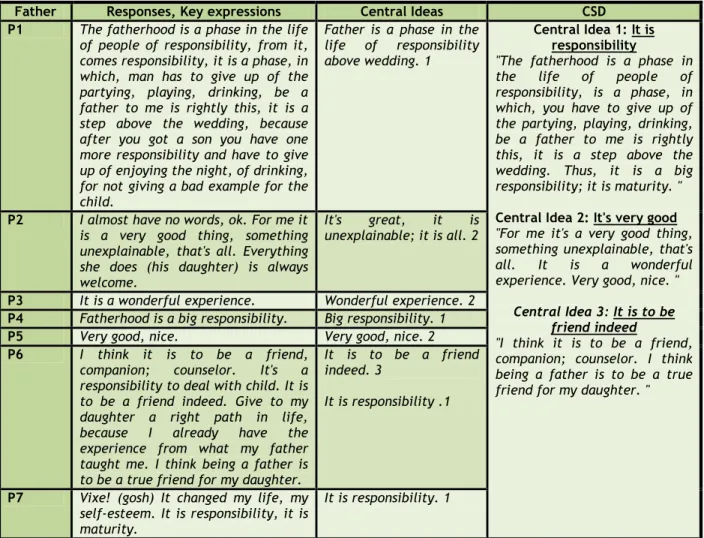
The results are presented in the following figures, which highlight the key expressions, the central ideas and the Collective Subject Discourse (CSD). Each figure corresponds to a question from the interview with the respective responses of fathers who were interviewed.
The figures 1 and 2 approach the results of the following questions: In your opinion, what is to be a father? What is your opinion with regard to the involvement of fathers in children care?
Father Responses, Key expressions Central Ideas CSD P1 The fatherhood is a phase in the life
of people of responsibility, from it, comes responsibility, it is a phase, in which, man has to give up of the partying, playing, drinking, be a father to me is rightly this, it is a step above the wedding, because after you got a son you have one more responsibility and have to give up of enjoying the night, of drinking, for not giving a bad example for the child.
Father is a phase in the life of responsibility above wedding. 1
Central Idea 1: It is responsibility
"The fatherhood is a phase in the life of people of responsibility, is a phase, in which, you have to give up of the partying, playing, drinking, be a father to me is rightly this, it is a step above the wedding. Thus, it is a big responsibility; it is maturity. "
Central Idea 2: It's very good
"For me it's a very good thing, something unexplainable, that's all. It is a wonderful experience. Very good, nice. "
Central Idea 3: It is to be friend indeed
"I think it is to be a friend, companion; counselor. I think being a father is to be a true friend for my daughter. "
P2 I almost have no words, ok. For me it is a very good thing, something unexplainable, that's all. Everything she does (his daughter) is always welcome.
It's great, it is unexplainable; it is all. 2
P3 It is a wonderful experience. Wonderful experience. 2
P4 Fatherhood is a big responsibility. Big responsibility. 1
P5 Very good, nice. Very good, nice. 2
P6 I think it is to be a friend, companion; counselor. It's a responsibility to deal with child. It is to be a friend indeed. Give to my daughter a right path in life, because I already have the experience from what my father taught me. I think being a father is to be a true friend for my daughter.
It is to be a friend indeed. 3
It is responsibility .1
P7 Vixe! (gosh) It changed my life, my self-esteem. It is responsibility, it is maturity.
It is responsibility. 1
Figure 1. Distribution of fathers with regard to the responses and key expressions, central ideas and CSD, which emerged from the following question: In your opinion, what is to be a father? Source: Research data, extracted from the interviews.
The first thematic developed, about what is being a father, among these subjects, provided three central ideas (CI): 1st CI - it is responsibility; 2nd CI - it is very good; 3rd CI – it is to be a friend indeed.
According to the statements in the figure 1, regarding the first CI, there is the presence of the fatherhood associated to responsability, that is to say, the fathers believe that being a father is a big responsibility; it is to give up of some leisure options to be more near the
children, it is a stage above the wedding; after the birth of their children, fathers become more responsible. This idea seeks to
identify from the fathers a more
differentiated meaning of fatherhood than the traditional sense, approaching a new view on the fatherhood. It was also highlighted the idea that being a father is maturity, is a phase, in man's life, of learning and development that makes it more mature.
English/Portuguese
These statements corroborate the
literature, which affirms that the fatherhood comes loaded with a sense of responsibility and professional investment, as a passage rite to the adulthood, but also brings feelings of fear and attachment by the children.7
In the second CI of the figure 1, the fathers consider the fatherhood as something very good in the life of a man, is a very good thing. Thus, it is clear that being a father is an achievement, is a wonderful experience for the man. Therefore, the fatherhood began to be perceived by the father, not as “heaviness”, in the case in which a man remembers, only, of financial costs and their role as authority to assist in the growth and development of the child, but also began to realize the most affective side of the fatherhood, which came as something good to add to the family institution..
Another aspect to emphasize, in the speech, is the third CI of the figure 1, which
relates the idea that being a father is to be a true friend to his child. It considers the fatherhood as a way of getting closer to the child, becoming his friend, companion and counselor. This idea strengthens the formulation and development of a fatherhood based on affective relationships, and its importance to the children care. Being a friend of the child strengthens the father-child relationship, developing a kind of fatherhood that is permeated confidence and affection.
So, it is possible to perceive that the meaning of being a father, expressed in the speeches of the fathers, became increasingly widespread and diffuse. Nowadays, there is the presence of elements which reinforce both the idea on the traditional fatherhood as the participative fatherhood. Anyway, lately, the man has experienced the fatherhood differently from the traditional model, that is to say, in a more participative way and with a father-child relationship more effective.
Father Responses, Key expressions Central Ideas CSD P1 The main thing is the question of
tenderness. Because, today we see too young fathers, who have no experience and they do not pay much attention. And what the child needs is more attention, the little time you can give it, play around with it and everything is a major opportunity, so that the child feels its father near there, and can rely on him in that moment, especially when he(baby) reaches an range age of 1 year to 4 years; he wants to identify with the father, get affection, and many fathers do not do it. There are few families that give the necessary attention.
The principal is the tenderness. 2
Central Idea 1: It is very important
"It's very important. Essential. The father has to participate of the child’s life, because, after all, he will be part of the growth. It is very important, because, we see the growth and development of the child. It's important to us to be always near the child, for that he/she is sure that’ll have security with us and get a better development. "
Central Idea 2: The principal is the tenderness
"The main thing is the question of tenderness.. And what the child needs is more attention, the little time you can give it, play around with it and everything is a major opportunity, so that the child feels its father near there(...)"
P2 It is very important. It is very important. 1
P3 It is primordial, it is very much
important. Mainly because when the father worries about the child, in its growth and education, he is already anticipating what is best for that child. So, sometimes, the mother for any reason, she leaves a bit to be desired, then there will be the partnership of the couple, the father takes the initiative to not play up the responsibility for the mother, and takes his part as a father, not simply by he is giving the food, supply, that he will let it out. there is the part of security, affection, pleasure. It’s essential. The father has to participate of the child’s life, because, after all, he will be part of the growth and especially when it is related to a male child.
Primordial, very much important. 1
Partnership of couple.
Essential. 1
P4 It is very important, because we see
the growth and development of the child. So, you can teach him/her many things, many good things, so he/she
English/Portuguese
will not get to a certain time doing wrong things.
P5 I think It is very important. It is very important. 1
P6 It is very important, because if we do not pay attention, do not care and do not give affection, I guess it will not lead to anything. It's important to us to be always near the child for that he/she is sure that’ll have security with us.
It is very important. 1
P7 Surely, It is very important, because when the child gets older, it will see the two together, the father and mother and not just the mother. It is important that the father is present, because the child will have a better development.
It is very important. 1
Figure 2. Distribution of fathers with regard to the responses and key expressions, central ideas and CSD, which emerged from the following question: What is your opinion with regard to the involvement of the father in children care? Source: Survey data, extracted from the interviews.
The analysis of the Collective Subject Discourse on the participation of fathers in children care provided two central ideas: 1st CI - Very important and 2nd CI The principal is the tenderness.
The first CI of the figure 2 highlighted, based on the speeches of a father, the importance of fathers participate, actively, in the children care. This idea considered as essential this participation, stating that the father is part of the development of the child, following up its growth and development. It also highlights that the participative fatherhood will provide greater security and better development for the child. It is noteworthy to note that the discourses of fathers are related to the idea of a "new father", which is characterized by the experience of fatherhood, based in an emotional intensity and willingness to share with the mother the performance of necessary cares to the child.11
With regard to the second CI of the Figure 2, it should be verified that to the child is required to realize the father figure in its life, this fact brings benefits for both: the child and the parent. It is also highlighted, in the
speeches, the notion that paternal
participation is important, because it offers care and tenderness, contributing for the welfare of the child.
It is evident, with support in discourse analysis, that the father is enhancing its presence and participation in the children care. The involvement in this process is important, since the child needs of the father because of his positive qualities and the things which distinguishes him from other men, such as the liveliness that covers his personality. If the father is present and wants to know his own child, this is a lucky child and, in the
happiest circumstances the father enriches the own child’s world, in a abundant manner. When both parents accept readily the responsibility for the child's existence, the stage is set for a good home.12
Thus, we can verify the importance of a greater participation and involvement of the father in the growth and development of the children, through the promotion of benefits to both(father and child) and the creation and strengthening of the bond between father and child, making a more fortified relationship.
The meaning atributted to the fatherhood is on the responsibility, of being very good, to be a true friend, of being very important and
affection(tenderness). Fatherhood is
experienced by men who love and care for their children. The meaning of being a father has become increasingly widespread and diffuse. From the new historical process, the
man has experienced the fatherhood
differently from the traditional model, that is to say, in a more participative way and with a father-child relationship more effective.
1. Ferreira, ABH. Dicionário Aurélio da Língua Portuguesa. 5 ed. Curitiba: Positivo; 2010.
2. PAI. In: Michaelis Moderno Dicionário da Língua Portuguesa [Internet]. São Paulo: Melhoramentos Ltda; 2009 [cited 2012 July
21]. Available from:
http://michaelis.uol.com.br/moderno/portug
ues/index.php?lingua=portugues-portugues&palavra=pai.
3. Staudt ACP, Wagner A. Paternidade em tempos de mudança. Psicol Teor Prat
CONCLUSION
English/Portuguese
[Internet]. 2008 June [cited 2012 July
21];10(1):174-185. Available
from:http://pepsic.bvsalud.org/scielo.php?sc
ript=sci_arttext&pid=S1516-36872008000100013&lng=en&nrm=iso>. ISSN
1516-3687.
4. Freitas WMF, Silva ATMC, Coelho EAC, Guedes RN, Lucena KDT, Costa APT. Paternidade: responsabilidade social do homem no papel de provedor. Rev Saúde Pública [Internet]. 2009 [cited 2012 July
21];43(1): 85-90. Available from:
www.scielosp.org/pdf/rsp/v43n1/6868.pdf
5.Hennigen I. Especialistas advertem: o pai é importante para o desenvolvimento infantil.
Fractal Rev Psicol [Internet]. 2010 Jan-Apr [cited 2012 July 21];22(1):169-184. Available from:
www.uff.br/periodicoshumanas/index.php/Fr actal/article/view/462
6. Davi MTG, Solano LC, Martins PHMC, Pedrosa KSC, Maia DKC, Fernandes ACL. Companion’s participation during prenatal care:challenge for nursing. Rev enferm UFPE on line [Internet]. 2011 Nov [cited 2012 Jan
20];5(9):2077-82. Available from:
http://www.ufpe.br/revistaenfermagem/inde
x.php/revista/article/view/1933 doi:
10.5205/reuol.1262-12560-1-LE.0509201101
7. Sutter C, Bucher-Maluschke JS. Pais que cuidam dos filhos: a vivência masculina na paternidade participativa. Psico [Internet]. 2008 Jan-Mar [cited 2012 July 21];39(1):74-82.
Available from:
revistaseletronicas.pucrs.br/ojs/index.php/re vistapsico/article/.../2799
8. Bustamante V, Trad LAB. Participação paterna no cuidado de crianças pequenas: um estudo etnográfico com famílias de camadas populares. Cad Saúde Pública [Internet]. 2005 dec [cited 2012 July 21];21(6):1865-1874.
Available from:
www.scielo.br/pdf/csp/v21n6/26.pdf
9. Lefèvre F, Lefèvre AMC. Discurso do sujeito coletivo: um novo enfoque em pesquisa qualitativa (desdobramentos). 2 ed. Caxias do Sul, RS: Educs; 2005.
10. Ministério da Saúde (BR). Conselho Nacional de Saúde. Comissão Nacional de Ética em Saúde. Resolução nº 196, de 1996. 2ª ed. Normas para pesquisa envolvendo seres humanos. Brasília: Ministério da Saúde; 2003.
11. Freitas WMF, Coelho EAC, Silva ATMC. Sentir-se pai:a vivência masculina sob o olhar de gênero. Cad Saúde Pública [Internet]. 2007 Jan [cited 2012 July 21];23(1):137-45.
Available from:
www.scielo.br/pdf/csp/v23n1/14.pdf
12. Winnicott DW. A criança e o seu mundo. 6 ed. Rio de Janeiro: LTC; 2008.
Sources of funding: No Conflict of interest: No
Date of first submission: 2012/04/03 Last received: 2012/08/26
Accepted: 2012/08/26 Publishing: 2012/09/01
Corresponding Address
Agnes Caroline Souza Pinto
Av. Sargento Hermínio, 2755, Ap. 402, Bl.-E Bairro Monte Castelo