Article
J. Braz. Chem. Soc., Vol. 22, No. 11, 2065-2069, 2011. Printed in Brazil - ©2011 Sociedade Brasileira de Química
0103 - 5053 $6.00+0.00
A
*e-mail: [email protected]
Microwave-Assisted Clean Synthesis of Amides via Aza-Wittig Reaction under
Solvent-Free Condition
Murugan Sathishkumar, Sangaraiah Nagarajan, Poovan Shanmuga Velan, Murugan Dinesh and Alagusundaram Ponnuswamy*
Department of Organic Chemistry, School of Chemistry, Madurai Kamaraj University, 625-021 Tamilnadu, India
O acoplamento de fosfazenos com cloretos de acila ou anidridos carboxílicos mediado por microondas na presença de fosfito de etila foi realizado, resultando nas correspondentes amidas, de maneira limpa e com bons rendimentos. Ao contrário das metodologias anteriores, que empregam solventes clorados, benzeno (cancerígeno), etc, este protocolo é eco-amigável, rápido e simples.
A solvent-free microwave-assisted coupling of phosphazenes with acyl chlorides or carboxylic anhydrides in presence of triethylphosphite has been accomplished resulting in a clean synthesis of amides in good yields. Unlike the prevailing time-consuming solution phase methodologies employing chlorinated solvents, benzene (carcinogenic), etc, the present protocol is an eco friendly, rapid and simple approach.
Keywords: microwave, solution phase, solvent-free, amide, aza-wittig
Introduction
Amide is an ubiquitous functionality prevalent in natural products, peptides and potential drugs.1 In view of this,
extensive research towards developing elegant protocols for amide bond formation is in progress wherein attempts are being continuously made to eradicate the difficulties and limitations enveloped with the prevailing methods.
Generally, the most relevant methodologies involve solution phase approach wherein the limitations associated with the polarity, refluxing temperature and the toxicity of the solvent/additives restrict their broad scope and question their eco-friendliness. Also, the components employed and formed as the by-products in the protocols play vital role in deciding the rate of the amide bond formation. Thus, all these aspects are to be considered in accomplishing time-conscious, eco-friendly protocols for amide bond formation. In particular, the direct coupling of an amine with a carboxylic acid results in an acid-base reaction to form a
stable salt following which the amide bond formation has to fight against adverse thermodynamics as the equilibrium lies on the side of hydrolysis rather than synthesis (Scheme 1).
Herein, azeotropic removal of water accumulated in the solution has been attempted2 for accomplishing an effective
synthesis of amides. Alternatively, molecular sieves are added to the solution to trap the water and expedite the reaction.
On the other hand, the direct coupling of amines with carboxylic acids has been assisted by coupling reagents3
(Scheme 2). Apparently, use of excess of coupling reagents and their corrosive nature is hazardous to the environment.
Further, other approaches like aminocarbonylation4
of aryl halides with amines and catalysis5 in amide bond
formation in solvent medium are with limitations such as loading of metal carbonyls/catalyst for large scale preparation and difficulties in reactivation/reusability of deactivated catalyst which may preclude the scope of their applicability.
R2COOH
+ R2COO−
R1NH2 R
1
NH3 R
1
NHCOR2+ H2O +
Microwave-Assisted Clean Synthesis of Amides via Aza-Wittig Reaction J. Braz. Chem. Soc.
2066
An alternative solution phase protocol involves the coupling of Staudinger’s phosphazenes,6 generated from
phosphines and organic azides, with carboxylic acids7
(Scheme 3) or their derivatives8to afford carboxamides. The
limitations of this methodology are the usage of benzene (carcinogenic) or toluene as the solvent of choice, very long reaction times7 and solubility problems that arise with
polar starting substrates.7
The polarity of the substrates and reagents puts restriction to the number of useful solvents. Further, solvents employed may either enhance or retard the rate of the reaction performed in view of differing interactions. Above all, the above said preferred solvents restrict the possibility of exploring the effect of temperature on the rate of the amide bond formation. Sometimes, the reaction can not be studied at higher temperatures.
Results and Discussion
Microwave-assisted organic synthesis9 had replaced
most of the time consuming conventional methodologies. Its applicability in amide bond formation has been scarcely studied. To the best of our knowledge, solvent-free coupling of phosphazenes with acid chlorides and anhydrides assisted by microwave has been never reported.
Hence, need for a better protocol avoiding the hazards to the environment becomes important. In this regard, we attempted the microwave-assisted aza-wittig coupling of the azides with acids in presence of triphenylphosphine under solvent-free condition. The reaction was fascinating in the sense, that the reaction was completed at 180 oC
within 15 min with good yield of the amides. The above coupling in solvents have been reported7 and noted by us
to afford the amides in 3-72 h. Thus the multifold increase in the rate under solvent-free condition has been apparently thought to be due to the close intimacy and collapsing of the reaction mixture. In spite of this advantage, the method
was still time consuming due to the need for the isolation of the by-product viz. triphenylphosphine oxide from the reaction mixture. This tempted us to simplify the protocol by some appropriate modifications.
This has been accomplished by substituting the acyl chlorides or the anhydrides in the place of the carboxylic acids and triethylphosphite in the place of triphenylphosphine. This would result in (i) enhancing the electrophilicity of the acyl carbon resulting in accelerating the reaction at relatively lower temperature and (ii) formation of water soluble triethylphosphate as the by-product. Based on these presumptions the present work was attempted, the findings of which are presented below.
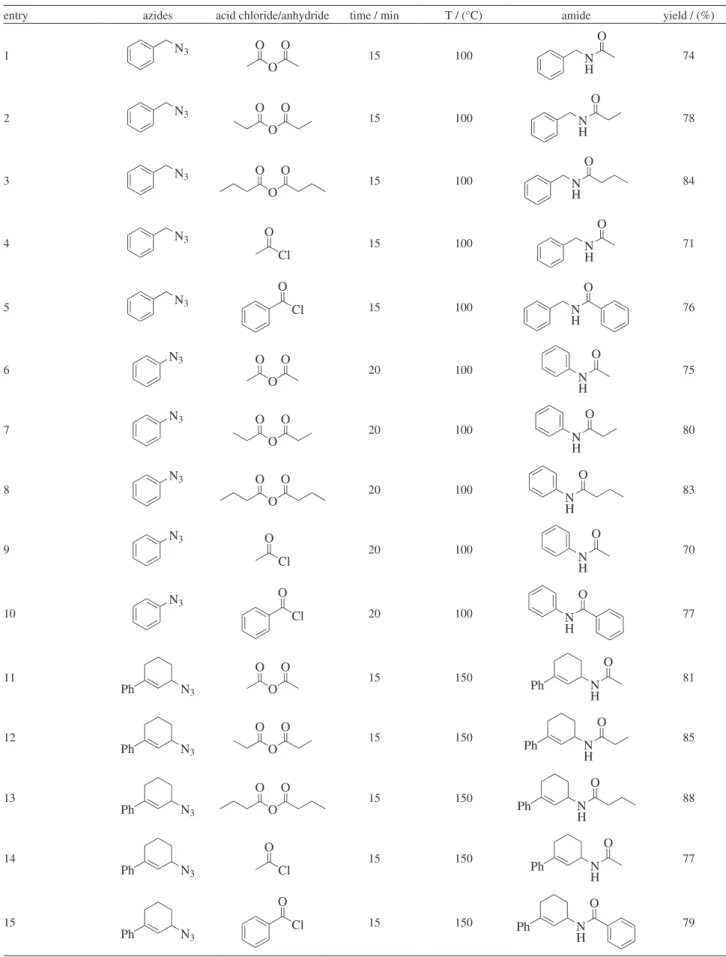
In a typical procedure (Scheme 4), a mixture of triethylphosphite (1 mmol), organic azide (1 mmol) and acid anhydride/acid chloride (1.3 mmol) was irradiated with microwave for 15-20 min at the temperature indicated in Table 1 to afford the amide in good yield.
Conclusions
In conclusion, the present study reports a solvent-free microwave-assisted amide synthesis via coupling of phosphazenes with acyl chlorides or carboxylic anhydrides in presence of triethylphosphite. It is an eco-friendly, rapid and simple approach which avoids the limitations associated with time-consuming solution phase methodologies where benzene (carcinogenic), toluene and chlorinated solvents are preferably employed.
Experimental
All chemicals, reagents and solvents were of commercially high purity grade purchased from Avra Synthesis Pvt. Ltd. and Merck Ltd. India. Silica gel (60-120 mesh) was used for column chromatographic isolation and purification of the amides synthesized. Organic azides were prepared according to the literature procedures. Melting points were noted on electro-thermal apparatus and are uncorrected.
1H NMR and 13C NMR spectra were recorded in CDCl 3 on
Bruker Avance 300 MHz spectrometer and the chemical shifts are reported as d values in parts per million (ppm)
R2COOH
+ coupling agent
solvent R
1NHCOR2
R1NH2
Scheme 2. Coupling of amines with carboxylic acids in presence of coupling agent.
R2-COX
solvents/ Ph3P NR1
P(R3)3 –N2 phosphazene
X= OH, Cl, OCOR
R1-N3 R1NHCOR2
longer time
Scheme 3. Coupling of Staudinger’s phosphazene with carboxylic carboxylic acids or their derivatives.
R1 = primary, secondary, aryl
R1-N3 R2COX R1NHCOR2
MW solvent-free P(OEt)3
X = Cl or OCOR2
15-20 min
Sathishkumar et al. 2067 Vol. 22, No. 11, 2011
Table1. Microwave-assisted amide synthesis
entry azides acid chloride/anhydride time / min T / (°C) amide yield / (%)
1 N3
O
O O
15 100 N
H O
74
2 N3
O
O O
15 100 N
H O
78
3 N3
O
O O
15 100 N
H O
84
4 N3
Cl O
15 100 N
H O
71
5 N3
Cl O
15 100 N
H O 76 6 N3 O O O 20 100 N H O 75 7 N3 O O O 20 100 N H O 80 8 N3 O O O 20 100 N H O 83 9 N3 Cl O 20 100 N H O 70 10 N3 Cl O
20 100 N
H O 77 11 N3 Ph O O O 15 150 N H O Ph 81 12 N3 Ph O O O 15 150 N H O Ph 85 13 N3 Ph O O O 15 150 N H O Ph 88 14 N3 Ph Cl O 15 150 N H O Ph 77 15 N3 Ph Cl O
15 150 N
H O
Ph 79
Microwave-Assisted Clean Synthesis of Amides via Aza-Wittig Reaction J. Braz. Chem. Soc.
2068
relative to tetramethylsilane, with J values in Hertz. The splitting patterns in 1H NMR spectra are reported as
follows: s = singlet; d = doublet; t = triplet; q = quartet; br s = broad singlet; br d = broad doublet; m = multiplet.
13C NMR data are reported with the solvent peak
(CDCl3 = 77.0) as the internal standard. Elemental analyses
were performed by CNRS (Vernaison, Lyon) and were in agreement with the calculated values within ±0.4%. Spectral data of known amides are given in supplementary section.
General procedure for the microwave-assisted synthesis of amides (Table 1, entry 1-15)
To an intimate mixture of triethylphosphite (1 equiv.) and organic azide (1 equiv.) in a microwave vial (10 mL) equipped with a magnetic stirring bar, acid anhydride/ acyl chloride (1.3 equiv.) was added in drops with stirring. Stirring was continued until liberation of nitrogen ceased and the reaction vessel was sealed with a septum. It was then placed into the cavity of a focused monomode micro-wave reactor (CEM Discover, benchmate) and operated for 15 min at 150 oC (temperature monitored by a built-in
IR sensor). The reaction temperature was maintained by modulating the power level of the reactor. The reaction vessel was then cooled to room temperature and the residue was dissolved in ethyl acetate and washed repeatedly with water followed by saturated sodium bicarbonate solution to afford the amides as white solids.
N-(3-phenylcyclohex-2-enyl)acetamide (Table 1, entry 11)
Yield 195 mg (85%), mp 118 ºC; IR (KBr) ν
max/cm-1:
3445 (−NH), 1671 (−C=O); 1H NMR (300 MHz, CDCl
3)
d (ppm): 7.20-7.40 (m, 5H, ArH), 5.96 (pseudo triplet, 1H, C=CH), 5.60 (br d, 1H, J 7.5 Hz, −NH), 4.70 (br s,1H,
CHN), 1.99 (s, 3H, −COCH
3), 2.20-2.42 (m, 2H, alicyclic
protons), 1.95-2.07 (m, 1H, alicyclic proton), 1.65-1.77 (m, 2H, alicyclic protons), 1.39-1.53 (m, 1H, alicyclic proton);
13C NMR (75 MHz, CDCl
3) d (ppm): 169.4, 148.1, 139.9,
138.7, 126.2, 125.0, 123.6, 45.5, 29.0, 27.1, 23.2, 20.1. Anal. calc. (%) for C14H17NO: C, 78.10; H, 7.96; N, 6.51.
Found (%): C, 78.25; H, 7.95; N, 6.51.
N-(3-phenylcyclohex-2-enyl)propionamide (Table 1, entry 12)
Yield 195 mg (85%), mp 97 ºC; IR (KBr) ν
max/cm-1:
3444 (−NH), 1682 (−C=O); 1H NMR (300 MHz, CDCl
3)
d (ppm): 7.20-7.50 (m, 5H, ArH), 5.96 (pseudo triplet, 1H, C=CH), 5.62 (br d, 1H, J 6.9 Hz, −NH), 4.70 (br s, 1H,
CHN), 2.21 (q, 2H, J 7.5 Hz, COCH2) 1.16 (t, 3H, J 7.5
Hz,−CH
3), 2.20-2.42 (m, 2H, alicyclic protons), 1.95-2.07
(m, 1H, alicyclic proton), 1.65-1.77 (m, 2H, alicyclic
protons), 1.39-1.53 (m, 1H, alicyclic proton); 13C NMR
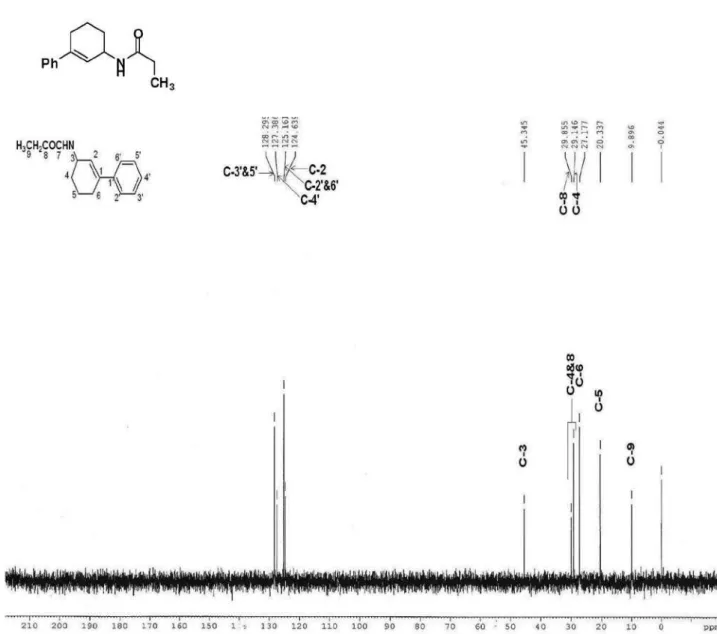
(75 MHz, CDCl3) d (ppm): 173.0, 141.2, 140.1, 128.2, 127.3, 125.1, 124.6, 45.3, 29.8, 29.1, 27.1, 20.3, 9.8. Anal. calc. for C15H19NO: C, 78.56; H, 8.35; N, 6.11. Found: C,
78.46; H, 8.36; N, 6.10.
N-(3-phenylcyclohex-2-enyl)butyramide (Table 1, entry 13)
Yield 195 mg (85%), mp 128-129 ºC; IR (KBr) ν
max/cm -1:
3447 (−NH), 1692 (−C=O); 1H NMR (300 MHz, CDCl
3) d
(ppm): 7.25-7.39 (m, 5H, ArH), 5.96 (s, 1H, C=CH), 5.50 (br d, J 6.4 Hz, 1H, NH), 4.71 (br s, 1H, CHN), 2.36-2.40 (m, 2H), 2.16 (m, 2H), 1.95-1.97 (m, 1H, alicyclic protons), 1.81-1.83 (m, 2H, alicyclic protons), 1.68 (m, 2H, alicyclic protons), 1.55-1.57 (m, 1H, alicyclic protons), 0.95 (t, J
14.7 Hz, 3H, CH3). 13C NMR (75 MHz, CDCl3) d (ppm):
172.9, 141.2, 140.2, 128.2, 127.3, 125.1, 124.6, 45.3, 29.8, 29.1, 27.2, 20.3, 18.3, 9.8. Anal. calc. for C16H21NO: C,
78.97; H, 8.70; N, 5.76. Found: C, 78.88; H, 8.72; N, 5.77.
N-(3-phenylcyclohex-2-enyl)benzamide (Table 1, entry 15)
Yield 220 mg (79%), mp 154 ºC; IR (KBr) ν
max/cm-1:
3451 (−NH), 1670 (−C=O); 1H NMR (300 MHz, CDCl
3)
d(ppm): 7.29-7.75 (10H, m, ArH), 6.00 (br s, 1H, C=CH), 5.60 (br d, 1H, J 8.4Hz, NH), 4.60 (br s, 1H, CHN), 2.20-2.42 (m, 2H, alicyclic protons), 1.95-2.07 (m, 1H , alicyclic proton), 1.65-1.77 (m, 2H, alicyclic protons), 1.39-1.53 (m, 1H, alicyclic proton); 13C NMR (75 MHz, CDCl
3) d
(ppm): 166.7, 148.2, 140.4, 138.6, 134.7, 131.3, 128.4, 126.9, 126.4, 125.1, 123.6, 45.0, 29.1, 27.2, 20.4. Anal. calc. for C19H19NO: C, 82.28; H, 6.90; N, 4.05. Found: C,
82.13; H, 6.91; N, 5.06.
Supplementary Information
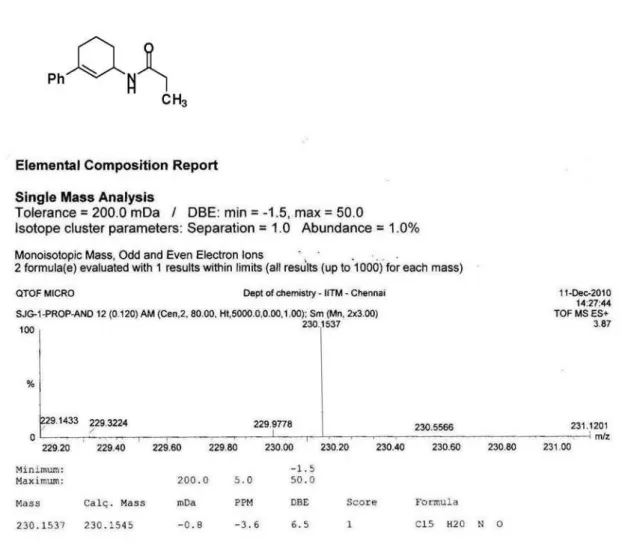
The spectroscopic 1H NMR, 13C NMR, IR data as well
as the HRMS of selected compounds are available free of charge at http://jbcs.sbq.org.br as PDF file.
Acknowledgments
The authors, M. S, S. N and P. S acknowledge their grateful thanks to UGC for the sanction of UGC-JRF meritorious fellowship and IRHPA, DST for providing 300 MHz NMR instrument for recording the NMR spectra for the compounds synthesized.
References
1. Hudson, D.; J. Org. Chem. 1988, 53, 617; Beckwith, A. L. J. In
Sathishkumar et al. 2069 Vol. 22, No. 11, 2011
In Comprehensive Organic Synthesis; Winterfeld, E., ed.; Pergamon: Oxford, 1991, Vol. 6; Ghose, A. K.; Viswanadhan, V. N.; Vendol, J. J.; J. Comb. Chem. 1999, 1, 55.
2. Cossy, J.; Pale-Grosdemange, C.; Tetrahedron Lett. 1989, 30, 2771.
3. Heal, W.; Thompson, M. J.; Mutter, R.; Cope, H.; Louth, J. C.; Chen. B.; J. Med. Chem.2007, 50, 1347; Dunn, P. J.; Galvin, S.; Hettenbach, K.; Green Chem.2004, 6, 43; Petersson, M. J.; Marchal, C.; Loughlin, W. A.; Jenlins, I. D.; Healy, P. C.; Almesaker, A.; Tetrahedron 2007, 63, 1395;Kadam, S. T.; Kim, S. S.; Synthesis2008, 2, 267.
4. Letavic, M. A.; Ly, K. S.; Tetrahedron Lett. 2007, 48, 2339; Lagerlund, O.; Mette, L.; Mantel, H.; Larhed, M.; Tetrahedron
2009, 65, 7646.
5. Narender, N.; Srinivasu, P.; Kulkarni, S. J.; Raghavan, K. V.;
Green Chem. 2000, 2, 104; Bures, J.; Martin, M.; Urpi, F.; Vilarrasa, J; J. Org. Chem.2009, 74, 2203; Luque, R.; Budarin, V.; Clark, J. H.; Macquarrie, D. J.; Green Chem.2009, 11, 459;
Maki, T.; Ishihara, K.; Yamamoto, H.; Tetrahedron 2007, 63, 8645.
6. Staudinger, H.; Meyer, J.; Helv. Chim. Acta 1919, 2, 635; Gololobov, Yu. G.; Zhmurova, I. N.; Kasukhin, L. F.;
Tetrahedron 1981, 37, 437; Gololobov, Yu. G.; Kasukhin, L. F.; Tetrahedron1992, 48, 1353.
7. Garica, J.; Urpi, F.; Vilarrasa, J.; Tetrahedron Lett. 1984,
25, 4841; Kovacs, L.; Osz, E.; Domokos, V.; Holzer, W.; Gyorgydesk, Z.; Tetrahedron2001, 57, 4609; Malkinson, J. P.; Falconer, R. A.; Toth, I. J.; J. Org. Chem.2000, 65, 5249; Urpi, F.; Vilarrasa, J.; Tetrahedron Lett. 1986, 27,4623.
8. Shalev, D. E.; Chiacchiera, S. M.; Radkowsky, A. E.; Kosower, E. M.; J .Org. Chem.1996, 61, 1689; Bosch, I.; Gonzalez, A.; Urpi, F.; Vilarrasa, J.; J. Org. Chem. 1996, 61, 5638.
9. Polshettiwar, V.; Varma, R. S.; Acc. Chem. Res.2008, 41, 629.
Submitted: May 31, 2011
Supplementary Information
S
I
J. Braz. Chem. Soc., Vol. 22, No. 11, S1-S18, 2011. Printed in Brazil - ©2011 Sociedade Brasileira de Química 0103 - 5053 $6.00+0.00
*e-mail: [email protected]
Microwave-Assisted Clean Synthesis of Amides via Aza-Wittig Reaction under
Solvent-Free Condition
Murugan Sathishkumar, Sangaraiah Nagarajan, Poovan Shanmuga Velan, Murugan Dinesh and Alagusundaram Ponnuswamy*
Department of Organic Chemistry, School of Chemistry, Madurai Kamaraj University, 625-021 Tamilnadu, India
Experimental
General
All chemicals, reagents and solvents were of commercially high purity grade purchased from Avra Synthesis Pvt. Ltd. and Merck Ltd. India. Silica gel (60-120 mesh) was used for column chromatographic isolation and purification of the amides synthesized. Organic azides used in the investigation were prepared according to the literature procedures. Melting points were noted on electro-thermal apparatus and are uncorrected. 1H NMR
and 13C NMR spectra were recorded in CDCl
3 on Bruker
Avance 300 MHz spectrometer and the chemical shifts are reported as d values in parts per million (ppm) relative to tetramethylsilane, with J values in Hertz. The splitting patterns in 1H NMR spectra are reported as follows: s =
singlet; d = doublet; t = triplet; q = quartet; br s = broad singlet; br d = broad doublet; m = multiplet. 13C NMR data
are reported with the solvent peak (CDCl3 = 77.0) as the
internal standard. Elemental analyses were performed by CNRS (Vernaison, Lyon) and were in agreement with the calculated values within ±0.4%.
Experimental procedure for the preparation of azides used in the synthesis of amides
Benzyl azide1
To a stirred solution of the benzyl bromide (1 g, 5.84 mmol) in water/acetone mixture (1:4 v/v, 10 mL), sodium azide (0.57 g, 8.77 mmol) was added. The resulting suspension was stirred at room temperature for 24 h. Dichloromethane was added to the mixture and the organic layer was separated. The aqueous layer was extracted with dichloromethane (3 × 10 mL) and the combined organic
layers were dried over anhydrous magnesium sulphate. Solvent was removed under reduced pressure, and the azide was obtained in quantitative yield sufficiently pure to use without further work up.
1-Azido-3-phenyl-2-cyclohex-2-ene2
To 20% ethanolic potassium hydroxide (10 mL), 1a-azido-2a-iodo-1e-phenylcyclohexane (1.0 g, 3.0 mmol) was added and the mixture refluxed for 1 h in water bath. Then the mixture after cooling to room temperature was added to excess water and extracted with ether (3 × 20 mL). The organic extract was washed repeatedly with water, dried over anhydrous magnesium sulphate to give the allyl azide contaminated with 1-phenylcyclohexene. Column chromatographic purification on silica with pet ether/ethyl acetate as the eluant afford 1-azido-3-phenyl-2-cyclohex-2-enein good yield.
Phenyl azide3
These azides were prepared by the diazotization procedure similar to that used for the preparation of iodobenzene from aminobenzene by diazotization followed by treatment of aqueous potassium iodide at low temperature. Herein, by the same procedure diazotized solution of aminobenzene and 1-amino-4-bromobenzene were treated with aqueous sodium azide to afford the corresponding organic azides, respectively, which was used without further purification for the synthesis of amides in our investigation.
Microwave-Assisted Clean Synthesis of Amides via Aza-Wittig Reaction J. Braz. Chem. Soc.
S2
was sealed with a septum. It was then placed into the cavity of a focused monomode micro-wave reactor (CEM Discover, benchmate) and operated for 15 min at 150 oC
(temperature monitored by a built-in IR sensor). The reaction temperature was maintained by modulating the power level of the reactor. The reaction vessel was then cooled to room temperature and the residue was dissolved in ethylacetate and washed repeatedly with water followed by saturated sodium bicarbonate solution to afford the amide as white solid. Experimental 85%, mp 118 ºC; IR (KBr)
ν
max/cm-1: 3445 (−NH), 1671 (−C=O); 1H NMR (300 MHz,
CDCl3) d (ppm): 7.20-7.40 (m, 5H, ArH), 5.96 (pseudo
triplet, 1H, C=CH), 5.60 (br d, 1H, J 7.5 Hz, −NH), 4.70
(br s,1H, CHN), 1.99 (s, 3H, −COCH
3), 2.20-2.42 (m, 2H,
alicyclic protons), 1.95-2.07 (m, 1H, alicyclic proton), 1.65-1.77 (m, 2H, alicyclic protons), 1.39-1.53 (m, 1H, alicyclic proton); 13C NMR (75 MHz, CDCl
3) d (ppm): 169.4, 148.1,
139.9, 138.7, 126.2, 125.0, 123.6, 45.5, 29.0, 27.1, 23.2, 20.1. Anal. calc. (%) for C14H17NO: C, 78.10; H, 7.96; N,
6.51. Found (%) C, 78.25; H, 7.95; N, 6.51.
N-(3-phenylcyclohex-2-enyl)propionamide (Table 1, entry 12)
The reaction mixture obtained from triethylphosphite (166 mg, 1 mmol), 1-azido-3-phenyl-2-cyclohexene (200 mg, 1 mmol) and propionic anhydride (170 mg, 1.3 mmol) was irradiated with microwave for the indicated time and temperature in Table 1 (vide supra); then, it was cooled to room temperature and the residue was dissolved in ethylacetate and washed repeatedly with water followed by saturated sodium bicarbonate solution to afford the amide as white solid. Yield 85%, mp 97 ºC; IR (KBr) ν
max/cm
-1:
3444 (−NH), 1682 (−C=O); 1H NMR (300 MHz, CDCl 3)
d (ppm): 7.20-7.50 (m, 5H, ArH), 5.96 (pseudo triplet, 1H, C=CH), 5.62 (br d, 1H, J 6.9 Hz, −NH), 4.70 (br s,
1H, CHN), 2.21 (q, 2H, J 7.5 Hz, COCH2 ) 1.16 (t, 3H,
J 7.5 Hz,−CH
3), 2.20-2.42 (m, 2H, alicyclic protons),
1.95-2.07 (m, 1H, alicyclic proton), 1.65-1.77 (m, 2H, alicyclic protons), 1.39-1.53 (m, 1H, alicyclic proton);
13C NMR (75 MHz, CDCl3) d (ppm): 173.0, 141.2, 140.1,
128.2, 127.3, 125.1, 124.6, 45.3, 29.8, 29.1, 27.1, 20.3, 9.8. Anal. calc. for C15H19NO: C, 78.56; H, 8.35; N, 6.11.
Found: C, 78.46; H, 8.36; N, 6.10.
N-(3-phenylcyclohex-2-enyl)butyramide (Table 1, entry 13) The reaction mixture obtained from triethylphosphite (166 mg, 1 mmol), 1-azido-3-phenyl-2-cyclohexene (200 mg, 1 mmol) and butyric anhydride (200 mg, 1.3 mmol) was irradiated with microwave for the indicated time and temperature in Table 1 (vide supra); then, it was cooled to room temperature and the
residue was dissolved in ethylacetate and washed repeatedly with water followed by saturated sodium bicarbonate solution to afford the amide as white solid. Experimental 85%, mp 128-129 ºC; IR (KBr) ν
max/cm
-1:
3447 (−NH), 1692 (−C=O); 1H NMR (300 MHz, CDCl 3)
d(ppm): 7.25-7.39 (m, 5H, ArH), 5.96 (s, 1H, C=CH), 5.50 (br d, J 6.4 Hz, 1H, NH), 4.71 (br s, 1H, CHN), 2.36-2.40 (m, 2H), 2.16 (m, 2H), 1.95-1.97 (m, 1H, alicyclic protons), 1.81-1.83 (m, 2H, alicyclic protons), 1.68 (m, 2H, alicyclic protons), 1.55-1.57 (m, 1H, alicyclic protons), 0.95 (t, J 14.7 Hz, 3H, CH3). 13C NMR (75 MHz, CDCl3) d (ppm):
172.9, 141.2, 140.2, 128.2, 127.3, 125.1, 124.6, 45.3, 29.8, 29.1, 27.2, 20.3, 18.3, 9.8. Anal. calc. for C16H21NO: C,
78.97; H, 8.70; N, 5.76. Found: C, 78.88; H, 8.72; N, 5.77.
N-(3-phenylcyclohex-2-enyl)acetamide (entry 14)
The reaction mixture obtained from triethylphosphite (166 mg, 1 mmol), 1-azido-3-phenyl-2-cyclo-hexene (200 mg, 1 mmol) and acetyl chloride (110 mg, 1.3 mmol) was irradiated with microwave for the indicated time and temperature in Table 1 (vide supra); then, it was cooled to room temperature and the residue was dissolved in ethylacetate and washed repeatedly with water followed by saturated sodium bicarbonate solution to afford the amide as white solid. Yield: 166 mg (77%).
N-(3-phenylcyclohex-2-enyl)benzamide (entry 15) The reaction mixture obtained from triethylphosphite (166 mg, 1 mmol), 1-azido-3-phenyl-2-cyclo-hexene (200 mg, 1mmol) and benzoyl chloride (185 mg, 1.3 mmol) was irradiated with microwave for the indicated time and temperature in Table 1 (vide supra ); then, it was cooled to room temperature and the residue was dissolved in ethylacetate and washed repeatedly with water followed by saturated sodium bicarbonate solution to afford the amide as white solid. Yield 79%, mp 154 ºC; IR (KBr)
ν
max/cm-1: 3451 (−NH), 1670 (−C=O); 1H NMR (300 MHz,
CDCl3) d(ppm): 7.29-7.75 (10H, m, ArH), 6.00 (br s,
1H, C=CH), 5.60 (br d, 1H, J 8.4Hz, NH), 4.60 (br s, 1H, CHN), 2.20-2.42 (m, 2H, alicyclic protons), 1.95-2.07 (m, 1H , alicyclic proton), 1.65-1.77 (m, 2H, alicyclic protons), 1.39-1.53 (m, 1H, alicyclic proton); 13C NMR (75 MHz,
CDCl3) d(ppm): 166.7, 148.2, 140.4, 138.6, 134.7, 131.3,
128.4, 126.9, 126.4, 125.1, 123.6, 45.0, 29.1, 27.2, 20.4. Anal. calc. for C19H19NO: C, 82.28; H, 6.90; N, 4.05. Found:
C, 82.13; H, 6.91; N, 5.06.
N-benzylacetamide (Table 1, entry 1)
Yield 74%, mp 58 ºC (Lit. 59-60 ºC);4 1H NMR
(300 MHz, CDCl3) d (ppm): 7.33-7.36 (m, 5H, ArH), 5.10
Sathishkumar et al. S3 Vol. 22, No. 11, 2011
N-benzylpropionamide (Table 1, entry 2)
Yield 78%; mp 47 ºC (Lit.48-49 ºC );5 1H NMR
(300 MHz, CDCl3) d (ppm) 7.12-7.33 (m, 5H, ArH), 4.99
(s, 2H, CH2N), 2.75 (q, J 7.2 Hz, 2H, CH2), 1.14 (t, J 7.2
Hz, 3H, CH3).
N-benzylbutyramide6 (Table 1, entry 3)
Yield 84%; 1H NMR (300 MHz, CDCl
3) d (ppm)
7.12-7.35 (m, 5H, ArH), 4.98 (s, 2H, CH2−N), 2.69 (t, J 7.2Hz, 2H, CH2), 1.69 (sextet, J 7.2Hz, 2H, CH2), 0.93
(t, J 7.2Hz, 3H, CH3).
N-benzylbenzamide (Table 1, entry 5)
Yield 76%; mp 103 ºC (Lit.103-104 ºC);5 1H NMR
(300 MHz, CDCl3) d (ppm) 7.32-8.18 (10H, m, ArH),
6.61(1H, br s, NH), 4.65 (2H, d, J 5.7 Hz, CH2−N).
N-phenylacetamide (Table 1, entry 6)
.Yield 75%; mp 115 ºC (Lit.115-116 ºC);7 1H NMR
(300 MHz, CDCl3)d (ppm) 7.08-7.50 (5H, m, ArH), 2.18
(s, 3H, CH3).
N-phenylpropionamide (Table 1, entry 7)
Yield 80%; mp 105 ºC (Lit. 105-106 ºC);7 1H NMR
(300 MHz, CDCl3) d (ppm) 7.06-7.56 (m, 5H, ArH), 2.38
(q, J 7.5Hz, 2H, CH2), 1.24 (t, J 7.5Hz, 3H, CH3).
N-phenylbutyramide6 (Table 1, entry 8)
Yield 83%; 1H NMR (300 MHz, CDCl
3) d (ppm)
7.06-7.52 (m, 5H, ArH), 2.32 (t, J 7.5Hz, 2H, CH2), 1.75
(sextet, J 7.5Hz, 2H, CH2), 0.99 (t, J 7.5Hz, 3H, CH3).
N-phenylbenzamide (Table 1, entry 10)
Yield 77%; mp 164 ºC (Lit. 162ºC);5 1H NMR
(300 MHz, CDCl3) d (ppm) 7.15-7.88 (m, 10H, ArH).
References
1. Campbell-Verduyn, L. S.; Mirfeizi, L.; Dierckx, R. A.; Elsinga, P. H.; Feringa, B. L.; Chem. Commun.2009, 2139.
2. Crotti, P.; Chinni, M.; Uccello-Barretta, G.; Macchia, F.; J. Org. Chem. 1989, 54, 4525.
3. Furniss, B. S.; Hannaford, A. J.; Rogers, V.; Smith, P. W. G.; Tatchell, A. R.; Vogel’s Textbook for Practical Organic Chemistry, 4th ed.; ELBS Longman: Harlow, Essex, 1978.
4. Shi, M.; Cui, S, C.; Synth. Commun.2005, 35, 2847. 5. Saito, Y.; Ouchi, H.; Takahata, H.; Tetrahedron2008, 64, 11129. 6. Allen, L. C.; Davulcu, S.; William, J. M. J.; Org. Lett.2010,
12, 5096.
7. Eshghi, H.; Gordi, Z.; Synth.Commun.2003, 33, 2971.
Microwave-Assisted Clean Synthesis of Amides via Aza-Wittig Reaction J. Braz. Chem. Soc.
S4
Sathishkumar et al. S5 Vol. 22, No. 11, 2011
Figure S3. 1H NMR (300 MHz, CDCl
Microwave-Assisted Clean Synthesis of Amides via Aza-Wittig Reaction J. Braz. Chem. Soc.
S6
Figure S4. 13C NMR (75 MHz, CDCl
Sathishkumar et al. S7 Vol. 22, No. 11, 2011
Microwave-Assisted Clean Synthesis of Amides via Aza-Wittig Reaction J. Braz. Chem. Soc.
S8
Sathishkumar et al. S9 Vol. 22, No. 11, 2011
Microwave-Assisted Clean Synthesis of Amides via Aza-Wittig Reaction J. Braz. Chem. Soc.
S10
Sathishkumar et al. S11 Vol. 22, No. 11, 2011
Microwave-Assisted Clean Synthesis of Amides via Aza-Wittig Reaction J. Braz. Chem. Soc.
S12
Figure S10. HMBC of N-(3-phenylcyclohex-2-enyl)propionamide(Table 1, entry 12).
Sathishkumar et al. S13 Vol. 22, No. 11, 2011
Figure S12.1H NMR (300MHz, CDCl
Microwave-Assisted Clean Synthesis of Amides via Aza-Wittig Reaction J. Braz. Chem. Soc.
S14
Figure S13. 1H NMR (300MHz, CDCl
Sathishkumar et al. S15 Vol. 22, No. 11, 2011
Figure S14. 13C NMR (75MHz, CDCl
Microwave-Assisted Clean Synthesis of Amides via Aza-Wittig Reaction J. Braz. Chem. Soc.
S16
Figure S15. 1H NMR (300MHz, CDCl
Sathishkumar et al. S17 Vol. 22, No. 11, 2011
Figure S16. 13C NMR (75MHz, CDCl
Microwave-Assisted Clean Synthesis of Amides via Aza-Wittig Reaction J. Braz. Chem. Soc.
S18
Figure S17. 13C NMR (75MHz, CDCl