0103 - 5053 $6.00+0.00
A
r
ti
c
le
* e-mail: [email protected]
#Present address: UNIFOR - CCS - Curso de Farmácia, Av. Washington
Soares, 1321, CP 1258, 60811-341 Fortaleza - CE.
New Pyrone and Quinoline Alkaloid from
Almeidea rubra
and their Trypanocidal Activity
Alessandra R. P. Ambrozina, Jair Mafezoli#,a, Paulo C. Vieira*,a, João B. Fernandesa, M. Fátima das G. F. da Silvaa, Javier A. Ellenab and Sérgio de Albuquerque c
a
Departamento de Química, Universidade Federal de São Carlos, Rod. Washington Luiz, km 235, CP 676, 13565-905 São Carlos - SP, Brazil
b
Instituto de Física de São Carlos, Universidade de São Paulo, Av. Trabalhador São Carlense, 400, 13560-970 São Carlos - SP, Brazil
c
Departamento de Análises Clínicas, Toxicológicas, Bromatológicas, Faculdade de Ciências Farmacêuticas de Ribeirão Preto, Universidade de São Paulo, Av. do Café, 14040-903 Ribeirão Preto - SP, Brazil
O estudo da fração acetato de etila do extrato metanólico das folhas de Almeidea rubra A. St.-Hil. (Rutaceae) permitiu o isolamento de duas substâncias inéditas: 4-metoxi-6-[2-(metilamino)fenil]-2H-piran-2-ona e acetato de rel-(7R,8R)-8-[(E )-3-hidroxi-3-metil-1-butenil]-4,8-dimetoxi-5,6,7,8-tetraidrofuro[2,3-b]quinolin-7-ila; e dos alcalóides arborinina, N-metil-1-hidroxi-3-metoxiacridona, esquimianina, cocusagina, isodutaduprina, isoesquimianina e isococusagina. Através da análise dos dados espectroscópicos foram estabelecidas as estruturas químicas das substâncias isoladas sendo que para os alcalóides inéditos tais dados são descritos pela primeira vez. Além disso, os ensaios bilógicos sobre as formas tripomastigotas do Trypanosoma cruzi das substâncias isoladas mostraram que elas possuem atividade tripanocida moderada.
The investigation of the ethyl acetate fraction of methanol extract from leaves of Almeidea rubra A. St.-Hil. (Rutaceae) afforded two new compounds 4-methoxy-6-[2-(methylamino)phenyl]-2H -pyran-2-one and rel-(7R,8R)-8-[(E )-3-hydroxy-3-methyl-1-butenyl]-4,8-dimethoxy-5,6,7,8-tetrahydrofuro[2,3-b]quinoline-7-yl acetate, along with the known compounds arborinine, N -methyl-1-hydroxy-3-methoxyacridone, skimmianine, kokusagine, isodutaduprine, isoskimmianine, and isokokusagine. Their structures were established based on their spectral data, and for the new compounds these data are described herein. Additionally, these compounds were assayed on the tripomastigote forms of Trypanosoma cruzi showing moderate trypanocidal activity.
Keywords:Almeidea rubra, Rutaceae, alkaloids, trypanocidal activity
Introduction
The genus Almeidea belongs to Rutaceae family and
is widely distributed in Brazil. Data about the secondary
metabolites of this genus are available. From Almeidea
guyanensis was isolated C-arabinosyl flavones, 2- and
4-quinolones, and flavone C-glycosides.1 We have
previously reported the isolation of triterpenoids, acridone, 2-quinolone, and furoquinoline alkaloids, and a new tetrahydrofuroquinoline alkaloid from A. coeruela and A. rubra2 besides steroids, one sesquiterpene, one cromone,
and one flavone.3
Chagas’ disease (American Trypanosomiasis) is caused by the flagellate protozoan Trypanosoma cruzi, affecting
more than 18 million people in Latin America.4 Its treatment
is still a challenge and new less toxic and more effective drugs are necessary.
As a part of our search for new trypanocidal compounds and our studies on the chemistry of Rutaceae, a new specimen of Almeidea rubra A. St.-Hil. was investigated.
Thus, here we report the isolation, identification and characterization of two new substances (1 and 2a) and seven
known compounds (3-9) from methanol extract of leaves of
this plant, in addition to their trypanocidal activities.
Results and Discussion
methanol extract from leaves of A. rubra afforded two new
compounds (1 and 2a) and known compounds (Figure 1)
arborinine (3), N-methyl-1-hydroxy-3-methoxyacridone
(4),5 skimmianine (5),6 kokusagine (6),7 isodutaduprine
(7),8 isoskimmianine (8), and isokokusagine (9), which
were identified through comparison of their NMR spectral data with the literature.
Compound 1 was isolated as a yellow powder and its
structure was determined by analysis of NMR and LRMS. The 1H NMR spectrum of 1 showed aromatic protons at
δ 7.33 (2H,m), and 6.70 (2H,m), assigned to H-4’, H-6’, and H-3’, H5’, respectively. Two olefinic protons (H-3 and H-5) appeared at δ 5.49, and 6.23 (d, J 2.2 Hz) assigned to an
2-pyrone by comparison with a styryl-2-2-pyrone described by Pizzolatti et al.,9 besides broad N-H and N-CH3 signals at δ
5.36, and 2.87. Furthermore, a singlet at δ 3.85 (3H) revealed the presence of the methoxyl group in the molecule.
The 13C NMR spectrum of 1 showed 13 carbons,
distinguished as 5 quaternaries (δ 171.7, 164.0, 162.8, 147.6, 116.0), 4 aromatics (δ 132.3, 129.2, 116.4, 111.2), 2 ofelinics (δ 100.1, 87.3), 1 methoxyl (δ 55.9), and 1 N
-methyl carbon (δ 30.4). The analysis of 13C NMR and
HSQC spectrum allowed us to attribute undoubtedly all chemical shifts to methyl, vinyl, and aromatic carbons/ hydrogens of 1 (Table 1).
The assignments of quaternary carbons were possible from observed correlations in the HMBC spectrum. The chemical shift of C-2’ was deduced from 3J correlation
between N-CH3 hydrogens (δ 2.87) and one carbon at δ
147.6. C-4 (δ 171.7) was assigned through 3J correlation
between the lowerfield carbon and methoxyl hydrogens (δ 3.85). Furthermore, C-6 (δ 162.8) and C-1’ (δ 116.0) were determined through 2J-3J correlation to H-5 (δ 6.23).
Finally, through the 2J correlation between H-3 (δ 5.49)
and a carbonyl carbon at δ 164.0 was attributed C-2. All these results allowed us to propose the structure
4-methoxy-6-[2-(methylamino)phenyl]-2H-pyran-2-one for
compound 1, which is described for the first time in the
literature and represents a new class of compounds formed by the reaction of anthranilic acid and two acetyl/malonyl-CoA units.
Single crystal X-ray diffraction established undoubtedly the structure of 1 as a derivative of anthranilic
acid (Figure 2).
The crystal structure of compound 1 shows the presence
of two independent molecules per asymmetric unit (Figure 2). The main conformational difference between both independent molecules is centered in the dihedral angle between the least square planes that pass through the aromatic rings in each molecule. The value of this angle in molecule 1 is 33.58(8)° and in molecule 2 is 34.79(8)°. The crystal structure also shows the presence of one intramolecular interaction in each molecule. These interactions are slightly different due to the conformation
Figure 1. Compounds isolated from Almeidea rubra.
Table 1. NMR spectral data (CDCl3, 9.8 T) of substance 1 isolated from Almeidea rubra
HSQC HMBC
Carbon δC δH (1JC-H) 2JC-H 3JC-H
2 164.0
3 87.3 5.49 d (J 2.2 Hz) 171.7, 164.0 100.1
4 171.7
5 100.1 6.23 d (J 2.2 Hz) 171.7, 162.8 116.0, 87.3
6 162.8
1’ 116.0
2’ 147.6
3’ and 5’ 116.4, 111.2 6.70 m 147.6, 132.3, 129.2 116.0
4’ and 6’ 132.3, 129.2 7.33 m 162.8, 147.6
4-OCH3 55.9 3.85 s 171.7
2’-NCH3 30.4 2.87 s 147.6
changes. The analyses of the crystal packing show the presence of four intermolecular interactions of the type C-H…O that give rise to the formation of chains along the (101) direction. These chains are connected with the chain just above and below it through three intermolecular interactions of the N-H…O type.
The quinoline and acridine alkaloids, which are widely distributed in Rutaceae, arise from combination of anthranilic acid and acetate/malonate.10 In these cases, the
ciclization takes place by nucleophilic attack of nitrogen atom to the carboxyl carbon. However, compound 1 should
be formed by the nucleophilic attack of the oxygen atom to the carboxyl carbon, giving rise an α-pyrone.
We have previously reported the isolation of the new tetrahydrofuroquinoline alkaloid 2b (Figure 1) from A. coerulea.2 Reinvestigation of A. rubra afforded an alkaloid
2a whose spectral data seem to be very similar to those of
2b. This alkaloid was isolated as a white powder and
identified by NMR and LRMS. The molecular formula C20H25NO6 of 2a was defined by elemental analysis.
In the 1H NMR spectrum of 2a were observed a pair of
doublets (J 2.6 Hz) at δ 7.58 and 6.97, and a singlet at δ
4.30, which indicate that 2a was a tetrahydrofuroquinoline
alkaloid. The signals at δ 2.78, 2.20, and 2.01, assigned to H-5, and H-6, respectively, confirmed that 2a had a reduced
furoquinoline ring.
1H NMR spectrum of 2a also showed two singlets at δ
3.14, and 2.03, and a group of signals at δ 6.06 (d, J 16.1
Hz), 5.69 (d, J 16.1 Hz), 1.34 (s), and 1.31 (s), which
indicated the presence of the 3-hydroxy-2-isopentenyl substituent. Through the spectral data comparison, it was established that 2a distinguished from 2b by the presence
of 3-hydroxy-2-isopentenyl substituent instead of
γ,γ-dimethylallyl moiety.
Analysis of HSQC correlations and literature data2
allowed us to attribute undoubtedly chemical shifts to methyl, methylene, vinyl, furanyl hydrogen/carbon of 2a
(Table 2).
The assignments of quaternary carbons of 2a were made
from observed correlations in the HMBC spectrum. The chemical shift of C-4 was deduced from 3J correlation
between methoxyl hydrogens at C-4 (δ 4.30) and one
carbon at δ 158.2. The correlation of the other methoxyl hydrogens (δ 3.14) and one carbon at δ 79.7 determined
Figure 2. ORTEP-3 diagram of compound 1.
Table 2. NMR spectral data (CDCl3, 9.8 T) of alkaloid 2a isolated from Almeidea rubra
HSQC HMBC
Carbon δC δH (1JC-H) 2JC-H 3JC-H
2 162.7
3 105.2
4 158.2
4a 117.6
5 19.5 2.78 m 117.6, 23.5 158.2, 150.0, 72.6
6 23.5 2.20, 2.01 m 72.6, 19.5 117.6, 79.7
7 72.6 5.43 dd (J 8.5, 2.9 Hz) 79.7 170.3, 126.9, 19.5
8 79.7
8a 150.0
2’ 142.9 7.58 d(J 2.6 Hz) 162.7, 105.2
3’ 104.6 6.97 d(J 2.6 Hz) 142.9, 105.2 162.7
1” 126.9 6.06 d (J 16.1 Hz) 70.8
2” 141.1 5.69 d (J 16.1 Hz) 70.8 79.7, 29.6, 29.5
3” 70.8
4” and 5” 29.6, 29.5 1.34, 1.31 s 70.8 141.1
4-OCH3 58.5 4.30 s 158.2
8-OCH3 51.3 3.14 s 79.7
-OOCCH3 170.3
C-8. C-4a was assigned through correlation between the carbon at δ 117.6 and H-5, and H-6 (δ 2.78, and 2.01). H-5 also correlated to C-8a (δ 150.0). Furthermore, methyl
hydrogens at δ 1.34, and 1.31, correlated with an
oxygenated carbon at δ 70.8, establishing C-3”. Finally, the correlation between furanyl hydrogens (δ 7.58, and
6.97) and quaternary carbons at δ 162.7, and 105.2
determined C-2, and C-3, respectively.
The close similarity between the chemical shifts observed for carbons of reduced furoquinoline ring when
compared with the model compound 7-O
-acetylha-plophyllidine (2b)2 led us to suggest a trans relationship
between the 7-acetoxy and 8-methoxy groups. Alkaloid
2a, rel-(7R,8R)-8-[(E
)-3-hydroxy-3-methyl-1-butenyl]-4,8-dimethoxy-5,6,7,8-tetrahydrofuro [2,3-b
]quinoline-7-yl acetate, is described for the first time in the literature, and the occurrence of tetrahydrofuroquinoline alkaloid such as 2a and 2b seems to be restricted to the genera
Almeidea and Haplophyllum of Rutaceae family.2,11
In order to improve the therapy of Chagas disease, we have been studying species of the order Rutales (Rutaceae, Meliaceae, Simaroubaceae, Burseraceae, and Cneoraceae) aiming to isolate hit compounds that could be used in the development of new antichagasic drugs.
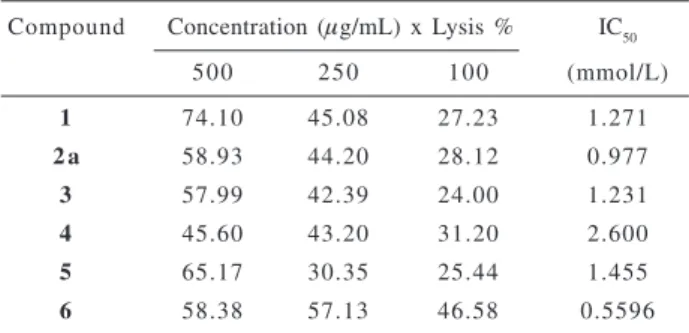
Compounds described in this paper were isolated from
an active fraction of A. rubra (62.9% lysis – percent
reduction of the parasite number) on the tripomastigote forms of T. cruzi.12 Their in vitro trypanocidal actions are
shown on Table 3. Three of them (7-9) could not be assayed
due to their instability.
The results showed that all of compounds had moderate
trypanocidal actions and kokusagine (6) was the most
active one. Probably, they are responsible by the activity of the A. rubra fraction.12 However, they could not be
considered good prototype for the development of new antichagasic drugs, mainly when their activities are compared with crystal violet and some lignans also isolated from other Rutaceae.13
Experimental
General experimental procedures
The 1H NMR, 13C NMR and 2D correlation spectra were
obtained in CDCl3 using either Bruker DRX-200 and ARX-400 NMR spectrometers, and using tetramethylsilane (TMS) as internal standard.
Low resolution EIMS were recorded on GC-17A, GCMS-QP5000 Shimadzu.
Plant material
The leaves of Almeidea rubra A. St.-Hil. were collected
in May 2000 in Espírito Santo State, southeast of Brazil. The plant material was identified by Dr. José Rubens Pirani from the Department of Botany, University of São Paulo (Brazil) and the voucher herbarium specimen (Pirani et al.
4746) was deposited at the Herbarium of that Department.
Extraction and isolation
Dried leaves (313.5 g) were extracted first with hexane and then with MeOH at room temp. Part of the methanol extract (15.9 g) was submitted to VLC on silica gel 60 (70-230 mesh) using a hexane-CH2Cl2-EtOAc-MeOH gradient, to yield the corresponding fractions (ALFMH, ALFMD, ALFMA, ALFMM). The fraction ALFMA (3.3208 g) was submitted to column chromatography over silica (silica gel 230-400 mesh, 410 x 43 mm i.d., stepwise with a hexane-EtOAc-MeOH gradient) to give eleven fractions. The second fraction (ALFMA2; 0.6302 g) was chromatographed on silica gel column (230-400 mesh, 358 x 31 mm i.d.) and eluted with solvents of increasing
polarity (hexane:AcOEt 8:2→MeOH) to afford ten
fractions. Through column chromatography over sephadex LH-20 (492 x 32 mm i.d., eluted with CH2Cl2:MeOH 1:1) from the fraction five (ALFMA2,5; 103.6 mg) was obtained four fractions. Then, the second fraction (ALFMA2,5,2; 68.0 mg) was subjected to column chromatography over silica gel (230-400 mesh, 394 x 32 mm i.d., stepwise with a CH2Cl2→MeOH gradient) to give four fractions. The third fraction (ALFMA2,5,2,3; 36.0 mg) was chromatographed on sephadex LH-20 column (492 x 32 mm i.d.) and eluted with CH2Cl2:MeOH (1:1) to afford six fractions. Through column chromatography over silica gel (230-400 mesh, 394 x 32 mm i.d., stepwise with a CH2Cl2→MeOH gradient) of the fraction five (ALFMA2,5,2,3,5; 14.3 mg) was isolated the alkaloid 2a (2.6 mg).
Fraction four (ALFMA4; 178.1 mg) was chroma-tographed on sephadex LH-20 column (492 x 32 mm i.d.)
Table 3. Trypanocidal activity of compounds isolated from Almeidea rubra
Compound Concentration (µg/mL) x Lysis % IC50
500 250 100 (mmol/L)
1 74.10 45.08 27.23 1.271
2 a 58.93 44.20 28.12 0.977
3 57.99 42.39 24.00 1.231
4 45.60 43.20 31.20 2.600
5 65.17 30.35 25.44 1.455
and eluted with MeOH to afford five fractions. Through column chromatography over sephadex LH-20 (492 x 32 mm i.d., eluted with CH2Cl2:MeOH 1:1) of the third fraction
(ALFMA4,3; 59.9 mg) was obtained the alkaloid 5
(ALFMA4,3,7; 2.5 mg) and eight fractions. Then, the fourth fraction (ALFMA4,3,4; 2.3 mg) was subjected to column chromatography over sephadex LH-20 (332 x 25 mm i.d., eluted with CH2Cl2:MeOH 1:1) to give three fractions. Further purification of the fraction two (ALFMA4,3,4,2; 2.0 mg) on preparative planar silica plate with hexane:EtOAc (8:2) afforded alkaloid 6 (1.6 mg). Through
column chromatography over sephadex LH-20 (492 x 32 mm i.d., eluted with CH2Cl2:MeOH) of the fraction five (ALFMA4,3,5; 21.5 mg) was isolated the compound 1 (14.7
mg).
The alkaloids arborinine (3) (43.2 mg), isodutaduprine
(7) (25.6 mg), and isoskimmianine (8) (28.8 mg) were
crystallized in MeOH from fraction six (ALFMA6; 104.5 mg), seven (ALFMA7; 317.3 mg) and nine (ALFMA9; 120.5 mg), respectively.
The other alkaloid isokokusagine (9) (32.1 mg) was
purified on sephadex LH-20 (492 x 32 mm i.d., eluted with MeOH) from fraction eight (ALFMA8; 90.3 mg), and the alkaloid 4 (3.2 mg) was obtained from fraction three
(148.8 mg).
4-methoxy-6-[2-(methylamino)phenyl]-2H-pyran-2-one (1)
Yellow powder; elemental analysis (Found: C, 68.0432; H, 5.565904; N, 6.11885. Calc. for C13H13NO3: C, 67.53; H, 5.63; N, 6.06%); UV λmax/nm (CH2Cl2): 240, 250, 283,
303, 332, 371; IR νmax/cm-1: 2920, 2855, 1719, 1630, 1557,
1401, 1010 (film); 1H NMR (CDCl
3, 400 MHz): Table 1;
13C NMR (CDCl
3, 100 MHz): Table 1; EIMS m/z: 231,
200, 199, 104, 77.
Rel-(7R,8R)-8-[(E)-3-hydroxy-3-methyl-1-butenyl]-4,8-dimethoxy-5,6,7,8-tetrahydrofuro[2,3-b]quinoline-7-yl acetate (2a)
White powder; [α]D25 = - 8.7° (c 0.15, CH 2Cl2);
elemental analysis (Found: C, 61.76958; H, 7.457999; N, 4.316954. Calc. for C20H25NO6: C, 64.00; H, 6.67; N, 3.73%); IR νmax/cm-1: 2922, 2855, 1741, 1579, 1371, 1327,
1244, 1093, 1017 (film); 1H NMR (CDCl
3, 400 MHz): Table
2; 13C NMR (CDCl
3, 100 MHz): Table 2; EIMS m/z: 226,
266, 326.
Single crystal X-ray analysis
Low temperature X-ray diffraction data collection was
performed at 120(2) K, on an Enraf-Nonius Kappa-CCD diffractometer equipped with an Oxford Cryosystem liquid N2 device, using graphite-monochromated MoKα radiation (0.71073 Å). Data were collected up to 50° in 2θ, with a redundancy of 4. The final unit cell parameters were based on all reflections. Data collections were made using the
COLLECT program;14 integration and scaling of the
reflections were performed with the HKL Denzo-Scalepack system of programs.15 No absorption corrections were applied.
The structure was solved by direct methods with SHELXS-97.16 The model was refined by full-matrix least
squares on F2 with SHELXL-97.17 All the hydrogen atoms
were set isotropic and freely refined. The programs SHELXL-97,17 and ORTEP-318 were used within WinGX19
to prepare materials for publication. Atomic coordinates, bond lengths and angles, and thermal parameters have been deposited at the Cambridge Crystallographic Data Centre. The supplementary crystallographic data have been sent in electronic format to the Cambridge Crystallographic Data Centre, as CIF file No. CCDC 242119. These can be obtained obtained free of charge by contacting the CCDC (12 Union Road, Cambridge CB2 1EZ, UK; fax: +44 1223 336033; www.ccdc.cam.ac.uk/conts/retrieving.html; [email protected]).
Trypanocidal activity in vitro
As described by Ambrozin et al.,12 the bioassays were
carried out using blood of infected Swiss albino mice, which was collected by cardiac puncture at the peak of parasitemic infection (7th day of infection for Y strain of T. cruzi). The infected blood was diluted with healthy mice
blood to achieve a concentration of 2.106 forms/mL.
Solutions of the compounds were prepared by dissolving in dimethylsulfoxide (DMSO). The activities of substances were evaluated at 500, 250, and 100 µg/mL.
The bioassays were performed in triplicate on titration microplates (96 wells) which contained 400 µL mixture/ well. The plates were incubated at 4 oC, and the number of
parasites counted after 24 h, following the method described by Brener.20
Infected blood with the same volume of DMSO was used as control, and gentian violet to a concentration of 250 µg/mL was used as positive control.
The activity is expressed as percent reduction of the parasite number (lysis) and IC50 values were calculated using the program GraphPad Prims v.3.0.
Acknowledgments
financial support and to Dr José Rubens Pirani for collecting and identifying the Almeidea rubra specimen.
References
1. Jay, M.; Gleye, J.; Bouillant, M.L.; Stanislas, E.; Moretti, C.;
Phytochemistry1979, 18, 184 ; Moulis, C.; Wirasutisna, K.R.;
Gleye, J.; Loiseau, P.; Stanislas, E.; Moretti, C.; Phytochemistry 1983, 22, 2095; Wirasutisna, K.R.; Gleye, J.; Moulis, C.;
Stanislas, E.; Moretti, C.; Phytochemistry1986, 25, 558.
2. Santos, C.S.; Januário, A.H.; Vieira, P.C.; Fernandes, J.B.; Da Silva, M.F.G.F.; Pirani, J.R.; J. Braz. Chem. Soc. 1998, 9, 39.
3. Januário, A.H.; PhD. Thesis, Universidade Federal de São
Carlos, 1995; Mafezoli, J.; Ph D. Thesis, Universidade Federal
de São Carlos, 2001.
4. http://www.who.int/ctd/chagas/disease.htm, accessed in May 2004.
5. Bergenthal, D.; Mester, I.; Rósza, Zs.; Reisch, J.; Phytochemistry 1979, 18, 161.
6. Ahond, A.; Picot, F.; Potier, P.; Poupat, C.; Sévenet, T.;
Phytochemistry 1978, 17, 166.
7. Yajima, T.; Kato, N.; Munakata, K.; Agric. Biol. Chem.1977, 41, 1263.
8. Baudouin, G.; Tillequin, F.; Koch, M.; Pusset, J.; Sevenet, T.;
J. Nat. Prod. 1981, 44, 546.
9. Pizzolatti, M.G.; Luciano, C.; Monache, F.D.; Phytochemistry 2000, 55, 819.
10. Dewick, P.M.; Medicinal Natural Products: A Biosynthetic Approach,John Wiley & Sons: England, 1997; Waterman,
P.G.; Phytochemistry 1999, 27, 395.
11. Rózsa, Zs.; Rábik, M.; Szendrei, K.; Kálmán, A.; Argay, Gy.; Pelczer, I.; Aynechi, M.; Mester, I.; Reisch, J.; Phytochemistry 1986, 25, 2005.
12. Ambrozin, A.R.P.; Vieira, P.C.; Fernandes, J.B.; da Silva, M.F.G.F.; de Albuquerque, S.; Mem. Inst. Oswaldo Cruz 2004, 99, 227.
13. Bastos, J.K.; de Albuquerque, S.; Silva, M.L.A; Planta Med. 1999, 65, 541.
14. Enraf-Nonius, 1997-2000. COLLECT. Nonius BV, Delft, The
Netherlands.
15. Otwinowski, Z.; Minor, W. In Methods in Enzymology;
Carter-Jr., C.W.; Sweet, R.M.; eds., Academic Press: New York, 1997, p. 276, 307.
16. Sheldrick, G. M.; SHELXS-97; Program for Crystal Structure Resolution; University of Göttingen, Germany, 1997.
17. Sheldrick, G. M.; SHELXL-97; Program for Crystal Structures Analysis; University of Göttingen, Germany, 1997.
18. Farrugia, L.J.; J. Appl. Cryst. 1997, 30, 565.
19. Farrugia, L.J.; WinGX; An Integrate System of Windows Programs for the Solution, Refinement and Analysis of Single
Crystal X-Ray Diffraction Data; University of Glasgow,
1997-2003.
20. Brener, Z.; Rev. Inst. Med. Trop. S. Paulo 1962, 4, 389.
Received: December 2, 2004
Published on the web: April 12, 2005