Article
Synthesis of New Chiral Auxiliares from Carbohydrates for Et
2AlCl-Promoted Diels-Alder Reactions
Vitor F. Ferreira*a, Sergio Pinheiroa, Clarissa C. Perroneb and Paulo R. R. Costac
a
Instituto de Química, Universidade Federal Fluminense, 24210-150, Niterói - RJ, Brazil.
b
Instituto Nacional de Tecnologia, 20081-310, Rio de Janeiro - RJ, Brazil.
c
Núcleo de Pesquisas de Produtos Naturais, Universidade Federal do Rio de Janeiro, 21941-590, Rio de Janeiro - RJ, Brazil.
Os acrilatos 3-O-acriloil-4,5-di-O-benzoil-1,2-O-isopropilideno-β-D-frutopiranose (6)e
3-O-benzil-5-O-acriloil-1,2-O-isopropilideno-α-D-xilofuranose (8) foram sintetizados em poucas etapas a partir dos respectivos monossacarídeos para utilização como auxiliares quirais em reações de Diels-Alder assimétricas com o ciclopentadieno, sob condições térmicas e promovidas por Et2AlCl. Os resultados indicaram que, embora tenham sido obtidas relações endo/exo de moderadas a excelentes, foram observadas baixas diastereosseletividades π-faciais para os cicloadutos 3-O -[(1'R, 4'R)-biciclo-[2.2.1]hept-2'-eno-5'-formil]-4,5-di-O-benzoil-1,2-O-isopropilideno-β -D-frutopiranose (21a) e 3-O-benzil-5-O-[(1'S, 4'S)-biciclo-[2.2.1]hept-2'-eno-5'-formil]-1,2-O -isopropilideno-α-D-xilofuranose (22b), indicando que as conformações tipo do “π-stacked” desejadas nos complexos formados entre os acrilatos e o ácido de Lewis não foram estabelecidas.
Acrylates 3-O-acryloyl-4,5-di-O-benzoyl-1,2-O-isopropylidene-β-D-fructopyranose (6)and 3-O-benzyl-5-O-acryloyl-1,2-O-isopropylidene-α-D-xylofuranose (8) were synthesized in few steps from carbohydrates to construct chiral dienophiles for asymmetric Diels-Alder reaction with cyclopentadiene under thermal and Et2AlCl-promoted conditions. Although from moderate to excellent endo/exo ratios were obtained, low p-facial diastereoselectivities were observed for the cycloadducts 3-O-[(1'R, 4'R)-bicyclo-[2.2.1]hept-2'-ene-5'-formyl]-4,5-di-O-benzoyl-1,2-O -isopropylidene-β-D-fructopyranose (21a) and 3-O-benzyl-5-O-[(1'S, 4'S )-bicyclo-[2.2.1]hept-2'-ene-5'-formyl]-1,2-O-isopropylideno-α-D-yilofuranose (22b) indicating that π-stacked conformations in the Lewis acid-acrylates complex were not effective.
Keywords: asymmetric Diels-Alder reactions, chiral dienophiles, carbohydrates
Introduction
The utilization of stoichiometric chiral auxiliaries is one of the most flexible and predictable methods by which stereocontrol can be imposed on asymmetric synthesis, spe-cially in the carbon-carbon bond formation1. The
synthe-sis of carbohydrate derivatives has been a topic of continu-ous interest since they are widespread and inexpensive chiral natural products from which several chiral auxilia-ries have been built2.
Our continuing interest has been focused on the syn-thesis and use of carbohydrate derivatives as auxiliaries in several organic reactions in order to broaden the applica-tion of these readily available chiral compounds. Indeed, some time ago we described the utilization of carbohy-drate-based chiral auxiliaries in α-alkylation of esters enolates3 and in Michael and aldol addition reactions4.
The Diels-Alder reactions have been among the most popular and successful synthetic applications of carbohy-drate auxiliaries, particularly when they are attached to the dienophile2,5. In fact, among other carbohydrates6,
arabi-nose7, ribose7, sorbitol8 and galactose9 have been used to
built chiral auxiliaries.
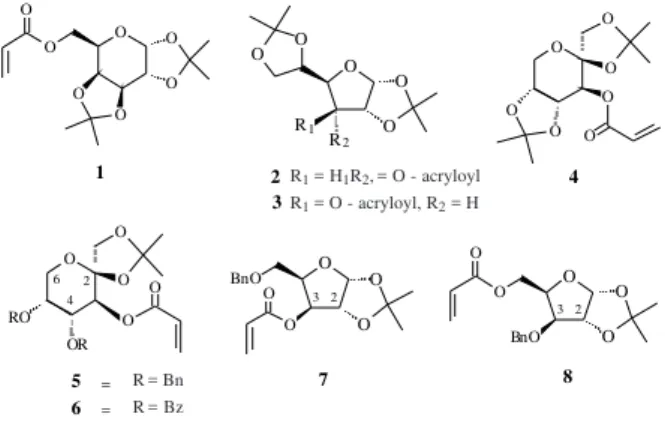
Recently we reported10 the use of acrylates 1-4 (Figure
1) derived from galactose, allose, glucose and D-fructose, respectively, as dienophiles in Lewis acid-cata-lyzed Diels-Alder reactions in up to 60 % of optical purity. Attempts to improve the π-facial diastereoselectivity in this cycloaddition reaction led us to conceive the new acry-lates 5-8 by simple elaborations from carbohydrates. These dienophiles were designed in order to favour the establish-ment of Lewis acid assisted π-stacked conformations11 A
(derived from 6) and B (derived from 8) where the carbonyl in their s-trans conformations adopt10 a syn-periplanar
relationship to the hydrogens H-3 and H-5, respectively, in order to block one of the face of the acrylates moieties (Fig-ure 2). In chiral auxiliaries derived from carbohydrates this principle was postulated by Shing and coworkers12 which
showed that this interaction controls the stereochemical pathway in Diels-Alder reactions catalyzed by Lewis acids between C (derived from D-arabinose) and cyclopentadiene.
Ester 3 already obtained from D-glucose10 was
em-ployed in an attempt to prepare acrylate 7 (Scheme 3). Hydrolysis13 with selective removal of the isopropylidene
group at C-4 and C-5 produced diol 11 in excellent yields. Subsequent cleavage with sodium periodate15 led to the
aldehyde 12.
Figure 1. Some chiral carbohydrate-acrylates recently used in Diels-Alder reactions. Cα δ A O O BzO O O O O H O Al Et Et Cl δ δ δ O O O O H5
H5'
O O H H H4 A l Cl Et Et B Cα C Cα O O O O H O O A l Et Et Cl δ δ
Figure 2. Possible π-stacked conformations for acrylates 6 and 8.
Results and Discussion
Compound 4 already prepared from D-fructose10 was
employed to synthesize the new acrylate 6 (Scheme 1). The selective hydrolysis13 of the isopropylidene group at
C-4 and C-5 led to diol 9 in good yields. Since benzylation (NaH, cat. n-Bu4NI, THF, 0oC to r.t. then BnBr, THF,
50oC)13 of the hydroxyl groups occurred with removal of
the acrylate moiety at C-3 producing compound 10 in 33 % yield, this approach did not allow to reach acrylate 5. However, diol 9 was converted into acrylate 6 upon treat-ment with benzoic acid in the presence of DCC-DMAP,14
since the reaction using benzoyl chloride in pyridine led to products from acid-catalyzed polymerization of 9, due to pyridinium chloride formation in the reaction media.
i O O O O O O O 6 BzO OBz O O O O O 9 HO OH O O O O O 4 BnO OBn O OBn O O
i)MeOH, aq. HOAc, 50 oC, 17 h, 70 %; ii) PhCO
2H, DCC, DMAP, CH2Cl2,
4 days, 87 %.
Scheme 1. Synthesis of new chiral acrylate 6.
i) MeOH, aq. HOAc, 50 oC, 17 h, 98 %; ii) aq. NaIO
4, SiO2, CH2Cl2, r.t., 1 h, 95 %;
iii) TBAC, 2N HCl, MeOH, r.t., 66 %, 13:14 = 1:1; iv) benzoic acid, DCC, DMAP, CH2Cl2, r.t., 4 days, 71 %, 15:16 = 1:1.
Scheme 2. Preparation of an equimolecular mixture of 15 and 16.
Since the reactions of aldehyde 12 with both NaBH4 /
MeOH and NaBH3CN / EtOH led to a complex mixture of products from acryloyl cleavage and degradation of the carbohydrate moiety, the reduction of the aldehyde group was conducted under mild conditions. However, the reac-tion with tetrabutylammonium cyanoborohydride (TBAC) in acidic media16 produced an equimolecular mixture of
isomers 13 and 14, the ratio being determined by 1H NMR
from the relative intensities of the signals due to the me-thyl groups of 13 (1.54 and 1.33 ppm) and of 14 (1.51 and 1.22 ppm). Attempts to convert this mixture into isomer 14, which could be used to reach acrylate 8, by migration of the acrylate moiety from C-3 to C-5 was carried out by treatment with silica gel in dichloromethane at room tem-perature for a month.17 Under these conditions and even
for a longer time, the mixture 13:14 = 1:1 was converted mainly into 14 in a ratio 13:14 = 1:3.
Since these isomers showed to be difficult to separate by chromatrography, the equimolecular mixture of 13 and 14 was esterified with benzoic acid in the presence of DCC-DMAP14 leading to a mixture of compounds 15 and 16. As
these isomers also showed to be difficult to be separated in silica gel, this approach did not allow to prepare acrylate 7. O O O O O O O 1 O O O O O O O 4
3 1 2
2 1 2
O O O R1 R2 O O O O O O BnO
O 3 2
6 = 5 = O O O O O RO OR 7 O O O BnO O O 8 2 3 4 6 2 R1 = H1R2,= O - acryloyl
R1 = O - acryloyl, R2 = H
R= Bn R= Bz
- Si - Si - Re ii 10 1 1 O O O R1O
RO 1 1 O O O R1O RO O O O OHC O O HO OH O O O O O 3 O O O O O O O i
13 = R= H, R1 = acryloyl 14 = R = acryloyl, R1 = H
15 = R= Bz, R1 = acryloyl
16 = R = acryloyl, R1 = Bz
11 12
ii
The synthesis of acrylate 8 was accomplished in four steps from commercially available diacetone glucose 17 (Scheme 3). After standard benzylation reaction13 giving 18 in almost
quantitative yield, this compound underwent a selective deprotection of the hydroxyl groups at C-5 and C-6 leading to 19. Diol cleavage followed by reduction produced 20 which upon esterification gave 8 in 59 % overall yield13.
close related. However, the result (entry 4) showed that enatiomer (S)-22b was obtained from the attack by the Cα -Re face indicating a transition state without π-stacking pref-erence. Other Lewis acid having two coordination centers like TiCl4 were used, but due to low stability of the carbo-hydrate moiety, there was decomposition even at low tem-perature. Although acrylate 6 leads to (R)-21a by the attack from its Cα-Si face, also in this case the low selectivity suggests that π-stacking interactions were not effective.
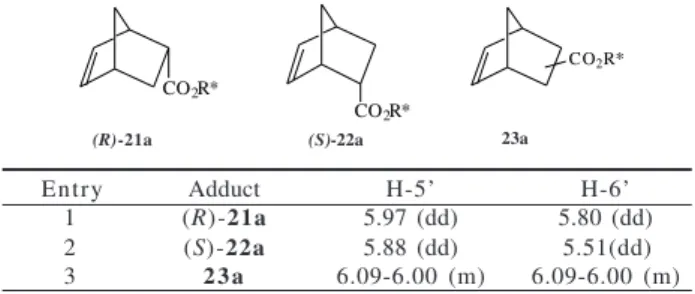
Both endo/exo ratios and R/S selectivities were deter-mined from the relative intensities of the signals attrib-uted to hydrogens H-5’ and H-6’ in the 1H NMR spectra at
200 MHz of crude mixtures of the endo and exo adducts (R)-21a, b and (S)-22a, b. These assignments were per-formed based on previous reports7,10 for Diels-Alder
reac-tions of chiral acrylates and cyclopentadiene, but the spec-tral analyses did not allow neither to determine the abso-lute configuration of the major exo isomer nor the R/S
ratios between them (Table 2).
While the endo/exo ratio for the mixture (R)-21a / (S )-22a = 6 / 4was obtained from the signals of H-5’ and H-6’ of (R)-21a and (S)-22a (entries 1 and 2) and the multiplet attributed to H-5’ and H-6’ ofthe exo isomer 23a (entry 3), the relative intensities of the signals of H-6’ furnished the
R/S selectivities between these isomeric adducts.
Conclusions
This work shows the syntheses of two new acrylates 6 and 8 in few steps from D-fructose and D-glucose, respec-tively. Compounds 6 and 8 are complementary in the sense of the Et2AlCl-promoted Diels-Alder reaction with cyclopentadiene, affording the cycloadducts (R)-21a and (S)-22b, respectively. Although these dienophiles led to high endo/exo ratios, they failed to control the stereochem-istry at C-2’ of the cycloadducts (20 % d.e.) and these results indicated that π-stacked conformations in the Lewis acid-acrylates complex were not effective.
O
O O Bn O O O
8
O
O O HO O O
i O
O O BnO O
O O
O O Bn O HO HO
O
O O Bn O HO
i) NaH, cat. n-Bu4I, THF, 0 oC to r.t. then benzyl bromide, THF, r.t. to 50 oC, 99
%; ii) MeOH, 50 % aqueous HOAc, 50 oC, 17 h, 93 %; iii) NaIO 4, aqueous
EtOH, r.t., 3 h then NaBH4, CH2Cl2, aqueous EtOH, 0 oC to r.t., 12 h, 92 %; iv)
acrylic acid, DCC, DMAP, CH2Cl2, r.t., 4 days, 70 %.
Scheme 3. Synthesis of new acrylate 8.
Thermal18 and Et2AlCl-promoted19 Diels-Alder
reac-tions of dienophiles 6 and 8 were carried out by using freshly distilled cyclopentadiene in dry CH2Cl2 following typical
procedures described in the literature (Table 1).
While the experiments conducted under thermal con-ditions (entries 1 and 3) led, as expected,10 to mixtures
of the adducts (R)-21a, b and (S)-22a, b in moderate
endo/exo ratio and without control of the stereochemis-try at C-2’, the reactions performed in the presence of 1.2 equivalents of Et2AlCl (entries 2 and 4) allowed to
reach these cycloadducts, which were not separated, in moderate to excellent endo/exo ratios but with low π-facial diastereoselectivities.
Based on the model proposed by Shing12 it was
ex-pected an attack from the Cα-Si face in the Lewis acid pro-moted Diels-Alder reaction of dienophile 8 in consequence of a more effective π-stacking since the groups are more
Table 1. Stereoselectivities in Diels-Alder reactions from acrylates 6 and 8.
(S (R
+
CO2R*
R*O O
CO2R*
Entry Acrylate Lewis acid T (o C) Yield (%) Adduct (Endo/ Exo)a 21:22a
1 6 ——- 0 9 9 a (74:26) 1:1
2 6 Et2AlCl -78 6 4 a (78:22) 6:4
3 8 ——- 0 8 5 b (80:20) 1:1
4 8 Et2AlCl -78 5 0 b (96: 4) 4:6
a Ratios determined by 1H NMR from the signals in positions 5’ and 6’.
17 18 19
20 8
iv iii
ii
Experimental
General Procedures.
Melting point was determined with a Thomas-Hoover apparatus and is uncorrected. Optical rotations were re-corded with a Acatec polarimeter. Column chromatogra-phy was performed on silica gel 230-400 mesh (Merck). TLC was carried out on precoated silica gel plates (0.2mm) F-254 (Merck). Infrared spectra were recorded with a Nicolet Magna-750 spectrophotometer. High Resolution Electron Impact Mass Spectra (HREIMS) and Low Reso-lution Electron Impact Mass Spectra (LREIMS) were mea-sured on a V.G. Auto Spec. Q spectrometer. NMR spectra were recorded with a Varian Gemini (200 MHz) and a Varian VXR (300 MHz) for solutions in CDCl3. The structures of
the substances were confirmed by NMR and HRMS.
General procedure for the preparation of 3-O-acryloyl-1,2-O-isopropylidene-β-D-fructopyranose (9), 3-O-acryloyl-1,2-O-isopropylidene-α-D-glucofuranose (11) and 3-O-benzyl-1,2-O-isopropylidene-α-D-glucofuranose (19).
A solution of 4 or 3 or 18 (3.8 mmol) in 10 mL of the mixture methanol:acetic acid:water (1:1:1) was stirred for 17 h at 50°C. The solvent was removed under reduced pressure and the crude residue chromatographed on a silica gel column eluted with 20 % ethyl acetate in n-hexane.
Compound 9 was obtained as a white solid in 70 % yield. m.p. 120oC; IR (KBr) 3300, 2980, 2930, 1720, 1630,
1450, 1400, 1380, 1290, 1255, 1180, 1165, 1080, 1060, 1035, 960, 890, 875, 855, 800 and 770 cm-1; 1H NMR
(200 MHz, CD3OD) δ 1.37 (s, 3H, CH3), 1.46 (s, 3H, CH3), 3.71 and 4.00 (2 x dd, J = 12.6 and J = 1.9 Hz, 2H, H-6), 3.84 and 3.92 (2 x d, J = 9.1 Hz, 2H, H-1); 3.89-3.99 (m, 2H, H-4 and H-5), 5.28 (d, J= 10.2 Hz, 1H, H-3), 5.95 (dd, J = 2.0 and J = 10.9 Hz, 1H, H-3’), 6.20 (dd, J = 10.9 and J = 17.7 Hz, 1H, 2’), 6.47 (dd, J = 2.0 and J = 17.7 Hz, 1H, H-3’) ppm; 13C NMR (CD3OD, DEPT) δ 26.8 (CH3), 27.2
(CH3), 66.2 (C-6), 70.6 (C-4), 71.2 (C-3), 71.4 (C-5), 73.2
(C-1), 106.4 (C-2), 113.3 (C-7), 129.7 (C-2’), 132.5 (C-3’), 167.9 (C-1’) ppm; LREIMS m/z (relative intensity): 259 (M+-15, 3), 59 (25), 55 (100); HREIMS calcd for C11H15O7
(M+ - 15): 259.081778. Found: 259.082434.
Compound 11 was obtained as a colorless oil in a 98 % yield. [α]D25 - 41o (c 2, CHCl3); IR (neat) 3434, 2980,
2930, 1736, 1620, 1400, 1381, 1290, 1250, 1180, 1150, 1075, 1060, 1010, 910, 880, 840 and 800 cm-1; 1H NMR
(200 MHz, CDCl3) δ 1.33 (s, 3H, CH3), 1.54 (s, 3H, CH3), 1.95 (b, OH), 3.26 (b, OH), 3.60-3.95 (m, 3H, H-5 and H-6), 4.24 (dd, J =3.0 and J = 9.3 Hz, 1H, H-4), 4.63 (d, J = 3.7 Hz, 1H, H-2), 5.37 (d, J = 3.0 Hz, 1H, H-3), 5.95 (d, J = 3.6 Hz, 1H, H-1), 5.98 (dd, J = 1.5 and 10.9 Hz, 1H, H-3’), 6.18 (dd, J = 10.9 and J = 17.1 Hz, 1H, H-2’), 6.53 (dd, J = 1.5 and J = 17.1 Hz,1H, H-3’) ppm; 13C NMR (CDCl3, DEPT) δ 26.0
(CH3), 26.4 (CH3), 63.9 (C-6), 68.1 (C-5), 76.5 (C-3), 79.0
(C-2), 82.9 (C-4), 104.7 (C-1), 112.2 (C-7), 127.2 (C-2’), 132.6 (C-3’), 165.6 (C-1’) ppm; LREIMS m/z (relative in-tensity): 259 (M+ - 15, 100), 213 (95), 185 (82), 155 (100),
145 (34), 143 (32), 139 (35), 127 (88), 113 (99), 100 (32), 85 (95), 73 (63); HREIMS calcd for C11H15O7 (M+ - 15):
259.081778. Found: (259.080983).
Compound 19 was obtained as a colorless oil in a 93 % yield. IR (neat) 3460, 3072, 3039, 2987, 2934, 2893, 1500, 1460, 1387, 1257, 1219, 1164, 1098, 1018, 858, 743 and 696 cm-1; 1H NMR (200 MHz, CDCl3) δ 1.32 (s, 3H, CH3),
1.49 (s, 3H, CH3), 2.10-2.40 (bs, 2H, 2 OH), 3.68 (dd, J = 15.5 and J = 5.5 Hz, 1H, H-6), 3.82 (dd, J = 15.5 and J = 3.3 Hz, 1H, H-6), 3.95-4.20 (m, 3H, H-3, H-4 and H-5), 4.55 and 4.73 (2 x d, J = 12.2 Hz, 2H, H-7), 4.63 (d, J = 4.4 Hz, 1H, H-2), 5.93 (d, J = 4.4 Hz, 1H, H-1), 7.20-7.50 (m, 5H, Ph) ppm; 13C NMR (CDCl
3, DEPT) δ 26.0 (CH3), 26.5
(CH3), 64.1 (C-6), 69.0 (C-5), 72.0 (C-8), 79.7 (C-3), 81.8 (C-2), 82.0 (C-4), 104.9 (C-1), 111.6 (C-7), 127.7 (C-10), 128.0 (C-12), 128.5 (C-11), 131.1 (C-9) ppm; LREIMS m/ z (relative intensity): 295 (M+ - 15, 2), 91 (100).
3-O-acryloyl-4,5-di-O-benzoyl-1,2-O-isopropylidene-β-D-fructopyranose (6).
A mixture of benzoic acid (1.22 g; 10 mmol), 9 (1.37 g; 5 mmol), DCC (2.06 g; 10 mmol) and DMAP (0.122 g, 1 mmol) in dry CH2Cl2 (100 mL) was stirred for 4 days at room temperature. The reaction mixture was filtered to remove N,N-dicyclohexylurea and the residue was washed with ether. The organic phase was washed with water (3 x 100 mL), 5% aqueous HOAc (3 x 100 mL), again with water (3 x 100 mL) and dried over anhydrous Na2SO4. The solvent was removed under reduced pressure and the crude residue chromatographed on a silica gel column eluted with 10 % ethyl acetate in n-hexane to give 6 (2.1 g; 87 %) as a colorless oil. IR (neat) 3068, 3035, 2940, 2894, 1728, 1636, 1606, 1456, 1411, 1372, 1293, 1176, 1091, 1072, 975, 905, 808, 761 and 721 cm-1; 1H NMR (200 MHz,
CDCl3) δ 1.43 (s, 3H, CH3), 1.53 (s, 3H, CH3), 4.00 and 4.10 (2 x d, J = 9.2 Hz, 2H, H-1), 4.01 and 4.29 (2 x dd, J = 1.8 and J = 13.4 Hz, 2H, H-6), 5.65-5.85 (m, 3H, H-3, H-4
Table 2. Assignments for H-5’ and H-6’ in 1H NMR at 200 MHz.
CO2R*
(R (S
CO2R*
CO2R*
Entry Adduct H-5’ H-6’
1 (R)-21a 5.97 (dd) 5.80 (dd)
2 (S)-22a 5.88 (dd) 5.51(dd)
3 2 3 a 6.09-6.00 (m) 6.09-6.00 (m)
and H-5), 5.80 (dd, J = 2.0 and J = 10.0 Hz, 1H, H-3’), 6.05 (dd, J = 10.0 and J = 17.0 Hz, 1H, H-2’), 6.40 (dd, J = 2.0 and J = 17.0 Hz, 1H, H-3’), 7.23-7.63 (m, 6H, Ph), 7.80-7.88 (m, 2H, Ph), 8.00-8.08 (m, 2H, Ph) ppm; 13C NMR
(CDCl3, DEPT) δ 25.9 (CH3), 26.3 (CH3), 62.3 (C-6), 67.0 (C-4), 69.9 (C-3), 70.0 (C-5), 71.8 (C-1), 104.5 (C-2), 112.3 (C-7), 127.2 (C-2’), 128.2, 128.4, 128.9, 129.4, 129.5, 129.7 and 133.1 (Ph), 132,3 (C-3’), 165.3, 165.4 and 165.6 (C=O) ppm; LREIMS m/z (relative intensity): 467 (M+ - 15, 4),
105 (100), 86 (29), 84 (47), 83 (39).
3-O-acryloyl-4(S)-formyl-1,2-O-isoprolylidene-β -L-treofuranose (12).
To a mixture of silica gel (2 g) in CH2Cl2 (16 mL) was added dropwise 15% aq. NaIO4 (2 mL) and to this
suspen-sion was added a solution of 11 (0.274 g; 1 mmol) in CH2Cl2 (2 mL). The mixture was stirred for 1 h, filtered
and the solvent was removed under reduced pressure. The resulting yellow oil was purified by column chromatogra-phy on silica gel (20 % ethyl acetate in n-hexane as the eluant) to give 11 as a yellowish oil (0.23 g; 95 %). IR (neat) 3473, 2971, 2932, 2850, 1734, 1635, 1618, 1412, 1380, 1189, 1168, 1079, 1024, 860 and 812 cm-1; 1H
NMR (200 MHz, CDCl3) 1.34 (s, 3H, CH3), 1.53 (s, 3H, CH3), 4.64 (d, J = 3.9 Hz, 1H, H-2), 4.77 (dd, J = 3.9 and J =
1.1 Hz, 1H, H-4), 5.59 (d, J = 3.9 Hz, 1H, H-3), 5.90 (dd, J = 10.5 and J = 1.4 Hz, 1H, H-3’), 6.06 (dd, J = 17.1 and J = 10.5 Hz, 1H, H-2’), 6.11 (d, J = 3.9 Hz, 1H, H-1), 6.42 (dd, J = 17.1 and J = 1.4 Hz, 1H, H-3’), 9.67 (s, 1H, CHO) ppm;
13C NMR (CDCl3, DEPT) δ 26.1 (CH3), 26.7 (CH3), 77.1
(C-3), 82.9 (C-2), 83.3 (C-4), 105.5 (C-1), 112.9 (C-6), 126.7 (C-2’), 132.8 (C-3’), 164.3 (C-1’), 196.7 (CHO) ppm; LREIMS m/z (relative intensity): 227 (M+ - 15, 18), 213
(24), 155 (44), 86 (29), 84 (45), 55 (100).
3-O-acryloyl-1,2-O-isopropylidene-α-D-xylofuranose (13) and 5-O-acr yloyl-1,2-O-isopropylidene-α -D-xylofuranose (14).
To a stirred mixture of 12 (0.242 g; 1 mmol), tetrabuty-lammonium cyanoborohydride (TBAC, 0.556 g; 2 mmol) and methyl orange (5 mg) in methyl alcohol (2 mL) was added dropwise a 2N methanolic HCl solution until the mixture becomes red. The solvent was removed under re-duced pressure and water (10 mL) was added. The aqueous layer was extracted with CH2Cl2 (3 X 15 mL), dried over anhydrous Na2SO4 and the solvent removed under reduced pressure. The residue was purified by column chromatog-raphy on silica gel (20 % ethyl acetate in n-hexane as the eluant) giving the mixture of 13 and 14 (0.161 g; 66 %) as a colorless oil. IR (neat) 3478, 2989, 2938, 1729, 1635, 1410, 1370, 1263, 1190, 1075, 1018, 887, 861 and 811 cm -1; 1H NMR (200 MHz, CDCl
3) δ 1.30 (s, 3H, CH3), 1.50 (s,
3H, CH3 of 14), 1.54 (s, 3H, CH3 of 13), 1.80 (b, OH), 3.21
(b, OH), 3.62 (dd, J = 11.9 and J = 6.3 Hz, 1H, H-5 of 13), 3.82 (dd, J = 11.9 and J = 6.0 Hz, 1H, H-5 of 13), 4.08-4.70 (m, 7H, H-2, H-4, H-3 of 14 and H-5 of 14), 5.29 (d, J = 3.0 Hz, 1H, H-3 of 13), 5.91 (dd, J = 6.8 and 1.2 Hz, 1H, H-3’ of 14), 5.94 (dd, J = 10.5 and 1.5 Hz, 1H, H-3’ of 13), 5.95 (d, J = 6.0 Hz, 1H, H-1 of 13), 5.96 (d, J = 2.4 Hz, 1H, H-1 of 14), 6.14 (dd, J = 11.3 and J = 6.8 Hz, 1H, H-2’ of 14), 6.15 (dd, J = 17.5 and 10.5 Hz, 1H, H-2’ of 13), 6.47 (dd, J = 11.2 and J = 1.2 Hz, 1H, H-3’ of 14), 6.49 (dd, J = 17.0 and J = 2.0 Hz, 1H, H-3’ of 13) ppm; 13C NMR (CDCl3, DEPT) δ 26.0
(CH3), 26.4 (CH3 of 13), 26.6 (CH3 of 14), 59.5 (C-5 of 13), 61.3 (C-5 of 14), 74.3 (C-3 of 14), 76.3 (C-3 of 13), 78.2 (C-2 of 14), 79.5 (C-2 of 13), 83.3 (C-4 of 13), 84.9 (C-4 of 14), 104.4 (C-1 of 13), 104.6 (C-1 of 14), 111.6 (C-6 of 14), 112.1 (C-6 of 14), 127.0 (C-2’ of 13), 127.5 (C-2’ of 14), 131.9 (C-3’ of 13), 132.6 (C-3’ of 14), 165.4 (C-1’ of 13), 166.6 (C-1’ of 14) ppm; LREIMS m/z (relative inten-sity): 229 (M+ - 15, 50), 155 (20), 115 (23), 85 (21), 59
(39), 55 (100).
3-O-acryloyl-5-O-benzoyl-1,2-O-isopropylidene-α -D-xylofuranose (15) and 3-O-benzoyl-5-O-acryloyl-1,2-O-isopropylidene-a-D-xylofuranose (16).
A suspension of benzoic acid (1.22 g; 10 mmol), a 1:1 mixture 13 and 14 (2.508 g; 11 mmol), DCC (2.27 g; 11 mmol) and DMAP (0.122 g, 1 mmol) in dry CH2Cl2 (100 mL) was stirred for 4 days at room temperature. The reac-tion mixture was filtrated to remove N,N-dicyclohexylurea and the residue was washed with ether. The organic phase was washed with water (3 x 100 mL), 5% aqueous HOAc (3 x 100 mL), again with water (3 x 100 mL) and dried over anhydrous Na2SO4. The solvent was removed under re-duced pressure and the crude residue chromatographed on a silica gel column eluted with 10 % ethyl acetate in n-hexane to give a 1:1 mixture of 15 and 16 (2.59 g; 71 %) as a colorless oil. IR (neat) 3071, 3032, 2990, 2938, 1728, 1634, 1602, 1452, 1381, 1269, 1187, 1072, 1024, 829 and 809 cm-1; 1H NMR (200 MHz, CDCl3) d 1.30 (s, 3H,
CH3 of 16), 1.34 (s, 3H, CH3 of 15), 1.56 (s, 3H, CH3 of 15), 1.57 (s, 3H, CH3 of 16), 4.35-4.75 (m, 4H, 2, 4 and H-5), 5.53 (d, J = 3.0 Hz, 1H, H-3 of 16), 5.44 (d, J = 3.0 Hz, 1H, H-3 of 15), 5.88 (dd, J = 10.0 and J = 2.0 Hz, 1H, H-3’ of 15), 5.91(dd, J = 10.5 and J = 1.5 Hz, 1H, H-3’ of 16), 6.01 (d, J = 4.0 Hz, 1H, H-1 of 15), 6.04 (d, J = 4.0 Hz, 1H, H-1 of 16), 6.10 (dd, J = 17.5 and J = 11.0 Hz, 1H, H-2’ of 16), 6.13 (dd, J = 17.0 and J = 10.0 Hz, 1H, H-2’ of 15), 6.42 (dd, J = 17.5 and J = 1.5 Hz, 1H, H-3’ of 16), 6.47 (dd, J = 17.0 and J = 2.0 Hz, 1H, H-3’ of 15), 7.39-7.66 (m, 3H, Ph), 7.98-8.08 (m,2H, Ph) ppm; 13C NMR (CDCl
3, DEPT) δ 26.0 (CH3),
127.5 (C-2’ of 16), 128.3, 129.3 and 129.5 (Ph), 131.3 (C-3’ of 15), 132.2 (C-3’ of 16), 132.9 (Ph), 133.4 (Ph), 164.4 (PhC=O of 15), 164.9 (PhC=O of 16), 165.4 (C-1’ of 15), 165.8 (C-1’ of 15) ppm; LREIMS m/z (relative intensity): 333 (M+ - 15, 26), 283 (19), 105 (77), 55 (100).
3-O-benzyl-1,2:5,6-di-O-isopro pylidene-α -D-glucofuranose (18).
To a solution of 17 (1.8g, 6,9 mmol) in dry THF (8 mL) at 0°C was added dropwise a suspension of NaH (60% oil dispersion, 0.306 g, 7.65 mmol) and tetrabutylammonium iodide (0.02 g, 0.054 mmol) in dry THF (5 mL). The mix-ture was warmed up to room temperamix-ture for the addition of benzyl bromide (0.9 mL, 7.6 mmol) and stirred at 50 °C for two hours. After the addition of MeOH (2 mL) the mix-ture was stirred at the same temperamix-ture for additional two hours, cooled, filtered and concentrated under reduced pressure. The resulting oil was diluted with CH2Cl2 (10 mL), washed with water (2 x 3 mL), dried over Na2SO4 and
the solvent evaporated in a rotatory evaporator, furnish-ing a crude product that was purified on a silica gel col-umn eluted with 10 % ethyl acetate in n-hexane to give 18 (2.4 g; 99 %) as a colorless oil. IR (neat): 3072, 3039, 2987, 2935, 2893, 1500, 1450, 1380, 1257, 1219, 1170, 1077, 1028, 891, 850, 741 and 700 cm-1; 1H NMR (200
MHz, CDCl3) d 1.32 (s, 3H, CH3), 1.39 (s, 3H, CH3), 1.46 (s, 3H, CH3), 1.52 (s, 3H, CH3), 3.98-4.21 (m, 4H, H-3, H-4 and H-6), 4.40 (dt, J = 7.8 and J = 5.9 Hz, 1H, H-5), 4.61 (d, J = 3.7 Hz, 1H, H-2), 4.68 (d, J = 2.6 Hz, 2H, H-7), 5.93 (d, J = 3.7 Hz, 1H, H-1), 7.25-7.45 (m, 5H, Ph) ppm; 13C NMR
(CDCl3, DEPT) δ 26.0 (CH3), 26.8 (CH3), 27.3 (CH3), 27.4 (CH3), 67.9 (C-6), 72.9 (C-9), 73.0 (C-5), 81.8 (C-3), 82.2 (C-2), 83.2 (C-4), 105.8 (C-1), 109.5 (C-8), 112.3 (C-7), 128.2, 128.3, 128.9 and 138.1(Ph); LREIMS m/z (relative intensity): 335 (M+ - 15, 6), 101 (27), 91 (100).
3-O-benzyl-1,2-O-isopropylidene-α-D-xylofuranose (20).
To a solution of 19 (1.5 g, 4.8 mmol) in 10 % aqueous ethanol (35 mL) under vigorous stirring was added portionwise NaIO4 (1.5 g; 7 mmol). After three hours, the reaction was quenched by adding CH2Cl2 (10 mL) and filtration of the solids. To the cooled (0°C) organic phase was added dropwise a suspension of NaBH4 (0.360 g, 9.5 mmol) in 20 % aqueous ethanol (13 mL). The mixture was stirred overnight at room temperature and quenched by the addition of excess ammonium chloride and 10 % aque-ous sodium thiosulfate (40 mL). The product was extracted with CH2Cl2 (3 x 20 mL), dried over Na2SO4 and the sol-vent removed under reduced pressure to give 20 (1.25 g: 92 %) as a colorless oil. IR (neat): 3500, 3072, 3039, 2987, 2934, 2893, 1497, 1455, 1377, 1170, 1076, 1017, 891, 863, 740, 699 and 606 cm-1; 1H NMR (200 MHz, CDCl
3)
δ 1.30 (s, 3H, CH3), 1.45 (s, 3H, CH3), 2.00-2.50 (bs, 1H,
OH), 3.82 and 3.93 (2 x dd, J = 5.8 and J = 11.7 Hz, 2H, H-5), 3.98 (d, J = 3.9 Hz, 1H, H-3), 4.26 (dt, J = 3.9 and J = 5.8 Hz, 1H, H-4), 4.47 and 4.69 (2 x d, J = 11.7 Hz, 2H, H-6), 4.62 (d, J = 3.9 Hz, 1H, H-2), 5.96 (d. J = 3.9 Hz, 1H, H-1), 7.20-7.45 (m, 5H, Ph) ppm; 13C NMR (CDCl3, DEPT) δ
26.0 (CH3), 26.5 (CH3), 60.5 (C-5), 71.6 (C-7), 80.1 (C-3),
82.1 (C-2), 82.2 (C-4), 104.7 (C-1), 111.5 (C-6), 127.4, 127.8, 128.3 and 136.9 (Ph) ppm; LREIMS m/z (relative intensity): 265 (M+ - 15, 4), 249 (M+-31, 2), 91 (100).
3-O-benzyl-5-O-acryloyl-1,2-O-isopropylidene-α -D-xylofuranose (8).
A suspension of acrylic acid (0.56 g; 10 mmol), 20 (2.80 g; 10 mmol), DCC (2.27 g; 11 mmol) and DMAP (0.122 g, 1 mmol) in dry CH2Cl2 (100 mL) was stirred for
4 days at room temperature. The reaction mixture was fil-tered to remove N,N-dicyclohexylurea and the residue was washed with ether. The organic phase was washed with water (3 x 100 mL), 5% aqueous HOAc (3 x 100 mL), again with water (3 x 100 mL) and dried over anhydrous Na2SO4. The solvent was removed under reduced pressure
and the crude residue chromatographed on a silica gel column eluted with 10 % ethyl acetate in n-hexane to give 8 (2.34 g; 70 %) as a colorless oil. [α]D25 -85o (c 2, CHCl3);
IR (neat): 3072, 3039, 2993, 2940, 2875, 1729, 1636, 1499, 1454, 1411, 1377, 1195, 1163, 1076, 1015, 891, 857, 812, 741 and 701 cm-1; 1H NMR (200 MHz, CDCl
3) δ 1.30 (s,
3H, CH3), 1.45 (s, 3H, CH3), 3.95 (bs, 1H, H-3), 4.25-4.48 (m, 3H, 4, 5), 4.47 and 4.67 (2 x d, J = 12.1 Hz, 2H, H-6), 4.61 (d, J = 3.7 Hz, 1H, H-2), 5.80 (dd, J = 1.6 and J = 10.0 Hz, 1H, H-3’), 5.95 (d, J = 3.6 Hz, 1H, H-1), 6.10 (dd, J = 10.0 and J = 17.2 Hz, 1H, H-2’), 6.39 (dd, J = 1.6 and J = 17.2 Hz, 1H, H-3’), 7.20- 7.40 (m, 5H, Ph) ppm; 13C
NMR (CDCl3, DEPT) δ 26.0 (CH3), 26.6 (CH3), 62.1 5), 71.6 7), 77.8 2), 81.3 3), 81.8 4), 105.0 (C-1), 111.6 (C-6), 127.5 (Ph), 127.8 (C-2’), 128.3 and 136.9 (Ph), 130.9 (C-3’), 165.6 (C-1’); LREIMS m/z (relative in-tensity): 334 (M+, 5), 333 (M+- 1, 26), 139 (21), 105 (100),
91 (88), 77 (21), 55 (38).
General Procedure for the Diels-Alder Reactions of Acrylates 6 and 8.
A typical catalyzed asymmetric Diels-Alder reaction was conducted as follows: To a -78oC cooled solution of
by column chromatography on silica gel (20 % AcOEt in n-hexane as the eluant) to afford the mixtures of cycloadducts (R)-21a, b and (S)-22a, b along with the re-spective minor exo adducts 23a, b.
3-O-[(1’R,4’R)-bicyclo-[2.2.1]hept-2’-ene-5’-formyl]-4,5-di-O-benzoyl-1,2-O-isopropyl-idene-β -D-fructopyra-nose (R)-21a and (S)-22a(endo + exo) was obtained as a pale yellow oil in a 64 % yield. IR (neat): 3063, 2988, 2942, 2882, 1731, 1600, 1453, 1374, 1282, 1180, 1072, 1030, 974, 909, 885, 760 and 712 cm-1; 1H NMR (200MHz,
CDCl3) δ 1.10-1.60 (m, 8H, H-3’and H-7’ of 21a + 22a and 2 CH3), 1.68 (bs, 1H, H-7’ of 23a), 1.70-1.94 (m, 1H, H-3’),
2.16 (m, 1H, H-2’ of 23a), 2.70-2.98 (m, 3H, H-4’ of 23a, H-2’ of 21a + 22a and H-1’), 3.04 (bs, 1H, H-4’ of 22a), 3.19 (bs, 1H, H-4’ of 21a), 3.90-4.35 (m, 4H, H-1 and H-6), 5.51 (dd, 1H, J = 3.0 and J = 6.0 Hz, H-6’ of 22a), 5.60-5.77 (m, 3H, 3, 4 and 5), 5.80 (dd, 1H, J = 3.0 and J = 6.0 Hz, H-6’ of 21a), 5.88 (dd, 1H, J = 3.0 and J = 6.0 Hz, H-5’ of 22a), 5.97 (dd, 1H, J = 3.0 and J = 6.0 Hz, H-5’ of 21a), 6.00-6.09 (m, 2H, H-5’ and H-6’ of 23a), 7.25-7.65 (m, Ph), 7.80-7.95 (m, Ph), 8.00-8.10 (m, Ph) ppm; 13C NMR (CDCl3, DEPT) δ
25.8, 25.9, 26.0 and 26.2 (CH3), 28.6, 29.2, 29.4 and 30.0
(C-3’), 41.99, 42.13, 42.85 and 42.97 (C-1’ and C-4’ of 21a + 22a), 45.04 and 45.37 (C-2’ of 21a + 22a), 49.33 (C-7’), 62.2 and 62.3 6), 66.5 and 66.7 4), 69.7 and 69.9 (C-3 and C-5), 71.7 and 71.8 (C-1), 104.4 and 104.5 (C-2), 112.0 (C-7), 128.1, 128.2, 128.9, 129.4 and 129.5 (Ph), 131.8 and 132.1 (C-6’ of 21a + 22a), 133.0 (Ph), 135.1 and 135.2 (C-6’ of 23a), 137.3 and 137.7 (C-5), 165.1, 165.2 and 165.5 (benzoyl C=O), 174.0 and 174.1 (acryloyl C=O of 21a + 22a), 176.0 and 176.2 (acryloyl C=O of 23a); LREIMS m/ z (relative intensity): 548 (M+, 3), 533 (M+ - 15, 5), 490 425
(20), 121 (33), 105 (100), 83 (43), 84 (68), 97 (16), 66 (15), 55 (21).
3-O-benzyl-5-O-[(1’R,4’R)-bicyclo-[2.2.1]hept-2’-ene-5’-formyl]-1,2-O-isopropylidene-α-D-xylofuranose (R)-21b
and (S)-22b (endo + exo) was obtained as a colorless oil in a 50 % yield. IR (neat): 3072, 3030, 2979, 2940, 2870, 1732, 1497, 1455, 1374, 1213, 1166, 1076, 1022, 891, 859, 738, 712 and 699 cm-1; 1H NMR (200MHz, CDCl
3) d
1.20-1.60 (m, 9H, H-3’, H-7’ of 21b + 22b and 2 CH3), 1.70 (bs, 1H, H-7’ of 23b), 1.80-2.00 (m, 1H, H-3’), 2.19-2.30 (m, 1H, H-2’ of 23b), 2.85-3.05 (m, 3H, H-1’, H-2’ of 21b + 22b and H-4’ of 23b), 3.14-3.26 (m, 1H, H-4’ of 21b + 22b), 3.93-4.01 (m, 1H, H-3), 4.18-4.74 (m, 6H, H-2, H-4, H-5 and H-6), 5.92 (dd, 1H, J = 3.0 and J = 6.0 Hz, H-6’ of 22b), 5.96-6.00 (m, 2H, H-6’ of 21b and 1), 6.05-6.14 (m, 2H, 5’ and H-6’ of 23b), 6.14-6.22 (m, 1H, H-5’ of 21b + 22b), 7.20-7.50 (m, Ph) ppm; 13C NMR (CDCl3, DEPT) d 26.1 (CH3), 26.6
(CH3), 29.0, 29.1, 30.1 and 30.2 (C-3’), 42.3, 42.7, 42.9 and 43.0 (C-1’ and C-4’ of 21b + 22b), 45.5 and 45.6 (C-2’ of
21b + 22b), 46.1 and 46.5 (C-2’ of 23b), 49.3 and 49.4 7’), 61.6, 61.8 and 62.0 5), 71.7 7), 77.8 and 77.9 (C-2), 81.3, 81.4, 81.5 and 81.7 (C-3 and C-4), 105.0 (C-1), 111.5 (C-6), 127.4, 127.5, 127.8, 127.9 and 128.3 (Ph), 132.0 and 132.1 (C-6’ of 21b + 22b), 135.4 and 135.5 (C-6’ of 23b), 137.0 (Ph), 137.5 and 137.6 (C-5’ of 21b + 22b), 137.8 and 137.9 (C-5’ of 23b), 174.2-176.4 (C=O); LREIMS m/z (relative intensity): 385 (M+ - 15, 1), 91 (100), 66 (15).
Acknowledgments
To INT (Instituto Nacional de Tecnologia) and to PADCT-CNPq for the financial support, as well as to Prof. Dr. Antônio Jorge R. da Silva (NPPN) for NMR and Mass spectra. V.F.F., S.P. and P.R.R.C. are grateful to CNPq for individual research fellowships.
References
1. Whiting, A. In Advanced Asymmetric Synthesis; Stephenson, G. R., Ed.; Blackie Academic & Professional; London, 1996; Seyden-Penne, J. Chiral Auxiliaries and Ligands in Asymmetric Synthesis; John Wiley & Sons., Inc.; New York, 1995.
2. Hultin, P. G.; Earle, M. S.; Sudharshan, M. Tetrahedron
1997, 53, 14823.
3. (a) Costa, P. R. R.; Ferreira, V. F.; Filho, H. C. A.; Ferreira, C. M.;. Pinheiro,S. J.Carbohydr. Chem. 1996, 15, 691. (b) Costa, P. R. R.; Ferreira, V.F.; Filho, H.C.A;. Pinheiro, S. J. Braz. Chem. Soc. 1996,7, 67. 4. Pinheiro, S.; Pedraza, S. F.; Peralta, M. A.; Carvalho,
E. M.; Farias, F. M. C.; Ferreira, V. F. J.Carbohydr.
Chem. 1998, 17, 901.
5. Kunz, H. Pure Appl. Chem. 1995,67, 1627. 6. (a) Beagley, B.; Curtis, A. D. M.; Pritchard, R. G.;
Stoodley, R. J. J. Chem. Soc.,Perkin Trans 11992, 1981. (b) Serrano, J. A.; Caceres, L. E.; Roman, E. J. Chem. Soc.,Perkin Trans 11992, 941. (c) Horton, D.; Koh, D. Tetrahedron Lett. 1993, 34, 2283. (d) Kunz, H.; Rück, K. Angew. Chem. Int. Ed. Engl. 1993, 32, 336. (e) Kunz, H.; Müller, B.; Schanzenbach, D.
Angew. Chem. Int. Ed. Engl.1987, 26, 267.
7. (a) Nouguier, R.; Gras, J.-L.; Giraud, B.; Virgili, A.
Tetrahedron1992, 48, 6245. (b) Nouguier, R.; Gras, J. -L.; Giraud, B.; Virgili, A. Tetrahedron Lett.1991,
32, 5529.
8. Gras, J. -L.; Poncet, A.; Nouguier, R. Tetrahedron Lett.1992, 33, 3323.
1993, 1146. (b) Banks, M. R.; Cadogan, J. I. G.; Gosney, I.; Gaur, S.; Hodgson, P. K. G. Tetrahedron: Asymmetry
1994, 5, 2447.
10. Ferreira, M. L. G.; Pinheiro, S.; Perrone, C. C.; Costa, P. R. R. Ferreira, V. F. Tetrahedron: Asymmetry1998,
9, 2671.
11. (a) Hunter, C. A.; Sanders, J. K. M. J. Am. Chem. Soc.
1990, 112, 5525. (b) Tucker, J. A.; Houk; K. N.; Trost, B. M. J. Am. Chem. Soc.1990, 112, 5465. (c) Jones G. B.; Chapman, B. J. Synthesis, 1995, 475. (d) Mezrhab, B.; Dumas, F.; d’Angelo, J.; Riche, C. J. Org. Chem.
1994, 59, 500. (e) Maddaluno, J. F.; Gresh, N.; Giessner-Prettre, C. J. Org. Chem. 1994, 59, 793. 12. (a) Shing, T. K. M.; Lloyd-Williams, P. J. Chem. Soc.,
Chem. Commun. 1987, 423. (b) Shing, T. K. M.; Chow, H. F.; Chung, I. H. F. Tetrahedron Lett. 1996,
37, 3713.
13. Fleet, G. W. J.; Witty, D. R. Tetrahedron: Asymmetry
1990, 1, 119.
14. Hassner, A.; Alexanian, V. Tetrahedron Lett. 1978,
46, 4475.
15. Daumas, M.; Vo-Quang, Y.; Vo-Quang, L.; LeGoffic, F.
Synthesis1989, 64.
16. Hutchins, R. O.; Kandasamy,D. J. Am. Chem. Soc. 1973, 95, 6131.
17. (a) Costa, P. R. R.; Pinheiro, S.; Lopes, C. C.
Tetrahedron Lett. 1985, 26, 4155. (b) Pinheiro, S.; Castro, R. N.; Fernandes, M. F. G.; Costa, P. R. R Synth. Commun. 1991, 21, 703.
18. Loupy, A.; Monteux, D. Tetrahedron Lett. 1996, 37, 7023. 19. (a) Blanks, M. R.; Blake, A. J.; Cadogan, J. I. G.; Doyle, A. A.; Gosney, I.; Hodgson, P. K. G.; Thorburn, P.
Tetrahedron1996, 52, 4079. (b) Roos, G. H. P.; Jensen, K. N. Tetrahedron: Asymmetry1992, 3, 1353.