Maneuvers for the treatment of
benign positional paroxysmal
vertigo: a systematic review
Summary
Lázaro Juliano Teixeira1, João Natel PollonioMachado2
1 Neurologic Physical Therapy Specialist – Professor of Physical Therapy applied to Neurology – University of Vale do Itajaí, Univali, Itajaí, SC. Physical Therapist of the
Balneário Camboriú City Hall, Balneário Camboriú, SC.
2 MSc in Medical Sciences – Federal University of Santa Catarina , Specialization and Medical Residence in Neurology – Federal University of Paraná. PhD student in
Neurology – University of São Paulo - Ribeirão Preto. MD. Neurology Professor – University Regional de Blumenau - FURB, Blumenau, SC. Mailing Address: Lázaro Juliano Teixeira - Rua Uruguai 458, Caixa Postal 360 Itajaí SC 88302-202.
E-mail: [email protected]
Paper submitted to the ABORL-CCF SGP (Management Publications System) on March 7th, 2005 and accepted on May 20th, 2005.
B
enign Paroxysmal Positional Vertigo (BPPV) is one of the most frequent diseases of the vestibular system and it is characterized by episodes of recurrent vertigo triggered by head movements or position changes. There are several approaches for treatment, but efficacy is still being discussed. Aim: To asses the effectiveness of the specific maneuvers available to the treatment of BPPV. Methodology: An electronic search at the main databases, including MEDLINE, LILACS, PEDro, Cochrane Collaborations Database was performed, and we selected only randomized clinical trials studying adults with diagnosis of BPPV confirmed by the Dix-Hallpike test. The trials should have included physical maneuvers such as Epley and Semont. The main outcome was Dix-Hallpike negative test and the changes to subjective complaints. The trials were assessed using Jadad’s scale and only studies with quality scores equal or above 3 were pooled on a meta-analyses to assess their effectiveness. Results: We found five controlled clinical trials phase I comparing the Epley’s maneuver with controls or placebo. The meta-analysis showed positive evidence of Epley’s maneuver to the posterior semicircular canal (effect size = 0.11 [CI 95% 0.05, 0.26] of objective improvement [Dix-Halpike] within one week, 0.24 [CI 95% 0.13, 0.45] within one month and 0.16 [CI 95% 0.08, 0.33] of improvement reported by the patients within one week. There are no studies about the efficacy of Semont’s maneuver. Conclusion: There is scientific evidence showing good efficacy of Epley’s maneuver in the treatment.Key words: Vestibular Diseases; Vertigo; Rehabilitation; Physi-cal Therapy; Meta-analysis; Literature Review.
REVIEW ARTICLE Rev Bras Otorrinolaringol
INTRODUCTION
Benign paroxysmal positional vertigo (BPPV) is one
of the most frequent vestibular disorders1,2. It is clinically
characterized by recurrent vertigo spells, usually trig-gered by certain head movements or patient’s change in
posture3.
Diagnosis is clinical. The interview reveals a typical
history with short vertigo spells at head movements4.
Be-cause of its clinical characteristics, patients feel fearsome, and both vertigo as well as triggering head movements
might considerably limit their daily activities5. Symptoms
tend to spontaneously resolve after a few weeks or months. However, some patients experience recurrent symptoms months or even years later, which may vary from short spells to decades of suffering, with short
re-mission spans5.
Dix-Hallpike maneuver aids in diagnosis. We have a positive maneuver when it triggers vertigo and nystagmus when the patient changes posture from sitting to laying down with his/her head hanging downwards horizontally,
with a 45° head turn towards the tested side3,5,6. Rotational
nystagmus is typical: four to five second latency and du-ration of 30 to 40 seconds. As we repeat the maneuver, fatigue ensues, reducing nystagmus intensity until it totally recedes in the third or fourth repetition.
BPPV clinical findings agree with the hypothesis that semicircular canals, with greater incidence on the posterior canal, have floating particles or debris, which are heavier
than the circulating endolymph5.
Although the exact mechanism by which these
debris cause BPPV and nystagmus is still unknown1, it is
broadly accepted that a canal lithiasis phenomenon be
responsible for this condition6.
Each free debris point require a different treat-ment strategy, through maneuvers comprised of head movements, in order to restore normal semicircular ca-nal function and thus eliminate vertigo and positioca-nal
nystagmus7.
This therapy involves head position changes in a series of repetitions, as proposed by Brandt and
Daroff8, Semont´s releasing maneuver, Epley`s canalicular
repositioning1,9, among others10-13. The main goal of these
maneuvers is to take the free debris from the semicircular canal back to the utricle, where they presumable adhere1. Head position exercises attempt to reach central nervous system adaptation and compensation mechanisms, trying symptom recovery.
There are three basic BPPV treatments, each with its own use indication: canal repositioning, releasing ex-ercises and habituation exex-ercises. Efficacy studies state that all three facilitate recovery. We typically use canal repositioning treatment or releasing maneuvers.
Habitu-ation exercises are used for milder residual complaints2.
Some papers have shown little effect of canal repositioning maneuvers as to long lasting symptoms improvement, as well as weak evidence when compared to other therapeu-tic resources (physical therapy, medical or surgery related) for posterior semicircular canal BPPV, especially due to a
lack of good quality clinical studies6,14.
Van der Velde15 analyzed other conservative and
non-pharmacological physical treatments besides reposi-tioning maneuvers. His conclusions are that these maneu-vers efficacies are not yet satisfactorily determined.
Herdman and Tusa2 Report some controversies
regarding canal repositioning maneuvers. They mention some studies which show 85 to 95% of symptoms remis-sion in posterior canal BPPV patients, however those were studies without control groups, and spontaneous recovery could not be ruled out.
Even if we establish that physical therapy resources (exercises and specific maneuvers) are of great value
for vertigo treatment16, we know that only clinical trials
may check their reliability, tolerance, effectiveness and
efficacy17.
Thus, we justify this review because of the need to group scientific evidence that show an efficacy measure for these maneuvering treatments proposed to treat BPPV, and we enquire: Is physical therapy intervention, through debris releasing maneuvers effective to treat BPPV?
The Goal of this review is to assess releasing maneu-vering efficacy in BPPV diagnosed patients.
STUDY METHODOLOGY
Population and Sample
This investigation was carried out in the following electronic data bases: LILACS (1982 until August 2004), MEDLINE (January 1966 until August 2004), Cochrane Register of controlled studies (2004/3 issue), PEDro (Physi-otherapy Evidence Database (1999 until August 2004). We also carried out new electronic and manual search in the references mentioned by the papers studied, in theme-re-lated electronic sites, national and international journals, and we also used the OVID search engine.
Search Strategy
The search strategy we used followed the
recom-mendations by Dickersinet al.18, Castro et al.19, Systematic
Reviews Cochrane Manual20 and Bickley and Harrison21.
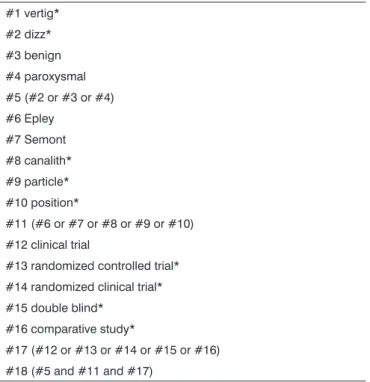
We used the expressions and combinations described on Table 1.
exercises, habituation, adaptation or compensation, com-pared to other interventions such as placebo, medication or surgical procedures. Expected outcomes included the patient’s functional improvement in their daily lives and negative result in the Dix-Hallpike test. We also consid-ered the following outcomes: vertigo spells frequence and severity and proportion of patients who reported improvements with the intervention. We selected only papers written in Portuguese, English or Spanish.
Exclusion criteria: other labyrinth diseases: Ménière disease, vestibular neuronitis, other peripheral vertigos, other vestibular function disorders, labyrinthitis, labyrinth fistula, labyrinth dysfunction and central origin vertigo. We also excluded those studies in which the primary therapy was related to physical changes in the individual’s environment (removing rugs, using lighting or signaling, etc), the use of movement aiding equipment, as well as papers which analyzed other forms of physical therapy intervention such as electrotherapy, electrical stimulation (functional, neuromuscular), transcutaneous electric neuro-stimulation (TENS).
Table 1. Search strategy used in this review #1 vertig*
#2 dizz* #3 benign #4 paroxysmal #5 (#2 or #3 or #4) #6 Epley
#7 Semont #8 canalith* #9 particle* #10 position*
#11 (#6 or #7 or #8 or #9 or #10) #12 clinical trial
#13 randomized controlled trial* #14 randomized clinical trial* #15 double blind*
#16 comparative study*
#17 (#12 or #13 or #14 or #15 or #16) #18 (#5 and #11 and #17)
Data Collection instruments:
Papers were assessed as to methods quality, in a non-blinding way by the first author of this paper. Despite the criticism regarding the assessment of work quality through a scale that primarily measures the quality reported
along the analyzed study22, we used Jadad’s Scale because
it is easier23. Jadad’s scale comprises the answer to five
questions: was the study described as being randomized? Was the randomization method adequate? Was the study described as being double blind? Was the masking method properly used? Were losses and withdrawals described? Each positive answer generates 1 point in the scale that varies from 0 to 5 points. 1 and 2 point clinical studies were considered low quality, and 3 to 5 point studies were considered high quality. Data analysis considered only data from 3 to 5 point studies.
Data Treatment: After qualitative analysis, the studies were classified in subcategories according to: 1. Intervention mode (Semont’s maneuver, Epley’s maneuver, other); 2. Follow up period (assessment made in days, weeks or months) and according to intervention type. Statistical analysis and metanalysis were carried out using the RevMan 4.2 software. All variables were considered dychotomic data, in other words, improvement is equal to negative Dix-Halpike or patient reported total improve-ment; or shown on quality scales used. For that we used relative risk (RR) and 95% confidence interval through a fixed effect model to interpret the results.
RESULTS
Some searched listed papers could not be located24
and others were not analyzed because they were written in a foreign language which was not part of those listed
in the inclusion criteria25-27. Twenty-nine papers were
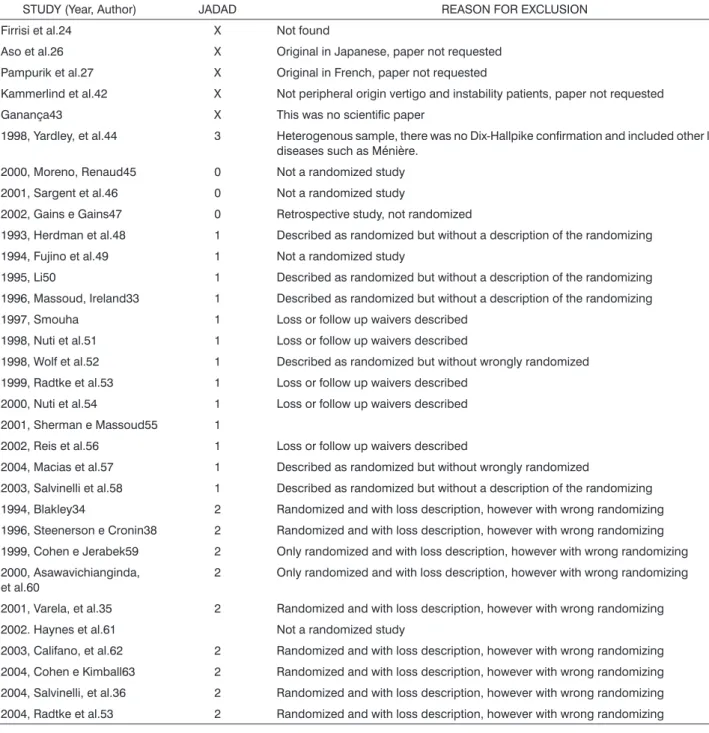
ex-cluded for different reasons. These studies, their quality assessment results and their exclusion criteria are listed on Table 2.
After the papers were selected according to inclu-sion criteria and to methodology quality, there were five Epley’s maneuver studies left, comparing them to placebos,
no treatment or medication28-32.
Lynn et al.28 compared Epley’s maneuver (n=18)
with placebo (n=15) without previous medication or vibra-tion. Medication was allowed after the maneuver, besides recommending the patients to keep their heads up and wearing a neck collar for 48 hours, avoid neck movements and avoid sleeping over the affected side for one week. The patients were reassessed one month after the Dix-Hallpike maneuver and through their personal journals. The test became negative in 88.9% of the maneuver group participants and in 26.7% in the placebo group (p=0.001). Improvement was reported in 61.1% in the treated group and in 20% in the placebo group (p=0.0329).
In a study by Froehling et al.31 Epley’s maneuver
Dix-Hallpike31 testing re-assessments were carried out after
one and two weeks and showed significant differences favoring the maneuver (67% vs 38%, p=0.046).
Angeli et al.32 developed a study with 47 senior
citizens. The patients were randomly distributed in two groups and Epley’s maneuver with mastoid vibration in the experimental group (n=28), there was only one con-trol group (n=19). Post-maneuver recommendations were given, such as to avoid vertigo-provoking movements, avoid sleeping with the head high for 48 hours and, if
Table 2. Evaluation of the studies as to the Jadad scale.
STUDY (Year, Author) JADAD REASON FOR EXCLUSION Firrisi et al.24 X Not found
Aso et al.26 X Original in Japanese, paper not requested Pampurik et al.27 X Original in French, paper not requested
Kammerlind et al.42 X Not peripheral origin vertigo and instability patients, paper not requested Ganança43 X This was no scientific paper
1998, Yardley, et al.44 3 Heterogenous sample, there was no Dix-Hallpike confirmation and included other labyrinth diseases such as Ménière.
2000, Moreno, Renaud45 0 Not a randomized study 2001, Sargent et al.46 0 Not a randomized study
2002, Gains e Gains47 0 Retrospective study, not randomized
1993, Herdman et al.48 1 Described as randomized but without a description of the randomizing 1994, Fujino et al.49 1 Not a randomized study
1995, Li50 1 Described as randomized but without a description of the randomizing 1996, Massoud, Ireland33 1 Described as randomized but without a description of the randomizing 1997, Smouha 1 Loss or follow up waivers described
1998, Nuti et al.51 1 Loss or follow up waivers described
1998, Wolf et al.52 1 Described as randomized but without wrongly randomized 1999, Radtke et al.53 1 Loss or follow up waivers described
2000, Nuti et al.54 1 Loss or follow up waivers described 2001, Sherman e Massoud55 1
2002, Reis et al.56 1 Loss or follow up waivers described
2004, Macias et al.57 1 Described as randomized but without wrongly randomized
2003, Salvinelli et al.58 1 Described as randomized but without a description of the randomizing 1994, Blakley34 2 Randomized and with loss description, however with wrong randomizing 1996, Steenerson e Cronin38 2 Randomized and with loss description, however with wrong randomizing 1999, Cohen e Jerabek59 2 Only randomized and with loss description, however with wrong randomizing 2000, Asawavichianginda,
et al.60 2 Only randomized and with loss description, however with wrong randomizing 2001, Varela, et al.35 2 Randomized and with loss description, however with wrong randomizing 2002. Haynes et al.61 Not a randomized study
2003, Califano, et al.62 2 Randomized and with loss description, however with wrong randomizing 2004, Cohen e Kimball63 2 Randomized and with loss description, however with wrong randomizing 2004, Salvinelli, et al.36 2 Randomized and with loss description, however with wrong randomizing 2004, Radtke et al.53 2 Randomized and with loss description, however with wrong randomizing
necessary, use anti-vertigo drugs. A neck collar was used during this period. Reassessment was carried out in one month and the treated group enjoyed 64% of improvement, while the control group had 5.26% (p<0.001)32.
Similarly, Yimtae et al.30 studied adding Epley’s
weeks, with results favoring the maneuver group, specially after one week (75.9% vs. 48.2%, respectively, p = 0.03), reducing from then on until there was no significant dif-ference after one month (96% vs 90%, respectively, p = 0.336). However, patients who underwent Epley’s maneu-ver, besides improving faster, used less anti-vertigo drugs
(p=0.001)30.
Sridhar et al.29 compared 20 patients who underwent
Epley’s maneuver to 20 control patients who used placebo only. Here, neither mastoid vibration nor medication was used as well, but only sleeping tips such as to elevate bead head for 48 hours. Both groups were followed for one year, with one and four weeks, three, six, nine and twelve months’ reassessment. After one week all patients were Dix-Hallpike test negative, compared to 30% of the control group (p < 0.001). This difference was maintained until the study end, when 95% of the Epley’s maneuver patients were described as cured, compared to 25% in the placebo-controlled group (p < 0.001).
METANALYSIS
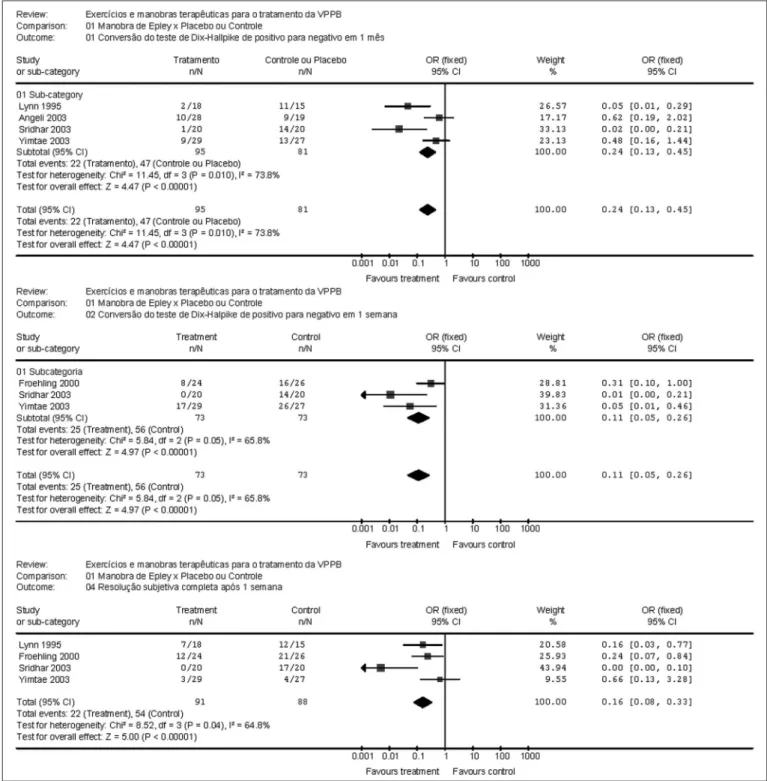
The filtered papers were then grouped according to follow up time and type of clinical outcome. Thus, it was possible to group them according to: Dix-Hallpike test cure one week after Epley’s maneuver; and patient reported subjective improvement one week after the same maneuver. Results are depicted on Figure 1 graphs.
DISCUSSION
All the studies selected for metanalysis are classi-fied as phase I clinical trials, with small sample sizes and most of them with one month follow up. There is a lack of phases II, III and IV clinical trials, and even multicentric studies, made up of large samples (over 100 individuals) and with longer follow up (over 1 year). There are very few publications either describing or proposing interventions for anterior and horizontal semi-circular canal dysfunctions, and the few studies found were not adequate according to the adopted criteria or Jadad’s scale.
We did not find any study on the Semont`s maneu-ver efficacy of enough methodological quality to meet the criteria of this review. A possible explanation is that we did not use a database with mainly European papers, for
instance EMBASE. Hilton and Pinder14 surveyed this
data-base and obtained results similar to ours, not adding any study from EMBASE. Therefore, we see a broad research field about Semont’s maneuver efficacy.
As to the studies found that met the minimum quality requirements to be grouped in our review, we see that only Epley’s maneuver was deeply investigated. Notwithstanding, there still remain details and variations as to that author’s originally described technique, curiously
obtaining similar results. Lynn et al.28 kept Epley’s
maneu-ver as initially described, although without mastoid vibra-tion or previous medicavibra-tion and allowed post-maneuver
use of medication. Froehling et al.31 did not use mastoid
vibration.
Yimtae et al.30 modified body position when
car-rying out the maneuver, allowing the patient to roll over,
belly down after belly up, making a 180° head angle,
besides using medication after the maneuver, according to
patient needs. Angeli et al.32, worked with senior citizens,
and they limited neck extension during the maneuver
and used mastoid vibration. Sridhar et al.29 maintained the
original maneuver, but did not use mastoid vibration. Post maneuver instructions also varied among the papers. In two papers the authors advised patients to wear
neck collar after the maneuver for 48 hours28,32. Such
rec-ommendation was not given in three other studies29-31.
In three studies, patients were advised to follow restrictive behavior in the first days, such as: sleep while
sitting for 48 horas28,29,31, avoid provoking movements28,31,32,
and avoid sleeping over the affected side for one week28 or
five days31. Yimtae et al.30 was the only study that made no
restrictions or recommendations. This issue was specifically
analyzed by Massoud and Ireland33 and they did no find
statistically significant differences among groups advised for and against restrictions after maneuver. Thus, the use of mastoid vibration, mild maneuver changes, neck move-ment restrictions with neck collars and advice to restrict movements or not to lay down over the affected side after the maneuver, don’t seem to influence therapeutic results, because the results of studies with and without such limitations are similar, as shown by the metanalysis, in other words, almost all studies represented by horizontal lines are to the left of the vertical line, showing a benefit with the proposed treatment mode. Besides variations on maneuvering techniques, there also are variations as to group follow up. We were able to group trial outcomes with one week and one month follow ups, objectively analyzing it through a negative Dix –Hallpike test. We were also able to group patient objective improvement results one week after the maneuver. Only one year long follow ups of BPPV patients has been considered impor-tant in the studies.
Sridhar et al.29 made the only trial that followed the
sample for one year. All others followed their samples for
one month at most, and Froehling et al.31 had only a 2
week follow up. Sridhar et al. showed that the maneuver positive result was kept for one year, besides presenting a considerably lower level of recurrence (10% in the Epley’s maneuver group vs 90% with placebo).
to notice a good improvement, for both physical exam and patient complaints in the first week, however less important in the first month. Notwithstanding, we lack enough scientific evidence to conclude that such benefit would last longer.
Despite this lack of stronger evidence towards BPPV management, there are proposals, which may not be uniformly proved by properly designed clinical studies, but still being part of an arsenal of options useful to treat these patients. These proposals varies from no treatment
at all34, all the way up to a combination of the numerous
existing maneuvers and exercises32,35,36.
In the elderly population, these maneuvers might have to be modified to gentler and slower movements with neck rotation limitation. When these maneuvers don’t work or when they may not be properly performed due to limitations caused by old age co-morbidities, additional modalities may be proposed as vestibular habituation
exercises32.
Other treatment variations may crop up. In a recent prospective study with 247 patients, Gordon et al. reported that trauma resulting BPPV cases are much less frequent than idiopathic origin BPPV cases (8.5% in this study are trauma-related), they are, however, more difficult to treat, requiring repeated treatment sessions to completely re-solve the symptoms (77% vs 14%, respectively, p<0.001), besides having greater recurrence trends (57% vs 19%,
respectively, p<0.004)37.
Steenerson contributes showing in his study the physical therapists usual modus operandi, with many weekly sessions for patients treated by canal repositioning maneuvers and for patients treated by vestibular rehabilita-tion. With his work it is possible to highlight the impor-tance of continuous follow up and interventions to treat BPPV, in order to facilitate patients’ understanding in car-rying out the exercises, and allowing the patients to learn
about self treatment – important in recurring cases38.
There were very few studies describing BPPV
treat-ment adverse effects. Yimtae et al.30 mentions the following
as Epley’s maneuver adverse effects: fainting, sweating, skin paleness and hypotension that may be caused by limbic system activation due to a repetition of the vertigo inducing procedure. These symptoms were found in 6.9% of the patients who took part in this study. Froehling et
al.31 mentions vomits during treatment and difficulties in
tolerating the maneuver due to neck problems.
The literature describes other systematic BPPV
treat-ment reviews14,15,39. Their findings, when compared among
themselves and present review results, show some
vari-ations. Maher40 states that this can be expected, showing
search strategies, the data bases used, the methodologi-cal quality measuring method for the studies and results grouping method used as modifying factors even at review conclusion. The most complete review was reformulated
last year14 and sought papers in MEDLINE (1966-2004),
EMBASE (1974-2004) and in Cochrane clinical studies reg-ister (2004). 296 papers were initially identified, 19 were selected and 15 were analyzed. These figures are similar
to ours. Of these, 3 papers were grouped28,30,31 making up
a total of 144 patients. Our search found one paper more than this aforementioned review, one of the
methodologi-cally best carried out and with the larger follow up29.
In the above review, studies were described as
being of low methodological quality14. The studies most
important limitations were allocation hiding and evaluator masking, and such factor was also observed with the use of Jadad’s scale in this paper. The authors concluded that there is some evidence that Epley’s maneuver is safe and effective in treating posterior semicircular canal BPPV; however, they did not find evidences that this maneuver promotes long term symptom resolution. This conclusion
could have been a little different if Sridhar et al’.29 trial
had been considered.
Hilton and Pinder also concluded that there are no evidences of maneuver comparison to other therapeutic, medical or surgical resources to treat posterior canal BPPV,
and we agree with such data14.
CONCLUSION
Kinesiotherapy, through Epley’s maneuver is ef-ficient for BPPV treatment when compared to placebo and/or drug therapy alone and/or without intervention. Notwithstanding, randomized clinical assays that allowed us these conclusions are phase I, with small samples and short follow up, thus limiting this finding strength.
We did not find evidences about the efficacy of the Semont’s maneuver in this review, thus it is not possible to corroborate or refute Semont’s maneuver efficacy for BPPV treatment.
We also did not see methodological relevant papers that described or proposed a proper handling of anterior and horizontal canal dysfunction.
We may state that, so far, the use of mastoid vibra-tion, subtle changes in the maneuver movements, restric-tion of neck movements through the use of a neck collar, movement limitation recommendations, not to lie down on the affected side after the maneuver don’t not seem to influence therapeutic results.
FINAL RECOMMENDATIONS
Because of the lack of controlled and randomized clinical trials using the Semont’s maneuver, we see a broad research field open as far as this maneuver efficacy is concerned.
The studies should be properly designed; especially as proper randomizing methods are concerned, reducing errors and masking, at least the investigator as to the therapy method used.
We also recommend that the study should not involve only otolaryngologists and neurologists, but all the other health care professionals involved in BPPV
pa-tient treatment such as general practitioners1, emergency
physicians4, psychiatrists41 and physical therapists2, we
must be attentive to identify BPPV early on, know its main differential diagnosis and its treatment.
Dix-Hallpike maneuver use in the usual testing of vertigo complaining patients may allow the immediate execution of a simple, fast, easy and low cost method, besides having the support of a reasonable amount of scientific evidence.
REFERENCES
1. Furman J, Cass SP. Benign paroxysmal positional vertigo. N Engl J Med 1999; 341(21): 1590-6.
2. Herdman S, Tusa R. Avaliação e tratamento dos pacientes com vertigem postural paroxística benigna. In: Reabilitação vestibular. Barueri: Manole; 2002. p. 447-71.
3. Maia R, Diniz F, Carlesse A. Tratamento da benign paroxysmal posi-tional vertigo com manobras de reposição. Rev Bras Otorrinolaringol 2001; 67(5): 612-6.
4. Koelliker P, Summers R, Hawkins B. Benign paroxysmal positional vertigo: diagnosis and treatment in the emergency department - A review of the literature and discussion of the canalith-repositioning maneuvers. Ann Emerg Med 2001; 37(4): 392-8.
5. Lempert T, Gresty M, Bronstein A. Benign positional vertigo: recogni-tion and treatment. Br Med J 1995; 311: 489-91.
6. Hilton M, Pinder D. The Epley (canalith repositioning) maneuvers for benign paroxysmal positional vertigo. In: The Cochrane Library. Oxford: Update Software; 2003.
7. Epley JM. Human Experience with Canalith Repositioning Maneuvers. Ann NY Acad Sci 2001; 942: 179-91.
8. Brandt T, Daroff R. Physical therapy for benign paroxysmal positional vertigo. Otolaryngol Head Neck Surg 1994; 110: 484-5.
9. Dal T, Özlüoglu LN, Ergin NT. The canalith repositioning maneuver in patients with benign positional vertigo. Eur Arch Otorhinolaryngol 2000; 257: 133-6.
10. Norré M. Rationale of rehabilitation treatment for vertigo. Am J Otolaryngol 1987; 8(1): 31-5.
11. Norré M, Beckers A. Exercises treatment for paroxysmal positional vertigo: comparison of two types of exercises. Arch Otolaryngol 1987; 244: 291-4.
12. Norré M, Beckers A. Vestibular habituation training. Arch Otolaryngol Head Neck Surg 1988; 114: 883-6.
13. Rine R, Schubert M, Balkany T. Visual-vestibular habituation and bal-ance training for motion sickness. Phys Ther 1999; 79(10): 949-57. 14. Hilton M, Pinder D. The Epley (canalith repositioning) manoeuvre
for benign paroxysmal positional vertigo. In: The Cochrane Library. Oxford: Update Software; 2004.
15. Van der Velde G. Benign paroxysmal positional vertigo part II: a qualitative treatments and case report presenting Epley’s “canalith repositioning procedure”, a non-invasive bedside manoeuvre for treating BPPV. J Can Chiropr Assoc 1999; 43(1): 41-9.
16. Ödkvist I, Ödkvist L. Physiotherapy in vertigo. Acta Otorrinolaringol 1988; Suppl 455: 74-6.
17. Acceturi C, Lewwi D, Lousana G. Manual de boas práticas em ensaios clínicos. São Paulo: Unifesp/EPM; 1997.
18. Dickersin KR, Scherer R, Lefebvre C. Systematic reviews: identifying
relevant studies for systematic reviews. Br Med J 1994; 309 (1286-91).
19. Castro AA, Clark OAC, Atallah AN. Optimal search strategy for clinical trials in the Latin American and Caribbean Health Science Literature Database (LILACS database): update. São Paulo Med J 1999; 117(3): 138-9.
20. Clarke M, Oxman AD. Cochrane Reviews Handbook 4.1.5. Oxford: Update Software 6; 2002.
21. Bickley S, Harrison J. How to... find the evidence. J. Orthod 2003; 30: 72-8.
22. Huwiler-Müntener K, Jüni P, Junker C, Egger M. Quality of reporting of randomized trials as a measure of methodologic quality. J Am Med Assoc 2002; 287(21): 2801-4.
23. Cardoso J, Atallah A. Acquatic therapy exercise for treating rheuma-toid arthritis - protocol. In: The Cochrane Library. Oxford: Update Software; 2001.
24. Firrisi L, Casale M, D’Ascanio L, Di Peco V, Greco F, Lamanna F, et al. A randomized trial of benign positional vertigo therapy. ORS Autumn Meeting 2003.
25. Lillet-Leclercq C, Lillet M, Demanez J. Benign paroxysmal vertigo: comparison of 2 rehabilitation methods. Acta Otorhinolaryngol Belg 1989; 43(4): 351-61.
26. Aso S, Yasumura S, Asai M, Shojaku H, Watanabe Y. The effect of Epley’s maneuver on benign paroxysmal positional vertigo (BPPV). Equilibrium Research 1995; 54(6): 547-52.
27. Pampurik J, R H, Coquoz E. The surgical and physiotherapeutic treat-ment of paroxysmal positional vertigo. Schweizerische Rundschau fur Medizin Praxis 1988; 77(23): 634-9.
28. Lynn S, Pool A, Rose D, Brey R, Suman V. Randomized trial of the canalith repositioning procedure. Otolaryngol Head Neck Surg 1995; 113: 712-20.
29. Sridhar S, Panda N, Raghunathan M. Efficacy of particle reposition-ing maneuver in BPPV: a prospective study. Am J Otolaryngol 2003; 24(6): 355-60.
30. Yimtae K, Srirompotong S, Srirompotong S, Sae-Seaw P. Randomized trial of the canalito repositioning procedure. Laryngoscope 2003; 113: 828-32.
31. Froehling DA, Bowen JM, Mohr DN, Brey RH, Beatty CW, Wollan PC, et al. The canalith repositioning procedure for the treatment of benign paroxysmal positional vertigo: a randomized controlled trial. Mayo Clin Proc 2000; 75: 695-700.
32. Angeli S, Hawley R, Gomez O. Systematic approach to BPPV in the elderly. Otolaryngol Head Neck Surg 2003; 128(5): 719-25. 33. Massoud E, Ireland D. Post-treatment instructions in the nonsurgical
management of benign paroxysmal positional vertigo. J Otoryngol-ogy 1996; 25(2): 121-5.
34. Blakley B. A randomized, controlled assessment of the canalith repo-sitioning maneuver. Otolaryngol Head Neck Surg 1994; 110: 391-6. 35. Varela A, Magro J, Pérez S, Regueiro M, García R, Caballero A. Benign
paroxysmal vertigo: a comparative prospective study of the efficacy of Brandt and Daroff exercises, Semont and Epley manoevre. Rev Laryngol Otol Rhinol 2001; 122(3): 179-83.
36. Salvinelli F, Casale M, Trivelli M, Firrisi L, Peco VD, D’Ascanio L, et al. Benign paroxysmal positional vertigo: a comparative prospective study of the efficacy of Semont maneuver and no treatment strategy. Laryngoscope 2004; 114: 824-31.
37. Gordon CR, Levite R, Joffe V, Gadoth N. Is Posttraumatic Benign Paroxysmal Positional Vertigo Different From the Idiopathic Form? Arch Neurol 2004; 61: 1590-3.
38. Steenerson R, Cronin G. Comparison of the canalith repositioning procedure and vestibular habituation training in forty patients with benign paroxysmal positional vertigo. Otolaryngol Head Neck Surg 1996; 114: 61-4.
39. López-Escamez J, González-Sánchez M, Salinero J. Metaanálisis del tratamiento del vértigo posicional paroxístico benigno mediante maniobras de Epley y Semont. Acta Otorrinolaringol Esp 1999; 50(5): 366-70.
for Evidence-Based Physical Therapy: Accessing and Interpreting High-Quality Evidence on Therapy. Phys Ther 2004; 84(7): 644-54. 41. Ciríaco JGM, Alexandre PL, Pereira CB, Wang YP, Scaff M. Vertigem
postural fóbica, aspectos clínicos e evolutivos. Arq. Neuropsiquiatr 2004; 62(3-A): 669-73.
42. Kammerlind A, Hakansson J, Skogsberg M. Effects of balance training in elderly people with nonperipheral vertigo and unsteadiness. Clin Reab 2001; 15(5): 463-70.
43. Ganança M. Should one consider dizziness without nystagmus, as the patient returns to the sitting position during the Dix-Hallpike maneuver, an indication of BPPV? Acta AWHO 2002; 21(2). 44. Yardley L, Beech S, Zander L, Evans T, Weinman J. A randomized
controlled trial of exercise therapy for dizziness and vertigo in primary care. Br J Gen Pract 1998; 48: 1136-40.
45. Moreno C, Renaud K. Las maniobras de Epley y de Semont en el tratamiento del vértigo postural paroxístico benigno. Gac Med Méx 2000; 136(5): 433-9.
46. Sargent E, Bankaitis A, Hollenbeak C, Currens J. Mastoid oscillation in canalith repositioning for paroxysmal positional vertigo. Otol Neurotol 2001; 22: 205-9.
47. Gains RE, Gains PAH. Treatment efficacy of benign paroxysmal positional vertigo (BPPV) with canalith repositioning maneuver and Semont liberatory maneuver in 376 patients. Semin Her 2002; 23: 129-42.
48. Herdman S, Tusa R, Zee D, Proctor L, Mattox D. Single treatment ap-proaches to Benign paroxysmal positional vertigo. Arch Otolaryngol Head Neck Surg 1993; 119: 450-4.
49. Fujino A, Tokumasu K, Yosio S, Naganuma H, Yoneda S, Nakamura M. Vestibular training for BPPV: Its efficacy in comparison with antiver-tigo drugs. Arch Otolaryngol Head Neck Surg 1994; 120: 497-504. 50. Li J. Mastoid oscillation: a critical factor for success in the canalith
repositioning procedure. Otolaryngol Head Neck Surg 1995; 112: 670-5.
51. Nuti D, Agus G, Barbieri M, Passali D. The management of horizon-tal paroxysmal positional vertigo. Acta Otolaryngol (Stockh) 1998; 118: 455-60.
52. Wolf M, Hertanu T, Novikov I, Kronenberg J. Epley’s manoevre for benign paroxysmal positional vertigo: a prospective study. Clin Otolaryngol 1998; 24: 43-6.
53. Ratdke A, Neuhauser H, von Breven M, Lempert T. A modified Epley’s procedure for self-treatment of benign paroxysmal positional vertigo. Neurology 1999; 53(6): 1358-60.
54. Nuti D, Nati C, Passali D. Treatment of benign paroxysmal positional vertigo: no need for portmaneuver restrictions. Otolaryngol Head Neck Surg 2000; 122: 440-4.
55. Sherman D, Massoud E. Treatment outcomes of benign paroxysmal positional vertigo. J Otolaryngol 2001; 30(5): 295-9.
56. Reis H, Moussalle S, Garcia D, Carlson V, Fabricio D. Eficácia ter-apêutica da manobra de reposicionamento otolítico na síndrome da vertigem posicional. R. Med. PUCRS 2002; 12(2): 124-6.
57. Macias J, Ellesohn A, Massingale S, Gerkin R. Vibration with the canalith repositioning maneuver: a prospective randomized study to determine efficacy. Laryngoscope 2004; 114: 1111-4.
58. Salvinelli F, Casale M, Trivelli M, D’Ascaneo L, Firrisi L, Lamanna F, et al. Treatment of benign positional vertigo in the elderly: a randomized trial. Clin Ther 2003; 154(1): 7-11.
59. Cohen H, Jerabek J. Efficacy of Treatments for Posterior Canal Benign Paroxysmal Positional Vertigo. Laryngoscope 1999; 109(4): 584-90. 60. Asawavichianginda S, Isipradit P, Snidvongs K, Supiyaphun P. Canalith
repositioning for benign paroxysmal positional vertigo: A randomized, controlled trial. Ear Nose Throat J 2000; 79(9): 732.
61. Haynes D, Resserm J, Labadie R, Girasole B, Kovach A, Schekr B, et al. Treatment of benign positional vertigo using the semont maneu-ver: efficacy in patients presenting without nistagmus. Laryngoscope 2002; 112: 796-801.
62. Califano L, Capparruccia P, Di Maria D, Melillo M, Villare D. Treat-ment of benign paroxysmal positional vertigo of posterior semicircular canal by “Quick liberatory rotation manoeuvre. Acta Otorhinolaryngol Ital 2003; 23: 161-7.