Artigo
*e-mail: [email protected]
VOLATILE CONSTITUENTS OF THE OILS FROM Povedadaphne quadriporata (LAURACEAE) FROM “ALBERTO M. BRENES” BIOLOGICAL PRESERVE, COSTA RICA
José F. Cicció* and Carlos Chaverri
Centro de Investigaciones en Productos Naturales and Escuela de Química, Universidad de Costa Rica, 2060 San José, Costa Rica
Recebido em 6/6/07; aceito em 27/9/07; publicado na web em 10/3/08
The composition of the leaf, bark and wood oils of Povedadaphne quadriporata W. Burgerfrom Costa Rica were analyzed by capillary GC/FID and GC/MS. One hundred and sixty-three compounds were identified. The major components from the leaf oil were α-pinene (21.2%), germacrene D (18.1%), β-pinene (14.8%), α-phellandrene (7.8%), α-copaene (6.6%), β-caryophyllene (6.1%) and δ-cadinene (3.5%). From bark oil, the main constituents were α-pinene (27.7%), p-cymene (7.8%), β-pinene (7.4%), camphene (3.6%), α-copaene (3.5%) and limonene (3.3%). From wood oil, 1,10-di-epi-cubenol (8.0%), α-eudesmol (3.4%), cadalene (3.4%) and δ-cadinene (3.0%) were the major compounds identified. This paper describes for the first time the composition of essential oils in this unique species and genus.
Keywords: Povedadaphne quadriporata; Lauraceae; essential oils.
INTRODUCTION
The Lauraceae is a family constituted of about 50 genera and includes 2000 to 3000 species of mostly trees from the tropics.1-4 This family is well distributed and ecologically important in the Costa Rican cloud forests. Many individuals appear in abundance and diversity.5 Taxonomically, this family is recognized by the simple, alternate, stiff and aromatic elliptic to obovate leaves, and by the fruits often borne in a cup. In Costa Rica, there are found about 130 species representing 18 genera, were the most diverse is Ocotea Aubl.6 About 37% of the species and two genera (Gamanthera and Povedadaphne) are endemic to Costa Rican forest. Worldwide, the family has a considerable economic value because it is used as a source of timber for construction and furniture. Also, some species are utilized for food (Persea americana Mill., Avocado), spices (Laurus nobilis L., Bay Laurel and Cinnamomum verum J. Presl, Cinnamon), aromatics [Sassafras albidum (Nutt.) Ness, Sassafras, Aniba rosaeodora Ducke, Rosewood] and medicines [Cinnamomum camphora (L.) J. Presl, Camphor Laurel].
Povedadaphne is a single species genus only known in Costa Rica. The plant Povedadaphne quadriporata W. Burger3,7 is a tree about 20 m tall. It can be found distributed in Costa Rica between 200 and 1000 m about sea level in the very wet premontane rain forest of the North Caribbean. The plant presents small stiff, slightly lustrous olive green (when dry), obovate-elliptic leaves, with conspicuous small pit domatia with white hairs in the vein axils of the lower surface. The leaf base is narrow and decurrent. The flowers are small with nine hairy stamens dehiscing by four apical pores. The fruit is globose or pyriform. The wood is pinkish and used in construction. When the leaves are crushed they give off a scent due to an oil of unknown composition which has not been previously reported. The aim of this work was to examine the chemical composition of the oils obtained from fresh leaves, bark and wood of P. quadriporata. This tree is rare and endemic to Costa Rica. Popularly known as “ira rosa” it is classified as “Vulnerable” according IUCN Status8 with a high risk of extinction in the wild in the medium-term future because the population is restricted to small locations.
EXPERIMENTAL
Plant material
Leaves, bark and wood of Povedadaphne quadriporata W. Burger were collected in May, in the tropical premontane rain forest of the “Alberto M. Brenes” Biological Preserve, located in the valley of the Río San Lorencito, San Ramón, Province of Alajuela, in north-central Costa Rica, at an elevation of 800 m. A voucher specimen was deposited at the Herbarium of the University of Cos-ta Rica (USJ 44865).
Oil isolation
Fresh leaves (1 kg) were subjected to hydrodistillation for 2 h using a modified Clevenger-type apparatus. The distilled oil was collected and dried over anhydrous sodium sulfate, filtered and stored in a freezer (0-10 °C). The colorless oil yield was 0.2% (v/w). The yields from bark and wood were 0.1% (v/w).
General analytical procedures
GC/FID analysis
The oils of P. quadriporata were analyzed by GC/FID using a Shimadzu GC-17 gas chromatograph. The data were obtained on a 5% phenyl- 95% methylpolysiloxane fused silica capillary column (30 m x 0.25 mm; film thickness 0.20 µm), Heliflex (Alltech) AT-5, with a Shimadzu Class-VP, version 4.3 software. Operating conditions were: carrier gas N2, flow 1.0 mL/min; oven temperature program: 60-220 °C at 3 °C/min, 220 °C (10 min); sample injection port temperature 250 °C; detector temperature 275 °C; split 1:50. GC/MS analysis
temperature 250 °C; detector temperature 260 °C; ionization voltage: 70 eV; ionization current 60 µA; scanning speed 0.5 s over 38-400 amu range; split 1:70.
Identification
Identification of the components of the oils was performed using the retention indices on a DB-5 type column, and by comparison of their mass spectra with those published in the literature9-11 or those of our own database. Integration of the total chromatogram, expressed as area percent, has been used to obtain quantitative compositional data.
RESULTS AND DISCUSSION
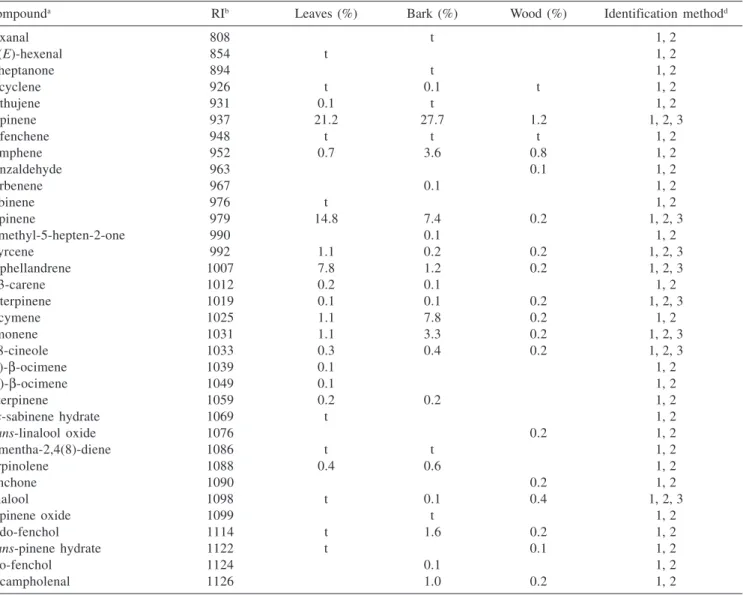
The oils obtained from leaves, bark and wood of P. quadriporata were predominantly terpenoid in nature. The chemical analysis of the leaf oil showed that the major classes of constituents were monoterpene and sesquiterpene hydrocarbons (48.9% and 45.2% respectively). Among the 86 compounds identified (Table 1), comprising about 99% of the total oil, the major constituents of the oil were α-pinene (21.2%), germacrene D (18.1%), β-pinene
amount only to about 5%.
From bark oil, the monoterpene and sesquiterpene hydrocarbons were 52.4% and 17.0% respectively. The oxygenated compounds were more abundant (24.6%) than encountered in the leaf oil. The 116 compounds identified represent about 97% of the oil. The major components of the oil were α-pinene (27.7%), p-cymene (7.8%), β-pinene (7.4%), camphene (3.6%), α-copaene (3.5%) and limonene (3.3%), as well as a significant number of cadinane, guaiane and eudesmane-type sesquiterpenoids.
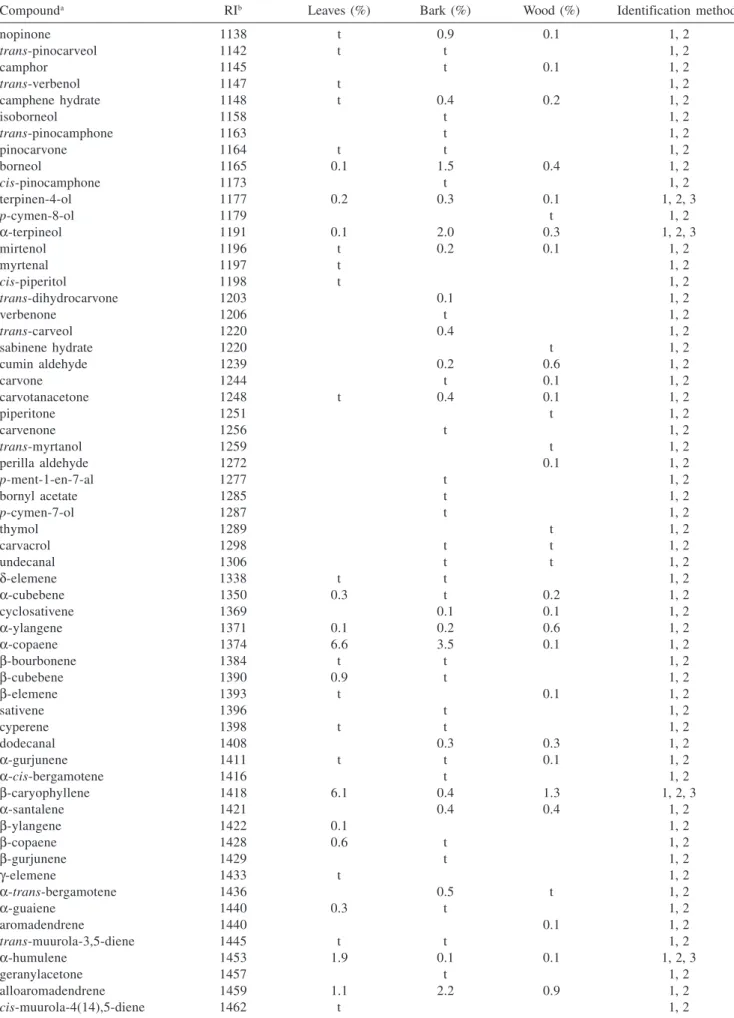
The wood oil is composed mainly of sesquiterpenoids. Of the 87 compounds identified, 1,10-di-epi-cubenol (8.0%) was the ma-jor constituent together with α-eudesmol (3.4%), cadalene (3.0%), δ-cadinene (3.0%) and γ-eudesmol (2.7%). Some constituents from this oil needed further identification.
ACKNOWLEDGEMENTS
The authors are grateful to Vicerrectoría de Investigación (UCR) (Project 809-93-600) for financial support, to A. H. Salazar, director of the “Alberto M. Brenes” Biological Preserve, and V. Mora for their enthusiastic assistance and for the botanical identification, to L. Hernandez (CIPRONA) for her technical assistance.
Table 1. Composition of the oils isolated from leaf, bark and wood of Povedadaphne quadriporata Burger
Compounda RIb Leaves (%) Bark (%) Wood (%) Identification methodd
hexanal 808 t 1, 2
2-(E)-hexenal 854 t 1, 2
2-heptanone 894 t 1, 2
tricyclene 926 t 0.1 t 1, 2
α-thujene 931 0.1 t 1, 2
α-pinene 937 21.2 27.7 1.2 1, 2, 3
α-fenchene 948 t t t 1, 2
camphene 952 0.7 3.6 0.8 1, 2
benzaldehyde 963 0.1 1, 2
verbenene 967 0.1 1, 2
sabinene 976 t 1, 2
β-pinene 979 14.8 7.4 0.2 1, 2, 3
6-methyl-5-hepten-2-one 990 0.1 1, 2
myrcene 992 1.1 0.2 0.2 1, 2, 3
α-phellandrene 1007 7.8 1.2 0.2 1, 2, 3
δ-3-carene 1012 0.2 0.1 1, 2
α-terpinene 1019 0.1 0.1 0.2 1, 2, 3
p-cymene 1025 1.1 7.8 0.2 1, 2
limonene 1031 1.1 3.3 0.2 1, 2, 3
1,8-cineole 1033 0.3 0.4 0.2 1, 2, 3
(Z)-β-ocimene 1039 0.1 1, 2
(E)-β-ocimene 1049 0.1 1, 2
γ-terpinene 1059 0.2 0.2 1, 2
cis-sabinene hydrate 1069 t 1, 2
trans-linalool oxide 1076 0.2 1, 2
p-mentha-2,4(8)-diene 1086 t t 1, 2
terpinolene 1088 0.4 0.6 1, 2
fenchone 1090 0.2 1, 2
linalool 1098 t 0.1 0.4 1, 2, 3
α-pinene oxide 1099 t 1, 2
endo-fenchol 1114 t 1.6 0.2 1, 2
trans-pinene hydrate 1122 t 0.1 1, 2
exo-fenchol 1124 0.1 1, 2
Table 1. continuation
Compounda RIb Leaves (%) Bark (%) Wood (%) Identification methodd
nopinone 1138 t 0.9 0.1 1, 2
trans-pinocarveol 1142 t t 1, 2
camphor 1145 t 0.1 1, 2
trans-verbenol 1147 t 1, 2
camphene hydrate 1148 t 0.4 0.2 1, 2
isoborneol 1158 t 1, 2
trans-pinocamphone 1163 t 1, 2
pinocarvone 1164 t t 1, 2
borneol 1165 0.1 1.5 0.4 1, 2
cis-pinocamphone 1173 t 1, 2
terpinen-4-ol 1177 0.2 0.3 0.1 1, 2, 3
p-cymen-8-ol 1179 t 1, 2
α-terpineol 1191 0.1 2.0 0.3 1, 2, 3
mirtenol 1196 t 0.2 0.1 1, 2
myrtenal 1197 t 1, 2
cis-piperitol 1198 t 1, 2
trans-dihydrocarvone 1203 0.1 1, 2
verbenone 1206 t 1, 2
trans-carveol 1220 0.4 1, 2
sabinene hydrate 1220 t 1, 2
cumin aldehyde 1239 0.2 0.6 1, 2
carvone 1244 t 0.1 1, 2
carvotanacetone 1248 t 0.4 0.1 1, 2
piperitone 1251 t 1, 2
carvenone 1256 t 1, 2
trans-myrtanol 1259 t 1, 2
perilla aldehyde 1272 0.1 1, 2
p-ment-1-en-7-al 1277 t 1, 2
bornyl acetate 1285 t 1, 2
p-cymen-7-ol 1287 t 1, 2
thymol 1289 t 1, 2
carvacrol 1298 t t 1, 2
undecanal 1306 t t 1, 2
δ-elemene 1338 t t 1, 2
α-cubebene 1350 0.3 t 0.2 1, 2
cyclosativene 1369 0.1 0.1 1, 2
α-ylangene 1371 0.1 0.2 0.6 1, 2
α-copaene 1374 6.6 3.5 0.1 1, 2
β-bourbonene 1384 t t 1, 2
β-cubebene 1390 0.9 t 1, 2
β-elemene 1393 t 0.1 1, 2
sativene 1396 t 1, 2
cyperene 1398 t t 1, 2
dodecanal 1408 0.3 0.3 1, 2
α-gurjunene 1411 t t 0.1 1, 2
α-cis-bergamotene 1416 t 1, 2
β-caryophyllene 1418 6.1 0.4 1.3 1, 2, 3
α-santalene 1421 0.4 0.4 1, 2
β-ylangene 1422 0.1 1, 2
β-copaene 1428 0.6 t 1, 2
β-gurjunene 1429 t 1, 2
γ-elemene 1433 t 1, 2
α-trans-bergamotene 1436 0.5 t 1, 2
α-guaiene 1440 0.3 t 1, 2
aromadendrene 1440 0.1 1, 2
trans-muurola-3,5-diene 1445 t t 1, 2
α-humulene 1453 1.9 0.1 0.1 1, 2, 3
geranylacetone 1457 t 1, 2
alloaromadendrene 1459 1.1 2.2 0.9 1, 2
Compound RI Leaves (%) Bark (%) Wood (%) Identification method
9-epi-caryophyllene 1466 t 1, 2
γ-gurjunene 1471 0.2 1, 2
drima-7,9(11)-diene 1473 t 1, 2
γ-muurolene 1477 0.1 1, 2
germacrene D 1481 18.1 0.7 1, 2
α-amorphene 1482 0.2 0.9 1, 2
β-selinene 1485 1.0 1.8 1.4 1, 2
valencene 1490 1.2 1, 2
viridiflorene 1492 t 1, 2
epi-cubebol 1492 t 0.9 1, 2
trans-muurola- 4(14),5-diene 1492 0.1 1, 2
bicyclogermacrene 1495 1.7 1, 2
α-himachalene 1497 0.1 1, 2
α-muurolene 1499 0.5 1.6 0.5 1, 2
cis-β-bisabolene 1505 1.6 1, 2
α-bulnesene 1506 0.1 1, 2
γ-cadinene 1514 1.4 0.9 0.2 1, 2
cubebol 1518 0.7 1, 2
δ-cadinene 1524 3.5 2.3 3.0 1, 2, 3
trans-cadina-1(2),4-diene 1530 0.5 t 0.2 1, 2
α-cadinene 1536 0.3 0.1 1, 2
α-calacorene 1541 t t 1.5 1, 2
cis-muurolol-5-en-4-β-ol 1543 0.7 1, 2
elemol 1550 0.3 1.7 0.2 1, 2
elemicine 1555 t 1, 2
β-calacorene 1563 t 0.5 1, 2
germacrene B 1564 0.1 1, 2
norolidol 1565 1.8 1, 2
1,5-epoxysalvial-4(14)-ene 1572 t t 1.3 1, 2
(Z)-isoelemicine 1573 0.1 1, 2
spathulenol 1576 0.2 t 1.1 1, 2
caryophyllene oxide 1582 0.3 0.3 1, 2
globulol 1584 0.1 1.2 1, 2
gleenol 1585 0.1 1, 2
viridiflorol 1590 0.3 0.1 1.0 1, 2
salvial-4(14)-en-1-one 1593 t t 1, 2
guaiol 1596 0.4 1.6 0.9 1, 2
humulene epoxyde II 1606 0.1 0.1 1.3 1, 2
1,10-di-epi-cubenol 1613 t 8.0 1, 2
tetradecanal 1614 1.6 1, 2
1-epi-cubenol 1627 0.3 1.3 1, 2
γ-eudesmol 1632 1.5 2.7 1, 2
β-acorenol 1635 0.1 0.4 1, 2
epi-α-cadinol (τ-cadinol) 1641 0.2 1.8 1.7 1, 2
cubenol 1642 1.8 1, 2
epi-α-muurolol (τ-muurolol) 1645 0.3 t 1, 2
α-muurolol 1647 0.3 1, 2
β-eudesmol 1649 t t 1, 2
α-eudesmol 1653 2.6 3.4 1, 2
α-cadinol 1655 1.4 2.9 1, 2
cis-calamenen-10-ol 1661 t 1, 2
bulnesol 1668 0.1 2.9 1, 2
cadalene 1672 3.4 1, 2
(+)-(4S,8R)-8-epi-β-bisabolol 1672 0.1 1, 2
β-costol 1684 t 0.8 1, 2
eudesma-4(15),7-dien-1-β-ol 1687 t 1.0 1, 2
γ-costol 1687 t 1, 2
α-costol 1692 t 1, 2
heptadecane 1700 t 1, 2
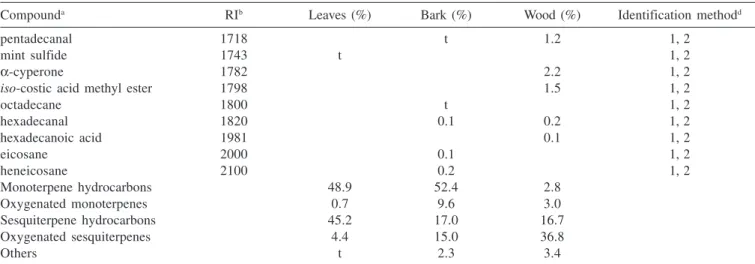
Table 1. continuation
Compounda RIb Leaves (%) Bark (%) Wood (%) Identification methodd
pentadecanal 1718 t 1.2 1, 2
mint sulfide 1743 t 1, 2
α-cyperone 1782 2.2 1, 2
iso-costic acid methyl ester 1798 1.5 1, 2
octadecane 1800 t 1, 2
hexadecanal 1820 0.1 0.2 1, 2
hexadecanoic acid 1981 0.1 1, 2
eicosane 2000 0.1 1, 2
heneicosane 2100 0.2 1, 2
Monoterpene hydrocarbons 48.9 52.4 2.8
Oxygenated monoterpenes 0.7 9.6 3.0
Sesquiterpene hydrocarbons 45.2 17.0 16.7
Oxygenated sesquiterpenes 4.4 15.0 36.8
Others t 2.3 3.4
aCompounds listed in order of elution from 5% phenyl- 95% methylpolysiloxane column. bRI = Retention index relative to n-alkanes on the 5% phenyl- 95% methylpolysiloxane column. ct = Traces (<0.05%). dMethod: 1 = Retention Index in 5% phenyl- 95% methylpolysiloxane column; 2 = MS spectra ; 3 = Standard.
REFERENCES
1. Cronquist, A.; An Integrated System of Classification of Flowering Plants, Columbia University Press: New York, 1981.
2. Rower, J. G. In The Families and Genera of Vascular Plants; Kubitzki, K., ed.; Springer Verlag: New York, 1993, vol. 2, p. 366-391.
3. Burger, W. C.; van der Werff, H.; Fieldiana, Bot., n.s. 1990, 23, 1. 4. Chanderbali, A. S.; van der Werff, H.; Renner, S. S.; Ann. Missouri Bot.
Gard. 2001, 88, 104.
5. Haber, W. A.; Zuchowski, W.; Bello, E.; An introduction to Cloud forest
trees: Monteverde, Costa Rica, La Nación: San José, Costa Rica, 1996, p.
134.
6. González, J. In La flora digital de La Selva, http://sloth.ots.ac.cr, acessed on January 2007.
7. Burger, W. C.; Brittonia 1988, 40, 275.
8. World Conservation Monitoring Centre, Povedadaphne quadriporata. In
2006 IUCN Red List of Threatened Species. 1998, www.iucnredlist.org,
acessed on January 2007.
9. Stenhagen, E.; Abrahamsson, S.; MacLafferty, F. W., eds.; Registry of Mass
Spectral Data, Wiley: New York, 1974.
10. McLafferty, F. W.; Registry of Mass Spectral Data, John Wiley & Sons: New York, 1993.
11. Adams, R. P.; Identification of Essential Oil Components by Gas
Chromatography/ Quadrupole Mass Spectroscopy, Allured: Carol Stream