Two New Norphenylpropanoid Glucosides and Hemipholin from
the Flowers of
Ononis vaginalis
Maged S. Abdel-Kader
Department of Chemistry, Virginia Polytechnic Institute and State University,
Blacksburg, Virginia 24061-0212, USA.
Received: May 12, 1997
Do extrato butanólico das flores de Ononis vaginalis Vahl. Symb. foram isolados dois novos glicosídeos norfenilpropanóides: 1 β-D-glicopiranosil-2-(4’hidroxifenil) (E)-eteno (trans -vagi-nosídeo) e 1 β-D-glicopiranosil-2-(4’hidroxifenil) (Z)-eteno (cis-vaginosídeo), e a flavanona C-gli-cosilada (+) 6-C-β-D-glicopiranosil (2S) naringenina (hemifolina). As estruturas destes compostos foram determinadas por métodos químicos e espectroscópicos.
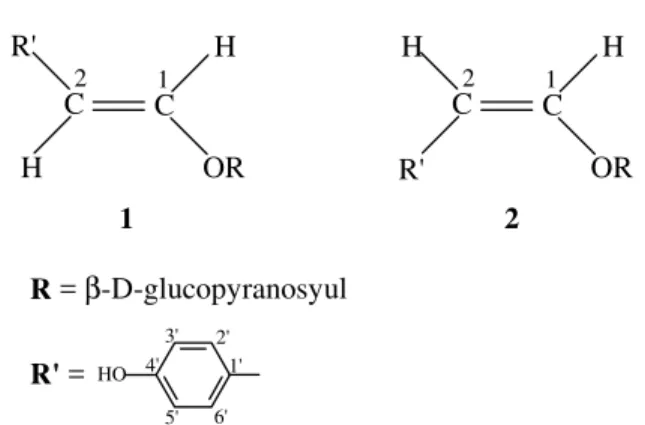
The butanol extract of the flowers of Ononis vaginalis Vahl. Symb. afforded two new norphenylpropanoid glucosides, 1-β-D-glucopyranosyl-2-(4’-hydroxyphenyl) (E)-ethene (
trans-vaginoside), 1-β-D-glucopyranosyl-2-(4’-hydroxyphenyl) (Z)-ethene (cis-vaginoside) as well as the known flavanone C-glucoside, (+)-6-C-β-D-glucopyranosyl (2S) naringenin (hemipholin). The structures of the isolated compounds were established utilizing chemical and spectroscopic methods.
Keywords: Ononis vaginalis, fabaceae, norphenylpropanoid glucosides, flavanone C-glu-coside
Introduction
The genus Ononis (Fabaceae) is represented in Egypt by eight species 1, 2. Several plants belonging to the genus are known to be used in the treatment of jaundice, urinary tract inflammations and kidney stones3. Recently, a number of alkyl resorcinols were isolated from Ononis species4. This class of naturally occurring compounds are glycerol-3-phosphate dehydrogenase inhibitors5 and cleave DNA through selective strand scission6. Previous investigation of the non polar ether fractions of the flowers of Ononis vaginalis resulted in the isolation of seven flavonoids7. Among these, eupatilin is known to have a cytotoxic action against human carcinoma of nasopharynx8 and trifolin proved to have an insect growth regulator like action9. However, the more polar butanol fraction was not subjected to more detailed investigation.
Results and Discussions
Compound 1 was isolated in the form of a yellowish gum. The UV λmax absorption at 263 nm indicated its
aromatic nature.In the 1H-NMR of 1 (Table 1), the two
doublets at 7.08 and 7.46 ppm (J = 8.4 Hz, 2H each) as well as their correlated carbons (base on a HETCOR ment) at 117.7 and 130.4 ppm respectively, (see experi-mental) were diagnostic for a p-substituted benzene ring. Another two doublets at 6.39, 7.37 ppm (J =16 Hz, 1H each) and their correlated carbons at 131.0 and 141.9 ppm were assigned for conjugated methines with their protons having the trans- orientation10. The chemical shifts of the carbons equivalent to C-1 in cinnamic acid and its deriva-tives is usually around 115 ppm11, while the 141.9 ppm resonance in 1 indicates that C-1 is oxygenated. The qua-ternary carbon resonances at 136.1 and 158.5 ppm were in complete agreement with carbon and oxygen substitutions on the aromatic system. Both 1H- and 13C-NMR showed signals diagnostic for β-D-glucopyranoside. FABMS showed an [M++H] at 299 m/z (100%) consistent with the molecular formula C14H18O7 as indicated from 1H, 13
C-NMR and DEPT experiments. Positive reaction to FeCl3,
12 nm UV bathochromic shift after the addition of NaOMe and the instability of the enol form (if the sugar part was attached to the phenolic OH) all support the position of glucose to be at C-1. Acid hydrolysis of 1 generated β
-D-Article
Permanent address: Department of Pharmacognosy, College of Pharmacy, University of Alexandria, Alexandria, Egypt.
J. Braz. Chem. Soc., Vol. 8, No. 6, 637-639, 1997. © 1997 Soc. Bras. Química
glucose (identified by TLC comparison with authentic material) and an aglycone identified as (4-hydroxy-phenyl)-acetaldehyde through comparing its 1H-NMR data with those in the literature12. As in cyanogentic glycosides; the glycosidic linkage is the main stabilizing factor for the aglycone. Consequently, hydrolysis of 1 resulted in the formation of the stable (4-hydroxy-phenyl)-acetaldehyde (keto form) rather than the unstable enol form.
Compound 2 showed essentially similar spectral char-acteristics to those of 1 (Table 1 and experimental). The major significant differences are in the J1,2 value (16 Hz in 1 and 12 Hz in 2) as well as H-1 and H-2 chemical shift (6.39, 7.37 ppm in 1 and 5.94, 6.33 ppm in 2) indicating that 2 is the cis -isomer of 110.
Compound 3 was identified as hemipholin (6-C-β -D-glucopyranosyl (2S) naringenin) through comparison of its data (see experimental) with those in the literature13,14 as well as its positive reaction with Gibb’s reagent eliminating the possibility of the sugar to be attached to C-815. The assignment of the unreported 13C-NMR data for 3 were
performed based on HETCOR experiments as well as comparison with the data of 6,8-di-C-β-D-glucopyranosyl (2S) naringenin16.
Experimental
General procedure
The melting point was determined using a Griffin melt-ing point apparatus and was uncorrected. UV spectra were obtained in MeOH on a Pye Unicam Sp8-100 spectrometer. CD spectrum was recorded using a Jasco J-720 spectropo-larimeter. NMR spectra were measured with a Bruker Ac-300 spectrometer at 300 and 75 MHz for 1H- and
13C-NMR respectively. Proton and carbon chemical shifts
are reported in parts per million (ppm) relative to residual undeuterated solvent. The carbon chemical shifts for 1 in D2O are reported relative to C-6 of glucose at 61.5 ppm.
FAB and Electrospray mass spectra were recorded using a Quattro-SQ mass spectrometer. β-D-Glucose was obtained from Sigma Chemical Co.
Plant material
Plant materials of Ononis vaginalis Vahl. Symb. (voucher MSA2) described earlier 7 were collected on April 5, 1995 from El Agamy, Alexandria, Egypt.
Extraction and isolation
1.5 kg of fresh flowers of Ononis vaginalis were ex-tracted with 95% ethanol (10 L). The concentrated ethano-lic extract (150 mL) was diluted with 300 mL water and successively extracted with light petrol (3 x 500 mL), ether (3 x 500 mL), ethyl acetate (3 x 300 mL) and butanol (2 x 300 mL).
The dried butanol fraction (7 g) was fractionated by VLC over silica gel (400 g) using fritted funnel (10 x 8.5 cm) and eluted with EtOAc/ MeOH mixtures. Fractions 10-12 (0.5 g), eluted with 10% MeOH in EtOAc, were refractionated over a flash column (2 cm in diameter, 25 g silica gel) eluted with 10% MeOH in CHCl3. Fractions 4-7
638 Abdel-Kader J. Braz. Chem. Soc.
O OH
H
O OH glc
OH
C C
R' H
OR H
1 2
1 2
2 1
H
OR H
R'
C C
R = β-D-glucopyranosyul
R' = 1'
2' 3' 4'
5' 6' HO
Table 1.1H-NMR spectral data (300 MHz) for compounds 1 and 2 in CD3OD.
No. 1 2
1 7.37 (d, J = 16 Hz) 6.33 (d, J = 12 Hz)
2 6.39 (d, J = 16 Hz) 5.94 (d, J = 12 Hz)
2’, 6’ 7.46 (d, J = 8.4 Hz) 7.53 (d, J = 8.8 Hz)
3’, 5’ 7.08 (d, J = 8.4 Hz) 7.01 (d, J = 8.8 Hz)
1" 4.93 (d, J = 7.1 Hz) 4.88*
2"-5" 3.41- 3.53 (m) 3.40-3.46 (m)
6" 3.70 (dd, J = 4.8, 13.6 Hz)
3.89 (dd, J = 1.7, 13.6 Hz)
3.69 (dd, J = 4.6, 11.9 Hz) 3.86 (dd, J = 1.8, 11.9 Hz)
(90 mg) were subjected to PTLC using EtOAc/ MeOH/ H2O (30:5:4) as developing system to afford 50 mg of 3
after crystallization from MeOH.
Fractions 14 and 15 (0.3 g), eluted with 15% MeOH in EtOAc, were refractionated over a flash column (2 cm in diameter, 20 g silica gel) eluted with 12% MeOH in CHCl3.
Fractions 6-9 (81 mg) were rechromatographed using PTLC silica gel plates and EtOAc- MeOH- H2O (30:5:4) as
devel-oping system (double development). Two bands were visual-ized under UV light, scraped off and eluted from silica with EtOAc- MeOH (1:1). After evaporation of the solvents, the first band (Rf value = 0.55) afforded 19 mg of 1 while the
second band (Rf value = 0.47) afforded 5 mg of 2.
trans-Vaginoside [1-β -D-glucopyranosyl-2-(4’-hydroxy-phenyl) (E) - ethene] (1)
Yellowish gum. [α]26D + 24° (c 0.71, MeOH). UV
(MeOH) λmax nm: 263, 204, (NaOMe) 275, 212. FABMS
m/z (rel. int.): 299 (100, M.++H), 279 (9, M.+-H) , 291 (7), 289 (12). 1H-NMR: Table 1. 13C-NMR (D2O): 61.5 (C-6"),
70.4 (C-4"), 73.9 (C-2"), 76.5 (C-5"), 77.1 (C-3"), 100.8 (C-1"), 117.7 (C-3’, C-5’), 130.4 (C-2’, C-6’), 131.0 (C-2), 136.1 (C-1’), 141.9 (C-1), 158.5 (C-4’).
cis-Vaginoside [1-β -D-glucopyranosyl-2-(4’-hydroxyphe-nyl) (Z) - ethene] (2)
Yellowish gum. [α]26D + 18° (c 0.52, MeOH). UV
(MeOH) λmax nm: 264, 206, (NaOMe) 277, 215. FABMS
m/z (rel. int.): 299 (100, M.++H), 279 (6, M.+-H) , 291 (3), 289 (5). 1H-NMR: Table 1.
Acid hydrolysis of 1 and 2
Compound 1 (9 mg) and compound 2 (3 mg) were dis-solved in 0.5 mL MeOH and 1 mL of 0.1 N HCl was added to each solution. After heating at reflux for 3 h. the solutions were extracted with CHCl3 (3 x 5 mL). The residue left after
the evaporation of solvents proved to be identical. The aque-ous layer afforded 3 and 0.9 mg of β-D-glucose, while the organic layer afforded 4 mg and 1 mg of (4-hydroxy-phenyl)-acetaldehyde in case of 1 and 2 respectively.
(4-hydroxy-phenyl)-acetaldehyde
Yellowish oil. 1H-NMR (CDCl3): 3.61 (2H, d, J = 2.3
Hz, H-2), 6.77 (2H, d, J = 8.9 Hz, H-3’, 5’), 7.11 (2H, d, J = 8.9 Hz, H-2’, 6’),9.73 (1H, t, J = 2.3 Hz, H-1).
Hemipholin [(+) -6-C-β-D-glucopyranosyl (2S) narin-genin] (3)
Yellow crystals m.p. 208- 209 °C. UV (MeOH) λmax nm:
329(sh), 288, 223, (NaOMe) 327, 243, (AlCl3) 379, 309, 224,
(AlCl3/HCl) 379, 310, 224,(NaOAc) 327, 241. CD (MeOH):
[θ]211 0, [θ]223 +16926, [θ]252 0, [θ]262 -3906, [θ]292 -11284,
[θ]303 0, [θ]319 +14765, [θ]331 0, [θ]343 -12152, [θ]365 0, .
Electrospray MS m/z (rel. int.): 457 (27, M.++Na), 435 (66,
M.++H), 391 (28), 276 (16), 214 (50), 163 (34), 124 (100). 1H-NMR (CD
3OD): 2.73 (dd, J = 3, 17 Hz, H-3), 3.12 (dd, J
= 13, 17 Hz, H-3), 3.34-3.44 (m, H-3"-H-5"), 3.67 (dd, J = 3, 13 Hz, H-6"), 3.85 (dd, J = 5, 12 Hz, H-6"), 4.11 (m , H-2"), 5.34 (dd, J = 3, 13 Hz, H-2), 5.95 (s , H-8), 6.79 (d, J = 8.6 Hz, H-3’, H-5’), 7.29 (d, J = 8.6 Hz, H-2’, H-6’). 13C-NMR
(CD3OD): 43.9 (C-3), 62.9 (C-6"), 71.8 (C-4"), 72.6 (C-2"),
75.2 (C-1"), 80.2 (C-3"), 80.4 (C-2), 82.5 (C-5"), 96.4 (C-8), 103.2 (C-10), 106.0 (C-6), 116.3 (C-3’, 5’), 129.1 (C-2’, 6’), 130.9 (C-1’), 159.0 (C-4’), 163.2 (C-9),164.2 (C-5), 167.4 (C-7), 198.0 (C-4).
Acknowledgments
This work was supported in part by the University of Alexandria. The author is very grateful to Dr. Tommaso A. Foderaro for carrying out the CD spectrum of compound 3.
References
1. Muschler, R. In A Manual Flora of Egypt; Friedlaen-der Shon, Karlstrasse, Berlin 1912, II, 476.
2. Tackholm, V. In Students Flora of Egypt; Cairo Uni-versity, 2 nd. Ed., 1974, p 229.
3. Boulos, L. In Medicinal Plants in North Africa; Ref-erence Publications, Inc. 1983, p 126.
4. Barrero, A.F.; Cabrera, E.; Rodriguez, I.; Fernandez-Gallego, E.V. Phytochemistry 1994,39, 189. 5. Tsuge, N; Mizokami, M.; Imai, S.; Shimazu, A.; Seto,
H. J. Antibiot. 1992, 45, 886.
6. Scannell, R.T.; Barr, J.R.; Murty, V.S.; Reddy, K.S.; Hecht S.M. J. Am. Chem. Soc. 1988, 110, 3650. 7. Amer, M.E.; Abdel-Kader, M.S.; Mahmoud, Z.F.;
Abdel-Salam, N.A.; Yang, S.S.; Mabry, T.J. Rev. Lat-inoamer. Quim. 1989, 20, 152.
8. Kupchan, S.M.; Sigel, C.W.; Hemingway, R.J.; Knox, J.R., Udayamurthy, M.S. Tetrahedron 1969, 25, 1603. 9. Abdel-Kader, M.S. M. S. Thesis 1989, Aexandria
Uni-versity.
10. Silverstein, R.M.; Bassler, G.C.; Morril, T.C. In Spec-trometric Identification of Organic Compounds; John Wiley & Sons, Inc. Fifth Ed., 1991, p 221.
11. Pouchert, C.J.; Behnke, J. The Aldrich Library of 13C and 1H FTNMR Spectra; Aldrich Chemical Company, Inc., 1993, Ed. I.
12. Padwa, A.; Wisnieff, T.J.; Walsh, E.J. J. Org. Chem. 1989, 54, 299.
13. Budzianowski, J.; Skrzypczakowa, L. Phytochemistry 1978,17, 2044.
14. Lorente, F.T.; Ferreres, F.; Barberan, F.A.T. Phyto-chemistry 1982,21, 1461.
15. Tahara, S.; Ingham, J.L.; Nakahara, S.; Mizutani, J.; Harborne, J.B. Phytochemistry 1984,23, 1889. 16. Okamura, N.; Yagi, A.; Nishioka, I. Chem. Pharm.
Bull. 1981, 29, 3507.
FAPESP helped in meeting the publication costs of this article