Abandoned, lost or otherwise discarded fishing gears in rocky reefs of
Southern Brazil
Johnatas Adelir-Alves
1*, Gecely Rodrigues Alves Rocha
1, Thiago Felipe Souza
2, Pedro Carlos
Pinheiro
2, Kátia de Meirelles Felizola Freire
31 Programa de Pós-Graduação em Sistemas Aquáticos Tropicais, Universidade Estadual de Santa Cruz. (Rodovia Ilhéus-Itabuna, 45662-900, Ilhéus, BA, Brasil).
2 Universidade da Região de Joinville.
(Rodovia Duque de Caxias, 89240-000, São Francisco do Sul, SC, Brasil.
3 Laboratório de Ecologia Pesqueira, Departamento de Engenharia de Pesca e Aquicultura, Universidade Federal de Sergipe (Rua Mal. Rondon S/N, Jardim Rosa Elze, 49100-000, São Cristóvão, SE, Brasil).
*Corresponding author: [email protected]
INTRODUCTION
The intense exploitation of ishing resources has led the activity into a global crisis. However, ishing efort continues to increase despite the collapse of some of the main ish stocks (FAO, 2014). This increasing efort produces both
direct and indirect impact on marine ecosystems (PAULY et al., 2002). Marine debris resulting from abandoned, lost or
otherwise discarded ishing gear (ALDFG) (LAIST, 1995;
MACFADYEN et al., 2009) is one type of indirect impact, responsible for harming marine fauna and for causing economic loss (DAYTON et al., 1995).
ALDFG captures target and non-target ish species by a phenomenon known as ‘ghost ishing’, which means that the ishing gear continues to catch ish even though ishers
are no longer controlling it (SMOLOWITZ, 1978). The
term is associated with mortality and injuries inlicted on
vertebrates and invertebrates caught by ALDFG (BREEN,
1987; BARREIROS; RAYKOV, 2014).
At least one-third of the Brazilian coast consists of reef environments, with coral reefs concentrated on the northern/ northeastern coast and rocky reefs on the southeastern/ southern coast. These ecosystems are highly diverse, rich in natural resources and of great ecological, economic and social importance, with immense potential for hosting
endemic species (FERREIRA et al., 2001; ROCHA, 2003). There are few studies on the impact of ghost ishing
in Brazil, many of them reporting the existence of
marine debris and ishing gear found in coastal areas (MACHADO; FILLMANN, 2010; MASCARENHAS et al., 2008; POSSATTO et al., 2011; VIEIRA et al., 2011;
DANTAS et al., 2012). Ghost ishing was reported for the irst time in Brazil - on the coast of the state of Santa
Catarina - by CHAVES and ROBERT (2009). There is,
however, no direct measurement of marine fauna mortality
caused by ghost ishing.
The state of Santa Catarina is part of the Brazilian southern region where rocky reefs are dominant. In view of
the magnitude of ishing in this state and the vulnerability
of reef environments, the objective of this study was to
analyze the occurrence and causes of ghost ishing on rocky
reefs. Santa Catarina has a coastline approximately 531 km long and is included in the Atlantic Biogeographical
Province (FLOETER; GASPARINI, 2000) and harbors
a great variety of environments including rocky reefs
(HOSTIM-SILVA et al., 2006).
A total of 84 surveys were carried out around 28 reef sites, between 26o and 29°S (Figure 1) in the search for
ALDFG, from November 2011 to December 2012. Surveys were conducted using scuba diving at depths of one to 25 m, with an average underwater duration of 30 min.
Quantitative and qualitative data of ALDFG and entangled species (entanglement only in nets) observed were recorded using plastic board and pencil, photos, and videos. Samples (parts) of gillnets were obtained to measure the mesh size (distance between opposing knots) using a digital caliper (precision of 0.1 mm) and images
were analyzed. The type of ishing gear was described in accordance with FAO (1990) deinitions and the species were identiied to the lowest possible taxonomic level.
Information on derelict ishing gear was also obtained through interviews with ishers (N=51), using a
semi-structured form based on ALBUQUERQUE et al. (2010), which contained questions related to: location, type of
ishing gear, target species, causes, season and methods of
prevention of ALDFG. Similar data were further obtained
Figure 1. Map showing the survey location along the coast of the state of Santa Catarina, Brazil: Pedra dos Lobos (PL), Pedra da Baleia (PB), Ilha da Paz (IPA), Ilha Mandigituba (IM), Monobóia (MON), Ilha Norte (IN), Ilha do Porto (IPO), Ilha dos Pássaros (IPAS), Ilha Sul (ISUL), Ilha dos Remédios (IR), Ilha das Araras (IAN), Parcel do Meio (PM), Laje Norte (LN), Ilha dos Lobos (ILN), Laje Sul (LS), Araçá (AR), Laje das Garoupas (LG), Ilha Galés (IG), Deserta (DES), Parcel da Deserta (PDES), Ilha do Arvoredo (IA), Ilha do Xavier (IX), Moleques do Sul (MS), Ilhas dos Corais (IC), Ilha das Araras (IAS), Parcel do Tacami (PT), Ilha dos Lobos (ILS), and Laje do Campo Bom (LCB). Map prepared by Diogo A. Moreira.
Figure 2. Gillnets, the most common ALDFG found on rocky reefs of the state Santa Catarina (A) and a specimen of E. marginatus entangled in a gillnet (B). Photos: Áthila A. Bertoncini.
We recorded ALDFG in all areas sampled, including
those in which ishing is not allowed, such as the
Arvoredo Marine Biological Reserve (a marine protected area - MPA) and a restricted region used to unload oil tankers (a national security area).
Twelve types of ALDFG were identified on the
coast of the state of Santa Catarina (N=107), with
gillnets (Figure 2) being the most common of them
(Table 1). These nets had seven mesh sizes measured between opposing knots: 90 mm (35%), 80 mm (25%),
100 mm (12%), and 40, 110, 120 and 140 mm (≤10%
each).
derelict gillnets (Figure 2), followed by crustaceans:
Menippe nodifrons, Damithrax hispidus, and Cronius ruber.
Fishers report that bottom gillnets were the most easily lost gears, usually during the winter, due to bad weather
conditions. According to ishers, there are also other contributing factors during the winter: a greater ishing efort on stocks of mullet (Mugil spp.) and the occurrence of right whale (Eubalaena australis). Fishers provided a list of ways to prevent ALDFG: enforcement of legislation, investment in location and navigation equipment (light
buoy, sonar, VHF radio, and GPS), training in the correct use of ishing gear, and knowledge of weather forecasting
(Table 3).
Table 1. Abandoned, Lost or otherwise Discarded Fishing Gear found on rocky reefs, total number (N) and relative abundance (%).
Fishing gear N %
Gillnet 49 46
Artiicial lure 14 13
Anchor 13 12
Twisted polyamide rope 8 7
Hook 7 6
Sinkers 5 5
Polyamide monoilament 5 5
Traps 2 2
Spear 1 1
Trawl net 1 1
Fishing rod 1 1
Longline 1 1
Table 2. Number and relative abundance (%) of species found in derelict gillnets on rocky reefs.
Group Species N %
Teleostei Epinephelus marginatus 7 22
Crustacea Menippe nodifrons 5 16
Crustacea Damithrax hispidus 5 16
Crustacea Cronius ruber 4 13
Teleostei Anisotremus surinamensis 3 9 Teleostei Abudefduf saxatilis 2 6
Crustacea Panulirus laevicauda 1 3 Teleostei Sparisoma axillare 1 3 Teleostei Chloroscombrus chrysurus 1 3
Teleostei Holocentrus adscensionis 1 3 Teleostei Lagocephalus laevigatus 1 3 Teleostei Porichthys porosissimus 1 3
Lost gillnets were mainly found near marine rocky
habitats because, according to ishers, they are deployed close to islands, clifs and rocky reef areas, targeting reef species
such as the dusky grouper (E. marginatus), snowy grouper (Hyporthodus niveatus), comb grouper (Mycteroperca acutirostris), black margate (Anisotremus surinamensis), sheepshead (Archosargus probatocephalus), sea chub (Kyphosus spp.) as well as other transient species, such as snooks (Centropomus spp.), African pompano (Alectis ciliaris), pompanos (Trachinotus spp.), blueish (Pomatomus saltatrix), serra Spanish mackerel (Scomberomorus brasiliensis), castin leatherjacket (Oligoplites saliens), and
Atlantic spadeish (Chaetodipterus faber).
Spearishers frequently observe ALDFG, especially
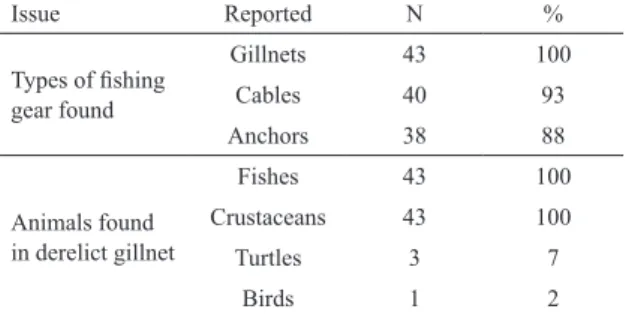
gillnets, along the coastline of the state of Santa Catarina. Fishes and crustaceans were the entangled groups observed
by all the spearishers interviewed (Table 4). Six ish species
were reported by them: dusky grouper (E. marginatus),
blueish (P. saltatrix), blue runner (Caranx crysos), mullets (Mugil spp.), sheepshead (A. probatocephalus)
and sea chub (Kyphosus spp.). Three crustaceans were reported: clinging crab (Damithrax hispidus), lump stone crab (Menippe nodifrons) and smoothtail spiny lobster (Panulirus laevicauda). Sea turtles (Cheloniidae) and the magellanic penguin (Spheniscus magellanicus) were also mentioned.
Table 3. Answers provided by ishers associated with certain issues concerning ALDFG (N=51 ishers). Number of ishers reporting each answer (N) and relative frequency
(%).
Issue Report N %
Fishing gear Bottom gillnet 49 96
Surface gillnet 15 29
Season
Spring 14 27
Summer 15 29
Autumn 30 59
Winter 41 80
Cause
Sea condition 51 100
Accidental removal 28 55
Unskilled isher 18 35
Large individual 15 29
Debris 12 24
Disappearance 6 12
Prevention
Enforcement 39 76
Equipment 51 100
Training 49 96
Table 4. Answers reported by spearishers associated with some issues related to ALDFG (N=43 ishers). Number of i -shers reporting each answer (N) and relative frequency (%).
Issue Reported N %
Types of ishing
gear found
Gillnets 43 100
Cables 40 93
Anchors 38 88
Animals found in derelict gillnet
Fishes 43 100
Crustaceans 43 100
Turtles 3 7
Birds 1 2
This study revealed that ALDFG is widely distributed on the coast of the state of Santa Catarina, mainly near the
shore where ishing activities are more intense. ALDFG has been found within ishing exclusion zones, a fact
that had already been reported in other Brazilian studies
(CASARINI; OBERG, 2007; GODOY et al., 2007). Anthropic pressure is greater on coastal islands (GODOY et al., 2007) because these are areas much used
by tourists and ishers (both recreational and commercial), thereby increasing ALDFG incidence. Ghost ishing is
also observed in areas distant from the coast and even
in areas where ishing is restricted, such as conservation
units. ALDFG has also been observed in oceanic habitats, such as seamounts and atolls in the Atlantic Ocean (SOARES et al., 2011; PHAM et al., 2013), deep sea (BO et al., 2014), Alaska (MASELKO et al., 2013), Antarctica (CAMPOS et al., 2013), and MPAs in the Paciic Ocean (MORISHIGE; MCELWEE, 2012).
Gillnets are one of the most widely used types
of ishing gear in the world (HOVGARD; LASSEN,
2000). This is also true among Brazilian artisanal
ishers, probably due to the relatively low investment
in equipment and human resources required when
compared to other ishing practices. The Brazilian ishing legislation imposes rules for the use of gillnets
(BRASIL, Ministério da Pesca e Aquicultura/Ministério
do Meio Ambiente, 2012), but ishing laws are not respected (KOTAS et al., 2005) and illegal ishing is one
of the possible causes of ALDFG.
The abandonment, loss or discarding of ishing gear on rocky reefs occurs regardless of the type of ishers (commercial or recreational) or ishing methods, and has
an impact on vulnerable species (e.g., sharks) and species with high market value such as groupers and lobsters. It is worth pointing out that, although the numbers observed
are relatively low, they represent speciic cases. The
mortality caused is, in fact, much higher due to the great durability of this gear.
Various studies have reported the incidence of the
capture, injury, and mortality of marine megafauna caused by ALDFG (GODLEY et al., 1998; GOOD et al., 2009; ALLEN et al., 2012; HONG et al., 2013). ALDFG is
considered to be non-selective, thereby posing a risk to
marine organisms of all sizes (CHAVES; ROBERT, 2009),
as well as to sessile species such as corals (CHIAPPONE et al., 2005; BO et al., 2014). Fish and crustaceans
are amongst the groups most afected by ghost ishing
(ERZINI et al., 1997).
The dusky grouper (E. marginatus) is an important
marine ish resource for the state of Santa Catarina
(MACHADO et al., 2003). It should be noted that
E. marginatus is currently listed under the category “vulnerable” in Brazil (BRASIL, Ministério do Meio
Ambiente, 2014) and classiied as “endangered”
according to the International List of Endangered Species by the International Union for the Conservation of Nature
(CORNISH; HARMELI-VIVIEN, 2004). Spearishers
report frequent observation of this species in derelict gear (gillnets), corroborated by our survey, thereby providing
evidence of cumulative losses for the ishing sector
(GILARDI et al., 2010) and for the entire ecosystem as this is one of the main predators (SALE, 1991).
Even though no turtles, birds or marine mammals
were observed in ALDFG during this study, spearishers reported incidences of capture for the irst two groups. IUCN classiied the magellanic penguin as “near to being classiied as threatened” (MÄDER; SERAFINI, 2011) and sea turtles occurring along the Brazilian coast are classiied
as “endangered” or “critically endangered” (MACHADO et al., 2008). The issue of ALDFG thus deserves greater attention than it currently receives in Brazil.
The occurrence of ALDFG usually happens during the winter, probably due to the adverse weather conditions associated with the predominance of southwesterly winds and cold fronts (Frontal Systems) coming from the south (ARAÚJO et al., 2006). The inluence of strong winds has also been reported by ishers in Brazil (ALARCON et
al., 2009) and other countries (MATTHEWS; GLAZER,
2010).
According to the ishers, there are also other
contributing factors in the state of Santa Catarina
during that period of the year. A greater ishing efort by commercial and recreational isheries targeting stocks of
saltatrix), and the whitemouth croaker (Micropogonias furnieri) (SUNYÉ, 2006) leading occasionally to the
accidental entanglement of baleen whales (PONTALTI; DANIELSKI, 2011). Further, reports from some areas of
the world, have shown that these interactions can result in the mortality or serious injury of marine mammals (READ et al., 2006).
Accidental removal by other vessels, unskilled
handling of ishing gear by recreational ishers, entanglement of large ish, presence of plant debris
(such as tree trunks and branches), and disappearance of
ishing gear have also been reported to be factors leading
to ALDFG in Santa Catarina. Accidents, rough seas,
driftwood or debris, and large ish were other causes cited in other Brazilian states (CHAVES; ROBERT, 2009), as
well as in other countries (LAIST, 1995). The main factors leading to ALDFG include adverse weather, damage to gear, collision with other vessels, entanglement in reefs, shipwrecks
or other ishing gear, operational problems (including human error), vandalism, and unregulated or illegal ishing (LAIST, 1995; BAIRD, 2006).
The ishers who participated in this study have suggested actions for tackling the efects of ALDFG. In some European countries, studies undertaken with ishers to prevent ishing gear being lost, abandoned or discarded have been proven to be eicient (PAWSON, 2003;
MACFADYEN et al., 2009).
Eforts have been made to reduce the impact of ghost ishing through: techniques designed to ind the lost gear
(MCELWEE et al., 2011; MORISHIGE; MCELWEE,
2012), manual removal by divers or vessels (LARGE et al.,
2005), incorporation of biodegradable products into ishing gear (BILKOVIC et al., 2012), technological support for
ishers (CHAVES; ROBERT, 2009), and enforcement of
laws that control the hidden impact of ALDFG.
As mentioned above, ALDFG is not a problem restricted to Brazil. Thus, studies and actions for tackling
the efects of ghost ishing have been carried out in many countries (VAN DER LAST, 2011; CHEN; LIU, 2013). The cost-efectiveness of these methods of control is
positive (BUTLER et al., 2013), mainly for the ishing
sector (ANTONELIS et al., 2011), but also for local and global marine biodiversity (GILARDI et al., 2010). About
10% of ishing gear is lost during ishing operations and thus ALDFG is unavoidable wherever ishing takes place
(MACFADYEN et al., 2009).
Fishing activities provide many beneits for society,
such as food, employment, business, and leisure. It is
crucial that these beneits continue to be available in the
future. Any policy designed to protect its sustainable use should incorporate knowledge regarding the impact that
ishing has on ishery resources and its environmental
support system.
Fishing management in the state of Santa Catarina
relects the problems of the national system. The ishing sector neither recognize the existence of the ghost ishing
problem nor adequately recognize its importance.
This indirect impact of ishing activity is rarely included in Brazilian studies, such as those on isheries management
or marine conservation, mainly due to the absence of data. Thus, the results presented here can be used as a basis for
some areas of knowledge, provide the irst data on the impact of ghost ishing on Brazilian rocky reefs.
ACKNOWLEDGMENTS
We would like to thank the scientiic diving team of the COMAR Institute for their collaboration in the ieldwork; the State University of Santa Cruz; Meros do Brasil and Pró-Arribada projects; the Brazilian Center for Research
and Management of Fishery Resources on the Southeastern and Southern Coast (CEPSUL/IBAMA) for their assistance
with logistics and equipment; the Chico Mendes Institute
for Biodiversity Conservation – ICMBio for the license
(SISBIO 31065-1); and the Brazilian Coordination of
Improvement for Higher Education Personal (CAPES) for
a scholarship provided for the irst author.
REFERENCES
ALARCON, D. T.; DÂMASO, R. C. S. C.; SCHIAVETTI, A.
Abordagem etnoecológica da pesca e captura de espécies não-alvo em Itacaré, Bahia (Brasil). Bol. Inst. Pesca, v. 35, n. 4, p. 675-686, 2009.
ALBUQUERQUE, U. P.; LUCENA, R. F. P.; LINS NETO, E. M. F.
Seleção dos participantes da pesquisa. In: ALBUQUERQUE,
U. P.; LUCENA, R. F. P.; CUNHA, L. F. C. (Orgs.). Métodos
e técnicas na pesquisa etnoecológica e etnobiológica. Recife: NUPEEA, 2010. 558 p.
ALLEN, R.; JARVIS, D.; SAYER, S.; MILLS, C. Entanglement
of grey seals Halichoerus grypus at a haul out site in Cornwall,
UK. Mar. Pollut. Bull.,v.64,n.12, p. 2815-2819, 2012.
ANTONELIS, K.; HUPPERT, D.; VELASQUEZ, D.; JUNE, J. Dungeness Crab mortality due to lost traps and a cost–beneit
analysis of trap removal in Washington State waters of the Salish Sea. N. Am. J. Fish. Manage., v. 31, n. 5, p. 880-893, 2011.
ARAÚJO, S. A.; HAYMUSSI, H.; REIS, F. H.; SILVA, F. E.
Caracterização climatológica do município de penha, SC.
In: BRANCO, J. O.; MARENZI, A. W. C. (Orgs.). Bases
DANTAS, D. V.; BARLETTA, M.; COSTA, M. F. The seasonal and spatial patterns of ingestion of polyilament nylon
fragments by estuarine drums (Sciaenidae). Environ. Sci. Pollut. Res. Int., v.19, n. 2, p. 600-606, 2012.
DAYTON, P. K.; THRUSH, S. F.; AGARDY, M. T.; HOFMAN, R. J. Environmental efects of marine ishing. Aquat.
Conserv., v. 5, n.3,p.205-232, 1995.
ERZINI, K.; MONTEIRO, C. C.; RIBEIRO, J.; SANTOS, M. N.; GASPAR, M.; MONTEIRO, P.; BORGES, T. C. An experimental study of gillnet and trammel net ‘ghost ishing’
of the Algarve (southern Portugal). Mar. Ecol-Prog. Ser., v. 158, p. 257-265, 1997.
FAO. Fishing gear classiication. Food and Agriculture
Organization of the United Nations. Rome: Fisheries Technical Paper, 1990. 92 p.
FAO. The state of world isheries and aquaculture. Food and Agri
-culture Organization of the United Nations. Rome, 2014. 223 p.
FERREIRA, C. E. L.; GONÇALVES, J. E. A.; COUTINHO, R. Community structure of ishes and habitat complexity on a
tropical rocky shore. Environ. Biol. Fish., v.61, n. 4, p. 353-369, 2001.
FLOETER, S. R.; GASPARINI, J. L. The southwestern Atlantic reef ish fauna: composition and zoogeographic patterns. J.
Fish Biol., v.56, n. 5, p. 1099-1114, 2000.
GILARDI, K. V. K.; CARLSON-BREMER, D.; JUNE, J. A.; ANTONELIS, K.; BROADHURST, G.; COWAN, T. Marine species mortality in derelict ishing nets in Puget Sound, WA and the cost/beneits of derelict net removal. Mar. Pollut.
Bull., v.60, n. 3, p. 376-382, 2010.
GODLEY, B. J.; GAYWOOD, M. J.; LAW, R. J.; MCCARTHY, C. J.; MCKENZIE, C.; PATTERSON, I. A. P.; PENROSE, R. S.; REID, R. J.; ROSS, H. M. Patterns of marine turtle
mortality in British waters (1992–1996) with reference to
tissue contaminant levels. J. Mar. Biol. Assoc. U.K.,v.78,
p. 973-984, 1998.
GODOY, E. A. S.; DAROS, F. A.; GERHARDINGER, L. C.; BERTUOL, P. R. K.; MACHADO, L. F.; ANDRADE, A. B.; HOSTIM-SILVA, M. Projeto Peixes de Costão Rochoso
de Santa Catarina: subsídios para conservação. In: PRATES,
A. P.; BLANC, D. (Eds.). Áreas protegidas do Brasil: áreas
aquáticas protegidas como instrumento de gestão pesqueira. Brasília: Ministério do Meio Ambiente, 2007. p. 89-105.
GOOD, T. P.; JUNE, J. A.; ETNIER, M. A.; BROADHURST,
G. Ghosts of the Salish Sea: threats to marine birds in Puget
Sound and the Northwest Straits from derelict ishing gear.
Mar. Ornithol.,v.37, p. 67-76, 2009.
HONG, S.; LEE, J.; JANG, Y. C.; KIM, Y. J.; KIM, H. J.; HAN, D.; HONG, S. H.; KANG, D.; SHIM, W. J. Impacts of marine debris on wild animals in the coastal area of Korea. Mar.
Pollut. Bull.,v. 66, n.1-2, p. 117-124, 2013.
HOSTIM-SILVA, M.; ANDRADE, A. B.; MACHADO, L. F.; GERHARDINGER, L. C.; DAROS, F. A. M.; BARREIROS,
J. P.; GODOY, E. A. S.Peixes de costão rochoso de Santa
Catarina: Arvoredo. Itajaí: Universidade do Vale do Itajaí,
2006. 135 p.
HOVGARD, H.; LASSEN, H. Manual on estimation of selectivity
for gillnet and longline gears in abundance surveys. Rome: FAO Fisheries Technical Paper, 2000. 84 p.
BAIRD, R. J. Aspects of illegal, unreported and unregulated
ishing the Southern Ocean. Berlin: Springer, 2006. 286 p. BARREIROS, J. P.; RAYKOV, V. S. Lethal lesions and
amputation caused by plastic debris and ishing gear on the
loggerhead turtle Caretta caretta (Linnaeus, 1758). Three case reports from Terceira Island, Azores (NE Atlantic). Mar. Pollut. Bull., v. 86, n. 1-2, p. 518-522, 2014.
BILKOVIC, D. M.; HAVENS, K. J.; STANHOPE, D. M.; ANGSTADT, K. T. Use of fully biodegradable panels to
reduce derelict pot threats to marine fauna. Conserv. Biol., v. 26,n.6, p. 957-966, 2012.
BO, M.; BAVA, S.; CANESE, S.; ANGIOLILLO, M.; CATTANEO-VIETTI, R.; BAVESTRELLO, G. Fishing
impact on deep Mediterranean rocky habitats as revealed by
ROV investigation. Biol. Conserv., v.171, p. 167-176, 2014.
BREEN, P. A. Mortality of dungeness crabs caught by lost traps in the Fraser River Estuary, British Columbia. N. Am. J. Fish. Manage., v.7, n. 3, p. 429-435, 1987.
BRASIL. Ministério do Meio Ambiente. Portaria nº 445, de 17 de dezembro de 2014. Fauna Aquática. Brasília: Ministério do Meio Ambiente, 2014.
BRASIL. Ministério da Pesca e Aquicultura/Ministério do Meio Ambiente. Instrução Normativa Interministerial Ministério da Pesca e Aquicultura/Ministério do Meio Ambiente n° 12, de 22 de agosto de 2012. Brasília: Ministério da Pesca e Aquicultura/Ministério do Meio Ambiente, 2012.
BUTLER, J. R. A.; GUNN, R.; BERRY, H. L.; WAGEY, G. A.; HARDESTY, B. D.; WILCOX, C. A value chain analysis
of ghost nets in the Arafura Sea: identifying trans-boundary
stakeholders, intervention points and livelihood trade-ofs. J.
Environ. Manage.,v.123, p. 14-25, 2013.
CAMPOS, L. S.; MONTONE, R. C.; MOURA, R. B.; YONESHIGUE-VALENTIN, Y.; KAWALL, H. G.; CONVEY, P. Anthropogenic impacts on Sub-Antarctic and
Antarctic Islands and the adjacent marine environments,
Chapter 10. In: VERDE, C.; PRISCO, G. (Eds.). Adaptation
and evolution in marine environments, from pole to pole.
Berlin: Springer-Verlag, 2013. p. 177-203.
CASARINI, L. M.; OBERG, I. M. F. Áreas marinhas de exclusão
a pesca em dutos e plataformas de prospecção de gás na Bacia
de Santos. In: GONÇALVES, A.; RODRIGUES, G. M. A.
(Orgs.). Direito do petrólelo e gás: aspectos ambientais e internacionais. Santos: Universitária Leopoldianum, 2007. p. 228-249.
CHAVES, P. T.; ROBERT, M. C. Extravios de petrechos e
condições para ocorrência de pesca-fantasma no litoral Norte de Santa Catarina e sul do Paraná. Bol. Inst. Pesca, São Paulo, v.35,n.3, p. 513-519, 2009.
CHEN, C. L.; LIU, T. K. Fill the gap: developing management strategies to control garbage pollution from ishing vessels.
Mar. Policy, v.40, p. 34-40, 2013.
CHIAPPONE, M.; DIENES, H.; SWANSON, D. W.; MILLER, S. L. Impacts of lost ishing gear on coral reef sessile invertebrates in the Florida Keys National Marine Sanctuary.
Biol. Conserv., v.121, n. 2, p. 221-230, 2005.
CORNISH, A.; HARMELIN-VIVIEN, M. Epinephelus
marginatus. (Grouper and Wrasse Specialist Group). The
KOTAS, J. E.; PETRERE JR., M.; AZEVEDO, V. G.; SANTOS,
S. A pesca de emalhe e de espinhel de superfície na Região
Sudeste-Sul do Brasil. Série documentos REVIZEE – Score Sul. São Paulo: Instituto Oceanográico, 2005. 72 p. LAIST, D. W. Marine debris entanglement and ghost ishing: a
cryptic and signiicant type of bycatch. In: Proceedings of the
Solving Bycatch Workshop, September 25-27, Seattle, 1995. p. 33-40.
LARGE, P.; REVILL, A.; RANDALL, P.; ARMSTRONG, M.; HOUGHTON, C.; HAREIDE, N. Programme 5: Western
Edge Ghost Nets (gillnet retrieval). Fisheries Science Partnership Report., 2005. 22 p.
MACFADYEN, G.; HUNTINGTON, T.; CAPPELL, R. Abandoned, lost or otherwise discarded ishing gear. UNEP Regional Seas Reports and Studies No.185; FAO Fisheries
and Aquaculture Technical Paper, No. 523. Rome, UNEP/ FAO, 2009. 115 p.
MACHADO, A. A.; FILLMANN, G. Estudo da contaminação
por resíduos sólidos na Ilha do Arvoredo, Reserva Biológica Marinha do Arvoredo - SC, Brasil. J. Integr. Coast. Zone Manage., v.10,n.3, p. 381-393, 2010.
MACHADO, A. B. M., DRUMMOND, G. M.; PAGLIA, A. P.
Livro vermelho da fauna brasileira ameaçada de extinção. Brasília: Ministério do Meio Ambiente, 2008.
MACHADO, L. F.; ANDRADE, A. B.; HOSTIM-SILVA, M.;
BARREIROS, J. P. Habitat use by the juvenile dusky grouper
Epinephelus marginatus and its relative abundance in Santa
Catarina, Brazil. Aqua J. Ichthyol. Aquat. Biol., v. 6, n. 4, p. 133-138, 2003.
MÄDER, A.; SERAFINI, P. Programa Nacional de
Monitoramento do Pinguim-de-Magalhães (Spheniscus
magellanicus) 2010-2015. Boletim Pinguins no Brasil n°1.
Florianópolis: Programa Nacional de Monitoramento do Pinguim-de-Magalhães, 2011. 8 p.
MASCARENHAS, R.; BATISTA, C. P.; MOURA, I. F.; CALDAS, A. R.; COSTA NETO, J. M.; VASCONCELOS, M. Q.; ROSA, S. S.; BARROS, T. V. S. Lixo marinho em área
de reprodução de tartarugas marinhas no Estado da Paraíba (Nordeste do Brasil). J. Integr. Coast. Zone Manage., v.8,n. 2, p. 221-231, 2008.
MASELKO, J.; BISHOP, G.; MURPHY, P. Ghost ishing in the southeast Alaska commercial Dungeness crab ishery. N. Am.
J. Fish. Manage., v.33,n.2, p. 422-431, 2013.
MATTHEWS, T.; GLAZER, R. Assessing opinions on abandoned, lost, or discarded ishing gear in the Caribbean: a inal report.
Marathon: Gulf and Caribbean Fisheries Institute, 2010. 17 p.
MCELWEE, K.; DONOHUE, M. J.; COURTNEY, C. A.; MORISHIGE, C.; RIVERA-VICENTE, A. A strategy for detecting derelict ishing gear at sea. Mar. Pollut. Bull., v. 65, n.1-3, p. 7-15, 2011.
MORISHIGE, C.; MCELWEE, K. At-sea detection of derelict ishing gear in the North Paciic: An overview. Mar. Pollut.
Bull., v. 65, n. 1-3, p. 1-6, 2012.
PAULY, D.; CHRISTENSEN, V.; GUÉNETTE, S.; PITCHER, T. J.; SUMAILA, U. R.; WALTERS, C.; WATSON, R.; ZELLER, W. D. Towards sustainability in world isheries.
Nature, v. 418, p. 689-695, 2002.
PAWSON, M. G. The catching capacity of lost static ishing
gears: introduction. Fish. Res., v. 64, n. 2-3, p. 101-105, 2003.
PHAM, C. K.; GOMES-PEREIRA, J. N.; ISIDRO, E. J.; SANTOS, R. S.; MORATO, T. Abundance of litter on Condor
Seamount (Azores, Portugal, Northeast Atlantic). Deep Sea Res. Part II Top. Stud. Oceanogr., v. 98, n. Part A, p. 204-208, 2013.
PONTALTI, M.; DANIELSKI, M. Registros de enredamentos de
baleias-franca, Eubalaena australis (Cetacea, Mysticeti), na temporada reprodutiva de 2010, em Santa Catarina, Brasil. Biotemas, v. 24,n.2, p. 109-112, 2011.
POSSATTO, F. E.; BARLETTA, M.; COSTA, M. F.; IVAR DO SUL, J. A.; DANTAS, D. V. Plastic debris ingestion by marine catish: an unexpected isheries impact. Mar. Pollut.
Bull., v. 62, n. 5, p. 1098-1102, 2011.
READ, A. J.; DRINKER, P.; NORTHRIDGE, S. Bycatch of
marine mammals in U.S. and global isheries. Conserv. Biol.,
v.20,n. 1, p. 163-169, 2006.
ROCHA, L. A. Patterns of distribution and processes of speciation
in Brazilian reef ishes. J. Biogeogr., v.30, n. 8, p.1161-1171, 2003.
SALE, P. F. The ecology of ishes on coral reefs. London:
Academic Press, 1991. 754 p.
SMOLOWITZ, R. J. Trap design and ghost ishing: discussion.
Mar. Fish. Rev., v. 40, p. 59-67, 1978.
SOARES, M. O.; PAIVA, C. C.; GODOY, T.; SILVA, M. B.
Rocas Atoll (Equatorial South Atlantic): a case of marine debris in remote areas. J. Integr. Coast. Zone Manage., v. 11, n.1, p. 149-152, 2011.
SUNYÉ, P. S. Diagnóstico da pesca no litoral do Estado de Santa
Catarina. In: ISAAC, V. N.; HAIMOVICI, M.; MARTINS, S. A.; ANDRIGUETTO, J. M. (Orgs.). A pesca marinha
e estuarina do Brasil no início do século XXI: recursos, tecnologias, aspectos socioecon̂micos e institucionais. Belém: UFPA, 2006. p. 141-156.
VAN DER LAST, N. The impacts of ghost ishing in the Dutch
North Sea: an introduction of the scale of the phenomenon and proposed management strategies. Final Report. Culemborg: Bureau Waardenburg bv, 2011. 45 p.
VIEIRA, B. P.; DIAS, D.; HANAZAKI, N. Homogeneidade de