Predation can maintain high local species diversity if the predator consumes a competitively dominant prey species (PAINE 1966, 1971, MENGE & SUTHERLAND 1987, VERLING et al. 2003). In this situation, the predator will have a fundamental influence at the community level by structuring interactions between species and reducing the impact of each, thereby permitting coexistence that would not occur in the absence of the preda-tor. Predators may also influence other processes, such as the induction of phenotypic modifications in prey species (LIMA 1998), that in turn can influence species growth, survival and fitness (MCPEEK et al. 2001). Predators have also influenced size limitation of prey within populations (MENGE 1976) as well as population dynamics (BOLKER et al. 2003).
Indirect effects of predation are also important, including cascading effects in which other species (not prey) respond as a result of predation on different, interacting species (PEACOR and WERNER 1997, TRUSSELL et al. 2003). In general, this effect is a re-sult of the interaction between the predator and prey, in which the prey has its own effects that may influence relationships between it and additional species. Thus, the predator can indi-rectly affect other species which in turn interact with their prey or competing species (RAIMONDI et al. 2000, PEACOR & WERNER 2004). Predators not only influence their prey in a community but may have additional complex consequences. Most patterns in intertidal rocky coasts are the result of combined effects of factors that influence the availability of space on rocky substrates, such as intra- and interspecific competition, biological
distur-bance (e.g., herbivory and predation) and physical factors (e.g., wave action and desiccation) (DAYTON 1971, PAINE 1971, MENGE 1976).
The complexity of these interactions between predators and their communities highlights the importance of experi-mental field studies to examine and quantify the influence of predation on community structure and process (PEACOR & WERNER 2004). Controlled laboratory experiments often can-not include many of the interacting components of the preda-tor-prey relationship and therefore may not reflect what hap-pens in the field. On the other hand, controlling important factors is often difficult in the field and as a consequence, field studies may yield results that are complex and difficult to in-terpret, due to temporal or spatial variability as well as biologi-cal interactions. These complex interactions are common, for example, in rocky intertidal habitats where the main predators are crabs, snails, starfish and fish.
Starfish are often important in community structuring processes (PAINE 1969a, b, 1976, DAYTON 1971, PAINE et al. 1985, GAYMERet al. 2004), mainly in intertidal regions in temperate latitudes (MENGE et al. 1994, NAVARRETE & MENGE 1996). Most ef-fects are observed in the lowest zones (subtidal) on rocky sub-strates, where the starfish are protected from desiccation or other abiotic influences that echinoderms, in general, do not tolerate well (STICKLE & DIEHL 1987). Starfish can be voracious predators that devastate some communities, such as Acanthaster planci
(Linnaeus, 1758) on coral reefs (CAMERON et al. 1991) and Asterias
The role of
Asterina stellifera
(Echinodermata: Asteroidea) as a predator
in a rocky intertidal community in southern Brazil
Patrícia Calil
1; Rosana M. da Rocha
1; Carolina A. Freire
2& James J. Roper
31 Departamento de Zoologia, Universidade Federal do Paraná. Caixa Postal 19020, 81580-980 Curitiba, Paraná, Brasil.
E-mail: [email protected]; [email protected]
2 Departamento de Fisiologia, Universidade Federal do Paraná. 81580-980 Curitiba, Paraná, Brasil. E-mail: [email protected] 3 Programa de Pós-graduação em Ecologia e Conservação, Setor de Ciências Biológicas, Universidade Federal do Paraná.
81580-980 Curitiba, Paraná, Brasil. E-mail: [email protected]
ABSTRACT. Populations of Asterina stellifera Möbius, 1859 are declining in southern Brazil and today the species is on the Brazilian list of endangered species. Here we experimentally investigate the ecological role played by A. stellifera as a predator on the rocky substrate community by increasing densities of this species. Starfish taken from other, nearby, locations were added to three replicate plots and their density was maintained every 15 days. None of the total of 32 species that were identified in the encrusting community appeared to be influenced by the experiment. Two species, the barnacle Chthamalus bisinuatus Pilsbry, 1916 and the algae Gracilaria verrucosa (Hudson), showed small apparent re-sponses to predation. We found that A. stellifera only exerts weak predation pressure on the community, even at high densities. This result is strikingly different from that observed for similar species in the northern hemisphere and in Australia.
sp. on mussels (GAYMERet al. 2002). Not all asteroids, however, are so voracious and some may maintain heterogeneity and bio-logical diversity of their communities (VERLING et al. 2003).
Classical studies that showed the importance of predation by starfish in intertidal rocky shores were carried out in the north-ern hemisphere, with starfish in the genera Asterias and Pisaster
and in Australia, with Acanthaster. Experimental removal of the predator Pisaster ochraceus (Brandt, 1835) resulted in the increased abundance and distribution of its prey Mytilus californicus Conrad, 1837 (PAINE 1969b). This resulted in reduced species richness and mussel dominance, which has also been seen elsewhere along the coast of North American due to strong interactions between
Pisaster and Mytilus and suggesting that Pisaster is an example of a keystone predator (PAINE 1966, 1969a, 1974). In Australia, simi-lar results occurred between the sea star Stichaster australis (Verrill, 1871) and the mussel Perna canaliculus Gmelin, 1791. Exclusion of the predator led to a 40% increase in the vertical distribution of its prey and decreased species richness from 20 to 14 species (PAINE 1971).
In Brazil, the ecological role played by asteroids has not yet been studied, although Asterina stellifera Möbius, 1859 is one of the few starfish species in the intertidal rocky coastal habitats of the Atlantic Ocean. Its is found from Cabo Frio, Brazil (23°S, 42°W) to Mar del Plata, Argentina (35°S, 56°W) in the western Atlantic and from Senegal (15°N, 15°W) to Namibia (28°S, 15°E) in the eastern Atlantic Ocean (CLARK & DOWNEY 1992). No starfish species of the low intertidal region is very abundant and A. stellifera is included in the Brazilian list of endangered species. Its biology is poorly known, with some information suggesting that it can change the permeability of its body wall to avoid desiccation at low tide (VIDOLINet al.
2002) and that late winter is when gonadal development is greatest with reproduction occurring in the spring or early sum-mer in southern Brazil (CARVALHO & VENTURA 2002).
Asterina stellifera is a carnivore and therefore may play an important role in community structure. Also, given its ex-tra-oral feeding strategy, it may affect more species than just the prey while feeding on the rocks through cascading interac-tions as described above. Here we examine the potential role and consequence of Asterina stellifera predation in a subtropi-cal rocky intertidal coastal area in Penha, in the southern Bra-zilian state of Santa Catarina.
MATERIAL AND METHODS
Study area
The study area is the rocky shore at Quilombo beach (26°46’S, 48°38’W), Penha, state of Santa Catarina. Rocks are predominantly granitic with many different shapes and sizes, with protected and exposed areas to wave action and direct sunshine. Rocks form rows more or less perpendicular to shore. The barnacle Chthamalus bisinuatus Pilsbry, 1916 and gastro-pods Littorina flava King & Broderip, 1832 and Littorina ziczac
(Gmelin, 1791) are found on these rocks.
We selected rocks that were exposed during 0.3 m tides for this study and most had three distinct horizontal zones that were visible during low tide. The upper zone had the barnacles
C. bisinuatus, Megabalanus sp. and Tetraclita stalactifera Lamarck, 1818 and the gastropods L. flava and L. ziczac. The intermediate zone had the same barnacles along with the bivalves Brachidontes solisianus d´Orbigny, 1846, Crassostrea rhizophorae (Guilding, 1828) and Isognomonbicolor (Adams, 1845), the gastropods L. flava, L. ziczac, Stramonita haemastoma (Linnaeus, 1758), Tegula viridula (Gmelin, 1791), Leucozonia nassa (Gmelin, 1791),
Collisella subrugosa (d’Orbigny, 1846) and Fissurella clenchi
Farfante, 1943, the polychaete Phragmatopoma caudata Mörch, 1863, and the algae Ulva fasciata Delile, 1813, Porphyra spiralis
var. spiralis Oliveira & Coll, 1975, and Centroceras clavulatum (C. Agardh) Montagne, 1846. The lowest zone had the starfish A. stellifera and occasionally Echinaster brasiliensis Müller & Troschel, 1842, the sea urchins Lytechinus variegatus (Lamarck, 1816) and
Arbacia lixula (Linnaeus, 1758), the sea cucumber Holothuria grisea
Selenka, 1867, the anemones Actinia bermudensis (McMurrich, 1889), Bunodosoma caissarum Correa, 1964, Anthopleura sp. and the tunicates Eudistoma carolinense Van Name, 1945, Botrylloides nigrum Herdman, 1886, Aplidium accarense (Millar, 1953),
Polysyncraton amethysteum (Van Name, 1902) and Clavelina oblonga Herdman, 1880, the hydrozoans Pinauay ralphi (Bale, 1884) and Dynamena crisioides Lamouroux, 1824, the bryozoan
Bugulaneritina (Linnaeus, 1758), the sponge Hymeniacidon heliophila Parker, 1910, and the algae Gracilaria verrucosa (Hudson) Papenfuss, 1950, Corallinaofficinalis Linnaeus, 1758, and Padina gymnospora (Kützing) Sonder, 1871.
Inclusion of
A. stellifera
Pilot relocation experiments in July 2004 were carried out to test whether moved individuals of A. stellifera would remain on the rocks where they were placed. Three rocks were randomly chosen in which three vertical transects were delim-ited. Six starfish were placed into each of the transects and 20 were placed within a circumference of 1 m radius around the transects (38 individuals per rock). These starfish were followed daily for 15 days at diurnal and nocturnal low tides. The moved individuals (70%) tended to remain within a radius of 1.0-1.5 m from the transects, for one week and in two weeks, 50% were still within that distance. Based on these data, the experi-ment was possible and the experiexperi-ment would be monitored and maintained at two week intervals, when starfish that had disappeared during that interval would be replaced.
Prior to placement of the starfish, in late July 2004, quad-rats were examined to quantify the organisms already in place, immediately after which the starfish were place in the experi-mental plots. At one month intervals beginning in late August through late October, quadrats were examined and organisms quantified. Organisms were quantified using visual estimation following FOSTER et al. (1991), within 10cm2 area that were sub-divided into 25 squares.
Data analysis
Starfish, when manipulated, often had everted stomachs as evidence of recent feeding. The preferred prey (if any) is unknown for A. stellifera and so all organisms in the encrust-ing community were measured to test for both direct and indi-rect effects of the predator. Since the organisms on all repli-cates were different, rather than a direct comparison between treatments and controls, we compared the change in cover in both treatments during each month, in which each rock acts as its own control. Given that rare occurrences of organisms are uninformative in this study, we included only species whose abundance permitted comparisons between more than one month. Percentage cover by species was compared between control and experimental treatments with Students t-test.
Physiological tolerance of
A. stellifera
Predatory action by A. stellifera during low tide depends on its tolerance of air exposure or its ability to survive in tidal pools. To examine this tolerance of temperature and salinity variation, individual were taken into the laboratory for physi-ological experiments. In the laboratory they were maintained in aquaria (390 L) with sea water under field conditions: 13:11 h light: dark photoperiod (in summer) and 12:12 h (in winter), 28 ± 1ºC in summer, and 18 ± 1ºC in winter, constant salinity 35 g/kg, pH 7.5-8.0).
Winter and summer salinity tolerance experiments (10, 35, 45 g kg-1, n = 10 for each group) and desiccation tolerance experiments (air exposure), with or without sunshine (n = 10 for each group) were carried out. Salinity values were based on values measured in situ in tidal pools on Penha beach, during daily analysis, and 35g kg-1 is typical of sea water. Measure-ments during that analysis were gathered every hour in six tidal pools in winter with 1) rainfall and 2) sunshine and in summer with 3) rainfall and 4) sunshine, for a total of four days of measurements, in which salinity varied from 5-39g kg-1. In the lab, water of salinity 10g kg-1 was obtained by dilution of sea water with fresh water. High salinity water was obtained using the first thaw of previously frozen natural sea water (salinity 55-85 g/kg) diluted with natural sea water to 45g kg-1. Each starfish was maintained in separate 2.5L aquaria. When tested, each was placed for 3h in the experimental aquaria under con-stant temperature (summer 28ºC, winter 18ºC).Salinity was measured by Shibuya S-28 salinity refractometer. Coelomic fluid (200-500 µl) was taken from the ambulacral area with syringes and disposable insulin needles. Osmolality (vapor pressure os-mometer Wescor, VAPRO 5520) and chloride concentration
were measured (n = 6 for each group). Chloride concentration was measured after diluting coelomic fluid samples with deion-ized water (1:3), by colorimetric assay using a commercially available kit (Labtest®). Absorbency (Ultrospec 2100 PRO Amersham Pharmacia Biotech spectrophotometer) was read at 470 nm (chloride ions react with mercury thiocyanate in the presence of ferric nitrate, yielding orange ferric thiocyanate). Approximate values of chloride concentration for sea water of different salinities were obtained from standard sea water (sa-linity 34.33 g/kg) concentrations following PROSSER (1973). Os-molality of sea water at different salinities was estimated as follows: salinity 35 = 1,050 mOsm/kg H2O.
In the desiccation experiment starfish were exposed to the air for three hours. During daylight hours, they were placed in open air containers either under sunny or cloudy condi-tion, in summer and winter. In the field, starfish would have had to sustain such conditions for a maximum of two hours.
After air exposure and salinity experiments, survival and “health” of the starfish were assessed by their ability to right themselves. After experimental exposure, starfish were placed upside down in sea water (35g kg-1 salinity) and observed for 30 minutes. If they righted themselves within this time they were considered healthy. Those that remained upside down were then each placed in a separate aquarium for 48 h and checked every six hours. Dead starfish remained inverted and those that had righted themselves were also considered healthy. All live star-fish were returned to their point of origin in the field.
RESULTS
The role of
A. stellifera
in the rocky coastal community
Among the 32 species that were found and quantified in the community, only four species were found consistently throughout the experiment. C. bisinuatus and B. solisianus oc-cupied the three or four higher quadrats on the vertical transect, while G. verrucosa occupied all six quadratsand H. heliophila
the three or four lower ones (Fig. 1). Variation in spatial distri-bution between months was similar on control and experimen-tal rocks and therefore the starfish had no apparent effect on any of these species.
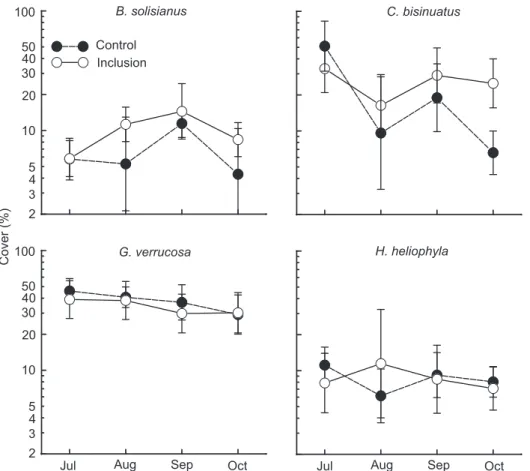
Cover in both C. bisinuatus and G. verrucosa was 50% at the beginning of the experiment. While G. verrucosa remained more or less constant during the experiment, C. bisinuatus de-clined on the control treatment in the first month of the ex-periment. Fluctuation in cover of C. bisinuatus was similar in both treatments but somewhat less extreme in the inclusion treatments (Fig. 2). Cover in both B. solisianus and H. heliophila
was low and similarly variable in both treatments except for in August, when cover increased in the inclusion treatment but decreased in the control (Fig. 2).
Experimental rocks with inclusion ofA. stellifera
B.s. Jul Aug Sep Oct C.b. Jul Aug Sep Oct G.v. Jul Aug Sep Oct H.h. Jul Aug Sep Oct B.R. Jul Aug Sep Oct
1 1 1 1 1
2 2 2 2 2
3 3 3 3 3
4 4 4 4 4
5 5 5 5 5
6 6 6 6 6
Control rocks
B.s. Jul Aug Sep Oct C.b. Jul Aug Sep Oct G.v. Jul Aug Sep Oct H.h. Jul Aug Sep Oct B.R. Jul Aug Sep Oct
1 1 1 1 1
2 2 2 2 2
3 3 3 3 3
4 4 4 4 4
5 5 5 5 5
6 6 6 6 6
Present Less than 5% cover Absent
Figure 1. Occurrence of four sessile species on permanent quadrats (100 cm2) along a vertical gradient (1 = higher and 6 = lower, close to
sand). (B.s.) Brachidontes solisianus, (C.b.) Chthamalus bisinuatus, (G.v.) Gracilaria verrucosa, (H.h.) Hymeniacidon heliophila, (B.R.) bare rock.
Figure 2. Percent cover (mean ± 95% confidence intervals) of four selected sessile species on permanent quadrats (100 cm2) during an
inclusion experiment of A. stellifera in Penha, Santa Catarina. B. solisianus
Inclusion Control 100
50 40
30
20
10
5 4 3 2
Cover
(%)
100
50 40
30
20
10
5 4 3 2
G. verrucosa
Jul Aug Sep Oct
H. heliophyla
Jul Aug Sep Oct
verrucosa in the control treatments, its variability did not re-sult in statistically significant differences. Cover in both B. solisianus and H. heliophyla was relatively constant in both treat-ments over time (Fig. 3).
Tolerance of
A. stellifera
to variation in salinity and
desiccation
All starfish survived all water salinity treatments in the summer and the highest salinity in the winter. In the winter, however, only 57% of the starfish survived the reduced salinity (10 g kg-1) and only 36% righted themselves within 30 minutes. In the desiccation experiment, none of the starfish sur-vived to air exposure under sunshine, during summer (air tem-perature: 31°C). However, all specimens survived exposure to the air in sunny winter days (air temperature: 27°C) as well as in cloudy days either in summer (air temperature: 29°C) or in winter (air temperature: 23°C).
Osmolality and chloride concentrations of the coelomic fluid was similar (although slightly lower) to that of sea water, both in summer and in winter. However, at 45 g kg-1, coelomic fluid osmolality was not different from that of the water in summer and slightly below in winter. Chloride concentration, on the other hand, was lower, in both seasons. In diluted sea water (salinity 10 g kg-1), the coelomic fluid of A. stellifera was
maintained hyper-osmotic and hyper-ionic to chloride with respect to ambient sea water, in both seasons (Figs 4 and 5).
DISCUSSION
The rocky intertidal community comprised 32 species (26 of which were sessile), and none showed a trend due to the increase in the number of predatory starfish, A. stellifera (Figs 2 and 3).Some species (e.g., C. bisinuatus and B. solisianus)seemed to vary due to their own dynamics in different ways on differ-ent rocks with the result that control treatmdiffer-ents were appar-ently more variable than inclusion treatments (Fig. 3). Thus, the potential regulatory role of this predator was not demon-strated. This result is surprising, considering that we increased the density of predatory starfish by 8-10 times (initial study found an average of four per rock), to attempt to demonstrate how predation might influence the rocky intertidal commu-nity. Had we also included an exclusion treatment no trend would have been observed due to naturally low densities.
The population decline of A. stellifera in southern Brazil has been substantial in the last decade (R.M. ROCHA, pers. obs.), yet experimental densities in this experiment were above natu-ral densities when the species was more common. Thus, the surprising lack of predatory influence on the rocky commu-Figure 3. Change in abundance (mean ± 95% confidence intervals) of four selected sessile species on permanent quadrats (100 cm2)
between subsequent months during an inclusion experiment of A. stellifera in Penha, Santa Catarina.
Change
in
percentage
cover
B. solisianus 20
10
0
-10
-20
-30
C. bisinuatus
Inclusion Control
G. verrucosa 20
10
0
-10
-20
-30
Jul Aug Sep Oct
H. heliophyla
nity may be due to predator limitation due to its narrow toler-ance range to desiccation and low salinity levels that may of-ten occur. Also, apparently the poof-tential prey has much greater tolerance as demonstrated by its continued abundance through-out the experiment. Interestingly, in the field, A. stellifera was seen exposed to the air (VIDOLIN et al. 2002), but perhaps for shorter time intervals or under less temperature stress than those in this experiment.
Also, the starfish is sensitive to reduced salinity (10g kg-1), especially during winter. Echinoderms are typically osmo-conformers and stenohaline, and very permeable to water and ions (review in STICKLE & DIEHL 1987) and so it is expected that they not be active predators when exposed during low tide. Indeed, no starfish was ever seen consuming prey while ex-posed during low tide. However, physiological limitation does not completely explain the apparent lack of predatory influ-ence on the community, since predation could certainly in-crease during high tides.
The osmolality of the coelomic fluid of A. stellifera in the higher salinities followed an osmoconformer pattern, as typi-cally described for echinoderms (STICKLE & DIEHL 1987), though with the maintenance of small osmotic and ionic gradients, but especially of a clear ionic (chloride) gradient, in the con-centrated sea water (45g kg-1). Coelomic fluid chloride below sea water concentrations has been reported for echinoids (VIDOLIN et al. 2007). The starfish also displayed a certain ca-pacity to avoid extreme dilution of its extracellular medium when exposed for 3h to very dilute sea water (10 g/kg). Avoid-ance of change in coelomic fluid osmolality was found in this starfish after air exposure for 1h in the field (VIDOLIN et al. 2002).
These results thus indicate a certain physiological capacity to withstand the environmental challenges of tidal pools and even emersion during low tide.
The impact a predator has in a community may be related to its predatory capacity, prey abundance and vulnerability, prey selection and, in rocky coasts, availability of refuges (BARBEAU & SCHEIBLING 1994, GAYMERet al. 2001a, WELLENREUTHER & CONNELL 2002, WONG & BARBEAU 2005). Starfish are passive predators, that is, they take prey as they are encountered while foraging, rather than hunting and chasing specific prey. This behavior suggests that it is prey vulnerability rather than predatory capacity of the predator (WONG & BARBEAU 2005) that structures a community. This is particularly relevant for starfish that evert their stomach when attacking prey, is the case for A. stellifera. In the labora-tory, A. stellifera mostly preyed on barnacles, mussels, and anemo-nes. After stomach eversion, starfish remained almost motion-less for 1 – 3 days. This behavior may be responsible for its weak predatory action observed in the field and may indicate a low metabolic rate. In the field the only movement during low tide was vertical (downward). In Peru, Heliaster helianthus (Lamarck, 1816) displays similar behavior in rocky coastal habitat and for-aging is reduced after days of intense predation. This starfish is also considered a passive predator, not displaying any horizon-tal displacement while searching for its preys on the rocky coast (TOKESHI & ROMERO 1995).
Asterina stellifera, a weak predator in this study, in con-trast with other starfish that are important predators in North America and in Australia at similar subtropical latitudes (PAINE 1974, CAMERON et al. 1991, NAVARRETE & MENGE 1996, GAYMER et al. 2002, 2004) and may be keystone predators (MENGE et al.
10 35 45
Salinity
Coelomic
fruid
osmolality
(mOsm/kgH
O)2
200 400 600 800 1000 1200 1400 1600
Water Summer Winter
100 200 300 400 500 600 700 800
10 35 45
Salinity
Coelomic
fruid
chloride
concentration
(mM)
Water Summer Winter
4
Figures 4-5. (4) Osmolality (mOsm/kgH2O, mean ± 95% confidence intervals) of the coelomic fluid of Asterina stellifera when exposed to the salinities of 10, 35, and 45, in summer and winter (n = 10 for each group). The single value for water in each group was calculated considering salinity 1 = 30 mOsm/kg H2O (PROSSER 1973); (5) chloride concentration (mM, mean ± 95% CI) of the coelomic fluid of
Asterina stellifera when exposed to the salinities of 10, 35, and 45, in summer and winter (n = 10 for each group). The single value for
water in each group was calculated from reference values published for standard sea water (PROSSER 1973).
1994). Starfish are often the most abundant benthic predators of the subtidal and intertidal areas (CAMERON et al. 1991, HIMMELMAN & DUTIL 1991, GAYMER et al. 2001a, 2002) where they prey intensively on most macro-invertebrates of both consoli-dated and unconsoliconsoli-dated substrates (HIMMELMAN & DUTIL 1991). They are very abundant and they aggregate on coastal rocks and reefs, thus maximizing the effects of predation (PAINE 1971, 1974, CAMERON et al. 1991, GAYMER et al. 2002, 2004).
Asterina stellifera had no apparent effect on the rocky coastal community of Penha, nor did it appear to influence any one prey more than any other. The starfish may have had a small effect on the barnacle C. bisinuatus and the alga G. verrucosa, yet due to the variability this possible trend will re-quire further study (Fig. 3). Barnacles are prey for starfish, but any effect on G. verrucosa might be due to the indirect effects, such as on recruitment (LEONARD 1994). Different types of preda-tors, either strong or weak, with high or low rates of predation, can impose important indirect effects, and they may occur in-dependently of any lethal or decimating effects that the preda-tor may cause (PEACOR & WERNER 1997). Constant presence of the predator may alter the behavior of the prey in response to predation risk (LIMA 1998). Thus, we cannot yet rule out, even without high predation rates, that long-term presence of the predator may influence population dynamics of the prey spe-cies by modifying their feeding or reproductive behavior.
In addition to the possible weak predation by A. stellifera, the possible subtle effect on the barnacle C. bisinuatus and not on the mussel B. solisianus would be surprising. Bivalves are frequently reported as preferential starfish prey (PAINE 1969a, b, 1971, MCCLINTOCK & LAWRENCE 1985, NAVARRETE & MENGE 1996, GAYMERet al. 2001b). The single study that shows close interac-tion between asteroids and barnacles was in the Wadden Sea in the Netherlands. Exclusion of the starfish Asterias rubens
Linnaeus, 1758 from the subtidal region increased recruitment of Balanus crenatus Brugière, 1789, while exclusion from the intertidal area did not influence either recruitment or popula-tion density of the barnacle Semibalanus balanoides (Linnaeus, 1767)(BUSCHBAUM 2002).
In Penha, other predators may also be important for struc-turing the encrusting community. Herbivores, such as C. subrugosa, F. clenchi, T. viridula, L. ziczac, L. flava, L. variegatus, A. lixula, and Aplysia sp. were found on both the control and inclu-sion treatments (and so did not interfere with the experiment). These predators may have maintained the community at lower levels thereby reducing the potential impact of the starfish. In the Wadden Sea foraging by herbivorous gastropods was con-sidered important for the population size of intertidal barnacles (BUSCHBAUM 2002). The role of the so-called “weak predators” may have been mistakenly minimized, especially in stressful envi-ronments, such as the intertidal ecosystem. In Oregon, the gas-tropods Nucella emarginata (Deshayes, 1839) and N. canaliculata
(Duclos, 1832) are weak predators that have a small effect on the mussel bank of Mytilus trossulus Gould, 1850, which is
usu-ally regulated by the important key predator P. ochraceus. When the starfish was excluded, both species of Nucella became vora-cious predators and replaced the starfish in its role in structur-ing the community (NAVARRETE & MENGE 1996).
Here we found the surprising result that increasing the density of an important community-structuring predator in other regions did not influence community structure in south-ern Brazil. We suggest that the starfish Asterina stellifera may still play a role as a weak predator in this subtropical intertidal community. However, perhaps long-term studies are required to elucidate that role. While density was artificially high, its importance could have been moderated by the other predators in the system. Its currently low and declining density, hence it being considered endangered, also suggests that it has little impact as a potential factor in community structure. Further studies to examine the role of predation in community struc-ture should examine the entire ensemble of predators.
ACKNOWLEDGMENTS
We would like to thank Ana T. Guimarães, Denilton Vidolin and all Patrícia Calil students for helping in the field. We thank DAAD for the donation of lab equipment to C.A. Freire. Rosana M. da Rocha has a research grant from CNPq. Thisis contribu-tion number 1763 of the Departamento de Zoologia, Universi-dade Federal do Paraná.
LITERATURE CITED
BARBEAU, M.A. & R.E. SCHEIBLING. 1994. Behavioural mechanisms of prey size selection by sea stars (Asterias vulgaris Verrill) and crabs (Cancer irroratus Say) preying on juvenile sea scallops (Placopecten magellanicus Gmelin). Journal of
Ex-perimental Marine Biology and Ecology 180: 103-136.
BOLKER, B.; M. HOLYOAK; V. KRIVAN; L. ROWE & O. SCHMITZ. 2003. Connecting theoretical and empirical studies of trait-mediated interactions. Ecology 84: 1101-1114.
BUSCHBAUM, C. 2002. Predation on barnacles of intertidal and subtidal mussel beds in the Wadden Sea. Helgoland Marine
Research 56: 37-43.
CAMERON, A.M.; R. ENDEAN & L.M. DE VANTIER. 1991. Predation on massive corals: are devastating population outbreaks of
Acanthaster planci novel events? Marine Ecology Progress
Series 75: 251-258.
CARVALHO, A. & C.R.R. VENTURA. 2002. The reproductive cycle of
Asterina stellifera (Möbius) (Echinodermata: Asteroidea) in the Cabo Frio region, southeastern Brazil. Marine Biology 141: 947-954.
CLARK, A.M. & M.E. DOWNEY. 1992. Starfishes of the Atlantic.
London, Chapman & Hall, 794p.
FOSTER, M.S.; C. HARROLD & D.D. HARDIN. 1991. Point vs. photo quadrat estimates of the cover of sessile marine organisms.
Journal of Experimental Marine Biology and Ecology146:
193-203.
GAYMER, C.F.; J.H. HIMMELMAN & L.E. JOHNSON. 2001a. Distribution and feeding ecology of the seastars Leptasterias polaris and
Asterias vulgaris in the northern Gulf of St. Lawrence, Canada. Journal of the Marine Biological Association of
the United Kingdom81: 827-843.
GAYMER, C.F.; J.H. HIMMELMAN & L.E. JOHNSON. 2001b. Use of prey resources by the seastars Leptasterias polaris and Asterias vulgaris: a comparison between field observations and laboratory experiments. Journal of Experimental Marine
Biology and Ecology262: 13-30.
GAYMER, C.F.; J.H. HIMMELMAN & L.E. JOHNSON. 2002. Effect of intra-and interspecific interactions on the feeding behavior of two subtidal seastars. Marine Ecology Progress Series232: 149-162.
GAYMER, C.F.; C. DUTILB & J.H. HIMMELMAN. 2004. Prey selection and predatory impact of four major sea stars on a soft bottom subtidal community. Journal of Experimental Marine
Biology and Ecology 313: 353-374.
HIMMELMAN, J.H. & C. DUTIL. 1991. Distribution, population size-structure and feeding of subtidal seastars in the northern Gulf of St. Lawrence. Marine Ecology Progress Series76: 61-72.
LEONARD, G.H. 1994. Effect of the bat star Asterina miniata (Brandt) on recruitment of the giant kelp Macrocystis pyrifera C. Agardh.
Journal of Experimental Marine Biology and Ecology 179:
81-98.
LIMA, S.L. 1998. Nonlethal effects in the ecology of predator– prey interactions – What are the ecological effects of anti-predator decision-making? Bioscience 48: 25-34.
MCCLINTOCK, J.B. & J.M. LAWRENCE. 1985. Characteristics of foraging in the soft-bottom benthic starfish Luidia clathrata
(Echinodermata: Asteroidea): prey selectivity, switching behavior, functional responses and movement patterns.
Oecologia 66: 291-298.
MCPEEK, M.A.; M. GRACE & J.M.L. Richardson. 2001. Physiological and behavioral responses to predators shape the growth/ predation risk trade-off in damselflies. Ecology 82: 1535-1545. MENGE, B.A. 1976. Organization of the New England rocky intertidal community: role of predation, competition, and environmental heterogeneity. Ecological Monographs 46: 355-393.
MENGE, B.A. & J.P. SUTHERLAND. 1987. Community regulation: variation in disturbance, competition, and predation in relation to environmental stress and recruitment. American
Naturalist 130: 730-757.
MENGE, B.A.; E.L. BERLOW; C.A. BLANCHETTE; S.A. NAVARRETE & S.B. YAMADA. 1994. The keystone species concept: variation in interaction strength in a rocky intertidal habitat. Ecological
Monographs64: 249-286.
NAVARRETE, S.A. & B.A. MENGE. 1996. Keystone predation and interaction strength: interactive effects of predators on their main prey. Ecological Monographs66: 409-429.
PAINE, R.T. 1966. Food web complexity and species diversity.
American Naturalist 100: 65-75.
PAINE, R.T. 1969a. The Pisaster-Tegula interaction: prey patches, predator food preference, and intertidal community structure. Ecology 50: 950-961.
PAINE, R.T. 1969b. A note on trophic complexity and community stability. American Naturalist 103: 91-93.
PAINE, R.T. 1971. A short-term experimental investigation of resource partitioning in a New Zeland rocky intertidal habitat.
Ecology 52: 1096-1106.
PAINE, R.T. 1974. Intertidal community structure: experimental studies on the relationship between a dominant competitor and its principal predator. Oecologia 15: 93-120.
PAINE, R.T. 1976. Size limited predation: an observational and experimental approach with the Mytilus-Pisaster interaction.
Ecology 57: 858-873.
PAINE, R.T.; J.C. CASTILLA & J. CANCINO. 1985. Perturbation and recovery patterns of starfish dominated intertidal assemblages in Chile, New Zealand and Washington State. American
Naturalist 125: 679-691.
PEACOR, S.P. & E.E. WERNER. 1997. Trait-mediated indirect interactions in a simple aquatic food web. Ecology 78: 1146-1156. PEACOR, S.P. & E.E. WERNER. 2004. Context dependence of
non-lethal effects of a predator on prey growth. Israel Journal
of Zoology 50: 139-167.
PR O S S E R, C.L. 1973. Comparative Animal Physiology.
Philadelphia, Saunders, 3rd ed., 966p.
RAIMONDI, P.T.; S.E. FORD; L.F. DELPH & C.M. LIVELY. 2000. Proces-ses structuring communities: evidence for trait-mediated indirect effects through induced polymorphisms. Oikos 91: 353-361.
STICKLE, W.B. & W.J. DIEHL. 1987. Effects of salinity on echinoderms, p. 235-285. In: JANGOUX M. & J.M. LAWRENCE (Eds). Echinoderm
Studies II. Rotterdam, A.A. Balkema, 285p.
TOKESHI, M. & L. ROMERO. 1995. Quantitative analysis of foraging behaviour in a field population of the South American sun-star Heliaster helianthus. Marine Biology 122: 297-303. TRUSSELL, G.C.; P.J. EWANCHUCK & M.D. BERTNESS. 2003.
Trait-mediated effects in rocky intertidal food chains: predator risk cues alter prey feeding rates. Ecology 84: 629-640. VERLING, E.; A.C. CROOK; D.K.A. BARNES & S.S.C. HARRISON. 2003.
Structural dynamics of a sea star (Marthasterias glacialis) population. Journal of the Marine Biological Association
of the United Kingdom83: 583-592.
VIDOLIN, D.; I.A. SANTOS-GOUVEA & C.A. FREIRE. 2002. Osmotic stability of the coelomic fluids of a sea-cucumber (Holothuria grisea) and starfish (Asterina stellifera) (Echinodermata) exposed to the air during low tide. Acta Biológica
Paranaense 31: 113-121.
in ion regulation in the sea urchins Lytechinus variegatus and
Arbacia lixula (Echinodermata: Echinoidea). Journal of the Marine Biological Association of the United Kingdom 87: 769-775.
WELLENREUTHER, M. & S.D. CONNELL. 2002. Response of predators to prey abundance: separating the effects of prey density and patch size. Journal of Experimental Marine Biology and
Submitted: 30.IX.2008; Accepted: 14.VI.2009. Editorial responsability: Paulo da Cunha Lana
Ecology273: 61-71.
WONG, M.C. & M.A. BARBEAU. 2005. Prey selection and the functional response of sea stars (Asterias vulgaris Verrill) and rock crabs (Cancer irroratus Say) when preying on juvenile sea scallops (Placopecten magellanicus (Gmelin)) and blue mussels (Mytilus edulis Linnaeus). Journal of Experimental