ORIGINAL ARTICLE
Narrative of Brazilian Individuals after Deafness Diagnosis
Rosa Monteiro
Universidade de Brasília, doutoranda Daniele Nunes Henrique Silva1
Universidade de Brasília Carl Ratner
Institute for Cultural Research and Education
ABSTRACT - In this article, we investigate what deaf people report about the discovery of their own deafness diagnosis.
Our data was collected in a focal group composed of ive poor deaf adults conducted by a multidisciplinary team (educator,
psychologist and sign language interpreter). All meetings were held in 2013 in Brasília, Brazil. As a result of our analysis, we
identiied narrative fragments which reveal two interdependent aspects of the impact of deafness diagnosis on the subjective identity: a) the iatrogenic efect; and b) the dramatic reconiguration of parental relations after diagnosis. Our conclusion indicates that, after the discovery of their deafness, subjects become identiied in the light of the unwelcome deiciency.
Keywords: deafness diagnosis, psychology of development, Vygotsky
Surdez e Diagnóstico: narrativas de surdos adultos
RESUMO - Investigamos neste artigo o que os surdos narram sobre a descoberta de sua própria condição a partir do diagnóstico da surdez. Partimos de uma metodologia qualitativa, estruturada em forma de grupo focal composto por cinco surdos adultos
pobres e conduzida por uma equipe multidisciplinar (pedagoga, psicóloga e intérprete de língua de sinais) ao longo de 2013 (Brasília, Brasil). Nos resultados, identiicamos fragmentos narrativos reveladores de dois aspectos interdependentes sobre
o impacto do diagnóstico da surdez na constituição do surdo: a) o efeito iatrogênico e b) o reposicionamento dramático das relações parentais após o diagnóstico. A conclusão aponta que, após a da descoberta da surdez, os participantes passam a ser
vistos a partir do lugar da deiciência indesejada.
Palavras-chave: diagnóstico da surdez, psicologia do desenvolvimento, Vigotski
1 Contact: [email protected]
Deafness is characterized as the reduction or absence of
the ability of hearing certain sounds and can be classiied into two diferent types: conductive hearing loss and sensorineural hearing loss. The irst type is caused by malformations in the outer ear, usually due to obstructions; the second type is linked to damage to hair cells in the inner ear, speciically in the cochlea (Ministry of Education of Brazil, 2006). It can
have multiple causes, such as malformation in pregnancy
(congenital) or it can be acquired during life. Congenital
deafness is caused by endogenous factors and acquired deafness can be caused by gestational rubella, recurrent
otitis in childhood, drug intoxication (excessive or poorly
managed use of antibiotics), among other causes. Anoxia,
i.e. insuicient oxygen supply at birth and premature birth,
has also been linked to deafness.
Deafness does not impose practical barriers in daily life;
deaf people can move freely, as there are no impediments
to their physical abilities (Setai, 2014). The diiculties ex -perienced by deaf people concern the inability to hear and therefore to communicate with hearing society, because they do not share a language channel. This situation hinders the
full integration of deaf people into their families (especially
when their parentes are hearing individuals), community, and society, as social relationships are established predominantly
spoken language (O’Keefe, 2012).
Within this complexity, it is important to note that
de-afness is not visually perceived, therefore it is diicult to diagnose, manifesting as an invisible deicit. This invisibility afects the relationship between parents and their children, bringing dramatic consequences for deaf people’s lives, as
will be shown in the present article. Because of these conse-quences, this article aims to discuss what deaf people narrate about the discovery of their deafness. From the analysis of
narratives of the investigated subjects, we identiied two
interdependent aspects which unfold from the bigger issue: a) The discovery of deafness diagnosis – the iatrogenic
efect; and
b) The inluences of the diagnosis on the dramatic recon
-iguration of parental relations after diagnosis.
Both concepts will be discussed based on our data in order to ensure stronger linkage between the narratives of the deaf
subjects and its convergence with the theoretical analysis.
These concepts relate to the matter of contention about the relation between the discovery of deafness diagnosis and parental relations.
Deafness discovery and its inluence
on family dynamics
2008) which report maternal narratives show that deafness occurs as a result of a sudden illness (fever and signs of in
-fection) around 3–6 years old. The surveyed mothers reported that after taking their children to hospital (to receive treatment
and medication) a worsening of their health conditions was detected. They then returned to get more information, which in most cases resulted in hospitalization. After hospital discharge,
all subjects stated that their children entered hospital with nor
-mal hearing and left deaf (Kelman et al, 2011; Santana, 2007).
Generally, these cases occur due to drugs, especially ototoxic antibiotics, being improperly administered to children, but they may also suggest that parents—even as they went to the hospital—did not notice the hearing loss. Often, deaf children are initially seen by their parents as quiet, shy, or inattentive
(Beazley & Moore, 2012). This confusion and delay in diag
-nosis show multiple variables interfering in children’s lives
until deafness is discovered.
Likewise, the discovery of deafness has an impact on the
family dynamics. Parents have diiculty to cope with the experience of a child who is diferent from what they ex -pected, and usually have reactions to diagnosis such as grief,
denial, sadness, depression, and thoughts of death (Yamazaki & Masini, 2008). Santana (2007) states that having a deaf
member of the family is to permanently mourn the idealized child. Thus, parents idealize and pursue development in the
child’s speech that is impossible to be naturally acquired. In this tension lies the main conlict involving deafness:
spoken language.
In this context, the deafness diagnosis has a large impact on the lives of the families of deaf Brazilian children, espe-cially because doctors take a prescriptive and quantitative
stance with regard to deaf children’s development (Vigotski, 1989). This means, in general, that in Brazil the medical
discourse over deafness reinforces the negative aspects of impairment. This negative perspective with regard to deaf development causes neglect, for example, of their bilingual social condition. It also reinforces parents’ views that their children will have many developmental limitations: problems in academic life, in social activities, etc. These elements, as
shown by research conducted by Kelman et al. (2011), pro -duce a biased view of the deaf child and impact the relations of children and parents. Parents begin to believe that their children cannot develop, and this diminishes the quality of family interactions, thus creating social isolation.
The impact of deafness diagnosis on families causes
changes in the subjective dynamic and constitution of the deaf people’s personality. Thus, we ask the following questions:
what do deaf people have to say about the moment when their hearing loss was revealed? What was the impact on their relations with their parents? Our purpose is to analyze, from
adult deaf subjects’ narrative fragments, what they experien -ced after being diagnosed as deaf on their early childhood.
Method
In order to analyze the mentioned issues we decided to develop our research by using a focus group. According to
Gatti (2005), a focus group aims to capture, from exchanges
between members of the group, “concepts, feelings, attitudes,
beliefs, experiences and reactions in a way that is not possible
by using other methods” (p. 9). This encounter, which only occurs in a group, enables the identiication of emerging
processes of the construction of meaning in interactions that are revealing of short-term social and historical issues
sur-rounding the cultural conditions of deaf people. Gatti (2005)
also states that focus groups are particularly useful when there
is no balance between participants regarding inluence. This dynamic is important for understanding diferences, contrasts,
and contradictions.
The focus group was composed of ive participants. Mee -tings were held weekly, lasting two hours each between April and December 2013, in a support institution for deaf people
in Brasilia (Distrito Federal, Brazil). They took place in a private room in order to ensure conidentiality of information and participants. Chairs were arranged in an eye shape (two semicircles horizontally oriented), as subjects used sign
language to communicate.
The research was conducted by a multidisciplinary team:
an educator (irst author), two interpreters (one participated during the irst semester of research, and the other during the second semester), and a psychologist (who participated only in the irst semester).
Research participants, and ield work and
procedure of data construction
The subjects were deaf adults from 27 to 37 years old,
attending the above-mentioned institution for several reasons: classes or educational and training workshops, consulting, or to interact with other deaf people. Intervention was mainly guided by communication between deaf people, and the
triad of deaf person–interpreter–listener, so subjects were required to be familiar with the use of Libras (Brazilian Sign Language), regardless of their luency.
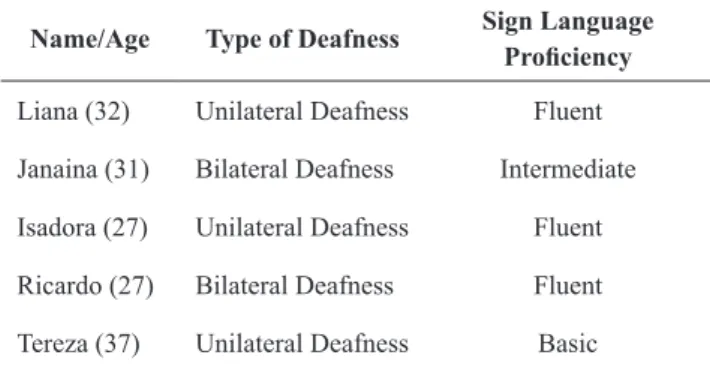
Deaf subjects are described in the table below (ictitious names were used in order to protect subjects’ identities). This project was cleared by the Research Ethics Committee of the Human Sciences Institute of University of Brasilia (Comitê de Ética em Pesquisa do Instituto de Ciências Humanas da Universidade de Brasília – CEP/IH).
Table 1. Participants
Name/Age Type of Deafness Sign Language
Proiciency
Liana (32) Unilateral Deafness Fluent
Janaina (31) Bilateral Deafness Intermediate
Isadora (27) Unilateral Deafness Fluent
Ricardo (27) Bilateral Deafness Fluent
Tereza (37) Unilateral Deafness Basic
We must emphasize that all participants’ families had
migrated from the northeast to the capital of Brazil in pursuit
this study did not beneit from the hearing test at birth for
two reasons: a) they were born in the seventies and eighties. At that time, hearing tests were performed only at private
hospitals and not in a preventive manner, as is done currently;
and, b) they were born at home, far from urban centers and with limited access to hospitals, apart from Isadora.
According to reports, subjects’ mothers had no prenatal
care and their babies did not have medical care at birth. These
subjects only gained access to medical consultation due to episodes of very high fever, cough, and cold from 3 to 5 years
of age. In these situations, family members were transferred to
hospitals in nearby towns. The journey could take up to three days by bus, as was the case of the subject mentioned above. Diiculties in accessing health care services highlight the
economic and social conditions of the deaf people surveyed and are a central indicator for understanding their stories. This also indicates the need to respect the process of the formation of their identity. It is important to point out that, at present time, the northeast region of Brazil has a low or very low
HDI (Human Development Index), as reported by the Atlas of Human Development 2013 in Brazil (UNDP, 2013), which
reveals the precarious living conditions in that region. Fieldwork consisted of 20 meetings, lasting an average of
two hours each. Of these, the irst two were not videotaped, because subjects showed resistance. Trust between researcher
and group had not yet been consolidated. Field notes were taken as follows: after each meeting, the researcher discussed
the issues that emerged from each day of ield research with the team members (psychologist and interpreter). These is
-sues included perceptions of care, conlicts within the group,
and new interventions. In the second round, after video transcription and data processing, an axis of the analysis of investigative results was listed.
It is important to note that because of the linguistic
di-iculty of the deaf subjects, fragments on particular topics (identity, family narratives, etc.) were not presented in a linear
manner, and we were often pressed to return to themes in subsequent meetings. In order to achieve a coherent narra-tive, it was necessary to analyze these fragments. This was only possible using video recordings and guiding principles analysis: present, past, and future.
From the emerging topics, our interest will be restricted to the analysis of fragments relating to the impact of deafness
diagnosis on the subjective perception of deafness and its
changes in parental relationships. To achieve our goal, we divided the results in two axes:
a) The discovery of deafness diagnosis – the iatrogenic
efect; and
b) The inluences of the diagnosis on the dramatic recon
-iguration of parental relations after diagnosis.
Results and discussion
a) The deafness discovery – the iatrogenic efect
To explore this issue, we presented subjects with ques
-tions such as: “How did your family ind out you were deaf?”; “Did someone talk to you about deafness?”; “What did you
feel when you realized that you were deaf?” and others served as basis for determining how the discourse around deafness was internalized by the participants and the role of medical diagnosis in their family dynamics during childhood.
The impacts of diagnosis on deaf people and their families
has been a theme for various investigations (Bogo, Cagnini, and Raduenz, 2014; Padilha, 2002). When an unexpected situation takes place in a family’s life, such as the birth of a child with special needs, parents’ feelings oscillate between
hoping things are not as bad as they seem and being certain
that something is very wrong (Yamazaki & Masini, 2008).
The diagnosis of a disabled child generates feelings of mourning in most families. However, the way each family member experiences this question depends on several
fac-tors, including the family’s psychological condition before the child’s birth (unwanted or planned pregnancy), and the inancial and social structure for raising the child (Kelman et al, 2011; Silva, Zanolli, & Pereira, 2008).
In the case of the deaf subjects of this study, it is diicult to determine what caused their deafness; their memories are
very vague and confused, specially relating to two aspects: a)
all deaf subjects, except for Isadora, made contact with sign
language in adulthood, having lived to that point with only
oral or no language; b) spaces (physical and symbolic) for
dialogue, cultural exchange, experiences, psychoeducational care, psychotherapy, and other purposes were scarce and
in some cases non-existent for the deaf subjects, making it diicult for them to talk about themselves, share experien -ces, and tell their stories. However, experience with doctors and the diagnosis of deafness caused changes in family
relationships and redeined their subjective trajectories, as
can be seen below. Janaína says:
I am the only deaf person in my family and an only child, too... Well, we went to the hospital. On that day, I smiled at my mother because we were going for a drive, I was ive then. I loved riding in the car … I closed my eyes and enjoyed the movement. It was soft, gentle. My mother did not smile back. I was worried. When I got to the hospital, a mustachioed doctor began stuing things in my ear. It felt awful! I had to come back another day. One day, at home, I saw my mother talking to my father, then I knew she was explaining to him that I was deaf, thus it was diicult to communicate. He, as usual, was rude. I remember reading his lips saying the phrase “No turning back.” Wow! That got to me deeply! Only when I started studying did I come to understand what that phrase meant. My parents were upset because they had had a planned pregnancy, but they never imagined they would have a deaf daughter. Nobody wants a deaf child. I remember my father striking so hard close to my ear with the palm of his hand, and I just stood there, quiet, silent. I knew it was strong because I saw the distance he put between his hands. But it was useless. It was very sad for me and I believe it was very sad for my family too. I could see the look in my mother’s eyes… She looked at me, smelled me, ran her hands through my hair. But she always had sadness in her eyes. Today I can tell that was a look of pity.
Kelman et al. (2011) show that many mothers blame
pregnancy, among others. In addition to feelings of guilt, mothers experience the denial of deafness and of their
chil-dren, as seen in Janaína’s report.
This question reaches a crucial problem: parents of a deaf child mourn the death of themselves as idealized normal parents of a deaf child, not at birth, but around the age of preschool. Therefore, the translation of this information into
subjective parental dynamics relects an even greater impact,
because all plans and dreams about the future, set at birth,
were made for a hearing, normal child (Monteiro, 2014).
Deafness diagnosis seems to modify the experiences which are intrinsic to relations between parents and children.
Bogo, Cagnini, and Raduenz (2014) point out that the family
relationship after diagnosis depends on how it is communi-cated by health professionals, because:
This period is very delicate: it changes the child’s status
for parents. It comes to carry the stigma of abnormality and
will be unable to fulill the dreams previously held at birth,
annihilating the hope placed in the child by the parents. Therefore, it is essential to provide necessary professional support, caring, supporting, and providing clear guidance, pointing out alternative ways to improve child development.
(p. s/n)
Janaína, when revisiting memories of her diagnosis, was confronted with two distinct parental relationships,
reconigured by the medical experience that she had just had. She highlights her parents’ negligence in regard to her
development.
Padilha (2002) notes that it is not uncommon for disabled children’s parents to simplify, for example, content, subjects,
commands, and stimuli, which limit mediation and learning experiences. Therefore, the encounter with medical diagnosis and the changes in parental relationships have much to tell us, as Ricardo says:
I was born deaf, but I don’t know how this happened. No one ever explained it to me. Visits to the hospital were diicult because I lived in the backcountry, on a farm, far from the city. But I remember that when we returned from the hospital, it felt like my life had stopped; my parents had changed, they were worried, tense. I know my mother sufered. I know that. Family frustrations are also evident in the words of Isadora:
I was not born deaf. This enabled me to perceive changes in my grandmother’s behavior. I began to realize that something was wrong when I was around 5 to 6 years old. My grandmother corrected me all the time, I spoke and she corrected me. I could not understand. She also called me a lot, all the time. I did not understand why she was acting that way. I saw her face angry, distressed, and impatient. That scared me to the point of wanting to cry. She took me to the doctor and then, after many tests, he said I was deaf. My grandmother was very afectionate, but I saw her face. My heart broke. I thought, “My grandmother is like that because of me… it’s my fault.” She became quieter, reserved. She was there, facing my disability. Now I do not take deafness as a disability, it’s my identity. It was very diicult and I know it was even harder for my mother, who always came to see me. She was very disappointed, “And now this? She is deaf.” I remember her saying. She despised me twice: she left me with my grandmother and did not raise me, and then she was disappointed because I was deaf.
Lebedef (2011) has a provided a theoretical overview of
the impact of the diagnosis of deafness on family structures.
This author, based on Kashyap (1986), inds that the diagno -sis of deafness can act as a source of severe “psychological
disorganization for adjustment of parents and the family”:
The impact of deafness on families seems to be signiicant. Lam-propoulou & Konstantareas (1998), stated that, compared to the efects of diabetes, asthma, and cystic ibrosis on parents, deaf children’s parents endure higher levels of stress. Communication diiculties seem to be the key to the problem of managing a deaf child (Tavormina, Boll, Dunn, Luscomb, 1981; Lebedef, 2011).
Otake and Ranier (2011, p. 138) describe that psycho -logical reactions to the diagnosis of deafness are similar to those found in studies of terminal patients: grief, denial, anger, bargaining, depression, and acceptance. These stages are not uniform and vary in each family. The authors also comment that the acceptance process may come gradually,
but may also not come at all. Kelman et al. (2011) indicate that mothers’ resistance to the diagnosis highlights the di
-iculty in communicating with their deaf children, because
for most mothers the only form of communication is speech. Following the same reasoning, Bittencourt and Montagnoli
(2007) point out that parents’ ignorance concerning deafness
contributes to a lack of acceptance of the diagnosis and cau-ses changes in the psychological and emotional dynamics.
In this context, Raad and Tunes (2011) state that medical diagnosis, while legislating in people’s lives to cure (both conlicts and disease) and creating the social signiicance of the subject as pathological, brings a new epidemic disease: iatrogenic interventions (pp. 19–20). The authors point that iatrogenesis is caused by the side efects of medical pathogens
accompanying medical procedures, drugs, and hospitals, as well as anxiety and other psychological damage resulting
from diagnosis (Raad & Tunes 2011, p. 17).
But why is medicine so necessary? Raad and Tunes
(2011) show that with the advent of modern science, medi -cine expanded its domain to cover all aspects of human life.
A new way to understand and experience conlicts in life unfolded, since, with the intention of solving people’s lives, all life demands are based on biological issues (pp. 15–17).
This medical practice generates a medicalization of life, establishing rules on how to eat and dress, rules on hygiene, sex, physical activity, relationships, and intimate decisions. This reduction of the human to a merely organic being is elucidated in the questions surrounding deafness. Janaína also experienced biological reductionism, which was marked by
changes in the family dynamics, starting with her mother’s
look after returning from the hospital.
Normative standards governed by medicine involve the
subject in a system made of practices of ideological mani -pulation, where people come to believe they are not capable of controlling their own destinies:
Tereza’s report contains evidence of this:
I started attending the oralist school from an early age. I remember when I was learning to speak, I was learning sign language at the same time. I loved ice cream and cycling. But my dad would only give me ice cream and let me ride on the street if I spoke. If I just started using sign language and … voila! I lost everything, bike, ice cream, games. Nonsense! My parents sufered a lot and made me sufer too because they were sure I was going to talk like hearers do, would speak and be a hearer. Every time we left the oralist center they upset me! Every time we went to doctors, speech therapists, specialists, was a day of fear and anguish to me. I would be a hearer. Even if she trains with a speech therapist, a deaf person’s speech will never be equal to a hearer’s … even with a remnant of hearing. Deaf is deaf. Hearing is hearing.
Raad and Tunes (2011) also warned that this process will gradually bring the subject’s illness to light. The doctor’s
interactions shape the emotional and social relations of those
who sufer, so that it is impossible to rid oneself of it: “the doctor’s gaze assumes a power capable of not only detecting
singular events that appear in the body, but describing them in a very particular language, transforming symptoms into signs” (Raad & Tunes 2011, p. 18).
The consequences of iatrogenesis within the social
ield are perceived in the diagnosis and felt in collective
experience: “iatrogenesis causes a disharmony between the individual and the social group, which starts to organize
without and against him” (Raad & Tunes, 2011, p. 21). Thus, subjects are considered unit, abnormal, and guilty of being diferent. Subjectivity is built from what is lacking,
from a disease that needs to be cured, supported by
clini-cal discourse regarding disability. Raad and Tunes (2011)
indicate that “social control by medicine makes society
less healthy by inhibiting people’s autonomy on issues that directly afect their lives” (p. 22).
This medicalized logic entails an endless cycle betwe-en illness or disability and the conviction of healing. The
standard is health and deviance must be ixed, cured, and
deleted. Driven by idealized social norms, people are pushed to engage in behaviors, ideals, and dreams in which they do not recognize themselves and come into psychological and
social conlict:
Scientiic terms often have a hypnotic power over people.
Although they do not respond to or clarify family doubts and questions, no one questions them. The qualifying nature of
diag-noses does not explain how the evaluated child is afected. They
come from a quantitative view of development, emphasizing the results obtained by testing. The practice of diagnosis and categorization of people is sustained by obedience to ideology and rules that people meekly accept, assuming a servile
condi-tion (Raad & Tunes 2011, p. 27).
b) The reconiguration of parental relations when confronted with the deafness diagnosis – the dramatic dimension of the psyche
The discussions presented so far indicate that deafness diagnosis gave new meaning to the parental dynamics of
the subjects. It is possible to say that becoming a father or
a mother of a deaf subject is a process developed from the discovery of the diagnosis and it radically reconigures the
family dynamics. In order to better understand the issue, we have decided to explore the psychic dimension as a drama, as proposed by Vigotski.
Delari Junior (2011) calls Vigotski’s theoretical contri
-bution to drama “art’s contri-bution to psychology,” and a “psychological reading of art itself” (p. 182). In other words,
the issue in question is a border region.
The drama assumes diferent meanings. In some texts,
for example, it is presented as synonymous to a theatrical play: “in the development of drama a new character arises,
a distinct and qualitatively peculiar factor: the teenager’s
very complex personality with such a complicated structure”
(Vygotski 1930, p. 243). At other times, Vygotski (1930)
uses the drama idea in an ontogenetic dimension, in which people act as if life paralleled a play, unwinding various
scenes, announcing scenarios, and assuming diferent and conlicting social roles.
Delari Junior (2011) summarizes:
These two meanings of the word drama in Vigotski, one more
nonspeciic and almost conversational and other more speciic
and with strong philosophical tone, are not, of course, mutually
exclusive, but involve diferent focuses: state that “new charac -ters come into play each new act,” or that “some actors have secondary roles and other key roles,” or else that “a struggle is established in one single act”—as when according to “duty” the hero should behave one way, while according to “love” he should act in a contrary way even when relating to the same
person (p. 185).
In his manuscript written in 1929 (Vigotski, 2000), Vi
-gotski indicates a more speciic meaning. The drama is seen as a conlict, an inner struggle that each person lives:
The drama really is full of impossible internal struggle in organic systems: personality dynamics are the drama… In a dream his
wife betrayed him (Othello), so she must die: tragedy. Drama is always the struggle of such connections (duty and feeling,
passion, etc.). Otherwise it may not be drama, that is, a clash of
systems. Psychology “humanizes” itself (Vigotski 2000, p. 35). Then analysis should be understood as a dialogue, “as modality mediated from a social relationship, which in the production of meanings and senses is constituted
as a dialectical contradiction” (Delari Junior, 2011, pp. 182–183). Therefore, the drama is essentially contradic -tion, doubt, unraveling of life with obstacles and
advan-ces in development, constituted from the person’s social
formation. Drama is not the answer. It is part of the tense movement of the constitution of the person or personality.
Such conlicts can only exist in real human beings’ lives,
says Vigotski. He also states that social drama can be understood as a role play or theatrical performance: “it is
as if diferent psychological functions, including certain human emotions, were the ‘actors.’ In these fragments, human beings are put as if in the ‘arena’ of their own drama” (Delari Junior, 2011, p. 192).
Thus, Vigotski (2000) writes:
The natural endowments of the actor (“amplua”) (emploi [fr.])
determine the scope of his roles, but even so, every drama
subjective repositioning when facing a diagnosis of deafness (a clash of clash systems). These subjects, when faced with an
adverse situation, have their lives transformed. They are faced
with a conlict in their performance unlike what they had until
that point, because now their children are deaf, and so, defective in their eyes. After diagnosis, they experience historical and social conditions which contradict the life they had intended.
In this context, Liana indicates that something changed
in her mother’s eyes. What changed for Liana’s mother after returning from the hospital? It seems that the doctor’s entry
into the family dynamics reallocated the interactions of the
subjects. The mother changed the way she saw her daughter, who was now deaf. This had an impact on her child’s process
of formation of her identity. The mother began to live under the strain of having a deaf daughter and being a loving mother
(she made a birthday cake) and protecting her child. But this
situation is dramatic: how would they act in this new scenario?
The thread is woven into the mother’s initiative to make her daughter’s irst birthday cake is the edge of pity. “My
mother took money out of her apron and bought a bag for
me. On my birthday, she made a cake, it was my irst cake.”
Following this, her drama, her systems clash synchronously
occurred: “She was putting the jellybeans on it and crying.
I did not understand. But my mother was sad.” Liana’s mo
-ther inhabits this conlict: while pleasing her daughter with her irst birthday cake and jellybeans, she cries at her drama
because she has a deaf daughter.
Liana, in her turn, tries to soothe her mother: “I got close, wanted to cuddle and comfort her.” However, her mother is awash with feelings that she does not conceal: “But she pushed me away. I cried. She wept and told me to go to my room. She locked me in there. I stayed there for a very long time.”The mother who weeps and makes a cake is also the mother who pushes her daughter away and locks her in her room.
Discovering deafness causes a systems clash. The diag-nosis reallocates the symbolic constitution of parental roles. The experience of these multiple antagonistic social roles is
drama: as a mother, I should love my child; however, I reject deafness, I reject disability; I love my child but have contempt for deafness; however, I have a deaf child. Now what?
This systems clash, so named by Vigotski (2000), collides with us synchronously (in the same historical moment of life). These mothers ind themselves holding opposing meanings for
the same child, dealing with the psychic dynamics of recreating
and annihilating emotional, subjective, and historical mea
-nings. These conlicts, looded with dialectical contradictions
between alliances and ruptures, are therefore social relations
and socially produced dramas (Delari Junior, 2011, p. 182).
So, as in a play, divided between mother and doctor, Liana concludes: “Today, I know she cried because maybe when we left the hospital she discovered that she had a deaf daughter, that I was deaf.”
It is into this drama that people who become deaf arri-ve, speaking of themselves as others speak. This systems
clash forms the identity processes; these factors, beyond
the constitution of linguistic identity, need to be analyzed in contemporary deaf identity in order to discuss the role of medical discourse in regards to how the diagnosis is presen-ted to parents, which is essential for the consideration of the
complex constitution of a deaf person’s personality. drama changes, but the role is the same = himself. Drama with
ixed roles is a representation of the old psychology. The new:
in the sphere of “amplua,” there are changing roles. The dream
in Kair’s drama (personality) has one part, and the neurotic has another: hero and villain, lover (p. 36).
Along these lines, the author also compares old
psycholo-gy as “a drama with ixed roles,” and states that new psycho
-logy is caused by the “change of roles” (Delari Junior, 2011, p 192; Vigotski 2000, p. 36). Thus, in Marxist psychology, Vigotski (2000) refers to every person as a social being, living
the drama of relations with others. Therefore, the same
per-son experiences social dramas with diferent psychological
roles historically possible, in which relationships are reset.
In social drama, the subject arises now as a spectator, or as victim: sometimes as judge, sometimes as thief.
Vigotski (2000) illustrates this question from the case of a judge who is forced to judge his own wife, “As a person, I sympathize; as a judge, I condemn. I know she is evil, but I love her; sympathize, but condemn. Which will win?” (p. 37).
Such contributions present a promising path for the existing debate on the contradictions and repositioning of
a deaf person’s parents and the deaf person facing speciic diagnostic conditions. Liana’s drama gives an elucidation of
this, as follows:
I am the only deaf person in family. I know I was born very small, prematurely. I was very ill. As a child, I was hospitalized for a long time after a very strong fever. My mother thought it was pneumonia, but my godmother said it could have been so-mething in my throat, I was ive then. My family lived on a farm in the backcountry; we did not have many resources. We lacked many things, apart from beans, because they always grew in the ields. My parents felt that there was something wrong with me when we got back from the hospital. I saw, I realized. I slept on my parents’ bedroom loor and they started ighting after we got back [from the hospital]. They fought and my mother cried, but my father was always ignorant, crude. I realized that the look in my mother’s eyes had changed. On the day, we returned from the hospital, her look changed. It was my ifth birthday and on that week a peddler had come to the farm. He sold clothes and many things. But I had an eye on a bag of candy, actually on a bag of jellybeans. My mother took money out of her apron and bought a bag for me. On my birthday, she made a cake, it was my irst cake. The cake had a white cover and she was putting the jellybeans around the cake, like a circle. I was looking at that scene in the kitchen, sitting on the stepstool. She was putting the jellybeans on it and crying. I did not understand. But my mother was sad. I got close, I wanted to cuddle and comfort her. But she pushed me away. I cried. She wept and told me to go to my room. She locked me in there. I stayed there for a very long time. Today, I know she cried because maybe when we left the hospital she discovered that she had a deaf daughter, that I was deaf. My family was very sad. My father tried to talk to me and I did not understand anything, so I was beaten a lot. I felt guilty, but today I do not think I was guilty of anything. Then, when I grew up, I wondered why it had happened to me. But I’m better now, no problem. It was very sad for my family. I sufered a lot.
Liana’s narrative develops from one episode: returning
Concluding remarks
Our research draws upon and extends cultural
psycho-logical theory and qualitative methodology (Ratner, 1997;
2002). Our research examines the relationship between social relations and personal experience, i.e., identity.
In our narrative fragments, we identiied that family rela -tionships produced after an encounter with diagnosis circu-mscribe these deaf people in certain dynamics, both physical
and psychological. In fact, our deaf subjects constitute their
narrative from the discovery of deafness, because it was at
this point they noticed a reconiguration of family dynamics.
The diagnosis on deafness has a large impact on fami-ly relations, repositioning parents as they deal with their children. From this point, the deaf person gives meaning
and narrates themselves in a diferent way. In these family
dynamics, deaf people experience contempt, denial, anger, grief, disappointment, and mourning of the idealized child. After all, “no one wants to have a deaf child,” as Janaína said.
In the social deployment of this issue, we conclude that health professionals need to know about the cultural and
linguistic development of deaf people. Medical staf (doctors,
nurses, etc.) must take into consideration the impact of the diagnosis of deafness on parental relations and how it can
afect deaf personality’s development. These aspects sug -gest avenues for future research, especially at the interface between psychology, medicine, education, and linguistics,
contributing to relections on the ield of public policy in
health and education.
References
Beazley & Moore, (2012). Deaf Children and Their Families. David
Fulton Book. Great Britain.
Bittencourt, Z. L. C., & Montagnoli, A. P. (2007, April/June).
Representações sociais da surdez. (Social Representations of Deafness). Medicina, Ribeirão Preto, 40(2), 243-249. Retrieved from http://www.revistas.usp.br/rmrp/article/view/322
Bogo, M. L. F., Cagnini, Z. V. S., & Raduenz, M. (2014). Momento
do diagnóstico de deiciências: sentimentos e modiicações
na vida dos pais. Retrieved from http://psicologado.com/
psicologia-geral/desenvolvimento-humano/momento-do-
diagnostico-de-deiciencia-sentimentos-e-modiicacoes-na-vida-dos-pais
Delari Junior, A. (2011). Sentidos do “drama” na perspectiva
de Vigotski: um diálogo no limiar entre arte e psicologia.
(Meanings of “drama” in Vygotsky’s perspective: a dialogue on threshold between art and psychology.). Psicologia em Estudo, Maringá, 16(2), 181-197. Retrieved from http://www.scielo.br/
scielo.php?pid=S1413-3722011000200002&script=sci_arttext Furtado, R. S. S. (2008). Surdez e a relação pais-ilhos na primeira
infância. (Deafness and parent-children relationships during infancy.) Porto Alegre: Ulbra
Gatti, B. A. (2005). Grupo focal na pesquisa em Ciências Sociais e Humanas. Brasília: Liber.
Kashyap, L. D. (1986) The family adjustment to their hearing
impaired child. The Indian Journal of Social Work, 47(1)
31–37. Retrieved from https://www.researchgate.net/ publication/232417744_The_family’s_adjustment_to_their_ hearing_impaired_child
Kelman, C. A., Silva, D. N. H., Amorim, A. C. F. de., Monteiro, R. M. G., & Azevedo, D. C. (2011). Surdez e família: facetas
das relações parentais no cotidiano comunicativo bilíngue.
(Deafness and family: facets of parental relationships in everyday bilingual communication). Linhas Críticas, 17(33),
349-365. Retrieved from http://seer.bce.unb.br/index.php/ linhascriticas/article/viewFile/5698/4710
Lampropoulou, V., & Konstantareas, M. (1998). Child involvement
and stress in Greek mothers of deaf children. American Annals of the Deaf, 143(4), 296–304. Retrieved from https://www.ncbi.
nlm.nih.gov/pubmed/9842056
Lebedef, T. (2011). Família e surdez: algumas considerações
sobre o impacto do diagnóstico e a necessidade de orientação.
Revista Educação Especial, 17. Retrieved from http://cascavel.
ufsm.br/revistas/ojs-.2.2/index.php/educacaoespecial/article/ view/5197/3188
Ministry of Education of Brazil (2006). Secretaria de Educação Especial. Educação Infantil e Surdez. Dificuldades de
comunicação e sinalização. Saberes e práticas da inclusão.
Brasilia: Secretaria de Educação Especial.
Monteiro, R.M.G. (2014). Surdez e Identidade Bicultural: como
nos descobrimos surdos? (Deafness and Bicultural Identity: how do we ind ourselves as deaf?) Universidade de Brasília,
Instituto de Psicologia. Master’s Thesis.
O’Keefe, E. (2012). Perceptions of early intervention programs for deaf children and their families. University of Florida.
Otake, Y. M., & Ranier, E. M. V. (2011, January/June). A vivência dos pais no diagnóstico da deficiência auditiva no filho.
Boletim Academia Paulista de Psicologia, 80(1), 136-147, São Paulo, Brasil. Retrieved from http://www.redalyc.org/ pdf/946/94622747013.pdf
Padilha, A. M. (2002). Processo de simbolização e inserção cultural do deficiente mental (um estudo de caso).
Comunicações, 9(2). Retrieved from https://www.metodista.
br/revistas/revistas-unimep/index.php/comunicacao/ article/ view/1628/1030
Raad, I. L. F., & Tunes, E. (2011). Deiciência como iatrogênese. In A. M. Martinez, & M. C. V. R. Tacca. (Orgs.), Possibilidades de Aprendizagem: ações pedagógicas para alunos com dificuldades e deficiência (pp. 15-45). (Disability as iatrogenesis. In Learning opportunities: educational activities for students with diiculties and disabilities) Campinas: Alínea.
Ratner, C. (1997). Cultural psychology and qualitative methodology: Theoretical and empirical considerations. N.Y.: Plenum. Ratner, C. (2002). Cultural psychology: Theory and method. N.Y.:
Plenum.
Santana, A. P. (2007). Surdez e linguagem: aspectos e implicações neurolinguísticas. (Deafness and language: psycholinguistic aspects and implications.) São Paulo: Plexus.
Setai, S. (2014). A case study of a Young Deaf Man’s identity
construction in a hearing family. University of the Witwatersrand. Faculty of Anthropology.
Silva, A. B. P., Zanolli, M. L., & Pereira, M. C. C. (2008). Surdez: relato de mães frente ao diagnóstico. Estudos de Psicologia, 13(2). Retrieved from http://www.redalyc.org/articulo.
oa?id=26113602010
Silva, D. N. H. (2012). Como brincam as crianças surdas (3a ed.).
(How deaf children play) São Paulo: Plexus.
Vygotski, L. S. (1930). Paidología del Adolescente. Capítulo 16:
Dinámica y estructura de la personalidad del adolescente. In L. S. Vigotski, Obras escogidas – Tomo IV. 2. ed. Madrid: Vysor
Aprendizage y Machado Libros. p. 225-248.
Vigotski, L. S. (1989). El defecto y La compensación. Fundamentos da defectologia–Psicologia do anormal e diiculdades de aprendizagem. Obras completas. (Disability and compensation. First chapter. Fundamentals of Defectology - Abnormal Psychology and learning disabilities. Complete works.) Tomo V. Cuba: Al Pueblo y Education.
Vigotski, L. S. (2000). Manuscrito de 1929. Educação & Sociedade
(1929 Manuscript. Education & Society), Campinas, 21(71),
21-44. Retrieved from http://www.scielo.br/pdf/es/v21n71/ a02v2171.pdf
Yamazaki, A. L., & Masini, E. A. (2008). A surdez no contexto familiar: o
olhar materno. (Deafness in family context: the maternal gaze) Rev. Saúde Pesqui., 1(2), 125-128. Retrieved from http://www.scielo.
br/scielo.php?script=sci_nlinks&ref=000117&pid=S0103-100201200090001300010&lng=