ORIGINAL ARTICLE
Free Association Norms for 1004 Portuguese Words
Gerson Américo Janczura1 Universidade de Brasília
Goiara Mendonça Castilho
Universidade de Brasília
Victor Nahuel Keller
Michigan State University
Nelson Rocha Oliveira
Secretaria de Saúde do Distrito Federal
ABSTRACT - Association norms for 1004 Brazilian Portuguese words are presented. The free association paradigm was
applied collecting the irst word associated with the cue, thus avoiding response chaining and response inhibition. At least 100 participants produced the irst associate of each word cue. Eight hundred seventy one undergraduates enrolled in 44 majors in public and private universities participated in the research. The norms report Forward Association Strength of all word cues and Backward Association Strength is included in several words. The number of associates per cue varied from 2 to 26. Stronger cue-to-target associations corresponded to the irst six associative positions. Issues related to the validity and generality of norms are discussed.
Keywords: norms, free association, Forward Association Strength, Backward Association Strength
Normas de Associação Livre para 1004 Palavras do Português Brasileiro
RESUMO - Normas de associação para 1004 palavras do português brasileiro são apresentadas. Aplicando-se o paradigma
da Associação Livre, coletou-se a primeira palavra que viesse à mente dos participantes, evitando-se efeitos de inibição e
encadeamento de respostas. Associadas de cada pista foram produzidas por um mínimo de 100 participantes. Oriundos de
IES pública e privada, matriculados em 44 cursos, 871 estudantes universitários participaram da coleta. As normas relatam a
Força Associativa Direta de todas as associadas, e várias incluem a Força Associativa Reversa.O número de associadas por pista variou de 2 a 26, sendo que as palavras mais fortemente associadas ocuparam as primeiras seis posições associativas. Discutem-se a generalidade e a validade de normas de associação.
Palavras-chave: normas, associação livre, força associativa direta, força associativa reversa
1 Contact: [email protected]
Knowledge about words like meaning, inflections, acoustic properties or visual code is acquired through several meetings with these stimuli in diferent contexts during the individual’s learning history. Most times, lexical knowledge is learned simultaneously with other words promoting asso-ciations of diferent natures. Such assoasso-ciations may capture semantic relations (for example, thinking of “caries” may lead the individual to semantically associate it with “tooth” or “dentist”), phonetic relations (thinking of “football” may lead to recall a rhyme like “handball”), or of antonyms (day/ night, clear/dark), among others. Access to attributes and properties of a word, or to the links between this and other words, is crucial to the study on perception and many other cognitive processes like memory, problem-solving, logical thinking and language. Collection of norms is one of the methodologies employed to access this information.
This study aimed to collect free association norms to 1004 Portuguese words. Collection of norms on words has long been used in Psychology to estimate measures like frequency of written material occurrence (Kucera & Francis, 1967; Thorndike & Lorge, 1944); semantic categories (Battig & Montague, 1969); imageability, concreteness and
meaning-fulness (Paivio, Yuille & Madigan, 1968); and, association to homographs (Kausler & Kollasch, 1970). There are few Brazilian databases that currently provide word association norms to the adult population: Salles et al. (2008) collected
norms for 88 words; Stein and Gomes (2009) described lists of words associated to 44 cues and Janczura (1996) identiied associates of 69 names of everyday categories. This situa-tion restricts the use of those verbal stimuli in the research, considering the need to control or manipulate the efect of diferent attributes on performance in diferent experimental paradigms. For example, pioneer works show that lack of control on the frequency of occurrence of words in recall and recognition tests gives rise to bias in the hit rate due to interaction between test type and frequency (Gorman, 1961; Hall, 1954) or in the magnitude of the generation efect (Nairne, Pusen & Widner, 1985). Biases can also occur in the performance of tasks involving linguistic processes like understanding and reading if the design does not observe the words’ concreteness (Haberlandt & Graesser, 1985; Sadoski & Paivio, 2001). Which information produces free associa-tion norms and why are these important to the control or manipulation in scientiic investigation?
(or many words) that comes into his/her mind when given a cue. It has been used in Psychology for more than 100 years (Galton, 1880) and is a task observed on a daily basis. For example, it happens when we automatically think of “money” when we hear the word “lottery”; or when we read “attack” and recall “terrorism”; or when we write “majesty” and the word “king” comes to our minds. When one hears, reads or recalls a familiar word, its representation in long-term memory is activated (Cofer, 1967; Meyer, Schvaneveldt & Ruddy, 1974; Nelson, McKinney, Gee & Janczura, 1998; Nelson, Schreiber & McEvoy, 1992b; Underwood, 1965), enabling access to this representation and to the representa-tions of words associated to it. This would correspond to the early stages of language processing. This access is crucial to perform tasks that include such verbal stimuli and corre-spond to the individual’s knowledge about the correcorre-sponding materials, acquired before executing the task.
Anderson (1983) and Collins & Loftus (1975) assume that knowledge about a word in any domain (e.g., phonologi-cal, semantic, visual), acquired through countless meetings where other words were present, makes up networks of interconnected words (i.e., associative networks). In these networks, nodes would stand for the words, and the links between them would reveal a relation or association between words (e.g. semantic or perceptual relation). Nelson et al. (1992b, 1998) have identiied several characteristics of the associative networks that diferentiate the words’ lexical representational structure in the long-term memory: the number of associates varies according to the cue (measure named Category Size); some words produced in response to the word used as cue are more likely than others (measure named Associative Strength); associative networks difer regarding the pattern of interconnectivity between words, i.e., some networks are much more interconnected than others (measure named Connectivity); connections between words can be unidirectional (measure named Forward Association Strength - when the word A produces the word B; or
Back-ward Association Strength - when the word B produces word
A), bidirectional (measure named Resonance - when the
word A produces the word B and B produces A), or indirect
(when the association between the word A and C is mediated by the word B). Comparisons of associative networks show
diferences in the degree of Connectivity and Resonance, and associations between words have diferent magnitudes of Associative strength. Those variables are related to pre-existing lexical representations that can be experimentally manipulated or controlled through the selection of words in experimentation. For example, targets of diferent con-nectivity and same category size can be compared, or the associative strength of cues with similar resonances can be manipulated in memory tests.
The inluence of these variables has been reported in diferent experimental paradigms such as recognition, cued recall, free recall, logical judgments involving conditional thinking, primed free association, remember/know judg-ments, feeling of knowing judgjudg-ments, stem completion, and complementation of radicals, among others. The diversity of paradigms and the robustness of associations captured by norms were evidenced in more than 140 experimental conditions (for review, please refer to Nelson et al. (1992b)
that report results to more than 140 experimental conditions). For example, studies showed that resonance and connectivity contribute, in an independent way, with recall in recognition and extralist cued recall: words with high resonance and con-nectivity are more likely to be recalled than words with low level in these factors (Nelson et al., 1998; Nelson, McEvoy
& Pointer, 2003). Moreover, frequency, concreteness and size of category do not inluence the connectivity efects (Gee, Nelson & Krawczyk, 1999; Nelson, Bennett, Gee, Schreiber & McLinney, 1993; Nelson & Goodmon, 2002). The category size and associative strength also inluence the probability of recalling a word, thus afecting the rates of acceptance and rejection of arguments Modus Pones and Modus Tollens
(Castilho & Janczura, 2012). The lower the number of associ-ates, the more likely for the word to be recalled regardless of ambiguity, concreteness, frequency, levels of processing or length of study (Gee, 1997; Nelson & McEvoy, 1979; Nel-son, Schreiber & Holley, 1992; Nelson et al., 1992b; Nelson
& Xu, 1995; Schreiber & Nelson, 1998;). The associative strength between words also contributes to the probability of recalling: the stronger the association between a cue and the target the highest the possibility of recovering the target (Nelson & Goodmon, 2003; Nelson et al., 1998).
The aforementioned studies and others (e.g. Nelson, Dyrdal, & Goodmon, 2005; Nelson & McEvoy, 2005; Nelson, McEvoy & Dennis, 2000) propose an innovative research approach to investigate cognitive processes like memory. This perspective investigates efects of the indi-vidual’s knowledge prior to data collection, without having access to or being aware of such information. The individual is very likely to have no conscious access to the number of words associated to a cue, nor to the associative strength between them, or to the connectivity and resonance of the as-sociative network. Evidences support that individuals would not be aware of these pieces of information that can inluence memory’s performance: direct instructions (i.e., participant is aware that memory will be tested) or indirect instructions (i.e., memory is tested without the participant’s knowledge) in recall do not inluence the efect of the Category Size (Nelson, Schreiber & Holley, 1992), and the magnitude of this efect is not inluenced whether the task demands, encourages or pro-hibits guessing (Nelson, Schreiber & McEvoy, 1992); there is no relation between standardized values of the Category Size and intentional estimates of the number of associates in memory (Schreiber & Nelson, 1998), and studies have not observed participants making free associations during controlled experiments (Nelson et al., 1998).
This raises the interesting possibility of investigating the unconscious contributions of the words’ characteristics to the performance in diferent tests. These inluences can be added to the variables of which the individual is aware or that she/he can control like manipulation on levels of processing or judgment of pleasantness in the research about human memory. Research designs including both variables to which individuals have conscious access and the inaccessible ones are promising to better understanding human performance in diferent tasks, as proposed by several researchers (e.g., Anderson, 1996; Nelson et al., 1998; Schacter, 1989;
diferent purposes like development of softwares oriented to acquire verbal skills; planning of memory rehabilitation programs; and, development of tests focused on the automatic processing of information.
Method
Participants
The sample comprised 871 university students from one public university (42.7%) and two private ones (40.9% and 9.5%, respectively). Of these, 73.9% were women and 26.1% were men. Participation in the research was voluntary.2
The average age of students was 24.22 years (SD = 7.78; Minimum = 16; Maximum = 65). The number of semesters enrolled at the university ranged from 1 to 13 (Mean = 3.27; SD = 2.1) distributed along 44 courses (Psychology = 54.5%, Nursing = 16.4%, Accounting Sciences = 6.8%, Medicine = 4.4%, Languages = 2%, Computer Sciences = 1.5%, Ad-ministration = 1.4%, Social Communication = 1.4%, Social Service = 1.3%, Pedagogy = 1% and the remainder 34 courses with less than 1% each). Students were from all the Brazilian regions and the Federal District (Federal District = 68.1%, Southeast = 12.8%, Northeast = 7.8%, Middle West = 7.6%, North = 1.4% and South = 1.1% − 1.2% have not informed place of origin) and length of residence in Brasilia ranged from one month to 45 years (Mean = 18.9 years, SD = 9.16). Participants were selected by convenience.
Materials
A set of 1004 words was used as cue in norms collection. Most words were nouns (70.8%), adjectives (10.5%) or verbs (3.2%). The remainder words (15.5%) correspond to other grammar categories or to more than one category. Nearly 90% of the words were standardized by other studies regarding concreteness, valence and arousal (see Janczura, Castilho, Rocha & Van Erven, 2007; Oliveira, Janczura & Castilho, 2013). Words were randomized and randomly distributed in 10 lists of at least 100 and no more than 101 words. Each list was printed on 3-page booklets (33 words on each page, in average) in random order. Each page had two columns: cue words were presented on the left column, and a doted line followed each cue on the right column, where participants should write the irst associate that came into their minds. A cover sheet requested the participants’ demographic data and instructed them about the task.
Procedures
The Free Association task was to write on the response column of the application pad the irst word that came to mind immediately after silent reading of the cue. The Free
2 Project approved through Report # 988.985 of the Research Ethics Committee/ICH/UnB.
Association task´s instructions were: “You will ind many words in this booklet. Your task is to silent read each word and write on the doted line besides it the irst word that comes into your mind after reading. Do not think too long; just write the irst word you recall. There is no right or wrong answer in this task. Write one single word besides each word. Please write it clearly, not minding the spelling. Thanks for your collaboration!”
There was no time limit to conclude the task. Data were collected in groups in the university classrooms, on times previously deined in the respective institutions. In the begin-ning of the collection session the experimenter explained the research objectives and the voluntary nature of participation. Then, participants signed the Free and Informed Consent Term and were given the word booklet. Similar numbers of the 10 lists were distributed in each group collection.
Results
Responses provided by participants were tabulated and further evaluated by independent judges, according to instructions by Janczura, Castilho and Oliveira (in press), who established the following criteria related to encoding: number variation (answers were encoded in a similar way if number variation would not change semantic meaning), synonyms (for example, words with same meaning were encoded in the most frequent form), gender (answers were encoded in similar way when there was not gender variation in semantic change), spelling (written responses that did not comply with spelling rules were re-encoded with the right spelling), verb tense (variations on verb tense were encoded diferently to the same cue), presence of article or adverb (re-encoded, reverting the sentence phrase nucleus, provided it did not change the semantic relations) and mistakes (answers disregarded because the cues were repeated, or answers other than words).
The free association norms make up an open data-base iled on <http://repositoriopesquisas.ibict.br/dvn/dv/ Janczura> of the research data repository of the Brazilian Institute of Information in Science and Technology (IBICT/ MCT). It is a downloadable slsx (Excel) spreadsheet. The spreadsheet has 79,395 information cells (79 columns x 1005 rows) presented as number or text, including the following information: the cue, its associates, whether the associates of the associate have been normed, the associate’s Associative Strength, and the ordinal position of the associate in relation to the magnitude of this variable. User can seek speciic information using the ilters on each column of the database.
The value of the Associative Strength corresponds to the probability of participants producing associate to a cue. Idiosyncratic answers (produced by only one participant, i.e., with absolute frequency of occurrence equal to 1) are not presented on the spreadsheet because they are not con-sidered to be reliable and are weakly associated with the cue, according to Nelson and Schreiber (1992).
The database used the following notations: palavra = cue
used in Free Association; 1a_associada = associate irstly
produced due to the magnitude of the Associative Strength;
as-sociate have been normed (sim = was normed, não = was
not normed); FA_da_1a = Associative Strength of the irst
associate). Information referring to the second associate is identiied by the notations 2a_associada, 2a_normatizada,
FA_da_2a and so on until the last associate produced to
the respective cue. The number of responses produced per
cue ranged from 2 to 26, with average = 14.22 (SD = 3.80). When the information on the last associate is presented, the remainder spreadsheet cells remain empty until the 26th
Associate, if applicable. For example: the cue “pineapple)
(palavra) produced 14 associates, where the irst is fruit
(1a_associada) with Associative Strength equal to 0.33
(FA_da_1a), which has also been normed (1a_normatizada);
the fourteenth associate is “juice” (14a_associada) with Associative Strength equal to 0.018 (FA_da_14a). This
associate has also been normed (14a_normatizada) and may
be found in the same database on the palavra column. The remainder columns after FA_da_14a are empty because there
was no other associate produced by at least two participants. When two or more associates have the same value for As-sociative Strength, the ordinal position corresponds to the word’s alphabetical order. Here, the ordinal indexation (for example, 2nd, 3rd, 4th) does not express diferences on the
As-sociative Strength magnitude. Illustrating: the value of the Associative Strength for the associates “acidity”, “thrush”, “good”, “delicious”, “orange”, “tasteful” and “juice” for the word “pineapple” is 0.018. The associates are respectively ranked from the eighth to the fourteenth. However, all of them correspond to the eighth ordinal position because they have the same value of Associative Strength.
Figure 1 shows the mean magnitude of the Associative Strength in relation to the ordinal position of the associate produced in the Free Association task, and the size of the words sample recorded on each position. The number of words per position ranged from 1004 (irst associate) to one (twenty-sixth associate), and the mean Associative Strength ranged from 0.23 to 0.01 to the irst and the twenty-sixth associates, respectively.
Sample size
Associative Strength
S
amp
le
s
iz
e
Associate Position
A
ss
oc
iati
ve
S
tr
en
gth
(M
ean
)
Figure 1. Mean Associative Strength and sample size in relation to
the response’s associative position.
The graph shows that the mean Associative Strength has asymmetric format, revealing negative correlation with the associative position (r = -0.60). In other words, the higher the associative position the lower the Forward Association
Strength. The graph curve points out that the magnitude of the Forward Association Strength is more discretely diferenti-ated among the irst six associates, and that the mean value of strength stabilizes from the twelfth associate onwards. That means that the possibility for the cue to produce associates with similar Associative Strength (i.e., from the tenth position on) is very low and weakly associated to the cue.
The irst associate is notably more strongly associated than the remainder ones. The mean values for the Associative Strength of the irst seven positions are 0.23 (SD = 0.13). 0.11 (SD = 0.05). 0.07 (SD = 0.03). 0.05 (SD = 0.01). 0.04 (SD = 0.01) and 0.03 (SD = 0.01), respectively. The curve pattern is similar to that reported by Nelson and Schreiber (1992) that have also pointed out the lack of correlation between the concreteness of the irst eight associates and the average Associative Strength.
The curve of the sample size used to calculate the mean Associative Strength in each position shows signiicant number of cases. The mean for the eight irst positions was calculated with at least 965 cases.
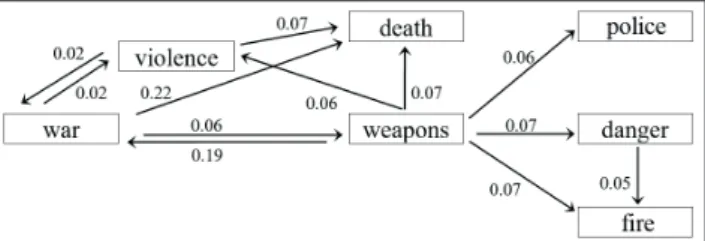
Norms identify pairs of words where associations can be unidirectional, bidirectional or mediated by other words. For example, the word “weapons” produces the associate “danger” with Forward Association Strength (unidirectional association) of 0.07. The relation between weapons and war is bidirectional because “weapons” produces “war” (Forward Association Strength = 0.19) and “war” produces “weapons” (Backward Association Strength = 0.06). This bidirectional association is named Resonance (please refer to Nelson etal.,
1998). Many cue’s associates have been normed, allowing the identiication of several kinds of associative directions among words. Considering the eight irst associates of each cue, nearly 76.1% of the irst associates are normed, 63.8% of the second, 61.7% of the third, 60.1% of the fourth, 57.3% of the ifth, 51.3% of the sixth, 50.8% of the seventh and 47.3% of the eighth. All associates of these associates can be found on the database. These associates allow describing the associative matrices of some words that are assumed to capture the associative representational structure among the normed words that the Free Association task was sensitive enough to collected. Figure 2 shows the associative network for the word “weapon” collected by the norms.
Figure 2. Graph of the intersection between the cue “weapons”
and associates
eight unidirectional connections (when word A produces word
B) and two bidirectional connections (when A produces B and
B produces A). Both resonant associations (i.e., “weapons” and
“war”, “war” and “violence”) show the Forward and Back-ward Association Strengths. Resonance between “weapons” and “war” is higher than between “war” and “violence”. This result is supported by the Resonance calculation (0.06 x 0.19; 0.02 x 0.02) indicated by Nelson et al. (1998).
Discussion
The norms collected through the Free Association para-digm produced associates that came into the participants’ mind in the absence of a more complex semantic context like a phrase or text, since cues have been presented alone. They represented a probabilistic distribution of knowledge shared by individuals that, nonetheless, may correspond or not to the individual experience (Nelson et al., 2000). The
fact that cues were presented separately allows the production of any associate. This probably gives rise to larger number of responses in comparison to the production of words in the presence, for example, of a semantic context. The reduction of the semantic ield in the presence of a sentence context was observed by Janczura (2005). Presenting the names of natural categories like “emotion”, “footwear” and “lower” in the presence of two diferent semantic contexts (e.g., “Learning about his grandfather’s death caused in Juca the emotion of ___.”; “Sufering a car accident caused in Juca the emotion of ___.”), he found seven associates in each context, on average. The mean found in these norms was 14.22 (SD=3.79). This is similar to the mean reported in the norms for 69 natural categories found by Janczura (1996), also collected through the Free Association paradigm, which was 14.25 (SD=4.39). The diference in the number of associates generated in the presence versus absence of context can be explained by the
hypothesis that absence of context does not create semantic restrictions imposed by the interaction between syntactic and semantic structures inherent to context (Chomsky, 1965; Gazdar, Klein, Pullum & Sag, 1985) that serve as associative cue, and the likely associative responses.
The fact that the irst associates to each cue are more likely to be produced than the others shows a stronger con-nection of the cue-associate pairs. Such concon-nections may comprise or not the semantic nature of the association, but are assumed to grasp the lexicon knowledge acquired through the many everyday experiences that individuals share with words (Nelson, McEvoy & Schreiber, 2004). In this sense, the values of the Associative Strength correspond to a relation between words (cue-associate) rather than to an individual measure of words, as would be the case of the frequency of occurrence (e.g., Thorndike & Lorge, 1944), of imageability (e.g., Paivio, Yuille & Madigan, 1968) or concreteness (e.g., Janczura et al., 2007).
Although the norms reported do not represent individual idiosyncratic experiences, Psychology extensively uses norms as illustrated by the projective and psychometric tests. Studies using measures like Forward and Backward Association Strengths, Resonance and Connectivity showed the predictive power of associative norms in the
perfor-mance of paradigms, like typicality judgments (Janczura & Nelson, 1999), linguistic production (Janczura & Nelson, 2006), free recall (Deese, 1965), recognition and cued recall (Nelson et al., 1998) and false memories (McEvoy, Nelson
& Komatsu, 1999). According to Nelson et al. (2000) these
results suggest that free association norms are efectively sensitive to capture core aspects of the lexicon knowledge shared by individuals under diferent conditions (for ex-ample, Nelson et al., 1992b). In addition, the eicacy of
normed measures to predict performance provides validity to factors when used as manipulation or for control in dif-ferent experimental designs.
However, norms generalization demands care. Cultural and linguistic diferences, age group and speciic groups can inluence the associates of a cue. For example, the study by Yoon et al. (2004) compared norms for semantic categories
among Chinese and Americans of diferent age groups, pointing out similarities and diferences between groups. Surveys with drug addicts found that words associated with addiction to substances were more strongly related with their cues for drug users (Stacy, 1997) and alcoholics (Reich & Goldman, 2005). These indings highlight the importance of criteriously selecting normed words when investigating speciic populations.
Conclusions
The free association norms to 1004 words result from a data collection work that lasted more than ive years. This is a hard task that engaged several researchers, research assis-tants and participants. The result is the database that will help researchers in the selection of verbal stimuli to the manipula-tion or experimental control of stimuli, and that can be used by other purposes like the elaboration of didactic materials and development of softwares. At the theoretical level, the norms also contribute with the mapping of associative lexicon knowledge shared by individuals and learned throughout the many everyday contacts with words. This mapping can be useful to investigate memory, language, problem solving and reasoning, among other cognitive processes.
Knowledge about words and its associates collected through Free Association can be added to other Brazilian norms that evaluated other attributes of cues and associates, like the Category Size, Frequency of Occurrence, Concrete-ness, Valence and Arousal. This set of variables allows researchers to develop research designs that demand higher control and/or experimental manipulation. The available norms referred to herein allow selecting, for example, words with many versus with few associates of diferent degrees
of concreteness, with high arousal and negative emotional valence, and that are frequent in Portuguese.
Janczura, G. A., Castilho, G. M., Rocha, N. O., & van Erven, T. J. C. (2007). Normas de concretude para 909 palavras da língua
portuguesa. Psicologia: Teoria e Pesquisa, 23(2), 195-204.
Kausler, D. H., & Kollasch, S. F. (1970). Word association to
homographs. Journal of Verbal Learning and Verbal Behavior, 9(4), 444-449. doi:10.1016/S0022-5371(70)80086-X
Kucera, H., & Francis, W. N. (1967). Computational Analysis of Present-day American English. Providence, RI: Brown
University Press.
McEvoy, C. L., Nelson, D. L., & Komatsu, T. (1999). What is the connection between true and false memories? The diferential
roles of interitem associations in recall and recognition. Journal of Experimental Psychology: Learning, Memory, & Cognition, 25(5), 1177-1194. doi:org/10.1037/0278-7393.25.5.1177
Meyer, D. E., Schvaneveldt, R. W., & Ruddy, M. E. (1974).
Functions of graphemic and phonemic codes in visual word
recognition. Memory & Cognition, 2(2), 309-321. doi:10.3758/
BF03209002
Nairne, J. S., Pusen, C. P., & Widner, R. L. (1985). Representation in mental lexicon: Implications for theories of the generation efect.
Memory & Cognition, 13(2), 183-191. doi:10.3758/BF03197011
Nelson, D. L., Bennett, D. J., Gee, N. R., Schreiber, T. A., & McKinney, M. (1993). Implicit memory: Efects of network size and interconnectivity on cued recall. Journal of Experimental Psychology: Learning, Memory, and Cognition, 19(4), 747-764. doi:org/10.1037/0278-7393.19.4.747
Nelson, D. L., Dyrdal, G. M., & Goodmon, L. B. (2005). What is pre-existing strength? Predicting free association probabilities, similarity ratings, and cued recall probabilities. Psychonomic Bulletin & Review, 12(4), 711-719. doi:10.3758/BF03196762
Nelson, D. L., & Goodmon, L. B. (2002). Experiencing a word can prime its accessibility and its associative connections to related
words. Memory & Cognition, 30(3), 380-398. doi:10.3758/
BF03194939
Nelson, D. L., & Goodmon, L. B. (2003). Disrupting attention: The need for retrieval cues in working memory theories. Memory & Cognition, 31(1), 65-76. doi:10.3758/BF03196083
Nelson, D. L., & McEvoy, C. L. (1979). Encoding context and set
size. Journal of Experimental Psychology: Human Learning and Memory, 5(3), 292-314. doi:org/10.1037/0278-7393.5.3.292
Nelson, D. L., & McEvoy, C. L. (2005). Implicitly activated memories: The missing links of remembering. In C. Izawa & N. Ohta (Eds.), Human Learning and Memory: Advances in Theory and Application: The 4th Tsukuba International Conference on Memory (pp. 177-198). Mahwah, NJ: Erlbaum.
Nelson, D. L., McEvoy, C. L., & Dennis, S. (2000). What is free association and what does it measure? Memory & Cognition, 28(6), 887-899. doi:10.3758/BF03209337
Nelson, D. L., McEvoy, C. L., & Pointer, L. (2003). Spreading activation or spooky action at a distance? Journal of Experimental Psychology: Learning, Memory, and Cognition, 29(1), 42-52. doi:org/10.1037/0278-7393.29.1.42
Nelson, D. L., McEvoy, C. L., & Schreiber, T. A. (2004). The University of South Florida free association, rhyme, and word
fragment norms. Behavior Research Methods, Instruments, & Computers, 36(3), 402-407. doi:10.3758/BF03195588
Nelson, D. L., McKinney, V. M., Gee, N., & Janczura, G. A. (1998). Interpreting the inluence of implicitly activated memories on
recall and recognition. Psychological Review, 105(2), 299-324.
doi:org/10.1037/0033-295X.105.2.299
References
Anderson, J. R. (1983). A spreading activation theory of memory.
Journal of Verbal Learning and Verbal Behavior, 22(3),
261-295. doi: 10.1016/S0022-5371(83)90201-3
Anderson, J. R. (1996). ACT: A simple theory of complex cognition.
American Psychologist, 51(4), 355-365.
doi:org/10.1037/0003-066X.51.4.355
Battig, W. F., & Montague, W. E. (1969). Category norms for verbal items in 56 categories: A replication and extension of the Connecticut category norms. Journal of Experimental Psychology, 80(3, Pt.2), 1-46. doi:org/10.1037/h0027577
Castilho, G. M., & Janczura, G. A. (2012). Raciocínio condicional: A
conclusão depende do conhecimento armazenado na memória. Estudos de Psicologia, 17(1), 53-61.
Chomsky, N. (1965). Aspects of a Theory of Syntax. Cambridge,
MA: MIT Press.
Cofer, C. N. (1967). Conditions for the use of verbal associations.
Psychological Bulletin, 68(1), 1-12. doi:org/10.1037/h0024713
Collins, A. M., & Loftus, E. F. (1975). A spreading-activation theory
of semantic processing. Psychological Review, 82(6), 407-428.
doi:org/10.1037/0033-295X.82.6.407
Deese, J. (1965). On the prediction of occurrence of particular verbal intrusions in immediate recall. Journal of Experimental Psychology, 58(1), 17-22. doi:org/10.1037/h0046671
Galton, E. (1879). Psychometric experiments. Brain, 2(2), 149-162.
doi:org/10.1093/brain/2.2.149
Gazdar, G., Klein, E., Pullum, G., & Sag, I. (1985). Generalized Phrase Structure Grammar. Oxford: Basil Blackwell.
Gee, N. R. (1997). Implicit memory and word ambiguity. Journal of Memory and Language, 36(2), 253-275. doi:org/10.1006/
jmla.1996.2481
Gee, N. R., Nelson, D. L., & Krawczyk, D. (1999). Is the concreteness efect a result of underlying network interconnectivity? Journal of Memory and Language, 40(4), 479-497. doi:org/10.1006/
jmla.1998.2627
Gorman, A. M. (1961). Recognition memory for nouns as a function of abstractness and frequency. Journal of Experimental Psychology, 61(1), 23-29. doi:org/10.1037/h0040561
Haberlandt, K. F., & Graesser, A. C. (1985). Component processes in text comprehension and some of their interactions. Journal of Experimental Psychology: General, 114(3), 357-375. doi:
org/10.1037/0096-3445.114.3.357
Hall, J. F. (1954). Learning as a function of word frequency.
The American Journal of Psychology, 67(1), 138-140.
doi:10.2307/1418080
Janczura, G. A. (1996). Normas associativas para 69 categorias
semânticas. Psicologia: Teoria e Pesquisa, 12(3), 237-244. Janczura, G. A. (2005). Contexto e normas de associação para
palavras: a redução do campo semântico. Paideia, 15(32),
417-425. doi:10.1590/S0103-8632005000300011
Janczura, G. A., & Nelson, D. L. (1999). Concept accessibility as the determinant of typicality judgments. The American Journal of Psychology, 112(1), 1-19.
Janczura, G. A., & Nelson, D. L. (2006). A hipótese da acessibilidade
conceitual para a tipicidade e a produção linguística.
Psicologia: Relexão e Crítica, 19(3), 491-497. doi:10.1590/
S010279722006000300018
Janczura, G. A., Castilho, G. M., & Rocha, N. O. (in press). Normas do tamanho da categoria para 906 palavras da língua
Nelson, D. L., & Schreiber, T. A. (1992). Word concreteness and
word structure as independent determinants of recall. Journal of Memory and Language, 31(2),
237-260.doi:10.1016/0749-596X(92)90013-N
Nelson, D. L., Schreiber, T. A., & Holley, P. E. (1992a). The
retrieval of controlled and automatic aspects of meaning on direct and indirect tests. Memory & Cognition, 20(6), 671-684.
doi:10.3758/BF03202717
Nelson, D. L., Schreiber, T. A., & McEvoy, C. L. (1992b). Processing implicit and explicit representations. Psychological Review, 99(2), 322-348. doi:org/10.1037/0033-295X.99.2.322
Nelson, D. L., & Xu, J. (1995). Efects of implicit memory on explicit recall: Set size and word frequency efects. Psychological Research, 57(3), 203-214. doi:10.1007/BF00431281
Oliveira, N. R., Janczura, G. A., & Castilho, G. M. (2013). Normas de alerta e valência para 908 palavras da língua portuguesa.
Psicologia: Teoria e Pesquisa, 29(2), 185-200.
Paivio, A., Yuille, J. C., & Madigan, S. A. (1968). Concreteness, imagery, and meaningfulness values for 925 nouns. Journal of Experimental Psychology, 76(1, Pt.2), 1-25. doi:org/10.1037/
h0025327
Reich, R. R., & Goldman, M. S. (2005). Exploring the alcohol expectancy memory network: The utility of free associates.
Psychology of Additive Behaviors, 19(3), 317-325.
doi:org/10.1037/0893-164X.19.3.317
Sadoski, M., & Paivio, A. (2001). Imagery and text: A dual coding theory of reading and writing. Mahwah, NJ: Lawrence Erlbaum.
Salles, J. F., Holderbaum, C. S., Becker, N., Rodrigues, J. C., Liedtke, F. V., Zibetti, M. R., & Piccoli, L. F. (2008). Normas de associação semântica para 88 palavras do português brasileiro.
Psico, 39(3), 260-268.
Schacter, D. L. (1989). On the relation between memory and consciousness: Dissociable interactions and conscious experience. In H. L. Roediger, III, & E. I. M. Craik (Eds.),
Varieties of Memory and Consciousness: Essays in Honor of Endel Tulving (pp. 335-89). Hillsdale, NJ: Erlbanm.
Schreiber, T. A., & Nelson, D. L. (1998). The relation between feelings of knowing and the number of neighboring concepts
linked to the test cue. Memory & Cognition, 26(5), 869-883.
doi:10.3758/BF03201170
Stacy, A. W. (1997). Memory activation and expectancy as
prospective predictor of alcohol and marijuana use. Journal of Abnormal Psychology, 106(1), 61-73. doi:org.ez54.periodicos.
capes.gov.br/10.1037/0021-843X.106.1.61
Stein, L. M., & Gomes, C. F. A. (2009). Normas brasileiras para listas de palavras associadas: Associação semântica, concretude, frequência e emocionalidade. Psicologia: Teoria e Pesquisa, 25(4), 537-546.
Thorndike, E. L., & Lorge, I. (1944). The teacher’s wordbook of 30,000 words. New York: Teacher’s College Press, Columbia
University.
Tulving, E. (1985). How many memory systems are there? The American Psychologist, 40(4), 385-398.
doi:org/10.1037/0003-066X.40.4.385
Underwood, B. J. (1965). False recognition produced by implicit verbal responses. Journal of Experimental Psychology, 70(1),
122-129. doi:org/10.1037/h0022014
Yoon, C., Feinberg, F., Hu, P., Gutchees, A. H., Hedden, T., Chen, H-Y. M., Park, D. C. (2004). Category norms as a function of culture and age: Comparisons of item responses to 105 categories by American and Chinese adults. Psychology and Aging, 19(3), 379-393. doi:org/10.1037/0882-7974.19.3.379