Profile of parturients and their newborn
babies receiving care in a university
hospital in northwestern Paraná
1 Master in Nursing. Nurse at the University Hospital of Maringá. Maringá, PR, Brazil. [email protected] 2 Nurse. PhD in Nursing. Professor at the State
O
RIGINAL
A
R
TICLE
PERFIL DAS PARTURIENTES E SEUS RECÉM-NASCIDOS ATENDIDOS EM UM HOSPITAL-ESCOLA DO NOROESTE DO ESTADO DO PARANÁ
PERFIL DE LAS PARTURIENTAS Y SUS RECIÉN NACIDOS ATENDIDOS EN UN HOSPITAL ESCUELA DEL NOROESTE DEL ESTADO DE PARANÁ
RESUMO
O estudo teve como objetivo traçar o perfil de parturientes e seus recém-nascidos aten-didos em um hospital-escola, a partir do Sis-tema de Informações sobre Nascidos Vivos - SINASC. Para isso, foi realizado um estudo descritivo exploratório que identificou as características de todas parturientes e seus recém-nascidos atendidos no Hospital Universitário de Maringá - HUM no ano de 2006. Observou-se que 27,1% das parturi-entes eram adolescparturi-entes, 68,4% não ti-nham companheiro, 59,3% residiam fora de Maringá, 63,6% realizaram sete ou mais consultas de pré-natal. A proporção de par-to cesárea foi de 50,4%. Os recém-nascidos, em sua maioria, apresentaram boa vitali-dade ao nascer, embora 25,5% eram pré-termos e 23,6% baixo peso ao nascer. Com os resultados, foi possível traçar o perfil das parturientes e seus recém-nascidos aten-didos no HUM, demonstrar a possibilidade de utilização do SINASC como um dos ins-trumentos de avaliação em saúde em uni-dade terciária e propor intervenções capa-zes de prevenir a morbimortalidade mater-no-infantil.
DESCRITORES Sistemas de informação. Saúde materno-infantil. Avaliação em saúde.
Gisele Ferreira da Silva1, Sandra Marisa Pelloso2
ABSTRACT
The study had the purpose to outline the profile of parturients and their newborn babies receiving care in a school hospital, based on the Live Birth Information System
- Sistema de Informações sobre Nascidos
Vivos - SINASC. For so, a descriptive, explor-atory study was elaborated, identifying the characteristics of all the parturients and their newborns receiving care at Hospital Universitário de Maringá - HUM in 2006. It was observed that 27.1% of the parturients were adolescents, 68.4% had no partner, 59.3% lived outside Maringá, and 63.6% had seven or more pre-natal appointments. The ratio of cesarian sections was 50.4%. The newborns, mostly, had good vitality at birth, although 25.5% were preterms and 23.6% had low weight at birth. With the results, it was possible to outline the pro-file of the parturients and their newborns receiving care at the HUM, show the possi-bility of using the SINASC as an instrument of health evaluation in tertiary units and propose interventions capable of prevent-ing maternal-child morbimortality.
KEY WORDS Information systems. Maternal and child health. Health evaluation.
RESUMEN
El estudio tuvo como objetivo trazar el per-fil de parturientes y sus recién nacidos aten-didos en un hospital escuela, a partir del Sistema de Informaciones sobre Nacidos Vivos - SINASC. Para lo cual, fue realizado un estudio descriptivo y exploratorio que iden-tificó las características de todas las par-turientes y sus recién nacidos atendidos en el Hospital Universitario de Maringá - HUM en el año de 2006. Se observó que 27,1% de las parturientes eran adolescentes, 68,4% no tenían compañero, 59,3% residían fuera de Maringá, 63,6% realizaron siete o más consultas de prenatal. La pro-porción de parto cesárea fue de 50,4%. Los recién nacidos, en su mayoría, presentaron una buena vitalidad al nacer, a pesar de que 25,5% eran prematuros y 23,6% de bajo peso al nacer. Con los resultados, fue posi-ble trazar el perfil de las parturientas y de sus recién nacidos, atendidos en el HUM, y demostrar la posibilidad de utilizar el SINASC como uno de los instrumentos de evaluación de la salud en una unidad ter-ciaria y proponer intervenciones capaces de prevenir la morbimortalidad materno-infantil.
INTRODUCTION
Knowledge of the characteristics of births at a given place and time is of fundamental importance in order to elaborate demographic and epidemiologic indicators that could repre-sent the reality of the community, with a view to the plan-ning and implementation of effective strategies to improve health conditions. Every year, approximately 3,100,000 chil-dren are born in Brazil. The southern region is responsible for 12% of births in Brazil; the state of Paraná had the high-est count of births in the southern region, with 40.8%, and the city of Maringá accounted for 3.5% of births in the state(1).
In Brazil, there are several sources of information about the number of births, among them: Instituto Brasileiro de Estatística e Geografia – IBGE, with the demographic cen-sus, the national polls per household – Pesquisas Nacionais por Amostra de Domicílios – PNAD and the national system of live-borns – Sistema de Informação sobre Nascidos Vi-vos - SINASC. The existence of information systems is para-mount to execute orientations and actions that are being or should be developed in healthcare services(2).
The health information systems – Sistemas de Informa-ção em Saúde – SIS, in Brazil, and the
de-centralization of healthcare services were created as a strategy of the Single Health Sys-tem – Sistema Único de Saúde – SUS to im-prove the health situation of the population. Among the SIS, SINASC is one of the tools most often used by cities and states as a source to calculate the rations of live-born children with low birth weight and live-born children from mothers with four or more / seven or more pre-natal consultations. It
also allows for calculations involving cesarean deliveries, the coefficients of child, neonatal and late neonatal mor-tality, ratio of maternal mormor-tality, among others that are part of the indicators to monitor and assess the Pact for Health, created to redefine the responsibilities of each manager in the search for social equity, considering the healthcare necessities of each population.
SINASC is a source of information about births, nation-ally implanted by the Ministry of Health in 1990 in response to the need for a database that would make available in-formation on the number of births, characteristics of the mothers, gestation, birth and the newborn(3). The
implan-tation of the SINASC in Brazil occurred gradually; in Paraná, it started in November and December, 1993(2), and it has
been expanded in the state, made available in the cities under the supervision of the state, which allowed for its utilization at local level. SINASC is currently implanted in all states and available on the website of Departamento de Informação e Informática do SUS/Ministério da Saúde.
SINASC uses the Declaration of Live-born Children –
Declaração de Nascidos Vivos – DNV, a document that
should be provided by the Civil Registry Notary Offices in
the services where the child was delivered, and also in cases of home deliveries or other places where there was no as-sistance by healthcare professionals(3). When the DNV is
filled out, it is possible to obtain fundamental information to plan obstetric healthcare actions, so as to evaluate healthcare actions and to build demographic and health indicators in the maternal-child area.
The Brazilian population does not fit a single social and educational standard and, with the huge regional differences in healthcare service, the type of obstetric service provided by the institutions cannot be generalized. Depending on the region where the women’s healthcare activities are found, there are specific characteristics that depend on the demo-graphic, cultural, social and economic aspects that determine different behavioral standards of the female population(4).
When the reference institution that monitors high-risk pregnancies is considered, it is interesting to outline the pro-file of the clients receiving care there, in order to recognize their characteristics and identify risk factors and intercurrences that could be avoider or treated(5). In view of
these considerations, it is believed that studies that charac-terize the population receiving care in each institution are necessary. Also, that the universities have the function of elaborating healthcare models that could be reproduced on larger population scales according to the specifics of each group.
With these data, it is fundamental to know who the parturients and their newborns receiv-ing care are in the context of a teachreceiv-ing hospi-tal. Mainly, it is expected that, with the profile of the parturients and their newborns, SINASC could be used as one assessment instrumentin tertiary units, intervening in actions that are capable of preventing morbidity and mortality.
In the context of the challenges and perspectives expe-rienced by the university hospitals of Brazil, maybe the most important step to be taken is the strengthening of its orga-nizational sustainability, including the development of sys-tems of indicators for assessment and management, among others(6).
OBJECTIVE
The objective of this study was to outline the profile of parturients and their newborns who received care at a teaching hospital, demonstrating the potential for the uti-lization of SINASC as one assessment instrument in mater-nal-child healthcare at a tertiary unit.
METHOD
The study was descriptive and exploratory, using SINASC to identify the characteristics of all parturients and their RN who received care at a teaching hospital in 2006. The universities have
the function of elaborating healthcare
The teaching hospital in question was Hospital Universitário de Maringá – HUM, in the Northwest of Paraná state, a referral healthcare institution for high-risk preg-nant women coming from all the 29 cities covered by the 15th regional healthcare division – RS. It also provides care
to low- and high-risk pregnant women, covering four basic healthcare units in the city of Maringá. It is a teaching hos-pital with routines that are implanted and supported by the Ministry of Health regarding care for gestation and de-livery. HUM started its activities in January, 1989, and its gynecology and obstetrics clinic started its own activities in 1993. It is registered in the SUS as a public healthcare institution, assigned as a teaching hospital and rated as a type-II hospital due to its operational capacity.
The profile of the parturients and their newborns was identified by means of sociodemographic variables (mater-nal age, marital status, education, occupation and city of residence), obstetric variables (number of live-born chil-dren, number of children dead at birth, gestational age, type of pregnancy, number of prenatal consultations, type of delivery) and variables of the newborn (gender, 1st minute
Apgar, 5th minute Apgar, race/color, weight, birth defects/
chromosome anomalies).
The term birth defects was used for the birth defects/ chromosome anomalies variable; the marital status vari-able was named marital situation, as it indicates a more adequate term for the presence of economic support in a stable situation and the psychosocial support of having a partner. And for the number of prenatal consultations vari-able, a value = 7 was considered an adequate value, which, according to the instructions of the pact indicators, is spe-cific for the cities where the ratio of liveborns from moth-ers who had four or more prenatal consultations was higher than 90% in the past year. This situation is indicated in this study, with 91.1% of liveborns from mothers who had four or more prenatal consultations.
The data were made available by the 15th RS with the
Tabwin program. The data were tabbed and processed with Statistica 6.0 (STATSOFT) software. The data obtained are considered preliminary, since they were not available online for collection. However, we believe in their truthfulness, as they had already been checked by the municipal typing de-partment and the number of births is compatible with the HUM logbook.
All DNV present in SINASC-2006 regarding children born in the HUM were analyzed, with the use of absolute and rela-tive frequencies for all studied variables, making the results evident in tables and discussion of results, with data from the Ministry of Health and assorted references for thematic analyses. Multiple-correspondence multivariate analysis was used among the variables mother’s city of residence, type of delivery, number of prenatal consultations and weight at birth, which are indicators of the Pact for Health, to visualize the association between the variables used as indicators.
The research project was approved by the Ethics Com-mittee of Universidade Estadual de Maringá – UEM,
accord-ing to the determinations of Resolution 196/96 of the Na-tional Research Council, file #008/2007. Since the study is based on secondary data, the authors were not requested to use a term of consent to perform this study.
RESULTS
The DNVs are usually filled out by nursing technicians of the obstetric sector at the HUM. After being filled out, the forms are collected by an employee of the municipal health secretariat, to be typed into the SINASC and sent to the state health secretariat – Secretaria de Estado da Saúde – SESA through the 15th regional healthcare division.
There were 760 liveborns at the HUM in 2006, which represented about 13% of the births occurred in the city of Maringá.
Few variables with no information were found in the forms, i.e. fields left blank or with information ignored, vary-ing by 0.1% for the newborn’s gender and 0.7% for the mother’s occupation.
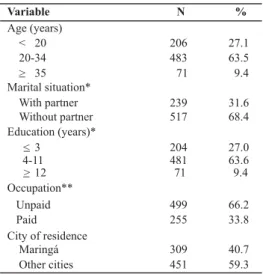
Table 1 displays the sociodemographic variables that re-fer to the parturients. Regarding age, the predominant age range observed was 20-34 with 63.5%; next, the age range > 20 years old with 27.1%. Regarding the marital situation, 68.4% had no partner, and most of them had little educa-tion, with 63.6% with 4-11 years, 27.0% with up to three years and only 9.4% with more than 12 years of education. Regarding the social condition of the parturients, we ob-served that only 33.8% had paid occupations, 62.7% were housewives and 3.5% were students. The analysis of the par-turients according to the city of residence shows a higher percentage of households outside Maringá, with 59.3%, against 40.7% for residents in the city of Maringá. Of the parturients who do not reside in Maringá, most live in Sarandi (11%) and Paiçandu (6%). The other parturients live in other cities, representing values ranging from less than 1% up to 5%.
Table 1 - Sociodemographic profile of the parturients who received care at Hospital Universitário de Maringá - Maringá, PR - 2006
Variable N %
Age (years)
< 20 206 27.1 20-34 483 63.5 > 35 71 9.4 Marital situation*
With partner 239 31.6 Without partner 517 68.4 Education (years)*
< 3 204 27.0 4-11 481 63.6 > 12 71 9.4 Occupation**
Unpaid 499 66.2 Paid 255 33.8 City of residence
Maringá 309 40.7 Other cities 451 59.3
Table 2 shows the obstetric variables related to the par-turients. Regarding the number of live-born children in pre-vious gestations, there was no significant difference be-tween the primiparous (50.4%) or multiparous (49.6%) cat-egories. For the number of children born dead in previous gestations, the category with no children born dead was expressive (91.0%). The gestational length showed that most (73.8%) occurred within 37 and 41 weeks, considered the most adequate length to favor the health conditions of the newborn(7). Also, 25.5% of the gestations were observed
not to come to term. The type of pregnancy was mostly single, with 93.2%. Most parturients had seven of more prenatal consultations (63.6%). The ratio of cesarean deliv-eries was 50.4%.
Table 2 - Obstetric profile of the parturients who received care at Hospital Universitário de Maringá - Maringá, PR - 2006
Variable N %
Live-born children
Primiparae 383 50.4 Multiparae 377 49.6 Children born dead
None 692 91.0 > 1 68 9.0 Length of gestation (weeks)
< 37 194 25.5 37- 41 561 73.8 > 42 5 0.7 Type of pregnancy
Single 708 93.2 Multiple 52 6.8 Number of prenatal consultations*
< 7 275 36.4 > 7 480 63.6 Type of delivery
Normal 377 49.6 Cesarean 383 50.4
* Five cases with no information were excluded
Table 3 shows data on born children. Most live-borns (51.5%) were male. Regarding the Apgar score, which contains the indicators to evaluate the birth conditions of the newborn, most of them had good vitality (Apgar > 7)(7)
in the 1st and 5th minutes, with 86.0% and 96.1%, respec-tively. Most newborns (76.4%) weighed 2,500 Kg or more, although 23.6% had low weight at birth. The results for race/ color of the newborns yielded 76.7% white children and 23.3% children of other colors. Finally, 1.4% of the new-borns had some type of birth defect.
Table 3 - Profile of the newborns who received care at Hospital Universitário de Maringá - Maringá, PR - 2006
Variable N %
Gender*
Male 391 51.5
Female 368 48.5
Apgar at the 1st minute **
< 7 106 14.0
> 7 652 86.0
Apgar at the 5th minute
< 7 29 3.9
> 7 731 96.1
Race/color
White 583 76.7
Black 7 0.9
Mixed ethnicity 167 22.0
Others 3 0.4
Weight
< 2,500g 179 23.6
> 2,500g 581 76.4
Birth defects
Yes 11 1.4
No 749 98.6
* One case with no information were excluded ** Two cases with no information were excluded
Figure 1 shows that the profile of the parturients and their newborns residing outside Maringá is associated to an inadequate number of prenatal consultations, low weight of the newborn at birth and cesarean deliveries. The profile of the mothers living in Maringá is associated to an adequate number of prenatal consultations, normal weight of the newborn and normal deliveries.
number of inadequate consultations
number of adequate consultations other cities
Maringá
low weight
normal weight vaginal
cesarean delivery
-2,0 -1,5 -1,0 -0,5 0,0 0,5 1,0
Dimension 1 -1,0
-0,8 -0,6 -0,4 -0,2 0,0 0,2 0,4 0,6 0,8 1,0
Dimension
2
DISCUSSION
The number of liveborns at the HUM in 2006 was close to the annual average number of liveborns in the past six years, which amounted to 727 liveborns/year. This result is suggested by the number of obstetric beds (three pre-partum beds and nine puerperium beds) and because the hospital is a referral institution for high-risk gestations, re-stricting the number of births. One study in Belo Horizonte verified no significant difference in the profile of the live-born children from 1992 to 1994 in other similar cities(8),
i.e. the constant profile of the births in that study could indicate that there is no difference in the profile of the live-born children at the HUM in the past years.
It should be observed that, after 14 years the implanta-tion of SINASC in the city of Maringá, the filling of the DNVs at the Hospital Universitário de Maringá is excellent, being considered an adequate source of information for the study. The variables with no information for the whole city of Maringá in 1994(2) varied by 0.4% for each type of delivery,
3.2% for the education of the mother and 0.1% for the newborn’s gender. The variable mother’s occupation was not presented in the referred study, since it was not part of the DNV at the time. The adequate filling of the DNV may be due to having been used for a long time, with doubts about its completion being clarified over time, as well as the awareness of the healthcare services regarding the use of this instrument.
The percentages presented in the parturients’ age range were close to the Belo Horizonte study(8). Although most
parturients were in the adequate range for gestation, the high percentage of adolescent mothers (27.1%) indicates the need for more family planning strategies for this age range. The result of gestation in adolescents was close to the one found in a study in São Luiz, state of Maranhão (1997-1998), with 29.4%(9). However, it was higher than the
values found for the state of Paraná in 2005, which amounted to 20.0%(1).
The condition of most parturients without a partner was also found in Campinas-2001, and this study complemented that adolescents without a partner faced higher risks for the pregnancy(10). It is necessary to agree with the published
study, which states that the current configuration of the DNV limits the real marital situation of the parturients, as this variable is categorized in (single, married, widowed and divorced), which imposes the classification of parturients in consensual stable unions as single instead of married, which would be more adequate. The importance of an ad-equate classification of this variable can be supported by the possible economic support of a stable situation and the psychosocial support of having a partner with whom to share this moment in life.
The education of the parturient can be seen as an indi-cator of social condition, as higher levels of instruction make access to jobs easier and offer the possibility of improving
the socioeconomic position of the family. The percentage of only 9.4% women with 12 or more years of education is below the figures found for the state of Paraná in 2005(1),
which was 16.9%. The percentage of near-illiterates, lower or equal to 3 years of education (27.0%), was higher than the figures for the state of Paraná and the city of Maringá(1),
which were 9.5% and 1.9%, respectively. The concentra-tion of low educaconcentra-tion level in the parturients presents the expected population of the SUS, therefore without other options for healthcare, living with the reality of long wait-ing lines.
The condition of only 33.5% of the mothers holding paid jobs complements the previous data, i.e. low education results in few socioeconomic options. It is worth noting that only 3.3% of the patients without paid occupations stud-ied, i.e. an expressive amount of young women. This was the variable with the highest absence of information. The absence of information can be explained because the Bra-zilian Occupational Classification - Classificação Brasileira de Ocupação – CBO was not available at the services, since this variable was filled out in the DNV but outside the op-tions of the CBO, being classified as blank in the SINASC database. Not filling out the occupation variable may inter-fere in socioeconomic studies. For this type of study, it is necessary that each referenced place have a copy of the CBO in order to fill out the DNV and avoid a number of cases filled out incorrectly. Another study, performed at Hospital Universitário de Gaffrée e Guinle (UNI-RIO), in the city of Rio de Janeiro, with women who received care at the obstetric outpatient clinic(5), found different results
re-lated to occupation: 62.7% held some type of paid job and only 37.2% held no paid jobs. However, like the present study, the UNI-RIO study showed that the mothers with-out a paid occupation were homemakers or students. The introduction of the option consensual union in the vari-able marital status may, in future studies involving the vari-able occupation, estimate the family income of the mar-ried mothers who do not hold paid jobs.
The fact that most of the studied population lives out-side Maringá strengthens the characteristics of the clien-tele that seeks the hospital because it is a referral institu-tion for several other cities, as a care provider for high-risk gestations and deliveries, which explains the great differ-ences in the proportions of indicators of the hospital in re-lation to the city. Although the popure-lation that receives care at the HUM lives in different cities, the utilization of the HUM by neighboring cities was expressive, particularly Sarandi and Paiçandu.
For the variable parity, a study performed in Caxias do Sul, in the state of Rio Grande do Sul, showed a significant association between this variable and the quality of pre-natal healthcare, indicating that the higher the number of children, the later the pregnant women started prenatal monitoring, with lower numbers of consultations(11). With
primiparae (50.4%) and multiparae (49.6%) in the data de-scription. Most of the women (63.6%) had seven or more prenatal consultations.
Regarding not having children dead at birth, it was veri-fied in the Rio de Janeiro study that there were no previous children dead at birth among the younger ages. The ado-lescents had 2.6% more chance of not having children dead at birth when compared to the other women(12). As such,
the presence of 27.1% of adolescent parturients, in this study, could indicate the small results of not having chil-dren dead at birth. Considering that 50.4% of the parturi-ents were primiparae and 27.1% were adolescparturi-ents, effec-tive activities by the healthcare team are needed at the time of delivery to reduce maternal, fetal and neonatal morbid-ity and mortalmorbid-ity.
The gestational length in the city of Maringá, in 2004, was 93.3% term and only 4.4% preterms(2). For 2006, the
figures were 73.8% term and 25.5% preterm. The changes in these proportions may clarify the increase by 23.6% in low-weight newborns in 2006 since, in the aforementioned study, preterm newborns most often had low weight at birth (64.8%). According to the Ministry of Health, the occurrence of low weight at birth expresses restriction
to intra-uterine growth or prematurity(13).
The number of prenatal consultations can support the quality of prenatal care since, among several factors that lead to prematu-rity, the number of liveborns with low weight at birth and deaths due to perinatal compli-cations could be avoided with satisfactory prenatal monitoring(8,14). Although this study
found that 36.2% of the women had less than seven consultations, another study(15) showed
that 41.2% did not even have the six prenatal consultations recommended by the Ministry of Health(13). Although the
number of prenatal consultations could be used to analyze the coverage of prenatal services, supporting the planning and assessment of prenatal care, it is limited because it does not cover women who had abortions or a child dead at birth, and does not reflect the quality of the service pro-vided in the prenatal consultations.
The 63.2% percentage for the adequate number of pre-natal consultations, reinforced by most parturients (59.3%) coming from other cities, seems to demonstrate that the neighboring cities have difficulties in providing care to preg-nant women in general, especially those considered at risk. As such, they are sent to the HUM, which is a referral insti-tution for high-risk pregnancies and deliveries and has both adult and neonatal intensive care units. Adequate prenatal care is a form of preventive medicine, as it makes adequate monitoring, exams, vaccines and specific orientations avail-able to reduce the anxiety of the pregnant woman. It also allows for the early detection of pathologies that can be treated early, contributing to reduce maternal and child mortality.
As described in literature, overall, Brazil has cesarean delivery rates higher than those recommended by the Min-istry of Health(13), which would be 40.0% for high risk and
25% for normal risk. The result of this study was no differ-ent, presenting 50.4% of cesarean deliveries, considering that this percentage is a regional reference at the HUM re-garding high-risk pregnancies. However, the values are higher than those found at Instituto Materno Infantil no Estado de Pernambuco (35%)(16), a referral hospital in the
SUS for risky pregnancies. The tendencies in cesarean de-liveries reaffirms the abusive use of technology associated to the execution of unnecessary procedures, the precari-ousness of prenatal and childbirth care quality and the de-ficiencies in professional education and qualification.
At the HUM, in 1994(2), most newborns (54.4%) weighed
3.000 Kg or more, and the rate of low-weight newborns was 14.8%. The results pointed to the fact that the HUM was the only public hospital in the city, serving as a regional referral institution and concentrating high-risk gestations. In some studies(8,12-13,15) that investigate the prevalence of
low weight, proportions varied from 9.8% to 18.7%. These data show that the HUM has a high incidence of low weight among newborns when compared with other Brazilian cities. The comparison of the num-ber of low-weight newborns with other stud-ies brings a reflection about the conditioning factors that result in having children with in-adequate weight. It is possible that there are deficiencies in prenatal control, either in the coverage or the quality of care, or a relation with other risk factors like prematurity and the age of the mothers in the extreme groups of reproductive life(12,14).
The results for the variables type of preg-nancy, gender, race/color and Apgar score of the newborn
in this study were compatible with other studies and the local reality of the city described next. Regarding the type of pregnancy, some studies(8,12) found that most cases
(98.2%) were of single gestation. The prevalence for male babies was also found in the city of Maringá, the state of Paraná and Brazil in 1994(1-2). The population of Paraná is
predominantly white(1). In 2005, most births (93.2%) were
registered as white race/color, which is in agreement with most of the children born at the HUM. The Apgar score results in this study were close to those found in other studies(12,16-17).
The ratio of birth defects was higher than the usual 0.6% in Maringá and Paraná in 2005, which was expected since the hospital was a referral institution for high-risk gesta-tions. With the high prevalence of birth defects, some de-gree of tracking has to be extended to the whole popula-tion of pregnant women(7). The impact of birth defects in
Brazil has been increasing steadily, climbing from the fifth to the second cause of death in children younger than one year old between 1980 and 2000, pointing to the need for specific strategies in healthcare policies(18).
The neighboring cities have difficulties in
providing care to pregnant women in
general, especially those considered at
The association among deliveries from mothers living in Maringá, adequate number of prenatal consultations, vagi-nal delivery and normal weight demonstrated that low-risk mothers seek the HUM, since it is a referral institution for the city. Deliveries by mothers living outside the city was as-sociated to an inadequate number of prenatal consultations, cesarean deliveries and low weight, demonstrating that high-risk mothers seek the HUM, since it is a referral hospital for the other cities. The association between the variables showed that the HUM is an established referral institution among the cities, and it could also suggest the need for im-provements in the pacts among the indicators in the cities outside Maringá, as these had the worst results for cesarean deliveries and low weight. For the number of prenatal con-sultations, the cities outside Maringá probably did not have a number of prenatal consultations > 7, which, according to the instructions of the pact indicators, is specific for cities where the ratio of liveborns from mothers with four or more prenatal consultations was higher than 90% of the previous year. This situation was found at the HUM (91.1%), probably because of the mothers residing in Maringá.
CONCLUSION
The results of this study permitted comparing the real-ity of the profile of the parturients and their newborns re-ceiving care at the HUM with other realities in Brazil. The result of the indicators found presented dangerous situa-tions for the survival of the studied population group when compared with the city of Maringá and the state of Paraná, especially due to the high number of adolescent mothers, with low education, living outside the city where they re-ceived childbirth care, prematurity and low weight strength-ening the reference for high-risk delivery care at this hospi-tal and the profile of the mother-child binomial, the ex-pected users of the SUS services.
The identification of dangerous situations in the survival of the newborns as the result of the healthcare system and differences in access and the quality of care are intimately related with the performance of the healthcare services. This summons healthcare managers to action, in the sense of
promoting access to quality services for the population. Therefore, the regionalization and qualification of care and the universalization of access are shown to be priority ac-tions and effective intervenac-tions to reduce the situaac-tions of danger in the survival of newborns in the 15th RS.
The possibility of using the SINASC as a maternal-child health assessment and planning instrument was confirmed. Therefore, studies aiming at improving the conditions of maternal-child health are feasible. However, it should be noted that, in order to supervise and control health indica-tors, it is necessary to invest in the improvement of informa-tion quality , both in filling out the DNVs and the truthful-ness and reliability of the data. Periodic reviews with those responsible for filling the DNV and the SINASC are indispens-able to verify difficulties for completion, and thus improve the truthfulness of the information according to reality.
The conditions of birth of the newborn could be related to the quality of care provided to the woman during preg-nancy, labor and childbirth. The information obtained in this study could assure healthcare for delivery and birth in safe conditions of material infrastructure and human re-sources, interdisciplinary teamwork with trained profession-als who are integrated to work with routine and emergency situations at the presented educational institution.
The fact that most parturients mentioned had more than seven prenatal consultations leads to reflection on a complementary study, due to the following questions: did they have the prenatal consultations due to an active search of the prenatal care services, or was it due to high-risk ges-tations, which needed more consultations?
Finally, it is believed that it is necessary for healthcare professionals to become more involved in the decentrali-zation of healthcare services. With the regionalidecentrali-zation of these services, it is possible to articulate and/or mobilize actions to improve the health of the population according to the specificity of each region, with the consequent pro-motion of effective interventions at the different service levels. And the improvement in the pacts of the indicators among the cities could influence the healthcare needs of each population.
REFERENCES
1. Brasil. Ministério da Saúde. DATASUS: informações de saúde [texto na Internet]. Brasília; 2002. [citado 2007 jul. 15]. Dispo-nível em: http://www.saude.datasus.gov.br
2. Carvalho WO. Nascidos vivos e óbitos perinatais dos municípios de Maringá, Paiçandu e Sarandi, PR-1994 [dissertação]. Lon-drina: Universidade Estadual de Londrina; 1996.
3. Brasil. Ministério da Saúde. Fundação Nacional de Saúde. Ma-nual de procedimentos do sistema de informações sobre nas-cidos vivos. Brasília; 2001.
4. Okazaki, ELFJ. Perfil biológico e social das parturientes do Hos-pital Geral do Grajaú [dissertação]. Santo Paulo: Faculdade de Medicina, Universidade de Santo Amaro; 2002.
5. Spindola T, Penna LHG, Progianti JM. Perfil epidemiológico de mulheres atendidas na consulta pré-natal de um hospital uni-versitário. Rev Esc Enferm USP. 2006;40(3):381-8.
7. Rezende J, Montenegro CAB. Obstetrícia fundamental. Rio de Janeiro: Guanabara Koogan; 2006.
8. Rodrigues CS, Magalhães Júnior HM, Evangelista PA, Ladeira RM, Laudares S. Perfil dos nascidos vivos no município de Belo Horizonte, 1992-1994. Cad Saúde Pública. 1997;13(1):53-7.
9. Simões VMF, Silva AAM, Bettiol H, Lamy Filho F,Tonial SR,
MochelEG. Características da gravidez na adolescência em São
Luís, Maranhão. Rev Saúde Pública. 2003;37(5):559-65. 10. Carniel EF, Zanolli ML, Almeida CAA, Morcillo AM.
Caracterís-ticas das mães adolescentes e de seus recém-nascidos e fato-res de risco para gravidez na adolescência em Campinas, SP, Brasil Rev Bras Saúde Matern Infatil. 2006;6(4):419-26. 11. Trevisan MR, Lorenzi DRS, Araújo NM, Ésber K. Perfil da
assis-tência pré-natal entre usuárias do Sistema Único de Saúde em Caxias do Sul. Rev Bras Ginecol Obstet. 2002;24(5):293-9. 12. Pastrana VV. Estudo epidemiológico das gestantes adolescen-tes de Niterói [dissertação]. Rio de Janeiro: Escola Nacional de Saúde Pública, Fundação Oswaldo Cruz;1998.
13. Brasil. Ministério da Saúde. Portaria n. 493, de 13 de março de
2006. Pacto de Indicadores da Atenção Básica, 2006. Brasília; 2006.
14. Kilsztajn S, Rossbach A, Carmo MSN, Sugahara GTL. Assistên-cia pré-natal, baixo peso e prematuridade no Estado de São Paulo, 2000. Rev Saúde Pública. 2003;37(3):303-10. 15. Domingues RMSM, Santos EM, Leal MC. Aspectos da
satisfa-ção das mulheres com a assistência ao parto: contribuisatisfa-ção para o debate. Cad Saúde Pública. 2004;20 Sup 1:S52-S62. 16.Vidal SA, Arruda BKG, Vanderlei LC, Frias PG. Avaliação da série
histórica dos nascidos vivos em unidade terciária de Pernam-buco-1991 a 2000. Rev Assoc Med Bras.2005;51(1):17-22. 17. Horovitz DDG, Llerena Junior JC, Mattos RA. Atenção aos
de-feitos congênitos no Brasil: panorama atual. Cad Saúde Pú-blica. 2005;21(4):1055-64.