Carbamazepine for prevention of chemotherapy-induced
nausea and vomiting: a pilot study
Carbamazepina para prevenção de náusea e vômito induzidos por quimioterapia:
um estudo piloto
Thaiana Aragão Santana
I, Felipe Melo Cruz
II, Damila Cristina Trufelli
I, João Glasberg
III, Auro Del Giglio
IVFundação e Faculdade de Medicina do ABC, Santo André, Brazil
ABSTRACT
CONTEXT AND OBJECTIVE: Nausea and vomiting are major inconveniences for patients undergoing che-motherapy. Despite standard preventive treatment, chemotherapy-induced nausea and vomiting (CINV) still occurs in approximately 50% of these patients. In an attempt to optimize this treatment, we evaluated the possible efects of carbamazepine for prevention of CINV.
DESIGN AND LOCATION: Prospective nonrandomized open-label phase II study carried out at a Brazilian public oncology service.
METHODS: Patients allocated for their irst cycle of highly emetogenic chemotherapy were continuously recruited. In addition to standard antiemetic protocol that was made available, they received carbam-azepine orally, with staggered doses, from the third day before until the ifth day after chemotherapy. Considering the sparseness of evidence about the eicacy of anticonvulsants for CINV prevention, we used Simon’s two-stage design, in which 43 patients should be included unless overall complete preven-tion was not achieved in 9 out of the irst 15 entries. The Funcpreven-tional Living Index-Emesis quespreven-tionnaire was used to measure the impact on quality of life.
RESULTS: None of the ten patients (0%) presented overall complete prevention. In three cases, carbam-azepine therapy was withdrawn because of somnolence and vomiting before chemotherapy. Seven were able to take the medication for the entire period and none were responsive, so the study was closed. There was no impact on the patients’ quality of life.
CONCLUSION: Carbamazepine was not efective for prevention of CINV and also had a deleterious side-efect proile in this population.
CLINICAL TRIAL REGISTRATION: NCT01581918.
RESUMO
CONTEXTO E OBJETIVO: Náusea e vômito são inconvenientes importantes para pacientes submetidos a quimioterapia. A despeito do tratamento preventivo padrão, náuseas e vômitos induzidos por quimioterapia (NVIQ) ocorrem em aproximadamente 50% dos pacientes. Na tentativa de otimizar este tratamento, avaliamos os possíveis efeitos da carbamazepina na prevenção de náuseas e vômitos induzidos por quimioterapia.
TIPO DE ESTUDO E LOCAL: Estudo fase II, prospectivo, não randomizado, aberto, realizado em um serviço público brasileiro de oncologia.
MÉTODOS: Recrutaram-se continuamente pacientes alocados para o primeiro ciclo de quimioterapia al-tamente emetogênica. Além do protocolo anti-emético padrão disponibilizado, os pacientes receberam carbamazepina, por via oral, em doses escalonadas, a partir do terceiro dia anterior até o quinto dia após a quimioterapia. Dada a escassa evidência de eicácia dos anticonvulsivantes na prevenção de NVIQ, adota-mos o desenho de Simon em duas fases, que deveria incluir 43 pacientes a não ser que prevenção com-pleta global não fosse alcançada em 9 dos primeiros 15 participantes. O questionário “Functional Living Index-Emesis” foi usado para avaliar o impacto na qualidade da vida.
RESULTADOS: Nenhum dos 10 pacientes (0%) apresentou prevenção completa global. Três tiveram a carbamazepina suspensa por sonolência e vômito antes da quimioterapia. Sete foram capazes de tomar a medicação por todo o período proposto e nenhum obteve resposta, sendo então interrompido o estudo. Não houve impacto na qualidade da vida.
CONCLUSÃO: Carbamazepina não foi efetiva para prevenção de NVIQ e apresentou peril deletério de efeitos adversos nesta população.
REGISTRO DE ENSAIO CLÍNICO: NCT01581918.
IMD. Oncology Fellow, Faculdade de Medicina
do ABC (FMABC), São Paulo, Brazil.
IIMD, MSc. Attending Physician, Discipline of
Oncology, Faculdade de Medicina do ABC (FMABC), São Paulo, Brazil.
IIIMD. Attending Physician, Discipline of Oncology,
Instituto do Câncer do Estado de São Paulo (ICESP), Faculdade de Medicina da Universidade de São Paulo (FMUSP), São Paulo, Brazil.
IVMD, MSc, PhD. Titular Professor, Discipline
of Oncology, Faculdade de Medicina do ABC (FMABC), São Paulo, Brazil.
KEY WORDS: Antiemetics. Vomiting. Nausea. Carbamazepine.
Prevention and control [subheading].
INTRODUCTION
Nausea and vomiting are major inconveniences for patients undergoing cancer therapy. hese symptoms, which are both common and stressful, are reported by almost half of such patients, either as a consequence of the illness itself, or as a treat-ment side efect.1 hey have a strikingly negative impact on these patients’ functional, emotional, social and nutritional status, ulti-mately leading to impairment of quality of life.2,3
Several factors have been implicated in development of chemotherapy-induced nausea and vomiting (CINV), i.e. the intrinsic emetogenicity of some chemotherapeutic agents, either alone or in combination.2,4,5 CINV is classiied accord-ing to the timaccord-ing of the occurrence: acute — occurs and resolves within the irst 24 hours ater chemotherapy; or delayed — occurs ater the irst 24 hours ater chemotherapy administra-tion.5,6 Because of the severity of the acute phase, this has been more oten targeted in therapeutic intervention studies. However, although the symptoms in the delayed period are less marked than those observed in acutely started nausea and vomiting, its course can be more protracted, resulting in poor hydration and nutrition control, in addition to poor performance status.7,8
According to the American Society of Clinical Oncology (ASCO) guidelines for antiemetic management in cancer patients, the standard preventive treatment for CINV is based on selective 5-HT3-receptor antagonists (5HT3AR), corticosteroids and neurokinin-1-receptor antagonists (NK1AR), combined to match the intensity of chemotherapy-induced vomiting.9-14 Despite the use of such therapy, approximately 50% of patients still present CINV.15
However, treatment with these three drugs has a high cost and some of them are unavailable in centers where healthcare funding is provided by the government. In most Brazilian cities, for instance, cancer patients covered by the national healthcare system have no sponsorship for use of either 5HT3RA or NK1RA while being treated in outpatient clinics. In this setting, because medicines are unafordable for most of these patients, CINV con-trol is even more poorly accomplished.
Eforts to improve CINV prevention have led to investiga-tion of other drugs that can be added to the standard treatment, thus retaining the efectiveness of antiemetics at lower cost. With this purpose, Cruz et al. developed a phase II randomized trial in which they demonstrated that the preventive antiemetic action of gabapentin increased when it was included in the combined treat-ment during the irst cycle of highly emetogenic chemotherapy. Although the mechanism of action of gabapentin has not been well clariied, this trial suggested that anticonvulsant drugs could be promising for prevention of CINV.16 Carbamazepine was reported by Strohscheer and Borasio as being completely successful in com-bating CINV in one patient with meningeal carcinomatosis.17
OBJECTIVE
In the present study, the primary objective was to evaluate the possible efects of carbamazepine in preventing nausea and vom-iting induced by highly emetogenic chemotherapy. he second-ary objective was to evaluate the side efects of this treatment and its possible inluence on patients’ quality of life.
METHODS
Patients were continuously recruited at a Brazilian public oncol-ogy service. Between December 2011 and March 2012, patients ≥ 18 years of age, with Eastern Oncology Group (ECOG) grade ≤ 2, who were scheduled to receive their irst cycle of moderately or highly emetogenic chemotherapy (deined as cisplatin, doxo-rubicin or epidoxo-rubicin at doses higher than 60 mg/m2, 50 mg/m2 and 50 mg/m2 respectively) were selected to enter the study group ater signing an informed consent form. he exclusion cri-teria were as follows: presence of concurrent diseases as possible causes of nausea and vomiting; concomitant radiotherapy; reg-ular use of opioids, corticosteroids, benzodiazepines, tricyclic antidepressants or cannabinoids before chemotherapy; and fail-ure to attend follow-up visits. his study was approved by our local ethics committee.
All patients received the standard antiemetic treatment that was available, which was based on intravenous ondansetron (8 mg), dexamethasone (10 mg) and ranitidine (50 mg) before chemother-apy infusion, followed by oral dexamethasone (4 mg), twice a day on days 2 and 3. Carbamazepine was added to this treatment in accor-dance with the following schedule: one tablet (200 mg) four times a day on the third day before chemotherapy; one tablet twice a day on the second day before chemotherapy; and one tablet three times a day starting on the day before chemotherapy and continuing until the ith day ater chemotherapy.
he patients were asked to record vomiting episodes on diary cards, starting on the day of chemotherapy infusion (0 h) and continuing until the morning of day 6 (120 h). In case of need, participants were free to take a “rescue therapy”, and the components of this were also to be recorded. he rescue med-ications included 5HT3RA, phenothiazines, butyrophenones and domperidone.
Complete prevention of nausea and vomiting was deined as the absence of any episode of these events and no use of rescue medication. Symptoms were deined as acute (occurring during the irst 24 hours ater chemotherapy), delayed (occurring from day 2 to day 5 ater chemotherapy) or overall (occurring over the full 120 hours of the study).18,19 Since NK1AR is not provided to Brazilian patients through the public healthcare system, this drug was not used.
of the impact of CINV on their quality of life.18 Adverse events were recorded up to the visit on day 6 ater chemotherapy.
Considering that there is a lack of evidence regarding the eicacy of anticonvulsants for CINV prevention, Simon’s opti-mal two-stage design19 was used. Based on the previous trial by Cruz et al.16 at our institution, which resulted in a 42.5% con-trol rate in the placebo group, we used a concon-trol rate < 50% as the null hypothesis to be tested and a rate > 70% as the alterna-tive hypothesis, since the previous trial showed a 20% beneit from associating gabapentin. he initial end point to be pursued was full control for a minimum of 9 patients out of the 15 in the irst stage of the study. Fulillment of this aim would maintain accrual of an additional 28 patients as a second phase. At the end of the study, in accordance with its design, achievement of com-plete control in 27 or more patients would be required to reject the null hypothesis. his design had 80% power while maintain-ing an α error rate of 5%. Summary statistics, including means, standard deviations and medians, were generated for continu-ous variables.19,20
RESULTS
Twelve patients were enrolled in the irst phase of the study. hese patients were continuously recruited and were all women who had been assigned to receive a highly emetogenic chemo-therapeutic regimen of doxorubicin and cyclophosphamide for treatment of breast cancer (100%). he mean age was 48 years
(Table 1). Two patients were excluded because of refusal to sign
the consent statement and opioid use during the study period. hree patients could not complete the intended treatment due to the advent of untoward manifestations before starting chemo-therapy: two presented vomiting before chemotherapy infusion and one had excessive (grade 3) somnolence.
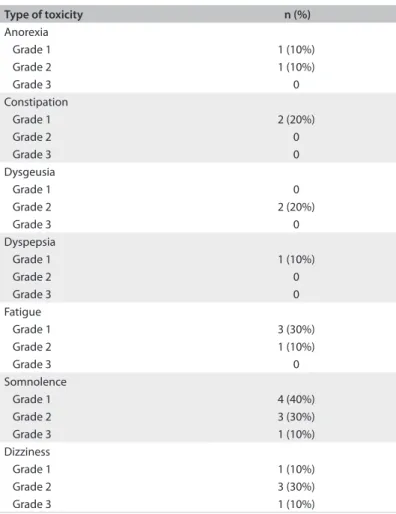
he primary objective of the study was not accomplished, since seven patients proved unresponsive to their properly taken trial treatment throughout the intended time span. Since this inding precluded the alternative hypothesis (> 70%), the study was discontinued. Other adverse events are displayed in Table 2.
Acute complete control failed in all cases. One patient (10%) achieved acute control of vomiting and this same patient also achieved delayed complete protection (10%). Rescue medica-tions were necessary for nine patients (90%) (Table 3).
here was no impact on patients’ quality of life, according to results from the FLIE questionnaire.
DISCUSSION
he present study showed that carbamazepine was inefective for CINV prevention. All patients failed to attain complete control of their symptoms, and most (90%) needed rescue medications. Moreover, carbamazepine was associated with more side efects
than expected, such as somnolence and dizziness, in addition to induction of vomiting before chemotherapy infusion onset in approximately 20% of the patients.
Table 1. Patients’ characteristics
All patients (n = 10) Gender
Female 10 (100%)
Mean age (years) 48
ECOG score
0 10 (100%)
1 0 (0%)
2 0 (0%)
Type of chemotherapy
AC 10 (100%)
ECOG = Eastern Oncology Group; AC = adriamycin (doxorubicin) and cyclophosphamide.
Table 2. Adverse events
Type of toxicity n (%)
Anorexia
Grade 1 1 (10%)
Grade 2 1 (10%)
Grade 3 0
Constipation
Grade 1 2 (20%)
Grade 2 0
Grade 3 0
Dysgeusia
Grade 1 0
Grade 2 2 (20%)
Grade 3 0
Dyspepsia
Grade 1 1 (10%)
Grade 2 0
Grade 3 0
Fatigue
Grade 1 3 (30%)
Grade 2 1 (10%)
Grade 3 0
Somnolence
Grade 1 4 (40%)
Grade 2 3 (30%)
Grade 3 1 (10%)
Dizziness
Grade 1 1 (10%)
Grade 2 3 (30%)
Grade 3 1 (10%)
Table 3. Complete control over nausea and vomiting and use of rescue medication, according to study phase
Acute Delayed Overall
Control over nausea and vomiting 0 1 (10%) 0
At our institution, Cruz et al. conducted a prospective, dou-ble-blinded, placebo-controlled study that showed that adding gabapentin to the standard preventive antiemetic treatment for moderately and highly emetogenic chemotherapy was efective (65% vs. 42.5%; P = 0.04).16 heir trial demonstrated that the acute complete control rate and use of gabapentin were inde-pendent factors for achieving an overall complete response. hese results suggested that gabapentin might be a cost-efective well-tolerated alternative to NK1RA, with a safety proile similar to that of the placebo. However, despite the anticonvulsant action of carbamazepine, this drug failed to relieve symptoms in our study, given that nausea and vomiting were not curbed in any of the participants, and that this drug was even hazardous to 30% of them because it elicited grade II dizziness and somnolence. he only patient who achieved delayed complete control had pre-viously achieved acute control of vomiting. Although the anti-emetic mechanism of action of gabapentin remains unknown, the reason for the diferent results from these two studies, which were carried out with similar methods in overlapping groups of subjects, could be that over the therapeutic concentration range, carbamazepine does not afect the GABA or glutamate-mediated neuronal pathways.21 GABA-related drugs need to be reassessed in future trials in order to establish their value as adjuvants in dealing with CINV.
Strohscheer and Borasio reported on a patient who achieved complete cessation of therapy-refractory nausea and vomiting through use of carbamazepine.17 his patient pre-sented meningeal carcinomatosis and paroxysmal syndrome as the causes of the symptoms. Our patients did not have any evi-dence of central nervous system involvement and failed to con-trol nausea and vomiting when treated with carbamazepine. Further studies will be needed in order to better understand why carbamazepine hinders nausea and vomiting in meningeal carcinomatosis patients but, contradictorily, is disappointing in unafected patients.
Phase III studies have already shown that benzodiazepines and olanzapine are efective for improving control over CINV when combined with standard treatment based on 5HT3RA and corticosteroids.22-24
In the present study, we used Simon’s optimal two-stage design because of the lack of evidence regarding carbamaze-pine use for preventing CINV. This is an innovative meth-odology for investigating nausea and vomiting, and its main advantage is that it avoids exposure of too many patients to an ineffective treatment. It should be reappraised in future pilot trials concerning prevention of CINV.19,25 Furthermore, other comparative studies with larger samples may be nec-essary to corroborate these data and evaluate the safety of carbamazepine.
CONCLUSION
Carbamazepine failed to prevent CINV and also presented a del-eterious side-efect proile among the patients studied. Based on these data, carbamazepine is not advisable as an antiemetic med-ication for patients undergoing chemotherapy outside of experi-mental settings.
REFERENCES
1. Warr DG. Chemotherapy-and cancer-related nausea and vomiting.
Curr Oncol. 2008;15(Suppl 1):S4-9.
2. Herrstedt J, Dombernowsky P. Anti-emetic therapy in cancer
chemotherapy: current status. Basic Clin Pharmacol Toxicol.
2007;101(3):143-50.
3. Bloechl-Daum B, Deuson RR, Mavros P, Hansen M, Herrstedt J.
Delayed nausea and vomiting continue to reduce patients’ quality of
life after highly and moderately emetogenic chemotherapy despite
antiemetic treatment. J Clin Oncol. 2006;24(27):4472-8.
4. Wickham R. Best practice management of CINV in oncology patients:
II. Antiemetic guidelines and rationale for use. J Support Oncol.
2010;8(2 Suppl 1):10-5.
5. Hesketh PJ. Chemotherapy-induced nausea and vomiting. N Engl J
Med. 2008;358(23):2482-94.
6. Frame DG. Best practice management of CINV in oncology patients:
I. Physiology and treatment of CINV. Multiple neurotransmitters and
receptors and the need for combination therapeutic approaches. J
Support Oncol. 2010;8(2 Suppl 1):5-9.
7. Roila F, Donati D, Tamberi S, Margutti G. Delayed emesis: incidence,
pattern, prognostic factors and optimal treatment. Support Care
Cancer. 2002;10(2):88-95.
8. Kris MG, Roila F, De Mulder PH, Marty M. Delayed emesis following
anticancer chemotherapy. Support Care Cancer. 1998;6(3):228-32.
9. Basch E, Prestrud AA, Hesketh PJ, et al. Antiemetics: American Society
of Clinical Oncology clinical practice guideline update. J Clin Oncol.
2011;29(31):4189-98.
10. Jordan K, Hinke A, Grothey A, et al. A meta-analysis comparing the
eicacy of four 5-HT3-receptor antagonists for acute
chemotherapy-induced emesis. Support Care Cancer. 2007;15(9):1023-33.
11. Bonneterre J, Chevallier B, Metz R, et al. A randomized
double-blind comparison of ondansetron and metoclopramide in the
prophylaxis of emesis induced by cyclophosphamide, luorouracil,
and doxorubicin or epirubicin chemotherapy. J Clin Oncol.
1990;8(6):1063-9.
12. Fujii M, Kanke M, Arai Y, et al. [A randomized crossover comparison
of azasetron alone and azasetron plus dexamethasone for the
prevention of nausea and vomiting by chemotherapy including
cisplatin]. Gan To Kagaku Ryoho. 2000;27(10):1557-63.
13. Ioannidis JP, Hesketh PJ, Lau J. Contribution of dexamethasone to
control of chemotherapy-induced nausea and vomiting: a
14. Navari RM, Reinhardt RR, Gralla RJ, et al. Reduction of
cisplatin-induced emesis by a selective neurokinin-1-receptor antagonist.
L-754,030 Antiemetic Trials Group. N Engl J Med. 1999;340(3):190-5.
15. Warr DG, Hesketh PJ, Gralla RJ, et al. Eicacy and tolerability of
aprepitant for the prevention of chemotherapy-induced nausea and
vomiting in patients with breast cancer after moderately emetogenic
chemotherapy. J Clin Oncol. 2005;23(12):2822-30.
16. Cruz FM, de Iracema Gomes Cubero D, Taranto P, et al. Gabapentin for
the prevention of chemotherapy- induced nausea and vomiting: a
pilot study. Support Care Cancer. 2012;20(3):601-6.
17. Strohscheer I, Borasio GD. Carbamazepine-responsive paroxysmal
nausea and vomiting in a patient with meningeal carcinomatosis.
Palliat Med. 2006;20(5):549-50.
18. Decker GM, DeMeyer ES, Kisko DL. Measuring the maintenance of
daily life activities using the functional living index-emesis (FLIE) in
patients receiving moderately emetogenic chemotherapy. J Support
Oncol. 2006;4(1):35-41, 52.
19. Simon R. Optimal two-stage designs for phase II clinical trials. Control
Clin Trials. 1989;10(1):1-10.
20. Hahn NM, Zon RT, Yu M, et al. A phase II study of pemetrexed as
second-line chemotherapy for the treatment of metastatic
castrate-resistant prostate cancer (CRPC); Hoosier Oncology Group GU03-67.
Ann Oncol. 2009;20(12):1971-6.
21. Lasoń W, Dudra-Jastrzębska M, Rejdak K, Czuczwar SJ. Basic
mechanisms of antiepileptic drugs and their pharmacokinetic/
pharmacodynamic interactions: an update. Pharmacol Rep.
2011;63(2):271-92.
22. Tan L, Liu J, Liu X, et al. Clinical research of Olanzapine for prevention
of chemotherapy-induced nausea and vomiting. J Exp Clin Cancer
Res. 2009;28:131.
23. Harousseau JL, Zittoun R, Bonneterre J, Hedouin M, Ouvry J.
Amélioation du contrôle des nausées et vomissements lors d’une
chimithérapie modérément émétisnate, par l’association ondansétron
méthylprednisolone et lorazépam, antiémétique antérieure
[Improvement in the control of chemotherapy induced emesis with
ondansetron, methylprednisolone and lorazepam combination in
patients treated by a moderate emetic treatment and uncontrolled
by a previous antiemetic combination]. Bull Cancer. 2000;87(6):491-7.
24. Meden H, Meissner O, Conrad A, Kuhn W. Improved control of nausea
and emesis with a new bromazepam-containing ondansetron
regimen in ovarian cancer patients receiving chemotherapy
with carboplatin and cyclophosphamide. Eur J Gynaecol Oncol.
1996;17(2):114-22.
25. Mander AP, Thompson SG. Two-stage designs optimal under the
alternative hypothesis for phase II cancer clinical trials. Contemp Clin
Trials. 2010;31(6):572-8.
Sources of funding: None
Conlict of interest: None
Date of irst submission: September 17, 2012
Last received: July 8, 2013
Accepted: July 16, 2013
Address for correspondence: Thaiana Aragão Santana
Rua Calixto da Mota, 106 — apto 94
Vila Mariana — São Paulo — Brasil
CEP 04117-100
Tel. (+55 11) 3807-1578
Cel. (+5511) 99891-6585