Evaluating psychiatric case-control studies using the
STROBE (STrengthening the Reporting of OBservational
Studies in Epidemiology) statement
Avaliando estudos de caso-controle em psiquiatria utilizando o STROBE
(STrengthening the Reporting of OBservational Studies in Epidemiology) statement
Pedro Domingues Goi
I, Julia Domingues Goi
I, Kariny Larissa Cordini
I, Keila Mendes Ceresér
II, Neusa Sica da Rocha
IIIPostgraduate Medical Program on Psychiatry, Universidade Federal do Rio Grande do Sul (UFRGS), Porto Alegre, Brazil
ABSTRACT
CONTEXT AND OBJECTIVE: Case-control studies are important in developing clinical and public health knowledge. The STROBE statement (STrengthening the Reporting of OBservational Studies in Epidemiol-ogy) was developed to establish a checklist of items that should be included in articles reporting observa-tional studies. Our aim was to analyze whether the psychiatric case-control articles published in Brazilian journals with CAPES Qualis rating B1/B2 in 2009 conformed with the STROBE statement.
DESIGN AND SETTING: Descriptive study on psychiatric papers published in Brazilian journals, within the Postgraduate Medical Program on Psychiatry, at Universidade Federal do Rio Grande do Sul.
METHODS: All psychiatric case-control studies from Brazilian Qualis B1/B2 journals of psychiatry, neurol-ogy and public health in 2009 were analyzed. The four most speciic items of the STROBE statement were used to evaluate whether these studies itted within the case-control parameters: 1) selection of cases and controls; 2) controlling for bias; 3) statistical analysis; and 4) presentation of results.
RESULTS: Sixteen case-control studies were identiied, of which eleven (68.75%) were in psychiatry-focused journals. From analysis using the STROBE statement, all of the articles conformed with item 1; two (12.5%) completely conformed with item 2; none completely conformed with item 3; and only three (18.8%) conformed with item 4.
CONCLUSION: The case-control studies analyzed here did not completely conform with the four STROBE statement items for case-control design. In view of the inadequate methodology of the published studies, these indings justify focusing on research and methodology and expanding the investigations on adher-ence of studies to their designs.
RESUMO
CONTEXTO E OBJETIVO: Estudos de caso-controle são importantes no desenvolvimento do conheci-mento clínico e de saúde pública. O STROBE statement (STrengthening the Reporting of OBservational Studies in Epidemiology) foi criado para estabelecer uma lista de itens que devem estar presentes na des-crição de estudos observacionais. Nosso objetivo é analisar a adequação de artigos caso-controle psiqui-átricos publicados em periódicos brasileiros Qualis B1/B2 CAPES em 2009 utilizando o STROBE statement.
TIPO DE ESTUDO E LOCAL: Estudo descritivo de artigos em psiquiatria publicados por periódicos brasi-leiros, realizado no Programa de Pós-Graduação em Medicina: Psiquiatria, na Universidade Federal do Rio Grande do Sul.
MÉTODOS: Todos os estudos de caso-controle psiquiátricos em revistas brasileiras Qualis B1/B2 de psi-quiatria, neurologia e saúde pública em 2009 foram analisados. Os quatro itens mais especíicos do STRO-BE statement foram utilizados para avaliar se os estudos se ajustavam aos parâmetros de caso-controle: 1) seleção de casos e controles, 2) controle de vieses, 3) análise estatística e 4) apresentação dos resultados.
RESULTADOS: Dezesseis estudos de caso-controle foram identiicados, 68,75% (11) deles de periódicos de psiquiatria. Após a análise com base no STROBE statement, todos os artigos adequavam-se ao item 1; 12,5% (2) adequavam-se completamente ao item 2; nenhum ajustava-se completamente ao item 3; e somente 18,8% (3) estavam adequados em relação ao item 4.
CONCLUSÃO: Os estudos de caso-controle avaliados aqui não se adequaram completamente aos quatro itens do STROBE statement para o desenho de caso-controle. Tendo em vista a inadequada metodologia dos estudos publicados, os achados justiicam direcionar-se o foco para a pesquisa e metodologia, au-mentando a investigação da adesão dos estudos aos seus desenhos.
IMD, MSc. Doctoral Student, Postgraduate Medical Program on Psychiatry, Universidade Federal do Rio Grande do Sul (UFRGS), Porto Alegre, Brazil. IIPharm, MSc, PhD. Professor, Postgraduate Medical Program on Psychiatry, Universidade Federal do Rio Grande do Sul (UFRGS), Porto Alegre; Member, INCT for Translational Medicine, Brazil.
IIIMD, MSc, PhD. Professor, Postgraduate Medical Program on Psychiatry, Universidade Federal do Rio Grande do Sul (UFRGS), Porto Alegre, Brazil.
KEY WORDS:
Epidemiology. Psychiatry. Research design. Case-control studies. Biomedical research.
PALAVRAS-CHAVE:
INTRODUCTION
Rational healthcare practice requires knowledge of the etiology, pathogenesis, diagnostics, prognosis and treatment of illnesses. A substantial portion of clinical and public health knowledge comes from observational research. Nine out of ten articles pub-lished in clinical journals describe observational investigations.1
Case-control studies belong to the observational studies group. hey emerged within epidemiology as part of the search to identify the risk factors in diseases. A case-control design is modest and less expensive than other models, and can produce surprisingly good results. Case-control studies can be interest-ingly useful when the outcome studied is rare or delayed and when the exposure is diicult to randomize. However, conduct-ing these studies can be challengconduct-ing because of the great possibil-ity of bias.2 hese studies cannot estimate the incidence or preva-lence of a disease, although they provide descriptive information about the characteristics of cases and, most importantly, an esti-mate of the magnitude of the association between each predict-ing variable and the presence or absence of disease. hese esti-mates are expressed in the form of odds ratios, which can be approximated to the relative risk if the prevalence of the disease is not too high.3,4
One of the main advantages of case-control studies is the large amount of information that can be rapidly provided from a small number of subjects, which favors studies on rare outcomes and enables generation of hypotheses. Case-control studies also have limitations, such as lacking the ability to directly estimate the incidence or prevalence of the disease and the attributed risk or excess of risk. Another problem is the possibility of study-ing just one of many possible outcomes. However, their greatest limitation is their enormous susceptibility to bias, which results mainly from isolated sampling of cases and controls and stan-dardization of retrospective predictive variables.4
he ideal case sample is the entire population (the real com-plete sample) or the one composed of randomly selected sub-jects from among those who have developed the disease under investigation. In general, sample bias becomes a real problem when the sample misrepresentation is related to the risk factor studied. In practice, case selection is usually a simple process because of the limited number of accessible subjects. However, the more challenging decisions in a case-control study relate to selection of controls. he goal is to sample controls for a popu-lation at risk of a disease that is, in other respects, similar to the case population. A good case-control study anticipates the pos-sible forms of bias, which according to Schulz and Grimes is the most diicult task in epidemiology.3 If the case selection is per-formed in a hospital or ambulatory setting, the selection of trols should be performed in the same location; cases and con-trols should be paired; there should be some assurance that they are comparable with one another; cases from population-based
samples can be used; and two or more control groups can even be used.3-5 Another important point that should be observed is the bias caused by standardization errors from the retrospective strategies used for measuring predictive variables. Two speciic strategies can be used to avoid these types of bias in measuring risk factors in case-control studies: use of data registered prior to the outcome and blinding.
Although little information can be found in the PubMed and SciELO databases regarding developmental methodology in this type of study, many published papers have used the case-control design.3 his gives rise to some concern about the quality of these studies, and therefore justiies expanding the discussion on the methodology of case-control studies.
Considering the importance of this issue, in 2007 a group of epidemiologists, methodologists, statisticians, researchers and editors became involved in development of the STROBE state-ment (STrengthening the Reporting of OBservational Studies in Epidemiology). Observational research comprises several study designs and many topic areas. his group aimed to establish a checklist of items that should be included in articles reporting such kind of research. he instrument thus produced can be used for evaluating the quality of reporting observational stud-ies and will be used in the present study.5 It should be noted that in reviewing the literature, we did not ind any articles that eval-uated published papers within the ield of psychiatry using this instrument.
OBJECTIVE
he objective of this study was to analyze the appropriateness of the case-control designs of articles that were published in 2009, in journals that had been rated as B1 and B2 in the Qualis sys-tem of the Brazilian Federal Agency for the Improvement of Higher Education (Coordenação de Aperfeiçoamento de Pessoal de Nível Superior, CAPES), using the STROBE statement. Furthermore, this investigation also aimed to analyze second-ary data from the distribution of the diferent publication types among the periodicals.
METHODS
his was a descriptive study on articles within the ield of psy-chiatry that were published in 2009, in Brazilian periodicals with a major ISI (homson Reuters Web of Knowledge, Institute for Scientiic Information) international impact. he year of 2009 was selected because the current impact factors refer to arti-cles published that year. A search was performed in the Qualis/ CAPES database to delineate the periodicals that had psychiatric topics within their scope.
Medical journals are subclassiied into three groups: Medicine I, Medicine II (which includes psychiatry) and Medicine III. his database ranks all scientiic journals in eight strata (A1, A2, B1, B2, B3, B4, B5 and C), depending on their international indexing. From A1 to B2, stratiication is made according to the ISI impact factor. Other Medline journals are classiied as B3, Scielo journals as B4, and Lilacs journals as B5. Journals oth-erwise indexed are classiied as C. Psychiatry journals ranked as B1 must have ISI impact factors of between 1.1 and 2.36. Journals classiied as B2 must have impact factors of between 0.11 and 1.09. None of the Brazilian psychiatry journals have achieved classiications greater than B1.
In order to diminish publication bias, journals that charge for publication (i.e. Clinics [B1] and Brazilian Journal of Medical and Biological Research [B2]) did not enter the analysis. Revista de Psiquiatria Clínica, a B2 psychiatric journal, did not enter the evaluation because its irst impact factor came in 2011. hus, the highest qualiications found were for one journal classi-ied as Qualis B1 and two journals classiied as Qualis B2 in the CAPES database. A third Qualis B2 journal, Cadernos de Saúde Pública, was excluded because among its few psychiatric articles, no abstract compatible with a case-control design was identiied prior to the article analysis.
hree journals stood out partially because of their focus on the subject addressed here. Journal number 1, Revista Brasileira de Psiquiatria, publishes original studies from all areas of psy-chiatry. Its impact factor in 2009 was 1.391. Journal number 2,
Arquivos de Neuro-psiquiatria, publishes original scientiic-tech-nological articles in the ield of neurology and applied neuro-sciences. Its impact factor in 2009 was 0.549. Journal number 3,
Revista de Saúde Pública, specializes in several interdisciplinary areas of public health, with emphasis on epidemiology. Its impact factor in 2009 was 1.006.
hree independent evaluators reviewed the volumes of these journals by reading the abstracts of all the articles, and then clas-sifying the ield, the design, and the type of publication of each study. Only original case-control studies within the ield of psy-chiatry that were published in full in Brazilian periodicals with CAPES Qualis B1/B2 ratings in 2009 were included. Articles published in supplements of these journals were excluded, since these are only rarely peer-reviewed.
he extent to which each study itted in with the method-ology of the case-control design was evaluated in accordance with the recommendations of the STROBE statement7 and the theoretical basis for case-control methodology that has been described in the literature.4 he STROBE statement checklist (available at http://www.strobe-statement.org) was used to rate the degree of conformity. For instance, checklist items 6a and 6b refer to selection of cases and controls. Checklist item 9 refers to controlling for bias, in which authors should list all potential
bias and clearly state how each of these forms of bias was dealt with. Checklist items 12a, 12b, 12c, 12d and 12e refer to statis-tical analysis; and checklist items 16a, 16b and 16c refer to pre-sentation of the results. Articles were classiied as “conforming” with an item if they completely complied with all subitems of the checklist, and as “non-conforming” if they did not comply with any of the subitems. All other descriptions were classiied as “par-tially conforming”.
Ater this selection, three evaluators independently applied the STROBE statement to all the articles, such that each article was evaluated three times by diferent evaluators. If there were any discrepancies in the checklist results, the evaluators formed a committee in order to reach a verdict.
Instrument
he STROBE statement7 is an instrument that was developed to ensure appropriate reporting of observational studies. It consists of 22 pointsthat are considered by specialists to be essential for this purpose.hese items involve various aspects of the study, such as the title and the abstract, as well as the detailing of facts presented in the discussion. It also includes other relevant top-ics, such as the inancing of the project. he three types of obser-vational design have 18 items in common, while four items are exclusively associated with each study design type: case-control, cohort and cross-sectional.
he present study took into consideration the four items that are exclusive to case-control studies. Item number one refers to the eligibility criteria of the cases and controls, the tallying sources and methods of the cases, and the selection of controls, includ-ing an explanation for how each group was chosen. Item number two refers to the eforts to address possible bias, including sam-pling, pairing and blinding in cases of retrospective studies. Item number three examines the suitability of the statistical methods and recommends that odds ratios should be used. hese meth-ods, particularly those that are used to control for confounding variables and manage missing data, should be clearly described. Item four refers to the presentation of results and directs atten-tion to adjusted and non-adjusted estimates.
Statistical analysis
between rows and columns are expressed using the chi-square measurement.9 The Kolmogorov-Smirnov test was used to investigate the normality of the distributions. The differences between averages obtained from control-case tallying were analyzed by means of the ttest. The data were analyzed using the Statistical Package for the Social Sciences version 17.0 for Windows (SPSS Inc., Chicago, Illinois, USA).
RESULTS
Distribution of published papers
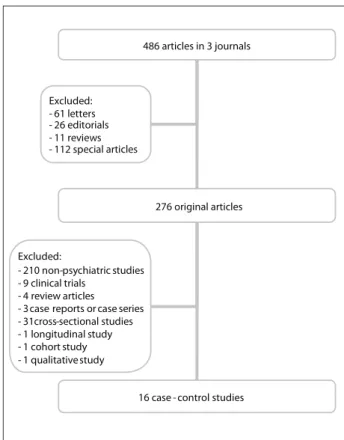
he three journals selected generated 486 published papers in 16 volumes in 2009. he publication types were classiied as original articles, letters, editorials, book reviews and special articles. he study designs were classiied as case-control, clinical trial (longi-tudinal studies with open or closed intervention, with or with-out controls, with or withwith-out randomization and with or withwith-out blinding), review articles (systematic reviews and meta-anal-yses), case reports or case series, cohorts, other cross-sectional studies, other longitudinal studies, non-psychiatric studies (in other ields within the scope of these journals) and other designs (articles without a deinite outline, such as reviews, editorials, comments, errata etc.).
Sixteen published psychiatric case-control studies were found in the three selected journals (Figure 1).
Degree of conformity of the published papers
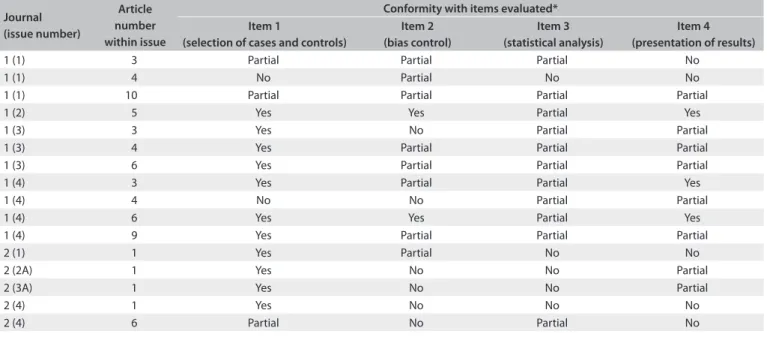
In relation to each item evaluated, the studies were classiied as conforming (1 point), partially conforming (0.5 points) or non-conforming (0 points), as shown in Table 1. No statistically sig-niicant diferences were found between the journals when the items were evaluated individually. he numbers of points for each item were summed and analyzed, and the results showed that case-control studies published in 2009 in psychiatry-spe-ciic journals obtained 2.18 points on average, compared with 1.4 points for the articles published in the neurology journal, which was a diference of 0.78 points: P= 0.031, 95% conidence inter-val (CI): 0.085-1.478.
In relation to item 1 (selection of cases and controls), 68.8% of the articles conformed with the method, 18.8% par-tially conformed and 12.5% did not conform. Regarding item 2 (strategy for the control of biases), 12.5% conformed, 50% partially conformed and 37.5% did not conform. There were no published papers that completely conformed with item 3 (statistical analysis), although 68.8% partially conformed and 31.2% did not conform. In relation to item 4 (presentation of results), 18.8% conformed, 50% partially conformed and 31.2% did not conform.
Relationship between journals and publication types
Apart from the main analysis on the case-control studies, this investigation also tested secondary data from the distribution of the diferent publication types among the periodicals. As men-tioned above, correspondence analysis was performed in order to explore the relationship between publication types and peri-odicals, and also among the diferent types. To view the relation-ship between the variables better, a correspondence analysis map was produced (Figure 2). On this map, the graphical display pro-vides a favorable overview of the connections between the vari-ables. It could clearly be seen that journal 2 (neurology) and jour-nal 3 (public health) were closer together, in comparison with the distance to journal 1 (psychiatry). Moreover, clinical trials, case-control studies, review articles, other longitudinal studies and cross-sectional studies were distributed closer to journal 1 than to 2 and 3 (chi-square distribution of two-dimensional cor-respondence = 223.39; P< 0.0001).
DISCUSSION
In this study, the appropriateness of the case-control method-ology reporting in articles was examined. Sixteen case-con-trol studies were retrieved from among 486 papers published in 2009 in three Brazilian journals. All of these articles, analyzed together, reached a mean score of 1,875 (on a scale from 0 to 4). he psychiatry and neurology journals difered signiicantly in their mean impact scores: 2.18 versus 1.4 points, respectively. 486 articles in 3 journals
276 original articles Excluded:
- 61 letters - 26 editorials - 11 reviews - 112 special articles
16 case - control studies Excluded:
- 210 non-psychiatricstudies - 9 clinical trials
- 4 review articles - 3 case reports or case series - 31 cross-sectional studies - 1 longitudinalstudy - 1 cohort study - 1 qualitative study
his result was in accordance with the impact factor, which was greater in the psychiatry journals.
Surprisingly, none of the studies from the Brazilian journals publishing articles on psychiatry that were selected, which had higher CAPES status during this period, satisied all of the items. None of the studies conformed completely with regard to the sta-tistical analysis (item 3), and only 12.5% completely conformed with the item addressing the care taken in relation to potential bias (item 2). While evaluating the articles, it became clear that little attention had been given to sampling the cases and con-trols, controlling for possible confounding factors, matching patients and controls and choosing the most appropriate statis-tical method for data analysis, including the use of odds ratios, conidence intervals and sensitivity analyses. he most striking fact is that, together, these items virtually deine the consistency of a case-control study.
Confusion about the term case-control study is not unique to the psychiatric literature. Only 75% of the self-declared case-control studies were found to meet the standard deinitions for this design in pediatric journals,2 and 35% in surgery journals.10 In dermatology,11 case-control studies usually fail in relation to sample size calculations, describing and managing missing data, detailing losses from follow-up, statistical methods and the role of funding bodies in the research.
A large, well-conducted survey of the literature among major psychiatric journals (i.e. those with impact factor > 3.0) noted that the reporting of methods in case-control studies is oten poor. In that survey, neuroimaging studies had the best descrip-tions of controlling for bias, while genetic studies had the worst.12 In analyzing secondary data from our sample, we also dem-onstrated that case-control studies, clinical trials and other
Table 1. Conformity of case-control articles published in 2009 to case-control reporting
Journal (issue number)
Article number within issue
Conformity with items evaluated* Item 1
(selection of cases and controls)
Item 2 (bias control)
Item 3 (statistical analysis)
Item 4 (presentation of results)
1 (1) 3 Partial Partial Partial No
1 (1) 4 No Partial No No
1 (1) 10 Partial Partial Partial Partial
1 (2) 5 Yes Yes Partial Yes
1 (3) 3 Yes No Partial Partial
1 (3) 4 Yes Partial Partial Partial
1 (3) 6 Yes Partial Partial Partial
1 (4) 3 Yes Partial Partial Yes
1 (4) 4 No No Partial Partial
1 (4) 6 Yes Yes Partial Yes
1 (4) 9 Yes Partial Partial Partial
2 (1) 1 Yes Partial No No
2 (2A) 1 Yes No No Partial
2 (3A) 1 Yes No No Partial
2 (4) 1 Yes No No No
2 (4) 6 Partial No Partial No
*Yes = 1, Partial = 0.5, No = 0.
2
1
0
-1
-2
-3
Dimension 2
Dimension 1
-3 -2 -1 0 1 2
Journal Type of Study
Cohort
Case series/report
Neurology Clinical trial
Cross-sectional
Qualitative research Case-control
Longitudinal
Non-psychiatric
Public health Other
Review Psychiatry
Figure 2. Two-dimensional derivation for correspondence analysis. Black circles represent the three journals evaluated. White circles represent the types of study (chi-square distribution of
two-dimensional correspondence = 223.39; P< 0.0001).
whether there is any diiculty in reporting cohort results in the Brazilian psychiatric literature; or whether the impact factor is associated with speciic types of studies.
One limitation of the present study was that it was restricted to using 4 of the 22 items of the conformity evaluation instru-ment, i.e. the STROBE statement on case-control studies. Another important point in the analysis was that it was limited to papers published only in 2009. By increasing the sample size, it might have been possible to identify more eligible studies that were not evaluated. he non-blinding of evaluators in relation to the journals and the authors of the published papers analyzed may also have biased the results.
he fact that only Brazilian published papers were evaluated can also be considered to be a limitation, although the results from the present study are important because of its original use of the STROBE statement in psychiatric journals. Furthermore, the results can be extrapolated to countries with similar journals, and may stimulate new studies evaluating the quality of pub-lished papers on diferent continents.
he results show that there is a need for more research stud-ies evaluating the appropriateness of case-control studstud-ies and other designs, with the intentions of discussing and improv-ing the methodological quality of these studies and upgradimprov-ing the clinical applicability of the results obtained from psychiat-ric research. Furthermore, these results should encourage clini-cians who use the scientiic literature in their practice to acquire basic skills for judging the validity of the articles available, and to become aware of the strengths and limitations of these articles.
CONCLUSION
he case-control studies analyzed here did not completely conform with the four STROBE statement items for case-control design. In view of the inadequate methodology of the published studies, these indings justify focusing on research and methodology and expand-ing the investigations on adherence of studies to their designs.
REFERENCES
1. Vandenbroucke JP, Von Elm E, Altman DG, et al. Mejorar la comunicación de estudios observacionales en epidemiología (STROBE): explicación y elaboració [Strengthening the reporting of observational studies in epidemiology (STROBE): explanation and elaboration]. Gac Sanit. 2009;23(2):158.
2. Hellems MA, Kramer MS, Hayden GF. Case-control confusion. Ambul Pediatr. 2006;6(2):96-9.
3. Schulz KF, Grimes DA. Case-control studies: research in reverse. Lancet. 2002;359(9304):431-4.
4. Newman TB, Browner WS, Cummings SR, Hulley SB. Designing cross-sectional and case-control studies. In: Hulley S, Cummings SR, Browner WS, et al, editors. Designing clinical research. 3rd ed.
Philadelphia: Lippincott Williams & Wilkins; 2007. p. 109-26.
5. von Elm E, Altman DG, Egger M, et al. Declaración de la iniciativa STROBE (Strengthening the Reporting of Observational Studies in Epidemiology): directrices para la comunicación de estudios observacionales. [The Strengthening the Reporting of Observational Studies in Epidemiology (STROBE) statement: guidelines for reporting observational studies]. Rev Esp Salud Publica. 2008;82(3):251-9. 6. Andriolo A, Souza AF, Farias AQ, et al. Classiication of journals in the
QUALIS System of CAPES urgent need of changing the criteria! Arq Neuropsiquiatr. 2010;68(2):327-9.
7. Vandenbroucke JP, von Elm E, Altman DG, et al. Strengthening the Reporting of Observational Studies in Epidemiology (STROBE): explanation and elaboration. Ann Intern Med. 2007;147(8):W163-94. 8. Mota JC, Vasconcelos AG, Assis SG. Correspondence analysis: a
method for classifying similar patterns of violence against women. Cad Saude Publica. 2008;24(6):1397-406.
9. Sourial N, Wolfson C, Zhu B, et al. Correspondence analysis is a useful tool to uncover the relationships among categorical variables. J Clin Epidemiol. 2010;63(6):638-46.
10. Mihailovic A, Bell CM, Urbach DR. Users’ guide to the surgical literature. Case-control studies in surgical journals. Can J Surg. 2005;48(2):148-51. 11. Langan SM, Schmitt J, Coenraads PJ, et al. STROBE and reporting
observational studies in dermatology. Br J Dermatol. 2011;164(1):1-3. 12. Lee W, Bindman J, Ford T, et al. Bias in psychiatric case-control studies:
literature survey. Br J Psychiatry. 2007;190:204-9.
Sources of funding: None
Conlict of interest: None
Date of irst submission: January 6, 2013
Last received: August 6, 2013
Accepted: August 19, 2013
Address for correspondence: Pedro Domingues Goi Rua Ramiro Barcelos, 2.350 Hospital de Clínicas de Porto Alegre Santana — Porto Alegre (RS) — Brasil CEP 90035-903