Behavioral satiety sequence: an
experimental model for studying
feeding behavior
Sequência comportamental de saciedade: um
modelo experimental para o estudo
do comportamento alimentar
Lisiane dos Santos OLIVEIRA1
Sandra Lopes de SOUZA2
Raul MANHÃES-DE-CASTRO3
A B S T R A C T
Feeding behavior is controlled by interactions between psychobiological and physiological systems. In rats, there is a sequence in the feeding behavior that is characterized by similar movements at the beginning and end of a meal, known as the behavioral satiety sequence. In the sequence, eating is followed by grooming and other activities, and ends with resting. The objective of this systematic review is to evaluate the use of the behavioral satiety sequence as an experimental model for the study of feeding behavior. A systematic search of the electronic databases MedLine, Lilacs, SciELO, Cochrane Library and PubMed was done from November 2007 to January 2008, using combinations of the keywords “behavioral,” “satiety” and “sequence”. Ninety articles were found and, of these, fifteen articles were selected for the review. The studies demonstrated the efficacy of using behavioral satiety sequence to evaluate the effects of some types of manipulations on feeding behavior. With this study method it was also possible to observe different factors that can interfere with feeding behavior, such as sedation, malaise or intake inhibition, by increasing satiety. Behavioral satiety sequence offers solid tools for gaining a better understanding of how treatment can influence feeding behavior.
Indexing terms:Feeding behavior. Resting. Satiety response.
R E S U M O
O comportamento alimentar é controlado por interações entre sistemas psicobiológicos e fisiológicos. Em ratos, existe uma sequência no comportamento alimentar que é caracterizada por movimentos similares no
1
Universidade Federal de Pernambuco, Centro Acadêmico de Vitória. R. Alto do Reservatório, s/n., Bela Vista, 55608-580, Vitória de Santo Antão, PE, Brasil. Correspondência para/Correspondence to: L.S. OLIVEIRA. E-mail: <[email protected]>.
2
Universidade Federal de Pernambuco, Centro de Ciências Biológicas, Departamento de Anatomia. Recife, PE, Brasil.
3
início e no término de uma refeição, conhecida como sequência comportamental de saciedade. Na sequência, o ato de comer é seguido pela limpeza e outra atividades, terminando com o descanso. O objetivo dessa revisão sistemática é avaliar o uso da sequência comportamental de saciedade como um modelo experimental para o estudo do comportamento alimentar. Uma busca sistemática das bases de dados MedLine, Lilacs, SciELO, Biblioteca Cochrane e PubMed foi realizada, no período de novembro de 2007 a janeiro de 2008, usando combinações das palavras chaves “behavioral”,“satiety” e “sequence”. Noventa artigos foram encontrados e, desses, quinze artigos foram selecionados para a revisão. Os estudos mostraram a eficácia do uso da sequência comportamental de saciedade para a avaliação dos efeitos de alguns tipos de manipulações sobre o comportamento alimentar. Com esse método de estudo, também é possível observar diversos fatores que podem intervir no comportamento alimentar, assim como sedação, mal-estar ou inibição do consumo por aumento da saciedade. A sequência comportamental de saciedade oferece sólidas ferramentas para obter um entendimento melhor de como um tratamento pode influenciar o comportamento alimentar.
Termos de indexação: Comportamento alimentar. Descanso. Resposta de saciedade.
I N T R O D U C T I O N
Appetite control is based on a psychobiological system and reflects the synchronous operation of events and processes involved with this system1. An interaction exists between psychological events (hunger perception, cravings, hedonic sensations), behavioral operations (intake of meals, snacks, energy and macronutrients), peripheral physiologic and metabolic events, and the levels of neurotransmitter and metabolic interactions in the brain that control feeding behavior2.
The feeding behavior of animals is an adaptive response, arising from demands of the internal environment and is modulated by limitations imposed by the external environment3. Neural events trigger and guide behavior, but each behavioral act involves a response in the peripheral physiological system1. These physiological responses are termed satiety signals, and can be represented by the satiety cascade1.Some concepts must be defined to understand feeding behavior better. Satiety involves the events subsequent to food intake that suppress hunger and maintain an inhibition toward eating for a particular period of time while hunger can be regarded as the need to eat or a period in which satiety signals are absent1. Between hunger and satiety there is satiation, a group of processes that determine meal termination1. The coordinated effects of satiation and satiety control the size and frequency of eating episodes, thereby defining the eating pattern1.
Studies have demonstrated that some behaviors in animals follow specific patterns4,5. Thus, after eating, an adult rat presents a period of grooming and locomotor activity5. After this period, the animal rests or sleeps4. Following these observations, a behavioral sequence was identified that is associated with satiety, because the cessation of eating is not a sufficient condition for the complete appearance of this behavioral sequence6. Thus the sequence was named Behavioral Satiety Sequence (BSS)6.
In 1975, the BSS was used for the first time as an experimental model for the study of satiety6. This work confirmed the association of postingestive behavior with satiety, and it is still considered a landmark for the consolidation of BSS as a technique for the study of feeding behavior.
In rodents, BSS is characterized as an eating phase, followed by grooming and locomotor activities and ending with a resting phase6,7. Eating itself is characterized by biting, gnawing, or swallowing food directly from a dish or from the front paws6,7. This action is one of the elements of feeding behavior that is related to the biological need of getting nutrients.
standing)6,7. Locomotor activity is related to exploratory behavior8. It consists of acts and postures that allow the animal to acquire information and to become familiar with its environment8. Changes of activities related to BSS can interfere with feeding behavior6. The increased duration and/or frequency of non-feeding activities associated with BSS can delay the start of the resting period and fragment eating into numerous, short episodes3,7.
Resting is characterized by inactivity. The animal sits or lies in a relaxed position with its head curled close to the body or resting against the floor6,7. Resting is the final posture assumed in the BSS6,7. The appearance of the resting posture in BSS is a condition caused by satiety7. This fact was demonstrated by changes of palatability, reduced food intake and because resting does not occur9. It has also been verified that the onset of resting can be anticipated by the prefeeding period10.Drug-induced changes can alter BSS and make resting occur before eating6.
The objective of this systematic review was to evaluate, through studies published in indexed journals, the efficiency of the BSS method for studying feeding behavior, as well as what type of behavioral interference related to satiety can be highlighted with the BSS method, since the study of food intake alone will not allow such verification.
M E T H O D S
A systematic search of the literature was done from November 2007 to January 2008 in the electronic databases MedLine (National Library of Medicine), Lilacs (Literatura Latino-americana e do Caribe em Ciências da Saúde), SciELO (Scientific Electronic Library Online), Cochrane Library and PubMed. This search focused on studies published from 1975 to 2008 that used BSS. The literature search used combinations of the keywords “behavioral”, “satiety” and “sequence”. In order to define the literature for
this review, the following inclusion criteria were established: a) studies that used the BSS method; b) studies with rats or mice; c) articles that considered the time when BSS was evaluated, such as eating, grooming and/or resting behavior durations. Articles that did not disclose eating, grooming and/or resting behavior durations or that had problems in the statistical analyses, such as no significance values or no confidence intervals, were excluded.
R E S U L T S A N D D I S C U S S I O N
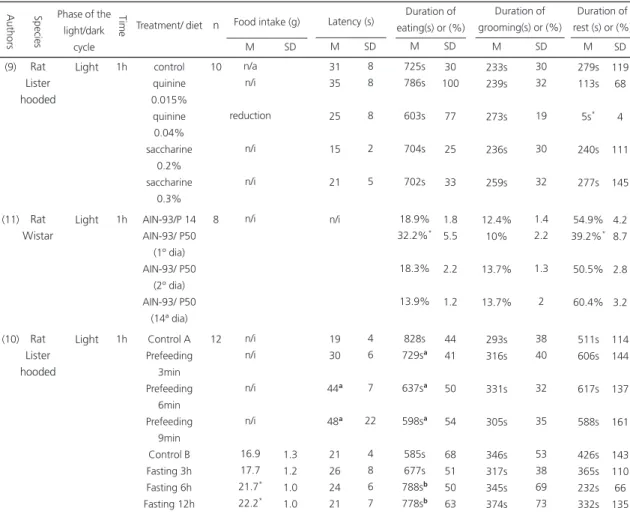
The initial search of the databases returned fifteen articles in MedLine, two articles in the Cochrane Library and ninety articles in PubMed. The two articles of the Cochrane Library were discarded because they did not concern BSS. The fifteen articles found in Medline were also present in PubMed. Of the ninety articles found in PubMed, thirty were discarded after analysis of the abstracts because they did not concern BSS. After reading the abstracts, sixty articles were selected and after complete analysis of each article, only fifteen articles met the inclusion criteria mentioned earlier. The results tabulated for this study were the murine species, phase of the light/dark cycle, duration of BSS assessment, type of diet or treatment and method of administration, amount of food consumed and duration of eating, grooming and resting behaviors. The duration of eating, grooming and resting behaviors were presented as means or percentage ± standard deviation. The articles were categorized according to type of manipulation: nutritional, pathological or pharmacological, and are summarized in Tables 1, 2 and 3, respectively.
Table 1. Effects of nutritional manipulations on the behavioral satiety sequence. Authors Rat Lister hooded Rat Wistar Rat Lister hooded (9) (11) (10)
Species Phase of the
light/dark cycle Light Light Light Ti m e 1h 1h 1h control quinine 0.015% quinine 0.04% saccharine 0.2% saccharine 0.3% AIN-93/P 14 AIN-93/ P50 (1º dia) AIN-93/ P50 (2º dia) AIN-93/ P50 (14ª dia) Control A Prefeeding 3min Prefeeding 6min Prefeeding 9min Control B Fasting 3h Fasting 6h Fasting 12h Treatment/ diet 10 8 12 n n/a n/i reduction n/i n/i n/i n/i n/i n/i n/i 16.9 17.7 21.7* 22.2* M SD 1.3 1.2 1.0 1.0 Food intake (g)
M SD Latency (s) 31 35 25 15 21 n/i 19 30 44a 48a 21 26 24 21 8 8 8 2 5 4 6 7 22 4 8 6 7 M SD Duration of eating(s) or (%)
725s 786s 603s 704s 702s 18.9% 32.2%* 18.3% 13.9% 828s 729sa 637sa 598sa 585s 677s 788sb 778sb 30 100 77 25 33 1.8 5.5 2.2 1.2 44 41 50 54 68 51 50 63 M SD Duration of grooming(s) or (%)
233s 239s 273s 236s 259s 12.4% 10% 13.7% 13.7% 293s 316s 331s 305s 346s 317s 345s 374s 30 32 19 30 32 1.4 2.2 1.3 2 38 40 32 35 53 38 69 73 Duration of rest (s) or (%)
M SD 279s 113s 5s* 240s 277s 54.9% 39.2%* 50.5% 60.4% 511s 606s 617s 588s 426s 365s 232s 332s 119 68 4 111 145 4.2 8.7 2.8 3.2 114 144 137 161 143 110 66 135
Data are means of the duration in seconds or mean of the percent duration and SD; (AIN-93): diet formulated for rodents by the American Institute of Nutrition in 1993 (35); (P14): Diet with 14% protein; (P50): diet with 50% protein; n/a: not applicable to the group; n/i: data not informative in the original reference; *significant difference (p>0.05) in relation to the control group.
asignificant difference (p>0.05) in relation to the control group A, bsignificant difference (p>0.05) in relation to the control group B; M: media; SD:
standard deviation.
Table 2. Effects of pathological state on the behavioral satiety sequence.
Authors
Rat Sprague-Dawley
(12)
Species Phase of the
light/dark cycle
Light
T
ime
1h Saline 1st hour Saline 3rd hour MDP 1st hour MDP 3rd hour Treatment/diet 8 8 n 0,9% 1.5mg/Kg Food intake M SD Food intake (g) 5.5 3.3 6.3 2.2 1.2 0.3 1.0 0.6 M SD Duration of eating(s) or (%)
10 7 10 4 1 1 2 1 M SD Duration of grooming(s) or (%)
10 13 7 5* 3 3 3 1 Duration of rest (s) or (%)
M SD 52* 58* 54* 82* 4 9 4 3 via i.p. Latency n/i
Data are means of the duration in seconds or the mean percentage of the duration and SD; n/i: data not informative in the original reference,
*significant difference (p>0.05) in relation to the saline group in the respective schedule.
Table 3. Effects of pharmacological manipulations on the Behavioral Satiety Sequence. Authors Rat Lister hooded Rat Lister hooded Rat Lister hooded Rat Lister hooded Rat Sprague-Dawley Rat Lister hooded Rat Lister hooded Rat Lister hooded Mice Rat Lister hooded Mice (18) (16) (19) (18) (27) (28) (30) (31) (29) (32) (33)
Species Phase of the
light/dark cycle Light Light Light Dark Light Dark Dark Dark Light Dark Light Ti m e 1h 1h 1h 1h 90 min 40 min 40 min 40 min 40 min 40 min 40 min Control Orexina-A Control LiCl SB-334867 Control SB-334867 Control CCK-8S Control naloxone Control Antagonist Y2 PYY 3-36 Antagonist Y2
+ PYY 3-36
Control Fluoxetine (ISRS) Metergoline Fluoxetine + metergoline Control MK-212 Control CP-94.253 Control RU-24969 Control RO-60-0175 Fenfluramine Control CP-94.253 Control VER23779 Treatment/ diet 12 12 12 12 10 10 10 10 10 10 10 10 10 10 10 10 8 8 8 8 12 12 12 12 12 12 12 12 12 12 12 12 12 12 12 12 12 12 12 12 12 n n/a 3.33µg 10µg 30µg n/a 90mg/Kg 10mg/Kg 30mg/Kg n/a 30mg/Kg n/a 5µg/Kg n/a 1mg/Kg 2.5mg/Kg 5.0mg/Kg n/a 5mg/Kg 50mg/Kg 5+50mg/Kg n/a 10mg/Kg 1mg/Kg 10+1mg/Kg n/a 5mg/Kg n/a 5mg/Kg n/a 1mg/Kg n/a 3mg/Kg 10mg/Kg 3mg/Kg n/a 1.25mg/Kg 2.5mg/Kg 5mg/Kg n/a 3mg/Kg 10mg/Kg
Food intake Latency (s)
23s 12s 12s 16s 25s 22s 26s 37s 21s 15s 23s 199s* 38s 58s 37s 41s n/i n/i n/i n/i n/i n/i n/i n/i n/i n/i n/i n/i n/i n/i n/i n/i n/i n/i n/i n/i n/i n/i n/i n/i 4 3 4 7 5 4 4 65 12 12 11 12 M SD Duration of eating(s) or (%) 804s 905s 823s 928s 659s 991s* 575s 467s 705s 418s* 719s 1151s* 33% 31% 22%* 34% 360s 279s 419s 506s* 405s 320s 318s 160s* 530s 440s* 49 62 45 69 32 66 33 44 43 41 50 87 3 3 2 5 31 57 72 77 61 48 38 26 39 42 M SD Duration of grooming(s) or (%) 305s 429s 461s 474s 263s 138s* 236s 154s 194s 160s 278s 154s* 207s 176s 99s 105s 371s 371s 298s 173s 248s 264s 51 52 49 42 24 20 41 36 29 31 30 21 46 32 20 20 47 69 46 33 42 44 Duration of rest (s) or
(%) M SD 700s 298s 417s 464s 593s 828s 858s 1251s* 1007s 1634s* 480s 855s* 34% 38% 63%* 35% 628s 1127s* 1129s* 1051s* 511s 1042s* 802s 1274s 398s 305s 159 63 79 135 106 119 144 185 105 129 146 107 7 5 4 9 114 162 142 114 62 129 149 175 137 107 n/a Increase Increase Increase n/a Not altered Increase Increase n/a Reduction Reduction n/i Not altered Reduction Not altered n/i Not altered Not altered Not altered n/a Not altered Not altered Not altered n/a Not altered Not altered Not altered n/a Not altered Not altered Reduction n/a Reduction Reduction n/i Reduction Reduction Reduction n/a Reduction Reduction Reduction n/a Reduction Reduction Reduction n/a Reduction Reduction M SD M SD 14.02g 19.99g* 18.92g* 19.26g* 21.25g 12.36g* 16.41g* 12.06g* 5.41g 5.49g 3.58*g 6.24g 8.0g 4.1g* 7.9g 7.3g 8.92g 4.33g* 7.2g 3.1g* 9.1g 6.22g* 1.82g 1.55g 1.18g* 1.00g* 0.96 1.15 1.11 1.09 0.80 0.98 1.46 1.35 0.46 0.44 0.35 0.64 0.40 0.90 0.70 0.80 1.31 0.81 0.90 0.60 0.94 0.79 0.18 0.31 0.23 0.19 n/a reduction n/a reduction n/i reduction, 54% reduction, 61% reduction, 65% n/a not altered reduction 37% reduction 78% n/a reduction reduction Dose
Dates presented are the means of the duration in seconds or mean percent of duration and SD; n/a: not applicable to the group; n/i: the original reference is not informative; (reduction): reduction of the duration of the behavior in relation to the control group [values not available in the original article]; (not altered ): no significant differences in relation to the control group [values not present in the original article].
In the first category of studies where the effects of nutritional manipulations on the temporal feeding pattern were examined (Table 1), it was clear how hunger and satiety states10, diet palatability9, and satiation power of the ingested diet11 affect feeding behavior. Thus, adulteration of food with quinine9, a bitter substance, reduced food intake without affecting eating duration and abolished the resting behavior usually observed at the end of BSS. Since satiety is associated with sleeping or inactivity, the absence of resting indicates lack of satiation. This observation underlies the fact that the taste of food is a crucial determinant of feeding and that this factor must be considered when the anorexic or orexigenic properties of a drug are studied or when the characterization of a drug response involves its administration through drinking water.
BBS has also been used to examine the effect of a high-protein diet on satiety11, and in particular on food intake, the rate of feeding and the relation between food intake and eating duration. In this study, animals were fed either standard chow or a high-protein diet and their feeding behavior was evaluated daily. On the first day, the animals fed the high-protein diet exhibited a reduction in food intake and rate of feeding, as well as an increased eating duration and a decreased resting duration. From the second to the fourteenth day, no differences between the two groups in the temporal BSS pattern were observed. The reduced resting duration in the first day indicated that a high-protein diet delays the appearance of satiety but this initial aversion to the high-protein diet is followed by adaptation.
Finally, it has been demonstrated that the interval between meals can affect food intake and the appearance of satiation9. Specifically, it was observed that the longer the fasting period, the greater the food intake and the duration of eating, and that the longer the pre-feeding period, the smaller the latency to begin eating and the feeding duration. These results indicate that a smaller interval of time between meals can reduce the motivation to eat the next meal. Using this
experimental approach, one can obtain information about the temporal display of feeding behavior, and identify the level of control in which individual behaviors are affected by nutritional manipulations.
In the second study category (Table 2), BSS was used to analyze how a pathological state can interfere with food intake. In one of these studies12, the effects of muramyl dipeptide on feeding behavior were analyzed. Muramyl dipeptide is the minimally active subunit of bacterial peptidoglycan, which is abundantly released during infections by gram-positive bacteria13,14, and has been associated with reduced food intake during infection15. In this study, none of the parameters of BSS, including the amount of ingested food, eating duration and feeding rate were altered within the first two hours after the administration of muramyl dipeptide. However, three hours after the administration of muramyl dipeptide there was a reduction in grooming duration and prolonged resting period. These behavioral changes are similar to those that appear during illness. This study also evaluated the cumulative food intake over a 24-hours period. This analysis demonstrated that the inhibitory effects of muramyl dipeptide on food intake extend from the third to the tenth hour after its administration. Collectively, these data suggest that the hypophagic effect of illness induced by a bacterial infection results from a change in the physiological mechanisms involved in the regulation of satiety.
BSS has been extensively used in pharmacological studies that aimed to identify new therapeutic targets for the treatment of eating disorders and its consequences, such as obesity, as well as to get an insight into the mechanism involved in the control of feeding behavior, both at the central and peripheral levels (Table 3). In relation to the first point, it has been recently demonstrated that orexins participate in the regulation of feeding behavior by stimulating food intake16. Orexin-A and orexin-B are neuropeptides derived from prepro-orexin. Both peptides exert their actions through the activation of orexin-1 and orexin-2 receptors but orexin-A binds with greater affinity to the orexin-1 receptor17. Intracerebroventricular administration of orexin-A leads to increased food intake. The fact that this hyperphagic effect is not associated with increased meal duration indicates that the orexigenic properties of orexin-A are due to its capacity to increase feeding rate18. On the other hand, the intraperitoneal administration of SB-334867, an antagonist of the orexin-1 receptor, reduces food intake and eating duration and increases resting duration16,19. These results indicate that orexin stimulates food intake through its interaction with orexin-1 receptors.
The intestinal hormone cholecystokinin is a satiety signal with anorexic effects7,20-22. The administration of an equi-anorectic dose of the natural satiety-related signal cholecystokinin octapeptide (CCK-8S) induced reduced food intake, along with increased latency to begin eating, increased eating and resting duration, and reduced grooming duration. Collectively, these observations indicate that cholecystokinin reduces satiety before eating begins and stimulates satiety after eating begins. Analysis of the effects of other pharmacological or nutritional manipulations on the pattern of BSS induced by the administration of cholecystokinin might be of interest for the dissection of other variables related to satiety.
Endogenous opioids are also involved in the regulation of appetite. Systemic or central administration of these peptides induces hyperphagia23. The physiological mechanisms underlying the orexigenic effects of opioids were
investigated by the use of naloxone, an opioid receptor antagonist18. The administration of this compound was shown to reduce both food intake and eating duration in control rats, without affecting the latency to start eating. Thus, opioids clearly regulate the satiety process but, in disagreement with a generally accepted idea, they do not seem to be involved in the motivation to eat.
BSS has also been used to analyze the anorexic effects of the YY3-36 peptide24,25. This peptide is released into the gastrointestinal tract after meals26. Examination of the BSS pattern after the administration of the YY3-36 peptide showed significant reductions in food intake and in eating duration. In addition, there was as an increase in resting duration, which is consistent with delayed onset of satiety. These results indicate that the YY3-36 peptide reduces food intake because it promotes satiety27. The stimulation of type 2 pre-synaptic receptors for neuropeptide Y (NPY) inhibits the release of NPY and GABA from hypothalamic arcuate nucleus neurons. Given that NPY is a potent orexigenic peptide and that YY3-36 peptide also stimulates NPY type-2 receptors24, the possibility exists that the inhibitory effects of YY3-36 on food intake are mediated by NPY. In agreement with this hypothesis, the administration of a Y2-receptor antagonist alone did not alter BSS but prevented the anorexic effect of YY3-3627.
receptor antagonist, does not alter food intake or eating duration, but it does increase the resting period28. When fluoxetine was administered together with metergoline, eating and resting duration increased but food intake did not change28, indicating that metergoline inhibited the effect of fluoxetine on the inhibition of food intake.
These controversial results can be explained by the fact that serotonin interacts with 14 different receptors which have been classified into different families according to their pharmacological, molecular and functional properties. Among these, serotonin 5-HT1B and 5-HT2C receptors have been specifically recognized as mediators of serotonin-induced satiety29,30. Thus, RU-24969, an agonist of the 5-HT-1A and 5-HT-1B receptors, reduces food intake and eating duration without changing the resting period31. Similarly, the administration of CP-94,253, a selective 5-HT1B receptor agonist, reduced food intake and eating and grooming durations but, in contrast to the administration of RU-24969, increased resting duration32. These findings clearly demonstrate that 5-HT-1B receptors modulate the inhibitory effects of serotonin on food intake.
On the other hand, initial studies indicated that the administration of MK-212, a 5-HT-2 receptor agonist, reduces food intake and increases resting duration but does not change eating duration30. These data indicate that serotonin 5-HT-2 receptors regulate feeding behavior through the stimulation of satiety. Subsequent studies with RO-60-0175 and VER23779, two selective 5-HT-2C receptor agonists, confirmed that the specific stimulation of 5-HT2C receptors inhibits food intake by reducing feeding time and increasing resting time29,33. Collectively, these and other analyses of the BSS in association with pharmacological studies using selective serotonin receptor compounds, indicate that the anorexic action of serotonin is mediated by separate receptor subtypes. Thus, while the reduced meal size consecutive to the administration of serotonin would depend on the stimulation 5-HT1B receptors, the reduction in feeding rate
would result from the selective stimulation of 5-HT2C receptors.
For BSS analysis, all the examined studies relied on a standard procedure in which a food-deprived animal is placed in an observation arena with ad libitum access to food and water for a period of 45-60 min. Food deprivation is used to obtain a high feeding baseline while the objective of the observation arena is to provide a larger enclosure than the animal’s house-cage to allow the expression of all the BSS behavioral parameters. The experimental protocol used differed, however, between the different laboratories in some respects. These included the phase of the light/ dark cycle in which the test was performed, the duration of the fasting period and how the behavioral data were analyzed and presented.
Most living organisms exhibit behavioral and physiological rhythms, including those associated with sleep, feeding and energy homeostasis. Therefore, the expression of BSS can vary depending on the phase of the light/dark cycle in which the analysis is performed. Initially, the BSS was monitored essentially during the light phase7, but more recently analysis of the BSS during the dark phase has been preferred18,19. In the first studies in which BSS was analyzed during the light phase, the animals were submitted to a fasting period of 17-20 hours3,7. The objective of this procedure was to reduce the eating latency and to stimulate the onset of the characteristic BSS behaviors. However, rats are nocturnal and, consequently, most of its activity, including eating, occurs during the dark cycle. During this phase, rats consume up to 80% of their daily food intake34. Thanks to the development of monitoring technology, it is possible to document BSS during the dark phase using special video recorders and red light. The use of this methodology allows not only BSS analysis under more natural conditions, but also has the advantage of reducing the fasting period. Currently, studies done during the dark phase usually use a four-hour food deprivation period6,28,30,35.
the number of episodes of each behavioral category per time bin (usually 5min), whereas other authors expressed the duration of each behavior in relation to the total length of the observation period (45-60min).
Only six articles of the fifteen articles presented data on feeding latency (Tables 1, 2 and 3). That is, the interval of time between the presentation of food and the moment at which the animal actually starts eating. Pre-satiated rats present longer latency periods to begin feeding9. Since food ingestion reduces the stimulation to start a new meal, feeding latency can be a measure of the animal’s motivation to eat.
Food intake is also an important factor for the interpretation of BSS. By the measurement of food intake and the duration of eating, that is, the time the animal actually spends consuming food, the feeding rate can be determined by calculating the ratio between food intake (g) and eating duration (min). It is also possible to quantify the mean intake per eating episode through quantification of the relationship between food intake (g) and the number of eating episodes.
C O N C L U S I O N
BSS is a noninvasive, inexpensive and highly efficient method for analyzing feeding behavior. The effects of pharmacological and nutritional manipulations on the natural physiological regulation of food intake can be evaluated using BSS. It is regrettable that many studies that aim to characterize the orexigenic or anorexigenic properties of a drug use the amount of ingested food as the only feeding behavior variable. Although a reduction or an increase in food ingestion reflects an effect on appetite, the measurement of food intake alone does not allow the determination of whether these changes are due to a change of the physiological mechanisms regulating food intake or to nonspecific effects, such as sedation, hyperactivity, malaise or enhanced satiety. BSS is a solid experimental tool for improving our understanding of the complex psychological and physiological processes involved in the regulation of feeding behavior.
C O N T R I B U T O R S
All authors contributed substantially to the paper, including literature review, organization of the manuscript, translation and critical review.
R E F E R E N C E S
1. Blundell JE, Goodson S, Halford JC. Regulation of appetite: role of leptin in signalling systems for drive and satiety. Int J Obes Relat Metab Disord. 2001; 25 (Suppl 1):S29-34
2. Blundell J. Pharmacological approaches to appetite suppression. Trends Pharmacol Sci. 1991; 12(4): 147-57. doi: 10.1016/0165-6147(91)90532-W. 3. Blundell JE, Rogers PJ, Hill AJ. Behavioural structure
and mechanisms of anorexia: calibration of natural and abnormal inhibition of eating. Brain Res Bull. 1985; 15(4):371-6. doi: 10.1016/0361-9230(85)90 004-8.
4. Bindra D, Blond J. A time-sample method for measuring general activity and its components. Can J Psychol. 1958; 12(2):74-6.
5. Bolles RC. Grooming behavior in the rat. J Comp Physiol Psychol. 1960; 53(3):306-10.
6. Halford JC, Wanninayake SC, Blundell JE. Behavioral satiety sequence (BSS) for the diagnosis of drug action on food intake. Pharmacol Biochem Behav. 1998; 61(2):159-68. doi: 10.1016/S0091-3 057(98)00032-X.
7. Antin J, Gibbs J, Holt J, Young RC, Smith GP. Cholecystokinin elicits the complete behavioral sequence of satiety in rats. J Comp Physiol Psychol. 1975; 89(7):784-90. doi: 10.1037/h0077040. 8. Berlyne DE, Koenig ID, Hirota T. Novelty, arousal,
and the reinforcement of diversive exploration in the rat. J Comp Physiol Psychol. 1966; 62(2):222-6. doi: 10.1037/h0023681.
9. Ishii Y, Blundell JE, Halford JC, Rodgers RJ. Palatability, food intake and the behavioural satiety sequence in male rats. Physiol Behav. 2003; 80(1): 37-47. doi: 10.1016/S0031-9384(03)00207-5. 10. Ishii Y, Blundell JE, Halford JC, Rodgers RJ. Effects
of systematic variation in presatiation and fasting on the behavioural satiety sequence in male rats. Physiol Behav. 2003; 79(2):227-38. doi: 10.1016/ S0031-9384(03)00066-0.
11. Bensaid A, Tome D, L’Heureux-Bourdon D, Even P, Gietzen D, Morens C, et al. A high-protein diet enhances satiety without conditioned taste aversion in the rat. Physiol Behav. 2003; 78(2):311-20. doi: 10.1016/S0031-9384(02)00977-0.
13. Krueger JM, Majde JA. Microbial products and cytokines in sleep and fever regulation. Crit Rev Immunol. 1994; 14(3-4):355-79.
14. Martin JR, Bos M, Jenck F, Moreau J, Mutel V, Sleight AJ, et al. 5-HT2C receptor agonists: pharmacological characteristics and therapeutic potential. J Pharmacol Exp Ther. 1998; 286(2):913-24. doi: 002 2-3565/98/2862-0913$03.00/0.
15. Langhans W. Bacterial products and the control of ingestive behavior: clinical implications. Nutrition. 1996; 12(5):303-15. doi: 10.1016/S0899-9007(96) 80052-9.
16. Ishii Y, Blundell JE, Halford JC, Upton N, Porter R, Johns A, et al. Differential effects of the selective orexin-1 receptor antagonist SB-334867 and lithium chloride on the behavioural satiety sequence in rats. Physiol Behav. 2004; 81(1):129-40. doi: 10.1016/j.physbeh.2004.01.009.
17. Sakurai T, Amemiya A, Ishii M, Matsuzaki I, Chemelli RM, Tanaka H, et al. Orexins and orexin receptors: a family of hypothalamic neuropeptides and G protein-coupled receptors that regulate feeding behavior. Cell. 1998; 92(5):1 page following 696. doi: 10.1016/S0092-8674(00)80949-6.
18. Tallett AJ, Blundell JE, Rodgers RJ. Night and day: diurnal differences in the behavioural satiety sequence in male rats. Physiol Behav. 2009; 97(1): 125-30. doi: 10.1016/j.bbr.2007.10.005. 19. Ishii Y, Blundell JE, Halford JC, Upton N, Porter R,
Johns A, et al. Satiety enhancement by selective orexin-1 receptor antagonist SB-334867: influence of test context and profile comparison with CCK-8S. Behav Brain Res. 2005; 160(1):11-24. doi: 10.10 16/j.bbr.2004.11.011.
20. Gibbs J, Young RC, Smith GP. Cholecystokinin elicits satiety in rats with open gastric fistulas. Nature. 1973; 245(5424):323-5. doi: 10.1038/245323a0. 21. Gibbs J, Young RC, Smith GP. Cholecystokinin decreases food intake in rats. J Comp Physiol Psychol. 1973; 84(3):488-95.
22. Halford JC, Boyland EJ, Cooper GD, Dovey TM, Smith CJ, Williams N, et al. Children’s food preferences: effects of weight status, food type, branding and television food advertisements (commercials). Int J Pediatr Obes. 2007:1-8. doi: 10.1080/17477160701645152.
23. Bodnar RJ. Endogenous opioids and feeding behavior: a 30-year historical perspective. Peptides. 2004; 25(4):697-725. doi: 10.1016/j.peptides.20 04.01.006.
24. Batterham RL, Cowley MA, Small CJ, Herzog H, Cohen MA, Dakin CL, et al. Gut hormone PYY (3-36) physiologically inhibits food intake. Nature. 2002; 418(6898):650-4. doi: 10.1038/nature00887. 25. Chelikani PK, Haver AC, Reidelberger RD. Intravenous infusion of peptide YY(3-36) potently
inhibits food intake in rats. Endocrinology. 2005; 146(2):879-88. doi: 10.1210/en.2004-1138. 26. Adrian TE, Ferri GL, Bacarese-Hamilton AJ, Fuessl
HS, Polak JM, Bloom SR. Human distribution and release of a putative new gut hormone, peptide YY. Gastroenterology. 1985; 89(5):1070-7. PII: 0016-5085(85)90211-2.
27. Scott V, Kimura N, Stark JA, Luckman SM. Intravenous peptide YY3-36 and Y2 receptor antagonism in the rat: effects on feeding behaviour. J Neuroendocrinol. 2005; 17(7):452-7. doi: 10.11 11/j.1365-2826.2005.01330.x.
28. Halford JC, Blundell JE. Metergoline antagonizes fluoxetine-induced suppression of food intake but not changes in the behavioural satiety sequence. Pharmacol Biochem Behav. 1996; 54(4):745-51. doi: 10.1016/0091-3057(95)02228-7.
29. Hewitt KN, Lee MD, Dourish CT, Clifton PG. Serotonin 2C receptor agonists and the behavioural satiety sequence in mice. Pharmacol Biochem Behav. 2002; 71(4):691-700. doi: 10.1016/S0091-3 057(01)00709-2.
30. Halford JC, Lawton CL, Blundell JE. The 5-HT2 receptor agonist MK-212 reduces food intake and increases resting but prevents the behavioural satiety sequence. Pharmacol Biochem Behav. 1997; 56(1):41-6. doi: 10.1016/S0091-3057(96)00152-9. 31. Halford JC, Blundell JE. The 5-HT1B receptor agonist CP-94,253 reduces food intake and preserves the behavioural satiety sequence. Physiol Behav. 1996; 60(3):933-9. doi: 10.1016/0031-93 84(96)00073-X.
32. Lee MD, Kennett GA, Dourish CT, Clifton PG. 5-HT1B receptors modulate components of satiety in the rat: behavioural and pharmacological analyses of the selective serotonin1B agonist CP-94,253. Psychopharmacology (Berlin). 2002; 164(1):49-60. doi:.10.1007/s00213-002-1162-7.
33. Somerville EM, Horwood JM, Lee MD, Kennett GA, Clifton PG. 5-HT(2C) receptor activation inhibits appetitive and consummatory components of feeding and increases brain c-fos immunoreactivity in mice. Eur J Neurosci. 2007; 25(10):3115-24. doi: 10.1111/j.1460-9568.2007.05567.x.
34. Vachon C, Savoie L. Circadian variation of food intake and digestive tract contents in the rat. Physiol Behav. 1987;39(5):629-32. doi: 10.1016/0031-93 84(87)90164-8.
35. Reeves PG, Nielsen FH, Fahey GC, Jr. AIN-93 purified diets for laboratory rodents: final report of the American Institute of Nutrition ad hoc writing committee on the reformulation of the AIN-76A rodent diet. J Nutr. 1993; 123(11):1939-51
Received on: 23/3/2010