The Atlantic Rain Forest harbors the highest diversity of harvestmen species in the world, with almost 600 described species, of which 97.5% are exclusive of this biome (PINTO-DA -ROCHA et al. 2005). Despite the importance of the group, knowl-edge on the Neotropical harvestmen systematics is still poor (PINTO-DA-ROCHA 2002). The Neotropical harvestmen systemat-ics developed mainly during the first half of XX century, when ROEWER (1913, 1923, 1930, 1943) and MELLO-LEITÃO (1923, 1932) described most Atlantic Forest species. Generic descriptions were based on subjective methodology, using single characters to define groups, mainly valuing differences, some of which were intra-specific variations or related to secondary sexual charac-ters, making the so called “Roewerian” classification highly unsatisfactory under modern standards (KURY 1989, 1990, PINTO -DA-ROCHA 1997, 2002).
Currently, the Atlantic Rain Forest harvestmen are re-ceiving great attention and several groups were recently revised,
most of them resulting in new classifications based on cladis-tic approaches. The following laniatorean groups within Gonyleptidae were recently revised: Bourguyiinae (YAMAGUTI & PINTO-DA-ROCHA 2009), Caelopyginae (PINTO-DA-ROCHA 2002), Goniosomatinae (DASILVA & GNASPINI 2009), Heteropachylinae (A.C. Mendes, unpublished data), Progonyleptoidellinae and Sodreaninae (PINTO-DA-ROCHA & BRAGAGNOLO, unpublished data), Gonyleptinae genus Mischonyx Bertkau (E.G. Vasconcelos , unpublished data), Pachylinae genus Eusarcus Perty (HARA & PINTO-DA-ROCHA 2010), Cosmetidae genus Metavononoides Roewer (C.P. Ferreira, unpublished data), and the Sclerosomatidae (Eupnoi) genus Jussara Mello-Leitão (TOURINHO & KURY 2003). Such emphasis in Gonyleptidae is because it is the largest fam-ily of the suborder Laniatores, with more than 800 described species, all from the Neotropics (KURY 2003) and dominant in the Atlantic Forest, with approximately 200 endemic species from this biome.
Systematic review and cladistic analysis of the Hernandariinae
(Opiliones: Gonyleptidae)
Marcio Bernardino DaSilva
1& Ricardo Pinto-da-Rocha
21 Departamento de Sistemática e Ecologia, Centro de Ciências Exatas e da Natureza, Universidade Federal da Paraíba. Cidade Universitária, 58059-900 João Pessoa, PB, Brazil. E-mail: [email protected]
2 Departamento de Zoologia, Instituto de Biociências, Universidade de São Paulo. Rua do Matão, Travessa 14, 101, Caixa Postal 11461, 05422-970 São Paulo, SP, Brazil. E-mail: [email protected]
ABSTRACT. The harvestmen subfamily Hernandariinae is reviewed and a new classification is proposed based on cladis-tic analysis using 67 morphological characters. The subfamily is composed of six genera and 23 species and occurs in south-southeastern Brazil, Paraguay, and northeastern Argentina. Fourteen new combinations are proposed: Hernandaria armatifrons (Roewer, 1917); H. una (Mello-Leitão, 1927); Acrogonyleptes granulatus (H. Soares, 1966); A. pectinifemur (Soares & Soares, 1947); Acanthogonyleptes alticola (Mello-Leitão, 1922); A. editus (Roewer, 1943); A. fallax (Mello-Leitão, 1932); A. fulvigranulatus (Mello-Leitão, 1922); A. marmoratus (Mello-Leitão, 1940); A. pictus (Piza, 1942); A. singularis (Mello-Leitão, 1935); A. soaresi (Mello-Leitão, 1944); A. variolosus (Mello-Leitão, 1944). Seven synonymies are proposed: Proweyhia Mello-Leitão, 1927 and Metaxundarava Mello-Leitão, 1927 = Hernandaria Sørensen, 1884; Apembolephaenus calcaratus Soares & Soares, 1945 = H. armatifrons (Roewer, 1917); Sphaerobunus Rower, 1917 and Paraproweyhia Soares & Soares, 1947 = Acrogonyleptes Roewer, 1917; Paraproweyhia curitibae Soares & Soares, 1947 = Acrogonyleptes exochus (Mello-Leitão, 1931); and Melloleitaniana curitibae B. Soares, 1943 = Acrogonyleptes spinifrons Roewer, 1917. Three species are revalidated: Acrogonyleptes granulatus (H. Soares, 1966), A. pectinifemur (Soares & Soares, 1947), and A. spinifrons Roewer, 1917. Seven new species are described: Hernandaria sundermannorumsp. nov.
(São Paulo State, Brazil), Hernandaria anitagaribaldiaesp. nov. (Santa Catarina State, Brazil), Hernandaria zumbiisp. nov.
(Santa Catarina State, Brazil), Hernandaria chicomendesisp. nov. (Santa Catarina State, Brazil), Acrogonyleptescheguevarai
sp. nov. (Rio Grande do Sul State, Brazil), Pseudotrogulus pagusp. nov. (São Paulo State, Brazil), Pseudotrogulus trotskyi
sp. nov. (Paraná State, Brazil).
Among the subfamilies mostly living in this biome is Hernandariinae, distributed from Rio de Janeiro (Serra dos Órgãos) to the southern borders of the Atlantic Forest in Ar-gentina and Paraguay. The subfamily and its genera have loose definitions and there is no phylogenetic hypothesis for its spe-cies. Thus, the aim of this study is to review the subfamily and propose a new classification based on a cladistic analysis, en-hancing the knowledge of harvestman systematics and enabling future studies on their diversity and biogeography.
Historical account of Hernandariinae
The taxonomic history of Hernandariinae is character-ized by sudden changes in diagnosis and taxa composition. It was erected as the monotypic family Hernandaroidae Sørensen, 1884, based on Hernandaria scabricula Sørensen, 1884, and was diagnosed by the presence of two transversal sulci on the mesotergum and how the defensive secretion was eliminated from the ozopore, which was concealed by the apophyses. HOLMBERG (1902) described ApembolephaenusJorgei (sic), which would have future consequences on Hernandaria.
During the 1910 decade, Roewer began his large contribu-tion to harvestmen systematics, dividing SØRENSEN’s (1884) four laniatorean families into 13 subfamilies of Gonyleptidae (ROEWER 1913). In this work, he included in Hernandariinae the mono-typic genera Hernandarioides Pickard-Cambridge, 1905, Hernandria Banks, 1909 and Saramacia Roewer, 1913. In addi-tion to the name similarities, ROEWER (1913) maintained the pres-ence of two sulci on the mesotergum as the main diagnostic character for the group. This resulted in a group comprising biogeographically disjunct monotypic genera: Rio da Prata, Ar-gentina (Hernandaria), Central America (Hernandarioides and Hernandria), and Amazon region (Saramacia). ROEWER (1931) in-cluded Glysterus Roewer, 1931 (Central America) and Stygnoleptes Banks, 1914 (Central America and the Andes), and in 1943 the Central American Glysteroides Roewer, 1943. SØRENSEN (1932) de-scribed Ariaeus tuberculatus in Hernandarioidae. The outdated group name was because the article was a posthumous publica-tion edited by Henriksen, based on Sørensen’s earlier manuscripts and did not incorporate the systematic changes proposed by ROEWER (1913). Although SØRENSEN (1932) placed A. tuberculatus in Hernandariinae, Henriksen stated in a note that the species should be allocated in Pachylinae. MELLO-LEITÃO (1933a) published the transfer, formalizing Henriksen’s note.
Since 1940, the so called “Roewerian classification sys-tem” began to be abandoned. Roewer’s exact taxonomical for-mulas, using single characters subjectively chosen to delimit taxa were confusing and led to an overestimated number of genera and species (e.g. KURY 1990, PINTO-DA-ROCHA 2002). Goodnight & Goodnight and Soares & Soares reversed this ten-dency and began transferring Hernandariinae genera to other subfamilies, such as Glysterus and Hernandria to Gonyleptinae (GOODNIGHT & GOODNIGHT 1947, SOARES & SOARES 1949, respec-tively) and Hernandarioides to Pachylinae (SOARES & SOARES 1954).
Influenced by this new systematic approach, RINGUELET (1959) presented a complete discussion on characters and the definitions of the Gonyleptidae subfamilies in which the sub-jective use of the number of sulci in the mesotergum was re-placed by the use of the number of areas, indicated by the po-sition of the tubercles and the width of coxae IV (RINGUELET 1955a, b, c, 1959). Thus, based on a large number of Argentinean specimens of Hernandariascabricula, RINGUELET (1955a) transferred the type genus of the subfamily to Pachylinae, synonymizing with Hernandariinae. In the same article, he also synonymized the genus Apembolephaenus Holmberg, 1909 under Hernandaria, increasing its number of species and distribution range to the state of Paraná.
The original identity and composition of Hernandariinae became very incongruent with the advent of this new system-atic approach, which came into use during the late XX cen-tury. Of the seven genera that originally composed the sub-family (ROEWER 1913, 1931, 1943), two are currently allocated in other families, Saramacia in Manaosbiidae and Stygnoleptes in Zalmoxidae, and the remaining five are considered incertae sedis within Gonyleptidae (KURY 2003).
of the anterior margin of the dorsal scute; ocularium with a pair of anteriorly directed convergent tubercles; and a dorsal scute camouflaged with debris. The inclusion of Pseudotrogulus in Hernandariinae had two very interesting implications. First, since Pseudotrogulus does not present sexual dimorphism on leg IV, it imposes interesting evolutionary transformations within Hernandariinae, as well as a greater morphological divergence. Second, the distribution of the subfamily is extended northwards, including the central part of the Atlantic Rain Forest, from Serra dos Órgãos, in Rio de Janeiro, to Serra do Mar, in São Paulo.
DASILVA & KURY (2007) included two genera without sexual dimorphism on leg IV in the subfamily: Piassagera Roewer, with a single species, Piassagera brieni Roewer, 1932, from the Serra do Mar of São Paulo, and Multumbo, with Multumbo terrenus Roewer, 1932 and a new species, Multumbo dimorphicus DaSilva & Kury, 2007, from the Serra dos Órgãos of Rio de Janeiro, both transferred from Gonyleptinae.
Finally, Ariaeustuberculatus Sørensen, 1932was synony-mized with the gonyleptinean Geraecormobius clavifemur by VASCONCELOS (2005).
At present, Hernandariinae is distributed from Rio de Janeiro, along the Atlantic Forest of Southeastern and Southern Brazil, to the flat regions of the Rio da Prata River Basin, in Argen-tina and Paraguay, comprising 14 species and five valid genera.
MATERIAL AND METHODS
A total of 545 specimens have been examined. Reposito-ries are: Instituto Butantan, São Paulo, São Paulo State (IBSP); Museu de Zoologia of the Universidade de São Paulo, São Paulo, São Paulo State (MZSP); Museu Nacional of the Universidade Federal do Rio de Janeiro, Rio de Janeiro, Rio de Janeiro State (MNRJ); Museu de História Natural do Capão da Imbuia, Curitiba, Paraná State (MHNCI); Hélia Soares’ private collection, currently deposited in MNRJ (HSCP); Museu de Ciências Naturais of the Fundação Zoobotânica do Rio Grande do Sul, Porto Alegre, Rio Grande do Sul State (MCN); Museu de Ciência e Tecnologia of the Pontifícia Universidade Católica do Rio Grande do Sul, Porto Alegre, Rio Grande do Sul State (MCTP); Carlos Nicolau Gofferjé’s private collection, Blumenau, Santa Catarina State (CGPC), all in Brazil and the Senckenberg Research Institute and Museum, Frankfurt am Main, Germany (SMF).
Most of the holotypes of described species were exam-ined, except Melloleitaniana pectinifemur Soares & Soares, 1947 and Pseudotrogulus mirim Kury, 1992, for which only the paratypes were examined (MZSP 941/978 and MNRJ 6530, re-spectively). The holotypes of Paraproweyhia curitibae Soares & Soares, 1947 (J. Leprevost’s private collection), Hernandaria scabricula Sørensen, 1884 (Zoologisk Museum Universität København, ZMUC) and Apembolephaenus jorgei Holmberg, 1909 (lost, SOARES & SOARES 1954) were not examined.
Illustrations of morphological structures are displayed by species in plates arranged in alphabetical order, with new
spe-cies at the end, beginning with the genus Hernandaria, followed by Acrogonyleptes, Multumbo, Piassagera and Pseudotrogulus (Figs 13-111). These are followed by plates displaying palps (Figs 112-117) and penises (Figs 118-130).
Scanning electron micrographs (SEM) were taken using ZEISS DSM 940 electron microscope from the Laboratório de Microscopia Eletrônica in the Instituto de Biociências of the Universidade de São Paulo. Penises were prepared according to methodology described in PINTO-DA-ROCHA (1997b). In some cases (Figs 135-137, 146-151, 152-155, 156-158, 159-165 and 168-173) the material was critical point dried, using a Critical Point Dryer BAL-TEC CPD 030.
Descriptions were based on all the examined material. Thus, variations are followed by the state of the type specimen in parenthesis. Description of male is complete and differences between sexes are listed below. Characters mentioned in genus and subfamily diagnoses are omitted from the species descrip-tions. In synonymic lists, the following abbreviations were used: (desc) description, (redesc) redescription, (syst) taxonomic change, (cat) catalogue citation, (key) identification key, (cit) any other type of citation.
Terminology for morphological structures follows DASILVA & GNASPINI (2009). “Granules” (always in plural) indicate smaller elevations concentrated in a region or structure. “Tubercles” indicate elevations that stand out due to the size of the gran-ules. “Spines” indicate elevations which are similar to tubercles but are conical and acuminated. “Apophyses” are irregular shaped structures found at the anterior margins of the dorsal scute, apex of coxae IV, trochanter IV and at the base of male femur IV. ACOSTA et al. (2007) proposed a standard nomencla-ture for harvestmen systematics, but we decided to present a system which is better adapted to hernandariine morphology.
Arrangements of structures in the penis are described as shown in figures. For example, “horizontal row” refers to it being perpendicular to main axis of penis.
We have used the taxon+ notation of AMORIM (1982) to name the clades without a taxonomical identity. Thus, “taxon+” indicates “taxon plus its sister-group”.
The outgroup is comprised of species belonging to four subfamilies closely related to Hernandariinae, according to hypotheses proposed by PINTO-DA-ROCHA (2002), KURY (1992) and KURY & PINTO-DA-ROCHA (1997) and one species of Pachylinae, and one Bourguyiinae. Bourguyia trochanteralis was used to root the trees because it is more basal among the species of the outgroup (PINTO-DA-ROCHA 2002: fig. 10).
Characters were coded with a tendency towards the proposition of ordered multistate characters, following the dis-cussion on “composite” characters presented by WILKINSON (1995) and M.B. DaSilva (unpublished data). The primary ho-mology hypothesis, determined by the variation of the struc-tures, can be coded by dividing a pattern into several variables, creating several binary characters, or by maintaining the gen-eral patterns observed for a character, using ordination to main-tain the original information (see discussion in “Cladistic Analy-sis” under “Results”). This coding dichotomy was treated as “synthetic x reflective” (POGUE & MICKEVICH 1990), “reductive x composite” (WILKINSON 1995, STRONG & LIPSCOMB 1999) and “sepa-rate x fused” (LEE & BRYANT 1999). The choice of a “composite” coding in this paper is due to the variation observed within the Hernandariinae species (see more in “Discussion” under “Cladistic Analysis”). Multistate characters were ordered when-ever we observed an indication of a transformation series among states. To observe the effects of ordination over the analysis results, an additional analysis was carried out using the same matrix and non-ordered characters.
Autapomorphies which are represented by binary char-acters were not included in the matrix. These resulting cla-dogram autapomorphies were caused by homoplasies or non-shared states of multistate characters.
The character matrix was edited using NDE 0.5.0 version (PAGE 2001). Parsimony analysis was carried out using computer software Paup 4.0b10 (SWOFFORD 2002) and Nona 2.0 (GOLOBOFF 1999); Nona 2.0 was used with interface Winclada 0.9.9 (NIXON 1999). The use of exact search algorithms was not possible due to the large number of taxa, thus we opted for the heuristic search algorithm, TBR (tree bisection and reconnection). The commands “hold10000; mult*1000; hold/1000” and “mult*max*” were used in Nona 2.0, and “hsearch addseq = random nreps = 1000 hold = 100” in Paup 4.0b10. The smaller number of trees held in each program is due to the amount of time each software takes to carry out the search.
Bremmer support index (BREMER 1994) was calculated for each node of the proposed phylogenetic hypothesis. It shows how many extra steps are necessary to collapse the node, as-sessing sub optimal trees. The index was calculated with Paup 4.0b10, using the command “constraint” followed by the par-enthetical notation of the clade in question.
Analysis using successive (FARRIS 1969, CARPENTER 1988) and implied (GOLOBOFF 1993) weighting approaches were also carried out. These methods were used as an alternative to equal weighted character parsimony to test character reliability (FARRIS 1969, CAR
-PENTER 1994) or how much a character converges with the most parsimonious topology. These hypotheses are based mainly on more congruent characters, i.e. those that adjust better to the topology and are less homoplastic, which receive greater weight. Weighting was also used to choose amongst the most parsimo-nious trees (CARPENTER 1988, RODRIGO 1992) resulting from the equal weighted analysis with unordered characters. Successive weighting was carried out in Paup 4.0b10 using the commands “reweight index = ri fit = maximum” or “reweight index = ri fit = minimum” followed by the heuristic search described above. This routine was repeated until the length of the trees obtained in a search equaled the length of the trees obtained in a previ-ous search (FARRIS 1969). The reweighting commands indicate the index chosen to weigh the character, in this case the reten-tion index (ri), and which ri’s of most parsimonious trees ob-tained was used, the minimum and maximum for each charac-ter. In these cases, analyses were carried out using both values. Implicit weighting was carried out using T.N.T. 1.0 (GOLOBOFFet al. 2003) with concavity indexes (GOLOBOFF 1993) varying from 1-6 (six analyses). This index shows the weight difference be-tween less and most homoplasious characters. Concavity index 1 applies harder penalties to the characters that adjust less to the tree. In the discussion of the results, the characters are indi-cated between brackets.
RESULTS AND DISCUSSION
Characters of cladistic analyses
The characters used in the cladistic analysis are listed in Appendix 1. The length (L), consistence index (ci), retention index (ri) and if each character is ordered are parenthesized. A total of 67 morphological characters, mainly related to body ornamentation, were coded including those on the dorsal scute (28 characters), venter (four), free tergites (nine), pedipalps (four), legs (16, seven of them related to secondary sexual char-acters of male), and related to penis (six). Twenty-three charac-ters were coded as multistate and 14 of them were coded as ordered. The data matrix is in Appendix 2.
The Hernandariinae clades and their new taxonomy
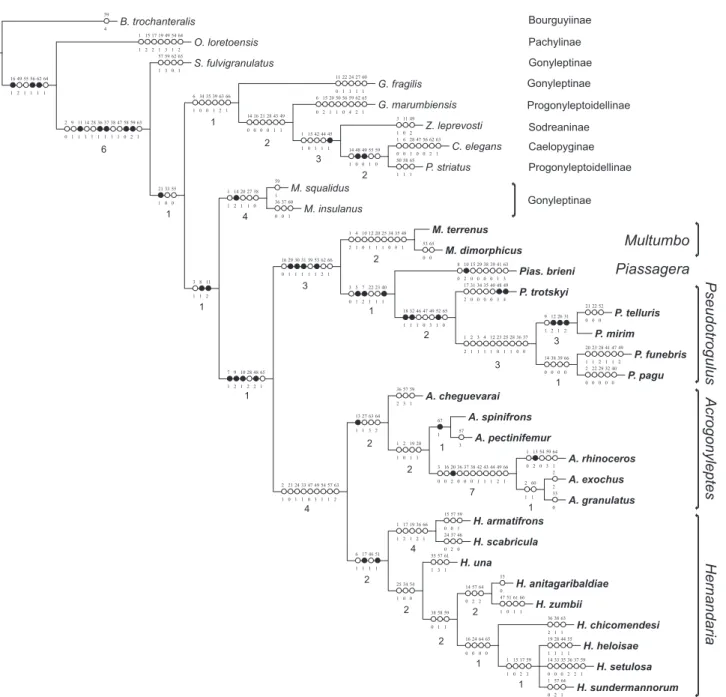
We obtained two most parsimonious trees (L = 277, CI = 0.35 e RI = 0.68, Fig. 1) in which the monophyly of Hernandariinae is confirmed. The subfamily is divided in two main clades: species with sexual dimorphism on leg IV, with males presenting strong armature especially on coxae and fe-mur IV (Figs 13-15, 48-50, 78-81 and 88-90); and species with-out sexual dimorphism on leg IV, where both males and fe-males have similar legs (Figs 102 and 105).
2 B. trochanteralis O. loretoensis G. fragilis Z. leprevosti C. elegans G. marumbiensis P. striatus S. fulvigranulatus M. squalidus M. insulanus A. rhinoceros A. exochus A. granulatus A. spinifrons A. pectinifemur A. cheguevarai H. armatifrons H. scabricula H. chicomendesi H. heloisae H. setulosa H. una H. sundermannorum H. anitagaribaldiae H. zumbii M. terrenus M. dimorphicus Pias. brieni P. funebris P. pagu P. telluris P. mirim P. trotskyi 59 4 64 2 54 1 49 3 19 1 17 2 15 2 1 1 60 1 27 1 24 1 22 1 11 0 49 2 11 0 3 1 63 1 62 2 56 0 47 0 28 1 6 0 1 0 65 1 62 2 59 4 56 0 50 1 20 1 15 2 6 0 65 1 58 1 50 1 65 1 62 0 59 3 57 1 59 1 60 1 37 0 36 0 64 1 59 3 54 0 13 2 1 0 2 2 33 0 57 3 59 1 57 3 36 2 59 1 57 0 15 0 46 0 37 2 24 0 63 1 38 1 36 2 55 1 44 1 28 1 19 1 59 1 37 2 36 2 35 0 33 0 14 0 61 1 57 3 55 1 64 1 57 2 1 0 15 0 66 1 61 1 51 0 47 1 65 0 53 0 63 3 41 1 39 0 38 0 29 0 15 0 10 2 8 0 49 2 47 1 41 1 28 2 23 1 20 1 40 0 32 0 29 0 22 0 2 0 52 0 22 0 21 0 49 4 48 3 40 0 35 0 34 0 31 0 17 2 31 2 26 1 12 2 9 1 66 0 39 0 38 0 14 0 37 0 36 0 28 1 25 1 23 0 12 1 4 1 3 1 2 1 1 2 65 0 52 1 49 3 47 0 46 1 32 1 18 1 40 1 23 1 22 1 7 2 5 1 3 0 48 1 35 0 34 0 25 1 20 1 12 1 10 0 4 1 1 2 66 1 62 2 53 1 39 1 31 1 30 1 29 1 16 0 64 2 57 2 14 0 59 3 17 2 15 0 1 1 65 0 64 0 24 0 16 0 59 1 58 1 38 0 54 0 34 0 25 1 66 1 36 2 19 1 17 2 1 1 51 1 46 1 17 1 6 1 67 1 60 1 2 1 66 1 49 2 44 1 43 1 42 1 38 0 37 0 36 0 20 2 16 0 3 0 20 1 19 1 2 0 1 1 64 2 63 3 27 1 13 1 63 2 57 1 54 1 49 3 47 0 33 1 24 1 21 0 2 1 65 1 48 2 28 2 10 1 9 2 7 1 38 0 27 1 20 1 14 2 1 1 11 2 8 1 3 1 59 0 55 1 49 0 48 0 14 1 45 1 44 1 42 1 15 0 1 1 49 1 43 1 28 0 21 0 16 0 14 0 66 1 63 2 39 1 35 0 34 0 6 1 55 0 33 0 21 1 63 1 59 2 58 0 47 1 38 1 37 1 36 1 28 1 14 1 11 1 9 1 2 0 64 1 62 1 56 1 55 1 49 2 16 1 2 1 4 1 2 3 2 1 2 1 1 4 1 6 2 3 2 3 3 1 2 7 2 1 4 2 2 1 1
Pseudotrogulus
Acrogonyleptes
Hernandaria
Multumbo
Piassagera
Gonyleptinae Gonyleptinae Gonyleptinae Pachylinae Bourguyiinae Progonyleptoidellinae Progonyleptoidellinae Caelopyginae SodreaninaeFigure 1. Strict consensus (L = 278; ci = .34; ri = .68) of two most parsimonious trees (L = 277; ci = .35; ri = .68) representing the phylogenetic relationships of the Hernandariinae. (z) Unique transformations, ({) homoplastic transformations. Ambiguous transfor-mations in ACCTRAN optimization. Bremer support index under each node.
diagnosis and species composition (Fig. 1). SOARES & SOARES (1984) classify the genera according to the number of sulci in the mesotergal areas, four in Acrogonyleptes and two or five in Hernandaria; the armature of the free tergites (armed or un-armed); the fusion of the tubercles in area III (fused or sepa-rated); and the presence of large convergent spines on the ocularium in Hernandaria. Nevertheless, the authors did not
In our hypothesis, Acrogonyleptes unus and A. armatifrons are transferred to Hernandaria – the latter species being syn-onymized with Hernandaria calcarata. Hernandaria is redefined according to the two non-ambiguous synapomorphies: 1) four flattened mesotergal areas, with very shallow sulci ([6] and [17]), and 2) leg tubercles arranged in similar, regular rows ([51]). Two more synapomorphies could also support the genus: 3) the presence of strong ventral tubercles on femur I ([51], using ACCTRAN) and 4) a deeper distal concavity of the ventral plate of the penis ([63] using DELTRAN). Large spines on ocularium (character 1) appear at least twice within the genus, while four new species present small, convergent tubercles, which falsify this synapomorphy proposed by SOARES & SOARES (1984).
Acrogonyleptes now includes six species: one new species (A. cheguevaraisp. nov.), two species previously assigned by SOARES & SOARES (1984) (A. spinifrons = A. curitibae, synonymized here,and A. exochus), two species previously considered junior synonyms of A. spinifrons and A. exochus (A. pectinifemur and A. granulatus,respectively) (SOARES & SOARES 1984), here revali-dated, and A. rhinoceros, transferred from Gonyleptinae. Thus, Acrogonyleptes is defined by the following unambiguous synapomorphies: 1) main tubercles in mesotergal area III fused at base [13], 2) mesotergum granules with heterogeneous sizes and shapes [27], 3) narrow distal concavity of the ventral plate of the penis [63], 4) ventral plate of penis with large lateral lobes [64]. Using DELTRAN, 5) the distal prolateral armature of female femur IV can also be considered a synapomorphy [54], even though it is also present in two basal species of Hernandaria (H. scabricula and H. armatifrons).
The second main clade of the subfamily includes Multumbo (with two species, DASILVA & KURY 2007), which is a sister genus of the clade composed by genera Piassagera (mo-notypic) and Pseudotrogulus (five species). This second main clade is composed of harvestmen without sexual dimorphism on leg IV, except Multumbo dimorphicus. The placement of this species within this clade results in an ambiguous loss of sexual dimorphism on leg IV and is extremely interesting from an evolutionary point of view (see discussion in “General patterns in character evolution”).
Pseudotrogulus includes three previously described and two new species (P. telluris, P. mirim, P. funebris, P. pagusp. nov., and P. trotskyi sp. nov., respectively). The non ambiguous synapomorphies for the genus are: 1) dark markings at area angles [18]; 2) ventral coxa IV and posterior border of the stig-matic area strongly granulose [32]; 3) leg I with strong ventral tubercles [46] (convergent in Hernandaria); 4) loss of sexual di-morphism in basitarsus I [47], 5) leg III with only six tarsomeres [49], and 6) sparse ventral tubercles on female femora II-IV [52]. Pseudotrogulustrotskyi sp. nov. is placed more basally inside the genus and shows a slightly different facies. The remaining four species present six non ambiguous synapomorphies, and ten under ACCTRAN optimization, that differentiate them from it. This pattern in the Multumbo+ group, with Piassagera brieni
sister to Pseudotrogulus,and P.trotskyi sister to the remaining four species, creates certain difficulties in the taxonomic clas-sification. Pseudotrogulustrotskyisp. nov., differing from all re-maining species of the genus (see genus diagnosis in Taxonomy), could be described in a new genus. Synonymizing Piassagera with Pseudotrogulus, thus defining the genus as having no sexual dimorphism on leg IV, would also be an alternative. The first alternative would be prejudicial because it involves creating a monotypic genus which would be followed by another mono-typic genus, Piassagera, causing loss of phylogenetic informa-tion. On the other hand, placing Piassagera brieni in Pseudotrogulus, considering that the former has unique and strong conspicuous autapomorphies, would ignore a recom-mendation of the International Code for Zoological Nomen-clature (ICZN, 1999) regarding the name stability. Thus, we preferred to describe P. trotskyisp. nov. in Pseudotrogulus and maintain Piassagera brieni as a monotypic genus.
The non-ambiguous synapomorphies which support Hernandariinae are: 1) a single ozopore on each side (as op-posed to the two observed in the remaining Gonyleptidae) [7]; 2) a pair of large median apophyses on the anterior margin of dorsal scute [9]; and 3) high density of body granulation [28]. Some ambiguous characters are synapomorphic under ACCTRAN optimization: 4) convergent median apophyses on the anterior margin of dorsal scute [10] (reversion in Multumbo); 5) five tarsomeres on leg I (reversion in Multumbo) [48]; and 6) basal setae of the ventral plate arranged in an oblique row [65] (reversion in Multumbo dimorphicus and Pseudotrogulus). Under DELTRAN optimization: 7) the camouflage with debris [8] can be considered synapomorphic for the subfamily. Some speci-mens of Mischonyx can also present a slight camouflage, but we cannot say if it is homologous with the available data.
When revalidating the subfamily, SOARES & SOARES (1984) pointed out some of its diagnostic characters. The only one that was corroborated by this phylogenetic analysis was “(...) body covered with small granules, almost always densely dis-tributed (...)” [28]. Many characters cited by the authors were removed from the diagnosis of Hernandariinae due to the place-ment of Multumbo in the subfamily. Of the characters cited by FIRMO & PINTO-DA-ROCHA (2002), only the camouflage with de-bris was maintained as a synapomorphy, while the other char-acters are either shared with part of the outgroup or not shared by all the Hernandariinae.
four subfamilies and Gonyleptinae, based mainly on the gen-eral pattern of the penis and palp. In the present hypothesis, Hernandariinae seems to be related to these subfamilies, even though only two species of other Gonyleptidae subfamilies were used in the analysis. The Gonyleptinae genus Mischonyx has a facies similar to Hernandariinae species with males presenting an armed leg IV, and its placement as sister taxon of Hernandariinae is supported by: 1) armature of ocularium di-rected forward [3]; 2) the large lateral apophysis on the ante-rior margin of dorsal scute [11]; and depending on the optimi-zation, 3) the camouflage with debris [8] (under ACCTRAN). This is not the first evidence pointing towards the polyphyly, or at least paraphyly, of Gonyleptinae (PINTO-DA-ROCHA 2002, KURY & PINTO-DA-ROCHA 2007), that can currently be defined by several taxa placed basally in this clade of five derived Gonyleptidae subfamilies (Gonyleptinae, Hernandariinae, Sodreaninae, Caelopyginae, Progonyleptoidellinae).
General patterns in character evolution
The structures that most contributed with informative characters in this analysis were the ornamentation and arma-ture of the dorsal scute and free tergites (30 out of 67 charac-ters). Structures such as the penis or the armature of male leg IV, traditionally associated to high phylogenetic values, repre-sented only few characters. The penis is highly homogeneous and conservative, even similar to the basic pattern observed in Gonyleptinae, showing greater autapomorphic modification at the species level. Thus, only six characters associated to pe-nis morphology were used in this analysis. Furthermore, these few characters have high retention index values (ri = 0.7, 0.77, 0.5, 0.6, 0.66, and 1) and, of their 32 steps, only six are synapomorphies of species level relationship, depicting a high phylogenetic signal for penial structure at the intergeneric-level. Thus, as structures fully related with sexual selection, changes in penial morphology are constrained “per se”. Slightly autapomorphic changes would be related to speciation pro-cesses, but with maintenance of a general pattern.
All characters associated to sexually dimorphic armature of male leg IV presented equal or below 50% retention indexes (RI of chosen tree was 68%). Although it is possible to recog-nize species by this armature, proposing homologies between them is difficult due to the large number of autapomorphies. The increase in the number of granules and tubercles in Hernandariinae occurs together with the camouflage of debris. These characters render an irregular appearance to these ani-mals, which can be often confused with small dirt pellets or any other debris on the substrate, especially if displaying thanatosis for defense (Fig. 176). In addition, they present a reduction of the complex ozopore region, with a single ozopore on each side, reduction of the size of the aperture (Fig. 174) and a characteristic type of emission: flowing through the ven-tral channels of the anterior coxae to the oral region (SOARES & SOARES 1984, HARA & GNASPINI 2003). These characters might be
related to the micro habitat in which these animals live, al-ways in the soil, in litter and with cryptic habits. Nevertheless, the coincidence of these characters and few others, such as the strengthening of leg I and the anterior part of the body, might be evidence of adaptation to this type of environment. The camouflage with debris appeared several times independently in harvestmen, in species of Eupnoi Sclerosomatidae, Dyspnoi Trogulidae, Laniatores Podoctidae, Triaenonychidae (GNASPINI & HARA 2007) and in the Gonyleptidae subfamily Ampycinae (KURY 2003), and Pachylinae Ceratoleptes proboscis Soares & Soares, 1979 (pers. obs.).
Hernandariinae also show an interesting evolution of sexual dimorphism. Many species show dimorphism in the or-namentation of the mesotergum, basitarsus I and leg IV. In the mesotergum, most females of the Acrogonyleptes + Hernandaria clade maintain the condition of having smaller tubercles in area III than those of males [16], a primitive state also present in the Gonyleptinae included in the cladistic analysis. This same clade is supported by the posterior margin and free tergites more armed in females than in males (with more derived reversals) ([33], Figs 180 and 181). In another evolutionary step, some species later acquired dimorphism in the ornamentation of the lateral margins ([19], Figs 180 and 181), also more armed in females. The latter two characters, despite appearing independently in Hernandariinae, are also observed in other Gonyleptidae taxa (e.g., Ogloblinia, Acanthogonyleptes, and Goniosomatinae). The stronger armature of the posterior part of the female body seems to compensate for the lack of armature on leg IV, when com-pared to the male. Many harvestmen of the family Gonyleptidae use legs IV to press against the posterior part of the body as a defense mechanism (GNASPINI & HARA 2007).
stronger and more characteristic armature in Gonyleptidae (KURY & PINTO-DA-ROCHA 2007). This character has proven to be an im-portant criterion for sexual selection, since males of some spe-cies of the family use the leg armature for mating territory dis-putes (MACHADO & MACÍAS-ORDÓÑEZ 2007b; WILLEMART et al. 2009). Thus, the conservation of this special characteristic is motivated by a very strong selective pressure, causing the loss of this di-morphism to be a very important modification. The implausi-bility of the homoplasy observed in this transformation can be explained by complex genetic processes that facilitate this loss, such as pleiotropy. In this case, a single mutation changes the whole group of characters related to the armature of male leg IV and a reversion could occur in this same manner. Under a cla-distic approach there is no sense in differentiating the origins of evolutionary changes, since the different states, observed from the similarity between structures, evidence these changes. Nev-ertheless, the phylogenetic results, such as the loss of sexual di-morphism of male leg IV, can stimulate the greater understand-ing and interpretation of these changes under an evolutionary and molecular approach.
The male basitarsus I is inflated in most Progonyleptoi-dellinae genera (KURY & PINTO-DA-ROCHA 1997), as well as in the Gonyleptinae and Sodreaninae used as outgroups in this analy-sis. In Hernandariinae it is maintained in Multumbo and Piassagera brieni and evolves secondarily in Pseudotrogulus funebris and Hernandariazumbii. It is the only type of dimor-phism observed in Multumbo+ (except M. dimorphicus) and vir-tually any type of sexual dimorphism in external morphology is lost in Pseudotrogulus mirim, P. telluris and P. pagu.
In addition to sexual dimorphism, several species show a great size variation in adult males. This difference seems to be more accentuated in the above mentioned secondary sexual characters, with larger males presenting a much stronger arma-ture of leg IV, even when taking into account body size. This variation was observed in several Grassatores taxa (GNASPINI et al. 2004), an infra-order of Laniatores, and can be due to the occur-rence of two adult instars (GNASPINIet al. 2004) or different re-productive strategies (MACHADOet al. 2009) caused by territorial disputes between males (MACHADO & MACÍAS-ORDÓÑEZ 2007b).
Cladistic analysis
The high density of granules [21] and camouflage with debris [6] are synapomorphies that support Hernandariinae, resulting in an extremely rugged tegument, enhancing the possibility of individual variations in the absence/presence and size of each elevation. In the present analysis, the intraspecific polymorphism which occurs in the ornamentation of the dor-sal scute, free tergites and apophysis of the anterior margin of the prosoma led to a great difficulty in coding these charac-ters. This polymorphism is associated, in the literature, to an increase in the number of homoplasies in the analysis, caused by phenotypic, environmental or epigenetic variations, by undersampling of some species or by the introduction of
re-versals caused by non fixed alleles (WIENS 1995, KORNET & TURNER 1999). AMORIM et al. (1993) used “syntrepty event” to indicate the appearance of an allele within a lineage, and “synapousy” for its fixation. In a phylogenetic analysis, the definition of primary homology of a polymorphic character might not take this difference into account, considering synapomorphies that might not be fixed within the lineage, and thus revesals occur, as “soft reversals” (KORNET & TURNER 1999).
In addition to coding two states for polymorphic cells (polymorphic coding, KORNET & TURNER 1999), the solution for great part of this problem was to generalize the variation in some structures, erecting characters that would cover interspe-cific variations without including intraspeinterspe-cific polymorphisms that occur throughout the family. This was the case in charac-ters 15, 20-22, 25, 27, 28, 34-39, 57 and 59. This type of coding goes against the proposition of absent/present characters for each structure. What was termed composite (WILKINSON 1995) or reflective data set (POGUE & MICKEVICH 1990), tries to represent, in a more realistic manner, the variation found in nature and in structure modification processes, without reducing it to sev-eral, usually interdependent, binary characters (POGUE & MICKEVICH 1990). The codification of the above mentioned char-acters in the present study forms complexes that, as well as reducing the problems related to polymorphisms, guarantee their independence. An over-weighting error for some phylo-genetic transformations could occur if the coding of separate characters for each structure or elevation was used.
Thus, 14 ordered multistate characters were proposed: 7, 9, 11-15, 17, 20, 28, 31, 48, 49 and 64. For these characters similarity evidences between the ordered states was observed, with similar states being closer to each other in a priori ordina-tion. This similarity could be treated as separate characters, transforming a single multistate character in few binary char-acters, maintaining the same information evidenced by the pri-mary homology. In any case, a priori observation is maintained as evidence to be contrasted with other characters, testing the convergence between them. Many authors defend this type of coding by including several inapplicable cells in the analysis, consequence of the coding of absent/present followed by a character of the present structure, and by the more realistic coding discussed in the previous paragraph (PIMENTEL & RIGGINS 1987, POGUE & MICKEVICH 1990, LIPSCOMB 1992, WILKINSON 1995, STRONG & LIPSCOMB 1999).
B. trochanteralis O. loretoensis G. fragilis G. marumbiensis A. fulvigranulatus M. squalidus M. insulanus Z. leprevosti C. elegans P. striatus M. terrenus M. dimorphicus Pias. brieni P. trotski P. funebris P. pagu P. telluris P. mirim A. cheguevarai A. spinifrons A. pectinifemur A. rhinoceros A. exochus A. granulatus H. armatifrons H. scabricula H. una H. anitagaribaldiae H. zumbii H. chicomendesi H. heloisae H. setulosa H. sundermannorum B. trochanteralis O. loretoensis G. fragilis G. marumbiensis A. fulvigranulatus M. squalidus M. insulanus Z. leprevosti C. elegans P. striatus M. terrenus M. dimorphicus Pias. brieni P. trotski P. funebris P. pagu P. telluris P. mirim A. cheguevarai A. spinifrons A. pectinifemur A. rhinoceros A. exochus A. granulatus H. armatifrons H. scabricula H. una H. anitagaribaldiae H. zumbii H. chicomendesi H. heloisae H. setulosa H. sundermannorum B. trochanteralis O. loretoensis G. fragilis G. marumbiensis A. fulvigranulatus M. squalidus M. insulanus Z. leprevosti C. elegans P. striatus M. terrenus M. dimorphicus Pias. brieni P. trotski P. funebris P. pagu P. telluris P. mirim A. cheguevarai A. spinifrons A. pectinifemur A. rhinoceros A. exochus A. granulatus H. armatifrons H. scabricula H. una H. anitagaribaldiae H. zumbii H. chicomendesi H. heloisae H. setulosa H. sundermannorum
Figures 2-4. Cladograms using non-ordered characters: (2) strict consensus of 24 most parsimonious trees; (3) succesive weighting using highest retention indexes (ri) among 24 trees; (4) same, using lowest retention indexes.
B. trochanteralis O. loretoensis G. fragilis G. marumbiensis A. fulvigranulatus M. squalidus M. insulanus Z. leprevosti C. elegans P. striatus M. terrenus M. dimorphicus Pias. brieni P. trotski P. funebris P. pagu P. telluris P. mirim A. cheguevarai A. spinifrons A. pectinifemur A. rhinoceros A. exochus A. granulatus H. armatifrons H. scabricula H. una H. anitagaribaldiae H. zumbii H. chicomendesi H. heloisae H. setulosa H. sundermannorum B. trochanteralis O. loretoensis G. fragilis G. marumbiensis A. fulvigranulatus M. squalidus M. insulanus Z. leprevosti C. elegans P. striatus M. terrenus M. dimorphicus Pias. brieni P. trotski P. funebris P. pagu P. telluris P. mirim A. cheguevarai A. spinifrons A. pectinifemur A. rhinoceros A. exochus A. granulatus H. armatifrons H. scabricula H. una H. anitagaribaldiae H. zumbii H. chicomendesi H. heloisae H. setulosa H. sundermannorum H. sundermannorum B. trochanteralis G. marumbiensis A. fulvigranulatus H. anitagaribaldiae O. loretoensis M. dimorphicus H. chicomendesi M. squalidus M. insulanus Z. leprevosti A. cheguevarai A. pectinifemur A. rhinoceros H. armatifrons G. fragilis C. elegans P. striatus M. terrenus Pias. brieni A. spinifrons A. exochus A. granulatus H. scabricula H. heloisae P. trotski P. funebris P. telluris H. setulosa P. pagu P. mirim H. zumbii H. una G. fragilis M. squalidus M. insulanus C. elegans M. terrenus M. dimorphicus Pias. brieni P. funebris A. cheguevarai A. spinifrons A. pectinifemur A. rhinoceros A. exochus A. granulatus H. armatifrons H. scabricula H. anitagaribaldiae H. zumbii H. chicomendesi H. heloisae H. setulosa H. sundermannorum P. trotski P. pagu P. telluris P. mirim H. una G. marumbiensis A. fulvigranulatus Z. leprevosti P. striatus B. trochanteralis O. loretoensis
Figures 5-8. Cladograms using non-ordered characters under different implicit weighting: (5) concavity 4, 5 or 6; (6) concavity 3; (7) concavity 2; (8) concavity 1.
The results obtained by successive weighing (Figs 3 and 4) (L = 163.13735 and L = 162.56235) are very similar to those ob-tained with character ordination, differing only in the rela-tionship between Pseudotrogulus funebris and P. pagu. Under implied weighting, with k = 3 to 6 (Figs 5 and 6) (fit = 26.54899, 22.88870, 20.16048, 18.03811, respectively), only the
relation-ships within Acrogonyleptes, Hernandaria and Pseudotrogulus were different, maintaining the relationship amongst genera. Un-der concavity indexes 1 and 2 (Figs 7 and 8) (fit = 39.68929, 31.66501), Multumbo is sister to all Hernandariinae. Thus, un-der the character reliability criterion (FARRIS 1969, CARPENTER 1994), even with the loss of information brought about by the
2 3 4
use of unordered characters, the basic topology and the mono-phyletism of the taxonomical categories were the same as in the chosen hypothesis (Fig. 1). The weighting analysis was car-ried out using the original matrix, with ordered characters, yielded the same results as all other analyses (Figs 9-12) (fit = 18.89532, 21.20016, 24.16013, 28.12835, 33.71659, 42.46901, concavity indexes 6 to 1, respectively). As a result of the
suc-cessive weighting, we obtained the hypothesis with Hernandaria heloisae as sister species to H. setulosa (L = 168.05412), just the same as one of the two trees obtained using equal weights (Fig. 1). Thus, even with a relatively low Bremmer index support for most taxa (Fig. 1), the analysis robustness was corroborated by the different weightings analyses, that is, by those characters with greater phylogenetic signal.
Figures 9-12. Cladograms using 14 ordered characters under different implicit weighting: (9) concavity 6; (10) concavities 3, 4 or 5; (11) concavity 2; (12) concavity 1.
G. marumbiensis A. fulvigranulatus H. anitagaribaldiae H. sundermannorum B. trochanteralis O. loretoensis M. squalidus M. insulanus Z. leprevosti M. dimorphicus A. cheguevarai A. spinifrons A. pectinifemur A. rhinoceros A. granulatus H. armatifrons H. scabricula H. chicomendesi H. heloisae G. fragilis C. elegans P. striatus M. terrenus Pias. brieni P. trotski P. funebris P. pagu P. telluris P. mirim A. exochus H. una H. zumbii H. setulosa B. trochanteralis O. loretoensis G. fragilis G. marumbiensis A. fulvigranulatus M. squalidus M. insulanus Z. leprevosti C. elegans P. striatus M. terrenus M. dimorphicus Pias. brieni P. trotski P. funebris P. pagu P. telluris P. mirim A. cheguevarai A. spinifrons A. pectinifemur A. rhinoceros A. exochus A. granulatus H. armatifrons H. scabricula H. una H. anitagaribaldiae H. zumbii H. chicomendesi H. heloisae H. setulosa H. sundermannorum B. trochanteralis O. loretoensis G. fragilis G. marumbiensis A. fulvigranulatus M. squalidus M. insulanus Z. leprevosti C. elegans P. striatus M. terrenus M. dimorphicus Pias. brieni P. trotski P. funebris P. pagu P. telluris P. mirim A. cheguevarai A. spinifrons A. pectinifemur A. rhinoceros A. exochus A. granulatus H. armatifrons H. scabricula H. una H. anitagaribaldiae H. zumbii H. chicomendesi H. heloisae H. setulosa H. sundermannorum B. trochanteralis O. loretoensis G. marumbiensis A. fulvigranulatus M. squalidus M. insulanus Z. leprevosti C. elegans M. terrenus M. dimorphicus Pias. brieni P. funebris A. cheguevarai A. spinifrons A. pectinifemur A. rhinoceros A. exochus A. granulatus H. armatifrons H. scabricula H. anitagaribaldiae H. chicomendesi H. heloisae H. setulosa H. sundermannorum G. fragilis P. striatus P. trotski P. telluris H. zumbii P. pagu P. mirim H. una
Taxonomy
The descriptions, diagnosis, key for identification and taxonomical changes proposed for genera and species of the Hernandariinae are presented below.
Hernandariinae Sørensen, 1884
Hernandaroidae Sørensen, 1884: 598 [desc]; 1895: 1 [cit]; Kury, 2007: 162 [cit].
Hernandariinae Roewer, 1913: 460 [redesc, key]; 1923: 582 [redesc, key]; 1931: 159 [syst, key]; 1943: 13, 14, 66 [cha, syst]; Mello-Leitão, 1926: 366 [key]; 1930b: 211 [syst]; 1949: 9, 13 [syst, key]; Kästner, 1937: 389 [cit]; Soares & Soares, 1949: 221 [cat, redesc, key]; 1984: 302 (reval.) [redesc, key]; 1985b: 16 [cit]; Ringuelet, 1955a: 291 (syn. Pachylinae) [syst]; H. Soares, 1972: 68 [cit]; Kury, 1994: 97 [cit]; 1997: 2 [cit]; Kury, 2003: 140 [cat]; Pinto-da-Rocha & Giribet, 2007: 91 (tab. 4.1) [cit]; Kury, 2007: 164, 167 [cit]; Kury & Pinto-da-Rocha, 2007: 196, 197 (fig. 4.29.h), 198, 199, 203 [cit], 202 [key], Curtis & Machado, 2007: 283 [biol]; Gnaspini & Hara, 2007: 393 [biol].
Hernandariinas Mello-Leitão, 1932: 129 [redesc, key]. Hernandariidae Sørensen, 1932: 280 [redesc, key]; Kury, 2007:
165 [cit].
Apembolepheninae (mispelling) Mello-Leitão, 1930b: 212 [desc]; 1933b: 149 [redesc]; 1935: 95, 111 [cat, key]; H. Soa-res, 1972: 68 [cit].
Apembolephaeninas Mello-Leitão, 1932: 416 [desc].
Apembolephaeninae Kästner, 1937: 389 [cit]; Canals, 1943: 1 (syn. Pachylinae) [syst]; Kury, 1997: 2 [cit]; Soares & Soares, 1984: 302 (syn. Hernandariinae) [syst].
Diagnosis. Anterior margin of prosoma with one median pair of separated convergent apophyses, or only one apophy-sis; with 2-3 inner apophyses (simple or bifid) at the corners. With one main pair of higher tubercles behind ocularium and areas I-III (more conspicuous). Only one ozopore. Lateral mar-gin, posterior margin and free tergites with one row of higher tubercles. Dense granulation over the whole body. Camouflage with debris on body and legs (except Piassagera brieni). Basichelicerit with scattered granules on bulla. Pedipalp: tro-chanter with three high ventral tubercles, some smaller in dor-sal side; femur unarmed with one ventro-bador-sal tubercle and some scattered granules. Coxae I-III with one ventral row of longitudinal tubercles decreasing in size from coxa I to III. Trocanthers with three larger ventral tubercles and some smaller scattered tubercles. Legs with rows of tubercles, decreasing in size distadly. Distitarsi 3-segmented, small tarsal process.
nis: ventral plate covered ventrally with short hairs, with one apical concavity; three long apical setae in longitudinal row, two smaller apical setae more ventrally placed, one median very small and four basal setae; glans with ventral process bear-ing flabellum; glans with or without dorsal process.
For genera with sexual dimorphism on leg IV (male): External apical apophysis of coxa IV with two apical branches. Trochanter granulated with longer basal external apophysis and median internal apophysis. Femur IV strongly armed. Femora II-III and tibiae I-IV with ventral tubercles increasing in size apicad. Female differs from male by lack of apophyses on leg IV and weaker femur armature.
Key for genera of Hernandariinae
1. Median pair of apophyses on anterior margin of dorsal scute separated, distance between their bases larger than apophyses diameter; tarsus I 6-segmented; with longitudinal mark which lacks pigment, in dorsal scute, in similar fashion to the transversal mesotergal sulcus (Fig. 92) ....Multumbo
1’. Median apophyses on anterior margin close to each other, convergent or single; tarsus I 5-segmented; mesotergal areas II-III (or I-IV) without mark such as inMultumbo (Fig. 74)..2
2. Sexual dimorphism on leg IV absent; leg IV straight and unarmed ... 3
2’. Sexual dimorphism on leg IV present; male leg IV strongly armed; female femur IV armed or if unarmed, curved inwards ... 4
3. Huge densely granulate spine on free tergite III (size similar to dorsal scute length); entire body covered with whitish/ yellow granules; camouflage with debris absent (Fig. 84)... ...Piassagera
3’. Free tergite III with spine much shorter than dorsal scute or absent (Fig. 80); whitish/yellow granulation, if present, does not cover all of dorsal scute; camouflage with debris may be present ...Pseudotrogulus
4. Main pair of tubercles on mesotergal area III far from each other (Fig. 39); four mesotergal areas (Figs 18 and 22) ...
...Hernandaria
4’. Main pair of tubercles on area III fused or with tubercles very close to each other (mainly on females) (Fig. 66); three mesotergal areas (Fig. 61) ...Acrogonyleptes
Hernandaria
Sørensen, 1884
Hernandaria Sørensen, 1884: 598 [desc]; 1895: 1 [cit]; 1932: 281 [key]; Roewer, 1913: 461 [redesc]; 1923: 582 [redesc]; 1931: 159 [key]; Mello-Leitão, 1926: 366 [key]; 1930b: 211 [syst]; 1932:130 [redesc, key]; Kästner, 1937: 389 [cit]; Soares & So-ares, 1949: 222 [cat, redesc, key]; Ringuelet, 1955a: 291 [syst]; 1955b: 2 [syst];; 1957: 19, 25 [cit]; 1959: 322 [redesc]; 1963: 42 [redesc]; Soares & Soares, 1984: 303 [redesc, key]; 1985b: 16 [cit]; H. Soares, 1972: 68 [cit]; Kury, 2003: 141 [cat].
Apembolephaenus Holmberg, 1909: 38 [desc]; Roewer, 1913: 139 [syst]; 1923: 449 [cit]; 1930: 449 [redesc, syst]; Mello-Leitão, 1930a: 137, 138 [redesc, syst]; 1930b: 211, 212 [syst, key]; 1932: 416 [redesc]; 1939: 624 [syst]; 1949: 9 [syst]; Kästner, 1937: 389 [cit]; Canals: 1943: 1 [cit]; Soares & Soares: 1954: 236 [cat, redesc, key]; Ringuelet, 1955a: 291 (syn. Hernandaria) [syst]; 1955b: 2 [syst]; 1957: 19 [cit]; Kury, 1997: 2. [cit]. (type species = Apembolephaenus jorgei Holmberg, 1909, by monotypy).
Apembolephenus (misspelling) Mello-Leitão, 1933b: 149 [redesc]. Proampycus Roewer, 1917: 111 [desc]; 1923: 410 [redesc]; 1929: 184 [key]; Mello-Leitão, 1930a: 138 [cit]; 1930b: 211, 212 [syst, key]; 1932: 214 [redesc]; 1935: 101 [key]; 1939: 624 (syn. Apembolephaenus) [syst]; 1949: 9 [syst]; Kästner. 1937: 389 [cit]; Ringuelet: 1955b: 2 (syn. Hernandaria) [syst]; 1957: 19 [cit]; Muñoz-Cuevas, 1973: 226 [cit]; Kury, 1997: 2 [cit]. (type species = Proampycus spinifrons Roewer, 1917, by monotypy). Proweyhia Mello-Leitão, 1927a: 414 [desc]; 1932: 279 [redesc]; 1935: 104 [key]; Roewer, 1930: 404 [redesc]; B. Soares, 1944: 165 [syst]; H. Soares, 1945: 219 [syst]; Soares & Soares, 1947a: 139 [syst]; 1949: 210 [cat, redesc, key]; 1984: 305 (syn. Acrogonyleptes) [syst]. (type species = Proweyhia una Mello-Leitão, 1927, by original designation) Syn. nov.
Metaxundarava Mello-Leitão, 1927b: 20 [desc]; 1932: 340 [redesc]; 1935: 105 [key]; 1949: 26 (revalid.) [syst]; B. Soares, 1944: 165 (syn. Proweyhia) [syst]; Soares & Soares, 1984: 305 (syn. Acrogonyleptes) [syst]. (type species = Metaxundarava heterotypica Mello-Leitão, 1927, by original designation) Syn. nov.
Type species: Hernandaria scabricula Sørensen, 1884, by monotypy.
Key to the species of
Hernandaria
1. Ocularium with a pair of high and straight convergent spines (Figs 13, 16, 28 and 29) ... 2 1’. Ocularium with a pair of small and curved tubercles (Figs
33, 37, 46 and 55) ... 5 2. Posterior margin of dorsal scute with one larger median
tubercle or spine (Figs 13 and 26); granulation evenly distributed on dorsal scute (Figs 13 and 23) (easier to see if covered with a thin layer of ethanol); corners of anterior margin of prosoma with two single apophyses (Figs 13 and 23) ... 3 2’. Posterior margin of dorsal scute with more than one larger
tubercle or spine (similarly-sized on male) (Figs 28 and 33); granules concentrated near mesotergal sulci (Figs 18 and 43), (easier to see if covered with a thin layer of ethanol); corners of anterior margin of prosoma with two (mesal one bifid) or three apophyses (Figs 43 and 52) ... 4 3. Male: pointed external apophysis of coxa IV; single
dorso-basal apophysis on femur IV. Female: with row of prolateral large spines on femur IV (Figs 13-17) ... H. armatifrons 3’. Male: spatulated external apophysis of coxa IV, with truncate apex; dorso-basal apophysis of femur IV bifid. Female: femur IV unarmed (Figs 23-27) ...H. scabricula 4. Femur IV longer than dorsal scute length; tubercles of mesotergal areas III and IV rounded and low (Figs 18-22).... ...H. heloisae 4’. Femur IV shorter than dorsal scute length; tubercles of mesotergal areas III and IV conical and high (Figs 28-32).... ...H. setulosa 5a. Female: free tergite III with conical tubercles or spines increasing in size to the middle, larger than tubercles of other free tergites ...H. una 5a’. Female: free tergite III with similar-sized tubercles, size of tubercles similar to those on other free tergites ...
...H. anitagaribaldiae sp. nov.
5b. Male: main pair of tubercles of mesotergal area III rounded, low and larger than those on other mesotergal areas (Figs 33 and 55) ... 6 5b’. Male: conical tubercles on mesotergal area III (Figs 46 and
51) ... 7 6. With spines between the median pair of apophyses and those
placed in the corners on anterior margin of prosoma; external apophysis of coxa IV and dorso-basal apophysis of femur IV falcate (Figs 52-56) ...H. chicomendesi sp. nov.
6’. Unarmed between median pair of apophyses and those placed in the corners on anterior margin of prosoma; external apophysis of coxa IV and dorso-basal apophysis of femur IV long and with two short branches (Figs 33-38) ...H.una 7. Mesotergal area IV easily seen; length similar to that of area III (Figs 39-42) ... ...H. sundermannorum sp. nov.
7’. Mesotergal area IV not easily seen (mesotergum seems to have three areas); much shorter than area III (Figs 43 and 48) ... 8 8. Main pair of tubercles of mesotergal area III large, larger than other areas; male femur IV with retrolateral-subapical larger spine; external apophysis of coxa IV with acute and backward directed apex (Figs 48-51) ....H. zumbii sp. nov.
8’. Main pair of tubercles of mesotergal area III similar-sized to those of other areas; retrolateral larger spines on male femur IV median or submedian; external apophysis of coxa IV with middle part thinner and swollen apex (Figs 43-47) ..
...H. anitagaribaldiae sp. nov.
Observation: females of H. sundermannorum sp. nov., H. zumbii sp. nov. and H. chicomendesi sp. nov. are unknown.
Hernandaria armatifrons
(Roewer, 1917)
comb. nov.
Figs 13-17, 131, 132, 177, 185
Metagonyleptes armatifrons Roewer, 1917: 135 (fig. 31) [desc]; 1923: 481 (fig. 605) [redesc]; 1930: 360 [key]; Mello-Leitão, 1932: 334 (fig. 211) [redesc]; Soares & Soares, 1949: 191 [cat]; 1984: 306 [syst].
Acrogonyleptes armatifrons: Soares & Soares, 1984: 306 [syst]; Kury, 2003: 141 [cat].
Apembolephaenus calcaratus Soares & Soares, 1945: 371 (fig. 3) [desc]; 1954: 236 [cat]; Pinto-da-Rocha & Caron, 1989: 1023 [cit].Syn. nov.
Hernandaria calcarata: Soares & Soares, 1984: 303 (figs 1-4) [syst]; Kury, 2003: 142 [cat].
Diagnosis. As H. scabricula, this species has a homoge-neous distribution of granules on dorsal scute, whereas other species of Hernandaria have a high density of granules near sulci of mesotergal areas. It shares high convergent spines on ocularium and unpaired armature on posterior margin and free tergites with H. scabricula. Differs from H. scabricula by (male) having dorso-basal apophysis of femur IV with single apex, pointed and curved outwards; prolateral spines of femur IV larger than other spines, except for larger subapical retrolateral; and short and pointed apex of external apophysis of coxa IV.
tergite III. Pedipalps. Tibia iiIi/IiI (iiIi) ectal; Ii/Iii/Iiii (Iiii) me-sal. Tarsus IiI ectal; II meme-sal. Legs (Figs 14, 15 and 17). All leg tubercles high, pointed and directed apicadly (except in leg I) and organized in six longitudinal rows (except in femur IV), larger on venter of femora I-IV and tibiae III-IV. External apical apophysis of coxa IV transversal, short apical branches, pointed dorsally, ventrally much smaller and rounded. Femur IV slightly curved inwards, with one retrolateral row of spines increasing in size, slightly curved frontwards; prolateral spines larger than retrolateral from 1/4 basal until the apex; single dorso-basal apophysis, which is short, pointed and curved outwards. Tar-sal formula: 5, 6/8, 6, 6/7 (7). Penis (Figs 131 and 132). Ventral
plate with basal setae close to each other in an oblique row, ventralmost much smaller; median seta similar-sized to ventro-apical setae, far from ventro-apical setae. Stylus with oblique apex and ventro median projections; ventral process with projections on shaft and with losangle flabellum bearing projections on ventral margin. Coloration (Fig. 177). Grayish brown with metatarsi and leg tarsi light brown, yellowish pedipalps. Mea-surements. Dorsal scute: 4.4-5.7 long; 4.4-5.8 wide; legs: I: 6.7-8.0, II: 13.1-17.8, III: 10.7-14.2, IV: 14.6-19.7, male femur IV: 3.7-5.0, pedipalp: 3.1-3.9.
Female. It differs from male by: acuminate tubercles and spines on lateral and posterior margins of dorsal scute and free Figures 13-17. Hernandaria armatifrons: (13) dorsal habitus, male (MZSP14760); (14) dorso-basal apophysis of right male femur IV, prolateral view (MZSP15954); (15) right male femur IV, dorsal view (MZSP15954); (16) body, right lateral view, male (MZSP15954); (17) trocanther-metatarsus of right leg I, retrolateral view, male (MZSP14716). Scale bar: 1 mm.
13
14
16
tergites; femur IV unarmed, except prolateral row (similar to male). Measurements. Dorsal scute: 4.4-5.9 (5.9) long; 4.1-5.8 (5.8) wide; legs: I: 6.7-8.5 (8.5), II: 11.6-13.6, III: 9.8-12.7 (12.7), IV: 13.1-18.1, pedipalp: 3.2-4.6 (4.6).
Material examined. BRASIL, São Paulo: Santos (mislabeled?), fe (SMFD1328, holotype of Metagonyleptes armatifrons); Pirajú, G.Skuk & V.X. Silva, 30.III.1996, 1 ma (MZSP29098); Paraná: Teixeira Soares (Rio D’Areia), R. Lange, IX.1944, 1 ma (MHNCI1079, holotype of Apembolephaenus calcaratus); Pinhão (UHE Segredo, Rio Butia), R. Pinto-da-Rocha, & Lopes, X.1991, 1 ma and 1 fe (MZSP14716); Três Barras do Paraná (Reserva do Rio Guarani), M. Oliveira-da-Silva & M. Miretzki, X.1998, 1 fe (MZSP17794); ibidem, R. S. Bérnils, G. Montingelli & R. Lingnau, VIII.1998, 1 fe (MZSP17951); ibidem,F.L. Franco, M. Di-Bernardo & S.A.A. Morato17.X.1998, 1 ma (MZSP-17823); Foz do Iguaçu (P.N. do Iguaçu), 1 ma (IBSP2948); ibidem, R. Pinto-da-Rocha & S. Casari, I.1997, 2 ma (MZSP15954); III.2002; General Carneiro (Faz. São Carlos), Borschein & Arruda, XII.1989, 1 fe (MHNCI6657). Santa Catarina: Joaçaba (Estrada de Concórdia), A. Bonaldo, A. B. Kury & R. Pinto-da-Rocha, I.1996, 1 ma (MZSP14760). Rio Grande do Sul: Derrubadas (P.E. Turvo), Equipe Biota, I.2002, 1 fe (IBSP5146); Barra do Ribeiro, H. Bischoff, XI.1976, 1 fe (MCN474).
Hernandaria heloisae
(H. Soares, 1945)
Figs 18-22, 112, 133, 134, 186
Proweyhia heloisae H. Soares, 1945: 217 (fig. 3) [desc]; Soares & Soares, 1945: 369 [syst]; 1949: 190 [cat]; Pinto-da-Rocha & Caron 1989: 1023 [cit].
Hernandaria heloisae: Soares & Soares 1984: 303 (figs 5-6) [redesc]; Hara & Gnaspini, 2003: 262 (fig. 3) [cit]; Kury, 2003: 142 [cat]; Braganolo et al. 2007: 393 (dist).
Diagnosis. Closely related to H. sundermannorum sp. nov., differs by having ocularium with one pair of convergent, high spines, with the tips touching each other (low spines in H. sundermannorum sp. nov.); pair of tubercles on area IV (two pairs in H. sundermannorum sp. nov.); lower density of granules mainly on lateral of areas and lateral margin; curved external apical apo-physis of coxa IV (straight in Hernandaria sundermannorum sp. nov.). Differs from other species of Hernandaria by the low den-sity of granules on dorsal scute, small basal curved spine of fe-mur IV and long leg IV (shared with H. sundermannorum sp. nov.). Male redescription. Dorsum (Figs 18 and 21). Corners on anterior margin of dorsal scute with two apophyses, mesal apo-physis can be bifid from the base, or three similar apophyses (type: two apophyses, internal one bifid). Ocularium with a pair of spines straight and convergent. Mesotergal areas I-IV with more dense granulation near sulci; sides of areas and lateral margin with lower density of granules; III with main pair of rounded tubercles on the center of the area, closer to each other than those on other areas; IV with same length of III, with one pair of tubercles on middle of area and more distant from each
other than in other areas. Lateral margin with a row of tubercles, increasing in size apicad until area III. Posterior margin and free tergites with a row of conical similar-sized tubercles, or with 1-5 slightly larger tubercles placed in the middle of each tergite (type: posterior margin and free tergite I: 2, free tergite II: 3, free tergite III: 5), plus some scattered granules. Pedipalps (Fig. 112). Tibia IIi ectal IIi/IiIi (IIi) mesal. Tarsus II ectal and mesal. Legs (Figs 19, 20 and 22). All tubercles of legs acuminated, similar-sized per leg, pointing backwards and organized in six longitudinal rows, except for femur I and IV. Femur I with ventral tubercles slightly larger than the rest of leg I. External apical apophysis of coxa IV almost transversal, slightly curved frontwards, with dorso-api-cal branch slightly curved backwards, more than twice larger than ventral branch. Femur IV long and straight; with three large median-retrolateral spines and few small scattered spines, basal curved frontwards; dorso-basal apophysis bifid, similar-sized to diameter of femur, internal branch directed upwards and exter-nal horizontal branch with straight apex. Tarsal formula: 5, 7/9 (8), 6, 7. Penis (Figs 133 and 134). Ventral plate with basal setae close to each other in longitudinal row on middle of ventral plate; median seta small as ventro-apicalmost setae, at same dis-tance of larger apical setae. Stylus with oblique apex and with-out projections; ventral process with losangle flabellum bearing projections on ventral margin. Coloration. Uniformly blackish, with yellowish pedipalps, metatarsi and tarsi of legs. Measure-ments. Dorsal scute: 3.2-5.0 (4.2) long; 3.6-5.0 (4.7) wide; legs: I: 5.5-8.4 (7.1), II: 15.3-22.1 (19.0), III: 10.7-16.1 (13.2), IV: 15.5-23.2, male femur IV: 4.8-6.8 (6.1); pedipalp: 3.4-4.7 (3.5).
Female. It differs from male by having: tubercles of pos-terior margin and free tergites larger than those of lateral mar-gin; femur IV with similar-sized tubercles. Measurements. Dor-sal scute: 4.5-4.7 long; 4-4.4 wide; legs: I: 7-8.3, II: 17.1-22.4, III: 11.5-14.8, IV: 17.1-22.5; pedipalp: 3.4-4.
Material examined. BRASIL, São Paulo: Cotia (Reserva do Morro Grande), Equipe Biota, III.2003, 1 ma (MZSP29091); ibi-dem, Equipe Biota, III.2003, 1 fe (IBSP); Miracatu (Fazenda Itereí), Equipe Biota, IX.2001, 1 fe (IBSP3598); ibidem, Equipe Biota, IX.2001, 1 ma (IBSP3543); Iporanga (PETAR, Ouro Grosso), Equipe Biota, XI.2001, 1 fe (IBSP4027). Paraná: Curitiba (Barigui), R. Lange, VIII.1944, 1 ma (MHNCI154); ibidem, R.Hertel, XI.1944, 1 ma (MZSP1338); ibidem, Hertel, 1944, 1 ma (MZSP944, holotype of Proweyhia heloisae).
Hernandaria scabricula
Sørensen, 1884
Figs 23-27, 135-137, 185
2007a: 407 (tab. 11.2) [biol]; Machado & Macías-Ordóñez, 2007b: 435 (tab. 12.2), 459 (tab. 13.1) [biol].
Apembolephaenus Jorgei Holmberg, 1909: 39 [desc]; Frers, 1917: 405 (fig.) [syst].
Apembolephaenus jorgei: Roewer, 1913: 139 [syst]; 1923: 449 [cit]; 1930:449 (fig. 47) [redesc, syst]; Mello-Leitão, 1930a: 139 [redesc]; 1933b: 150 [syst]; 1939: 624 [syst]; Canals, 1936: 61 [biol]; Kästner, 1937: 342 (fig. 427) [cit]; B. Soares, 1945b: 369 [cit]; Soares & Soares, 1954: 236 [cat]; Ringuelet, 1955a: 291 (syn. Hernandaria scabricula) [syst]; 1955c: 7 [syst]; H. Soares, 1972: 68 [cit]; Kury, 1997: 3 [cit].
Apembolephenus jorgei (misspelling): Mello-Leitão, 1931b: 84 [syst]. Proampycus spinifrons Roewer, 1917: 111 (fig. 16) [desc]; 1923: 411 (fig. 505) [redesc]; Mello-Leitão, 1939: 624 (syn. Apembolephaenus jorgei) [syst]; Ringuelet, 1957: 12 [cit]; H. Soares, 1972: 68 [cit]; Acosta, 1996: 222 [cit].
Diagnosis. It is closely related to H. armatifrons sharing a dense granulation on dorsal scute; convergent high spines on ocularium and unpaired armature on posterior margin and free tergites. It differs from H. armatifrons by having a bifid dorso-basal apophysis on male femur IV, a much larger spine on male femur IV, with different shape at apex and base; apex of exter-nal apophysis of male coxa IV spatule-shaped; lack of one row of prolateral larger spines on female femur IV and only one large spine on posterior margin of female dorsal scute.
Male redescription. Dorsum (Figs 23 and 26). Corners of anterior margin of dorsal scute with two apophyses, similar in size and shape, external apophysis forwardly directed. Ocularium with a pair of straight and convergent spines. Dor-sal scute homogeneously covered by granules. Mesotergal ar-eas I-III each one with a main pair of rounded tubercles, slightly increasing in size from I to III, some specimens have one para-Figures 18-22. Hernandaria heloisae: (18) dorsal habitus, male holotype (MHNCI154); (19) dorso-basal apophysis of right male femur IV, prolateral view, holotype (MHNCI154); (20) right male femur IV, dorsal view, holotype (MHNCI154); (21) body, right lateral view, male (IBSP3543); (22) trochanter-tarsus of right leg I, retrolateral view, male (IBSP, Cotia). Scale bar: 1 mm.
18
19
21 22
median pair of smaller tubercles; IV with same length of III, with two pairs or one pair of tubercles similar to those of I, in a transversal row. Lateral margin with one row of tubercles simi-lar in size to those of areas I-III. Posterior margin and free terg-ites with one row of rounded tubercles similar in size to those of lateral margin, with one median larger rounded or conical tubercle, decreasing in size from posterior margin to free terg-ite III or similar in size. Pedipalps. Tibia IIi ectal; IiIi mesal. Tarsus IiI ectal; II mesal. Legs (Figs 24, 25 and 27). All leg tu-bercles high, acuminate and directed apicad, organized in six longitudinal rows, except in femur IV, larger on venter of femora I-IV and tibiae III-IV. Femur I with ventral tubercles slightly
larger than tubercles on the rest of leg I. External apical apo-physis of coxa IV almost transversal, with large dorso-apical branch spatule-shaped, ventral branch much smaller and rounded. Femur IV slightly curved inwards, with one retrolateral row of spines increasing in size until one large median spine, whose length is more than twice of femur diameter, with a large and straight base, distal half curved frontwards; prolateral spines larger than retrolateral, except the median one, larger on median portion; venter sparsely granulated; low dorso-basal apophysis with similar-sized apical branch, internal branch curved upwards, external branch horizontal, slightly curved downwards. Tarsal formula: 5, 7, 6, 7. Penis (Figs 135-137). Figures 23-27. Hernandaria scabricula: (23) dorsal habitus, male (SMFD3864); (24) dorso-basal apophysis of right male femur IV, prolateral view (SMFD1311); (25) right male femur IV, dorsal view (MNRJ1415); (26) body, right lateral view, male (MNRJ1415); (27) trochanter-tarsus of right leg I, retrolateral view, male (MNRJ1415). Scale bar: 1 mm.
24
25 23
27