A Work Project, presented as part of the requirements for the Award of a Masters Degree in Management from the NOVA School of Business and Economics
HOW DO BANKS CHOOSE A CERTAIN COSTING SYSTEM
AND WHY
CARLOTA COSTA, 895
A Project carried out on the Accounting & Financial Reporting area under the supervision of:
Professor Inês Cruz
Abstract
This work project has the purpose of examining how banks choose a certain costing system and why. A survey addressed to all banks operating in Portugal was used to identify which organizational, contextual and cultural factors influence the banks’
decision to adopt a specific costing system. The importance of cost control, cost information and top management support, which are omitted factors from other studies, as well as nationality and cost structure were found to be statistically significant. No association was detected between the decision of adopting a costing system and the factors product diversity/complexity, level of competition, size of the bank and business segment.
Keywords: Activity-based costing; Traditional costing systems; Adoption; Banking
I. Purpose of the work project
The decision concerning which costing system to adopt and how to design it is crucial for a company as “If poorly designed costing systems report inaccurate product costs1, companies can make poor decisions on resource supply, product mix, pricing, order acceptance, and customer relationships.” (Atkinson et al., 2012, p. 167). Such
decision depends on various contextual, organizational and cultural factors (Cooper, 1988) and is particularly important in the case of service sector companies such as financial and commercial companies, as their cost structures are mainly composed by indirect costs2 (Al-Omiri and Drury, 2007).
Yet, there is not much literature on this topic regarding the banking sector as the existing studies mostly concern the health care sector (Demeere, Stouthuysen and Roodhooft, 2009; Cardinaels, Roodhooft and van Herck, 2004) or the market as a whole (Al-Omiri and Drury, 2007; Roztocki and Schultz, 2003). However, the importance of the banking sector in an economy is massive. Banks reflect the health of an economy. They can facilitate the processes of production, distribution, exchange and consumption, allowing the economy to develop and grow (Monnin and Jokipii, 2010). Therefore, if banks do not choose the appropriate costing system, wrong decisions can be made, leading to negative impacts in the economy. When a bank does not adopt the most
1
These include costs of purchasing the goods that are going to be resold in the case of a merchandising sector company, and the costs of raw materials and direct labour if we are talking about a manufacturing sector company, as well as selling, marketing, administrative and financial costs.
2
suitable costing system (in accordance to its type of cost structure), then the data provided by such system might probably be inaccurate. For instance, the data regarding product profitability can be incorrect leading the bank to choose a wrong product mix, which could lead banks to price their loans too high and, therefore, make potential profitable clients choose not to do business with them. Consequently, this will harm the country’s economic development (Levine and Zervos, 1998).
Thus, the purpose of this work project is to identify and understand the factors that most influence a bank when adopting a specific costing system. For that, a survey (questionnaire), followed by some face-to-face interviews, was undertaken in the banking sector in Portugal. As nationality was a cultural factor to be taken into account in this study, the latter concentrated in all the banks registered in Banco de Portugal. These include subsidiaries of banks headquartered in other countries, allowing us to understand how and why such banks choose their costing systems, while comparing with what happens in banks headquartered in Portugal.
The next section reviews the literature on the main costing systems, their main advantages and disadvantages, as well as the main gaps not yet answered concerning the factors that influence a firm’s decision to adopt a certain costing system. A brief
analysis of the banking sector in Portugal follows in section III. Section IV outlines the methodology used to develop this work project. Finally, Section V depicts its findings and Section VI the conclusions reached, main contributions and limitations.
II. Literature Review
In order to measure profitability, control costs and plan future decisions, companies can use two main costing systems: traditional costing systems and activity-based costing systems (ABC). The main difference between the two relies in the way they assign indirect costs or also called overheads. Traditional costing systems assign such costs firstly to cost centres, which normally correspond to departments in the organizational structure of a company. Moreover, a traditional costing system is a volume-based system as it uses measures of output volume (in terms of production) such as units produced, machine hours, direct labour hours or number of inspections as the bases3 to allocate/assign those overhead or indirect costs from cost centres to cost objects (Cooper and Kaplan, 1988). This implies that cost objects such as products and services consume overheads in a highly correlated way with the number of units produced (Drury, 2012). In other words, it is assumed that the higher the production of a product or service, the higher its generation of overheads. Instead, and according to Abusalama (2008, p. 8), “ABC recognizes that many overhead costs vary in proportion
3
to changes in activities4, rather than the measure of production volume utilized as the allocation base in the traditional system”. Therefore, ABC is said to be a costing system
that achieves improved accuracy in the assignment of overhead costs to products/services by using multiple cost drivers5, while under traditional costing systems, overhead costs are treated as a homogeneous lump sum (Demeere, Stouthuysen and Roodhooft, 2009).
Therefore, traditional costing systems are said to cause cost distortions since they do not often correctly attribute the costs of the support departments (purchasing department, maintenance department, cleaning department or financial department, for example) to the main ones (production department for instance), as no cause-and-effect allocation bases are used to assign support or overhead costs to cost objects (Drury, 2012). This is due to the fact that these overhead costs are assigned to the products (or services) in proportion to their production volumes, although the relationship between the overhead costs and the production volume of those products (or services) might not be straightforward (Cooper, 1988). However, there are certain environments in which these cost distortions are more likely to occur than in others. A high product variety environment is an example where the exclusive use of volume drivers to allocate overhead costs may lead to cost distortions. Moreover, if an organization sells a high variety of projects, instead of selling products, cost distortions are also likely to take place (Atkinson et al., 2012). Consequently, although these traditional costing systems can be much less expensive to implement, they can, in some cases, introduce considerable distortions that can lead managers to make decisions regarding
4
Aggregation of many different tasks, events or units of work that cause the consumption of resources. On the contrary, departments are specialized functional areas within an organization or a division, such as accounting, marketing or planning.
5
product/service mix, pricing and cost control that might generate severe long-term losses (Mishra and Vaysman, 2001).
ABC systems can be quite costly to be implemented when compared with traditional costing systems (Atkinson et al., 2012). Yet, ABC has become the centre of attention because it is considered not only a way to accurately assign indirect costs, but also a mechanism for managing costs. Two different surveys addressed to British companies from different sectors showed that financial companies were the ones with the highest ABC’s adoption rate (Innes et al., 2000; Al-Omiri and Drury, 2007). In
another study, financial companies mentioned that, when adopting ABC, their main goal was to be able to have an accurate profitability analysis of their clients and products (Hankes, 1995). Even so, ABC’s adoption rates have not been what one would
expect, given the benefits associated with this costing system (Bhimani et al., 2007; Al-Omiri and Drury, 2007). There are various possible reasons for this, which can include difficulty in identifying activities, in assigning resources to activities and in selecting the cost drivers (Innes and Mitchell, 1993; Clarke et al., 1999; Groot, 1999). Fear of internal resistance, fear of lack of top management support, satisfaction with the current system (Clarke et al., 1999) and the fact that implementing such a system can be costly (Kaplan and Anderson, 2004; Atkinson et al., 2012) can be pointed out as other possible reasons.
that is used by the activities performed to produce the various products or services (Atkinson et al., 2012; Drury, 2012). However, very few studies focus on actual applications of this type of costing system in companies (e.g. Gervais et al., 2009).
Still, in order to decide which costing system to adopt, there are several factors that a company has to have in mind. These factors are of various types: contextual (related to the macro environment of the firm, how the firm fits within the market), organizational (related to the micro environment of the firm, what happens within the firm) and cultural (Cooper, 1988). The potential for cost distortions (Krumwiede, 1998), the product diversity (Kaplan, 1988), the cost structure6 (Clarke et al., 1999; Brown et
al., 2004) and the size of a company (Krumwiede, 1998; Baird et al., 2004; Gosselin,
1997) are said to be the most relevant contextual factors. Moreover, the intensity/level of competition (Libby and Waterhouse, 1996; Simons, 1990) and the business segment (Anderson, 1995; Estrin et al., 1994) are also contextual factors that help a company decide which costing system to adopt. Concerning the organizational factors, there are three that stand out: top management support (Krumwiede, 1998), resistance to change within the company (Friedman and Lyne, 1999; Malmi, 1997) and lack of relevant employees’ skills to implement the costing system (Liu and Pan, 2007). The national or local culture can be pointed out as the most important cultural factor (Hopwood, 1999) and is related to the headquarters’ location of each firm. For example, in this study, the
distinction between the banks that are headquartered in Portugal and those whose headquarters are abroad is important.
Regarding all these factors, some studies find them statistically significant when a firm is deciding what type of costing system to adopt and others not. The two factors
6
where the studies diverge more are the cost structure and the product diversity/complexity, as some studies found that a higher proportion of overheads in a firm’s total costs or a higher diversity of products leads to a higher probability of adopting ABC (Bjornenak, 1997; Krumwiede, 1998), while others contended that there is no relationship at all between these parameters (Clarke et al., 1999; Brown et al., 2004; Van Nguyen and Brooks, 1997). The proportion of overheads and the product diversity/complexity are also related to another factor: the potential for cost distortions. This contextual factor is said to have a direct relationship with the probability of adopting an ABC costing system (Krumwiede, 1998). Another factor that seems to have a positive relationship with the adoption of ABC is the size of the organization. This is said to happen due to the fact that larger firms have greater access to resources (personnel, computing facilities and time) and, therefore, are more likely to obtain the right knowledge/skills to implement such a costing system (Krumwiede, 1998). Moreover, the level of competition has encouraged the search for new cost management approaches, as increasing competition tends to create pressure to reduce product/service costs, leading to a renewed awareness of this tendency by top management, which is also seen as an important factor when deciding to adopt a costing system (Anderson, 1995; Libby and Waterhouse, 1996; Krumwiede, 1998). The lack of employees’ skills
multinational firms or their subsidiaries operating in the same country. National firms are said to be slower when adopting ABC as their managers may be less aware of the new management accounting practices than the managers of a subsidiary of a multinational firm which communicate with managers from other subsidiaries and/or from the headquarters (Anderson, 1995; Clarke et al., 1999).
As mentioned before, previous studies have focused in other sectors and in other countries, rather than in the banking sector in Portugal. Moreover, the studies that deal with the adoption of a costing system usually focus on ABC, rather than trying to understand what makes a company choose a certain costing system in detriment of another and why. Finally, most studies focus on the contextual factors, not even mentioning the organizational and cultural ones. Therefore, the present work project seeks to address the research gaps just identified, in order to understand, within the banking sector in Portugal, what are the contextual, organizational and cultural factors that contribute the most for a bank’s decision to choose a certain costing system.
III. Brief analysis of the banking sector in Portugal
several financial products that facilitate transactions between these economic agents (Monnin and Jokipii, 2010).
In the present study and following Al-Omiri and Drury (2007), the banking context in Portugal will be characterized based on the size of the players, intensity of the competitive environment, product diversity and cost structure.
In terms of size, most of the banks that operate in Portugal (60,6%)7 are considered to be small8. However, in 2011, they only represented 5,7% of the total assets of the banking sector in Portugal as the largest five banks operating in Portugal generated 73,7% of those total assets. This means that this sector is highly concentrated, although the type of products/services and the distribution channels are very similar among the banks operating in Portugal (Boletim Informativo – Associação Portuguesa de Bancos, 2011). Therefore, differentiation comes from the quality of service, which pushes banks to try to gain customer loyalty through products like mortgages.
The variety of products/services offered by banks is high. We can divide those products/services according to the business segment of the banking activity, for example. So, for retail banking, where individuals are the main clients, frequent products are checking accounts; savings accounts; certificates of deposit; credit or debit cards; mortgages and personal loans. In the commercial/investment banking segment which main clients are companies, products like overdrafts; current account loans; project financing; risk management and capital raising are the most common ones. In respect to services provided by the banks, the opening of saving accounts; processing withdraws done by clients through ATM or other channels; providing information about
7
Data from “Boletim Informativo –Associação Portuguesa de Bancos: nº 47, 2011”
8
Banks are considered to be “large” when they represent more than 5% of the total assets of all banks in Portugal; “medium” when they represent between 1% and 5%; and “small” when they represent less than
accounts; buying and selling securities; transferring money nationally and internationally and home-banking can be pointed out.
Finally, in order to understand the cost structure of a bank, it is useful to compare its Profit and Loss Account (P&L) with the P&L Account of a manufacturing company (appendix 1). Whereas the revenues in banks come from sales of loans to customers or fees from the services provided, in a manufacturing company, the revenue is mostly generated by the sale of manufactured products. Moreover, in the manufacturing P&L, “Gross Profit” is determined by the difference between sales and the cost of the manufactured goods that are sold. In a bank’s P&L, the banking income
is calculated as the sum of the net interest income and the net fees and commissions. Net interest income refers to the total amount of interest earned in loans less the interest paid in deposits collected. Net fees and commissions are calculated by deducting from the fees/commissions received in the services provided (loan arrangement fees, annual credit card fee, charges for using cheques when account is overdrawn, for example) the fees/commissions paid for services bought to other banks. Regarding the costs, banks do not incur in a crucial type of costs in manufacturing companies: direct materials costs and inventory costs.
interrelated products/services share different activities, products, responsibility centers, associated employees/computers, etc, making it hard to understand exactly how to allocate these costs. Therefore, choosing the right type of costing system that fits this type of cost structure is crucial, as it could dictate if a bank takes the most efficient decisions and measures, for example, in terms of pricing and lending policy.
IV. Methodology
A research survey was used to gather the data with the purpose of explaining how and why a bank chooses a certain costing system. According to Dillman (2007), there are three key elements that can assess the quality of a research survey: research design, sampling procedure and data collection methods. In the research design, it is important to understand the purpose of the survey and to whom it is addressed, as well as to do a pilot test of the survey. The sampling procedure has the objective of choosing the sample to be used and how to select it from the population. Finally, it is important to choose the right type of data collection method, which can go from mail surveys to face-to-face interviews.
accounting (Van der Stede et al., 2005), the sample was made equal to the population. The mail survey (appendix 2) was addressed to the Head of Accounting or Reporting Department, to the Head of the Planning and Controlling Department and to the Chief Financial Officer of each bank registered in Banco de Portugal. But before, the survey was tested with two professors from management accounting and banking courses and with two practitioners. This was important to refine the questions to be addressed in the survey, as well as their sequence. A follow-up mail was sent to the non-respondents of the first mailing. A total of 9 out of 36 responses were received, which corresponds to a 25% response rate.
Six face-to-face interviews were planned to be done, three in banks that had not answered the online survey and three in those that had already answered the online survey. However, only one interview was done in banks which had not answered the online survey. This increased the response rate to 28% (10 out of 36 banks)9. All interviews with three banks that had already answered the online survey were accomplished.
Finally, in order to analyze the answers given in both the online survey and the face-to-face interviews of the present study, Eviews, which is a statistical program, was drawn upon. This tool can be used for general statistical and econometric analyses, such as cross-section and panel data analysis and time series estimation and forecasting. The findings from this analysis were reviewed by a professor of Econometrics.
V. Research Findings
9
Before analyzing the research findings, it is important to characterize the set of banks that responded to the survey and the interviewing process: two mentioned that they have no costing system, five adopted a traditional costing system, two an ABC costing system and one uses both an ABC and a time-driven ABC system. In terms of nationality, thirty percent of the ten respondents are subsidiaries of banks headquartered outside Portugal10. Of these three banks, two have adopted an ABC (one of which using also a time-driven ABC costing system), while the other does not have a costing system. Among the banks with headquarters in Portugal, only one has mentioned not having adopted a costing system. Regarding the size of each bank, two measures were used to compute it: the number of employees and the banking income in the year 2011. A positive relationship between these two measures exists as whenever the number of employees is high, the banking income is also high and vice-versa. Six out of the ten banks that responded have less than two thousand employees and generated a banking income in 2011 of less than five hundred million Euros. Of these six banks, four have adopted a costing system and the other two not. The remaining forty percent had generated a banking income larger than five hundred million Euros in 2011, have more than two thousand employees and have costing systems.
Regarding the main functions of the costing systems implemented by the ten respondents, we could find out that the costing systems have four main purposes: preparation of the budgets, budget deviation (or variance) analysis, costing of products/services and profitability analysis. But the most important purpose stated by the banks was the latter, i.e., the profitability analysis, which is used to assess the profitability of products/services, clients, branches and other distribution channels, and
10
business segments. In terms of the cost objects used in these costing systems, most banks stated that they use more than one although the more common are departments, activities, clients and products/services. Finally, among the five banks that have adopted a traditional costing system, one has never thought of adopting an ABC or time-driven ABC system and another currently has both a traditional costing system and an ABC system, although the ABC is only used to perform profitability analysis. The remaining banks have thought of adopting ABC or time-driven ABC but have not done it due to the following reasons: the costs to adopt ABC or time-driven ABC outweighed the benefits of such adoption; priority of other projects; and too much time required to implement such systems.
But, as the present work project aimed to understand how and why banks chose a costing system and what made them choose between a traditional costing system and an ABC system, two models were estimated (equation 1 and 2). These models were constructed using the answers of the online survey and the face-to-face interviews where banks were asked to classify, from crucial to irrelevant, the factors that influence their decisions to adopt or not a costing system.
The first model intended to understand which factors made a bank opt to adopt a costing system or not. For that, the contextual factors importance of cost information, size of the bank and product diversity/complexity were taken into account, as well as the
organizational factor top management support and the cultural factor nationality. The following linear probability model (LPM) was considered, because the dependent variable is a binary variable:
: assuming the value 1 if the bank adopted a costing system and zero, otherwise; : importance of cost information;
: size of the bank, measured by its banking income in 2011;
: dummy variable set equal to 1 if the bank is headquartered in Portugal and zero, otherwise;
: top management support;
: product diversity or complexity.
The LPM violates the assumption of homocedasticity. When the dependent variable is a binary variable, we have , where denotes the bank’s probability of adopting a costing system:
. This indicates that there exists heterocedasticity in the LPM model. Therefore, this implies that the Ordinary Least Squares (OLS) estimators are inefficient in the LPM. Hence we have to correct for heterocedasticity applying the waited least squares method (WLS) to estimate the equation using weights. The weights are: . Finally, in order to guarantee that the square root is always positive, when was higher than 1, the value of 0.99 was attributed to this estimate. When was lower than 0, the value of 0.01 was attributed to this estimate.
The variable number of employees was excluded as measure of the size of a bank since it was highly correlated with two other explanatory variables (appendix 3):
banking income (correlation is significant at the 0.01 level) and importance of cost
information (correlation is significant at the 0.05 level). Moreover, the variable number
of employees can be omitted because, as stated earlier, it can be replaced by a proxy to
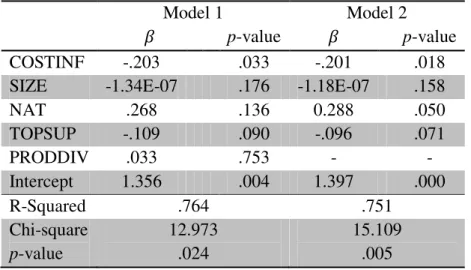
Table 1 shows the estimation results.
Table 1 - Regression analysis of equation 1 (n=10)
Model 1 Model 2
p-value p-value
COSTINF -.203 .033 -.201 .018
SIZE -1.34E-07 .176 -1.18E-07 .158
NAT .268 .136 0.288 .050
TOPSUP -.109 .090 -.096 .071
PRODDIV .033 .753 - -
Intercept 1.356 .004 1.397 .000
R-Squared .764 .751
Chi-square p-value
12.973 .024
15.109 .005
The model (equation 1) presented previously has two specifications: the first (model 1) includes all the variables, while in the second (model 2) the independent variable product diversity/complexity is excluded since it is not statistically significant. It is possible to see that this slight modification does not bring relevant changes in the magnitude of the estimates of the regression coefficients, but alters the significance of the remaining exogenous variables. Therefore, according to table 1 and model 2, the following independent variables are statistically significant: importance of cost information (p < .02), nationality of the bank (p < .05) and top management support (p
< .08) whereas the size of a bank is not.
In order to measure the effects that such factors have in the decision of a bank to adopt a costing system, estimates of the probability of the statistically significant variables of model 2 were calculated (appendix 4). These probabilities were calculated for each variable’s category (crucial, very important, important, little important and
system is crucial, the probability that that bank has adopted a costing system is 1. On the other hand, the same probability for a subsidiary of a multinational bank is smaller (.86). However, when this information is irrelevant, the probability of adopting a costing system is quite low (.35 for a national bank and .06 for a foreign bank). Another variable found statistically significant is the importance of top management support. For a bank headquartered in Portugal, even when this factor is irrelevant, the probability of adopting a costing system is quite high (.61). In the case of a subsidiary of a multinational bank, the probability is not as high (.32), but if we compare it with the probability when the cost information is also irrelevant, .32 is significant. Finally, regarding the banks’ nationality, the probability that a bank headquartered in Portugal
adopts a costing system is twenty nine percentage points higher than that of a subsidiary of a multinational bank (table 1).
To determine the goodness of fit of the model, several measures were used. The R2, coefficient of determination, measures how well a regression line fits a data set. Both specification models show R2 greater than .75, which indicates that both models draw a regression that fits the data quite well. The Chi-square measures the overall significance of the model. Model 2 is statistically significant at the .005 level.
A second model was estimated in order to understand what influenced a bank’s
improved cost control and importance of understanding what causes certain costs). The following linear probability model (LPM) was considered:
where:
: assuming the value 1 if the bank adopted a traditional costing system and zero if the bank adopted an ABC and/or time-driven ABC system;
: importance of an improved cost control;
: importance of understanding what causes certain costs;
: importance of the weight the indirect costs (overheads) in the bank’s cost structure;
: business segment of the bank (retail baking, corporate banking, investment banking, for example);
: decision of the headquarters;
: sector’s competitive intensity environment.
Once again, the LPM does violate the assumption of homocedasticity. When the dependent variable is a binary variable, we have , where
denotes the bank’s probability of adopting a traditional costing system: . To correct for heterocedasticity, the waited least squares method (WLS) was applied to estimate the
equation using weights. The weights are: . Finally, in order to
Table 2 shows the estimation results for three specifications of the model presented previously (equation 2).
Table 2 - Regression analysis of equation 2 (n=8)
Specification model A Specification model B Specification model C
p-value p-value p-value
CC -.187 .527 -.367 .046 -.511 .000
CAUSES -.424 .497 - - - -
IC .455 .326 -.417 .050 .445 .009
BS -.137 .415 .064 .481 - -
HQ .182 .266 .140 .214 - -
COMP -.143 .612 - - - -
Intercept .796 .718 -.176 .613 .205 .586
R-Squared .981 .979 .952
Chi-square p-value
50.809 .000
136.788 .000
98.168 .000
The first specification (model A) includes all the variables, while in the second specification (model B) the independent variables causes and level of competition are excluded since they present some of the highest p-values. Finally, in model C, the independent variables business segment and decision of the headquarters are not included since they are not statistically significant. Once more, it is possible to see that these slight modifications do not bring relevant changes in the magnitude of the estimates of the regression coefficients, but they alter the significance of the remaining exogenous variables. Therefore, according to table 2 and models B and C, the following variables are statistically significant: importance of improved cost control (p < .05 and p < .00, respectively), and weight of the indirect costs (p < .05 and p < .01, respectively). The remaining variables are not statistically significant.
previous model (equation 1, model 2), these probabilities were calculated for each variable’s category (crucial, very important, important, little important and irrelevant), keeping the remaining variables equal to the sample mean. It is not surprising to see that in both models (B and C), when the factor weight of the indirect costs is stated as crucial in the decision between adopting a traditional costing system or an ABC and/or time-driven ABC costing system, the bank’s probability of adopting a traditional costing system is zero.11 In terms of the importance of improved cost control obtained by adopting a traditional costing system, the probabilities are equal to zero when this factor is said to be important (only in model C), little important or irrelevant.
The R2, coefficient of determination, is greater than .95 in all models, which indicates that they draw a regression that fits the data almost perfectly. Moreover, taking into account the Chi-square statistic, the three models are overall statistically significant at the .000 level.
We now proceed to discuss our findings and conclude.
VI. Discussion and conclusion
Prior research about the factors influencing the decision to adopt a certain costing system has provided contradictory findings. The present work project has sought to overcome these weaknesses in respect to a specific sector and country: the banking sector in Portugal.
The weight of indirect/overheads costs over the total costs, or in other words, the cost structure (contextual factor), top management support (organizational factor) and
11
nationality (cultural factor) were found to be statistically significant variables. Although in previous studies, the results regarding the impact of a firm’s cost structure in the decision to adopt a certain costing system were ambiguous, in the banking sector in Portugal the conclusion is quite different. When the factor weight of the indirect costs is crucial in the decision to adopt between a traditional costing system or an ABC and/or time-driven ABC costing system by a bank, it chooses not to adopt a traditional costing system. This is in line with what was reviewed in section II, i.e., when a firm has a cost structure similar to the one banks have (where their main costs are indirect/overhead costs), the most fitted costing system is an ABC costing system. The variable top management support was not used in most of the studies, but in the present it was found
to be relevant in the decision of banks to adopt a costing system, although with a higher importance in multinational banks then in banks headquartered in Portugal. The variable nationality was found to be significant not only to decide whether or not to adopt a
costing system, but also which type of costing system should be adopted by each bank. As in previous studies, almost seventy percent of the banks headquartered outside Portugal that participated in this research adopted an ABC and/or time-driven ABC system, against only fifteen percent of the banks headquartered in Portugal. Finally, two other variables not generally used in previous studies were considered statistically significant: the importance of cost information and the importance of cost control.
The contextual factors product diversity/complexity, level of competition,
business segment and size were not statistically significant variables for deciding
or time-driven ABC systems, while the remaining banks adopt mainly traditional costing systems. This conclusion is similar to the one found in previous studies. Yet, the irrelevance of the variable level of competition is surprising, since this variable is considered to have a positive impact in the probability of adopting a costing system in previous studies (Anderson, 1995; Libby and Waterhouse, 1996; Krumwiede, 1998). The results found regarding the variables product diversity/complexity and business
segment are not unexpected, since previous studies (Clarke et al., 1999; Brown et al.,
2004; Van Nguyen and Brooks, 1997) also presented vague outcomes.
This work project contributes to the literature by incorporating important omitted variables in previous studies like top management support, importance of cost
information and of cost control and by focusing in one particular but very important
VI. References
Abusalama, F. A. 2008. “Barriers to adopting activity-based costing systems (ABC): an empirical investigation using cluster analysis.” Doctoral Thesis, Dublin Institute of Technology, 2-352.
Al-Omiri, M. and Drury, C. 2007. “A survey of factors influencing the choice of product costing systems in UK organizations.” Management Accounting Research, 18: 399-424.
Anderson, S.W. 1995. “A framework for assessing cost management system changes: the case of activity-based costing at General Motors, 1986-1993.” Journal of Management Accounting Research, 7: 1-51.
Associação Portuguesa de Bancos. 2012. “Boletim Informativo – Associação
Portuguesa de Bancos: nº 47, 2011.”
http://www.apb.pt/content/files/Boletim_Informativo_APB_47.pdf (accessed 3 September, 2012).
Atkinson, Anthony A., Kaplan, Robert S., Matsumura, Ella Mae and Young, S. M. 2012. “Accumulating and assigning costs to products.” In Management Accounting, Information for Decisions Making and Strategy Execution, ed. Essex (US Edition),
121-64. New Jersey: Pearson Education Limited.
Atkinson, Anthony A., Kaplan, Robert S., Matsumura, Ella Mae and Young, S. M. 2012. “Activity-based cost systems.” In Management Accounting, Information for Decisions Making and Strategy Execution, ed. Essex (US Edition), 165-217. New
Jersey: Pearson Education Limited.
Atkinson, Anthony A., Kaplan, Robert S., Matsumura, Ella Mae and Young, S. M. 2012. “Measuring and managing customer relationships.” In Management Accounting, Information for Decisions Making and Strategy Execution, ed. Essex (US
Edition), 218-51. New Jersey: Pearson Education Limited.
Baird, K., Harrison, G. and Reeve, R. 2004. “Adoption of activity management practices: a note on the extent of adoption and the influence of organizational and cultural factors.” Management Accounting Research, 15: 383-99.
Bjornenak, T. 1997. “Diffusion and accounting: the case of Norway.” Management Accounting Research, 8: 3-17.
Brown, D., Booth, P., and Giacobbe, F. 2004. “Technological and organizational influences on the adoption of Activity-Based Costing in Australia.” Accounting and Finance, 44(3): 329-56.
Cardinaels, E., Roodhooft, F. and van Herck, G. 2004. “Drivers of cost system development in hospitals: Results of a survey.” Health Policy, 69(2): 239-52.
Carenys, J. and Sales, X. 2008. “Costing the Banking Services: A Management Accounting Approach.” Journal of Money, Investment and Banking, 6: 34-53.
Carvalho, H. 2008. “A implementação e manutenção do activity-based costing num banco português.” ISCTE Business School, 1-137.
Clarke, P., Hill, N. and Stevens, K. 1999. “Activity-Based Costing in Ireland: Barriers to and Opportunities for change.” Critical Perspectives on Accounting, 10(4): 443-68.
Cooper, R. 1988. “The rise of activity-based costing – part two: when do I need an activity-based costing system?” Journal of Cost Management, 2(3): 41-48.
Cooper, R. and Kaplan, R. S. 1988. “How Cost Accounting Distorts Product Costs.” Management Accounting, 8(3): 20-7.
Demeere, N., Stouthuysen, K. and Roodhooft, F. 2009. “Time-driven activity-based costing in an outpatient clinic environment: Development, relevance and managerial impact.” Health Policy, 92: 296-304.
Dillman, D. 2007. Mail and Internet Surveys – The Tailored Design Method. New Jersey: John Wiley & Sons, Inc.
Drury, C. 2012. Management and Cost Accounting. Hampshire: Cengage Learning EMEA.
Estrin, T.L., Kantor, J., Albers, D. 1994. “Is ABC suitable for your company?” Management Accounting, April: 40-5.
Ferreira, L. and Sarmento, M. 2009. “Da investigação quantitativa em contabilidade: Investigação por inquérito.” In Contabilidade e controlo de gestão: Teoria, metodologia e prática, ed. Maria João Major and Rui Vieira, 167-208. Lisboa:
Escolar Editora.
Techniques: A Long-Term Perspective. London: CIMA.
Gervais, M., Ducrocq, C. and Levant, Y. 2009. “Time-driven activity-based costing: new wine, or just new bottles?” La place de la dimension européenne dans la
Comptabilité Contrôle Audit.
http://halshs.archives-ouvertes.fr/docs/00/45/51/35/PDF/p2.pdf (accessed November 26, 2012)
Gosselin, M. 1997. “The effect of strategy and organizational structure on the adoption and implementation of activity-based costing.” Accounting, Organizations and Society, 22(2): 105-22.
Groot, T. L. 1999. “Activity-Based Costing in US and Dutch Food Companies.” Advances in Management Accounting, 7: 47-64.
Hankes, J. 1995. “ABC is a firm favourite with high street banks.” Management Accounting, 73(1): 19.
Hopwood, A. 1999. “Situating the practice of management accounting in its cultural context: an introduction.” Accounting, Organizations and Society, 24: 377-78.
Innes, J. and Mitchell, F. 1993. Overhead Cost. London: CIMA.
Innes, J., Mitchell, F. and Sinclair, D. 2000. “Activity-based costing in the UK’s largest companies: A comparison of 1994 and 1999 survey results.” Management Accounting Research, 11: 349-62.
Kaplan, R. 1988. “One Cost System Isn’t Enough.” Harvard Business Review, January-February: 61-6.
Kaplan, R. and Anderson, S.R. 2004. “Time-Driven Activity-Based Costing”, Harvard Business Review, November: 131-138
Krumwiede, K. R. 1998. “The implementation stages of activity-based costing and the impact of contextual and organizational factors.” Journal of Management Accounting Research, 10: 239-77.
Levine, R. 1998. “The Legal Environment, Banks, and Long-Run Economic Growth.” Journal of Money, Credit, and Banking, 30(3): 596-612.
Levine, R. and Zervos, S. 1998. “Stock Markets, Banks, and Economic Growth.” The American Economic Review, 88(3): 537-58.
Libby, T. and Waterhouse, J. H. 1996. “Predicting change in management accounting systems.” Journal of Management Accounting Research, 8: 137-150.
China: an innovation action research approach.” The British Accounting Review, 39(3): 249-64.
Malmi, T. 1997. “Towards explaining activity-based costing failure: accounting and control in a decentralized organization.” Management Accounting Research, 8(4): 459-80.
Mishra, B. and Vaysman, I. 2001. “Cost-system choice and incentives – Traditional Vs Activity-based costing.” Journal of Accounting Research, 39(3): 619-41. Monnin, P. and Jokipii, T. 2010. “The Impact of Banking Sector Stability on the Real Economy.” Swiss National Bank Working Papers, 2010(5).
Pinsonneault, A. and Kraemer, K.L. 1993. “Survey research methodology in management information systems: an assessment.” I.T. in Government, Center for
Research on Information Technology and Organizations, UC Irvine.
Roztocki, N. and Schultz, S. M. 2003. “Adoption and implementation of activity-based costing: a web-based survey.” Proceedings of the 12th Annual Industrial Engineering Research Conference. Portland, OR.
Sanders, T.H. 1928. “Cost control in banks.” Harvard Business Review, 6: 420-32.
Simons, R. 1990. “The Role of Management Control System in Creating Competitive Advantage: New Perspectives.” Accounting, Organizations and Society, 15: 127- 43.
Swenson, Dan. 1995. “The benefits of activity-based cost management to the manufacturing industry.” Journal of Management Accounting Research, 7 (Fall): 167-80.
Van der Stede, W. A., Young, S. M. and Chen, C. X. 2005. “Assessing the quality of evidence in empirical management accounting research: The case of survey studies.” Accounting, Organizations and Society, 30: 655-84.
Appendices
Appendix 1 –Bank’s P&L versusManufacturing Company’s P&L
Profit and Loss Account of a Bank Profit and Loss Account of a Manufacturing Company
Net Interest Income Sales
+ Net Fee and Net Commission
Income - Cost of Sales
= Banking Income = Gross Profit
- Operating Costs (Salaries, Insurances, Utilities, Etc)
- Operating Costs (Salaries, Office Supplies, Utilities, Training & Education)
= Net Operating Income = Operating Profit (EBITDA)
- Net Provisions - Other Expenses (Interest, Depreciation, Amortization)
= Income Before Taxes and
Minorities = Pre-tax Profit
- Tax - Tax
- Minority Interests = Net Profit
= Net Income
Appendix 2 – Survey on types of costing systems used by banks in Portugal
Thank you for taking the time to complete this survey, which is crucial to the success of my Work project in the Masters in Management at Nova School of Business and Economics. Yours answers will be anonymous and the survey should not take more than 15 minutes of your time. In the end of the research, the results found can be forwarded to you. If you are interested in these, please answer the last question of this survey. The main goal of this study is to understand which are the factors that influence a bank in its decision of adopting a certain costing system and why.
1. Name of the bank where you work (optional): ____________________________
2. What is your current position in the bank? * ________________________ 3. How long have you been working in that position? * _____________________ 4. Is your bank a wholly Portuguese-owned one? *
□ Yes □ No
If your answer was “No”, state the dominant nationality of the ownership of the bank: _______________________
5. Please indicate the number of employees of the bank (in terms of domestic activity): *
□ Up to 500 □ 501 - 2000 □ 2001 - 5000 □ More than 5000
6. Indicate the Banking Income in 2011 of the bank (in terms of domestic activity): *
□ Up to €100 000 thousand
□ €100 001 thousand - €500 000 thousand □ €500 001 thousand - €1 000 000 thousand □ More than €1 000 000 thousand
7. Does the bank have a costing system to allocate the operating costs (salaries and wages, depreciation, ...) to a cost object (clients/products/transactions/agencies)?* □ Yes
□ No
If you answered “Yes”, please proceed to question 8. If you answered “No”, please
proceed to question 15.
8. Which are the cost objects (anything for which a cost is computed) used by the bank? *
□ Department □ Branch □ Activity □ Transactions
□ Others. Which? _______________________________________
9. What are the functions of the bank’s costing system? If you select more than one, classify it according to its importance. (1. Crucial; 2. Very Important; 3. Important; 4. Little Important; 5. Irrelevant) *
□ Costing of products/services; □ Profitability analysis;
o Which type? ______________
□ Choice of which products/services to produce/offer; □ Pricing the products/services:
o Of all products/services;
o Of just a few of the products/services. Which ones?
________________________ □ Preparation of budgets;
□ Variance analysis;
□ Other. Which? _______________________________________________________
10. How would you define your bank’s costing system? *
Traditional Costing System (system that first allocates the operational costs to the cost centres (usually departments), and then allocates the costs of those cost centres to the products/services, using a small number of allocation bases, such as machines hours or workers hours)
ABC (Activity Based Costing) (system that first allocates the operational costs to activities (cost centres) and then allocates those activities to the products/services, using a larger number of allocation bases than the traditional costing system)
Time-driven ABC (simplification of the ABC system. Uses only two parameters: the cost rate for each type of indirect resource and the quantity/supply of the resources’ (installed capacity) used by the activities performed to produce the various products or services)
ABC + Time-driven ABC
Other. Which? (Please define it): _________________________________
11. For a better understanding of the answer given in the previous question, describe with more detail how does your bank’s costing system works, in terms of: *
11.2. Which are the main steps of the costing system?
11.3. Which the allocation bases are used to assign the costs of the cost centres to the cost objects?
11.4. Other details you find relevant.
12. Please choose the number which best describes the importance of the following factors when deciding to adopt your bank’s costing system (1. Crucial; 2. Very Important; 3. Important; 4. Little Important; 5. Irrelevant): *
Percentage/weight of the overheads (indirect costs) in the bank’s cost structure; Increasing range of products/services provided by the bank;
Type of service provided by the bank (retail banking; corporate banking; investment banking; etc);
Accuracy/precision of the information generated by the costing system; Improved cost control;
Improved insight in understanding what causes certain costs; Decisions of the Board of Directors;
Decision of the Headquarters;
Sector’s Competitive intensity environment;
Other: ______________________________________________________________
If you answered “Traditional Costing System” in question 10, please proceed to question 13. If not, please proceed to question 16.
13. Has your bank ever thought of adopting ABC or Time-driven ABC? * □ Yes
□ No
14. If “Yes”, why wasn’t it adopted? (More than one answer allowed)*
□ The adoption costs of ABC or Time-driven ABC outweigh the benefits of the systems;
□ Difficulty to obtain all data necessary to implement those systems; □ Too much time needed to implement such a system;
□ Internal resistance;
□ Potential lack of top management support; □ Priority of other projects;
□ Lack of knowledge of ABC or Time-driven ABC;
15. Please choose the number which best describes the importance of the following factors when deciding to not adopt a costing system (1. Crucial; 2. Very Important; 3. Important; 4. Little Important; 5. Irrelevant): *
The costs of adopting a costing system outweigh the benefits; Difficulty in identifying cost objects;
Difficulty to obtain all data necessary to implement a costing system; Internal resistance;
Potential lack of top management support; Priority of other projects;
Lack of knowledge regarding costing systems;
Number of products/services is limited to justify the adoption of a costing system; Poor quality of the data gathered by the costing systems;
High manual effort in data collection;
Lack of external consultants to implement the costing system; Lack of internal human resources to implement the costing system; Lack of budget;
Other. Which? _____________
16. Comments and suggestions
17. Data to send study’s results (Name, E-mail, Telephone) Thank you.
Appendix 3 – Correlation matrix for the independent variables of equation 1
1 2 3 4 5 6
1.Cost information 1.000
2.Banking Income -.614 1.000
3. Nationality -.036 .157 1.000
4.Top management support .0447 -.141 .189 1.000
5. Product diversity/complexity -.161 .430 -.184 .123 1.000 6. Number of employees -.690* .954** .072 -.091 .445 1.000
*Correlation is significant at the 0.05 level (2-tailed).
Appendix 4 – Estimates of the probability of adopting a costing system (model 2)
Banks Headquartered in Portugal Subsidiaries of Multinational Banks
Variable: COSTINF Probability Variable: COSTINF Probability
if Crucial 1 if Crucial .861
if Very Important .948 if Very Important .659
if Important .747 if Important .458
if Little Important .546 if Little Important .257
if Irrelevant .345 if Irrelevant .056
Variable: TOPSUP Probability Variable: TOPSUP Probability
if Crucial .991 if Crucial .703
if Very Important .895 if Very Important .606
if Important .798 if Important .510
if Little Important .702 if Little Important .414
if Irrelevant .606 if Irrelevant .317
Appendix 5 – Estimates of the probability of adopting a traditional costing system
(model B and C)
Model B Model C
Variable: CC Probability Variable: CC Probability
if Crucial .961 if Crucial 1.000
if Very Important .594 if Very Important .516
if Important .227 if Important .005
if Little Important .000 if Little Important .000
if Irrelevant .000 if Irrelevant .000
Variable: IC Probability Variable: IC Probability
if Crucial .000 if Crucial .000
if Very Important .223 if Very Important .135
if Important .640 if Important .580
if Little Important 1.000 if Little Important 1.000